1. Introduction
Sorghum [
Sorghum bicolor (L.) Moench] is a multi-purpose crop valued for its adaptability to diverse environments, from the hot climates of Sudan to the cooler conditions of Canada [
1]. Among its three main types—grain, forage, and sweet sorghum-the latter is distinguished by high stem sugar content, making it particularly suitable for silage [
2]. Sweet sorghum’s suitability for ensiling depends on key chemical constituents-crude protein (CP), water-soluble carbohydrates (WSC), and cell wall polysaccharides-which are significantly influenced by harvest timing and nitrogen (N) fertilization [
3].
Dry matter (DM) content is critical for successful ensiling. Below 250 g/kg, silage is prone to effluent production and spoilage; sorghum silage with DM below 270 g/kg can lose up to 14.4% DM, with greatly elevated microbial spoilage risk [
4]. Forage nutritional value is evaluated by digestible DM, lignin, neutral detergent fiber (NDF), and acid detergent fiber (ADF), with elevated NDF and ADF reducing palatability and digestibility [
2]. Agronomic practices-including cultivar selection, harvest timing, and N fertilization-can effectively manage DM accumulation and nutrient balance, with N optimization being particularly effective for enhancing CP and DM yield [
5].
Harvest timing and N rate interact to determine sweet sorghum silage quality. Terler et al. [
6] showed that under Central European conditions, the dough stage optimizes sweet sorghum silage, balancing high starch, minimal NDF, and peak metabolizable energy. Regarding N management, varietal responses differ considerably. El-Sheikh et al. [
7] found that ‘MN 4490’ achieved maximum biomass and nutrient accumulation at 120 kg N/fed. Bollam et al. [
8], working with 186 sorghum genotypes, demonstrated significant genotype-by-environment interactions for N use efficiency: low-N tolerant lines maintained yield through genes such as glutamine synthetase, whereas N-responsive lines required favorable conditions to express their advantage.
Field trials consistently confirm the regulatory role of N in nutritional quality. Under Amazonian conditions, Chagas et al. [
9] reported that giant forage sorghum DM yield increased by 29.42% with 200 kg N/ha, and CP increased by 97.3% with 400 kg N/ha; inoculation with
Azospirillum brasilense provided no additional benefit. Although no N effect on NDF was detected, high N rates improved in vitro DM digestibility, suggesting an optimization of fiber quality. In the semi-arid Loess Plateau of China, Gao et al. [
10] reported that 160 kg N/ha maximized dry matter yield and CP content in forage sorghum, while further increasing N rate elevated NDF and ADF and decreased relative feed value (RFV), indicating that optimized nitrogen application improves nutritional quality by regulating fiber accumulation and protein synthesis.
Nitrogen and harvest timing also shape silage fermentation by modulating microbial communities [
11]. Voluntary intake correlates strongly with N and fiber content-a pattern confirmed in sweet sorghum by Zhang et al. [
12], who found that high-sugar sweet sorghum silage (with higher CP and lower NDF and ADF) supported DM intakes comparable to corn silage in dairy cows.
Despite this body of work, systematic data on sweet sorghum silage remain scarce, particularly for late-maturing, photoperiod-sensitive varieties grown under rainfed conditions. How these varieties-which stay vegetative for extended periods-accumulate sufficient WSC to drive lactic acid fermentation and improve silage quality is not well understood. This knowledge gap is especially significant in regions where maize production is constrained by limited rainfall and irrigation, creating demand for alternatives with greater drought tolerance and lower water requirements. Sweet sorghum, with its adaptability to water-limited environments and capacity to accumulate fermentable sugars, is a promising candidate. Zhang et al. [
12] further showed that sweet sorghum silage can replace corn silage in dairy diets without sacrificing milk yield, nutrient digestibility, or rumen fermentation, strengthening the rationale for its use in water-scarce regions. The harvest dates (80 and 110 days after planting; DAP) were chosen based on preliminary observations: at 80 DAP, the crop had accumulated sufficient biomass for silage while remaining fully vegetative; at 110 DAP, it approached the late-vegetative stage without any reproductive development under the local photoperiod. These two time points represent early and late windows for harvest under rain-fed conditions, allowing us to evaluate the trade-off between yield and quality.
Therefore, this study examined how harvest date (80 vs. 110 days after planting) and N rate (0, 75, 150, 225, or 300 kg N/ha) affect nutritive value, fermentation characteristics, and in vitro rumen gas production of the late-maturing, photoperiod-sensitive sweet sorghum cultivar ‘Hunnigreen’ under rain-fed conditions. The objective was to identify optimal management combinations for producing high-quality sweet sorghum silage where maize production is limited by water availability.
2. Materials and Methods
2.1. Experimental Site and Treatments
The experiment was carried out in 2021 at the National Agricultural Microbiology Ordos Experimental Station in Dalad Banner, Ordos, Inner Mongolia, China (40°26′ N, 109°58′ E). The study area has a temperate continental climate. During the 2021 growing season (May–September), the monthly precipitation ranged from 32.5 to 78.2 mm, the monthly mean temperature was 15.2–22.4 °C, and the photoperiod (sunshine duration) varied between 14.1 and 15.3 h. Detailed meteorological dynamics are presented in
Supplementary Figure S1. The soil is classified as Kastanozems with a pH of 7.84. The topsoil (0–20 cm) contained 9.14 g/kg organic matter, 120.61 mg/kg available phosphorus, 62.45 mg/kg available potassium, and 108.32 mg/kg available nitrogen. The previous crop was maize (
Zea mays L.).
We sowed a photoperiod-sensitive sweet sorghum cultivar (Sorghum bicolor L. Moench cv. Hunnigreen) on 12 May 2021. The experiment followed a randomized complete block design with three replications, arranged as a 2 × 5 factorial combination of two harvest dates (80 and 110 days after planting; DAP) and five nitrogen (N) fertilization rates (0, 75, 150, 225, and 300 kg N/ha, applied as urea). In total, 30 plots, each 12 m2 (4 m × 3 m), were established with row spacing of 30 cm and plant spacing of 25 cm. All plots were tilled to a depth of 20 cm and received cattle manure as basal dressing at 75 t/ha. The cattle manure contained 0.53 g total N per 100 g DM (265 g/kg DM), supplying approximately 397.5 kg total N/ha. Assuming a first-year mineralization rate of 30–50% under local conditions, the plant-available N from manure was estimated at 120–200 kg N/ha. For weed control, atrazine (2.5 L/ha) was applied as a pre-emergence herbicide during seedbed preparation, followed by 2-4-D as a post-emergence herbicide one week after germination.
2.2. Harvest Scheduling, Measurement, and Plant Partitioning
Hunnigreen is a late-maturing variety that remains vegetative throughout the growing season in this region. At each harvest (80 and 110 DAP), plants from the two center rows of each plot were cut about 10 cm above ground. Fresh samples were weighed immediately, and subsamples were dried at 60 °C for 72 h to determine dry matter (DM) content. Total forage yield was calculated on a DM basis. Dried samples were ground to pass through a 1 mm sieve for subsequent analyses of nutritive value and in vitro gas production. The two harvest dates (80 and 110 DAP) were selected because they represent distinct vegetative growth stages: 80 DAP corresponds to mid-vegetative with moderate biomass and high sugar content, while 110 DAP represents late-vegetative with maximum biomass but lower digestibility, based on previous field observations.
For plant partitioning, two representative plants were randomly selected from each plot and manually separated into leaf and stem fractions. Each fraction was dried individually to determine DM content and to calculate leaf-to-stem (L/S) ratio. Plant height (m) and lodging intensity (percentage of lodged plants per plot) were recorded just before harvest.
The field experimental unit was each plot, with three replications per treatment combination. For silage analysis, each plot contributed one silage bag; thus, silage data also had three true biological replicates per treatment. For in vitro gas production, each silage sample (from each plot) was incubated in duplicate (technical replicates), and the average of the two technical replicates was used as one biological replicate (n = 3 per treatment). Rumen fluid was collected from three cows and pooled; the cow donor was not treated as a random effect because the fluid was combined before incubation. Based on a preliminary power analysis, three replications were considered sufficient to detect meaningful differences in the measured parameters.
2.3. Silage Preparation and Fermentation Characteristics
At each harvest, we randomly selected three additional plants from each plot, chopped them to a theoretical particle length of 2.0–3.0 cm, and mixed thoroughly. Approximately 250 g of chopped material was vacuum-packed into pre-weighted 30 × 40 cm polyethylene bags that were thick-gauge food-grade vacuum bags (estimated thickness 0.18–0.20 mm based on typical specifications for this bag type). The material was manually pressed into the bag to remove air pockets before vacuum sealing, and the packing density was approximately 220–240 g/L of fresh matter, estimated based on bag volume (approx. 1.1 L) and sample weight (250 g). Vacuum packing was performed using a household vacuum sealer that achieved a residual pressure of about 10 kPa. These bags were stored at ambient temperature for 90 days to complete ensiling. This sample size was chosen based on preliminary trials, which indicated it was sufficient for all planned analyses while maintaining representative subsampling.
After opening, each silage sample was divided into two subsamples. One subsample was dried at 65 °C for 48 h to determine DM content, then ground to pass a 1-mm sieve for chemical analyses. The second subsample (approximately 35 g) was mixed with 140 mL of distilled water and extracted at 4 °C for 24 h. The extract was filtered through four layers of cheesecloth followed by filter paper, and the filtrate was used for pH, ammonia-N (NH3-N), lactic acid (LA), and volatile fatty acids (VFA) determinations.
2.4. Chemical and Fermentation Quality Analyses
Crude protein (CP) concentration was determined by the Kjeldahl method [
13]. Water soluble carbohydrates (WSC) were measured using a colorimetric method [
14]. Neutral detergent fiber (NDF) and acid detergent fiber (ADF) were analyzed according to Van Soest, et al. [
15] and expressed inclusive of residual ash, using an Ankom fiber analyzer (F57, Ankom Technology, Macedon, NY, USA) for extraction and filtration. Lignin (sa) was determined by sulfuric acid hydrolysis of the acid detergent residue. In vitro dry matter digestibility (IVDMD) were analyzed using the method of Tilley and Terry [
16] as modified by Goto and Minson [
17]. Digestible dry matter (DDM) was calculated from acid detergent fiber (ADF) concentration using the following regression equation:
where 88.9 is the intercept and 0.777 is the regression coefficient derived from standard forage-quality evaluation models.
Silage pH was measured using a pH meter (HANNA-211, Hanna Instruments Italia Srl, Villafranca Padovana, Italy). Lactic acid was determined by a colorimetric method [
18]. VFA was analyzed by high-performance liquid chromatography (HPLC) following Li et al. [
19]. Ammonia-N concentration was determined using the phenol-hypochlorite colorimetric method [
20].
2.5. In Vitro Gas Production and Fermentation Variables
Rumen fluid was collected from three lactating Holstein cows (body weight 580 ± 33.5 kg) fitted with rumen fistulas immediately before the morning feeding. The cows were fed a diet consisting of 4.2 kg alfalfa hay, 3.2 kg whole maize silage, and 5.5 kg commercial concentrate (63% maize meal, 24% soybean meal, 10% distillers dried grains, plus supplemental vitamins and minerals). Cows were fed at 07:00 and 19:00 and had free access to water.
Rumen fluid from the three cows was pooled before mixing with the buffer. The rumen fluid was filtered through four layers of cheesecloth into pre-warmed (39 °C) thermos bottles flushed with CO
2, and then mixed with an anaerobic buffer solution (1:2,
v/
v) prepared according to Menke et al. [
21]. The buffer was composed of (added in order) 400 mL distilled H
2O, 0.1 mL solution A (13.2 g CaCl
2·2H
2O, 10.0 g MnCl
2·4H
2O, 1.0 g CoCl
2·6H
2O, 8.0 g FeCl
3·6H
2O made up to 100 mL with H
2O), 200 mL solution B (4.0 g NH
4HCO
3, 35.0 g NaHCO
3 made up to 1000 mL with H
2O), 200 mL solution C (5.7 g Na
2HPO
4, 6.2 g KH
2PO
4, 0.6 g MgSO
4·7H
2O made up to 1000 mL with H
2O), 1 mL resazurin (0.1%
w/
v), and 400 mL reducing solution (0.16 g NaOH, 625.0 mg Na
2S·9H
2O made up to 100 mL with H
2O). The mixture was continuously stirred under CO
2 flushing at 39 °C until used.
Approximately 200 mg of ground sample was incubated with 30 mL of buffered rumen fluid in 100 mL glass syringes (häberle LABORTECHNIK GmbH+Co.KG, Lonsee-Ettlenschiess, Germany) pre-warmed to 39 °C. Syringes were incubated in a water bath maintained at 39 °C. Each sample was incubated in duplicate (two syringes as technical replicates). Three blank syringes (containing only buffered rumen fluid, no substrate) were also incubated. Syringes were incubated in a water bath maintained at 39 °C. Petroleum jelly (Hebei Feitian Petrochemical Group Co., Ltd., Xinji City, China) was applied to syringe pistons to ensure smooth movement and prevent gas leakage. Gas production was recorded at 2, 12, 24, and 48 h of incubation. Gas production from the three blank syringes was averaged and subtracted from the sample readings at each time point to correct for background gas production. If syringe volume exceeded 75 mL between recording intervals, volume was recorded and the piston was reset to release accumulated gas. After 48 h of incubation, the pH of the fermented residue was measured.
For each replicate, the cumulative gas production (GP) data (2, 12, 24, 48 h) were fitted to the exponential model of Ørskov and McDonald [
22] using nonlinear regression SAS v9.2 (SAS Institute Inc., Cary, NC, USA):
where GP
t is gas production at time t (mL/200 mg DM); a is GP from the immediately soluble fraction (mL); b is GP from the insoluble but fermentable fraction (mL); c is the fractional rate of GP r (mL/h); (a + b) is the potential GP (mL); and t is incubation time (h). The estimated kinetic parameters (a, b, c) were then analyzed using the same mixed model described in
Section 2.6. The parameter estimates (least squares means ± SE) for each treatment are presented in
Supplementary Table S1.
Metabolizable energy (ME) content was calculated using the equations of Menke et al. [
21]:
where GP is 24 h net gas production (mL/200 mg DM) and CP is in g/kg DM.
2.6. Statistical Analysis
Data were analyzed using a linear mixed model (PROC MIXED, SAS) with a 2 × 5 factorial treatment structure. The statistical model included harvest date, N rate, and their interaction as fixed effects, with replication as a random effect. The orthogonal polynomial harvest date × N rate interaction was significant (p < 0.05); treatment means were separated using Tukey’s HSD test within each harvest date; otherwise, main effects were interpreted. Normality of residuals was checked using the Shapiro-Wilk test, and homogeneity of variance was verified with Levene’s test. Results are presented as least squares means with pooled standard error of the mean (SEM).
3. Results
3.1. Plant Morphology, DM Partitioning, and Lodging Resistance
Harvest date and N rate both influenced plant morphology and DM partitioning, but their effects differed by trait (
Table 1). Plant height increased with N rate at both harvest dates, though the pattern varied. At 80 DAP, height rose steadily from 1.84 to 2.47 m as N rate went from 0 to 300 kg N/ha. At 110 DAP, height peaked at 3.08 m with 225 kg N/ha, then dropped slightly (3.25%) at 300 kg N/ha. Plants were taller at 110 DAP than at 80 DAP across all N treatments (
p < 0.001).
Dry matter content did not respond to N rate (p = 0.11) but increased as plants matured (p < 0.001). The leaf-to-stem (L/S) ratio responds to both factors. At 80 DAP, the L/S ratio increased with N rate up to 225 kg N/ha (p < 0.001); at 110 DAP, the highest L/S ratio (0.32) was at 150 kg N/ha. Overall, the L/S ratio was higher at 80 DAP than at 110 DAP (p < 0.001), indicating that more DM went to stems as plants got older.
Lodging intensity showed a clear interaction between harvest date and N rate (p < 0.001). Lodging increased with N rate at both harvest dates, but much more sharply at 110 DAP. At 80 DAP, no lodging occurred. At 110 DAP, lodging increased with N rate up to 13.8% at 225 kg N/ha, then slightly declined to 11.3% at 300 kg N/ha. We found no interactions for plant height, DM content, or L/S ratio (p > 0.05).
3.2. Dry Matter Yield and Nutritive Value
Delaying harvest from 80 to 110 DAP increased DM yield across all N rates (
p < 0.001;
Table 2). At 80 DAP, DM yield went from 18.5 to 24.8 t/ha as N rate increased from 0 to 225 kg N/ha. At 110 DAP, yield ranged from 25.4 to 30.2 t/ha over the same N range. At both harvest dates, yield stopped increasing at 225 kg N/ha, with no extra gain at 300 kg N/ha.
As plants matured, DM yield increased, but CP and IVDMD decreased (p < 0.001), while NDF, ADF, and lignin (sa) increased. Across both harvest dates, raising the N rate from 0 to 300 kg N/ha increased CP, NDF, ADF, and lignin (sa) but decreased IVDMD.
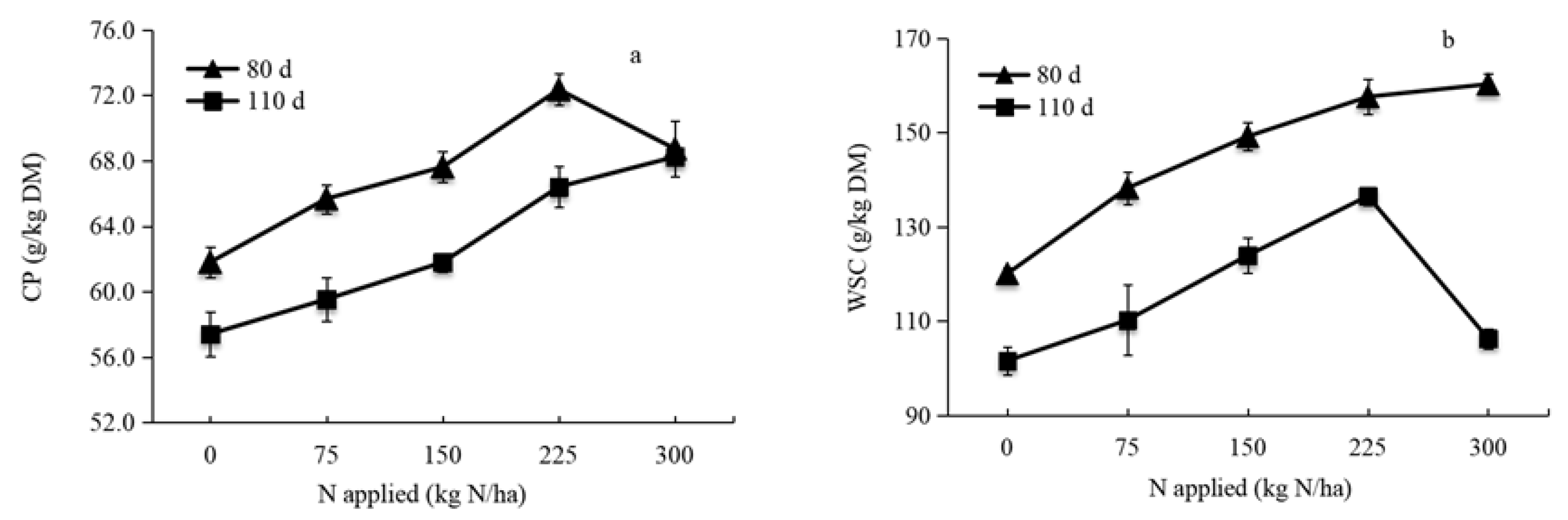
The highest CP concentration at 80 DAP (72.3 g/kg DM) came with 225 kg N/ha; at 110 DAP, the maximum CP (68.2 g/kg DM) was at 300 kg N/ha. WSC responded differently depending on harvest date (interaction p < 0.05). At 80 DAP, WSC increased with N rate up to 300 kg N/ha, reaching 160 g/kg DM. At 110 DAP, WSC peaked at 225 kg N/ha and then declined slightly at 300 kg N/ha. For other nutritive parameters, no harvest date × N rate interactions were detected (p < 0.05).
The responses of CP and WSC to N fertilization differed between harvest dates (
Figure 1). At 80 DAP, CP concentration increased progressively with N rate up to 225 kg N/ha, reaching a plateau thereafter. At 110 DAP, CP showed a similar but less pronounced increase, with the highest value recorded at 300 kg N/ha. In contrast, WSC concentration at 80 DAP increased linearly with N rate up to 300 kg N/ha, while at 110 DAP, WSC peaked at 225 kg N/ha and declined slightly at 300 kg N/ha. These patterns indicate that early harvest allows greater N responsiveness in terms of WSC accumulation, whereas late harvest limits the WSC response to high N inputs.
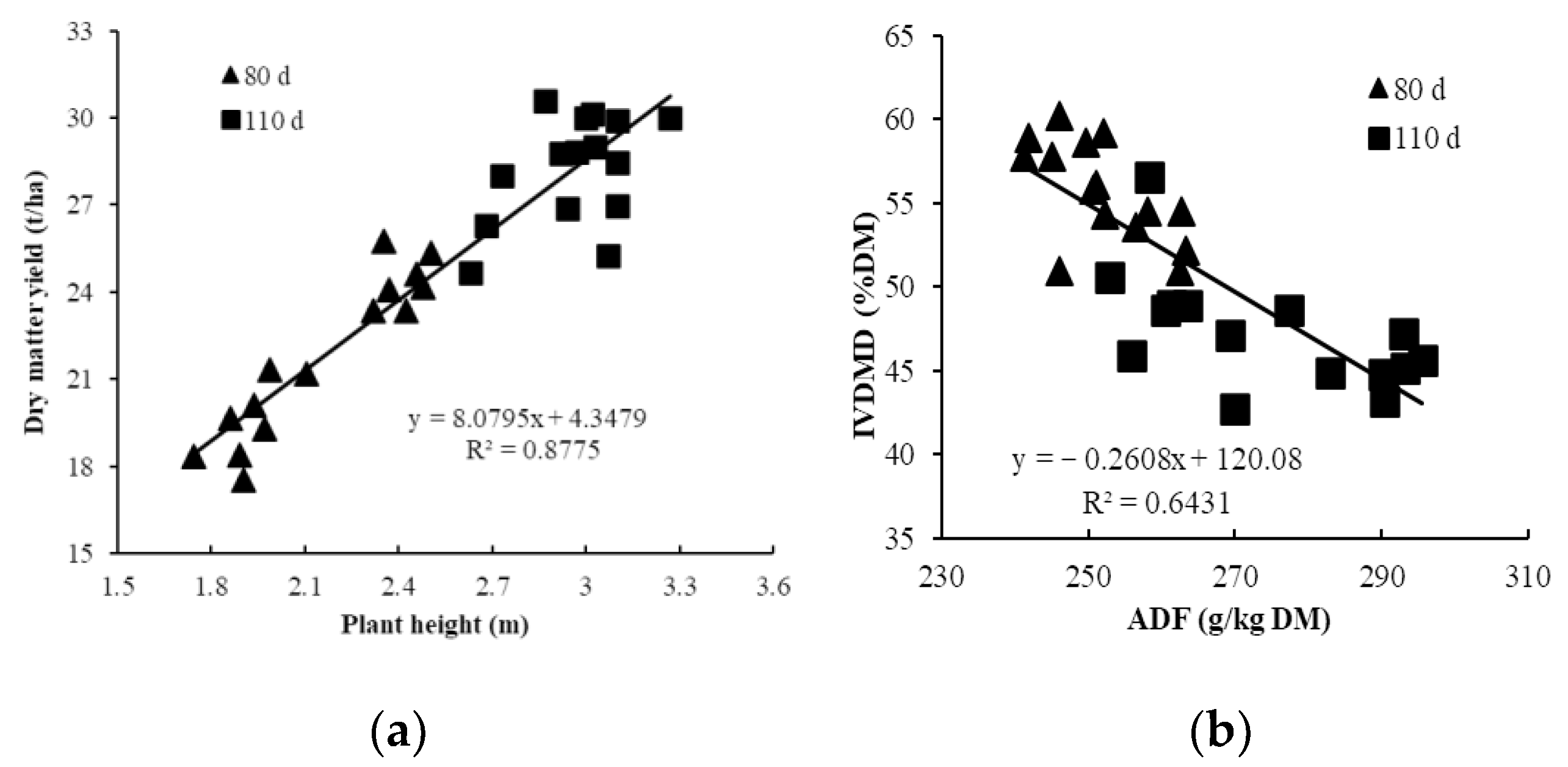
To evaluate the overall relationships between key agronomic and nutritional parameters across harvest dates, data from both 80 and 110 DAP were pooled for regression analysis (
Figure 2). As shown in
Figure 2a, plant height exhibited a strong positive linear correlation with DM yield (y = 8.08x + 4.35, R
2 = 0.8775), indicating that taller plants consistently produced higher dry matter yield regardless of harvest timing.
Figure 2b illustrates the negative relationship between ADF concentration and IVDMD across all samples. The regression equation (y = −0.2608x + 120.08, R
2 = 0.6431) confirms that increased fiber content significantly reduces in vitro dry matter digestibility, highlighting fiber as a key limiting factor for forage quality in sweet sorghum.
3.3. Silage Chemical Composition
After ensiling, CP and WSC concentrations were affected by harvest date and N rate (
p < 0.001;
Table 3). Silage from the 80 DAP harvest retained higher CP than that from 110 DAP. During ensiling, CP decreased by 21.7% in 80 DAP material and by 19.2% in 110 DAP material. In contrast, WSC was higher in silage from 110 DAP than from 80 DAP.
Fiber fractions (NDF, ADF, lignin) were higher in silage than in the corresponding fresh forage, and IVDMD was correspondingly lower. Silage from 80 DAP had slightly higher IVDMD than that from 110 DAP (p = 0.04).
3.4. Silage Fermentation Characteristics
Nitrogen rate affected silage pH, Lactic acid (LA), and ammonia-N (
p < 0.05) but did not influence acetic acid (AA), propionic acid (PA), or butyric acid (BA) concentrations (
p = 0.48;
Table 4). The harvest date affected all fermentation parameters measured (
p < 0.05).
Silage from 80 DAP had lower pH and higher LA than silage from 110 DAP, indicating more vigorous fermentation. Ammonia-N and BA increased with N rate at both harvest dates. At N rates of 225 and 300 kg N/ha, both ammonia-N and BA were lower in 80 DAP silage than in 110 DAP silage. AA was lower at 80 DAP than at 110 DAP (p = 0.02), while PA was higher at 80 DAP (p = 0.02). No harvest date × N rate interactions were detected for AA, PA, or BA (p > 0.05).
3.5. In Vitro Rumen Fermentation
Gas production kinetics were influenced by both harvest date and N rate, with a significant interaction between the two factors (p < 0.001). Cumulative gas production increased with incubation time across all treatments, with the largest differences at 24 h and 48 h.
For fresh forage harvested at 110 DAP, the 150 kg N/ha treatment produced the most gas: 61.5 mL/200 mg DM at 24 h and 71.2 mL/200 mg DM at 48 h. For forage harvested at 80 DAP, maximum gas production occurred at 300 kg N/ha: 61.4 mL/200 mg DM at 24 h and 70.6 mL/200 mg DM at 48 h.
After ensiling, gas production followed similar patterns but with different optimal N rates. For silage from 110 DAP, 150 kg N/ha again gave the highest values: 52.3 mL/200 mg DM at 24 h and 61.0 mL/200 mg DM at 48 h. For silage from the 80 DAP, 225 kg N/ha produced the most gas, with 48-h production reaching 54.7 mL/200 mg DM.
The pH measured at 48 h increased gradually with N rate at both harvest dates and was consistently higher for 110 DAP material than for 80 DAP material. All pH values remained within the normal rumen fermentation range (6.2–6.8).
4. Discussion
Harvest date and N rate interacted to shape nearly every aspect of sweet sorghum performance in this study-from plant architecture and lodging risk to nutritive value, silage fermentation, and rumen gas production. Our results suggest that optimizing sweet sorghum for silage under rain-fed conditions requires balancing different priorities, depending on whether the goal is maximum yield, best fermentation quality, or highest rumen fermentability.
4.1. Leaf Biomass, L/S Ratio, and Resource Allocation
Nitrogen fertilization increased leaf biomass and L/S ratio up to 225 kg N/ha, consistent with the well-documented responsiveness of leaves to N supply [
23]. The slight decline at 300 kg N/ha likely reflects a shift in resource allocation toward structural support at the expense of leaf expansion under high N conditions, though this warrants further investigation.
More striking was the lodging response. Lodging remained below 10% at 80 DAP across all N rates but exceeded 25% at 110 DAP when N exceeded 225 kg N/ha. This pattern matters for two reasons. First, early harvest effectively decouples N rate from lodging risk-farmers can apply higher N for yield without worrying about lodging. Second, the relationship between plant height and lodging is not linear; there may be a height threshold beyond which lodging risk accelerates. Reddy et al. [
24] noted similar threshold effects in grain sorghum, where lodging increased sharply once plants exceeded 2.5 m. In our study, plants at 110 DAP with ≥225 kg N/ha exceeded 3.0 m, well above that threshold.
These findings have clear practical implications: harvest timing serves as an effective management tool to balance biomass yield and lodging resistance. Under conditions where early harvest is applicable, relatively higher nitrogen application rates can be adopted without increasing lodging risk. Conversely, if delayed harvest is required to achieve target yields, nitrogen application should be limited to 150 kg N/ha to effectively reduce lodging risk.
4.2. Yield and Quality Trade-Off
The trade-off between yield and quality with advancing maturity is well established [
25], and our data confirm it: DM yield increased from 80 to 110 DAP, but CP and IVDMD declined while fiber fractions increased. This reflects progressive lignification of cell walls and dilution of protein by structural carbohydrates as plants mature.
More interestingly, the way N rate modulated this trade-off was different between harvest dates. At 80 DAP, CP peaked at 225 kg N/ha; at 110 DAP, CP continued increasing to 300 kg N/ha. This suggests that later-maturing plants have a greater capacity to convert additional N into protein, possibly because they remain in a more active metabolic state for longer. The mechanism may involve sustained activity of N-assimilating enzymes, as suggested by Margna [
26], who showed that N availability regulates the shikimic acid pathway, providing precursors for both protein synthesis and lignification.
The concurrent increase in lignin with N rate and the corresponding decline in IVDMD are consistent with this metabolic competition hypothesis. Cherney et al. [
27] estimated that each 1% increase in lignin reduces IVDMD roughly 4%, which aligns with our observations. The practical takeaway is that while moderate N (up to 225 kg N/ha) improves both yield and protein, excessive N (300 kg N/ha) may erode digestibility without adding yield benefit. Regarding WSC, at 110 DAP the concentration peaked at 225 kg N/ha and then declined at 300 kg N/ha. The decline in WSC at 110 DAP with 300 kg N/ha may result from a metabolic shift toward fiber synthesis under high N availability, limiting sugar accumulation in stems. It should also be noted that all plots received a basal manure application, providing a background of plant-available N (estimated 120–200 kg N/ha in the first year). Therefore, the reported inorganic N rates represent additional N on top of this baseline.
4.3. Silage Fermentation Quality
The minimum DM content recommended for adequate ensiling is approximately 247 g/kg DM [
28], yet fermentation quality differed markedly. Despite lower DM at 80 DAP, silage from this harvest had lower pH and higher LA-indicators of more vigorous fermentation. This traces back to the initial WSC, which was higher at 80 DAP and fueled rapid lactic acid production.
Even with faster pH decline, proteolysis was not completely suppressed at 80 DAP when N rates were below 225 kg N/ha, as shown by higher ammonia-N compared to 110 DAP. We suspect that the rate of pH decline may be more critical than the final pH value for limiting proteolysis; however, under our conditions, the rapid drop was still insufficient to fully suppress protease activity. One possible explanation is that sweet sorghum proteases are less pH-sensitive than those of other forages. Heron et al. [
29] found that protease activity in some species persists even at pH 4.0. Alternatively, the higher initial N content at 80 DAP may have provided more substrate for proteolysis, partly offsetting the pH effect.
At N rates ≥225 kg/ha, however, 80 DAP silage showed superior quality—lower pH, lower BA, and lower ammonia-N than 110 DAP silage. This suggests a threshold effect: above a certain N input, the advantages of early harvest (higher WSC, more fermentable substrate) outweigh the risks of proteolysis. For farmers, this means that if they plan to use high N rates, they should harvest early to capture both yield and quality benefits.
4.4. In Vitro Rumen Fermentation Characteristics
The in vitro gas production data reinforce that optimal management depends on the target outcome. A significant harvest date × N rate interaction was observed (
p < 0.001;
Table 2), indicating that the optimal N rate for gas production depends on harvest timing. For fresh forage, maximum 48-h gas production (71.2 mL/200 mg DM) occurred at 110 DAP with 150 kg N/ha. This combination apparently struck the best balance between readily fermentable carbohydrates and structural components-enough WSC and CP to fuel microbes, but not so much lignin as to limit access. These values are comparable to those reported by Terler et al. [
6] for dough-stage sorghum (65–75 mL/200 mg DM) and by Zhang et al. [
12] for high-sugar sweet sorghum silage (58–62 mL/200 mg DM), indicating that our optimized combinations achieved fermentability similar to well-managed systems.
At 80 DAP, gas production peaked at 300 kg N/ha, reaching levels nearly as high (70.6 mL/200 mg DM) as the 110 DAP optimum. This suggests that earlier-harvested plants can tolerate-and even benefit from-higher N inputs, possibly because the extra N boosts CP without the lignin penalty seen at later stages.
After ensiling, gas production declined across all treatments, reflecting losses of soluble nutrients during fermentation. However, the relative patterns held: 110 DAP with 150 kg N/ha still gave the highest values (61.0 mL/200 mg DM), followed by 80 DAP with 225 kg N/ha (54.7 mL/200 mg DM). The 300 kg N/ha treatment did not improve gas production from silage at either harvest date, consistent with the idea that very high N may lead to nitrate accumulation that inhibits rumen microbes [
30] or that the additional lignin at high N offsets any gains in CP. It should be noted that the in vitro buffer system buffers pH more strongly than true rumen fluid; therefore, the pH values reported here are mainly useful for comparative purposes among treatments rather than for absolute prediction of rumen pH.
Notably, ruminal pH remained within the normal range (6.2–6.8) across all treatments, confirming that even with suboptimal N management, sweet sorghum silage does not disrupt rumen function. Similarly, Ran et al. [
31] similarly reported stable rumen fermentation when sweet sorghum silage replaced corn silage in dairy diets, which supports our observation that even with suboptimal N management, sweet sorghum silage does not disrupt rumen function.
4.5. Synthesis and Implications
Taken together, our data suggest that for rain-fed sweet sorghum, there is no single “best” management recipe. Instead, the optimal harvest date and N rate depend on what the producer prioritizes. For maximum silage fermentation quality (low pH, low BA, and low ammonia-N) under high N input, harvesting at 80 DAP with 225 kg N/ha is recommended. For maximum rumen fermentability as reflected by gas production, harvesting at 110 DAP after planting with 150 kg N/ha gives the best result. For DM yield alone, 110 DAP with 225 kg N/ha produces the highest tonnage, but at the cost of higher lodging risk and lower digestibility.
The photoperiod-sensitive nature of ‘Hunnigreen’-its ability to remain vegetative for an extended period-provides the flexibility to make these choices. In regions where maize is constrained by water availability, this flexibility is valuable: farmers can tailor sweet sorghum management to their specific needs, whether that is maximizing yield, ensuring high-quality silage, or optimizing rumen fermentability.
5. Conclusions
In this study, harvest date and N rate interacted to influence the agronomic performance, silage quality, and rumen fermentability of photoperiod-sensitive sweet sorghum under rain-fed conditions. Harvesting early (80 DAP) with 225 kg N/ha gave silage with better fermentation traits: lower pH, less butyric acid, and ammonia-N, while still keeping an acceptable DM yield. Harvesting later (110 DAP) with 150 kg N/ha, on the other hand, maximized rumen fermentation potential, as shown by higher in vitro gas production. These different optimal combinations mean there is no single “best” way to manage the crop. Instead, the choice of harvest date and N rate should depend on what matters most-silage quality, rumen fermentability, or DM yield.
The photoperiod-sensitive nature of ‘Hunnigreen’ gives growers the flexibility to make these trade-offs, making it a valuable option in places where water limits maize production. Because this study used only one cultivar and one growing season, the findings should be validated over more years and locations and with other sweet sorghum varieties. Future research should also look at animal performance-for example, whether the improvements we saw in silage quality and rumen fermentation actually lead to better milk production or weight gain in livestock.