


Research on the Fallow Compensation Mechanism for Groundwater Overexploitation in the Tarim River Basin Under Bidirectional Collaboration

Abstract
1. Introduction
2. Materials and Methods
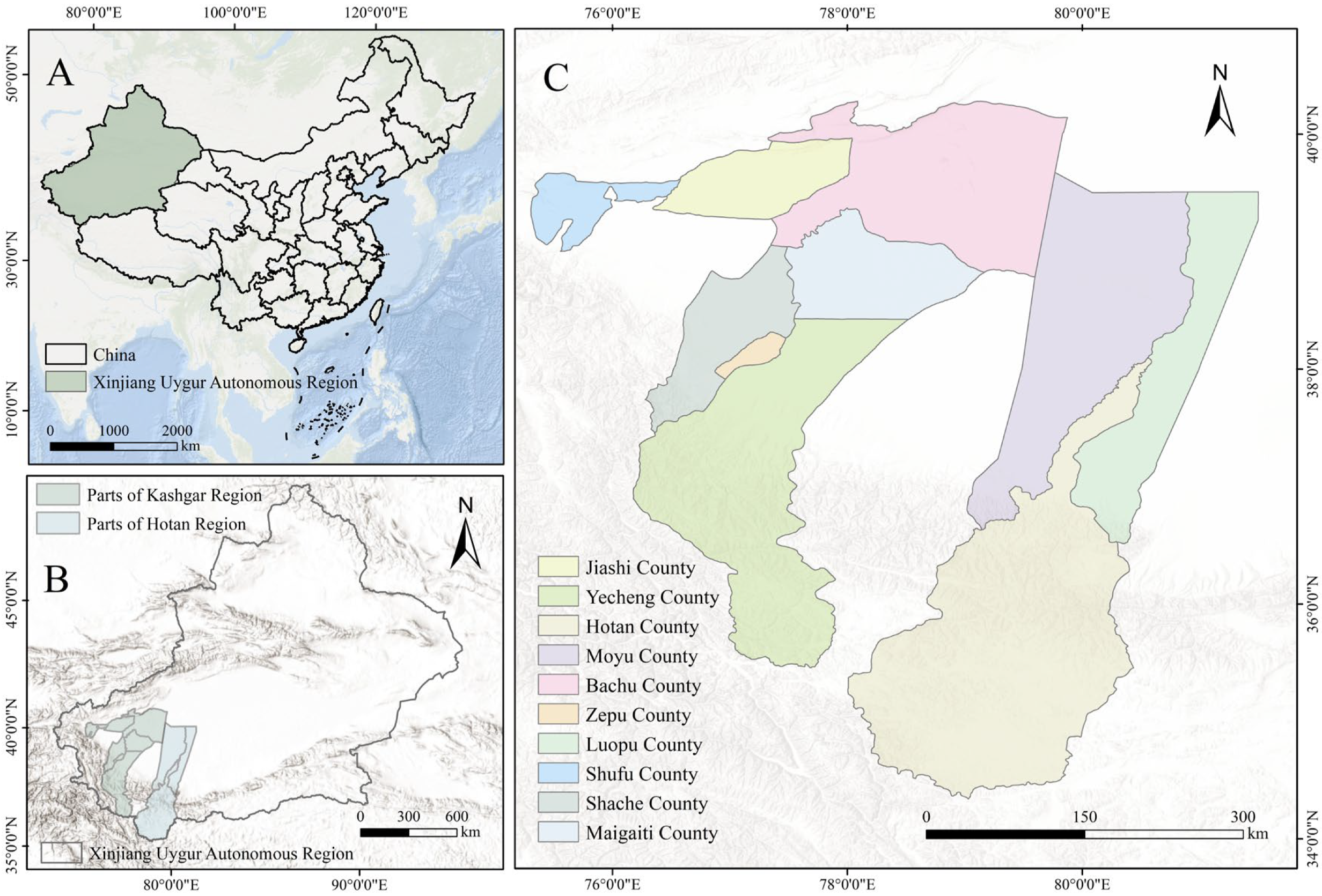
2.1. Study Area
2.2. Data Sources and Description
2.3. Research Methods
2.3.1. FC Standard Calculation from the Perspective of Bidirectional Collaboration
2.3.2. Quantitative Method of Ecological Compensation
- Calculate the total ecological service value of farmland
- Calculate the ecological overload index of farmland
- Calculate the amount of ecological compensation for farmland
- Maximum scale calculation of fallow based on modified farmland pressure index
- Fallow compensation standard
2.3.3. Opportunity Cost Method
2.3.4. Logistic Model
3. Results
3.1. Calculation of FC Standards
3.1.1. FC Standards Using the Ecological Compensation Quantitative Method
3.1.2. FC Standards Using the Opportunity Cost Method
3.1.3. FC Standards Under Bidirectional Collaboration
3.2. Factors Influencing the Selection of FC Methods
4. Discussion
4.1. The Novelty of the Comprehensive Model in Determining FC Standards
4.2. FC Standard and the Selection of Compensation Methods
4.3. Policy Suggestions for Groundwater Overexploitation in the TRB
4.4. Limitations and Prospects
5. Conclusions
Author Contributions
Funding
Institutional Review Board Statement
Data Availability Statement
Conflicts of Interest
References
- Kong, X.B. China must protect high-quality arable land. Nature 2014, 50, 7. [Google Scholar] [CrossRef]
- Zeng, Q.M.; Wang, Y.R.; Wang, J.; Chen, L.G.; Huang, J.S.; Liu, X.P. Spatial distribution and compensation strategy of land fallow based on quality-risk in arid areas. Trans. Chin. Soc. Agric. Eng. 2021, 37, 266–276. [Google Scholar]
- Roberts, L. 9 Billion? Science 2011, 333, 540–543. [Google Scholar] [CrossRef] [PubMed]
- Alexandratos, N.; Bruinsma, J. World Agriculture Towards 2030/2050: The 2012 Revision; Food and Agriculture Organization: Rome, Italy, 2012. [Google Scholar]
- Hao, J.X.; Shen, L.Q.; Zhan, H.; Yang, G.; Chen, H.H.; Wang, Y.J. A Spatiotemporal Assessment of Cropland System Health in Xinjiang with an Improved VOR Framework. Agriculture 2025, 15, 1826. [Google Scholar] [CrossRef]
- Liu, H.J.; Li, C.; Bai, X.H.; Wang, N.; Cui, Q.L.; Liu, J.; Roland, P.; Qiu, T.Y.; Mei, Y.X.; He, H.R.; et al. Exogenous silicon facilitates safe crop production in cadmium-contaminated soils: A comprehensive meta-analysis. J. Hazard. Mater. 2024, 480, 136368. [Google Scholar] [CrossRef]
- Du, J.J.; Liu, W.T.; Zhou, Q.X. Combating the Food Crisis and Farmland Contamination with Safe Farming Practices. J. Agric. Food Chem. 2024, 72, 15053–15054. [Google Scholar] [CrossRef]
- Lan, X.; Ding, G.J.; Dai, Q.H.; Yan, Y.J. Assessing the degree of soil erosion in karst mountainous areas by extenics. Catena 2022, 209, 105800. [Google Scholar] [CrossRef]
- Zheng, C.Z.; Li, Y.Q.; Wang, X.Y.; Wang, L.L.; Duan, Y.L.; Chen, Y.; Lu, J.N. Desertification indirectly affects soil fauna by reducing complexity of soil habitats and diversity of energy sources. Sci. Total Environ. 2024, 954, 176509. [Google Scholar] [CrossRef]
- Blanca, T.R.; Christian, V.; Gabriela, J.; Jackie, C.; Genoveva, A.G.; Edison, B.; Laura, L.G. Aquatic biodiversity loss in Andean urban streams. Urban Ecosyst. 2022, 25, 1619–1629. [Google Scholar] [CrossRef]
- Ouyang, Z.Y.; Zheng, H.; Xiao, Y.; Polasky, S.; Liu, J.G.; Xu, W.H.; Wang, Q.; Zhang, L.; Xiao, Y.; Rao, E.M.; et al. Improvements in ecosystem services from investments in natural capital. Science 2016, 352, 1455–1459. [Google Scholar] [CrossRef]
- Fan, Z.L.; Yu, P.J.; Qiao, M.; Xu, H.L.; Zhang, P.; Zhang, Q.Q.; Fu, J.Y. Comprehensive improvement of cultivated land for ecological protection to agriculture in arid areas: A case of Manasi River Basin of Xinjiang. Arid Land Geogr. 2012, 35, 772–777. [Google Scholar]
- Asadoullahtabar, S.R.; Asgari, A.; Tabari, M.M.R. Assessment, identifying, and presenting a plan for the stabilization of loessic soils exposed to scouring in the path of gas pipelines, case study: Maraveh-Tappeh city. Eng. Geol. 2024, 342, 107747. [Google Scholar] [CrossRef]
- Chen, X.; An, P.L.; Li, Y.Y.; Zhang, G.L.; Jin, Y.L.; Zhou, Y.; Zhao, H.L.; Li, L.Y.; Pan, Z.H. Lowering cropland use intensity through crop-fallow rotation optimization fosters a resilient water future in the central farming-pastoral ecotone of northern China. Agric. Water Manag. 2025, 316, 109570. [Google Scholar] [CrossRef]
- West, C.P.; Gerber, S.J.; Engstrom, M.P.; Mueller, N.D.; BrAUMAN, A.K.; Carlson, M.K.; Cassidy, E.S.; Johnston, M.; MacDonald, K.G.; Ray, K.D.; et al. Leverage points for improving global food security and the environment. Science 2014, 345, 325–328. [Google Scholar] [CrossRef]
- Qin, X.M.; Zhao, P.; Liu, H.E.; Nie, Z.J.; Zhu, J.J.; Qin, S.Y.; Li, C. Selenium inhibits cadmium uptake and accumulation in the shoots of winte wheat by altering the transformation of chemical forms of cadmium in soil. Environ. Sci. Pollut. Res. Int. 2021, 29, 8525–8537. [Google Scholar] [CrossRef]
- Shi, F.; Yang, Q.Y.; Wang, C.; Chen, Z.T. Practice and research progress on spatiotemporal collocation of fallow of cultivated land in world. Trans. Chin. Soc. Agric. Eng. 2018, 34, 1–9. [Google Scholar]
- Yin, J.F.; Song, C.Q.; Gao, P.C.; Wang, G.L.; Ye, S.J. Analysis of international cropland fallow practice experience and construction of differentiated fallow framework in China. Trans. Chin. Soc. Agric. Eng. 2025, 41, 22–34. [Google Scholar]
- Fujioka, M.; Jr, A.W.J.; Yoshida, H.; Maeda, T. Value of fallow farmlands as summer habitats for waterbirds in a Japanese rural area. Ecol. Res. 2001, 16, 555–567. [Google Scholar] [CrossRef]
- Hellerstein, M.D. The US Conservation Reserve Program: The evolution of an enrollment mechanism. Land Use Policy 2017, 63, 601–610. [Google Scholar] [CrossRef]
- Ustaoglu, E.; Collier, J.M. Farmland abandonment in Europe: An overview of drivers, consequences, and assessment of the sustainability implications. Environ. Rev. 2018, 26, 396–416. [Google Scholar] [CrossRef]
- Duan, J.Y.; Kuang, N.Y.; Gao, L.L. International practices in black soil conservation and China’s lessons. Chin. J. Eco-Agric. 2025, 33, 1–11. [Google Scholar]
- Xiong, W.Y.; Wang, L.; Ding, X.Q.; Wu, Z.H.; Tan, Y.Z. Re-cultivation Behavior and Influencing Factors of Fallow Farmers under the Extended Theory of Planned Behavior: Evidence from Heavy Metal-contaminated Fallow Areas. China Land Sci. 2024, 38, 117–128. [Google Scholar]
- Guo, H.W.; Xu, H.L.; Ling, H.B.; Aihemaiti, P. Quantitative relationship between cultivated land expansion and natural vegetation degradation in the lower reaches of the Tarim River. Agric. Res. Arid. Areas 2018, 36, 226–233. [Google Scholar]
- Ti, J.S.; Yang, Y.H.; Pu, L.L.; Wen, X.Y.; Yin, X.G.; Chen, F. Ecological compensation for winter wheat fallow and impact assessment of winter fallow on water sustainability and food security on the North China Plain. J. Clean. Prod. 2021, 328, 129431. [Google Scholar] [CrossRef]
- Yang, W.J.; Liu, D.; Gong, Q.W. Construction of differentiated dynamic compensation model for fallow land and its guarantee measures. Rural Econ. 2018, 36–42. [Google Scholar]
- Gao, X.; Shen, J.Q.; He, W.J.; Sun, F.H.; Zhang, Z.F.; Zhang, X.; Zhang, C.C.; Yang, K.; An, M.; Liang, Y.; et al. Changes in ecosystem services value and establishment of watershed ecological compensation standards. Int. J. Environ. Res. Public Health 2019, 16, 2951. [Google Scholar] [CrossRef]
- Adhikari, R.K.; Kindu, M.; Pokharel, R.; Castro, L.M.; Knoke, T. Financial compensation for biodiversity conservation in Ba Be national park of Northern Vietnam. J. Nat. Conserv. 2017, 35, 92–100. [Google Scholar] [CrossRef]
- Jiang, Y.N.; Guan, D.J.; He, X.J.; Yin, B.L.; Zhou, L.L.; Sun, L.L.; Huang, D.N.; Li, Z.H.; Zhang, Y.J. Quantification of the coupling relationship between ecological compensation and ecosystem services in the Yangtze River Economic Belt, China. Land Use Policy 2022, 114, 105995. [Google Scholar] [CrossRef]
- Liu, M.C.; Yang, L.; Min, Q.W. Establishment of an eco-compensation fund based on eco-services consumption. J. Environ. Manag. 2018, 211, 306–312. [Google Scholar] [CrossRef]
- Xue, R.H. Research on Ecological Compensation Mechanism of Cultivated Land Rotation in Northeast Black Soil Region Under Multi-Subject Cooperation; Northeast Agricultural University: Harbin, China, 2023. [Google Scholar]
- Zhao, X.F.; Xu, H.L.; Wang, M.; Zhang, P.; Ling, H.B.; Zheng, G. Overloading analysis of irrigation area in basins of Tarim River in different years. Trans. Chin. Soc. Agric. Eng. 2015, 31, 77–81. [Google Scholar]
- Deng, M.J.; Yang, P.N.; Zhou, H.Y.; Xu, H.L. Water Conversion and Strategy of Ecological Water Conveyance in the Lower Reaches of the Tarim River. Arid. Zone Res. 2017, 34, 717–726. [Google Scholar]
- Shen, L.; Li, Z.; Hao, J.; Wang, L.; Chen, H.; Wang, Y.; Xia, B. Evaluating the Dynamic Response of Cultivated Land Expansion and Fallow Urgency in Arid Regions Using Remote Sensing and Multi-Source Data Fusion Methods. Agriculture 2025, 15, 839. [Google Scholar] [CrossRef]
- Xue, D.; Gui, D.; Ci, M.; Liu, Q.; Wei, G.; Liu, Y. Spatial and temporal downscaling schemes to reconstruct high-resolution GRACE data: A case study in the Tarim River Basin, Northwest China. Sci. Total Environ. 2024, 907, 167908. [Google Scholar] [CrossRef]
- Yu, W.; Ma, X.; Wang, Y.; Yan, W.; Luo, C.; Han, Y.; Fan, B. Simulating wind prevention and sand fixation service flow in arid Inland River basins: Insights from the Tarim River basin, China. Sci. Total Environ. 2025, 959, 178241. [Google Scholar] [CrossRef]
- Xie, G.D.; Zhang, C.X.; Zhang, L.M.; Chen, W.H.; Li, S.M. Improvement of the Evaluation Method for Ecosystem Service Value Based on Per Unit Area. J. Nat. Resour. 2015, 30, 1243–1254. [Google Scholar]
- Ruan, X.S.; Li, T.; Zhang, O.X.; Yao, Z.W. A Quantitative study on ecological compensation of cultivated land in the Yangtze River economic belt based on ecological service value. Chin. J. Agric. Resour. Reg. Plan. 2021, 42, 68–76. [Google Scholar]
- Wackernagel, M.; Reesw, E. Our Ecological Foot Print Reducing, Human Impact on the Earth; New Society Publishers: Gabriela Island, BC, Canada, 1996; pp. 192–210. [Google Scholar]
- Liu, X.X.; Pu, C.L.; Liu, Z.Y.; Yan, Z.M.; Mu, F.X. Quantitatively study on ecological value compensation of regional cultivated land—Taking Xinjiang as an example. Chin. J. Agric. Resour. Reg. Plan. 2018, 39, 84–90. [Google Scholar]
- Ma, X.Y.; Zhao, J. Ecological compensation heterogeneity of Xinjiang’s farmlands based on ecological footprint model. Resour. Ind. 2023, 25, 138–149. [Google Scholar]
- Zhang, H.W.; Fang, B.; Wei, Q.Q.; Qu, Y.; Wang, Q.R. Building Quantitative Model of Ecological Value Compensation for Regional Arable Land: A Case Study of Jiangsu Province. China Land Sci. 2015, 29, 63–70. [Google Scholar]
- Chen, Y.Q.; Gao, W.S. How to Determine the Payment Amount of Ecological Compensation: Based on the Theories and Methods of Ecological Economics. Syst. Eng. Theory Pract. 2007, 4, 165–170. [Google Scholar]
- Cai, Y.L.; Fu, Z.Q.; Dai, E.F. The minimum area per capita of cultivated land and its implication for the optimization of land resource allocation. Acta Geogr. Sin. 2002, 57, 127–134. [Google Scholar]
- Luo, X.; Zhang, L.; Zhu, Y.Y. China’s food security based on farmland pressure index. Chin. Rural Econ. 2016, 83–96. [Google Scholar]
- Tan, S.K.; Han, S.Y.; Zhang, L. Study on Fallow Scale and Dynamical Simulation of Major Grain Producing Areas in China from the Food Security Perspective. China Land Sci. 2020, 34, 9–17. [Google Scholar]
- Kleyn, J.; Arashi, M.; Bekker, A.; Millard, S. Preliminary testing of the Cobb–Douglas production function and related inferential issues. Commun. Stat. Simulat. Comput. 2017, 46, 469–488. [Google Scholar] [CrossRef]
- Chen, Y.D.; Yang, Q.Y.; Zeng, L.; Yang, R.H.; Liu, S.H. Study on the demand for differentiated compensation of fallow farmers in different livelihood conditions–A case study in Xingtai, Hebei Province. Chin. J. Agric. Resour. Reg. Plan. 2018, 39, 196–203+223. [Google Scholar]
- Sheng, W.; Zhen, L.; Xie, G.; Xiao, Y. Determining eco-compensation standards based on the ecosystem services value of the mountain ecological forests in Beijing, China. Ecosyst. Serv. 2017, 26, 422–430. [Google Scholar] [CrossRef]
- Campos, P.; Caparr´os, A.; Oviedo, J.L.; Ovando, P.; Álvarez-Farizo, B.; Díaz-Balteiro, L.; Carranza, J.; Beguería, S.; Díaz, M.; Herruzo, C.A.; et al. Bridging the gap between national and ecosystem accounting application in andalusian forests, Spain. Ecol. Econ. 2019, 157, 218–236. [Google Scholar] [CrossRef]
- Xie, H.; Cheng, L.; Lv, T. Factors influencing farmer willingness to fallow winter wheat and ecological compensation standards in a groundwater funnel area in Hengshui, Hebei Province, China. Sustainability 2017, 9, 839. [Google Scholar] [CrossRef]
- Zhang, Z.H.; Cui, Y.Z.; Wang, L.; Sun, X.M.; Gao, Y. Determining the ecological compensation standards based on willingness to accept (WTA) for intensive agricultural production areas: A case in China. Appl. Geogr. 2023, 158, 103051. [Google Scholar] [CrossRef]
- Zhang, Y.; Ji, Y.; Zhou, Y.; Sun, H. Ecological compensation standard for non-point pollution from farmland. Probl. Sustain. Dev. 2017, 12, 139–146. [Google Scholar]
- Wang, X.; Li, X.B.; Xin, L.J.; Tan, M.H.; Li, S.F.; Wang, R.J. Ecological compensation for winter wheat abandonment in groundwater over-exploited areas in the North China Plain. Acta Geogr. Sin. 2016, 71, 829–839. [Google Scholar] [CrossRef]
- Yu, Y.H.; Liu, Y.S. Farmers’ willingness to fallow and preference for compensation methods: An experimental analysis based on the selection of farmers in ten districts and counties of Chongqing. Agric. Econ. 2022, 93–97. [Google Scholar]
- Richards, R.C.; Rerolle, J.; Aronson, J.; Pereira, P.H.; Gonçalves, H.; Brancalion, P.H.S. Governing a pioneer program on payment for watershed services: Stakeholder involvement, legal frameworks and early lessons from the Atlantic forest of Brazil. Ecosyst. Serv. 2015, 16, 23–32. [Google Scholar] [CrossRef]
- Tomczyk, P.; Wdowczyk, A.; Wiatkowska, B.; Pulikowska, A.S.; Kuriqi, A. Fertility and quality of arable soils in Poland: Spatial–temporal analysis of long-term monitoring. Ecol. Indic. 2024, 166, 112375. [Google Scholar] [CrossRef]
- Cihan, B.; Ali, R.A. Efficient monitoring of groundwater level changes using compressive remote sensing. Egypt. J. Remote Sens. Space Sci. 2025, 28, 659–665. [Google Scholar]
- Chang, S.; Wuepper, D.; Heissenhuber, A.; Sauer, J. Investigating rice farmers’ preferences for an agri-environmental scheme: Is an eco-label a substitute for payments? Land Use Policy 2017, 64, 374–382. [Google Scholar] [CrossRef]
- Sofia, B.; Rebecca, T.; Bart, C.; Michael, B.; Lukas, E.; Dietrich, S.E.; Nicole, M.; Murat, O.; Ralf, S.; Eleonore, S.; et al. Aligning agri-environmental subsidies and environmental needs: A comparative analysis between the US and EU. Environ. Res. Lett. 2021, 16, 054067. [Google Scholar] [CrossRef]
- Xie, X.; Xie, H.L.; Cheng, S.; Wu, Q.; Lua, L. Estimation of ecological compensation standards for fallow heavy metal-polluted farmland in China based on farmer willingness to accept. Sustainability 2017, 9, 1859. [Google Scholar] [CrossRef]

| Criterion Layer | Variable Name | Description/Definition |
|---|---|---|
| Natural capital (N) | Per capita area of farmland (N1) | Ratio of total farmland area to total number of family members (hm2/person) |
| Farmland quality (N2) | Proportion of high-quality farmland in households to total farmland area (%) | |
| Human capital (H) | Education level (H1) | Illiterate = 0; Primary school = 0.25; junior middle school = 0.5; high school = 0.75; college or higher = 1 |
| Dependency ratio (H2) | Proportion of household labor force to total household population (%) | |
| Health status of labor force (H3) | Excellent = 1; Good = 0.75; Medium = 0.5; Poor = 0.25 | |
| Material capital (M) | Household asset ownership status (M1) | Truck = 1; sedan = 0.8; tractor = 0.6; agricultural tricycle = 0.4; motorcycle = 0.2 |
| Economic condition evaluation (M2) | Excellent = 1; Good = 0.75; Medium = 0.5; Poor = 0.25 | |
| Social capital(S) | Family members and neighborhood relationships (S1) | Excellent = 1; Good = 0.75; Medium = 0.5; Poor = 0.25 |
| Family members’ participation in training (S2) | Number of training sessions per year | |
| Financial capital (F) | Nonfarm household income (F1) | Household nonfarm total income (CNY) |
| Agricultural household income (F2) | Annual total income from family agriculture (CNY) |
| The Farmland Service Value (108 CNY/108 USD) | Farmland Overload Index (I) | Farmland Pressure Index (K) | Fallow Compensation (108 CNY/108 USD) | |
|---|---|---|---|---|
| Hotan County | 3.75/0.528 | 0.59 | 0.57 | 1.50/0.208 |
| Luopu County | 4.72/0.656 | 0.63 | 0.53 | 1.87/0.260 |
| Moyu County | 8.17/1.135 | 0.57 | 0.54 | 2.87/0.399 |
| Shache County | 23.00/3.194 | 0.72 | 0.48 | 10.11/1.404 |
| Jiashi County | 22.16/3.078 | 0.81 | 0.42 | 10.94/1.519 |
| Bachu County | 15.96/2.217 | 0.80 | 0.41 | 7.77/1.079 |
| Zepu County | 6.51/0.904 | 0.75 | 0.50 | 2.95/0.410 |
| Shufu County | 8.53/1.185 | 0.77 | 0.54 | 4.00/0.556 |
| Yecheng County | 13.52/1.878 | 0.72 | 0.55 | 5.91/0.821 |
| Maigaiti County | 11.03/1.532 | 0.80 | 0.47 | 5.38/0.747 |
| Influencing Factors | Coefficient | Standard Error | Z Statistic | p Value |
|---|---|---|---|---|
| Age | 0.0006 | 0.0232 | 0.4924 | 0.6343 |
| Education level | −0.0443 ** | 0.0216 | −2.2531 | 0.0424 |
| Farmland area | 0.7752 | 0.0756 | 10.3171 | 0.0000 |
| Quality of farmland | 0.5934 ** | 0.1183 | 4.3762 | 0.0000 |
| Labor input | 0.0321 | 0.0354 | 0.9205 | 0.4075 |
| Capital input | 0.2054 | 0.0621 | 4.3251 | 0.0502 |
| R2 = 0.8237 | ||||
| Prob(F-statistic) = 0 | ||||
| County | FC Standards Using Ecological Compensation Quantitative Method (CNY/USD/hm2) | FC Standards Using Opportunity Cost Method (CNY/USD/hm2) | FC Standards Under Bidirectional Collaboration (CNY/USD/hm2) |
|---|---|---|---|
| Hotan County | 5141.85/714.15 | 6048.00/840.00 | 5594.93/777.07 |
| Luopu County | 6086.10/845.29 | 6382.65/886.48 | 6234.38/865.89 |
| Moyu County | 5565.60/773.00 | 5515.80/766.08 | 5540.40/769.54 |
| Shache County | 6829.80/948.58 | 6526.35/906.44 | 6678.08/927.51 |
| Jiashi County | 7840.65/1088.98 | 7700.40/1069.50 | 7770.53/1079.24 |
| Bachu County | 6653.10/924.04 | 7085.25/984.06 | 6869.18/954.05 |
| Zepu County | 6963.30/967.13 | 6695.25/929.90 | 6829.28/948.51 |
| Shufu County | 7867.95/1092.77 | 7005.75/973.02 | 7436.85/1032.90 |
| Yecheng County | 7812.45/1085.06 | 6313.80/876.92 | 7063.13/980.99 |
| Maigaiti County | 6891.45/957.15 | 6259.80/869.42 | 6575.63/913.28 |
| Indicators | Monetary Compensation | Physical Compensation | Technical Compensation | |||
|---|---|---|---|---|---|---|
| Coefficient | Standard Error | Coefficient | Standard Error | Coefficient | Standard Error | |
| Per capita area of farmland | 0.486 *** | 0.149 | 0.365 *** | 0.112 | 0.139 | 0.120 |
| Farmland quality | 0.124 | 0.093 | 0.113 | 0.372 | 0.086 | 0.086 |
| Education level | 0.151 * | 0.107 | −0.087 | 0.009 | 0.649 *** | 0.189 |
| Dependency ratio | 0.738 *** | 0.226 | −0.153 | 0.101 | 0.172 | 0.134 |
| Health status of labor force | −0.062 | 0.085 | −0.203 ** | 0.089 | 0.034 | 0.075 |
| Household asset ownership status | 0.238 | 0.201 | −0.473 | 0.312 | −0.156 | 0.190 |
| Economic condition evaluation | −0.297 | 0.158 | −0.562 ** | 0.249 | 0.622 | 0.332 |
| Family members and neighborhood relationships | 1.337 | 0.841 | 1.238 | 0.863 | 0.961 | 0.712 |
| Family members’ participation in training | 0.131 | 0.092 | 0.093 | 0.081 | 0.596 ** | 0.174 |
| Nonfarm household income | 0.352 ** | 0.156 | 1.032 | 0.724 | 0.747 *** | 0.256 |
| Agricultural household income | 0.336 * | 0.182 | 0.489 *** | 0.172 | 0.097 | 0.118 |
| Nagelkerke R2 | 0.693 | 0.675 | 0.638 | |||
| Sig | 0.038 | 0.043 | 0.047 | |||
Disclaimer/Publisher’s Note: The statements, opinions and data contained in all publications are solely those of the individual author(s) and contributor(s) and not of MDPI and/or the editor(s). MDPI and/or the editor(s) disclaim responsibility for any injury to people or property resulting from any ideas, methods, instructions or products referred to in the content. |
© 2025 by the authors. Licensee MDPI, Basel, Switzerland. This article is an open access article distributed under the terms and conditions of the Creative Commons Attribution (CC BY) license (https://creativecommons.org/licenses/by/4.0/).
Share and Cite
Hao, J.; Zhong, K.; Shen, L.; Cheng, Z.; Wang, Y. Research on the Fallow Compensation Mechanism for Groundwater Overexploitation in the Tarim River Basin Under Bidirectional Collaboration. Agriculture 2025, 15, 2301. https://doi.org/10.3390/agriculture15212301
Hao J, Zhong K, Shen L, Cheng Z, Wang Y. Research on the Fallow Compensation Mechanism for Groundwater Overexploitation in the Tarim River Basin Under Bidirectional Collaboration. Agriculture. 2025; 15(21):2301. https://doi.org/10.3390/agriculture15212301
Chicago/Turabian StyleHao, Jiaxin, Kangzheng Zhong, Liqiang Shen, Zengyi Cheng, and Yuejian Wang. 2025. "Research on the Fallow Compensation Mechanism for Groundwater Overexploitation in the Tarim River Basin Under Bidirectional Collaboration" Agriculture 15, no. 21: 2301. https://doi.org/10.3390/agriculture15212301
APA StyleHao, J., Zhong, K., Shen, L., Cheng, Z., & Wang, Y. (2025). Research on the Fallow Compensation Mechanism for Groundwater Overexploitation in the Tarim River Basin Under Bidirectional Collaboration. Agriculture, 15(21), 2301. https://doi.org/10.3390/agriculture15212301


