Monitoring Atrial Fibrillation Using Wearable Digital Technologies: The Emerging Role of Smartwatches
 ,
,  , , , , , , , , , , and
Abstract
1. Introduction
2. Methods
3. Traditional Methods for AF Monitoring
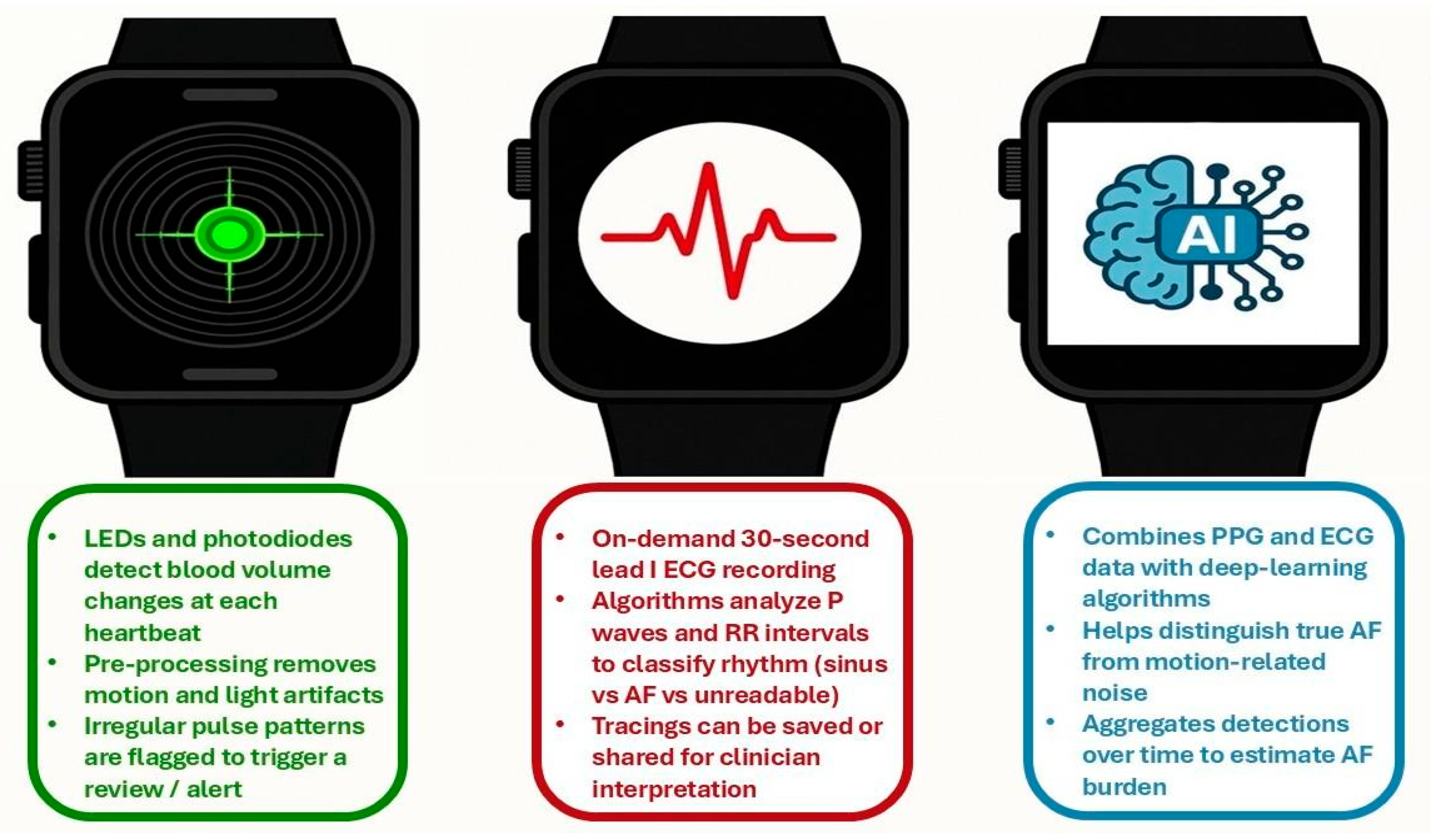
4. Core Technologies and Commercial Applications in AF Wearables
5. Accuracy and Diagnostic Performance of AF Wearables
6. Advantages of Smartwatch-Based AF Monitoring
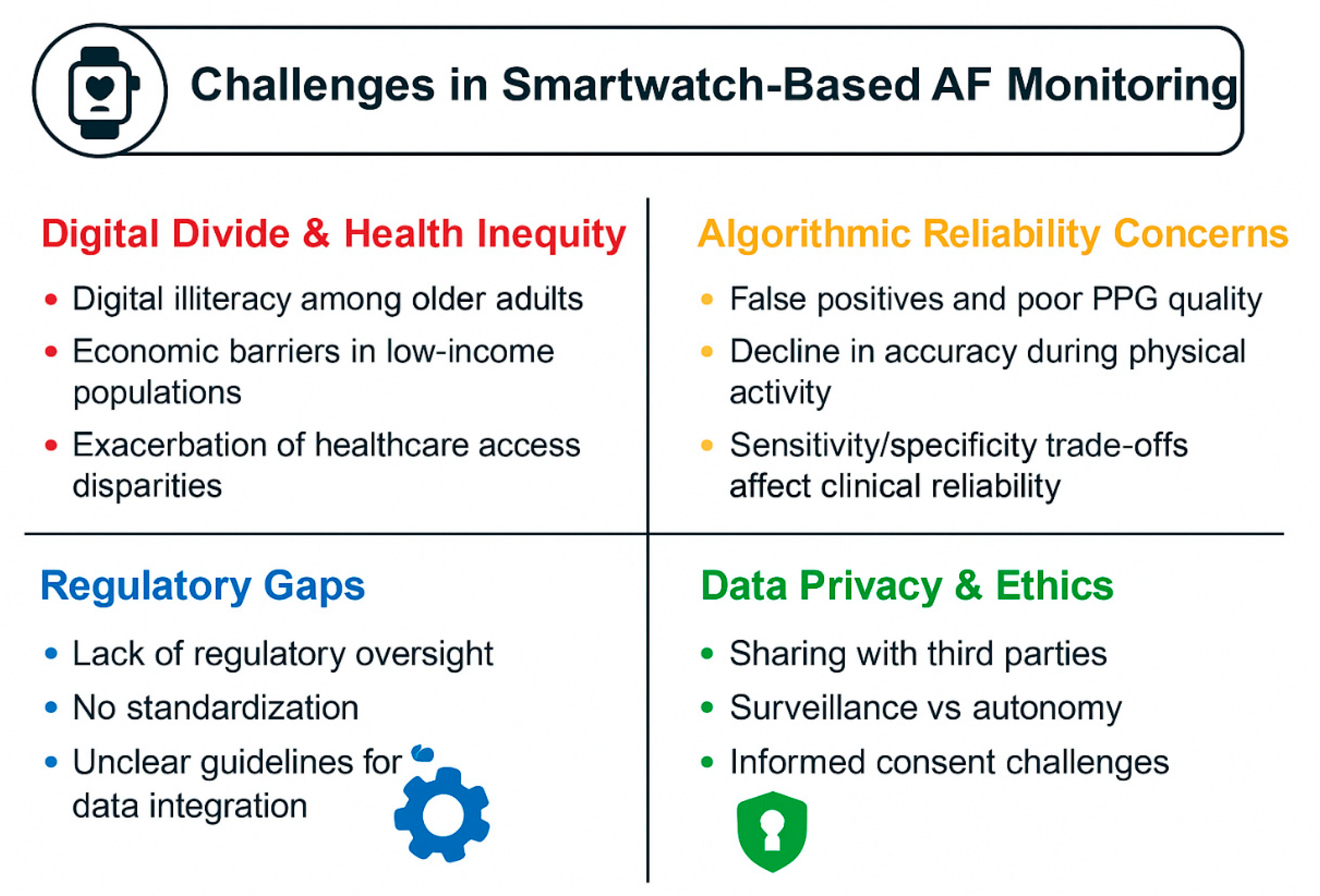
7. Challenges and Limitations of Smartwatch-Based AF Monitoring
8. Clinical Integration and Future Perspectives
9. Conclusions
Author Contributions
Funding
Institutional Review Board Statement
Informed Consent Statement
Data Availability Statement
Acknowledgments
Conflicts of Interest
Abbreviations
| AF | Atrial Fibrillation |
| AFL | Atrial Flutter |
| AI | Artificial Intelligence |
| AFEQT | Atrial Fibrillation Effect on QualiTy of Life |
| BPM | Beats Per Minute |
| CI | Confidence Interval |
| CNN | Convolutional Neural Networks |
| DCCV | Direct Current Cardioversion |
| ECG | Electrocardiography |
| HER | Electronic Health Records |
| GDPR | General Data Protection Regulation |
| HF | Heart Failure |
| HR | Hazard Ratio |
| IHRN | Irregular Heart Rhythm Notification |
| ILR | Implantable Loop Recorders |
| LED | Light Emitting Diodes |
| NPV | Negative Prognostic Value |
| OAC | Oral Anticoagulation |
| OR | Odds Ratio |
| PACs | Premature Atrial Contractions |
| PPG | Photoplethysmography |
| PPV | Positive Prognostic Value |
| PVCs | Premature Ventricular Contractions |
| RCT | Randomized Clinical Trial |
| Se | Sensitivity |
| Sp | Specificity |
References
- Hindricks, G.; Potpara, T.; Dagres, N.; Arbelo, E.; Bax, J.J.; Blomström-Lundqvist, C.; Boriani, G.; Castella, M.; Dan, G.-A.; Dilaveris, P.E.; et al. 2020 ESC Guidelines for the Diagnosis and Management of Atrial Fibrillation Developed in Collaboration with the European Association for Cardio-Thoracic Surgery (EACTS). Eur. Heart J. 2021, 42, 373–498. [Google Scholar] [CrossRef] [PubMed]
- Linz, D.; Gawalko, M.; Betz, K.; Hendriks, J.M.; Lip, G.Y.H.; Vinter, N.; Guo, Y.; Johnsen, S. Atrial Fibrillation: Epidemiology, Screening and Digital Health. Lancet Reg. Health-Eur. 2024, 37, 100786. [Google Scholar] [CrossRef]
- Yiin, G.S.C.; Howard, D.P.J.; Paul, N.L.M.; Li, L.; Luengo-Fernandez, R.; Bull, L.M.; Welch, S.J.V.; Gutnikov, S.A.; Mehta, Z.; Rothwell, P.M. Age-Specific Incidence, Outcome, Cost, and Projected Future Burden of Atrial Fibrillation–Related Embolic Vascular Events. Circulation 2014, 130, 1236–1244. [Google Scholar] [CrossRef]
- Aebersold, H.; Foster-Witassek, F.; Serra-Burriel, M.; Brüngger, B.; Aeschbacher, S.; Beer, J.-H.; Blozik, E.; Blum, M.; Bonati, L.; Conen, D.; et al. Estimating the Cost Impact of Atrial Fibrillation Using a Prospective Cohort Study and Population-Based Controls. BMJ Open 2023, 13, e072080. [Google Scholar] [CrossRef]
- Serpa, F.; Tale, A.; Zimetbaum, P.J.; Kramer, D.B. Trends in Health Care Expenditures and Incremental Health Care Cost in Adults with Atrial Fibrillation in the United States. Heart Rhythm O2 2025, 6, 11–20. [Google Scholar] [CrossRef]
- Deshmukh, A.D.; Iglesias, M.I.; Khanna, R.K.; Beaulieu, T.B. Healthcare Utilization and Costs Associated with a Diagnosis of Incident Atrial Fibrillation. Eur. Heart J. 2022, 3, 577–586. [Google Scholar] [CrossRef]
- Wijffels, M.C.E.F.; Crijns, H.J.G.M. Non-Invasive Characteristics of Atrial Fibrillation: The Value of Holter Recordings for the Treatment of AF. Card. Electrophysiol. Rev. 2002, 6, 233–238. [Google Scholar] [CrossRef]
- Sana, F.; Isselbacher, E.M.; Singh, J.P.; Heist, E.K.; Pathik, B.; Armoundas, A.A. Wearable Devices for Ambulatory Cardiac Monitoring. J. Am. Coll. Cardiol. 2020, 75, 1582–1592. [Google Scholar] [CrossRef] [PubMed]
- Piccini, J.P.; Stanelle, E.J.; Johnson, C.C.; Hylek, E.M.; Kanwar, R.; Lakkireddy, D.R.; Mittal, S.; Peacock, J.; Russo, A.M.; Soderlund, D.; et al. Performance of Atrial Fibrillation Burden Trends for Stroke Risk Stratification. Circ. Arrhythm. Electrophysiol. 2024, 17, e012394. [Google Scholar] [CrossRef] [PubMed]
- Becher, N.; Metzner, A.; Toennis, T.; Kirchhof, P.; Schnabel, R.B. Atrial Fibrillation Burden: A New Outcome Predictor and Therapeutic Target. Eur. Heart J. 2024, 45, 2824–2838. [Google Scholar] [CrossRef]
- Zhu, L.; Nathan, V.; Kuang, J.; Kim, J.; Avram, R.; Olgin, J.; Gao, J. Atrial Fibrillation Detection and Atrial Fibrillation Burden Estimation via Wearables. IEEE J. Biomed. Health Inform. 2022, 26, 2063–2074. [Google Scholar] [CrossRef]
- Mittal, S.; Oliveros, S.; Li, J.; Barroyer, T.; Henry, C.; Gardella, C. AI Filter Improves Positive Predictive Value of Atrial Fibrillation Detection by an Implantable Loop Recorder. JACC Clin. Electrophysiol. 2021, 7, 965–975. [Google Scholar] [CrossRef]
- Allen, J. Photoplethysmography and Its Application in Clinical Physiological Measurement. Physiol. Meas. 2007, 28, R1–R39. [Google Scholar] [CrossRef]
- Park, J.; Seok, H.S.; Kim, S.-S.; Shin, H. Photoplethysmogram Analysis and Applications: An Integrative Review. Front. Physiol. 2022, 12, 808451. [Google Scholar] [CrossRef]
- Traykov, V.; Puererfellner, H.; Burri, H.; Foldesi, C.L.; Scherr, D.; Duncker, D.; Arbelo, E.; Botto, G.L.; Boriani, G.; Heidbuchel, H.; et al. EHRA Perspective on the Digital Data Revolution in Arrhythmia Management: Insights from the Association’s Annual Summit. Europace 2025, 27, euaf149. [Google Scholar] [CrossRef] [PubMed]
- Papalamprakopoulou, Z.; Stavropoulos, D.; Moustakidis, S.; Avgerinos, D.; Efremidis, M.; Kampaktsis, P.N. Artificial Intelligence-Enabled Atrial Fibrillation Detection Using Smartwatches: Current Status and Future Perspectives. Front. Cardiovasc. Med. 2024, 11, 1432876. [Google Scholar] [CrossRef]
- Sridhar, A.R.; Cheung, J.W.; Lampert, R.; Silva, J.N.A.; Gopinathannair, R.; Sotomonte, J.C.; Tarakji, K.; Fellman, M.; Chrispin, J.; Varma, N.; et al. State of the Art of Mobile Health Technologies Use in Clinical Arrhythmia Care. Commun. Med. 2024, 4, 218. [Google Scholar] [CrossRef]
- Gaoudam, N.; Sakhamudi, S.K.; Kamal, B.; Addla, N.; Reddy, E.P.; Ambala, M.; Lavanya, K.; Palaparthi, E.C.; Bhattam, A.; Periasamy, P.; et al. Wearable Devices and AI-Driven Remote Monitoring in Cardiovascular Medicine: A Narrative Review. Cureus 2025, 17, e90208. [Google Scholar] [CrossRef] [PubMed]
- Karakasis, P.; Theofilis, P.; Sagris, M.; Pamporis, K.; Stachteas, P.; Sidiropoulos, G.; Vlachakis, P.K.; Patoulias, D.; Antoniadis, A.P.; Fragakis, N. Artificial Intelligence in Atrial Fibrillation: From Early Detection to Precision Therapy. J. Clin. Med. 2025, 14, 2627. [Google Scholar] [CrossRef] [PubMed]
- Karakasis, P.; Antoniadis, A.P.; Theofilis, P.; Vlachakis, P.K.; Milaras, N.; Patoulias, D.; Karamitsos, T.; Fragakis, N. Digital Twin Models in Atrial Fibrillation: Charting the Future of Precision Therapy? J. Pers. Med. 2025, 15, 256. [Google Scholar] [CrossRef]
- Stachteas, P.; Nasoufidou, A.; Karagiannidis, E.; Patoulias, D.; Karakasis, P.; Alexiou, S.; Samaras, A.; Zormpas, G.; Stavropoulos, G.; Tsalikakis, D.; et al. The Role of Sodium Glucose Co-Transporter 2 Inhibitors in Atrial Fibrillation: A Comprehensive Review. J. Clin. Med. 2024, 13, 5408. [Google Scholar] [CrossRef]
- Wu, Y.-H.; Ware, C.; Damnée, S.; Kerhervé, H.; Rigaud, A.-S. Bridging the Digital Divide in Older Adults: A Study from an Initiative to Inform Older Adults about New Technologies. Clin. Interv. Aging 2015, 10, 193–200. [Google Scholar] [CrossRef]
- Md Fadzil, N.H.; Shahar, S.; Singh, D.K.A.; Rajikan, R.; Vanoh, D.; Mohamad Ali, N.; Mohd Noah, S.A. Digital Technology Usage among Older Adults with Cognitive Frailty: A Survey during COVID-19 Pandemic. Digit. Health 2023, 9, 20552076231207594. [Google Scholar] [CrossRef] [PubMed]
- Zhou, J.; Salvendy, G.; Boot, W.R.; Charness, N.; Czaja, S.; Gao, Q.; Holzinger, A.; Ntoa, S.; Rau, P.-L.P.; Rogers, W.A.; et al. Grand Challenges of Smart Technology for Older Adults. Int. J. Hum. Comput. Interact. 2025, 41, 4439–4481. [Google Scholar] [CrossRef]
- Spertus, J.; Dorian, P.; Bubien, R.; Lewis, S.; Godejohn, D.; Reynolds, M.R.; Lakkireddy, D.R.; Wimmer, A.P.; Bhandari, A.; Burk, C. Development and Validation of the Atrial Fibrillation Effect on QualiTy-of-Life (AFEQT) Questionnaire in Patients with Atrial Fibrillation. Circ. Arrhythm. Electrophysiol. 2011, 4, 15–25. [Google Scholar] [CrossRef] [PubMed]
- Yan, Q.; Liang, J.; Yuan, Y.; Li, Y.; Fan, J.; Wu, W.; Xu, P.; Wang, Q.; Xue, J. Association between Personality Type and Patient-Reported Outcomes (PRO) in Patients with Atrial Fibrillation. BMC Cardiovasc. Disord. 2024, 24, 437. [Google Scholar] [CrossRef]
- Kwon, S.; Lee, S.-R.; Choi, E.-K.; Ahn, H.-J.; Song, H.-S.; Lee, Y.-S.; Oh, S.; Lip, G.Y.H. Comparison Between the 24-Hour Holter Test and 72-Hour Single-Lead Electrocardiogram Monitoring with an Adhesive Patch-Type Device for Atrial Fibrillation Detection: Prospective Cohort Study. J. Med. Internet Res. 2022, 24, e37970. [Google Scholar] [CrossRef]
- Takagi, T.; Miyazaki, S.; Kusa, S.; Taniguchi, H.; Ichihara, N.; Iwasawa, J.; Kuroi, A.; Nakamura, H.; Hachiya, H.; Hirao, K.; et al. Role of Extended External Auto-Triggered Loop Recorder Monitoring for Atrial Fibrillation. Circ. J. 2014, 78, 2637–2642. [Google Scholar] [CrossRef] [PubMed][Green Version]
- Zungsontiporn, N.; Link, M.S. Newer Technologies for Detection of Atrial Fibrillation. BMJ 2018, 363, k3946. [Google Scholar] [CrossRef]
- Eitel, C.; Husser, D.; Hindricks, G.; Fruhauf, M.; Hilbert, S.; Arya, A.; Gaspar, T.; Wetzel, U.; Bollmann, A.; Piorkowski, C. Performance of an Implantable Automatic Atrial Fibrillation Detection Device: Impact of Software Adjustments and Relevance of Manual Episode Analysis. Europace 2011, 13, 480–485. [Google Scholar] [CrossRef]
- Galli, A.; Ambrosini, F.; Lombardi, F. Holter Monitoring and Loop Recorders: From Research to Clinical Practice. Arrhythm. Electrophysiol. Rev. 2016, 5, 136. [Google Scholar] [CrossRef]
- Charlton, P.H.; Marozas, V. Wearable Photoplethysmography Devices. In Photoplethysmography; Elsevier: Amsterdam, The Netherlands, 2022; pp. 401–439. [Google Scholar]
- Ahmad, R.u.S.; Khan, W.U.; Khan, M.S.; Cheung, P. Emerging Rapid Detection Methods for the Monitoring of Cardiovascular Diseases: Current Trends and Future Perspectives. Mater. Today Bio. 2025, 32, 101663. [Google Scholar] [CrossRef] [PubMed]
- Chung, I.-Q.; Yu, J.-T.; Hu, W.-C. Estimating Heart Rate and Respiratory Rate from a Single Lead Electrocardiogram Using Ensemble Empirical Mode Decomposition and Spectral Data Fusion. Sensors 2021, 21, 1184. [Google Scholar] [CrossRef] [PubMed]
- Knecht, S.; Waldmann, F.; Kuhn, R.; Mannhart, D.; Kuhne, M.; Sticherling, C.; Badertscher, P.; Wildhaber, R. Technical Characterization of the Single-Lead Electrocardiogram Signal from Four Different Smartwatches and Its Clinical Implications. Europace 2023, 25, euad122.568. [Google Scholar] [CrossRef]
- Kristof, F.; Kapsecker, M.; Nissen, L.; Brimicombe, J.; Cowie, M.R.; Ding, Z.; Dymond, A.; Jonas, S.M.; Lindén, H.C.; Lip, G.Y.H.; et al. QRS Detection in Single-Lead, Telehealth Electrocardiogram Signals: Benchmarking Open-Source Algorithms. PLoS Digit. Health 2024, 3, e0000538. [Google Scholar] [CrossRef]
- John, A.; Parhi, K.K.; Cardiff, B.; John, D. MLFusion: Multilevel Data Fusion Using CNNs for Atrial Fibrillation Detection. Comput. Biol. Med. 2025, 189, 109901. [Google Scholar] [CrossRef]
- Shahid, S.; Iqbal, M.; Saeed, H.; Hira, S.; Batool, A.; Khalid, S.; Tahirkheli, N.K. Diagnostic Accuracy of Apple Watch Electrocardiogram for Atrial Fibrillation. JACC Adv. 2025, 4, 101538. [Google Scholar] [CrossRef]
- Klier, K.; Koch, L.; Graf, L.; Schinköthe, T.; Schmidt, A. Diagnostic Accuracy of Single-Lead Electrocardiograms Using the Kardia Mobile App and the Apple Watch 4: Validation Study. JMIR Cardio 2023, 7, e50701. [Google Scholar] [CrossRef]
- Lubitz, S.A.; Faranesh, A.Z.; Selvaggi, C.; Atlas, S.J.; McManus, D.D.; Singer, D.E.; Pagoto, S.; McConnell, M.V.; Pantelopoulos, A.; Foulkes, A.S. Detection of Atrial Fibrillation in a Large Population Using Wearable Devices: The Fitbit Heart Study. Circulation 2022, 146, 1415–1424. [Google Scholar] [CrossRef]
- Rajakariar, K.; Koshy, A.N.; Sajeev, J.K.; Nair, S.; Roberts, L.; Teh, A.W. Accuracy of a Smartwatch Based Single-Lead Electrocardiogram Device in Detection of Atrial Fibrillation. Heart 2020, 106, 665–670. [Google Scholar] [CrossRef]
- Goldenthal, I.L.; Sciacca, R.R.; Riga, T.; Bakken, S.; Baumeister, M.; Biviano, A.B.; Dizon, J.M.; Wang, D.; Wang, K.C.; Whang, W.; et al. Recurrent Atrial Fibrillation/Flutter Detection after Ablation or Cardioversion Using the AliveCor KardiaMobile Device: IHEART Results. J. Cardiovasc. Electrophysiol. 2019, 30, 2220–2228. [Google Scholar] [CrossRef] [PubMed]
- Hermans, A.N.L.; Gawalko, M.; Pluymaekers, N.A.H.A.; Dinh, T.; Weijs, B.; van Mourik, M.J.W.; Vorstermans, B.; den Uijl, D.W.; Opsteyn, L.; Snippe, H.; et al. Long-Term Intermittent versus Short Continuous Heart Rhythm Monitoring for the Detection of Atrial Fibrillation Recurrences after Catheter Ablation. Int. J. Cardiol. 2021, 329, 105–112. [Google Scholar] [CrossRef]
- Huang, S.; Zhao, T.; Liu, C.; Qin, A.; Dong, S.; Yuan, B.; Xing, W.; Guo, Z.; Huang, X.; Cha, Y.; et al. Portable Device Improves the Detection of Atrial Fibrillation After Ablation. Int. Heart J. 2021, 62, 21–067. [Google Scholar] [CrossRef]
- Machino, T.; Aonuma, K.; Komatsu, Y.; Yamasaki, H.; Igarashi, M.; Nogami, A.; Ieda, M. Dry Textile Electrode for Ambulatory Monitoring after Catheter Ablation of Atrial Fibrillation: A Pilot Study of Simultaneous Comparison to the Holter Electrocardiogram. F1000Research 2022, 11, 97. [Google Scholar] [CrossRef]
- Sikorska, A.; Baran, J.; Piotrowski, R.; Kryński, T.; Szymot, J.; Soszyńska, M.; Kułakowski, P. Daily ECG Transmission versus Serial 6-Day Holter ECG for the Assessment of Efficacy of Ablation for Atrial Fibrillation—The AGNES-ECG Study. J. Interv. Card. Electrophysiol. 2022, 65, 373–380. [Google Scholar] [CrossRef]
- Senoo, K.; Yukawa, A.; Ohkura, T.; Iwakoshi, H.; Nishimura, T.; Shimoo, S.; Inoue, K.; Sakatani, T.; Kakita, K.; Hattori, T.; et al. The Impact of Home Electrocardiograph Measurement Rate on the Detection of Atrial Fibrillation Recurrence after Ablation: A Prospective Multicenter Observational Study. IJC Heart Vasc. 2023, 44, 101177. [Google Scholar] [CrossRef] [PubMed]
- Manninger, M.; Hermans, A.N.L.; Caracioni, A.-A.; Rohrer, U.; Eberl, A.-S.; Vernooy, K.; Zirlik, A.; Linz, D.; Scherr, D. Photoplethysmography-Documented Atrial Fibrillation in the First Week after Catheter Ablation Is Associated with Lower Success Rates. Front. Cardiovasc. Med. 2023, 10, 1199630. [Google Scholar] [CrossRef]
- Noujaim, C.; Lim, C.; Donnellan, E.; Mekhael, M.; Zhao, C.; Shan, B.; Hadi el Hajjar, A.; Chouman, N.; Assaf, A.; Feng, H.; et al. Smartphone AF Burden During the Blanking Period Predicts Catheter Ablation Outcomes. JACC Clin. Electrophysiol. 2023, 9, 2085–2095. [Google Scholar] [CrossRef]
- Adasuriya, G.; Barsky, A.; Kralj-Hans, I.; Mohan, S.; Gill, S.; Chen, Z.; Jarman, J.; Jones, D.; Valli, H.; Gkoutos, G.V.; et al. Remote Monitoring of Atrial Fibrillation Recurrence Using MHealth Technology (REMOTE-AF). Eur. Heart J. Digit. Health 2024, 5, 344–355. [Google Scholar] [CrossRef] [PubMed]
- Sandgren, E.; Hermans, A.N.L.; Gawalko, M.; Betz, K.; Sohaib, A.; Fung, C.H.; Hillmann, H.A.K.; van der Velden, R.M.J.; Verhaert, D.; Scherr, D.; et al. Smartphone App-Based Approximation of Time Spent with Atrial Fibrillation and Symptoms in Patients after Catheter Ablation: Data from the TeleCheck-AF Project. Europace 2024, 26, euae247. [Google Scholar] [CrossRef]
- Aguilar, M.; Macle, L.; Chamieh, R.; Khairy, P.; Deyell, M.W.; Bennett, R.G.; Andrade, J.G. Wearable Smartwatches for Atrial Fibrillation Detection and Burden Estimation After Ablation: Comparison with Continuous Monitoring. Europace 2025, euaf280. [Google Scholar] [CrossRef]
- Van Gelder, I.C.; Rienstra, M.; Bunting, K.V.; Casado-Arroyo, R.; Caso, V.; Crijns, H.J.G.M.; De Potter, T.J.R.; Dwight, J.; Guasti, L.; Hanke, T.; et al. Correction to: 2024 ESC Guidelines for the Management of Atrial Fibrillation Developed in Collaboration with the European Association for Cardio-Thoracic Surgery (EACTS): Developed by the Task Force for the Management of Atrial Fibrillation of the European Society of Cardiology (ESC), with the Special Contribution of the European Heart Rhythm Association (EHRA) of the ESC. Endorsed by the European Stroke Organisation (ESO). Eur. Heart J. 2025, 46, 4349. [Google Scholar] [CrossRef]
- Barrera, N.; Solorzano, M.; Jimenez, Y.; Kushnir, Y.; Gallegos-Koyner, F.; Dagostin de Carvalho, G. Accuracy of Smartwatches in the Detection of Atrial Fibrillation. JACC Adv. 2025, 4, 102133. [Google Scholar] [CrossRef]
- Francisco, A.; Pascoal, C.; Lamborne, P.; Morais, H.; Gonçalves, M. Wearables and Atrial Fibrillation: Advances in Detection, Clinical Impact, Ethical Concerns, and Future Perspectives. Cureus 2025, 17, e77404. [Google Scholar] [CrossRef]
- Pan, Y.; Chen, E.; Jie, S.; Huo, D.; Ding, Z.; Zhou, J.; Jiang, J.; Li, J.; Huo, Y. Continuous Atrial Fibrillation Monitoring Using a Wearable Smartwatch: Using Long-Term Holter as Reference. Digit. Health 2025, 11, 20552076251314105. [Google Scholar] [CrossRef]
- Clark, A.; Gresham, G.; Pevnick, J.; Duncan, R.; Kamrava, M.; Sobolev, M. Predicting Engagement Patterns with Connected Wearable Devices in a Health System: Survival Analysis. J. Med. Internet Res. 2025, 27, e78507. [Google Scholar] [CrossRef]
- Doehner, W.; Boriani, G.; Potpara, T.; Blomstrom-Lundqvist, C.; Passman, R.; Sposato, L.A.; Dobrev, D.; Freedman, B.; Van Gelder, I.C.; Glotzer, T.V.; et al. Atrial Fibrillation Burden in Clinical Practice, Research, and Technology Development: A Clinical Consensus Statement of the European Society of Cardiology Council on Stroke and the European Heart Rhythm Association. Europace 2025, 27, euaf019. [Google Scholar] [CrossRef]
- Masoumian Hosseini, M.; Masoumian Hosseini, S.T.; Qayumi, K.; Hosseinzadeh, S.; Sajadi Tabar, S.S. Smartwatches in Healthcare Medicine: Assistance and Monitoring; a Scoping Review. BMC Med. Inform. Decis. Mak. 2023, 23, 248. [Google Scholar] [CrossRef] [PubMed]
- Triantafyllidis, A.; Kondylakis, H.; Katehakis, D.; Kouroubali, A.; Alexiadis, A.; Segkouli, S.; Votis, K.; Tzovaras, D. Smartwatch Interventions in Healthcare: A Systematic Review of the Literature. Int. J. Med. Inform. 2024, 190, 105560. [Google Scholar] [CrossRef] [PubMed]
- Nuvvula, S.; Ding, E.Y.; Saleeba, C.; Shi, Q.; Wang, Z.; Kapoor, A.; Saczynski, J.S.; Lubitz, S.A.; Kovell, L.C.; McKee, M.D.; et al. NExUS-Heart: Novel Examinations Using Smart Technologies for Heart Health—Data Sharing from Commercial Wearable Devices and Telehealth Engagement in Participants with or at Risk of Atrial Fibrillation. Cardiovasc. Digit. Health J. 2021, 2, 256–263. [Google Scholar] [CrossRef] [PubMed]
- Rizas, K.D.; Freyer, L.; Sappler, N.; von Stülpnagel, L.; Spielbichler, P.; Krasniqi, A.; Schreinlechner, M.; Wenner, F.N.; Theurl, F.; Behroz, A.; et al. Smartphone-Based Screening for Atrial Fibrillation: A Pragmatic Randomized Clinical Trial. Nat. Med. 2022, 28, 1823–1830. [Google Scholar] [CrossRef] [PubMed]
- Chen, W.; Khurshid, S.; Singer, D.E.; Atlas, S.J.; Ashburner, J.M.; Ellinor, P.T.; McManus, D.D.; Lubitz, S.A.; Chhatwal, J. Cost-Effectiveness of Screening for Atrial Fibrillation Using Wearable Devices. JAMA Health Forum 2022, 3, e222419. [Google Scholar] [CrossRef]
- Soubh, N.; Rasenack, E.; Haarmann, H.; Zabel, M.; Bergau, L. Smartwatch-Enabled Early Detection and Treatment of Cardiomyopathy Induced by Premature Atrial Contractions: A Case Report. Eur. Heart J. Case Rep. 2025, 9, ytaf151. [Google Scholar] [CrossRef]
- Gill, S.K.; Barsky, A.; Guan, X.; Bunting, K.V.; Karwath, A.; Tica, O.; Stanbury, M.; Haynes, S.; Folarin, A.; Dobson, R.; et al. Consumer Wearable Devices for Evaluation of Heart Rate Control Using Digoxin versus Beta-Blockers: The RATE-AF Randomized Trial. Nat. Med. 2024, 30, 2030–2036. [Google Scholar] [CrossRef]
- Sunaga, A.; Tanaka, N.; Egami, Y.; Minamiguchi, H.; Oka, T.; Kawasaki, M.; Inoue, K.; Masuda, M.; Miyoshi, M.; Makino, N.; et al. Novel Anticoagulation Therapy Using Apple Watch after Catheter Ablation for Atrial Fibrillation—Up to AF Trial: Design and Rationale. J. Arrhythm. 2025, 41, e13194. [Google Scholar] [CrossRef]
- Ding, E.Y.; Tran, K.-V.; Lessard, D.; Wang, Z.; Han, D.; Mohagheghian, F.; Mensah Otabil, E.; Noorishirazi, K.; Mehawej, J.; Filippaios, A.; et al. Accuracy, Usability, and Adherence of Smartwatches for Atrial Fibrillation Detection in Older Adults After Stroke: Randomized Controlled Trial. JMIR Cardio 2023, 7, e45137. [Google Scholar] [CrossRef]
- Saeed, S.A.; Masters, R.M. Disparities in Health Care and the Digital Divide. Curr. Psychiatry Rep. 2021, 23, 61. [Google Scholar] [CrossRef]
- Husain, L.; Greenhalgh, T.; Hughes, G.; Finlay, T.; Wherton, J. Desperately Seeking Intersectionality in Digital Health Disparity Research: Narrative Review to Inform a Richer Theorization of Multiple Disadvantage. J. Med. Internet Res. 2022, 24, e42358. [Google Scholar] [CrossRef]
- Stachteas, P.; Stachteas, C.; Symvoulakis, E.K.; Smyrnakis, E. The Role of Telemedicine in the Management of Patients with Chronic Diseases in Primary Care During the COVID-19 Pandemic. Maedica 2022, 17, 931–938. [Google Scholar] [CrossRef] [PubMed]
- Stachteas, P.; Stachteas, F. COVID-19 pandemic as an aggravating factor of health inequalities. Greek Rev. Soc. Res. 2020, 154, 129. [Google Scholar] [CrossRef]
- Ahmed, M.M.; Okesanya, O.J.; Olaleke, N.O.; Adigun, O.A.; Adebayo, U.O.; Oso, T.A.; Eshun, G.; Lucero-Prisno, D.E. Integrating Digital Health Innovations to Achieve Universal Health Coverage: Promoting Health Outcomes and Quality Through Global Public Health Equity. Healthcare 2025, 13, 1060. [Google Scholar] [CrossRef]
- Sun, Y.; Chen, J.; Ji, M.; Li, X. Wearable Technologies for Health Promotion and Disease Prevention in Older Adults: Systematic Scoping Review and Evidence Map. J. Med. Internet Res. 2025, 27, e69077. [Google Scholar] [CrossRef]
- Mitzner, T.L.; Dijkstra, K. Evaluating User-Centered Design of E-Health for Older Adults. In Health Care Delivery and Clinical Science; IGI Global: Hershey, PA, USA, 2017; pp. 338–359. [Google Scholar]
- Müller, A.; Schaaf, J. User or Patient/Human or Person? Development of a Practical Framework for Applying User-Centered Design to Vulnerable Populations for Digital Transformation in Healthcare. Digit. Health 2025, 11, 20552076251375835. [Google Scholar] [CrossRef]
- Fernstad, J.; Svennberg, E.; Åberg, P.; Kemp Gudmundsdottir, K.; Jansson, A.; Engdahl, J. External Validation of a Machine Learning-Based Classification Algorithm for Ambulatory Heart Rhythm Diagnostics in Pericardioversion Atrial Fibrillation Patients Using Smartphone Photoplethysmography: The SMARTBEATS-ALGO Study. Europace 2025, 27, euaf031. [Google Scholar] [CrossRef] [PubMed]
- Bashar, S.K.; Han, D.; Hajeb-Mohammadalipour, S.; Ding, E.; Whitcomb, C.; McManus, D.D.; Chon, K.H. Atrial Fibrillation Detection from Wrist Photoplethysmography Signals Using Smartwatches. Sci. Rep. 2019, 9, 15054. [Google Scholar] [CrossRef] [PubMed]
- Bacevicius, J.; Abramikas, Z.; Dvinelis, E.; Audzijoniene, D.; Petrylaite, M.; Marinskiene, J.; Staigyte, J.; Karuzas, A.; Juknevicius, V.; Jakaite, R.; et al. High Specificity Wearable Device with Photoplethysmography and Six-Lead Electrocardiography for Atrial Fibrillation Detection Challenged by Frequent Premature Contractions: DoubleCheck-AF. Front. Cardiovasc. Med. 2022, 9, 869730. [Google Scholar] [CrossRef]
- Chen, T.; Hertog, E.; Mahdi, A.; Vanderslott, S. A Systematic Review on Patient and Public Attitudes toward Health Monitoring Technologies across Countries. NPJ Digit. Med. 2025, 8, 433. [Google Scholar] [CrossRef]
- Eversdijk, M.; Bak, M.A.R.; Dekker, L.R.C.; van der Eerden, B.J.W.; Bruijnzeels, A.E.C.; Willems, D.L.; Tan, H.L.; Kop, W.J.; Habibović, M. Patient and Physician Perspectives on Smartwatch-Based out-of-Hospital Cardiac Arrest Detection. Eur. Heart J. Digit. Health 2025, 6, 1145–1158. [Google Scholar] [CrossRef]
- Ricci, F.; Mattei, E.; Calcagnini, G.; Censi, F. Home Detection of Atrial Fibrillation Using Cardiac Activity Analysis: Technologies Available to the Patient. Expert. Rev. Med. Devices 2025, 22, 711–724. [Google Scholar] [CrossRef]
- Caiani, E.G.; Kemps, H.; Hoogendoorn, P.; Asteggiano, R.; Böhm, A.; Borregaard, B.; Boriani, G.; Brunner La Rocca, H.-P.; Casado-Arroyo, R.; Castelletti, S.; et al. Standardized Assessment of Evidence Supporting the Adoption of Mobile Health Solutions: A Clinical Consensus Statement of the ESC Regulatory Affairs Committee. Eur. Heart J. Digit. Health 2024, 5, 509–523. [Google Scholar] [CrossRef] [PubMed]
- ISO/TS 82304-2:2021; Health software. Part 2: Health and wellness apps — Quality and reliability. ISO: Geneva, Switzerland, 2021.
- Pierucci, N.; Laviola, D.; Mariani, M.V.; Nardini, A.; Adamo, F.; Mahfouz, K.; Colaiaco, C.; Ammirati, F.; Santini, L.; Lavalle, C. Remote Monitoring and Heart Failure. Eur. Heart J. Suppl. 2025, 27, i126–i131. [Google Scholar] [CrossRef] [PubMed]
- De Lathauwer, I.L.J.; Nieuwenhuys, W.W.; Hafkamp, F.; Regis, M.; Brouwers, R.W.M.; Funk, M.; Kemps, H.M.C. Remote Patient Monitoring in Heart Failure: A Comprehensive Meta-analysis of Effective Programme Components for Hospitalization and Mortality Reduction. Eur. J. Heart Fail. 2025, 27, 1670–1685. [Google Scholar] [CrossRef]
- Varma, N.; Braunschweig, F.; Burri, H.; Hindricks, G.; Linz, D.; Michowitz, Y.; Ricci, R.P.; Nielsen, J.C. Remote Monitoring of Cardiac Implantable Electronic Devices and Disease Management. Europace 2023, 25, euad233. [Google Scholar] [CrossRef] [PubMed]
- Kinast, B.; Lutz, M.; Schreiweis, B. Telemonitoring of Real-World Health Data in Cardiology: A Systematic Review. Int. J. Environ. Res. Public Health 2021, 18, 9070. [Google Scholar] [CrossRef] [PubMed]



| First Author, Year | Study Type | Population and Setting | Device/Modality and Time Characteristics | Reference Standard and Time Characteristic | Follow-Up (Months) | Main Outcomes | Clinical Implication |
|---|---|---|---|---|---|---|---|
| Goldenthal, 2019 [42] | RCT [single center (USA)] | Post-ablation or post DCCV AF patients | AliveCor KardiaMobile, single-lead handheld ECG device daily and when symptomatic | EHR-documented data by clinical ECG source | 6 | Earlier detection of recurrent AF/AFL vs. control (HR: 1.56, CI 1.06–2.30, p = 0.024) | Simple daily mobile-ECG for earlier recognition of AF recurrences |
| Hermans, 2021 [43] | Prospective within-subject paired comparison | Post-ablation AF patients (paroxysmal) | AliveCor KardiaMobile, single-lead handheld ECG device, 3 recordings/day and when symptomatic | Simultaneous ambulatory ≥24 h Holter ECG at 3,6 and 12 months | 12 | More AF recurrences (25.2% vs. 14.8%, p < 0.001, Se = 95.3%, Sp = 97.5%, PPV = 76.5%, NPV = 99.6%) | Single-lead handheld ECG device as a credible tool for post-ablation follow-up |
| Huang, 2021 [44] | RCT [single center (China)] | Post-ablation AF patients | BigThumb handheld single-lead ECG, ≥3 recordings/day and when symptomatic | Holter monitoring at 3,6 and 12 months, ECGs if symptomatic | 12 | More AF recurrences detected (AF-free survival 64.2% vs. 78.9%, p = 0.0016), AI algorithm had higher diagnostic accuracy (Se = 94.4%, Sp = 98.5%) | High-frequency handheld ECG improves recurrence detection and influences management (OAC) |
| Machino, 2022 [45] | Prospective observational, pilot study (Japan) | Post-ablation AF patients | Bra-type device with the dry textile electrode (hitoe) for 3 h the day after ablation | Holter for 3 h the day after ablation(simultaneously) | Single session | Consistency between the two methods, noise count higher in wearable | Comparable performance, noise deemed clinically negligible |
| Sikorska, 2022 [46] | Prospective within-subject (paired) comparison (AGNES-ECG) [single center (Poland)] | Post-ablation AF patients | Trans-telephonic 6-channel ECG monitoring (HR-2000 recorder), daily and when symptomatic | Holter monitoring at 3,6 and 12 months | 12 | More AF recurrences documented (24% vs. 14%, p = 0.0416) and shorter time-to-first recurrence (156 ± 91 vs. 204 ± 121 days) | Daily intermittent mobile-ECG is a practical, patient-friendly alternative for post-ablation follow up |
| Senoo, 2023 [47] | Prospective multicenter observational study | Post-ablation AF patients | “Complete” device (ECG and blood pressure monitor) daily | 24 h Holter and 12-lead ECG every 3 months | 12 | More AF recurrences documented (33% vs. 9%) and shorter time-to-first recurrence (40.9 ± 73.9 days faster), benefit greatest with high adherence. | Better and faster detection of AF episodes, adherence matters for diagnostic yield. |
| Manninger, 2023 [48] | Prospective cohort [single center (Austria)] | Post-ablation AF patients from TeleCheck-AF | Smartphone PPG app (FibriCheck), 3 recordings/day and when symptomatic in the first week after ablation | N/A | 18 | PPG-suggestive AF in week 1 predicted late ECG-documented recurrence (Se = 65.4%, Sp = 83%, PPV = 89.7%, NPV = 71.9% p < 0.001), remote data often triggered interventions | Early PPG monitoring gives actionable prognostic information in the blanking period |
| Noujaim, 2023 [49] | Post hoc prognostic cohort analysis nested within a multicenter RCT | Post-ablation persistent AF patients from the DECAAF II trial | Handheld smartphone single-lead ECG device (ECG Check, Cardiac Designs), daily in the blanking period | N/A | 18 | Smartphone ECG-recorded AF burden in the blanking period predicted late recurrence (HR:1.41;95% CI:1.36–1.47; p < 0.001) | Quantifying early smartphone ECG-recorded AF burden risk-stratifies patients for later recurrence after ablation |
| Adasuriya, 2024 [50] | Prospective within-subject (paired) comparison (REMOTE-AF) [dual center (UK)] | Post-ablation long standing persistent AF patients (from CASA-AF) | Consumer wearable (Fitbit) PPG-derived, continuous, 1 min averages in 30 min windows | ILR (Reveal LINQ) or dual-chamber pacemaker, continuous with EGM confirmation | 10 | Wearable HR ≥110 BPM vs. ILR recurrence: Se = 95.3%, Sp = 54.1%, PPV = 15.8%, NPV = 99.2% | Simple HR-based wearable signals for ruling out recurrence but generate false positives |
| Sandgren, 2024 [51] | Retrospective sub-analysis of TeleCheck-AF [multicenter (Europe)] | Post-ablation AF patients from TeleCheck-AF | Smartphone PPG app (FibriCheck)with simultaneous symptom logging, 3 recordings/day and when symptomatic | N/A | 12 | Strong internal correlations for %AF recordings /load/% days (rs 0.88–0.95) and for %symptom recordings/load/%days (rs 0.95–0.98), feasible, high adherence | On-demand PPG can approximate AF burden and patient-reported outcomes |
| Aguilar, 2025 [52] | Sub-analysis of a multicenter, open-label, RCT [eight centers in Canada] | Post-ablation AF patients in the CIRCA-DOSE trial | Wearable smartwatches (AppleWatch, Fitbit), daytime wear (8:00 AM–10:00 PM) | ILR (Reveal LINQ), continuous monitoring | 12 | Wearable smartwatch: high sensitivity (highest 82%), estimated AF burden strongly correlated with AF burden from ILR (r > 0.97) and AF burden in missed cases was low (<0.2%) | Smartwatches can be used as a follow-up method in post-ablation patients |
Disclaimer/Publisher’s Note: The statements, opinions and data contained in all publications are solely those of the individual author(s) and contributor(s) and not of MDPI and/or the editor(s). MDPI and/or the editor(s) disclaim responsibility for any injury to people or property resulting from any ideas, methods, instructions or products referred to in the content. |
© 2025 by the authors. Licensee MDPI, Basel, Switzerland. This article is an open access article distributed under the terms and conditions of the Creative Commons Attribution (CC BY) license.
Share and Cite
Stachteas, P.; Bantidos, M.G.; Papoutsidakis, N.; Nasoufidou, A.; Karakasis, P.; Sidiropoulos, G.; Kofos, C.; Patoulias, D.; Ediaroglou, V.; Stavropoulos, G.; et al. Monitoring Atrial Fibrillation Using Wearable Digital Technologies: The Emerging Role of Smartwatches. J. Clin. Med. 2026, 15, 14. https://doi.org/10.3390/jcm15010014
Stachteas P, Bantidos MG, Papoutsidakis N, Nasoufidou A, Karakasis P, Sidiropoulos G, Kofos C, Patoulias D, Ediaroglou V, Stavropoulos G, et al. Monitoring Atrial Fibrillation Using Wearable Digital Technologies: The Emerging Role of Smartwatches. Journal of Clinical Medicine. 2026; 15(1):14. https://doi.org/10.3390/jcm15010014
Chicago/Turabian StyleStachteas, Panagiotis, Marios G. Bantidos, Nikolaos Papoutsidakis, Athina Nasoufidou, Paschalis Karakasis, Georgios Sidiropoulos, Christos Kofos, Dimitrios Patoulias, Vasileios Ediaroglou, George Stavropoulos, and et al. 2026. "Monitoring Atrial Fibrillation Using Wearable Digital Technologies: The Emerging Role of Smartwatches" Journal of Clinical Medicine 15, no. 1: 14. https://doi.org/10.3390/jcm15010014
APA StyleStachteas, P., Bantidos, M. G., Papoutsidakis, N., Nasoufidou, A., Karakasis, P., Sidiropoulos, G., Kofos, C., Patoulias, D., Ediaroglou, V., Stavropoulos, G., Karagiannidis, E., Fyntanidou, B., Tsalikakis, D., Smyrnakis, E., Kassimis, G., Papadopoulos, C. E., & Fragakis, N. (2026). Monitoring Atrial Fibrillation Using Wearable Digital Technologies: The Emerging Role of Smartwatches. Journal of Clinical Medicine, 15(1), 14. https://doi.org/10.3390/jcm15010014