Combined Histological and Proteomic Analysis Reveals Muscle Denervation in KMT5B-Related Neurodevelopmental Disorder: A Case Report
 , , , , , , , , ,
Abstract
1. Introduction
2. Materials and Methods
2.1. Clinical Data Collection
2.2. Whole-Exome Sequencing (WES) and Variant Interpretation
2.3. Microscopic Studies
2.4. Proteomic Profiling
3. Results
3.1. Case Presentation
3.2. Diagnostic Workup
3.3. Whole-Exome Sequencing
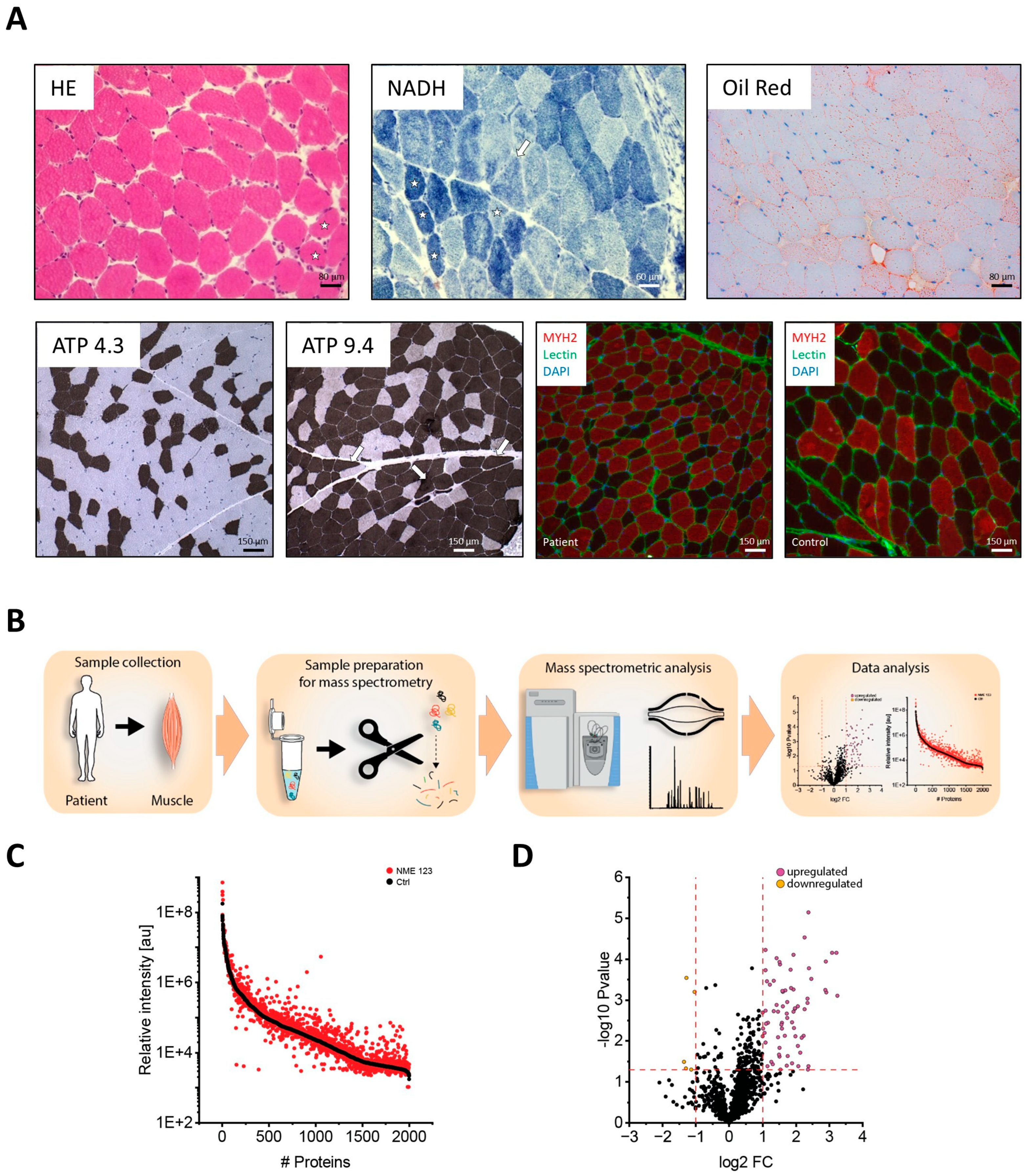
3.4. Microscopic Findings
3.5. Proteomic Findings
4. Discussion
Supplementary Materials
Author Contributions
Funding
Institutional Review Board Statement
Informed Consent Statement
Data Availability Statement
Acknowledgments
Conflicts of Interest
Abbreviations
| A2M | Alpha-2-macroglobulin |
| ACTA1 | Actin alpha 1 |
| ADHD | Attention deficit hyperactivity disorder |
| APOA1/2/4 | Apolipoprotein A1/2/4 |
| APOB | Apolipoprotein B |
| APOE | Apolipoprotein E |
| ASD | Autism spectrum disorder |
| BPGM | Bisphosphoglycerate mutase |
| C1QC | Complement C1q C Chain |
| C3 | Complement Component 3 |
| C4BPA | Complement Component 4 Binding Protein Alpha |
| CADD | Combined Annotation Dependent Depletion |
| CFB | Complement factor B |
| EEG | Electroencephalogram |
| EID3 | EP300 Interacting Inhibitor of Differentiation 3 |
| gnomAD | The Genome Aggregation Database |
| GPAP | RD-Connect Genome Phenome Analysis Platform |
| H4K20 | Histone H4 at lysine 20 |
| HBA1 | Hemoglobin subunit alpha 1 |
| HBB | Hemoglobin subunit beta |
| HBD | Hemoglobin subunit delta |
| HBG1 | Hemoglobin Subunit Gamma 1 |
| HP | Haptoglobin |
| ITIH1/2/4 | Inter-alpha-trypsin inhibitor, heavy chain 1/2/4 |
| KMT5B | Lysine-specific methyltransferase 5B |
| LDHB | Lactate Dehydrogenase B |
| LRG1 | Leucine-rich alpha-2-glycoprotein 1 |
| MAF | Minor Allele frequency |
| MRI | Magnetic resonance imaging |
| MYL2 | Myosin light chain-2 |
| NDUFB3 | NADH: Ubiquinone Oxidoreductase Subunit B3 |
| NDUFB8 | NADH: Ubiquinone Oxidoreductase Subunit B8 |
| NMJ | Neuromuscular junction |
| ORM2 | Orosomucoid 2 |
| PKLR | Pyruvate Kinase L/R |
| PolyPhen-2 | Polymorphism phenotyping v2 |
| PRDX2 | Peroxiredoxin 2 |
| REVEL | Rare Exome Variant Ensemble Learner |
| S100A8 | S100 calcium-binding protein A8 |
| S100A9 | S100 calcium-binding protein A9 |
| SERPINA1/3 | Serpin family A member 1/3 |
| SIFT | Sorting Intolerant from Tolerant |
| SLC2A1 | Solute carrier family 2, member 1 |
| TNNI2 | Troponin I2 |
| VTN | Vitronectin |
References
- Bromberg, K.D.; Mitchell, T.R.H.; Upadhyay, A.K.; Jakob, C.G.; Jhala, M.A.; Comess, K.M.; Lasko, L.M.; Li, C.; Tuzon, C.T.; Dai, Y.; et al. The SUV4-20 inhibitor A-196 verifies a role for epigenetics in genomic integrity. Nat. Chem. Biol. 2017, 13, 317–324. [Google Scholar] [CrossRef] [PubMed]
- Wu, H.; Siarheyeva, A.; Zeng, H.; Lam, R.; Dong, A.; Wu, X.-H.; Li, Y.; Schapira, M.; Vedadi, M.; Min, J. Crystal structures of the human histone H4K20 methyltransferases SUV420H1 and SUV420H2. FEBS Lett. 2013, 587, 3859–3868. [Google Scholar] [CrossRef] [PubMed]
- Wang, Z.-J.; Rein, B.; Zhong, P.; Williams, J.; Cao, Q.; Yang, F.; Zhang, F.; Ma, K.; Yan, Z. Autism risk gene KMT5B deficiency in prefrontal cortex induces synaptic dysfunction and social deficits via alterations of DNA repair and gene transcription. Neuropsychopharmacology 2021, 46, 1617–1626. [Google Scholar] [CrossRef] [PubMed]
- Sheppard, S.E.; Bryant, L.; Wickramasekara, R.N.; Vaccaro, C.; Robertson, B.; Hallgren, J.; Hulen, J.; Watson, C.J.; Faundes, V.; Duffourd, Y.; et al. Mechanism of KMT5B haploinsufficiency in neurodevelopment in humans and mice. Sci. Adv. 2023, 9, eade1463. [Google Scholar] [CrossRef] [PubMed]
- Chen, G.; Han, L.; Tan, S.; Jia, X.; Wu, H.; Quan, Y.; Zhang, Q.; Yu, B.; Hu, Z.; Xia, K.; et al. Loss-of-function of KMT5B leads to neurodevelopmental disorder and impairs neuronal development and neurogenesis. J. Genet. Genom. 2022, 49, 881–890. [Google Scholar] [CrossRef] [PubMed]
- Hulen, J.; Kenny, D.; Black, R.; Hallgren, J.; Hammond, K.G.; Bredahl, E.C.; Wickramasekara, R.N.; Abel, P.W.; Stessman, H.A.F. KMT5B is required for early motor development. Front. Genet. 2022, 13, 901228. [Google Scholar] [CrossRef] [PubMed]
- Neguembor, M.V.; Xynos, A.; Onorati, M.C.; Caccia, R.; Bortolanza, S.; Godio, C.; Pistoni, M.; Corona, D.F.; Schotta, G.; Gabellini, D. FSHD muscular dystrophy region gene 1 binds Suv4-20h1 histone methyltransferase and impairs myogenesis. J. Mol. Cell Biol. 2013, 5, 294–307. [Google Scholar] [CrossRef] [PubMed]
- Wickramasekara, R.N.; Stessman, H.A.F. Histone 4 Lysine 20 Methylation: A Case for Neurodevelopmental Disease. Biology 2019, 8, 11. [Google Scholar] [CrossRef] [PubMed]
- Faundes, V.; Newman, W.G.; Bernardini, L.; Canham, N.; Clayton-Smith, J.; Dallapiccola, B.; Davies, S.J.; Demos, M.K.; Goldman, A.; Gill, H.; et al. Histone Lysine Methylases and Demethylases in the Landscape of Human Developmental Disorders. Am. J. Hum. Genet. 2018, 102, 175–187. [Google Scholar] [CrossRef] [PubMed]
- Trinh, J.; Kandaswamy, K.K.; Werber, M.; Weiss, M.E.R.; Oprea, G.; Kishore, S.; Lohmann, K.; Rolfs, A. Novel pathogenic variants and multiple molecular diagnoses in neurodevelopmental disorders. J. Neurodev. Disord. 2019, 11, 11. [Google Scholar] [CrossRef] [PubMed]
- Eliyahu, A.; Barel, O.; Greenbaum, L.; Zaks Hoffer, G.; Goldberg, Y.; Raas-Rothschild, A.; Singer, A.; Bar-Joseph, I.; Kunik, V.; Javasky, E.; et al. Refining the Phenotypic Spectrum of KMT5B-Associated Developmental Delay. Front. Pediatr. 2022, 10, 844845. [Google Scholar] [CrossRef] [PubMed]
- Politano, D.; Borgatti, R.; Borgonovi, G.; Cistaro, A.; Danesino, C.; Fania, P.; Garghetti, G.; Guala, A.; Orlando, I.; Schiera, I.G.; et al. Bridging Genotype to Phenotype in KMT5B-Related Syndrome: Evidence from RNA-Seq, 18FDG-PET, Clinical Deep Phenotyping in Two New Cases, and a Literature Review. Genes 2025, 16, 1174. [Google Scholar] [CrossRef] [PubMed]
- Dubowitz, V.; Sewry, C.A.; Oldfors, A.; Lane, R.J.M. Muscle Biopsy: A Practical Approach: Expert Consult, 5th ed.; Elsevier: Amsterdam, The Netherlands, 2020. [Google Scholar]
- Fischer, J.C.; Ruitenbeek, W.; Gabreëls, F.J.M.; Janssen, A.J.M.; Renier, W.O.; Sengers, R.C.A.; Stadhouders, A.M.; Ter Laak, H.J.; Trijbels, J.M.F.; Veerkamp, J.H. A mitochondrial encephalomyopathy: The first case with an established defect at the level of coenzyme Q. Eur. J. Pediatr. 1986, 144, 441–444. [Google Scholar] [CrossRef] [PubMed]
- Pauper, M.; Hentschel, A.; Tiburcy, M.; Beltran, S.; Ruck, T.; Schara-Schmidt, U.; Roos, A. Proteomic Profiling Towards a Better Understanding of Genetic Based Muscular Diseases: The Current Picture and a Look to the Future. Biomolecules 2025, 15, 130. [Google Scholar] [CrossRef] [PubMed]
- Satterstrom, F.K.; Kosmicki, J.A.; Wang, J.; Breen, M.S.; De Rubeis, S.; An, J.-Y.; Peng, M.; Collins, R.; Grove, J.; Klei, L.; et al. Large-Scale Exome Sequencing Study Implicates Both Developmental and Functional Changes in the Neurobiology of Autism. Cell 2020, 180, 568–584.e23. [Google Scholar] [CrossRef] [PubMed]
- Richards, S.; Aziz, N.; Bale, S.; Bick, D.; Das, S.; Gastier-Foster, J.; Grody, W.W.; Hegde, M.; Lyon, E.; Spector, E.; et al. Standards and guidelines for the interpretation of sequence variants: A joint consensus recommendation of the American College of Medical Genetics and Genomics and the Association for Molecular Pathology. Genet. Med. 2015, 17, 405–424. [Google Scholar] [CrossRef] [PubMed]
- Gumucio, J.P.; Qasawa, A.H.; Ferrara, P.J.; Malik, A.N.; Funai, K.; Mcdonagh, B.; Mendias, C.L. Reduced mitochondrial lipid oxidation leads to fat accumulation in myosteatosis. FASEB J. 2019, 33, 7863–7881. [Google Scholar] [CrossRef] [PubMed]
- Della Marina, A.; Arlt, A.; Schara-Schmidt, U.; Depienne, C.; Gangfuß, A.; Kölbel, H.; Sickmann, A.; Freier, E.; Kohlschmidt, N.; Hentschel, A.; et al. Phenotypical and Myopathological Consequences of Compound Heterozygous Missense and Nonsense Variants in SLC18A3. Cells 2021, 10, 3481. [Google Scholar] [CrossRef] [PubMed]
- Fraiman, Y.S.; Wojcik, M.H. The influence of social determinants of health on the genetic diagnostic odyssey: Who remains undiagnosed, why, and to what effect? Pediatr. Res. 2021, 89, 295–300. [Google Scholar] [CrossRef] [PubMed]

Disclaimer/Publisher’s Note: The statements, opinions and data contained in all publications are solely those of the individual author(s) and contributor(s) and not of MDPI and/or the editor(s). MDPI and/or the editor(s) disclaim responsibility for any injury to people or property resulting from any ideas, methods, instructions or products referred to in the content. |
© 2025 by the authors. Licensee MDPI, Basel, Switzerland. This article is an open access article distributed under the terms and conditions of the Creative Commons Attribution (CC BY) license (https://creativecommons.org/licenses/by/4.0/).
Share and Cite
Aksel Kilicarslan, O.; Gangfuß, A.; Kölbel, H.; Muhmann, D.; Polavarapu, K.; Thompson, R.; Schmitt, L.-I.; Lessard, L.; Chen, L.; Eisenkölbl, A.; et al. Combined Histological and Proteomic Analysis Reveals Muscle Denervation in KMT5B-Related Neurodevelopmental Disorder: A Case Report. J. Clin. Med. 2025, 14, 8636. https://doi.org/10.3390/jcm14248636
Aksel Kilicarslan O, Gangfuß A, Kölbel H, Muhmann D, Polavarapu K, Thompson R, Schmitt L-I, Lessard L, Chen L, Eisenkölbl A, et al. Combined Histological and Proteomic Analysis Reveals Muscle Denervation in KMT5B-Related Neurodevelopmental Disorder: A Case Report. Journal of Clinical Medicine. 2025; 14(24):8636. https://doi.org/10.3390/jcm14248636
Chicago/Turabian StyleAksel Kilicarslan, Ozge, Andrea Gangfuß, Heike Kölbel, David Muhmann, Kiran Polavarapu, Rachel Thompson, Linda-Isabell Schmitt, Lola Lessard, Lei Chen, Astrid Eisenkölbl, and et al. 2025. "Combined Histological and Proteomic Analysis Reveals Muscle Denervation in KMT5B-Related Neurodevelopmental Disorder: A Case Report" Journal of Clinical Medicine 14, no. 24: 8636. https://doi.org/10.3390/jcm14248636
APA StyleAksel Kilicarslan, O., Gangfuß, A., Kölbel, H., Muhmann, D., Polavarapu, K., Thompson, R., Schmitt, L.-I., Lessard, L., Chen, L., Eisenkölbl, A., Schara-Schmidt, U., Hentschel, A., Lochmüller, H., & Roos, A. (2025). Combined Histological and Proteomic Analysis Reveals Muscle Denervation in KMT5B-Related Neurodevelopmental Disorder: A Case Report. Journal of Clinical Medicine, 14(24), 8636. https://doi.org/10.3390/jcm14248636