


Abstract
Allogeneic hematopoietic stem cell transplantation (allo-HCT) is a potentially curative treatment modality, frequently used for patients suffering from haematological malignancies. In the last two decades, there have been multiple randomised controlled trials (RCTs), review articles, and meta-analyses addressing the efficacy of rabbit anti-thymocyte globulin (r-ATG) as a graft-versus-host disease (GvHD) prophylaxis. Nevertheless, only a few aimed to compare the effectiveness of different r-ATG formulations. Since the last article we retrieved comparing different r-ATGs in GvHD prophylaxis dates back to 2017, we performed a systematic literature review of articles published since 2017 to this day, utilising PubMed, Scopus, Cochrane, and MEDLINE, with the main endpoints being prophylaxis of acute GvHD (aGvHD) and chronic GvHD (cGvHD). We subjected to scrutiny a total of five studies, of which four compared the differences between Thymoglobulin (ATG-T) and Grafalon (ATG-G), and one discussed the impact of ATG-T dose. Overall, cGvHD, aGvHD grades II–IV, TRM, OS, NRM, LFS, relapse, overall infections, and EBV reactivation do not seem to be affected by the type of utilised rATG. However, data on aGvHD grades III–IV, GRFS, moderate–severe cGvHD, and CMV reactivation is conflicting. Through our research, we sought to summarise the most recent findings concerning r-ATGs in allo-HCT, and provide insight into the differences between the targets and origin of various ATG formulations.
1. Introduction
GvHD stands as a paramount allo-HCT complication [1,2], as it detrimentally impacts both the duration and quality of life for post-transplant patients [3]. Elevated T cell count, HLA mismatch, and the employment of peripheral blood stem cells (PBSC) as a major transplant material nowadays represent factors of vulnerability for both aGvHD and cGvHD [4,5,6,7]. In spite of the administration of calcineurin inhibitors (CNIs) in conjunction with methotrexate (MTX) as prophylaxis of GvHD, numerous patients, ranging from 30% to 50%, develop aGvHD [8], while cGvHD persists in 30% to 70% of cases [9]. Hence, emphasis is put on developing appropriate immunosuppressive strategies that will not negatively affect the post-transplantation course.
In Europe, the prevailing therapeutic approach to prevent GvHD includes standard prophylaxis comprising CNIs, MTX, or mycophenolate mofetil in conjunction with one of the available r-ATGs for unrelated donor transplantation, and in recent years—for sibling as well [10]. There are a number of ATG formulations available in different countries, which originate from either rabbits, horses, or pigs, and are generated by the inoculation of human cell lines or human thymocytes. Porcine ATG (p-ATG) and horse ATG (h-ATG), as far as European countries are concerned, are rather rarely utilised medicaments. The former is employed in cases of severe aplastic anaemia in China and India and, to a lesser extent, in the context of allo-HCT [11,12], while the latter is considered the first-line therapy for moderate–severe aplastic anaemia [13] and GvHD prophylaxis [14].
There are currently two types of rATGs, which consist of polyclonal IgG obtained from the hyperimmune sera of rabbits. These IgG antibodies are immunised either with human thymocytes in the case of ATG-T (anti-thymocyte globulin, Thymoglobulin; Sanofi, Paris, France; formerly Genzyme), or with human Jurkat leukaemia T-cell lines in the case of ATG-G (anti-T-lymphocyte globulin, Grafalon; Neovii, Raperswil, Switzerland; formerly Fresenius) [15]. Furthermore, ATG-T and ATG-G differ also in the antigens to which they bind. ATG-T targets antigens expressed on T cells (CD2, CD3, CD4, CD6, CD8), B cells, natural killer cells, macrophages, and dendritic cells, HLA class 1 and HLA-DR [16]. ATG-T also contains antibodies that specifically target antigens associated with cellular adhesion and trafficking, along with antigens implicated in inflammation, apoptosis, and cellular proliferation [16]. The range of antigens recognised by ATG-G is narrower in comparison to that of ATG-T, as ATG-G contains few or no antibodies targeting CD3, CD4, or HLA-DR [17,18]. However, ATG-G has more antibodies directed against CD107, an antigen expressed on T cells during degranulation following antigenic stimulation [18]. Competitive binding experiments have revealed that ATG-T presents higher reactivity and a more potent complement-mediated cytotoxic effect towards peripheral blood mononuclear cells than ATG-G, and more effectively induces apoptosis of dendritic cells compared to ATG-G when equal doses of the two formulations are used. Hence, higher doses of ATG-G are administered in GvHD prophylaxis than ATG-T, as demonstrated in Table 1. The immunological consequences of ATG are also influenced by various factors, including the cumulative dosage, timing of administration in relation to allo-HCT, and the lymphocyte count of the recipient at the time of the transplantation. Higher doses of ATG, closer timing to transplantation, and lower host total lymphocyte count can result in prolonged exposure to ATG following the infusion of donor T cells [4]. This, in turn, delays immune reconstitution [19,20], thus increasing the potential for relapse, susceptibility to infections, and the development of post-transplant lymphoproliferative disorders [21]. Consequently, these factors are to be considered when assessing the outcomes when administering ATG.

Table 1.
Types of ATG and summary of their main characteristics. Abbreviations: h-ATG—horse ATG, ATG-T—Thymoglobuline, Genzyme, ATG-G—Grafalon, Fresenius. Based on the chart by Baron et al. [15].
According to the recommendations from an expert panel by Bonifazi et al. [21], ATG-T and ATG-G are strongly recommended as part of a myeloablative conditioning (MAC) regimen prior to bone marrow (BM) and PBSC allo-HCT from a matched or mismatched unrelated donor (MUD/MMUD), as prophylaxis of aGvHD and cGvHD. With limited evidence, ATG-T and ATG-G are also recommended prior to matched related donor (MRD) PBSC allo-HCT. In instances of reduced intensity or nonmyeloablative conditioning (RIC/NMA) regimens, being aware of a higher risk of relapse, ATG-T, and ATG-G are also efficacious in preventing aGvHD and cGvHD. Studies have also shown that ATG can effectively reduce the occurrence of GvHD and prolong the survival of patients who have undergone allo-HCT from unrelated donors (URDs) and haploidentical donors, without increasing relapse rates [22,23].
2. Materials and Methods
2.1. Systematic Literature Review
We performed a systematic literature review through PubMed, Scopus, Cochrane, and MEDLINE, searching both separately and individually variants of the following keywords: anti-thymocyte globulin, acute graft-versus-host disease, chronic graft-versus-host disease, allogeneic stem cell transplantation, Thymoglobulin, Grafalon (Supplementary Materials). Moreover, we analysed the references of various meta-analyses, reviews and studies. The search was conducted from 1 January 2017 to 14 June 2023, since the last article we retrieved comparing different r-ATGs in GvHD prophylaxis dates back to 2017 [24]. Studies were included that addressed r-ATG formulations in the context of GvHD prophylaxis and, additionally, reported data on overall survival (OS), transplantation-related mortality (TRM), non-relapse mortality (NRM), graft-versus-host/relapse-free survival (GRFS), leukaemia-free survival (LFS), relapse, and reactivations of infections, including CMV and EBV. The titles and abstracts were screened first, followed by the full text. Citations were excluded for the following reasons: economic outcomes, study phase, intervention, disease, design of the study, patient population, non-English.
2.2. Data Presentation, Extraction and Endpoints
All the available data from the studies reporting on rates, hazard ratios (HRs) with or without 95% confidence intervals (CIs) was extracted, following the endpoints: cGvHD (all grades), aGvHD grade II–IV, aGvHD grade III–IV, OS, TRM, NRM, GRFS, LFS, relapse, and infection reactivations. Not all of the endpoints were discussed in each article. We present the details about each study in Figure 1, while each outcome, if reported, is noted in Table 2 and Table 3.

Figure 1.
Summary of Risk of Bias Assessment tool for Non-randomized Studies (RoBANS) [25,26,27,28,29].
Table 2.
Endpoints with reported and extracted data. Abbreviations: ATG-T—Thymoglobulin, Genzyme, ATG-G—Grafalon, Fresenius, BM—bone marrow, PBSC—peripheral blood stem cells, AML—acute myeloid leukaemia, CML—chronic myeloid leukaemia, ALL—acute lymphoblastic leukaemia, MDS—myelodysplastic syndrome, MPNs—myeloproliferative neoplasms, ALAL—acute leukaemia with ambiguous lineage, FLU—fludarabine, BU—busulfan, CY—cyclophosphamide, MUD—matched unrelated donor, MRD—matched related donor, MMRD—mismatched related donor, MMUD—mismatched unrelated donor, URD—unrelated donor, Haplo—haploidentical donor, NR—not reported.
Table 3.
Reported and extracted endpoints. Abbreviations: ATG-T—Thymoglobulin, Genzyme, ATG-G—Grafalon, Fresenius, OS—overall survival, TRM—transplantation-related mortality, NRM—non-relapse mortality, GRFS—graft-versus-host/relapse-free survival, LFS—leukaemia-free survival, NR—not reported.
2.3. Risk of Bias Assessment
We evaluated the eligible studies identified during the study selection process, as delineated above, to determine their methodological quality and risk of bias. The quality assessment heavily relied on details regarding the trial’s design, implementation, data analysis, and outcome reporting. A validity assessment form, comprising the following elements as recommended by the Risk of Bias Assessment tool for Non-randomized Studies (RoBANS), was employed to evaluate quality and potential for bias: selection of participants, incomplete outcome data, confounding variables, measurement of exposure, blinding of outcome assessments, selective outcome reporting. The summary of the risk of bias assessment is presented in Figure 1.
3. Results
Results—Systematic Literature Review
We retrieved a total of 1547 citations from the aforementioned databases. After removing duplicates 749 citations were left, and after a screening process considering titles and abstracts we excluded 730 articles from further analysis. In the next phase, 19 full texts were screened, of which five have been included in our review article. The flowchart of the identification of studies has been shown in Figure 2.
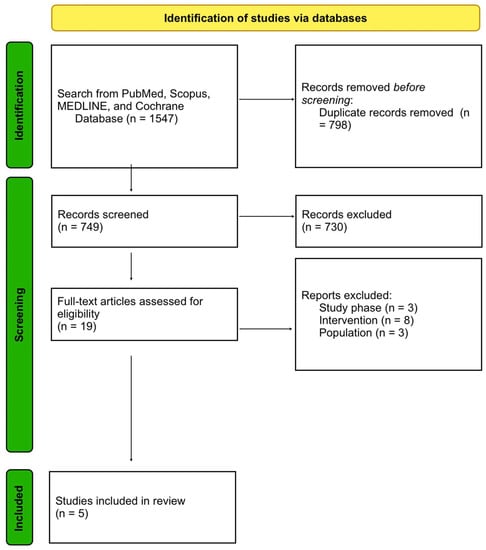
Figure 2.
PRISMA flow diagram of the study selection process.
The citations consist of five full-text retrospective analyses published between 2017 and 2023, four of which carried out a comprehensive comparison of the effectiveness of ATG-T (anti-thymocyte globulin, Thymoglobulin; Sanofi, Paris, France; formerly Genzyme) and ATG-G (anti-T-lymphocyte globulin, Grafalon; Neovii, Raperswil, Switzerland; formerly Fresenius) [25,26,27,28], and one compared the outcomes of different ATG-T doses [29]. The overall population comprised 783 patients (ATG-T, n = 591; ATG-G, n = 192). Note that one of the articles’ population was paediatric [26].
4. Outcomes
In terms of overall cGvHD, aGvHD grades II–IV, TRM, OS, NRM, LFS, relapse, overall infections, and EBV reactivation, none of the included studies reported differences between ATG-T and ATG-G. There are discrepancies concerning the occurrence of aGvHD grades III–IV, as one of the studies revealed a significantly lower incidence when utilising ATG-G vs ATG-T (0% vs. 12%, p = 0.025) [26], while another has shown the opposite, with ATG-T being more effective in comparison to ATG-G (2.27% vs. 17.39%, p = 0.026) [27]. As for GRFS, one of the studies has confirmed the efficacy of instituting ATG-G vs ATG-T (67.4% vs. 41.9%, p = 0.042) [25], and low-dose ATG-T seems to lead to a longer GRFS compared to ATG-G (43.1% vs. 32.4%, p = 0.014) [29]. A major reduction in CMV reactivations has been observed in one study, with ATG-G causing substantially less of these than ATG-T (29.9% vs. 64.6%, p < 0.001) [28].
5. Discussion
This systematic review addressing the efficacy of various r-ATG formulations in the context of allo-HCT included five retrospective studies published between 2017 and 2023 with a total of 783 participants. Our main findings upon an in-depth analysis of these are discrepant results concerning more severe forms of aGvHD (grades III–IV), GRFS, and CMV reactivation. Changes in overall cGvHD, aGvHD grades II–IV, TRM, OS, NRM, LFS, relapse, overall infections, and EBV reactivation were statistically insignificant.
In spite of a serious progress in transplantation procedures, GvHD remains one of the major and most severe complications following allo-HCT [1,2], negatively affecting the patient’s quality of life and, in more advanced grades, GvHD may prove fatal [30]. Hence, an effort is made to find the most effective GvHD prophylaxis regimen, which would limit the occurrence of GvHD, while maintaining a satisfactory graft-versus-leukaemia (GvL) effect and low incidence of fatal infection reactivations. It is important, especially in patients undergoing allo-HCT from MMRD or MMUD with PBSC, which are well-known risk factors for GvHD [4,6]. ATG is a commonly employed approach for in vivo depletion of T cells, aiming to mitigate the occurrence of GvHD in patients undergoing HLA-matched or HLA-mismatched allo-HCT [31]. While there have been numerous studies confirming the feasibility of ATG in GvHD prophylaxis [32,33,34,35,36,37], very few discussed the impact of different r-ATG formulations.
Recently, four meta-analyses discussing the efficacy of ATG-T and ATG-G have been published [24,31,37,38]. None of them found any differences in terms of OS and NRM regardless of the rATG type in both related and unrelated donor settings [24,31,37,38]. Furthermore, Kumar et al. performed a subgroup analysis of OS and NRM according to ATG-T doses of <6 mg/kg and >6 mg/kg total, indicating no major impact of ATG-T doses on OS and NRM [31]. Soiffer et al. [39] addressed the efficacy of ATG-G in patients with haematological malignancies in an ATG-G vs placebo in MUD allo-HCT settings. The obtained results suggest that the use of ATG-G does not affect OS [39]. Similarly, Kroger et al. [34] conducted a study comparing ATG-G vs. no ATG-G in MRD allo-HCT, which implied the lack of ATG-G influence on OS. These outcomes are in line with what we discovered through an analysis of the articles included in Figure 1 and Table 2, with no major impact of neither ATG-T nor ATG-G on OS and NRM [25,26,27,28,29]. As for TRM, the outcomes of both our analysis of articles [25,26,27,28,29] and the network meta-analysis by Gagelmann et al. [24] are conforming, suggesting a comparable influence of ATG-G/ATG-T on TRM.
In terms of aGvHD and cGvHD, the aforementioned four meta-analyses on ATG-T/ATG-G found a significant reduction of GvHD incidence regardless of the instituted rATG formulation [24,31,37,38]. However, a network meta-analysis by Gagelmann et al. [24] indicated a higher efficacy of ATG-G in preventing cGvHD and aGvHD compared to ATG-T and standard treatment. Numerous studies suggest the effectiveness of both ATG-T and ATG-G in GvHD prophylaxis independently of the donor setting, as articles have already been published indicating their effectiveness in haploidentical allo-HCT [40,41,42], MRD allo-HCT [21], and MUD/MMUD allo-HCT [21]. Our review unveiled contrasting results concerning severe forms of aGvHD (grades III–IV), where one study revealed a higher effectiveness of ATG-T vs. ATG-G (2.27% vs. 17.39%, p = 0.026) [27], while another proved ATG-G to be more efficacious compared to ATG-T (0% vs. 12%, p = 0.025) [26]. Overall cGvHD and aGvHD grades II–IV did not seem to be affected by the utilised type of rATG [25,26,27,28,29]. The study by Polverelli et al. [25] revealed an interesting finding concerning GvHD prophylaxis comparing ATG-T vs. ATG-G in MUD allo-HCT. Despite finding no statistically significant differences between the two rATGs in terms of aGvHD and overall cGvHD, a reduced moderate–severe cGVHD occurrence was noticed in the ATG-G group (20% vs. 75%, p = 0.05) [25]. Moreover, in a MUD setting, a longer GRFS has been linked to ATG-G compared to ATG-T (67.4% vs. 41.9%, p = 0.042) [25]. In a different study comparing low-dose and high-dose ATG-T in MUD allo-HCT, a better GRFS has been associated with low-dose ATG-T rather than high-dose ATG-T in MUD allo-HCT (43.1% vs. 32.4%, p = 0.014) [29]. There are discrepancies about relapse, as contrary to the findings of both our review [25,26,27,28,29] and other researchers’ meta-analyses [30,32,39], Kumar et al. [31] reported a higher risk of disease relapse when employing ATG-T/ATG-G.
ATG-T and ATG-G target various antigens expressed on the surface of immune cells, with the spectrum of the former being much broader, resulting in a significantly stronger T-cell-depleting effect [16,17,18]. The administration of ATG-G and ATG-T, by inducing a delayed immune reconstitution [19,20], potentially elevates the risk of infections [43,44]. Due to divergent outcomes resulting from variations in rATG dosage, there is an ongoing debate about how strong of an impact it has on infection reactivations [21]. Despite there not being a consensus on this matter, most studies corroborate an overall tendency towards an increased risk of infection in patients subjected to higher rATG doses [45,46,47]. According to the studies we analysed in our review [25,26,27,28,29], neither the type of utilised rATG nor the doses have a significant influence on EBV reactivation and the overall occurrence of infections. As for CMV reactivation, most of the articles did not show any differences between ATG-T/ATG-G [25,26,27] and doses of ATG-T [29]. Interestingly, there has been a recent report that demonstrated a substantial difference in CMV reactivation in favour of ATG-G compared to ATG-T in an URD setting (29.9% vs. 64.6%, p < 0.001) [28]. The stronger immunosuppressive effect of ATG-T administered at a dosage of 10 mg/kg in contrast to ATG-G at a dosage of 20 mg/kg may be a potential explanation for this result [28]. In support of this hypothesis, two studies provided evidence of a connection between ATG-T at 10 mg/kg and a delayed T-cell reconstitution in comparison to ATG-G when utilised in doses of 25 mg/kg to 45–60 mg/kg [26,48]. Nowadays, while letermovir is a widely employed CMV prophylaxis in seropositive allo-HCT recipients, further research is mandatory in order to establish the most appropriate approach.
This article also has some limitations. First, it does not comprise a network meta-analysis and methodological quality assessment. Second, all of the included studies are retrospective with, in some instances, not very large sample sizes, and the distribution of baseline characteristics of patients may have been uneven. However, the overall risk of bias of the included studies was judged to be moderate. Thus, the data collected in our study might be inadequate to establish the robustness of the conclusions. To validate these findings, there is still a requirement for multicentre, large-scale, prospective, randomised controlled trials.
In conclusion, the type of utilised rATG does not seem to affect overall cGvHD, aGvHD grades II–IV, TRM, OS, NRM, LFS, relapse, overall infections and EBV reactivation. However, we have found conflicting results in what concerns aGvHD grades III–IV, moderate–severe cGvHD, GRFS, and CMV reactivations. In addition to the most adequate rATG formulation, the optimal timing, dosage and blood concentration of rATG are yet to be determined.
Supplementary Materials
The following supporting information can be downloaded at: https://www.mdpi.com/article/10.3390/jcm12175449/s1, File S1: PRISMA-P (Preferred Reporting Items for Systematic review and Meta-Analysis Protocols) 2015 checklist: recommended items to address in a systematic review protocol. Reference [49] is cited in the supplementary materials.
Author Contributions
Conceptualization U.G. and J.D.; writing—original draft preparation, U.G., J.D. and J.P.; investigation, U.G., J.M. and A.B.; writing—review and editing, U.G., J.D. and J.P.; supervision, J.D. and M.M.-D. All authors have read and agreed to the published version of the manuscript.
Funding
This research received no external funding.
Institutional Review Board Statement
Not applicable.
Informed Consent Statement
Not applicable.
Data Availability Statement
Not applicable.
Conflicts of Interest
The authors declare no conflict of interest.
Abbreviations
The following abbreviations have been used in this manuscript:
| AML | acute myeloid leukaemia |
| ALAL | acute leukaemia with ambiguous lineage |
| ALL | acute lymphoblastic leukaemia |
| allo-HCT | allogeneic hematopoietic stem cell transplantation |
| ATG-G | Grafalon |
| ATG-T | Thymoglobulin |
| h-ATG | horse ATG |
| p-ATG | porcine ATG |
| BM | bone marrow |
| BU | busulfan |
| CIs | confidence intervals |
| CML | chronic myeloid leukaemia |
| CMV | cytomegalovirus |
| CNIs | calcineurin inhibitors |
| CY | cyclophosphamide |
| EBV | Epstein-Barr virus |
| FLU | fludarabine |
| GRFS | graft-versus-host/relapse-free survival |
| GvHD | graft-versus-host disease |
| aGvHD | acute graft-versus-host disease |
| cGvHD | chronic graft-versus-host disease |
| GvL | graft-versus-leukaemia |
| Haplo | haploidentical donor |
| HRs | hazard ratios |
| LFS | leukaemia-free survival |
| MAC | myeloablative conditioning |
| MDS | myelodysplastic syndrome |
| MRD | matched related donor |
| MMRD | mismatched related donor |
| MUD | matched unrelated donor |
| MMUD | mismatched unrelated donor |
| MPNs | myeloproliferative neoplasms |
| MTX | methotrexate |
| NMA | nonmyeloablative conditioning |
| NR | not reported |
| NRM | non-relapse mortality |
| OS | overall survival |
| PBSC | peripheral blood stem cells |
| r-ATG | rabbit anti-thymocyte globulin |
| RCTs | randomised controlled trials |
| RIC | reduced intensity conditioning |
| TRM | transplantation-related mortality |
| URD | unrelated donor |
References
- Wingard, J.R.; Majhail, N.S.; Brazauskas, R.; Wang, Z.; Sobocinski, K.A.; Jacobsohn, D.; Sorror, M.L.; Horowitz, M.M.; Bolwell, B.; Rizzo, J.D.; et al. Long-Term Survival and Late Deaths after Allogeneic Hematopoietic Cell Transplantation. J. Clin. Oncol. 2011, 29, 2230–2239. [Google Scholar] [CrossRef] [PubMed]
- Martin, P.J.; Counts, G.W.; Appelbaum, F.R.; Lee, S.J.; Sanders, J.E.; Deeg, H.J.; Flowers, M.E.D.; Syrjala, K.L.; Hansen, J.A.; Storb, R.F.; et al. Life Expectancy in Patients Surviving More than 5 Years after Hematopoietic Cell Transplantation. J. Clin. Oncol. 2010, 28, 1011–1016. [Google Scholar] [CrossRef]
- Pidala, J.; Kurland, B.; Chai, X.; Majhail, N.; Weisdorf, D.J.; Pavletic, S.; Cutler, C.; Jacobsohn, D.; Palmer, J.; Arai, S.; et al. Patient-Reported Quality of Life Is Associated with Severity of Chronic Graft-versus-Host Disease as Measured by NIH Criteria: Report on Baseline Data from the Chronic GVHD Consortium. Blood 2011, 117, 4651–4657. [Google Scholar] [CrossRef] [PubMed]
- Watkins, B.; Williams, K.M. Controversies and Expectations for the Prevention of GVHD: A Biological and Clinical Perspective. Front. Immunol. 2022, 13, 1057694. [Google Scholar] [CrossRef] [PubMed]
- Arai, S.; Arora, M.; Wang, T.; Spellman, S.R.; He, W.; Couriel, D.R.; Urbano-Ispizua, A.; Cutler, C.S.; Bacigalupo, A.A.; Battiwalla, M.; et al. Increasing Incidence of Chronic Graft-versus-Host Disease in Allogeneic Transplantation: A Report from the Center for International Blood and Marrow Transplant Research. Biol. Blood Marrow Transplant. 2015, 21, 266–274. [Google Scholar] [CrossRef]
- Flowers, M.E.D.; Inamoto, Y.; Carpenter, P.A.; Lee, S.J.; Kiem, H.P.; Petersdorf, E.W.; Pereira, S.E.; Nash, R.A.; Mielcarek, M.; Fero, M.L.; et al. Comparative Analysis of Risk Factors for Acute Graft-versus-Host Disease and for Chronic Graft-versus-Host Disease According to National Institutes of Health Consensus Criteria. Blood 2011, 117, 3214–3219. [Google Scholar] [CrossRef]
- Anasetti, C.; Logan, B.R.; Lee, S.J.; Waller, E.K.; Weisdorf, D.J.; Wingard, J.R.; Cutler, C.S.; Westervelt, P.; Woolfrey, A.; Couban, S.; et al. Peripheral-Blood Stem Cells versus Bone Marrow from Unrelated Donors. N. Engl. J. Med. 2012, 367, 1487–1496. [Google Scholar] [CrossRef]
- Zeiser, R.; Blazar, B.R. Acute Graft-versus-Host Disease - Biologic Process, Prevention, and Therapy. N. Engl. J. Med. 2017, 377, 2167–2179. [Google Scholar] [CrossRef]
- Zeiser, R.; Blazar, B.R. Pathophysiology of Chronic Graft-versus-Host Disease and Therapeutic Targets. N. Engl. J. Med. 2017, 377, 2565–2579. [Google Scholar] [CrossRef]
- Ruutu, T.; Van Biezen, A.; Hertenstein, B.; Henseler, A.; Garderet, L.; Passweg, J.; Mohty, M.; Sureda, A.; Niederwieser, D.; Gratwohl, A.; et al. Prophylaxis and Treatment of GVHD after Allogeneic Haematopoietic SCT: A Survey of Centre Strategies by the European Group for Blood and Marrow Transplantation. Bone Marrow Transplant. 2012, 47, 1459–1464. [Google Scholar] [CrossRef]
- Chen, X.; Wei, J.; Huang, Y.; He, Y.; Yang, D.; Zhang, R.; Jiang, E.; Ma, Q.; Zhai, W.; Yao, J.; et al. Effect of Antithymocyte Globulin Source on Outcomes of HLA-Matched Sibling Allogeneic Hematopoietic Stem Cell Transplantation for Patients with Severe Aplastic Anemia. Biol. Blood Marrow Transplant. 2018, 24, 86–90. [Google Scholar] [CrossRef] [PubMed]
- Chen, M.; Liu, C.; Zhuang, J.; Zou, N.; Xu, Y.; Zhang, W.; Li, J.; Duan, M.; Zhu, T.; Cai, H.; et al. Long-Term Follow-up Study of Porcine Anti-Human Thymocyte Immunoglobulin Therapy Combined with Cyclosporine for Severe Aplastic Anemia. Eur. J. Haematol. 2016, 96, 291–296. [Google Scholar] [CrossRef] [PubMed]
- Scheinberg, P.; Nunez, O.; Weinstein, B.; Scheinberg, P.; Biancotto, A.; Wu, C.O.; Young, N.S. Horse versus Rabbit Antithymocyte Globulin in Acquired Aplastic Anemia. N. Engl. J. Med. 2011, 365, 430–438. [Google Scholar] [CrossRef] [PubMed]
- Kekre, N.; Zhang, Y.; Zhang, M.J.; Carreras, J.; Ahmed, P.; Anderlini, P.; Atta, E.H.; Ayas, M.; Boelens, J.J.; Bonfim, C.; et al. Effect of Antithymocyte Globulin Source on Outcomes of Bone Marrow Transplantation for Severe Aplastic Anemia. Haematologica 2017, 102, 1291–1298. [Google Scholar] [CrossRef] [PubMed]
- Baron, F.; Mohty, M.; Blaise, D.; Socié, G.; Labopin, M.; Esteve, J.; Ciceri, F.; Giebel, S.; Gorin, N.C.; Savani, B.N.; et al. Anti-Thymocyte Globulin as Graft-versus-Host Disease Prevention in the Setting of Allogeneic Peripheral Blood Stem Cell Transplantation: A Review from the Acute Leukemia Working Party of the European Society for Blood and Marrow Transplantation. Haematologica 2017, 102, 224–234. [Google Scholar] [CrossRef]
- Mohty, M. Mechanisms of Action of Antithymocyte Globulin: T-Cell Depletion and Beyond. Leukemia 2007, 21, 1387–1394. [Google Scholar] [CrossRef]
- Popow, I.; Leitner, J.; Majdic, O.; Kovarik, J.J.; Saemann, M.D.; Zlabinger, G.J.; Steinberger, P. Assessment of Batch to Batch Variation in Polyclonal Antithymocyte Globulin Preparations. Transplantation 2012, 93, 32–40. [Google Scholar] [CrossRef]
- Popow, I.; Leitner, J.; Grabmeier-Pfistershammer, K.; Majdic, O.; Zlabinger, G.J.; Kundi, M.; Steinberger, P. A Comprehensive and Quantitative Analysis of the Major Specificities in Rabbit Antithymocyte Globulin Preparations. Am. J. Transplant. 2013, 13, 3103–3113. [Google Scholar] [CrossRef]
- Servais, S.; Menten-Dedoyart, C.; Beguin, Y.; Seidel, L.; Gothot, A.; Daulne, C.; Willems, E.; Delens, L.; Humblet-Baron, S.; Hannon, M.; et al. Impact of Pre-Transplant Anti-T Cell Globulin (ATG) on Immune Recovery after Myeloablative Allogeneic Peripheral Blood Stem Cell Transplantation. PLoS ONE 2015, 10, e0130026. [Google Scholar] [CrossRef]
- Bosch, M.; Dhadda, M.; Hoegh-Petersen, M.; Liu, Y.; Hagel, L.M.; Podgorny, P.; Ugarte-Torres, A.; Khan, F.M.; Luider, J.; Auer-Grzesiak, I.; et al. Immune Reconstitution after Anti-Thymocyte Globulin-Conditioned Hematopoietic Cell Transplantation. Cytotherapy 2012, 14, 1258–1275. [Google Scholar] [CrossRef]
- Bonifazi, F.; Rubio, M.T.; Bacigalupo, A.; Boelens, J.J.; Finke, J.; Greinix, H.; Mohty, M.; Nagler, A.; Passweg, J.; Rambaldi, A.; et al. Rabbit ATG/ATLG in Preventing Graft-versus-Host Disease after Allogeneic Stem Cell Transplantation: Consensus-Based Recommendations by an International Expert Panel. Bone Marrow Transplant. 2020, 55, 1093–1102. [Google Scholar] [CrossRef] [PubMed]
- Walker, I.; Panzarella, T.; Couban, S.; Couture, F.; Devins, G.; Elemary, M.; Gallagher, G.; Kerr, H.; Kuruvilla, J.; Lee, S.J.; et al. Addition of Anti-Thymocyte Globulin to Standard Graft-versus-Host Disease Prophylaxis versus Standard Treatment Alone in Patients with Haematological Malignancies Undergoing Transplantation from Unrelated Donors: Final Analysis of a Randomised, Open-Label, Multicentre, Phase 3 Trial. Lancet Haematol. 2020, 7, e100–e111. [Google Scholar] [CrossRef] [PubMed]
- El-Cheikh, J.; Devillier, R.; Dulery, R.; Massoud, R.; Al Chami, F.; Ghaoui, N.; Moukalled, N.; Pagliardini, T.; Marino, F.; Malard, F.; et al. Impact of Adding Antithymocyte Globulin to Posttransplantation Cyclophosphamide in Haploidentical Stem-Cell Transplantation. Clin. Lymphoma Myeloma Leuk. 2020, 20, 617–623. [Google Scholar] [CrossRef] [PubMed]
- Gagelmann, N.; Ayuk, F.; Wolschke, C.; Kröger, N. Comparison of Different Rabbit Anti-Thymocyte Globulin Formulations in Allogeneic Stem Cell Transplantation: Systematic Literature Review and Network Meta-Analysis. Biol. Blood Marrow Transplant. 2017, 23, 2184–2191. [Google Scholar] [CrossRef]
- Polverelli, N.; Malagola, M.; Turra, A.; Skert, C.; Perucca, S.; Chiarini, M.; Cattina, F.; Rambaldi, B.; Cancelli, V.; Morello, E.; et al. Comparative Study on ATG-Thymoglobulin versus ATG-Fresenius for the Graft-versus-Host Disease (GVHD) Prophylaxis in Allogeneic Stem Cell Transplantation from Matched Unrelated Donor: A Single-Centre Experience over the Contemporary Years. Leuk. Lymphoma 2018, 59, 2700–2705. [Google Scholar] [CrossRef]
- Oostenbrink, L.V.E.; Jol-Van Der Zijde, C.M.; Kielsen, K.; Jansen-Hoogendijk, A.M.; Ifversen, M.; Müller, K.G.; Lankester, A.C.; Van Halteren, A.G.S.; Bredius, R.G.M.; Schilham, M.W.; et al. Differential Elimination of Anti-Thymocyte Globulin of Fresenius and Genzyme Impacts T-Cell Reconstitution After Hematopoietic Stem Cell Transplantation. Front. Immunol. 2019, 10, 315. [Google Scholar] [CrossRef]
- Liu, L.; Xu, G.; Zhang, Y.; Jiao, W.; Lei, M.; Zhou, H.; Wang, Q.; Qiu, H.; Tang, X.; Han, Y.; et al. Comparison of 2 Different Rabbit Anti-Thymocyte Globulin (r-ATG) Preparations: Thymocyte r-ATG versus T Lymphoblast Cell Line r-ATG in Allogeneic Hematopoietic Stem Cell Transplantation for Acquired Severe Aplastic Anemia: Propensity Score-Matched Analysis. Transplant. Cell. Ther. 2021, 27, 186.e1–186.e3. [Google Scholar] [CrossRef]
- Wang, L.; Kong, P.; Zhang, C.; Gao, L.; Zhu, L.; Liu, J.; Gao, S.; Chen, T.; Liu, H.; Yao, H.; et al. Outcomes of Patients with Hematological Malignancies Who Undergo Unrelated Donor Hematopoietic Stem Cell Transplantation with ATG-Fresenius versus ATG-Genzyme. Ann. Hematol. 2023, 102, 1–11. [Google Scholar] [CrossRef]
- Butera, S.; Cerrano, M.; Brunello, L.; Dellacasa, C.M.; Faraci, D.G.; Vassallo, S.; Mordini, N.; Sorasio, R.; Zallio, F.; Busca, A.; et al. Impact of Anti-Thymocyte Globulin Dose for Graft-versus-Host Disease Prophylaxis in Allogeneic Hematopoietic Cell Transplantation from Matched Unrelated Donors: A Multicenter Experience. Ann. Hematol. 2021, 100, 1837–1847. [Google Scholar] [CrossRef]
- Lee, S.J.; Logan, B.; Westervelt, P.; Cutler, C.; Woolfrey, A.; Khan, S.P.; Waller, E.K.; Maziarz, R.T.; Wu, J.; Shaw, B.E.; et al. Comparison of Patient-Reported Outcomes in 5-Year Survivors Who Received Bone Marrow vs Peripheral Blood Unrelated Donor Transplantation: Long-Term Follow-up of a Randomized Clinical Trial. JAMA Oncol. 2016, 2, 1583–1589. [Google Scholar] [CrossRef]
- Kumar, A.; Reljic, T.; Hamadani, M.; Mohty, M.; Kharfan-Dabaja, M.A. Antithymocyte Globulin for Graft-versus-Host Disease Prophylaxis: An Updated Systematic Review and Meta-Analysis. Bone Marrow Transplant. 2019, 54, 1094–1106. [Google Scholar] [CrossRef] [PubMed]
- Fang, S.; Wang, N.; Wang, L.; Du, J.; Yang, J.; Wen, Y.; Wei, Y.; Qian, K.; Wang, H.; Jiao, Y.; et al. Reduced Risk of Chronic Graft-Versus-Host Disease (CGVHD) by Rabbit Anti-Thymocyte Globulin (ATG) in Patients Undergoing Matched Sibling Donor Transplantation in Hematological Malignancies. Ann. Transplant. 2022, 27, e937356-1. [Google Scholar] [CrossRef]
- Arcuri, L.J.; Kerbauy, M.N.; Kerbauy, L.N.; de Souza Santos, F.P.; Ribeiro, A.A.F.; Hamerschlak, N. ATG in HLA-Matched, Peripheral Blood, Hematopoietic Cell Transplantation in Acute Myeloid Leukemia and Myelodysplastic Syndrome: A Secondary Analysis of a CIBMTR Database. Transplant. Cell. Ther. 2023, 29, 40.e1–40.e4. [Google Scholar] [CrossRef] [PubMed]
- Kröger, N.; Solano, C.; Wolschke, C.; Bandini, G.; Patriarca, F.; Pini, M.; Nagler, A.; Selleri, C.; Risitano, A.; Messina, G.; et al. Antilymphocyte Globulin for Prevention of Chronic Graft-versus-Host Disease. N. Engl. J. Med. 2016, 374, 43–53. [Google Scholar] [CrossRef] [PubMed]
- Baron, F.; Galimard, J.E.; Labopin, M.; Yakoub-Agha, I.; Niittyvuopio, R.; Kröger, N.; Griskevicius, L.; Wu, D.; Forcade, E.; Richard, C.; et al. Allogeneic Peripheral Blood Stem Cell Transplantation with Anti-Thymocyte Globulin versus Allogeneic Bone Marrow Transplantation without Anti-Thymocyte Globulin. Haematologica 2020, 105, 1138–1146. [Google Scholar] [CrossRef] [PubMed]
- Dou, L.; Hou, C.; Ma, C.; Li, F.; Gao, X.; Huang, W.; Wang, S.; Gao, C.; Yu, L.; Liu, D. Reduced Risk of Chronic GVHD by Low-Dose RATG in Adult Matched Sibling Donor Peripheral Blood Stem Cell Transplantation for Hematologic Malignancies. Ann. Hematol. 2020, 99, 167–179. [Google Scholar] [CrossRef]
- Arai, Y.; Jo, T.; Matsui, H.; Kondo, T.; Takaori-Kondo, A. Efficacy of Antithymocyte Globulin for Allogeneic Hematopoietic Cell Transplantation: A Systematic Review and Meta-Analysis. Leuk. Lymphoma 2017, 58, 1840–1848. [Google Scholar] [CrossRef]
- Yuan, J.; Pei, R.; Su, W.; Cao, J.; Lu, Y. Meta-Analysis of the Actions of Antithymocyte Globulin in Patients Undergoing Allogeneic Hematopoietic Cell Transplantation. Oncotarget 2017, 8, 10871–10882. [Google Scholar] [CrossRef][Green Version]
- Soiffer, R.J.; Kim, H.T.; McGuirk, J.; Horwitz, M.E.; Johnston, L.; Patnaik, M.M.; Rybka, W.; Artz, A.; Porter, D.L.; Shea, T.C.; et al. Prospective, Randomized, Double-Blind, Phase III Clinical Trial of Anti-T-Lymphocyte Globulin to Assess Impact on Chronic Graft-Versus-Host Disease-Free Survival in Patients Undergoing HLA-Matched Unrelated Myeloablative Hematopoietic Cell Transplantation. J. Clin. Oncol. 2017, 35, 4003–4011. [Google Scholar] [CrossRef]
- Bonini, C.; Peccatori, J.; Stanghellini, M.T.L.; Vago, L.; Bondanza, A.; Cieri, N.; Greco, R.; Bernardi, M.; Corti, C.; Oliveira, G.; et al. Haploidentical HSCT: A 15-Year Experience at San Raffaele. Bone Marrow Transplant. 2015, 50 (Suppl. 2), S67–S71. [Google Scholar] [CrossRef]
- Di Bartolomeo, P.; Santarone, S.; De Angelis, G.; Picardi, A.; Cudillo, L.; Cerretti, R.; Adorno, G.; Angelini, S.; Andreani, M.; De Felice, L.; et al. Haploidentical, Unmanipulated, G-CSF-Primed Bone Marrow Transplantation for Patients with High-Risk Hematologic Malignancies. Blood 2013, 121, 849–857. [Google Scholar] [CrossRef]
- Wang, Y.; Fu, H.X.; Liu, D.H.; Xu, L.P.; Zhang, X.H.; Chang, Y.J.; Chen, Y.H.; Wang, F.R.; Sun, Y.Q.; Tang, F.F.; et al. Influence of Two Different Doses of Antithymocyte Globulin in Patients with Standard-Risk Disease Following Haploidentical Transplantation: A Randomized Trial. Bone Marrow Transplant. 2014, 49, 426–433. [Google Scholar] [CrossRef] [PubMed]
- Marty, F.M.; Ljungman, P.; Chemaly, R.F.; Maertens, J.; Dadwal, S.S.; Duarte, R.F.; Haider, S.; Ullmann, A.J.; Katayama, Y.; Brown, J.; et al. Letermovir Prophylaxis for Cytomegalovirus in Hematopoietic-Cell Transplantation. N. Engl. J. Med. 2017, 377, 2433–2444. [Google Scholar] [CrossRef] [PubMed]
- Schmidt-Hieber, M.; Schwarck, S.; Stroux, A.; Ganepola, S.; Reinke, P.; Thiel, E.; Uharek, L.; Blau, I.W. Immune Reconstitution and Cytomegalovirus Infection after Allogeneic Stem Cell Transplantation: The Important Impact of in Vivo T Cell Depletion. Int. J. Hematol. 2010, 91, 877–885. [Google Scholar] [CrossRef] [PubMed]
- Walker, I.; Panzarella, T.; Couban, S.; Couture, F.; Devins, G.; Elemary, M.; Gallagher, G.; Kerr, H.; Kuruvilla, J.; Lee, S.J.; et al. Pretreatment with Anti-Thymocyte Globulin versus No Anti-Thymocyte Globulin in Patients with Haematological Malignancies Undergoing Haemopoietic Cell Transplantation from Unrelated Donors: A Randomised, Controlled, Open-Label, Phase 3, Multicentre Trial. Lancet Oncol. 2016, 17, 164–173. [Google Scholar] [CrossRef] [PubMed]
- Bacigalupo, A.; Lamparelli, T.; Bruzzi, P.; Guidi, S.; Alessandrino, P.E.; Di Bartolomeo, P.; Oneto, R.; Bruno, B.; Barbanti, M.; Sacchi, N.; et al. Antithymocyte Globulin for Graft-versus-Host Disease Prophylaxis in Transplants from Unrelated Donors: 2 Randomized Studies from Gruppo Italiano Trapianti Midollo Osseo (GITMO). Blood 2001, 98, 2942–2947. [Google Scholar] [CrossRef]
- Finke, J.; Bethge, W.A.; Schmoor, C.; Ottinger, H.D.; Stelljes, M.; Zander, A.R.; Volin, L.; Ruutu, T.; Heim, D.A.; Schwerdtfeger, R.; et al. Standard Graft-versus-Host Disease Prophylaxis with or without Anti-T-Cell Globulin in Haematopoietic Cell Transplantation from Matched Unrelated Donors: A Randomised, Open-Label, Multicentre Phase 3 Trial. Lancet Oncol. 2009, 10, 855–864. [Google Scholar] [CrossRef]
- Terasako, K.; Sato, K.; Sato, M.; Kimura, S.I.; Nakasone, H.; Okuda, S.; Kako, S.; Tanaka, Y.; Yamazaki, R.; Oshima, K.; et al. The Effect of Different ATG Preparations on Immune Recovery after Allogeneic Hematopoietic Stem Cell Transplantation for Severe Aplastic Anemia. Hematology 2010, 15, 165–169. [Google Scholar] [CrossRef]
- Shamseer, L.; Moher, D.; Clarke, M.; Ghersi, D.; Liberati, A.; Petticrew, M.; Shekelle, P.; Stewart, L.; PRISMA-P Group. Preferred reporting items for systematic review and meta-analysis protocols (PRISMA-P) 2015: Elaboration and explanation. BMJ 2015, 349, g7647. [Google Scholar] [CrossRef]
Disclaimer/Publisher’s Note: The statements, opinions and data contained in all publications are solely those of the individual author(s) and contributor(s) and not of MDPI and/or the editor(s). MDPI and/or the editor(s) disclaim responsibility for any injury to people or property resulting from any ideas, methods, instructions or products referred to in the content. |
© 2023 by the authors. Licensee MDPI, Basel, Switzerland. This article is an open access article distributed under the terms and conditions of the Creative Commons Attribution (CC BY) license (https://creativecommons.org/licenses/by/4.0/).