

Pregnant Women and Vaccine Safety in Uganda: Knowledge, Barriers, and Opportunities for Engagement
 , and
, and
Abstract
1. Introduction
2. Materials and Methods
2.1. Study Design
2.2. Study Site, Population and Sampling
2.3. Eligibility
2.4. Data Collection
- 1
- Knowledge and awareness of vaccines administered during pregnancy (including types, schedules, and benefits);
- 2
- Perceptions of risks and benefits associated with maternal vaccination;
- 3
- Experiences with adverse events following immunization (AEFIs) and perceived severity;
- 4
- Knowledge, sources of information and awareness of AEFI reporting mechanisms
- 5
- Barriers and facilitators to reporting AEFIs;
- 6
- Involvement in decision-making regarding vaccine uptake during pregnancy.
2.5. Data Analysis
3. Results
3.1. Participant Characteristics
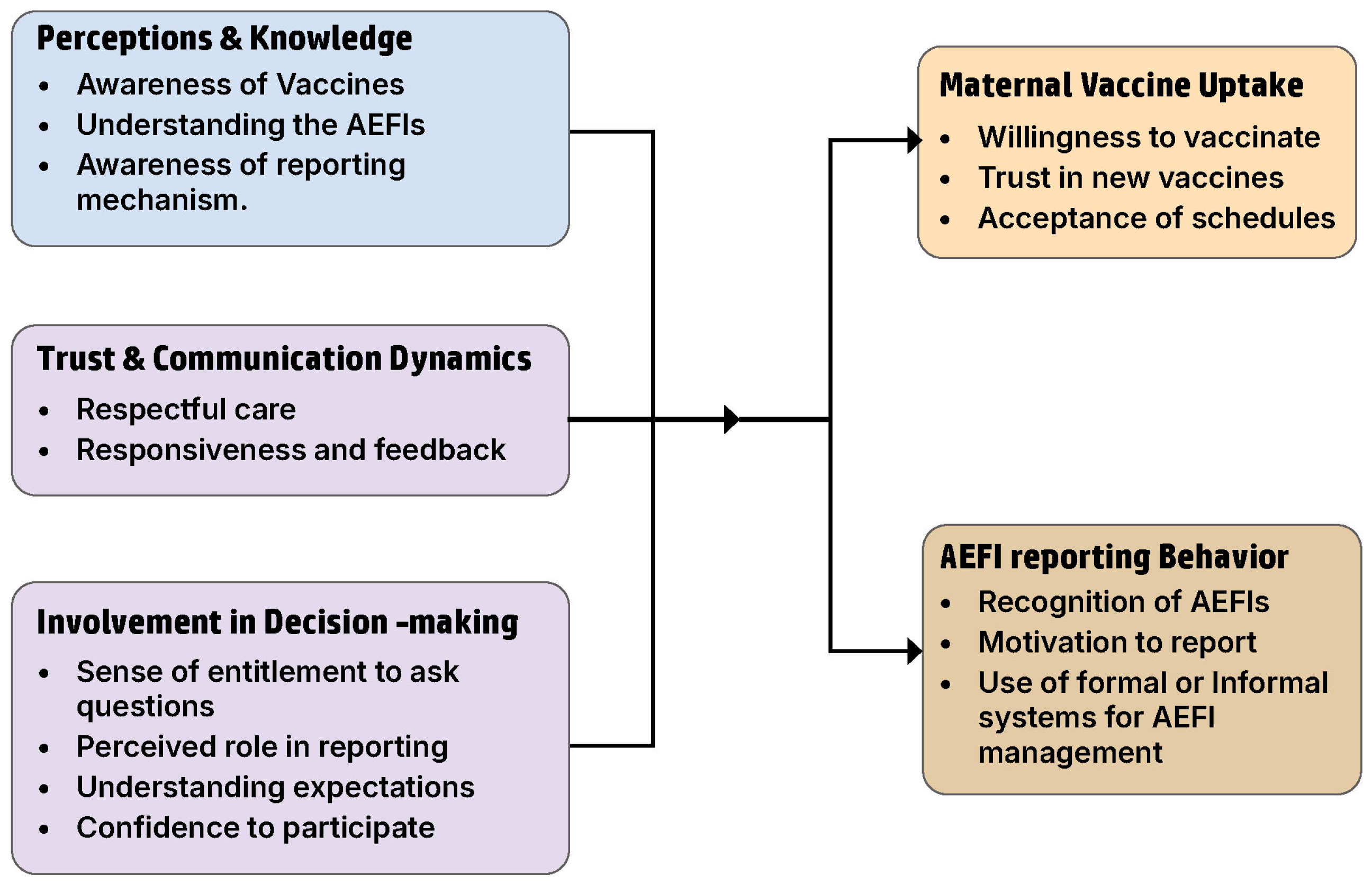
3.2. Perceptions of Vaccination in Pregnancy
“The Vaccine is important because it helps both the pregnant woman and the unborn baby not to get the disease.”(FGD_Mother_F4 HC III)
“Vaccines help us in some cases. You can deliver from a dirty place, but if you are vaccinated against tetanus, it helps prevent you from contracting tetanus.”(FGD_Mother_F1 RRH)
“We do not know the right time when we are supposed to receive the Tetanus injection, but anytime you go is when you can receive it.”(FGD_Mother_F1 RRH)
“Immunization is important, but we don’t know when we should get it or how many times.”(FGD_Mother_F2 NRH)
3.3. Knowledge and Awareness of AEFI and Reporting Mechanisms
“They immunised me when I was three months pregnant. I developed a fever, and my arm was so swollen that I couldn’t hold anything.”(FGD_Mother_F2 NRH)
“Yes, I experienced arm pain for a short period of time. I thought side effects were normal after the injections. I did not know we were supposed to report or tell anyone about it unless it became severe.”(FGD_Mother_F1 RRH)
“They told us that if the arm becomes heavy, we should give it time, and it will return to its normal state.”(FGD_Mother_F2 NRH)
“If you experience any problems after vaccination, you are supposed to return to the health facility and seek advice.”(FGD_Mother_F1 RRH)
“They tell you that if you encounter any issues upon returning home, you should come back to the hospital and explain your situation to the health worker so they can assist you in finding a solution.”(FGD_Mother_F4 HCIII)
3.4. Community as a Source of Guidance in Managing AEFIs (Emergent Theme)
“When your arm swells, the people in the village will start advising you to look for herbs like Dodo vegetable (Amaranth leaves), saying that if you smear it on the vaccination site, you will recover.”(FGD_Mother_F3 RRH)
“Once, after being immunised against tetanus, the injection site became itchy, and I started to scratch it. While scratching the itchy patch, I began to feel pain. My sister advised me to put a bottle in the refrigerator and then apply it to the site every morning. I then did so, and the itching and pain reduced.”(FGD_Mother_F3 RRH)
3.5. Prior Knowledge of Adverse Events and Their Effect on Vaccine Acceptance
“If I know that there is a problem with that vaccine which they immunize us with, I can’t go back because when I was young, they brought a polio vaccine which they injected many children with, most of whom later became disabled, some even died. So, now if I hear such about the vaccine, I will not come back for another dose.”(FGD_Mother_F3 RRH)
“It depends on the adverse events they tell me about. If they inform me that the adverse event is minor and will not affect my baby or my life, I can go ahead with the vaccination. However, if I believe it might impact my baby, then I cannot accept it.”(FGD_Mother_F3 RRH)
3.6. Experience and Barriers to Reporting Adverse Events
3.6.1. Lack of Adequate Information
“I am uncertain about the appropriate course of action, as often when we return to the nurses who administered the vaccines, they inform us that it is normal, leading us to endure the side effects until they resolve. However, there are instances where the effects persist.”(FGD_Mother_F2 NRH)
3.6.2. Normalization and Endurance of AEFIs (Emergent Theme)
“Yes, I experienced arm pain for a short period of time. I thought side effects were normal after the injections. I didn’t know we were supposed to report or tell anyone about it unless it became severe.”(FGD_Mother_F1 RRH)
“Often, when you try to go back to inform them, they tend to ignore you. Instead, they keep saying that, “it is normal.”(FGD_Mother_F2 NRH)
3.6.3. Trust and Communication Dynamics in Healthcare Interactions (Emergent Theme)
“When we go back to the health workers and explain to them, some of them are rude, so you also fear telling them what hurts you, you fear disclosing it to them and instead keep quiet.”(FGD_Mother_F2 NRH)
“We don’t know what the vaccine is, but we trust that the health workers would not harm us.”(FGD_Mother_F1 RRH)
“I do not think there is any danger because, when we come here, our lives are in the hands of the health workers. So, I don’t think it can be dangerous to us because they also get pregnant like us, and they use the same drugs, so I don’t think they can use a dangerous drug, yet they will also use it in future.”(FGD_Mother_F1 RRH)
3.7. Desire for Greater Involvement in Vaccine Decision-Making
“But if they make a vaccine, before they roll it out in people, since we can’t stop them from making vaccines, they should first come and teach us why they have brought this vaccine and what it will be used for. That way, we shall not have any problem with that.”(FGD_Mother_F3 RRH)
“I think before the government rolls out vaccines, they should first come to the villages to assess our health situation. They need to find out how many women are suffering from illnesses, the prevalence of tetanus, or how many women have died because they refused to be vaccinated against tetanus. They should conduct research and ask us about the health problems or diseases we face before introducing those vaccines.”(FGD_Mother_F3 RRH)
“I think we have a right to know the types of vaccines which they inject the children or us.”(FGD_Mother_F3 RRH)
4. Discussion
4.1. Implication for Policy and Practice
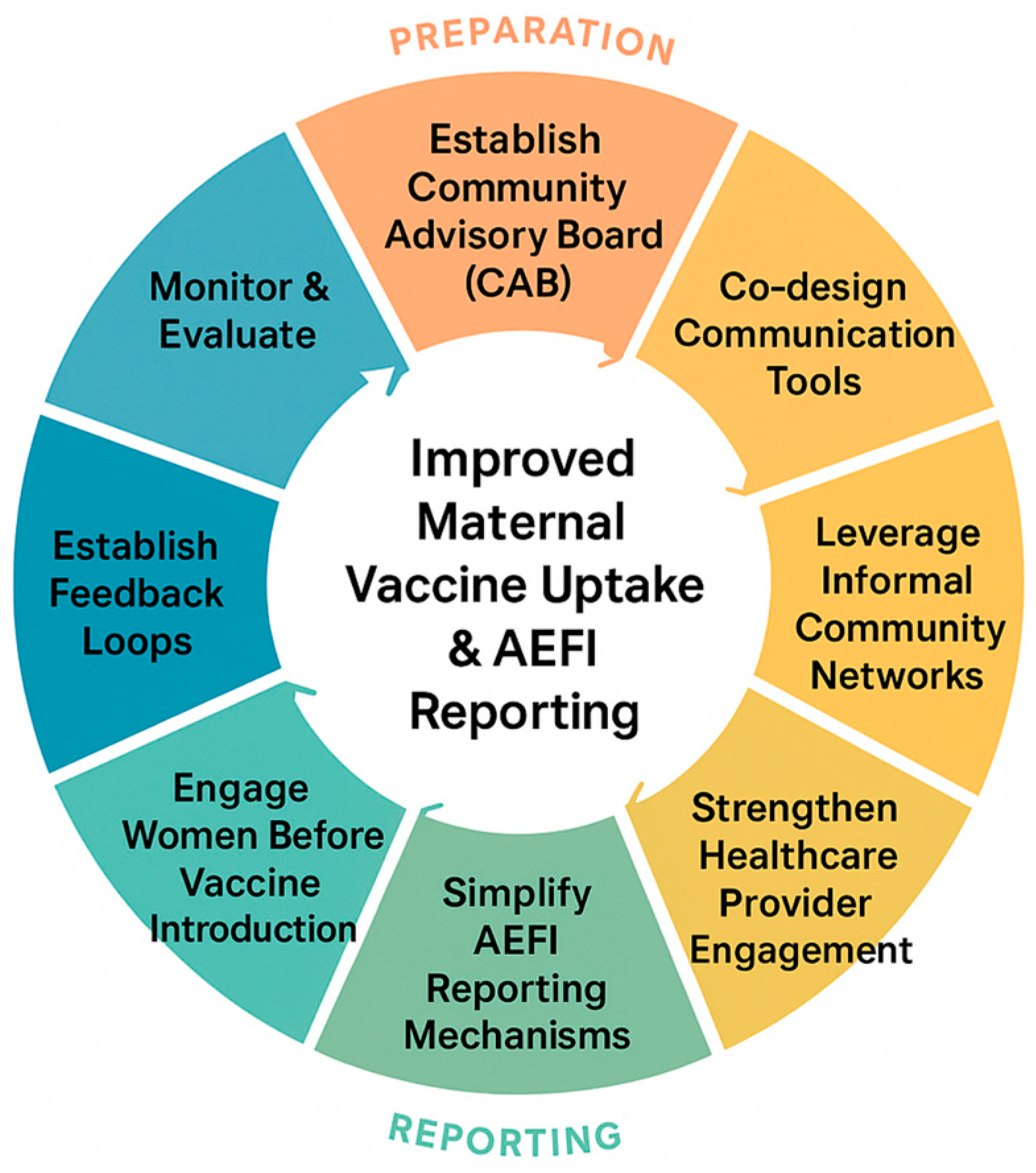
4.2. Translating Findings into Action
4.3. Strength and Limitation
5. Conclusions
- Provide clear, balanced communication about vaccine benefits and risks, addressing knowledge gaps.
- Simplify and publicize reporting mechanisms through fit-for-purpose visual tools, digital platforms, and integration with community health workers and informal care networks, enabling broader and earlier reporting.
- Strengthen healthcare provider capacity through training in respectful, responsive communication, while simultaneously addressing broader systemic challenges such as high patient loads, staffing shortages, limited counseling time, and lack of feedback mechanisms for submitted reports.
- Engage women before the introduction of new vaccines, incorporating their perspectives into program design and policy decisions to build confidence, ownership, and trust.
Supplementary Materials
Author Contributions
Funding
Institutional Review Board Statement
Informed Consent Statement
Data Availability Statement
Acknowledgments
Conflicts of Interest
Abbreviations
| AEFI | Adverse Event Following Immunization |
| ANC | Antenatal Care |
| CAB | Community Advisory Board |
| CHW | Community Health Work |
| EPI | Expanded Programme for Immunisation |
| FGD | Focus group discussion |
| GBS | Group B Streptococcus |
| HCIII | Health Centre III |
| HCP | Healthcare Provider |
| LMIC | Low and middle income countries |
| MOH | Ministry of Health |
| NMRA | National Medicine Regulatory Authority |
| NPC | National Pharmacovigilance Centre |
| NRH | National Referral Hospital |
| PV | Pharmacovigilance |
| RRH | Regional Referral Hospital |
| RSV | Respiratory Syncytial virus |
| USSD | Unstructured Supplementary Service Data |
Appendix A

| Characteristics | Iganga Hospital (N = 8) F1 | Kawempe NRRH (N = 8) F2 | Mbarara RRH (N = 8) F3 | Namulonge HCIII (N = 8) F4 | MUJHU (Research Centre (N = 8) F5 | Total (N = 40) |
|---|---|---|---|---|---|---|
| Age | ||||||
| 18–24 | 03 | 02 | 02 | 06 | - | 13 |
| 25–29 | 02 | 05 | 04 | - | 01 | 12 |
| 30–39 | 02 | 01 | 02 | 02 | 07 | 14 |
| 40–49 | 01 | 00 | 00 | 00 | 00 | 01 |
| Occupation | ||||||
| Informal employment(Hair dressing, roadside stalls, bar attendants, tailoring) | 07 | 06 | 08 | 04 | 02 | 27 |
| Formal employment | 01 | 02 | 00 | 01 | 00 | 04 |
| Unemployed | - | - | - | 03 | 06 | 09 |
| Marital status | ||||||
| Single | - | - | - | 01 | - | 01 |
| Married | 08 | 06 | 07 | 07 | 08 | 36 |
| Cohabiting | - | 02 | 01 | - | - | 03 |
| Widow | - | - | - | - | - | |
| Education level | ||||||
| None | - | - | - | - | - | |
| Primary | 02 | 02 | - | 01 | 07 | 12 |
| Secondary | 04 | 05 | 07 | 07 | 01 | 24 |
| Tertiary | 02 | 01 | 01 | - | - | 04 |
| Number of children | ||||||
| 0–4 | 07 | 07 | 08 | 08 | 08 | 38 |
| 5+ | 01 | 01 | - | - | - | 02 |
| Theme | Subthemes | Quote | Analytical Commentary |
|---|---|---|---|
| Perceptions of Vaccination in Pregnancy | Knowledge about vaccines—importance of vaccines, the common vaccines used, and information about schedules | “Immunization is very important because, suppose a woman comes for delivery and gets a tear, and they stitch her. If she has been immunized against Tetanus, the wound would not rot, and it would heal easily. But if she has not been immunized, then she takes longer to recover.” (FGD_Mother_F2 NRRH) “It helps us in some cases. You can deliver from a dirty place, but if you were vaccinated against tetanus, it helps you not to contract tetanus.” (FGD_Mother_F1 RRH) “Immunization is beneficial, but we don’t know when we are supposed to get it or how many times.” (FGD_Mother_F2 NRH) “For us, we know that it’s immunization against Tetanus.” (FGD_Mother_F2 NRH) “They have always immunized us against tetanus.” (FGD_Mother_F3 RRH) “Sometimes we come for immunization and we get doses we don’t know… However, to me I think we have a right to know the types of vaccines that are being injected into the children or us.” (FGD_Mother_F1 RRH) “We don’t know the right time when we are supposed to receive the Tetanus injection, but anytime you go is when you can receive it.” (FGD_Mother_F2 NRH) | Participants understood the general importance of vaccination, particularly tetanus, which is routinely used in antenatal care, but had gaps in knowledge regarding schedules and vaccine purposes. A positive attitude about the vaccines however may not always translate into complete or timely uptake, compromising both individual and public health benefits. |
| Prior knowledge and experience influencing vaccine uptake | “If I know there is a problem with that vaccine, I won’t go back… most of them later became disabled, some even died.” (FGD_Mother_F2 NRRH) “Yes, I am willing to accept another vaccine if the health worker has explained about its benefits.” (FGD_Mother_F2 NRH) “When I returned for antenatal care the second time, they told me to get it, but I was afraid because the first time I had a fever, and my arm became heavy. I was alone and had to do household chores. The next time, I dodged it.” (FGD_Mother_F2 NRH) “When I am pregnant and am told that the treatment can affect the baby, but it is still necessary to treat me, I will refuse treatment. However, if the treatment is for my child and not me, then I am willing to undergo it.” (FGD_Mother_F2 NRH) “I do not think there is any danger because, when we come here, our lives are in the hands of the health workers. So, I don’t think it can be dangerous to us because they also get pregnant like us, and they use the same drugs, so I don’t think they can use a dangerous drug, yet they will also use it in future.” (FGD_Mother_F1 RRH) | Women’s willingness to accept vaccines is not determined solely by personal knowledge or risk perception, but also by the credibility of information sources and interpersonal trust within their communities. Negative experiences or peer stories can amplify fear and hesitation, eroding confidence in vaccination programs. Conversely, trustworthy and empathetic communication from health workers can counter misinformation, provide reassurance, and reinforce positive attitudes toward maternal vaccines. | |
| Emerging sense of ownership and right to vaccine information | “I think we have a right to know the types of vaccines which they inject the children or us.” (FGD_Mother_F1 RRH) | This emerging participatory stance toward maternal healthcare decisions signals a positive evolution toward participatory maternal healthcare. It may imply that Successful vaccination programs must not only ensure access but also foster trust, dialogue, and respect for women’s right to information and expectation for informed consent. | |
| Knowledge and Awareness of AEFI Reporting Mechanisms | Knowledge about possible side effects | “Like high temperature, body weakness and the arm got swollen “They immunized me when I was three months pregnant. I was affected because I developed a fever and my arm became swollen to the point where I could not hold anything.” (FGD_Mother_F1 RRH) “Yes, I experienced arm pain for a short period.” (FGD_Mother_F1 RRH) “I think these vaccines have no problem because all the times I have been immunized with all five doses, I have not seen any major issues.” (FG_Mother_F3_RRH) | Women could identify common mild reactions but tended to normalize them, limiting formal AEFI reporting. |
| Knowledge about reporting channels and platforms | “I do not know what to do because most times when we go back to the nurses… they say, ‘it is normal.’ So you have to endure the side effects until they disappear.” (FGD_Mother_F2 NRH) “If you experience any abnormalities after vaccination, please return to the health facility and seek advice.” (FGD_Mother_F1 RRH) “They tell you that if you encounter any issues upon returning home, you should come back to the hospital and explain your situation to the health worker so they can assist you in finding a solution.” (FGD_Mother_F4 HCIII) “They told us that if the arm becomes heavy, we should give it time, and it will return to its normal state. Also, when we get home, we should not use that arm for anything. It may feel heavy, but it will return to normal over time.” (FGD_Mother_F3 RRH) | The awareness that formal reporting mechanisms were minimal and that healthcare provider response often discouraged reporting points to a missed opportunity for early detection and response to vaccine safety concerns. | |
| Community as a source of guidance in managing AEFIs (emergent) | “When my arm began to swell and hurt, I asked elders who have given birth before, and they told me I should not use that hand.” (FGD_Mother_F3 RRH) “After I was immunized, the site where I was injected became itchy. My sister advised me to put a cold bottle on it.” (FGD_Mother_F3 RRH) | In the absence of guidance from health workers, women relied on community members for advice. This informal support helped manage mild reactions but could perpetuate misconceptions and reduce formal reporting. | |
| Experiences and Barriers in Reporting AEFIs | Barriers to reporting/provider interactions | “When we go back to the health workers and explain to them, some of them are rude, so you also fear telling them what hurts you.” (FGD_Mother_F1 RRH) | Fear of negative provider reactions discourages AEFI reporting, highlighting that health worker attitudes are a key determinant of system responsiveness. |
| Normalization and endurance of AEFIs (emergent) | “Most of the time, even if you experience swelling of the arm and intense pain, sometimes accompanied by fever, they keep saying, ‘it is normal.” (FGD_Mother_F1 RRH) | There is missed opportunity for pharmacovigilance that can lead to underreporting of AEFIs and deprives the immunization program of valuable data needed to monitor safety trends and detect early warning signals. | |
| Trust and communication dynamics in healthcare interactions (emergent) | “We don’t know what the vaccine is, but we trust that the health workers would not harm us.” (FGD_Mother_F1 RRH) “I do not think there is any danger because, when we come here, our lives are in the hands of the health workers. So, I don’t think it can be dangerous to us because they also get pregnant like us and they use the same drugs, so I don’t think they can use a dangerous drug, yet they will also use it in future.” (FGD_Mother_F1 RRH) |
Participants’ strong trust in health workers sometimes translated into passive acceptance of vaccination recommendations. This is illustrated by participant statements such as “Health workers would not harm us” and “Our lives are in the hands of the health workers High levels of trust can enhance vaccine uptake and compliance, underscoring the importance of provider credibility in maternal vaccination programs. However, excessive trust may lead to passive acceptance, where women do not make informed health choices. This raises concerns for informed consent and health education; while trust is beneficial for uptake, it should not replace clear communication and shared decision-making. | |
| Involvement in Decision-Making | Desire for inclusion and informed participation | “Before they roll out vaccines, they should first come and teach us about it and what it will be used for.” (FGD_Mother_F3 RRH) | Women expressed a desire for education and involvement in vaccine-related decisions. This challenges the traditional top-down delivery model and calls for transparent, people-centered approaches that foster trust, empower women to make informed choices, and strengthen both vaccine uptake and accurate reporting. |
| Step | Action | Details/Notes | Potential Challenges/Considerations |
|---|---|---|---|
| 1 | Establish Maternal Vaccine Community Advisory Board (CAB)- | Include pregnant women, CHWs, local leaders, and health providers. Review new vaccine plans, messaging, and schedules. Note: An option to use existing structures, such as Village Health Teams (VHTs), to perform CAB functions, including pregnant women, CHWs, local leaders, and health providers. Functions include reviewing new vaccine plans, messaging, and schedules. Implementation can be adapted to available resources. |
|
| 2 | Co-design communication tools | Workshops with women to develop visual aids, appointment cards, and simplified reporting guides. Test for comprehension. | Time constraints, resources to develop graphic design, translation and prototyping funds. |
| 3 | Leverage informal networks | Train mother-to-mother groups, traditional birth attendants, peer networks to recognize and report AEFIs, and link them to formal reporting systems. | Consider inconsistent messaging. Resources: Training modules, supervision, job aids. |
| 4 | Strengthen healthcare provider engagement. | Training in respectful, empathetic communication. Address systemic barriers: staffing, workload, counseling time, and feedback for reports. | Heavy workload; high turnover. Resources: Flexible training, job aids, supervision. |
| 5 | Simplify reporting mechanisms | Use visual tools, digital platforms, and integrate reporting into CHW/community networks. Ensure accessibility for women with varying literacy levels. | Resources: USSD, toll-free line, Mobile APPs, and manual forms. Funding of tools, translations, and follow-up of notifications to generate complete reports Challenges: perception reporting is for HCPs only, internet connectivity for electronic tools if adopted |
| 6 | Engage women before vaccine introduction. | Solicit feedback on rollout strategy, messaging, and reporting tools. Incorporate their input into policy/program design. | Resources: CHW mobilization, consultation guides, and small incentives. |
| 7 | Establish feedback loops | Share AEFI data, uptake results, and program adjustments with women and community networks to sustain trust and ownership. | Define responsibilities: NRA, EPI-MoH Managing community expectation Collaboration on developing messages for feedback. |
| 8 | Monitor & evaluate | Track participation, reporting rates, uptake, and community satisfaction. Use results to improve engagement strategies iteratively. | Challenges: Fragmented data; limited qualitative capacity. Resources: Harmonized indicators, integrated tools, survey budget. |
References
- Munoz, F.M.; Jamieson, D.J. Maternal Immunization. Obstet. Gynecol. 2019, 133, 739–753. [Google Scholar] [CrossRef]
- Bergin, N.; Murtagh, J.; Philip, R.K. Maternal Vaccination as an Essential Component of Life-Course Immunization and Its Contribution to Preventive Neonatology. Int. J. Environ. Res. Public Health 2018, 15, 847. [Google Scholar] [CrossRef]
- Larson, H.J.; Jarrett, C.; Eckersberger, E.; Smith, D.M.D.; Paterson, P. Understanding vaccine hesitancy around vaccines and vaccination from a global perspective: A systematic review of published literature, 2007–2012. Vaccine 2014, 32, 2150–2159. [Google Scholar] [CrossRef] [PubMed]
- United Nations Foundation. Reluctance to Vaccinate Named a Top Global Health Threat in 2019. Available online: https://unfoundation.org/blog/post/anti-vaxxers-named-top-global-health-threat-in-2019/ (accessed on 21 December 2020).
- Sharan, A.; Jahagirdar, S.; Stuurman, A.L.; Elango, V.; Riera-Montes, M.; Kumar Kashyap, N.; Kumar Arora, N.; Mathai, M.; Mangtani, P.; Devlieger, H.; et al. Operational lessons learned in conducting an international study on pharmacovigilance in pregnancy in resource-constrained settings: The WHO Global Vaccine safety Multi-Country collaboration project. Vaccine X 2022, 11, 100160. [Google Scholar] [CrossRef] [PubMed]
- WHO. Safety of Immunization During Pregnancy: A Review of the Evidence: Global Advisory Committee on Vaccine Safety. Available online: https://www.who.int/publications/i/item/WHO-HIS-2014.07 (accessed on 16 April 2021).
- Regan, A.K. The safety of maternal immunization. Hum. Vaccines Immunother. 2016, 12, 3132–3136. [Google Scholar] [CrossRef] [PubMed]
- Kampmann, B.; Madhi, S.A.; Munjal, I.; Simões, E.A.F.; Pahud, B.A.; Llapur, C.; Baker, J.; Pérez Marc, G.; Radley, D.; Shittu, E.; et al. Bivalent Prefusion F Vaccine in Pregnancy to Prevent RSV Illness in Infants. N. Engl. J. Med. 2023, 388, 1451–1464. [Google Scholar] [CrossRef]
- Carreras-Abad, C.; Ramkhelawon, L.; Heath, P.T.; Le Doare, K. A Vaccine Against Group B Streptococcus: Recent Advances. Infect. Drug Resist. 2020, 13, 1263–1272. [Google Scholar] [CrossRef]
- GAPPS. Maternal Immunization Safety Monitoring in Low- and Middle-Income Countries: A Roadmap for Program Development Building an Approach That Is Practical, Affordable, and Sustainable. 2017. Available online: https://www.gapps.org/PDF/MaternalImmunizationSafetyMonitoringInLMICs.pdf (accessed on 20 November 2025).
- Dieck, G.S.; Betger, S.; Kracov, D.A.; Manion, D.; Tanner, A. Constant Vigilance: The Role of Pharmaceutical Companies in Medicine Safety. Drug Inf. J. 2009, 43, 603–616. [Google Scholar] [CrossRef]
- Kiguba, R.; Olsson, S.; Waitt, C. Pharmacovigilance in low- and middle-income countries: A review with particular focus on Africa. Br. J. Clin. Pharmacol. 2023, 89, 491–509. [Google Scholar] [CrossRef]
- Prakasam, A.; Nidamanuri, A.; Kumar, S. Knowledge, perception and practice of pharmacovigilance among community pharmacists in South India. Pharm. Pract. 2012, 10, 222–226. [Google Scholar] [CrossRef]
- Kiguba, R.; Karamagi, C.; Waako, P.; Ndagije, H.B.; Bird, S.M. Recognition and reporting of suspected adverse drug reactions by surveyed healthcare professionals in Uganda: Key determinants. BMJ Open 2014, 4, e005869. [Google Scholar] [CrossRef] [PubMed]
- Mwakawanga, D.L.; Kilonzi, M.; Philipo, E.G.; Martine, A.; Mbilinyi, T.; Kileo, N.F.; Mkinga, B.; Shonyella, C.J.; Mohamedi, J.A.; Clement, A.; et al. Pharmacovigilance and Adverse Drug Reactions Reporting: Healthcare Providers’ Experiences from Southern Highland Tanzania. Adv. Pharmacol. Pharm. Sci. 2023, 2023, 5537592. [Google Scholar] [CrossRef] [PubMed]
- Krubiner, C.B.; Faden, R.R.; Karron, R.A.; Little, M.O.; Lyerly, A.D.; Abramson, J.S.; Beigi, R.H.; Cravioto, A.R.; Durbin, A.P.; Gellin, B.G.; et al. Pregnant women & vaccines against emerging epidemic threats: Ethics guidance for preparedness, research, and response. Vaccine 2021, 39, 85–120. [Google Scholar] [CrossRef] [PubMed]
- Asiamah, M.; Akuffo, K.O.; Nortey, P.; Donkor, N.; Danso-Appiah, A. Spontaneous reporting of adverse drug reaction among health professionals in Ghana. Arch. Public Health 2022, 80, 33. [Google Scholar] [CrossRef]
- CIOMS Working Group. Practical Aspects of Signal Detection in Pharmacovigilance: Report of CIOMS Working Group VIII; Council for International Organizations of Medical Sciences: Geneva, Switzerland, 2010. [Google Scholar]
- Pacurariu, A.C.; Straus, S.M.; Trifirò, G.; Schuemie, M.J.; Gini, R.; Herings, R.; Mazzaglia, G.; Picelli, G.; Scotti, L.; Pedersen, L.; et al. Useful Interplay Between Spontaneous ADR Reports and Electronic Healthcare Records in Signal Detection. Drug Saf. 2015, 38, 1201–1210. [Google Scholar] [CrossRef]
- Olsson, S.; Pal, S.N.; Dodoo, A. Pharmacovigilance in resource-limited countries. Expert Rev. Clin. Pharmacol. 2015, 8, 449–460. [Google Scholar] [CrossRef]
- van Hunsel, F.; van der Welle, C.; Passier, A.; van Puijenbroek, E.; van Grootheest, K. Motives for reporting adverse drug reactions by patient-reporters in the Netherlands. Eur. J. Clin. Pharmacol. 2010, 66, 1143–1150. [Google Scholar] [CrossRef]
- Sienkiewicz, K.; Burzyńska, M.; Rydlewska-Liszkowska, I.; Sienkiewicz, J.; Gaszyńska, E. The Importance of Direct Patient Reporting of Adverse Drug Reactions in the Safety Monitoring Process. Int. J. Environ. Res. Public Health 2021, 19, 413. [Google Scholar] [CrossRef]
- Avery, A.J.; Anderson, C.; Bond, C.M.; Fortnum, H.; Gifford, A.; Hannaford, P.C.; Hazell, L.; Krska, J.; Lee, A.J.; McLernon, D.J.; et al. Evaluation of patient reporting of adverse drug reactions to the UK ‘Yellow Card Scheme’: Literature review, descriptive and qualitative analyses, and questionnaire surveys. Health Technol. Assess. 2011, 15, 1–234, iii–iv. [Google Scholar] [CrossRef]
- Rolfes, L.; Wilkes, S.; van Hunsel, F.; van Puijenbroek, E.; van Grootheest, K. Important information regarding reporting of adverse drug reactions: A qualitative study. Int. J. Pharm. Pract. 2014, 22, 231–233. [Google Scholar] [CrossRef]
- Härmark, L.; van Hunsel, F.; Grundmark, B. ADR Reporting by the General Public: Lessons Learnt from the Dutch and Swedish Systems. Drug Saf. 2015, 38, 337–347. [Google Scholar] [CrossRef]
- van Grootheest, K.; de Graaf, L.; de Jong-van den Berg, L.T.W. Consumer Adverse Drug Reaction Reporting. Drug Saf. 2003, 26, 211–217. [Google Scholar] [CrossRef]
- Al Dweik, R.; Stacey, D.; Kohen, D.; Yaya, S. Factors affecting patient reporting of adverse drug reactions: A systematic review. Br. J. Clin. Pharmacol. 2017, 83, 875–883. [Google Scholar] [CrossRef] [PubMed]
- Dedefo, M.G.; Lim, R.; Kassie, G.M.; Roughead, E.; Ellett, L.K. Consumers’ knowledge and experiences of adverse drug reaction reporting in Australia: A national survey. Eur. J. Clin. Pharmacol. 2024, 80, 1543–1554. [Google Scholar] [CrossRef] [PubMed]
- Nambasa, V.P.; Ssebagereka, A.; Ssali, A.; Namugumya, R.; Nalubega, P.; Figueras, A.; Kajungu, D.; Koch, B.; Le Doare, K.; Kampmann, B. Pharmacovigilance for Vaccines Used in Pregnancy: A Gap Analysis from Uganda. Pediatr. Infect. Dis. J. 2025, 44, S123–S129. [Google Scholar] [CrossRef] [PubMed]
- Adams, R.M.; Gonik, B. The Evolving Maternal Vaccine Platform. Reprod. Med. 2024, 5, 154–171. [Google Scholar] [CrossRef]
- Cassidy, C.; MacDonald, N.E.; Steenbeek, A.; Ortiz, J.R.; Zuber, P.L.; Top, K.A. A global survey of adverse event following immunization surveillance systems for pregnant women and their infants. Hum. Vaccines Immunother. 2016, 12, 2010–2016. [Google Scholar] [CrossRef]
- Miles, M.B.; Huberman, M. Qualitative Data Analysis: A Sourcebook of New Methods; Sage Publications: Beverly Hills, CA, USA, 1994. [Google Scholar]
- Erlingsson, C.; Brysiewicz, P. A hands-on guide to doing content analysis. Afr. J. Emerg. Med. 2017, 7, 93–99. [Google Scholar] [CrossRef]
- Nalubega, P.; Karafillakis, E.; Atuhaire, L.; Akite, P.; Zalwango, F.; Chantler, T.; Cochet, M.; Seeley, J.; Le Doare, K. Maternal Vaccination in Uganda: Exploring Pregnant Women, Community Leaders and Healthcare providers’ Perceptions. Vaccines 2021, 9, 552. [Google Scholar] [CrossRef]
- Kajungu, D.; Muhoozi, M.; Stark, J.; Weibel, D.; Sturkenboom, M. Vaccines safety and maternal knowledge for enhanced maternal immunization acceptability in rural Uganda: A qualitative study approach. PLoS ONE 2020, 15, e0243834. [Google Scholar] [CrossRef]
- Larson Williams, A.; McCloskey, L.; Mwale, M.; Mwananyanda, L.; Murray, K.; Herman, A.R.; Thea, D.M.; MacLeod, W.B.; Gill, C.J. “When you are injected, the baby is protected:” Assessing the acceptability of a maternal Tdap vaccine based on mothers’ knowledge, attitudes, and beliefs of pertussis and vaccinations in Lusaka, Zambia. Vaccine 2018, 36, 3048–3053. [Google Scholar] [CrossRef]
- Ymba, A.; Perrey, C. Acceptability of tetanus toxoid vaccine by pregnant women in two health centres in Abidjan (Ivory Coast). Vaccine 2003, 21, 3497–3500. [Google Scholar] [CrossRef]
- Pugliese-Garcia, M.; Heyerdahl, L.W.; Mwamba, C.; Nkwemu, S.; Chilengi, R.; Demolis, R.; Guillermet, E.; Sharma, A. Factors influencing vaccine acceptance and hesitancy in three informal settlements in Lusaka, Zambia. Vaccine 2018, 36, 5617–5624. [Google Scholar] [CrossRef]
- Maher, L.; Dawson, A.; Wiley, K.; Hope, K.; Torvaldsen, S.; Lawrence, G.; Conaty, S. Influenza vaccination during pregnancy: A qualitative study of the knowledge, attitudes, beliefs, and practices of general practitioners in Central and South-Western Sydney. BMC Fam. Pract. 2014, 15, 102. [Google Scholar] [CrossRef] [PubMed]
- Azarpanah, H.; Farhadloo, M.; Vahidov, R.; Pilote, L. Vaccine hesitancy: Evidence from an adverse events following immunization database, and the role of cognitive biases. BMC Public Health 2021, 21, 1686. [Google Scholar] [CrossRef] [PubMed]
- García-Abeijon, P.; Costa, C.; Taracido, M.; Herdeiro, M.T.; Torre, C.; Figueiras, A. Factors Associated with Underreporting of Adverse Drug Reactions by Health Care Professionals: A Systematic Review Update. Drug Saf. 2023, 46, 625–636. [Google Scholar] [CrossRef]
- Jacobs, T.G.; Hilda Ampadu, H.; Hoekman, J.; Dodoo, A.N.O.; Mantel-Teeuwisse, A.K. The contribution of Ghanaian patients to the reporting of adverse drug reactions: A quantitative and qualitative study. BMC Public Health 2018, 18, 1384. [Google Scholar] [CrossRef] [PubMed]
- Sales, I.; Aljadhey, H.; Albogami, Y.; Mahmoud, M.A. Public awareness and perception toward Adverse Drug Reactions reporting in Riyadh, Saudi Arabia. Saudi Pharm. J. 2017, 25, 868–872. [Google Scholar] [CrossRef]
- Kim, S.; Yu, Y.M.; You, M.; Jeong, K.H.; Lee, E. A cross-sectional survey of knowledge, attitude, and willingness to engage in spontaneous reporting of adverse drug reactions by Korean consumers. BMC Public Health 2020, 20, 1527. [Google Scholar] [CrossRef]
- Sondagar, C.; Xu, R.; MacDonald, N.E.; Dubé, E. Vaccine acceptance: How to build and maintain trust in immunization. Can. Commun. Dis. Rep. 2020, 46, 155–159. [Google Scholar] [CrossRef]
- Ekezie, W.; Igein, B.; Varughese, J.; Butt, A.; Ukoha-Kalu, B.O.; Ikhile, I.; Bosah, G. Vaccination Communication Strategies and Uptake in Africa: A Systematic Review. Vaccines 2024, 12, 1333. [Google Scholar] [CrossRef] [PubMed]
- Simas, C.; Larson, H.J.; Paterson, P. “Saint Google, now we have information!”: A qualitative study on narratives of trust and attitudes towards maternal vaccination in Mexico City and Toluca. BMC Public Health 2021, 21, 1170. [Google Scholar] [CrossRef] [PubMed]
- Girish, H.; Jyothi, R.; Akash, G.; Nikita Sudhir, K.; Ashwini, M.K.; Bhoomi Chirag, B.; Jhilli, B.; Udaya, K. Knowledge, attitude, and practices regarding reporting of Adverse Events Following Immunization (AEFI) among healthcare professionals. J. Pharmacovigil. Drug Res. 2023, 4, 16–23. [Google Scholar] [CrossRef]
- Puthussery, S.; Bayih, W.A.; Brown, H.; Aborigo, R.A. Promoting a global culture of respectful maternity care. BMC Pregnancy Childbirth 2023, 23, 798. [Google Scholar] [CrossRef] [PubMed]
- World Health Organization. The Prevention and Elimination of Disrespect and Abuse During Facility-Based Childbirth. Available online: https://www.who.int/publications/i/item/WHO-RHR-14.23 (accessed on 14 September 2014).
- Kumah, E. The informal healthcare providers and universal health coverage in low and middle-income countries. Glob. Health 2022, 18, 45. [Google Scholar] [CrossRef]
- Perry, H.B.; Zulliger, R.; Rogers, M.M. Community health workers in low-, middle-, and high-income countries: An overview of their history, recent evolution, and current effectiveness. Annu. Rev. Public Health 2014, 35, 399–421. [Google Scholar] [CrossRef]
- Lewin, S.; Munabi-Babigumira, S.; Glenton, C.; Daniels, K.; Bosch-Capblanch, X.; van Wyk, B.E.; Odgaard-Jensen, J.; Johansen, M.; Aja, G.N.; Zwarenstein, M.; et al. Lay health workers in primary and community health care for maternal and child health and the management of infectious diseases. Cochrane Database Syst. Rev. 2010, 2010, Cd004015. [Google Scholar] [CrossRef]
- MoH. Village Health Team: Strategy and Operational Guidelines; Ministry of Health: Kampala, Uganda, 2010. [Google Scholar]
- Nganga, S.W.; Otieno, N.A.; Adero, M.; Ouma, D.; Chaves, S.S.; Verani, J.R.; Widdowson, M.A.; Wilson, A.; Bergenfeld, I.; Andrews, C.; et al. Patient and provider perspectives on how trust influences maternal vaccine acceptance among pregnant women in Kenya. BMC Health Serv. Res. 2019, 19, 747. [Google Scholar] [CrossRef]
- CIOMS. Patient Involvement in the Development, Regulation and Safe Use of Medicines; CIOMS, Ed.; World Health Organization: Geneva, Switzerland; CIOMS: Council for International Organizations of Medical Sciences: Geneva, Switzerland, 2022. [Google Scholar]
- Vahdat, S.; Hamzehgardeshi, L.; Hessam, S.; Hamzehgardeshi, Z. Patient involvement in health care decision making: A review. Iran. Red Crescent Med. J. 2014, 16, e12454. [Google Scholar] [CrossRef]
- Ayouni, I.; Mbangiwa, T.; Amponsah-Dacosta, E.; Noll, S.; Kagina, B.M.; Muloiwa, R. Acceptance and uptake of vaccines against tetanus, influenza, pertussis, and COVID-19 among pregnant and postpartum women in low- and middle-income countries: A systematic review and meta-analysis protocol. Syst. Rev. 2024, 13, 227. [Google Scholar] [CrossRef]
- World Health Organization. Immunization Agenda 2030: A Global Strategy to Leave No One Behind. Available online: https://www.who.int/publications/m/item/immunization-agenda-2030-a-global-strategy-to-leave-no-one-behind (accessed on 1 April 2020).


Disclaimer/Publisher’s Note: The statements, opinions and data contained in all publications are solely those of the individual author(s) and contributor(s) and not of MDPI and/or the editor(s). MDPI and/or the editor(s) disclaim responsibility for any injury to people or property resulting from any ideas, methods, instructions or products referred to in the content. |
© 2025 by the authors. Licensee MDPI, Basel, Switzerland. This article is an open access article distributed under the terms and conditions of the Creative Commons Attribution (CC BY) license (https://creativecommons.org/licenses/by/4.0/).
Share and Cite
Nambasa, V.P.; Komuhendo, R.; Serwanga, A.; Kajungu, D.; Koch, B.C.P.; Kampmann, B.; Le Doare, K.; Ssali, A. Pregnant Women and Vaccine Safety in Uganda: Knowledge, Barriers, and Opportunities for Engagement. Vaccines 2025, 13, 1210. https://doi.org/10.3390/vaccines13121210
Nambasa VP, Komuhendo R, Serwanga A, Kajungu D, Koch BCP, Kampmann B, Le Doare K, Ssali A. Pregnant Women and Vaccine Safety in Uganda: Knowledge, Barriers, and Opportunities for Engagement. Vaccines. 2025; 13(12):1210. https://doi.org/10.3390/vaccines13121210
Chicago/Turabian StyleNambasa, Victoria Prudence, Robinah Komuhendo, Allan Serwanga, Dan Kajungu, Birgit C. P. Koch, Beate Kampmann, Kirsty Le Doare, and Agnes Ssali. 2025. "Pregnant Women and Vaccine Safety in Uganda: Knowledge, Barriers, and Opportunities for Engagement" Vaccines 13, no. 12: 1210. https://doi.org/10.3390/vaccines13121210
APA StyleNambasa, V. P., Komuhendo, R., Serwanga, A., Kajungu, D., Koch, B. C. P., Kampmann, B., Le Doare, K., & Ssali, A. (2025). Pregnant Women and Vaccine Safety in Uganda: Knowledge, Barriers, and Opportunities for Engagement. Vaccines, 13(12), 1210. https://doi.org/10.3390/vaccines13121210