Annona muricata (Soursop) and Hematopoiesis: Ethnomedicinal Insights, Immunomodulatory Mechanisms, and Translational Challenges


Abstract
1. Introduction
2. Methodology of the Review
2.1. Databases and Search Strategy
2.2. Inclusion and Exclusion Criteria
- Inclusion criteria comprised:
- Exclusion criteria included:
2.3. Data Synthesis
3. Ethnomedicinal Use of Annona muricata in Blood-Related Conditions
3.1. Traditional Use in Anemia and Blood Weakness
3.2. Post-Illness and Post-Partum Recovery
3.3. Immune Strengthening and Febrile Illnesses
3.4. Linking Ethnomedicine to Hematopoietic Relevance
4. Phytochemical Profile of Annona muricata Relevant to Hematopoiesis
4.1. Acetogenins
4.2. Flavonoids and Polyphenols
5. Mechanistic Pathways Linking Annona muricata to Hematopoiesis
5.1. Modulation of Oxidative Stress in the Bone Marrow Niche
5.2. Anti-Inflammatory Regulation of Hematopoietic Suppression
5.3. Immunomodulatory Effects and Leukocyte Regulation
5.4. Protection Against Myelosuppression and Cytotoxic Injury
5.5. Potential Influence on Lineage-Specific Hematopoiesis
- Erythropoiesis: via reduction in inflammatory inhibition and oxidative damage;
- Leukopoiesis: through immune regulation and cytokine balance;
- Thrombopoiesis: indirectly via marrow niche protection and reduced inflammatory suppression.
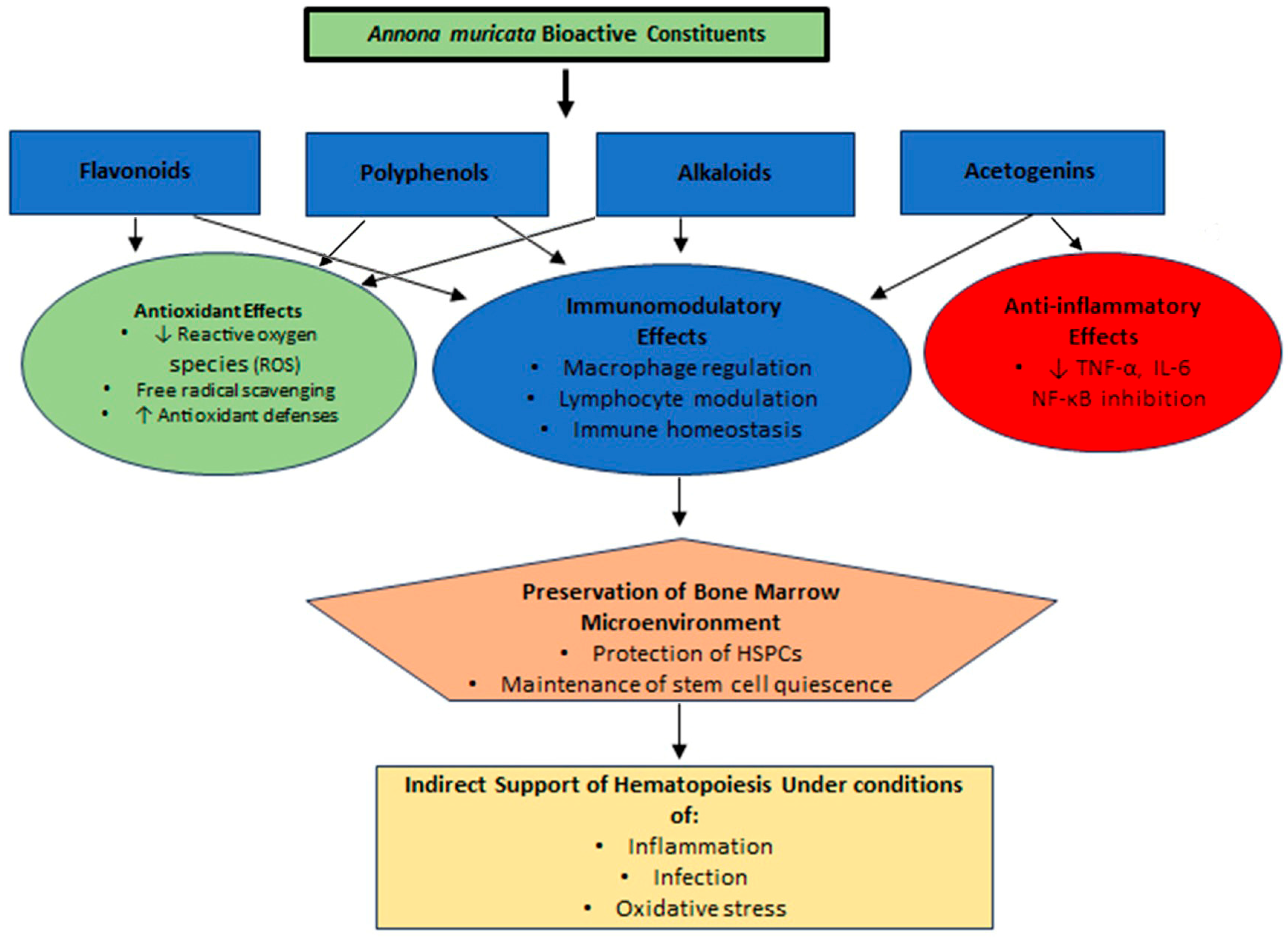
5.6. Conceptual Framework
6. Evidence from Preclinical Studies
6.1. In Vitro Studies
6.2. Animal Studies
6.3. Limitations of Preclinical Evidence
7. Safety, Toxicity, and Dose Considerations
7.1. Neurotoxicity Concerns
7.2. Hepatotoxicity and Systemic Toxicity
7.3. Hematological Safety
7.4. Drug–Herb Interactions
7.5. Knowledge Gaps and Need for Standardization
8. Translational Implications
8.1. Potential Role in Anemia and Bone Marrow Suppression
8.2. Chemotherapy-Induced Cytopenias and Myelosuppression
8.3. Post-Viral and Inflammatory Marrow Dysfunction
8.4. Relevance to Integrative and Community-Based Care
8.5. Pathway Toward Clinical Translation
9. Challenges and Research Gaps
9.1. Limited Human Clinical Evidence
9.2. Variability in Plant Preparation and Dosage
9.3. Safety and Toxicity Concerns
9.4. Methodological Gaps in Hematopoietic Assessment
9.5. Regulatory and Ethical Challenges
9.6. Need for Interdisciplinary and Translational Research Models
10. Conclusions
11. Future Directions
Author Contributions
Funding
Institutional Review Board Statement
Informed Consent Statement
Data Availability Statement
Conflicts of Interest
References
- Challen, G.A.; Boles, N.C.; Chambers, S.M.; Goodell, M.A. Distinct hematopoietic stem cell subtypes are differentially regulated by TGF-β1. Cell Stem Cell 2010, 6, 265–278. [Google Scholar] [CrossRef]
- King, K.Y.; Baldridge, M.T.; Weksberg, D.C.; Chambers, S.M.; Lukov, G.L.; Wu, S.; Boles, N.C.; Jung, S.Y.; Qin, J.; Liu, D.; et al. Irgm1 protects hematopoietic stem cells by negative regulation of IFN signaling. Blood 2011, 118, 1525–1533. [Google Scholar] [CrossRef] [PubMed]
- Yahata, T.; Takanashi, T.; Muguruma, Y.; Ibrahim, A.A.; Matsuzawa, H.; Uno, T.; Sheng, Y.; Onizuka, M.; Ito, M.; Kato, S.; et al. Accumulation of oxidative DNA damage restricts the self-renewal capacity of human hematopoietic stem cells. Blood 2011, 118, 2941–2950. [Google Scholar] [CrossRef]
- World Health Organization. WHO Global Report on Traditional and Complementary Medicine 2019; WHO: Geneva, Switzerland, 2019. [Google Scholar]
- Safiri, S.; Kolahi, A.A.; Noori, M.; Nejadghaderi, S.A.; Karamzad, N.; Bragazzi, N.L.; Sullman, M.J.M.; Abdollahi, M.; Collins, G.S.; Kaufman, J.S.; et al. Burden of anemia and its underlying causes in 204 countries and territories, 1990–2019: Results from the Global Burden of Disease Study 2019. J. Hematol. Oncol. 2021, 14, 185. [Google Scholar] [CrossRef]
- Kassebaum, N.J.; Jasrasaria, R.; Naghavi, M.; Wulf, S.K.; Johns, N.; Lozano, R.; Regan, M.; Weatherall, D.; Chou, D.P.; Eisele, T.P.; et al. A systematic analysis of global anemia burden from 1990 to 2010. Blood 2014, 123, 615–624. [Google Scholar] [CrossRef]
- Ito, K.; Ito, K. Metabolism and the control of cell fate decisions and stem cell renewal. Annu. Rev. Cell Dev. Biol. 2016, 32, 399–409. [Google Scholar] [CrossRef]
- Cabezas-Wallscheid, N.; Buettner, F.; Sommerkamp, P.; Klimmeck, D.; Ladel, L.; Thalheimer, F.B.; Pastor-Flores, D.; Roma, L.P.; Renders, S.; Zeisberger, P.; et al. Vitamin A-retinoic acid signaling regulates hematopoietic stem cell dormancy. Cell 2017, 169, 807–823.e19. [Google Scholar] [CrossRef] [PubMed]
- Ludin, A.; Gur-Cohen, S.; Golan, K.; Kaufmann, K.B.; Itkin, T.; Medaglia, C.; Lu, X.-J.; Ledergor, G.; Kollet, O.; Lapidot, T. Reactive oxygen species regulate hematopoietic stem cell self-renewal, migration and development, as well as their bone marrow microenvironment. Antioxid. Redox Signal. 2014, 21, 1605–1619. [Google Scholar] [CrossRef]
- Mantovani, A.; Allavena, P.; Sica, A.; Balkwill, F. Cancer-related inflammation. Nature 2008, 454, 436–444. [Google Scholar] [CrossRef] [PubMed]
- Li, S.; Yao, J.-C.; Oetjen, K.A.; Krambs, J.R.; Xia, J.; Zhang, J.; Schmidt, A.P.; Helton, N.M.; Fulton, R.S.; Heath, S.E.; et al. IL-1β expression in bone marrow dendritic cells is induced by TLR2 agonists and regulates HSC function. Blood 2022, 140, 1607–1620. [Google Scholar] [CrossRef]
- Bogeska, R.; Mikecin, A.-M.; Kaschutnig, P.; Fawaz, M.; Büchler-Schäff, M.; Le, D.; Ganuza, M.; Vollmer, A.; Paffenholz, S.V.; Asada, N.; et al. Inflammatory exposure drives long-lived impairment of hematopoietic stem cell self-renewal activity and accelerated aging. Cell Stem Cell 2022, 29, 1273–1284.e8. [Google Scholar] [CrossRef] [PubMed]
- Nemeth, E.; Tuttle, M.S.; Powelson, J.; Vaughn, M.B.; Donovan, A.; Ward, D.M.; Ganz, T.; Kaplan, J. Hepcidin regulates cellular iron efflux by binding to ferroportin and inducing its internalization. Science 2004, 306, 2090–2093. [Google Scholar] [CrossRef]
- Weiss, G.; Goodnough, L.T. Anemia of chronic disease. N. Engl. J. Med. 2005, 352, 1011–1023. [Google Scholar] [CrossRef] [PubMed]
- Prummel, K.D.; Woods, K.; Kholmatov, M.; Schmitt, E.C.; Vlachou, E.P.; Labyadh, M.; Wehner, R.; Poschmann, G.; Stühler, K.; Winter, S.; et al. Inflammatory stromal and T cells mediate human bone marrow niche remodeling in clonal hematopoiesis and myelodysplasia. Nat. Commun. 2025, 16, 10042. [Google Scholar] [CrossRef]
- Pan, S.Y.; Zhou, S.F.; Gao, S.H.; Yu, Z.-L.; Zhang, S.-F.; Tang, M.-K.; Sun, J.-N.; Ma, D.-L.; Han, Y.F.; Fong, W.-F.; et al. New perspectives on how to discover drugs from herbal medicines: CAM’s outstanding contribution to modern therapeutics. Evid.-Based Complement. Altern. Med. 2013, 2013, 627375. [Google Scholar] [CrossRef]
- Tilburt, J.C.; Kaptchuk, T.J. Herbal medicine research and global health: An ethical analysis. Bull. World Health Organ. 2008, 86, 594–599. [Google Scholar] [CrossRef]
- Zhao, J.L.; Baltimore, D. Regulation of stress-induced hematopoiesis. Curr. Opin. Hematol. 2015, 22, 286–292. [Google Scholar] [CrossRef] [PubMed]
- Etkin, N.L. Local knowledge of biotic diversity and its conservation in rural Hausaland, Northern Nigeria. Econ. Bot. 2002, 56, 73–88. [Google Scholar] [CrossRef]
- Coria-Téllez, A.V.; Montalvo-González, E.; Yahia, E.M.; Obledo-Vázquez, E.N. Annona muricata: A comprehensive review on its traditional medicinal uses, phytochemicals, pharmacological activities, mechanisms of action and toxicity. Arab. J. Chem. 2018, 11, 662–691. [Google Scholar] [CrossRef]
- Saraiva, A.L.; Justino, A.B.; Franco, R.R.; Silva, H.C.G.; Arruda, F.d.S.; Klein, S.G.; Celes, M.R.N.; Goulart, L.R.; Espindola, F.S. Polyphenols-Rich Fraction from Annona muricata Linn. Leaves Attenuates Oxidative and Inflammatory Responses in Neutrophils, Macrophages, and Experimental Lung Injury. Pharmaceutics 2022, 14, 1182. [Google Scholar] [CrossRef]
- Ginting, B.; Yahya, M.; Saidi, N.; Maulana, I.; Murniana, M.; Safitri, E.; Bahi, M.; Rosiyana, Y.; Novani, H.; Milza, D.N.A. Antioxidant and cytotoxicity screenings of ethyl acetate extract from Annona muricata leaves and its fractions. J. Adv. Pharm. Technol. Res. 2024, 15, 70–74. [Google Scholar] [CrossRef]
- Balderrama-Carmona, A.P.; Silva-Beltrán, N.P.; Gálvez-Ruiz, J.-C.; Ruíz-Cruz, S.; Chaidez-Quiroz, C.; Morán-Palacio, E.F. Antiviral, antioxidant, and antihemolytic effect of Annona muricata L. leaves extracts. Plants 2020, 9, 1650. [Google Scholar] [CrossRef]
- Scalbert, A.; Johnson, I.T.; Saltmarsh, M. Dietary polyphenols and health. Crit. Rev. Food Sci. Nutr. 2005, 45, 287–306. [Google Scholar] [CrossRef]
- Etkin, N.L. Perspectives in ethnopharmacology: Forging a closer link between bioscience and traditional empirical knowledge. J. Ethnopharmacol. 2001, 76, 177–182. [Google Scholar] [CrossRef]
- Pietras, E.M.; Mirantes-Barbeito, C.; Fong, S.; Loeffler, D.; Kovtonyuk, L.V.; Zhang, S.; Lakshminarasimhan, R.; Chin, C.P.; Techner, J.-M.; Will, B.; et al. Chronic interleukin-1 exposure drives haematopoietic stem cells towards precocious myeloid differentiation at the expense of self-renewal. Cell Stem Cell 2016, 18, 496–508. [Google Scholar] [CrossRef] [PubMed]
- Rudolf, R.; Busch, R.; Patra, A.K.; Muhammad, K.; Avots, A.; Andrau, J.C.; Klein-Hessling, S.; Serfling, E. Architecture and expression of the nfatc1 gene in lymphocytes. Front. Immunol. 2014, 5, 21. [Google Scholar] [CrossRef]
- Escobar-Khondiker, M.; Höllerhage, M.; Muriel, M.-P.; Champy, P.; Bach, A.; Depienne, C.; Respondek, G.; Yamada, E.S.; Lannuzel, A.; Yagi, T.; et al. Annonacin, a natural mitochondrial complex I inhibitor, causes tau pathology in cultured neurons. J. Neurosci. 2007, 27, 7827–7837. [Google Scholar] [CrossRef] [PubMed]
- Lannuzel, A.; Michel, P.P.; Höglinger, G.U.; Champy, P.; Jousset, A.; Medja, F.; Lombès, A.; Darios, F.; Gleye, C.; Laurens, A.; et al. The mitochondrial complex I inhibitor annonacin is toxic to mesencephalic dopaminergic neurons by impairment of energy metabolism. Neuroscience 2003, 121, 287–296. [Google Scholar] [CrossRef] [PubMed]
- Champy, P.; Melot, A.; Guérineau-Eng, V.; Gleye, C.; Fall, D. Consumption of tropical fruits containing annonacin and risk of atypical Parkinsonism. Mov. Disord. 2005, 20, 1629–1633. [Google Scholar] [CrossRef]
- Green, B.N.; Johnson, C.D.; Adams, A. Writing narrative literature reviews for peer-reviewed journals: Secrets of the trade. J. Chiropr. Med. 2006, 5, 101–117. [Google Scholar] [CrossRef]
- Kannan, R.R.; Vincent, S.G.P. Screening of herbal extracts influencing hematopoiesis and their chemical genetic effects in embryonic zebrafish. Asian Pac. J. Trop. Biomed. 2012, 2, S1002–S1009. [Google Scholar] [CrossRef]
- Rani, P.; Chaudhary, M. Plant-Based Therapeutics for Blood Cancer: Bridging Traditional Knowledge and Modern Oncology. IJSAT-Int. J. Sci. Technol. 2025, 16. [Google Scholar] [CrossRef]
- Onyegeme-Okerenta, B.M.; Anacletus, F.C.; Omeje, H.C. Annona muricata Leaf Extract Modulates Chloramphenicol-Induced Lymphoma in Female Wistar Rats. Trop. J. Nat. Prod. Res. 2023, 7, 3042–3049. [Google Scholar] [CrossRef]
- Gavamukulya, Y.; Abou-Elella, F.; Wamunyokoli, F.; El-Shemy, H.A. Phytochemical screening, anti-oxidant activity and in vitro anticancer potential of ethanolic and water leaves extracts of Annona muricata (Graviola). Asian Pac. J. Trop. Med. 2014, 7, S355–S363. [Google Scholar] [CrossRef]
- Sofowora, A.; Ogunbodede, E.; Onayade, A. The role and place of medicinal plants in the strategies for disease prevention. Afr. J. Tradit. Complement. Altern. Med. 2013, 10, 210–229. [Google Scholar] [CrossRef]
- Cragg, G.M.; Newman, D.J. Natural products: A continuing source of novel drug leads. Biochim. Biophys. Acta–Gen. Subj. 2013, 1830, 3670–3695. [Google Scholar] [CrossRef]
- Moghadamtousi, S.Z.; Fadaeinasab, M.; Nikzad, S.; Mohan, G.; Ali, H.M.; Kadir, H.A. Annona muricata (Annonaceae): A review of its traditional uses, isolated acetogenins and biological activities. Int. J. Mol. Sci. 2015, 16, 15625–15658. [Google Scholar] [CrossRef]
- Miranda, N.C.; Araujo, E.C.B.; Justino, A.B.; Cariaco, Y.; Mota, C.M.; Costa-Nascimento, L.A.; Espindola, F.S.; Silva, N.M. Anti-parasitic activity of Annona muricata L. leaf ethanolic extract and its fractions against Toxoplasma gondii in vitro and in vivo. J. Ethnopharmacol. 2021, 273, 114019. [Google Scholar] [CrossRef] [PubMed]
- Chevallier, A. The Encyclopedia of Medicinal Plants; Dorling Kindersley: London, UK, 1996. [Google Scholar]
- Convention on Biological Diversity. Nagoya Protocol on Access to Genetic Resources and the Fair and Equitable Sharing of Benefits Arising from Their Utilization; Secretariat of the Convention on Biological Diversity: Montreal, QC, Canada, 2011. [Google Scholar]
- Medzhitov, R. Origin and physiological roles of inflammation. Nature 2008, 454, 428–435. [Google Scholar] [CrossRef] [PubMed]
- McLaughlin, J.L. Paw paw and cancer: Annonaceous acetogenins from discovery to commercial products. J. Nat. Prod. 2008, 71, 1311–1321. [Google Scholar] [CrossRef] [PubMed]
- Ibrahim, M.A.; Saad, E.K.; Khaled, F.A.; Ali, M.S. Hematopoietic and modulatory effects of leaf extract of Annona muricata on Male adults rabbits. Int. J. Pharm. Life Sci. 2021, 12, 50–55. [Google Scholar]
- Avan, E.D.; Quadry, R.O.; Ikenna-Ossai, C.N.; Okolie, N.P. Effects of Annona muricata biofunctionalized gold nanoparticles on erythrocyte osmotic fragility and hematological profile in rat model. Covenant J. Phys. Life Sci. (Spec. Ed.) 2018, 1, 33–45. [Google Scholar]
- McLaughlin, J.L.; Zeng, L.; Oberlies, N.H.; Alfonso, D.; Johnson, H.A.; Cummings, B.A. Annonaceous acetogenins, potent mitochondrial inhibitors with diverse applications. In Phytochemicals for Pest Control; Hedin, P.A., Hollingworth, R.M., Masler, E.P., Miyamoto, J., Thompson, D.G., Eds.; ACS Symposium Series; American Chemical Society: Washington, DC, USA, 1997; pp. 117–133. [Google Scholar]
- Bello, Y.; Yakubu, A.; Ibrahim, K.K.; Muhammad, S.Y.; Lukman, H.; Aliyu, I.B.; Erhabor, O. Effect of Methanolic Leaves Extract of Annona muricata on Haematological Parameters in Benzene-Induced Acute Myeloid Leukaemic WistarRats. Sokoto J. Med. Lab. Sci. 2025, 10, 103–112. [Google Scholar] [CrossRef]
- Pérez-Cano, F.J.; Castell, M. Flavonoids, inflammation and immune system. Nutrients 2016, 8, 659. [Google Scholar] [CrossRef]
- Li, Y.; Yao, J.; Han, C.; Yang, J.; Chaudhry, M.T.; Wang, S.; Liu, H.; Yin, Y. Quercetin, inflammation and immunity. Nutrients 2016, 8, 167. [Google Scholar] [CrossRef]
- Ito, K.; Hirao, A.; Arai, F.; Takubo, K.; Matsuoka, S.; Miyamoto, K.; Ohmura, M.; Naka, K.; Hosokawa, K.; Ikeda, Y.; et al. Reactive oxygen species act through p38 MAPK to limit the lifespan of hematopoietic stem cells. Nat. Med. 2006, 12, 446–451. [Google Scholar] [CrossRef] [PubMed]
- Naka, K.; Muraguchi, T.; Hoshii, T.; Hirao, A. Regulation of reactive oxygen species and genomic stability in hematopoietic stem cells. Antioxid. Redox Signal. 2008, 10, 1883–1894. [Google Scholar] [CrossRef]
- Bigarella, C.L.; Liang, R.; Ghaffari, S. Stem cells and the impact of reactive oxygen species signaling. Development 2014, 141, 4206–4218. [Google Scholar] [CrossRef]
- Takubo, K.; Nagamatsu, G.; Kobayashi, C.I.; Nakamura-Ishizu, A.; Kobayashi, H.; Ikeda, E.; Goda, N.; Rahimi, Y.; Johnson, R.S.; Soga, T.; et al. Regulation of glycolysis by Pdk functions as a metabolic checkpoint for Cell Cycle Quiescence in Hematopoietic Stem Cells. Cell Stem Cell 2013, 12, 49–61. [Google Scholar] [CrossRef]
- Tothova, Z.; Kollipara, R.; Huntly, B.J.; Lee, B.H.; Castrillon, D.H.; Cullen, D.E.; McDowell, E.P.; Lazo-Kallanian, S.; Williams, I.R.; Sears, C.; et al. FoxOs are critical mediators of hematopoietic stem cell resistance to physiologic oxidative stress. Cell 2007, 128, 325–339. [Google Scholar] [CrossRef]
- Jang, Y.Y.; Sharkis, S.J. A low level of reactive oxygen species selects for primitive hematopoietic stem cells that may reside in the low-oxygenic niche. Blood 2007, 110, 3056–3063. [Google Scholar] [CrossRef]
- Maryanovich, M.; Zaltsman, Y.; Ruggiero, A.; Goldman, A.; Shachnai, L.; Zaidman, S.L.; Porat, Z.; Golan, K.; Lapidot, T.; Gross, A. An MTCH2 pathway repressing mitochondria metabolism regulates haematopoietic stem cell fate. Nat. Commun. 2015, 6, 7901. [Google Scholar] [CrossRef]
- Agu, K.C.; Okolie, N.P.; Eze, I.; Anionye, J.C.; Falodun, A. Phytochemical analysis, toxicity profile, and hemomodulatory properties of Annona muricata (Soursop). Egypt. J. Haematol. 2017, 42, 36–44. [Google Scholar] [CrossRef]
- George, V.C.; Kumar, D.R.; Suresh, P.K.; Kumar, R.A. Antioxidant, DNA protective efficacy and HPLC analysis of Annona muricata leaf extracts. J. Food Sci. Technol. 2015, 52, 2328–2335. [Google Scholar] [CrossRef]
- Morrison, S.J.; Scadden, D.T. The bone marrow niche for hematopoietic stem cells. Nature 2014, 505, 327–334. [Google Scholar] [CrossRef]
- Trumpp, A.; Essers, M.; Wilson, A. Awakening dormant haematopoietic stem cells. Nat. Rev. Immunol. 2010, 10, 201–209. [Google Scholar] [CrossRef]
- King, K.Y.; Goodell, M.A. Inflammatory modulation of hematopoietic stem cells: Viewing the HSC as a foundation for the immune response. Nat. Rev. Immunol. 2011, 11, 685–699. [Google Scholar] [CrossRef]
- Manz, M.G.; Boettcher, S. Emergency granulopoiesis. Nat. Rev. Immunol. 2014, 14, 302–314. [Google Scholar] [CrossRef]
- Baldridge, M.T.; King, K.Y.; Goodell, M.A. Inflammatory signals regulate hematopoietic stem cells. Trends Immunol. 2011, 32, 57–65. [Google Scholar] [CrossRef]
- Essers, M.A.G.; Offner, S.; Blanco-Bose, W.E.; Waibler, Z.; Kalinke, U.; Duchosal, M.A.; Trumpp, A. IFNα activates dormant haematopoietic stem cells in vivo. Nature 2009, 458, 904–908. [Google Scholar] [CrossRef]
- Ito, K.; Suda, T. Metabolic requirements for the maintenance of hematopoietic stem cells. Nat. Rev. Mol. Cell Biol. 2014, 15, 243–256. [Google Scholar] [CrossRef]
- Shao, L.; Li, H.; Pazhanisamy, S.K.; Meng, A.; Wang, Y.; Zhou, D. Reactive oxygen species and hematopoietic stem cell senescence. Int. J. Hematol. 2011, 94, 24–32. [Google Scholar] [CrossRef]
- Pietras, E.M. Inflammation: A key regulator of hematopoietic stem cell fate in health and disease. Blood 2017, 130, 1693–1698. [Google Scholar] [CrossRef]
- Chavakis, T.; Mitroulis, I.; Hajishengallis, G. Hematopoietic progenitor cells as integrative hubs for adaptation to and fine-tuning of inflammation. Nat. Immunol. 2019, 20, 802–811. [Google Scholar] [CrossRef]
- Laksmitawati, D.R.; Prasanti, A.P.; Larasinta, N.; Syauta, G.A.; Hilda, R.; Ramadaniati, H.U.; Widyastuti, A.; Karami, N.; Afni, M.; Rihibiha, D.D.; et al. Anti-inflammatory potential of gandarusa (Gendarussa vulgaris Nees) and soursoup (Annona muricata L) extracts in LPS stimulated-macrophage cell (RAW264.7). J. Nat. Rem. 2016, 16, 73–81. [Google Scholar] [CrossRef]
- Huizar-López, M.D.R.; Santerre, A.; Coronilla-Martínez, J.; Ávila-Dávila, X.R.; Ortiz-Lazareno, P.C.; Casas-Solís, J. Annona muricata ethanolic extract protects BALB/c mice against colitis-associated colon cancer through modulation of cytokine levels and KRAS and APC expression. Adv. Tradit. Med. 2025, 25, 553–565. [Google Scholar] [CrossRef]
- Giampaolo, S.; Wójcik, G.; Klein-Hessling, S.; Serfling, E.; Patra, A.K. B cell development is critically dependent on NFATc1 activity. Cell. Mol. Immunol. 2019, 16, 508–520. [Google Scholar] [CrossRef] [PubMed]
- Patra, A.K.; Avots, A.; Zahedi, R.P.; Schüler, T.; Sickmann, A.; Bommhardt, U.; Serfling, E. An alternative NFAT-activation pathway mediated by IL-7 is critical for early thymocyte development. Nat. Immunol. 2013, 14, 127–135. [Google Scholar] [CrossRef]
- Klein-Hessling, S.; Rudolf, R.; Muhammad, K.; Knobeloch, K.P.; Maqbool, M.A.; Cauchy, P.; Andrau, J.-C.; Avots, A.; Talora, C.; Ellenrieder, V.; et al. A threshold level of NFATc1 activity facilitates thymocyte differentiation and opposes notch-driven leukaemia development. Nat. Commun. 2016, 7, 11841. [Google Scholar] [CrossRef]
- Abdul Wahab, S.M.; Husain, K.; Jantan, I.; Arshad, L.; Areeful Haque, M.; Mohd Fauzi, N.; Nafiah, M.A.; Das, S. Immunosuppressive effects of Annona muricata L. leaf extract on cellular and humoral immune responses in male Wistar rats. Curr. Pharm. Biotechnol. 2023, 24, 1465–1477. [Google Scholar] [CrossRef] [PubMed]
- Mazumdar, S.; Ghosh, A.K.; Purohit, S.; Das, A.K.; Bhattacharyya, A.; Karmakar, P. Immunomodulatory activity of ethanol extract of Annona reticulata L. leaf in cultured immune cells and in Swiss albino mice. J. Ayurveda Integr. Med. 2022, 13, 100554. [Google Scholar] [CrossRef]
- Kim, G.T.; Tran, N.K.S.; Choi, E.H.; Song, Y.J.; Song, J.H.; Shim, S.M.; Park, T.S. Immunomodulatory Efficacy of Standardized Annona muricata (Graviola) Leaf Extract via Activation of Mitogen-Activated Protein Kinase Pathways in RAW 264.7 Macrophages. Evid.-Based Complement. Altern. Med. 2016, 2016, 2905127. [Google Scholar] [CrossRef]
- Abdul Wahab, S.M.; Jantan, I.; Haque, M.A.; Arshad, L. Exploring the leaves of Annona muricata L. as a source of potential anti-inflammatory and anticancer agents. Front. Pharmacol. 2018, 9, 661. [Google Scholar] [CrossRef]
- Roduan, M.R.M.; Abd Hamid, R.; Cheah, Y.K.; Mohtarrudin, N. Cytotoxicity, antitumor-promoting and antioxidant activities of Annona muricata in vitro. J. Herb. Med. 2019, 15, 100219. [Google Scholar] [CrossRef]
- Babu, M.; Thomas, S.V.; Sruthi, T.P.; Joseph, J. Evaluation of cytotoxic activity of Annona muricata fruits and leaves. Res. J. Pharm. Technol. 2019, 12, 3802–3806. [Google Scholar] [CrossRef]
- Bhanuwati, A.V.; Pakpahan, A. Cytotoxic test of different solvents of soursop (Annona muricata) leaf extract against HSC-3 cell line. Dent. J. (Maj. Kedokt. Gigi) 2022, 55, 130–136. [Google Scholar] [CrossRef]
- Sasso, S.; Sampaio e Souza, P.C.; Santana, L.F.; Cardoso, C.A.L.; Alves, F.M.; Portugal, L.C.; De Faria, B.B.; Da Silva, A.F.; Motta-Castro, A.R.C.; Soares, L.S.; et al. Use of an extract of Annona muricata Linn to prevent high-fat diet induced metabolic disorders in C57BL/6 mice. Nutrients 2019, 11, 1509. [Google Scholar] [CrossRef] [PubMed]
- Kamal, M.S.; Mohamed, E.T.; Mahdy, E.S.M.; Singer, G.A.; Elkiki, S.M. Role of Annona muricata (L.) in oxidative stress and metabolic variations in diabetic and gamma-irradiated rats. Egypt. J. Radiat. Sci. Appl. 2017, 30, 73–83. [Google Scholar] [CrossRef]
- Cercato, L.M.; Araújo, J.M.D.; Oliveira, A.S.; Melo, A.J.O.; Lima, B.S.; Dos Santos, E.W.P.; Neto, A.G.d.S.; de Albuquerque-Júnior, R.L.C.; Duarte, M.C.; Araujo, A.A.S.; et al. Reduced cutaneous inflammation associated with antioxidant action after topical application of the aqueous extract of Annona muricata leaves. Inflammopharmacology 2021, 29, 307–315. [Google Scholar] [CrossRef] [PubMed]
- Chan, W.J.J.; Beale, P.; McLachlan, A.J.; Hanrahan, J.R.; Harnett, J.E. The safety and tolerability of Annona muricata leaf product in people living with cancer: Study protocol. Adv. Integr. Med. 2024, 11, 143–148. [Google Scholar] [CrossRef]
- Opara, P.O.; Enemor, V.H.; Eneh, F.U.; Emengaha, F.C.; Asiwe, E.S.; Duru, M.K. Acute Toxicity Studies and In Vivo Antioxidant Potential of Annona muricata Leaf in Alloxan-Induced Diabetic Rats. Trop. J. Nat. Prod. Res. 2024, 8, 6465–6470. [Google Scholar] [CrossRef]
- Takizawa, H.; Regoes, R.R.; Boddupalli, C.S.; Bonhoeffer, S.; Manz, M.G. Dynamic variation in cycling of hematopoietic stem cells in steady state and inflammation. J. Exp. Med. 2011, 208, 273–284. [Google Scholar] [CrossRef]
- Zeweil, M.M.; Khafaga, A.F.; Mahmoud, S.F.; Wasef, L.; Saleh, H.; Elrehim, A.M.A.; Bassuoni, N.F.; Alwaili, M.A.; Saeedi, N.H.; Ghoneim, H.A. Annona muricata L. extract restores renal function, oxidative stress, immunohistochemical structure, and gene expression of TNF-α, IL-1β, and CYP2E1 in the kidney of DMBA-intoxicated rats. Front. Pharmacol. 2024, 15, 1348145. [Google Scholar] [CrossRef]
- De Sousa, O.V.; Vieira, G.D.-V.; De Pinho, J.d.J.R.G.; Yamamoto, C.H.; Alves, M.S. Antinociceptive and anti-inflammatory activities of the ethanol extract of Annona muricata L. leaves in animal models. Int. J. Mol. Sci. 2010, 11, 2067–2078. [Google Scholar] [CrossRef]
- Ishola, I.O.; Awodele, O.; Olusayero, A.M.; Ochieng, C.O. Mechanisms of analgesic and anti-inflammatory properties of Annona muricata Linn. (Annonaceae) fruit extract in rodents. J. Med. Food 2014, 17, 1375–1382. [Google Scholar] [CrossRef]
- Adewole, S.O.; Ojewole, J.A. Protective effects of Annona muricata linn. (Annonaceae) leaf aqueous extract on serum lipid profiles and oxidative stress in hepatocytes of streptozotocin-treated diabetic rats. Afr. J. Tradit. Complement. Altern. Med. 2010, 6, 30–41. [Google Scholar] [CrossRef]
- Silihe, K.K.; Mbou, W.D.; Ngo Pambe, J.C.; Kenmogne, L.V.; Maptouom, L.F.; Kemegne Sipping, M.T.; Zingue, S.; Njamen, D. Comparative anticancer effects of Annona muricata Linn (Annonaceae) leaves and fruits on DMBA-induced breast cancer in female rats. BMC Complement. Med. Ther. 2023, 23, 234. [Google Scholar] [CrossRef] [PubMed]
- Ekor, M. The growing use of herbal medicines: Issues relating to adverse reactions and challenges in monitoring safety. Front. Pharmacol. 2014, 4, 177. [Google Scholar] [CrossRef] [PubMed]
- Calixto, J.B. Efficacy, safety, quality control, marketing and regulatory guidelines for herbal medicines (phytotherapeutic agents). Braz. J. Med. Biol. Res. 2000, 33, 179–189. [Google Scholar] [CrossRef]
- Radapong, S.; Suppajariyawat, P.; Sincharoenpokai, P.; Chaorai, B.; Phankhajon, K.; Primprai, P.; Aunkat, S.; Chansuvanich, N. Chronic toxicity of Annona muricata L. leaf extract. Agric. Nat. Resour. 2019, 53, 53–60. [Google Scholar]
- Natacha, A.; Melanie, A.; Behanzin, J.; Alphonse, S. Evaluation of the toxicity of Annona muricata leaf extracts on liver and kidney function and investigation of acute and subacute toxicity in Wistar rats. Am. J. PharmTech Res. 2018, 8, 189–217. [Google Scholar] [CrossRef]
- Jocelin Chan, W.J.; Harnett, J.E.; Meroni, A.; McLachlan, A.J.; Hanrahan, J.R. An evaluation of the quality of Annona muricata leaf products. J. Pharm. Pharmacol. 2023, 75, 1357–1365. [Google Scholar] [CrossRef]
- Ekweaga, E.C.; Tobalu, F.O.; Orheruata, A.R.; Momodu, O.I.; Idemudia, O.U.; Enogieru, A.B. Preliminary Evidence of Possible Neurotoxic Activity of Aqueous Annona muricata (Soursop) Leaf Extract In The Cerebellum of Adult Wistar Rats. J. Appl. Sci. Environ. Manag. 2025, 29, 393–400. [Google Scholar] [CrossRef]
- das Chagas Lima, N.N.; Faustino, D.C.; Allahdadi, K.J.; de Aragão França, L.S.; Pinto, L.C. Acetogenins from Annonaceae plants: Potent antitumor and neurotoxic compounds. PharmaNutrition 2022, 20, 100295. [Google Scholar] [CrossRef]
- Souza, D.O.; dos Santos Sales, V.; de Souza Rodrigues, C.K.; de Oliveira, L.R.; Lemos, I.C.S.; de Araújo Delmondes, G.; Monteiro, Á.B.; do Nascimento, E.P.; Sobreira Dantas Nóbrega de Figuêiredo, F.R.; Martins da Costa, J.G.; et al. Phytochemical analysis and central effects of Annona muricata Linnaeus: Possible involvement of the gabaergic and monoaminergic systems. Iran. J. Pharm. Res. IJPR 2018, 17, 1306–1317. [Google Scholar] [PubMed]
- Izzo, A.A.; Hoon-Kim, S.; Radhakrishnan, R.; Williamson, E.M. A critical approach to evaluating clinical efficacy, adverse events and drug interactions of herbal remedies. Drugs 2016, 76, 311–330. [Google Scholar] [CrossRef]
- Menon, S.; Al-Eisa, R.A.; Hamdi, H.; Lawrence, L.; Syamily, P.S.; Sivaram, V.P.; Padikkala, J.; Mathew, S.E.; Narayanankutty, A. Protective effect of Annona muricata Linn fruit pulp lyophilized powder against paracetamol-induced redox imbalance and hepatotoxicity in rats. Processes 2023, 11, 276. [Google Scholar] [CrossRef]
- Castro, A.C.S.; Austria, B.M.; Nas, J.S.B. Identification of putative toxicophores in Annona muricata phytochemical and their hepatotoxic potential. J. Prev. Diagn. Treat. Strateg. Med. 2024, 3, 269–277. [Google Scholar] [CrossRef]
- Ferreira, G.G.; Quaresma, A.C.S.; Brandão, D.L.D.N.; Marinho, A.M.D.R.; Siqueira, J.E.D.S.; Correa, K.L.; Silva-Júnior, J.O.C.; Percario, S.; Dolabela, M.F. Evaluation of genotoxicity and toxicity of Annona muricata L. seeds and in silico studies. Molecules 2022, 28, 231. [Google Scholar] [CrossRef]
- Zubaidi, S.N.; Qadi, W.S.M.; Maarof, S.; Mohmad Misnan, N.; Mohammad Noor, H.S.; Hamezah, H.S.; Baharum, S.N.; Rosli, N.; Jam, F.A.; Al-Olayan, E.; et al. Assessing the acute toxicological effects of Annona muricata leaf ethanol extract on rats: Biochemical, histopathological, and metabolomics analyses. Toxics 2023, 11, 688. [Google Scholar] [CrossRef]
- Osauzou, E.E.; Moronkeji, A.; Akinbo, F.O. Toxicopathological evaluation of Annona muricata leaf extract on selected organs of albino rats. Sci. World J. 2026, 21, 33–42. [Google Scholar]
- Cabrera-Licona, A.; Hernández-Fuentes, G.A.; Pineda-Urbina, K.; Hernández-Rangel, A.E.; Alcalá-Pérez, M.A.; Diaz-Martinez, J.; Díaz-Llerenas, U.; Guzmán-Esquivel, J.; Montesinos-López, O.A.; Casarez-Price, J.C.; et al. In Vitro Evaluation of Annona muricata Leaf Infusion as a Modulator of Antineoplastic Drug-Induced Cytotoxicity in Cancer Cell Lines. Pharmaceuticals 2025, 18, 1177. [Google Scholar] [CrossRef]
- Manoharan, J.P.; Palanisamy, H.; Vidyalakshmi, S. Overcoming multi drug resistance mediated by ABC transporters by a novel acetogenin-annonacin from Annona muricata L. J. Ethnopharmacol. 2024, 322, 117598. [Google Scholar] [CrossRef]
- Nemeth, E.; Ganz, T. Anemia of inflammation. Hematol. Oncol. Clin. N. Am. 2014, 28, 671–681. [Google Scholar] [CrossRef]
- Cappellini, M.D.; Musallam, K.M.; Taher, A.T. Iron deficiency anaemia revisited. J. Intern. Med. 2020, 287, 153–170. [Google Scholar] [CrossRef]
- Ganz, T. Anemia of inflammation. N. Engl. J. Med. 2019, 381, 1148–1157. [Google Scholar] [CrossRef]
- Kautz, L.; Nemeth, E. Molecular liaisons between erythropoiesis and iron metabolism. Blood 2014, 124, 479–482. [Google Scholar] [CrossRef] [PubMed]
- World Health Organization. Global Anaemia Estimates, 2021 Edition; World Health Organization: Geneva, Switzerland, 2021. [Google Scholar]
- Nairz, M.; Theurl, I.; Wolf, D.; Weiss, G. Iron deficiency or anemia of inflammation? Differential diagnosis and mechanisms of anemia of inflammation. Wien. Med. Wochenschr. 2016, 166, 411–423. [Google Scholar] [CrossRef]
- Oyesola, O.; Iquot, I.; Soetan, O.; Olayemi, O.; Ojo-Adebayo, E. Comparative renoprotective and haematological effects of gallocathechin and Anona muricata in rats treated with 7,12-dimethylbenz[a]anthracene (DMBA). Health Sci. Investig. J. 2025, 7, 1271–1279. [Google Scholar] [CrossRef]
- Paparo, S.M.; Mendoza, R.M.; Jethi, S.; Brister, M.; Jonnalagadda, S.C.; Budak-Alpdogan, T.; Strair, R.; Pandey, M.K. Unlocking nature’s potential: Soursop in the battle against resistant acute myeloid leukemia. Biochem. Biophys. Rep. 2025, 44, 102354. [Google Scholar] [CrossRef] [PubMed]
- Wahab, N.Z.A.; Ibrahim, N.; Kamarudin, M.K.A.; Lananan, F.; Juahir, H.; Ghazali, A.; Yusra, A.I. Cytotoxicity and antiviral activity of Annona muricata aqueous leaves extract against dengue virus type 2. J. Fundam. Appl. Sci. 2018, 10, 580–589. [Google Scholar]
- Prasad, S.K.; Pradeep, S.; Shimavallu, C.; Kollur, S.P.; Syed, A.; Marraiki, N.; Egbuna, C.; Gaman, M.-A.; Kosakowska, O.; Cho, W.C.; et al. Evaluation of Annona muricata acetogenins as potential anti-SARS-CoV-2 agents through computational approaches. Front. Chem. 2021, 8, 624716. [Google Scholar] [CrossRef] [PubMed]
- Mushlih, M.; Aliviameita, A.; Puspitasari, P.; Jamil, A.S. Potential molecules against COVID-19 from Annona muricata; An in-silico approach. Med. Technol. Public Health J. 2022, 6, 11–20. [Google Scholar] [CrossRef]
- Bandara, H.M.S.K.H.; Alakolanga, A.G.A.W.; Amarasinghe, N.R.; Adikaram, N.K.B.; Jayasinghe, L.; Fujimoto, Y. Antiviral Activities of Some Traditional Medicinal Plants of Sri Lanka. Curr. Tradit. Med. 2023, 9, 25–38. [Google Scholar] [CrossRef]
- World Health Organization. WHO Traditional Medicine Strategy 2014–2023; World Health Organization: Geneva, Switzerland, 2014. [Google Scholar]
- Ioannidis, J.P.A. Why most clinical research is not useful. PLoS Med. 2016, 13, e1002049. [Google Scholar] [CrossRef] [PubMed]


| Bioactive Component/Extract | Reported Biological Effect | Experimental Model | Relevance to Hematopoiesis | References |
|---|---|---|---|---|
| Leaf polyphenols (quercetin, kaempferol) | Antioxidant activity; reduction in reactive oxygen species; inhibition of lipid peroxidation | In vitro (macrophages, epithelial cells) | Protects hematopoietic stem and progenitor cells (HSPCs) from oxidative stress and preserves bone marrow niche integrity | [21,35] |
| Crude leaf extract | Anti-inflammatory effects; reduced TNF-α and IL-6; inhibition of NF-κB signaling | In vitro/rodent models | Reduces inflammation-induced suppression of erythropoiesis and leukopoiesis | [20,21] |
| Acetogenin-containing fractions (e.g., annonacin) | Mitochondrial Complex I inhibition; cytotoxic and immunomodulatory effects; modulates stress-associated hematopoiesis in a dose-dependent manner | In vitro/in vivo | Dose-dependent effects on proliferating cells and hematopoiesis under stress conditions | [28,30] |
| Whole plant/leaf extracts | Cytoprotective and antioxidant effects | Preclinical studies (animal models) | Indirect support of bone marrow integrity and recovery following oxidative or inflammatory stress | [35,86] |
Disclaimer/Publisher’s Note: The statements, opinions and data contained in all publications are solely those of the individual author(s) and contributor(s) and not of MDPI and/or the editor(s). MDPI and/or the editor(s) disclaim responsibility for any injury to people or property resulting from any ideas, methods, instructions or products referred to in the content. |
© 2026 by the authors. Licensee MDPI, Basel, Switzerland. This article is an open access article distributed under the terms and conditions of the Creative Commons Attribution (CC BY) license.
Share and Cite
Matano, F.; Patra, A. Annona muricata (Soursop) and Hematopoiesis: Ethnomedicinal Insights, Immunomodulatory Mechanisms, and Translational Challenges. Antioxidants 2026, 15, 579. https://doi.org/10.3390/antiox15050579
Matano F, Patra A. Annona muricata (Soursop) and Hematopoiesis: Ethnomedicinal Insights, Immunomodulatory Mechanisms, and Translational Challenges. Antioxidants. 2026; 15(5):579. https://doi.org/10.3390/antiox15050579
Chicago/Turabian StyleMatano, Fatma, and Amiya Patra. 2026. "Annona muricata (Soursop) and Hematopoiesis: Ethnomedicinal Insights, Immunomodulatory Mechanisms, and Translational Challenges" Antioxidants 15, no. 5: 579. https://doi.org/10.3390/antiox15050579
APA StyleMatano, F., & Patra, A. (2026). Annona muricata (Soursop) and Hematopoiesis: Ethnomedicinal Insights, Immunomodulatory Mechanisms, and Translational Challenges. Antioxidants, 15(5), 579. https://doi.org/10.3390/antiox15050579