Article

Copper-Induced Thyroid Disruption and Oxidative Stress in Schizopygopsis younghusbandi Larvae
1
National Agricultural Science Observing and Experimental Station of Chongqing, Yangtze River Fisheries Research Institute, Chinese Academy of Fishery Sciences, Wuhan 430223, China
2
Institute of Fisheries Science, Xizang Academy of Agricultural and Animal Husbandry Sciences, Lhasa 850000, China
3
Yunnan Academy of Fishery Sciences, Kunming 655000, China
4
Bureau of Agriculture and Rural Affairs of Gongshan County, Nujiang 673599, China
5
College of Fisheries, Huazhong Agricultural University, Wuhan 430070, China
6
College of Water Resource & Hydropower, Sichuan University, Chengdu 610065, China
*
Authors to whom correspondence should be addressed.
These authors contributed equally to this work.
Antioxidants 2026, 15(1), 112; https://doi.org/10.3390/antiox15010112
Submission received: 28 November 2025 / Revised: 9 January 2026 / Accepted: 13 January 2026 / Published: 15 January 2026
(This article belongs to the Special Issue The Role of Oxidative Stress in Environmental Toxicity—2nd Edition)

Abstract

In recent years, heavy metal emissions in Lhasa have been increasing, which has an impact on the local water environment. The negative effects of copper (Cu2+) on aquatic ecosystems have attracted much attention, as even low concentrations of Cu2+ can exert toxic effects on aquatic organisms. However, the impact of Cu2+ on native fish species from the Lhasa River remains poorly understood. In this study, Schizopygopsis younghusbandi (S. younghusbandi) larvae were exposed to Cu2+ at concentrations of 0. 5, 5, 50, and 500 μg/L for 7 or 14 days to evaluate its toxic effects on thyroid function and the antioxidant system. The results indicate that whole-body total thyroxine (T4) and triiodothyronine (T3) levels were significantly decreased following Cu2+ exposure. This decrease was accompanied by a marked increase in dio1 and dio2 gene expression and decreased expression of thyroid hormone synthesis genes (nis, tg, ttf1 and pax8) after exposure to Cu2+. Furthermore, the activity of superoxide dismutase (SOD), catalase (CAT), and glutathione reductase (GR) and the content of lipid peroxidation were increased, while the content of glutathione (GSH) was decreased. In addition, the survival rates and body lengths of S. younghusbandi larvae were significantly reduced following 7- and 14-day Cu2+ exposure. The Integrated Assessment of Biomarker Response (IBR) analysis further revealed dose- and time-dependent effects of Cu2+ on the larvae. In conclusion, the findings demonstrate that Cu2+ exposure induced disruption of thyroid endocrine and antioxidant systems and caused developmental toxicity in S. younghusbandi larvae.

1. Introduction

As the largest tributary of the Brahmaputra River, the Lhasa River plays a crucial role in the Lhasa region by providing the main water source for drinking, agriculture, and industry. The exploration of geothermal and mineral resources, along with municipal waste discharge, has introduced heavy metals into the rivers [1,2,3]. The Tibetan Plateau acts as a regional convergence zone for airborne contaminants, potentially leading to the accumulation of pollutants [4]. Previous studies indicated that the health risk caused by heavy metals (containing As, Cd, Cu, Zn, and Pb) in the Lhasa River has exceeded the standard values recommended by the Environmental Protection Agency [5]. A recent study showed that the content of Cu2+ in water samples of the Lhasa River reached up to 15.4 μg/L, exceeding class III of the Chinese surface water quality standard [6]. Cu2+ has also been detected in native fish from the Lhasa River, including Ptychobarbus dipogon, Schizopygopsis stoliczkae, Schizopygopsis younhusbandi (S. younghusbandi), Schizopygopsis microphalus, and Oxygymnocypris stewartia; the highest Cu2+ concentration in the liver reached 59 μg/g wet weight [7]. Among heavy metals (including As, Cd, Cr, Cu, Hg, Mn, Pb, and Zn), Cu2+ poses the highest ecological risk to aquatic organisms in the Lhasa River [8]. Thus, there might be undiscovered safety hazards related to Cu2+ pollution in the Lhasa River basin.
Cu2+ is a vital trace element required by living organisms [9,10]. It plays an important role as an enzymatic cofactor in energy production, iron and oxygen transport, metabolism, hormone processing, and signal transduction [11]. Nevertheless, higher concentrations of this essential heavy metal can cause negative effects on organisms [12]. Exposure to Cu2+ induced multiple adverse effects in fish, including physiological, behavioral, and immunological alterations, histomorphological damage to gills, and growth performance impairment [13]. Additionally, previous studies showed that Cu2+ induced developmental toxicity and oxidative stress in fish [14,15]. Cu2+ is also an endocrine-disrupting heavy metal [16]; the hypothalamic–pituitary–gonadal (HPG) axis was disrupted in Cu2+-exposed zebrafish [16]. The results from our recent study indicated that Cu2+ induced thyroid-disrupting effects in zebrafish [17]. Although various effects of Cu2+ on fish have been well documented, its impact on the native fish species of the Lhasa River remains limited.
Cu2+ poses the highest ecological risk to aquatic organisms, and despite its well-known adverse effects on fish, the specific effects of Cu2+ on the native fish species inhabiting the Lhasa River remain poorly understood. Additionally, fish residing in alpine lakes or rivers are more susceptible to pollutants [18]. S. younghusbandi emerges as the predominant fish species within the Lhasa River, accounting for 20–40% of total fishery catch [19,20]. It also serves as a key indicator species within the specific aquatic ecosystem [21]. Consequently, S. younghusbandi serves as an excellent model for investigating the responses of various environmental pollutants. The thyroid hormone (TH) system is essential for regulating fish growth, development, and metabolism [22], making it a sensitive target for endocrine disruption. As mentioned above, Cu2+ has the ability to interfere with the hypothalamus–pituitary–thyroid (HPT) axis and induce oxidative stress. Therefore, it is necessary to assess the effects of Cu2+ on the TH system and oxidative stress in S. younghusbandi.
In the present study, S. younghusbandi larvae were exposed to Cu2+ at different concentrations for 7 or 14 days with the aim of evaluating its toxic effects on thyroid endocrine and antioxidant systems. The aims of our study were as follows: (1) to verify whether Cu2+ can disturb the thyroid endocrine and antioxidant systems of S. younghusbandi and (2) to assess the disruptive effects of Cu2+ on S. younghusbandi and elucidate the potential mechanisms.

2. Materials and Methods

2.1. Chemicals and Reagents

CuSO4 (purity ≥ 99%) was purchased from Aladdin (Shanghai, China) and was subsequently dissolved in deionized water. TRIzol reagent was obtained from Invitrogen (Carlsbad, CA, USA). Total thyroid hormone (TH) levels, including thyroxine (T4) and triiodothyronine (T3), were quantified using specific enzyme-linked immunosorbent assay (ELISA) kits (T3: CEA453Ge; T4: CEA452Ge) purchased from Cloud-Clone Corp (Katy, TX, USA). The activities of superoxide dismutase (SOD, A001-1-1), catalase (CAT, A007-1-1), and glutathione reductase (GR, A062-1-1) and the contents of glutathione (GSH, A006-2-1) and malondialdehyde (MDA, A003-1-1) were determined using commercial assay kits from the Nanjing Jiancheng Bioengineering Institute (Nanjing, China), strictly following the manufacturer’s protocols. All reagents employed in this study were of analytical grade.

2.2. Larvae Culture and Exposure

S. younghusbandi larvae were provided by the Xizang Academy of Agriculture and Animal Husbandry Sciences. This work was approved by the Animal Experimental Ethical Inspection of Laboratory Animal Centre, Yangtze River Fisheries Research Institute, Chinese Academy of Fishery Sciences (No. 20190415001). Due to the absence of an established rearing protocol for this species, larvae were maintained in Holt buffer (3.5 g/L NaCl, 0.05 g/L KCl, 0.025 g/L NaHCO3, 0.1 g/L CaCl2, pH = 8.76, DO = 6.89 mg/L) for 7 days prior to the exposure experiment. Preliminary observations indicated that the survival rates in the Holt buffer exceeded 98%. Then, healthy larvae at 10 days post fertilization (10 dpf) were maintained in Holt buffer at a controlled temperature (12 ± 0.5 °C), with a 12:12 (light/dark) photoperiod. The larvae were not fed during the exposure periods, as the experiment was conducted entirely during their endogenous yolk sac stage, before they started exogenous feeding at about 25 dpf. A total of 200 larvae per replicate were randomly selected and transferred into glass beakers containing 500 mL exposure solutions (0, 0.5, 5, 50, and 500 μg/L Cu2+) for either 7 days (17 dpf) or 14 days (24 dpf). This resulted in an initial density of 0.4 larvae/mL. Three replicates were performed for each group. The glass beakers were covered with perforated plastic lids to minimize evaporation and contamination. Gentle and continuous aeration was provided to maintain dissolved oxygen. As Cu2+ concentrations in surface waters had been reported to range from 0.5 to 1000 μg/L [23], the chosen Cu2+ concentrations were environmentally relevant. Exposure was conducted in a semi-static system with complete daily renewal of the exposure medium. Key water quality parameters (pH, DO, and temperature) were monitored daily throughout the exposure period to ensure stability. The measured ranges were as follows: pH 8.70–8.82, DO 6.72–6.95 mg/L, and temperature 12.0 ± 0.5 °C. To verify that the Cu2+ concentrations matched the nominal levels, water samples were collected within 2 h of solution renewal and analyzed following a previously established method [24]. The measured Cu2+ concentrations in the treatment groups were maintained within 82.7% to 106.4% of the nominal values. As the larvae were in the yolk sac stage and not fed, and the exposure medium was completely renewed daily, and parameters such as ammonia, nitrite, and nitrate were not monitored. During the experimental period, dead larvae were removed daily. Developmental indices including survival rate, malformation frequency, and body length were recorded at the end of the exposure periods (7 and 14 days). Survival rate was calculated as the percentage of live larvae relative to the initial number. Malformation frequency was expressed as the percentage of larvae exhibiting any morphological abnormality. Body length was measured from the tip of the head to the end of the tail using a calibrated micrometer under a stereomicroscope. Subsequently, larvae from each group (varied exposure duration) were randomly selected, promptly flash-frozen in liquid nitrogen, and stored at −80 °C for analysis of gene expression and TH levels.

2.3. Gene Expression Analysis

To further determine gene expression in S. younghusbandi larvae, six pooled samples (n = 3 larvae per pool) were randomly selected. Total RNA was extracted, purified, quantified, and reverse-transcribed into first-strand cDNA, followed by mRNA expression analysis, all conducted according to established protocols described in previous studies [25,26]. UltraSYBR Mixture (CWBIO, Beijing, China, CW2602M) was used for quantitative RT-PCR (qRTPCR), which was then analyzed on an ABI 7500 System (Applied Biosystems, Foster City, CA, USA). Gene expression levels were calculated using the 2−ΔΔCt method [27]. The qRT-PCR protocol consisted of an initial denaturation step at 95 °C for 10 min, followed by 40 cycles of 95 °C for 15 s and 60 °C for 1 min. The amplification efficiencies of all primer sets ranged from 95% to 105%. Detailed sequences of the quantitative qRT-PCR primers are provided in Table 1. Serving as a housekeeping gene, β-actin was stably expressed regardless of Cu2+ exposure. The average Ct values of β-actin were 16.68 ± 0.39 and 16.57 ± 0.45 following 7 and 14 days of exposure, respectively. Expression levels of target genes were normalized to β-actin mRNA to ensure accurate quantification.

2.4. TH Assay

Following 7 or 14 days of Cu2+ exposure, S. younghusbandi larvae from each group were collected for TH analysis. Detection of T4 and T3 levels was carried out according to a previously described method [25]. Briefly, approximately 100 larvae from each of the three replicate exposure beakers (n = 3) were pooled separately and homogenized on ice in phosphate-buffered saline (PBS) using a glass grinder. The homogenates were then centrifuged at 2348× g for 30 min at 4 °C, and the resulting supernatant was used to quantify TH levels via ELISA kits (Cloud-Clone Corp, Katy, TX, USA). Briefly, standards and samples were added to the pre-coated plate, followed by the addition of the detection antibody and enzyme conjugate. After incubation and washing, the substrate solution was added for color development. The reaction was stopped, and the absorbance was measured at 450 nm. The detection limits for T4 and T3 were 1.29 ng/mL and 51.7 pg/mL, respectively. According to the manufacturer’s specifications, the intra- and inter-assay coefficients of variation (CV) for the T3 and T4 ELISA kits were <10% and <12%, respectively.

2.5. Assay of Biochemical Parameters

After 7 or 14 days of Cu2+ exposure, S. younghusbandi larvae from each group were collected for antioxidant enzyme analysis. Frozen samples were thawed and homogenized on ice in 10 volumes of pre-chilled 0.86% physiological saline using an ultrasonic cell disrupter (Scientz-IID, Ningbo, China). The larval homogenate was centrifuged at 845× g for 10 min at 4 °C to provide the supernatant which was then used to measure the activities of CAT, SOD, and GR and the contents of GSH and MDA. The activities of SOD, CAT, and GR and the contents of GSH and MDA were determined using specific commercial assay kits purchased from the Nanjing Jiancheng Bioengineering Institute (Nanjing, China). The assays were performed strictly in accordance with the manufacturer’s protocols. The use of these kits for biochemical determination in tissue homogenates is well established and has been extensively documented in previous studies [28,29]. CAT activity was measured using the ammonium molybdate method. The reaction mixture contained the supernatant and substrate (H2O2) in phosphate buffer. After exactly 1 min of reaction at 37 °C, the reaction was terminated by the addition of ammonium molybdate. The residual H2O2 formed a stable yellow complex with molybdate, and its absorbance was measured at 405 nm. One unit of CAT activity was defined as the amount of enzyme that decomposes 1 μmol of H2O2 per second per mg of protein. The intra- and inter-assay CVs for the CAT activity assay kit were 1.9% and 4.94%, respectively. SOD activity was assessed using the hydroxylamine method (xanthine oxidase system). The assay system generates superoxide anions, which oxidize hydroxylamine to form nitrite. The nitrite then reacts with a chromogenic agent to produce a purple-red color, which was measured at 550 nm. SOD activity inhibits this color development. One unit of SOD activity was defined as the amount of enzyme that causes 50% inhibition of the nitrite formation reaction per mg of protein. According to the manufacturer’s specifications, the SOD activity assay kit demonstrated intra- and inter-assay CVs of 1.7% and 3.52%, respectively. GR activity was determined by monitoring the decrease in absorbance at 340 nm due to the oxidation of NADPH to NADP+. The reaction mixture contained the supernatant, oxidized glutathione (GSSG), and NADPH. The decrease in absorbance was recorded over a 2 min reaction interval. Activity was calculated using the extinction coefficient of NADPH and expressed as units per mg of protein, where one unit is defined as the amount of enzyme that oxidizes 1 μmol of NADPH per minute. The GR activity assay kit had reported intra- and inter-assay CVs of 2.5% and 4.25%, respectively. The GSH content was quantified using the 5,5′-dithiobis-(2-nitrobenzoic acid) (DTNB) method. The supernatant was deproteinized and then reacted with DTNB to form a yellow-colored 2-nitro-5-thiobenzoic acid (TNB), which was measured at 420 nm. GSH concentration was calculated against a standard curve of known GSH concentrations and expressed as μmol per mg of protein. For the GSH content assay, the kit’s intra- and inter-assay CVs were 1.2% and 3.86%, respectively. Similarly, MDA content was measured using the thiobarbituric acid (TBA) method. The supernatant was heated with TBA under acidic conditions (95 °C for 40 min) to form a pink MDA-TBA adduct. After cooling and centrifugation, the absorbance of the supernatant was read at 532 nm. MDA content was determined by comparing the absorbance to a standard curve prepared from tetraethoxypropane and expressed as nmol per mg of protein. The MDA content assay kit showed intra- and inter-assay CVs of 3.5% and 4.11%, respectively. Protein concentration was also determined using a commercial protein assay kit (Nanjing Jiancheng Bioengineering Institute).

2.6. Integrated Biomarker Response (IBR)

IBR combines multiple biomarkers into a single stress index, making it a valuable tool for evaluating ecological risk. The IBR was performed using the previously described method [30,31]. IBR version 2 was used in the present study. Biomarkers for IBR were selected based on their established roles in thyroid function and oxidative stress responses in fish. All detected biomarkers were standardized, with their scores shown in star plots.

2.7. Statistical Analysis

Data were presented as the mean ± standard deviation (SD). The normality of data distribution and homogeneity of variances were assessed using the Kolmogorov–Smirnov and Levene’s tests, respectively. When assumptions for parametric tests were violated, data were log-transformed. The transformed data were then re-tested for normality and homogeneity of variances. If the transformed data met the assumptions, a one-way analysis of variance (ANOVA) was performed. If the assumptions were still not satisfied after transformation, the non-parametric Kruskal–Wallis test was used. In this study, with the exception of the T3 data at 7 days, all transformed datasets met the parametric assumptions. As each gene and biochemical parameter was treated as an independent endpoint, multiple comparisons were controlled for within each analysis using Tukey’s test following ANOVA. The specific statistical tests applied to each variable were summarized in Supplementary Table S1. All statistical analyses were performed using SPSS 20.0 (IBM, Chicago, IL, USA), with a significance threshold set at p < 0.05.

3. Results

3.1. Developmental Toxicity

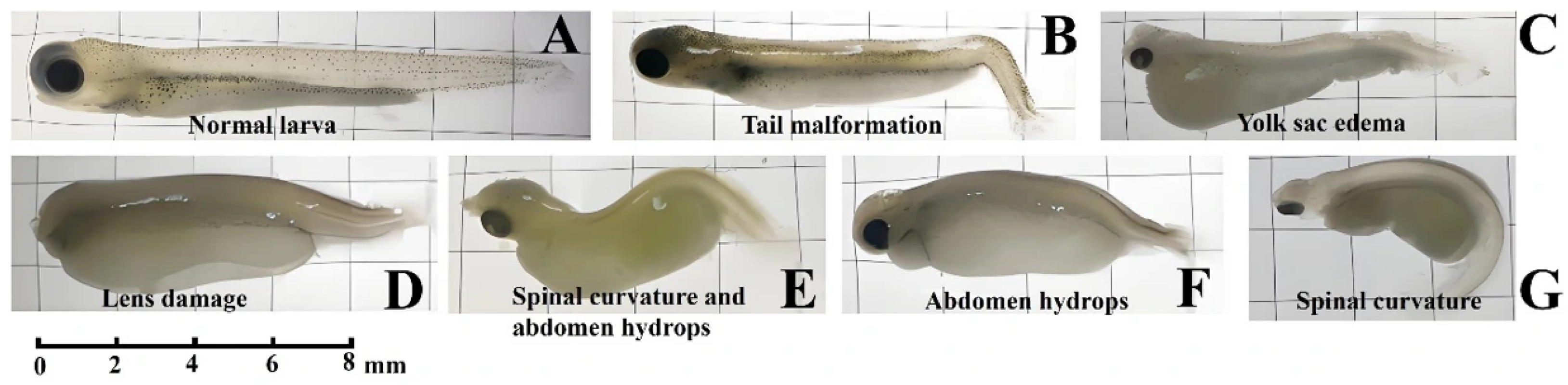
Malformation rates exhibited an increasing trend following 7 and 14 days of Cu2+ exposure, with statistically significant increases (one-way ANOVA, Tukey’s test) observed in the 50 and 500 μg/L Cu2+ groups after 14 days. Cu2+ caused malformation in S. younghusbandi larvae including tail malformation (Figure 1B), yolk sac edema (Figure 1C), lens damage (Figure 1D), abdomen hydrops (Figure 1E,F), and spinal curvature (Figure 1E,G). Following 7 and 14 days of exposure, the survival rates in the Cu2+-treated groups showed a decreasing trend compared with the control group. After exposure for 7 days, there were no significant changes in all Cu2+ groups. After exposure for 14 days, the survival rate in the 50 and 500 μg/L Cu2+ groups were significantly lowered. After 7 and 14 days of exposure, the body length of larvae in the Cu2+-treated groups showed a decreasing trend compared with the control group, with the most pronounced reduction observed in the 500 μg/L Cu2+ exposure group (Table 2).

3.2. Gene Expression

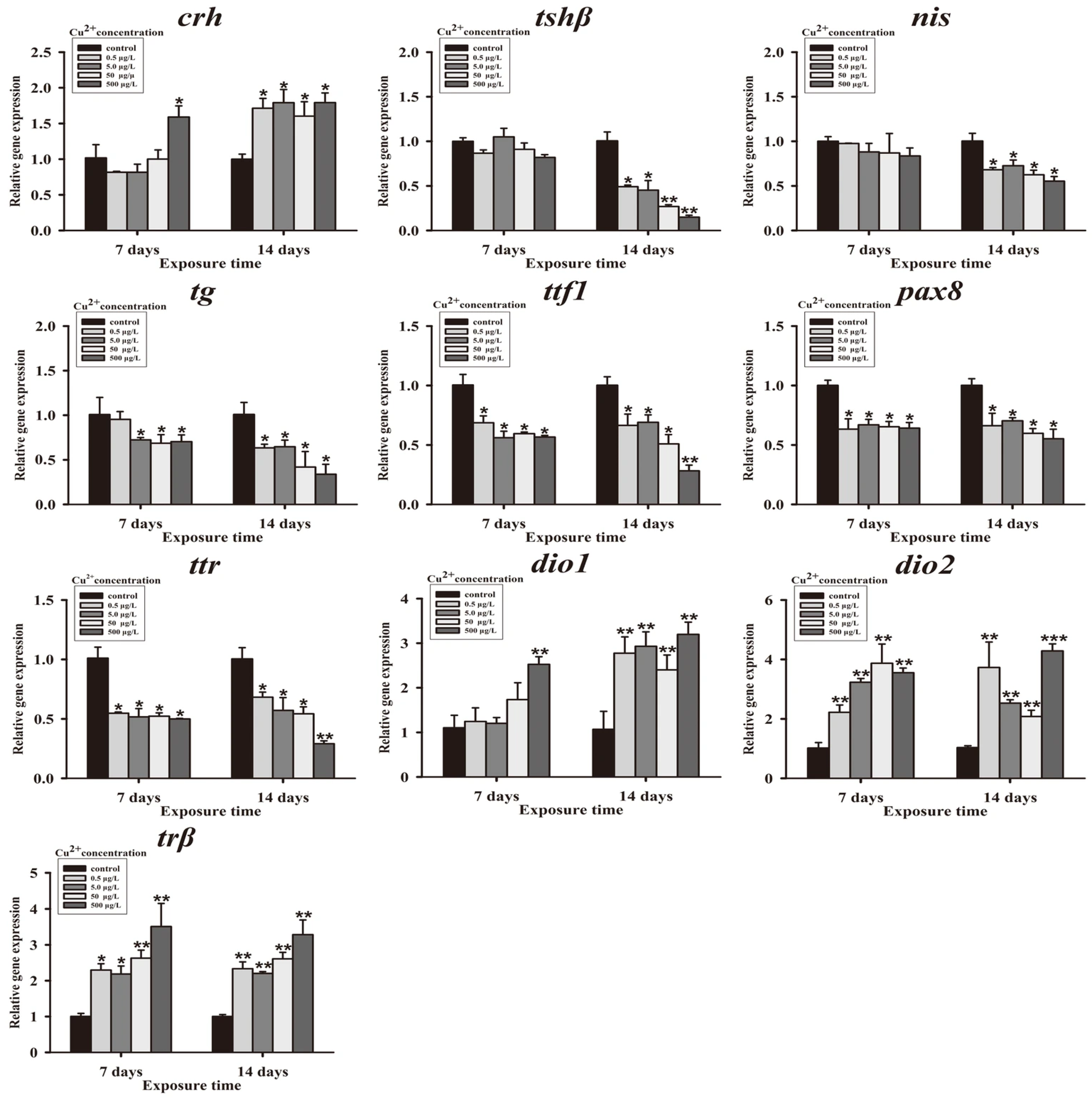
The expression of genes associated with the HPT axis in S. younghusbandi larvae was evaluated following 7 and 14 days of Cu2+ exposure. After 7 days, the expression levels of corticotropin-releasing hormone (crh) and type I iodothyronine deiodinase (dio1) were significantly upregulated 1.59- and 2.52-fold, respectively, in the 500 μg/L Cu2+ treatment group. Type II iodothyronine deiodinase (dio2) and TH receptor-β (trβ) genes were significantly increased in all Cu2+ exposure groups compared with the control group. However, exposure to 0.5, 5, 50, and 500 μg/L Cu2+ significantly downregulated mRNA expression of thyroid transcription factor-1 (ttf1), paired box protein 8 (pax8), and transthyretin (ttr) 0.69-, 0.56-, 0.60-, and 0.57-fold; 0.63-, 0.67-, 0.65-, and 0.64-fold; and 0.55-, 0.52-, 0.52-, and 0.50-fold, respectively. Meanwhile, the expression level of thyroid-stimulating hormone-β (tshβ) was not altered in all Cu2+ exposure groups (Figure 2).
After 14 days of exposure, mRNA expression of crh (1.71-, 1.80-, 1.60-, and 1.80-fold), dio1 (2.78-, 2.93-, 2.40-, and 3.20-fold), dio2 (3.73-, 2.53-, 2.08-, and 4.28-fold), and trβ (2.33-, 2.20-, 2.61-, and 3.29-fold) was significantly upregulated in all Cu2+ exposure groups. Moreover, mRNA expression of tshβ (0.55-, 0.52-, 0.52-, and 0.50-fold), tg (0.63-, 0.65-, 0.42-, and 0.34-fold), ttf1 (0.66-, 0.69-, 0.51-, and 0.28-fold), pax8 (0.66-, 0.70-, 0.60-, and 0.55-fold), and ttr (0.68-, 0.57-, 0.54-, and 0.30-fold) was significantly downregulated in all Cu2+ exposure groups (Figure 2).

3.3. TH Profile

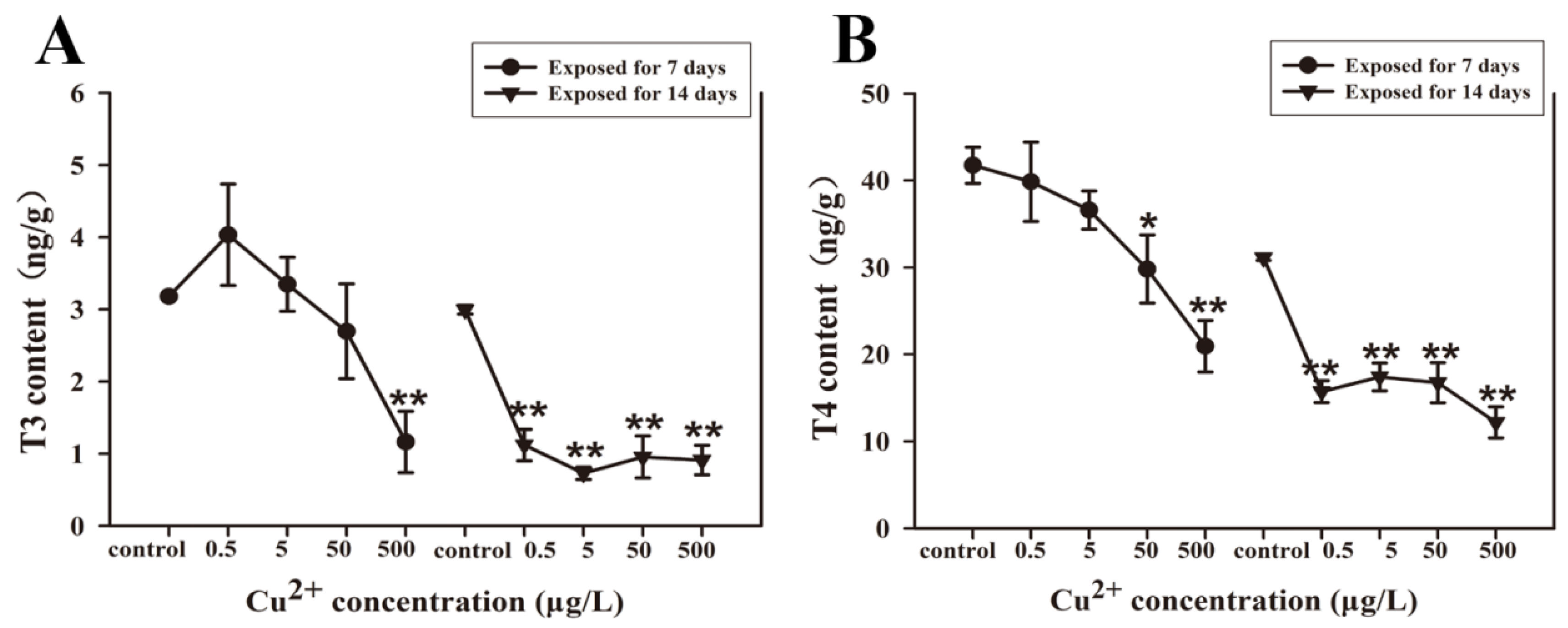
Whole-body total TH levels in the larvae were assessed following 7 and 14 days of Cu2+ exposure. After 7 days of exposure, T3 content was decreased significantly in the 500 μg/L Cu2+ exposure group compared with the control group (Figure 3A). Strikingly, T3 content was increased in the 0.5 and 5 μg/L Cu2+ exposure groups, though these increases were not statistically significant compared with the control group (Figure 3A). Moreover, compared with the control group (41.74 ng/g), whole-body total T4 (29.80 and 20.93 ng/g) contents were significantly decreased in the 50 and 500 μg/L Cu2+ exposure groups (Figure 3B). Compared with the control group (T3: 3.00 ng/g, T4: 31.12 ng/g), the whole-body total T3 (1.12, 0.73, 0.96, 0.91 ng/g) and T4 (15.72, 17.40, 16.74, 12.17 ng/g) contents were significantly decreased in all Cu2+ exposure groups after 14 days of exposure (Figure 3A,B).

3.4. Antioxidant and Detoxification Enzyme Activities

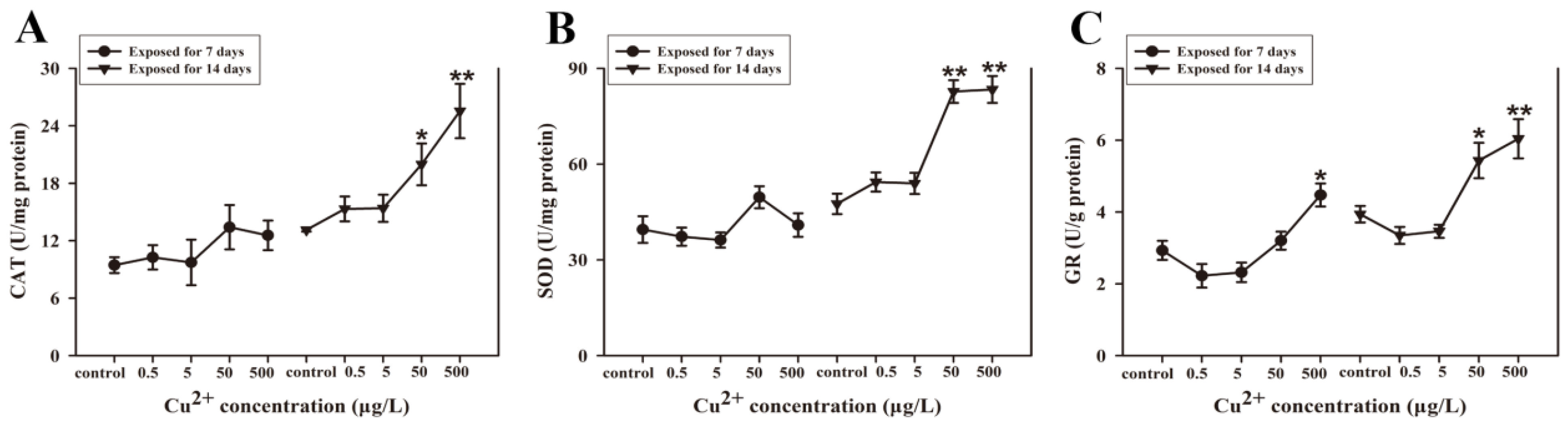
Figure 4 shows the impact of Cu2+ exposure on the activities of SOD, CAT, and GR in S. younghusbandi larvae. After 7 days of exposure, although CAT and SOD levels showed a slight increase across all Cu2+ treatment groups, these changes were not statistically significant (p > 0.05). However, CAT activity was significantly increased in the 50 and 500 μg/L Cu2+ exposure groups following 14 days of treatment. The percentage increase in CAT activity was 52.2% and 94.5%, respectively, compared with control (Figure 4A). Moreover, SOD activity was significantly increased in the 50 and 500 μg/L Cu2+ exposure groups following 14 days of treatment. SOD activities increased by 73.9% and 75.3% in the 50 and 500 μg/L Cu2+ exposure groups, respectively, compared with the control (Figure 4B). After 7 days of exposure, GR activity was significantly elevated in the 500 μg/L Cu2+ exposure group. After 14 days of exposure, GR activity levels were significantly elevated in both the 50 and 500 μg/L Cu2+ exposure groups, increasing by 37.8% and 53.3% in these respective treatment groups (Figure 4C).

3.5. Levels of Glutathione and Lipid Peroxidation

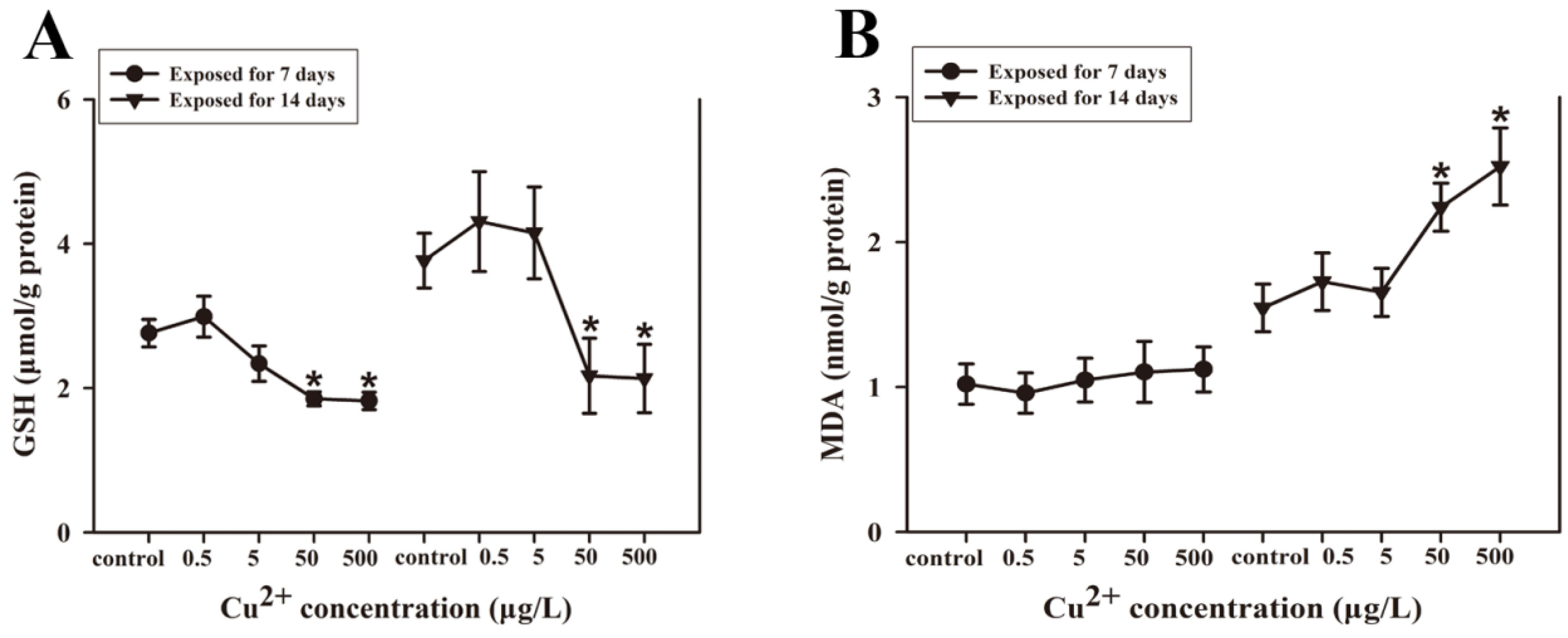
After 7 days of exposure, GSH levels were significantly decreased in the 50 and 500 μg/L Cu2+ groups, with reductions of 33.0% and 34.1%, respectively. Furthermore, GSH levels were decreased significantly in the 50 and 500 μg/L Cu2+ groups after 14 days of exposure. The percentage decrease in GSH levels were 42.4% and 43.5%, respectively. Of particular note, there were no significant changes in the 0.5 and 5 μg/L Cu2+ groups (p > 0.05) after 7 or 14 days (Figure 5A).
The levels of MDA in S. younghusbandi larvae are shown in Figure 5B. There were no significant changes in all Cu2+ exposure groups following 7 days of treatment (p > 0.05). Following 14 days of Cu2+ exposure, MDA levels rose considerably within the 0.5 and 5 μg/L Cu2+ groups. Additionally, GSH levels increased by 44.5% and 62.6% in these respective groups compared with the control (Figure 5B).

3.6. Integrated Assessment of Cu2+ Response

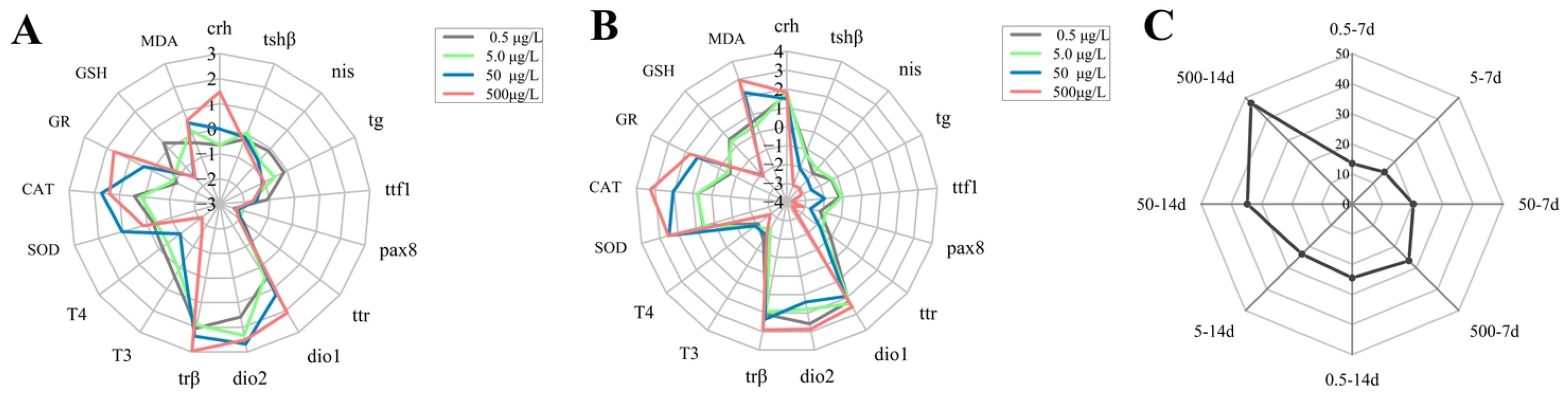
The star plots (Figure 6A,B) present the parameters that characterize the reference deviation of each analyzed biomarker. Areas above 0 indicate biomarker induction, while areas below 0 correspond to biomarker inhibition. With the increase in concentration, the IBR values become higher (13.5, 15.1, 20.3, and 26.6 for 0.5, 5, 50, and 500 μg/L Cu2+, respectively) after larvae exposure to Cu2+ for 7 days. After 14 days of Cu2+ exposure, the IBR values are also increased (24.5, 23.6, 34.7, and 47.4 for 0.5, 5, 50, and 500 μg/L Cu2+ respectively) (Figure 6C).

4. Discussion

Cu2+ exposure induced significant developmental toxicity in S. younghusbandi larvae, as evidenced by reduced survival and body length, increased malformation rates, and various deformities including yolk sac edema, abdominal hydrops, and spinal curvature. Similar observations have been reported in previous studies, where Cu2+ exposure significantly impacted larval development by reducing survival rate, decreasing body length or weight, and increasing malformation rate [17,32]. In this study, whole-body total T4 and T3 levels in S. younghusbandi larvae were significantly reduced. THs are essential for regulating the development and growth of fish larvae [22]. The developmental toxicity in S. younghusbandi larvae exposed to Cu2+ may be attributed to impaired thyroid function.
In vertebrates, the hypothalamus releases thyroid-releasing hormone (TRH), which in turn stimulates the pituitary gland to release thyroid-stimulating hormone (TSH). TSH promotes iodine uptake by the thyroid gland and regulates the synthesis and secretion of THs [33]. In fish, TSH secretion is primarily regulated by CRH released from the hypothalamus. Previous studies have shown that THs influence the expression of crh in fish through a negative feedback loop [22]. It was reported that short-term Cu2+ exposure could reduce the levels of THs (T3 and T4) in Chinese rate minnow (Gobiocypri rarus) larvae, a change that is associated with increased expression of crh and tshβ [34]. In this study, we noted that the expression of crh was also increased in response to Cu2+ exposure for 7 days and 14 days, associated with the reduction in THs (T4 and T3). This outcome may be attributed to a negative feedback response triggered by the reduced TH levels in S. younghusbandi larvae. In vertebrates, TSH is encoded by the tshβ gene and regulates the thyroid axis by binding to its specific receptor on the thyroid gland [35].
PAX8 is critical for terminal follicular cell maturation, while TTF1 regulates thyroid ontogeny in fish [36,37]. The observed downregulation of ttf1 and pax8 gene transcription suggests that Cu2+ might disrupt the transcriptional regulatory network essential for thyroid differentiation and function, which could potentially contribute to the subsequent impairment of TH synthesis.
The nis and tg genes play essential roles in the synthesis of TH. Through the function of nis, iodide originating from the bloodstream is absorbed and concentrated within thyroid cells [36]. The expression of the nis gene is controlled by thyroid transcription factor (ttf1 and ttf2) and pax8, and is activated under the stimulation of TSH [38]. In this study, the downregulation of nis was accompanied by the downregulation of tshβ, ttf1, and pax8 genes after exposure to Cu2+ for 14 days. Therefore, the collective downregulation of tshβ, ttf1, and pax8 by Cu2+ most likely led to the observed decrease in nis mRNA, implying a reduced ability of the thyroid gland to take up iodide. A previous study has demonstrated that TG is a dimeric protein synthesized and exclusively utilized within the thyroid gland, where it serves as a precursor for the production of THs. Tg expression exhibited TH sensitivity, serving as a potential biomarker for assessing thyroid function in standard development. In our study, tg gene expression was decreased following Cu2+ exposure. This finding aligns with the observed decrease in TH (T3 and T4) contents. In summary, Cu2+ exposure disrupted the expression of key genes of the HPT axis. This consistent downregulation of synthesis genes might explain the decrease in T3 and T4 levels.
Following production, THs (mostly T4) attach to TTR for conveyance to responsive areas [39]. In this study, exposure to Cu2+ led to the downregulation of ttr gene expression alongside a reduction in T4 levels, which may be attributed to the decreased T4 content resulting from Cu2+ exposure.
We also analyzed the expression of deiodinase genes, which encode enzymes that modulate TH levels at the peripheral level. In fish, dio2 catalyzes the deiodination of the inner ring of T4 to generate the active hormone T3 [22]. Dio1 is generally considered to have a limited role in maintaining plasma TH homeostasis but plays a significant part in iodine recovery and TH degradation [40]. In this study, dio1 expression was significantly upregulated in the Cu2+ exposure groups, which may contribute to the observed reduction in T3 levels. Furthermore, after 7 and 14 days of Cu2+ exposure, mRNA expression of dio2 was significantly increased compared with the control group. The elevated transcription of dio2 could partially explain the decreased circulating T4 levels and likely exerts a substantial effect on TH homeostasis within tissues [41]. A previous study also demonstrated that reduced whole-body T3 and T4 levels in juvenile grass carp were accompanied by increased expression of the dio1 and dio2 genes following Cd2+ exposure [42].
THs mediate their actions by binding to specific TRs, which function as ligand-activated transcription factors [22,43]. In this study, the expression of trβ was significantly upregulated in all Cu2+-exposed groups compared with the control, possibly reflecting an autoregulatory mechanism in response to reduced THs levels. In contrast to the reported downregulation in Chinese rare minnow [34], notable upregulation of trβ in S. younghusbandi was found. This inconsistency might be explained by the well-documented role of Cu2+ as a TR antagonist; it can suppress T3-induced responses [44] and compete for T3-binding sites [45]. Thus, the downregulation of trβ observed in the present study likely reflects a direct disruptive effect of Cu2+ on the thyroid system. It is important to note that the evidence for thyroid disruption presented in this study is based on hormonal assays and gene expression profiles. Further histological investigations of the thyroid gland are required to validate the observed thyroid-disrupting effects in the present study.
The thyroid-disrupting effects of Cu2+ observed in S. younghusbandi were not an isolated phenomenon but appeared to be a conserved toxicological response in fish. For instance, Cu2+ exposure led to a reduction in T3 levels and upregulation of tshβ in zebrafish [17]. Furthermore, a study on common carp demonstrated that Cu2+ exposure significantly elevated plasma T4 levels [46]. These studies confirmed that the HPT axis is a sensitive target for Cu2+ toxicity in fish. It is noteworthy that cuprous ions (Cu+) are known to form stable complexes with iodide, which could theoretically interfere with iodine uptake and thyroid hormone synthesis in a manner distinct from Cu2+. The present study focused on Cu2+, as it is commonly reported in environmental monitoring. Future investigations comparing the thyroid-disrupting effects of Cu+ and Cu2+, particularly regarding iodine metabolism, would be valuable to fully elucidate copper’s endocrine toxicity mechanisms.
Cu2+ could affect antioxidants in tissues and cause the generation of reactive oxygen species (ROS), resulting in severe peroxidative damage to cell membranes, DNA, and other macromolecules [47,48]. Antioxidant defense systems, found in all aerobic cells, could scavenge excess ROS and avoid oxidative damage to cells [49]. Among them, SOD and CAT serve as the primary line of defense against oxygen toxicity induced by metal exposure, functioning as key antioxidant enzymes. SOD facilitates the dismutation of the superoxide anion radical to water and hydrogen peroxide, which is detoxified by CAT activity [50]. We observed that the levels of SOD and CAT activities were significantly increased after exposure to 50 and 500 μg/L Cu2+. Previous studies have also shown that SOD and CAT activities in gills of rainbow trout, common carp, and gibel carp all showed a trend of induction after Cu2+ exposure [51]. This might be due to the increase in superoxide anions, and SOD and CAT activity were induced to maintain the dynamic balance between ROS removal and production in cells [52].
GSH has been reported to form GS-Me complexes with a range of metals via its thiolate sulfur group [53]. Specifically, GSH can reduce Cu2+ to form a stable Cu+-SG complex [54,55], thereby inhibiting further redox cycling and limiting the production of free radicals [56]. Therefore, the decrease in GSH content in larvae might be caused by higher concentrations and longer Cu2+ exposure. In addition, the GR enzyme is the critical enzyme of GSH. It plays a key role in regulating the oxidized GSH (GSSG)/GSH balance [57]. When its activity is enhanced, more GSSG is reduced back to GSH, thereby boosting the cell’s capacity to neutralize free radicals. In the present study, we observed that the activity of GR increased after Cu2+ exposure. It is speculated that these observed alterations may represent a compensatory mechanism in response to reduced GSH levels.
Lipid peroxidation is commonly recognized as a key indicator of oxidative stress in aquatic animals and is considered a major factor contributing to cellular dysfunction under oxidative stress conditions [58]. In this study, MDA, serving as a marker of oxidative stress, showed a significant increase in fish exposed to 50 and 500 μg/L of Cu2+ for 14 days, thus indicating the generation of serious oxidative stress. It is important to note that the assessment of oxidative stress relies on classical antioxidant markers. Further studies are needed to thoroughly understand the underlying mechanisms by directly measuring ROS and evaluating mitochondrial function.
The IBR is an effective method for quantitative evaluation of the toxic effects of pollutants on organisms and has been applied in many fields [59]. In our study, the IBR was applied to evaluate the changes in different biomarkers and summarize the subacute toxicity trend of Cu2+ exposure at different concentrations and for different durations. A star plot is used to present the parameters representing the reference deviation for each analyzed biomarker. Areas extending above 0 indicate biomarker induction, while those below 0 indicate biomarker inhibition. Moreover, the IBR combines the response of multiple biomarkers into a single value, providing an overall indication of the toxic stress level caused by Cu2+ exposure. The results of the IBR showed that crh, dio1, dio2, and trβ, the GR enzyme, and MDA contents of S. younghusbandi larvae were elevated, and nis, tg, ttf, pax8, and ttr, T4, and GSH contents were inhibited after exposure to Cu2+, which is consistent with the results of the toxicology experiments in this study. Additionally, with the increase in Cu2+ exposure concentration, the deviation in THs (T3 and T4), CAT, and MDA was more obvious. These appear to serve as biomarkers for monitoring Cu2+ pollution in S. younghusbandi. In the present study, we also observed that the calculated IBR values showed a strong correlation with both Cu2+ concentration and duration of exposure. These findings indicate that Cu2+ exposure exerts dose-dependent and time-dependent effects on S. younghusbandi larvae. As both the concentration of Cu2+ and the duration of exposure increase, S. younghusbandi larvae were subjected to more severe stress. Notably, while our higher exposure doses (50, 500 μg/L) defined toxicity thresholds, the IBR revealed a marked time-dependent effect even at the environmentally relevant level of 5 μg/L, the level at which the IBR value increased from 15.1 (7 days) to 23.6 (14 days). This indicates that prolonged exposure to Cu2+ concentrations within the reported environmental range could induce significant integrated stress, highlighting a potential chronic risk to S. younghusbandi larval development.
The IBR index has been proved to be a useful tool for integrating multi-level biomarker responses and visualizing the dose- and time-dependent stress induced by Cu2+. However, it is important to acknowledge the limitations of this approach. It inevitably oversimplifies the organism’s physiological state by reducing the complex and distinct biological effects to a single numerical value. Therefore, the IBR serves as a complementary tool that provides an overview of the overall stress and should be interpreted together with gene expression and hormone data to elucidate the specific toxicity mechanisms of Cu2+.

5. Conclusions

This study demonstrated that exposure to Cu2+ disrupted the thyroid endocrine system and induced oxidative stress in early life stages of S. younghusbandi, a dominant fish species in the ecologically sensitive Lhasa River. The key findings include a significant reduction in THs, dysregulation of genes critical for TH synthesis, transport, and metabolism, and impairment of the antioxidant enzyme system. These results indicate that native high-altitude fish are highly vulnerable to Cu2+ pollution. Moreover, the IBR results confirm that Cu2+ exposure exerted a dose- and time-dependent toxic effect, highlighting the risk even at lower concentrations under prolonged exposure. Future research should focus on validating the long-term and multi-generational toxicity of environmentally realistic Cu2+ levels to native fish.

Supplementary Materials

The following supporting information can be downloaded at: https://www.mdpi.com/article/10.3390/antiox15010112/s1, Table S1 . Summary of statistical tests applied to each variable.

Author Contributions

L.Z.: conceptualization, investigation, methodology, software, writing—original draft, writing—review and editing. C.Z.: investigation, methodology, resources, writing—review and editing. F.L.: methodology, resources, writing—review and editing. H.G.: investigation, methodology, writing—review and editing. D.D.: methodology, writing—review and editing. F.Y.: investigation, methodology, software, visualization, data curation, writing—review and editing. B.M.: supervision, writing—review and editing. M.L.: Conceptualization, funding acquisition, supervision, writing—review and editing. X.D.: funding acquisition, supervision, writing—review and editing. All authors have read and agreed to the published version of the manuscript.

Funding

This work was funded by the Finance Special Fund of the Chinese Ministry of Agriculture and Rural Affairs of the People’s Republic of China (Fisheries Resources and Environment Survey in the Key Water Areas of Southwest China), the Central Public-interest Scientific Institution Basal Research Fund, CAFS (2023TD09), and the National Key R&D Program of China (2023YFC3205903).

Institutional Review Board Statement

The animal study protocol was approved at 15 April 2019 by the Animal Experimental Ethical Inspection of Laboratory Animal Centre, Yangtze River Fisheries Research Institute, Chinese Academy of Fishery Sciences, with approval number 20190415001.

Informed Consent Statement

Not applicable.

Data Availability Statement

The original contributions presented in this study are included in the article/Supplementary Materials . Further inquiries can be directed to the corresponding author(s).

Conflicts of Interest

The authors declare no conflicts of interest.

References

  1. Swain, C.K. Environmental pollution indices: A review on concentration of heavy metals in air, water, and soil near industrialization and urbanisation. Discov. Environ. 2024, 2, 5. [Google Scholar] [CrossRef]
  2. Hu, Y.; Cheng, H.; Tao, S. Environmental and human health impacts of geothermal exploitation in China and mitigation strategies. Crit. Rev. Environ. Sci. Technol. 2023, 53, 1173–1196. [Google Scholar] [CrossRef]
  3. Xing, W.; Wei, L.; Ma, W.; Li, J.; Liu, X.; Hu, J.; Wang, X. Geochemistry and sources apportionment of major ions and dissolved heavy metals in a small watershed on the Tibetan Plateau. Water 2022, 14, 3856. [Google Scholar] [CrossRef]
  4. Chai, L.; Zhou, Y.; Wang, X. Impact of global warming on regional cycling of mercury and persistent organic pollutants on the Tibetan Plateau: Current progress and future prospects. Environ. Sci. Process. Impacts 2022, 24, 1616–1630. [Google Scholar] [CrossRef]
  5. Liu, F.; Li, M.; Zhang, R.; Cui, Y. Pollution analysis and health risk assessment of heavy metals in Lhasa River. Environ. Chem. 2012, 31, 580–585. [Google Scholar]
  6. Mao, G.; Zhao, Y.; Zhang, F.; Liu, J.; Huang, X. Spatiotemporal variability of heavy metals and identification of potential source tracers in the surface water of the Lhasa River basin. Environ. Sci. Pollut. Res. 2019, 26, 7442–7452. [Google Scholar] [CrossRef]
  7. Yang, R.; Yao, T.; Xu, B.; Jiang, G.; Xin, X. Accumulation features of organochlorine pesticides and heavy metals in fish from high mountain lakes and Lhasa River in the Tibetan Plateau. Environ. Int. 2007, 33, 151–156. [Google Scholar] [CrossRef]
  8. Mao, G.; Zhang, Y.; Tong, Y.; Huang, X.; Mehrl, F. Ecological risk assessment of heavy metals to aquatic organisms in the Lhasa River, Tibet, China. Environ. Sci. Pollut. Res. 2020, 27, 26091–26102. [Google Scholar] [CrossRef]
  9. Vo, T.T.T.; Peng, T.-Y.; Nguyen, T.H.; Bui, T.N.H.; Wang, C.-S.; Lee, W.-J.; Chen, Y.-L.; Wu, Y.-C.; Lee, I.-T. The crosstalk between copper-induced oxidative stress and cuproptosis: A novel potential anticancer paradigm. Cell Commun. Signal. 2024, 22, 353. [Google Scholar] [CrossRef]
  10. Karimian, S. A critical review on developed ion selective electrodes for Cu2+. J. Chem. Biol. Med. Sci. 2025, 13, 54–63. [Google Scholar]
  11. Kim, B.-E.; Nevitt, T.; Thiele, D.J. Mechanisms for copper acquisition, distribution and regulation. Nat. Chem. Biol. 2008, 4, 176–185. [Google Scholar] [CrossRef]
  12. Mir, A.R.; Pichtel, J.; Hayat, S. Copper: Uptake, toxicity and tolerance in plants and management of Cu-contaminated soil. BioMetals 2021, 34, 737–759. [Google Scholar] [CrossRef] [PubMed]
  13. Tavares-Dias, M. Toxic, physiological, histomorphological, growth performance and antiparasitic effects of copper sulphate in fish aquaculture. Aquaculture 2021, 535, 736350. [Google Scholar] [CrossRef]
  14. Kumar, M.; Singh, S.; Dwivedi, S.; Trivedi, A.; Dubey, I.; Trivedi, S.P. Copper-induced genotoxicity, oxidative stress, and alteration in transcriptional level of autophagy-associated genes in snakehead fish Channa punctatus. Biol. Trace Elem. Res. 2023, 201, 2022–2035. [Google Scholar] [CrossRef] [PubMed]
  15. Wang, H.; Zhou, L.; Liao, X.; Meng, Z.; Xiao, J.; Li, F.; Zhang, S.; Cao, Z.; Lu, H. Toxic effects of oxine-copper on development and behavior in the embryo-larval stages of zebrafish. Aquat. Toxicol. 2019, 210, 242–250. [Google Scholar] [CrossRef]
  16. Cao, J.; Wang, G.; Wang, T.; Chen, J.; Wenjing, G.; Wu, P.; He, X.; Xie, L. Copper caused reproductive endocrine disruption in zebrafish (Danio rerio). Aquat. Toxicol. 2019, 211, 124–136. [Google Scholar] [CrossRef]
  17. Zhong, L.; Zhang, H.; Wu, L.; Ru, H.; Wei, N.; Yao, F.; Ni, Z.; Duan, X.; Li, Y. Copper and zinc treatments alter the thyroid endocrine system in zebrafish embryos/larvae. Toxics 2022, 10, 756. [Google Scholar] [CrossRef]
  18. Kidd, K.A.; Schindler, D.W.; Muir, D.C.; Lockhart, W.L.; Hesslein, R.H. High concentrations of toxaphene in fishes from a subarctic lake. Science 1995, 269, 240–242. [Google Scholar] [CrossRef]
  19. Chen, F.; Chen, Y. Investigation and protection strategies of fishes of Lhasa River. Acta Hydrobiol. Sin. 2010, 34, 278–285. [Google Scholar] [CrossRef]
  20. Fan, L.; Liu, H.; Guo, Q.; Pan, G. Fishes and their distribution patterns in a meadow wetland of the Lhasa River Basin, the Tibetan Plateau. Resour. Sci. 2010, 32, 1657–1665. [Google Scholar]
  21. Han, H.; Wang, L.; Zhang, C.; Li, H.; Ma, B. Population structure, growth characteristics, resource dynamics, and management strategies of Schizopygopsis younghusbandi in four tributaries of the Yarlung Zangbo River, Tibet. Biology 2025, 14, 707. [Google Scholar] [CrossRef] [PubMed]
  22. Deal, C.K.; Volkoff, H. The role of the thyroid axis in fish. Front. Endocrinol. 2020, 11, 596585. [Google Scholar] [CrossRef] [PubMed]
  23. Zahra, N. Studies of Various Adsorbents for the Removal of Copper (II) from Drinking Water. J. Eng. Sci. Technol. Rev. 2013, 6, 72–75. [Google Scholar]
  24. Li, H.; Zhang, N.; Lin, X. Spatio-temporal characteristics of Yarlung Zangbo River in Tibet. J. Henan Norm. Univ. 2010, 38, 126–130. [Google Scholar]
  25. Wu, L.; Li, Y.; Ru, H.; Xie, H.; Yao, F.; Ni, Z.; Zhong, L. Parental exposure to 2,2′,4,4′5-pentain polybrominated diphenyl ethers (BDE-99) causes thyroid disruption and developmental toxicity in zebrafish. Toxicol. Appl. Pharmacol. 2019, 372, 11–18. [Google Scholar] [CrossRef]
  26. Yao, F.; Wu, J.; Ru, H.; Li, Y.; Wu, L.; Ni, Z.; Chen, D.; Zhong, L. Thyroid disruption and developmental toxicity caused by Cd2+ in Schizopygopsis younghusbandi larvae. Comp. Biochem. Physiol. Part C Toxicol. Pharmacol. 2020, 235, 108783. [Google Scholar] [CrossRef]
  27. Livak, K.J.; Schmittgen, T.D. Analysis of relative gene expression data using real-time quantitative PCR and the 2(-Delta Delta C(T)) Method. Methods 2001, 25, 402–408. [Google Scholar] [CrossRef]
  28. Peng, C.; Fu, X.; Zhang, Y.; Zhang, H.; Ye, Y.; Deng, J.; Tan, B. Effects of malondialdehyde on growth performance, gastrointestinal health, and muscle quality of striped catfish (Pangasianodon hypophthalmus). Antioxidants 2024, 13, 1524. [Google Scholar] [CrossRef]
  29. Liang, H.; Mi, H.; Wang, K.; Ren, M.; Zhang, L.; Huang, D.; Gu, J. Enhancement of hypoxia tolerance of gibel carp (Carassius auratus gibelio) via a ferroporphyrin-rich diet. Antioxidants 2025, 14, 738. [Google Scholar] [CrossRef]
  30. Sanchez, W.; Burgeot, T.; Porcher, J.-M. A novel “Integrated Biomarker Response” calculation based on reference deviation concept. Environ. Sci. Pollut. Res. 2013, 20, 2721–2725. [Google Scholar] [CrossRef]
  31. Beliaeff, B.; Burgeot, T. Integrated biomarker response: A useful tool for ecological risk assessment. Environ. Toxicol. Chem. 2002, 21, 1316–1322. [Google Scholar] [CrossRef] [PubMed]
  32. Wang, R.-F.; Zhu, L.-M.; Zhang, J.; An, X.-P.; Yang, Y.-P.; Song, M.; Zhang, L. Developmental toxicity of copper in marine medaka (Oryzias melastigma) embryos and larvae. Chemosphere 2020, 247, 125923. [Google Scholar] [CrossRef]
  33. Zoeller, R.; Tan, S.; Tyl, R. General background on the hypothalamic-pituitary-thyroid (HPT) axis. Crit. Rev. Toxicol. 2007, 37, 11–53. [Google Scholar] [CrossRef] [PubMed]
  34. Zhong, L.; Yuan, L.; Rao, Y.; Li, Z.; Zhang, X.; Liao, T.; Xu, Y.; Dai, H. Distribution of vitellogenin in zebrafish (Danio rerio) tissues for biomarker analysis. Aquat. Toxicol. 2014, 149, 1–7. [Google Scholar] [CrossRef] [PubMed]
  35. MacKenzie, D.S.; Jones, R.A.; Miller, T.C. Thyrotropin in teleost fish. Gen. Comp. Endocrinol. 2009, 161, 83–89. [Google Scholar] [CrossRef]
  36. Porazzi, P.; Calebiro, D.; Benato, F.; Tiso, N.; Persani, L. Thyroid gland development and function in the zebrafish model. Mol. Cell. Endocrinol. 2009, 312, 14–23. [Google Scholar] [CrossRef]
  37. Wendl, T.; Lun, K.; Mione, M.; Favor, J.; Brand, M.; Wilson, S.W.; Rohr, K.B. pax2.1 is required for the development of thyroid follicles in zebrafish. Development 2002, 129, 3751–3760. [Google Scholar] [CrossRef]
  38. Zoeller, R.T.; Tyl, R.W.; Tan, S.W. Current and Potential Rodent Screens and Tests for Thyroid Toxicants. Crit. Rev. Toxicol. 2007, 37, 55–95. [Google Scholar] [CrossRef]
  39. Zuñiga, L.F.F.; Muñoz, Y.S.; Pustovrh, M.C. Thyroid hormones: Metabolism and transportation in the fetoplacental unit. Mol. Reprod. Dev. 2022, 89, 526–539. [Google Scholar] [CrossRef]
  40. Van der Geyten, S.; Byamungu, N.; Reyns, G.E.; Kühn, E.R.; Darras, V.M. Iodothyronine deiodinases and the control of plasma and tissue thyroid hormone levels in hyperthyroid tilapia (Oreochromis niloticus). J. Endocrinol. 2005, 184, 467–479. [Google Scholar] [CrossRef]
  41. Yu, L.Q.; Deng, J.; Shi, X.J.; Liu, C.S.; Yu, K.; Zhou, B.S. Exposure to DE-71 alters thyroid hormone levels and gene transcription in the hypothalamic-pituitary-thyroid axis of zebrafish larvae. Aquat. Toxicol. 2010, 97, 226–233, Erratum in Aquat. Toxicol. 2010, 100, 376. [Google Scholar] [CrossRef] [PubMed]
  42. Mu, W.N.; Li, Z.H.; Zhong, L.Q.; Wu, Y.H. Effect of Tributyltin, Cadmium, and Their Combination on Physiological Responses in Juvenile Grass Carp. J. Aquat. Anim. Health 2016, 28, 181–186. [Google Scholar] [CrossRef] [PubMed]
  43. Contreras-Jurado, C. Thyroid hormones and co-workers: An overview. In Thyroid Hormones: Methods and Protocols; Humana: New York, NY, USA, 2024; Volume 2876, pp. 3–16. [Google Scholar]
  44. Li, J.; Liu, Y.; Kong, D.D.; Ren, S.J.; Li, N. T-screen and yeast assay for the detection of the thyroid-disrupting activities of cadmium, mercury, and zinc. Environ. Sci. Pollut. Res. 2016, 23, 9843–9851. [Google Scholar] [CrossRef] [PubMed]
  45. Surks, M.I.; Ramirez, I.J.; Shapiro, L.E.; Kumara-Siri, M. Effect of zinc(II) and other divalent cations on binding of 3,5,3’-triiodo-L-thyronine to nuclear receptors from cultured GC cells. J. Biol. Chem. 1989, 264, 9820. [Google Scholar] [CrossRef]
  46. Hoseini, S.M.; Hedayati, A.; Mirghaed, A.T.; Ghelichpour, M. Toxic effects of copper sulfate and copper nanoparticles on minerals, enzymes, thyroid hormones and protein fractions of plasma and histopathology in common carp Cyprinus carpio. Exp. Toxicol. Pathol. 2016, 68, 493–503. [Google Scholar] [CrossRef]
  47. Husain, N.; Mahmood, R. Copper(II) generates ROS and RNS, impairs antioxidant system and damages membrane and DNA in human blood cells. Environ. Sci. Pollut. Res. 2019, 26, 20654–20668. [Google Scholar] [CrossRef]
  48. Zeeshan, M.; Murugadas, A.; Ghaskadbi, S.; Rajendran, R.B.; Akbarsha, M.A. ROS dependent copper toxicity in Hydra-biochemical and molecular study. Comp. Biochem. Physiol. Part C Toxicol. Pharmacol. 2016, 185, 1–12. [Google Scholar] [CrossRef]
  49. Lushchak, V.I. Environmentally induced oxidative stress in aquatic animals. Aquat. Toxicol. 2011, 101, 13–30. [Google Scholar] [CrossRef]
  50. Hao, F.; Jing, M.; Zhao, X.; Liu, R. Spectroscopy, calorimetry and molecular simulation studies on the interaction of catalase with copper ion. J. Photochem. Photobiol. B Biol. 2015, 143, 100–106. [Google Scholar] [CrossRef]
  51. Eyckmans, M.; Celis, N.; Horemans, N.; Blust, R.; De Boeck, G. Exposure to waterborne copper reveals differences in oxidative stress response in three freshwater fish species. Aquat. Toxicol. 2011, 103, 112–120. [Google Scholar] [CrossRef]
  52. Livingstone, D.R. Contaminant-stimulated Reactive Oxygen Species Production and Oxidative Damage in Aquatic Organisms. Mar. Pollut. Bull. 2001, 42, 656–666. [Google Scholar] [CrossRef]
  53. Canesi, L.; Viarengo, A.; Leonzio, C.; Filippelli, M.; Gallo, G. Heavy metals and glutathione metabolism in mussel tissues. Aquat. Toxicol. 1999, 46, 67–76. [Google Scholar] [CrossRef]
  54. Ahmad, I.; Maria, V.L.; Oliveira, M.; Pacheco, M.; Santos, M.A. Oxidative stress and genotoxic effects in gill and kidney of Anguilla anguilla L. exposed to chromium with or without pre-exposure to β-naphthoflavone. Mutat. Res.-Genet. Toxicol. Environ. Mutagen. 2006, 608, 16–28. [Google Scholar] [CrossRef] [PubMed]
  55. Sanchez, W.; Palluel, O.; Meunier, L.; Coquery, M.; Porcher, J.M.; Aït-Aïssa, S. Copper-induced oxidative stress in three-spined stickleback: Relationship with hepatic metal levels. Environ. Toxicol. Pharmacol. 2005, 19, 177–183. [Google Scholar] [CrossRef]
  56. Milne, L.; Nicotera, P.; Orrenius, S.; Burkitt, M.J. Effects of glutathione and chelating agents on copper-mediated DNA oxidation: Pro-oxidant and antioxidant properties of glutathione. Arch. Biochem. Biophys. 1993, 304, 102–109. [Google Scholar] [CrossRef] [PubMed]
  57. Almroth, B.C.; Albertsson, E.; Sturve, J.; Förlin, L. Oxidative stress, evident in antioxidant defences and damage products, in rainbow trout caged outside a sewage treatment plant. Ecotoxicol. Environ. Saf. 2008, 70, 370–378. [Google Scholar] [CrossRef] [PubMed]
  58. Srivastava, B.; Reddy, P. Lipid peroxidation and DNA damage as biomarkers of pollution induced oxidative stress (OS) in fish. Life Sci. Int. J. 2017, 4, 194–198. [Google Scholar]
  59. Duarte, I.A.; Reis-Santos, P.; França, S.; Cabral, H.; Fonseca, V.F. Biomarker responses to environmental contamination in estuaries: A comparative multi-taxa approach. Aquat. Toxicol. 2017, 189, 31–41. [Google Scholar] [CrossRef]
Figure 1. Morphology of S. younghusbandi larvae exposed to Cu2+. (A) Normal larva. (B) Tail malformation. (C) Yolk sac edema. (D) Lens damage. (E) Spinal curvature and abdomen hydrops. (F) Abdomen hydrops. (G) Spinal curvature.
Antioxidants 15 00112 g001
Figure 2. Gene, expression in S. younghusbandi larvae exposed to 0.5, 5, 50 and 500 μg/L Cu2+ for 7 days and 14 days. Data are presented as mean ± SD (n = 6). * p < 0.05, ** p < 0.01 and *** p < 0.001 indicate significant differences between exposure groups and corresponding control.
Antioxidants 15 00112 g002
Figure 3. The whole-body total T3 (A) and T4 (B) content in S. younghusbandi larvae exposed to 0.5, 5, 50, and 500 μg/L Cu2+ for 7 days and 14 days. Data are presented as the mean ± SD (n = 3). * p < 0.05 and ** p < 0.01 indicate significant differences between the exposure groups and the corresponding control.
Antioxidants 15 00112 g003
Figure 4. The levels of antioxidant enzyme activities (CAT (A), SOD (B), GR (C)) in S. younghusbandi larvae exposed to 0.5, 5, 50, and 500 μg/L Cu2+ for 7 days and 14 days. Data are presented as the mean ± SD (n = 3). * p < 0.05 and ** p < 0.01 indicate significant differences between the exposure groups and the corresponding control.
Antioxidants 15 00112 g004
Figure 5. GSH (A) and MDA (B) contents in S. younghusbandi larvae exposed to 0.5, 5, 50, and 500 μg/L Cu2+ for 7 days and 14 days. Data are presented as mean ± SD (n = 3). * p < 0.05 indicate significant differences between exposure groups and corresponding control.
Antioxidants 15 00112 g005
Figure 6. Star plots for biomarker responses in S. younghusbandi larvae after exposure to 0.5, 5, 50, and 500 μg/L Cu2+ for 7 days (A) and 14 days (B), and integrated biomarker response of all parameters measured after Cu2+ exposure (C).
Antioxidants 15 00112 g006
Table 1. The primer sequences used for qRT-PCR in this study.
NameSequence of Primer 5′-3′Product Length (bp)GenBank Accession
β-actin-FGATGGACTCTGGTGATGGTGTGAC167NM_131031.2
β-actin-RTTTCTCTTTCGGCTGTGGTGGTG
crh-FGATTTCCCTGGACCTGACC131XM_016522229.1
crh-RGGGTTTGCTCGTGGTTACTT
tshβ-FGAGTTGGTGGGTCCTCGTT177NM_181494.2
tshβ-RTTCTAAGGGCACATTCATCAC
ttf1-FAGAGCAAATGTGACCCAAGCAGAC86XM_016553336.1
ttf1-RGGTTCTTCCTCGTGTTCGGTGATC
pax8-FGCAGTTCATCGCAGGCAGAGAC94XM_042757200.1
pax8-RAGTGATGGTGGACGAGGAGAAGC
nis-FGACTATGCTGTATTTGCTGCTATG102XM_042729464.1
nis-RGAAGAAGCTGTCCAGGTTAGAG
tg-FTGATGGTGCTGCGAAAGAAAGGTC105XM_016533797.1
tg-RCAAGCGTCCGATACACTCCAGAAC
ttr-FTGGAGTTTGACACTAAAGCCTACT110XM_016518290.1
ttr-RCCAGAGTGTAATGACGATGCC
dio1-FATAAGCCAGCTGCCGATTT152XM_019086809.2
dio1-RCTCCTCCAGATTACGGTGTTTC
dio2-FCAGATTTCCTGCTGGTCTACAT134XM_016567490.1
dio2-RTCCTCCAGATTTCGGTGTTTC
trβ-FGAGGAGCAGCAGAATGAAAGA130XM_042735414.1
trβ-RCCCTTGCGTTCACTCGATTA
Table 2. Developmental indexes of S. younghusbandi larvae exposed to 0, 0.5, 5, 50, and 500 μg/L Cu2+ for 7 days and 14 days. Data are presented as mean ± SD (n = 3). Different lowercase letters denote significant differences among groups (p < 0.05).
Cu2+ (μg/L)00.5550500
Malformation (7days, %)1.33 ± 0.01 a1.47 ± 0.01 a1.91 ± 0.01 a2.86 ± 0.01 a3.12 ± 0.02 a
Malformation (14 days, %)2.02 ± 0.08 a2.79 ± 0.05 a4.26 ± 0.10 a,b5.77 ± 0.07 b6.92 ± 0.11 b
Survival (7 days, %)96.83 ± 0.01 a92.50 ± 2.16 a90.33 ± 1.25 a89.83 ± 1.24 a86.33 ± 2.36 a
Survival (14 days, %)92.83 ± 1.89 a85.33 ± 1.25 a80.17 ± 1.25 a,b77.33 ± 4.03 b68.83 ± 2.05 c
Length (7 days, mm)12.45 ± 0.31 a12.40 ± 0.36 a12.31 ± 0.18 a11.95 ± 0.18 a,b11.65 ± 0.49 b
Length (14 days, mm)13.84 ± 0.38 a13.52 ± 0.35 a13.51 ± 0.62 a13.08± 0.56 b12.46 ± 0.41 b
Disclaimer/Publisher’s Note: The statements, opinions and data contained in all publications are solely those of the individual author(s) and contributor(s) and not of MDPI and/or the editor(s). MDPI and/or the editor(s) disclaim responsibility for any injury to people or property resulting from any ideas, methods, instructions or products referred to in the content.