Driving with Motor Neuron Disease: Disease-Specific Considerations, Multi-Domain Assessments and Support Strategies

 ,
,
Abstract
1. Introduction
2. Driving with MND
3. Methods
4. Results
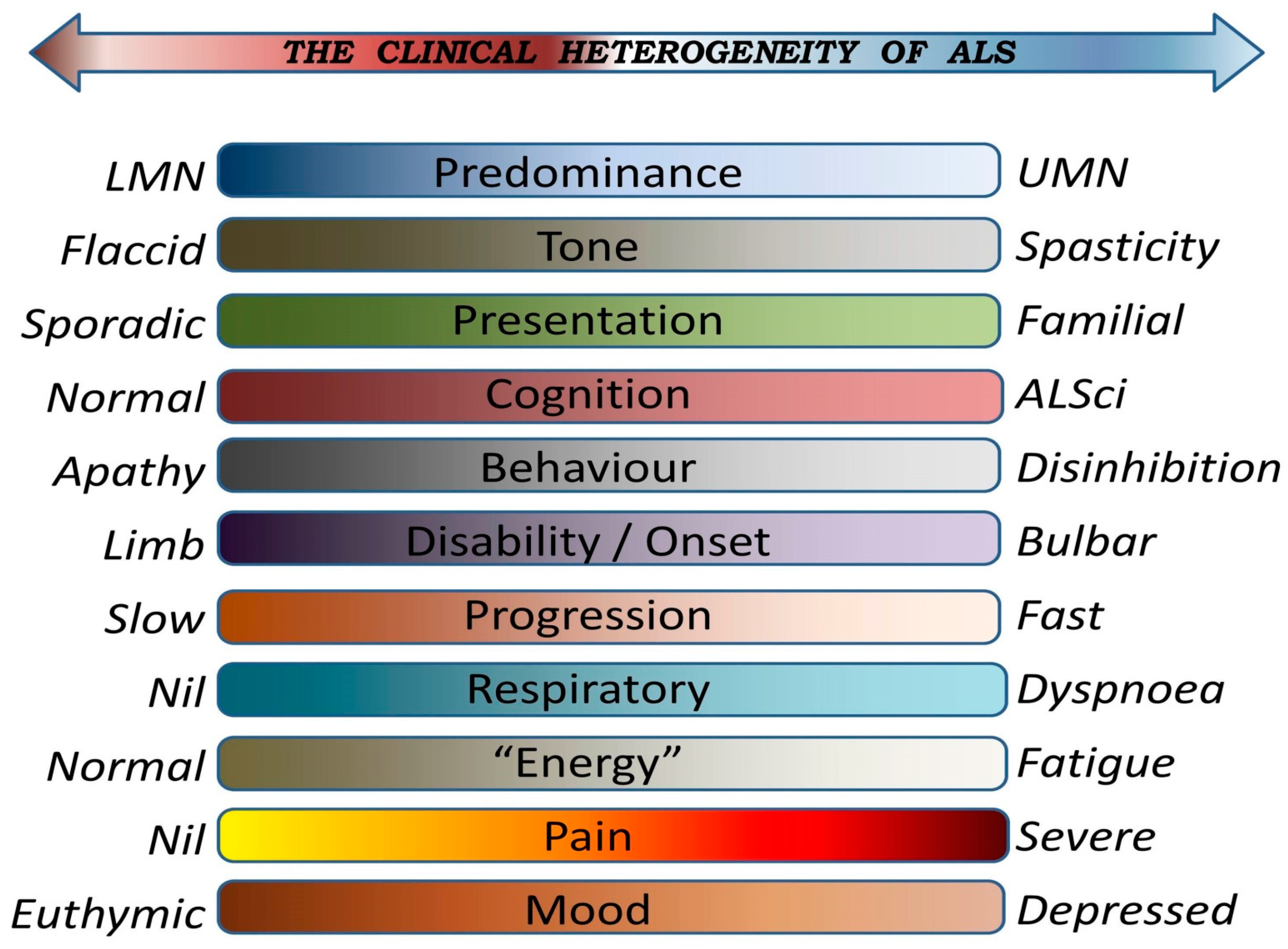
4.1. Motor Manifestations of ALS
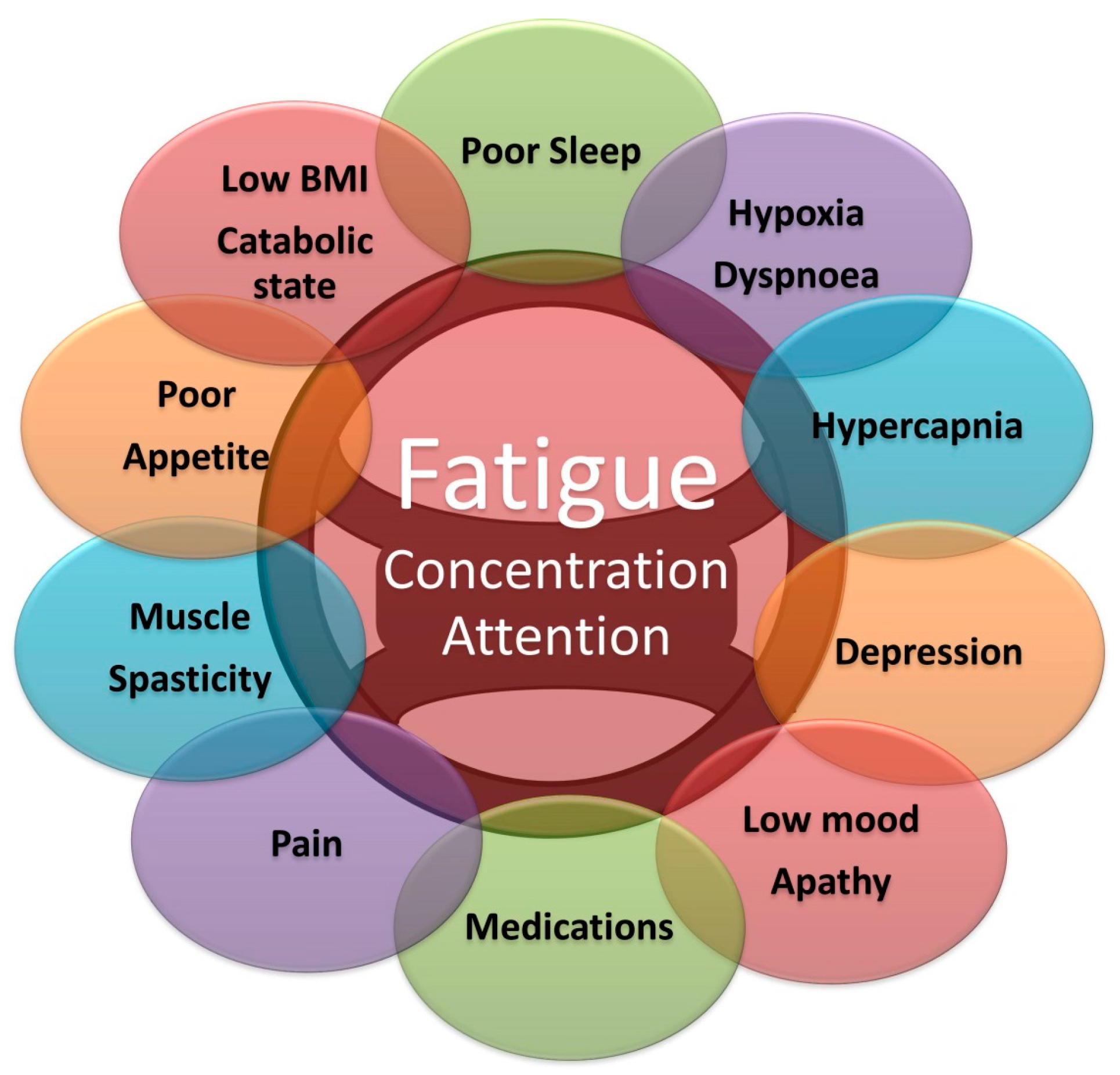
4.2. Non-Motor Features of ALS/MND
4.3. Non-ALS MND Phenotypes
4.4. Driving Studies in MND
4.5. Lessons from Other Neurological Conditions
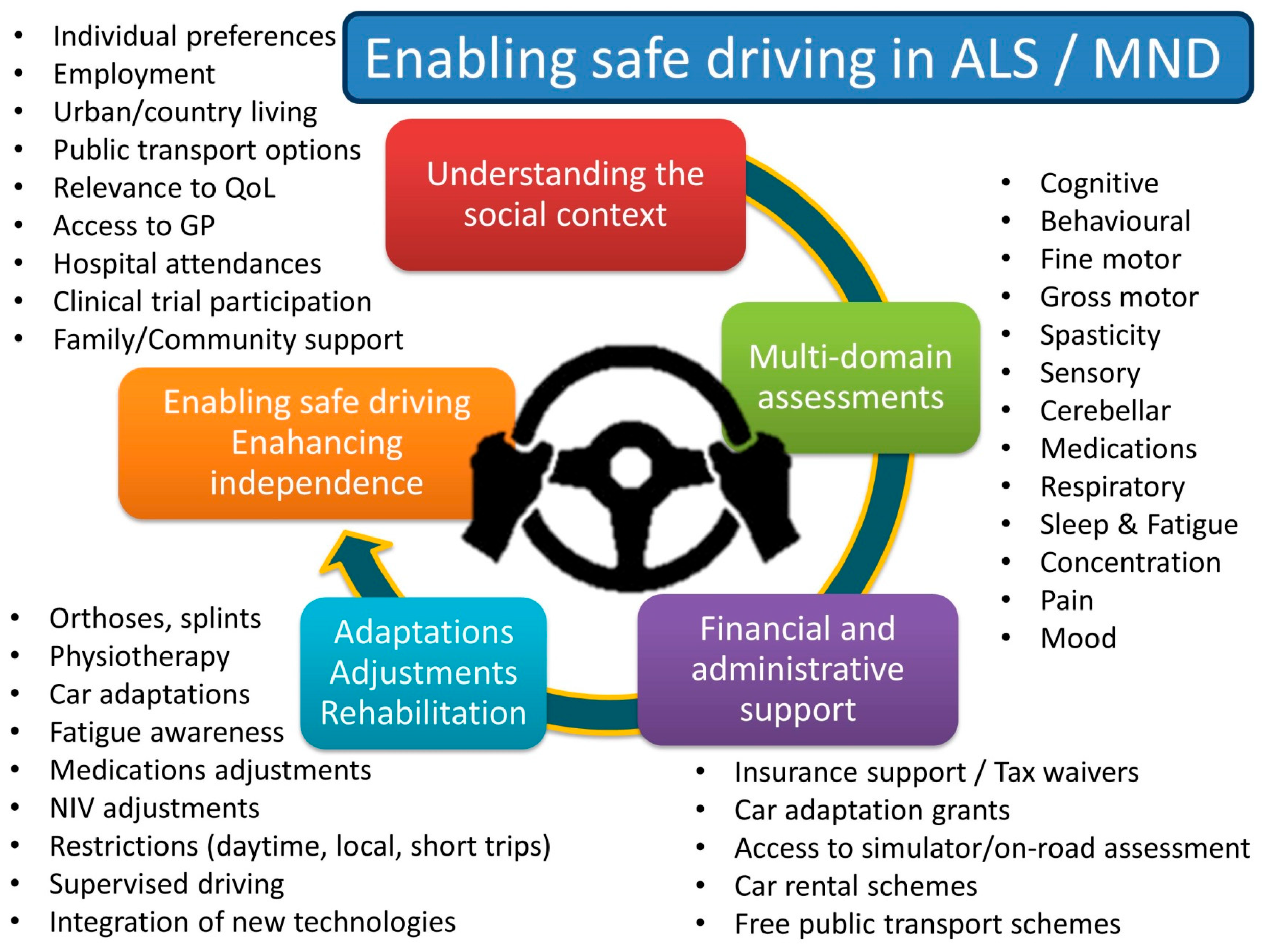
4.6. Assessment Strategies in ALS/MND
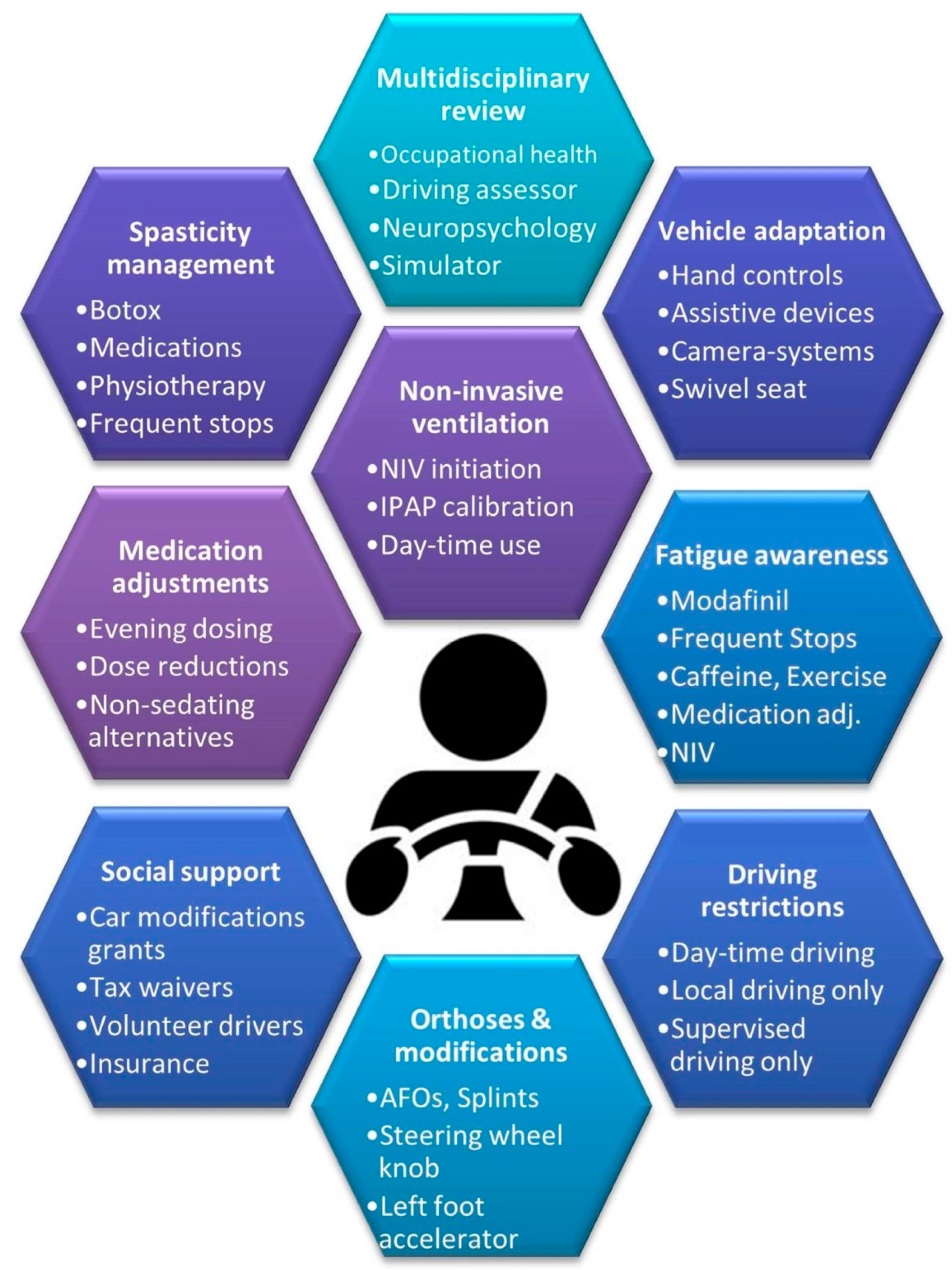
4.7. Interventions
4.8. Governing Concepts
4.9. Stakeholders
4.10. Knowledge Gaps and Future Directions
5. Conclusions
Author Contributions
Funding
Institutional Review Board Statement
Informed Consent Statement
Data Availability Statement
Conflicts of Interest
Glossary
References
- Fang, T.; Al Khleifat, A.; Stahl, D.R.; Lazo La Torre, C.; Murphy, C.; Young, C.; Shaw, P.J.; Leigh, P.N.; Al-Chalabi, A. Comparison of the King’s and MiToS staging systems for ALS. Amyotroph. Lateral Scler. Front. Degener. 2017, 18, 227–232. [Google Scholar] [CrossRef]
- Thakore, N.J.; Lapin, B.R.; Kinzy, T.G.; Pioro, E.P. Deconstructing progression of amyotrophic lateral sclerosis in stages: A Markov modeling approach. Amyotroph. Lateral Scler. Front. Degener. 2018, 19, 483–494. [Google Scholar] [CrossRef]
- Roche, J.C.; Rojas-Garcia, R.; Scott, K.M.; Scotton, W.; Ellis, C.E.; Burman, R.; Wijesekera, L.; Turner, M.R.; Leigh, P.N.; Shaw, C.E.; et al. A proposed staging system for amyotrophic lateral sclerosis. Brain A J. Neurol. 2012, 135, 847–852. [Google Scholar] [CrossRef] [PubMed]
- Tramacere, I.; Dalla Bella, E.; Chio, A.; Mora, G.; Filippini, G.; Lauria, G. The MITOS system predicts long-term survival in amyotrophic lateral sclerosis. J. Neurol. Neurosurg. Psychiatry 2015, 86, 1180–1185. [Google Scholar] [CrossRef]
- Strong, M.J.; Grace, G.M.; Freedman, M.; Lomen-Hoerth, C.; Woolley, S.; Goldstein, L.H.; Murphy, J.; Shoesmith, C.; Rosenfeld, J.; Leigh, P.N.; et al. Consensus criteria for the diagnosis of frontotemporal cognitive and behavioural syndromes in amyotrophic lateral sclerosis. Amyotroph. Lateral Scler. 2009, 10, 131–146. [Google Scholar] [CrossRef]
- Strong, M.J.; Abrahams, S.; Goldstein, L.H.; Woolley, S.; McLaughlin, P.; Snowden, J.; Mioshi, E.; Roberts-South, A.; Benatar, M.; Hortobágyi, T.; et al. Amyotrophic lateral sclerosis—Frontotemporal spectrum disorder (ALS-FTSD): Revised diagnostic criteria. Amyotroph. Lateral Scler. Front. Degener. 2017, 18, 153–174. [Google Scholar] [CrossRef] [PubMed]
- Al-Chalabi, A.; Chiò, A.; Merrill, C.; Oster, G.; Bornheimer, R.; Agnese, W.; Apple, S. Clinical staging in amyotrophic lateral sclerosis: Analysis of Edaravone Study 19. J. Neurol. Neurosurg. Psychiatry 2021, 92, 165–171. [Google Scholar] [CrossRef] [PubMed]
- Lagier-Tourenne, C.; Baughn, M.; Rigo, F.; Sun, S.; Liu, P.; Li, H.R.; Jiang, J.; Watt, A.T.; Chun, S.; Katz, M.; et al. Targeted degradation of sense and antisense C9orf72 RNA foci as therapy for ALS and frontotemporal degeneration. Proc. Natl. Acad. Sci. USA 2013, 110, E4530–E4539. [Google Scholar] [CrossRef]
- Tran, H.; Moazami, M.P.; Yang, H.; McKenna-Yasek, D.; Douthwright, C.L.; Pinto, C.; Metterville, J.; Shin, M.; Sanil, N.; Dooley, C.; et al. Suppression of mutant C9orf72 expression by a potent mixed backbone antisense oligonucleotide. Nat. Med. 2022, 28, 117–124. [Google Scholar] [CrossRef]
- Ciani, G.; Pincus, C.; Grimaldi, G. Contextual Factors & Barriers to Driving Among People With Amyotrophic Lateral Sclerosis: Research in Progress. Am. J. Occup. Ther. 2023, 77, 7711505064p1. [Google Scholar] [CrossRef]
- Stepney, M.; Kirkpatrick, S.; Locock, L.; Prinjha, S.; Ryan, S. A licence to drive? Neurological illness, loss and disruption. Sociol. Health Illn. 2018, 40, 1186–1199. [Google Scholar] [CrossRef] [PubMed]
- Savoie, C.; Voyer, P.; Lavallière, M.; Bouchard, S. Transition from driving to driving-cessation: Experience of older persons and caregivers: A descriptive qualitative design. BMC Geriatr. 2024, 24, 219. [Google Scholar] [CrossRef] [PubMed]
- Chipika, R.H.; Siah, W.F.; McKenna, M.C.; Li Hi Shing, S.; Hardiman, O.; Bede, P. The presymptomatic phase of amyotrophic lateral sclerosis: Are we merely scratching the surface? J. Neurol. 2021, 268, 4607–4629. [Google Scholar] [CrossRef]
- Bede, P.; Bogdahn, U.; Lope, J.; Chang, K.M.; Xirou, S.; Christidi, F. Degenerative and regenerative processes in amyotrophic lateral sclerosis: Motor reserve, adaptation and putative compensatory changes. Neural Regen. Res. 2021, 16, 1208–1209. [Google Scholar] [CrossRef] [PubMed]
- Bede, P.; Murad, A.; Lope, J.; Li Hi Shing, S.; Finegan, E.; Chipika, R.H.; Hardiman, O.; Chang, K.M. Phenotypic categorisation of individual subjects with motor neuron disease based on radiological disease burden patterns: A machine-learning approach. J. Neurol. Sci. 2022, 432, 120079. [Google Scholar] [CrossRef]
- Corcia, P.; Bede, P.; Pradat, P.F.; Couratier, P.; Vucic, S.; de Carvalho, M. Split-hand and split-limb phenomena in amyotrophic lateral sclerosis: Pathophysiology, electrophysiology and clinical manifestations. J. Neurol. Neurosurg. Psychiatry 2021, 92, 1126–1130. [Google Scholar] [CrossRef]
- Thakore, N.J.; Pioro, E.P.; Rucker, J.C.; Leigh, R.J. Motor neuronopathy with dropped hands and downbeat nystagmus: A distinctive disorder? A case report. BMC Neurol. 2006, 6, 3. [Google Scholar] [CrossRef]
- Holdom, C.J.; Williamson, J.L.; O’Reilly, G.; Henderson, R.D.; Neville, S.; Ngo, S.T.; Dick, T.J.M.; Steyn, F.J. Lower-limb biomechanics in motor neuron disease: A joint-level perspective of gait disruption. Amyotroph. Lateral Scler. Front. Degener. 2025, 27, 44–54. [Google Scholar] [CrossRef] [PubMed]
- Hayes, H.A.; Hu, N.; Wang, X.; Gibson, S.; Mathy, P.; Berggren, K.; Bromberg, M. Comparison of driving capacity among patients with amyotrophic lateral sclerosis and healthy controls using the lane change task. J. Neurol. Sci. 2020, 413, 116741. [Google Scholar] [CrossRef] [PubMed]
- Dal Bello-Haas, V.; Florence, J.M.; Krivickas, L.S. Therapeutic exercise for people with amyotrophic lateral sclerosis or motor neuron disease. Cochrane Database Syst. Rev. 2013, 2013, CD005229. [Google Scholar] [CrossRef] [PubMed]
- Souza, A.A.D.; da Silva, S.T.; Macedo, L.R.D.D.; Aires, D.N.; Pondofe, K.D.M.; Melo, L.P.D.; Valentim, R.A.D.M.; Ribeiro, T.S. Physical therapy for muscle strengthening in individuals with amyotrophic lateral sclerosis: A protocol for a systematic review and meta-analysis. PLoS ONE 2024, 19, e0307470. [Google Scholar] [CrossRef]
- Marvulli, R.; Megna, M.; Citraro, A.; Vacca, E.; Napolitano, M.; Gallo, G.; Fiore, P.; Ianieri, G. Botulinum Toxin Type A and Physiotherapy in Spasticity of the Lower Limbs Due to Amyotrophic Lateral Sclerosis. Toxins 2019, 11, 381. [Google Scholar] [CrossRef]
- Young, C.A.; Chaouch, A.; McDermott, C.J.; Al-Chalabi, A.; Chhetri, S.K.; Bidder, C.; Ellis, C.; Annadale, J.; Mills, R.J.; Tennant, A. Fatigue in amyotrophic lateral sclerosis/motor neuron disease: Prevalence, influences and trajectories. Amyotroph. Lateral Scler. Front. Degener. 2025, 27, 78–89. [Google Scholar] [CrossRef]
- Ng, L.; Khan, F. Multidisciplinary Rehabilitation in Amyotrophic Lateral Sclerosis. In Amyotrophic Lateral Sclerosis; Maurer, M.H.H., Ed.; IntechOpen: London, UK, 2012. [Google Scholar]
- Meng, L.; Li, X.; Li, C.; Tsang, R.C.C.; Chen, Y.; Ge, Y.; Gao, Q. Effects of Exercise in Patients With Amyotrophic Lateral Sclerosis: A Systematic Review and Meta-Analysis. Am. J. Phys. Med. Rehabil. 2020, 99, 801–810. [Google Scholar] [CrossRef] [PubMed]
- Finegan, E.; Chipika, R.H.; Li Hi Shing, S.; Hardiman, O.; Bede, P. Pathological Crying and Laughing in Motor Neuron Disease: Pathobiology, Screening, Intervention. Front. Neurol. 2019, 10, 260. [Google Scholar] [CrossRef]
- Bede, P.; Finegan, E. Revisiting the pathoanatomy of pseudobulbar affect: Mechanisms beyond corticobulbar dysfunction. Amyotroph. Lateral Scler. Front. Degener. 2018, 19, 4–6. [Google Scholar] [CrossRef]
- Finegan, E.; Kleinerova, J.; Hardiman, O.; Hutchinson, S.; Garcia-Gallardo, A.; Tan, E.L.; Bede, P. Pseudobulbar affect: Clinical associations, social impact and quality of life implications—Lessons from PLS. J. Neurol. 2025, 272, 266. [Google Scholar] [CrossRef]
- Tahedl, M.; Chipika, R.H.; Lope, J.; Li Hi Shing, S.; Hardiman, O.; Bede, P. Cortical progression patterns in individual ALS patients across multiple timepoints: A mosaic-based approach for clinical use. J. Neurol. 2021, 268, 1913–1926. [Google Scholar] [CrossRef] [PubMed]
- Bede, P.; Bokde, A.L.; Byrne, S.; Elamin, M.; Fagan, A.J.; Hardiman, O. Spinal cord markers in ALS: Diagnostic and biomarker considerations. Amyotroph. Lateral Scler. 2012, 13, 407–415. [Google Scholar] [CrossRef] [PubMed]
- Abidi, M.; de Marco, G.; Couillandre, A.; Feron, M.; Mseddi, E.; Termoz, N.; Querin, G.; Pradat, P.-F.; Bede, P. Adaptive functional reorganization in amyotrophic lateral sclerosis: Coexisting degenerative and compensatory changes. Eur. J. Neurol. 2020, 27, 121–128. [Google Scholar] [CrossRef]
- Abidi, M.; de Marco, G.; Grami, F.; Termoz, N.; Couillandre, A.; Querin, G.; Bede, P.; Pradat, P. Neural Correlates of Motor Imagery of Gait in Amyotrophic Lateral Sclerosis. J. Magn. Reson. Imaging 2021, 53, 223–233. [Google Scholar] [CrossRef]
- Abidi, M.; Pradat, P.F.; Termoz, N.; Couillandre, A.; Bede, P.; de Marco, G. Motor imagery in amyotrophic lateral Sclerosis: An fMRI study of postural control. NeuroImage Clin. 2022, 35, 103051. [Google Scholar] [CrossRef]
- Feron, M.; Couillandre, A.; Mseddi, E.; Termoz, N.; Abidi, M.; Bardinet, E.; Delgadillo, D.; Lenglet, T.; Querin, G.; Welter, M.-L.; et al. Extrapyramidal deficits in ALS: A combined biomechanical and neuroimaging study. J. Neurol. 2018, 265, 2125–2136. [Google Scholar] [CrossRef]
- Chipika, R.H.; Mulkerrin, G.; Pradat, P.F.; Murad, A.; Ango, F.; Raoul, C.; Bede, P. Cerebellar pathology in motor neuron disease: Neuroplasticity and neurodegeneration. Neural Regen. Res. 2022, 17, 2335–2341. [Google Scholar] [CrossRef]
- Tahedl, M.; Tan, E.L.; Kleinerova, J.; Delaney, S.; Hengeveld, J.C.; Doherty, M.A.; Mclaughlin, R.L.; Pradat, P.-F.; Raoul, C.; Ango, F.; et al. Progressive Cerebrocerebellar Uncoupling in Sporadic and Genetic Forms of Amyotrophic Lateral Sclerosis. Neurology 2024, 103, e209623. [Google Scholar] [CrossRef]
- Bede, P.; Chipika, R.H.; Christidi, F.; Hengeveld, J.C.; Karavasilis, E.; Argyropoulos, G.D.; Lope, J.; Shing, S.L.H.; Velonakis, G.; Dupuis, L.; et al. Genotype-associated cerebellar profiles in ALS: Focal cerebellar pathology and cerebro-cerebellar connectivity alterations. J. Neurol. Neurosurg. Psychiatry 2021, 92, 1197–1205. [Google Scholar] [CrossRef]
- Kleinerova, J.; Tahedl, M.; Tan, E.L.; Delaney, S.; Hengeveld, J.C.; Doherty, M.A.; McLaughlin, R.L.; Hardiman, O.; Chang, K.M.; Finegan, E.; et al. Supra- and infra-tentorial degeneration patterns in primary lateral sclerosis: A multimodal longitudinal neuroradiology study. J. Neurol. 2024, 271, 3239–3255. [Google Scholar] [CrossRef] [PubMed]
- Finegan, E.; Siah, W.F.; Li Hi Shing, S.; Chipika, R.H.; Hardiman, O.; Bede, P. Cerebellar degeneration in primary lateral sclerosis: An under-recognized facet of PLS. Amyotroph. Lateral Scler. Front. Degener. 2022, 23, 542–553. [Google Scholar] [CrossRef] [PubMed]
- Malm, J.; Kristensen, B.; Karlsson, T.; Carlberg, B.; Fagerlund, M.; Olsson, T. Cognitive impairment in young adults with infratentorial infarcts. Neurology 1998, 51, 433–440. [Google Scholar] [CrossRef] [PubMed]
- Stoodley, C.J.; MacMore, J.P.; Makris, N.; Sherman, J.C.; Schmahmann, J.D. Location of lesion determines motor vs. cognitive consequences in patients with cerebellar stroke. NeuroImage Clin. 2016, 12, 765–775. [Google Scholar] [CrossRef]
- Keren-Happuch, E.; Chen, S.H.; Ho, M.H.; Desmond, J.E. A meta-analysis of cerebellar contributions to higher cognition from PET and fMRI studies. Hum. Brain Mapp. 2014, 35, 593–615. [Google Scholar]
- Stoodley, C.J.; Schmahmann, J.D. Functional topography in the human cerebellum: A meta-analysis of neuroimaging studies. Neuroimage 2009, 44, 489–501. [Google Scholar] [CrossRef]
- Argyropoulos, G.P.D.; van Dun, K.; Adamaszek, M.; Leggio, M.; Manto, M.; Masciullo, M.; Molinari, M.; Stoodley, C.J.; Van Overwalle, F.; Ivry, R.B.; et al. The Cerebellar Cognitive Affective/Schmahmann Syndrome: A Task Force Paper. Cerebellum 2020, 19, 102–125. [Google Scholar] [CrossRef]
- Tedesco, A.M.; Chiricozzi, F.R.; Clausi, S.; Lupo, M.; Molinari, M.; Leggio, M.G. The cerebellar cognitive profile. Brain 2011, 134, 3672–3686. [Google Scholar] [CrossRef] [PubMed]
- Levisohn, L.; Cronin-Golomb, A.; Schmahmann, J.D. Neuropsychological consequences of cerebellar tumour resection in children: Cerebellar cognitive affective syndrome in a paediatric population. Brain 2000, 123, 1041–1050. [Google Scholar] [CrossRef] [PubMed]
- Tahedl, M.; Tan, E.L.; Siah, W.F.; Hengeveld, J.C.; Doherty, M.A.; McLaughlin, R.L.; Hardiman, O.; Finegan, E.; Bede, P. Radiological correlates of pseudobulbar affect: Corticobulbar and cerebellar components in primary lateral sclerosis. J. Neurol. Sci. 2023, 451, 120726. [Google Scholar] [CrossRef] [PubMed]
- Trojsi, F.; Di Nardo, F.; D’Alvano, G.; Caiazzo, G.; Passaniti, C.; Mangione, A.; Sharbafshaaer, M.; Russo, A.; Silvestro, M.; Siciliano, M.; et al. Resting state fMRI analysis of pseudobulbar affect in Amyotrophic Lateral Sclerosis (ALS): Motor dysfunction of emotional expression. Brain Imaging Behav. 2023, 17, 77–89. [Google Scholar] [CrossRef]
- Argyropoulos, G.D.; Christidi, F.; Karavasilis, E.; Velonakis, G.; Antoniou, A.; Bede, P.; Seimenis, I.; Kelekis, N.; Douzenis, A.; Papakonstantinou, O.; et al. Cerebro-cerebellar white matter connectivity in bipolar disorder and associated polarity subphenotypes. Prog. Neuropsychopharmacol. Biol. Psychiatry 2021, 104, 110034. [Google Scholar] [CrossRef]
- McKenna, M.C.; Chipika, R.H.; Li Hi Shing, S.; Christidi, F.; Lope, J.; Doherty, M.A.; Hengeveld, J.C.; Vajda, A.; McLaughlin, R.L.; Hardiman, O.; et al. Infratentorial pathology in frontotemporal dementia: Cerebellar grey and white matter alterations in FTD phenotypes. J. Neurol. 2021, 268, 4687–4697. [Google Scholar] [CrossRef]
- Kleinerova, J.; Tahedl, M.; McKenna, M.C.; Garcia-Gallardo, A.; Hutchinson, S.; Hardiman, O.; Raoul, C.; Ango, F.; Schneider, B.; Pradat, P.-F.; et al. Cerebellar dysfunction in frontotemporal dementia: Intra-cerebellar pathology and cerebellar network degeneration. J. Neurol. 2025, 272, 289. [Google Scholar] [CrossRef]
- Pradat, P.-F.; Bruneteau, G.; Munerati, E.; Salachas, F.; Le Forestier, N.; Lacomblez, L.; Lenglet, T.; Meininger, V. Extrapyramidal stiffness in patients with amyotrophic lateral sclerosis. Mov. Disord. 2009, 24, 2143–2148. [Google Scholar] [CrossRef]
- Geser, F.; Prvulovic, D.; O’Dwyer, L.; Hardiman, O.; Bede, P.; Bokde, A.L.; Trojanowski, J.; Hampel, H. On the development of markers for pathological TDP-43 in amyotrophic lateral sclerosis with and without dementia. Prog. Neurobiol. 2011, 95, 649–662. [Google Scholar] [CrossRef]
- Brettschneider, J.; Del Tredici, K.; Toledo, J.B.; Robinson, J.L.; Irwin, D.J.; Grossman, M.; Suh, E.R.; Van Deerlin, V.M.; Wood, E.M.; Baek, Y.; et al. Stages of pTDP-43 pathology in amyotrophic lateral sclerosis. Ann. Neurol. 2013, 74, 20–38. [Google Scholar] [CrossRef]
- Finegan, E.; Hi Shing, S.L.; Chipika, R.H.; McKenna, M.C.; Doherty, M.A.; Hengeveld, J.C.; Vajda, A.; Donaghy, C.; McLaughlin, R.L.; Hutchinson, S.; et al. Thalamic, hippocampal and basal ganglia pathology in primary lateral sclerosis and amyotrophic lateral sclerosis: Evidence from quantitative imaging data. Data Brief. 2020, 29, 105115. [Google Scholar] [CrossRef]
- Finegan, E.; Li Hi Shing, S.; Chipika, R.H.; Doherty, M.A.; Hengeveld, J.C.; Vajda, A.; Donaghy, C.; Pender, N.; McLaughlin, R.L.; Hardiman, O.; et al. Widespread subcortical grey matter degeneration in primary lateral sclerosis: A multimodal imaging study with genetic profiling. NeuroImage Clin. 2019, 24, 102089. [Google Scholar] [CrossRef]
- Tahedl, M.; Kleinerova, J.; Doherty, M.A.; Hengeveld, J.C.; McLaughlin, R.L.; Hardiman, O.; Tan, E.L.; Bede, P. Progressive thalamo-cortical disconnection in amyotrophic lateral sclerosis genotypes: Structural degeneration and network dysfunction of thalamus-relayed circuits. Eur. J. Neurol. 2025, 32, e70146. [Google Scholar] [CrossRef]
- Westeneng, H.J.; Verstraete, E.; Walhout, R.; Schmidt, R.; Hendrikse, J.; Veldink, J.H.; Heuvel, M.P.v.D.; Berg, L.H.v.D. Subcortical structures in amyotrophic lateral sclerosis. Neurobiol. Aging 2015, 36, 1075–1082. [Google Scholar] [CrossRef] [PubMed]
- Westeneng, H.J.; Walhout, R.; Straathof, M.; Schmidt, R.; Hendrikse, J.; Veldink, J.H.; Heuvel, M.P.v.D.; Berg, L.H.v.D. Widespread structural brain involvement in ALS is not limited to the C9orf72 repeat expansion. J. Neurol. Neurosurg. Psychiatry 2016, 87, 1354–1360. [Google Scholar] [CrossRef]
- Ganguly, J.; Chai, J.R.; Jog, M. Minipolymyoclonus: A Critical Appraisal. J. Mov. Disord. 2021, 14, 114–118. [Google Scholar] [CrossRef] [PubMed]
- de Carvalho, M.; Swash, M. Origin of fasciculations in amyotrophic lateral sclerosis and benign fasciculation syndrome. JAMA Neurol. 2013, 70, 1562–1565. [Google Scholar] [CrossRef] [PubMed]
- Vogelnik, K.; Koritnik, B.; Leonardis, L.; Dolenc Grošelj, L.; Saifee, T.A.; Zidar, J.; Kojović, M. Shaky hands are a part of motor neuron disease phenotype: Clinical and electrophysiological study of 77 patients. J. Neurol. 2022, 269, 4498–4509. [Google Scholar] [CrossRef]
- McKenna, M.C.; Corcia, P.; Couratier, P.; Siah, W.F.; Pradat, P.F.; Bede, P. Frontotemporal Pathology in Motor Neuron Disease Phenotypes: Insights From Neuroimaging. Front. Neurol. 2021, 12, 723450. [Google Scholar] [CrossRef]
- Crockford, C.; Newton, J.; Lonergan, K.; Chiwera, T.; Booth, T.; Chandran, S.; Colville, S.; Heverin, M.; Mays, I.; Pal, S.; et al. ALS-specific cognitive and behavior changes associated with advancing disease stage in ALS. Neurology 2018, 91, e1370–e1380. [Google Scholar] [CrossRef]
- Radakovic, R.; Stephenson, L.; Colville, S.; Swingler, R.; Chandran, S.; Abrahams, S. Multidimensional apathy in ALS: Validation of the Dimensional Apathy Scale. J. Neurol. Neurosurg. Psychiatry 2016, 87, 663–669. [Google Scholar] [CrossRef]
- Kleinerova, J.; Tan, E.L.; Delaney, S.; Smyth, M.; Bede, P. Advances and research priorities in the respiratory management of ALS: Historical perspectives and new technologies. Rev. Neurol. 2025, 181, 525–534. [Google Scholar] [CrossRef]
- Abrahams, S.; Leigh, P.N.; Harvey, A.; Vythelingum, G.N.; Grise, D.; Goldstein, L.H. Verbal fluency and executive dysfunction in amyotrophic lateral sclerosis (ALS). Neuropsychologia 2000, 38, 734–747. [Google Scholar] [CrossRef]
- Abrahams, S.; Newton, J.; Niven, E.; Foley, J.; Bak, T.H. Screening for cognition and behaviour changes in ALS. Amyotroph. Lateral Scler. Front. Degener. 2014, 15, 9–14. [Google Scholar] [CrossRef] [PubMed]
- Strong, M.J. The syndromes of frontotemporal dysfunction in amyotrophic lateral sclerosis. Amyotroph. Lateral Scler. 2008, 9, 323–338. [Google Scholar] [CrossRef] [PubMed]
- Christidi, F.; Karavasilis, E.; Rentzos, M.; Velonakis, G.; Zouvelou, V.; Xirou, S.; Argyropoulos, G.; Papatriantafyllou, I.; Pantolewn, V.; Ferentinos, P.; et al. Hippocampal pathology in amyotrophic lateral sclerosis: Selective vulnerability of subfields and their associated projections. Neurobiol. Aging 2019, 84, 178–188. [Google Scholar] [CrossRef] [PubMed]
- Christidi, F.; Karavasilis, E.; Velonakis, G.; Ferentinos, P.; Rentzos, M.; Kelekis, N.; Evdokimidis, I.; Bede, P. The Clinical and Radiological Spectrum of Hippocampal Pathology in Amyotrophic Lateral Sclerosis. Front. Neurol. 2018, 9, 523. [Google Scholar] [CrossRef] [PubMed]
- Christidi, F.; Karavasilis, E.; Zalonis, I.; Ferentinos, P.; Giavri, Z.; Wilde, E.A.; Xirou, S.; Rentzos, M.; Zouvelou, V.; Velonakis, G.; et al. Memory-related white matter tract integrity in amyotrophic lateral sclerosis: An advanced neuroimaging and neuropsychological study. Neurobiol. Aging 2017, 49, 69–78. [Google Scholar] [CrossRef]
- Tahedl, M.; Tan, E.L.; Chipika, R.H.; Lope, J.; Hengeveld, J.C.; Doherty, M.A.; McLaughlin, R.L.; Hardiman, O.; Hutchinson, S.; McKenna, M.C.; et al. The involvement of language-associated networks, tracts, and cortical regions in frontotemporal dementia and amyotrophic lateral sclerosis: Structural and functional alterations. Brain Behav. 2023, 13, e3250. [Google Scholar] [CrossRef] [PubMed]
- Bak, T.H.; Hodges, J.R. Cognition, Language and Behaviour in Motor Neurone Disease: Evidence of Frontotemporal Dysfunction. Dement. Geriatr. Cogn. Disord. 1999, 10, 29–32. [Google Scholar] [CrossRef]
- Grossman, M.; Anderson, C.; Khan, A.; Avants, B.; Elman, L.; McCluskey, L. Impaired action knowledge in amyotrophic lateral sclerosis. Neurology 2008, 71, 1396–1401. [Google Scholar] [CrossRef]
- Burke, T.; Elamin, M.; Bede, P.; Pinto-Grau, M.; Lonergan, K.; Hardiman, O.; Pender, N. Discordant performance on the ‘Reading the Mind in the Eyes’ Test, based on disease onset in amyotrophic lateral sclerosis. Amyotroph. Lateral Scler. Front. Degener. 2016, 17, 467–472. [Google Scholar] [CrossRef]
- Michielsen, A.; van Veenhuijzen, K.; Hiemstra, F.; Jansen, I.M.; Kalkhoven, B.; Veldink, J.H.; Kruitwagen, E.T.; van Es, M.; van Zandvoort, M.J.E.; Berg, L.H.v.D.; et al. Cognitive impairment within and beyond the FTD spectrum in ALS: Development of a complementary cognitive screen. J. Neurol. 2025, 272, 268. [Google Scholar] [CrossRef]
- Chio, A.; Vignola, A.; Mastro, E.; Giudici, A.D.; Iazzolino, B.; Calvo, A.; Moglia, C.; Montuschi, A. Neurobehavioral symptoms in ALS are negatively related to caregivers’ burden and quality of life. Eur. J. Neurol. 2010, 17, 1298–1303. [Google Scholar] [CrossRef]
- Burke, T.; Pinto-Grau, M.; Lonergan, K.; Elamin, M.; Bede, P.; Costello, E.; Hardiman, O.; Pender, N. Measurement of Social Cognition in Amyotrophic Lateral Sclerosis: A Population Based Study. PLoS ONE 2016, 11, e0160850. [Google Scholar] [CrossRef] [PubMed]
- Castelnovo, V.; Canu, E.; Aiello, E.N.; Curti, B.; Sibilla, E.; Torre, S.; Freri, F.; Tripodi, C.; Lumaca, L.; Spinelli, E.G.; et al. How to detect affect recognition alterations in amyotrophic lateral sclerosis. J. Neurol. 2024, 271, 7208–7221. [Google Scholar] [CrossRef]
- Mioshi, E.; Hsieh, S.; Caga, J.; Ramsey, E.; Chen, K.; Lillo, P.; Simon, N.; Vucic, S.; Hornberger, M.; Hodges, J.R.; et al. A novel tool to detect behavioural symptoms in ALS. Amyotroph. Lateral Scler. Front. Degener. 2014, 15, 298–304. [Google Scholar] [CrossRef] [PubMed]
- Depestele, S.; Ross, V.; Verstraelen, S.; Brijs, K.; Brijs, T.; van Dun, K.; Meesen, R. The impact of cognitive functioning on driving performance of older persons in comparison to younger age groups: A systematic review. Transp. Res. Part. F Traffic Psychol. Behav. 2020, 73, 433–452. [Google Scholar] [CrossRef]
- Chipika, R.H.; Christidi, F.; Finegan, E.; Li Hi Shing, S.; McKenna, M.C.; Chang, K.M.; Karavasilis, E.; Doherty, M.A.; Hengeveld, J.C.; Vajda, A.; et al. Amygdala pathology in amyotrophic lateral sclerosis and primary lateral sclerosis. J. Neurol. Sci. 2020, 417, 117039. [Google Scholar] [CrossRef] [PubMed]
- Christidi, F.; Kleinerova, J.; Tan, E.L.; Delaney, S.; Tacheva, A.; Hengeveld, J.C.; Doherty, M.A.; McLaughlin, R.L.; Hardiman, O.; Siah, W.F.; et al. Limbic Network and Papez Circuit Involvement in ALS: Imaging and Clinical Profiles in GGGGCC Hexanucleotide Carriers in C9orf72 and C9orf72-Negative Patients. Biology 2024, 13, 504. [Google Scholar] [CrossRef]
- Finegan, E.; Shing, S.L.H.; Chipika, R.H.; Chang, K.M.; McKenna, M.C.; Doherty, M.A.; Hengeveld, J.C.; Vajda, A.; Pender, N.; Donaghy, C.; et al. Extra-motor cerebral changes and manifestations in primary lateral sclerosis. Brain Imaging Behav. 2021, 15, 2283–2296. [Google Scholar] [CrossRef] [PubMed]
- Costello, E.; Rooney, J.; Pinto-Grau, M.; Burke, T.; Elamin, M.; Bede, P.; McMackin, R.; Dukic, S.; Vajda, A.; Heverin, M.; et al. Cognitive reserve in amyotrophic lateral sclerosis (ALS): A population-based longitudinal study. J. Neurol. Neurosurg. Psychiatry 2021, 92, 460–465. [Google Scholar] [CrossRef] [PubMed]
- Montuschi, A.; Iazzolino, B.; Calvo, A.; Moglia, C.; Lopiano, L.; Restagno, G.; Brunetti, M.; Ossola, I.; Presti, A.L.; Cammarosano, S.; et al. Cognitive correlates in amyotrophic lateral sclerosis: A population-based study in Italy. J. Neurol. Neurosurg. Psychiatry 2015, 86, 168–173. [Google Scholar] [CrossRef] [PubMed]
- Arenaza-Urquijo, E.M.; Landeau, B.; La Joie, R.; Mevel, K.; Mezenge, F.; Perrotin, A.; Desgranges, B.; Bartrés-Faz, D.; Eustache, F.; Chételat, G. Relationships between years of education and gray matter volume, metabolism and functional connectivity in healthy elders. NeuroImage 2013, 83, 450–457. [Google Scholar] [CrossRef]
- Li Hi Shing, S.; Lope, J.; Chipika, R.H.; Hardiman, O.; Bede, P. Extra-motor manifestations in post-polio syndrome (PPS): Fatigue, cognitive symptoms and radiological features. Neurol. Sci. 2021, 42, 4569–4581. [Google Scholar] [CrossRef]
- Gibbons, C.; Pagnini, F.; Friede, T.; Young, C.A. Treatment of fatigue in amyotrophic lateral sclerosis/motor neuron disease. Cochrane Database Syst. Rev. 2018, 1, CD011005. [Google Scholar] [CrossRef]
- Rabkin, J.G.; Gordon, P.H.; McElhiney, M.C.; Rabkin, R.; Chew, S.; Mitsumoto, H. Modafinil treatment of fatigue in patients with ALS: A placebo-controlled study. Muscle Nerve 2009, 39, 297–303. [Google Scholar] [CrossRef]
- Bertorini, T.E.; Rashed, H.; Zeno, M.; Tolley, E.A.; Igarashi, M.; Li, Y.D. Effects of 3-4 Diaminopyridine (DAP) in Motor Neuron Diseases. J. Clin. Neuromuscul. Dis. 2011, 12, 129–137. [Google Scholar] [CrossRef]
- Wang, H.; Liu, X.; Hu, H.; Wan, F.; Li, T.; Gao, L.; Bezerianos, A.; Sun, Y.; Jung, T.-P. Dynamic Reorganization of Functional Connectivity Unmasks Fatigue Related Performance Declines in Simulated Driving. IEEE Trans. Neural Syst. Rehabil. Eng. 2020, 28, 1790–1799. [Google Scholar] [CrossRef]
- Hammad, M.; Silva, A.; Glass, J.; Sladky, J.T.; Benatar, M. Clinical, electrophysiologic, and pathologic evidence for sensory abnormalities in ALS. Neurology 2007, 69, 2236–2242. [Google Scholar] [CrossRef]
- Gubbay, S.S.; Kahana, E.; Zilber, N.; Cooper, G.; Pintov, S.; Leibowitz, Y. Amyotrophic lateral sclerosis. A study of its presentation and prognosis. J. Neurol. 1985, 232, 295–300. [Google Scholar] [CrossRef] [PubMed]
- Isaacs, J.D.; Dean, A.F.; Shaw, C.E.; Al-Chalabi, A.; Mills, K.R.; Leigh, P.N. Amyotrophic lateral sclerosis with sensory neuropathy: Part of a multisystem disorder? J. Neurol. Neurosurg. Psychiatry 2007, 78, 750–753. [Google Scholar] [CrossRef]
- Gregory, R.; Mills, K.; Donaghy, M. Progressive sensory nerve dysfunction in amyotrophic lateral sclerosis: A prospective clinical and neurophysiological study. J. Neurol. 1993, 240, 309–314. [Google Scholar] [CrossRef] [PubMed]
- Dalla Bella, E.; Lombardi, R.; Porretta-Serapiglia, C.; Ciano, C.; Gellera, C.; Pensato, V.; Cazzato, D.; Lauria, G. Amyotrophic lateral sclerosis causes small fiber pathology. Eur. J. Neurol. 2016, 23, 416–420. [Google Scholar] [CrossRef] [PubMed]
- Isak, B.; Pugdahl, K.; Karlsson, P.; Tankisi, H.; Finnerup, N.B.; Furtula, J.; Johnsen, B.; Sunde, N.; Jakobsen, J.; Fuglsang-Frederiksen, A. Quantitative sensory testing and structural assessment of sensory nerve fibres in amyotrophic lateral sclerosis. J. Neurol. Sci. 2017, 373, 329–334. [Google Scholar] [CrossRef] [PubMed]
- Nolano, M.; Provitera, V.; Manganelli, F.; Iodice, R.; Caporaso, G.; Stancanelli, A.; Marinou, K.; Lanzillo, B.; Santoro, L.; Mora, G. Non-motor involvement in amyotrophic lateral sclerosis: New insight from nerve and vessel analysis in skin biopsy. Neuropathol. Appl. Neurobiol. 2017, 43, 119–132. [Google Scholar] [CrossRef]
- Weis, J.; Katona, I.; Muller-Newen, G.; Sommer, C.; Necula, G.; Hendrich, C.; Ludolph, A.; Sperfeld, A.-D. Small-fiber neuropathy in patients with ALS. Neurology 2011, 76, 2024–2029. [Google Scholar] [CrossRef]
- Radtke, R.A.; Erwin, A.; Erwin, C.W. Abnormal sensory evoked potentials in amyotrophic lateral sclerosis. Neurology 1986, 36, 796–801. [Google Scholar] [CrossRef]
- Iglesias, C.; Sangari, S.; El Mendili, M.M.; Benali, H.; Marchand-Pauvert, V.; Pradat, P.F. Electrophysiological and spinal imaging evidences for sensory dysfunction in amyotrophic lateral sclerosis. BMJ Open 2015, 5, e007659. [Google Scholar] [CrossRef]
- Pugdahl, K.; Fuglsang-Frederiksen, A.; de Carvalho, M.; Johnsen, B.; Fawcett, P.R.; Labarre-Vila, A.; Liguori, R.; Nix, W.A.; Schofield, I.S. Generalised sensory system abnormalities in amyotrophic lateral sclerosis: A European multicentre study. J. Neurol. Neurosurg. Psychiatry 2007, 78, 746–749. [Google Scholar] [CrossRef] [PubMed]
- Pugdahl, K.; Fuglsang-Frederiksen, A.; Johnsen, B.; de Carvalho, M.; Fawcett, P.R.; Labarre-Vila, A.; Liguori, R.; Nix, W.A.; Schofield, I.S. A prospective multicentre study on sural nerve action potentials in ALS. Clin. Neurophysiol. 2008, 119, 1106–1110. [Google Scholar] [CrossRef] [PubMed]
- Chipika, R.H.; Mulkerrin, G.; Murad, A.; Lope, J.; Hardiman, O.; Bede, P. Alterations in somatosensory, visual and auditory pathways in amyotrophic lateral sclerosis: An under-recognised facet of ALS. J. Integr. Neurosci. 2022, 21, 88. [Google Scholar] [CrossRef]
- Zhou, C.; Hu, X.; Hu, J.; Liang, M.; Yin, X.; Chen, L.; Zhang, J.; Wang, J. Altered Brain Network in Amyotrophic Lateral Sclerosis: A Resting Graph Theory-Based Network Study at Voxel-Wise Level. Front. Neurosci. 2016, 10, 204. [Google Scholar] [CrossRef] [PubMed]
- Devine, M.S.; Pannek, K.; Coulthard, A.; McCombe, P.A.; Rose, S.E.; Henderson, R.D. Exposing asymmetric gray matter vulnerability in amyotrophic lateral sclerosis. NeuroImage Clin. 2015, 7, 782–787. [Google Scholar] [CrossRef]
- Kleinerova, J.; Chipika, R.H.; Tan, E.L.; Yunusova, Y.; Marchand-Pauvert, V.; Kassubek, J.; Pradat, P.-F.; Bede, P. Sensory Dysfunction in ALS and Other Motor Neuron Diseases: Clinical Relevance, Histopathology, Neurophysiology, and Insights from Neuroimaging. Biomedicines 2025, 13, 559. [Google Scholar] [CrossRef]
- Simmatis, L.; Atallah, G.; Scott, S.H.; Taylor, S. The feasibility of using robotic technology to quantify sensory, motor, and cognitive impairments associated with ALS. Amyotroph. Lateral Scler. Front. Degener. 2019, 20, 43–52. [Google Scholar] [CrossRef]
- Chang, J.; Shaw, T.B.; Holdom, C.J.; McCombe, P.A.; Henderson, R.D.; Fripp, J.; Barth, M.; Guo, C.C.; Ngo, S.T.; Steyn, F.J.; et al. Lower hypothalamic volume with lower body mass index is associated with shorter survival in patients with amyotrophic lateral sclerosis. Eur. J. Neurol. 2023, 30, 57–68. [Google Scholar] [CrossRef]
- Chang, J.; Shaw, T.B.; McCombe, P.A.; Henderson, R.D.; Lucia, D.; Guo, C.C.; Lv, J.; Garner, K.; Bollmann, S.; Ngo, S.T.; et al. Appetite loss in patients with motor neuron disease: Impact on weight loss and neural correlates of visual food cues. Brain Commun. 2025, 7, fcaf111. [Google Scholar] [CrossRef]
- Niedermeyer, S.; Murn, M.; Choi, P.J. Respiratory Failure in Amyotrophic Lateral Sclerosis. Chest 2019, 155, 401–408. [Google Scholar] [CrossRef]
- Pondofe, K.; Marcelino, A.A.; Ribeiro, T.S.; Torres-Castro, R.; Vera-Uribe, R.; Fregonezi, G.A.F.; Resqueti, V.R. Effects of respiratory physiotherapy in patients with amyotrophic lateral sclerosis: Protocol for a systematic review of randomised controlled trials. BMJ Open 2022, 12, e061624. [Google Scholar] [CrossRef]
- de Bernardo, N.; de la Rubia Ortí, J.E.; Villarón-Casales, C.; Privado, J.; Maset-Roig, R.; Cañabate, M.; Sancho-Cantus, D.; Orrit Sanz, I.; Fernández, R.F.; Proaño, B.; et al. Autonomic nervous system and mediating role of respiratory function in patients with ALS. Sci. Rep. 2025, 15, 10513. [Google Scholar] [CrossRef]
- Huynh, W.; Sharplin, L.E.; Caga, J.; Highton-Williamson, E.; Kiernan, M.C. Respiratory function and cognitive profile in amyotrophic lateral sclerosis. Eur. J. Neurol. 2020, 27, 685–691. [Google Scholar] [CrossRef]
- Azuma, K.; Kagi, N.; Yanagi, U.; Osawa, H. Effects of low-level inhalation exposure to carbon dioxide in indoor environments: A short review on human health and psychomotor performance. Environ. Int. 2018, 121, 51–56. [Google Scholar] [CrossRef]
- Lowther, S.D.; Dimitroulopoulou, S.; Foxall, K.; Shrubsole, C.; Cheek, E.; Gadeberg, B.; Sepai, O. Low Level Carbon Dioxide Indoors—A Pollution Indicator or a Pollutant? A Health-Based Perspective. Environments 2021, 8, 125. [Google Scholar] [CrossRef]
- Benzo-Iglesias, M.J.; Rocamora-Pérez, P.; Valverde-Martínez, M.d.l.Á.; García-Luengo, A.V.; Benzo-Iglesias, P.M.; López-Liria, R. Efficacy of respiratory muscle training in improving pulmonary function and survival in patients with amyotrophic lateral sclerosis: A systematic review and meta-analysis. Ther. Adv. Respir. Dis. 2025, 19, 17534666251346095. [Google Scholar] [CrossRef] [PubMed]
- Beaudin, A.E.; Raneri, J.K.; Ayas, N.T.; Skomro, R.P.; Smith, E.E.; Hanly, P.J. Contribution of hypercapnia to cognitive impairment in severe sleep-disordered breathing. J. Clin. Sleep. Med. 2022, 18, 245–254. [Google Scholar] [CrossRef]
- Morrison, A.H.; Jimenez, J.V.; Hsu, J.Y.; Elman, L.; Choi, P.J.; Ackrivo, J. Identifying Daytime Hypercapnia Using Transcutaneous Carbon Dioxide Monitoring in Patients with Amyotrophic Lateral Sclerosis. Muscle Nerve 2025, 71, 611–619. [Google Scholar] [CrossRef] [PubMed]
- Kung, S.-C.; Shen, Y.-C.; Chang, E.-T.; Hong, Y.-L.; Wang, L.-Y. Hypercapnia impaired cognitive and memory functions in obese patients with obstructive sleep apnoea. Sci. Rep. 2018, 8, 17551. [Google Scholar] [CrossRef]
- Ackrivo, J.; Geronimo, A. Transcutaneous carbon dioxide monitoring in ALS: Assessment of hypoventilation heats up. Muscle Nerve 2022, 65, 371–373. [Google Scholar] [CrossRef] [PubMed]
- Dorst, J.; Behrendt, G.; Ludolph, A.C. Non-invasive ventilation and hypercapnia-associated symptoms in amyotrophic lateral sclerosis. Acta Neurol. Scand. 2019, 139, 128–134. [Google Scholar] [CrossRef]
- Boentert, M.; Brenscheidt, I.; Glatz, C.; Young, P. Effects of non-invasive ventilation on objective sleep and nocturnal respiration in patients with amyotrophic lateral sclerosis. J. Neurol. 2015, 262, 2073–2082. [Google Scholar] [CrossRef]
- Zhang, Y.; Ren, R.; Yang, L.; Nie, Y.; Zhang, H.; Shi, Y.; Sanford, L.D.; Vitiello, M.V.; Tang, X. Sleep in amyotrophic lateral sclerosis: A systematic review and meta-analysis of polysomnographic findings. Sleep. Med. 2023, 107, 116–125. [Google Scholar] [CrossRef]
- Boentert, M. Sleep and Sleep Disruption in Amyotrophic Lateral Sclerosis. Curr. Neurol. Neurosci. Rep. 2020, 20, 25. [Google Scholar] [CrossRef]
- Boentert, M. Sleep disturbances in patients with amyotrophic lateral sclerosis: Current perspectives. Nat. Sci. Sleep. 2019, 11, 97–111. [Google Scholar] [CrossRef]
- Hermann, D.M.; Bassetti, C.L. Role of sleep-disordered breathing and sleep-wake disturbances for stroke and stroke recovery. Neurology 2016, 87, 1407–1416. [Google Scholar] [CrossRef] [PubMed]
- Silva, F.; Silva, J.; Salgueira, S.; Mendes, A.; Matos, E.; Conde, B. Sleep Disturbances in Amyotrophic Lateral Sclerosis and Prognostic Impact—A Retrospective Study. Life 2024, 14, 1284. [Google Scholar] [CrossRef]
- Charlton, J.L.; Di Stefano, M.; Dimech-Betancourt, B.; Aburumman, M.; Osborne, R.; Peiris, S.; Cross, S.L.; Williams, G.; Stephens, A.; McInnes, A.; et al. What is the motor vehicle crash risk for drivers with a sleep disorder? Transp. Res. Part F Traffic Psychol. Behav. 2022, 90, 229–242. [Google Scholar] [CrossRef]
- Gottlieb, D.J.; Ellenbogen, J.M.; Bianchi, M.T.; Czeisler, C.A. Sleep deficiency and motor vehicle crash risk in the general population: A prospective cohort study. BMC Med. 2018, 16, 44. [Google Scholar] [CrossRef]
- Garbarino, S.; Magnavita, N.; Guglielmi, O.; Maestri, M.; Dini, G.; Bersi, F.M.; Toletone, A.; Chiorri, C.; Durando, P. Insomnia is associated with road accidents. Further evidence from a study on truck drivers. PLoS ONE 2017, 12, e0187256. [Google Scholar] [CrossRef]
- Bharadwaj, N.; Edara, P.; Sun, C. Sleep disorders and risk of traffic crashes: A naturalistic driving study analysis. Saf. Sci. 2021, 140, 105295. [Google Scholar] [CrossRef]
- Bioulac, S.; Micoulaud-Franchi, J.A.; Arnaud, M.; Sagaspe, P.; Moore, N.; Salvo, F.; Philip, P. Risk of Motor Vehicle Accidents Related to Sleepiness at the Wheel: A Systematic Review and Meta-Analysis. Sleep 2017, 40, zsx134. [Google Scholar] [CrossRef]
- Philip, P. Excessive daytime sleepiness versus sleepiness at the wheel, the need to differentiate global from situational sleepiness to better predict sleep-related accidents. Sleep 2023, 46, zsad231. [Google Scholar] [CrossRef]
- El-Nabi, S.A.; Ramadan, K.F.; El-Rabaie, E.-S.M.; Emam, A.; El-Shafai, W. A real-time design and implementation of intelligent drowsiness and fatigue recognition system for enhancing driver safety. Eng. Appl. Artif. Intell. 2025, 162, 112665. [Google Scholar] [CrossRef]
- Al-Quraishi, M.S.; Azhar Ali, S.S.; Al-Qurishi, M.; Tang, T.B.; Elferik, S. Technologies for detecting and monitoring drivers’ states: A systematic review. Heliyon 2024, 10, e39592. [Google Scholar] [CrossRef] [PubMed]
- Kielty, P.; Dilmaghani, M.S.; Shariff, W.; Ryan, C.; Lemley, J.; Corcoran, P. Neuromorphic Driver Monitoring Systems: A Proof-of-Concept for Yawn Detection and Seatbelt State Detection Using an Event Camera. IEEE Access 2023, 11, 96363–96373. [Google Scholar] [CrossRef]
- Bede, P.; Iyer, P.M.; Schuster, C.; Elamin, M.; McLaughlin, R.L.; Kenna, K.; Hardiman, O. The selective anatomical vulnerability of ALS: ‘disease-defining’ and ‘disease-defying’ brain regions. Amyotroph. Lateral Scler. Front. Degener. 2016, 17, 561–570. [Google Scholar] [CrossRef]
- Burke, T.; Lonergan, K.; Pinto-Grau, M.; Elamin, M.; Bede, P.; Madden, C.; Hardiman, O.; Pender, N. Visual encoding, consolidation, and retrieval in amyotrophic lateral sclerosis: Executive function as a mediator, and predictor of performance. Amyotroph. Lateral Scler. Front. Degener. 2017, 18, 193–201. [Google Scholar] [CrossRef]
- Tahedl, M.; Tan, E.L.; Shing, S.L.H.; Chipika, R.H.; Siah, W.F.; Hengeveld, J.C.; Doherty, M.A.; McLaughlin, R.L.; Hardiman, O.; Finegan, E.; et al. Not a benign motor neuron disease: Longitudinal imaging captures relentless motor connectome disintegration in primary lateral sclerosis. Eur. J. Neurol. 2023, 30, 1232–1245. [Google Scholar] [CrossRef]
- de Vries, B.S.; Rustemeijer, L.M.M.; van der Kooi, A.J.; Raaphorst, J.; Schröder, C.D.; Nijboer, T.C.W.; Hendrikse, J.; Veldink, J.H.; Berg, L.H.v.D.; van Es, M.A. A case series of PLS patients with frontotemporal dementia and overview of the literature. Amyotroph. Lateral Scler. Front. Degener. 2017, 18, 534–548. [Google Scholar] [CrossRef] [PubMed]
- de Vries, B.S.; Spreij, L.A.; Rustemeijer, L.M.M.; Bakker, L.A.; Veldink, J.H.; van den Berg, L.H.; Nijboer, T.C.; van Es, M.A. A neuropsychological and behavioral study of PLS. Amyotroph. Lateral Scler. Front. Degener. 2019, 20, 376–384. [Google Scholar] [CrossRef] [PubMed]
- Chipika, R.H.; Finegan, E.; Li Hi Shing, S.; McKenna, M.C.; Christidi, F.; Chang, K.M.; Doherty, M.A.; Hengeveld, J.C.; Vajda, A.; Pender, N.; et al. “Switchboard” malfunction in motor neuron diseases: Selective pathology of thalamic nuclei in amyotrophic lateral sclerosis and primary lateral sclerosis. NeuroImage Clin. 2020, 27, 102300. [Google Scholar] [CrossRef]
- de Vries, B.S.; Rustemeijer, L.M.M.; Bakker, L.A.; Schröder, C.D.; Veldink, J.H.; van den Berg, L.H.; Nijboer, T.C.W.; van Es, M.A. Cognitive and behavioural changes in PLS and PMA:challenging the concept of restricted phenotypes. J. Neurol. Neurosurg. Psychiatry 2019, 90, 141–147. [Google Scholar] [CrossRef]
- Bede, P.; Pradat, P.F.; Lope, J.; Vourc’h, P.; Blasco, H.; Corcia, P. Primary Lateral Sclerosis: Clinical, radiological and molecular features. Rev. Neurol. 2022, 178, 196–205. [Google Scholar] [CrossRef]
- Pioro, E.P.; Turner, M.R.; Bede, P. Neuroimaging in primary lateral sclerosis. Amyotroph. Lateral Scler. Front. Degener. 2020, 21, 18–27. [Google Scholar] [CrossRef]
- Manzano, R.; Sorarú, G.; Grunseich, C.; Fratta, P.; Zuccaro, E.; Pennuto, M.; Rinaldi, C. Beyond motor neurons: Expanding the clinical spectrum in Kennedy’s disease. J. Neurol. Neurosurg. Psychiatry 2018, 89, 808–812. [Google Scholar] [CrossRef] [PubMed]
- Querin, G.; Bede, P.; Marchand-Pauvert, V.; Pradat, P.F. Biomarkers of Spinal and Bulbar Muscle Atrophy (SBMA): A Comprehensive Review. Front. Neurol. 2018, 9, 844. [Google Scholar] [CrossRef] [PubMed]
- Raaphorst, J.; de Visser, M.; van Tol, M.J.; Linssen, W.H.; van der Kooi, A.J.; de Haan, R.J.; van den Berg, L.H.; Schmand, B. Cognitive dysfunction in lower motor neuron disease: Executive and memory deficits in progressive muscular atrophy. J. Neurol. Neurosurg. Psychiatry 2011, 82, 170–175. [Google Scholar] [CrossRef]
- Raaphorst, J.; van Tol, M.J.; Groot, P.F.; Altena, E.; van der Werf, Y.D.; Majoie, C.B.; van der Kooi, A.J.; Berg, L.H.v.D.; Schmand, B.; de Visser, M.; et al. Prefrontal involvement related to cognitive impairment in progressive muscular atrophy. Neurology 2014, 83, 818–825. [Google Scholar] [CrossRef]
- Hayes, H.A.; Whiting, N.; Andersen, D.M.; Berggren, K.N.; Mathy, P.; Gibson, S.; Bromberg, M. Driving capacity in drivers with Amyotrophic Lateral Sclerosis compared to healthy controls. F1000Research 2016, 5. [Google Scholar]
- Hayes, H.; Dorius, N.; Gibson, S.; Mathy, P.; Berggren, K.; Bromberg, M. Comparison of Driving Capacity with Distraction Using the Lane Change Task in Drivers with Amyotrophic Lateral Sclerosis Compared with Healthy Controls (P3.291). Neurology 2016, 86, P3-291. [Google Scholar] [CrossRef]
- Taule, T.; Tysnes, O.B.; Aßmus, J.; Morland, A.S.; Renså, M.A.; Revheim, T.; Glesnes, S.; Rekand, T. Early cognitive decline in amyotrophic lateral sclerosis and its relation to driving: An observational study. J. Rehabil. Med. 2025, 57, jrm43483. [Google Scholar] [CrossRef] [PubMed]
- Hayes, H.A.; Hu, N.; Wang, X.; Leatham, J.; Gibson, S.; Bromberg, M. Cessation of driving in individuals with Amyotrophic Lateral Sclerosis. F1000Research 2019, 8. [Google Scholar]
- Ellis, R.; Nowell, W.B.; Patel, N.; Wipperman, M.F.; Lyu, J.; Mishra, S.; Scotina, A.; Tu, D.; Wagner, J.A.; Levy, O.; et al. Driving novel endpoints and study designs in amyotrophic lateral sclerosis: Closer examination of the ALSFRS-R subdomains and a new definition of fast and slow progressors. medRxiv 2025. [Google Scholar] [CrossRef]
- Aarsland, D.; Brønnick, K.; Larsen, J.P.; Tysnes, O.B.; Alves, G. Cognitive impairment in incident, untreated Parkinson disease: The Norwegian ParkWest study. Neurology 2009, 72, 1121–1126. [Google Scholar] [CrossRef]
- Mitsumoto, H.; Chiuzan, C.; Gilmore, M.; Zhang, Y.; Simmons, Z.; Paganoni, S.; Kisanuki, Y.Y.; Zinman, L.; Jawdat, O.; Sorenson, E.; et al. Primary lateral sclerosis (PLS) functional rating scale: PLS-specific clinimetric scale. Muscle Nerve 2020, 61, 163–172. [Google Scholar] [CrossRef]
- Mitsumoto, H.; Jang, G.; Lee, I.; Simmons, Z.; Sherman, A.V.; Heitzman, D.; Sorenson, E.; Cheung, K.; Andrews, J.; Harms, M.; et al. Primary lateral sclerosis natural history study—Planning, designing, and early enrollment. Amyotroph. Lateral Scler. Front. Degener. 2023, 24, 394–404. [Google Scholar] [CrossRef]
- Fox, G.K.; Bowden, S.C.; Smith, D.S. On-road assessment of driving competence after brain impairment: Review of current practice and recommendations for a standardized examination. Arch. Phys. Med. Rehabil. 1998, 79, 1288–1296. [Google Scholar] [CrossRef] [PubMed]
- Van den Berg-Vos, R.M.; Visser, J.; Kalmijn, S.; Fischer, K.; de Visser, M.; de Jong, V.; de Haan, R.J.; Franssen, H.; Wokke, J.H.J.; Berg, L.H.V.D. A long-term prospective study of the natural course of sporadic adult-onset lower motor neuron syndromes. Arch. Neurol. 2009, 66, 751–757. [Google Scholar] [CrossRef]
- Khan, M.K.; Khan, A. Challenges Linked to Post-Polio-Paralysis in Khyber Pakhtunkhwa Region. J. Prosthet. Orthot. Sci. Technol. 2024, 3, 48–52. [Google Scholar] [CrossRef]
- Selander, H.; Kjellgren, F.; Sunnerhagen, K.S. Self-perceived mobility in immigrants in Sweden living with the late effects of polio. Disabil. Rehabil. 2020, 42, 3203–3208. [Google Scholar] [CrossRef] [PubMed]
- Naveh, Y.; Shapira, A.; Ratzon, N.Z. Using a driving simulator during vehicle adaptation. Br. J. Occup. Ther. 2015, 78, 377–382. [Google Scholar] [CrossRef]
- Dada, O.O.; Ogundapo, F.A.; Adejare, O.A.; Mbada, C.E.; Ekechukwu, E.N.D. (Eds.) Independent Driving Improved the Self-esteem and Health Related Quality of Life of a Polio Survivor. In Proceedings of the 21st Congress of the International Ergonomics Association (IEA 2021); Springer International Publishing: Cham, Switzerland, 2022. [Google Scholar]
- Zeilig, G.; Weingarden, H.; Shemesh, Y.; Herman, A.; Heim, M.; Zeweker, M.; Dudkiewicz, I. Functional and environmental factors affecting work status in individuals with longstanding poliomyelitis. J. Spinal Cord. Med. 2012, 35, 22–27. [Google Scholar] [CrossRef] [PubMed]
- Ysander, L. The safety of physically disabled drivers. Br. J. Ind. Med. 1966, 23, 173–180. [Google Scholar] [CrossRef]
- Steinfeldt, F.; Seifert, W.; Günther, K.P. Modern carbon fibre orthoses in the management of polio patients--a critical evaluation of the functional aspects. Z. Orthop. Ihre Grenzgeb. 2003, 141, 357–361. [Google Scholar] [CrossRef] [PubMed]
- Henriksson, P.; Peters, B. Safety and mobility of people with disabilities driving adapted cars. Scand. J. Occup. Ther. 2004, 11, 54–61. [Google Scholar] [CrossRef]
- Lings, S. Assessing driving capability: A method for individual testing: The significance of paraparesis inferior studied in a controlled experiment. Appl. Erg. 1991, 22, 75–84. [Google Scholar] [CrossRef]
- Meinders, M.J.; Maas, B.R.; Bloem, B.R.; van Geluk, H.; Darweesh, S.K.L. Exploring the Impact of Parkinson’s Disease on Driving: A Population-Based Survey. Mov. Disord. Clin. Pract. 2025, 12, 177–184. [Google Scholar] [CrossRef]
- Sportelli, C.; Poplawska-Domaszewicz, K.; Borley, C.; Metta, V.; Leta, V.; Wu, K.; Sauerbier, A.; Santoro, C.; Landolfo, S.; Urso, D.; et al. “Dozing off” in the car and excessive daytime sleepiness (EDS) in Parkinson’s disease: A survey of 125 patients. J. Neural Transm. 2025. [Google Scholar] [CrossRef]
- Fründt, O.; Fadhel, M.; Heesen, C.; Seddiq Zai, S.; Gerloff, C.; Vettorazzi, E.; Pöttgen, J.; Buhmann, C. Do Impulse Control Disorders Impair Car Driving Performance in Patients with Parkinson’s Disease? J. Park. Dis. 2022, 12, 2261–2275. [Google Scholar] [CrossRef] [PubMed]
- Cordell, R.; Lee, H.C.; Granger, A.; Vieira, B.; Lee, A.H. Driving assessment in Parkinson’s disease—A novel predictor of performance? Mov. Disord. 2008, 23, 1217–1222. [Google Scholar] [CrossRef]
- Chee, J.N.; Rapoport, M.J.; Molnar, F.; Herrmann, N.; O’Neill, D.; Marottoli, R.; Mitchell, S.; Tant, M.; Dow, J.; Ayotte, D.; et al. Update on the Risk of Motor Vehicle Collision or Driving Impairment with Dementia: A Collaborative International Systematic Review and Meta-Analysis. Am. J. Geriatr. Psychiatry 2017, 25, 1376–1390. [Google Scholar] [CrossRef] [PubMed]
- Anderson, S.W.; Aksan, N.; Dawson, J.D.; Uc, E.Y.; Johnson, A.M.; Rizzo, M. Neuropsychological assessment of driving safety risk in older adults with and without neurologic disease. J. Clin. Exp. Neuropsychol. 2012, 34, 895–905. [Google Scholar] [CrossRef] [PubMed]
- Lazeras, C.; Cartier, M.; Bonnet, M.; Laurens, B.; Meissner, W.G.; Planche, V. Why and how to evaluate driving abilities in patients with neurodegenerative diseases? Gériatrie Psychol. Neuropsychiatr. Vieil. 2021, 19. [Google Scholar]
- Stamatelos, P.; Economou, A.; Stefanis, L.; Yannis, G.; Papageorgiou, S.G. Driving and Alzheimer’s dementia or mild cognitive impairment: A systematic review of the existing guidelines emphasizing on the neurologist’s role. Neurol. Sci. 2021, 42, 4953–4963. [Google Scholar] [CrossRef]
- Drazkowski, J.F.; Sirven, J.I. Driving and Neurologic Disorders. Neurology 2011, 76, S44–S49. [Google Scholar] [CrossRef]
- Worringham, C.J.; Wood, J.M.; Kerr, G.K.; Silburn, P.A. Predictors of driving assessment outcome in Parkinson’s disease. Mov. Disord. 2006, 21, 230–235. [Google Scholar] [CrossRef]
- Seddiq Zai, S.; das Nair, R.; Heesen, C.; Buhmann, C.; Pedersen, A.; Pöttgen, J. Factors affecting driving performance in patients with Multiple Sclerosis—Still an open question. Front. Neurol. 2024, 15, 1369143. [Google Scholar] [CrossRef] [PubMed]
- Holowaychuk, A.; Parrott, Y.; Leung, A.W.S. Exploring the Predictive Ability of the Motor-Free Visual Perception Test (MVPT) and Trail Making Test (TMT) for On-Road Driving Performance. Am. J. Occup. Ther. 2020, 74, 7405205070p1–7405205070p8. [Google Scholar] [CrossRef] [PubMed]
- Piersma, D.; Fuermaier, A.B.M.; de Waard, D.; Davidse, R.J.; de Groot, J.; Doumen, M.J.A.; Bredewoud, R.A.; Claesen, R.; Lemstra, A.W.; Vermeeren, A.; et al. Prediction of Fitness to Drive in Patients with Alzheimer’s Dementia. PLoS ONE 2016, 11, e0149566. [Google Scholar] [CrossRef] [PubMed]
- Handley, J.D.; Thomas, R.H.; McKenna, P.; Hughes, T.A.T. On the road again: Assessing driving ability in patients with neurological conditions. Pract. Neurol. 2017, 17, 203–206. [Google Scholar] [CrossRef] [PubMed]
- Motnikar, L.; Stojmenova, K.; Štaba, U.Č.; Klun, T.; Robida, K.R.; Sodnik, J. Exploring driving characteristics of fit- and unfit-to-drive neurological patients: A driving simulator study. Traffic Inj. Prev. 2020, 21, 359–364. [Google Scholar] [CrossRef] [PubMed]
- Wood, K.J. Driving Reassessment Following Neurological Damage: An Integrated Approach. Ph.D. Dissertation, Massey University, Auckland, New Zealand, 1996. [Google Scholar]
- Woolley, S.C.; York, M.K.; Moore, D.H.; Strutt, A.M.; Murphy, J.; Schulz, P.E.; Katz, J.S. Detecting frontotemporal dysfunction in ALS: Utility of the ALS Cognitive Behavioral Screen (ALS-CBS). Amyotroph. Lateral Scler. 2010, 11, 303–311. [Google Scholar] [CrossRef]
- Murphy, J.; Ahmed, F.; Lomen-Hoerth, C. The UCSF screening exam effectively screens cognitive and behavioral impairment in patients with ALS. Amyotroph. Lateral Scler. Front. Degener. 2015, 16, 24–30. [Google Scholar] [CrossRef]
- Tremolizzo, L.; Lizio, A.; Santangelo, G.; Diamanti, S.; Lunetta, C.; Gerardi, F.; Messina, S.; La Foresta, S.; Riva, N.; Falzone, Y.; et al. ALS Cognitive Behavioral Screen (ALS-CBS): Normative values for the Italian population and clinical usability. Neurol. Sci. 2020, 41, 835–841. [Google Scholar] [CrossRef]
- Iazzolino, B.; Pain, D.; Laura, P.; Aiello, E.N.; Gallucci, M.; Radici, A.; Palumbo, F.; Canosa, A.; Moglia, C.; Calvo, A.; et al. Italian adaptation of the Beaumont Behavioral Inventory (BBI): Psychometric properties and clinical usability. Amyotroph. Lateral Scler. Front. Degener. 2022, 23, 81–86. [Google Scholar] [CrossRef]
- Gosselt, I.K.; Nijboer, T.C.W.; Van Es, M.A. An overview of screening instruments for cognition and behavior in patients with ALS: Selecting the appropriate tool for clinical practice. Amyotroph. Lateral Scler. Front. Degener. 2020, 21, 324–336. [Google Scholar] [CrossRef]
- Didcote, L.; Vitoratou, S.; Al-Chalabi, A.; Goldstein, L.H. What is the extent of reliability and validity evidence for screening tools for cognitive and behavioral change in people with ALS? A systematic review. Amyotroph. Lateral Scler. Front. Degener. 2024, 25, 437–451. [Google Scholar] [CrossRef]
- Didcote, L.; Vitoratou, S.; Al-Chalabi, A.; Goldstein, L.H. The reliability and validity of in-person and remote behavioural screening tools for people with amyotrophic lateral sclerosis. J. Neurol. Sci. 2024, 466, 123282. [Google Scholar] [CrossRef]
- Warrington, E.K.; James, M.; Thames Valley Test, C. The Visual Object and Space Perception Battery; Thames Valley Test Company: Bury St. Edmunds, UK, 1991. [Google Scholar]
- Wilson, B.A.; Alderman, N.; Burgess, P.W.; Emslie, H.; Evans, J.J.; Krabbendam, L.; Kalff, A.C. BADS: Behavioural Assessment of the Dysexecutive Syndrome; Pearson: London, UK, 1996. [Google Scholar]
- McKenna, P.; Bell, V. Fitness to drive following cerebral pathology: The Rookwood Driving Battery as a tool for predicting on-road driving performance. J. Neuropsychol. 2007, 1, 85–100. [Google Scholar] [CrossRef]
- Hemmelgarn, B.; Suissa, S.; Huang, A.; Boivin, J.F.; Pinard, G. Benzodiazepine use and the risk of motor vehicle crash in the elderly. JAMA 1997, 278, 27–31. [Google Scholar] [CrossRef] [PubMed]
- Meuleners, L.B.; Duke, J.; Lee, A.H.; Palamara, P.; Hildebrand, J.; Ng, J.Q. Psychoactive medications and crash involvement requiring hospitalization for older drivers: A population-based study. J. Am. Geriatr. Soc. 2011, 59, 1575–1580. [Google Scholar] [CrossRef] [PubMed]
- Betz, M.E.; Hyde, H.; DiGuiseppi, C.; Platts-Mills, T.F.; Hoppe, J.; Strogatz, D.; Andrews, H.F.; Mielenz, T.J.; Hill, L.L.; Jones, V.; et al. Self-Reported Opioid Use and Driving Outcomes among Older Adults: The AAA LongROAD Study. J. Am. Board. Fam. Med. JABFM 2020, 33, 521–528. [Google Scholar] [CrossRef]
- Carr, D.B.; Beyene, K.; Doherty, J.; Murphy, S.A.; Johnson, A.M.; Domash, H.; Riley, N.; Walker, A.; Sabapathy, A.; Morris, J.C.; et al. Medication and Road Test Performance Among Cognitively Healthy Older Adults. JAMA Netw. Open 2023, 6, e2335651. [Google Scholar] [CrossRef] [PubMed]
- Rapoport, M.J.; Zagorski, B.; Seitz, D.; Herrmann, N.; Molnar, F.; Redelmeier, D.A. At-fault motor vehicle crash risk in elderly patients treated with antidepressants. Am. J. Geriatr. Psychiatry 2011, 19, 998–1006. [Google Scholar] [CrossRef] [PubMed]
- Simmons, S.M.; Caird, J.K.; Sterzer, F.; Asbridge, M. The effects of cannabis and alcohol on driving performance and driver behaviour: A systematic review and meta-analysis. Addiction 2022, 117, 1843–1856. [Google Scholar] [CrossRef]
- Marcotte, T.D.; Umlauf, A.; Grelotti, D.J.; Sones, E.G.; Sobolesky, P.M.; Smith, B.E.; Hoffman, M.A.; Hubbard, J.A.; Severson, J.; Huestis, M.A.; et al. Driving Performance and Cannabis Users’ Perception of Safety: A Randomized Clinical Trial. JAMA Psychiatry 2022, 79, 201–209. [Google Scholar] [CrossRef]
- Liang, Z.; Chihuri, S.; Andrews, H.F.; Betz, M.E.; DiGuiseppi, C.; Eby, D.W.; Hill, L.L.; Jones, V.; Mielenz, T.J.; Molnar, L.J.; et al. Interaction between benzodiazepines and prescription opioids on incidence of hard braking events in older drivers. J. Am. Geriatr. Soc. 2023, 71, 3744–3754. [Google Scholar] [CrossRef]
- Jones, C.; Abbassian, A.; Trompeter, A.; Solan, M. Driving a modified car: A simple but unexploited adjunct in the management of patients with chronic right sided foot and ankle pain. Foot Ankle Surg. 2010, 16, 170–173. [Google Scholar] [CrossRef]
- Burke, K.M.; Arulanandam, V.; Scirocco, E.; Royse, T.; Hall, S.; Weber, H.; Arnold, J.; Pathak, P.; Walsh, C.; Paganoni, S. Assistive Technology in ALS: A Scoping Review of Devices for Limb, Trunk, and Neck Weakness. Am. J. Phys. Med. Rehabil. 2025, 104, e115–e124. [Google Scholar] [CrossRef]
- Hegberg, A. 42—Driving and Related Assistive Devices. In Atlas of Orthoses and Assistive Devices, 5th ed.; Webster, J.B., Murphy, D.P., Eds.; Elsevier: Philadelphia, PA, USA, 2019; pp. 425–431.e1. [Google Scholar]
- Tachakra, S.S. Driving for the disabled. Br. Med. J. (Clin. Res. Ed) 1981, 283, 589–591. [Google Scholar] [CrossRef] [PubMed][Green Version]
- Garbarino, S.; Durando, P.; Guglielmi, O.; Dini, G.; Bersi, F.; Fornarino, S.; Toletone, A.; Chiorri, C.; Magnavita, N. Sleep Apnea, Sleep Debt and Daytime Sleepiness Are Independently Associated with Road Accidents. A Cross-Sectional Study on Truck Drivers. PLoS ONE 2016, 11, e0166262. [Google Scholar] [CrossRef] [PubMed]
- Bonsignore, M.R.; Randerath, W.; Schiza, S.; Verbraecken, J.; Elliott, M.W.; Riha, R.; Barbe, F.; Bouloukaki, I.; Castrogiovanni, A.; Deleanu, O.; et al. European Respiratory Society statement on sleep apnoea, sleepiness and driving risk. Eur. Respir. J. 2021, 57, 2001272. [Google Scholar] [CrossRef]
- Mittelmann, M.; Greenfield, W.H., Jr. The handicapped driver: An insurer’s point of view. Arch. Phys. Med. Rehabil. 1977, 58, 365–368. [Google Scholar]
- Nasreddine, Z.S.; Phillips, N.A.; Bedirian, V.; Charbonneau, S.; Whitehead, V.; Collin, I.; Cummings, J.L.; Chertkow, H. The montreal cognitive assessment, MoCA: A brief screening tool for mild cognitive impairment. J. Am. Geriatr. Soc. 2005, 53, 695–699. [Google Scholar] [CrossRef] [PubMed]
- Cedarbaum, J.M.; Stambler, N.; Malta, E.; Fuller, C.; Hilt, D.; Thurmond, B.; Nakanishi, A. The ALSFRS-R: A revised ALS functional rating scale that incorporates assessments of respiratory function. BDNF ALS Study Group (Phase III). J. Neurol. Sci. 1999, 169, 13–21. [Google Scholar] [CrossRef]
- Fox, G.K.; Bashford, G.M.; Caust, S.L. Identifying safe versus unsafe drivers following brain impairment: The Coorabel Programme. Disabil. Rehabil. 1992, 14, 140–145. [Google Scholar] [CrossRef]
- Nikolakakis, I.; Grigoriadis, P.; Dimitriou, N.; Parisis, D.; Nasios, G.; Messinis, L.; Bakirtzis, C. Navigating a Misty Road: Novel Ways to Study the Impact of Cognition on Driving Performance in Multiple Sclerosis. Brain Sci. 2025, 15, 1017. [Google Scholar] [CrossRef]
- Bede, P.; Murad, A.; Hardiman, O. Pathological neural networks and artificial neural networks in ALS: Diagnostic classification based on pathognomonic neuroimaging features. J. Neurol. 2022, 269, 2440–2452. [Google Scholar] [CrossRef] [PubMed]
- Bede, P.; Murad, A.; Lope, J.; Hardiman, O.; Chang, K.M. Clusters of anatomical disease-burden patterns in ALS: A data-driven approach confirms radiological subtypes. J. Neurol. 2022, 269, 4404–4413. [Google Scholar] [CrossRef] [PubMed]
- Grollemund, V.; Le Chat, G.; Secchi-Buhour, M.S.; Delbot, F.; Pradat-Peyre, J.F.; Bede, P.; Pradat, P.-F. Manifold learning for amyotrophic lateral sclerosis functional loss assessment: Development and validation of a prognosis model. J. Neurol. 2021, 268, 825–850. [Google Scholar] [CrossRef]
- Westeneng, H.J.; Debray, T.P.A.; Visser, A.E.; van Eijk, R.P.A.; Rooney, J.P.K.; Calvo, A.; Martin, S.; McDermott, C.J.; Thompson, A.G.; Pinto, S.; et al. Prognosis for patients with amyotrophic lateral sclerosis: Development and validation of a personalised prediction model. Lancet Neurol. 2018, 17, 423–433. [Google Scholar] [CrossRef] [PubMed]
- Grollemund, V.; Chat, G.L.; Secchi-Buhour, M.S.; Delbot, F.; Pradat-Peyre, J.F.; Bede, P.; Pradat, P.-F. Development and validation of a 1-year survival prognosis estimation model for Amyotrophic Lateral Sclerosis using manifold learning algorithm UMAP. Sci. Rep. 2020, 10, 13378. [Google Scholar] [CrossRef]
- Tan, H.H.G.; Westeneng, H.J.; Nitert, A.D.; van Veenhuijzen, K.; Meier, J.M.; van der Burgh, H.K.; van Zandvoort, M.J.E.; van Es, M.A.; Veldink, J.H.; Berg, L.H.v.D. MRI Clustering Reveals Three ALS Subtypes with Unique Neurodegeneration Patterns. Ann. Neurol. 2022, 92, 1030–1045. [Google Scholar] [CrossRef] [PubMed]
- van Veenhuijzen, K.; Tan, H.H.G.; Nitert, A.D.; van Es, M.A.; Veldink, J.H.; van den Berg, L.H.; Westeneng, H. Longitudinal Magnetic Resonance Imaging in Asymptomatic C9orf72 Mutation Carriers Distinguishes Phenoconverters to Amyotrophic Lateral Sclerosis or Amyotrophic Lateral Sclerosis with Frontotemporal Dementia. Ann. Neurol. 2025, 97, 281–295. [Google Scholar] [CrossRef]
- Lajoie, I.; Kalra, S.; Dadar, M. Regional Cerebral Atrophy Contributes to Personalized Survival Prediction in Amyotrophic Lateral Sclerosis: A Multicentre, Machine Learning, Deformation-Based Morphometry Study. Ann. Neurol. 2025, 97, 1144–1157. [Google Scholar] [CrossRef] [PubMed]



| Authors & Year | Cohort | Study Design | Number of Participants | Main Focus & Objectives | Clinical Data and Instruments | Main Study Findings and Conclusions |
|---|---|---|---|---|---|---|
| Hayes et al., 2020 [19] | ALS | Prospective | 28 ALS 20 Controls | Driving capacity | MOCA, ALS-CBS, gait speed, ALSFRS-r, LCT | LCT scores between pALS and HC are not different under motor, cognitive, or visual distraction. Driving assessment needs to be expanded longitudinally. |
| Hayes et al., 2016 [153] | ALS | Prospective | 30 ALS 20 Controls | Driving simulation tasks & driving skills | LCT, MOCA, ALS-CBS, gait speed, ALSFRS-r | pALS with mild cognitive and motor deficits perform similarly to HC. Individuals typically cease driving within 2 years but objective indicators are lacking. |
| Hayes et al., 2016 [154] | ALS | Prospective | 20 ALS 9 Controls | Driving capacity while distracted using computer simulation | Gait speed, MOCA, TMTB, LCT, MDT, VDT | pALS perform poorly under motor distraction. |
| Taule et al., 2025 [155] | ALS | Observational study | 31 ALS | Impact of cognitive change on driving cessation | ECAS, ALSFRS-r | Cognitive function is not a predictor of driving cessation. |
| Hayes et al., 2019 [156] | ALS | Prospective | 27 ALS 20 Controls | Clinical correlates of driving capacity | ALSFRS-R, LCT, MDT, VDT | Distraction variables and ALSFRS-r predict driving cessation. |
| Lings, 1991 [171] | HSP | Prospective | 52 Paraparesis 109 Controls | The impact of paresis & spasticity on driving | Grip strength, RT | Paresis affects reaction times more than spasticity. |
| Khan et al., 2024 [163] | PPS | Cross-sectional | 200 PPS | Challenges faced in PPS | Post-Polio Clinic Questionnaire | Pain, fatigue, and muscular weakness reported by 91.5%; driving deemed impossible by 70%. |
| Selander et al., 2020 [164] | Polio | Retrospective | 145 Polio | Outdoor mobility with polio | Mobility, independence, pain, depression, mobility, transport questionnaire | In total, 57% independent and active drivers. Dependence for outdoor mobility linked to depression. |
| Zeilig et al., 2012 [167] | Polio | Retrospective | 123 Polio | Social and functional barriers in poliomyelitis | Demographics, B-ADL, E-ADL, mobility | LSP impacts on employment as per ICF. |
| Ysander, 1966 [168] | Polio | Cohort study | 494 Polio | RTAs in patients with poliomyelitis | Disability profiles | Successful vehicle modifications for LEoP, low % (0.6) of RTAs due to disability. |
| Steinfeld et al., 2003 [169] | Polio | Retrospective | 55 Polio | Benefits of modern AFOs in polio | AFO acceptance, functional capacity, comfort | Benefits of carbon fibre orthoses: improved ADLS, ambulation and driving. |
| Henriksson et al., 2004 [170] | Polio | Cross-sectional | 793 | Safety of drivers with disabilities | Driving questionnaire, adaptations, safety, involvement in RTAs | Benefits of vehicle adaptation, 1 out of 10 drivers involved in RTAs over 3.5 years. |
| Assessment Domain | Specific Factors to Consider |
|---|---|
| Social context | Individual driving preferences, employment, habitation (town/country), relevance to QoL, frequency of hospital attendances, clinical trial participation, community support, isolation, etc. |
| Cognition | Executive function, visuospatial skills, spatial memory, attention, concentration |
| Behaviour | Disinhibition, apathy, social cognition |
| Mood | Anxiety, depression, outlook, motivation |
| Medications | Anti-spasticity meds, anticholinergics, opiates, benzodiazepine, SSRI, SNRI, TCA, antihistamines, cannabis, syringe drivers, patches |
| Pain | Spasticity, adhesive capsulitis, cramps, pressure sores, odynophagia, oral candidiasis |
| Extra-motor manifestations | Proprioceptive, extrapyramidal, cerebellar manifestations, paraesthesia, sialorrhea, pseudobulbar affect |
| Involuntary movements | Polyminimyoclonus, thumb tremor, involuntary crying and laughter |
| Tone | Spasticity, cramps |
| Fatigue | Somnolence, concentration, attention |
| Sleep | OSA, Hypoxic events, REM sleep behaviour disorder, restless legs syndrome |
| Respiratory function | Morning headaches, orthopnoea, hypercapnia, NIV-dependence |
| Fine motor control | Dexterity, ankle–foot control |
| Gross motor control | Pedal and steering operation, ability to get in and out of the vehicle, wheelchair use |
| Sensory examination | Proprioceptive deficits, sensory ataxia, pseudoathetosis, paraesthesia, vibrotactile deficits |
| Financial and regulatory contexts | Insurance premium, availability of car modification grants, charity support, government support, free travel on public transport, car tax waiver |
| Knowledge and Research Gaps | Priorities and Future Directions |
|---|---|
| Absence of disease-specific guidelines & best-practice recommendations | Prospective studies & accident rate registries |
| Small, poorly designed, retrospective studies | Predictors and prognostic indicators for driving cessation need to be studied |
| Limited clinical instruments implemented | Outcome assessment of driving restrictions (local, daytime, morning only, etc.) |
| Focus on motor function primarily | International expert committees for driving with MND |
| Overlooking cognitive and behavioural aspects of the disease | Satellite meetings at large international conferences |
| Generic disability-based regulations and guidelines | Raising awareness of MND-associated challenges with decision makers, insurance companies, local driving authorities |
| Limited access to simulators and on-road assessments | Campaigning at local health authorities, governments, insurance industry for subsidies and grants |
| Long waiting times for assessments | Prompt access to simulators and road tests |
| Unclear coordination of care | Access to timely car adaptations |
| Slow approval of car modification grants in many jurisdictions | Renting schemes of modified vehicles |
| Clinicians have a low threshold of advising driving cessation | Financial grants for renting and adaptations |
| Social context, QoL implications often overlooked | Volunteer driver network to access hospital appointments |
| The impact of commonly administered medications in ALS seldom considered | Involvement of relevant stakeholders: patients, caregivers, families, charities, patient advocacy groups |
| Poor access to neuropsychology | Implementation of new technologies, drive-by-wire, touch screens, voice command, collision avoidance systems, back-up & 360° camera systems, park-assist technology, semi-autonomous driving, etc. |
| Blanket driving cessation recommendations instead of restriction such as daytime, local, morning driving | Consideration of experience from other neurological conditions MS, PF, AD, MCI, etc. Establishment of MND-specific assessment and car adaptation schemes |
| Limited ongoing research despite huge practical relevance | Collection of patient perspectives and caregiver perspectives regarding driving experience |
Disclaimer/Publisher’s Note: The statements, opinions and data contained in all publications are solely those of the individual author(s) and contributor(s) and not of MDPI and/or the editor(s). MDPI and/or the editor(s) disclaim responsibility for any injury to people or property resulting from any ideas, methods, instructions or products referred to in the content. |
© 2026 by the authors. Licensee MDPI, Basel, Switzerland. This article is an open access article distributed under the terms and conditions of the Creative Commons Attribution (CC BY) license.
Share and Cite
Kleinerova, J.; Tully, J.; Lope, J.; Tan, E.L.; Toomey, A.; Siah, W.F.; Bede, P. Driving with Motor Neuron Disease: Disease-Specific Considerations, Multi-Domain Assessments and Support Strategies. Brain Sci. 2026, 16, 408. https://doi.org/10.3390/brainsci16040408
Kleinerova J, Tully J, Lope J, Tan EL, Toomey A, Siah WF, Bede P. Driving with Motor Neuron Disease: Disease-Specific Considerations, Multi-Domain Assessments and Support Strategies. Brain Sciences. 2026; 16(4):408. https://doi.org/10.3390/brainsci16040408
Chicago/Turabian StyleKleinerova, Jana, Jane Tully, Jasmin Lope, Ee Ling Tan, Alison Toomey, We Fong Siah, and Peter Bede. 2026. "Driving with Motor Neuron Disease: Disease-Specific Considerations, Multi-Domain Assessments and Support Strategies" Brain Sciences 16, no. 4: 408. https://doi.org/10.3390/brainsci16040408
APA StyleKleinerova, J., Tully, J., Lope, J., Tan, E. L., Toomey, A., Siah, W. F., & Bede, P. (2026). Driving with Motor Neuron Disease: Disease-Specific Considerations, Multi-Domain Assessments and Support Strategies. Brain Sciences, 16(4), 408. https://doi.org/10.3390/brainsci16040408