Challenge Level Contributes to the Efficacy of Treadmill Interventions after Stroke: A Systematic Review and Meta-Analysis

 ,
,  ,
,  ,
,
Abstract
:1. Introduction
2. Materials and Methods
2.1. Search Strategy
2.2. Study Screening and Eligibility Assessment
2.3. Data Extraction

| Challenge Rating | % Baseline Walking Speed | RPE | % HRR | % HRmax | % VO2 Peak | % 1-RM | Comparable Physiotherapy Interventions |
|---|---|---|---|---|---|---|---|
| Low | <90% fastest OG gait speed, <135% comf OG gait speed, or 100% comf treadmill speed | RPE <12/20 | <40% HRR | <64% HRmax | <61% VO2 peak | Resistance training < 60% 1-RM | Stationary cycle ergometer (<5 min per session), walking between parallel bars, standing balance exercises, seated quadriceps extension, or bed exercises. |
| Moderate | 90–110% fastest OG gait speed, 135–165% comf OG gait speed, or ≈140% comf treadmill speed | RPE 12–13/20 | 40–60% HRR | 64–76% HRmax | 61–80% VO2 peak | Resistance training 60–70% 1-RM | Therapeutic activities at 40–60% HRR including upright stationary cycle ergometer, recumbent bike, upper limb ergometer, stepper, cross-trainer, or stairs. |
| High | >110% fastest OG gait speed, >165% comf OG gait speed, or fastest possible treadmill speed | RPE >13/20 or >5/10 | >60% HRR | >77% HRmax | >80% VO2 peak | Resistance training ≥ 80% 1-RM |
2.4. Completeness of Intervention Reporting Assessment
2.5. Risk-of-Bias Assessment
2.6. Data Processing
2.7. Meta-Analyses
3. Results
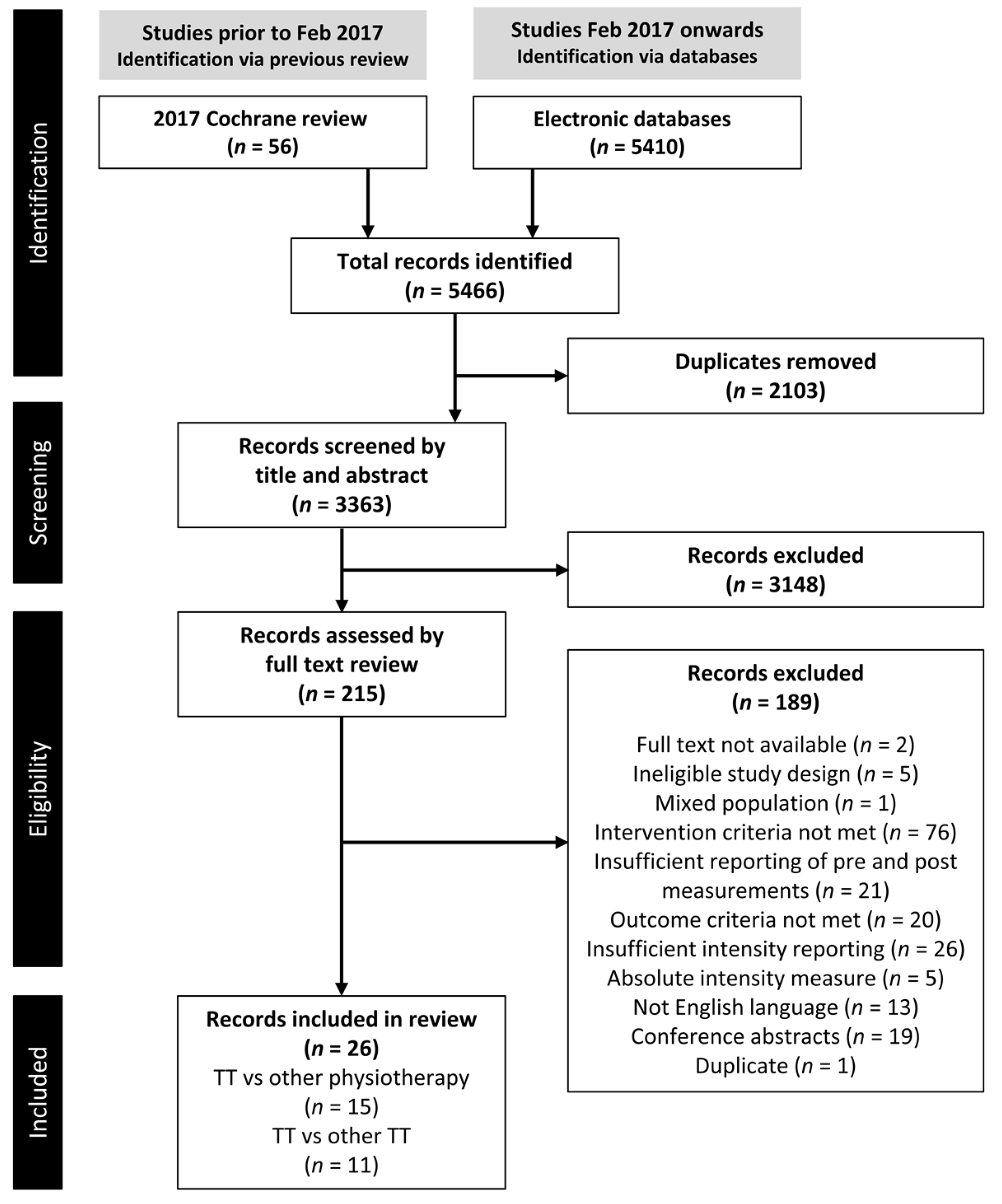
3.1. Identification and Selection of Studies
3.2. Participant Characteristics
3.3. Intervention Characteristics
3.4. Intervention Challenge
3.5. Intervention Amount
3.6. Walking Measurements
3.7. Quality of Intervention Reporting
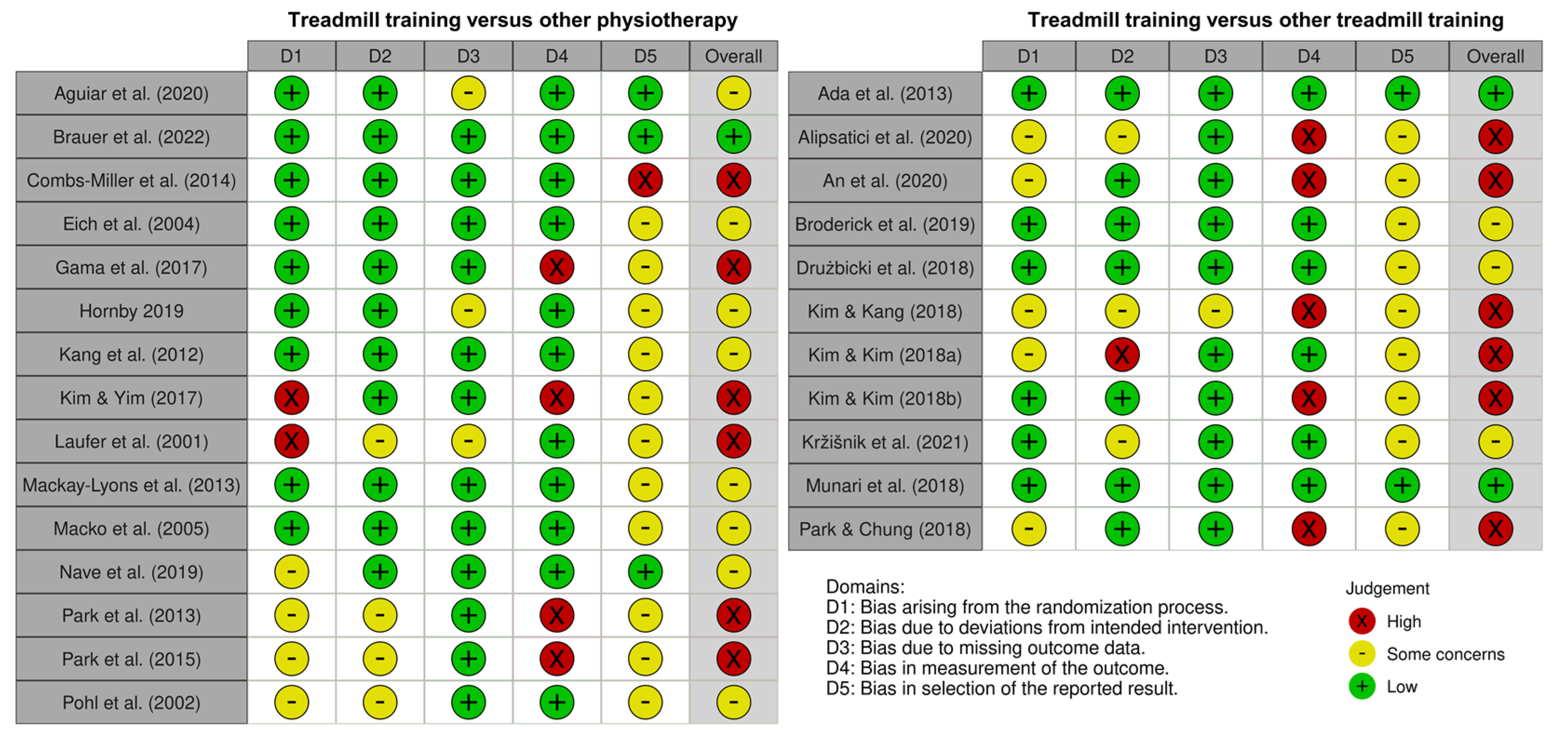
3.8. Risk of Bias
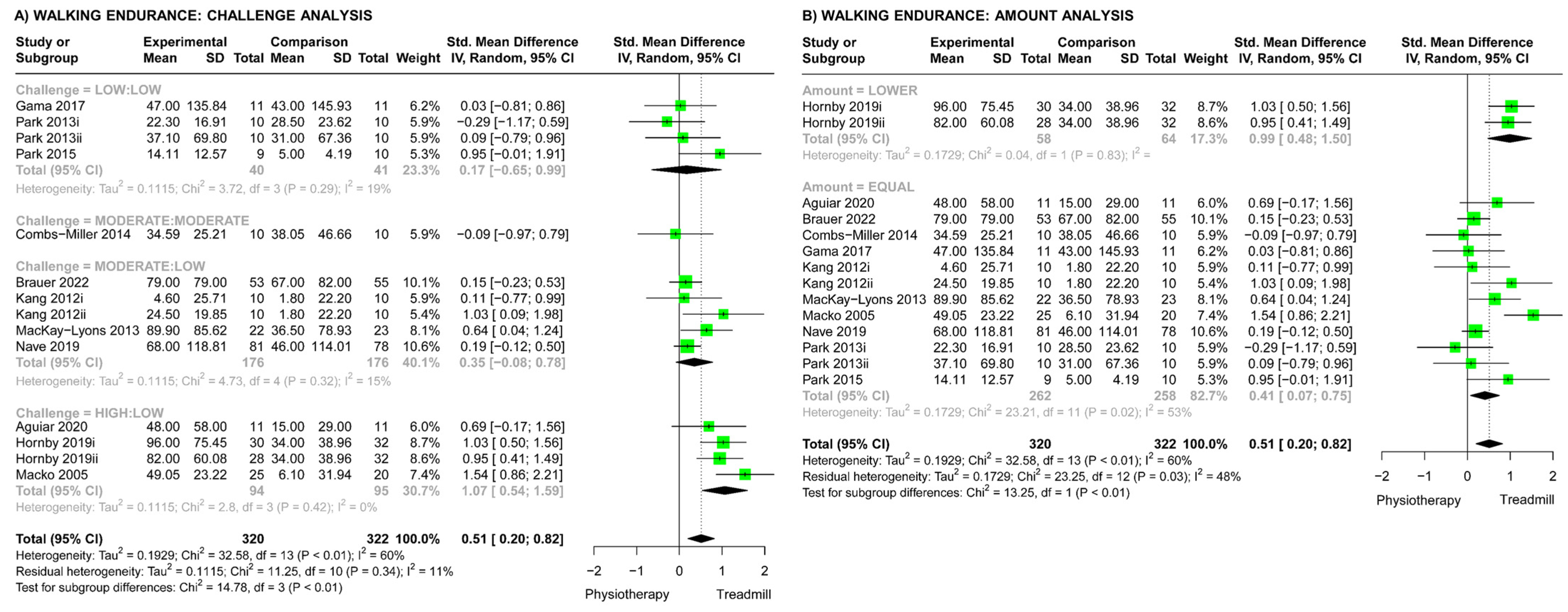
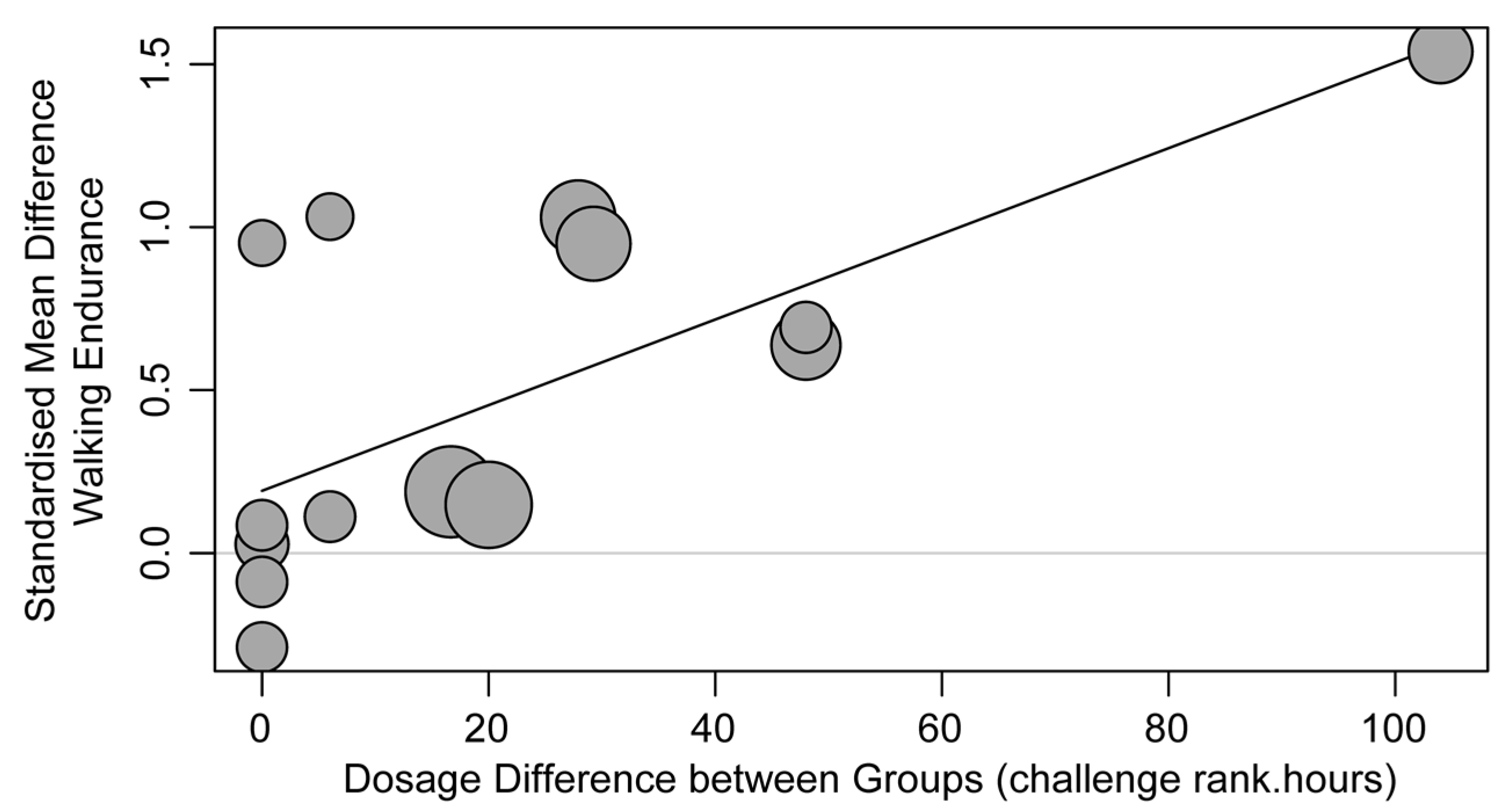
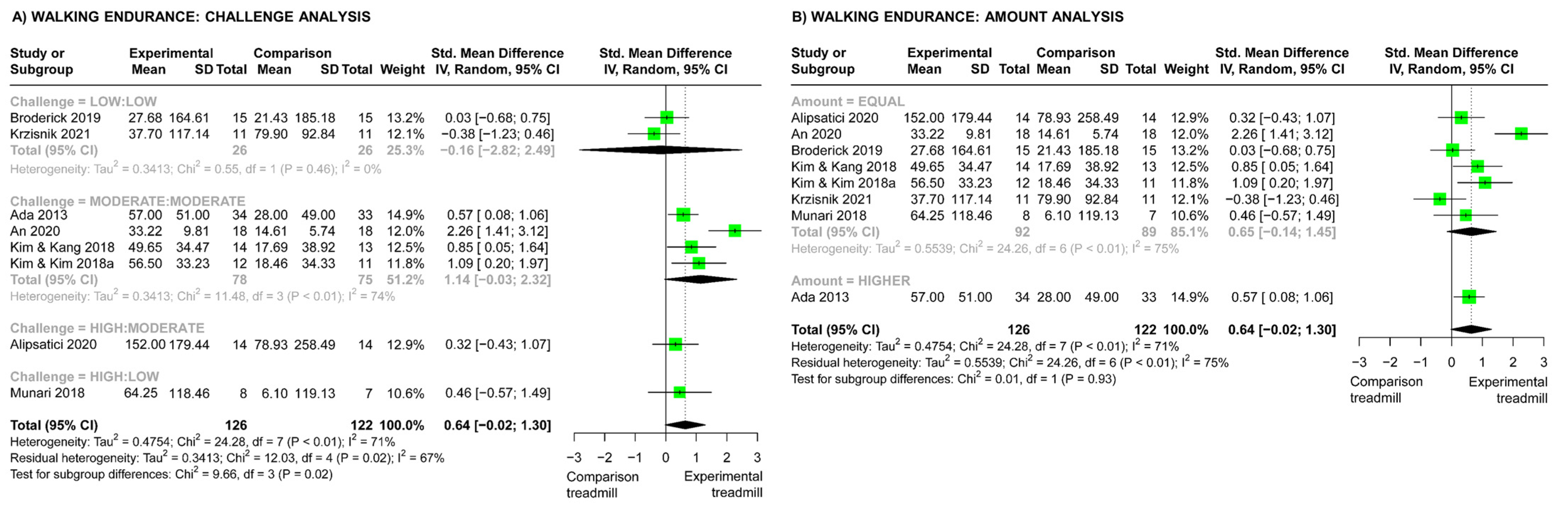
3.9. Walking Endurance Outcomes: Effects of Challenge, Amount, and Dosage
3.9.1. Studies Comparing Treadmill Training with Other Physiotherapy
3.9.2. Studies Comparing Different Types of Treadmill Training
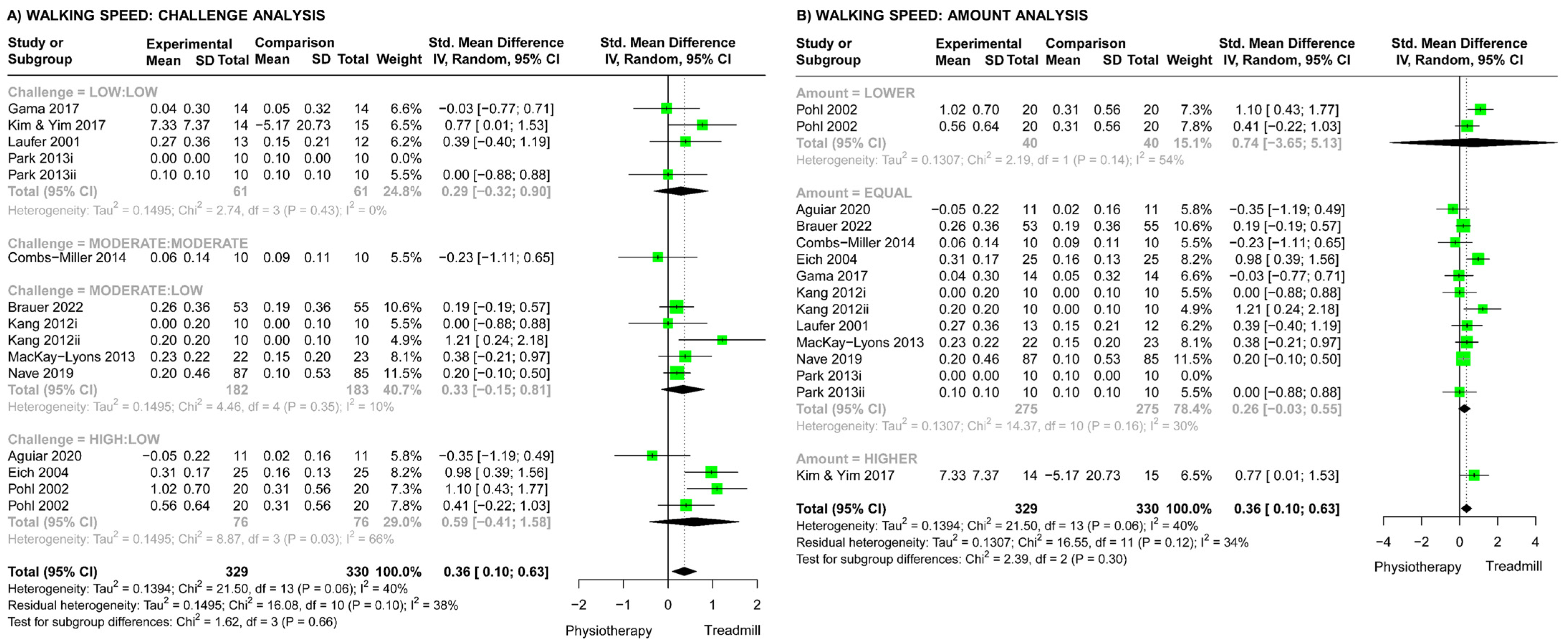
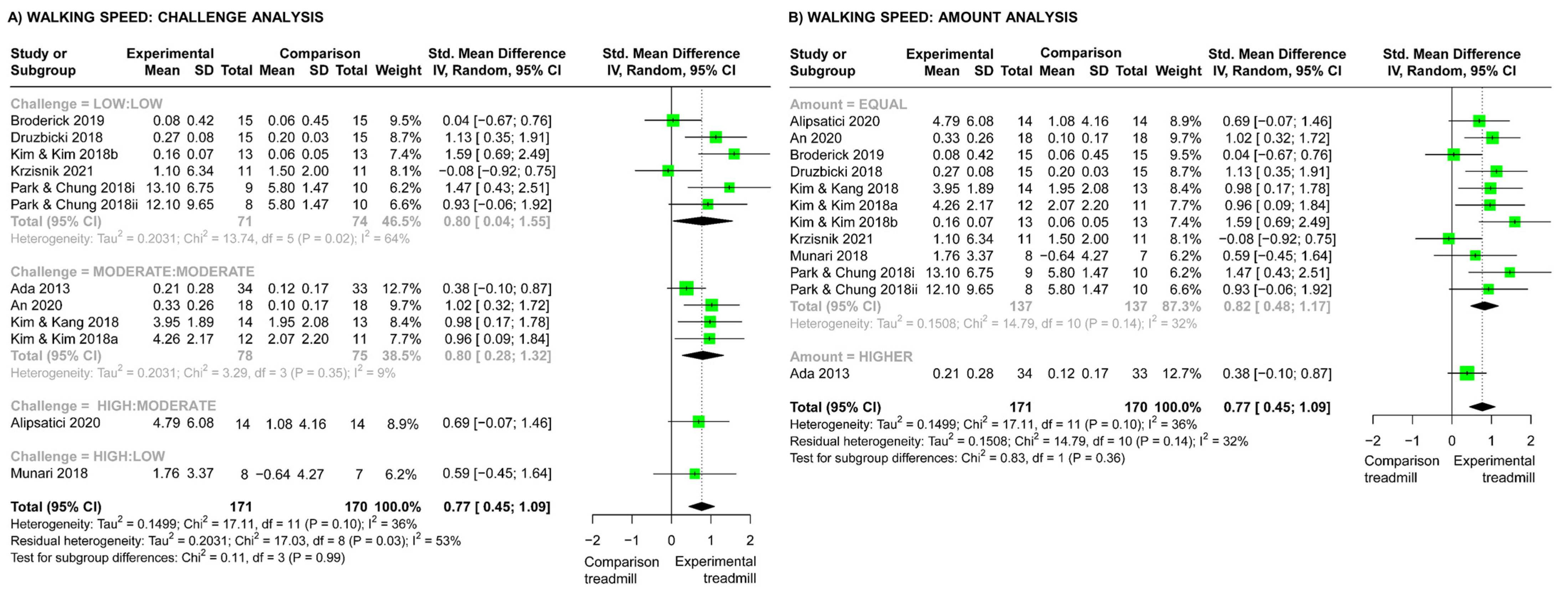
3.10. Walking Speed Outcomes: Effects of Challenge, Amount, and Dosage
3.10.1. Studies Comparing Treadmill Training with Other Physiotherapy
3.10.2. Studies Comparing Different Types of Treadmill Training
4. Discussion
4.1. Walking Endurance Outcomes: Effects of Challenge, Amount, and Dosage
4.1.1. Studies Comparing Treadmill Training with Other Physiotherapy
4.1.2. Studies Comparing Different Types of Treadmill Training
4.2. Walking Speed Outcomes: Effects of Challenge, Amount, and Dosage
4.3. Limitations
4.4. Clinical Implications
5. Conclusions
Supplementary Materials
Author Contributions
Funding
Institutional Review Board Statement
Informed Consent Statement
Data Availability Statement
Acknowledgments
Conflicts of Interest
References
- Krishnamurthi, R.V.; Ikeda, T.; Feigin, V.L. Global, regional and country-specific burden of ischaemic stroke, intracerebral haemorrhage and subarachnoid haemorrhage: A systematic analysis of the Global Burden of Disease Study 2017. Neuroepidemiology 2020, 54, 171–179. [Google Scholar] [CrossRef]
- Woodman, P.; Riazi, A.; Pereira, C.; Jones, F. Social participation post stroke: A meta-ethnographic review of the experiences and views of community-dwelling stroke survivors. Disabil. Rehabil. 2014, 36, 2031–2043. [Google Scholar] [CrossRef] [PubMed]
- Langhorne, P.; Bernhardt, J.; Kwakkel, G. Stroke rehabilitation. Lancet 2011, 377, 1693–1702. [Google Scholar] [CrossRef]
- Sennfalt, S.; Norrving, B.; Petersson, J.; Ullberg, T. Long-Term Survival and Function after Stroke. Stroke 2018, 50, 53–61. [Google Scholar] [CrossRef]
- Kuptniratsaikul, V.; Kovindha, A.; Piravej, K.; Dajpratham, P. First-Year Outcomes after Stroke Rehabilitation: A Multicenter Study in Thailand. ISRN Rehabil. 2013, 2013, 595318. [Google Scholar] [CrossRef]
- Rudberg, A.S.; Berge, E.; Laska, A.C.; Jutterstrom, S.; Nasman, P.; Sunnerhagen, K.S.; Lundstrom, E. Stroke survivors’ priorities for research related to life after stroke. Top. Stroke Rehabil. 2021, 28, 153–158. [Google Scholar] [CrossRef] [PubMed]
- Fulk, G.D.; He, Y.; Boyne, P.; Dunning, K. Predicting home and community walking activity poststroke. Stroke 2017, 48, 406–411. [Google Scholar] [CrossRef] [PubMed]
- Boyd, L.A.; Vidoni, E.D.; Wessel, B.D. Motor learning after stroke: Is skill acquisition a prerequisite for contralesional neuroplastic change? Neurosci. Lett. 2010, 482, 21–25. [Google Scholar] [CrossRef]
- Kleim, J.A.; Jones, T.A. Principles of experience-dependent neural plasticity: Implications for rehabilitation after brain damage. J. Speech Lang. Hear. Res. 2008, 51, S225–S239. [Google Scholar] [CrossRef]
- Nudo, R. Adaptive plasticity in motor cortex: Implications for rehabilitation after brain injury. J. Rehabil. Med. 2003, 35, 7–10. [Google Scholar] [CrossRef]
- Lang, C.E.; Lohse, K.R.; Birkenmeier, R.L. Dose and timing in neurorehabilitation: Prescribing motor therapy after stroke. Curr. Opin. Neurol. 2015, 28, 549–555. [Google Scholar] [CrossRef] [PubMed]
- Lohse, K.R.; Lang, C.E.; Boyd, L.A. Is more better? Using metadata to explore dose-response relationships in stroke rehabilitation. Stroke 2014, 45, 2053–2058. [Google Scholar] [CrossRef] [PubMed]
- Kwakkel, G.; van Peppen, R.; Wagenaar, R.C.; Wood Dauphinee, S.; Richards, C.; Ashburn, A.; Miller, K.; Lincoln, N.; Partridge, C.; Wellwood, I.; et al. Effects of augmented exercise therapy time after stroke: A meta-analysis. Stroke 2004, 35, 2529–2539. [Google Scholar] [CrossRef] [PubMed]
- Veerbeek, J.M.; Koolstra, M.; Ket, J.C.F.; van Wegen, E.E.H.; Kwakkel, G. Effects of augmented exercise therapy on outcome of gait and gait-related activities in the first 6 months after stroke. Stroke 2011, 42, 3311–3315. [Google Scholar] [CrossRef] [PubMed]
- Polese, J.C.; Ada, L.; Dean, C.M.; Nascimento, L.R.; Teixeira-Salmela, L.F. Treadmill training is effective for ambulatory adults with stroke: A systematic review. J. Physiother. 2013, 59, 73–80. [Google Scholar] [CrossRef] [PubMed]
- Mehrholz, J.; Thomas, S.; Elsner, B. Treadmill training and body weight support for walking after stroke. Cochrane Database Syst. Rev. 2017, 8, CD002840. [Google Scholar] [CrossRef] [PubMed]
- Page, S.J.; Schmid, A.; Harris, J.E. Optimizing terminology for stroke motor rehabilitation: Recommendations from the American Congress of Rehabilitation Medicine Stroke Movement Interventions Subcommittee. Arch. Phys. Med. Rehabil. 2012, 93, 1395–1399. [Google Scholar] [CrossRef] [PubMed]
- Cooke, E.V.; Mares, K.; Clark, A.; Tallis, R.C.; Pomeroy, V.M. The effects of increased dose of exercise-based therapies to enhance motor recovery after stroke: A systematic review and meta-analysis. BMC Med. 2010, 8, 60. [Google Scholar] [CrossRef]
- Dalton, E.J.; Churilov, L.; Lannin, N.A.; Corbett, D.; Campbell, B.C.V.; Hayward, K.S. Early-phase dose articulation trials are underutilized for post-stroke motor recovery: A systematic scoping review. Ann. Phys. Rehabil. Med. 2022, 65, 101487. [Google Scholar] [CrossRef]
- Amanzonwe, E.R.; Tedesco Triccas, L.; Codjo, L.; Hansen, D.; Feys, P.; Kossi, O. Exercise dosage to facilitate the recovery of balance, walking, and quality of life after stroke. S. Afr. J. Physiother. 2023, 79, 1846. [Google Scholar] [CrossRef]
- Lang, C.E.; Strube, M.J.; Bland, M.D.; Waddell, K.J.; Cherry-Allen, K.M.; Nudo, R.J.; Dromerick, A.W.; Birkenmeier, R.L. Dose response of task-specific upper limb training in people at least 6 months poststroke: A phase II, single-blind, randomized, controlled trial. Ann. Neurol. 2016, 80, 342–354. [Google Scholar] [CrossRef] [PubMed]
- Ward, N.S.; Brander, F.; Kelly, K. Intensive upper limb neurorehabilitation in chronic stroke: Outcomes from the Queen Square programme. J. Neurol. Neurosurg. Psychiatry 2019, 90, 498–506. [Google Scholar] [CrossRef] [PubMed]
- Hsieh, Y.W.; Wu, C.Y.; Lin, K.C.; Yao, G.; Wu, K.Y.; Chang, Y.J. Dose-response relationship of robot-assisted stroke motor rehabilitation: The impact of initial motor status. Stroke 2012, 43, 2729–2734. [Google Scholar] [CrossRef]
- Abbasian, S.; Rastegar Mm, M. Is the Intensity or Duration of Treadmill Training Important for Stroke Patients? A Meta-Analysis. J. Stroke Cerebrovasc. Dis. 2018, 27, 32–43. [Google Scholar] [CrossRef] [PubMed]
- Page, M.J.; McKenzie, J.E.; Bossuyt, P.M.; Boutron, I.; Hoffmann, T.C.; Mulrow, C.D.; Shamseer, L.; Tetzlaff, J.M.; Akl, E.A.; Brennan, S.E.; et al. The PRISMA 2020 statement: An updated guideline for reporting systematic reviews. BMJ 2021, 372, n71. [Google Scholar] [CrossRef] [PubMed]
- Boyne, P.; Dunning, K.; Carl, D.; Gerson, M.; Khoury, J.; Rockwell, B.; Keeton, G.; Westover, J.; Williams, A.; McCarthy, M.; et al. High-intensity interval training and moderate-intensity continuous training in ambulatory chronic stroke: Feasibility study. Phys. Ther. 2016, 96, 1533–1544. [Google Scholar] [CrossRef]
- Rosa, M.C.; Marques, A.; Demain, S.; Metcalf, C.D. Fast gait speed and self-perceived balance as valid predictors and discriminators of independent community walking at 6 months post-stroke—A preliminary study. Disabil. Rehabil. 2015, 37, 129–134. [Google Scholar] [CrossRef] [PubMed]
- Kautz, S.A.; Bowden, M.G.; Clark, D.J.; Neptune, R.R. Comparison of motor control deficits during treadmill and overground walking poststroke. Neurorehabil. Neural Repair 2011, 25, 756–765. [Google Scholar] [CrossRef]
- Van Bladel, A.; De Ridder, R.; Palmans, T.; Van der Looven, R.; Cambier, D. Comparing spatiotemporal gait parameters between overground walking and self-paced treadmill walking in persons after stroke. Disabil. Rehabil. 2023, 45, 1016–1021. [Google Scholar] [CrossRef]
- Mohammadi, R.; Ershad, N.; Rezayinejad, M.; Fatemi, E.; Phadke, C.P. Functional effects of treadmill-based gait training at faster speeds in stroke survivors: A prospective, single-group study. Int. J. Rehabil. Res. 2017, 40, 275–278. [Google Scholar] [CrossRef]
- Billinger, S.A.; Boyne, P.; Coughenour, E.; Dunning, K.; Mattlage, A. Does aerobic exercise and the FITT principle fit into stroke recovery? Curr. Neurol. Neurosci. Rep. 2015, 15, 519. [Google Scholar] [CrossRef]
- Reynolds, H.; Steinfort, S.; Tillyard, J.; Ellis, S.; Hayes, A.; Hanson, E.D.; Wijeratne, T.; Skinner, E.H. Feasibility and adherence to moderate intensity cardiovascular fitness training following stroke: A pilot randomized controlled trial. BMC Neurol. 2021, 21, 132. [Google Scholar] [CrossRef]
- Rodrigues, L.; Moncion, K.; Eng, J.J.; Noguchi, K.S.; Wiley, E.; de Las Heras, B.; Sweet, S.N.; Fung, J.; MacKay-Lyons, M.; Nelson, A.J.; et al. Intensity matters: Protocol for a randomized controlled trial exercise intervention for individuals with chronic stroke. Trials 2022, 23, 442. [Google Scholar] [CrossRef] [PubMed]
- Miller, A.; Reisman, D.S.; Billinger, S.A.; Dunning, K.; Doren, S.; Ward, J.; Wright, H.; Wagner, E.; Carl, D.; Gerson, M.; et al. Moderate-intensity exercise versus high-intensity interval training to recover walking post-stroke: Protocol for a randomized controlled trial. Trials 2021, 22, 457. [Google Scholar] [CrossRef]
- Sage, M.; Middleton, L.E.; Tang, A.; Sibley, K.M.; Brooks, D.; McIlroy, W. Validity of rating of perceived exertion ranges in individuals in the subacute stage of stroke recovery. Top. Stroke Rehabil. 2013, 20, 519–527. [Google Scholar] [CrossRef]
- Munari, D.; Pedrinolla, A.; Smania, N.; Picelli, A.; Gandolfi, M.; Saltuari, L.; Schena, F. High-intensity treadmill training improves gait ability, VO2peak and cost of walking in stroke survivors: Preliminary results of a pilot randomized controlled trial. Eur. J. Phys. Rehabil. Med. 2018, 54, 408–418. [Google Scholar] [CrossRef]
- Lee, J.; Stone, A.J. Combined Aerobic and Resistance Training for Cardiorespiratory Fitness, Muscle Strength, and Walking Capacity after Stroke: A Systematic Review and Meta-Analysis. J. Stroke Cerebrovasc. Dis. 2020, 29, 104498. [Google Scholar] [CrossRef]
- Gomes, E.; Alder, G.; Olsen, S.; Signal, N. Abstract Presented at Stroke 2023—The Combined Stroke Society of Australasia and Smart Strokes Nursing and Allied Health Scientific Meeting, 22–25 August 2023, Melbourne, Australia. Int. J. Stroke 2023, 18, 3–78. [Google Scholar]
- Hoffmann, T.C.; Glasziou, P.P.; Boutron, I.; Milne, R.; Perera, R.; Moher, D.; Altman, D.G.; Barbour, V.; Macdonald, H.; Johnston, M.; et al. Better reporting of interventions: Template for intervention description and replication (TIDieR) checklist and guide. BMJ 2014, 348, g1687. [Google Scholar] [CrossRef]
- Holden, S.; Rathleff, M.S.; Jensen, M.B.; Barton, C.J. How can we implement exercise therapy for patellofemoral pain if we don’t know what was prescribed? A systematic review. Br. J. Sports Med. 2018, 52, 385. [Google Scholar] [CrossRef]
- Sterne, J.A.C.; Savovic, J.; Page, M.J.; Elbers, R.G.; Blencowe, N.S.; Boutron, I.; Cates, C.J.; Cheng, H.Y.; Corbett, M.S.; Eldridge, S.M.; et al. RoB 2: A revised tool for assessing risk of bias in randomised trials. BMJ 2019, 366, l4898. [Google Scholar] [CrossRef]
- R Core Team. R: A Language and Environment for Statistical Computing; R Foundation for Statistical Computing: Vienna, Austria, 2022. [Google Scholar]
- Balduzzi, S.; Rücker, G.; Schwarzer, G. How to perform a meta-analysis with R: A practical tutorial. Evid. Based Ment. Health 2019, 22, 153–160. [Google Scholar] [CrossRef]
- Nave, A.H.; Rackoll, T.; Grittner, U.; Blasing, H.; Gorsler, A.; Nabavi, D.G.; Audebert, H.J.; Klostermann, F.; Muller-Werdan, U.; Steinhagen-Thiessen, E.; et al. Physical Fitness Training in Patients with Subacute Stroke (PHYS-STROKE): Multicentre, randomised controlled, endpoint blinded trial. BMJ 2019, 366, l5101. [Google Scholar] [CrossRef]
- Aguiar, L.T.; Nadeau, S.; Britto, R.R.; Teixeira-Salmela, L.F.; Martins, J.C.; Samora, G.A.R.; da Silva Junior, J.A.; Faria, C. Effects of aerobic training on physical activity in people with stroke: A randomized controlled trial. NeuroRehabilitation 2020, 46, 391–401. [Google Scholar] [CrossRef]
- Brauer, S.G.; Kuys, S.S.; Ada, L.; Paratz, J.D. Improving Physical Activity after stroke via Treadmill training (IMPACT) and self-management: A randomized trial. Int. J. Stroke 2022, 17, 1137–1144. [Google Scholar] [CrossRef]
- Combs-Miller, S.A.; Kalpathi Parameswaran, A.; Colburn, D.; Ertel, T.; Harmeyer, A.; Tucker, L.; Schmid, A.A. Body weight-supported treadmill training vs. overground walking training for persons with chronic stroke: A pilot randomized controlled trial. Clin. Rehabil. 2014, 28, 873–884. [Google Scholar] [CrossRef]
- Eich, H.J.; Mach, H.; Werner, C.; Hesse, S. Aerobic treadmill plus Bobath walking training improves walking in subacute stroke: A randomized controlled trial. Clin. Rehabil. 2004, 18, 640–651. [Google Scholar] [CrossRef]
- Gama, G.L.; Celestino, M.L.; Barela, J.A.; Forrester, L.; Whitall, J.; Barela, A.M. Effects of Gait Training With Body Weight Support on a Treadmill Versus Overground in Individuals With Stroke. Arch. Phys. Med. Rehabil. 2017, 98, 738–745. [Google Scholar] [CrossRef]
- Hornby, T.G.; Henderson, C.E.; Plawecki, A.; Lucas, E.; Lotter, J.; Holthus, M.; Brazg, G.; Fahey, M.; Woodward, J.; Ardestani, M.; et al. Contributions of Stepping Intensity and Variability to Mobility in Individuals Poststroke. Stroke 2019, 50, 2492–2499. [Google Scholar] [CrossRef]
- Kang, H.K.; Kim, Y.; Chung, Y.; Hwang, S. Effects of treadmill training with optic flow on balance and gait in individuals following stroke: Randomized controlled trials. Clin. Rehabil. 2012, 26, 246–255. [Google Scholar] [CrossRef]
- Kim, J.; Yim, J. Effects of an Exercise Protocol for Improving Handgrip Strength and Walking Speed on Cognitive Function in Patients with Chronic Stroke. Med. Sci. Monit. 2017, 23, 5402–5409. [Google Scholar] [CrossRef] [PubMed]
- Laufer, Y.; Dickstein, R.; Chefez, Y.; Marcovitz, E. The effect of treadmill training on the ambulation of stroke survivors in the early stages of rehabilitation: A randomized study. J. Rehab Res. Dev. 2001, 38, 69–78. [Google Scholar]
- Mackay-Lyons, M.; McDonald, A.; Matheson, J.; Eskes, G.; Klus, M.A. Dual effects of body-weight supported treadmill training on cardiovascular fitness and walking ability early after stroke: A randomized controlled trial. Neurorehabil. Neural Repair 2013, 27, 644–653. [Google Scholar] [CrossRef]
- Macko, R.F.; Ivey, F.M.; Forrester, L.W.; Hanley, D.; Sorkin, J.D.; Katzel, L.I.; Silver, K.H.; Goldberg, A.P. Treadmill exercise rehabilitation improves ambulatory function and cardiovascular fitness in patients with chronic stroke: A randomized, controlled trial. Stroke 2005, 36, 2206–2211. [Google Scholar] [CrossRef]
- Park, I.M.; Lee, Y.S.; Moon, B.M.; Sim, S.M. A comparison of the effects of overground gait training and treadmill gait training according to stroke patients’ gait velocity. J. Phys. Ther. Sci. 2013, 25, 379–382. [Google Scholar] [CrossRef]
- Park, J.; Park, S.Y.; Kim, Y.W.; Woo, Y. Comparison between treadmill training with rhythmic auditory stimulation and ground walking with rhythmic auditory stimulation on gait ability in chronic stroke patients: A pilot study. NeuroRehabilitation 2015, 37, 193–202. [Google Scholar] [CrossRef]
- Pohl, M.; Ritschel, C.; Ruckriem, S. Speed-dependent treadmill training in ambulatory hemiparetic stroke patients A randomized controlled trial. Stroke 2002, 33, 553–558. [Google Scholar] [CrossRef]
- Ada, L.; Dean, C.M.; Lindley, R. Randomized trial of treadmill training to improve walking in community-dwelling people after stroke: The AMBULATE trial. Int. J. Stroke 2013, 8, 436–444. [Google Scholar] [CrossRef]
- Alipsatici, C.; Alaca, N.; Canbora, M. Comparison of the effects of treadmill trainings on walking and balance functions by increasing the speed and incline in chronic patients with stroke. Turk. J. Neurol. 2020, 26, 316–321. [Google Scholar] [CrossRef]
- An, B.; Woo, Y.; Park, K.; Kim, S. Effects of insole on the less affected side during execution of treadmill walking training on gait ability in chronic stroke patients: A preliminary study. Restor. Neurol. Neurosci. 2020, 38, 375–384. [Google Scholar] [CrossRef]
- Broderick, P.; Horgan, F.; Blake, C.; Ehrensberger, M.; Simpson, D.; Monaghan, K. Mirror therapy and treadmill training for patients with chronic stroke: A pilot randomized controlled trial. Top. Stroke Rehabil. 2019, 26, 163–172. [Google Scholar] [CrossRef]
- Druzbicki, M.; Przysada, G.; Guzik, A.; Brzozowska-Magon, A.; Kolodziej, K.; Wolan-Nieroda, A.; Majewska, J.; Kwolek, A. The Efficacy of Gait Training Using a Body Weight Support Treadmill and Visual Biofeedback in Patients with Subacute Stroke: A Randomized Controlled Trial. Biomed. Res. Int. 2018, 2018, 3812602. [Google Scholar] [CrossRef]
- Kim, B.R.; Kang, T.W. The effects of proprioceptive neuromuscular facilitation lower-leg taping and treadmill training on mobility in patients with stroke. Int. J. Rehabil. Res. 2018, 41, 343–348. [Google Scholar] [CrossRef]
- Kim, C.-H.; Kim, Y.-N. Effects of proprioceptive neuromuscular facilitation and treadmill training on the balance and walking ability of stroke patients. J. Korean Phys. Ther. 2018, 30, 79–83. [Google Scholar] [CrossRef]
- Kim, K.J.; Kim, K.H. Progressive treadmill cognitive dual-task gait training on the gait ability in patients with chronic stroke. J. Exerc. Rehabil. 2018, 14, 821–828. [Google Scholar] [CrossRef]
- Kržišnik, M.; Horvat Rauter, B.; Bizovčar, N. Effects of virtual reality-based treadmill training on the balance and gait ability in patients after stroke. Hrvat. Rev. Za Rehabil. Istraživanja 2021, 57, 92–102. [Google Scholar] [CrossRef]
- Park, J.H.; Chung, Y.J. Comparison of Aquatic Treadmill and Anti-Gravity Treadmill Gait Training to Improve Balance and Gait Abilities in Stroke Patients. J. Korean Phys. Ther. 2018, 30, 67–72. [Google Scholar] [CrossRef]
- Miller, F.L.; O’Connor, D.P.; Herring, M.P.; Sailors, M.H.; Jackson, A.S.; Dishman, R.K.; Bray, M.S. Exercise dose, exercise adherence, and associated health outcomes in the TIGER study. Med. Sci. Sports Exerc. 2014, 46, 69–75. [Google Scholar] [CrossRef]
- Pang, M.Y.; Charlesworth, S.A.; Lau, R.W.; Chung, R.C. Using aerobic exercise to improve health outcomes and quality of life in stroke: Evidence-based exercise prescription recommendations. Cerebrovasc. Dis. 2013, 35, 7–22. [Google Scholar] [CrossRef]
- Stoller, O.; de Bruin, E.D.; Knols, R.H.; Hung, K.J. Effects of cardiovascular exercise early after stroke: Systematic review and meta-analysis. BMC Neur. 2012, 12, 45. [Google Scholar] [CrossRef]
- Bang, D.H.; Son, Y.L. Effect of intensive aerobic exercise on respiratory capacity and walking ability with chronic stroke patients: A randomized controlled pilot trial. J. Phys. Ther. Sci. 2016, 28, 2381–2384. [Google Scholar] [CrossRef]
- Lee, M.J.; Kilbreath, S.L.; Singh, M.F.; Zeman, B.; Lord, S.R.; Raymond, J.; Davis, G.M. Comparison of effect of aerobic cycle training and progressive resistance training on walking ability after stroke: A randomized sham exercise-controlled study. J. Am. Geriatr. Soc. 2008, 56, 976–985. [Google Scholar] [CrossRef] [PubMed]
- Sankaranarayan, H.; Gupta, A.; Khanna, M.; Taly, A.; Thennarasu, K. Role of ankle foot orthosis in improving locomotion and functional recovery in patients with stroke: A prospective rehabilitation study. J. Neurosci. Rural. Pract. 2016, 7, 544–549. [Google Scholar] [CrossRef]
- Mudge, S.; Barber, P.A.; Stott, N.S. Circuit-based rehabilitation improves gait endurance but not usual walking activity in chronic stroke: A randomized controlled trial. Arch. Phys. Med. Rehabil. 2009, 90, 1989–1996. [Google Scholar] [CrossRef]
- Hesse, S.; Werner, C. Poststroke motor dysfunction and spasticity. Novel pharmacological and physical treatment strategies. Ther. Pract. 2003, 17, 1093–1107. [Google Scholar] [CrossRef]
- Lang, C.E.; Macdonald, J.R.; Reisman, D.S.; Boyd, L.; Jacobson Kimberley, T.; Schindler-Ivens, S.M.; Hornby, T.G.; Ross, S.A.; Scheets, P.L. Observation of amounts of movement practice provided during stroke rehabilitation. Arch. Phys. Med. Rehabil. 2009, 90, 1692–1698. [Google Scholar] [CrossRef]
- Yang, L.; Lam, F.M.; Huang, M.; He, C.; Pang, M.Y. Dual-task mobility among individuals with chronic stroke: Changes in cognitive-motor interference patterns and relationship to difficulty level of mobility and cognitive tasks. Eur. J. Phys. Rehab Med. 2018, 54, 526–535. [Google Scholar] [CrossRef]
- Beaudry, L.; Rochette, A.; Fortin, S. Use of adapted dance to intensify subacute rehabilitation post-stroke: A qualitative study on the participation experience and active participation time. Altern. Ther. Health Med. 2022, 28, 40–51. [Google Scholar] [CrossRef]
- Kim, T.G.; Bae, S.H.; Kim, K.Y. Effects of dual-task training with different intensity of aerobic exercise on cognitive function and neurotrophic factors in chronic stroke patients. Res. J. Pharm. Tech. 2019, 12, 693–698. [Google Scholar] [CrossRef]
- Baek, C.Y.; Chang, W.N.; Park, B.Y.; Lee, K.B.; Kang, K.Y.; Choi, M.R. Effects of dual-task gait treadmill training on gait ability, dual-task interference, and fall efficacy in people with stroke: A randomized controlled trial. Phys. Ther. 2021, 101, pzab067. [Google Scholar] [CrossRef]
- Tang, A.; Sibley, K.M.; Thomas, S.G.; McIlroy, W.E.; Brooks, D. Maximal exercise test results in subacute stroke. Arch. Phys. Med. Rehabil. 2006, 87, 1100–1105. [Google Scholar] [CrossRef] [PubMed]
- Hornby, T.G.; Reisman, D.S.; Ward, I.G.; Scheets, P.L.; Miller, A.; Haddad, D.; Fox, E.J.; Fritz, N.E.; Hawkins, K.; Henderson, C.E.; et al. Clinical Practice Guideline to Improve Locomotor Function Following Chronic Stroke, Incomplete Spinal Cord Injury, and Brain Injury. J. Neurol. Phys. Ther. 2020, 44, 49–100. [Google Scholar] [CrossRef] [PubMed]
- Marzolini, S.; Robertson, A.D.; Oh, P.; Goodman, J.M.; Corbett, D.; Du, X.; MacIntosh, B.J. Aerobic Training and Mobilization Early Post-stroke: Cautions and Considerations. Front. Neurol. 2019, 10, 1187. [Google Scholar] [CrossRef]

| Inclusion | Exclusion | |
|---|---|---|
| Participants | Aged ≥ 18 years with stroke diagnosis and lower limb motor deficit resulting in slow gait speed or abnormal gait pattern. | |
| Experimental intervention | TT with or without BWS, either alone or in combination with another intervention. | Robotic or mechanically assisted TT. Backwards TT only. Non-invasive brain stimulation. Single-session intervention. |
| Comparison intervention | Either another physiotherapy intervention, another type of TT (±BWS) alone or in combination with another intervention, or no intervention. | As per exclusion criteria for experimental intervention. |
| Outcomes | Pre- and post-intervention measurements of either unassisted walking speed (with 6 m or 10 m walk test (10 mWT)) and/or unassisted walking endurance (with 6 min walk test (6 MWT)). | |
| Data reported | Sufficient description of interventions to enable extraction of intervention amount (in minutes) and rating of challenge for both experimental and comparison groups according to Table 2. | |
| Study design | Randomized and quasi-randomized controlled trials. | Crossover or non-experimental studies. |
| Publication | Full-text peer-reviewed journal articles in English. | Conference abstracts. |
| Author | Population Criteria | Experimental Intervention (EXP) | Comparison Intervention (COMP) | Outcome Time Points | ||||
|---|---|---|---|---|---|---|---|---|
| Description and Sample | Amount | Challenge | Description and Sample | Amount | Challenge | |||
| Treadmill Training Versus Other Physiotherapy Interventions | ||||||||
| Aguiar et al. (2020) [45] | Chronic stroke (n = 22), able to walk ind ± aids for ≥10 min | Aerobic TT, n = 11, 3F, age 52 y (11 y), post stroke 51 m (68 m) | 40 min, 3 times/w, 12 w Total 1440 min | High | Outdoor OGT, n = 11, 3F, age 48 y (10 y), post stroke 44 m (26 m) | 40 min, 3 times/w, 12 w, total 1440 min | Low | Baseline, 12 w, 16 w |
| Brauer et al. (2022) [46] | Subacute stroke (n = 119), able to walk 10 m ind ± aids | TT + self-management education + conv GT, n = 60, 12F, age 62 y (11 y), post stroke 28 d (15 d) | TT: 30 min, 3 times/w, 8 w Conv GT: 30 min, 2 times/w, 8 w Total 1200 min | Mod | Conv GT, n = 59, 12F, age 64 y (9 y), post stroke 27 d (16 d) | 30 min, 5 times/w, 8 w, total 1200 min | Low | Baseline, 8 w, 26 w |
| Combs-Miller et al. (2014) [47] | Chronic stroke (n = 20), able to walk 10 m ± aids at comf speed < 1 m/s | BWSTT, n = 10, 6F, age 56 y (8 y), post stroke 62 m (49 m) | 30 min, 5 times/w, 2 w Total 300 min | Mod | OGT, n = 10, 3F, age 66 y (7 y), post stroke 60 m (52 m) | 30 min, 5 times/w, 2 w Total 300 min | Mod | Baseline, 2 w, 3 m |
| Eich et al. (2004) [48] | Subacute stroke (n = 50), able to walk ≥ 12 m with intermittent help or supervision | BWSTT + conv GT, n = 25, 8F, age 62 y (5 y), post stroke 6.1 w (2.2 w) | TT: 30 min, 5 times/w, 6 w Conv GT: 30 min, 5 times/w, 6 w. Total 1800 min | High | Conv GT, n = 25, 9F, age 64 y (6 y), poststroke 6.3 w (2.5 w) | 60 min, 5 times/w, 6 w Total 1800 min | Low | Baseline, 6 w, 18 w |
| Gama et al. (2017) [49] | Chronic stroke (n = 32), able to walk 10 m ± assistance | BWSTT, n = 14, 7F, age 59 y (8 y), post stroke 60 m (55 m) | 45 min, 3 times/w, 6 w Total 810 min | Low | BWS OGT, n = 14, 8F, age 58 y (10 y), post stroke 54 m (42 m) | 45 min, 3 times/w, 6 w Total 810 min | Low | Baseline, 7 w, 12 w |
| Hornby et al. (2019) [50] | Chronic stroke (n = 97), able to walk ind ± aids at comf gait speed < 1.0 m/s over 10 m | EXP 1: TT + OGT, n = 30, 13F, age 60 y (95% CI: 56–64 y), post stroke 31 m (95% CI: 19–42 m) EXP 2: Variable training on TT, OGT + stairs, n = 28, 5F, age 59 y (95% CI: 55–62 y), post stroke 60 m (95% CI: 14–106 m) | EXP 1: 33 min, mean 3.375 times/w, 8 w Total 891 min EXP 2: 34 min, mean 3.375 times/w, 8 w Total 918 min | EXP 1 + 2: High | Stepping activities in variable contexts, n = 32, 14F, age 56 y (95% CI: 52–60 y), post stroke 27 m (95% CI: 18–36 m) | 37 min per session, 3–5 times/w, for 8 w Total 999 min | Low | Baseline, 8 w, 12 w |
| Kang et al. (2012) [51] | Chronic stroke (n = 32), able to walk ind for ≥15 min | EXP 1: TT + conv PT, n = 10, 6F, age 56 y (8 y), post stroke 14 m (4 m). EXP 2: TT + optic flow + conv PT, n = 10, 4F, age 56 y (7 y), post stroke 14 m (4 m) | EXP 1 + 2: 30 min, 3 times/w, 4 w Total 360 min. (session duration for conv PT 5 times/w NR) | EXP 1 + 2: Mod | Stretching, ROM exercises + conv PT, n = 10, 4F, age 56 y (8 y), post stroke 15 m (7 m) | 30 min, 3 times/w, 4 w Total 360 min. (session duration for conv PT 5 times/w NR) | Low | Baseline, 4 w |
| Kim and Yim (2017) [52] | Chronic stroke (n = 30), able to ind walk 10 m | TT + handgrip strengthening + conv rehab (NDT), n = 14, 5F, age 51 y (15 y), post stroke 13 m (7 m) | TT + hand strengthening: 35 min, 3 times/w, 6 w Conv rehab: 60 min, twice daily, 5 times/w, 6 w Total 4230 min | Low | Conv rehab (NDT), n = 15, 5F, age 52 y (17 y), post stroke 12 m (8 m) | 60 min, twice daily, 5 times/w, 6 w Total 3600 min | Low | Baseline, 6 w |
| Laufer et al. (2001) [53] | Subacute stroke (n = 25), able to walk 2 min on treadmill at ≥0.2 km/h with mod assistance | TT + conv PT, n = 13, 6F, age 67 y (7 y), post stroke 33 d (21 d) | 4–8 min, 5 times/w, 3 w Total 90 min (session duration for conv PT 5 times/w NR) | Low | OGT + conv PT, n = 12, 5F, age 69 y (8 y), post stroke 36 d (17 d) | 4–8 min, 5 times/w, 3 w Total 90 min (session duration for conv PT 5 times/w NR) | Low | Baseline, 3 w |
| MacKay-Lyons et al. (2013) [54] | Subacute stroke (n = 50), able to walk 5 m ± aids or stand-by assistance | BWSTT + stretching + UL/LL active exercises, n = 24, 9F, age 62 y (15 y), post stroke 23 d (6 d) | 60 min, 5 times/w for 1st 6 w and 3 times/w for 2nd 6 w Total 2880 min | Mod | Stretching + UL/LL active exercises, n = 26, 12F, age 59 y (13 y), post stroke 29 d (6 d) | 60 min, 5 times/w for 1st 6 w and 3 times/w for 2nd 6 w Total 2880 min | Low | Baseline, 12 w, 6 m, 12 m |
| Macko et al. (2005) [55] | Chronic stroke (n = 61), able to walk on treadmill for 3 min at >0.22 m/s | TT, n = 32, 10F, age 63 y (10 y) | 40 min, 3 times/w, 26 w Total 3120 min | High | Supervised stretches + 5 min TT, n = 29, 8F, age 64 y (8 y), post stroke 39 m (59 m) | 40 min, 3 times/w, 26 w Total 3120 min | Low | Baseline, 6 m |
| Nave et al. (2019) [44] | Subacute stroke (n = 200) | BWSTT + conv rehab, n= 105, 45F, age 69 y (12 y), post stroke 30 d (IQR: 17–39 d) | 50 min, 5 times/w, 4 w Total 1000 min | Mod | Relaxation + conv rehab, n = 95, 36F, age 70 y (11 y), post stroke 27 d (IQR: 17–41 d) | 50 min, 5 times/w, 4 w Total 1000 min | Low | Baseline, 4 w, 3 m, 6 m |
| Park et al. (2013) [56] | Chronic stroke (n = 40), able to walk ≥ 10 m without aids | TT. Analyzed in 2 groups: slow walkers (n = 10, 3F, age 52 y (9 y) post stroke 23 m (6 m)), and fast walkers (n = 10, 5F, age 53 y (7 y) post stroke 19 m (8 m)) | 30 min, 10 times/w (twice daily), 1 w Total 300 min | Low | OGT. Analyzed in 2 groups: slow walkers (n = 10, 4F, age 51 y (11 y) post stroke 17 m (9 m)) and fast walkers (n = 10, 3F, age 55 y (7 y) post stroke 15 m (7 m)) | 30 min, 10 times/w (twice daily), 1 w Total 300 min | Low | Baseline, 4 w |
| Park et al. (2015) [57] | Chronic stroke (n = 19), able to walk ≥ 10 min on treadmill | TT with rhythmic auditory stimulation + conv rehab (NDT), n = 9, 5F, age 52 y (13 y), post stroke 10 m (3 m) | 30 min, 5 times/w, 3 w Total 450 min. (session duration for conv rehab 5 times/w NR) | Low | OGT with rhythmic auditory stimulation + conv rehab (NDT), n = 10, 4F, age 55 y, post stroke 13 m (4 m) | 30 min, 5 times/w, 3 w Total 450 min. (session duration for conv rehab 5 times/w NR) | Low | Baseline, 3 w |
| Pohl et al. (2002) [58] | Subacute stroke (n = 60), able to walk ind 10 m in 5–60 s | EXP 1: Speed dependent TT + conv PT, n = 20, 4F, age 58 y (11 y), post stroke 16 w (16 w) EXP 2: Limited progressive TT + conv PT, n = 20, 6F, age 57 y (14 y), post stroke 17 w (21 w) | TT: 30 min, 3 times/w, 4 w Conv PT: 45 min, 2 times/w, 4 w Total 720 min | EXP 1 + 2: High | Conv GT + conv PT, n = 20, 7F, age 62 y (11 y), post stroke 16 w (19 w) | Conv GT: 45 min, 3 times/w, 4 w Conv PT: 45 min, 2 times/w, 4 w Total 900 min | Low | Baseline, 4 w |
| Treadmill Training Versus Another Type of Treadmill Training | ||||||||
| Ada et al. (2013) [59] | Chronic stroke (n = 102), able to walk 10 m without aids in >9 s | EXP 1: 4 m TT + OGT, n = 34, 10F, age 70 y (11 y), post stroke 22 m (16 m) | 30 min, 3 times/w, 16 w Total 1440 min | Mod | COMP 1: 2 m TT + OGT, n = 34, 6F, age 64 y (12 y), post stroke 20 m (15 m) COMP 2: No intervention (not meta- analyzed), n = 34, 15F, age 63 y (13 y), post stroke 19 m (13 m) | COMP 1: 30 min, 3 times/w, 8 w Total 720 min COMP 2: 0 min | Mod | Baseline, 2 m, 4 m, 6 m, 12 m |
| Alipsatici et al. (2020) [60] | Chronic stroke (n = 30), able to ind walk 10 m in <0.9 m/s | TT with increased speed + conv rehab + e-stim, n = 14, 6F, age 45 y (12 y), post stroke NR | 75 min (TT 30, conv rehab 30, e-stim 15 min), 3 times/w, 8 w Total 1800 min | High | TT with increased incline + conv rehab + e-stim, n = 14, 5F, age 40 y (12 y), post stroke NR | 75 min (TT 30, conv rehab 30, e-stim 15 min), 3 times/w, 8 w Total 1800 min | Mod | Baseline, 8 w |
| An et al. (2020) [61] | Chronic stroke (n = 36), functional ambulation category (FAC) score ≥ 3 | Insole during TT + conv PT, n = 18, 7F, age 55 y (11 y), post stroke 10 m (2 m) | 30 min, 5 times/w, 4 w Total 600 min (session duration for conv PT NR) | Mod | TT + conv PT, n = 18, 6F, age 55 y (9 y), post stroke 10 m (2 m) | 30 min, 5 times/w, 4 w Total 600 min. (session duration for conv PT NR) | Mod | Baseline, 4 w |
| Broderick et al. (2019) [62] | Chronic stroke (n = 30), ambulatory ± aids | TT + mirror therapy, n = 15, 5F, age 61 y (10 y), post stroke 75 m (88 m) | 30 min, 3 times/w, 4 w Total 360 min | Low | TT + placebo mirror therapy, n = 15, 5F, age 67 y (19 y), post stroke 34 m (31 m) | 30 min, 3 times/w, 4 w Total 360 min | Low | Baseline, 6 w, 3 m |
| Drużbicki, et al. (2018) [63] | Chronic stroke (n = 30), able to walk ind | BWSTT with visual biofeedback + conv rehab, n = 15, 5F, age 62 y (10 y), post stroke 9 d (6–23 d) | TT: 30 min, 5 times/w, 3 w Conv rehab: 120 min, 5 times/w, 3 w + 45 min, once per w, 3 w Total 2385 min | Low | BWSTT without visual biofeedback + conv rehab, n = 15, 7F, age 62 y (11 y), post stroke 8 d (5–19 d) | TT: 30 min, 5 times/w, 3 w Conv rehab: 120 min, 5 times/w, 3 w + 45 min, once per week, 3 w Total 2385 min | Low | Baseline, 3 w |
| Kim and Kang (2018) [64] | Chronic stroke (n = 27), able to walk 10 m ind and walking speed >0.5 m/s | TT with PNF taping, n = 14, 6F, age 51 y (3 y), post stroke 20 m (4 m) | 30 min, 5 times/w, 6 w Total 900 min | Mod | TT with placebo taping, n = 13, 6F, age 52 y (3 y), post stroke 21 m (3 m) | 30 min, 5 times/w, 6 w Total 900 min | Mod | Baseline, 6 w |
| Kim and Kim (2018) [65] | Chronic stroke (n = 23), able to walk ind 10 m | TT + PNF, n = 12, 5F, age 61 y (3 y), post stroke 20 m (4 m) | 40 min, (TT of 15 min), 5 times/w, 6 w Total 1200 min | Mod | TT, n = 11, 4F, age 61 y (3 y), post stroke 19 m (4 m) | 40 min (TT of 30 min), 5 times/w, 6 w Total 1200 min | Mod | Baseline, 6 w |
| Kim and Kim (2018) [66] | Chronic stroke (n = 26), able to walk ind unaided + on treadmill > 30 min | TT with cognitive dual-task gait training, n = 13, 5F, age 53 y (10 y), post stroke 13 m (4 m) | 30 min, 5 times/w, 4 w Total 600 min | Low | TT with no cognitive tasks, n = 13, 6F, age 56 y (11 y), post stroke 11 m (4 m) | 30 min, 5 times/w, 4 w Total 600 min | Low | Baseline, 4 w |
| Kržišnik et al. (2021) [67] | Subacute stroke (n = 22), able to walk ind or with supervision ± aids | TT with virtual reality + conv rehab, n = 11, 4F, age 60 y (8 y), post stroke 5 m (2 m) | TT: mean 15.5 min, 5 times/w, 4 w Conv rehab: 90 min, 5 times/w, 4 w Total 2110 min | Low | TT + conv rehab, n = 11, 3F, age 55 y (6 y), post stroke 5 m (2 m) | TT: mean 15.5 min, 5 times/w, 4 w Conv rehab: 90 min, 5 times/w, 4 w Total 2110 min | Low | Baseline, 4 w |
| Munari et al. (2018) [36] | Chronic stroke (n = 16), able to walk on treadmill ≥ 0.3 km/h for 3 min | High-intensity TT, n = 8, 1F, age 61 y (6 y), post stroke 5 y (3 y) | 55 min, 3 times/w, 12 w Total 1980 min | High | Low-intensity TT, n = 7, 0F, age 62 y (11 y), post stroke 6 y (4 y) | 55 min, 3 times/w, 12 w Total 1980 min | Low | Baseline, 3 m |
| Park and Chung et al. (2018) [68] | Chronic stroke (n = 27), able to walk 10 min ± aids | EXP 1: Aquatic TT + conv PT, n = 9, 3F, age 63 y (13 y), post stroke 7 m (1 m) EXP 2: Anti-gravity TT + conv rehab, n = 8, 4F, age 66 y (10 y), post stroke 6.75 m (1 m) | TT: 30 min, 3 times/w, 4 w Conv PT: 30 min, 5 times/w, 4 w Total 960 min | Low | TT + conv PT, n = 10, 5F, age 67 y (8 y), post stroke 8 m (1 m) | TT: 30, 3 times/w, 4 w Conv PT: 30 min, 5 times/w, 4 w Total 960 min | Low | Baseline, 4 w |
| Author | Experimental Intervention | Comparison Intervention | ||||
|---|---|---|---|---|---|---|
| Initial Challenge Level | Progression | Overall Challenge | Initial Challenge Level | Progression | Overall Challenge | |
| Treadmill Training Versus Other Physiotherapy Interventions | ||||||
| Aguiar et al. (2020) [45] | Obj: 60–80% HRR | Individually tailored to ability, RPE, HR, and BP | High | Obj: <40% HRR | NR | Low |
| Brauer et al. (2022) [46] | Obj: 40% HRR or Subj: Borg RPE 11–14 | ↑ Challenge weekly until 60% HRR reached | Mod | Described as usual gait training with supervision | Individually tailored | Low |
| Combs-Miller et al. (2014) [47] | Subj: Borg RPE 11–14, 30% BWS | ↑ Speed to target Borg RPE 11–14 ↓ Verbal/manual cues each session If speed > 2.0 mph, <3 breaks were required, and gait quality was maintained without assistance, ↓ BWS from 30% to 15% to 0% | Mod | Subj: Borg RPE 11–14 | ↑ Speed to keep Borg RPE 11–14 ↓ Verbal/manual cues at each session | Mod |
| Eich et al. (2004) [48] | Obj: 60% HRR | ↑ Speed or incline to achieve target HR | High | Described as Bobath-oriented gait rehab | NR | Low |
| Gama et al. (2017) [49] | Subj: comf treadmill speed (patient judgement) | ↓ BWS, ↑ speed, and/or ↓ hand support | Low | Subj: comf OG gait speed (patient judgement) | ↓ BWS, ↑ speed, and/or ↓ hand support | Low |
| Hornby et al. (2019) [50] | EXP 1 + 2: Obj: 70–80% HRR | EXP 1: ↑ speed to achieve target %HRR EXP 2: ↑ speed to achieve target %HRR, ↓ handrail use, and ↑ task variation | EXP 1 + 2: High | Obj: 30–40% HRR | Stepping activities in variable contexts but maintaining 30–40% HRR | Low |
| Kang et al. (2012) [51] | EXP 1 + 2: Obj: Stable OG gait speed (from 10 mWT) | EXP 1 + 2: ↑ speed 0.1 km/h each time individual could walk 20 s with stable gait (+ optic flow for EXP 1) | EXP 1 + 2: Mod | Described as range-of-motion exercises | NR | Low |
| Kim & Yim (2017) [52] | Subj: comf treadmill speed (patient judgement) | ↑ Speed by 0.1 km/h each round | Low | Described as facilitation in supine, sitting, standing + walking | NR | Low |
| Laufer et al. (2001) [53] | Subj: comf treadmill speed (patient judgement) | ↓ Physical assistance | Low | Subj: comf OG gait speed (patient judgement) | NR | Low |
| MacKay-Lyons et al. (2013) [54] | Obj: HR achieved at 40–50% VO2 peak, 70–90% comf OG gait speed with 20–40% BWS | ↑ To HR equivalent to 60–75% baseline VO2 peak by weeks 4–5, ↑ speed + incline, ↓ BWS + assistance | Mod | Subj: comf OG gait speed (patient judgement) | NR | Low |
| Macko et al. (2005) [55] | Obj: 40–50% HRR | ↑ %HRR by 5% every 2 weeks to target 60–70% HRR | High | Subj: stretching (therapist judgement) Obj: 5 min TT at 30–40% HRR | NR | Low |
| Nave et al. (2019) [44] | Obj: 180 minus age (equating to > 64% HRmax) | NR | Mod | Described as contraction and relaxation of muscle groups (face/arms/trunk) | NR | Low |
| Park et al. (2013) [56] | Subj: comf treadmill speed (patient judgement) | Maintained comf treadmill speed | Low | Described as walking on 30 m track with therapist supervising behind | NR | Low |
| Park et al. (2015) [57] | Obj: 90% comf OG gait speed (from 10 mWT) | ↑ Speed by 10% each week | Low | Obj: 90% comf OG gait speed (from 10 mWT) | ↑ Speed by 10% each week | Low |
| Pohl et al. (2002) [58] | EXP 1: Subj: fastest safe treadmill speed (therapist judgement) EXP 2: Obj: fastest OG gait speed (from 10 mWT) | EXP 1: after 10 s successful walking, ↑ speed by 10% or ↓ if not successful EXP 2: ↑ speed up to 5% weekly (up to maximum 20%) | EXP 1 + 2: High | Described as gait therapy based on PNF + Bobath principles | NR | Low |
| Treadmill Training Versus Another Type of Treadmill Training | ||||||
| Ada et al. (2013) [59] | Subj: comf treadmill speed (patient judgement) + instructions to walk slowly to ↑ step length | ↑ Speed until step length compromised, ↑ incline, concurrent cognitive task OGT ↑ from 20% to 50% of session with ↑ workload | Mod | Subj: comf treadmill speed (patient judgement) + instructions to walk slowly to ↑ step length | ↑ Speed until step length compromised, ↑ incline, add cognitive task. OGT ↑ from 20% to 50% of session with ↑ workload | Mod |
| Alipsatici et al. (2020) [60] | Obj: 80% fastest OG gait speed (from 10 mWT) | ↑ Speed by 10% each week | High | Obj: 80% fastest OG gait speed (from 10 mWT) with 3% incline | ↑ Incline 1–1.5% each week as able with Borg RPE 11–14 | Mod |
| An et al. (2020) [61] | Obj: fastest OG gait speed (from 10 mWT) | ↑ Speed by 10% week 1 + 20% week 2 | Mod | Obj: fastest OG gait speed (from 10 mWT) | ↑ Speed by 10% week 1 + 20% week 2 | Mod |
| Broderick et al. (2019) [62] | Obj: comf treadmill speed (guided by OG 10 mWT) with mirror | NR | Low | Obj: comf treadmill speed (guided by OG 10 mWT) without mirror | NR | Low |
| Drużbicki, et al. (2018) [63] | Obj: comf OG gait speed (from 3D gait analysis) | ↑ Step length and speed by 5–10% each session ↓ BWS | Low | Obj: comf OG gait speed (from 3D gait analysis) | ↑ Speed by 5–10% each session ↓ BWS | Low |
| Kim and Kang (2018) [64] | Subj:11–15 Borg RPE | NR | Mod | Subj: 11–15 Borg RPE | NR | Mod |
| Kim and Kim (2018a) [65] | Subj: 11–15 Borg RPE | NR | Mod | Subj: 11–15 Borg RPE | NR | Mod |
| Kim and Kim (2018b) [66] | Subj: comf treadmill speed (patient judgement) | If stable gait was maintained for 20 s, ↑ speed 0.1 km/h next session + different cognitive tasks each week | Low | Subj: comf treadmill speed (patient judgement) | If stable gait was maintained for 20 s, ↑ speed by 0.1 km/h next session | Low |
| Kržišnik et al. (2021) [67] | Subj: comf treadmill speed (patient judgement) | Maintained comf speed In weeks 3 + 4, ↑ duration, ↑ speed, ↑ VR obstacles + cognitive load | Low | Subj: comf treadmill speed (patient judgement) | Maintained comf speed Stimulated stepping over/around obstacles + narrow walking | Low |
| Munari et al. (2018) [36] | Obj: HR achieved at 85–95% VO2 peak | ↑ Speed + incline to maintain HR achieved at 85–95% VO2 peak | High | Obj: HR achieved at 60% VO2 peak | NR | Low |
| Park and Chung et al. (2018) [68] | EXP 1 +2 Obj: timed to comf gait speed (from OG 10 mWT) | NR | Low | Obj: comf gait speed (from 10 mWT) | NR | Low |
Disclaimer/Publisher’s Note: The statements, opinions and data contained in all publications are solely those of the individual author(s) and contributor(s) and not of MDPI and/or the editor(s). MDPI and/or the editor(s) disclaim responsibility for any injury to people or property resulting from any ideas, methods, instructions or products referred to in the content. |
© 2023 by the authors. Licensee MDPI, Basel, Switzerland. This article is an open access article distributed under the terms and conditions of the Creative Commons Attribution (CC BY) license (https://creativecommons.org/licenses/by/4.0/).
Share and Cite
Olsen, S.; Alder, G.; Rashid, U.; Gomes, E.; Aislabie, M.; Chee, F.; Smith, C.; Kean, B.; Towersey, N.; Signal, N. Challenge Level Contributes to the Efficacy of Treadmill Interventions after Stroke: A Systematic Review and Meta-Analysis. Brain Sci. 2023, 13, 1729. https://doi.org/10.3390/brainsci13121729
Olsen S, Alder G, Rashid U, Gomes E, Aislabie M, Chee F, Smith C, Kean B, Towersey N, Signal N. Challenge Level Contributes to the Efficacy of Treadmill Interventions after Stroke: A Systematic Review and Meta-Analysis. Brain Sciences. 2023; 13(12):1729. https://doi.org/10.3390/brainsci13121729
Chicago/Turabian StyleOlsen, Sharon, Gemma Alder, Usman Rashid, Emeline Gomes, Madeleine Aislabie, Fran Chee, Caitlin Smith, Brody Kean, Nicola Towersey, and Nada Signal. 2023. "Challenge Level Contributes to the Efficacy of Treadmill Interventions after Stroke: A Systematic Review and Meta-Analysis" Brain Sciences 13, no. 12: 1729. https://doi.org/10.3390/brainsci13121729
APA StyleOlsen, S., Alder, G., Rashid, U., Gomes, E., Aislabie, M., Chee, F., Smith, C., Kean, B., Towersey, N., & Signal, N. (2023). Challenge Level Contributes to the Efficacy of Treadmill Interventions after Stroke: A Systematic Review and Meta-Analysis. Brain Sciences, 13(12), 1729. https://doi.org/10.3390/brainsci13121729