Article

A Probabilistic Model Based on Gamma Distribution for Performance Analysis of Urban Drainage Systems


1
School of Electronics and Control Engineering, Chang’an University, Xi’an 710064, China
2
School of Engineering, Hong Kong University of Science and Technology, Hong Kong 999077, China
*
Authors to whom correspondence should be addressed.
These authors contributed equally to this work.
Appl. Sci. 2026, 16(9), 4099; https://doi.org/10.3390/app16094099
Submission received: 22 February 2026 / Revised: 15 April 2026 / Accepted: 17 April 2026 / Published: 22 April 2026

Featured Application

Focus on urban drainage system design/renovation under specific climates. Quantify runoff, spill volume, and control efficiency, support reliable sizing of downstream storage and pipes, and meet local regulatory requirements for combined sewer overflow (CSO) control.

Abstract

Evaluating urban drainage system efficacy is critical for design and renovation. Existing probabilistic models often rely on exponential distributions, which are inadequate for specific climatic regions (coefficient of variation of rainfall characteristics does not equal 1). This study proposes a Gamma distribution-based probabilistic model, integrating B.J. Adams’ rainfall-runoff transformation theory to accurately characterize rainfall properties (volume, duration, intensity, interevent time) and assess drainage system performance. A systematic, criteria-based framework is provided to determine where the Gamma model should be preferred. The model enhances estimation accuracy by incorporating both the mean and standard deviation of meteorological data, providing a reliable tool for engineering design.

1. Introduction

1.1. Background

Urban drainage systems are introduced to solve problems of flooding caused by stormwater as well as dry weather flow. Separated sewer systems and combined sewer systems are utilized to convey storm runoff to receiving waters. Generally, problems associated with separated sewer systems as well as combined sewer systems are categorized into two branches, quantity problem and quality problem [1]. The responsibilities of engineers and scientists are to propose an approach to deal with these problems.
The primary cause of flooding is precipitation, which follows meteorological conditions. Therefore, it is required to figure out the properties of meteorology to estimate the characteristics of a rainfall event [2].
In urban stormwater management planning, one of the key challenges in implementing storage and treatment facilities is striking the optimal balance between storage capacity, controlled outflow rates, and the desired levels of system performance [3].
There exists a relationship between the performance of the drainage system and the properties of meteorology. Kinds of models have been proposed to analyze this relationship so that proper stormwater management systems might be designed [4].

1.2. State of the Theoretical Background

1.2.1. Meteorological Characteristics

Initially, meteorological data is employed to perform an analysis for runoff quantity.
Meteorological events are often described by their return period, but they possess multiple characteristics—both external (e.g., total volume, duration, and average storm intensity) and internal (e.g., time to peak intensity, number of peaks, and volume distribution around peaks). Each of these characteristics can be analyzed to determine its own return period, making it impractical to define meteorological events as unique occurrences with a specific average return period. Instead, statistical rainfall events can be defined using external characteristics such as rainfall volume (v), duration (t), and average intensity (i) [5]. In hydrology, a statistical event is typically defined by a random variable meeting or exceeding a specific threshold [6], which facilitates the mathematical representation of key features of natural meteorological events.
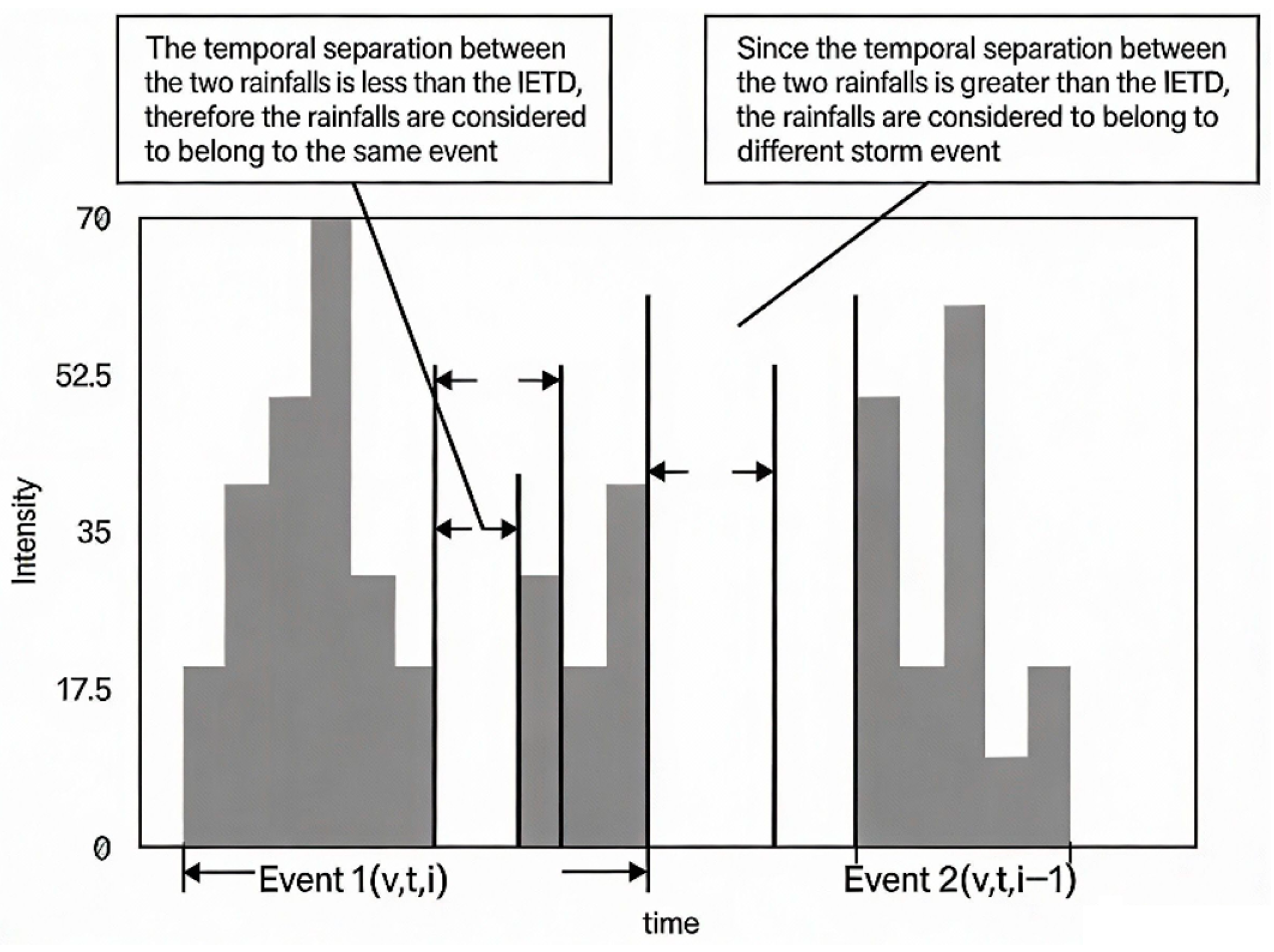
Long-term rainfall records (hyetographs) consist of successive rainfall pulses. A common method to distinguish individual storm events from long-term rainfall records is the Inter-Event Time Definition (IETD). If the interval between two rainfall pulses is shorter than the IETD, the pulses are classified as part of the same event; otherwise, they are considered separate events (see Figure 1).
By applying an IETD, a long-term continuous rainfall record can be discretized into a record of individual storm events. Therefore, characteristics of each individual rainfall event (e.g., volume, duration, average intensity and interevent time) can be determined in the record.
Statistics are derived from random datasets (samples) and can be used to estimate runoff parameters. Several assumptions must be made before meteorological variables or characteristics can be treated as random variables for statistical analysis [7]:
  • Rainfall characteristics are assumed to be a random sample of events drawn from an underlying parent probability distribution (population).
  • Rainfall events are homogeneous, meaning they are all drawn from the same population.
  • Rainfall events are mutually independent.
  • The processes generating rainfall are stationary, with unchanging statistical properties over time.
  • The sample size is sufficiently large to reliably estimate the parameters of the underlying population.
  • Parameter estimates are unbiased.

1.2.2. Probability Density Functions

To perform probabilistically based analyses of systems whose input parameters are random in nature, an appropriate representation of the probability density functions (PDF) of such parameters is necessary [8]. Generally, three types of PDF are commonly utilized to represent characteristics of runoff data: Exponential distribution, Gamma distribution [9] and Lognormal distribution [10].
The exponential probability density function is given by
f x ( x ) = γ e γ x ,   x 0
γ = 1 μ x = 1 σ x
where μ x is the mean and σ x is the standard deviation of the PDF.
The two-parameter probability distribution function is given by
f x ( x ) = x ρ 1 e x / τ τ ρ Γ ( ρ ) ,       x 0
And
Γ ( ρ ) = 0 z ρ 1 e z d z
The parameters ρ and τ are related to the population mean and standard deviation by the following:
μ x = ρ τ
σ x 2 = ρ τ 2
The PDF of the lognormal distribution is given by
f x ( x ) = 1 x σ y 2 π exp { [ ln ( x ) μ y ] 2 2 σ y 2 }  
Assuming that catchment rainfall and/or snowmelt is adequately represented by point rainfall/snowmelt data, meteorological inputs are processed as follows: First, the meteorological record is divided into discrete precipitation events using the IETD criterion. Each event is characterized by its external properties: volume (v), duration (t), average intensity (i), and interevent time (b). Histograms are then generated for these characteristics, and PDFs are fitted to these histograms. As noted earlier, exponential PDFs are employed here (see Table 1).
Table 1. Exponential Probability Density Functions (PDFs) and Applicable Ranges for Rainfall Characteristics.
Rainfall CharacteristicExponential PDFApplicable Range
Volume, v (mm) f V ( v ) = ξ e ξ v , ξ = 1 v ¯ (8) 0 v
Duration, t (h) f T ( t ) = λ e λ t , λ = 1 t ¯ (9) 0 t
Average intensity, i (mm/h) f I ( i ) = β e β i , β = 1 i ¯ (10) 0 i
Interevent time, b (h) f B ( b ) = ψ e ψ ( b I E T D ) , ψ = 1 b ¯   (11) I E T D b
Simplified version f B ( b ) = ψ e ψ b , ψ = 1 b ¯   (12) 0 b
The expected value of the precipitation volume of each storm event, E [ V ] , is given by
E [ V ] = 0 v f v ( v ) d v = 0 v ξ e ξ v d v = 1 ξ = v ¯
then, the average annual volume of precipitation ( P p ) is given by
P p = θ E [ V ] = θ v ¯ = θ ξ

1.2.3. Rain-Runoff Transformation

A core component in developing analytical probabilistic models using derived probability distribution theory is establishing the rainfall-runoff transformation. This transformation mathematically converts system inputs (e.g., rainfall) into outputs (e.g., runoff) [11].
Analytical probabilistic models employ a lumped rainfall-runoff relationship to translate catchment rainfall event volumes (v, in mm) into runoff event volumes ( v r , in mm), as formulated below:
v r = { 0 ,   v S d ϕ ( v S d ) ,   v > S d
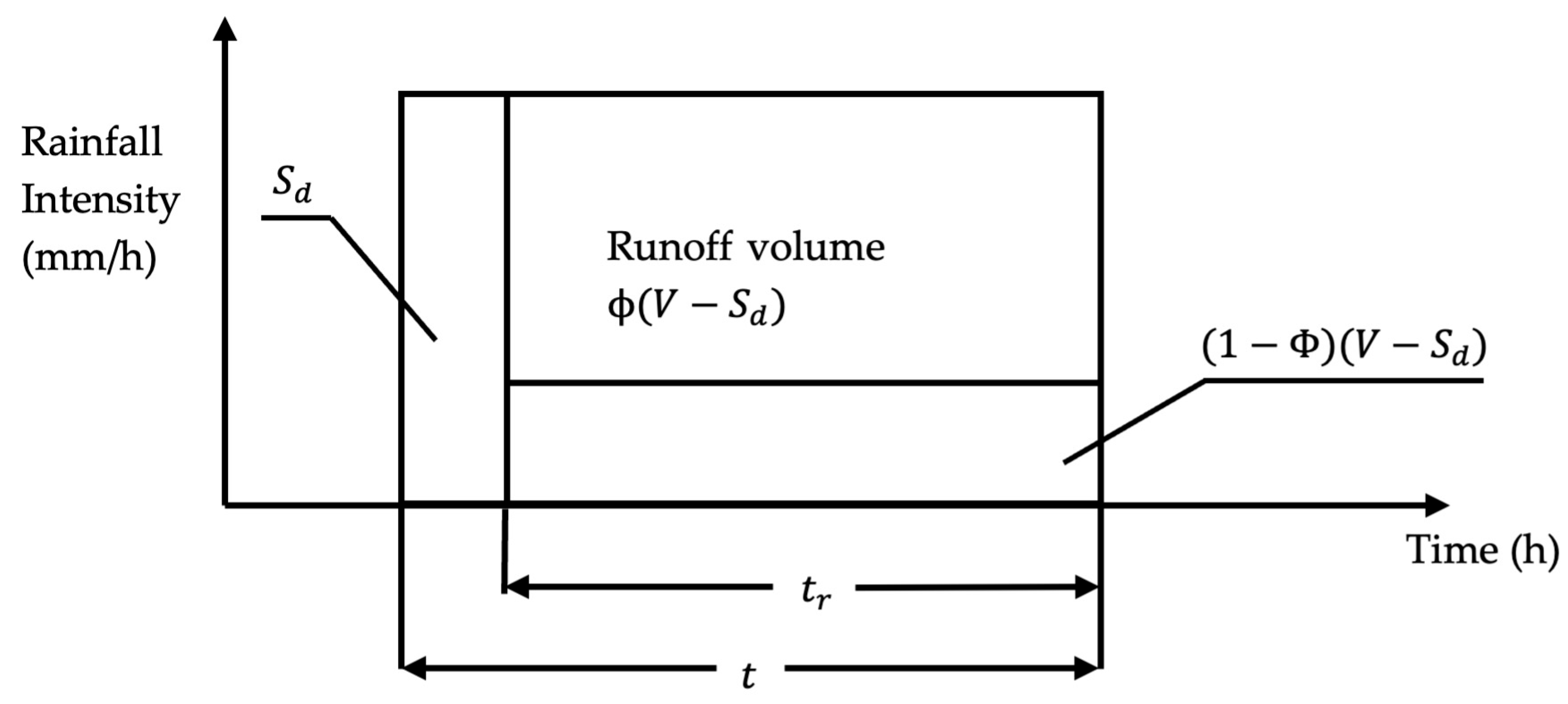
where ϕ is a dimensionless runoff coefficient and S d is the depression storage volume. This transformation is depicted in Figure 2. The expression ( 1 ϕ ) ( v S d ) signifies uniform infiltration losses, which transpire once the initial depression storage is replenished and continue until the conclusion of the event. The maximum reservoir storage volume S a (mm) is denoted as a depth over the catchment, with outflow regulated at a steady rate Ω (mm/h).

1.3. Research Content

Various models of urban stormwater quantity are developed in the literature [12]. These models are of different degrees of complexity and based on different theoretical approaches. The derived probability distribution approach has been widely employed in flood frequency analysis. Data on meteorological characteristics has been represented by exponential distributions of probability density commonly. And based on this, drainage system performance models are put forward.
However, exponential distributions are not always sufficient to describe meteorological data across all climatic regions. In certain specific regions, the Gamma distribution has been demonstrated to offer a more precise fit to rainfall record histograms than exponential distributions [13]. Consequently, to fulfil this gap, this study proposes methodologies and crucial procedures for creating an urban stormwater volume model that amalgamates B.J. Adams’ rainfall-runoff transformation theory with the Gamma probability density distribution.

1.4. Contributions

This study makes three distinct contributions to urban drainage system analysis:
Theoretical Innovation: We develop the first comprehensive drainage system performance model that integrates B.J. Adams’ rainfall-runoff transformation theory with Gamma probability distributions. This addresses a critical gap in probabilistic modeling, as the Gamma distribution—despite its demonstrated superiority in characterizing rainfall statistics across diverse climatic regions—has not yet been systematically applied to drainage system performance analysis.
Methodological Framework: The study establishes a complete modeling methodology and computational procedures for urban stormwater volume analysis using Gamma distributions. By incorporating both the mean and standard deviation of rainfall data, the proposed model overcomes the inherent limitation of exponential models (which require CV = 1) and provides enhanced flexibility for modeling rainfall characteristics with varying variability and skewness.
Validation and Application: The practical applicability of the Gamma model is rigorously verified through dual validation strategies: comparative analysis with conventional exponential models and benchmarking against continuous simulation results. The validation demonstrates statistically significant improvements in estimation accuracy, particularly for climatic regions where rainfall data exhibit high variability and right-skewed distributions. Additionally, the study provides systematic criteria for model selection, offering practitioners clear guidance on when to prefer the Gamma model over traditional approaches.

2. Materials and Methods

2.1. Gamma PDFs of Rainfall Characteristics

Frequency analysis can be performed on the magnitudes of individual rainfall characteristics using storm event samples from continuous rainfall records, which generates histograms. Exponential, lognormal, or Gamma probability density functions (PDFs) can then be fitted to these histograms, effectively representing the data.
As stated in Section 1, exponential probability distribution functions have been commonly employed to model meteorological characteristics in analytical probabilistic models. However, their applicability is fundamentally constrained by the inherent statistical requirement that the mean (μ) must equal the standard deviation (σ), resulting in a fixed coefficient of variation C V = σ / μ of 1 [14]. This condition C V =   1 often does not hold for observed rainfall data in many climatic regions [14]. In regions with high rainfall variability (e.g., monsoonal [15] or semi-arid [16]), the data frequently exhibit μσ and significant right-skewness. For such cases, the two-parameter Gamma distribution, which can independently accommodate μ and σ and capture a wider range of skewness, has been demonstrated to provide a statistically superior fit to rainfall histograms [11,14].
Therefore, we develop the following Gamma PDF expressions to describe meteorological characteristics, providing a more accurate and flexible foundation for probabilistic modeling across diverse climatic conditions.

2.1.1. PDF of Rainfall Volume

PDF of rainfall volume, v, is given by the following expressions [17]:
f V ( v ) = g ( v | σ , τ ) = v σ 1 e v τ τ σ Γ ( σ )   ,   v 0
And
Γ ( σ ) = 0 z σ 1 e z d z
where
σ = ( μ v σ v ) 2
τ = σ v 2 μ v   ( m m )
μ v is the sample mean of rainfall volume and σ v is the standard deviation of rainfall volume.

2.1.2. PDF of Rainfall Duration

PDF of rainfall duration, t, is given by the following expressions:
f T ( t ) = g ( t | λ , ε ) = t λ 1 e t ε ε λ Γ ( λ )   ,   t 0
and
Γ ( λ ) = 0 z λ 1 e z d z
where
λ = ( μ t σ t ) 2
ε = σ t 2 / μ t
μ t is the sample mean of rainfall duration and σ t is the standard deviation of rainfall duration.

2.1.3. PDF of Rainfall Intensity

PDF of rainfall intensity, i, is given by the following expressions:
f I ( i ) = g ( i | β , ϵ ) = i β 1 e i ϵ ϵ β Γ ( β )   ,   i 0
and
Γ ( β ) = 0 z β 1 e z d z
where
β = ( μ i σ i ) 2
ϵ = σ i 2 / μ i
μ i is the sample mean of rainfall intensity and σ i is the standard deviation of rainfall intensity.

2.1.4. PDF of Rainfall Interevent Time

To accurately analyze interevent times (b), it is necessary to modify the variable. An Inter-Event Time Definition (IETD) must be clearly specified to differentiate between individual rainfall events, thereby eliminating interevent times that fall shorter than the defined IETD. Consequently, the valid range for analyzing interevent times is not merely b > 0, but rather b > IETD. This adjustment also impacts the calculation of the sample mean. The resulting Probability Density Function (PDF) of interevent time (b) is as follows:
PDF of rainfall interevent time, b
f B ( b ) = g ( b I E T D | ψ , ω ) = ( b I E T D ) ψ 1 e b I E T D ω ω ψ Γ ( ψ )   ,   b I E T D
and
Γ ( ψ ) = 0 z ψ 1 e z d z
where the shape parameter ψ and scale parameter ω are estimated by the method of moments:
ψ = ( μ b σ b ) 2
ω = σ b 2 μ b
μ b = μ b I E T D
With little sacrifice in accuracy, a simplified version of PDF is introduced to simplify analysis. The simplified gamma PDF is given by:
PDF of rainfall interevent time, b
f B ( b ) = g ( b | ψ , ω ) = ( b ) ψ 1 e b ω ω ψ Γ ( ψ )   ,   b 0
and
Γ ( ψ ) = 0 z ψ 1 e z d z
where the parameters are calculated directly from the sample mean ( μ b ) and sample variance ( σ b 2 ) of all interevent times (b ≥ 0):
ψ = ( μ b σ b ) 2
ω = σ b 2 / μ b

2.2. Cumulative Distribution Functions (CDFs) of Rainfall Characteristics

The CDFs of rainfall volume, v, duration, t, intensity, i, and interevent time, b, are listed here [18].
The CDF of rainfall volume is given by
F V ( V ) = 0 V g ( v | σ , τ ) d v = G ( V | σ , τ ) = 1 τ σ Γ ( σ ) 0 V t σ 1 e t τ d t
The CDF of rainfall duration is given by
F T ( T ) = 0 T g ( t | λ , ε ) d t = G ( T | λ , ε ) = 1 ε λ Γ ( λ ) 0 T t λ 1 e t ε d t
The CDF of rainfall intensity is given by
F I ( I ) = 0 I g ( i | β , ϵ ) d i = G ( I | β , ϵ ) = 1 ϵ β Γ ( β ) 0 I t β 1 e t ϵ d t
A simplified version of the CDF of the rainfall interevent time is given by
F B ( B ) = 0 B g ( b | ψ , ω ) d b = G ( B | ψ , ω ) = 1 ω ψ Γ ( ψ ) 0 B t ψ 1 e t ω d t

2.3. Runoff Quantity Analysis

2.3.1. Runoff Volume

Based on the rainfall-runoff transformation theory [19], the process of converting the probability density function (PDF) of rainfall volume to that of runoff volume can be depicted as follows.
At the beginning, rainfall events will not cause runoff until the volume of rainfall exceeds the depression storage. So, there is an impulse probability that no runoff occurs, which is equal to the probability that a given rainfall event’s volume is equal to or less than depression storage. This impulse probability is given by
P r o b [ V r = 0 ] = P r o b [ V S d ] = 0 S d g ( v | σ , τ ) d v = G ( S d | σ , τ )
For rainfall events with volumes that exceed the depression storage ( v > S d ), the CDF of runoff volume is as follows:
F V r = P r o b [ V r v r ] = P r o b [ V r = 0 ] + P r o b [ S d < V < v r ϕ + S d ] = 1 τ σ Γ ( σ ) 0 ( v r ϕ ) + S d t σ 1 e t τ d t
over the range where V r > 0 .
Using derived probability distribution theory, the PDF of runoff volume is obtained as follows:
f V r ( v r ) = d d v r F V r ( v r ) = 1 ϕ g [ ( v r ϕ ) + S d ] = 1 ϕ [ ( v r ϕ ) + S d ] σ 1 e ( v r ϕ ) + S d τ τ σ Γ ( σ ) ,   v r > 0
The expected value of runoff volume per rainfall event, E [ V r ], is given by
E [ V r ] = 0 · P V r ( 0 ) + 0 v r f V r ( v r ) d v r = 0 + v r 1 ϕ [ ( v r ϕ ) + S d ] σ 1 e ( v r ϕ ) + S d τ τ σ Γ ( σ ) d v r
Then the average annual volume of runoff, R, can be obtained as follows:
R = θ E [ V r ]

2.3.2. Number of Runoff Events

Based on the rainfall-runoff conversion principle, the probability of runoff generation in a single rainfall event is equivalent to the probability that the rainfall amount surpasses the depression storage capacity and is given by
P r o b [ V > S d ] = S d f V ( v ) d v = 1 0 S d f V ( v ) d v = 1 G ( S d , ρ , τ )
and the average number of runoff events, n r , is given by
n r = θ · P r o b [ V > S d ] = θ [ 1 G ( S d , ρ , τ ) ]
where θ is the annual number of rainfall events.

2.3.3. Loss Volume

Loss volume (l) denotes the portion of rainfall that does not generate runoff. These losses can be divided into two categories: rainfall captured by depression storage, which is eventually reincorporated into the hydrological cycle through evapotranspiration and subsequent infiltration, and rainfall that is lost to infiltration during the storm event, as characterized by the runoff coefficient [20]. The expected value of loss volume (E[l]) is expressed as follows:
E [ l ] = 0 S d v f V ( v ) d v + S d [ v ϕ ( v S d ) ] f V ( v ) d v = 0 S d v g ( v | σ , τ ) d v + S d [ v ϕ ( v S d ) ] g ( v | σ , τ ) d v
where the term [ v ϕ ( v S d ) ] represents the volume of rainfall that is lost after the depression storage is filled. In addition, the average annual loss volume, L, is given by
L = θ · E [ l ]

2.3.4. Depression Storage

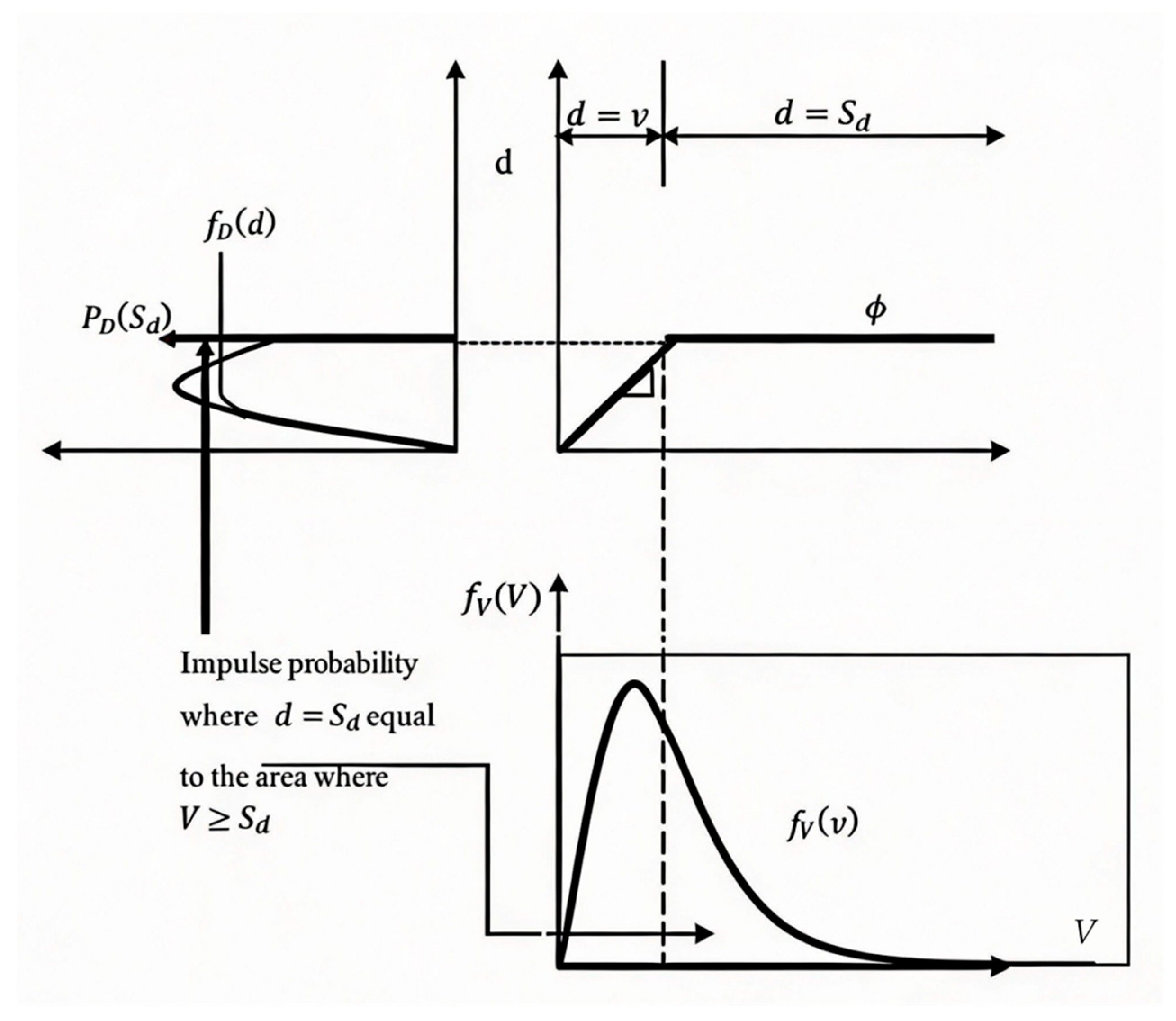
It is commonly accepted that rainfall transforms into runoff only when the depression storage has been completely filled. Therefore, at the conclusion of a rainfall event, the volume of water held in the depression storage is equivalent to the volume of rainfall if the latter is lower than the depression storage capacity; if not, it is equal to the depression storage capacity. Figure 3 presents a schematic representation of how the probability density function (PDF) of rainfall volume is converted into the PDF of depression storage.
The cumulative distribution function (CDF) of the occupied depression storage volume (d), denoted as F D ( d ) , is formulated as follows [21]:
F D ( d ) = P r o b [ D d ] = 0 d f V ( v ) d v = G ( d , σ , τ ) , 0 < d < S d
The probability of the entire depression storage being occupied, i.e., the rainfall volume meeting or exceeding the depression storage capacity, is as follows:
P D ( S d ) = P r o b [ V S d ] = v = S d f V ( v ) d v = 1 G ( S d , σ , τ )
The PDF of the occupied depression storage volume ( f D ( d ) ) is:
f D ( d ) = d d d F D ( d ) = g ( d | σ , τ ) , 0 d S d  
The expected volume of water stored in depressions at the end of a rainfall event (E[D]) is:
E [ D ] = d = 0 S d d f D ( d ) d d + S d P D ( S d ) = d = 0 S d d g ( d | σ , τ ) d d + S d G ( S d , σ , τ )
The average annual storage volume of occupied depression ( D a ) is:
D a = θ E [ D ]
All expressions and results presented in this paper assume that depression storage is completely empty at the commencement of each rainfall event [22]. While this assumption is not fully realistic (as it neglects to consider variable interevent durations and processes), experienced model users can mitigate this inaccuracy by calibrating the depression storage estimation to offset the impact.

2.4. Reservoir Spill Volume

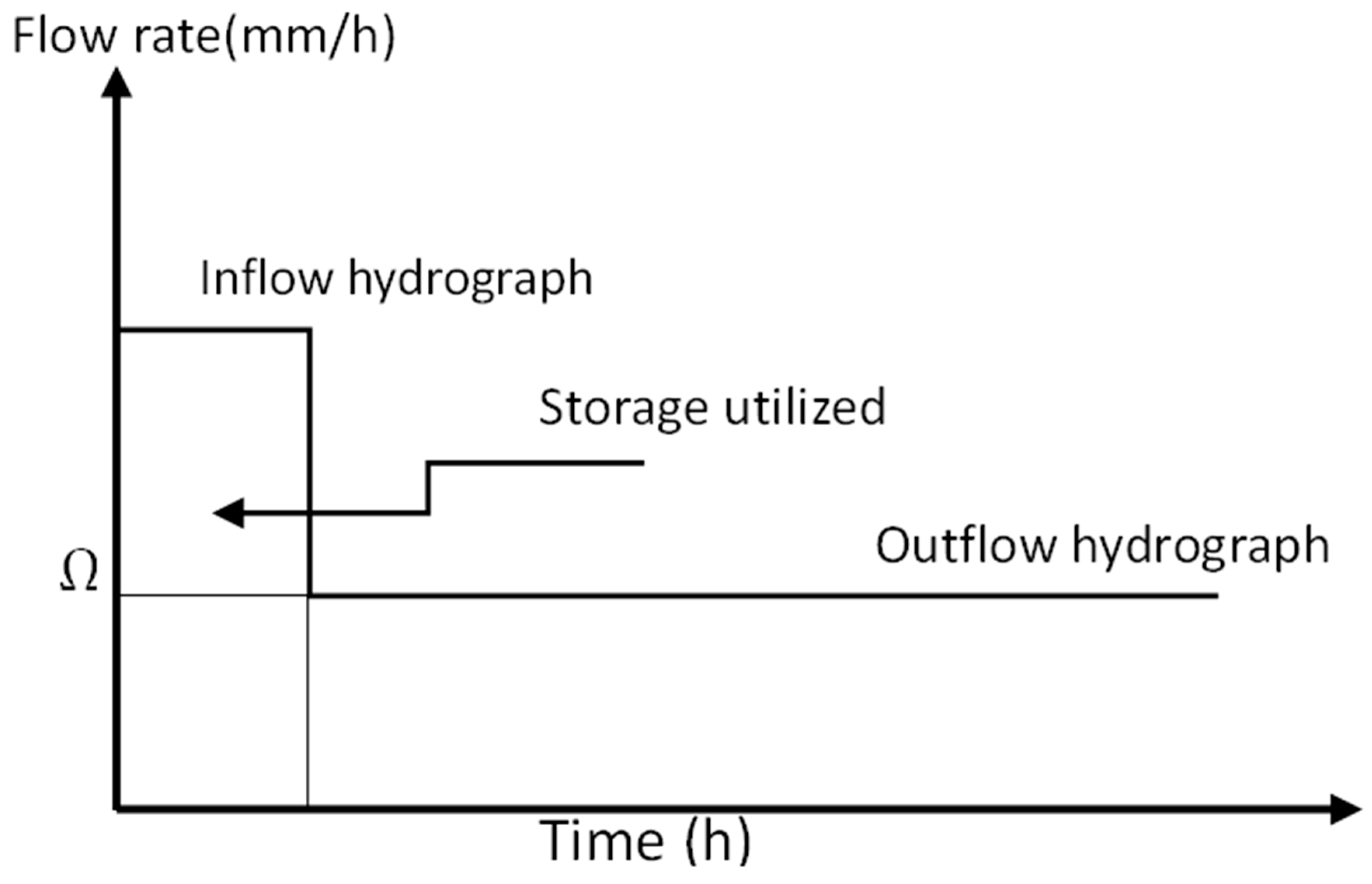
Shown in Figure 4, the downstream reservoir is drained by a controlled outflow, Ω (mm/h), which is expressed as equivalent depth across the catchment area and is a constant rate. When the reservoir is filled with runoff and the inflow rate is greater than the controlled outflow rate, the excess volume, p(mm), is spilled.
Knowing the probability distribution of reservoir contents at the end of a rainfall event, as well as knowing the probability distributions of interevent time, storm volume, and duration, a probability distribution for the volume of water spilled from storage due to a subsequent event can be obtained [23]. Because the steady-state probability distribution of reservoir contents cannot be derived, we make an assumption of a reservoir storage level at the end of a rainfall event to get a closed-form expression for reservoir contents [24]. The assumption involves two cases. Two scenarios are considered: the reservoir is empty at the end of the previous event, or it is full (a relatively conservative assumption).
Based on the rainfall-runoff model, the inflow hydrograph is assumed to take the form of a square wave (refer to Figure 4), and similarly, the controlled outflow hydrograph from the reservoir is also postulated as a square wave.
The derivation of the joint probability density function employs a standard simplifying assumption of analytical probabilistic models: the statistical independence of rainfall volume, duration, and interevent time. This assumption, which facilitates the derivation of closed-form solutions, is acknowledged as a limitation, as these variables may exhibit correlation in observed datasets.

2.4.1. Reservoir Full at the End of the Last Event

Based on the rainfall-runoff transformation and the probability density functions (PDFs) of rainfall characteristics (assuming the statistical independence of duration, volume, and interevent time), a joint probability density function for rainfall volume, duration, and interevent time ( f V , B , T ( v , b , t ) ) can be formulated [25]:
f V , B , T ( v , b , t ) = f V ( v ) × f B ( b ) × f T ( t ) = g ( v | σ , τ ) g ( b | ψ , ω ) g ( t | λ , ε ) = v σ 1 e v τ τ σ Γ ( ρ ) × b ψ 1 e b ω ω ψ Γ ( ψ ) × t λ 1 e t ε ε λ Γ ( λ )  
Assuming that the reservoir is full at the end of the last rainfall event, there are three kinds of time histories of storage contents which should be considered for deriving the probability distribution of reservoir spill volume [26]. The first and second ones are under the fact of ( I E T D < S A Ω ) , and the third case is under the fact of ( I E T D > S A Ω ) .
In the first case, at the end of the preceding event, t = 0, the downstream reservoir is assumed full ( s i = S A ); when this rainfall event begins, the interevent time is greater than IETD (b > IETD); and the reservoir is not drained completely ( b < S A Ω ), yet. Thus, during this rainfall event, there is a storage of Ω b (mm) in the reservoir at the beginning. This storage will be filled with runoff at a rate of ϕ ( v S d ) t Ω until the reservoir is completely full. The runoff volume besides the part that is diverted by the sewer at a rate of Ω is spill, p. The volume of the spill is given by:
p = ϕ ( v S d ) Ω t Ω b
In this case, the spill of a certain volume ( p 0 ) occurs conditionally. The condition is that the duration of this event is greater than zero (t > 0), that the interevent time is greater than IETD and less than the time that is required to drain the reservoir completely ( I E T D < b < S A Ω ) and that the volume of the rainfall event is capable of causing a spill of volume p 0 , ( v > ( p 0 + Ω t + Ω b ) ϕ + S d ).
In the second case, the downstream reservoir is also assumed to be full at the end of the preceding rainfall event ( s i = S A ) [27]; the interevent time is greater than IETD; and the reservoir is drained completely ( b > S A Ω ). So, there is a storage of S A at the beginning of this event. This storage will be filled with runoff at a rate of ϕ ( v S d ) t Ω until the reservoir is completely full. The runoff volume besides the part that is diverted by the sewer at a rate of Ω is then become spill, p. The volume of the spill is given by:
p = ϕ ( v S d ) Ω t S A   ( m m )
In the second case, the spill of a certain volume ( p 0 ) occurs conditionally. The condition is that the duration of this event is greater than zero (t > 0), that the interevent time is greater than the time that is required to drain the reservoir completely ( b > S A Ω ) and that the volume of the rainfall event is capable of causing a spill of volume p 0 , ( v > ( p 0 + Ω t + S A ) ϕ + S d ).
It is noticeable that the spill of p 0 can occur under the first case or the second case. Therefore, in this situation, the probability per rainfall event of a spill volume equaling or exceeding a value p 0 is derived as follows:
G P 1 ( p 0 ) = t = 0 b = I E T D S A Ω v = ( ( p 0 + Ω t + Ω b ) ϕ + S d ) g ( v | σ , τ ) g ( b | ψ , ω ) g ( t | λ , ε ) d v d b d t                               + t = 0 b = S A Ω v = ( ( p 0 + Ω t + S A ) ϕ + S d ) g ( v | σ , τ ) g ( b | ψ , ω ) g ( t | λ , ε ) d v d b d t
In the third case, the downstream reservoir is also assumed to be full at the end of the preceding rainfall event ( s i = S A ). Because IETD is greater than the period that the downstream reservoir is drained completely, ( I E T D > S A Ω ) , there is a storage of S A at the beginning of this event. The reservoir will be filled with runoff at the same rate as in Cases 1 and 2 until the reservoir is completely full. The volume of the spill is given by:
p = ϕ ( v S d ) Ω t S A   ( m m )
In the third case, a spill of a certain volume ( p 0 ) occurs conditionally. The condition is that the duration of this event is greater than zero (t > 0), that the interevent time is greater than IETD (b > IETD) and that the volume of the rainfall event is capable of causing a spill of volume p 0 ,( v > ( p 0 + Ω t + S A ) ϕ + S d ).
The probability per rainfall event of a spill volume equaling or exceeding a value p 0 is derived as follows:
G P 1 ( p 0 ) = t = 0 b = I E T D v = ( ( p 0 + Ω t + S A ) ϕ + S d ) g ( v | σ , τ ) g ( b | ψ , ω ) g ( t | λ , ε ) d v d b d t
Probability of G P 1 ( p 0 = 0 ) is a critical probability that a spill of any volume will occur in a rainfall event. G P 1 ( 0 ) is given by
When IETD < S A / Ω
G P 1 ( 0 ) = t = 0 b = I E T D S A Ω v = ( Ω t + Ω b ϕ + S d ) g ( v | σ , τ ) g ( b | ψ , ω ) g ( t | λ , ε ) d v d b d t                               + t = 0 b = S A Ω v = ( Ω t + S A ϕ + S d ) g ( v | σ , τ ) g ( b | ψ , ω ) g ( t | λ , ε ) d v d b d t
when IETD > S A / Ω
G P 1 ( 0 ) = t = 0 b = I E T D v = ( Ω t + S A ϕ + S d ) g ( v | σ , τ ) g ( b | ψ , ω ) g ( t | λ , ε ) d v d b d t
The expression of the critical probability, G P 1 ( 0 ) , is to be examined in some limiting conditions to have an overall understanding of the expression.
If there is no storage capacity of the downstream reservoir provided, S A = 0 , and Ω is a constant larger than zero, IETD must be greater than S A / Ω . Therefore, G P 1 ( 0 ) is given by
lim S A 0 G P 1 ( 0 ) = t = 0 b = I E T D v = ( Ω t ϕ + S d ) g ( v | σ , τ ) g ( b | ψ , ω ) g ( t | λ , ε ) d v d b d t
An interesting fact could be found:
Runoff rate = v ϕ t = Ω t ϕ + S d t × ϕ = Ω + ϕ S d t = Ω + c o n s t a n t . This means that a spill will occur in a drainage system without a downstream storage when the runoff rate is greater than outflow rate.
Otherwise, if the storage capacity of reservoir is infinite, S A = , and Ω is a constant larger than zero, IETD is less than S A / Ω . This limiting condition is given by
lim S A G P 1 ( 0 ) = t = 0 b = I E T D Ω v = ( Ω t + Ω b ϕ + S d ) g ( v | σ , τ ) g ( b | ψ , ω ) g ( t | λ , ε ) d v d b d t   + t = 0 b = Ω v = ( Ω t + ϕ + S d ) g ( v | σ , τ ) g ( b | ψ , ω ) g ( t | λ , ε ) d v d b d t   = t = 0 b = I E T D v = ( Ω t + Ω b ϕ + S d ) g ( v | σ , τ ) g ( b | ψ , ω ) g ( t | λ , ε ) d v d b d t
according to the equation, it is suggested that the reservoir can provide a storage of Ω b for the detention of runoff in each event, no matter how long the interevent time is.
The outflow capacity also has two types of limiting conditions [28]. Firstly, if there is no outflow capacity, Ω = 0 , IETD is obviously less than S A / Ω . And this situation is governed by
lim Ω 0 G P 1 ( 0 ) = t = 0 b = I E T D v = ( 0 + S d ) g ( v | σ , τ ) g ( b | ψ , ω ) g ( t | λ , ε ) d v d b d t   + t = 0 b = v = ( 0 + S A ϕ + S d ) g ( v | σ , τ ) g ( b | ψ , ω ) g ( t | λ , ε ) d v d b d t   = t = 0 b = I E T D v = S d g ( v | σ , τ ) g ( b | ψ , ω ) g ( t | λ , ε ) d v d b d t
It can be found that spill will occur if the volume of rainfall is greater than storage of the catchment when the outflow is unavailable.
Secondly, in the case that outflow is infinite, this probability that spill occurs per event is given by
lim Ω G P 1 ( 0 ) = t = 0 b = I E T D v = g ( v | σ , τ ) g ( b | ψ , ω ) g ( t | λ , ε ) d v d b d t = 0
if the outflow capacity is extreme great, spill never happens since all the runoffs can be handled by the outflow device immediately. So, it is no doubt that larger outflow capacity is preferred without consideration of cost and construction.

2.4.2. Reservoir Empty at the End of the Last Event

Otherwise, if it is assumed that the reservoir is empty at the end of the preceding rainfall event ( s i = 0 ), there is one condition of storage contents which should be considered for deriving the PDF of reservoir spill volume [29]. This is because whether the interevent time is larger than IETD or not does not have any influence on the storage contents and rainfall event always starts with a reservoir storage of S A . Actually, this condition is the same as the condition in the third case under s i = S A . Spill of a certain volume ( p 0 ) also occurs conditionally. The condition is that the duration of this event is greater than zero (t > 0), that interevent time is greater than IETD (b > IETD) and that the volume of the rainfall event is capable of causing a spill of volume p 0 ,( v > ( p 0 + Ω t + S A ) ϕ + S d ).
Therefore, the probability per rainfall event of a spill equaling or larger a certain value p 0 , G P 2 , is given by
G P 2 ( p 0 ) = t = 0 b = I E T D v = ( p 0 + Ω t + S A ) ϕ + S d g ( v | σ , τ ) g ( b | ψ , ω ) g ( t | λ , ε ) d v d b d t
The critical probability per rainfall event of a spill of any magnitude ( p 0 > 0 ), G P 2 ( 0 ) is given by
G P 2 ( p 0 = 0 ) = t = 0 b = I E T D v = ( Ω t + S A ) ϕ + S d g ( v | σ , τ ) g ( b | ψ , ω ) g ( t | λ , ε ) d v d b d t
The limiting conditions are also examined here.
Assuming that there is no storage capacity, the G P 2 ( 0 ) is given by
lim S A 0 G P 2 ( 0 ) = t = 0 b = I E T D v = Ω t ϕ + S d g ( v | σ , τ ) g ( b | ψ , ω ) g ( t | λ , ε ) d v d b d t
We may have the same result as lim S A 0 G P 1 ( 0 ) .
If the storage of the downstream reservoir is ultimate, the G P 2 ( 0 ) is given by
lim S A G P 2 ( 0 ) = t = 0 b = I E T D v = Ω t ϕ + S d + g ( v | σ , τ ) g ( b | ψ , ω ) g ( t | λ , ε ) d v d b d t = 0
no spill would occur since the empty downstream reservoir is impossible to be filled during a rainfall event.
For no controlled outflow capacity ( Ω = 0 ), the G P 2 ( 0 ) is given by
lim Ω 0 G P 2 ( 0 ) = t = 0 b = I E T D v = S A ϕ + S d g ( v | σ , τ ) g ( b | ψ , ω ) g ( t | λ , ε ) d v d b d t
It is suggested that spill will occur if the volume of rainfall is greater than the storage of the catchment and the capacity of the downstream reservoir ( S A ϕ ).
For ultimate controlled outflow capacity ( Ω = ), the G P 2 ( 0 ) is given by
lim Ω G P 2 ( 0 ) = t = 0 b = I E T D v = g ( v | σ , τ ) g ( b | ψ , ω ) g ( t | λ , ε ) d v d b d t = 0
obviously, no spill would occur if the system were serviced by an ultimate controlled outflow.
The following discussion is based on the less conservative assumption that the reservoir was empty at the end of the preceding rainfall event ( s i = 0 ).

2.5. Performance Measures

2.5.1. PDF of Reservoir Spill Volume

The CDF of reservoir spill volume, F P ( p ) , may be obtained from the expression of G P ( p ) as follows,
F P ( p ) = P r o b ( P < p ) = 1 G P ( p ) 0 < p <
Therefore, we can derive the PDF of the reservoir spill volume from the above equation, see the following equation,
f P ( p ) = d d p F P ( p ) = d d p G P ( p )
and it is noticeable that there is an impulse probability associated with a spill volume of zero. This impulse probability is given by
P P ( 0 ) = P r o b [ P = 0 ] = 1 G P ( 0 )
The expected volume of spill per rainfall event, E[P], can be obtained based on the above expressions as follows,
E [ P ] = 0 · P P ( 0 ) + 0 P f P ( p ) d p = 0 P d d P G P ( P ) d P
Computer adds are required to do calculations with these equations.

2.5.2. Average Annual Number of Spills

The average annual number of spills plays a crucial role in evaluating the performance of drainage facilities when it comes to CSO (Combined Sewer Overflow) control [30]. By building on the derived critical probability of spillage occurrence during a single rainfall event, we can develop an expression for the average annual number of spills.
Specifically, the average annual number of spills, denoted as n s , is calculated as the product of the average annual frequency of rainfall events and the critical probability that a spill occurs in each individual rainfall event. The corresponding expression is as follows:
n s = θ G P   ( 0 )

2.5.3. Average Annual Spill Volume

For assessing the environmental impact of uncontrolled runoff, the average annual volume of uncontrolled spills holds undeniable significance [31]. Additionally, it also serves as a key dataset for conducting quality analysis of urban drainage systems.
The average annual spill volume, denoted as P u , is calculated as the product of the average annual number of spills and the expected spill volume per rainfall event. That is,
P u = θ E [ P ]

2.5.4. Spill Volume of Specified Return Period

It is common that the authority governs the performance of drainage system via requirements on the spill volume of a specified return period. The relationship between the return period ( T R in years) of a spill of magnitude, P T R is given by
T R = 1 θ G P ( P T R )
Substituting the equation of G P ( P T R ) into the equation above, we can get the value of P T R . In terms of this calculation, the assistance of a computer may be needed.

2.6. Runoff Control

Downstream reservoirs and interceptors are utilized to eliminate spill in urban stormwater drainage systems. The responsibility of engineers is to determine the proper degree of runoff control offered by various combinations of reservoir capacity and controlled outflow rate. Based on the derivation of the runoff volume and the spill volume above, it is possible to perform the design and control approximately.
The average annual fraction of runoff spilled, R s , is a parameter which is introduced to measure how the runoff is controlled quantitatively and is a product of the average volume of uncontrolled spills divided by average annual volume of runoff, see as follows [32]
R s = P u R
Correspondingly, the average annual fraction of runoff controlled, C R , is given by
C R = 1 R s
As presented before, the average volume of uncontrolled spills can be expressed as a function of the storage of the reservoir, S A , and the controlled outflow, Ω , and the average annual volume of runoff is determined by meteorological conditions [33]. Therefore, it is possible to develop a model to design the reservoir and outflow with requirements of the fraction of runoff controlled. This model is given by a formula as follows [34]:
R s = P u R = θ E [ P ] θ E [ V r ] = 0 P d d P { t = 0 b = I E T D v = P + Ω t + S A ϕ + S d g ( v | σ , τ ) g ( b | ψ , ω ) g ( t | λ , ε ) d v d b d t } d P 0 + v r 1 ϕ [ ( v r ϕ ) + S d ] σ 1 e ( v r ϕ ) + S d τ τ σ Γ ( σ ) d v r
Based on the model above, information about the performance serviced by various combinations of S A and Ω may be obtained via plotting curves or computations. Then, it is available to determine right size of reservoirs and pipes to meet the local requirements [35].

3. Results

3.1. Case Study Description and Formulation

3.1.1. System Description

A combined sewer catchment in the Eastern Beaches area of Toronto has a catchment area of 300 ha. The depression storage available on the catchment is estimated to be 0.5 mm and the runoff coefficient is 0.4. IETD is 2 h. The population density is 60 capita/ha and DWF is 600 L/capita/day. Flows in the combined trunk sewer are diverted, up to a maximum flow rate of 3.5 × DWF, to an interceptor sewer that is tributary to the Ash-bridges Bay (Main Toronto) treatment plant. Combined trunk flows in excess of the interceptor diversion rate are caused to overflow to Lake Ontario. Assume that the reservoir is full at the end of the last event [1].

3.1.2. Regulatory Context and Design Objectives

The engineering problem involves meeting stringent regulatory requirements for Combined Sewer Overflow (CSO) control [30]. The objectives are:
  • Existing System Evaluation: Determine current annual spill frequency ( n s ) and runoff control rate ( C R ).
  • Design Requirements: Reduce n s to ≤10 spills/year and increase C R to ≥90%.

3.1.3. Meteorological Data

The basic statistical characteristics of rainfall events in this region, derived from long-term historical records, are presented in Table 2.

3.2. Step-by-Step Application of Gamma Model

Step 1: Parameter Calculation for Gamma Distributions
Using the method of moments (Equations (18), (19), (22), (23), (26), (27), (35) and (36)), calculate Gamma distribution parameters from Table 2 data, and the results are listed as follows in Table 3.
Step 2: Calculate Controlled Outflow Rate (Ω)
We have to determine the effective Ω which is the capacity available to transmit wet weather flow.
Ω = 3.5 × D W F D W F = 0.375   m m / h
Step 3: Evaluate Existing System Performance
The critical probability, G P ( 0 ) , is given by
G P 1 ( 0 ) = t = 0 b = 2 v = ( 0.375 t 0.4 + 0.5 ) g ( v | 2.250 , 2.222 ) × g ( b | 6.250 , 8.000 ) × g ( t | 3.240 , 1.029 ) d v d b d t = 0.6115
Average annual number of combined sewer overflows is given by
n s = θ G p ( 0 ) = 120 × 0.6115 = 74   t i m e s   p e r   y e a r
The average annual percent runoff control, C R , is determined by
P u = θ 0 P d d P G P ( P ) d P = 120     0.8628 = 103.54   m m
R = θ 0 + v r 1 ϕ [ ( v r ϕ ) + S d ] ρ 1 e ( v r ϕ ) + S d τ τ ρ Γ ( ρ ) d v r = 216.12   m m
R s = P u R = θ E [ P ] θ E [ V r ] = 0 P d d P G P ( P ) d P 0 + v r 1 ϕ [ ( v r ϕ ) + S d ] ρ 1 e ( v r ϕ ) + S d τ τ ρ Γ ( ρ ) d v r = 0.4791
C R = 1 P u R s = 1 0.4791 = 0.5209 = 52.1 %
Step 4: Design for New Regulations
New regulations require n s to be reduced to 10 per year, and the average annual percent runoff control to be increased to 90%. Determine the storage requirement to meet these new standards.
According to the Gamma PDF model, the reservoir storage which can meet the new regulations cannot be derived directly. However, it is possible to establish a new function of regulations parameters, i.e., n s and C R , and the storage of the reservoir, S A .
For n s and S A , the function is given by
ns = 120 × t = 0∞b = 2∞v = (0.375t + SA0.4 + 0.5)∞gv2.250, 2.222 × gb6.250, 8.000 × gt3.240, 1.029dvdbdt
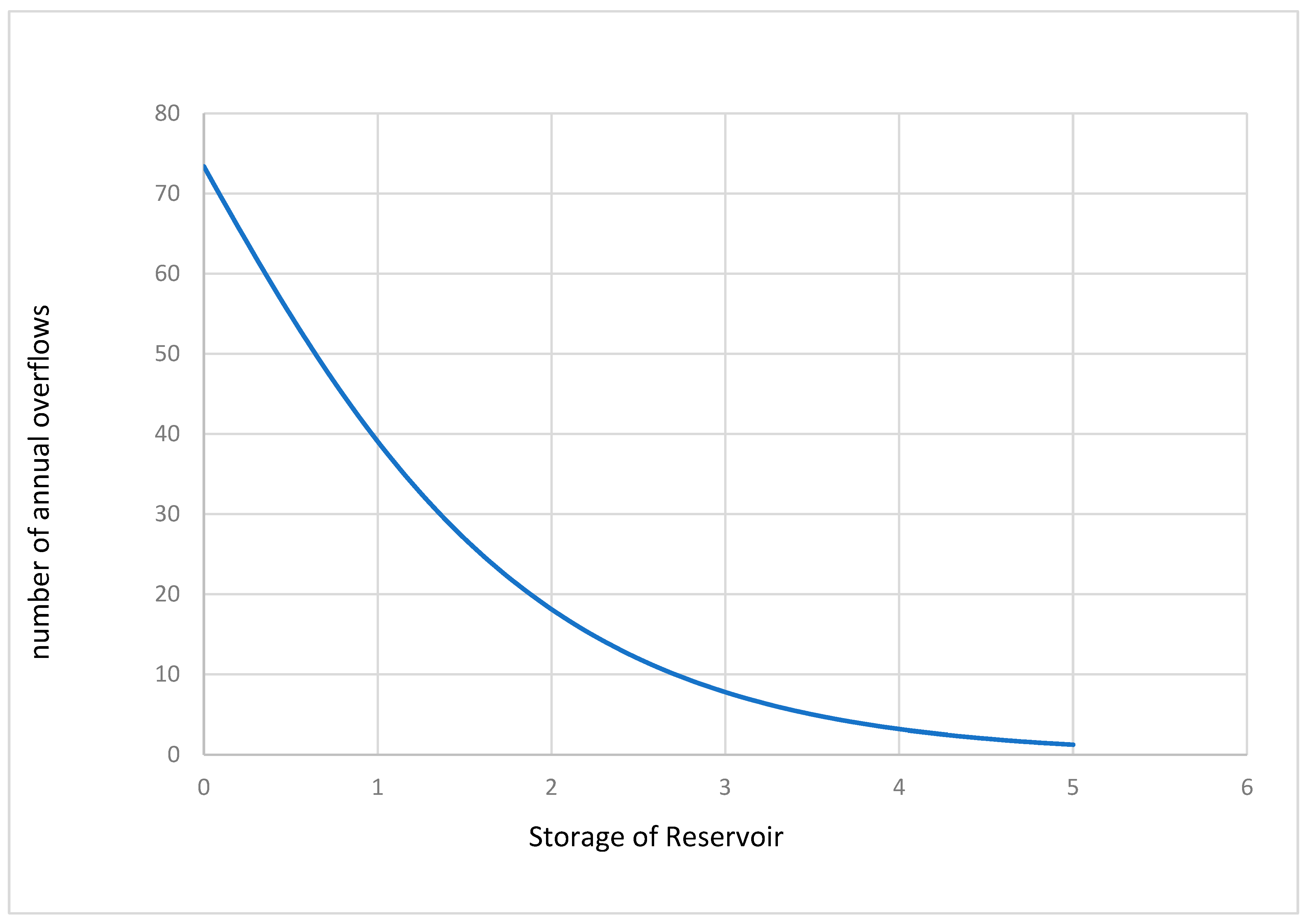
To have n s equal to 10, S A could be determined via plotting n s versus S A . It is possible to attain the plot results by computer, and the result is demonstrated in Figure 5.
It is shown in the plot that a reservoir storage of 2.8 mm may meet the requirement on the number of annual overflows.
In terms of percentage of runoff control, C R , the relationship between C R and S A , is given by the Gamma PDF model as follows
C R ( S A ) = 1 0 P d d P { z = 0 y = 2 x = P + 0.375 z + S A 0.4 + 0.5 x 1.25 e x 2.222 2.222 2.25 Γ ( 2.25 ) × y 5.25 e y 8 8 6.25 Γ ( 8 ) × z 2.24 e z / 1.029 1.029 3.24 Γ ( 3.24 ) d x d y d z } d P 0 + v r 1 0.4 [ ( v r 0.4 ) + 0.5 ] 1.25 e ( v r 0.4 ) + 0.5 2.222 2.222 2.25 Γ ( 2.25 ) d v r
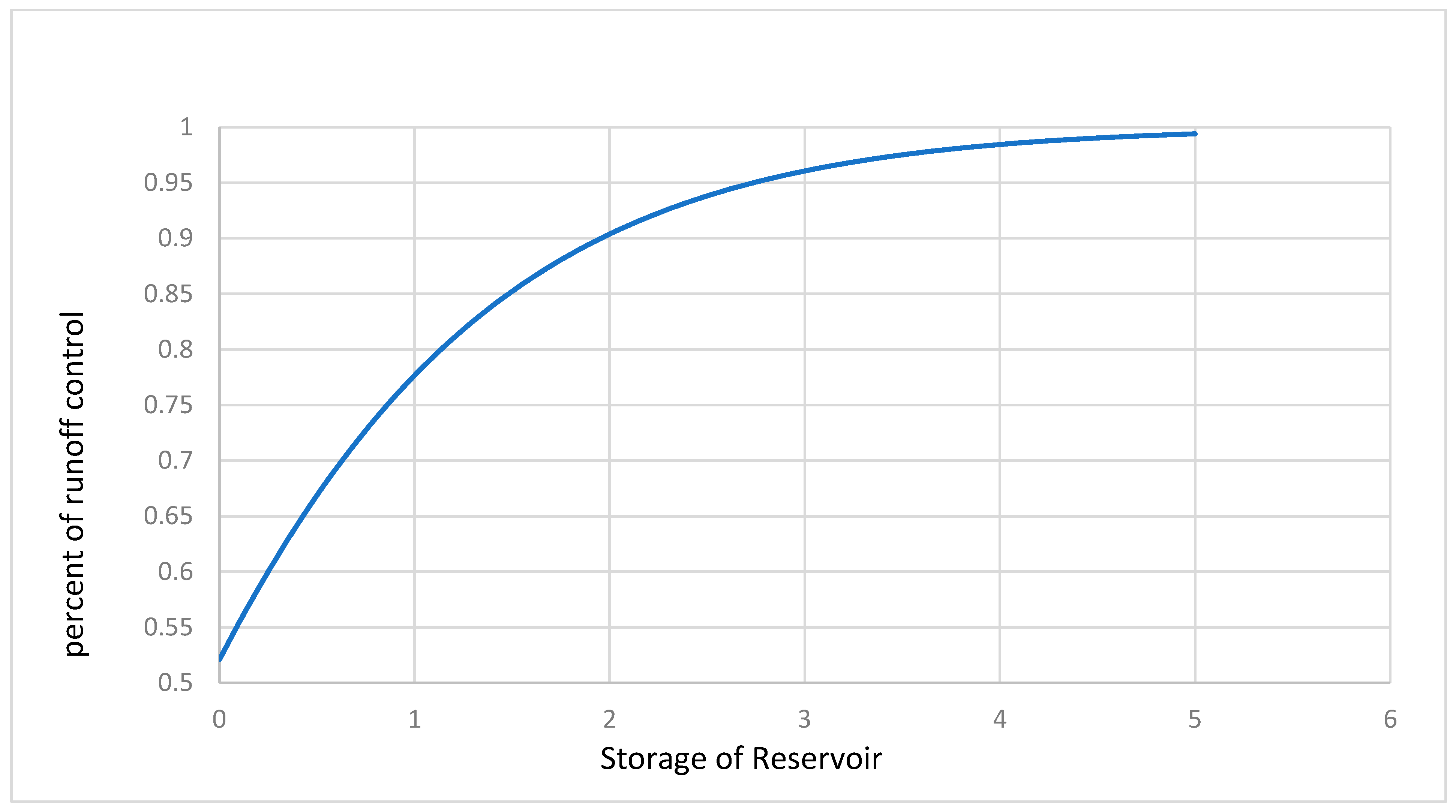
With the assistance of a computer, we can plot C R versus S A and the result is shown in Figure 6.
We may find that the storage of a reservoir of 2 mm may have a corresponding percent of runoff control of 0.9. Therefore, the governing design requirement is S A = 2.8 mm (based on spill frequency target).

3.3. Verification of Results and Consistency with Reality

3.3.1. Comparison with Exponential Model Benchmark

Because Exponential PDF is a single-parameter distribution function, it is necessary to make an assumption that population standard deviation has the same value as the population mean. This means Exponential PDF must ignore the influence of standard deviation of meteorological statistics. See Table 4 and Table 5:
The critical probability, G P ( 0 ) , is given by
G P ( 0 ) = λ / Ω λ Ω + ξ ϕ e ξ ( 0 ϕ + S d ) = 0.5568
Average annual number of combined sewer overflows is given by
n s = θ G p ( 0 ) = 120 × 0.5568 = 67   t i m e s   p e r   y e a r
P u = θ ϕ ξ G p ( 0 ) = 133.6   m m
The average annual percent runoff control is determined by
C R = 1 P u R = 1 133.6 217.16 = 38.46 %
According to the Exponential PDF model, to have n s equal to 10, the S A is determined by
S A = ϕ ξ ln [ n s θ ( 1 + ξ Ω λ ϕ ) ] ϕ S d = 5.22   m m
and to have C R equal to 0.9, the S A is given by
S A = ϕ ξ l n { ϕ ξ { ( 1 C R ) ( 1 + ξ Ω λ ϕ ) ( ψ Ω + ξ ϕ ) ψ Ω } } = 4.41   m m
The differences in outputs between exponential model and gamma model are listed as follows. See Table 6.

3.3.2. Comparative Validation via Continuous Simulation (SWMM)

A comparative analysis is conducted among the proposed Gamma-based probabilistic model (GPM), the classical Exponential-based model, and results from a simplified continuous simulation (CS) approach developed in the Storm Water Management Model (SWMM, U.S. Environmental Protection Agency, Washington, DC, USA) framework via the PySWMM interface (version 2.1.0, PySWMM Developers, San Francisco, CA, USA) [36].
A simplified continuous rainfall runoff and storage simulation was implemented. The system from the Toronto case study was simulated over a synthetic 10-year period comprising 1200 rainfall events. Key physical and operational parameters were kept identical across all models. The simulation tracked the water balance for each event sequentially, accounting for initial storage conditions, runoff generation, storage filling, and spill occurrence.
Three storage scenarios were analyzed to facilitate comparison:
Base Case ( S A = 0 mm): Evaluating existing system performance.
Gamma Design Case ( S A = 2.8 mm): Testing the storage requirement derived from the GPM to meet a target of n s = 10 spills/year.
Exponential Design Case ( S A = 5.22 mm): Testing the storage requirement derived from the Exponential model for the same target.
The SWMM simulations confirm the fundamental effectiveness of both probabilistic models for drainage system design. See Table 7. When the storage sizes determined by each probabilistic model (2.8 mm for Gamma, 5.22 mm for Exponential) to achieve a regulatory target of n s = 10 spills/year are implemented in the continuous simulation, the system performance significantly exceeds the target. This validates that designs based on either probabilistic approach are conservative and effective, ensuring robust performance in a more realistic simulation environment.

3.3.3. Reproducibility Statement

All calculations can be reproduced using the equations and parameters provided. Numerical integration and expected values can be implemented in standard computational software (MATLAB, version R2015a. The MathWorks, Inc., Natick, MA, USA.) using Gamma distribution functions with specified parameters.

4. Discussion

4.1. Comparative Analysis with Existing Studies and Methods

The proposed Gamma-based probabilistic model extends the classical analytical framework established by Adams and colleagues. Our comparative analysis reveals several key distinctions.

4.1.1. Comparison with Exponential Model

Firstly, while the Exponential model assumes CV = 1 for all rainfall characteristics, the Gamma model accommodates the observed variability (CV ≠ 1), providing more accurate input representation.
Secondly, for the Toronto case study, the Gamma model suggests 46% less storage capacity than the Exponential model to achieve the same spill frequency target.
Thirdly, the Exponential model’s fixed-CV constraint limits its applicability to regions where empirical CV ≈ 1, whereas the Gamma model adapts to various climatic conditions.

4.1.2. Comparative Analysis of Exponential vs. Gamma Distribution Fits

To quantitatively evaluate the advantage of Gamma distributions over Exponential distributions and establish their climatic appropriateness, a systematic comparative analysis (goodness-of-fit) was conducted [37]. This analysis is grounded in the well-documented climatic spectrum of precipitation interannual variability, where the coefficient of variation (CV) is a key diagnostic:
Low-variability regimes (CV < 1) are characteristic of humid temperate climates, where precipitation amounts are relatively stable from year to year, confirmed by global-scale analyses [38].
High-variability regimes (CV > 1) are a defining feature of global drylands, where precipitation is highly erratic and intense [16].
Moderate-variability regimes (CV ≈ 1) are typified by core monsoon regions, which experience strong seasonal concentration but relatively stable long-term annual totals [15].
Rainfall event series representative of these three distinct climatic regions was analyzed:
Humid Temperate (HT): Representing low-variability regimes (CV < 1).
Semi-Arid (SA): Representing high-variability regimes (CV > 1).
Tropical Monsoon (TM): Representing regions with moderate variability (CV ≈ 1).
For each region, rainfall event volume (v) was extracted using a consistent IETD. Both Exponential and Gamma distributions were fitted to the empirical data.
Goodness-of-fit was assessed using the Kolmogorov–Smirnov (KS) statistic and the Akaike Information Criterion (AIC).
The comparative analysis results are summarized in Table 8.
Key Findings
1. Climatic Regions Where Gamma is More Adequate:
Regions with CV Significantly Different from 1: The Gamma distribution provides a dramatically superior fit in both humid temperate (CV = 0.67) and semi-arid (CV = 1.45) climates. This empirically validates that the Exponential model (constrained to CV = 1) fails where observed variability deviates from unity, particularly in the high-variability context of drylands.
Region with CV ≈ 1: In the tropical monsoon climate (CV = 0.92), both distributions perform comparably, aligning with the theoretical expectation and the documented precipitation regime of such regions.
2. Precision Gain Quantification:
In the semi-arid region, using the Gamma distribution reduces the KS statistic by approximately 60%, a major gain in accuracy for extreme value estimation.
In the humid temperate region, the very strong statistical support (ΔAIC = 48.7) for the Gamma model underscores its utility even in less variable climates where the Exponential constraint remains mismatched.
This comparative analysis, framed within established climate variability research, provides robust empirical justification for adopting Gamma distributions in probabilistic models, especially where observed rainfall variability deviates from the Exponential model’s restrictive CV = 1 assumption.

4.2. Performance Differences Between Gamma, Exponential, and SWMM Models

The comparative analysis of the Gamma-based probabilistic model, the Exponential probabilistic model, and the SWMM continuous simulation reveals systematic differences in their predicted performance metrics for urban drainage systems. These differences arise from the fundamental methodological approaches inherent to each modeling paradigm.
Through the validation exercise using continuous simulation, the outputs of both probabilistic models have been confirmed to be reliable for engineering design purposes. Notably, the Exponential model consistently yields the most conservative estimates among the three approaches, while both the Gamma and Exponential models produce more conservative outcomes than the SWMM simulation. This observed conservatism stems primarily from the contrasting ways in which the models conceptualize and simulate system behavior.
The SWMM simulation offers a more physically detailed representation by accounting for the dynamic recovery processes of storage facilities between rainfall events, the temporal and spatial variability of rainfall intensity within events, and the inherent storage and routing effects within the pipe network itself. This allows SWMM to capture buffering effects and sequential interactions that can mitigate spill volumes and frequencies.
In contrast, the analytical probabilistic models incorporate a series of simplifying assumptions to derive closed-form solutions. These include treating rainfall events as statistically independent and characterizing them with simplified temporal patterns. This inherently leads to more conservative predictions of spill frequency and volume for a given system configuration.
Thus, the differences in results reflect a spectrum of representation, from the detailed, process-based simulation of SWMM to the simplified, statistically robust approximations of the analytical models. This understanding underscores their complementary roles: Continuous simulation is invaluable for detailed design and verification, while the probabilistic models provide efficient and conservative tools for planning, screening, and understanding system sensitivities.

4.3. Implications of the Independence Assumption on Model Reliability

It is important to note that the current model inherits a key assumption from classical analytical probabilistic models: the statistical independence of rainfall event characteristics (volume, duration, interevent time) when constructing the joint probability distribution (Equation (55)). While this assumption enables the derivation of tractable analytical expressions, it may not fully represent the interdependence often observed in meteorological data, potentially affecting the accuracy of extreme spill probability estimates.

4.3.1. Theoretical Context and Mathematical Necessity

The independence assumption for rainfall event characteristics (volume, duration, and interevent time) is a foundational premise in analytical probabilistic stormwater modeling, enabling the factorization of the joint probability density function (Equation (55)).
This assumption represents a standard convention established in the seminal work of Adams and Papa and subsequently adopted in numerous analytical probabilistic models for urban drainage system analysis. The mathematical necessity of this assumption lies in its facilitation of closed-form analytical solutions; without it, the derivation of explicit expressions for spill probability distributions becomes computationally intractable, necessitating numerical integration or simulation-based approaches.
However, empirical meteorological evidence reveals that the correlation structure between rainfall variables exhibits pronounced climatic dependence [39,40]. Extensive hydrological literature documents that the correlation between rainfall volume (v) and duration (t) varies systematically across climatic zones. Table 9 synthesizes empirical correlation coefficients from published multi-site studies.
Therefore, this section systematically examines how the independence assumption affects model predictions, establishes the bias direction through probabilistic analysis, and defines the climatic conditions under which the Gamma-based model provides reliable engineering guidance.

4.3.2. Case Study: Volume-Duration Correlation

The Gamma-based probabilistic model assumes independence among three rainfall event variables: volume (v), duration (t), and interevent time (b). When correlation exists between any pair of these variables, the model predictions deviate from the true system behavior. The direction and magnitude of this deviation depend on the correlation sign and the specific variable pair involved.
To illustrate the general principle, we examine the correlation between rainfall volume (v) and duration (t) as a representative example. This variable pair has been extensively documented in hydrological literature, providing empirical validation for the theoretical framework.
Large-volume rainfall events are typically generated by synoptic-scale weather systems (frontal passages, mesoscale convective complexes, monsoon depressions) that persist over extended periods, whereas small-volume events often result from localized convective cells of limited spatial and temporal extent. This physical coupling creates statistical dependence between volume and duration.
Under positive correlation between rainfall volume and duration, the independence assumption produces conservative bias in overflow probability estimation.
A theoretical proof is demonstrated here.
Consider the overflow-driving event combination: large rainfall volume paired with short duration, expressed as P(v > v*t < t*), where v* and t* represent threshold values for overflow occurrence.
The true joint probability under positive correlation ( P true ) is defined by:
P true ( v > v * t < t * ) = P ( v > v * ) · P ( t < t * | v > v * )
By the definition of positive correlation, larger values of v are associated with larger values of t. Therefore, conditioning on v > v* (large volume) increases the probability of long duration. A conditional probability inequality can be established:
P ( t > t * | v > v * ) > P ( t > t * )
Equivalently:
P ( t < t * | v > v * ) < P ( t < t * )
The joint probability under the independence assumption ( P indep ) is defined by:
P indep ( v > v * t < t * ) = P ( v > v * ) · P ( t < t * )
Thus,
P true ( v > v * t < t * ) < P ( v > v * ) · P ( t < t * ) = P indep
Therefore, we conclude that P indep > P true .
The independence assumption systematically overestimates the probability of overflow-driving events (large volume with short duration), producing conservative bias in model predictions. This ensures that designs based on the independence assumption provide inherent safety margins.
The conservative bias predicted by theory is empirically confirmed in the Toronto case study.
To rigorously evaluate the potential impact of variable interdependence on the proposed model, a collinearity diagnostic was performed using 1200 simulated events based on the Toronto climate moments. As summarized in Table 10, although a significant positive correlation exists between v and t (Kendall’s τ = 0.619), the calculated Variance Inflation Factors (VIF) for all variables are approximately 3.1 or lower. Since these values are well below the critical threshold of 5, it can be concluded that multicollinearity does not compromise the stability of the model, and the inherent physical coupling of rainfall variables is statistically manageable.
The Toronto climate (humid continental, τ ≈ 0.619) exhibits strong positive volume-duration correlation expected for frontal-dominated climatic regimes. The Gamma model’s overestimation of spill frequency by 62% validates the theoretical prediction of conservative bias under positive correlation.
Conversely, if negative correlation existed between volume and duration, the analysis would yield:
P indep < P true
Indicating non-conservative bias where the model would underestimate overflow risk.
The independence assumption systematically underestimates the probability of overflow-driving events, producing non-conservative bias that may lead to undersized storage facilities and inadequate system performance.

4.3.3. Generalization to Other Variable Pairs

The analytical framework demonstrated for volume-duration correlation applies analogously to other variable pairs in the model:
Volume-Interevent Time Correlation
  • Positive correlation: Large-volume events followed by short interevent periods would indicate clustering of heavy rainfall events. Independence assumption would overestimate the probability of (large volume with long interevent time), producing conservative bias.
  • Negative correlation: Large-volume events followed by long interevent periods would indicate isolated heavy events. Independence assumption would underestimate the probability of (large volume with short interevent time), producing non-conservative bias.
Duration-Interevent Time Correlation
  • Positive correlation: Long-duration events followed by short interevent periods. Independence assumption would overestimate the probability of (long duration with long interevent time), producing conservative bias.
  • Negative correlation: Long-duration events followed by long interevent periods. Independence assumption would underestimate the probability of (long duration with short interevent time), producing non-conservative bias.
Key Findings: The direction of bias under the independence assumption can be derived through logical reasoning based on the correlation sign between any pair of variables. However, the correlation structure among rainfall variables varies across different climatic regions—positive correlation in one variable pair does not imply the same correlation direction in another. Therefore, practical application requires examination of actual rainfall data to determine the specific correlation structure for the location of interest.

5. Conclusions

5.1. Model Summary

A probabilistic model based on Gamma probability distribution is proposed as a numerical approach to analyze performance of urban drainage system. The proposed model serves as a critical supplement to the Exponential-based model in climatic regions where the coefficient of variation (CV) of rainfall characteristics deviates from one. By relaxing the restrictive CV = 1 assumption inherent to the Exponential distribution, the Gamma model provides a more flexible and statistically faithful representation of meteorological inputs, thereby enhancing the accuracy of performance estimations across diverse climate regimes.
Validation against a continuous simulation model (SWMM) confirms the utility and reliability of the analytical probabilistic approach. The results demonstrate that the Gamma model, while producing more conservative design outcomes than the detailed continuous simulation, provides a prudent and reliable basis for engineering design.

5.2. Limitations and Research Prospect

In this study, it is assumed that meteorological histogram of some climatic regions appears to fit gamma PDF. However, this assumption is not perfectly accurate and errors exist inevitably. Thus, this model works at a level of planning of screening. In the future, studies should focus on how to simulate the meteorology more accurately, adequate mathematical methods are supposed to be introduced.
While Section 4.3 qualitatively analyzed the directional impact of positive/negative correlations on model bias, the magnitude of these effects is deserved to be analyzed. The independence assumption prevents the model from incorporating correlation coefficients (e.g., Kendall’s τ) into predictions, meaning two regions with identical marginal distributions but different correlation strengths would yield identical outputs despite different actual system behaviors. This limitation is important for engineering practice, as the degree of correlation-induced bias cannot be quantified or corrected without explicit correlation modeling. To address this limitation, future work should integrate more advanced tools (e.g., Copula theory [44,45]) to explicitly model dependence structures between rainfall variables under various climates, thereby improving reliability of the model.
It is noticeable that some equations are derived not easy-to-use, given that expression is complicated. To applying this model, computer adds should be employed. Additionally, tools like nomographs, software and programs are expected to be developed, which may provide model users with convenience.

Author Contributions

B.W.: Conducted cross-institutional validation of the model using meteorological datasets; verified the consistency of rainfall-runoff transformation results; assisted in refining the model’s parameter calibration methods. R.Z. (Ruijie Zhou): Designed and performed core experiments, including meteorological data collection and statistical analysis; developed the Gamma distribution-based probabilistic model framework; drafted the “Materials and Methods” and “Results” sections; contributed to manuscript revision. M.Q.: Curated and standardized experimental datasets; performed formal statistical analysis (e.g., PDF/CDF fitting); designed and optimized all schematic figures (Figure 1, Figure 2, Figure 3, Figure 4, Figure 5 and Figure 6) and tables; ensured data integrity. R.Z. (Ran Zhou): Participated in the development and debugging of runoff quantity and spill volume calculation models; verified experimental reproducibility through repeated simulations; supplemented technical details in the model derivation process. W.L. (Wei Li): Conducted comprehensive literature review; synthesized theoretical backgrounds of probabilistic models and rainfall-runoff transformation; drafted the “Introduction” and “Discussion” sections; refined the manuscript’s logical flow. X.Z.: Conceptualized the overall research framework and technical roadmap; secured funding support; supervised experimental design and data interpretation; led the structuring of the manuscript and finalized key conclusions. Q.W.: Assisted in daily experimental operations, including equipment maintenance and reagent preparation; checked the accuracy of primary meteorological data; ensured compliance with statistical analysis protocols. X.L.: Provided academic guidance and technical oversight throughout the study; directed model optimization and result interpretation. W.L. (Weiyu Liu): Coordinated team division of labor and supervised research progress; managed research funding and resource allocation; verified the academic rigor and innovation of the study; confirmed key conclusions and approved the final submission. All authors have read and agreed to the published version of the manuscript.

Funding

This work was supported by the National Natural Science Foundation of China (No. 62403072 and No. 12172064), the Innovation and entrepreneurship training program for college students from Chang’an University entitled “Research and development of AC Electrothermal Microfluidic Immunoassay Device”.

Data Availability Statement

The data that support the findings of this study are available from the corresponding authors upon reasonable request.

Conflicts of Interest

The authors declare no conflict of interest.

Nomenclature

SymbolMeaningUnit
vRainfall volumemm
tRainfall durationh
iAverage rainfall intensitymm/h
bInterevent timeh
IETDInter-Event Time Definitionh
γExponential distribution parameter-
μxMean of random variable x-
σxStandard deviation of random variable x-
ρGamma distribution shape parameter-
τGamma distribution scale parameter-
E[V]Expected rainfall volume per eventmm
PpAverage annual precipitation volumemm
θAnnual number of rainfall eventsevents/year
vrRunoff volumemm
SdDepression storage volumemm
ϕRunoff coefficient-
SAMaximum reservoir storage volumemm
ΩControlled outflow rate from downstream reservoirmm/h
μvSample mean of rainfall volumemm
σvSample standard deviation of rainfall volumemm
μtSample mean of rainfall durationh
σtSample standard deviation of rainfall durationh
μiSample mean of rainfall intensitymm/h
σiSample standard deviation of rainfall intensitymm/h
μbSample mean of interevent timeh
σbSample standard deviation of interevent timeh
FV(V)Cumulative distribution function of rainfall volume-
FT(T)Cumulative distribution function of rainfall duration-
FI(I)Cumulative distribution function of rainfall intensity-
FB(B)Cumulative distribution function of interevent time-
FVrCumulative distribution function of runoff volume-
fVr(vr)Probability density function of runoff volume-
E[Vr] Expected runoff volume per rainfall eventmm
RAverage annual runoff volumemm
nrAverage annual number of runoff eventsevents/year
lLoss volumemm
E[l]Expected loss volume per rainfall eventmm
LAverage annual loss volumemm
dOccupied depression storage volumemm
FD(d)Cumulative distribution function of occupied depression storage volume-
PD (Sd) Probability of full depression storage occupation-
fD(d)Probability density function of occupied depression storage volume-
E[D]Expected occupied depression storage volume at the end of a rainfall eventmm
DaAverage annual occupied depression storage volumemm
pReservoir spill volumemm
p0Specific spill volume thresholdmm
E[P]Expected spill volume per rainfall eventmm
nsAverage annual number of spillsspills/year
PuAverage annual spill volumemm
TRReturn period of spill eventsyears
P T R Spill volume with return period TRmm
RsRatio of annual spill volume to annual runoff volume-
CRAnnual runoff control rate-
DWFDry weather flowL/capita/day
CVCoefficient of variation-

References

  1. De Toffol, S.; Engelhard, C.; Rauch, W. Combined sewer system versus separate system—A comparison of ecological and economical performance indicators. Water Sci. Technol. 2007, 55, 255–264. [Google Scholar] [CrossRef]
  2. Sun, B.; Xue, R.; Li, W.; Zhou, S.; Li, H.; Zhou, B.; Wang, H. How does Mei-yu precipitation respond to climate change? Natl. Sci. Rev. 2023, 10, nwad246. [Google Scholar] [CrossRef]
  3. Gharib, A.A.; Blumberg, J.; Manning, D.T.; Goemans, C.; Arabi, M. Assessment of vulnerability to water shortage in semi-arid river basins: The value of demand reduction and storage capacity. Sci. Total Environ. 2023, 871, 161964. [Google Scholar] [CrossRef] [PubMed]
  4. Kim, H.; Mallari, K.J.B.; Baek, J.; Pak, G.; Choi, H.I.; Yoon, J. Considering the effect of groundwater on bioretention using the Storm Water Management Model. J. Environ. Manag. 2019, 231, 1270–1276. [Google Scholar] [CrossRef] [PubMed]
  5. Adams, B.J.; Papa, F. Urban Stormwater Management Planning with Analytical Probabilistic Models; Wiley: New York, NY, USA, 2000. [Google Scholar]
  6. Zhao, Y.; Wang, L.; Jiang, Q.; Wang, Z. Spatiotemporal nonlinear characteristics and threshold effects of China’s water resources. J. Environ. Manag. 2025, 373, 123633. [Google Scholar] [CrossRef]
  7. Baig, M.A.; Zaman, Q.; Baig, S.A.; Qasim, M.; Khalil, U.; Khan, S.A.; Ismail, M.; Muhammad, S.; Ali, S. Regression analysis of hydro-meteorological variables for climate change prediction: A case study of Chitral Basin, Hindukush region. Sci. Total Environ. 2021, 793, 148595. [Google Scholar] [CrossRef]
  8. Tian, G.-L.; Ju, D.; Yuen, K.C.; Zhang, C. New expectation–maximization-type algorithms via stochastic representation for the analysis of truncated normal data with applications in biomedicine. Stat. Methods Med. Res. 2018, 27, 2459–2477. [Google Scholar] [CrossRef]
  9. Johnson, N.L.; Kotz, S.; Balakrishnan, N. Continuous Univariate Distributions, 2nd ed.; Wiley: New York, NY, USA, 1994; Volume 1. [Google Scholar]
  10. Aitchison, J.; Brown, J.A.C. The Lognormal Distribution; Cambridge University Press: Cambridge, UK, 1957. [Google Scholar]
  11. Al-Babtain, A.A.; Merovci, F.; Elbatal, I. The McDonald exponentiated gamma distribution and its statistical properties. SpringerPlus 2015, 4, 2. [Google Scholar] [CrossRef]
  12. Chen, J.; Adams, B.J. Urban stormwater quality control analysis with detention ponds. Water Environ. Res. 2006, 78, 744–753. [Google Scholar] [CrossRef]
  13. García-Ledesma, I.; Madrigal, J.; Pardo-Loaiza, J.; Hernández-Bedolla, J.; Domínguez-Sánchez, C.; Sánchez-Quispe, S.T. Flood analysis comparison with probability density functions and a stochastic weather generator. PeerJ 2025, 13, e19333. [Google Scholar] [CrossRef]
  14. Yonus, M.; Jan, B.; Khan, H.; Nawaz, F.; Ali, M. Study the seasonal trend analysis and probability distribution functions of rainfall for atmospheric region of Pakistan. MethodsX 2023, 10, 102058. [Google Scholar] [CrossRef] [PubMed]
  15. Guhathakurta, P.; Rajeevan, M. Trends in the rainfall pattern over India. Int. J. Climatol. 2008, 28, 1453–1469. [Google Scholar] [CrossRef]
  16. Feng, S.; Fu, Q. Expansion of global drylands under a warming climate. Atmos. Chem. Phys. 2013, 13, 10081–10094. [Google Scholar] [CrossRef]
  17. Mu, L.; Kang, Y.; Yan, Z.; Yang, X.; Zhu, G. Quantifying uncertainties in data and model: A prediction model for extreme rainfall events with application to Beijing subway. Accid. Anal. Prev. 2025, 222, 108238. [Google Scholar] [CrossRef]
  18. Mascaro, G. Comparison of local, regional, and scaling models for rainfall intensity–duration–frequency analysis. J. Appl. Meteorol. Climatol. 2020, 59, 1519–1536. [Google Scholar] [CrossRef]
  19. Zhang, K.; Che, W.; Zhang, W.; Zhao, Y. Discussion about initial runoff and volume capture ratio of annual rainfall. Water Sci. Technol. 2016, 74, 1764–1772. [Google Scholar] [CrossRef]
  20. Tao, W.; Shao, F.; Su, L.; Wang, Q.; Zhou, B.; Sun, Y. An analytical model for simulating the rainfall-interception-infiltration-runoff process with non-uniform rainfall. J. Environ. Manag. 2023, 344, 118490. [Google Scholar] [CrossRef]
  21. Kim, H.; Han, M.; Lee, J.Y. The application of an analytical probabilistic model for estimating the rainfall–runoff reductions achieved using a rainwater harvesting system. Sci. Total Environ. 2012, 424, 213–218. [Google Scholar] [CrossRef]
  22. Wang, J.; Jiang, D.; Huang, Y.; Wang, H. Drought analysis of the Haihe river basin based on GRACE terrestrial water storage. Sci. World J. 2014, 2014, 578372. [Google Scholar] [CrossRef]
  23. Park, D.; Roesner, L.A. Evaluation of pollutant loads from stormwater BMPs to receiving water using load frequency curves with uncertainty analysis. Water Res. 2012, 46, 6881–6890. [Google Scholar] [CrossRef]
  24. Zegpi, M.; Fernandez, B. Hydrological model for urban catchments–analytical development using copulas and numerical solution. Hydrol. Sci. J. 2010, 55, 1123–1136. [Google Scholar] [CrossRef]
  25. Rauf, A.; Rahman, A. Study of fixed-duration design rainfalls in Australian rainfall runoff and joint probability based design rainfalls. In Proceedings of the 2nd APHW Conference, Singapore, 5–8 July 2004. [Google Scholar]
  26. Kim, B.; Shin, S.C. Statistical analysis of changes in reservoir storage according to standard precipitation evapotranspiration index (SPEI) and dam water release. J. Korean Soc. Hazard Mitig. 2018, 18, 409–415. [Google Scholar] [CrossRef]
  27. Wang, Y.; Gao, L.; Huang, S.; Peng, X. Combined effects of rainfall types and antecedent soil moisture on runoff generation at a hillslope of red soil region. Eur. J. Soil Sci. 2022, 73, e13274. [Google Scholar] [CrossRef]
  28. Klein, J. Influence of Inflow and Outflow Boundary Conditions on Flow Situation in Vertical Slot Fishways. Master’s Thesis, University of Stuttgart, Stuttgart, Germany, 2018. [Google Scholar]
  29. Bourgault, M.-A.; Bechtold, M.; Holden, J.; Blundell, A.; Dettman, U.; Garneau, M.; Howson, T.; Jutras, S.; Kløve, B.; Larocque, M.; et al. The quantification of water storage capacity of peatlands across different hydroclimatic settings using a simple rainfall event to water-table response ratio method. In Proceedings of the EGU General Assembly 2021, Online, 19–30 April 2021. [Google Scholar] [CrossRef]
  30. van Daal-Rombouts, P.; Sun, S.; Langeveld, J.; Bertrand-Krajewski, J.-L.; Clemens, F. Design and performance evaluation of a simplified dynamic model for combined sewer overflows in pumped sewer systems. J. Hydrol. 2016, 538, 609–624. [Google Scholar] [CrossRef]
  31. Yang, Y.; Zhu, D.Z.; Loewen, M.R.; Zhang, W.; van Duin, B.; Mahmood, K. Impacts of climate change on urban stormwater runoff quantity and quality in a cold region. Sci. Total Environ. 2024, 954, 176439. [Google Scholar] [CrossRef]
  32. Sambito, M.; Freni, G.; Piazza, S. Application of Bayesian Optimisation to Water Quality Monitoring in Urban Drainage Systems. In Proceedings of the 15th International Conference on Hydroinformatics, Beijing, China, 27–30 May 2024. [Google Scholar]
  33. Marsalek, J.; Barnwell, T.O.; Geiger, W.; Grottker, M.; Huber, W.C.; Saul, A.J.; Schilling, W.; Torno, H.C. Urban Drainage Systems: Design and Operation. Water Sci. Technol. 1993, 27, 31–70. [Google Scholar] [CrossRef]
  34. Deletic, A.; Dotto, C.B.S.; McCarthy, D.T.; Kleidorfer, M.; Freni, G.; Mannina, G.; Uhl, M.; Henrichs, M.; Fletcher, T.D.; Rauch, W.; et al. Assessing uncertainties in urban drainage models. Phys. Chem. Earth Parts A/B/C 2012, 42–44, 3–10. [Google Scholar] [CrossRef]
  35. Bach, P.M.; Rauch, W.; Mikkelsen, P.S.; Deletic, A. A critical review of integrated urban water modelling–Urban drainage and beyond. Environ. Model. Softw. 2014, 54, 88–107. [Google Scholar] [CrossRef]
  36. McDonnell, B.E.; Ratliff, K.M.; Tryby, M.E.; Wu, J.X.; Mullapudi, A. PySWMM: The Python Interface to Stormwater Management Model (SWMM). J. Open Source Softw. 2020, 5, 2292. [Google Scholar] [CrossRef]
  37. Hosmer, D.W.; Lemeshow, S.; Sturdivant, R.X. Applied Logistic Regression, 3rd ed.; Wiley: New York, NY, USA, 2013. [Google Scholar]
  38. Fatichi, S.; Ivanov, V.Y.; Caporali, E. Investigating interannual variability of precipitation at the global scale: Is there a connection with seasonality? J. Clim. 2012, 25, 5512–5527. [Google Scholar] [CrossRef]
  39. Huff, F.A. Time distribution of rainfall in heavy storms. Water Resour. Res. 1967, 3, 1007–1019. [Google Scholar] [CrossRef]
  40. FAO. Rainfall-runoff analysis. In Water Harvesting; Chapter 3; Food and Agriculture Organization of the United Nations: Rome, Italy, 1991. [Google Scholar]
  41. Vandenberghe, S.; Verhoest, N.E.C.; De Baets, B. A comparative copula-based bivariate frequency analysis of observed and simulated storm events: A case study on Bartlett-Lewis modeled rainfall. Water Resour. Res. 2011, 47, W07529. [Google Scholar] [CrossRef]
  42. Buliah, N.A.; Yie, W.L.S. Modelling of extreme rainfall using copula. AIP Conf. Proc. 2020, 2266, 090007. [Google Scholar]
  43. Kao, S.C.; Govindaraju, R.S. A bivariate frequency analysis of extreme rainfall with implications for design. J. Geophys. Res. Atmos. 2007, 112, D13119. [Google Scholar] [CrossRef]
  44. Salvadori, G.; De Michele, C. Frequency analysis via copulas: Theoretical aspects and applications to hydrological events. Water Resour. Res. 2004, 40, W12511. [Google Scholar] [CrossRef]
  45. Zhang, L.; Singh, V.P. Bivariate rainfall frequency distributions using Archimedean copulas. J. Hydrol. 2007, 332, 93–109. [Google Scholar] [CrossRef]
Figure 1. Schematic of distinguishing individual storm events from long-term rainfall records via Inter-Event Time Definition (IETD). Pulses with intervals < IETD are classified as the same event.
Applsci 16 04099 g001
Figure 2. Schematic of rainfall-runoff transformation, showing depression storage ( S d ), infiltration losses [(1 − ϕ)(V S d )], and runoff volume [ϕ(V S d )] over time.
Applsci 16 04099 g002
Figure 3. Schematic of converting rainfall volume PDF to occupied depression storage PDF, including the impulse probability of full depression storage (V S d ).
Applsci 16 04099 g003
Figure 4. Schematic of inflow and outflow hydrographs in a downstream reservoir, illustrating storage utilization and controlled outflow rate (Ω) over time.
Applsci 16 04099 g004
Figure 5. Relationship between reservoir storage ( S A ) and average annual spill number ( n s ) based on the Gamma PDF model; S A = 2.8 mm meets n s = 10.
Applsci 16 04099 g005
Figure 6. Relationship between reservoir storage ( S A ) and annual runoff control rate ( C R ) based on the Gamma PDF model; S A = 2 mm achieves C R = 90%.
Applsci 16 04099 g006
Table 2. Basic meteorological statistical data of rainfall characteristics in the Eastern Beaches area of Toronto.
RainfallMeanSDCoefficient of Variation (CV)
Intensity (mm/h)1.3160.4700.357
Duration (h)3.3331.8520.556
Interevent Time (h)50.00020.0000.400
Volume (mm)5.0003.3330.667
Average annual numbers of events120
Table 3. Parameter values of the gamma probability density function (PDF) model.
ParametersValuesParametersValues
σ2.250β7.840
τ2.222ϵ0.168
λ3.240ψ6.250
ε1.029ω8.000
Table 4. Rainfall characteristic statistical data under the assumption of exponential probability density function (PDF) model.
RainfallMeanSD
Intensity (mm/h)1.3161.316
Duration (h)3.3333.333
Interevent Time (h)50.00050.000
Volume (mm)5.0005.000
Average annual numbers of events120
Table 5. Parameter values of the exponential probability density function (PDF) model.
ParametersValuesUnit
β0.76h/mm
λ0.3/h
ψ0.02/h
ξ0.2/mm
Table 6. Comparison of existing system performance estimates and design requirements: exponential vs. gamma (PDF) model.
Performance MetricExponential ModelGamma ModelRelative Difference
n s (spills/year)6774+10.4%
C R (control rate)38.5%52.1%+35.3%
Required S A for n s = 10/year5.22 mm2.8 mm−46.4%
Table 7. Comparison of model predictions with continuous simulation results.
Scenario (Storage, S A ) Method Spill Freq., n s /yr Control Rate, C R
Existing System
( S A = 0 mm)
Exponential Model670.385
Gamma Model740.521
SWMM Simulation45.60.787
Design Storage (Gamma)
( S A = 2.8 mm)
Gamma Model (Target)100.9
SWMM Simulation1.10.998
Design Storage (Exp.)
( S A = 5.22 mm)
Exponential Model (Target)100.9
SWMM Simulation0.10.99
Table 8. Comparative goodness-of-fit analysis for rainfall volume across climates.
Climatic RegionHumid Temperate (HT)Semi-Arid (SA)Tropical Monsoon (TM)
Empirical CV0.671.450.92
KS Statistic (Exp/Gamma)0.081/0.0450.152/0.0610.065/0.058
AIC Value (Exp/Gamma)1250.2/1201.5843.7/788.32100.5/2102.1
Preferred ModelGammaGammaExp (marginal)
Precision Gain (ΔAIC)48.7 (ΔAIC > 10 indicates strong preference)55.4 (60% reduction in KS statistic)1.6 (ΔAIC < 2 indicates no meaningful preference)
Table 9. Kendall’s rank correlation coefficient (τ) between rainfall volume and duration from published studies.
LocationClimate ClassificationKendall’sInterpretation
Uccle, Belgium [41]Humid temperate0.631positive
Besut, Malaysia [42]Tropical humid0.521positive
Dungun, Malaysia [42]Tropical humid0.512positive
Sungai Tong, Malaysia [42]Tropical humid0.561positive
Indiana, USA [43]Humid continental0.40–0.60positive
Table 10. Correlation and multicollinearity diagnostics for the Toronto dataset.
CategoryVariable Pair/VariableStatisticValueResult/Interpretation
Correlationv vs. tKendall’s τ0.619Significant positive correlation
v vs. bKendall’s τ−0.008Negligible
t vs. bKendall’s τ−0.006Negligible
Collinearityv (Volume)VIF3.096Low (within acceptable range)
t (Duration)VIF3.095Low (within acceptable range)
b (Inter-event)VIF1.001No collinearity
Disclaimer/Publisher’s Note: The statements, opinions and data contained in all publications are solely those of the individual author(s) and contributor(s) and not of MDPI and/or the editor(s). MDPI and/or the editor(s) disclaim responsibility for any injury to people or property resulting from any ideas, methods, instructions or products referred to in the content.