Article

Production of Synthetic Fuels as a Form of Utilizing Renewable Energy Surpluses—Spain and Poland Case Study


1
Mineral and Energy Economy Research Institute of the Polish Academy of Sciences, 31-261 Kraków, Poland
2
Department of Thermal and Fluid Flow Machines, Faculty of Energy and Fuels, AGH University of Kraków, 30-059 Kraków, Poland
3
Institute for Energy Engineering, Universitat Politècnica de València, Camino de Vera s/n, 46022 Valencia, Spain
*
Author to whom correspondence should be addressed.
Appl. Sci. 2026, 16(4), 1968; https://doi.org/10.3390/app16041968
Submission received: 26 January 2026 / Revised: 12 February 2026 / Accepted: 12 February 2026 / Published: 16 February 2026

Abstract

The increasing share of variable renewable energy sources (RES) in power systems leads to growing challenges related to grid balancing and the management of periodic electricity surpluses. One potential pathway for utilizing these surpluses is their conversion into synthetic fuels via Power-to-X technologies. This study analyzes the technical and economic potential of surplus renewable electricity utilization for the production of green hydrogen and synthetic fuels, using Poland and Spain as representative case studies of power systems with low and high RES penetration, respectively. An original methodology based on hourly power system data was developed to identify technically feasible surplus electricity volumes, accounting for changes in renewable and conventional generation, minimum renewable energy share thresholds, and a minimum two-hour continuous operation requirement. The analysis quantifies both instantaneous and usable surplus energy on an annual basis and evaluates the resulting capacity factors of Power-to-X installations. The results show that the annual usable surplus energy amounts to approximately 886 GWh in Poland and 2329 GWh in Spain, corresponding to maximum capacity factors of about 27% and 50%, respectively. Based on these surpluses and assuming low-cost electricity during surplus periods (10 EUR/MWh), the levelized cost of green hydrogen was estimated at 4.1 EUR/kg in Poland and 2.18 EUR/kg in Spain. The resulting production costs of green methanol reach approximately 739 EUR/Mg for Poland and 378 EUR/Mg for Spain after accounting for avoided CO2 emissions. The findings indicate that surplus-based Power-to-X systems can play a meaningful role in integrating high shares of renewable energy, particularly in power systems with high and stable RES penetration. However, their contribution remains strongly constrained by surplus availability, temporal continuity, and system-specific characteristics.

1. Introduction

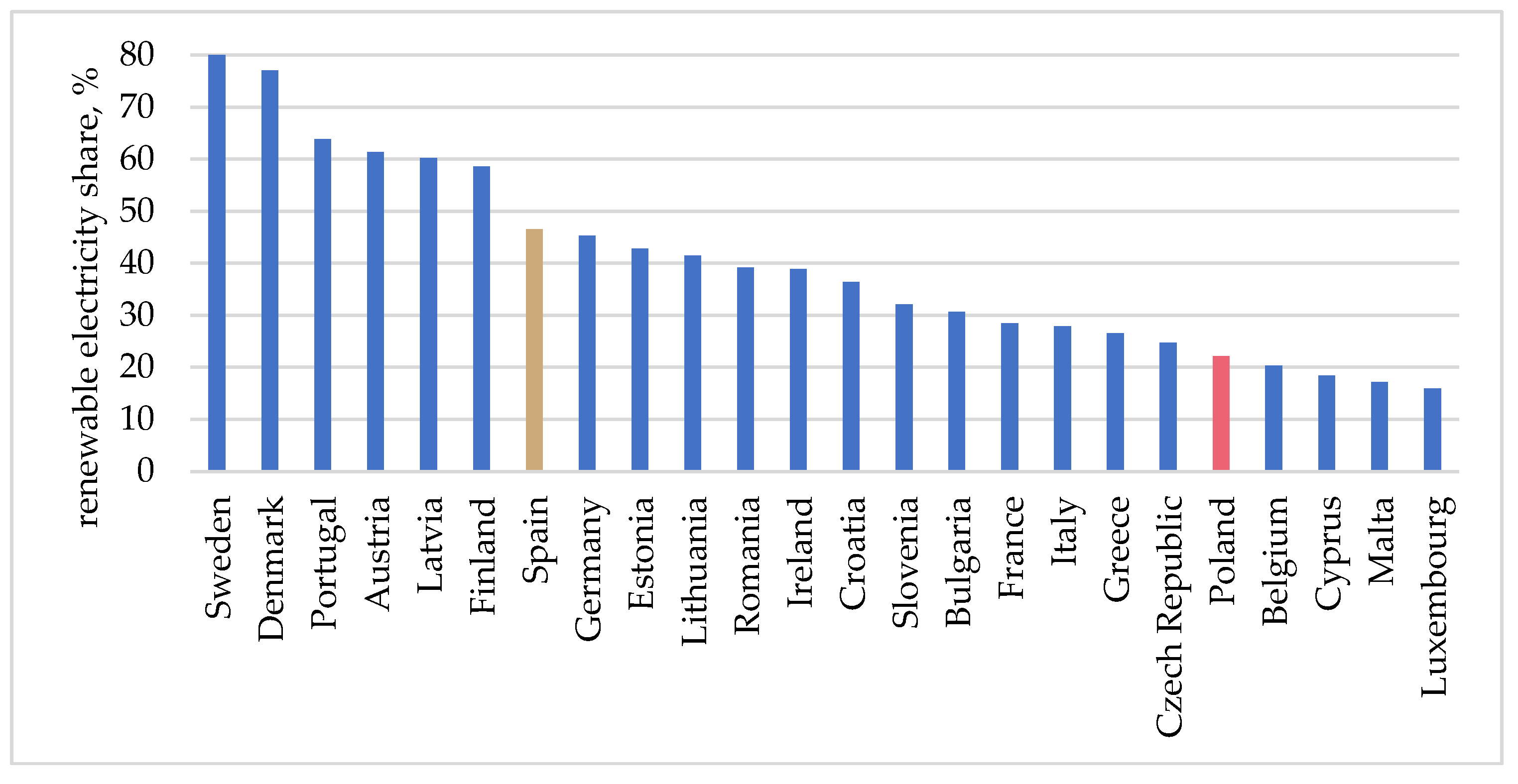
The increasing penetration of Renewable Energy Sources (RES) in electric power systems, when managed appropriately, presents both significant opportunities and challenges [1,2,3]. One of the key opportunities, which simultaneously poses a technical and economic challenge, is the utilization of electricity surpluses for purposes outside the conventional power system. Within the scope of this research, the potential for identifying and harnessing these surpluses for synthetic fuel production (Power-to-X [4]) was analyzed in two countries with markedly different energy mixes: Poland and Spain (Figure 1).
The data reveals a clear leading group, with Sweden and Denmark reporting the highest shares at approximately 80% and 77% respectively, demonstrating a robust transition to renewable-based electricity systems. The majority of countries cluster in the 30% to 60% range, including major economies like Germany (around 45%). Spain, with a share near 47%, stands well above the EU average, while Poland reports a much lower share of approximately 22%. This substantial difference in renewable energy penetration directly relates to the varying availability of surplus energy, influencing the technical feasibility and economics of Power-to-X solutions for synthetic fuel production, as the potential Capacity Factor (CF) for such facilities would be inherently higher in countries with greater overall renewable energy deployment and resulting excess generation [5].
The selection of these countries was dictated by the necessity to evaluate diverse factors related to RES availability, including differences in the annual CF, for instance, for photovoltaic installations. These aspects have a direct influence on the technical viability and economics of implementing such solutions. These analyses align with the broader context of the energy transition, encompassing not only the electricity sector but also hard-to-abate sectors such as heavy industry and transport. These solutions are crucial for maintaining strategic energy security by creating reserves of available energy carriers (e.g., synthetic fuels).

1.1. Energy System Transformation

Vidal-Amaro et al. [6] developed a methodology for determining the minimum capacity share in power systems. The analysis considered the availability of various types of renewable energy sources, as well as the possibility of using fossil fuels and energy carriers as one form of energy storage, often implemented indirectly. The proposed methodology was applied to simulations of power system operation over a time horizon of several decades.
Forsberg [7] analyzed various methods for utilizing surplus energy production in energy systems, highlighting the potential use of excess energy for transport applications and for the production of synthetic fuels with relatively low production costs. Mazur et al. [8] addressed the issue of the future structure and balancing of power systems under conditions of declining fossil fuel use and the consequent growing importance of renewable energy and various forms of energy storage and utilization across different industrial sectors. In this context, the authors conducted a literature review on the operation of such systems and previous studies in this field, with particular emphasis on Poland.
Kalair et al. [9] presented various concepts for the transition from fossil fuel use to renewable energy sources, taking into account energy storage technologies and the challenges associated with them. The authors also discussed the role of thermal energy storage and the potential of advanced technologies, such as artificial photosynthesis, as components of future energy systems. The circular economy can be integrated with power systems through, among other approaches, the utilization of by-products and waste streams as well as energy derived from renewable sources. In this context, the management of surplus electricity is of particular importance, and one possible solution is its use for the production of synthetic fuels. The analyses considered environmental costs and benefits associated with the production of hydrocarbon-based fuels, with particular emphasis on hydrogen, methane, methanol, and ammonia, using a comparative approach [10].

1.2. Technological Pathways for Synthetic Fuel Production

Saeidi et al. [11] demonstrated that one of the key challenges of modern energy production is CO2 emissions and the need for their effective management. The authors analyzed various catalyst types, kinetic aspects, process methods, and operational frameworks aimed at increasing hydrogen production efficiency, particularly in the transition from so-called gray hydrogen to blue hydrogen. Existing technological solutions and industrial processes were also considered.
Najari et al. [12] analyzed studies focused on CO2 emission reduction through the use of renewable hydrogen, employing various catalysts based on zeolites as well as sodium- and potassium-containing compounds. Their work also investigated the Fischer–Tropsch synthesis as one of the key pathways for synthetic fuel production.
Li and Guan [4] demonstrated that renewable synthetic fuels represent one of the key options for phasing out fossil fuels and achieving carbon neutrality. In this context, the authors analyzed development prospects for fuel production technologies, including reaction mechanisms, catalytic materials, and reactor designs at both laboratory and industrial scales. Synthetic fuels were identified as a necessary element for enabling a substantial increase in the share of renewable energy in the global energy balance, potentially exceeding 50% at national or global levels. The authors also emphasized the possibility of converting CO2 into fuels for energy, aviation, and transport applications via intermediate pathways involving hydrocarbons, alcohols, or biomass.
Khan et al. [13] conducted research on the potential utilization of CO2, as well as the application of biofuels, alternative fuels, and synthetic fuels as components of the transformation of energy and fuel systems. Alsunousi [14] demonstrated and emphasized the growing role of synthetic fuels as part of the transition away from fossil fuels, with particular focus on CO2 reuse. The author indicated that this approach may contribute to reducing costs and process losses, improving fuel production efficiency, and enabling more effective monitoring and transformation of the transport sector toward low-emission solutions.

1.3. Systemic Role of Synthetic Fuels in Decarbonization

Wilson et al. [15] hypothesized that fuels are and will remain a key component of future energy systems. This is due, among other factors, to their advantages in terms of storage, transport, and handling costs, as well as their importance for energy security. The authors conducted a detailed analysis for the United Kingdom based on time-series data on demand for liquid fuels, natural gas, and electricity. The study examined demand dynamics for individual energy carriers and highlighted the advantages and limitations of synthetic fuels compared to other energy carriers available on the market.
Ram and Salkuti [16] showed that, due to numerous challenges facing the energy and fuel sectors, research on synthetic fuels has been ongoing for many years, with the primary objective of identifying alternatives to conventional energy carriers, taking into account storage capabilities and applications such as transport. The authors analyzed a broad range of chemical compounds that could serve as alternatives to conventional fuels such as diesel. A comprehensive review of classification schemes, production methods, and production potential was presented, along with an assessment of industrial-scale feasibility. Environmental aspects were also considered, and the advantages and limitations of synthetic fuels in the transition away from fossil fuels were discussed.
Rosa [17] pointed out that one of the key challenges associated with increasing the use of renewable energy is the need for synthetic fuels, whose storage is significantly simpler and technologically well-established compared to the direct use of electricity from new renewable sources, which often involves technical and systemic limitations. Synthetic fuels may therefore represent an effective means of achieving a more comprehensive transition away from fossil fuels while accounting for existing system barriers.
Aramendia et al. [18] examined investment-related issues associated with different types of energy carriers, with particular emphasis on critical resources and technologies as well as fuel production. The authors indicated that the assessment of energy investment profitability should account not only for economic factors but also for energy performance indicators such as EROI (Energy Return on Investment). Their analysis included a comparison of different fuel types and their potential roles in renewable energy-based energy systems.
Sangeeta et al. [19] showed that, due to the progressive depletion of fossil fuels, the importance and potential advantages of various alternative fuels are increasing. The authors indicated that the principles governing their use do not differ significantly from those of conventional fuels, including hydrogen-based fuels, which were also examined.

1.4. Sectoral Applications of Synthetic Fuels

Fuchs et al. [20] highlighted CO2 emissions associated with agricultural activities, distinguishing between internal operations (including farm buildings, residential facilities, and livestock production) and field cultivation processes, where the use of synthetic fuels may be feasible. Using a case study of an agricultural cooperative in Germany, the authors examined pathways toward achieving net-zero CO2 emissions by 2050. The analysis assumed local production of synthetic fuels using surplus electricity from renewable sources and included economic aspects such as investment costs and uncertainty. Various energy demand scenarios were considered, along with corresponding configurations of renewable energy installations, including small-scale photovoltaic systems and wind turbines, as well as energy storage systems and synthetic fuel production facilities. The results showed that current synthetic fuel production costs in agricultural settings remain very high, implying that economic viability may only be achieved through significant future technological progress. An alternative development pathway involves ensuring adequate feedstock volumes, competitive prices, and access to surplus electricity without competing with other energy utilization pathways.
Pregger et al. [21] presented the results of the “Future Fuels” project, carried out by multiple institutions associated with the German aviation sector. Using a modeling approach, the authors assessed prospects for synthetic fuel production based on renewable energy in a manner compatible with the future structure of the power system. According to the findings, these fuels may play a significant role in both road transport and aviation.
Kulczycki et al. [22] analyzed drop-in fuels intended for use in aviation gas turbines. The authors also examined the conditions for their deployment in comparison with conventional fossil fuels used in aviation applications. The analysis was based, among other factors, on issues related to carbon monoxide formation and activation energy associated with reaction pathways involving carbon monoxide and carbon dioxide.
Ridjan et al. [23] are among the authors who demonstrated that the transport sector remains heavily dependent on oil, particularly in the European Union. They emphasized that no single simple solution currently exists for the large-scale deployment of renewable energy to meet demand for low-emission transport, due in part to the diversity of transport modes and engine technologies. Initial steps toward transport decarbonization have included biofuels and electromobility; however, the authors highlighted increasing competition for biomass among economic sectors and competition between electricity use for transport and fuel production. The results identified potential synthetic fuel production pathways, with particular emphasis on hydrogen production integrated with CO2 capture and utilization.
Ebhota et al. [24] carried out an analysis of various materials used in energy systems, with a focus on hybrid systems based on renewable energy sources. The study addressed energy challenges in Sub-Saharan Africa and explored the potential role of magnetic technologies in supporting the development and efficiency of such energy systems.

1.5. Energy Security

Rybak et al. [25] analyzed the energy security of European Union member states, with particular emphasis on Poland. The authors considered a set of factors determining energy security levels, focusing on the impact of the increasing share of renewable energy sources. In this context, attention was drawn to the importance of critical raw materials, particularly rare earth elements. The study showed that access to these materials is systematically declining in both Poland and the European Union as a whole, posing a significant challenge for the further development of renewable energy technologies [26,27].
Buchart-Korol [28] conducted a review of the Polish fuel market with particular emphasis on alternative fuels. They demonstrated that in 2019 only a small percentage of vehicles were powered by LPG, while only several thousand vehicles used CNG. The share of biofuels in the fuel market remained low, significantly below the 10% level required by the European Union. At the same time, the market for synthetic fuels was still at the planning stage.
Hübner and von Roon [29] analyzed the potential for industrial transformation toward low-emission technologies, with particular emphasis on the role of synthetic fuels as a means of achieving very low CO2 emission levels in Germany using renewable fuels. Their model-based calculations assumed a target production of 163 TWh of synthetic fuels, including 134 TWh of synthetic methane. The results indicate that a transition away from fossil fuels is primarily feasible through the extensive deployment of synthetic fuels while maintaining energy supply security. Direct hydrogen use was considered only for the steel industry. The findings provide a basis for further analyses of different transformation pathways and comparative assessments of their effectiveness in the energy system transition for industry and transport.

2. Materials and Methods

An original methodology was developed for calculating the potential electrical energy designated for synthetic fuel production (Power-to-X), utilizing surplus renewable energy during periods of high Variable RES supply in the power system. This calculation is inherently challenging because, apart from redispatch data, there are no official data on RES energy surpluses—the system inherently balances itself.
This methodology is based on a set of additional criteria, including:
  • The current hourly share of renewable energy in the energy mix (the so-called Renewable Energy Share).
  • Trend analysis, i.e., verifying whether, in a given hour compared to the previous hour, there is an increase in the amount of renewable energy and a decrease in the amount of energy derived from non-renewable, conventional sources in the system.
The methodology is founded on assumptions established by expert organizations such as IRENA [30]. A key element involves the selection of time periods where the increased generation from Variable Renewable Energy Sources coincides with a decrease in energy production from other, conventional sources. This situation is particularly critical as it highlights moments when the high share of RES in the current energy mix creates unfavorable conditions for balancing the power system. It is precisely during these moments that the highest probability of surplus energy occurs, making it available for utilization in synthetic fuel production.

Potential of Electrical Energy Surplus

In the first step of the analysis, the actual volumes of electricity production from Variable Renewable Energy Sources (VRES) were determined. Concurrently, the volume of production from non-renewable (conventional, dispatchable) sources was also identified. These data allowed for the precise determination of the hourly RES share in the total energy mix.
R E G ( τ )   = W T E G ( τ )   + P V E G ( τ )  
where
  • REG—variable renewable energy generation, MWh (data from PSE [31]);
  • WTEG—wind turbine hourly energy generation to NPS, MWh (data from PSE [31]);
  • PVEG—photovoltaic hourly energy generation to NPS, MWh (without self-consumption especially in households, [31]).
S E G ( τ )   = G E G ( τ )   R E G ( τ )  
where:
  • SEG—generation of energy from controllable energy sources on an hourly scale, MWh;
  • GEG—gross energy generation in NPS, MWh.
s h R E S ( τ ) = R E G ( τ ) G E G ( τ )    
  • shRES—hourly share of REG in GEG.
Then, hourly differences in the volume of generated REG and SEG energy were calculated:
Δ R E G ( τ )   =   R E G ( τ )     R E G ( τ 1 )
where
  • ΔREG—hourly difference in REG value, MWh.
Δ S E G ( τ ) = S E G ( τ ) S E G ( τ 1 )
where
  • ΔSEG—hourly difference in SEG value, MWh.
The potential energy surplus was then calculated iteratively using successive equations. The first value, designated SuE1 (potential energy surplus in the first calculation step), was assumed to be the value determined after the following conditions were met:
  • The amount of electricity from variable renewable sources (ΔREG) increases hour by hour.
  • Simultaneously, the amount of energy from stable sources (mainly conventional sources) decreases (ΔSEG).
If both conditions are met, the smaller of the absolute values of these changes (i.e., the increase in REG generation and the decrease in generation from stable sources) is selected as the potential energy surplus in the first iteration. The second integration considered whether the power system had an adequate share of renewable energy. If so, the value calculated in the second iteration SuE2 was set to the value from the first iteration (SuE1), and if not, the potential surplus equals zero.
S u E 1 ( τ ) = { min ( R E G ( τ ) , S E G ( τ ) ) i f   Δ R E G ( τ ) > 0   a n d   Δ S E G ( τ ) < 0 0   f o r   o t h e r
S u E 2 ( τ ) = { S u E 1 ( τ )   i f   s h R E S ( τ ) l i m S 1 0     i f   s h R E S ( τ ) < l i m S 1
where
  • limS1—lower limit of the share of PV installations and wind turbines in the energy mix (shRES) on an hourly basis, defined as 20%.
Additionally, energy volumes were taken into account in periods with an exceptionally high share of renewable energy (SuEa). This was calculated when the previously calculated values (SuE2) were equal to zero and the share of variable renewable energy sources was higher than a specified limit (limS2). This was intended to also identify potential energy surpluses in cases where, for example, the amount of renewable energy decreased slightly despite a very high share in the energy mix.
S u E a ( τ ) = { G E G ( τ ) × s h 1     i f   S u E 2 ( τ ) = 0   a n d   s h R E S ( τ ) l i m S 2 0     f o r   o t h e r
where
  • limS2—lower limitation of shRES 55% [32,33];
  • sh1—share of GEG in case of high value of shRES, assumed as 2%.
As indicated above, the calculated SuE2 and SuEa values were summed for each hour according to the following equation:
S u E 3 ( τ ) = S u E 2 ( τ ) + S u E a ( τ )
Then, the obtained values were reduced, taking into account the limitation resulting from the maximum level of energy reception power by the potential fuel production installation (limE1).
S u E ( τ ) = { S u E 3 ( τ )   i f   S u E 3 ( τ ) l i m E 1 l i m E 1     i f   S u E 3 ( τ ) > l i m E 1
where
  • SuE—estimated surplus variable renewable energy, MWh;
  • limE1—maximum Energy consumption for installation based on maximum capacity of installation, assume in first step as 100 MWh [34].
The next step involved selecting continuous periods in which a potential synthetic fuel production plant could operate for at least two hours. This process resulted in the SuEh2 value (usable energy for 2 h minimum), which represents the value of energy available for each hour, provided that the energy surplus (defined as SuE) occurs (is greater than zero) in pairs (i.e., for at least two consecutive hours).

3. Results—Surplus Energy

3.1. Poland

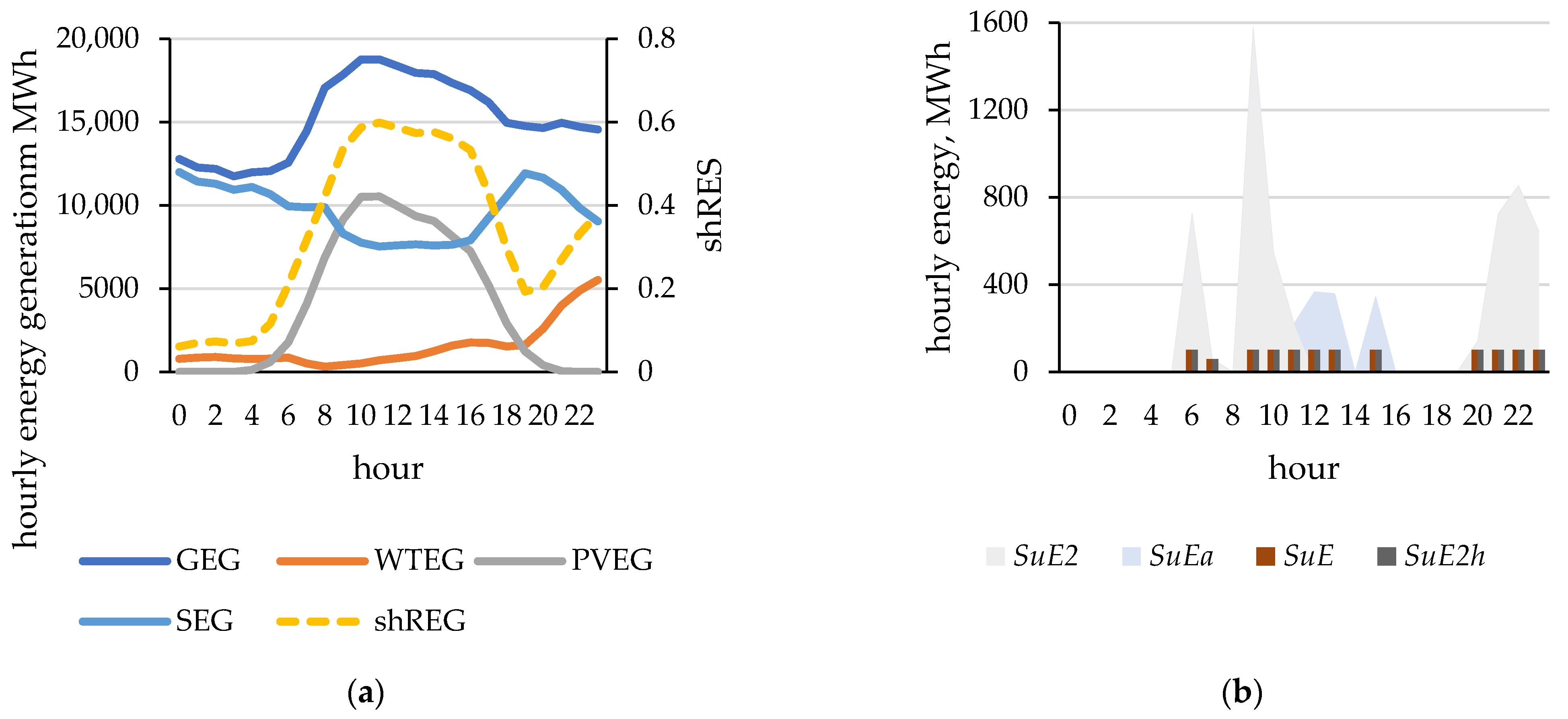
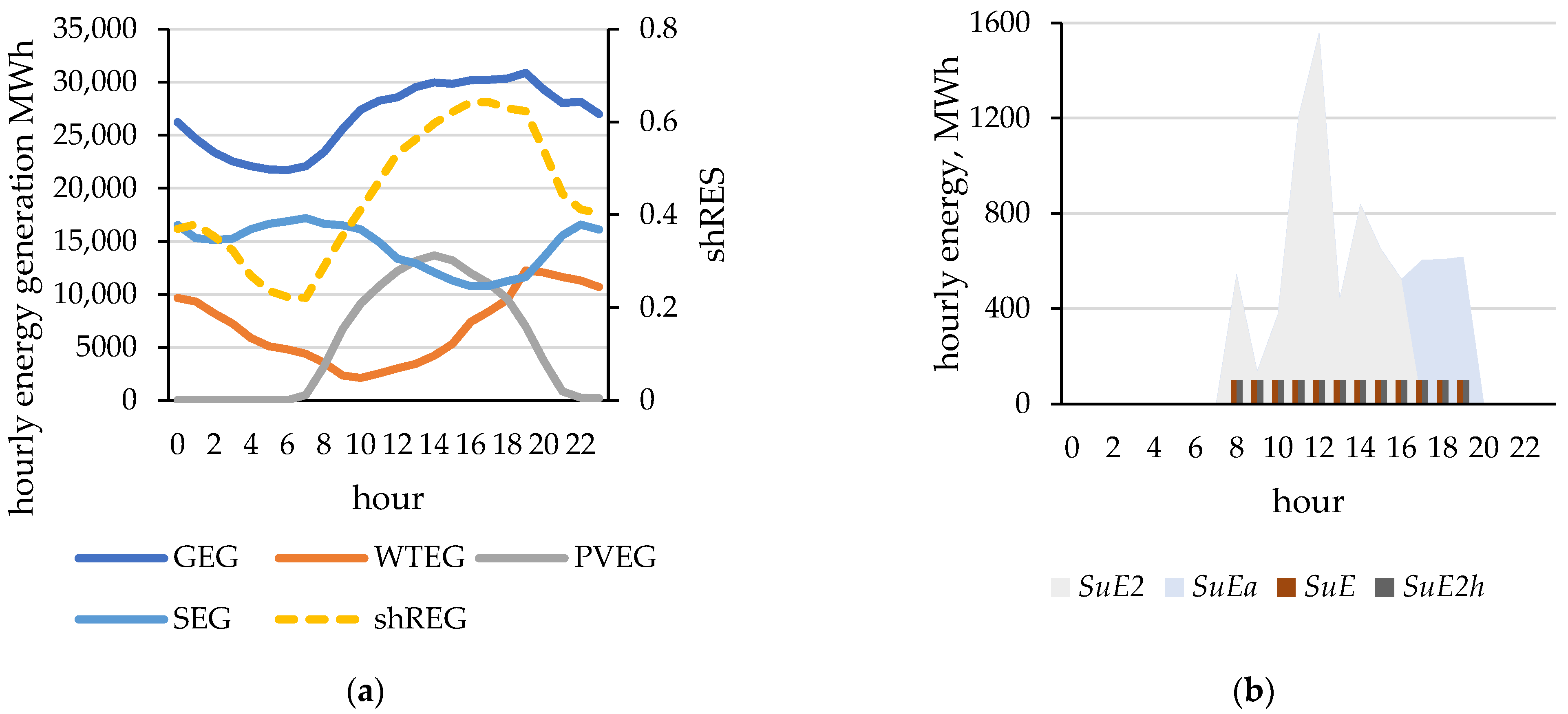
An example of calculation of energy surpluses or renewable energy sources for the Polish power system is presented in the graph below (Figure 2).
Hourly Renewable Energy Share (shRES) peaks sharply at approximately 60% around 11:00 a.m., confirming a period of high RES penetration that can lead to grid imbalances. The large, light green shaded area (SuE2) represents the primary hourly surplus potential, with peaks, particularly around 9:00 a.m., exceeding 1200 MWh. This surge directly corresponds to the steep rise in PVEG and the peak in the shRES seen in the left figure. The key metric for synthetic fuel production, the Usable Energy for 2 h minimum operation (SuE2h) (dark green shaded area), is significantly smaller than the instantaneous surplus, mainly due to the hourly energy intake limit (100 MWh). Non-zero values of SuE2h only appear during specific continuous periods, such as the early morning (around 6:00 a.m.), midday, and late evening (around 8:00 p.m. to 11:00 p.m, mainly based on high WTEG: left figure). These blocks of contiguous surplus energy, represent the technically exploitable energy that meets the minimum operational requirement of at least two consecutive hours, illustrating how the grid’s instantaneous peak surplus must be filtered to determine the truly feasible energy potential for industrial-scale Power-to-X processes.
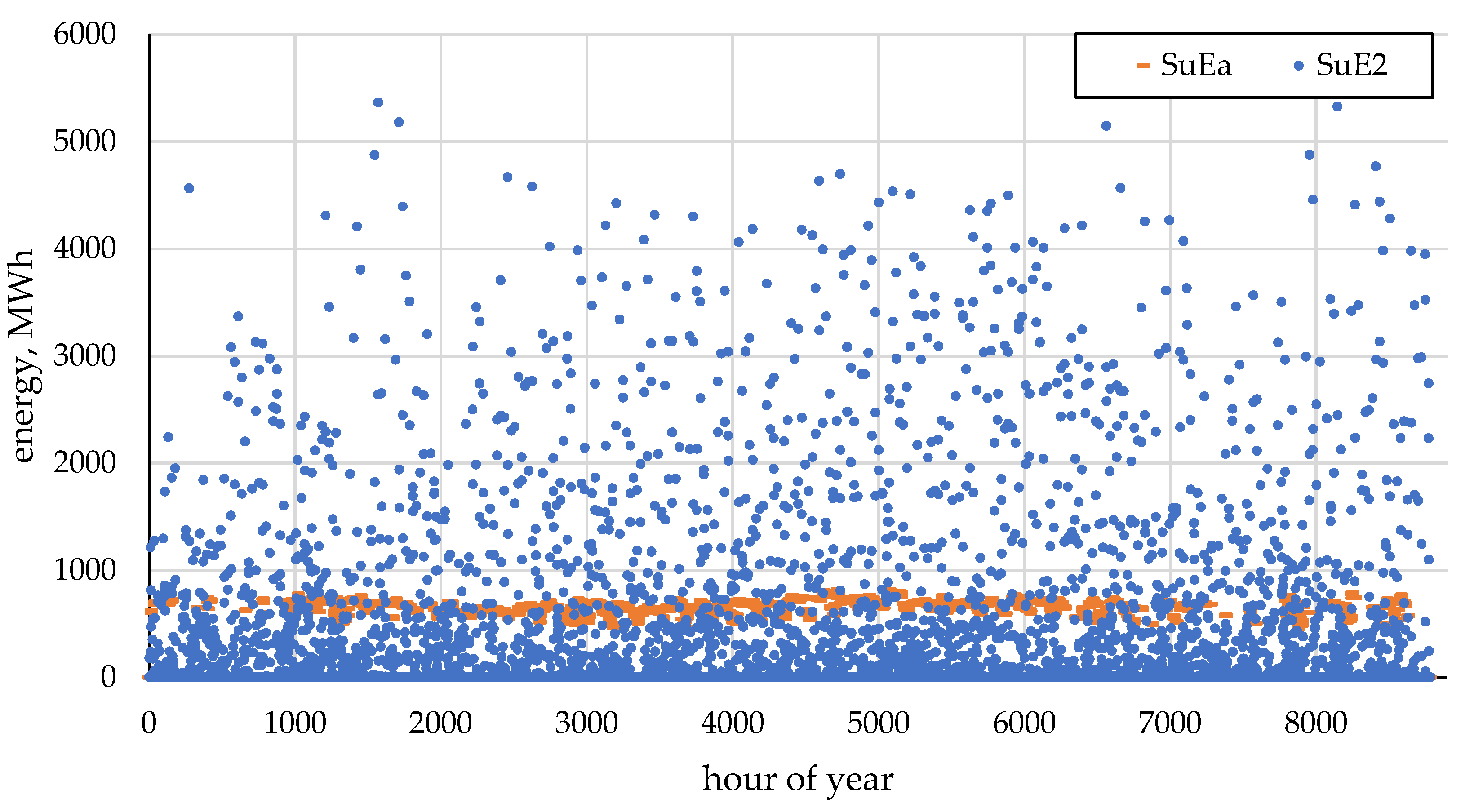
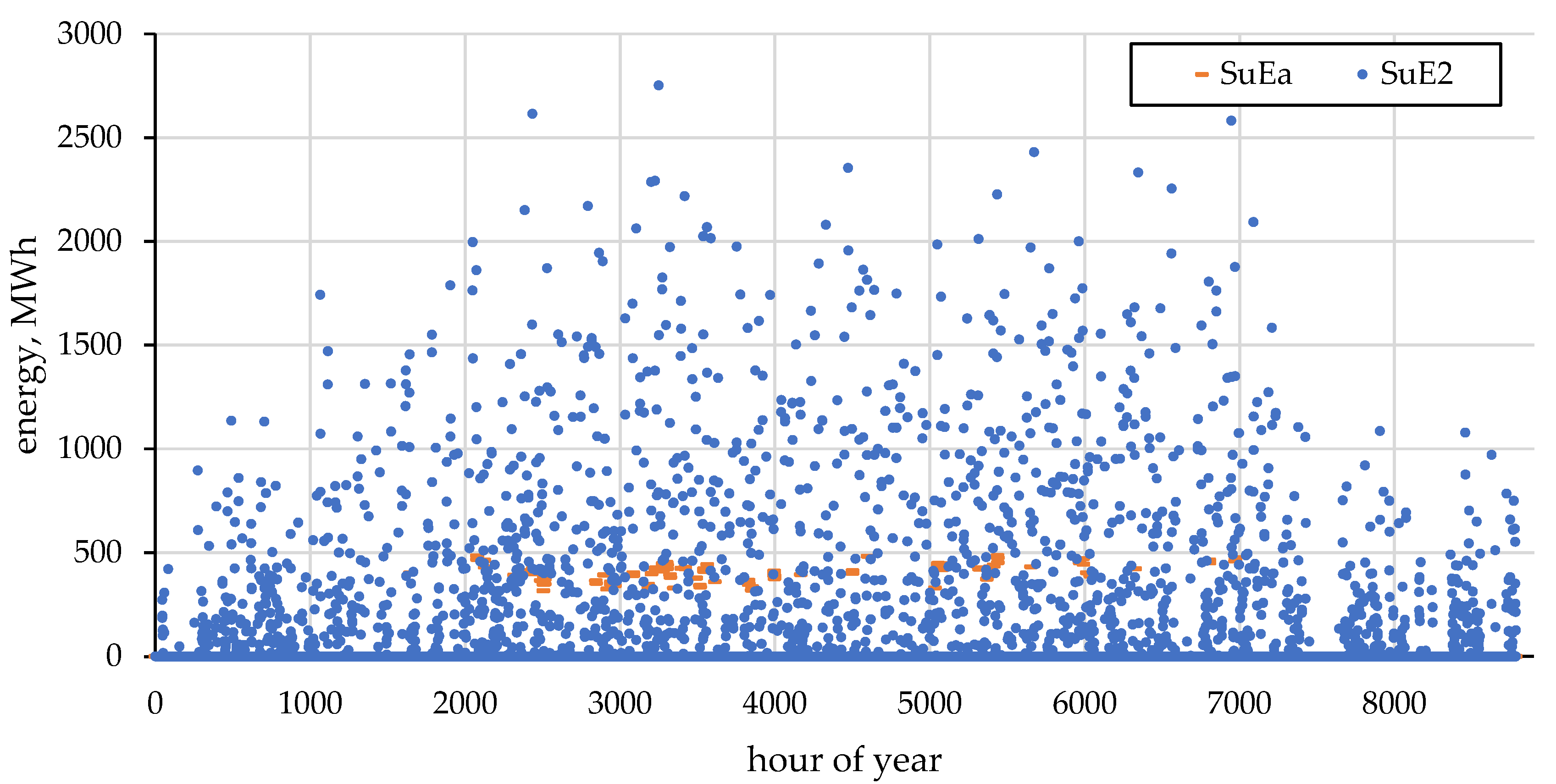
The occurrence and quantification of two types of energy surpluses defined as SuE2 and SuEa are presented for Poland in the figure below (Figure 3).
While the majority of SuE2 values are below 1000 MWh, numerous instances spike above 2000 MWh, with a maximum approaching 3000 MWh, indicating frequent but instantaneous periods of high renewable energy oversupply. In contrast, the average surplus SuEa, shows much lower, more consistent values, generally remaining below 500 MWh. The significant difference between the volatile SuE2 and SuEa highlights the technical challenge in converting momentary grid imbalances into a reliable, consistent energy feedstock for industrial consumers like synthetic fuel production.
The cumulative annual sum of the instantaneous surplus SuE amounts to approximately 886 GWh, whereas the SuEa totals 54 GWh.
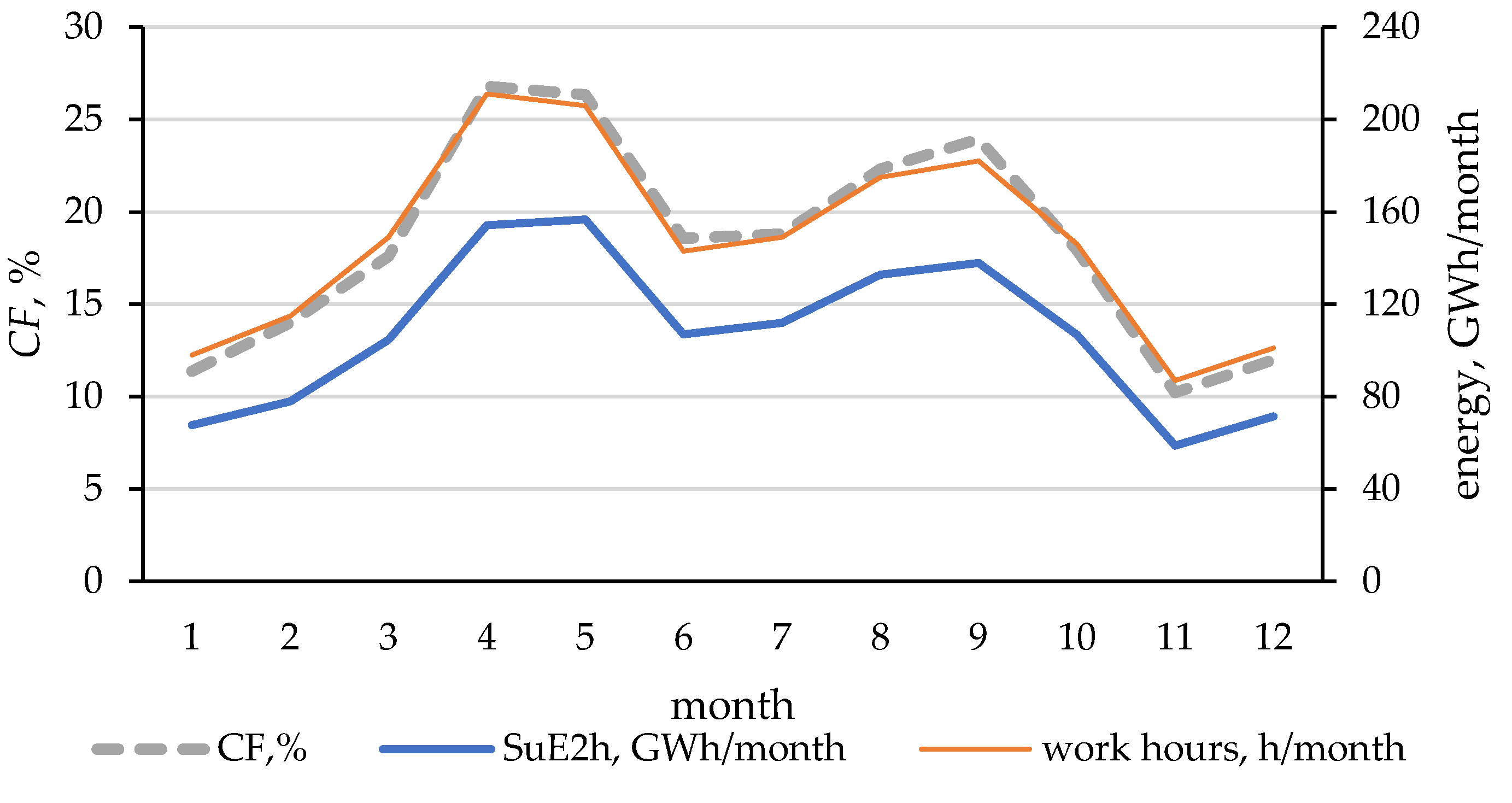
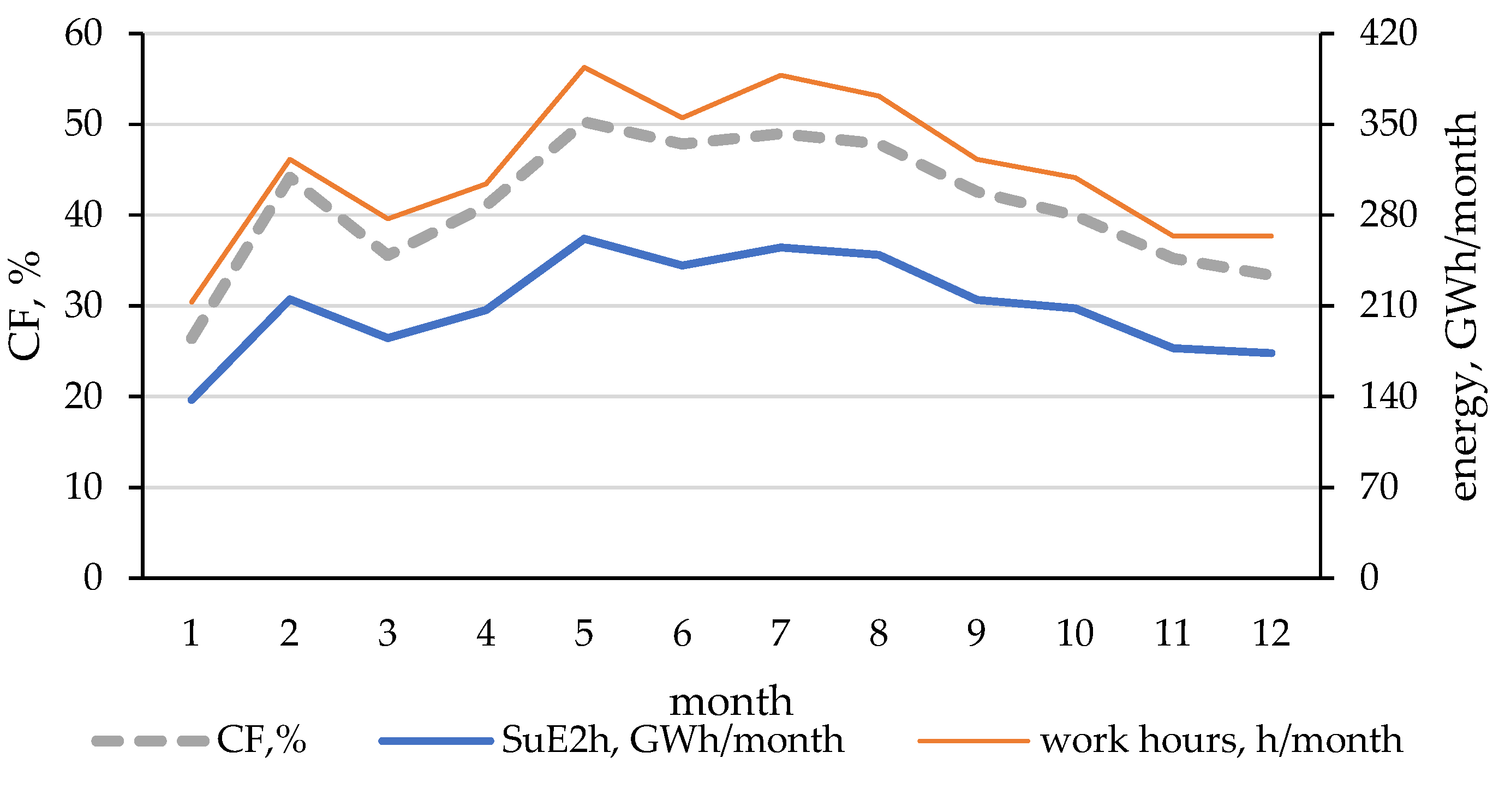
The total energy calculated with volume limits and minimum operating time SuE2h, along with the resulting number of working hours and Capacity Factor, are presented in the subsequent graph (Figure 4).
Usable Energy SuE2h, representing the energy available for production over periods of at least two hours, peaks significantly in the spring months (April, May), reaching nearly 200 GWh, and drops to its lowest level in late autumn/early winter (November). This pattern is closely mirrored by the monthly working hours (h/month) and the Capacity Factor (CF, %), which also show their maximum values around April and May (reaching approximately 25–27% for CF) and their minimum values in November. The strong correlation between the three variables suggests that the productivity and utilization of the facility are directly constrained by the availability of surplus renewable energy, which is highest during the high-insolation and occasionally based on wind speed.

3.2. Spain

An example of calculation of energy surpluses or renewable energy sources for the Spanish electricity system is presented in the graph below (Figure 5).
The left figure depicts an alternative scenario for hourly electricity generation profiles, which shows slightly different patterns compared to the Polish case study (Figure 2). The Total Gross Electricity Generation (GEG) displays a production pattern peaking later in the day, around 6:00 p.m.–7:00 p.m. The individual Variable Renewable Energy Sources contributions show high Wind (WTEG) generation starting the day strong and peaking again later in the afternoon, while Photovoltaic (PVEG) dominates the mid-day generation, peaking around 14:00. The generation from Stable Sources (SEG) maintains a relatively high base load, dipping slightly during the peak solar hours. The Hourly Renewable Energy Share (shRES) is particularly high, reaching approximately 68% around 6:00 p.m., confirming a period of significant RES penetration that challenges grid balancing. This generation profile is reflected in the second figure, which quantifies the resulting hourly surplus potential. The primary hourly surplus SuE2, represented by the large light green area, exhibits its maximum peak around 12:00 a.m.–1:00 a.m., exceeding 1200 MWh. This peak clearly correlates with the highest PVEG generation when demand (and SEG) has not yet reached its evening maximum. The key metric for synthetic fuel production, the Usable Energy for 2 h minimum operation (SuE2h), is again significantly constrained compared to the instantaneous SuE2 (mainly based on limE1). In this scenario, non-zero values for SuE2h appear during a long, continuous block, stretching from approximately 8:00 a.m. until 6:00 p.m. This extended period of usable surplus (compared to Poland) is due to the high and sustained contribution from both PVEG and WTEG during the day, which keeps the total shRES elevated.
The occurrence and quantification of two types of energy surpluses defined as SuE2 and SuEa are presented for Spain in the figure below (Figure 6).
The majority of SuE2 values are distributed below the 2000 MWh threshold, but frequent and numerous spikes exceed this level, with a maximum value reaching nearly 5500 MWh. This indicates significantly higher frequency and magnitude of instantaneous renewable energy oversupply events compared to Poland. SuEa exhibits a much lower and more consistent profile, generally remaining below 1000 MWh.
The cumulative annual sum of the instantaneous surplus SuE amounts to approximately 2329 GWh, whereas the SuEa totals 887 GWh (more than 12 times higher than in Poland).
The total energy related to the energy volume limits and minimum operating time (SuE2h) and also number of working hours and Capacity Factor are presented in the graph below (Figure 7).
The usable energy SuE2h, representing the energy available for production over periods of at least two hours, peaks significantly in May and July, reaching nearly 400 GWh (two times higher than in Poland), and drops to its lowest level in late winter (January). The maximum values of CF obtained for May (reaching 50%) and their minimum values in January (26%).

3.3. Comparison

In the section comparing the energy potential of Poland and Spain, hourly shares of variable renewable energy in the energy mix, the annual operating hours of the installation, and the total amount of energy available as a function of the assumed energy limit, i.e., the maximum energy consumption of the considered installation, were taken into account.
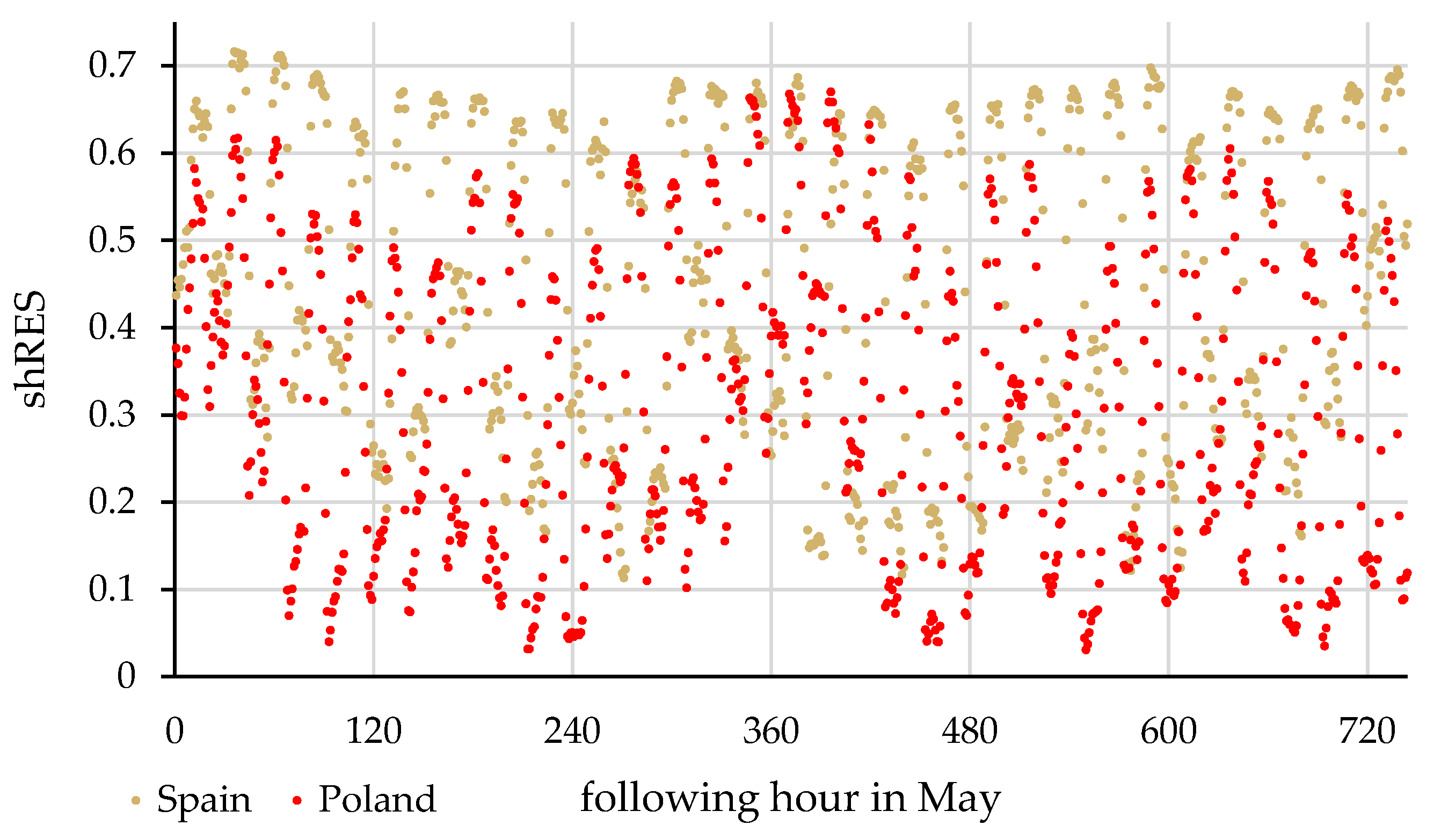
The hourly shares of variable renewable energy in the energy mix for the months in which the maximum values of SuE2h were observed are presented in the figure below.
The graph above (Figure 8) illustrates that Spain consistently maintains a significantly higher shRES than Poland throughout the month. Spain’s hourly share frequently reaches and exceeds 60%, with many data points clustered in the 50% to 70% range, indicating periods of very high-RES penetration. In contrast, Poland’s shRES data points are generally lower, rarely exceeding 0.6, and frequently dipping below 0.3, showing greater volatility and periods of low renewable contribution, particularly around the 240, 480, and 720 h marks.
The comparison of the potential annual operating hours of a synthetic fuel production plant (based on surplus energy) is shown in Figure 9, below.
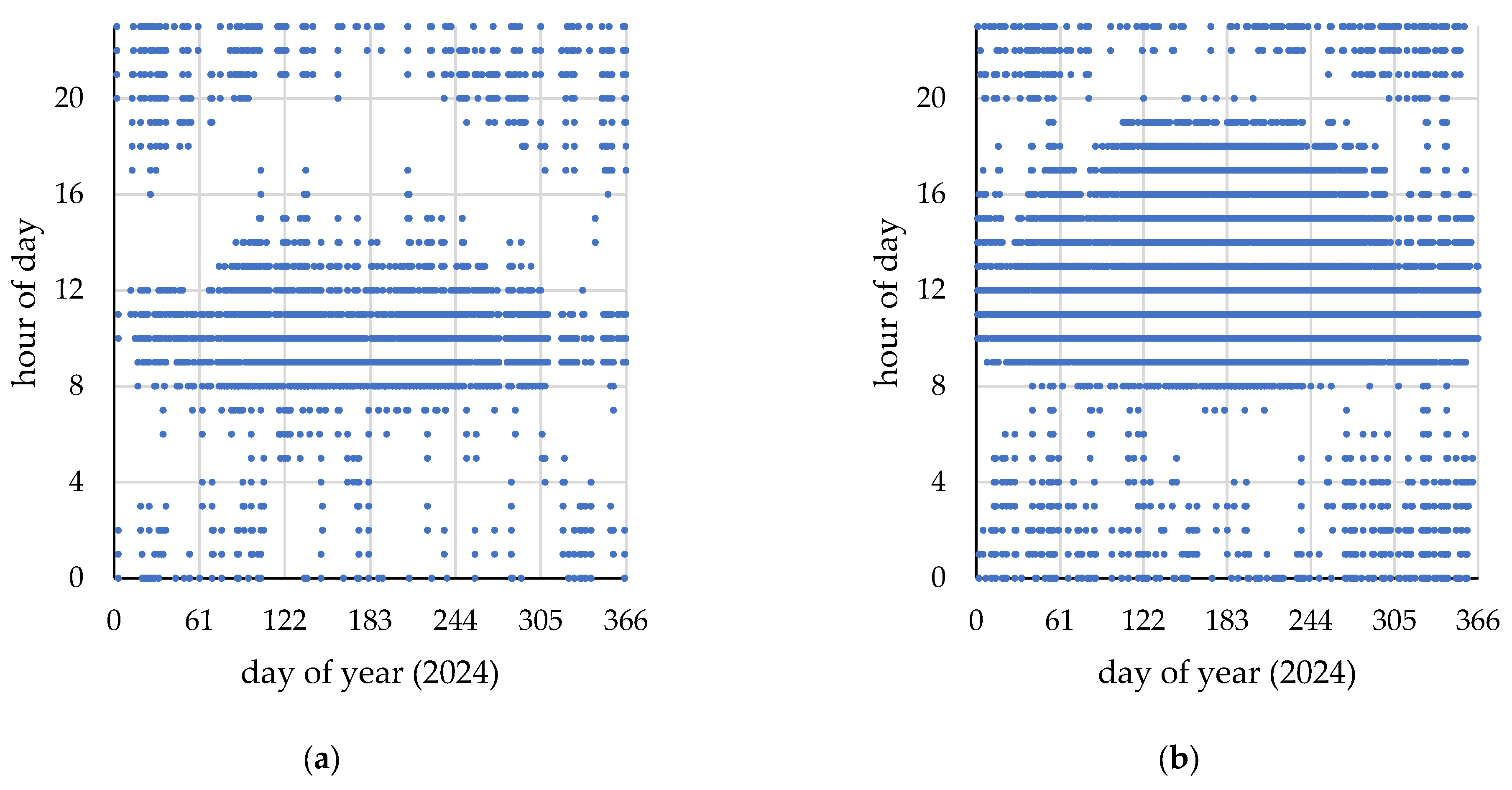
Both graphs (a and b—Figure 9) show the impact of morning and evening peak demand (similarly seasonal in both countries) on energy. During these hours, especially with low wind generation, a potential synthetic fuel installation will not have access to surplus renewable energy. The total number of operating hours for Poland was 1762, and for Spain, 3786.
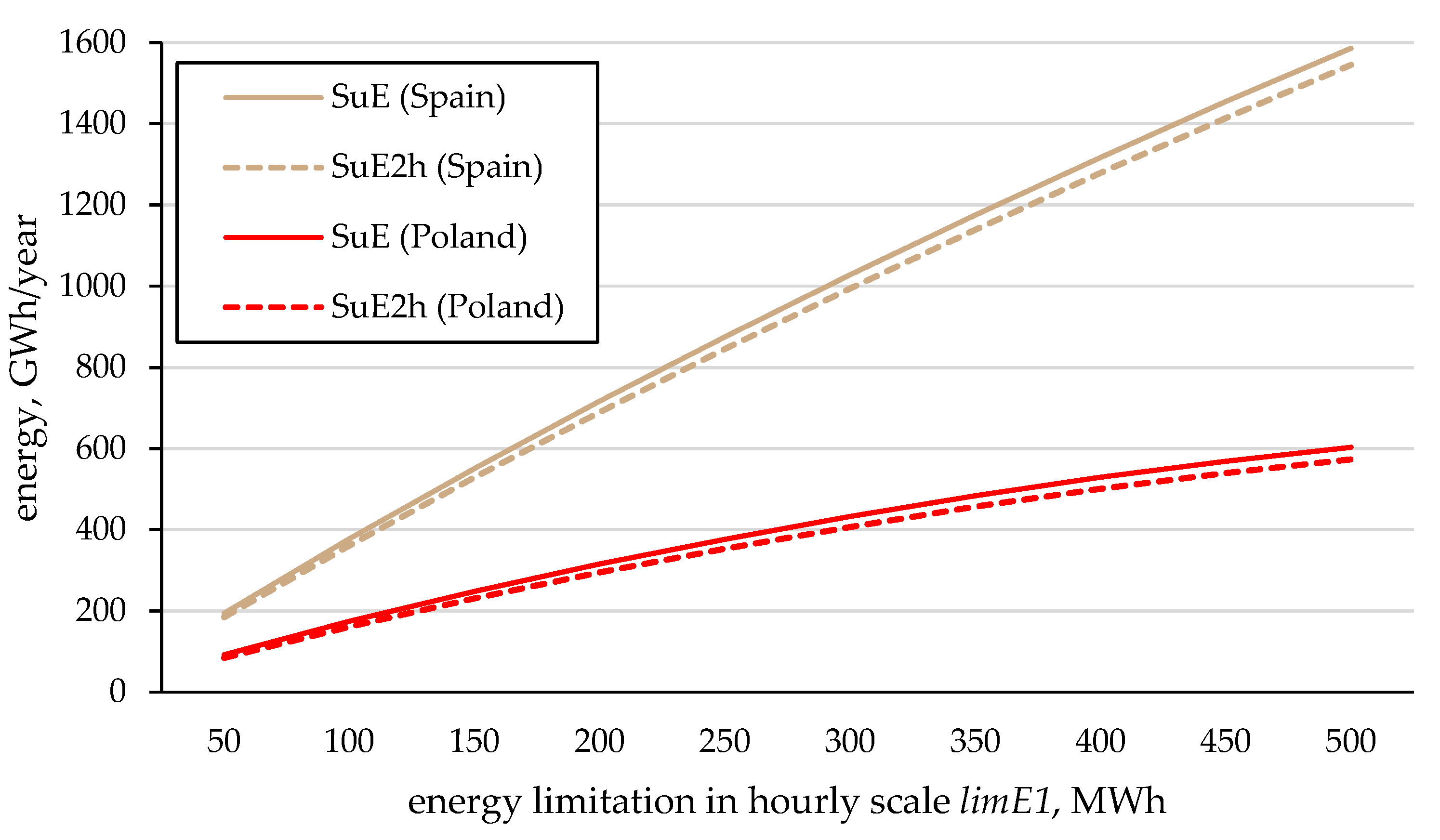
The below figure (Figure 10) provides a direct comparison of the annual usable energy potential for synthetic fuel production between Spain and Poland, plotted against the hourly energy limitation limE1, which represents the maximum allowed hourly energy intake for the Power-to-X facility.
The results clearly indicate that Spain (brown lines) possesses a significantly higher annual energy potential than Poland (red lines) across the entire range of the hourly energy limitation. For instance, at an hourly limitation of 500 MWh, Spain’s usable energy SuE approaches 1600 GWh/year, while Poland’s remains below 600 GWh/year. This difference underscores the impact of the higher and more consistent Renewable Energy Share in Spain’s energy mix, as shown in the bar chart comparison (Figure 1). Furthermore, in both countries, the difference between the total usable energy SuE and the energy available for minimum two-hour continuous operation SuE2h is minimal, as shown by the closely overlapping solid and dashed lines. This suggests that most hourly surplus events that are utilized also meet the minimum two-hour duration requirement necessary for continuous industrial operation, highlighting that the primary constraint on annual production is the overall magnitude of the surplus rather than the duration of the surplus periods.
The observed cross-country disparities are driven by differences in renewable resource quality and seasonality, the size and structure of the installed RES fleet, and overall power-system flexibility. This is also visible in the Capacity Factor: Spain reaches much higher CF in spring-summer months (e.g., ~50% in May).

4. Utilization of Surplus Renewable Electricity for Synthetic Fuel Production

4.1. Regulatory Context and Classification of Synthetic Fuels

The energy transition and climate policy necessitate emission reductions in sectors that are difficult to electrify directly, such as aviation, maritime transport, high-temperature industrial processes, and heavy-duty transport [35]. Regulatory pressure is increasing significantly due to the RED III Directive, which raises the EU target for the share of renewable energy sources (RES) to at least 42.5% by 2030 (with an aspirational goal of 45%) [36]. Synthetic fuels are a key response to these challenges, enabling the utilization of RES electricity in a chemical form characterized by high energy density and compatibility with existing logistics infrastructure and end-use conversion technologies (engines, turbines, boilers, and furnaces).
The analysis of synthetic fuels should be based on their classification as energy products rather than just manufacturing technologies, as the end product determines applications, quality requirements, logistics costs, and regulatory treatment. While a single, universally accepted classification does not exist, several complementary axes of division are consistently used in technical, economic, and environmental assessments [37,38].
The first criterion is the origin of the carbon and the energy carrier. Classic synthetic fuels include “X-to-Liquid” (XtL) pathways where the carbon source is fossil fuels or biomass: Coal-to-Liquid (CTL), Gas-to-Liquid (GTL), and Biomass-to-Liquid (BTL). In these processes, carbon from coal, natural gas, or biomass is converted into syngas (CO/H2) and subsequently into liquid hydrocarbon fuels [39,40,41]. In parallel, a class of electricity-derived fuels is emerging, where the primary energy carrier is electricity (preferably from RES) and carbon is sourced from CO2 captured from industrial processes or the air (or, in the case of ammonia, nitrogen from the air). This group is referred to as e-fuels, electrofuels, Power-to-X (PtX), or (in EU regulatory terms) Renewable Fuels of Non-Biological Origin (RFNBO) [40,42,43,44].
The second criterion concerns the technological pathway. For fossil and biomass-based fuels, the dominant methods are gasification and Fischer–Tropsch synthesis (producing synthetic liquid hydrocarbons like jet fuel, diesel, and gasoline) or methanol synthesis followed by conversion (e.g., methanol-to-olefins, methanol-to-gasoline) [39,40,41]. Electricity-derived fuels typically follow a two-stage chain: the production of green hydrogen via water electrolysis using electricity, followed by its conversion with CO2 (or N2) into a specific end-fuel [37,42,45].
The third axis is based on the product type and its function. These include:
  • Synthetic gaseous fuels: Hydrogen, methane (including e-methane/SNG), and ammonia.
  • Synthetic liquid fuels: Synthetic diesel and gasoline, synthetic aviation fuel (e-kerosene), methanol (CH3OH), dimethyl ether (DME), and oxymethylene ethers (OME) [37,42,46].
  • Power-to-Chemicals: Where the fuel serves a dual role as an energy carrier and a feedstock for the chemical industry [37,47].

4.2. Market Perspective

From the perspective of sectoral potential, “hydrogen demand” will be generated along two dimensions: (1) as direct demand (fuel cells in transport, industrial applications), and (2) as indirect demand, generated by the need to produce RFNBOs and e-fuels.
The primary demand impulse for e-fuels in Poland is driven by transport targets resulting from RED III. According to the implementation approach presented in policy analyses (IEA), Member States are required by 2030 to introduce measures ensuring that RFNBOs account for at least 1% of total energy consumption in transport, while simultaneously meeting the combined target of 5.5% for RFNBOs and advanced biofuels [48]. In addition, a certain demand impulse may arise from the new EU CO2 emission standard for cars, under which all new passenger cars sold from 2035 onwards must be zero-emission, with the exception of vehicles running exclusively on fuels that are fully CO2-neutral. This theoretically opens a niche for vehicles powered solely by e-fuels after 2035, although the scale of such a market remains uncertain. In the 2040 perspective, electric drivetrains are expected to dominate passenger cars, while synthetic fuels will be used mainly in existing internal combustion vehicles as blending components to reduce the carbon footprint of conventional fuels or in specialized applications (e.g., military vehicles, retro automotive uses).
From the fuel market perspective, this effectively implies the emergence of a segment of “mandatory demand,” in which e-fuels will be sought regardless of short-term fluctuations in fossil fuel prices, and where compliance costs will play a key role. Sectoral regulations are of particular importance for the development potential of the domestic e-fuels sector, as they effectively channel demand toward PtX technologies.
In shipping, the FuelEU Maritime regulation sets maximum limits on the average annual GHG emission intensity (well-to-wake) of the energy used by ships calling at EU ports. The European Commission indicates that the target starts with a 2% reduction in 2025 and increases to 80% by 2050 [49].
In aviation, ReFuelEU Aviation establishes a mandatory increase in the share of sustainable aviation fuels (SAF) from 2% in 2025 to 70% in 2050, while simultaneously introducing a requirement for synthetic e-fuels, rising from 0.7% in 2030 to 35% in 2050 [50]. From Poland’s perspective, this information has a dual meaning: on the one hand, it confirms that regulatory demand for e-fuels will be real and growing; on the other hand, it suggests that a competitive advantage may arise not only through domestic consumption but also through early entry into the supply chain under conditions of a potential EU market deficit.
On the supply side, a necessary condition for the development of e-fuels is access to large volumes of cheap, low-emission electricity. From the PtX technology perspective, this is of fundamental importance. The development of the e-fuels sector will directly depend on the ability to utilize surplus electricity, further accelerate renewable energy investments, and on the capacity of power grids to integrate new generation capacity and limit balancing costs.
Komorowska (2025) [51] estimated the potential use of hydrogen in Poland for powering road vehicles, taking into account RED III requirements. The results indicate that in 2030, assuming hydrogen covers 0.5% of energy demand in road transport, total demand would amount to 38.08 million kg of H2, while in a more ambitious variant (1% share in 2030) it would reach 76.17 million kg. In the long-term horizon, the scale increases to levels that are no longer a “technological niche” but potentially a fully fledged fuel segment. For 2050, the reference scenario (5% share of hydrogen in transport energy demand) corresponds to 339.46 million kg of H2, while the increased-demand scenario (10%) amounts to 678.93 million kg. Even if these figures concern road transport, for PtX assessment they constitute a “lower bound” of the hydrogen economy’s scale. The main barrier to sector development remains project economics, i.e., still high production costs of synthetic fuels based on green hydrogen, which are higher than in conventional technologies.
The subsequent part of the article presents an assessment of the production costs of green hydrogen and methanol based on surplus energy generated by renewable energy technologies in Poland and Spain.

4.3. Case Study: Utilization of Surplus Energy in Power-to-H2 and Power-to-Methanol Processes

Surplus RES energy can be stored by being converted into hydrogen via electrolysis (Power-to-H2). This hydrogen, combined with purified carbon dioxide, can then be used for methanol synthesis (Power-to-Methanol). To illustrate the efficiency of this process, production costs were calculated for Polish and Spanish conditions, based on expert knowledge and literature data. These were subsequently compared with conventional industrial production costs.
The cost analysis utilized an updated Levelized Cost formula for hydrogen as follows:
L C O H = C A P E X · C R F + O P E X P ( H 2 )
where
  • CRF represents the Capital Recovery Factor, a parameter used to annualize capital expenditures (CAPEX) by converting a one-time investment into an equivalent annual cost. The CRF is expressed by the following formula:
C R F = ( 1 + d ) n / [ ( 1 + d ) n 1 ]
  • OPEX denotes annual operating expenses, including electricity consumption costs at a rate of 50 kWh/kg H2.
The calculations assume an analysis horizon (n) of 20 years and a discount rate (d) of 8%. For hydrogen production, an electrolyzer capacity of 50 MW was assumed, with a unit CAPEX of 1000 EUR/kW (or EUR/MW, depending on the specific data). The installation’s operating hours were set according to the results in Chapter 3, namely 1762 h/year for Poland and 3786 h/year for Spain. It should be emphasized that the analysis assumes a very low electricity price from renewable sources (10 EUR/MWh), based on the premise that this energy is sourced during hours of low market demand (periods of high RES surplus). Consequently, this price is significantly lower than the average market price on the Polish Power Exchange.
Under these assumptions, the annual hydrogen production (calculated for 2 h periods) amounted to 1762 Mg in Poland and 3786 Mg in Spain. Ultimately, the levelized cost of hydrogen production under these conditions was estimated at 4.1 EUR/kg for Poland and 2.18 EUR/kg for Spain. Detailed calculations are presented in Table 1.
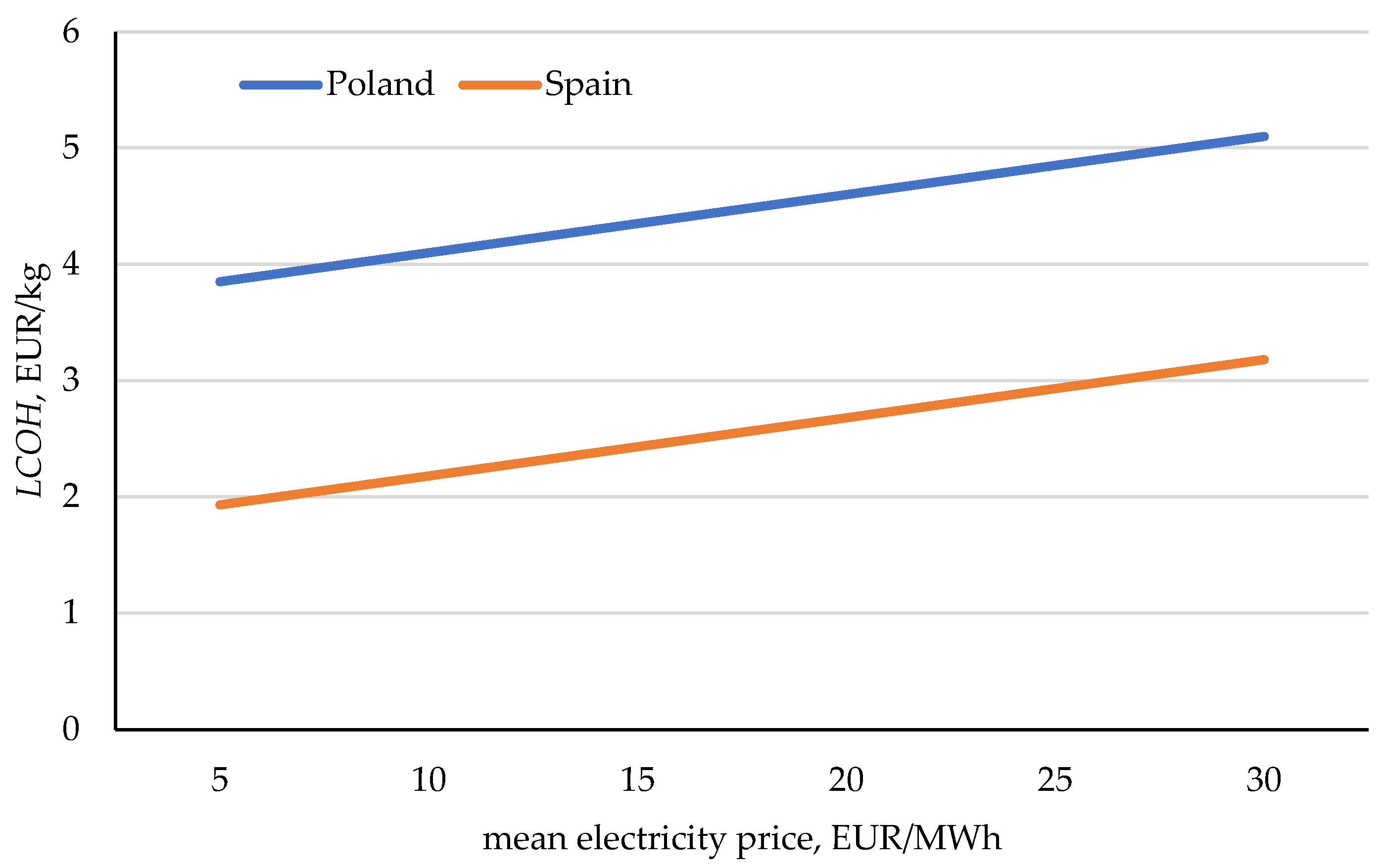
A sensitivity analysis was also performed to determine how electricity prices during periods of surplus energy influence hydrogen production costs in these countries. The line graph (Figure 11) illustrates the levelised cost of hydrogen (LCOH) as a function of the mean electricity price (EUR/MWh) for Poland and Spain. Spain maintains a significantly lower LCOH across the entire price range, starting at approximately 2 EUR/kg, whereas Poland’s costs are substantially higher, beginning near 4 EUR/kg. This suggests that Spain has a competitive advantage in hydrogen production, likely due to greater surplus energy availability and longer electrolyser operating hours, which improve utilization and reduce unit costs even when surplus-energy mean prices fluctuate.
To estimate the scale of methanol synthesis, stoichiometric calculations for the MeOH synthesis process were applied. Methanol production is based on the reaction of carbon dioxide with hydrogen, according to the following scheme:
C O + 3 H C H O H + H O
Based on the reaction stoichiometry and literature data, it was assumed that the production of one ton (Mg) of green methanol requires 1.37 Mg of CO2 and 0.187 Mg of H2. The approximate levelized cost of methanol synthesis (LCOM) was calculated using the following formula:
L C O M e O H = C A P E X M e O H · C R F P ( M e O H ) +   0.187 · L C O H 2 + 1.37 · K ( C O 2 ) + O P E X M e O H
The symbols are defined as above. CAPEX for MeOH was set at 800 EUR/Mg MeOH/year based on literature data for small and medium-sized installations. The cost of carbon dioxide acquisition and purification to the required standard was assumed to be 30 EUR/Mg.
Furthermore, the analysis accounts for the fact that methanol production results in CO2 sequestration; therefore, the production costs of green hydrogen and methanol were also calculated by deducting this effect. Ultimately, the production cost of green methanol under Polish conditions was estimated at approximately 880 EUR/Mg, while for Spain, it was nearly 520 EUR/Mg. After accounting for the carbon sequestration effects, the production costs were adjusted to approximately 739 EUR/Mg MeOH for Poland and 378 EUR/Mg MeOH for Spain (Table 2).
It is noteworthy, however, that the calculated production costs for green hydrogen and methanol remain high in comparison to those associated with existing industrial facilities utilizing natural gas. The production cost of ‘gray’ hydrogen ranges between 1.5 and 3 EUR/kg, while the inclusion of carbon capture and storage systems—resulting in ‘blue’ hydrogen—increases the cost by an additional 0.5 EUR/kg. In contrast, natural gas-based methanol production costs fluctuate within the range of 90–230 EUR/Mg. Currently, the production costs of green hydrogen and methanol derived from surplus renewable energy are several times higher.
From a climate perspective, the decarbonization benefit (Table 2. Avoided emission) arises when renewable hydrogen displaces fossil hydrogen and when the CO2 used for methanol synthesis is captured from biogenic or unavoidable industrial sources (or permanently stored), thereby avoiding net additions of fossil carbon. Economically, Figure 11 shows that LCOH is strongly driven by the mean electricity price during surplus periods and by electrolyser utilization: Spain maintains a markedly lower LCOH across the entire electricity-price range, consistent with higher usable surplus energy and more operating hours (higher effective value of CF), which amortizes electrolyser CAPEX (Table 1 and Table 2) over a larger annual H2 output.

5. Conclusions

This study developed and applied an original methodology to estimate the technically feasible potential for utilizing surplus renewable electricity for synthetic fuel production through Power-to-X technologies. By explicitly accounting for hourly generation dynamics, renewable energy share thresholds, and a minimum two-hour continuous operation constraint, the analysis provides a realistic assessment of surplus electricity that can be effectively harnessed for industrial-scale fuel synthesis.
The comparative analysis of Poland and Spain demonstrates that the scale and usability of surplus renewable electricity are strongly dependent on the overall penetration and temporal stability of renewable energy sources in the power system. Spain, characterized by a high and relatively stable renewable energy share, exhibits nearly three times higher annual usable surplus energy than Poland across all considered capacity limits. Consequently, Power-to-X installations in Spain achieve significantly higher annual operating hours and capacity factors, reaching up (in monthly scale) to 50%, compared to approximately 27% in Poland.
The results highlight a key technical challenge: although instantaneous surplus electricity volumes can reach very high values, often exceeding several gigawatt-hours on an hourly basis, only a fraction of this energy meets the continuity and power intake requirements necessary for industrial Power-to-X operation. This filtering effect substantially reduces the effective energy available for synthetic fuel production and limits achievable capacity factors, particularly in power systems with lower RES penetration.
From an economic perspective, the utilization of surplus renewable electricity enables a substantial reduction in the production costs of green hydrogen and synthetic fuels, especially in high-RES systems. Under favorable assumptions regarding surplus electricity prices, green hydrogen and methanol production costs in Spain approach levels that may become competitive in regulated fuel markets. In contrast, in Poland, surplus-based Power-to-X remains a complementary solution rather than a primary decarbonization pathway under current system conditions.
Directions of further study include incorporating dynamic electricity market pricing, grid constraints, alternative surplus utilization pathways, and interactions with other flexibility technologies. Extending the analysis to multi-year scenarios, cross-border electricity exchanges, and integrated energy system models would further improve the assessment of Power-to-X as a long-term component of the energy transition.

Author Contributions

Conceptualization, D.K., M.K., P.O. and L.M.; methodology, M.K., P.O. and D.M.; software, D.K. and M.K.; validation, D.M., L.M. and P.O.; formal analysis, M.K. and L.M. investigation, M.K. and P.O.; resources, D.M. and L.M.; data curation, P.O., D.K. and M.K.; writing—original draft preparation, L.M., D.M. and P.O.; writing—review and editing, D.M., D.K. and L.M.; visualization, M.K.; supervision, L.M. and P.O. All authors have read and agreed to the published version of the manuscript.

Funding

This research received no external funding.

Data Availability Statement

Data are available for request.

Conflicts of Interest

The authors declare no conflicts of interest.

References

  1. Tomaszewski, K. The Polish Road to the New European Green Deal—Challenges and Threats to the National Energy Policy. Polityka Energetyczna–Energy Policy J. 2020, 23, 5–18. [Google Scholar] [CrossRef]
  2. Paska, J.; Surma, T.; Terlikowski, P.; Zagrajek, K. Electricity Generation from Renewable Energy Sources in Poland as a Part of Commitment to the Polish and EU Energy Policy. Energies 2020, 13, 4261. [Google Scholar] [CrossRef]
  3. Komorowska, A.; Gawlik, L. Management of Surplus Electricity Production from Unstable Renewable Energy Sources Using Power to Gas Technology. Polityka Energetyczna–Energy Policy J. 2018, 21, 43–64. [Google Scholar] [CrossRef]
  4. Li, Y.; Guan, B.; Guo, J.; Chen, Y.; Ma, Z.; Zhuang, Z.; Zhu, C.; Dang, H.; Chen, L.; Shu, K.; et al. Renewable Synthetic Fuels: Research Progress and Development Trends. J. Clean. Prod. 2024, 450, 141849. [Google Scholar] [CrossRef]
  5. Eurostat Statistical Data. Available online: https://ec.europa.eu/eurostat/statistics-explained/index.php?title=Renewable_energy_statistics/pl#Energia_wiatrowa_jest_najwa.C5.BCniejszym_odnawialnym_.C5.BAr.C3.B3d.C5.82em_energii_elektrycznej (accessed on 30 November 2025).
  6. Vidal-Amaro, J.J.; Østergaard, P.A.; Sheinbaum-Pardo, C. Optimal Energy Mix for Transitioning from Fossil Fuels to Renewable Energy Sources—The Case of the Mexican Electricity System. Appl. Energy 2015, 150, 80–96. [Google Scholar] [CrossRef]
  7. Forsberg, C.W. Sustainability by Combining Nuclear, Fossil, and Renewable Energy Sources. Prog. Nucl. Energy 2009, 51, 192–200. [Google Scholar] [CrossRef]
  8. Mazur, Ł.; Cieślik, S.; Czapp, S. Trends in Locally Balanced Energy Systems without the Use of Fossil Fuels: A Review. Energies 2023, 16, 4551. [Google Scholar] [CrossRef]
  9. Kalair, A.; Abas, N.; Saleem, S.; Kalair, A.; Khan, N. Role of Energy Storage Systems in Energy Transition from Fossil Fuels to Renewables. Energy Storage 2020, 3, e135. [Google Scholar] [CrossRef]
  10. Wen, D.; Kuo, P.-C.; Saeidi, S.; Özdemir, F.; Maréchal, F. Renewable Synthesis Fuels for a Circular Economy: A Life Cycle Assessment. Resour. Conserv. Recycl. 2024, 211, 107851. [Google Scholar] [CrossRef]
  11. Saeidi, S.; Sápi, A.; Khoja, A.H.; Najari, S.; Ayesha, M.; Kónya, Z.; Asare-Bediako, B.B.; Tatarczuk, A.; Hessel, V.; Keil, F.J.; et al. Evolution Paths from Gray to Turquoise Hydrogen via Catalytic Steam Methane Reforming: Current Challenges and Future Developments. Renew. Sustain. Energy Rev. 2023, 183, 113392. [Google Scholar] [CrossRef]
  12. Najari, S.; Saeidi, S.; Sápi, A.; Kónya, Z.; Somorjai, G.A. Unveiling the Power of Proximity of Prevalent Fe-Based Tandem Catalysts in CO2 Hydrogenation via Modified Fischer–Tropsch: Crucial Relations toward Industrialization. Chem. Rev. 2025, 125, 10179–10247. [Google Scholar] [CrossRef] [PubMed]
  13. Khan, N.; Sudhakar, K.; Mamat, R. Role of Biofuels in Energy Transition, Green Economy and Carbon Neutrality. Sustainability 2021, 13, 12374. [Google Scholar] [CrossRef]
  14. Alsunousi, M.; Kayabasi, E. The Role of Hydrogen in Synthetic Fuel Production Strategies. Int. J. Hydrogen Energy 2024, 54, 1169–1178. [Google Scholar] [CrossRef]
  15. Wilson, I.A.G.; Styring, P. Why Synthetic Fuels Are Necessary in Future Energy Systems? Front. Energy Res. 2017, 5, 19. [Google Scholar] [CrossRef]
  16. Ram, V.; Salkuti, S.R. An Overview of Major Synthetic Fuels. Energies 2023, 16, 2834. [Google Scholar] [CrossRef]
  17. Rosa, R.N. The Role of Synthetic Fuels for a Carbon Neutral Economy. C 2017, 3, 11. [Google Scholar] [CrossRef]
  18. Aramendia, E.; Brockway, P.E.; Taylor, P.G.; Norman, J.B.; Heun, M.K.; Marshall, Z. Estimation of Useful-Stage Energy Returns on Investment for Fossil Fuels and Implications for Renewable Energy Systems. Nat. Energy 2024, 9, 803–816. [Google Scholar] [CrossRef]
  19. Sangeeta; Moka, S.; Pande, M.; Rani, M.; Gakhar, R.; Sharma, M.; Rani, J.; Bhaskarwar, A.N. Alternative Fuels: An Overview of Current Trends and Scope for Future. Renew. Sustain. Energy Rev. 2014, 32, 697–712. [Google Scholar] [CrossRef]
  20. Fuchs, C.; Meyer, D.; Poehls, A. Production and Economic Assessment of Synthetic Fuels in Agriculture—A Case Study from Northern Germany. Energies 2022, 15, 1156. [Google Scholar] [CrossRef]
  21. Pregger, T.; Schiller, G.; Cebulla, F.; Dietrich, R.-U.; Maier, S.; Thess, A.; Lischke, A.; Monnerie, N.; Sattler, C.; Le Clercq, P.; et al. Future Fuels—Analyses of the Future Prospects of Renewable Synthetic Fuels. Energies 2020, 13, 138. [Google Scholar] [CrossRef]
  22. Kulczycki, A.; Przysowa, R.; Białecki, T.; Gawron, B.; Jasiński, R.; Merkisz, J.; Pielecha, I. Empirical Modeling of Synthetic Fuel Combustion in a Small Turbofan. Energies 2024, 17, 2622. [Google Scholar] [CrossRef]
  23. Ridjan, I.; Mathiesen, B.V.; Connolly, D.; Duić, N. The Feasibility of Synthetic Fuels in Renewable Energy Systems. Energy 2013, 57, 76–84. [Google Scholar] [CrossRef]
  24. Ebhota, W.; Jen, T.-C. Fossil Fuels Environmental Challenges and the Role of Solar Photovoltaic Technology Advances in Fast Tracking Hybrid Renewable Energy System. Int. J. Precis. Eng. Manuf. Technol. 2019, 7, 97–117. [Google Scholar] [CrossRef]
  25. Rybak, A.; Rybak, A.; Kolev, S.D. A Synthetic Measure of Energy Security Taking into Account the Influence of Rare Earth Metals. The Case of Poland. Energy Rep. 2023, 10, 1474–1484. [Google Scholar] [CrossRef]
  26. Lewicka, E.D.; Burkowicz, A.; Babii, K.; Riumina, D.; Szlugaj, J.; Kamyk, J.; Gałaś, A. The Impact of the War in Ukraine on the Supply of Selected Raw Materials to Poland and to the European Union. Gospod. Surowcami Miner.-Miner. Resour. Manag. 2025, 41, 5–43. [Google Scholar] [CrossRef]
  27. Galos, K.; Lewicka, E.; Burkowicz, A.; Guzik, K.; Kot-Niewiadomska, A.; Kamyk, J.; Szlugaj, J. Approach to Identification and Classification of the Key, Strategic and Critical Minerals Important for the Mineral Security of Poland. Resour. Policy 2021, 70, 101900. [Google Scholar] [CrossRef]
  28. Burchart-Korol, D.; Grzywacz-Gazda, M.; Zarębska, K. Research and Prospects for the Development of Alternative Fuels in the Transport Sector in Poland: A Review. Energies 2020, 13, 2988. [Google Scholar] [CrossRef]
  29. Hübner, T.; von Roon, S. Synthetic Fuels in the German Industry Sector Depending on Climate Protection Level. Smart Energy 2021, 3, 100042. [Google Scholar] [CrossRef]
  30. Taibi, E.; Nikolakakis, T.; Gutierrez, L.; Fernandez, C.; Kiviluoma, J.; Rissanen, S.; Lindroos, T.J. Power System Flexibility for the Energy Transition Part 1: Overview for Policy Makers; International Renewable Energy Agency: Abu Dhabi, United Arab Emirates, 2018. [Google Scholar]
  31. ENTSOE. Generation by Fuel. Available online: http://energy.instrat.pl/generation_by_fuel (accessed on 14 June 2025).
  32. Rusin, A.; Wojaczek, A. Changes in the Structure of the Polish Energy Mix in the Transition Period to Ensure the Safety and Reliability of Energy Supplies. Energy 2023, 282, 128831. [Google Scholar] [CrossRef]
  33. Shrestha, A.; Rajbhandari, Y.; Gonzalez-Longatt, F. Day-Ahead Energy-Mix Proportion for the Secure Operation of Renewable Energy-Dominated Power System. Int. J. Electr. Power Energy Syst. 2024, 155, 109560. [Google Scholar] [CrossRef]
  34. Nzihou, A.; Flamant, G.; Stanmore, B. Synthetic Fuels from Biomass Using Concentrated Solar Energy—A Review. Energy 2012, 42, 121–131. [Google Scholar] [CrossRef]
  35. Montuori, L.; Alcázar-Ortega, M.; Díaz-Bello, D.; Vargas-Salgado, C. Towards the Decarbonization of the Maritime Industry: Design of a Novel Methodology for the Sustainable Strategy Assessment. Sustain. Energy Technol. Assess. 2025, 83, 104632. [Google Scholar] [CrossRef]
  36. European Parliament; Council of the European Union. Directive (EU) 2018/2001, Regulation (EU) 2018/1999 and Directive 98/70/EC as Regards the Promotion of Energy from Renewable Sources, and Repealing Council Directive (EU) 2015/652. Available online: https://eur-lex.europa.eu/legal-content/EN/TXT/?uri=CELEX%3A32023L2413 (accessed on 16 January 2026).
  37. Müller, G.; Kullmann, F.; Linssen, J.; Stolten, D. The Costs of Future Energy Technologies: A Comprehensive Review of Power-to-X Processes. J. CO2 Util. 2025, 92, 103019. [Google Scholar] [CrossRef]
  38. Beckmann, J.; Klöckner, K.; Letmathe, P. The Role of Power-to-X and Domestic EFuel Production for Energy Transition and Energy Independence in Europe. J. Clean. Prod. 2025, 492, 144807. [Google Scholar] [CrossRef]
  39. Tuomisalo, T.; Lähdesmäki, E.; Ulvila, L.; Breyer, C.; Khalili, S.; Urpelainen, S.; Laaksonen, P. Assessment of Finnish Power-to-X Economy Research 2017–2023: Scientific Articles and Research Activities. Next Res. 2025, 2, 100126. [Google Scholar] [CrossRef]
  40. Khalili, S.; Lopez, G.; Breyer, C. Role and Trends of Flexibility Options in 100% Renewable Energy System Analyses towards the Power-to-X Economy. Renew. Sustain. Energy Rev. 2025, 212, 115383. [Google Scholar] [CrossRef]
  41. Lin, H.; Wu, W. Techno-Economic Comparison of Power-to-X Batteries: A Multidimensional Assessment Using the P-Graph Method. Energy Convers. Manag. 2025, 343, 120207. [Google Scholar] [CrossRef]
  42. Oyewo, A.S.; Lopez, G.; ElSayed, M.; Galimova, T.; Breyer, C. Power-to-X Economy: Green e-Hydrogen, e-Fuels, e-Chemicals, and e-Materials Opportunities in Africa. Energy Rep. 2024, 12, 2026–2048. [Google Scholar] [CrossRef]
  43. Luceño-Sánchez, J.A.; Martín, M.; Macchietto, S. Towards an Efficient Integrated CSP Production Network: Sustainability, Storage and Power-to-X Selection, Based on Social Metrics. Comput. Chem. Eng. 2026, 204, 109389. [Google Scholar] [CrossRef]
  44. Abbas, A.; Tahir, M.M.; Dickson, R. GIS-Driven Techno-Economic & Environmental Feasibility of Power-to-X Pathways: A Multi-Country Analysis. Sustain. Energy Technol. Assess. 2025, 82, 104514. [Google Scholar] [CrossRef]
  45. Pfennig, M.; Böttger, D.; Häckner, B.; Geiger, D.; Zink, C.; Bisevic, A.; Jansen, L. Global GIS-Based Potential Analysis and Cost Assessment of Power-to-X Fuels in 2050. Appl. Energy 2023, 347, 121289. [Google Scholar] [CrossRef]
  46. European Parliament; Council of the European Union. Commission Delegated Regulation (EU) 2023/1184 of 10 February 2023 Supplementing Directive (EU) 2018/2001 as Regards Rules for the Production of Renewable Liquid and Gaseous Transport Fuels of Non-Biological Origin (RFNBOs). Available online: https://eur-lex.europa.eu/eli/reg_del/2023/1184/oj/eng (accessed on 16 January 2026).
  47. European Parliament; Council of the European Union. Commission Delegated Regulation (EU) 2023/1185 of 10 February 2023 Establishing a Methodology for Assessing GHG Emission Savings from RFNBO and Recycled Carbon Fuels. Available online: https://eur-lex.europa.eu/eli/reg_del/2023/1185/oj/eng (accessed on 16 January 2026).
  48. International Energy Agency Renewable Energy Directive III (RED III)—GHG Threshold. Available online: https://www.iea.org/policies/27735-renewable-energy-directive-iii-red-iii-ghg-threshold (accessed on 16 January 2026).
  49. European Parliament; Council of the European Union. Regulation (EU) 2023/1805 on the Use of Renewable and Low-Carbon Fuels in Maritime Transport (FuelEU Maritime). Available online: https://eur-lex.europa.eu/eli/reg/2023/1805/oj (accessed on 16 January 2026).
  50. European Parliament; Council of the European Union. Regulation (EU) 2023/2405 on Ensuring a Level Playing Field for Sustainable Air Transport (ReFuelEU Aviation). Available online: https://eur-lex.europa.eu/eli/reg/2023/2405/oj/eng (accessed on 16 January 2026).
  51. Komorowska, A. Hydrogen in Poland’s Energy Transition: Integrating Renewable Energy and Transport; Mineral and Energy Economy Research Institute: Kraków, Poland, 2025. [Google Scholar]
Figure 1. Renewable Electricity Share in EU, 2023 (%). Source: own study based on Eurostat 2025 [5].
Applsci 16 01968 g001
Figure 2. Input data (a) and calculation results (b) for the Polish power system based on data from 8 June 2024; limE1 = 100 MWh. Source: own study.
Applsci 16 01968 g002
Figure 3. Results of calculation: Hourly energy in case of high shRES (>55%): SuEa and instantaneous energy surplus without energy limitation SuE2 for each hour on a yearly scale, Poland. Source: Own study based on 2024 data.
Applsci 16 01968 g003
Figure 4. Monthly Capacity Factor (CF, %), Usable Energy SuE2h, and Working Hours (h/month) for a Synthetic Fuel Production Installation Based on Surplus Renewable Energy (2024 Data), Poland.
Applsci 16 01968 g004
Figure 5. Input data (a) and calculation results (b) for the Spanish power system based on data from 8 June 2024; limE1 = 100 MWh. Source: own study.
Applsci 16 01968 g005
Figure 6. SuEa and SuE2 results for each hour in yearly scale, Spain. Source: own study based on 2024 data.
Applsci 16 01968 g006
Figure 7. Monthly Capacity Factor (CF, %), Usable Energy SuE2h, and Working Hours (h/month) for a Synthetic Fuel Production Installation Based on Surplus Renewable Energy (2024 Data), Spain.
Applsci 16 01968 g007
Figure 8. Comparison of variable renewable energy hourly share for Poland and Spain, May 2024. Source: own study.
Applsci 16 01968 g008
Figure 9. Calculation results in the form of hours of energy surplus (potential operating hours) limited to a minimum of two-hour SuE2h blocks for Poland (a) and Spain (b). Source: own study based on 2024 data.
Applsci 16 01968 g009
Figure 10. Annual usable energy potential comparison for Spain and Poland in case of SuE and SuE2h. Source: own study.
Applsci 16 01968 g010
Figure 11. Sensitivity analysis of the levelised cost of hydrogen (LCOH) for different mean electricity prices (assuming existing usable energy potential). Source: own study.
Applsci 16 01968 g011
Table 1. Green H2 cost estimation in Poland and Spain.
General Assumptions PolandSpain
Descriptionsu.m.ValueValue
Analysis periodyears2020
WACC%8.08.0
CRF%10.1910.19
Energy priceEUR/MWh10.0010.00
CO2 price (ETS)EUR/Mg100.00100.00
Operating hoursh/year17623786
Power to H2
Electrolyser capacityMW5050
Electrolyser CAPEXEUR/kW10001000
Energy consumptionkWh/kg5050
OPEX%2.52.5
Total CAPEXEUR50,000,00050,000,000
Annual H2 productionkg/year1,762,0003,786,000
Annual energy costEUR/year881,0001,893,000
Annual CAPEXEUR/year5,100,0005,092,610
Annual OPEXEUR/year1,250,0001,250,000
Energy costEUR/year881,0001,893,000
LCOH(Levelized Cost of Hydrogen)EUR/kg4.102.18
Source: own study.
Table 2. MeOH synthesis cost estimation in Poland and Spain.
Power to Methanol PolandSpain
DescriptionsunitValueValue
H2 consumptionMg/Mg0.1870.187
CO2 consumptionMg/Mg1.3701.370
CO2 acquisition costEUR/Mg3030
Methanol CAPEXEUR/Mg/year800800
Annual CAPEXEUR/year15,300,00032,900,000
Annual MeOH OPEXEUR/Mg7070
LCOH in MeOHEUR/Mg767.4406.8
CO2 factor/coefficientEUR/Mg41.141.1
Methanol productionkg/year9,391,460.020,179,380.0
Methanol costEUR/Mg880.2519.5
Value of avoided emissions
Total CO2 consumptionMg/year13,303.128,584.3
Value of avoided emissionsEUR/year1,330,310.02,858,430.0
Value of avoided emissionsEUR/Mg MeOH141.7141.7
Net resultEUR/Mg MeOH738.5377.9
Source: own study.
Disclaimer/Publisher’s Note: The statements, opinions and data contained in all publications are solely those of the individual author(s) and contributor(s) and not of MDPI and/or the editor(s). MDPI and/or the editor(s) disclaim responsibility for any injury to people or property resulting from any ideas, methods, instructions or products referred to in the content.