1. Introduction
Undergraduate students often struggle to translate abstract concepts in electromagnetism and electrochemistry into practical applications. This challenge limits their opportunities for meaningful learning and makes it difficult for them to connect theory with practice. To address this issue, we propose a project titled “Emulation of an Electrochemical Supercapacitor in a Two-Loop, Two-Capacitor RC Circuit.” This project employs the principles of project-based learning (PjBL) combined with science, technology, engineering, and mathematics (STEM) education [
1]. PjBL employs real-world issues to engage students in identifying and exploring the concepts and principles essential for effective problem-solving. Students then utilize their knowledge and skills to develop diverse solutions [
2]. Through this project, students will study energy storage by emulating the behavior of an electrochemical supercapacitor and apply principles such as energy conservation, electric charge, differential equations, and numerical computation to real-world situations. The project consists of three iterative phases—engagement, research, and action—allowing students to move from problem identification to model evaluation while providing visible evidence of their learning [
3].
The increasing demand for electronic devices has highlighted the need for energy storage solutions that can handle high electric currents. Traditional rechargeable batteries are inadequate due to low current capacity. In response, electrochemical supercapacitors have been developed, providing higher charge storage capacity and faster charge and discharge cycles than conventional batteries [
4].
Supercapacitors consist of a cathode, an anode, and an electrolyte, enabling high charge–discharge rates and long cycle life [
5]. Refining reactive transport techniques in porous media is essential, linking circuit-level behavior with interfacial chemistry [
6,
7]. Electrochemical supercapacitors are energy storage devices classified by their charge storage mechanisms: electrical double-layer capacitors (EDLCs), pseudo-capacitors, and hybrid capacitors. EDLCs store energy through physical processes at the electrode–electrolyte interface, offering high power density and long lifespan, but limited energy density. Pseudo-capacitors use rapid, reversible redox reactions to increase capacitance, though this reduces durability. Hybrid capacitors combine both mechanisms to achieve higher energy densities and fast response times, making them suitable for demanding applications such as load stabilization in data centers and artificial intelligence infrastructure. Research in this field focuses on electrode and electrolyte chemistry, particularly carbon-based materials and low-toxicity aqueous electrolytes. This enables safe use in academic settings and supports the study of transition metal oxides with pseudo-capacitive properties, such as manganese dioxide, nickel oxide, and copper oxide. This activity emphasizes the chemistry of electrodes and electrolytes using carbonaceous electrodes (like activated carbon) and benign, aqueous electrolytes, making it suitable for first-year laboratories [
5,
8]. This framework also allows for future exploration of pseudo-capacitive materials.
Studying electrochemical supercapacitors involves challenges, such as describing molecular characteristics and refining experimental techniques. Research on electrochemical supercapacitors faces several challenges, such as characterizing the molecular properties of active materials and improving experimental methods. Accurately describing reactive transport in porous media is essential, as carbonaceous electrodes typically have micropores less than 2 nm and mesopores between 2 and 50 nm. The distribution and accessibility of these pores directly affect charge dynamics, energy storage, and response time. Future work will address these phenomena, including the use of deep learning to solve partial differential equations and the study of pore size distribution effects on electrochemical behavior [
9].
A crucial question arises: How can we integrate energy storage concepts with the laws of conservation of electric charge and energy? Addressing this will help engineering students at Tecnológico de Monterrey apply their theoretical knowledge to practical problems, enhancing their collaboration and problem-solving skills, as well as building the professional competencies they will rely on for their future careers.
Our goal is to apply the concept of energy storage through the principles of charge and energy conservation by collaborating with engineering students at Tecnológico de Monterrey to emulate a supercapacitor using an RC circuit with a double loop and two capacitors. By employing the PjBL methodology combined with a STEM approach, we will facilitate experiential and collaborative learning. However, there are challenges in teaching electromagnetism by building, simulating, and modeling a double-loop circuit with PjBL, as introductory physics textbooks [
10,
11,
12] often do not address the discharge of two capacitors.
Additionally, working with capacitors and resistors requires precision and patience from students, while managing time effectively can be challenging for both teachers and students, given the shift from traditional to multidisciplinary learning. Therefore, this project introduces a relevant model while helping students visualize ionic processes that are not observable at the microscopic level. Practical considerations, such as the growing demand for sustainable synthetic methods in modern industry, driven by environmental protection requirements [
13], safety, low cost, and replicability, have also been addressed to ensure feasibility in undergraduate settings.
Additionally, the manipulation of capacitors and resistors demands precision and patience from students, while effective time management presents challenges for both educators and learners, especially during the transition from traditional to multidisciplinary teaching models. The proposed project addresses these issues by introducing a didactic framework that enables students to visualize and model ionic processes that are not directly observable at the microscopic level, utilizing accessible experimental and mathematical tools. This pedagogical approach is analogous to the challenges encountered in teaching electromagnetism at the university level, which is recognized as one of the most complex areas within engineering and science curricula. In both contexts, students are required to comprehend physical phenomena that are not directly observable, such as electric charge dynamics, electric fields, and energy storage processes. This necessitates the use of mathematical models and a high degree of conceptual abstraction. In electromagnetism, the complexity is heightened by the requirement to master advanced mathematical tools for describing the vector properties of electric and magnetic fields, in contrast to the more intuitive frameworks of Newtonian mechanics [
14]. Similarly, the study of supercapacitors compels students to interpret microscopic phenomena through macroscopic representations, thereby reinforcing the educational relevance of this analogy. Furthermore, practical considerations have been incorporated to address the increasing demand for sustainable synthetic methods in modern industry. These considerations are motivated by requirements for environmental protection, safety, cost-effectiveness, and replicability [
13], thereby supporting the viability of the proposed approach within the university context. To achieve our goal, we have established the following specific objectives:
- 1.
To propose a solution for building a prototype that simulates a supercapacitor using an RC circuit with two loops and two capacitors.
- 2.
To develop a teaching strategy for basic science students at the Tecnológico de Monterrey that uses PjBL to improve critical thinking skills by applying conservation laws and constructing a circuit that simulates a supercapacitor.
The purpose of this prototype is to stimulate discussion within the academic community, rather than to serve as the definitive solution for simulating supercapacitors.
Section 2 provides a theoretical framework for understanding the chemistry and physics of supercapacitors by applying the laws of conservation of charge and energy to simulate their charge and discharge times.
Section 3 outlines the methodological implementation, including the phases of PjBL, evaluation strategies, and a laboratory validation stage that connects theory to empirical data. This structure upholds academic rigor and fosters the competencies established in the Tec21 educational model within an integrated STEM experience.
Section 4 offers additional discussions, while
Section 5 presents the conclusions.
2. The Contextual Framework
Concerning our first specific objective, we have developed a solution to develop and design a prototype for simulating a supercapacitor. Building a resistor–capacitor (RC) circuit with two loops and two capacitors is a complex task not typically covered in introductory university courses [
10,
11,
12]. Therefore, additional research is required to explore this topic in greater depth. The necessary components are readily available at any electronics store.
Supercapacitors store significantly more energy than conventional ceramic or electrolytic capacitors [
4,
5]. While ceramic and electrolytic capacitors use a solid dielectric to separate two metal electrodes, supercapacitors use an electrochemical setup with an anode and a cathode. These electrodes are usually made from high-surface-area carbon materials, such as activated carbon, graphene, or carbon nanotubes, or from pseudo-capacitive materials, such as metal oxides and conductive polymers. An electrolyte, which can be aqueous (such as
or
solutions), organic, or an ionic liquid, separates the electrodes and enables ion transport and the formation of the electrical double layer or surface redox reactions. The structure and chemical properties of the electrode–electrolyte interface are critical for the electrochemical processes that drive energy storage and conversion.
Enhanced mesoscopic thermodynamic models employing deep neural networks, referred to as DeepMT (deep learning for molecular thermodynamics), have been developed to describe and optimize the thermodynamic behavior of electrolytes based on their chemical potential. These models are designed to capture complex thermodynamic relationships and accurately predict phenomena such as ion adsorption, surface charge, and differential capacitance [
4]. In contrast, DeepONet (Deep Operator Network) is a deep learning framework that approximates mathematical operators, making it particularly effective for solving partial differential equations and modeling complex dynamical systems. While DeepMT is tailored to predict thermodynamic properties from molecular descriptors, DeepONet models the functional relationship between input and output fields, which is advantageous for representing physical processes governed by differential equations.
However, extracting representative features from the complex structures found in supercapacitors, particularly in porous materials, poses a significant challenge. This difficulty arises from their size and the transport of reactants within them. To address this issue, DeepONet has been proposed. This method is a straightforward yet highly effective extension of convolutional neural networks (CNNs) that allows for accurate and efficient learning of solution operators [
2].
Cyclic voltammetry (CV) is a widely employed electrochemical technique for investigating both supercapacitors and batteries. This method enables the analysis of redox processes, electrochemical stability, and charge storage mechanisms by measuring the relationship between current and applied electrical potential over time. For accurate interpretation, variables such as scan rate, anodic and cathodic potentials, and corresponding peak currents must be clearly defined. Ref. [
5] has demonstrated the value of these electrochemical techniques in energy storage systems, particularly in batteries and functional materials, thereby reinforcing the connection between electrochemical principles and practical applications. Additionally, collaborative analysis and interpretation of electrochemical data promote a cooperative learning environment, highlighting the importance of teamwork in understanding complex phenomena, discussing results, and reaching sound conclusions. This collaborative approach should be emphasized as a fundamental component of both educational and scientific processes.
Ionic mobility within a supercapacitor is a complex phenomenon influenced by multiple factors. Research has shown that nonlinear self-discharge occurs due to various chemical mechanisms [
6,
7,
15]. As supercapacitors represent a promising energy storage technology, understanding their electrical behavior during charge and discharge cycles is essential. The amount of current leakage resulting from self-discharge is particularly important. Several models [
15,
16,
17], all utilizing an equivalent circuit framework, have been proposed to analyze this. An equivalent circuit is a conceptual arrangement consisting of a linear circuit that generates the same impedance response (or set of current/voltage curves) as the investigated electrochemical system. In this project, students will have the opportunity to emulate the electrical behavior of a supercapacitor during the charging phase.
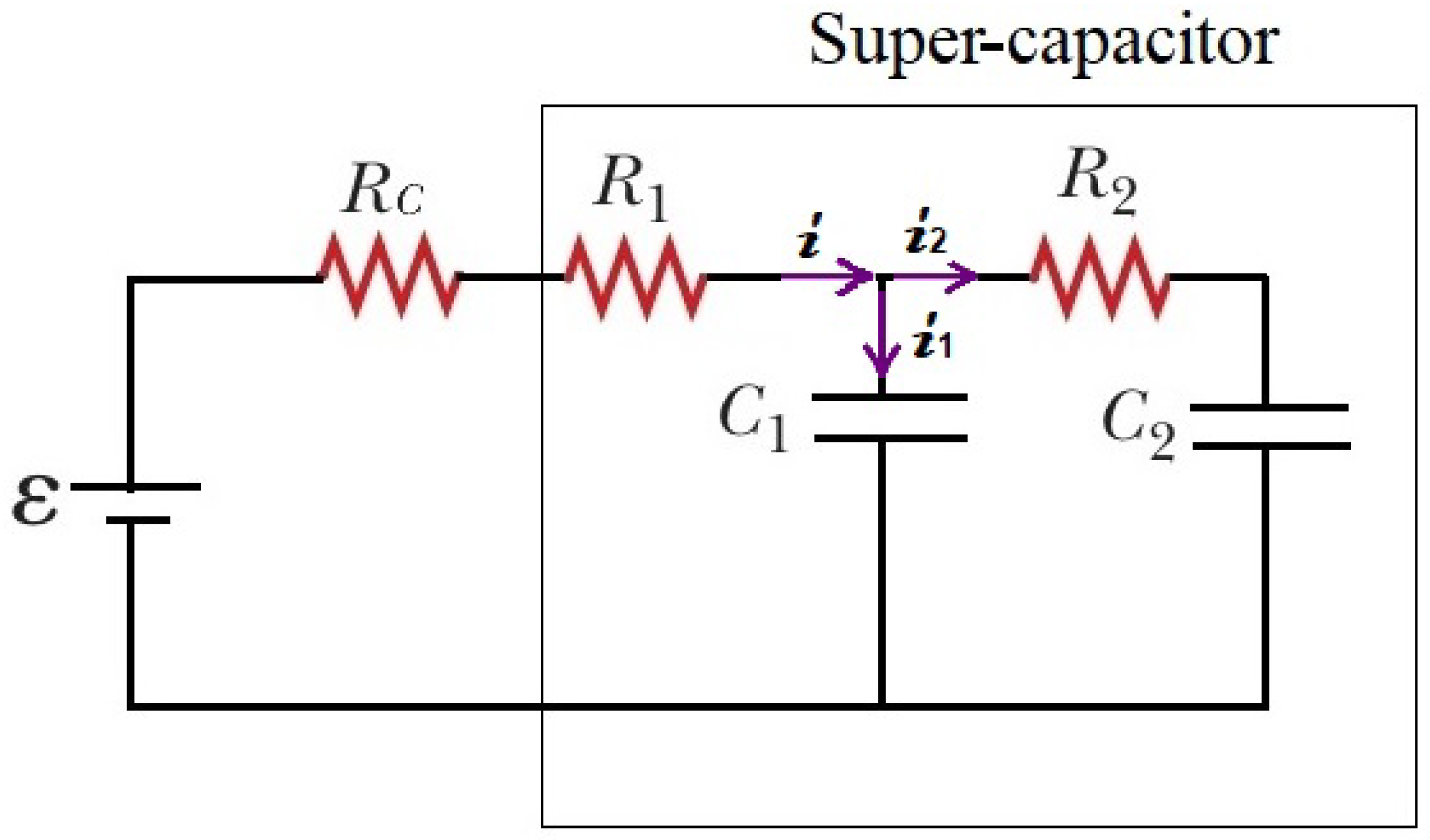
The proposed equivalent circuit features two RC circuits in cascade, as shown in
Figure 1. This arrangement is not commonly found in introductory physics textbooks and presents an intellectually stimulating challenge. Modeling through this equivalent circuit can help visualize ion mobility, an otherwise unobservable phenomenon. This approach is ideal for fostering collaborative work among students, a key aspect of PjBL. For instance, commercial supercapacitors deliver currents in amperes, and to emulate this, we will use conventional resistors (ohms) and electrolytic capacitors (microfarads). The component values shown in
Figure 1 are
,
,
,
,
, and
.
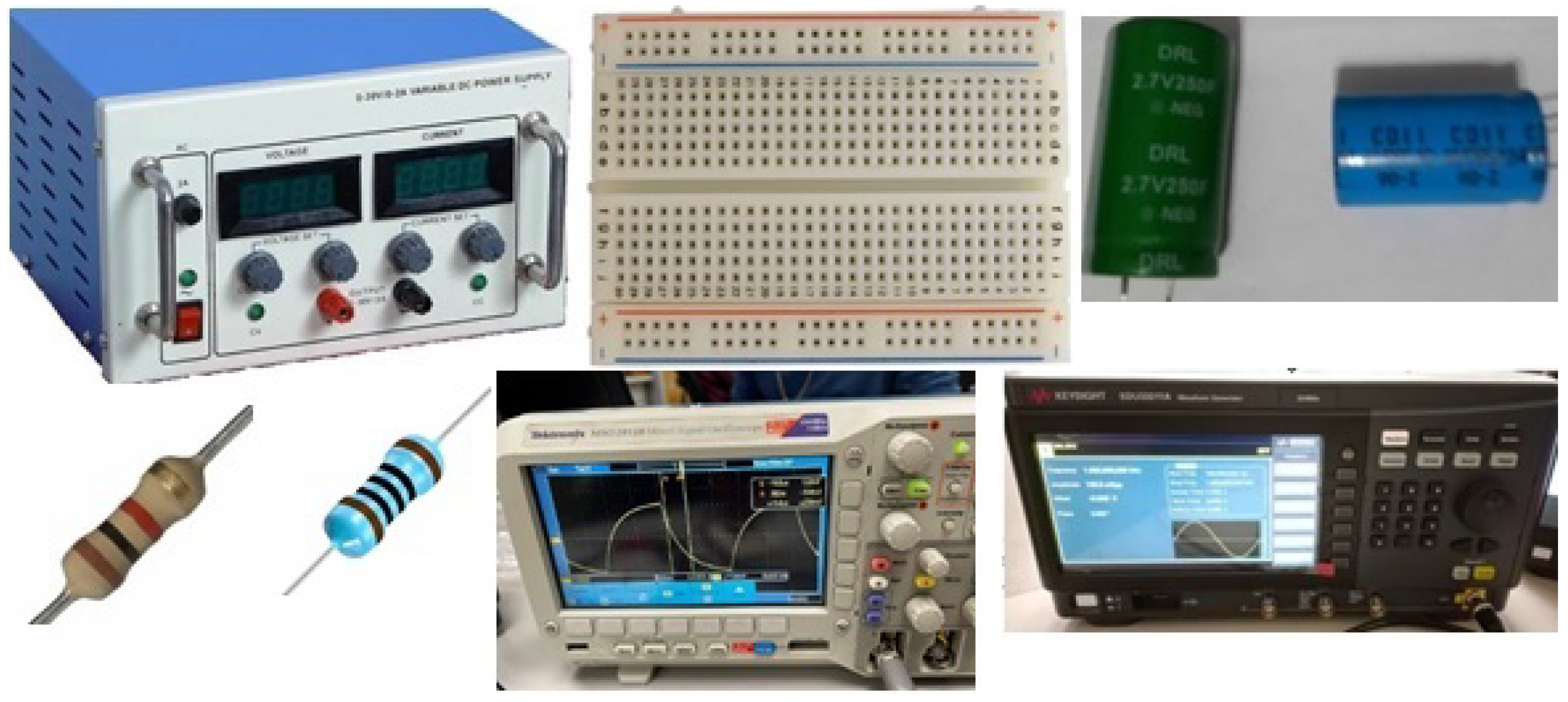
Appendix A provides additional details on these components and other necessary materials for the project.
The dynamic behavior of the equivalent circuit shown in
Figure 1 can be simulated and analyzed by modeling it using differential equations derived from Kirchhoff’s laws. This topic is typically not covered in introductory physics textbooks [
10,
11,
12].
By applying Kirchhoff’s second law (loop rule) to the left and right loops in
Figure 1, we can derive the following loop equations for each, respectively:
From Kirchhoff’s first law (Kirchhoff’s junction rule), where
and
, we obtain
Next, by replacing Equation (
3) in Equation (
1), we can simplify the system.
We also have the expression
from Equation (
2), which is substituted in Equation (
4), generating a new relationship:
To analyze the discharge of the capacitor
, we take the derivative of Equation (
2) with respect to time, where
has been abbreviated as
:
Now, from the previous equation, we obtain
This expression is then substituted into Equation (
5) to continue the analysis.
Equation (
8) is then multiplied by
:
After rearranging and simplifying the previous equation,
We thus obtain the differential equation that describes the behavior of capacitor
. Using this model, we can determine the time constants for both the charging and discharging of the system:
where
,
and
.
Once the differential equation model of the equivalent circuit is established, the system’s charging and discharging time constants can be determined by solving the differential equation, Equation (
9). This process follows standard procedures in the mathematics module. The homogeneous solution is first found using the characteristic equation. Representative component values are then selected (
,
,
,
,
,
) based on laboratory availability, safety, instructor experience, and consistency with values commonly used in educational modeling of RC systems and supercapacitor simulators. Using two capacitances of different magnitudes allows for the simulation of both fast and slow dynamics, which is essential for accurately representing supercapacitor behavior. With these values, the charge of capacitor
is calculated as follows:
with characteristic roots
and
.
These correspond to two time constants; the slower mode dominates the response. In particular, the effective charging time estimated that the capacitors charge 99% after it is
seconds, where
is the root of lower magnitude of the characteristic polynomial of Equation (
9).
3. Methodology and Design Experiment
Tecnológico de Monterrey has implemented the Tec21 Educational Model [
18], an innovative framework based on modules and subjects that incorporates PJBL for teaching electromagnetism to first-year engineering students. This model emphasizes competency-based training and is organized around four key concepts: challenges, flexibility, exceptional experiences, and inspiring professors. The electromagnetism course consists of three theoretical modules and an experimental challenge spanning five weeks. The experimental and physics modules, which address topics such as electric fields and circuits, each constitute 33% of the course, while the introduction to differential equations and the Runge–Kutta method each represent 17%.
During the experimental challenge, students spent four to five weeks developing a group project, participating in weekly four-hour in-person sessions, and completing independent work outside of class. This structured timeline enabled students to progressively deepen their understanding of supercapacitor modeling and analysis using electrical circuits, thereby reinforcing theoretical concepts through practical application.
Before the laboratory exercise, students had a a fundamental understanding of classical mechanics, thermodynamics, and differential calculus, gained through introductory coursework. This background provided the necessary conceptual framework for interpreting the mathematical formulations of relevant physical models and for analyzing dynamical systems. While students lacked prior experience with supercapacitors, the physics module began with a contextualization phase that introduced the fundamental principles of electric fields, electric circuits, and electrochemical energy storage. This preparation allowed students to address the experimental challenge with an informed perspective and supported their progression from familiar concepts to more advanced electromagnetic and electrochemical phenomena.
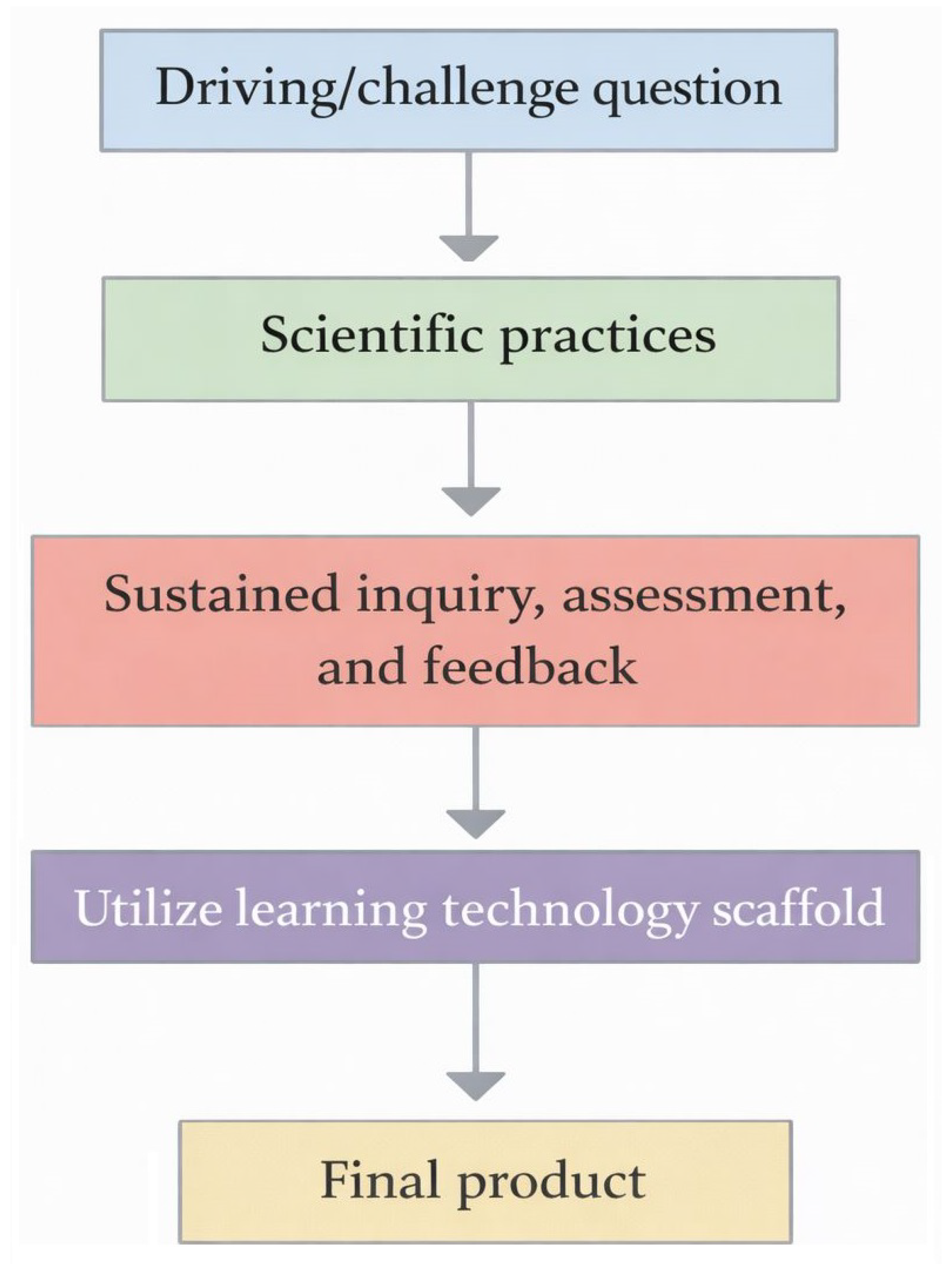
Aligned with the second specific objective of this study, the PjBL methodology described in [
1] was implemented. This approach is organized into several phases, as shown in
Figure 2, enabling students to apply theoretical knowledge to real-world scenarios through participatory, research, and action processes [
3]. The learning environment was structured to promote guided, self-directed learning, where students, supported by the instructor, actively identified problems, sought relevant information, and made technical decisions.
During the research phase, teams independently analyzed the electrical characteristics of commercial supercapacitors and determined the equivalent circuit component values needed to safely replicate their behavior, accounting for limitations associated with high currents. This phase offered explicit opportunities for students to develop independent research skills, such as consulting technical literature, data sheets, and specialized digital resources.
In the action phase, students assembled circuits, recorded electrical behavior, and compared experimental results with theoretical values obtained from simulations, thereby demonstrating integrated application of their knowledge. Equitable participation was promoted by assigning specific roles and continuously evaluating collaborative work, ensuring effective contributions from all team members.
The implemented PjBL approach fostered structured collaborative learning by organizing classes into small groups to facilitate discussion, idea exchange, and joint problem-solving [
2]. To ensure optimal working conditions, it was recommended that adequate laboratory space be provided, with each block limited to a maximum of 25 students, divided into teams of three to four. This arrangement enabled close supervision and effective support throughout the learning process.
3.1. Proposed Methodology
Students will collaborate on a project involving circuit building, literature reviews, measurements, and numerical modeling with MATLAB R2023b and presentations, guided by their teachers [
19]. MATLAB is chosen for its suitability and is supported by the computing faculty at no cost. This project is intellectually engaging and fosters collaboration, key to PjBL [
20]. Students should have prior knowledge of calculus and introductory programming, as well as access to laboratory equipment for measurements and prototypes. Additional lab time can be arranged if needed.
Driving/challenging questions.They are central to the PjBL methodology. The instructor who leads the challenge must clearly and concisely communicate these questions to the students, along with the evaluation criteria, during the first class session. Students begin the PjBL process with the following open-ended question, which allows for multiple methods of solution: How would you simulate and describe a supercapacitor using an electrical circuit that includes two loops, three resistors, and two capacitors?
Scientific practices. Help students formulate hypotheses, identify variables, generate ideas, and engage in solving challenging questions related to electrical circuits with resistors and capacitors. They will measure capacitance, resistance, and potential using a multimeter and construct systems digitally with simulators like LTspice.
Sustained inquiry, assessment, and feedback. Students will research the applications of supercapacitors and investigate their charging and discharging using principles of charge and energy conservation. They will derive the relevant differential equations and must submit their first assignment to receive instructor feedback.
Utilize learning technology scaffolds. Students will create a double-loop RC cascade circuit with two capacitors and three resistors, visualizing charging and discharging processes with an oscilloscope and LTspice. They will also model the circuit in MATLAB, solve the corresponding second-order differential equation, and determine time constants for each capacitor, documenting their process through photos and videos.
Final product. After completing their experimental work, students will accept or reject their hypotheses. They will simulate a supercapacitor and model charging and discharging processes using MATLAB R2023b, documenting their work with photos and videos.
Final oral examination. Attendance by all participating and invited teachers is highly recommended. Teachers should prepare a set of questions in advance to avoid any need for improvisation. The questions should focus on the following topics: supercapacitors, the laws of conservation of electric charge and energy as applied in circuits, the solutions of differential equations, and the main modeling commands in MATLAB R2023b.
Learning Issues. Towards the end of the project, students will engage with the material by reading, writing, and discussing results in teams [
21]. Recommended discussion questions include
- (A)
What are the advantages and disadvantages of calculating the loading times from the poles of the characteristic polynomial concerning simulation and experimentation?
- (B)
In which applications is it possible and advantageous to modify the charging time in super-capacitors?
- (C)
How does the energy stored in supercapacitors compare to that in conventional capacitors?
3.2. Simulation and Design
To gain experience in reflection and analysis, students should validate capacitor charging times by simulating the equivalent circuit using software like LTspice XVII, NI Multisim 14.3, or MATLAB R2023b.
Using a load resistance of
, the coefficients of the differential equation yield
,
,
, resulting in poles
and
, and a load time of
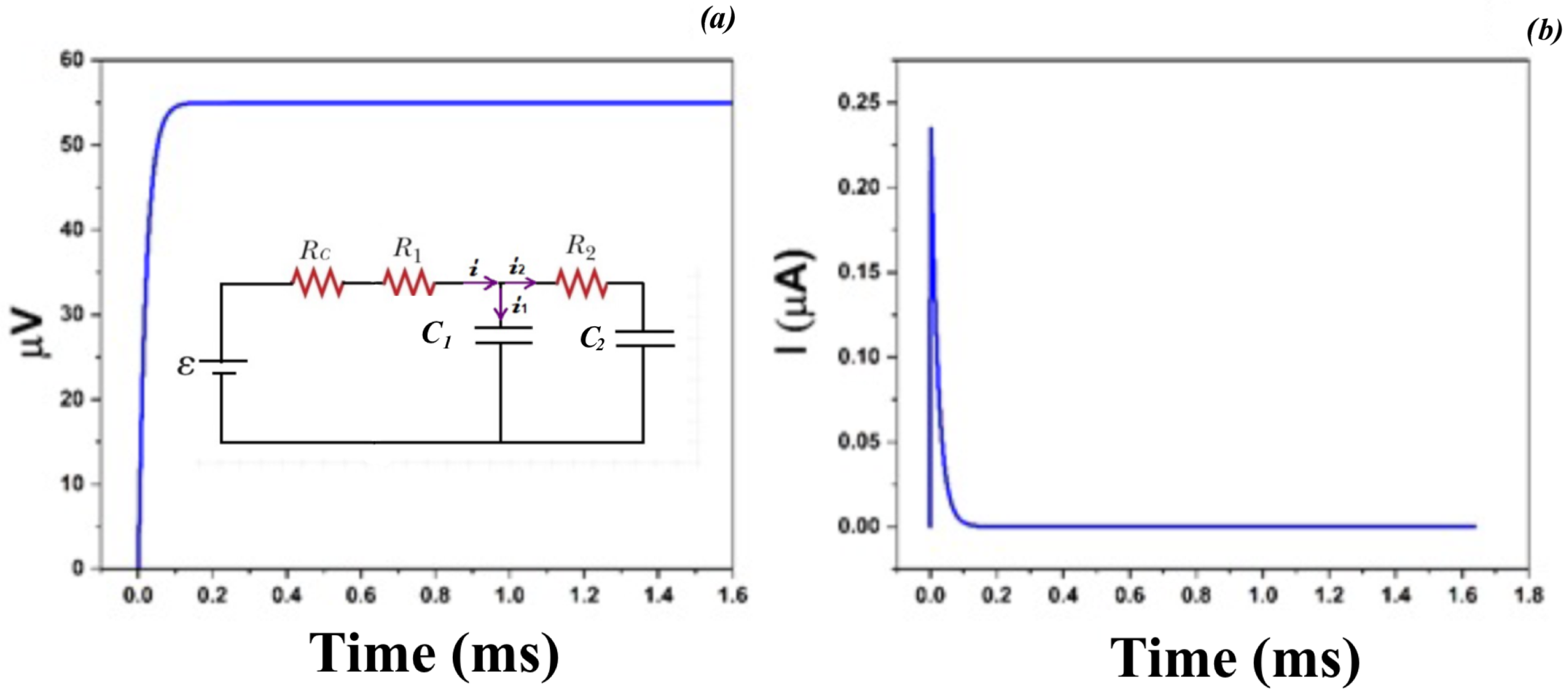
. Students should refer to
Figure 3 to determine an appropriate value of RC that results in a charging constant of approximately
, which can be done through trial and error or numerical methods. The circuit can then be simulated with the calculated
.
3.3. Experimentation Design
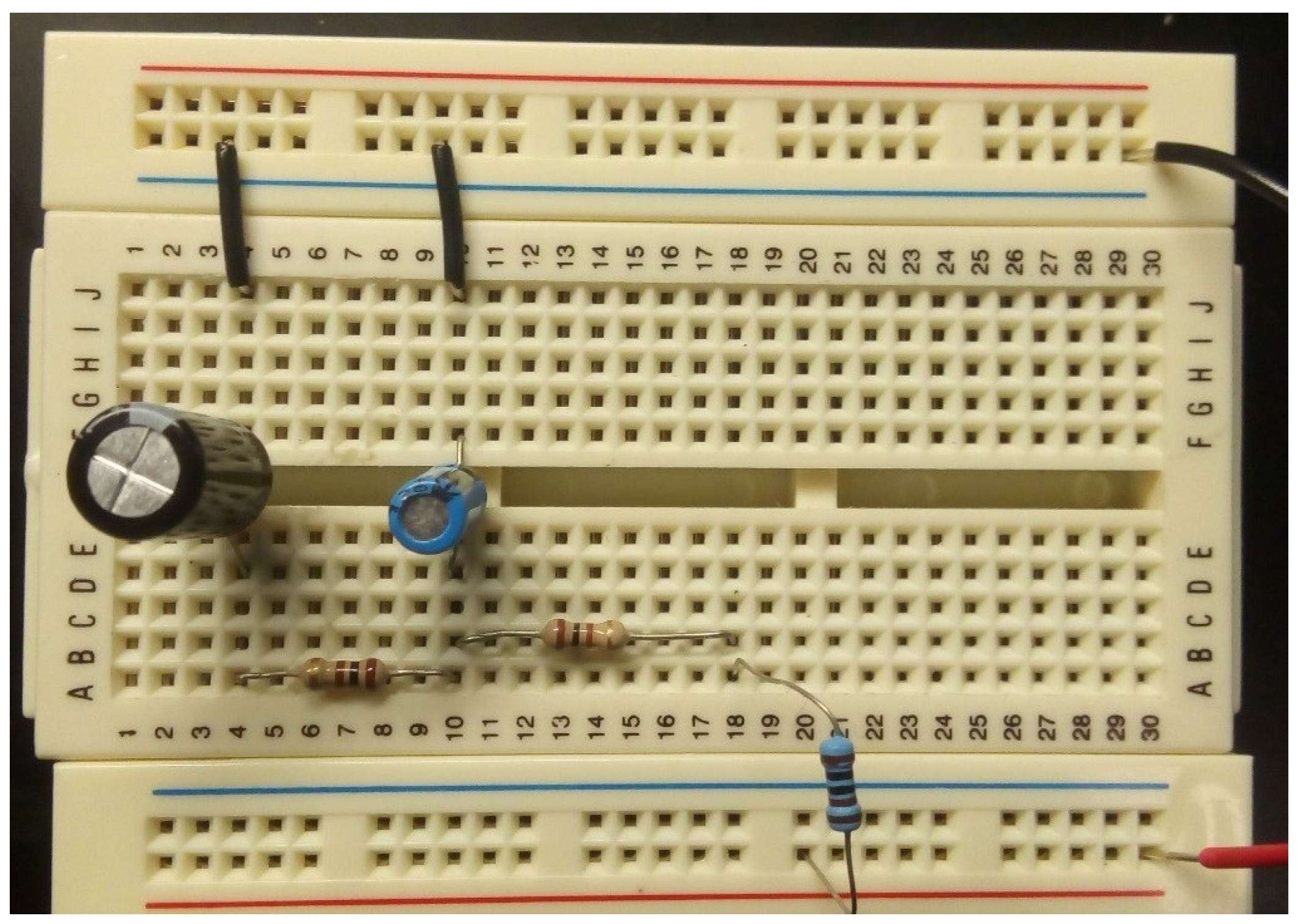
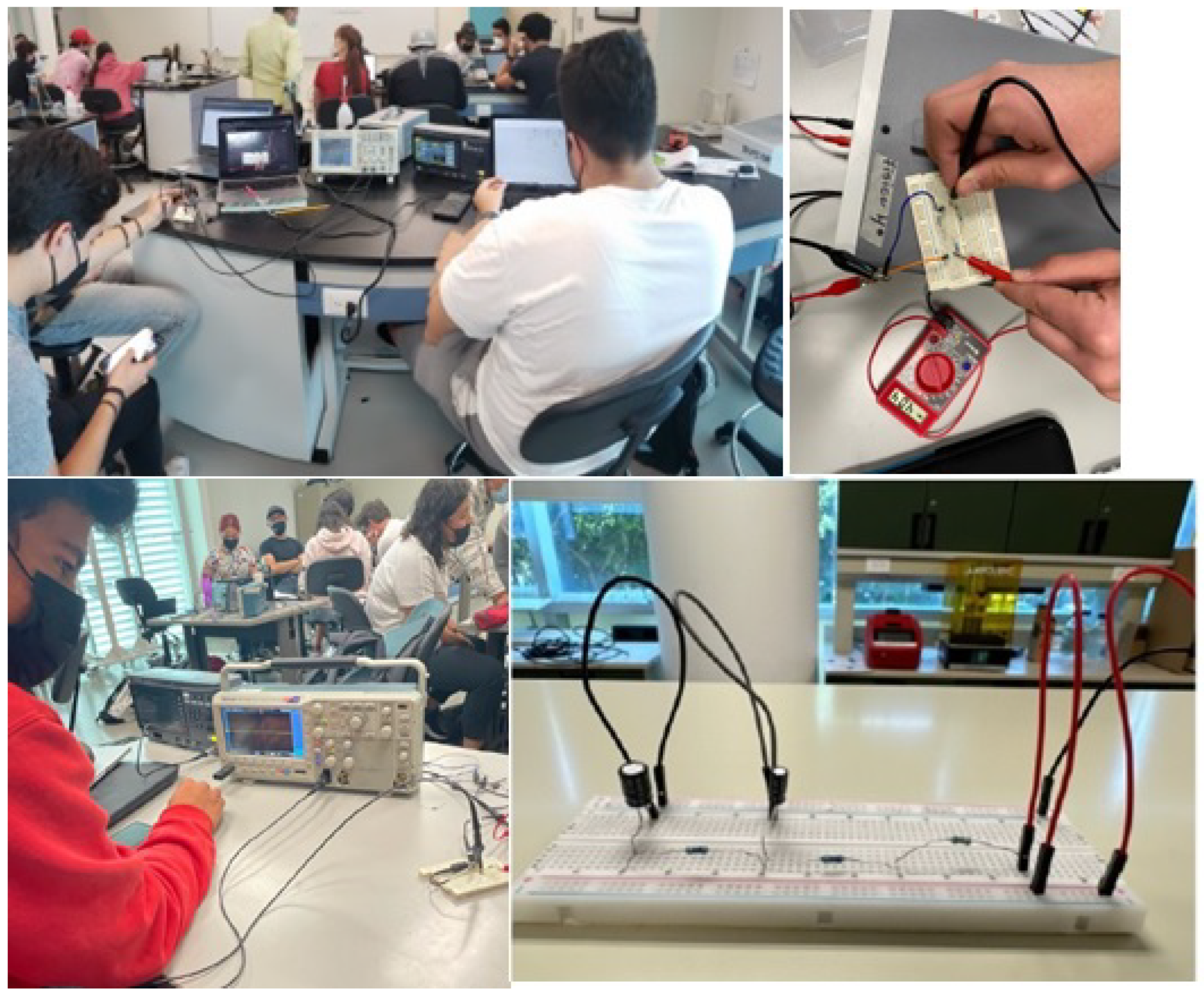
In the next step, professors guide students to experimentally verify the equivalent circuit results in the lab. Students will work in teams to assemble the circuit shown in
Figure 4 on a breadboard.
Instead of using a constant voltage source of
, we recommend employing a signal generator to provide a square wave signal of
amplitude with a frequency below
. This allows for a
observation of both the load (high signal) and discharge (low signal) transients, particularly when
and monitoring the voltage of
. Using an oscilloscope, students can measure the voltage across
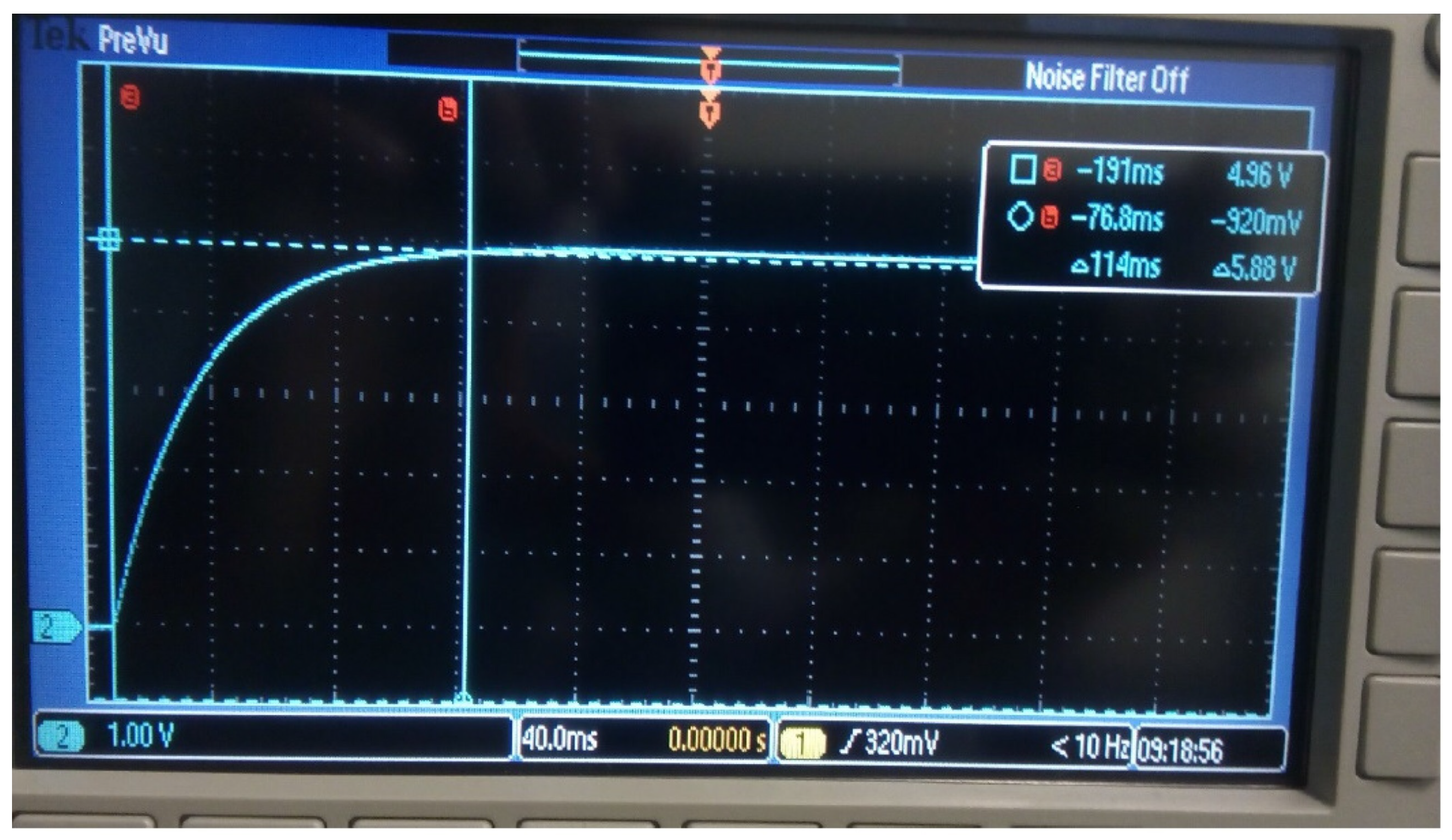
and analyze the charge–discharge cycle, with the calculated charging time being approximately 114 ms comparable to 108 ms derived from the characteristic equation
Figure 5.
To further explore supercapacitor behavior, students can refer to the values in
Table 1 to calculate charge times and total energy stored in the equivalent circuit (
and
) as detailed in
Table 2.
3.4. Project Evaluation
This project aims to explore connections across various disciplines, benefiting from collaboration among teachers. Akimov explored the possibilities of educational technologies to enhance the Open Innovation model [
22], while Abbas and his team assessed the Institutional Effectiveness Department at Tecnológico de Monterrey across twenty-six campuses [
23].
PjBL offers diverse assessment opportunities for both group and individual evaluations. Students can produce different outputs, such as guiding questions, solutions with beta-test plans, instructional videos, journals, and reflection videos, depending on their progress and project requirements [
24]. Collaboration between teachers and students is essential for defining assessment products and criteria [
20]. Establishing clear performance expectations and rubrics during the planning stage is crucial. In
Supplementary Materials we introduce the RETAF (Rubric for the Assessment and Tutoring of Learning in the Forum) [
25,
26], which is designed for assessing assignments in e-learning forums. Based on authentic assessment methods, the RETAF enables a controlled evaluation of student performance, resulting in measurable grades.
3.5. Impact Measurement
To investigate teachers’ learning strategies using the PjBL methodology, a student satisfaction survey was administered by the coordinating teacher between April and May 2022. The survey questions and results are available in this article’s
Supplementary Materials.
The survey evaluated students’ satisfaction with both theoretical and project modules across various aspects, such as content, methodology, and teaching staff. A total of 130 students from professional programs at Tecnológico de Monterrey, Guadalajara campus, participated. While the overall results were positive, some students expressed dissatisfaction, particularly in mathematics courses. Concerns included the disorganization of scientific content and insufficient integration of assessment activities. To enhance reliability, it is recommended to conduct the questionnaire each time this teaching block occurs.
4. Discussions
Students involved in the project using the PjBL methodology effectively applied energy conservation and electric charge principles by simulating a supercapacitor [
1] (
Appendix B). They used inexpensive materials commonly found in basic science labs, unlike other studies that rely on costly resources [
4]. The results indicate that the PjBL methodology described in this study demonstrates significant potential for transferability and scalability to various educational contexts. While the project was implemented in an introductory electromagnetism course for engineering students, the methodological framework, which is structured around a guiding question, scientific practices, sustained inquiry, and technological scaffolding, can be adapted to multiple academic levels and related courses, including electrical circuits, basic electronics, heat transfer, energy systems, and computational modeling. The flexibility of the PjBL approach enables adjustments to conceptual complexity, simulation tools, and evaluation criteria, while consistently emphasizing the integration of theory and practice and the development of both technical and transversal skills. These features support the methodology’s feasibility for application beyond the specific context examined, facilitating its adoption across diverse educational programs and fostering active, meaningful learning experiences.
From a constructivist perspective, learning is conceived as an active process of knowledge construction, as reflected in the implementation of PjBL approach described in this study. Unlike traditional approaches focused on content transmission, the supercapacitor simulation project fosters the effective integration of theory and practice through system modeling using differential equations applied to electromagnetic devices and experimentation with electrical circuits. This approach allows students to move beyond purely theoretical treatments in basic science texts without introducing excessive complexity, aligning with the principles of experiential learning widely discussed in engineering higher education.
The proposed method can be effectively integrated into the Outcome-Based Learning (OBE) approach because it facilitates the definition of clear and measurable learning outcomes. The activities are designed to support the development of specific competencies, which are observable and measurable through student performance, thereby ensuring coherent alignment among teaching, learning, and assessment.
Compared to other methodological frameworks used in higher education, such as competency-based education, the PjBL approach presented here not only facilitates the development of specific technical skills but also promotes the acquisition of transversal skills, such as collaborative work, critical thinking, and complex problem-solving. These characteristics constitute one of the main strengths of the approach, as they promote a comprehensive education for students in line with current demands in engineering education. The topic of supercapacitors is usually not included in introductory physics courses [
10,
11,
12], posing a challenge for students. This approach centered on three key themes:
- 1.
Interdisciplinary Learning: Students integrated concepts from physics, mathematics, and computer science, reviewing essential topics such as electric fields and capacitance, while also addressing challenging differential equations, despite not having taken a differential equations course yet.
- 2.
Practical Application: Engaging in real-life projects allowed students to deepen their understanding of electromagnetism, moving away from rote memorization.
- 3.
Technical and Social Skills Development: Students gained skills in modeling and measuring electrical devices and enhanced their teamwork abilities, including collaboration and communication [
2]. Assessments should reflect these real-life applicable skills.
Section 2 and
Section 3 proposed one of several solutions with details that guide the simulation of a supercapacitor through an RC circuit with two loops, two capacitors, and three resistors. A significant limitation is that, due to the danger of discharging supercapacitors larger than 1 farad, capacitors of the order of microfarads were taken [
4,
5]. Over five weeks, 132 second-semester engineering students engaged with the PjBL methodology. Generally, they were satisfied with their experience, though some expressed concerns about specific mathematics topics and integration activities. As a result, instructors were encouraged to provide more feedback on students’ progress.
Guided by their teachers and working in teams, students solved the
question/challenge involving the order of magnitude for capacitors and resistors to simulate a supercapacitor. They summarized their findings on charging and discharging capacitors, discussed MATLAB simulations, and presented their final projects. Time management emerged as a challenge for teachers transitioning from traditional methods [
27], leaving some students feeling overwhelmed when integrating physics concepts with differential equations. Additional support and monitoring of student progress were recommended.
This challenge was achieved thanks to a scientific practice devised by the professors. This practice engaged students in observing and measuring resistors and capacitors in series and parallel configurations, as well as in examining the discharge of a capacitor. The MATLAB modeling enabled them to solve differential equations while simulating actual supercapacitor data numerically.
The students learned how to use learning technology scaffolds by measuring capacitors’ discharge with an oscilloscope powered by a function generator. They compared the experimental results with those obtained from MATLAB simulations. Additionally, the students applied Kirchhoff’s laws to calculate the discharge, leading to a differential equation that they solved using the Euler and bisection methods. This process allowed them to create graphs of charge and current over time. Students were encouraged to relate their findings to real-world problems by analyzing these graphs. However, one limitation of the project was that connecting two or more capacitors in a cascade required support from the teacher and effective teamwork.
As part of their final learning project, students, guided by two rubrics outlined in
Tables S1 and S2 of the supplement to this article, submitted two progress reports: one after three weeks and another as a final report. They then presented a summary of their work during a team presentation, in which they analyzed their achievements and limitations. Unlike previous courses that included multiple assignments and exams, this approach was less overwhelming for the students.
The final oral examination promoted learning by encouraging organization and teamwork. It also allowed for the assessment of students’ knowledge and reaction time, providing immediate feedback that enabled prompt corrections and clarification of any doubts [
1,
2]. However, this method has certain disadvantages: evaluating large groups can be challenging, there is a risk of subjectivity in grading, and it requires a considerable amount of time to administer. During the exam, we observed motivation and enthusiasm in some students, but there was also an increase in stress levels in others. To enhance the validity and objectivity of this assessment method, it is essential to establish clear communication with the guest lecturers, maintain a well-structured question bank, and define transparent grading criteria.
Implementing the PjBL methodology enabled students to develop an integrated understanding of the principles governing supercapacitor operation, with particular emphasis on charging and discharging processes and energy conservation. The results demonstrate that students effectively connected theoretical physics and mathematical concepts to practical applications through both simulation and experimental analysis.
Practical skills were assessed through the design and analysis of simulations in MATLAB, the experimental measurement of resistors and capacitors, and the interpretation of data obtained with laboratory instruments such as oscilloscopes and function generators. These activities enabled students to evaluate their ability to model real physical systems and to compare theoretical predictions with experimental data.
Conceptual understanding of supercapacitors was evaluated through written reports, oral presentations, and a final oral exam, all guided by predefined rubrics. These assessment tools enabled us to determine the level of conceptual mastery, the capacity for technical argumentation, and the ability to explain underlying physical phenomena. Collectively, the results indicate that the PjBL approach fosters deep and meaningful learning while promoting the development of technical competencies and transversal skills relevant to engineering education. However, transferring PjBL methodology to other courses or educational contexts presents several critical challenges. The cognitive demands of integrating physics, mathematics, and computational tools may be substantial for students with limited mathematical backgrounds, which necessitates the development of additional scaffolding and a progressive sequence of content. Implementation also requires considerable time and teacher support, particularly in large groups. Differences in infrastructure and technology, such as access to simulation software and laboratory equipment, can impede consistent adoption. Project and oral assessments may raise concerns about objectivity and consistency, underscoring the need for clear rubrics and transparent evaluation criteria. Addressing these issues is crucial for the effective and sustainable use of PjBL in diverse settings.
Tecnológico de Monterrey promotes active student participation in the PjBL methodology, emphasizing collaboration. This approach involves exploring a lesser-known electrical phenomenon, providing real-world experiential learning that sets it apart from traditional methods. PjBL helps students deepen their understanding of core subjects while developing essential life and career skills
5. Conclusions
PjBL is an innovative educational approach that combines active learning with collaboration, enabling students to create solutions through an inter-professional and creative method [
1]. This approach enhances students’ learning by familiarizing them with scientific equipment and motivating them in STEM courses, leading to a deeper understanding of theoretical concepts [
28]. Emphasizing the project’s definition and approach is crucial, as well as the knowledge and skills used in problem-solving. Evaluation instruments should align with the project solution and the competencies developed during the process.
The PjBL approach encouraged students to explore topics across multiple disciplines, such as electromagnetism, differential equations, and programming, which helped them see connections between subjects. Teachers implemented PjBL in teams and found collaboration enjoyable, reporting positive impacts on their professional growth.
PjBL leverages students’ interests to make education meaningful while developing key competencies such as collaboration, decision-making, communication, ethics, and leadership [
19,
29]. It enhances understanding of core subjects and essential life skills. Teachers should provide clear guidance and allow freedom for creativity and self-discipline. Ultimately, PjBL fosters collaboration in teaching physics and promotes positive thinking habits and learning approaches.
During the implementation of the PJBL methodology, we identified three phases: engagement, research, and action [
3]. In the engagement phase, students simulated the electrical behavior of supercapacitors available in their local market. During the research phase, they determined the values of the equivalent circuit components necessary to safely emulate these commercial supercapacitors, with a strong emphasis on safety due to the high currents involved. To minimize risks, students utilized microfarad and picofarad capacitors in their simulations [
30]. In the action phase, they assembled the circuit, documented its electrical behavior, and compared their results with the theoretical values of the target supercapacitors.




 ,
,