Article

Differential Effects of Low and High Caffeine Doses on Bench Press Muscular Endurance: A Randomized, Double-Blind, Placebo-Controlled Crossover Study


by
Guilherme Pereira Saborosa
1,
Luciano Bernardes Leite
1,*,
Pedro Forte
2,3,4,5,*,
Alexandra Malheiro
3,4,
Pedro Afonso
3,4,5,
Dan Holz de Arruda
6,
Sebastião Felipe Ferreira Costa
1,
Helton de Sá Souza
1 and
Sandro Fernandes da Silva
7
1
Department of Physical Education, Federal University of Viçosa, Viçosa 36570-000, MG, Brazil
2
Department of Sports, Instituto Politécnico de Bragança, 5300-253 Bragança, Portugal
3
Department of Sports, Higher Institute of Educational Sciences of the Douro, 4560-708 Penafiel, Portugal
4
Research Center for Active Living and Wellbeing (LiveWell), Instituto Politécnico de Bragança, 5300-253 Bragança, Portugal
5
Biosciences Higher School of Elvas, Polytechnic Institute of Portalegre, 7300-110 Portalegre, Portugal
6
Department of Nutrition, Universidade Federal de Viçosa, Viçosa 36570-900, MG, Brazil
7
Graduate Program in Nutrition and Health, Federal University of Lavras-UFLA, Lavras 37203-202, MG, Brazil
*
Authors to whom correspondence should be addressed.
Appl. Sci. 2026, 16(4), 1679; https://doi.org/10.3390/app16041679
Submission received: 30 December 2025 / Revised: 4 February 2026 / Accepted: 5 February 2026 / Published: 7 February 2026
(This article belongs to the Special Issue Health Promotion Through Physical Activity and Diet)

Abstract

Background: Caffeine contributes to improvements in physical performance by enhancing muscular strength and endurance. However, it is necessary to evaluate the effects of different dosages on resistance training (RT) performance. Therefore, this study aimed to compare the effects of different caffeine doses (i.e., 3 mg·kg−1 and 6 mg·kg−1) on the maximum number of repetitions in a muscular endurance test. Methods: The study included 11 male participants (25.7 ± 5.9 years) who completed six in-person visits. During the first visit, a 24 h dietary recall (24HDR) was administered, anthropometric measurements were assessed, and one-repetition maximum (1RM) was determined in the flat bench press (BP). The second visit (baseline; BL) included a new 24HDR, assessment of muscle thickness using portable ultrasound (pre- and post-test), and a muscular endurance test in the BP at 80% of 1RM performed until concentric failure. The four subsequent visits followed the same protocol, with the administration of caffeine or placebo capsules 60 min before testing in a randomized, double-blind manner: low-dose caffeine (3 mg·kg−1; LC), high-dose caffeine (6 mg·kg−1; HC), low-dose placebo (3 mg·kg−1; LP), and high-dose placebo (6 mg·kg−1; HP). The first three interventions were conducted with 48 h intervals, and the remaining interventions were separated by a 7-day interval. Results: The number of repetitions and total workload (TWL) increased in all conditions compared with baseline; however, no significant differences were observed (p > 0.05). LC and HP achieved the highest repetition values (LC: 12.09 ± 3.33 reps; HP: 12.27 ± 2.72 reps). Muscle thickness was greater in all conditions in the post-test assessment, showing a significant increase (p < 0.05). Conclusions: Low- or high-dose caffeine supplementation appears to moderately influence responses in a muscular endurance test, suggesting that caffeine may be a potential supplement for resistance training.

1. Introduction

The constant pursuit of improved physical performance has substantially contributed to the increased use of ergogenic aids. Among these, nutritional ergogenic aids, such as caffeine, are the most commonly used for this purpose [1,2]. Caffeine is an alkaloid belonging to the purine family and acts as a central nervous system (CNS) stimulant by inhibiting the action of adenosine, a CNS depressant [3]. By antagonizing adenosine receptors, caffeine increases neural excitability and reduces the perception of fatigue, which underlies its widespread use as an ergogenic aid [3].
Caffeine (1,3,7-trimethylpurine-2,6-dione) is widely present in individuals’ daily dietary intake. For this reason, is considered a natural ergogenic aid, naturally occurring in the seeds and leaves of various plants [4,5].
To achieve potential benefits of caffeine during physical exercise, dietary supplements, beverages, or foods containing adequate concentrations are commonly used [6]. However, caution is required regarding the dosage present in food products or in its isolated form. Very high doses (i.e., >9 mg·kg−1) may lead to adverse effects, such as nervousness, gastrointestinal disturbances, and sleep disorders, particularly in individuals who do not habitually consume caffeine on a regular basis [7]. The optimal doses proposed to elicit positive effects related to physical exercise range from 3 to 6 mg·kg−1, without completely excluding the use of higher doses (9 mg·kg−1), depending on the characteristics of the individual and the type of exercise performed [5]. It is important to highlight that caffeine is predominantly consumed in an acute manner, typically within a short time frame before exercise or training sessions, as its ergogenic benefits are primarily associated with immediate physiological and neurocognitive responses following its absorption [7].
Some of the ergogenic benefits obtained from acute caffeine supplementation are primarily associated with improvements in endurance performance (e.g., running and cycling), which are attributed to increased fatty acid oxidation and preservation of muscle glycogen [8]. In resistance training (RT), caffeine supplementation aimed at enhancing performance may promote increases in muscular strength, endurance, and power [9,10].
The mechanisms underlying the beneficial effects of caffeine in RT are related to its action on adenosine receptors, altering calcium release from the sarcoplasmic reticulum and motor unit recruitment, thereby resulting in stronger and more fatigue-resistant muscle contractions [8,9,11].
Although caffeine supplementation is commonly used by RT practitioners and has demonstrated potential benefits in several studies [12,13], it is necessary to identify how different doses influence improvements in muscular endurance performance. Therefore, the present study aimed to compare the influence of different dosages (i.e., 3 mg·kg−1 and 6 mg·kg−1) of acute caffeine supplementation on muscular endurance parameters.

2. Materials and Methods

2.1. Experimental Design

The study followed a randomized, double-blind, placebo-controlled, cross-over design, in which all participants completed all experimental conditions in a randomized order, separated by a washout period. Participant blinding was not complete, as individuals were able to identify the low- and high-dose conditions based on the number of capsules ingested (one or two capsules). However, participants were unaware of the capsule content (caffeine or placebo), as all capsules were visually identical, thereby preserving blinding with respect to the administered substance. In addition, the crossover design and the use of placebo under equivalent conditions helped reduce potential biases related to dose perception. An independent researcher was responsible for all procedures related to supplement and placebo blinding. Participants were informed about the study objectives and procedures and provided written informed consent by signing an informed consent form. The study was approved by the Research Ethics Committee involving human subjects under the project entitled Nutritional Supplements and Responses to Different Physical Activity Programs (COEP, CAAE no. 20221419.7.0000.5148) and was conducted in accordance with the Declaration of Helsinki (latest revision, 2024) of the World Medical Association.
Figure 1 illustrates the procedures performed throughout the study. In total, six visits were conducted, all scheduled at the same time of day based on the first visit. All sessions took place at the Human Movement Studies Laboratory (LEMOH), located at the Federal University of Lavras (UFLA) in Minas Gerais, Brazil, in a fully equipped and climate-controlled environment (25 °C). The interval between the first, second, and third visits was 48 h. From the third to the sixth visit, the interval was standardized at 7 days to ensure an adequate washout period. Participants completed one session for sample characterization and five testing conditions: Baseline (BL), Low-Dose Caffeine (LC), Low-Dose Placebo (LP), High-Dose Caffeine (HC), and High-Dose Placebo (HP).
Sample characterization, performed during the first visit, included anthropometric assessment, participant familiarization with the test exercise, determination of one-repetition maximum (1RM), and administration of a 24 h dietary recall (24HDR). During the second visit, designated as the BL condition, the following procedures were conducted: assessment of pectoral muscle thickness at pre- and post-test, execution of the muscular endurance test in the flat bench press (BP), and administration of the 24HDR. The subsequent visits followed the same procedures established for the BL condition. However, prior to any testing procedures, supplementation was administered, with only the dose and type of supplement (caffeine or placebo) differing between visits (LC, LP, HC, or HP).
At the end of each session, potential side effects related to the ingested substance were monitored using a questionnaire assessing possible adverse reactions, as well as participants’ perceptions regarding which dose or substance they believed they had consumed.

2.2. Sample

A total of 11 male individuals (25.7 ± 5.9 years) with practical experience in resistance training (RT) (7.5 ± 3.8 years) participated in this study. The inclusion criteria were as follows: individuals who did not engage in chronic caffeine supplementation or acute caffeine ingestion for RT purposes, had a minimum of 1 year of RT experience, and were free from any musculoskeletal injuries. To characterize habitual caffeine intake, a validated questionnaire was used [14].
The exclusion criteria included individuals who were unable to use caffeine supplementation due to medical recommendations or had high sensitivity to the substance, those who failed to attend the assessment sessions at the predetermined date and location, and those who sustained an injury during the study period.

2.3. Supplementation

The supplementation intervention was conducted through the administration of caffeine or placebo capsules containing starch, provided 60 min before the start of the muscular endurance test. Both caffeine and placebo were administered in two distinct doses, defined as low or high doses. Low-dose caffeine (LC) capsules contained 3 mg·kg−1, whereas high-dose caffeine (HC) capsules contained 6 mg·kg−1. The total placebo substance per dose was standardized at 230 mg for the low-dose placebo (LP) and 460 mg for the high-dose placebo (HP).
Low-dose conditions were administered in a single capsule, whereas high-dose conditions were administered in two capsules. Participants were informed that, in certain visits, they would receive low doses (one capsule) and, in others, high doses (two capsules); however, all capsules were identical in color, size, weight, and taste, preventing identification of the substance received, with only the dosage being apparent. Capsules were provided in sealed envelopes according to individual randomization, with no repetition of conditions. A 7-day interval between visits was standardized to ensure an adequate washout period, thereby minimizing any potential influence of prior supplementation [14].

2.4. Analyses

2.4.1. Anthropometry

Total body mass (kg) was measured using a digital scale (G-tech, Glass-10; Carmy Electronic Ltd., Zhongshan, China). Height (cm) was measured using a wall-mounted stadiometer with a maximum length of 210 cm and a precision of 1 mm. Body fat percentage (%BF) was calculated using the Siri equation [15], based on the Jackson and Pollock three-site skinfold protocol for men [16]. To assess the reference sites for %BF (chest, abdomen, and thigh), a portable ultrasound device (Bodymetrix® BX 2000, IntelaMetrix Inc., Livermore, CA, USA) was used.

2.4.2. Muscle Thickness Measurement

Muscle thickness was assessed using the same portable ultrasound device (Bodymetrix® BX 2000, IntelaMetrix Inc., Livermore, CA, USA) employed for %BF estimation. Measurements were obtained from the right pectoral muscle. The ultrasound probe was positioned on the lateral region of the muscle, with the origin near the axilla, and moved toward the nipple using ultrasound conductive gel (Ultra-Gel®, Multigel, São Carlos, SP, Brazil). Measurements were consistently performed at pre-test and post-test time points. Muscle thickness values were provided in millimeters (mm) by the BodyView® software (version 3.0.9.22073-N, IntelaMetrix Inc., Livermore, CA, USA). All assessments were conducted by a single evaluator to minimize potential measurement bias.

2.4.3. 24 h Dietary Recall

The 24 h dietary recall (24HDR) was administered and analyzed at all visits by an experienced nutritionist. Participants were individually instructed to maintain their usual dietary habits during the 24 h preceding each visit and to refrain from consuming any nutritional ergogenic aids that could interfere with test outcomes. No dietary intervention or modification was imposed by the evaluators. Habitual caffeine intake could potentially influence the responses to the experimental interventions due to tolerance-related effects. Therefore, an individualized standardization strategy was adopted. Participants were instructed to avoid caffeine consumption during the 24 h preceding each testing session; however, if caffeine was consumed, intake was required to match each participant’s habitual consumption pattern previously identified through the first 24HDR. This approach aimed to minimize acute withdrawal effects and ensure intra-individual consistency across sessions, thereby reducing potential bias in the study outcomes.

2.4.4. One-Repetition Maximum Test

The One-Repetition Maximum Test (1RM) test was performed to determine the maximum load lifted in the flat bench press (BP). Testing procedures followed protocols similar to those described by Rodríguez–Ridao et al. [17], with necessary adaptations. The test consisted of five stages: (1) a warm-up of one set of 15 repetitions without load; (2) one minute of upper-limb stretching prescribed by the evaluators; (3) one set of eight repetitions at 50% of the perceived 1RM; (4) one set of three repetitions at 70% of the perceived 1RM; and (5) three to five attempts to determine the maximal load.
To establish the final load, participants were required to perform two complete repetitions in each attempt. The test was terminated if concentric failure occurred during the second repetition of any attempt; in this case, the load used was considered the 1RM. Rest intervals between attempts were standardized at 5 min.

2.4.5. Muscular Endurance Test

The muscular endurance test aimed to assess the maximum number of repetitions performed until concentric failure at a predetermined load [18]. According to Karp [18], this test allows an indirect estimation of muscle fiber composition based on the number of repetitions achieved at a given percentage of 1RM, as also proposed by Hall et al. [19]. In the present study, the exercise used was the flat bench press, performed on a guided bar machine (Smith machine–Master Line, 4-inch).
The testing protocol consisted of an initial warm-up of 20 repetitions at 20% of 1RM. Following the warm-up, participants performed as many repetitions as possible at 80% of 1RM until concentric failure. Evaluators were not allowed to assist during exercise execution; if any assistance occurred at the point of failure, that repetition was not counted.

2.4.6. Mensured Total Workload

Total workload (TWL) was expressed in arbitrary units and represented the work performed during the muscular endurance test for each participant. TWL reflects the relationship between training volume (number of repetitions) and intensity (load used). It was calculated by multiplying the number of repetitions by the exercise load (AU = number of repetitions × load) [20]. TWL was calculated for all experimental conditions to quantify the total work performed during the test.

2.5. Statistical Analysis

All variables were analyzed using descriptive statistics, with results expressed as mean ± standard deviation. The Shapiro–Wilk test was used to assess data normality and homoscedasticity, revealing normally distributed data (p > 0.05). Homogeneity of variances was evaluated using Levene’s test, which indicated homogeneity for all variables (p > 0.05). Pre- and post-test muscle thickness within each condition was compared using Student’s t test.
Comparisons of the number of repetitions, TWL, and post-test muscle thickness across the different conditions (BL, LC, LP, HC, and HP) were performed using one-way analysis of variance (ANOVA), with the analyzed variable treated as dependent. The Scheffé post hoc test was applied when appropriate to identify potential differences between conditions. Additionally, effect sizes for ANOVA were calculated using partial eta squared (ηp2), with values of approximately 0.01 considered small, 0.06 moderate, and ≥ 0.14 large. The mean magnitude (Δmean) of the number of repetitions for each condition was also calculated (Δmean = Condition 1 − Condition 2).
The sample size was determined a priori using GPower software (version 3.1; University of Düsseldorf, Germany), based on a repeated-measures MANOVA design. An effect size (f2) of 0.55, an alpha level of 0.05, and a statistical power of 0.95 were assumed, resulting in a required minimum sample size of 10 participants. All statistical analyses were conducted using JAMOVI® software (2025, version 2.6), adopting a significance level of α = 5% (p < 0.05). Graphs were generated using GraphPad Prism® version 8.0.2.

3. Results

3.1. Anthropometric Characteristics

The anthropometric characteristics of the study participants are presented in Table 1, providing descriptive data on body mass, height, body fat percentage, lean mass, fat mass, and body mass index (BMI). Importantly, all participants completed all assessment sessions, and no dropouts or absences were recorded throughout the study.

3.2. Dietary Profile

The dietary profile of the participants, including daily macronutrient intake and habitual caffeine consumption expressed in absolute and relative terms, is presented in Table 2.

3.3. Muscular Endurance

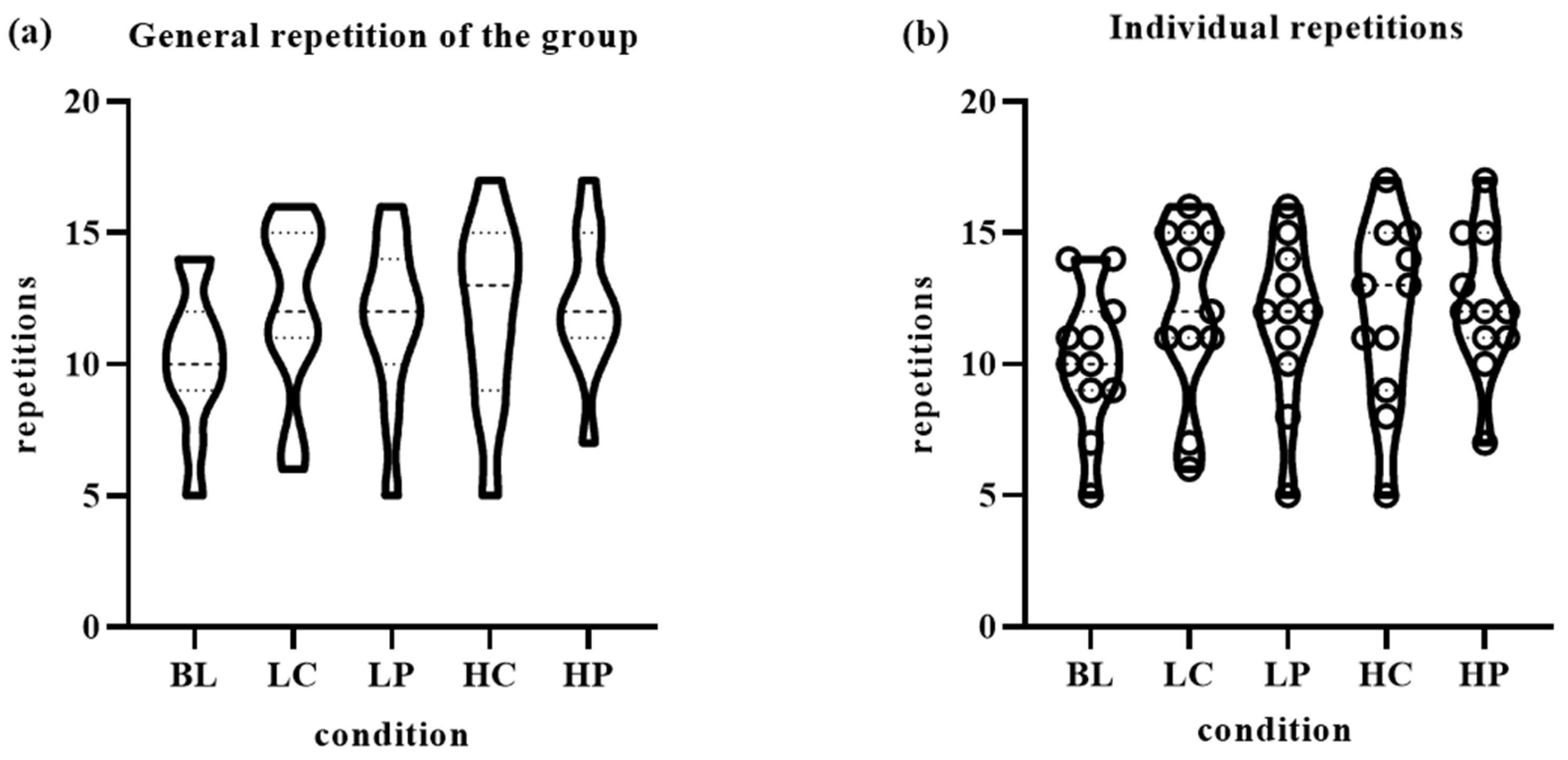
The number of repetitions (reps) achieved (Figure 2a) across the different conditions for the entire sample (Figure 2a) showed an increase compared with baseline (ΔLC = +1.90, ΔLP = +1.45, ΔHC = +1.72, ΔHP = +2.09); however, no significant differences were observed (F = 0.79; p = 0.532; ηp2 = 0.060). When within-subject effects were analyzed (Figure 2b), no statistically significant differences were identified (F = 2.12; p = 0.096; ηp2 = 0.175). The LC and HP conditions achieved the highest number of repetitions (LC: 12.09 ± 3.33 reps; HP: 12.27 ± 2.72 reps) compared with the other conditions.

3.4. Magnitude of Variation in the Number of Repetitions

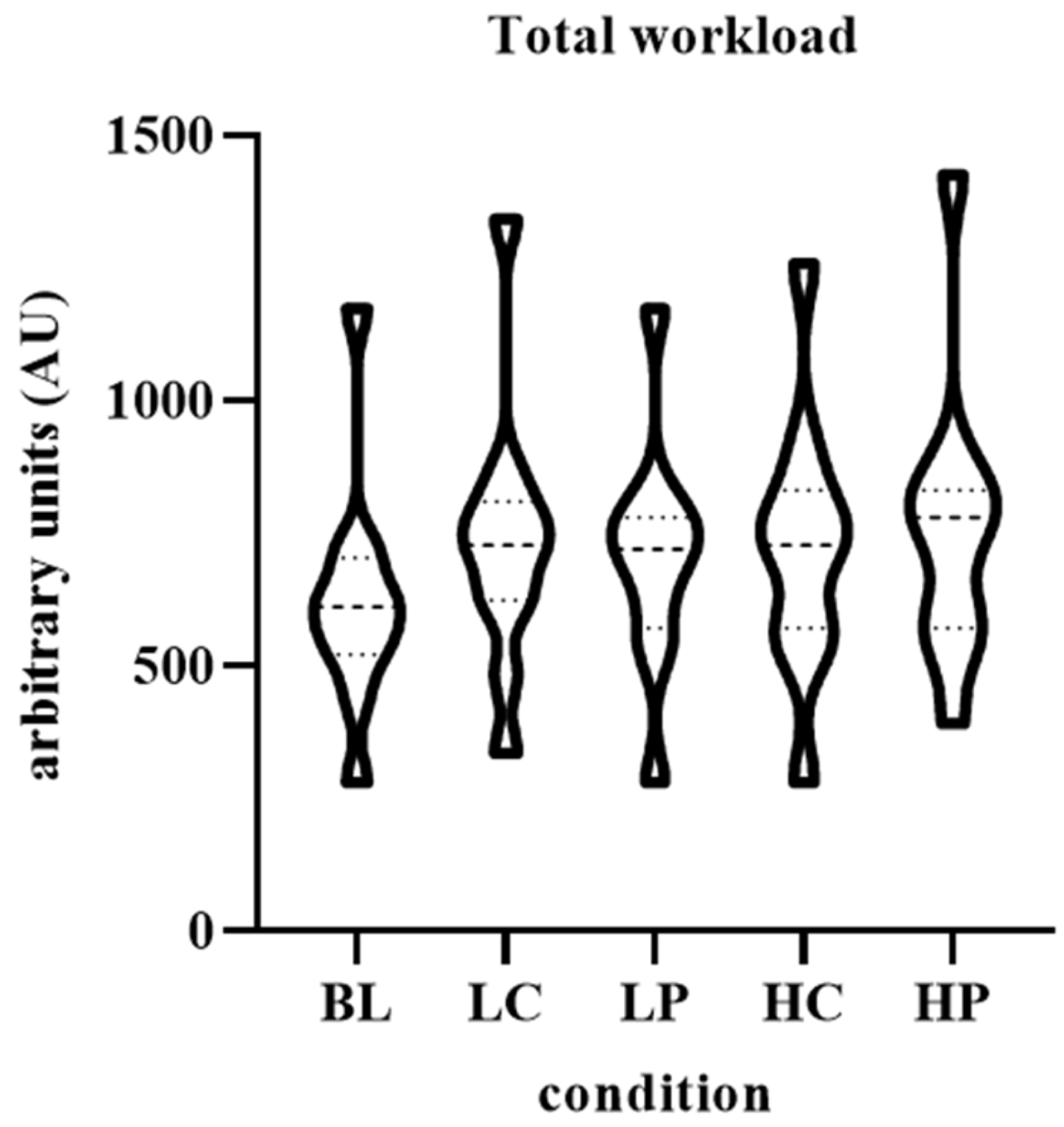
The magnitude of variation (Figure 3 and Table 3) represents the mean difference in the number of repetitions between conditions. Positive values (>0) indicate that the second condition exhibited a higher mean number of repetitions than the first condition when compared (e.g., first condition [BL] vs. second condition [HC]). Conversely, negative values (<0) indicate that the first condition resulted in a higher mean number of repetitions than the second (e.g., first condition [LC] vs. second condition [HC]). The findings demonstrated that the LC and HP conditions consistently showed the greatest magnitudes of variation. When compared directly, the magnitude was greater for the HP condition.

3.5. Total Workload

TWL showed minimal variation across conditions (F = 0.49; p = 0.739; ηp2 = 0.038) when the overall sample was analyzed. The LC and HP conditions achieved the highest TWL values (LC: 733 ± 254 AU; HP: 756 ± 270 AU), reflecting the greater number of repetitions performed (Figure 2). In contrast, the baseline condition exhibited the lowest exercise-induced workload (BL: 621 ± 222 AU).

3.6. Muscle Thickness

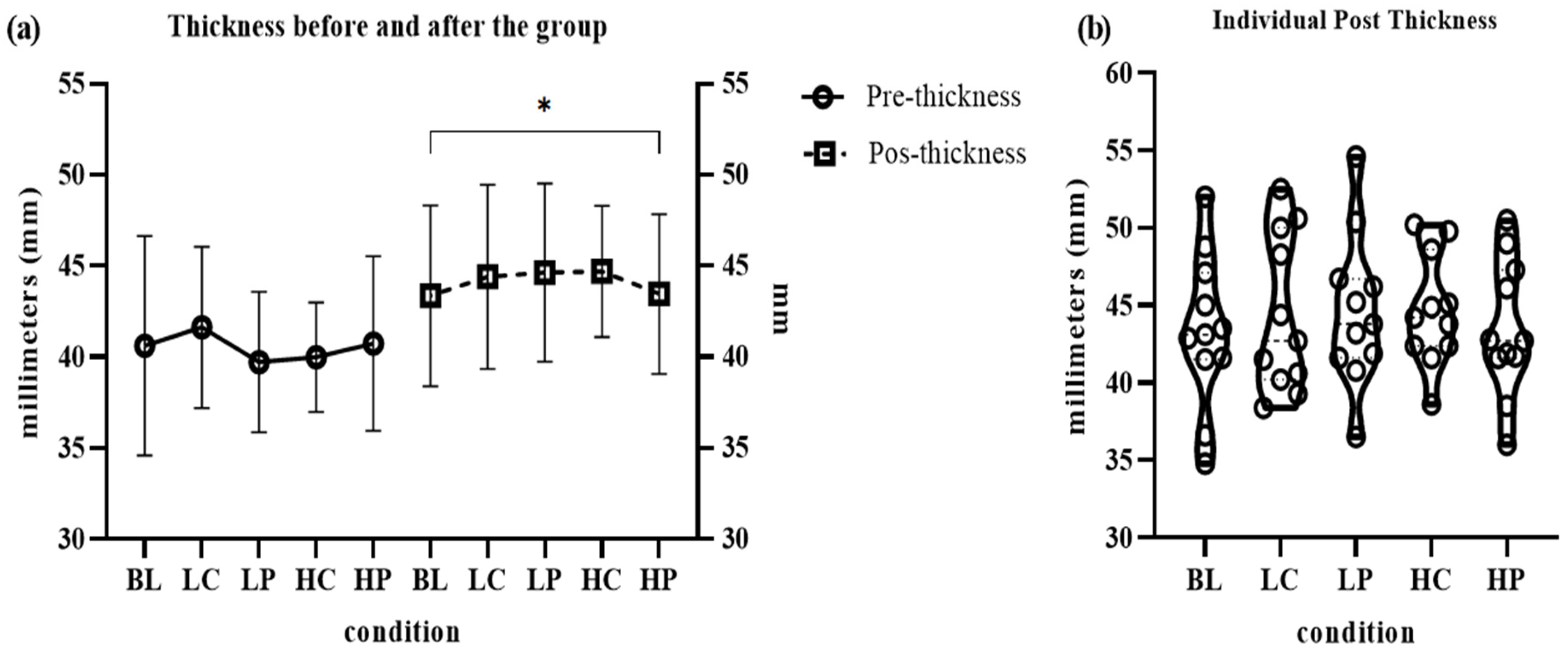
Muscle thickness showed a significant increase (p < 0.05) in all conditions at the post-test assessment (Figure 4a) compared with pre-test values. The conditions that demonstrated the greatest increases in muscle thickness were LC (Pre = 41.6 ± 4.42 vs. Post = 44.4 ± 4.90 mm; Δ = 4.07 mm; p = 0.002) and HC (Pre = 40.0 ± 3.01 vs. Post = 44.7 ± 3.61 mm; Δ = 7.22 mm; p < 0.001).
When muscle thickness was analyzed only at the post-test time point on an individual basis across all conditions (Figure 4b), no statistically significant differences were observed (F = 0.259; p = 0.902; ηp2 = 0.025). Similarly, comparisons between conditions considering only post-test values revealed no significant differences (F = 0.217; p = 0.928; ηp2 = 0.017), indicating that the observed changes were insufficient to reach statistical significance (Figure 4a).

4. Discussion

The present study aimed to compare the influence of different dosages (3 mg·kg−1 and 6 mg·kg−1) of acute caffeine supplementation on the maximum number of repetitions in a muscular endurance test. Our findings demonstrated that, regardless of the administered caffeine dose, the number of repetitions did not differ from the placebo condition. However, a small improvement was observed, particularly with the lower dose of caffeine.
It is well-established that acute caffeine supplementation enhances several aspects of sports performance, including muscular endurance and strength [5]. Specifically, caffeine ingestion prior to exercise allows the maintenance of force output even in the presence of metabolic alterations in the activated muscle associated with fatigue. This effect enables improved performance through the preservation of neural drive despite ongoing biochemical disturbances [21]. Studies by Da Silva et al. [22] and Duncan and Oxford [23] support significant increases (p < 0.05) in muscular endurance during resistance exercise following caffeine supplementation. Both studies administered caffeine capsules at a dose of 5 mg·kg−1. Da Silva et al. [22] reported increases in the number of repetitions for upper (+11.6%) and lower limbs (+19.1%) after to 3 sets of bench press and 3 sets of leg press exercises, whereas Duncan and Oxford [23] observed not only an increase in repetitions (p = 0.03) but also an increase in strength (p = 0.02) during the bench press exercise to failure at a load of 60% 1RM, demonstrating the practical effectiveness of caffeine. Similarly, Berjisian et al. [24] showed that trained individuals supplemented with caffeine (6 mg·kg−1) exhibited improvements in strength, muscular endurance, and power in both upper- and lower-body exercises compared with control or placebo groups.
These findings support the methodological adequacy of the present study, indicating that the supplementation doses used were sufficient to induce increases in muscular endurance. However, the absence of a statistically significant effect of caffeine raises the hypothesis that the low volume of the assessment protocol limited to a single exercise set—may have been a critical factor in underestimating the ergogenic potential of caffeine supplementation. This methodological limitation contrasts with previous studies that employed higher training volumes. For instance, Duncan et al. [25] reported significant increases (p = 0.0001) in muscular endurance across multiple exercises (deadlift, bent-over row, and back squat), while Spinelli et al. [26] observed significant increases (p < 0.05) in repetitions at lighter loads (20% of 1RM) and noticeable improvements at 25 and 30% of maximal load during the bench press. Such evidence suggests that a greater number of exercises and higher training volume may be essential to better elucidate the effects of caffeine supplementation.
To understand the effects of caffeine on resistance exercise, its mechanisms of action must be considered. The primary mechanism explaining caffeine-induced improvements in muscular endurance is its antagonistic effect on adenosine receptors. After absorption and crossing the blood–brain barrier, caffeine blocks adenosine binding to A1 and A2A receptors, promoting the release of acetylcholine, noradrenaline, dopamine, serotonin, and other neurotransmitters. Consequently, caffeine may enhance performance by exerting effects on the central nervous system (CNS) and muscle myofibrils through neurotransmitter release, particularly acetylcholine [8,27]. When this neurotransmitter acts at the neuromuscular junction, it triggers an action potential that promotes skeletal muscle contraction [28]. Additionally, caffeine increases calcium release from the sarcoplasmic reticulum, further contributing to enhanced muscular endurance [5,29].
The responses observed for total workload (TWL) changed directly according to the number of repetitions performed, as TWL reflects the product of repetitions and the load lifted (80% of 1 RM). It is important to note that increases in repetitions resulted in increases in TWL; however, these increments were not statistically significant under any condition (p > 0.05). Given that caffeine enhances muscular endurance, leading to a greater number of repetitions during resistance training [30], it is expected that TWL would also be influenced. This relationship was observed in the present study, which showed small increases in repetitions and, consequently, in TWL following low- and high-dose caffeine supplementation.
Muscle thickness (Figure 4a) showed significant differences (p < 0.05) across all conditions when pre- and post-test values were compared for the overall group. This increase is directly related to muscle damage and metabolic stress induced by exercise, resulting in greater mechanical and metabolic strain [31,32]. However, given the acute nature of the intervention and the immediate post-exercise assessment in the present study, these findings should not be directly interpreted as muscle hypertrophy, but rather as transient phenomena such as exercise-induced muscle swelling, edema, and increased intramuscular fluid accumulation [31]. Fridén and Lieber [33] indicated that increases in exercise intensity or volume induce greater muscle damage, influencing both acute and chronic skeletal muscle thickness. Caffeine consumption enhances work capacity by increasing muscular and metabolic tension during exercise, thereby influencing muscle thickness [34]. These mechanisms may explain the findings of the present study, as participants achieved increases in the number of repetitions and TWL under the different conditions compared with baseline.
Interindividual differences in the ergogenic response to caffeine are attributed to genetic variations associated with caffeine metabolism, as well as to physical and psychological responses and habitual intake patterns [5]. These factors should be considered when caffeine is used as an ergogenic aid, as they may modulate performance outcomes. Finally, placebo intervention also induced small, non-significant improvements (p > 0.05) in total repetitions and TWL compared with baseline. These responses may be directly related to psychological effects elicited during testing, potentially influencing performance outcomes [35]. Notably, this improvement was more evident in the high-dose placebo condition, which may reflect expectancy-related psychological processes. As participants were not fully blinded to the dosage condition and were aware that ingesting two capsules represented a higher dose of either substance (caffeine or placebo), performance expectations may have been enhanced, thereby contributing to these subtle performance changes, despite the absence of any physiological ergogenic effect of the placebo. Although participants were unaware of the capsule content, these findings highlight the potential influence of psychological factors on resistance exercise performance [36].
Regarding study limitations, the relatively small sample size may have restricted the statistical power to detect differences between conditions. Additionally, the low volume induced by the proposed testing protocol may be considered a limitation. Nevertheless, this study provides relevant and necessary evidence regarding the acute effects of caffeine on muscular endurance during resistance exercise. Further research is warranted to expand upon these findings, particularly with respect to different dosages, given that caffeine is a widely used nutritional ergogenic aid. Despite the absence of statistically significant differences, small variations observed in total workload and muscle thickness should be interpreted with caution. Considering the acute design of the study and the immediate post-exercise assessment, these responses predominantly reflect transient physiological phenomena, such as exercise-induced metabolic stress and muscle edema, rather than chronic adaptations or processes related to muscle hypertrophy. Future studies are warranted to further elucidate the effects of caffeine on muscular endurance, particularly through protocols involving greater exercise volume, chronic interventions, and different levels of resistance training experience, to determine whether these variables may modulate the responses observed in the present study.

5. Conclusions

Acute caffeine supplementation at doses of 3 and 6 mg·kg−1 did not promote significant changes in muscular endurance, as the number of repetitions was similar across all experimental conditions, including the placebo. Therefore, the results of the present study do not support significant ergogenic effects of caffeine on muscular endurance under the conditions evaluated. It is also noteworthy that the placebo group exhibited favorable responses, suggesting the influence of psychological factors, such as expectancy and motivation, on muscular endurance performance. These findings reinforce the relevance of placebo effects in exercise settings and the importance of considering such effects when interpreting the results.

Author Contributions

Conceptualization, G.P.S. and S.F.d.S.; methodology, G.P.S., S.F.d.S., D.H.d.A., S.F.F.C. and L.B.L.; original draft preparation, writing—review and editing, G.P.S., L.B.L., A.M., P.A., S.F.F.C. and H.d.S.S.; data curation G.P.S. and S.F.d.S.; formal analysis, H.d.S.S. and L.B.L.; resources, P.F.; funding acquisition, P.F., G.P.S. and S.F.d.S. All authors have read and agreed to the published version of the manuscript.

Funding

This research received no external funding.

Institutional Review Board Statement

This study was approved by the Human Research Ethics Committee under the research project entitled “Nutritional Supplements and Responses to Different Physical Activity Programs” (CAAE No. 20221419.7.0000.5148). All procedures were conducted in accordance with the ethical standards of the committee responsible and with the Declaration of Helsinki. Informed consent was obtained from all participants prior to their inclusion in the study.

Informed Consent Statement

Informed consent was obtained from all subjects involved in this study.

Data Availability Statement

The data that support the findings of this study are not publicly available due to ethical and privacy restrictions but are available from the corresponding author upon reasonable request.

Acknowledgments

The authors would like to thank all the volunteers who generously participated in this study for their time, commitment, and effort. Their cooperation and dedication were essential for the successful completion of the experimental procedures and data collection.

Conflicts of Interest

The authors declare no conflicts of interest.

References

  1. Kreider, R.B.; Wilborn, C.D.; Taylor, L.; Campbell, B.; Almada, A.L.; Collins, R.; Cooke, M.; Earnest, C.P.; Greenwood, M.; Kalman, D.S.; et al. ISSN exercise & sport nutrition review: Research & recommendations. J. Int. Soc. Sports Nutr. 2010, 7, 7. [Google Scholar] [CrossRef]
  2. Maughan, R.J. Dietary supplements and the high-performance athlete. Int. J. Sports Nutr. Exerc. Metab. 2018, 28, 101. [Google Scholar] [CrossRef] [PubMed]
  3. Fiani, B.; Zhu, L.; Musch, B.L.; Briceno, S.; Andel, R.; Sadeq, N.; Ansari, A.Z. The Neurophysiology of Caffeine as a Central Nervous System Stimulant and the Resultant Effects on Cognitive Function. Cureus 2021, 13, e15032. [Google Scholar] [CrossRef] [PubMed]
  4. Goldstein, E.R.; Ziegenfuss, T.; Kalman, D.; Kreider, R.; Campbell, B.; Wilborn, C.; Antonio, J. International society of sports nutrition position stand: Caffeine and performance. J. Int. Soc. Sports Nutr. 2010, 7, 5. [Google Scholar] [CrossRef] [PubMed]
  5. Guest, N.S.; VanDusseldorp, T.A.; Nelson, M.T.; Grgic, J.; Schoenfeld, B.J.; Jenkins, N.D.; Campbell, B.I. International society of sports nutrition position stand: Caffeine and exercise performance. J. Int. Soc. Sports Nutr. 2021, 18, 1. [Google Scholar] [CrossRef]
  6. Collado-Mateo, D.; Lavín-Pérez, A.M.; Merellano-Navarro, E.; Coso, J.D. Effect of acute caffeine intake on the fat oxidation rate during exercise: A systematic review and meta-analysis. Nutrients 2020, 12, 3603. [Google Scholar] [CrossRef]
  7. de Souza, J.G.; Del Coso, J.; Fonseca, F.D.S.; Silva, B.V.C.; de Souza, D.B.; da Silva Gianoni, R.L.; Claudino, J.G. Risk or benefit? Side effects of caffeine supplementation in sport: A systematic review. Eur. J. Nutr. 2022, 61, 3823–3834. [Google Scholar] [CrossRef]
  8. Grgic, J.; Mikulic, P.; Schoenfeld, B.J.; Bishop, D.J.; Pedisic, Z. The influence of caffeine supplementation on resistance exercise: A review. Sports Med. 2019, 49, 17–30. [Google Scholar] [CrossRef]
  9. Ferreira, L.H.; Forbes, S.C.; Barros, M.P.; Smolarek, A.C.; Enes, A.; Lancha-Junior, A.H.; Souza-Junior, T.P. High doses of caffeine increase muscle strength and calcium release in the plasma of recreationally trained men. Nutrients 2022, 14, 4921. [Google Scholar] [CrossRef]
  10. Tallis, J.; Guimaraes-Ferreira, L.; Clarke, N.D. Not another caffeine effect on sports performance study—Nothing new or more to do? Nutrients 2022, 14, 4696. [Google Scholar] [CrossRef]
  11. Black, C.D.; Waddell, D.E.; Gonglach, A.R. Caffeine’s ergogenic effects on cycling: Neuromuscular and perceptual factors. Med. Sci. Sports Exerc. 2015, 47, 1145–1158. [Google Scholar] [CrossRef] [PubMed]
  12. Pakulak, A.; Candow, D.G.; Totosy de Zepetnek, J.; Forbes, S.C.; Basta, D. Effects of creatine and caffeine supplementation during resistance training on body composition, strength, endurance, rating of perceived exertion and fatigue in trained young adults. J. Diet. Suppl. 2022, 19, 587–602. [Google Scholar] [CrossRef] [PubMed]
  13. Trexler, E.T.; Smith-Ryan, A.E.; Roelofs, E.J.; Hirsch, K.R.; Mock, M.G. Effects of coffee and caffeine anhydrous on strength and sprint performance. Eur. J. Sport Sci. 2016, 16, 702–710. [Google Scholar] [CrossRef] [PubMed]
  14. Bühler, E.; Lachenmeier, D.W.; Schlegel, K.; Winkler, G. Development of a tool to assess caffeine intake among teenagers and young adults. Ernahr. Umsch. 2014, 61, 58–63. [Google Scholar] [CrossRef]
  15. Siri, W.E. Body Composition from Fluid Spaces and Density: Analysis of Methods; University of California: Berkeley, CA, USA, 1956. [Google Scholar]
  16. Jackson, A.S.; Pollock, M.L. Generalized equations for predicting body density of men. Br. J. Nutr. 1978, 40, 497–504. [Google Scholar] [CrossRef]
  17. Rodríguez-Ridao, D.; Antequera-Vique, J.A.; Martín-Fuentes, I.; Muyor, J.M. Effect of five bench inclinations on the electromyographic activity of the pectoralis major, anterior deltoid, and triceps brachii during the bench press exercise. Int. J. Environ. Res. Public Health 2020, 17, 7339. [Google Scholar] [CrossRef]
  18. Karp, J.R. Muscle fiber types and training. Strength Cond. J. 2001, 23, 21. [Google Scholar] [CrossRef]
  19. Hall, E.C.; Lysenko, E.A.; Semenova, E.A.; Borisov, O.V.; Andryushchenko, O.N.; Andryushchenko, L.B.; Ahmetov, I.I. Prediction of muscle fiber composition using multiple repetition testing. Biol. Sport 2021, 38, 277–283. [Google Scholar] [CrossRef]
  20. McBride, J.M.; McCaulley, G.O.; Cormie, P.; Nuzzo, J.L.; Cavill, M.J.; Triplett, N.T. Comparison of methods to quantify volume during resistance exercise. J. Strength Cond. Res. 2009, 23, 106–110. [Google Scholar] [CrossRef]
  21. Bowtell, J.L.; Mohr, M.; Fulford, J.; Jackman, S.R.; Ermidis, G.; Krustrup, P.; Mileva, K.N. Improved exercise tolerance with caffeine is associated with modulation of both peripheral and central neural processes in human participants. Front. Nutr. 2018, 5, 6. [Google Scholar] [CrossRef]
  22. Da Silva, V.L.; Messias, F.R.; Zanchi, N.E.; Gerlinger-Romero, F.; Duncan, M.J.; Guimarães-Ferreira, L. Effects of acute caffeine ingestion on resistance training performance and perceptual responses during repeated sets to failure. J. Sports Med. Phys. Fit. 2015, 55, 383–389. [Google Scholar]
  23. Duncan, M.J.; Oxford, S.W. The effect of caffeine ingestion on mood state and bench press performance to failure. J. Strength Cond. Res. 2011, 25, 178–185. [Google Scholar] [CrossRef] [PubMed]
  24. Berjisian, E.; Naderi, A.; Mojtahedi, S.; Grgic, J.; Ghahramani, M.H.; Karayigit, R.; Forbes, S.C. Are caffeine’s effects on resistance exercise and jumping performance moderated by training status? Nutrients 2022, 14, 4840. [Google Scholar] [CrossRef] [PubMed]
  25. Duncan, M.J.; Stanley, M.; Parkhouse, N.; Cook, K.; Smith, M. Acute caffeine ingestion enhances strength performance and reduces perceived exertion and muscle pain perception during resistance exercise. Eur. J. Sport Sci. 2013, 13, 392–399. [Google Scholar] [CrossRef] [PubMed]
  26. Spineli, H.; Acioli, J.; Pinto, M.P.; Learsi, S.; Bastos-Silva, V.J.; Araujo, G.G.D. Caffeine intake improves muscular endurance and induces depletion of anaerobic work capacity in the bench press. Motriz Rev. Educ. Fís. 2022, 28, e102200014921. [Google Scholar] [CrossRef]
  27. McLellan, T.M.; Caldwell, J.A.; Lieberman, H.R. A review of caffeine’s effects on cognitive, physical and occupational performance. Neurosci. Biobehav. Rev. 2016, 71, 294–312. [Google Scholar] [CrossRef]
  28. Bottinelli, R.Y.C.R.; Reggiani, C. Human skeletal muscle fibres: Molecular and functional diversity. Prog. Biophys. Mol. Biol. 2000, 73, 195–262. [Google Scholar] [CrossRef]
  29. Allen, D.G.; Lamb, G.D.; Westerblad, H. Impaired calcium release during fatigue. J. Appl. Physiol. 2008, 104, 296–305. [Google Scholar] [CrossRef]
  30. Grgic, J.; Del Coso, J. Ergogenic effects of acute caffeine intake on muscular endurance and muscular strength in women: A meta-analysis. Int. J. Environ. Res. Public Health 2021, 18, 5773. [Google Scholar] [CrossRef]
  31. Fink, J.; Schoenfeld, B.J.; Kikuchi, N.; Nakazato, K. Effects of drop set resistance training on acute stress indicators and long-term muscle hypertrophy and strength. J. Sports Med. Phys. Fit. 2017, 58, 597–605. [Google Scholar] [CrossRef]
  32. Proske, U.; Allen, T.J. Damage to skeletal muscle from eccentric exercise. Exerc. Sport Sci. Rev. 2005, 33, 98–104. [Google Scholar] [CrossRef]
  33. Fridén, J.; Lieber, R.L. Eccentric exercise-induced injuries to contractile and cytoskeletal muscle fibre components. Acta Physiol. Scand. 2001, 171, 321–326. [Google Scholar] [CrossRef]
  34. Bazzucchi, I.; Felici, F.; Montini, M.; Figura, F.; Sacchetti, M. Caffeine improves neuromuscular function during maximal dynamic exercise. Muscle Nerve 2011, 43, 839–844. [Google Scholar] [CrossRef]
  35. Linde, K.; Fässler, M.; Meissner, K. Placebo interventions, placebo effects and clinical practice. Philos. Trans. R. Soc. B Biol. Sci. 2011, 366, 1905–1912. [Google Scholar] [CrossRef]
  36. Hurst, P.; Schipof-Godart, L.; Szabo, A.; Raglin, J.; Hettinga, F.; Roelands, B.; Lane, A.; Foad, A.; Coleman, D.; Beedie, C. The placebo and nocebo effect on sports performance: A systematic review. Eur. J. Sport Sci. 2020, 20, 279–292. [Google Scholar] [CrossRef]
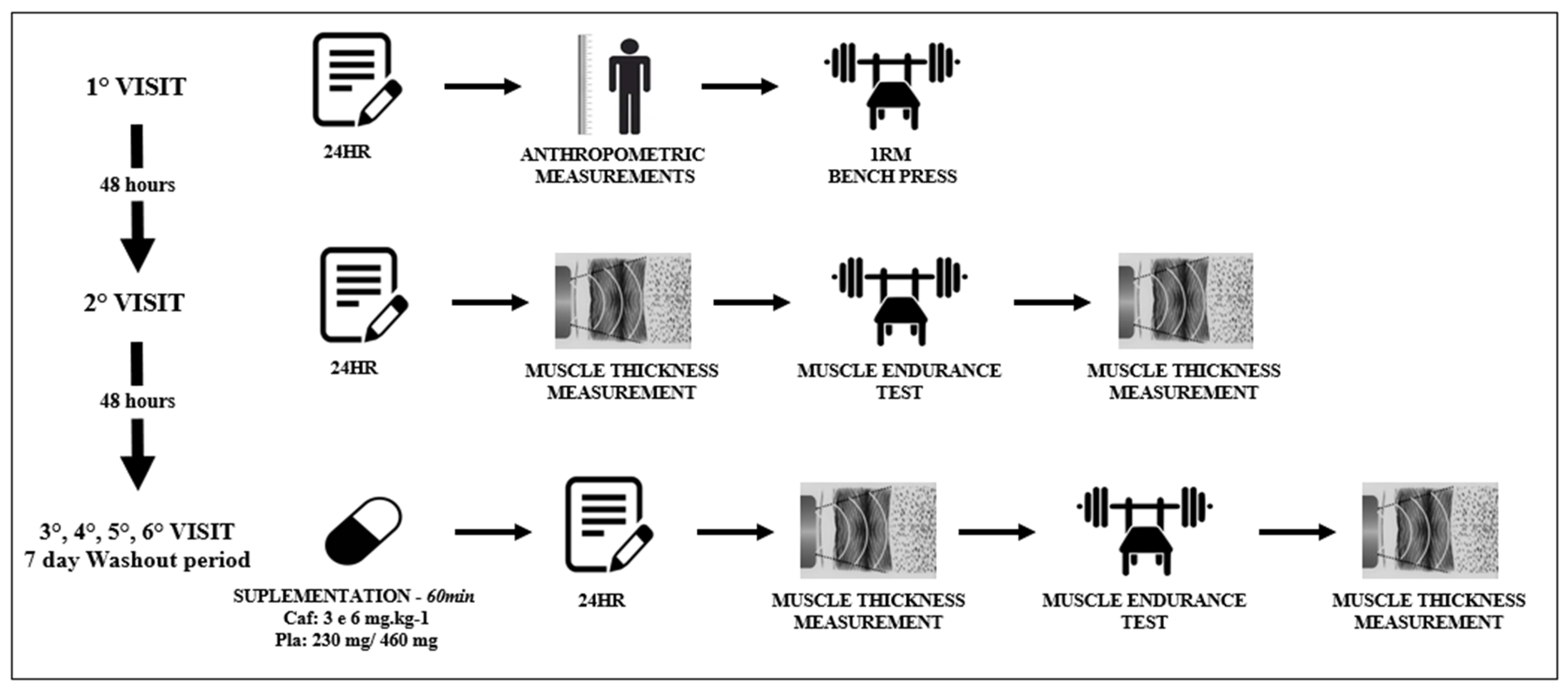
Figure 1. Experimental design of the study. The figure illustrates the study timeline and procedures across visits. During the first visit, participants completed a 24 h dietary recall (24HR), underwent anthropometric measurements, and performed a one-repetition maximum (1RM) flat bench press test. Forty-eight hours later, during the second visit, participants completed a 24HR, followed by muscle thickness assessment, a muscle endurance test, and a post-test muscle thickness measurement. The third to sixth visits were conducted with a 7-day washout period between sessions and included supplementation ingestion (caffeine at 3 or 6 mg·kg−1 or placebo at 230 or 460 mg) 60 min before testing, followed by a 24HR, muscle thickness measurement, muscle endurance test, and post-test muscle thickness measurement.
Applsci 16 01679 g001
Figure 2. Distribution of repetitions across experimental conditions. Panel (a) shows the group-level distribution of repetitions for each condition (BL, LC, LP, HC, and HP), represented by violin plots. The dotted lines indicate the median and interquartile range, while the width of the violins represents data density. Panel (b) presents individual repetitions for each condition, with dots representing individual participants overlaid on the distribution. The y-axis indicates the number of repetitions, and the x-axis represents the experimental conditions.
Applsci 16 01679 g002
Figure 3. Total workload across experimental conditions. Violin plots illustrate the distribution of total workload, expressed in arbitrary units (AU), for each experimental condition (BL, LC, LP, HC, and HP). The width of each violin represents data density, while the central dashed lines indicate the median and interquartile range. The x-axis denotes the experimental conditions and the y-axis represents total workload.
Applsci 16 01679 g003
Figure 4. Muscle thickness before and after the experimental conditions. Panel (a) presents group mean ± standard deviation of muscle thickness (mm) measured before (pre-thickness) and after (post-thickness) each condition (BL, LC, LP, HC, and HP). The asterisk (*) indicates a significant difference between pre- and post-measurements (p < 0.05). Panel (b) shows individual post-exercise muscle thickness values for each condition, with violin plots representing data distribution and dots indicating individual participants. The dashed line is shown only as a visual guide to connect the mean values across conditions and does not represent an additional statistical measure. The x-axis denotes experimental conditions, and the y-axis represents muscle thickness in millimeters.
Applsci 16 01679 g004
Table 1. Anthropometric characteristics of the study participants.
Anthropometric MeasurementsValue
Weight (kg)71.1 ± 11.0
Height (cm)170.72 ± 6.6
BF (%)12.49 ± 3.8
Lean Mass (kg)62.40 ± 11.0
Free Fat (kg)8.75 ± 2.4
BMI (kg.m−2)24.36 ± 2.2
Data are presented as mean ± standard deviation (SD). Weight is expressed in kilograms (kg), height in centimeters (cm), body fat percentage (BF, %), lean mass in kilograms (kg), fat mass in kilograms (kg), and body mass index (BMI) calculated as body mass divided by height squared (kg·m−2).
Table 2. Dietary profile of the study participants.
Macronutrients and CaffeineAmount
Carbohydrate (g)273.90 ± 60.54
Fat (g) 93.01 ± 24.41
Protein (g) 141.60 ± 36.21
Caffeine (mg)86.05 ± 95.71
Caffeine (mg·kg−1)1.22 ± 1.45
Daily macronutrient intake and caffeine consumption of the participants. Data are presented as mean ± standard deviation (SD). Macronutrient intake is expressed in grams (g), caffeine intake is expressed in milligrams (mg), and relative caffeine intake is normalized to body mass in milligrams per kilogram (mg·kg−1).
Table 3. Mean magnitude of the number of repetitions.
ConditionMagnitude of Variation
RepetitionsVariation
BL vs. LC10.2 ± 2.71 vs. 12.1 ± 3.33+1.91 ± 2.02
BL vs. LP10.2 ± 2.71 vs. 11.16 ± 3.14+1.45 ± 1.37
BL vs. HC10.2 ± 2.71 vs. 11.9 ± 3.53+1.73 ± 2.10
BL vs. HP10.2 ± 2.71 vs. 12.3 ± 2.72+2.09 ± 1.04
LC vs. LP12.1 ± 3.33 vs. 11.16 ± 3.14−0.45 ± 2.30
LC vs. HC12.1 ± 3.33 vs. 11.9 ± 3.53−0.18 ± 2.64
LC vs. HP12.1 ± 3.33 vs. 12.3 ± 2.72+0.18 ± 2.44
LP vs. HC11.16 ± 3.14 vs. 11.9 ± 3.53+0.27 ± 2.00
LP vs. HP11.16 ± 3.14 vs. 12.3 ± 2.72+0.64 ± 1.36
HC vs. HP11.9 ± 3.53 vs. 12.3 ± 2.72+0.36 ± 2.42
The table presents mean ± standard deviation of repetitions for each pair of conditions (BL, LC, LP, HC, and HP), along with the magnitude of variation expressed as the mean difference ± standard deviation. Positive values indicate higher repetitions in the second condition of the comparison, whereas negative values indicate lower repetitions.
Disclaimer/Publisher’s Note: The statements, opinions and data contained in all publications are solely those of the individual author(s) and contributor(s) and not of MDPI and/or the editor(s). MDPI and/or the editor(s) disclaim responsibility for any injury to people or property resulting from any ideas, methods, instructions or products referred to in the content.