1. Introduction
The inversion and reconstruction of hydrocarbon migration pathways are a major research focus in contemporary petroleum geology exploration. This field originated from the classical theory that hydrocarbons migrate from regions of high fluid potential to low-potential reservoirs, where they accumulate [
1]. Scholars have consistently investigated the influence of factors such as overburden pressure, buoyancy, fault activity, and the porosity and permeability of sandstone bodies within different sedimentary facies on fluid potential gradients and hydrocarbon migration pathways [
2,
3,
4,
5]. By the early 21st century, the research focus had gradually transitioned to multi-factor coupling analysis. A key advancement was the proposal of a dual-pathway migration model involving both lateral and vertical conduits [
6]. In recent years, the widespread application of techniques such as basin numerical modelling, fluid inclusion analysis, and organic geochemistry has significantly advanced studies on the evolution of hydrocarbon migration systems and the reconstruction of migration pathways, providing critical support for hydrocarbon exploration.
In the western Kuqa Foreland Basin, existing research on hydrocarbon migration systems has primarily focused on theoretical aspects of petroleum geology, particularly the controlling mechanisms of hydrocarbon migration and accumulation. However, substantial divergence remains among scholars regarding these controls. Some researchers have proposed that petroleum derived from Early Triassic source rocks in the eastern study area migrated along unconformities or connected sandstone bodies, resulting in long-distance lateral migration within the eastern slope uplift zone [
7,
8,
9,
10]. Other scholars have emphasised that an abundant hydrocarbon supply, an efficient transport system, and sustained late-stage recharge are key factors controlling hydrocarbon accumulation in the eastern study area [
11]. Furthermore, studies focusing on the western area indicate that hydrocarbons originated from a mixed source of Jurassic and Triassic source rocks in the northern sag. These hydrocarbons subsequently underwent secondary migration along a composite conduit system consisting of the Gumubiezi fault, sandstone bodies, and unconformities, ultimately accumulating in structural highs within the Neogene Jidike reservoirs [
12,
13,
14].
The western Kuqa Foreland Basin has experienced multiple phases of tectonic activity, with particularly intense deformation during the Late Himalayan orogeny. Key hydrocarbon migration elements, including sandstone structural ridges, fault systems, and unconformities, have undergone pronounced spatial and temporal superpositions and continuous evolution, forming a complex and dynamic migration framework. As a result, the present hydrocarbon distribution in this region exhibits clear features of multiphase accumulation, spatiotemporal differentiation, and dynamic enrichment. However, previous studies have largely focused on analyses of static geological conditions, such as the transport system, and having neither sufficiently elucidated the evolutionary patterns of hydrocarbon migration systems from a dynamic perspective, nor clarified their controlling mechanisms over multi-phase hydrocarbon accumulation and spatiotemporal differentiation. Thus, this critical scientific issue remains unresolved and must be addressed. This study systematically examined the evolution of the hydrocarbon migration system from a dynamic perspective, providing a basis for reconstructing accumulation processes and clarifying hydrocarbon enrichment patterns in the study area.
2. Geological Setting
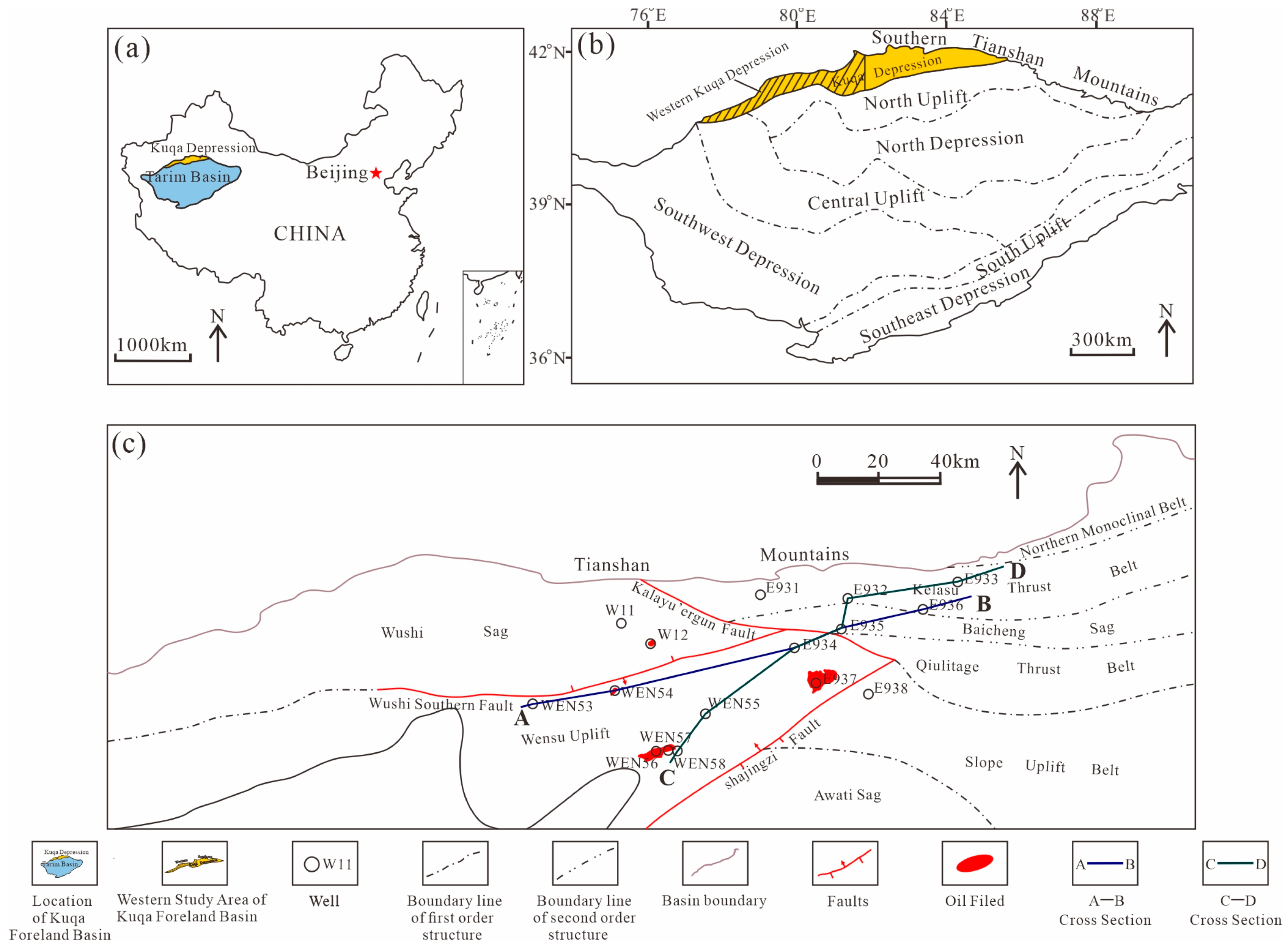
The Kuqa Foreland Basin is located between the northern margin of the Tarim Basin and the southern edge of the Tianshan Orogenic Belt. It represents a Mesozoic–Cenozoic composite foreland basin developed on a Paleozoic passive continental margin basement [
15]. Within the western part of the basin, several structural belts were developed sequentially from north to south, including the Northern Monocline Belt, the Karasu Thrust Belt, the Qiulitage Thrust Belt, and the Southern Slope–Uplift Belt. This study focused on the Wensu Uplift in the western part of the study area and the slope zone to the southeast (
Figure 1).
The tectonic evolution of the basin can be divided into two main phases. During the early phase (approximately 16–5 Ma), tectonic activity in the eastern part of the study area remained relatively stable, whereas the western Wensu Uplift experienced initial uplift. This uplift caused extensive erosion of elevated areas and resulted in direct stratigraphic contact between the Cambrian–Ordovician sequences and overlying Neogene succession. During the late phase (since approximately 5 Ma), the eastern part of the study area was characterised by the intense development of thrust faults and compressional folds driven by near north–south compression between the New Tianshan and Tarim plates. These processes led to the gradual formation of the Karasu and Qiulitage structural belts [
16,
17]. Concurrently, uplift of the western Wensu Uplift intensified further, and early stage thrust faulting persisted in the WEN54 area. This faulting produced fault-nose structural traps within the shallow Neogene Jidike Formation, reflecting typical forearc-basin tectonic and sedimentary characteristics [
18,
19,
20].
Triassic and Jurassic lacustrine mudstones developed in the Baicheng Sag in the northeastern part of the study area represent the primary hydrocarbon source rocks of the region and are characterised by high organic matter abundance, dominated by Type II–III kerogen. Thermal evolution analysis shows that peak oil generation of the Triassic Huangshanjie Formation source rocks occurred approximately between 23 and 12 Ma, accompanied by a gradual westward migration of the hydrocarbon generation centre from the eastern Baicheng Sag. In contrast, peak oil generation of the Jurassic Qiakemake Formation lacustrine source rocks occurred between approximately 5 and 2 Ma, during which the hydrocarbon generation centre expanded outwards from the western Baicheng Sag. Consequently, hydrocarbon distribution in the study area is controlled by the spatiotemporal evolution of these major hydrocarbon generation centres [
21,
22].
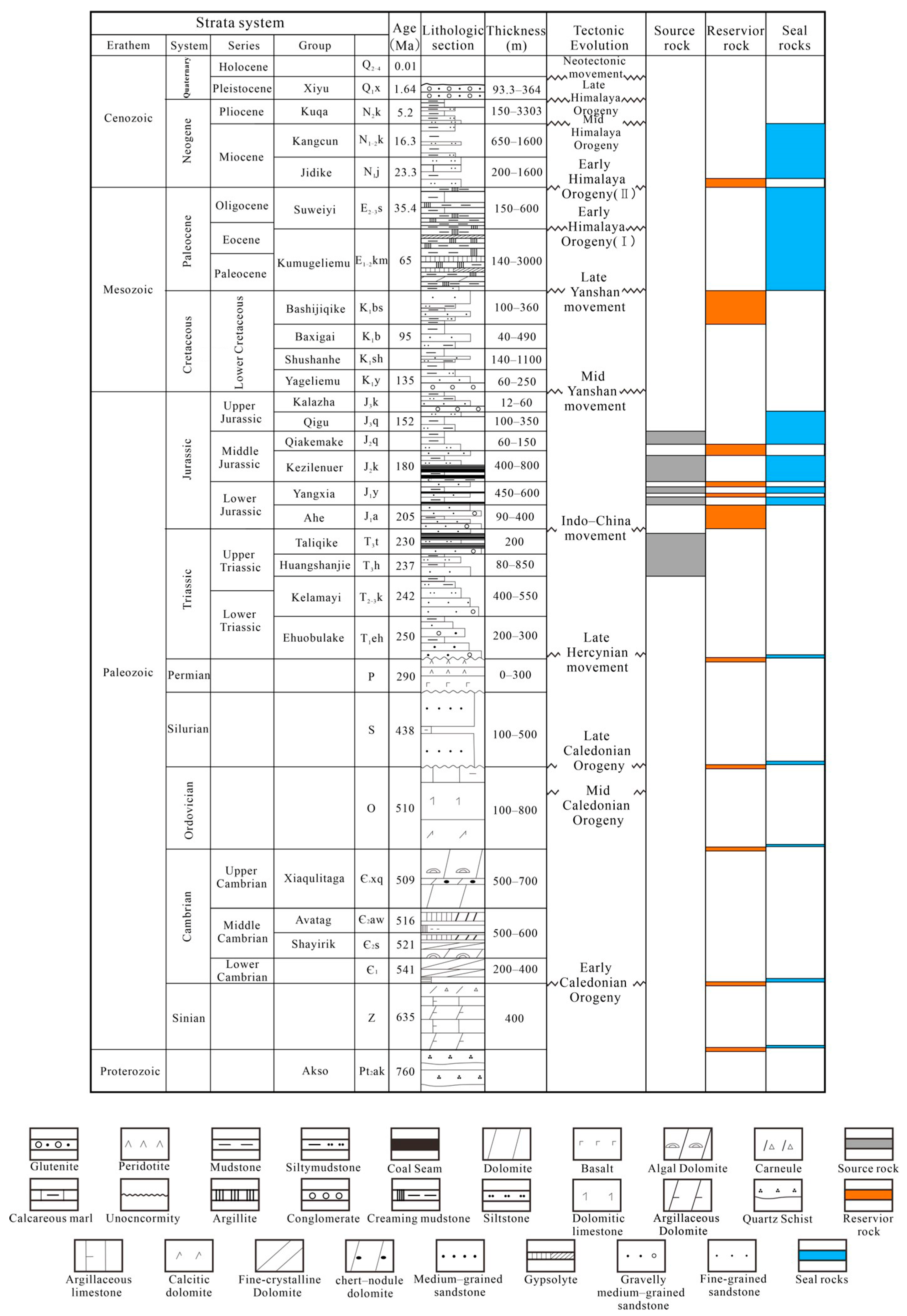
The weathered crust of buried hills and the sandstones of the Neogene Jidike Formation are the principal reservoirs in the study area. Together with the thick Palaeogene salt-bearing cap rock in the eastern region and the Neogene Jidike Formation mudstone cap rock in the western region, these reservoirs form multiple vertically stacked reservoir–cap rock assemblages (
Figure 2). Hydrocarbon reservoirs have been identified in several stratigraphic intervals, including sandstone units of the Neogene Jidike Formation and buried-hill weathered-crust reservoirs developed in Cambrian, Ordovician, and Silurian strata [
23]. Among these, weathered crust reservoirs are mainly distributed in wells E937, WEN54, WEN56, and WEN58, whereas sandstone reservoirs of the Neogene Jidike Formation occur predominantly in wells WEN54, WEN56, WEN57, and WEN58.
Figure 1.
(
a) Geographical location of the Tarim Basin; (
b) tectonic units of the Tarim Basin and location of the Kuqa Depression along its northern margin (modified after [
24]); (
c) structural framework, major oil and gas fields, sample locations, and cross-section lines AB and CD in the western Kuqa Depression (modified after [
24]).
Figure 1.
(
a) Geographical location of the Tarim Basin; (
b) tectonic units of the Tarim Basin and location of the Kuqa Depression along its northern margin (modified after [
24]); (
c) structural framework, major oil and gas fields, sample locations, and cross-section lines AB and CD in the western Kuqa Depression (modified after [
24]).
Figure 2.
Composite stratigraphic column of the western Kuqa Foreland Depression.
Figure 2.
Composite stratigraphic column of the western Kuqa Foreland Depression.
3. Method and Data
Hubbert (1953) established the theoretical foundation for studies of hydrocarbon migration and fluid potential, proposing that buoyancy is the primary driving force for secondary hydrocarbon migration [
1]. The magnitude of this force is primarily controlled by the density difference between hydrocarbons and formation water (Equation (1)).
where Φ
o denotes the fluid potential per unit mass of the oil phase (unit: erg/g), Φ
W denotes the fluid potential per unit mass of the water phase (unit: erg/g), ρ
W is the formation water density (unit: g/cm
3), ρ
o is the crude oil density (unit: g/cm
3), g is the gravitational acceleration (constant, 980 cm/s
2), z is the burial depth (unit: cm),
represents the contribution of water fluid potential to the oil potential, and
represents the gravitational contribution to the oil potential.
The migration of free oil and gas within reservoirs is governed by the mechanical equilibrium among buoyancy, hydrodynamic forces, capillary forces, and pore fluid pressure [
25,
26]. Building on the fluid potential theory proposed by Hubbert (1953) [
1], England et al. (1987) introduced oil dynamic potential parameters into quantitative analyses of secondary hydrocarbon migration [
3]. Subsequent studies demonstrated that this parameter can effectively quantify the driving forces acting during migration, thereby providing critical constraints on both the magnitude and direction of secondary migration processes (Equation (2)). This theoretical framework links microscopic pore-scale mechanics with macroscopic migration pathways and is consistent with observed dominant hydrocarbon migration routes. Consequently, its applicability in numerical simulations of hydrocarbon migration has been widely recognised.
Here, ΦP denotes the petroleum potential (unit: Pa or J/m3), ΦW denotes the water potential (unit: Pa or J/m3), ρW − ρP denotes the density difference between formation water and crude oil (kg/m3), and g and z are the gravitational acceleration (m/s2) and burial depth (m), respectively. The term 2γ/r is the capillary pressure, where γ is the interfacial tension coefficient (unit: N/m or J/m2), and r is the radius of curvature (unit: m).
By integrating fluid inclusion isothermal data with single-well stratigraphic burial histories and thermal history simulation results, the principal hydrocarbon accumulation stages in the study area were identified. Burial and thermal history simulations were conducted using Schlumberger IES PetroMod 2016.2 software.
Using the geological modelling software IES PetroMod 2016.2, palaeo-fluid potential fields corresponding to each hydrocarbon accumulation phase were reconstructed. Among the input parameters, crude oil density and reservoir paleoburial depth are the key factors controlling the accuracy of fluid potential calculations and the assessment of hydrocarbon accumulation potential. Paleoburial depth data for each accumulation phase were obtained from palaeotectonic maps. For fluid potential calculations, formation water density and gravitational acceleration were uniformly set to 1.03 g/cm3 and 9.8 m/s2, respectively. By integrating palaeo-fluid potential characteristics with present-day crude oil density and carbon isotope data, dominant hydrocarbon migration pathways during the early and late accumulation phases were quantitatively analysed. Crude oil density and carbon isotope data were obtained from the public geological database of the oilfield in the study area and core analysis reports provided by collaborating partners and were analysed using gas chromatography–isotope ratio mass spectrometry (GC–IRMS).
The identification and restoration of structural ridges at the top of weathered crust reservoirs in buried hills during different hydrocarbon accumulation phases were conducted using a combination of Move 2010.1 and IES PetroMod 2016.2 software. The workflow consisted of several steps. First, present-day elevation data of the pre-Cretaceous top surface were converted into a PetroMod-compatible format, and contour maps were generated to delineate present-day structural ridges and closed high-point areas. To reconstruct the spatial distribution of palaeotectonic ridges during earlier stages, systematic palaeotectonic restoration was performed. This process included the removal of younger sedimentary strata, application of decompaction corrections to restore original stratigraphic thicknesses and palaeoburial depths, reconstruction of eroded stratigraphic sequences and structural geometries through erosion restoration, and restoration of fault-related stratigraphic offsets to re-establish continuous layers. Finally, using the mudstone layer at the top of the restored strata as a reference horizon, a layer-levelling procedure was applied to structural cross-sections to remove tectonic deformation that occurred after the target period. This approach enabled reconstruction of the palaeo-structural morphology at the top of the buried-hill reservoirs and identification of positive structural ridges and closed high-point convergence zones. Consequently, the morphology and spatial distribution of structural ridges can be reconstructed in detail [
27].
By reconstructing the spatial distribution of connected sandstone ridges, highly permeable unconformities, and source rock faults for each hydrocarbon accumulation phase, a dynamic evolutionary model of the coupled ‘fault–unconformity–sandstone ridge’ hydrocarbon migration system was established. Based on this model, favourable hydrocarbon accumulation zones within the study area were predicted, and the results were cross-validated and assessed for reliability using drilling and logging data.
The fluorescence characteristics of organic inclusions were observed using a Nikon 80i dual-channel fluorescence microscope (Nikon Corporation, Tokyo, Japan). Dual-channel imaging was employed to analyse the occurrence state and fluorescence intensity of organic components within the inclusions. Microscopic thermometry of the fluid inclusions was performed using a Linkam MDSG 600 microthermostage (Linkam Scientific Instruments Ltd., Surrey, UK) coupled with a Leica DMLP polarising microscope (Leica Microsystems GmbH, Wetzlar, Germany), enabling real-time monitoring of phase transitions in inclusions at elevated temperatures.
Based on the geological characteristics of the western segment of the southern slope of the Kuqa Foreland Basin and the objectives of this study, a numerical simulation workflow was implemented using IES PetroMod 2016.2. The workflow comprised data preprocessing, including the integration of drilling, logging, and seismic data, followed by the construction of a three-dimensional geological model, parameter assignment, hydrocarbon migration simulation, and result validation through comparison with known hydrocarbon discoveries. The key simulation configurations and their rationales are described below. Hydrocarbon migration was simulated using the software’s built-in Darcy flow–streamline combined algorithm, which integrates the advantages of both approaches to achieve a balance between simulation accuracy and computational efficiency. In addition, the integrated multi-component, multi-phase hydrocarbon generation and migration module of PetroMod was employed to characterise the dynamic evolution of migration pathways in the study area. This capability is particularly important for capturing migration pathway adjustments induced by extensive faulting associated with multi-stage Himalayan tectonic activity. A structured grid with a resolution of 200 m in the horizontal direction and 10 m in the vertical direction was employed. The horizontal resolution is consistent with seismic interpretation accuracy, whereas the vertical resolution allows precise representation of the thin Palaeogene salt-bearing gypsum cap rock. Stratigraphic properties were constrained using core, logging, and sedimentary facies data. Porosity was calibrated as a function of depth using 12 core samples, and permeability was derived from porosity using the Carman–Kozeny equation. Fault properties were classified based on seismic interpretation as either open faults (with permeabilities of 100–1000 mD and acting as migration pathways) or closed faults (with permeabilities < 1 mD and functioning as sealing barriers). This classification is consistent with the multi-stage tectonic activity during the Himalayan orogeny. In the simulations, all faults active during the accumulation period were treated as open. Boundary conditions were specified as follows. Palaeo-water depth was calibrated using palaeontological, palaeoecological, and authigenic mineral data. As the study area represents an inland lacustrine basin, water-depth influence was neglected in the sedimentation history analysis. Sediment–water interface temperature was automatically generated by the software based on the geographical setting of the study area (Northern Hemisphere, East Asian continent, 41° N). Palaeo-heat flow values were directly assigned from existing oilfield data [
28].
4. Results
4.1. Accumulation Period
Thin-section observations indicate that target fluid inclusions occurred mainly in two reservoir settings. The first type was distributed in bands along post-diagenetic microfractures that cut across quartz grains, whereas the second type occurred within intergranular dissolution pores and fracture networks. These inclusions were trapped during reservoir cement precipitation and microfracture healing. Their formation records information on temperature, pressure, and fluid composition during hydrocarbon migration and reservoir filling, thereby providing reliable evidence for reconstructing palaeogeothermal conditions and identifying key hydrocarbon accumulation phases. Currently, fluid inclusion thermometry is widely recognised as an important technique for investigating hydrocarbon accumulation stages and processes [
29].
Fluid inclusion microthermometry was conducted on 75 core samples collected from wells W12, E937, WEN54, WEN55, WEN56, and WEN58, and the results were integrated with the regional thermal evolution history to reconstruct the timing of hydrocarbon-filling.
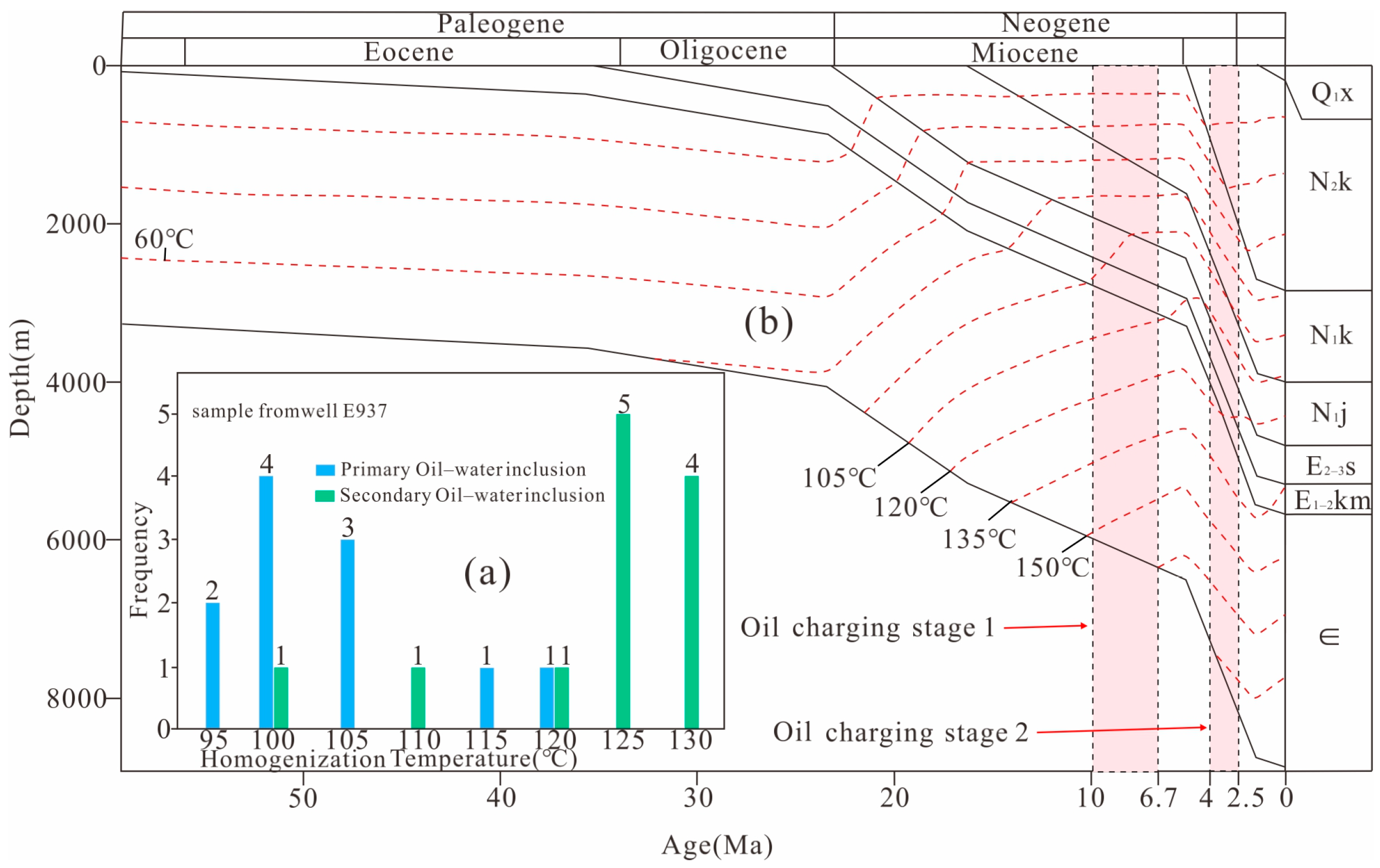
Figure 3 presents a histogram of homogenisation temperatures obtained from Cambrian buried-hill reservoir samples in the 5690–5756 m interval of well E937. The results showed that homogenisation temperatures of brine inclusions associated with primary oil inclusions during the first stage mainly ranged from 95 to 105 °C, whereas those related to secondary oil inclusions predominantly fell between 120 and 130 °C. When combined with burial and thermal history simulation results for well E937 (
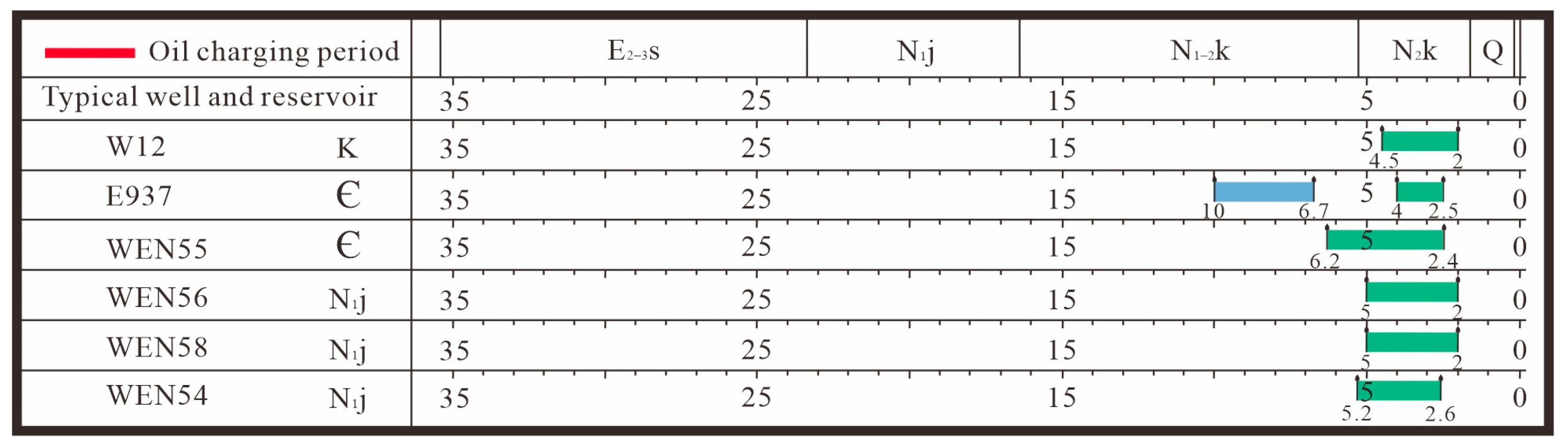
Figure 3), these temperature intervals corresponded to burial stages at approximately 10–6.7 Ma and 4–2.5 Ma, respectively. By integrating data from all representative wells with the simulation results, hydrocarbon accumulation stages in the study area were identified (
Figure 4), confirming two distinct phases: early (16–5 Ma) and late stages (5–0 Ma).
4.2. Direction of Hydrocarbon Migration
Since the late 1970s, quantitative studies on hydrocarbon migration based on petroleum composition have been widely conducted [
30]. In this study, the planar distribution of fluid potential was integrated with systematic variations in crude oil density and carbon isotope composition to comprehensively determine the dominant hydrocarbon migration directions during the early and late accumulation phases in the study area.
4.2.1. Fluid Potential
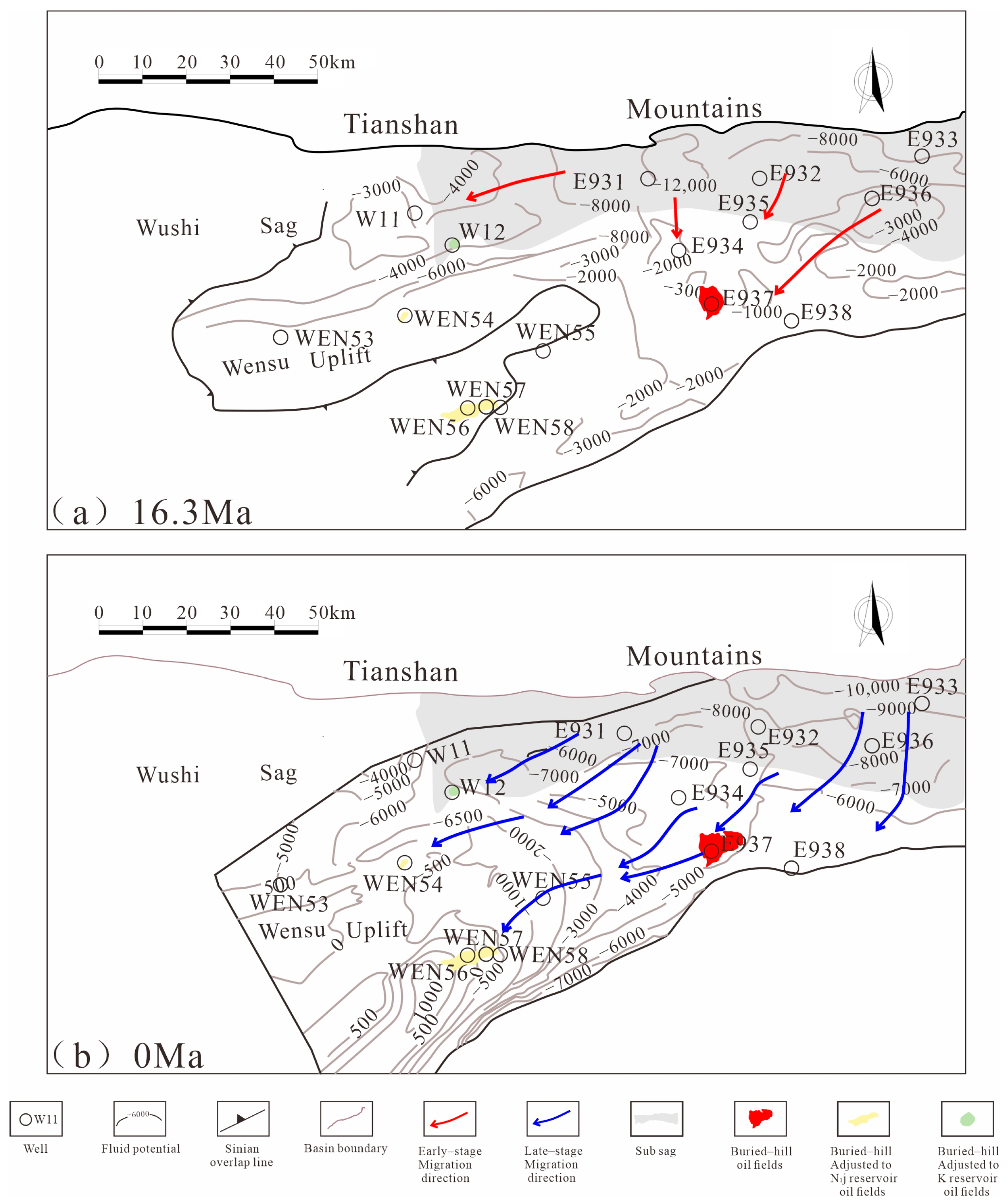
During hydrocarbon migration, fluids generally flow from zones of high potential to zones of low potential. By quantitatively analysing fluid potential across different accumulation phases using Equation (2) and integrating these results with crude oil density distributions, the evolutionary trends of fluid potential for each stage were reconstructed. The fluid potential evolution schematic shown in
Figure 5 aligns with the quantitative analysis of fluid potential gradients (Equation (2)), revealing the dominant migration direction of hydrocarbons from the Baicheng Sag (high-potential zone) toward tectonic highs (low-potential zones). Results indicate that the southeastern and southwestern parts of the study area constitute primary low-potential zones, while high-potential zones closely correspond to the Baicheng Sag.
During the early hydrocarbon accumulation phase (16–5 Ma), hydrocarbon migration exhibited four principal trends: (1) from E936 to E938; (2) from E932 to E935; (3) from E931 to E934; and (4) from E931 westward to W11.
During the late hydrocarbon accumulation phase (5–0 Ma), overall migration distances increased, and a southwestward convergence pattern developed. Specifically, hydrocarbons from E936 continued to migrate towards E938, and two major migration pathways developed west of well E936. The first pathway extended along E932, E935, and E937 towards WEN55, WEN56, WEN57, and WEN58, whereas the second pathway ran from E932, E935, and E934 towards WEN55, WEN56, WEN57, and WEN58. In the western part of the study area, hydrocarbons from E931 migrated in two directions: towards W12 and WEN54 [
14,
22].
4.2.2. Crude Oil Density and Carbon Isotope
Existing studies indicate that hydrocarbons undergo oxidation during migration, leading to continuous loss of lighter components. This process results in a systematic increase in crude oil density with increasing migration distance, a pattern documented in multiple sedimentary basins [
31,
32]. For example, using crude oil density and geochemical analyses, Huang [
33] showed that denser crude oils in the Enping Formation of the southern Lufeng area of the Pearl River Mouth Basin occurred closer to hydrocarbon accumulation centres. These observations provide valuable evidence for tracing hydrocarbon migration pathways in terrestrial basins.
The crude oils in the study area share a common origin, having been derived from Triassic–Jurassic lacustrine source rocks in the Baicheng Sag. This interpretation is supported by source rock geochemistry and oil-source correlation analyses [
34]. Consequently, variations in the physical properties and carbon isotope compositions of crude oils from different stratigraphic units serve as effective indicators for reconstructing late-stage hydrocarbon migration pathways.
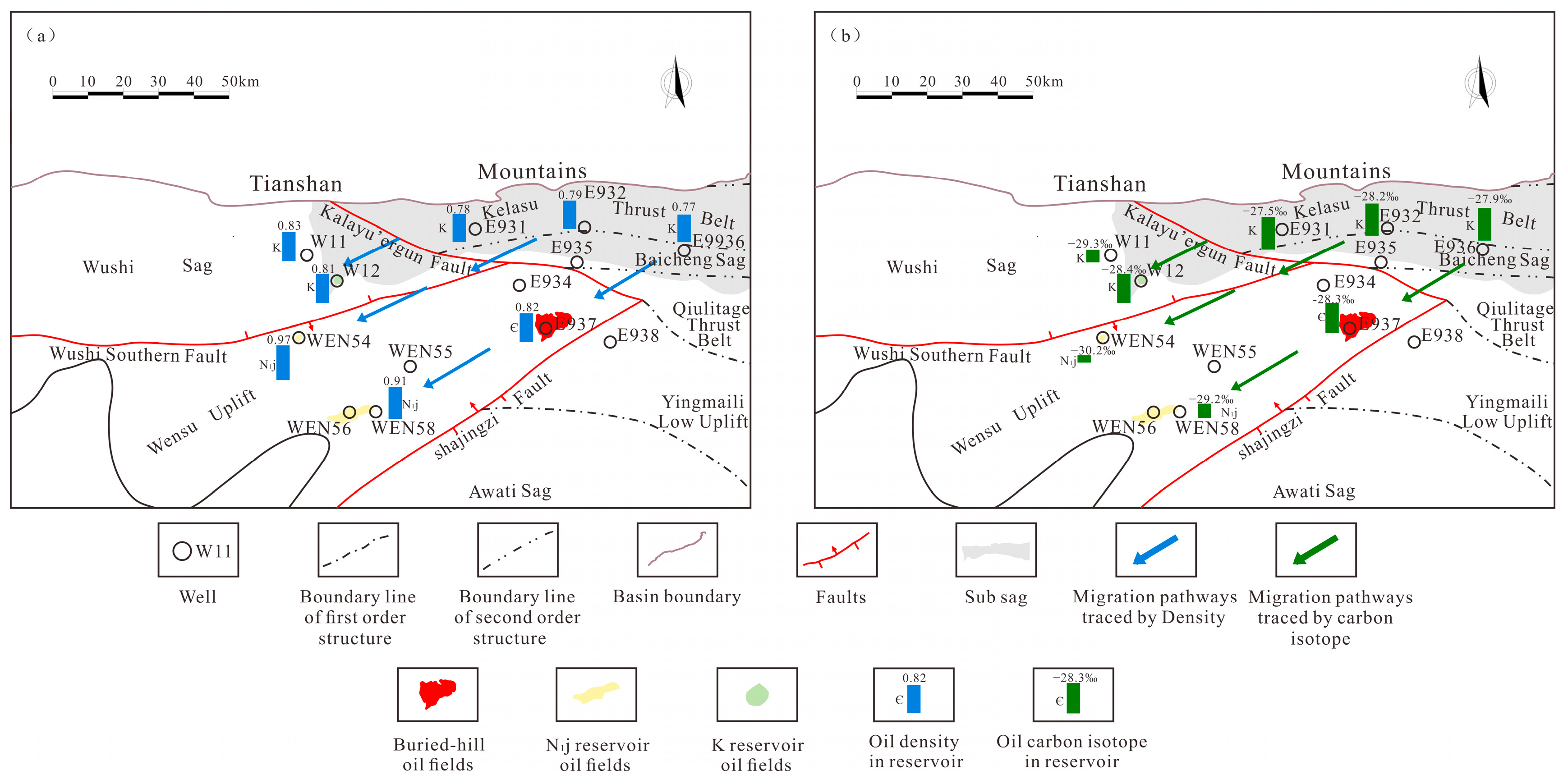
Based on the responses of crude oil density and carbon isotope composition to migration distance and burial depth, late-stage accumulated crude oils in the study area exhibited distinct distance- and depth-dependent trends. In terms of density, values increased progressively from 0.79 g/cm
3 at burial depths exceeding 7000 m in the northeastern Baicheng Sag to 0.91 g/cm
3 at depths shallower than 1500 m in the southwestern Wensu Uplift (
Figure 6a). This trend indicates an overall increase in crude oil density with increasing migration distance and decreasing burial depth. In contrast, carbon isotope values decreased from −28.2‰ at burial depths greater than 7000 m in the Baicheng Sag to −30.2‰ at depths less than 1500 m in the Wensu Uplift (
Figure 6b). This pattern reflects an overall decline in the carbon isotope values with increasing migration distance and decreasing burial depth.
Crude oil from the Jidike Formation in wells WEN54, WEN56, and WEN58 of the Wensu Uplift is predominantly medium- to heavy-viscosity oil, and its characteristics are largely controlled by regional geological conditions. The Wensu Uplift is shallowly buried and overlain by mudstone cap rocks with a relatively weak sealing capacity. Consequently, crude oil in this area has been exposed to a relatively open environment for an extended period, undergoing intense biodegradation and water washing, which led to the formation of viscous oil reservoirs. Analyses indicated that crude oil densities in these wells were generally high and increased with greater migration distance and shallower burial depth. This trend is closely related to the Cenozoic uplift of the Wensu Uplift. On the one hand, shallow burial conditions enhance susceptibility to biodegradation and water washing, thereby significantly increasing crude oil density. On the other hand, during east-to-west and deep-to-shallow migration, the continuous loss of light components, combined with degradation processes, further intensifies density increases. Collectively, these processes reflect the overall hydrocarbon migration characteristics of the study area.
In terms of spatial distribution, crude oil densities in wells E936, E932, and E931 within the Baicheng Sag were generally lower than those in the elevated Wensu Uplift region, including wells WEN56, WEN57, WEN58, and WEN54, as well as adjacent wells. In contrast, carbon isotope values (δ13C) in the Baicheng Sag were significantly higher. By integrating spatial variations in the physical properties of crude oil with geochemical indicators, the principal hydrocarbon migration pathways were identified as migration from E931 to W12, from E932 to WEN54, and from E936 via E937 to WEN56, WEN57, and WEN58.
4.3. Hydrocarbon Migration Pathway
4.3.1. Structure Ridge
Driven by buoyancy, hydrocarbons typically migrate laterally over long distances along structural ridges at the top of reservoirs. Reservoir heterogeneity does not diminish the role of structural ridges as the primary controlling factor for secondary hydrocarbon migration. Instead, the morphology, continuity, burial depth, and spatial distribution of structural ridges during key accumulation phases collectively control the selection of hydrocarbon migration pathways and the scale of hydrocarbon accumulation [
35].
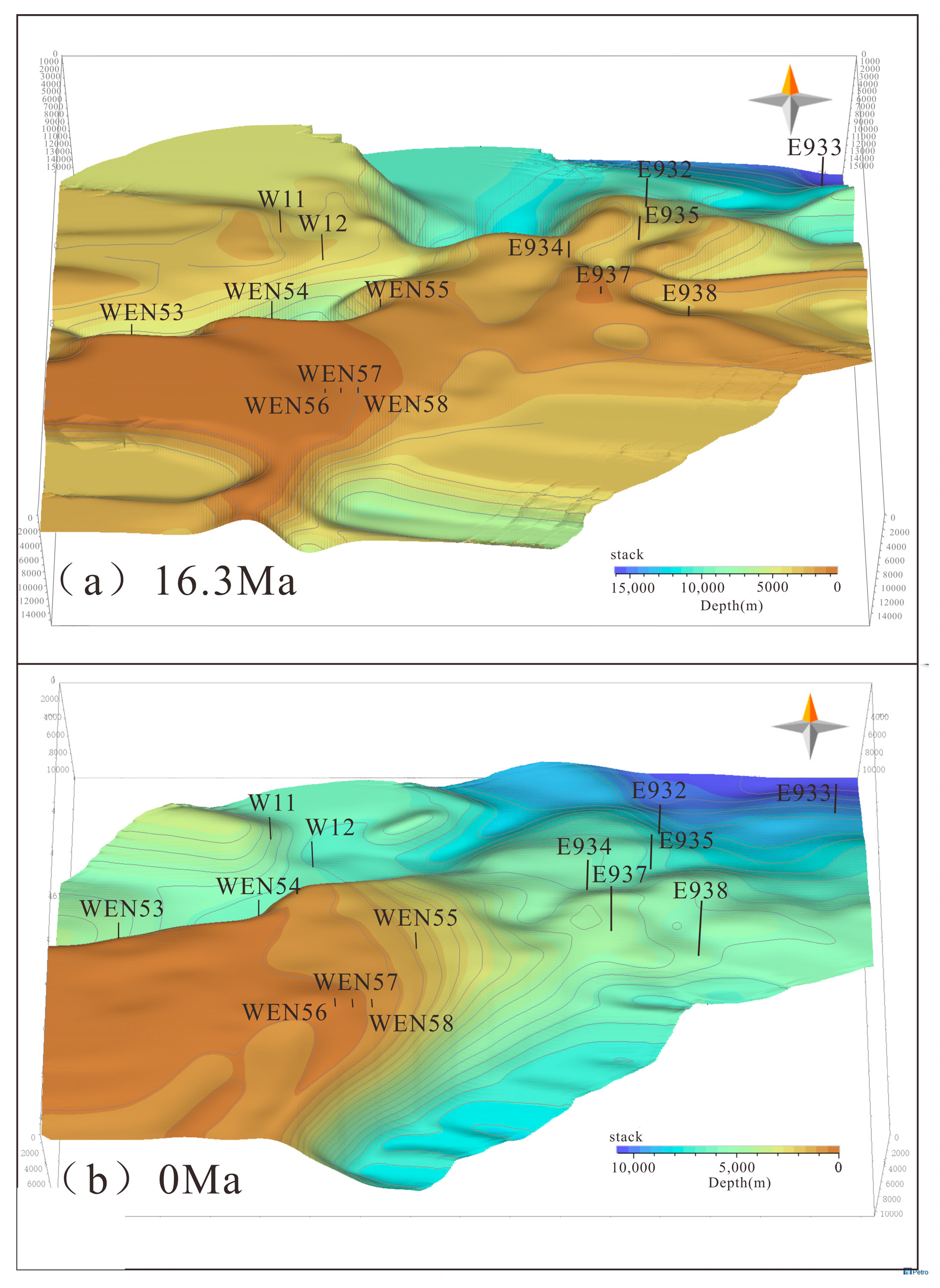
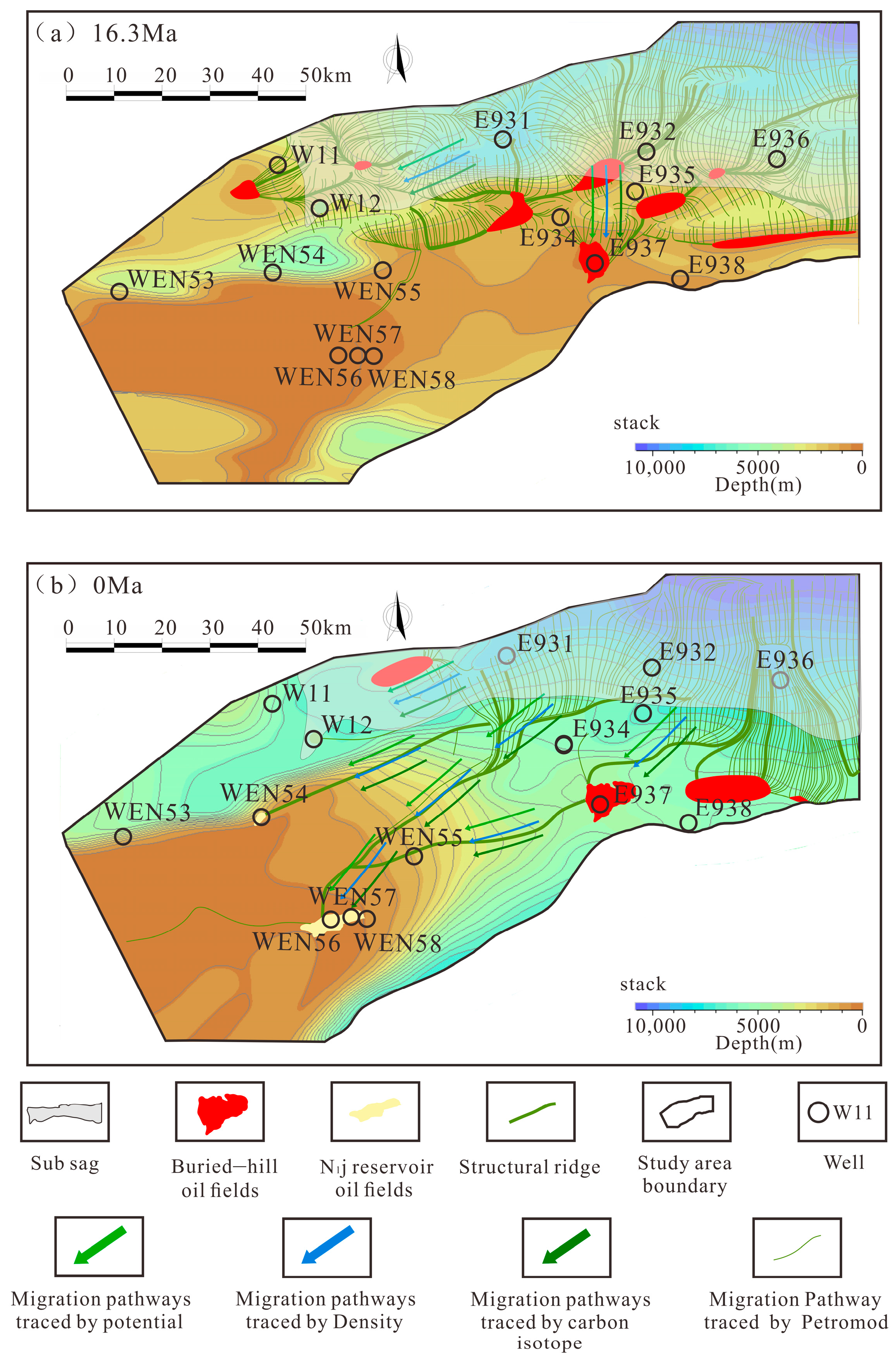
This study, based on the latest high-precision three-dimensional structural map of the buried-hill reservoir top surface, employed a combined approach of structural surface curvature analysis and trend surface fitting in the software IES PetroMod 2016.2. This approach was used to systematically identify the distribution of structural ridges within the pre-Cretaceous buried-hill weathering crust reservoir during two hydrocarbon accumulation stages: the early (16–5 Ma) and late (5–0 Ma) stages (
Figure 7). The specific identification criteria were as follows: along the structural undulations of the reservoir top surface, trajectories exhibiting continuously positive curvature and relatively high elevation were selected as ridges to ensure they represent the spatial trend of structural highs.
The uncertainty in structural ridge identification primarily stems from the following aspects: (1) Data resolution limitations: the grid resolution of the original three-dimensional structural maps may affect the accuracy of identifying subtle structures; (2) Complex structural interference: in areas with extensive fault development or structural superimposition, the continuity of ridge lines may be disrupted; (3) Variations in manual interpretation: subjective judgment may influence the trend-fitting process. To reduce uncertainty and validate reliability, the identified ridges were cross-checked against actual drilling data and known fault distributions. The results show a good correspondence between the identified ridges and the distribution of discovered hydrocarbon reservoirs.
Simulation results demonstrate: During the early phase, structural ridges were mainly distributed west of the Baicheng Sag, near W12, north of WEN55, and in the vicinity of well E937. In the southwestern part of the study area, including wells WEN54, WEN56, WEN57, and WEN58, structural ridges were also developed within the buried-hill weathered crust reservoirs. However, their greater distance from Triassic source rock hydrocarbon generation centres limited the development of efficient migration pathways and hindered large-scale hydrocarbon accumulation. Combined with structural evolution analyses [
36,
37], this stage corresponds to a transitional tectonic regime from weak extension to compression, characterised by overall tectonic stability across the study area (
Figure 8a).
During the second hydrocarbon accumulation phase, the study area was influenced by far-field effects associated with northward subduction of the Indian Plate during the Late Himalayan orogeny (approximately 5 Ma), resulting in NW–SE-directed reverse thrusting. This tectonic process expanded hydrocarbon accumulation zones within the pre-Cretaceous buried-hill weathered crust reservoirs. Structural ridge distributions extended southwestward while largely inheriting the pattern established during the early phase. The southern Baicheng Sag, near well E937, remained the primary area for structural ridge development. In contrast, in the southwestern well areas, including WEN54, WEN56, WEN57, and WEN58, the closer proximity to the Jurassic hydrocarbon generation centre enabled effective hydrocarbon charging of the buried-hill weathered-crust reservoirs. Consequently, new and extensive hydrocarbon accumulation zones developed in the western part of the study area (
Figure 8b).
4.3.2. Sandstone and Unconformity Lateral Conduit Systems
Sandstone conduit systems are key pathways for long-distance hydrocarbon migration and are characterised by high continuity, permeability, and connectivity [
38]. Their conductive capacity is controlled by multiple factors, including lithological assemblages, tectonic setting, porosity, and permeability, and therefore exhibits pronounced heterogeneity [
39]. Unconformity conduit systems also act as important migration pathways for hydrocarbons and are commonly associated with regionally extensive, highly permeable ancient weathered crusts or palaeokarst zones. These features provide favourable conditions for long-distance hydrocarbon migration and the formation of large-scale hydrocarbon reservoirs [
40].
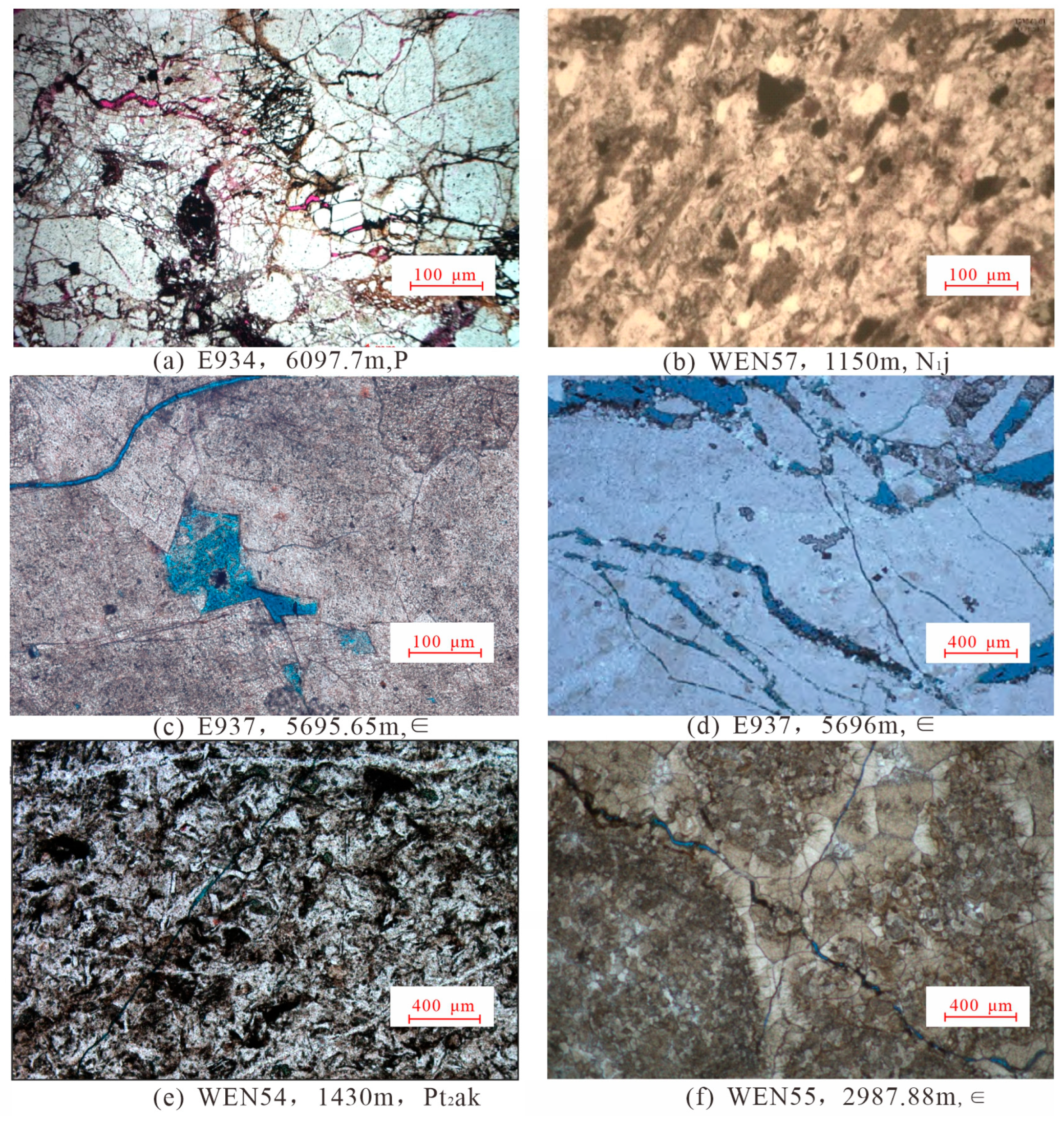
Based on optical microscopic examination of eight thin sections collected from different depths in wells WEN57, WEN54, E934, W12, E937, and WEN55 (
Figure 9), combined with pore-scale characterisation, residual primary intergranular pores were identified as the dominant pore type in Cenozoic clastic reservoirs. In contrast, reservoir space within the unconformity-associated semi-weathered rock layer at the base of the Cretaceous strata, corresponding to the top of the buried hill, was dominated by structural fractures and dissolution cavities. The integration of drilling and completion reports with thin-section analyses indicated substantial variations in lithology, reservoir space, and physical properties among coeval reservoir units in the study area. Specifically, the Mesoproterozoic Aksu Group, Cambrian–Ordovician buried-hill reservoirs (unconformity-associated semi-weathered rock conduit layers), and Neogene Jidike Formation sandstone reservoirs were classified as good to high-quality conduits. In contrast, Permian volcanic buried-hill reservoirs (unconformity-associated semi-weathered rock conduit layers) were classified as poor conduits. To standardise evaluation of conductive capacity across different lithologies, pore quality was categorised into three grades: good, moderate, and poor, based on
the Reservoir Evaluation Criteria for the study area (
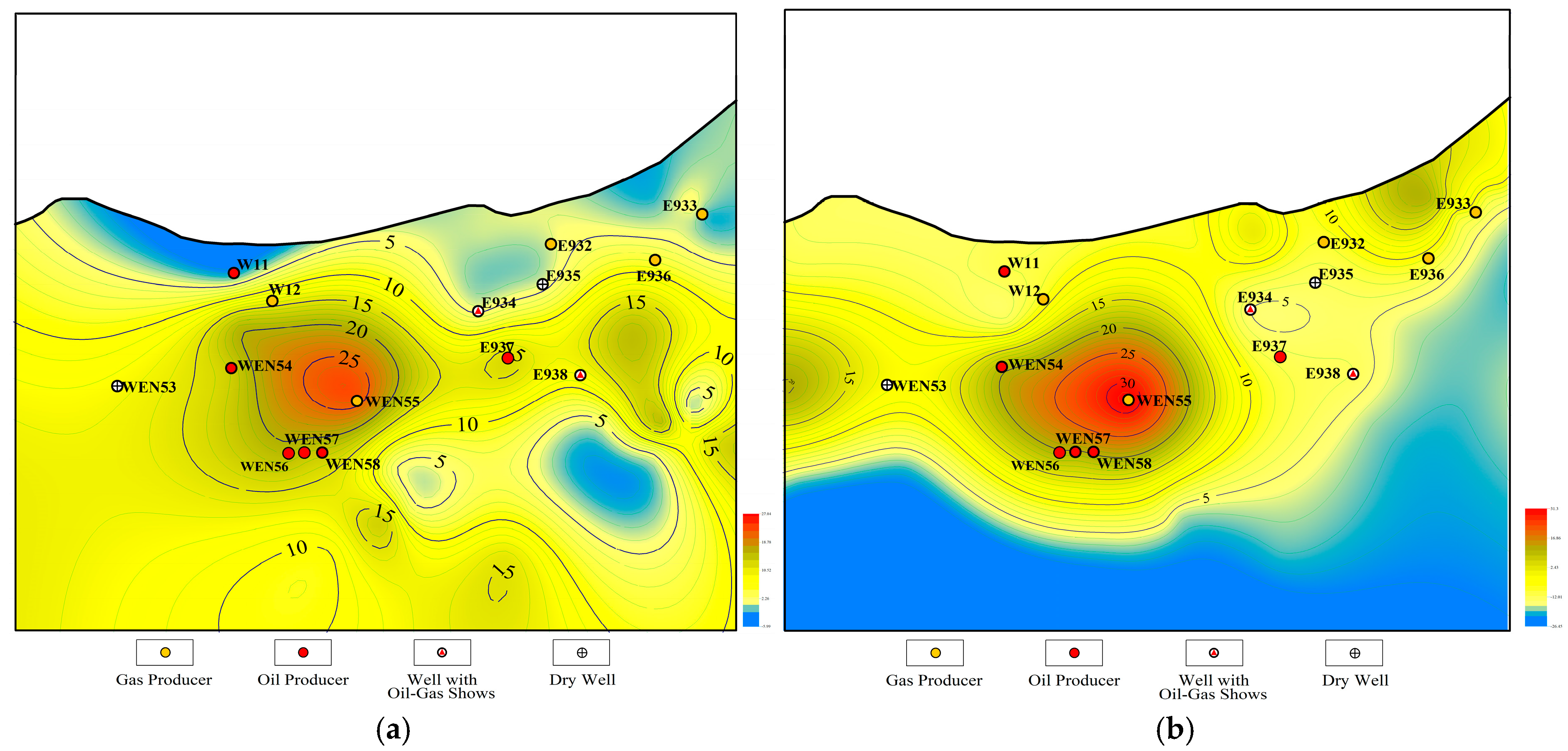
Table 1). Porosity index and conductive capacity contour maps were generated for two conduit layers: the pre-Cretaceous buried-hill top unconformity and the Neogene Jidike Formation sandstone (
Figure 10a,b). The results showed that high-conductivity zones during the late accumulation phase were strongly associated with dominant sedimentary facies belts and karst-developed areas, whereas low-conductivity zones were mainly distributed in volcanic buried hills, lacustrine mudstone zones, and tight carbonate areas.
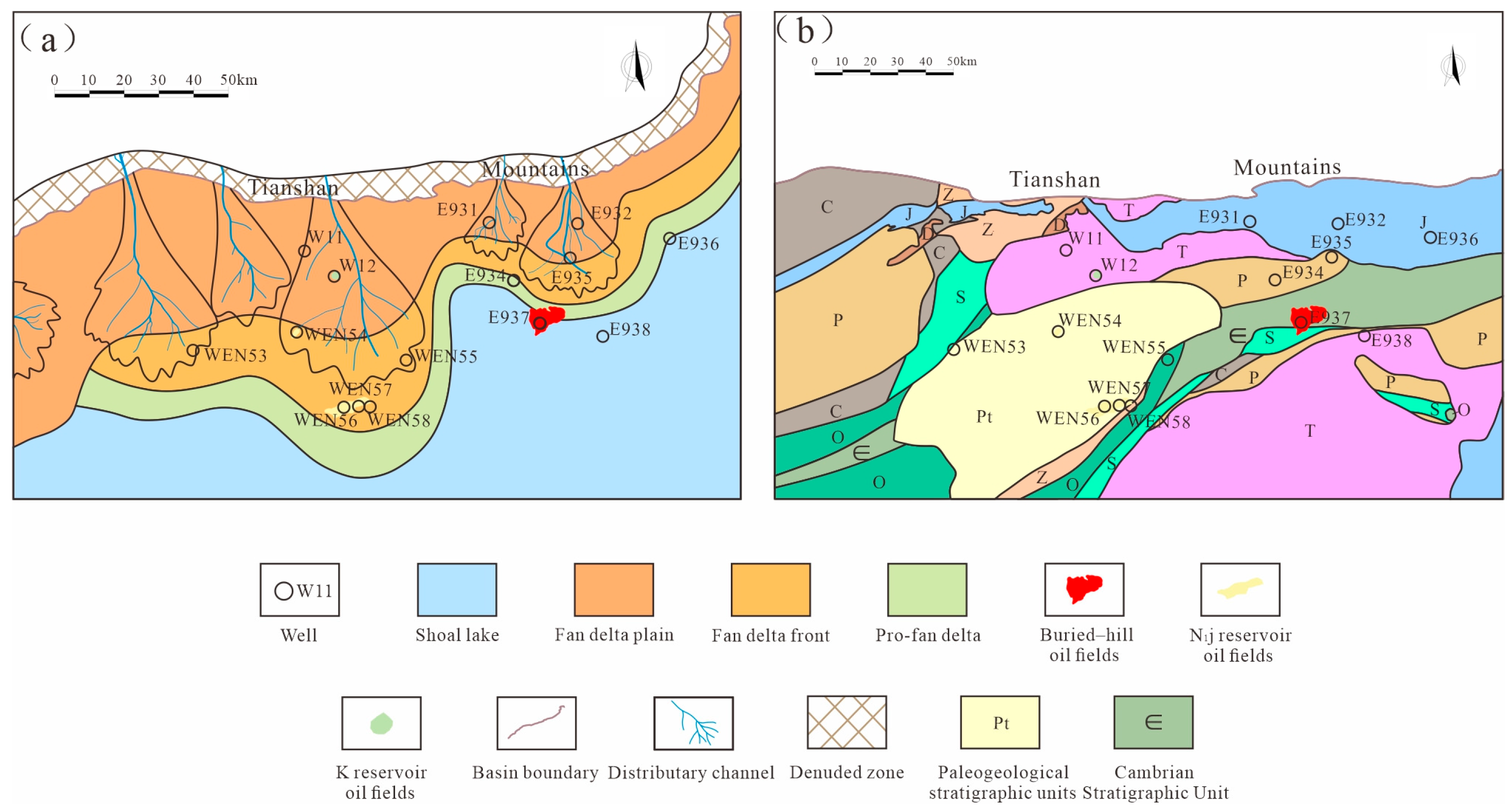
The unconformity conduit layer within the carbonate buried-hill zone on the southeastern slope of the study area formed during the early burial (~461 Ma). Early dolomitisation effectively preserved primary porosity, and this layer experienced no significant late-stage alteration during the early accumulation phase (~16 Ma). Consequently, both its porosity structure and conduit capacity exceeded present-day conditions. The unconformity conduit layer of the metamorphic basement in the Wensu Uplift underwent rapid deep burial beginning at approximately 23 Ma after prolonged uplift and erosion. Reduced compaction and the development of late-stage overpressure favoured pore preservation, resulting in porosity at 16 Ma that remained higher than that during the late accumulation phase. At 16 Ma, the Neogene Jidike Formation sandstone conduit system in the Wensu Uplift was still at the early diagenetic stage A, with calcite cementation not yet fully developed. Consequently, both porosity and conductivity were markedly higher than the present-day values. In contrast, the igneous buried-hill and lacustrine mudstone areas exhibited poor conductivity at 16 Ma because of lithological constraints (
Figure 11a,b) [
41,
42,
43].
In summary, since approximately 16 Ma, the key conduit systems in the study area have maintained effective porosity across most regions. Consequently, porosity evolution was not the primary factor controlling hydrocarbon migration pathways during the early or late accumulation phases. Therefore, subsequent analyses focused on the influence of tectonic factors, such as structural morphology and the distribution of structural ridges, on hydrocarbon migration.
4.3.3. Fault Vertical Migration System
Unlike sandstone and unconformity conduit systems, source rock faults generally exhibit higher migration efficiency, enabling cross-stratigraphic migration and acting as critical conduits that connect source rocks to traps. Fault activity typically follows a cyclic pattern and interacts with overburden pressure regimes. During active phases, fracture systems within fault zones open, forming effective pathways for hydrocarbon migration. During quiescent phases, these fractures tend to close under overburden loads and regional compressive stress. This episodic behaviour results in pulsed hydrocarbon charging. Hydrocarbons accumulate near fault zones during tectonic quiescence, and during renewed tectonic activity, faults reopen, enabling rapid migration into shallow traps. Collectively, these coupled processes promote efficient hydrocarbon accumulation in the basin.
A prerequisite for vertical hydrocarbon migration along faults is the temporal coupling between major hydrocarbon generation and expulsion from mature source rocks and periods of fault activity [
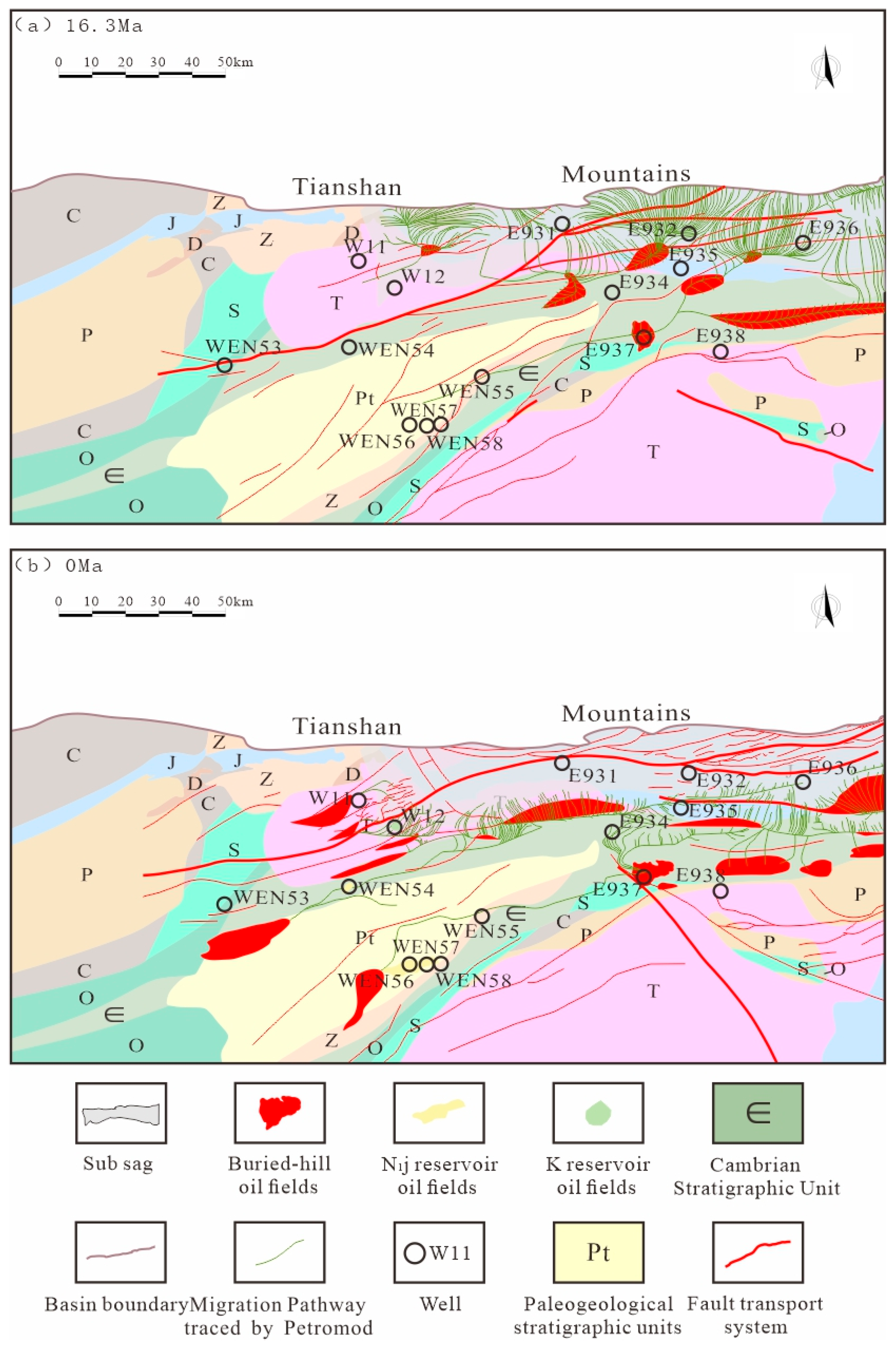
44]. To identify hydrocarbon sources associated with fault-controlled migration in the study area, source rock maturity was simulated using IES PetroMod 2016.2 software. This analysis defined effective source rock sequences associated with different faults, established their depth intervals, and determined a critical expulsion depth of 5800 m. During the early accumulation phase (16–5 Ma), this depth corresponded to the Triassic mudstone sequence within the Baicheng Sag. Only this sequence satisfied the conditions required for large-scale hydrocarbon generation and expulsion during this phase, thereby allowing hydrocarbons to migrate vertically along source faults. Early stage fault distribution maps were derived by projecting palaeotectonic restoration results from present-day east–west and north–south seismic and geological profiles. Fault maps for the late phase (5–0 Ma) were generated using the same approach (
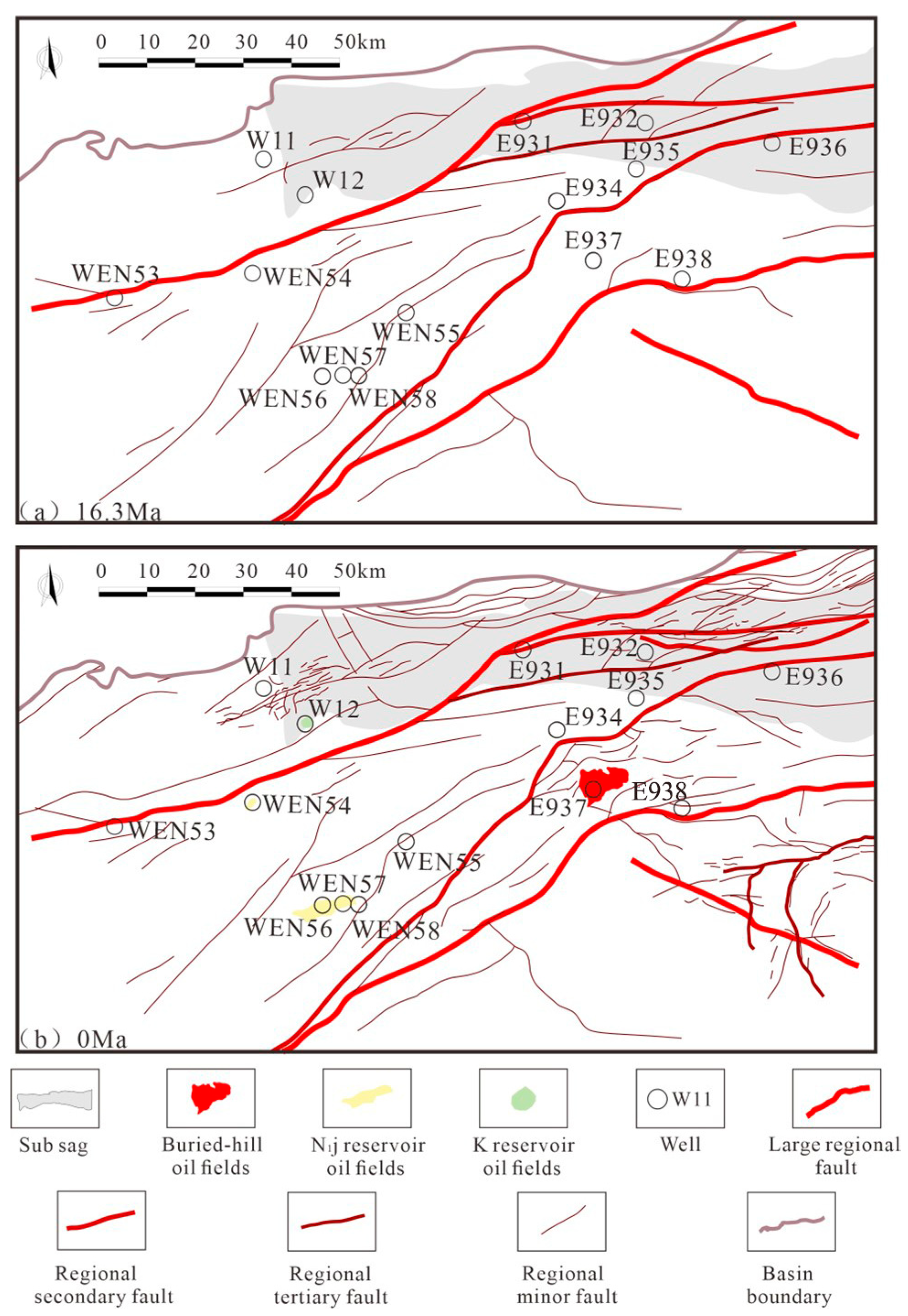
Figure 12). The results showed that early stage source faults trended predominantly NEE–SWW across the study area and were concentrated in the northern and central regions of the study area. During the late phase, influenced by Himalayan tectonics, the western part of the study area experienced uplift of the Wensu basement and shallow thrusting, leading to the development of a series of east–west- and north–south-trending extensional faults. In the northeastern region, the Baicheng Sag developed large-scale, north-dipping imbricate thrusts that cut into the source rocks and extended upward into the salt-bearing strata, forming the principal source faults of the Kuqa Depression. In contrast, shallow- to medium-depth accommodation normal faults in the southeastern slope zone were relatively small in scale and limited in vertical extent, mainly providing lateral sealing, controlling trap formation, and regulating vertical hydrocarbon distribution.
4.3.4. Migration System and Evolution
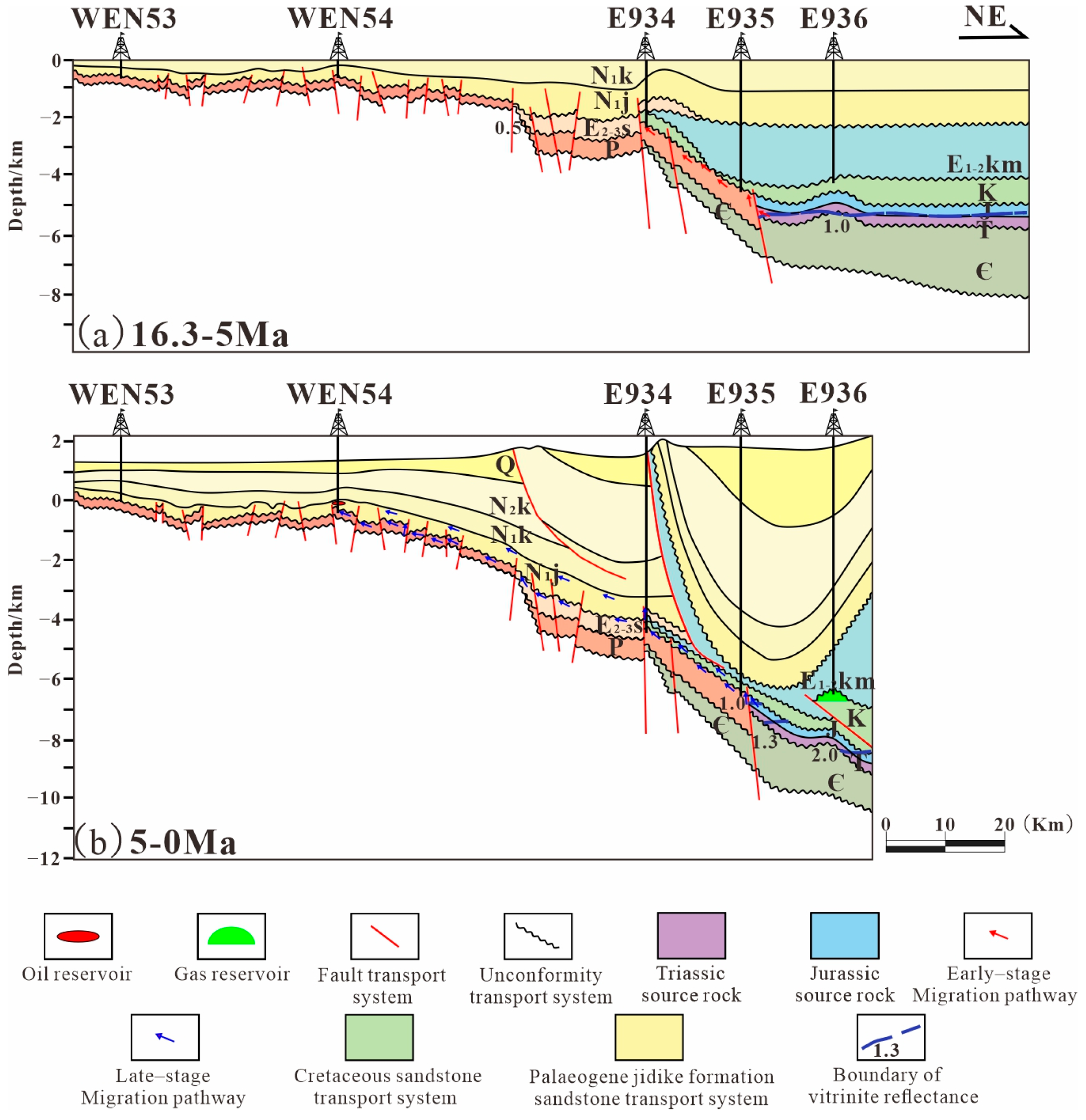
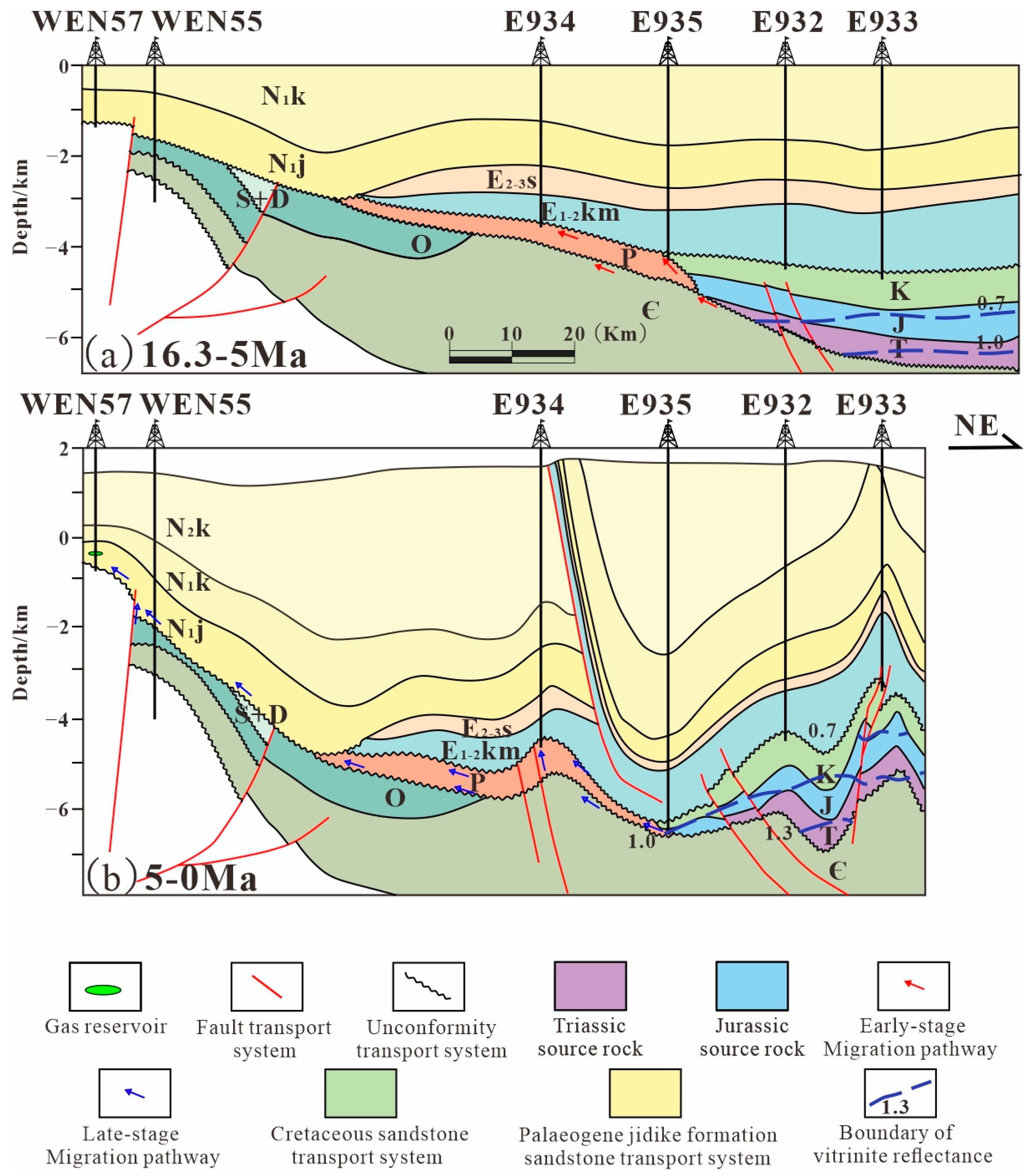
The evolution of the hydrocarbon migration system in the study area was reconstructed using two-dimensional and three-dimensional numerical simulation capabilities of IES PetroMod 2016.2 software (
Figure 13,
Figure 14 and
Figure 15).
The study area contains two principal source rock units: lacustrine source rocks of the Triassic Huangshanjie Formation and those of the Jurassic Qiakemake Formation. Based on the physical properties, chemical characteristics, and relative contributions of Triassic and Jurassic source rocks, the crude oils in the study area were classified into two types. One type comprised light- to medium-density crude oils, represented by well E937, whereas the other consisted of medium- to heavy-viscosity crude oils, exemplified by wells WEN56, WEN58, and WEN54 [
45].
Figure 13 and
Figure 14 illustrate that while the early-phase simulations highlight the critical role of source-rock maturation, the late-phase results demonstrate how the composite transport system subsequently facilitated large-scale hydrocarbon migration. Specifically, during the early phase (16–5 Ma), the Triassic source rocks west of the Baicheng Sag, along the sections of wells WEN54 and WEN57, had not reached maturity for large-scale hydrocarbon expulsion. Consequently, despite the presence of the unconformity conduit system, long-distance hydrocarbon migration to the Wensu Uplift was not possible. In contrast, during the late phase (5–0 Ma), both Triassic and Jurassic source rocks entered the mature stage and expelled hydrocarbons on a large scale. These hydrocarbons were then able to migrate and accumulate in the Wensu Uplift through the composite conduit system consisting of faults, unconformities, and sandstones.
Early hydrocarbon accumulation (16–5 Ma) was dominated by a single medium- to long-distance conduit system developed along the top unconformity of buried hills. During this phase, tectonic activity in the study area was relatively weak and occurred within a stable extensional regime under weak north–south compression. Stratigraphic deposition was relatively stable, with only minor thickness variation. Source rock faults were sparse and mainly concentrated in the northeastern Baicheng Sag. Owing to shallow burial conditions, unconformity reservoirs exhibited high porosity, favouring lateral hydrocarbon migration. As a result, hydrocarbons accumulated primarily in Cambrian buried-hill weathered-crust reservoirs, with traps mainly confined to areas adjacent to the Baicheng Sag and within the southeastern slope zone (
Figure 15a).
During the late phase (5–0 Ma), the hydrocarbon accumulation pattern evolved into a composite relay system composed of source faults, unconformities, and sandstone conduits. Although burial depth increased rapidly during this stage, favourable conditions inherited from the early accumulation phase, including high porosity and permeability, overpressure, and relatively low palaeotemperatures, contributed to the preservation of reservoir properties in both sandstone and carbonate weathered-crust reservoirs. Under continued north–south compression between the Tianshan and Tarim plates during the Late Neogene, the lateral conduit system extending from the east–west-trending Baicheng Sag to the Wensu Uplift was inherited and preserved. Intense compression led to the widespread development of folds, synsedimentary thrust faults, and thrust structures across the study area, resulting in a marked increase in the number of source rock faults during the late accumulation phase. Meanwhile, Jurassic hydrocarbon generation centres were located closer to traps in the western Wensu Uplift than those associated with Triassic source rocks. This proximity enabled hydrocarbons expelled from source rocks to migrate laterally over longer distances, ultimately reaching the Wensu Uplift (
Figure 13b,
Figure 14b and
Figure 15b).
The hydrocarbon charging locations, accumulation extents, and reservoir formation timing predicted by the simulations were highly consistent with data from discovered oilfields in the study area [
11], thereby further confirming the reliability of the simulation results.
5. Discussion
The central contribution of this study lies in its detailed characterisation of the dynamic evolution of the hydrocarbon transport system in the western Kuqa Foreland Basin. It demonstrates that the coupling between transport system evolution and migration of hydrocarbon generation kitchens jointly controls the contrasting accumulation patterns of ‘early near-source charging’ and ‘late far-source composite migration’. This perspective moves beyond static factor-based analyses and highlights the critical role of spatiotemporal evolution of the transport framework in governing regional hydrocarbon distribution.
Previous studies have identified two distinct hydrocarbon accumulation phases within the study area at 16–5 Ma and 5–0 Ma. This study advances previous work by systematically demonstrating that the transport system itself underwent a fundamental evolution linking these two phases. During the early phase (16–5 Ma), the migration system was relatively simple and dominated by unidirectional lateral migration along regional unconformities. Therefore, hydrocarbon accumulation was mainly proximal and constrained by the position of the Triassic source kitchen in the eastern Baicheng Sag. In contrast, during the late phase (5–0 Ma), coincident with westward migration of the Jurassic source kitchen and intensified Himalayan tectonism, the fault system experienced extensive development and reactivation. This evolution transformed the migration pattern into an efficient composite relay network composed of faults, unconformities, and sandstone bodies. The dynamically evolving transport network, coupled with the westward migration of hydrocarbon sources, provided effective pathways for long-distance westward hydrocarbon migration to the Wensu Uplift. Consequently, this process controlled both the scale and spatial distribution of late-stage far-source hydrocarbon accumulation.
Based on this understanding of the dynamic evolution of the migration system, exploration strategies should move beyond static trap evaluation towards a more detailed analysis of historically effective migration pathways and their controlling factors. A comparison between a successful case (WEN54) and an unsuccessful case (WEN53) indicates that the fundamental difference lies in their respective positions and connectivity within the late-stage composite migration network. WEN54 occupies a key network node characterized by the spatial coincidence of the migration conduits and the trap, whereas WEN53 is constrained by local tectonic depression. These observations demonstrate that within complex migration domains, effective traps located along dominant migration pathways represent the primary exploration targets.
This study identified two key geological risks associated with the evolution of the transport system. The first is the risk of source–transport coupling mismatch. In this scenario, although a trap location may possess favourable late-stage transport conditions, the critical period of hydrocarbon generation, and expulsion does not temporally coincide with the peak activity phase of the transport system. For example, although an early transport network was present in the Wensu Uplift, the primary hydrocarbon source had not yet entered a phase of large-scale expulsion. The second risk is insufficient transport network efficiency. In this case, fundamental transport elements (e.g., faults) are present, but their scale, permeability, or spatial configuration is inadequate to form an effective relay system, thereby preventing efficient hydrocarbon replenishment of distal traps. This limitation may partly explain why hydrocarbons did not reach the Wensu Uplift on a large scale during the early stage of basin evolution. Therefore, future exploration should place greater emphasis on quantitative modelling of transport network efficiency to distinguish and assess these two risks.
The dynamic evolution model identified two key geological domains. The first is the Qiulitage structural belt along the southern margin of the Baicheng Sag, which is located near hydrocarbon sources and has long been situated along a dominant migration pathway. This setting makes it a favourable zone for capturing multiphase hydrocarbon adjustments. The second domain comprises the Wensu Uplift and its coupling points with traps within the migration network. In this area, accumulation effectiveness is strongly controlled by the distribution of late-stage composite transport networks. Therefore, exploration should focus on identifying high-permeability conduits and associated traps within these networks.
The analytical framework established in this study has broad methodological implications. It integrates the reconstruction of the palaeo-conductivity framework during key accumulation phases with an analysis of conductive mode evolution and further couples these results with source kitchen migration and trap formation timing. For many foreland basins characterised by multiphase tectonic evolution and diverse hydrocarbon sources, the phased development of transport systems represents a common core factor underlying the complexity of hydrocarbon distribution. This study emphasises that understanding hydrocarbon accumulation patterns in such basins requires systematic identification of dominant transport modes at different accumulation stages, careful tracing of the evolutionary processes in the key controlling factors (such as fault activity phases and transport system configurations) during mode transitions, as well as evaluation of how spatiotemporal variations in transport efficiency govern hydrocarbon redistribution within the basin. Therefore, the dynamic perspective and methodological approach presented in this study provide a useful reference for addressing these issues in complex foreland basins.
In summary, by focusing on the dynamic evolution of the transport system, this study clarifies the mechanisms underlying the differential hydrocarbon enrichment in the western Kuqa Foreland Basin. The central contribution lies in demonstrating how the evolution from ‘simple unidirectional transport’ to ‘complex network-based transport’ governs the shift in hydrocarbon accumulation from ‘proximal’ to ‘distal’ sources. This perspective not only provides process-based guidance for hydrocarbon exploration in the study area but also offers a useful analytical framework for understanding complex hydrocarbon accumulation in other multiphase superimposed basins, highlighting the importance of transport-system dynamics.
6. Conclusions
- (1)
Building on the established geochemical classification framework for crude oils [
34], this study integrated burial–thermal history modelling with dynamic migration system analysis to demonstrate that two types of crude oil in the western Kuqa Foreland Basin accumulated during two distinct stages. The early stage (~16–5 Ma) involved hydrocarbons sourced from the Triassic Huangshanjie Formation, with accumulation mainly in the buried-hill reservoir at well E937. The late stage (~5–0 Ma) was characterised by hydrocarbons derived from the Jurassic Qiakemake Formation, with accumulation extending across a broader area encompassing both well E937 and the Wensu Uplift. These results refine the static chronological framework proposed in previous studies [
34] and clarify the dominant controls and spatial differentiation patterns governing the two accumulation stages.
- (2)
Hydrocarbon accumulation in the study area was governed by the dynamic coupling of source kitchen distribution, tectonic evolution, and migration system evolution. Integrated simulation results indicated that during the early stage (16–5 Ma), hydrocarbons migrated predominantly southward along unconformities and accumulated in the buried-hill belt along the southern margin of the Baicheng Sag. During the late stage (5–0 Ma), the migration system evolved into a composite network comprising source rock faults, unconformities, and sandstone structural ridges. This evolution substantially expanded migration distances and enabled effective hydrocarbon accumulation in more distal traps, such as those within the Wensu Uplift. These findings demonstrate that dynamic evolution of the migration framework plays a pivotal role in controlling late-stage, long-distance hydrocarbon accumulation, thereby addressing gaps in previous studies regarding system dynamics.
- (3)
The dynamic evolution of hydrocarbon enrichment patterns were closely correlated with migration pathways. Early-stage accumulations were concentrated in the structural highs of carbonate buried-hill reservoirs adjacent to source rocks, whereas late-stage accumulations expanded towards the Wensu Uplift following the development of a composite transport system. The enrichment pattern identified in this study, characterised by early proximal accumulation and later distal accumulation, provides a basis for optimising exploration strategies. Accordingly, structural traps within the Qiulitage structural belt and composite structural–lithological traps in the Wensu Uplift represent the most promising targets for future exploration.
Author Contributions
Supervision, writing—review and editing, project administration, funding acquisition, resources, X.L.; methodology, data curation, X.Z.; conceptualization, methodology, investigation, data curation, writing—original draft and revise, H.Z.; software, resources, X.W.; software, data curation, M.P. All authors have read and agreed to the published version of the manuscript.
Funding
This research was funded by a research project of CNPC (Tarim Oilfield) (Grant No. HX20220069).
Data Availability Statement
The data used to support the findings of this study are available from the first author upon request (first author:
2021310037@student.cup.edu.cn).
Acknowledgments
The authors would like to thank all the reviewers who participated in the review.
Conflicts of Interest
Author Xiaoxue Wang was employed by the company PetroChina Tarim Oilfield Company, and Mingyu Pu was employed by the company PetroChina Southwest Oil & Gasfield Company. The remaining authors declare that the research was conducted in the absence of any commercial or financial relationships that could be construed as a potential conflict of interest.
References
- Hubbert, M.K. Entrapment of petroleum under hydrodynamic conditions. AAPG Bull. 1953, 37, 1954–2026. [Google Scholar] [CrossRef]
- Smith, D.A. Sealing and nonsealing faults in the Louisiana gulf coast salt basin. AAPG Bull. 1980, 64, 145–172. [Google Scholar] [CrossRef]
- England, W.A.; Mackenzie, S.A.; Mann, D.M. The movement and entrapment of petroleum fluids in the subsurface. J. Geol. Soc. 1987, 144, 327–347. [Google Scholar] [CrossRef]
- Chandler, M.A.; Kocurek, G.; Goggin, D.J.; Lake, L.W. Effects of stratigraphic heterogeneity on permeability in eolian sandstone sequence, Page Sandstone, northern Arizona. AAPG Bull. 1989, 73, 658–668. [Google Scholar] [CrossRef]
- Hunt, J.M. Generation and migration of petroleum from abnormally pressured fluid compartments. AAPG Bull. 1990, 74, 1–12. [Google Scholar] [CrossRef]
- Galeazzi, J.S. Structural and stratigraphic evolution of the western Malvinas basin, Argentina. AAPG Bull. 1998, 82, 596–636. [Google Scholar] [CrossRef]
- Zhang, S.C.; Zhang, B.; Zhu, G.Y.; Wang, H.T.; Li, Z.X. Geochemical evidence for coal-derived hydrocarbons and their charge history in the Dabei Gas Field, Kuqa Thrust Belt, Tarim Basin, NW China. Mar. Pet. Geol. 2011, 28, 1364–1375. [Google Scholar] [CrossRef]
- Zhang, S.C.; Zhang, B.; Yang, H.J.; Zhu, G.Y.; Su, J.; Wang, X.M. Adjustment and alteration of hydrocarbon reservoirs during the Late Himalayan Period, Tarim Basin, NW China. Petrol. Explor. Dev. 2012, 39, 712–724. [Google Scholar] [CrossRef]
- Liu, C.; Chen, S.J.; Zhao, J.L.; Su, Z.; Chen, G.; Liu, X.Y.; Gao, Q. Geochemical tracer of hydrocarbon migration path of Middle-Cenozoic in the south slope of the Kuga foreland basin. Acta Geol. Sin. 2020, 94, 3488–3502. [Google Scholar] [CrossRef]
- Liu, C.; Chen, S.J.; Zhao, J.L.; Chen, G.; Su, Z.; Gao, Q. Accumulation conditions and main controlling factors of far-source oil and gas reservoirs: A Case Study of the Meso-Cenozoic Reservoirs in the Southern Slope Belt of Kuqa depression. Acta Pet. Sin. 2021, 42, 307–318. [Google Scholar] [CrossRef]
- Wang, Q.H.; Yang, H.J.; Cai, Z.Z.; Yang, X.Z.; Zhang, L.; Jiang, J.; Zhou, L. Major breakthrough and significance of petroleum exploration in Well Tuotan 1 on the south slope of Kuqa Depression, Tarim Basin. China Pet. Explor. 2023, 28, 28–42. [Google Scholar] [CrossRef]
- Zhang, J.F.; Gao, Y.J.; Yang, Y.X.; Zhou, X.G.; Zhang, J.H.; Zhang, Y.Y. Oil exploration breakthrough in the Wensu salient, northwest Tarim Basin and its implications. Petrol. Explor. Dev. 2019, 46, 16–26. [Google Scholar] [CrossRef]
- Zhang, J.H.; Yang, Y.X.; Gao, Y.J.; Li, S.M.; Yu, B.S.; Gong, X.X.; Bai, Z.K.; Miao, M.Q.; Zhang, Y.Y.; Sun, Z.C.; et al. Geochemistry and source of crude oils in the Wensu uplift, Tarim Basin, NW China. J. Pet. Sci. Eng. 2022, 208, 109448. [Google Scholar] [CrossRef]
- Cao, R.Z.; Zhou, H.; Gu, L.L.; Lu, X.S.; Wu, N.; Yu, X.Q.; Ding, L.H. Diagenetic and hydrocarbon accumulation process of Jidike Formation in the Wensu uplift: A case study of Gumu 1 reservoir. J. China Univ. Min. Technol. 2023, 52, 976–989. [Google Scholar]
- Yang, H.J.; Hu, S.Y.; Yang, X.Z.; Hu, M.Y.; Xie, H.W.; Zhang, L.; Li, L.; Zhou, L.; Zhang, G.W.; Luo, H.Y.; et al. Episodic thrusting and sequence-sedimentary responses and their petroleum geological significance in Kuqa foreland basin, NW China. Petrol. Explor. Dev. 2024, 51, 1451–1464. [Google Scholar] [CrossRef]
- Zhao, B.; Wang, X. Evidence of early passive diapirism and tectonic evolution of salt structures in the western Kuqa depression (Quele area), southern Tianshan (NW China). J. Asian Earth Sci. 2016, 125, 138–151. [Google Scholar] [CrossRef]
- Zhang, Z.L.; Tang, P.C.; Sun, J.M.; Ren, Z.K. Chronology, structures and salt tectonics in the northern Kuqa Depression, NW China: Implications for the Cenozoic uplift of Tian Shan and foreland deformation. Glob. Planet. Change 2024, 243, 104618. [Google Scholar] [CrossRef]
- Yu, G.; Liu, K.; Xi, K.L.; Yang, X.; Yuan, J.; Xu, Z.; Zhou, L.; Hou, S. Variations and causes of in-situ stress orientations in the Dibei-Tuziluoke gas Field in the Kuqa Foreland Basin, western China. Mar. Pet. Geol. 2023, 158, 106528. [Google Scholar] [CrossRef]
- Wang, Q.H.; Yang, H.J.; Yang, W. New progress and future exploration targets in petroleum geological research of ultra-deep clastic rocks in Kuqa Depression, Tarim Basin, NW China. Petrol. Explor. Dev. 2025, 52, 79–94. [Google Scholar] [CrossRef]
- Wang, H.; Xi, K.L.; Cao, Y.C.; Yang, X.Z.; Liu, K.Y.; Yu, G.D.; Zan, N.M.; Liu, Y. The formation mechanism of high-quality clastic rock reservoir controlled by coupling of “structure-lithofacies-fluid” in the foreland thrust belt in northern Kuqa, Tarim Basin, Northwestern China. Pet. Sci. 2025, 22, 4357–4380. [Google Scholar] [CrossRef]
- Wang, F.Y.; Du, Z.L.; Li, Q.; Zhang, S.C.; Chen, J.P.; Xiao, Z.Y.; Liang, D.G. Organic maturity and hydrocarbon generation history of the Mesozoic oil-prone source rocks in Kuga depression, Tarim Basin. Geochimica 2005, 34, 136–146. [Google Scholar] [CrossRef]
- Zhang, Y.Y.; Song, Z.Z.; Bai, Z.K.; Liu, X.Z.; Zhang, Z.Y. Oil-gas conditions of the Proterozoic metamorphic basement reservoirs in the Wensu Salient, Tarim Basin, China. Pet. Sci. 2025; in press. [Google Scholar] [CrossRef]
- Wang, Q.H.; Zhang, L.; Lü, X.X.; Zhou, L.; Wang, R. Hydrocarbon Accumulation Types and Distribution Prediction in the Western section of frontal uplift of Kuqa foreland basin. Acta Pet. Sin. 2023, 44, 730–747. [Google Scholar] [CrossRef]
- Wang, B.; Qiu, N.S.; Littke, R.; Amberg, S.; Liu, Z.D. Petroleum System Modelling in a Compressional Tectonic Setting: The Eastern Kuqa Depression, Tarim Basin, Northwestern China. J. Asian Earth Sci. 2023, 249, 105612. [Google Scholar] [CrossRef]
- McNeal, R.P. Hydrodynamic Entrapment of Oil and Gas in Bisti Field, San Juan County, New Mexico. AAPG Bull. 1961, 45, 315–329. [Google Scholar] [CrossRef]
- Schowalter, T.T. Mechanics of secondary hydrocarbon migration and entrapment. AAPG Bull. 1979, 63, 723–760. [Google Scholar] [CrossRef]
- Dahlstrom, C.D. Balanced cross sections. Can. J. Earth Sci. 1969, 6, 743–757. [Google Scholar] [CrossRef]
- Khalaf, M.; Kim, H.; Sun, A.Y.; Van Essendelft, D.; Shih, C.Y.; Liu, G.; Siriwardane, H. High-Performance Reservoir Simulation with Wafer-Scale Engine for Large-Scale Carbon Storage. Energies 2025, 18, 5874. [Google Scholar] [CrossRef]
- Jiang, Y.L.; Liu, X.J.; Zhao, X.Z.; Jin, F.M.; Liu, J.D.; Lv, X.Y. Comprehensive Identification of Oil and Gas Accumulation Period by Fluid Inclusion Technique and Reservoir Bitumen Characteristics: A Case Study of the Paleozoic Buried Hill in Beidagang, Huanghua Depression. Earth Sci. 2020, 45, 980–988. [Google Scholar] [CrossRef]
- Larter, S.R.; Aplin, A.C. Reservoir geochemistry: Methods, applications and opportunities. In The Geochemistry of Reservoirs; Special Publications; Geological Society of London: London, UK, 1995; pp. 159–183. [Google Scholar] [CrossRef]
- Larter, S.R.; Bowler, B.; Li, M.F.J. Molecular indicators of secondary oil migration distances. Nature 1996, 383, 593–597. [Google Scholar] [CrossRef]
- Ruggieri, R.; Trippetta, F.; Cassola, T.; Petracchini, L. Basin modeling constrains source rock position and dimension in the Burano-Bolognano petroleum system (Central Italy). J. Asian Earth Sci. 2022, 240, 105436. [Google Scholar] [CrossRef]
- Huang, S.M.; Pang, H.; Ma, K.Y.; Li, H.B.; Zhang, L.L.; Yu, S. Evolution of the hydrocarbon migration system of the lower Enping Formation in the Pearl River Estuary Basin. Geoenergy Sci. Eng. 2023, 222, 211454. [Google Scholar] [CrossRef]
- Zhang, H.; Lyu, X.X.; Wang, X.X.; Li, S.M.; Zhu, Y.X.; Pu, M.Y.; Li, Y.Q. Study on the Hydrocarbon Accumulation Process in the Western Segment of the Southern Slope of the Kuqa Foreland Basin. Pet. Sci. Bull. 2025, 10, 35–50. [Google Scholar] [CrossRef]
- Feng, X.K.; Bai, X.F.; An, P.; Shen, Y.; Hu, S.H. Tectonic Ridges in an Extensional Setting: Characteristics of Favourable Zones for Hydrocarbon Conduction and Accumulation. Acta Pet. Sin. 2025, 46, 1477–1488. [Google Scholar] [CrossRef]
- Yang, K.J.; Xu, L.W.; Qi, J.F.; He, P.; Du, J.M.; Sun, T. Structural deformation of the Northern Monocline belt in the Kuqa depression and implications for the Cenozoic uplift history of the South Tianshan Mountains. Tectonophysics 2023, 857, 229840. [Google Scholar] [CrossRef]
- Li, J.R.; Wang, R.; Qin, S.; Shi, W.Z.; Geng, F.; Luo, F.S.; Li, G.P.; Zhang, X. Evolution of Mesozoic paleo-uplifts and differential control on sedimentation on the southern margin of Kuqa Depression, Tarim Basin. Mar. Pet. Geol. 2024, 161, 106707. [Google Scholar] [CrossRef]
- Luo, X.R.; Zhang, L.Q.; Zhang, L.Q.; Lei, Y.; Cheng, M.; Shi, H.; Cao, B. Heterogeneity of Clastic Reservoir Conductors and Hydrocarbon Migration-Accumulation-Trapping Processes. Acta Pet. Sin. 2020, 41, 253–272. [Google Scholar] [CrossRef]
- Skeie, J.E.; Di Primio, R.; Karlsen, D.A.; Bjørlykke, K. An integrated basin modelling study applying asphaltene kinetics from reservoired petroleum in the Snorre Area, northern North Sea. In Geological Society, London, Special Publications; Geological Society of London: London, UK, 2004; Volume 237, pp. 133–155. [Google Scholar] [CrossRef]
- Aigbadon, G.O.; Overare, B.; Akakuru, O.C.; Obasi, A.I.; Ocheli, A.; Akudo, E.O.; Onyekuru, S.O.; Avwenagha, E.O.; Odoma, A.N.; Ahmed, J.B.; et al. Evolution of petroleum systems and hydrocarbon migration in the Dahomey Basin: Insights from basin modeling, machine learning and geochemical analysis. Solid Earth Sci. 2025, 10, 100273. [Google Scholar] [CrossRef]
- Zhang, L.; Zhu, Y.X.; Zhou, L.; Qin, K.X.; Jiang, J.; Xiong, R.K.; Li, Z.Z. Preservation mechanism of pores in middle and deep sandstone reservoirs of Cretaceous Bashijigike Formation in Yingmaili area, Kuqa Depression, Tarim Basin. Pet. Geol. Exp. 2024, 46, 1075–1087. [Google Scholar] [CrossRef]
- Hu, H.; Zheng, J.F.; Luo, X.S.; Duan, J.M.; Lv, Q.Q.; Shi, L.; Tian, H.N. Reservoir characteristics and main controlling factors of dolomite of Upper Cambrian: A case study of the Xiaoerblak section, western Tabei Uplift. Mar. Orig. Pet. Geol. 2025, 30, 193–205. [Google Scholar] [CrossRef]
- Yang, X.Z.; Huang, Y.H.; Wang, B.; Wen, Z.G.; Zhou, L.; Zhang, K.; He, T.H.; Luo, T.; Chen, X.; Zeng, Q.H. Oil and gas accumulation and diagenetic fluid evolution in deep Cambrian strata: A case study of well Tuotan 1, Kuqa Depression, Tarim Basin. Pet. Reserv. Eval. Dev. 2025, 15, 382–393. [Google Scholar] [CrossRef]
- Hooper, E.C.D. Fluid migration along growth faults in compacting sediments. J. Pet. Geol. 1991, 14, 161–180. [Google Scholar] [CrossRef]
- Zhang, H.F.; Wang, X.; Zhang, K.; Shi, C.Q.; Fan, S.; Lou, H.; Wang, X.X.; Li, G. Oil-source correlation and accumulation evolution in Wushi-Wensu area of Tarim Basin. Nat. Gas Geosci. 2022, 33, 24–35. [Google Scholar] [CrossRef]
Figure 3.
Identification of hydrocarbon accumulation phases: (a) homogenisation temperature histogram of fluid inclusions from Cambrian strata in well E937; (b) burial history of well E937.
Figure 3.
Identification of hydrocarbon accumulation phases: (a) homogenisation temperature histogram of fluid inclusions from Cambrian strata in well E937; (b) burial history of well E937.
Figure 4.
Hydrocarbon accumulation phases of key wells in the western Kuqa Foreland Depression. The blue bars represent the first hydrocarbon accumulation phase, while the green bar represents the second hydrocarbon accumulation phase.
Figure 4.
Hydrocarbon accumulation phases of key wells in the western Kuqa Foreland Depression. The blue bars represent the first hydrocarbon accumulation phase, while the green bar represents the second hydrocarbon accumulation phase.
Figure 5.
Fluid potential distribution in the western Kuqa Foreland Depression during (a) the early and (b) late hydrocarbon accumulation phases (superimposed on the structural topography of the buried-hill reservoir). The analysis uses the E934 well area as a reference point (potential value set to 0), with migration directions inferred based on structural elevation gradients and basin numerical simulation of hydrocarbon accumulation patterns. Red and blue arrows indicate the migration directions of the early and late hydrocarbon accumulation stages, respectively, while red blocks denote discovered buried-hill reservoirs.
Figure 5.
Fluid potential distribution in the western Kuqa Foreland Depression during (a) the early and (b) late hydrocarbon accumulation phases (superimposed on the structural topography of the buried-hill reservoir). The analysis uses the E934 well area as a reference point (potential value set to 0), with migration directions inferred based on structural elevation gradients and basin numerical simulation of hydrocarbon accumulation patterns. Red and blue arrows indicate the migration directions of the early and late hydrocarbon accumulation stages, respectively, while red blocks denote discovered buried-hill reservoirs.
Figure 6.
Schematic diagram of hydrocarbon migration directions inferred from crude oil density (a) and carbon isotope composition (b) in the western Kuqa Foreland Depression.
Figure 6.
Schematic diagram of hydrocarbon migration directions inferred from crude oil density (a) and carbon isotope composition (b) in the western Kuqa Foreland Depression.
Figure 7.
Structural map of the top surface of the buried-hill reservoir during the early (a) and late (b) hydrocarbon accumulation phases.
Figure 7.
Structural map of the top surface of the buried-hill reservoir during the early (a) and late (b) hydrocarbon accumulation phases.
Figure 8.
Distribution of structural ridges within the buried-hill reservoir during the early (a) and late (b) hydrocarbon accumulation phases. Structural ridges were identified using IES Petromod 2016.2 software through curvature analysis combined with trend surface fitting (criteria: trajectories exhibiting continuous positive curvature and elevated elevation), and have been cross-validated with drilling data. The thick green lines denote structural ridges, and the red blocks represent discovered buried-hill reservoirs.
Figure 8.
Distribution of structural ridges within the buried-hill reservoir during the early (a) and late (b) hydrocarbon accumulation phases. Structural ridges were identified using IES Petromod 2016.2 software through curvature analysis combined with trend surface fitting (criteria: trajectories exhibiting continuous positive curvature and elevated elevation), and have been cross-validated with drilling data. The thick green lines denote structural ridges, and the red blocks represent discovered buried-hill reservoirs.
Figure 9.
Thin-section images of representative reservoir samples from typical wells, showing pore types. All images were captured under plane-polarised light. (a) Sample 6102.7 m, well E934: quartz-rich porphyritic rock with multiple (filled) structural joints (P). (b) Sample 1150 m, well WEN57: grey sandstone with granular matrix cementation and irregular muddy cementation, exhibiting a dense texture (N1j). (c) Sample 5688.17 m, well E937: coarse-grained crystalline dolomite exhibiting intergranular voids and unfilled fractures (∈). (d) Sample 5695.84 m, well E937: residual arenaceous dolomite (∈) with well-developed microfractures and a face rate of 1.5%. (e) Sample 1420 m, well WEN54: vitreous tuff (Pt2ak) with secondary joints; early stage siliceous-filled joints exhibit an ‘X’-shaped intersection pattern, whereas late-stage microfissures remain unfilled. (f) Sample 2987.88 m, well WEN55: fine-grained cohesive dolomite (∈) with well-developed unfilled structural corrosion fractures.
Figure 9.
Thin-section images of representative reservoir samples from typical wells, showing pore types. All images were captured under plane-polarised light. (a) Sample 6102.7 m, well E934: quartz-rich porphyritic rock with multiple (filled) structural joints (P). (b) Sample 1150 m, well WEN57: grey sandstone with granular matrix cementation and irregular muddy cementation, exhibiting a dense texture (N1j). (c) Sample 5688.17 m, well E937: coarse-grained crystalline dolomite exhibiting intergranular voids and unfilled fractures (∈). (d) Sample 5695.84 m, well E937: residual arenaceous dolomite (∈) with well-developed microfractures and a face rate of 1.5%. (e) Sample 1420 m, well WEN54: vitreous tuff (Pt2ak) with secondary joints; early stage siliceous-filled joints exhibit an ‘X’-shaped intersection pattern, whereas late-stage microfissures remain unfilled. (f) Sample 2987.88 m, well WEN55: fine-grained cohesive dolomite (∈) with well-developed unfilled structural corrosion fractures.

Figure 10.
Porosity index and conductivity contour maps for the two major conduit systems in the study area: (a) the pre-Cretaceous buried-hill top unconformity and (b) sandstone of the Neogene Jidike Formation, where the symbols are defined as follows: red solid circles represent wells with industrial oil flow (e.g., WEN54), yellow solid circles represent wells with industrial gas flow (e.g., WEN55), cross symbols represent dry wells (e.g., E935), and triangle symbols represent wells with oil and gas shows (e.g., E934).
Figure 10.
Porosity index and conductivity contour maps for the two major conduit systems in the study area: (a) the pre-Cretaceous buried-hill top unconformity and (b) sandstone of the Neogene Jidike Formation, where the symbols are defined as follows: red solid circles represent wells with industrial oil flow (e.g., WEN54), yellow solid circles represent wells with industrial gas flow (e.g., WEN55), cross symbols represent dry wells (e.g., E935), and triangle symbols represent wells with oil and gas shows (e.g., E934).
Figure 11.
Distribution of sedimentary facies of the Jidike Formation (a) and the pre-Cretaceous palaeogeological framework (b) in the western Kuqa Foreland Depression. The uppercase letters in (b) denote different palaeogeological stratigraphic units: C = Carboniferous, O = Ordovician, P = Permian, Pt = Proterozoic, S = Silurian, T = Triassic, J = Jurassic, ∈ = Cambrian, Z = Sinian.
Figure 11.
Distribution of sedimentary facies of the Jidike Formation (a) and the pre-Cretaceous palaeogeological framework (b) in the western Kuqa Foreland Depression. The uppercase letters in (b) denote different palaeogeological stratigraphic units: C = Carboniferous, O = Ordovician, P = Permian, Pt = Proterozoic, S = Silurian, T = Triassic, J = Jurassic, ∈ = Cambrian, Z = Sinian.
Figure 12.
Distribution of fault conduit systems in the western Kuqa Foreland Depression during (a) the early and (b) late hydrocarbon accumulation phases.
Figure 12.
Distribution of fault conduit systems in the western Kuqa Foreland Depression during (a) the early and (b) late hydrocarbon accumulation phases.
Figure 13.
Hydrocarbon migration systems and thermal history along the W–E cross-section through well WEN54 during (
a) the early and (
b) late hydrocarbon accumulation phases. Simulations indicate that during the early stage, the Triassic source rocks on the western flank of the Baicheng Sag were immature. Although the migration system was conducive, it could not support long-distance transport. By the late stage, mature Triassic and Jurassic source rocks facilitated extensive hydrocarbon migration through a composite pathway consisting of faults, unconformities, and sandstones, resulting in accumulation within the Wensu Uplift (section location in
Figure 1).
Figure 13.
Hydrocarbon migration systems and thermal history along the W–E cross-section through well WEN54 during (
a) the early and (
b) late hydrocarbon accumulation phases. Simulations indicate that during the early stage, the Triassic source rocks on the western flank of the Baicheng Sag were immature. Although the migration system was conducive, it could not support long-distance transport. By the late stage, mature Triassic and Jurassic source rocks facilitated extensive hydrocarbon migration through a composite pathway consisting of faults, unconformities, and sandstones, resulting in accumulation within the Wensu Uplift (section location in
Figure 1).
Figure 14.
Hydrocarbon migration systems and thermal history along the W–E cross-section through well WEN57 during (
a) the early and (
b) late hydrocarbon accumulation phases. This illustrates the evolutionary process in which, during the early stage, hydrocarbons were present but did not migrate due to source-rock immaturity, whereas in the late stage, mature source rocks enabled large-scale migration through a composite transport system toward the Wensu Uplift. The different colors in the figure represent distinct stratigraphic units, while other hydrocarbon accumulation elements including reservoirs, source rocks, transport systems, and migration pathways are also illustrated, with their specific meanings detailed in the legend. (section location is shown in
Figure 1).
Figure 14.
Hydrocarbon migration systems and thermal history along the W–E cross-section through well WEN57 during (
a) the early and (
b) late hydrocarbon accumulation phases. This illustrates the evolutionary process in which, during the early stage, hydrocarbons were present but did not migrate due to source-rock immaturity, whereas in the late stage, mature source rocks enabled large-scale migration through a composite transport system toward the Wensu Uplift. The different colors in the figure represent distinct stratigraphic units, while other hydrocarbon accumulation elements including reservoirs, source rocks, transport systems, and migration pathways are also illustrated, with their specific meanings detailed in the legend. (section location is shown in
Figure 1).
Figure 15.
Pre-Cretaceous unconformity (weathering crust) conduit system and favourable trap simulation during (a) the early and (b) late hydrocarbon accumulation phases in the western Kuqa Foreland Basin. This diagram visually illustrates the evolutionary process where hydrocarbon accumulation, initially confined near the Baicheng Sag, expanded significantly southwestward toward the Wensu Uplift during the late stage, consistent with the actual reservoir distribution. The uppercase letters in both (a) and (b) denote different palaeogeological stratigraphic units: C = Carboniferous, O = Ordovician, P = Permian, Pt = Proterozoic, S = Silurian, T = Triassic, J = Jurassic, ∈ = Cambrian, Z = Sinian.
Figure 15.
Pre-Cretaceous unconformity (weathering crust) conduit system and favourable trap simulation during (a) the early and (b) late hydrocarbon accumulation phases in the western Kuqa Foreland Basin. This diagram visually illustrates the evolutionary process where hydrocarbon accumulation, initially confined near the Baicheng Sag, expanded significantly southwestward toward the Wensu Uplift during the late stage, consistent with the actual reservoir distribution. The uppercase letters in both (a) and (b) denote different palaeogeological stratigraphic units: C = Carboniferous, O = Ordovician, P = Permian, Pt = Proterozoic, S = Silurian, T = Triassic, J = Jurassic, ∈ = Cambrian, Z = Sinian.
Table 1.
Reservoir evaluation criteria for the study area.
Table 1.
Reservoir evaluation criteria for the study area.
| Lithology | Physical Properties | Evaluation Criteria |
|---|
| Excellent | Good | Medium | Poor |
|---|
| Carbonate Rock | Porosity (%) | | >4.5 | 3.5–4.5 | <3.5 |
| Permeability (×10−3 μm2) | | >10 | 0.5–10 | <0.5 |
| Sandstone | Porosity (%) | >20 | 15–20 | 8–15 | <8 |
| Permeability (×10−3 μm2) | >100 | 10–100 | 1–10 | <1 |
| Disclaimer/Publisher’s Note: The statements, opinions and data contained in all publications are solely those of the individual author(s) and contributor(s) and not of MDPI and/or the editor(s). MDPI and/or the editor(s) disclaim responsibility for any injury to people or property resulting from any ideas, methods, instructions or products referred to in the content. |