4.1. Datasets and Evaluation Protocol
Previous comparative studies have shown that the relative ranking of tempo-estimation systems can change with the data distribution and annotation convention [
32]. We therefore consider three complementary settings: short musical loops, complete excerpts spanning multiple genres, and electronic dance music. The training domain is kept strictly separate from the two external test domains so that in-domain accuracy and cross-dataset generalization can be assessed independently.
4.1.1. FSL10K
The Freesound Loop Dataset (FSL10K) consists of short musical loops with user-provided BPM labels [
33]. The local metadata contain 9493 records, of which 9486 have usable WAV audio and are included in our experiments. Their labels range from 30 to 300 BPM.
Loops uploaded by the same contributor or included in the same sample pack often share timbre, recording conditions, and production templates. To prevent source leakage under random sample splitting, we construct a bipartite graph , where denotes contributors and denotes sample packs. An edge links a contributor to a pack whenever that contributor uploaded a loop belonging to the pack. Each connected component is treated as an indivisible source group, ensuring that related contributors and packs do not cross the training, validation, and test sets. This procedure yields 742 contributor–pack components.
Subject to these source-group constraints, we perform stratified group partitioning in 10-BPM intervals and select, from 64 candidate assignments, the five-fold split with the most closely matched full 1-BPM histograms. The five test folds contain 2262, 1750, 1798, 1876, and 1800 clips, respectively. For run k, fold k is used for testing, fold for validation, and the remaining three folds for training. The validation fold is used for early stopping and model selection. Final in-domain metrics are computed after pooling the per-sample out-of-fold predictions from all five test folds.
4.1.2. GTZAN
GTZAN contains 1000 approximately 30-s excerpts distributed evenly across ten genres [
34]. We use the CPJKU v1.1 beat annotations derived from GTZAN-Rhythm [
35] and compute global BPM from the median adjacent inter-beat interval after the first 5 s. Of the original 1000 files, 999 can be matched by name to this annotation release; after removing one file that cannot be decoded, 998 tracks remain. Because GTZAN has known data-quality limitations [
36], these matching and exclusion rules are fixed for all systems.
Models trained on FSL10K remain frozen on GTZAN. Each track is divided into five non-overlapping 6-s segments, and their BPM posteriors are averaged to obtain a track-level estimate. GTZAN is used exclusively for external testing and never for training, validation, checkpoint selection, or hyperparameter tuning.
4.1.3. GiantSteps Tempo
GiantSteps Tempo contains 664 Beatport previews of electronic dance music with manually corrected tempo annotations [
37]. We use the version-2 annotations and remove three tracks whose BPM value is zero, leaving 661 valid test tracks. All audio files are obtained from the official JKU/Beatport mirror and verified against the official MD5 checksums.
Five uniformly spaced 6-s segments are extracted from each track and combined with the same posterior-averaging strategy used for GTZAN. This setting tests whether a model trained on short loops transfers to long-form electronic dance music and provides a common local evaluation set for Quinton-ESS, Beat This!, and other recent systems.
The datasets employed in this study serve different purposes in the experimental framework, as summarized in
Table 1.
4.2. Implementation Details
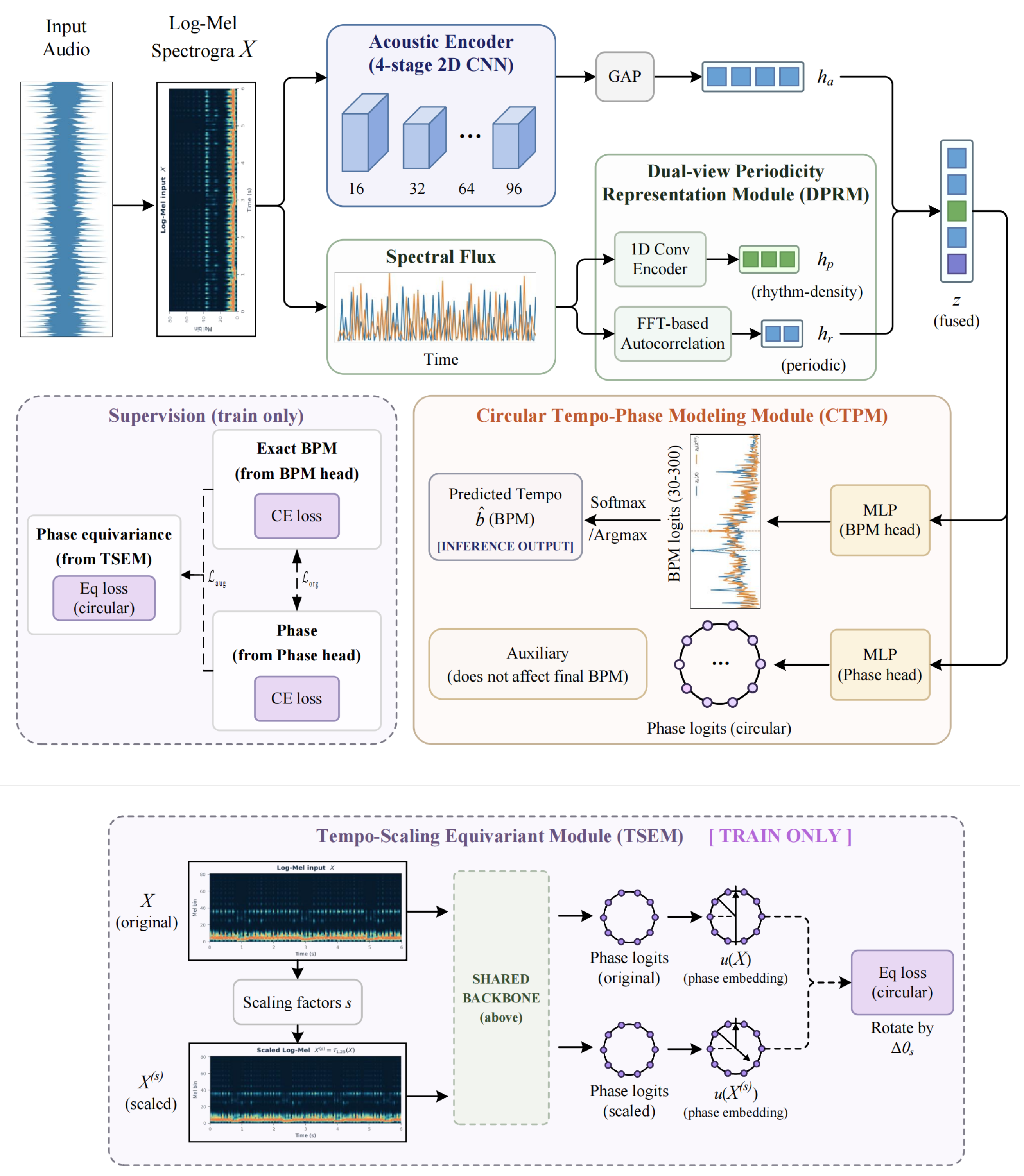
Audio is converted to mono and resampled to 11,025 Hz. Each input is a 6-s segment represented by an 81-bin log-Mel spectrogram. We use a short-time Fourier transform window of 1024 samples and a hop size of 512 samples, producing an input tensor of size . Tempo estimation is formulated as a 271-class problem with one integer-valued class per BPM from 30 to 300. The model containing only the convolutional acoustic backbone and exact-BPM head is denoted ERM. The configuration that adds only the DPRM is denoted Periodic (ERM+DPRM), and the complete model is denoted PEA-Tempo.
For a long recording, we uniformly select
N 6-s segments and fuse their exact-BPM posteriors,
Only the exact-BPM posteriors are fused; the circular phase head, a beat tracker, and dynamic Bayesian post-processing are not used. We fix for both GTZAN and GiantSteps.
For PEA-Tempo, its ERM and Periodic variants, and the MGANet and He-TempoTCN adaptations trained from scratch on FSL10K, we use AdamW with an initial learning rate of , weight decay of , a batch size of 64, and at most 25 epochs. Training stops when validation ACC1 does not improve for six consecutive epochs, and the gradient norm is clipped to 5.0. The weights of the original-sample and tempo-transformed classification losses are 1.0 and 0.5, respectively; the auxiliary phase-classification and phase-equivariance losses are weighted by 0.35 and 0.2.
Experiments are conducted on an NVIDIA GeForce RTX 4070 GPU with 8 GB of memory. ERM and PEA-Tempo contain 236,927 and 326,231 trainable parameters, respectively. With precomputed feature caches, their cumulative times for five-fold optimization, validation, and final testing are 4.31 and 5.21 min; the mean selected epochs are 8.4 and 9.2. These times cover optimization, validation, and testing with precomputed feature caches; audio decoding and feature-cache generation are excluded. Here, “lightweight” refers to the compact model size of 326,231 trainable parameters. The reported timings characterize computational cost under the cached-feature experimental setting, while complete-pipeline inference profiling is left for future work. DPRM adds only two lightweight one-dimensional convolutions and a 41-dimensional autocorrelation descriptor; its FFT-based autocorrelation has complexity . CTPM adds a small fully connected head during training, whereas TSEM introduces no additional trainable backbone.
Traditional baselines use the standard implementations or batch-analysis outputs archived with the project, with per-sample results aligned by sound ID. Percival14 and Percival14-Essentia denote our reproduction and the Essentia implementation, respectively [
4,
38]. madmom RNN+ACF uses pretrained neural beat activations and autocorrelation to infer global tempo [
39]; it is distinguished from the resonating-comb-filter backend of Böck et al. [
5]. Samples for which a traditional system produces no valid estimate are not numerically imputed and are excluded only from the common-subset comparison.
For learning-based baselines, the MGANet and He-TempoTCN adaptations are trained on FSL10K using the same 6-s input, 30–300-BPM output space, and optimization protocol. Quinton-ESS is initialized from the official pretrained TCN and fine-tuned end to end on the corresponding fold. Beat This! uses the official checkpoint with DBN post-processing disabled; global BPM is obtained from the median adjacent inter-beat interval in the range 0.2–2.0 s, and a clip is marked as having no prediction when no valid interval can be formed. On the external datasets, all local systems receive the same budget of five 6-s segments. The FSL10K-trained or fine-tuned systems use no target-domain data for training, tuning, or checkpoint selection; Beat This! retains its official pretraining provenance.
We distinguish three comparison settings: training from scratch on the same FSL10K folds (ERM, Periodic, PEA-Tempo, and the MGANet and He-TempoTCN adaptations); official pretraining followed by FSL10K fine-tuning (Quinton-ESS); and inference with an official pretrained checkpoint (Beat This!). The first setting supports comparisons under matched local training conditions. The latter two describe transfer performance with different training histories. Published GiantSteps scores are reported separately as benchmark context.
The comparison methods span three methodological families. Degara12, Zapata14, Percival14, and madmom RNN+ACF represent traditional or hybrid periodicity analysis [
4,
5,
20,
21]; Schreiber CNN, the Böck–Davies multi-task model, the MGANet adaptation, Beat This!, and the He-TempoTCN adaptation represent supervised learning and beat-transfer approaches [
7,
8,
9,
26,
27]; and Quinton-ESS and the corrected Henkel-SDNet represent self-supervised tempo learning [
10,
11].
4.3. Evaluation Metrics and Statistical Analysis
ACC1 and ACC2 follow the standard protocol for tempo-induction systems: ACC1 accepts an approximately 4% relative error, whereas ACC2 additionally accepts common integer-related metrical levels [
2,
3]. Per-sample predictions, correctness decisions, and error terms are retained in accordance with the transparent evaluation principles advocated by MIR evaluation tools [
40].
Let
and
denote the reference and predicted tempos. ACC1 is defined as
ACC2 additionally accepts the metrical factors
[
3]:
The ACC2-only error is the percentage of examples that satisfy ACC2 but not ACC1 and therefore reflects predictions at an alternative metrical level accepted by the relaxed metric. Because ACC2 also accepts one-third and triple tempo, we do not equate this quantity with a strict half/double-only octave error. MAE is the mean absolute difference between predicted and reference BPM. The tempo-scaling experiment additionally reports response accuracy, -tempo response error, and posterior phase error.
For FSL10K, confidence intervals are obtained with 10,000 paired bootstrap replicates at the contributor–pack connected-component level. Track-level paired bootstrap is used for GTZAN and GiantSteps. The main five-fold evaluation uses one training run per configuration per fold. We additionally evaluate the four incremental configurations using three random seeds on the fixed FSL10K fold-0 split, with the same seed set across configurations. Checkpoints are selected using only FSL10K validation data, and results are reported as the mean and sample standard deviation across seeds.
For the additional multi-seed paired comparisons, the same evaluation units are resampled for both models and all seeds within each bootstrap replicate, and metric differences are averaged across seeds. These intervals characterize test-sample uncertainty for the evaluated runs, complementing the across-seed standard deviations.
4.4. Baseline Comparisons
The out-of-fold predictions from all five test folds are pooled, and only the 9364 samples for which every traditional and learned system has a valid output are retained. PEA-Tempo obtains 67.30% ACC1 and 76.59% ACC2, outperforming every traditional method. Relative to the best traditional scores, these values represent gains of 10.73 and 5.66 percentage points. Adding DPRM to ERM already raises ACC1 and ACC2 to 66.16% and 74.99%, while the complete PEA-Tempo achieves the highest values for both metrics in this pooled comparison. Periodic obtains the lowest MAE, further indicating that explicit periodic evidence reduces absolute BPM deviations.
Table 2 reports the five-fold pooled comparison, whereas
Table 3 fixes the same 2262 fold-0 test clips for all locally evaluated recent methods. To ensure a fair comparison, the fold-0 results in
Table 3 are interpreted separately from the pooled five-fold results in
Table 2. On the fixed fold-0 test set, PEA-Tempo obtains the highest ACC1 and ACC2, reaching 56.68% and 71.79%, respectively. It improves ACC2 over the MGANet adaptation by 5.26 percentage points (95% CI: [0.73, 6.72]) and improves ACC1 and ACC2 over the He-TempoTCN adaptation by 2.61 and 3.58 points, respectively. PEA-Tempo uses only approximately 8.7% as many parameters as MGANet and 15.5% as many as Beat This!, indicating that the observed gains are not simply attributable to increased model capacity.
Quinton-ESS and Beat This! perform less strongly on FSL10K. The dataset consists primarily of short loop audio, whereas Beat This! requires a predicted beat sequence from which global BPM can be summarized; it fails to produce a valid tempo for 235 test clips. Quinton-ESS is initialized from the official pretrained TCN and then fine-tuned, and its result highlights the effects of pretraining domain, tempo representation, and downstream adaptation on transfer to loop audio. Overall, explicitly modeling periodic structure and tempo transformations is well suited to this short-loop setting.
4.7. Qualitative Analysis
To clarify the failure modes underlying the aggregate accuracy gains, we distinguish between metrical-level errors that fail ACC1 but satisfy ACC2 and errors that fail both metrics. The following examples examine both types of correction, together with newly introduced errors and shared failures. Sensitivity to tempo scaling is evaluated separately through the controlled transformations in
Section 4.6.
4.7.1. Representative Cases
As shown in
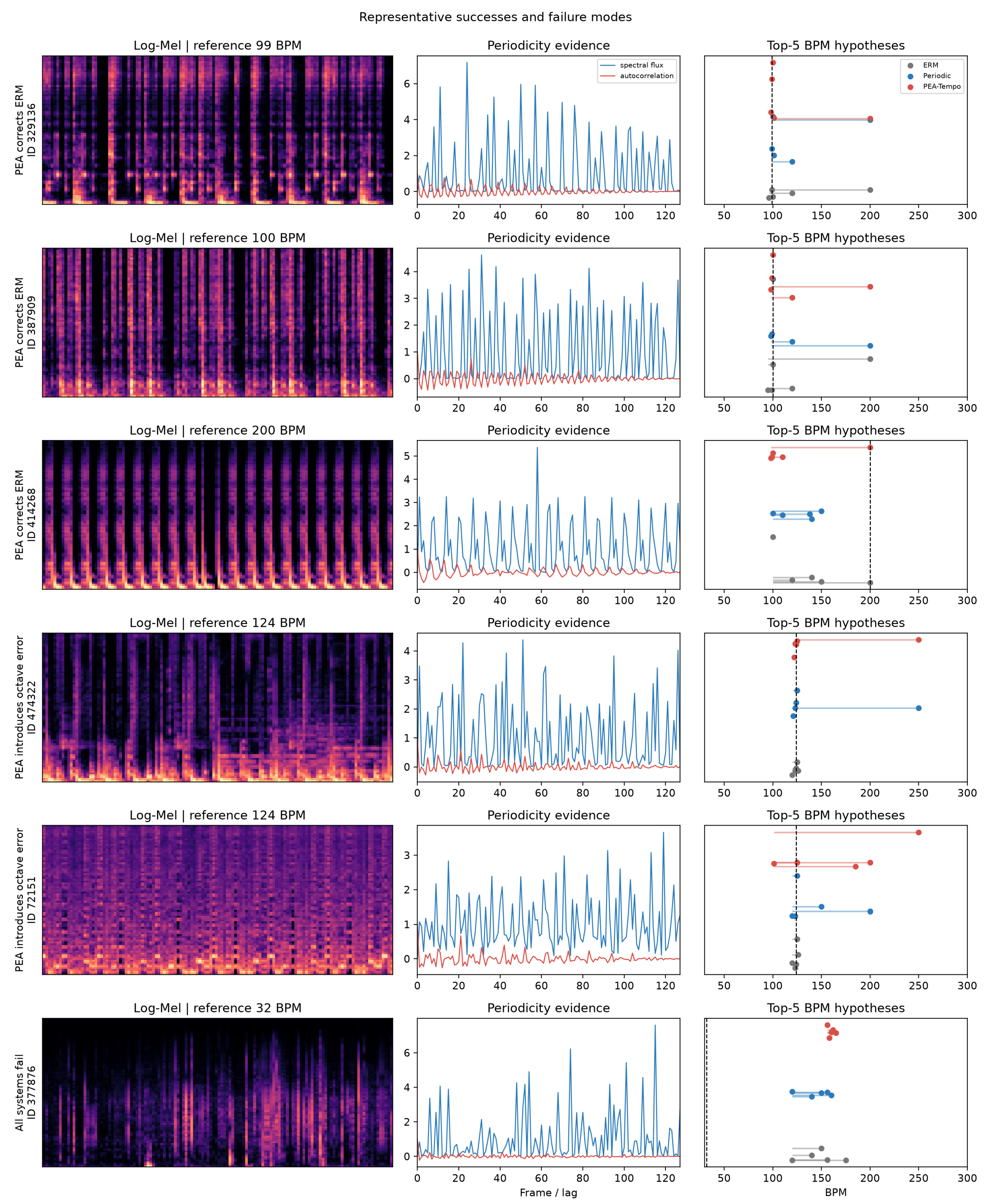
Table 14, the first two cases show that DPRM can reorganize competing 100/200-BPM peaks when timbral cues are unreliable. The 200-BPM hardcore example illustrates how the joint CTPM–TSEM constraint can assist fast-level selection. The two 124-BPM cases explain the increase in ACC2-only error: circular phase identifies the correct periodic family, but the prediction can still switch between integer-related metrical levels.
4.7.2. Visualization of Error Structure
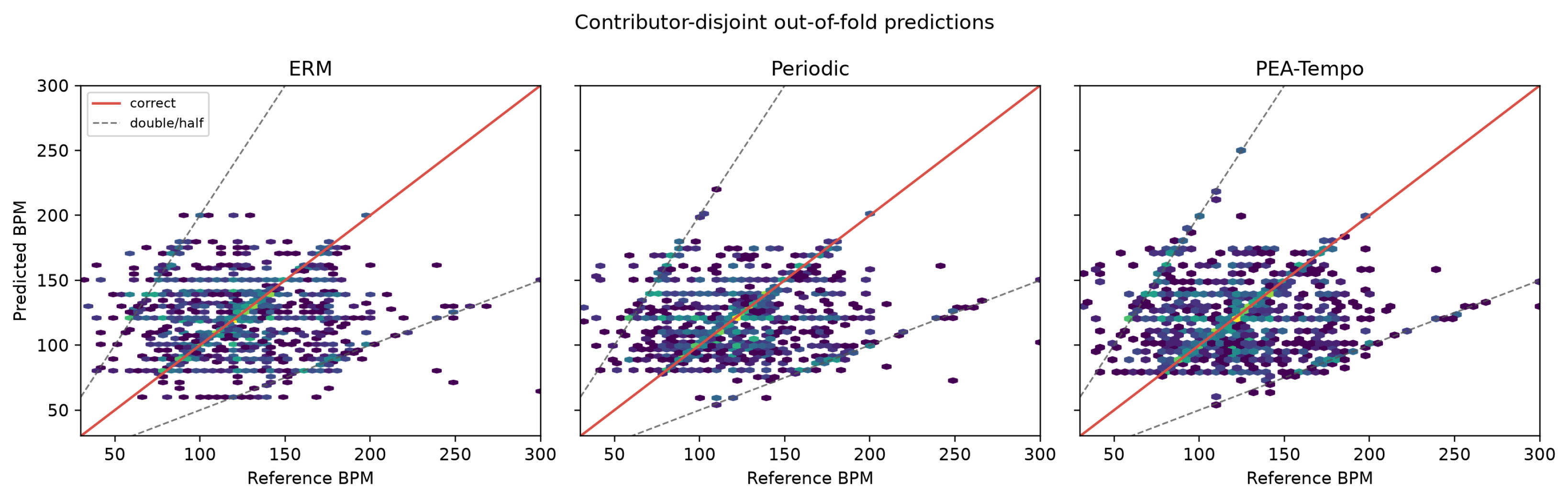
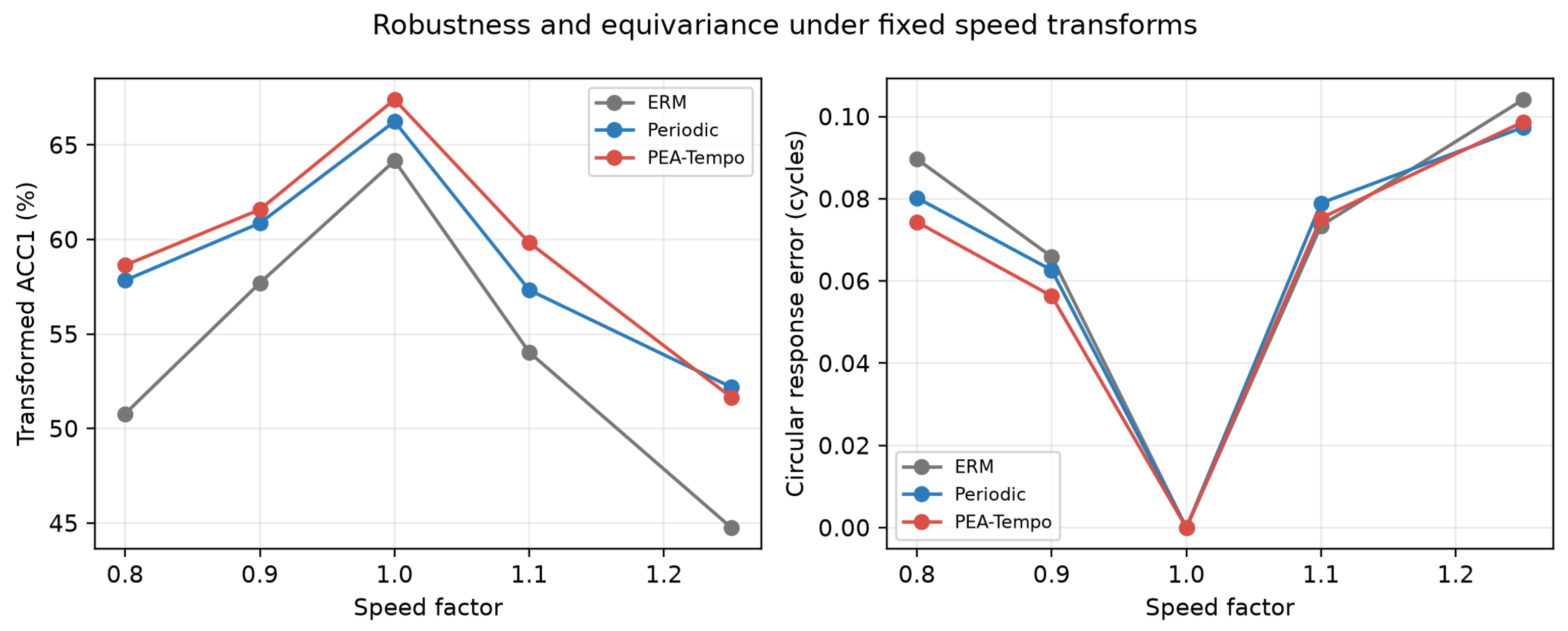
Figure 2,
Figure 3 and
Figure 4 analyze three complementary levels: local candidate reranking, the global distribution of prediction errors, and controlled transformation responses.
For the first two clips, whose reference tempos are 99 and 100 BPM, ERM ranks 200 BPM first and therefore makes a double-tempo error. Periodic moves the dominant peak to 100 BPM after DPRM is introduced. PEA-Tempo further concentrates most of the probability mass within 98–101 BPM and suppresses the competing 200-BPM peak. The explicit autocorrelation and spectral-flux evidence can therefore rerank candidates when the acoustic backbone has already detected the correct tempo but ranks it below an integer-related alternative. For the fast 200-BPM hardcore loop, ERM and Periodic select 100 and 150 BPM, whereas PEA-Tempo promotes 200 BPM to the dominant hypothesis, illustrating the complementary contribution of phase and scaling constraints.
The figure also retains representative failures. For both 124-BPM clips, ERM and Periodic concentrate near 124–125 BPM, whereas PEA-Tempo promotes 250 BPM. The correct periodic family is recognized, but the posterior switches from the original to the double-tempo level, consistent with the increase in ACC2-only error. In the final weakly periodic 32-BPM clip, stable transient intervals and a clear autocorrelation peak are absent, and all three systems predict far from the reference. Structural periodicity priors cannot replace reliable low-level pulse evidence when that evidence is missing.
ERM forms pronounced horizontal high-density bands around 80–150 BPM, suggesting that different reference tempos are compressed toward frequent regions of the training distribution. After DPRM is added, the main density moves closer to the red diagonal, particularly in the mid-tempo range. PEA-Tempo further strengthens the high-density trajectory along the diagonal over a wider range, consistent with its higher ACC1 and ACC2. Residual bands near the half- and double-tempo lines indicate that metrical-level ambiguity remains in some examples. In the pooled five-fold ablation results (
Table 8), PEA-Tempo reduces the proportion of predictions failing ACC2 from 28.34% to 23.34% compared with ERM. Meanwhile, the ACC2-only rate changes from 7.50% to 9.26%. Together with the improved ACC1, these results show better overall tempo recognition and greater coverage of the metrical alternatives accepted by ACC2, while identifying absolute metrical-level selection as a direction for further improvement.
Periodic retains higher ACC1 than ERM at every non-identity scaling factor, demonstrating that explicit periodic features mitigate degradation under time-scale changes. PEA-Tempo generally achieves the highest accuracy between 0.8× and 1.1×, with particularly clear margins over ERM at 0.8× and 1.1×. Under the stronger 1.25× acceleration, Periodic is slightly more accurate than PEA-Tempo, indicating that substantial acceleration can still trigger a metrical-level switch.
All systems have zero phase-response error for the identity transformation by construction. Across the non-identity transformations, the macro-average circular error decreases from 0.0833 cycles for ERM to 0.0798 for Periodic and 0.0762 for PEA-Tempo. Together with PEA-Tempo’s transformed macro-average ACC1 of 57.93%, this result indicates improved posterior-phase consistency for the evaluated spectrogram resampling. ERM and Periodic also use tempo augmentation during training, so the comparison measures the added phase objectives under this transformation. The response remains asymmetric between deceleration and acceleration.
4.7.3. Matched-Sample Comparison with Recent Methods
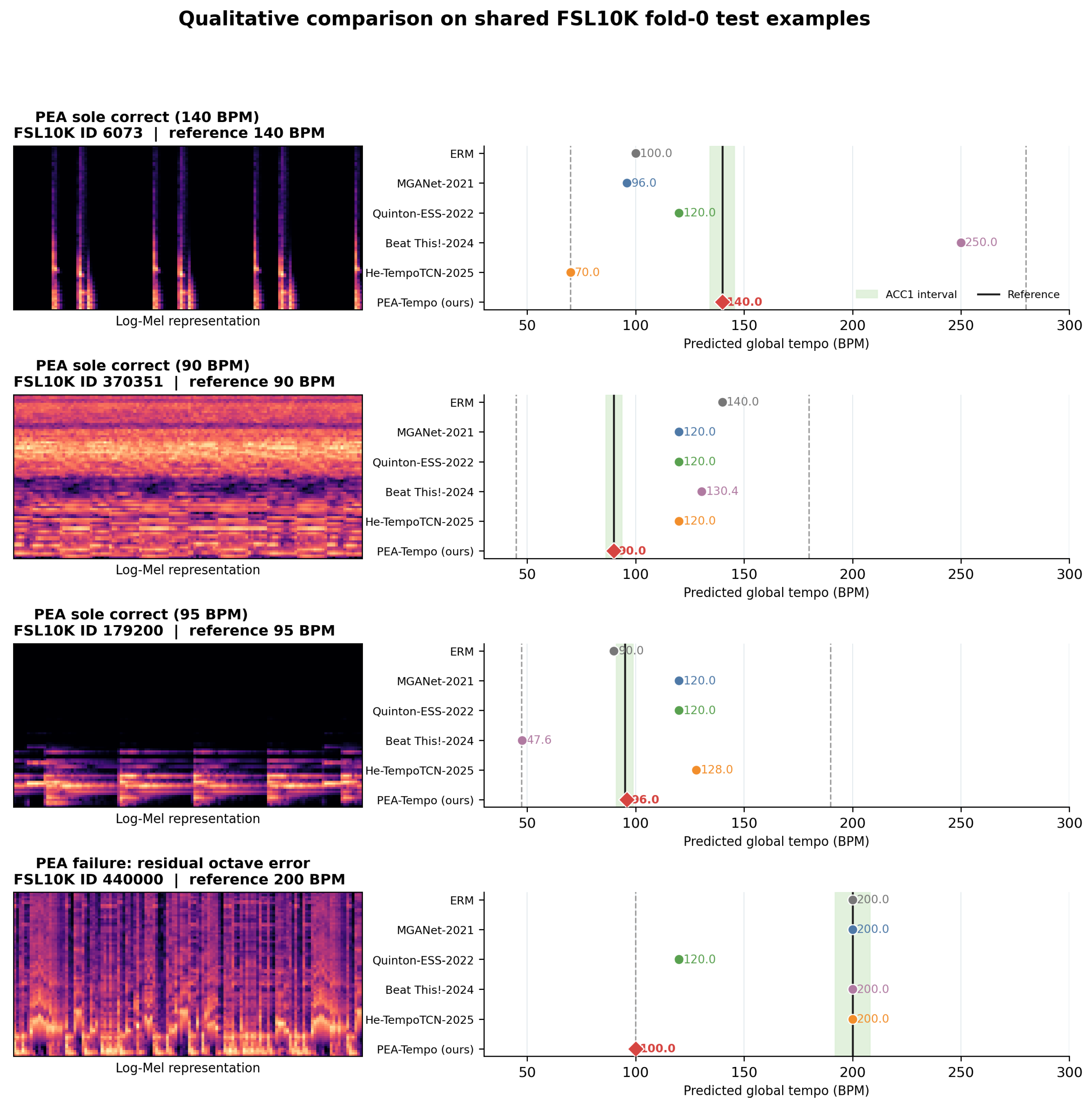
Figure 5 compares track-level predictions from ERM, MGANet-2021, Quinton-ESS-2022, Beat This!-2024, He-TempoTCN-2025, and PEA-Tempo on the same FSL10K fold-0 examples. The solid black line denotes the reference BPM, the green region denotes the
ACC1 interval, and gray dashed lines show the half- or double-tempo positions when they fall within the evaluation range. N/A denotes that no valid estimate was produced.
In the first three cases, PEA-Tempo is the only method whose prediction falls within the ACC1 interval. For the 140-BPM drum loop, PEA-Tempo predicts 140 BPM, whereas ERM, MGANet, Quinton-ESS, Beat This!, and He-TempoTCN predict 100, 96, 120, 250, and 70 BPM. For the 90-BPM synthesizer loop, PEA-Tempo predicts 90 BPM, while all five comparison systems fall between 120 and 140 BPM. For the 95-BPM piano loop, PEA-Tempo predicts 96 BPM, while the comparison systems predict 90, 120, 120, 47.6, and 128 BPM. These clips originate from different contributors. For the 90-BPM synthesizer loop (FSL10K ID 370351), all five baseline estimates fail both ACC1 and ACC2, whereas PEA-Tempo satisfies both. The baseline values of 120–140 BPM fall outside the accepted metrical families, so this example concerns an incorrect periodicity estimate rather than only half/double-tempo selection. The 140-BPM drum loop and 95-BPM piano loop each have four baselines failing both metrics; He-TempoTCN at 70 BPM and Beat This! at 47.6 BPM, respectively, still satisfy ACC2. These two examples combine periodicity errors with metrical-level ambiguity. These examples illustrate corrections of both errors outside the metrical alternatives accepted by ACC2 and errors in absolute metrical-level selection. DPRM provides explicit transient and repetition cues, while CTPM supplies auxiliary phase supervision shared by half- and double-tempo hypotheses.
The final 200-BPM example exposes a representative limitation. ERM, MGANet, Beat This!, and He-TempoTCN all predict 200 BPM, whereas PEA-Tempo selects the 100-BPM half-tempo level. Thus, although the proposed method outperforms every comparator in the first three examples, it does not fully resolve absolute metrical-level selection in fast music.