


Abstract
Compared with sequential recommendation, which leverages users’ historical interaction sequences to capture interest characteristics, time-specific recommendation additionally infers user preferences by analyzing historical temporal information and predicts next-item interactions under specified target timestamps. Existing approaches, however, remain limited in effectively representing complex interest dynamics and their temporal evolution. To address the limitations, we propose MIFARec, a Fourier analysis network with mixed-interest representation for the time-specific recommendation task. MIFARec constructs mixed-interest representations within a session by aggregating item embeddings, positional information, and time-interval information. By incorporating global item associations, this approach provides a proxy for longer-term preference patterns and alleviates the limitations of conventional multi-interest frameworks with a fixed number of interests. Such frameworks cannot adequately capture the diverse and hierarchically intertwined nature of user preferences. A fixed number of interests may either fail to represent diverse preferences or introduce redundant interest clusters that weaken recommendation signals. Meanwhile, MIFARec uniquely captures temporal influence on mixed interests by leveraging Fourier analysis. It treats the temporal influence on users as periodic temporal modulation of their mixed interests through a Fourier-feature expansion. Extensive experiments on five public datasets illustrate MIFARec’s superior top-K recommendation performance and computational efficiency compared with state-of-the-art baselines.
1. Introduction
In the context of information overload on the Internet, efficiently filtering and recommending user-preferred items from massive data has become a critical research focus. Sequential recommendation [1], which uses interaction sequences for predictions, outperforms traditional collaborative filtering methods in many scenarios. Session-based recommendation [2], a key implementation of sequential recommendation, segments fixed-length historical interactions as session units and uses the last item as a supervision signal. Session-based recommendation does not collect users’ personal information and solely relies on their interaction sequences to make recommendations, thereby ensuring the security of user privacy [3] and reducing computational costs.
Time-specific recommendation [4] emphasizes the timing of recommendations, positing that user interest evolution correlates with temporal progression. For instance, a recommendation system predicts user preferences based on the specific time and proactively delivers targeted suggestions in the form of real-time notifications, such as food recommendations during meal hours or winter clothing recommendations in cold seasons. Such systems generate recommendations that better satisfy users’ immediate requirements by incorporating temporal context. In dataset-based experiments with related algorithms, timestamps of labels within the dataset are usually explicitly input as known conditions to simulate the “user’s current temporal state” during model training and inference.
Our work focuses on the time-specific recommendation task and adopts the fundamental framework of session-based recommendation systems. As a whole, current research on session-based recommendation and time-specific recommendation faces the identified challenges as follows:
- Limited Long-term Interest Capture. Session-based models prioritize recent interactions, often neglecting long-term interests. While some of them attempt to address this with attention mechanisms, they still fail to holistically model global interactions and may dilute short-term signals.
- Oversimplified User Representation. Most sequential models represent user interests as single vectors, causing interference among diverse interests. Multi-interest models disentangle user features into multiple embeddings, but still require a predefined number of interests, which aligns poorly with real-world complexity.
- Interference of Neighbor Interactions. Temporal-aware models often focus on interaction time intervals but struggle with irrelevant historical items. Different from other sequential data, e.g., natural language or videos, neighbor interactions in sequences may not share semantic relevance due to users’ multiple interests, leading to biased recommendations. In particular, conventional sequence encoders usually compress the whole interaction sequence into a single vector or a fixed number of latent vectors, so that signals of co-existing interests are entangled rather than disentangled, and irrelevant neighbor interactions further contaminate the resulting user representation.
To address these issues, we propose MIFARec, a Fourier analysis network based on mixed-interest representation. The model is applied to the time-specific recommendation task. On the one hand, it integrates session form and global interaction patterns to construct a mixed-interest representation, then applies a self-attention network for learning. On the other hand, it employs Fourier analysis to model temporal features. In summary, the main contributions of this work are as follows:
- Mixed-Interest Representation. This work introduces the concept of mixed-interest and clarifies its application scenarios in sequential recommendation. It employs static information-weighted aggregation of item embeddings for session modeling, preserving the excellent anonymity and computational scalability of conversational recommendation systems while capturing implicit feedback information through global static features.
- Fourier Analysis on Mixed Interests. This study explores the modeling of interest migration characteristics under temporal influences. By using neural networks to model the spectral patterns of interests, it learns how periodic temporal patterns modulate the influence of each mixed interest at a specified time.
- Extensive Experiments. The experimental results demonstrate consistent recommendation performance improvements. Extensive experiments conducted with multiple baseline models and datasets validate the explicit effectiveness of MIFARec.
2. Related Works
2.1. Self-Attention-Based Sequential Recommendation
The self-attention mechanism [5,6], renowned for its superior architecture, has been widely adopted across diverse research domains. It maps queries to contextual keys and values derived from the data itself, thereby capturing intrinsic correlations within sequences. The Transformer architecture [7] consists of multi-head self-attention (SA) layers and feed-forward neural network (FFN) layers. The former linearly aggregates relationships between tokens, while the latter extracts inner-channel features for individual tokens. Self-attention-based sequential recommendation models [8,9] typically analyze latent patterns in user interaction histories by segmenting them into sessions. Specifically, they characterize users through fixed-length item sequences within local sessions, rather than directly establishing learnable implicit user vectors.
2.2. Interests Modeling in Recommendation
Short- and Long-term Interests. As a key variant of sequential recommendation, session-based models predict next-item interactions using fixed-length recent user histories. However, long-term interests often manifest across extended interaction sequences. Some models [10] introduce search-based paradigms to address this, incorporating dedicated modules to retrieve and reweight items from long-term histories based on candidate features and similarities. While these approaches balance computational efficiency with long-term interest capture, they often sacrifice short-term modeling capabilities and fail to integrate global interactions holistically. We attribute this limitation to the inherent trade-off between the model’s representational ability and computational cost.
Multi-Interest Representation. Traditional sequential recommendation models [11] represent users as single vectors, causing interference among diverse interests during training. Averaged gradient updates across aggregated embeddings obscure distinct interest-specific signals. To mitigate the issue, models with a multi-interest framework [12,13,14] propose adaptive clustering of user behaviors into multiple embeddings via self-attention or dynamic routing mechanisms. Nevertheless, existing models typically predefine a fixed number of interests due to computational constraints, which deviates from real-world scenarios—user interests should be taken as uncountable, diverse categories with complex interconnections across different preference domains. Consequently, existing multi- interest modeling frameworks struggle to accurately capture the complex, non- linear dependencies inherent in authentic behavioral patterns.
2.3. Time-Aware Recommendation
Time Interval Modeling in Recommendation: Time-aware recommendation systems extract implicit temporal features from interaction timestamps. Certain studies [15,16] integrate time intervals into user representations through attention-based temporal embeddings, computing weighted sums of interval-specific embeddings based on item similarities. Some works [17,18] incorporate temporal representation learning into self-attention architectures, enabling models to capture time-dependent user behaviors by encoding timestamps and temporal intervals before combining them with item embeddings.
Time-specific Recommendation. Research in the domain [4] focuses on scenarios where recommendations must adapt to specific timestamps, recognizing that users exhibit varying interests over time even with static interaction histories. However, current approaches often rely on auxiliary knowledge, such as pre-defined interest periodicity assumptions, lacking end-to-end learning capabilities to autonomously capture temporal dynamics. Furthermore, current research in the domain remains in the nascent phase, characterized by limited theoretical frameworks and fragmented empirical validation. More specifically, representative time-specific models such as ROTAN [3] encode temporal regularities through rotation-based temporal attention built upon pre-assumed periodic patterns; once the assumed periodicity deviates from the real interest dynamics, such temporal bias cannot be corrected by data. Frequency-domain modeling has also been explored in general sequential recommendation; for instance, FMLP-Rec [19] denoises interaction sequences with learnable frequency-domain filters, while graph-based models such as LightGCN [20] smooth item representations through iterative graph convolutions. In contrast, MIFARec employs a Fourier-feature expansion whose amplitudes are adaptively predicted from the mixed-interest representations to model temporal influence conditioned on the target prediction time, and it uses the graph-derived similarity matrix only as a static weighting prior for interest aggregation rather than for iterative embedding propagation, which keeps the online inference cost unchanged.
3. Methodology
Building upon the established theoretical foundations, we formalize the theoretical framework of MIFARec, which focuses on the time-specific recommendation task. We first define the target task and propose critical hypotheses to guide our approach, and then detail the model.
Definition of the time-specific recommendation task: Given a user set U, an item set I, and historical interactions with timestamps R = {(u, i, tu, i)|u ∈ U, i ∈ I}, the model predicts the next item a user will interact with at a specific time t, generating an ordered recommendation list of length K. For the sake of analysis, we ignore repetitive interactions in this work.
Hypotheses. (1) Mixed Interests and Mixed Decisions. User interests are multifaceted and hierarchical, forming composite preferences through superposition. Meanwhile, interactions arise from the interplay of multiple collaborating interests, rather than isolated ones. Consequently, these interests are numerous and intricately correlated. Conventionally modeling them poses consistent challenges. (2) Target Time in Session-Based Recommendation.
While time-aware models segment sequences via sliding windows, redundant temporal signals across sessions may arise. Moreover, interference from neighboring interactions could become prominent. We posit that the time-specific recommendations should prioritize the interval between a historical interest and the target prediction time, rather than intervals between historical interests. (3) Non-Linear Temporal Influence. The relevance of a historical interaction may change non-linearly with its time interval from the current interaction. In particular, interests associated with recurring behaviors may become relevant again at similar times in later cycles. For example, a user who purchases a toothbrush every few months may show renewed interest in the product category even when the most recent purchase occurred some time ago. This pattern motivates the use of Fourier-based temporal weighting to capture variations in interest relevance across time intervals. (4) Multi-Scale Periodic Temporal Dynamics. User interests demonstrate multi-scale periodic patterns. We propose modeling temporal influence as a complex periodic function governing the evolution of interests.
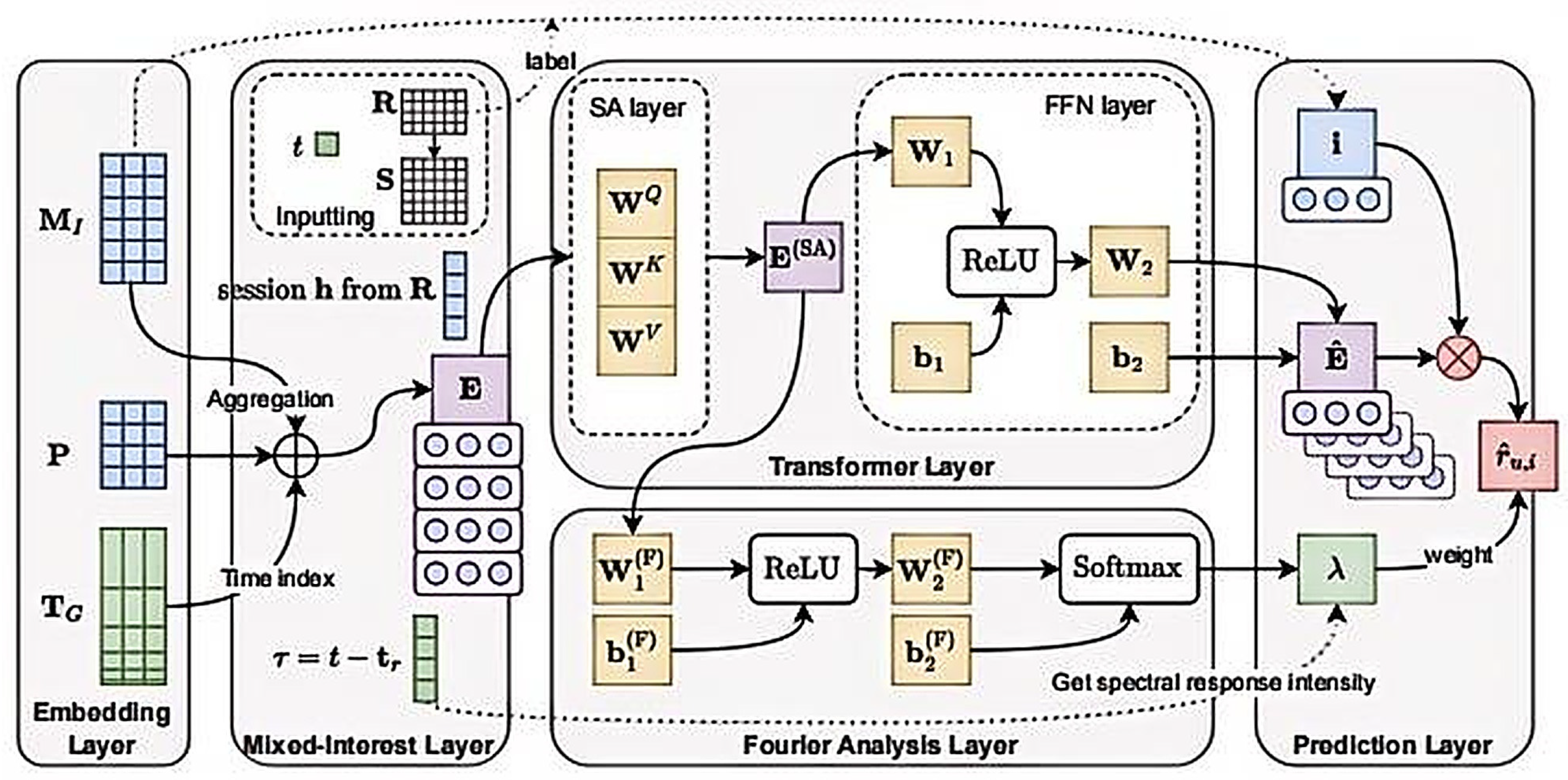
We now introduce the MIFARec model, a novel architecture composed of five core components: Embedding layer, Mixed-interest layer, Transformer layer, Fourier analysis layer, and Prediction layer. The framework is illustrated in Figure 1 and synergistically integrates these components. Technical details of each component are systematically elaborated in subsequent subsections.
Figure 1.
The framework overview of MIFARec.
3.1. Embedding Layer
Three learnable embedding components are initialized as foundational elements: Item Embeddings (MI): Adopting the SASRec [8] initialization strategy, we construct MI = [i1, i2,…, i|I|] ∈ R|I| × d, where |I| denotes the item vocabulary size. Positional Embeddings (P). Encoding sequential order within sessions of default length n = 20: P ∈ Rn × d. Specific Time Interval Embeddings (TG): Discretizing continuous time into N(T) = 256 predefined buckets to capture time intervals between historical interactions and target timestamps: TG ∈ RN(T) × d. The mixed-interest representations are subsequently derived through task-specific aggregation operations over these embeddings.
3.2. Mixed-Interest Layer
Core Insight. We posit that every interaction is collectively determined by multiple interests from the user, and all distributions of explicit interest superimpose to form a “mixed-interest”. The user exhibits dynamic evolution of interests, with each mixed-interest representing temporary preference specificity at the corresponding moment. Every mixed-interest contains an anchor item—the actually interacted item—which serves as a sampling instance from the mixed- interest distribution, as it is collectively determined by all unknown, explicit interests. While mixed-interests can be inferred from corresponding anchored items through session data, it constitutes an intermediate representation rather than the ultimate objective: time-specific recommendation models focus not on reconstructing historical interest states but on capturing interest distributions at a specific moment to predict next-item interactions. Therefore, the Mixed-interest layer would extract session-formatted mixed-interests by aggregating item embeddings and analyzing their implicit patterns using neural networks later.
Item-Item Similarity Matrix ConstructionThe global item-item similarity matrix S ∈ R|I| × |I| is derived from the historical user-item interaction matrix R ∈ R|U| × |I| [21]. Following graph-structured representation principles [20], we define S as a normalized co-occurrence matrix:
where Iu,i,j = I(Ru,i = 1∧Ru,j = 1) indicates the co-occurrence of items i and j within user u’s interactions, where I denotes the indicator function. Du = ‖{i ∈ I∣Ru,i = 1}‖ represents the degree of user u, and Di = ‖{u ∈ U∣Ru,i = 1}‖ denotes the global popularity of item i. To capture high-order connectivity patterns in graph-structured data while maintaining computational efficiency, the similarity matrix undergoes an iterative refinement process:
where is the Laplacian-normalized interaction matrix (D: degree matrix); and keep high-order connectivity and mitigate graph over-smoothing; K(S) = 500 truncates non-top similarities per item to reduce noise and capacity; L2-normalization ensures scale-invariant similarity comparisons.
Specific Time Interval Embedding Representation. Timestamps are first linearly normalized to daily-scale floating-point values. Let t(min) and t(max) denote the earliest and latest timestamps in the dataset. The temporal embedding mapping is governed by:
where τr = t − tr is the interval between interaction time tr and target time t; a denotes the logarithm base dynamically determined by temporal span and embedding dimension N(T) = 256; clip(·) ensures i(idx) ∈ [1, N(T)]; TG ∈ RN(T) × d is the global temporal embedding matrix. This logarithmic binning strategy converts continuous time intervals into discrete indices, enabling session-length- aligned matrix representation T = [t1, t2,…, tn] ∈ Rn × d. Note that the base a is kept as a real-valued quantity without rounding, so that the bin index can reach all N(T) buckets over the observed temporal span; the ceiling operator is applied only to the logarithmic value to obtain an integer bin index, which is consistent with the released implementation.
Embedding Aggregation. The mixed-interest construction begins with item embedding aggregation guided by the item-item similarity matrix S. Each mixed-interest vector mi anchored at item i is computed as: mi = siMI, where si ∈ R|I| denotes the i-th row of S. For a session h containing n items, the session-level mixed-interest matrix is: M = [mh1,…, mhn] ∈ Rn × d. Incorporating positional and temporal contexts, the final session embedding E ∈ Rn × d is formed through element-wise summation:
where Session(·) denotes segmenting a session according to the user interaction sequence and global mixed-interests; i(idx) ∈ Nn contains the temporal indices for all interactions in the session. Sessions shorter than the predefined length n are zero-padded to maintain dimensional consistency.
The mixed-interest paradigm aggregates item embeddings through similarity- weighted fusion without auxiliary interest-specific embedding spaces, offering three key advantages: (1) Modeling Short-Term Interests with Global Item Associations. MIFARec models short-term interest dynamics through session sequences and incorporates a static global item–item similarity matrix to represent population-level associations. These associations serve as a proxy for longer-term preference patterns; they do not track the lifelong interests of individual users. (2) Adaptive Multi-interest Representation. Unlike methods with fixed-cardinality interest representations, MI- FARec adaptively models global interests through item-anchored fusion, eliminating the trade-off between predefined interest counts and computational scalability. (3) Temporal Similarity Enhancemen. Proximate historical interests exhibit higher similarity weights by incorporating time embeddings, so that the self-attention mechanism can capture interests related to temporally adjacent interactions during feature fusion. The similarity matrix S is precomputed offline and remains static during training, which limits the model’s ability to incorporate newly arriving items or interactions into the mixed-interest construction in a timely manner, thereby introducing a cold-start limitation. For industrial-scale catalogs containing millions of items, the O(∣I∣2) construction of S can be performed as an independent offline task and further accelerated using approximate nearest-neighbor search or locality-sensitive hashing, as only the top-K(S) similarities for each item need to be stored.
3.3. Transformer Layer
The Transformer layer employs a self-attention encoder to process mixed-interest embeddings E ∈ Rn × d, aiming to produce reconstructed embeddings with identical dimensionality. The computation pipeline is formalized as:
where Θ = {W1, b1, W2, b2} denotes the parameters W1, b1, W2, and b2 in the FFN layer, which belong to the Transformer layer and are distinguished from the Fourier-layer parameters defined in Section 3.4, d denotes the dimensionality of embeddings, the SA layer captures similarity of mixed-interests with each other, and the FFN layer captures cross-interest commonalities while processing individual mixed-interests. The MIFARec model follows the LayerNorm, ResNet, and Dropout from the Transformer [5,22] framework.
3.4. Fourier Analysis Layer
Core Insight. We believe that user interests undergo dynamic temporal shifts even when historical interactions remain static—a phenomenon termed temporal migration of interests. We posit that the temporal influence could be regarded as a change in relative weight among all mixed-interests in a session, and let an unknown complex periodic function λ = f (,τ) denote influence from both mixed-interests and a specific time interval. The function is probably difficult to give directly, but it should still conform to periodic regularity. To capture the regularity, we design a Fourier-analysis-based framework that adaptively models mixed-interest evolution under the passage of time.
Implementation. We design a Fourier-feature expansion (i.e., a weighted cosine basis with a fixed zero phase rather than a conventional discrete Fourier transform) to fit the real temporal influence, which assumes that a mixed-interest is aggregated from multiple periodic features. It can be represented as
where N, with 256 as the default, denotes the predefined quantity of discrete frequency bands from the spectrum; the frequency fk is specified in advance; the response strength in discrete frequency band α is completely determined by the corresponding mixed-interest and able to be fitted with a learnable neural network. They are represented as
where the shortest period T1 is assigned to 1 day and the longest period TN to 10 years; is constant for any k value. Specifically, the periods form a geometric progression, i.e., . The frequency vector f ∈ RN collects the N predefined frequencies, while the response-strength vector α ∈ RN is adaptively predicted from each mixed-interest representation. The Fourier analysis is completed with a 2-layer FFN. The intermediate matrix E (SA) is used as the input instead of the reconstructed mixed-interest embedding to preserve the original feature information. The time-influence function can also be expressed in the following standard form:
where . This property follows directly from the softmax normalization in Equation (7): since the response strengths are normalized to sum to 1, the constant (DC) component equals 0.5, which centers the weight function; combined with the cosine term ranging in [−1, 1], the weight λ is linearly restricted to [0, 1], which minimizes the computation scale while covering all real-world situations and ensures stable temporal influence modeling. Meanwhile, MIFARec explicitly infers the temporal effect from the specific time interval: the weight reaches its maximum when τ = 0, which implicitly predefines a zero phase value across all periodic components. In practice, this zero-phase constraint encodes the prior that the most recent interactions exert the strongest influence on the current decision; it matches empirical forgetting behavior and avoids learning unstable phase shifts from sparse temporal signals.
The Fourier analysis layer achieves two critical properties as below: (1) Feature Preservation. Maintains inter-channel correlations of mixed interests by solely adjusting weights, leaving intrinsic features unaltered. (2) Personalized Temporal Modeling. Characterizes time as a composite of periodic factors, adaptively fitting interest-specific temporal patterns. This enables differentiated cycle representations through learnable amplitude-frequency modulation.
3.5. Prediction Layer
Scoring. For user u in session h, the prediction layer computes the recommendation score for item i by evaluating the inner product between the item embedding and the mixed-interest embeddings, weighted by the Fourier coefficients:
where l denotes the effective session length.
Loss Function. Learnable parameters include embeddings MI, P, TG, Self-Attention layer parameters WQ, WK, WV, FFN layer parameters W1, b1, W2, b2, and Fourier analysis parameters , , , (where W1(F) ∈ Rd×d, b1(F) ∈ Rd, W2(F) ∈ Rd×N, and b2(F) ∈ RN). These parameters are updated via the Bayesian Personalized Ranking (BPR) pairwise loss:
where S(u) denotes the set of all sessions segmented from user u; i and j denote the positive and negative items, respectively; for each positive item i, the negative item j is uniformly sampled from the items with which the user has not interacted, and the published equation is now identical to the released implementation [23].
4. Experiments
Preparation. All experiments were conducted on hardware comprising a Ryzen-7900X CPU, 64 GB-6400 MHz RAM, and RTX-4080S GPU, with software including Python 3.12.3, PyTorch 2.3.1, and CUDA 12.6. We utilized the datasets Video-Games and Beauty [24,25], NYC and TKY [26,27], and Gowalla [28].
All codes are based on ReChorus [24], an extensible recommendation framework. For the hyperparameters in MIFARec, we set batch size as 256, sequence length as 20, epochs-maximum as 200, early-stop-threshold as 10 epochs, learning rate as 0.001 with Adam optimizer. For self-attention models such as SASRec, 1 self-attention block and 4 self-attention heads were set. For each user, the last interaction served as the test positive sample with 999 randomly sampled negatives. All models ranked these 1000 items to simulate real-world recommendation scenarios. Recall@10 and NDCG@10 were selected to evaluate recommendation performance. The statistics of the five datasets after preprocessing are summarized in Table 1. All interactions of each user are chronologically ordered; the most recent interaction serves as the test sample and the penultimate one serves as the validation sample (temporal leave-one-out). Repeated interactions are removed by keeping only their first occurrence, and the target prediction time of each test or validation sample is set to the timestamp of the held-out interaction, which simulates a realistic time-specific recommendation scenario. The item similarity matrix S is constructed exclusively from training interactions, so that no information from validation or test interactions can leak into the model. All models use the same embedding dimension d = 64, dropout with a rate of 0.1 is applied to the embedding and self-attention layers, and L2 regularization with a coefficient of 1 × 10⁻⁵ is adopted. The 999 negative samples are randomly drawn from the items with which the user has not interacted and are shared across all models for every test user, ensuring a fair comparison; this sampled-ranking protocol follows the common practice in sequential recommendation [5,12]. Baseline-specific hyperparameters are tuned on the validation set following the configurations recommended by ReChorus [19] and the original papers. All reported results are averaged over five independent runs with different random seeds, and the standard deviations of both metrics are below 0.005 on all datasets.
Table 1.
Statistics of the five datasets after preprocessing.
In addition, we have publicly released code implementation at https://anonymous.4open.science/r/MIFARec-6BB7 (accessed on 29 July 2026) to facilitate others to repeat this work.
4.1. Comparison with Baselines
A series of baselines were selected to conduct comparison experiments, including Caser [29], which is based on a CNN; GRU4Rec [30], which is based on an RNN; SASRec [8], which is based on a Transformer; DiffuRec [31], which is based on a diffusion model; ComiRec [12] and TimiRec [13], which are based on multi-interest modeling; and TiSASRec [15], which is a time-interval-aware approach. Results of these models tested on public datasets are shown in Table 2, and the row Iprv denotes the improvement percentage of MIFARec relative to the best performance of all other models. It can be observed that MIFARec achieves consistent performance improvements compared with the baseline models mentioned.
Table 2.
Experiment results of performance comparison. MIFARec achieved improvements ranging up to 25.05%, with an average enhancement of approximately 9.38%.
Analyzing the training cost of MIFARec. Different from other models, MI- FARec pre-constructs a static item similarity matrix before training, which has an independent calculation process with time complexity O(|I|2). This process occupies a small proportion of computation (less than one epoch of training). Although the actual recommendation system usually maintains a much larger size than the instanced dataset, the construction and updating of the item similarity matrix could be run independently as a branch offline task.
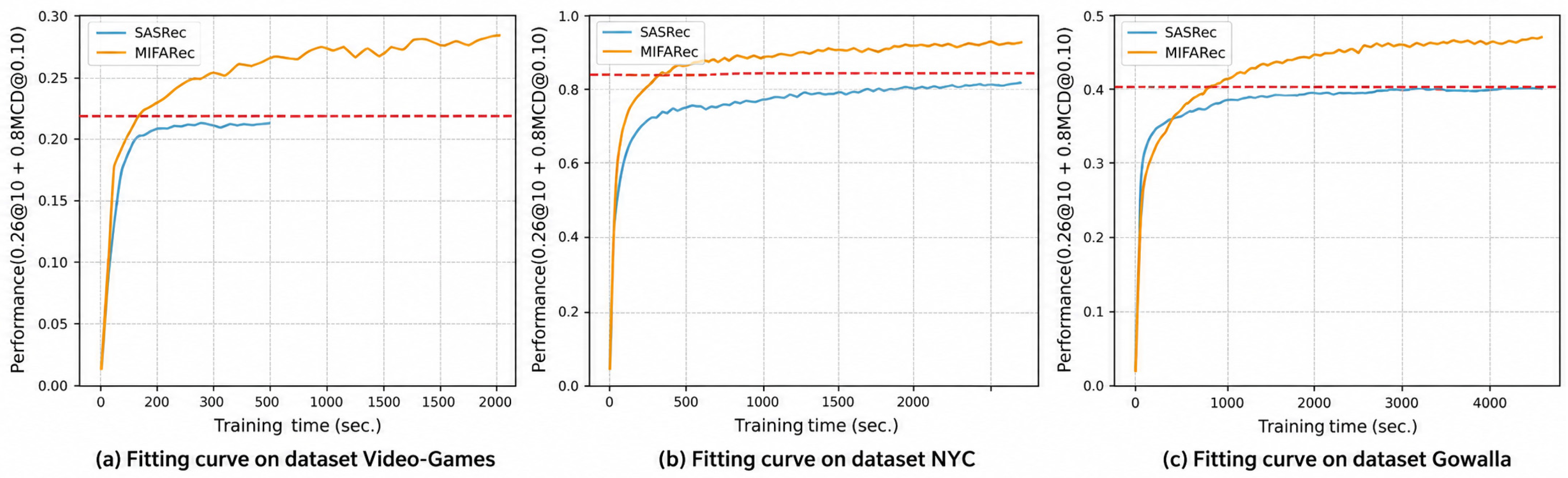
We evaluated the training efficiency of MIFARec against SASRec on Video-Games, NYC, and Gowalla, and the model fitting curve is shown in Figure 2. For comprehensive model evaluation, we prioritized ranking quality by assigning 20% and 80% weights to Recall@10 and NDCG@10, respectively. Here, the total training cost is defined as the wall-clock time required for a model to reach its best validation performance under the early-stopping protocol. In terms of per-run wall-clock time, MIFARec costs only 12.29% more time than SASRec [8] on average, since the mixed-interest construction involves a larger parameter space. However, as shown in Figure 2, MIFARec reaches the highest performance level that SASRec can achieve within a much shorter training time on all datasets; in other words, when efficiency is measured by the time required to achieve a target recommendation performance, MIFARec is substantially more efficient than SASRec.
Figure 2.
Fitting curve of MIFARec and SASRec on three representative datasets. (a) Fitting curve on the Video-Games dataset; (b) Fitting curve on the NYC dataset; (c) Fitting curve on the Gowalla dataset. The red dashed lines denote the best performance achieved by SASRec on each dataset. MIFARec reaches the highest recommendation performance of SASRec with substantially less training time (i.e., a lower time-to-target-performance) across all listed datasets, although its total per-run wall-clock training time is about 12.29% higher.
4.2. Ablation Study
We designed and conducted ablation experiments. The mixed-interest representation, time embedding, and Fourier analysis layer are independent of each other. These were removed and designated as MIFARec-i, MIFARec-t, MIFARec-f in turn. Additionally, we deactivated the Fourier analysis layer and set all α to 1, which means that every frequency band contributes an identical unit amplitude, so that the temporal modulation degenerates into a unified spectrum shared by all mixed-interests instead of an interest-adaptive spectrum predicted from each mixed-interest representation; we named it MIFARec-fb. The results of ablation experiments on the models previously described are shown in Table 3. Removing any component degrades the recommendation performance in almost all cases, which indicates that each individual component of MIFARec contributes positively. The only marginal exceptions are MIFARec-t on NYC and MIFARec-f on Gowalla in terms of NDCG@10, where the differences (−0.12% and −0.00%) are within the range of run-to-run variance.
Table 3.
Experiment results for ablation.
4.3. Hyperparameter Analysis
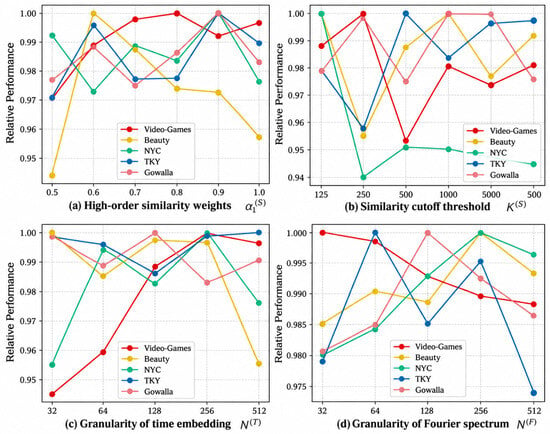
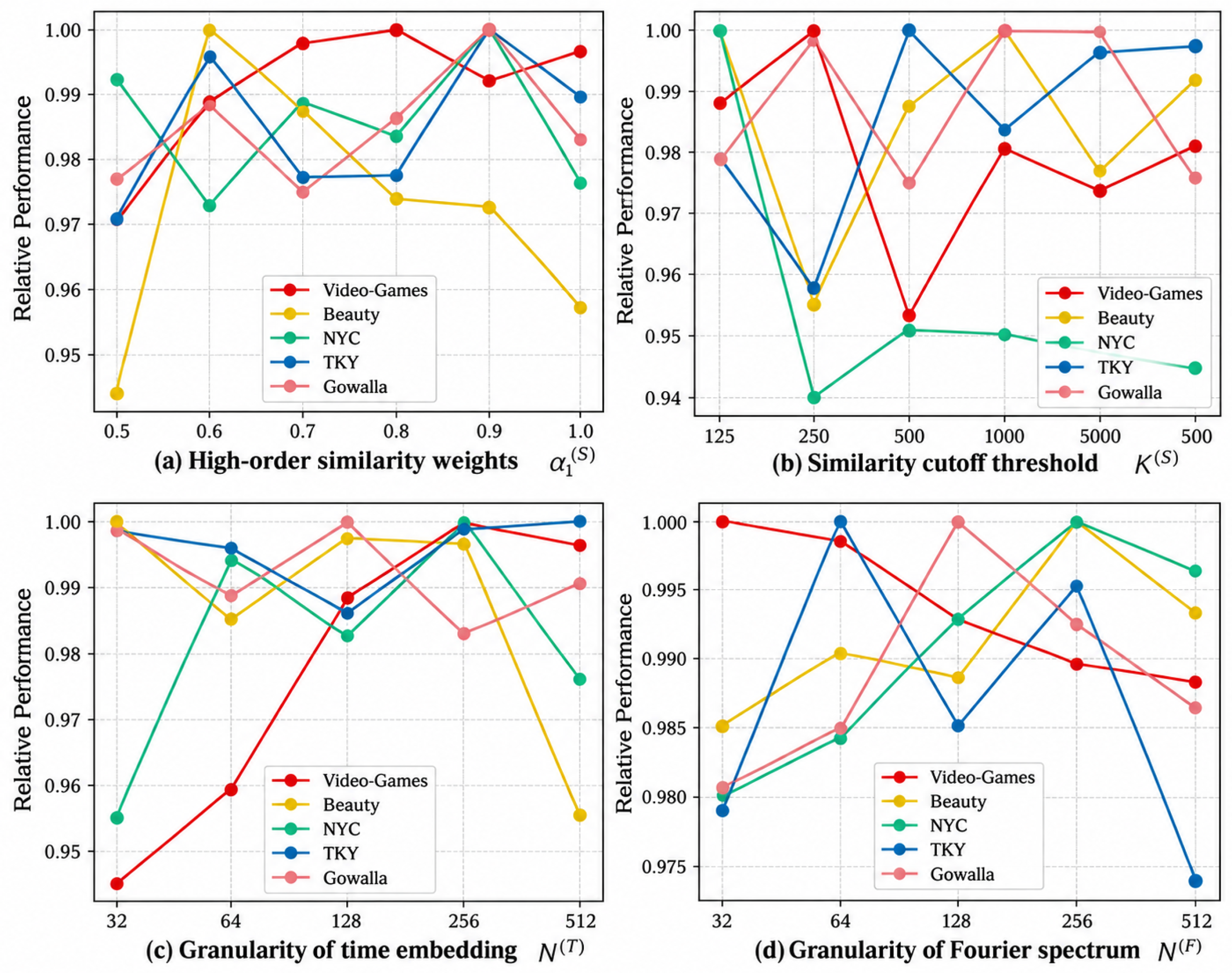
We systematically investigated four critical hyperparameters: high-order similarity weights α(S), similarity cutoff threshold K(S), temporal embedding bin sizes N(T), and Fourier frequency domain resolutions N. We planned to investigate the influence of tuning these hyperparameters within predefined ranges on the recommendation performance.
High-order Similarity Weights. As shown in Figure 3a, tuning first-order weight from 0.5 to 1.0 (step = 0.1) reveals optimal performance at = 0.9, demonstrating the dominance of direct item correlations over higher-order connections.
Figure 3.
Test results on adjusted hyperparameters. The performance peaked around = 0.9 (a), and was generally better at N(T) = 256 (c) and N = 256 (d), although the optimal value is not identical across all datasets. No consistent regularity was observed for K(S) (b) due to the specificity of different datasets. The last x-axis tick label in (c) has been corrected from 256 to 512.
Similarity Cutoff Threshold. Figure 3b illustrates that cutoff thresholds tested with {125, 250, 500, 1000, 2000, no-cutoff} exhibit dataset-dependent performance variations without clear universal patterns. This reflects the inherent diversity of real-world item relationship patterns, which static similarity matrices in MIFARec cannot fully adapt to. We identify dynamic similarity learning as a critical future research direction.
Granularity of Time Embedding. As depicted in Figure 3c, a temporal bin size of 256 achieves a good trade-off between temporal resolution and noise robustness on most of the datasets.
Granularity of Fourier Spectrum. Figure 3d shows that partitioning the frequency domain into 256 bins generally yields favorable performance, balancing periodic pattern capture and computational efficiency, although the optimal resolution varies slightly across datasets.
4.4. Core Components Analysis
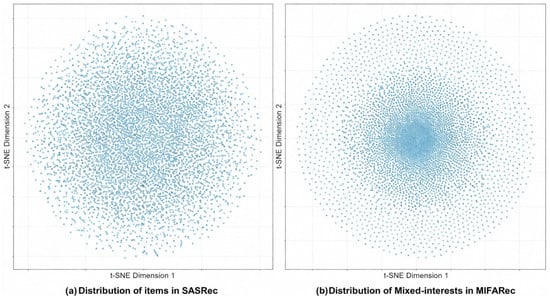
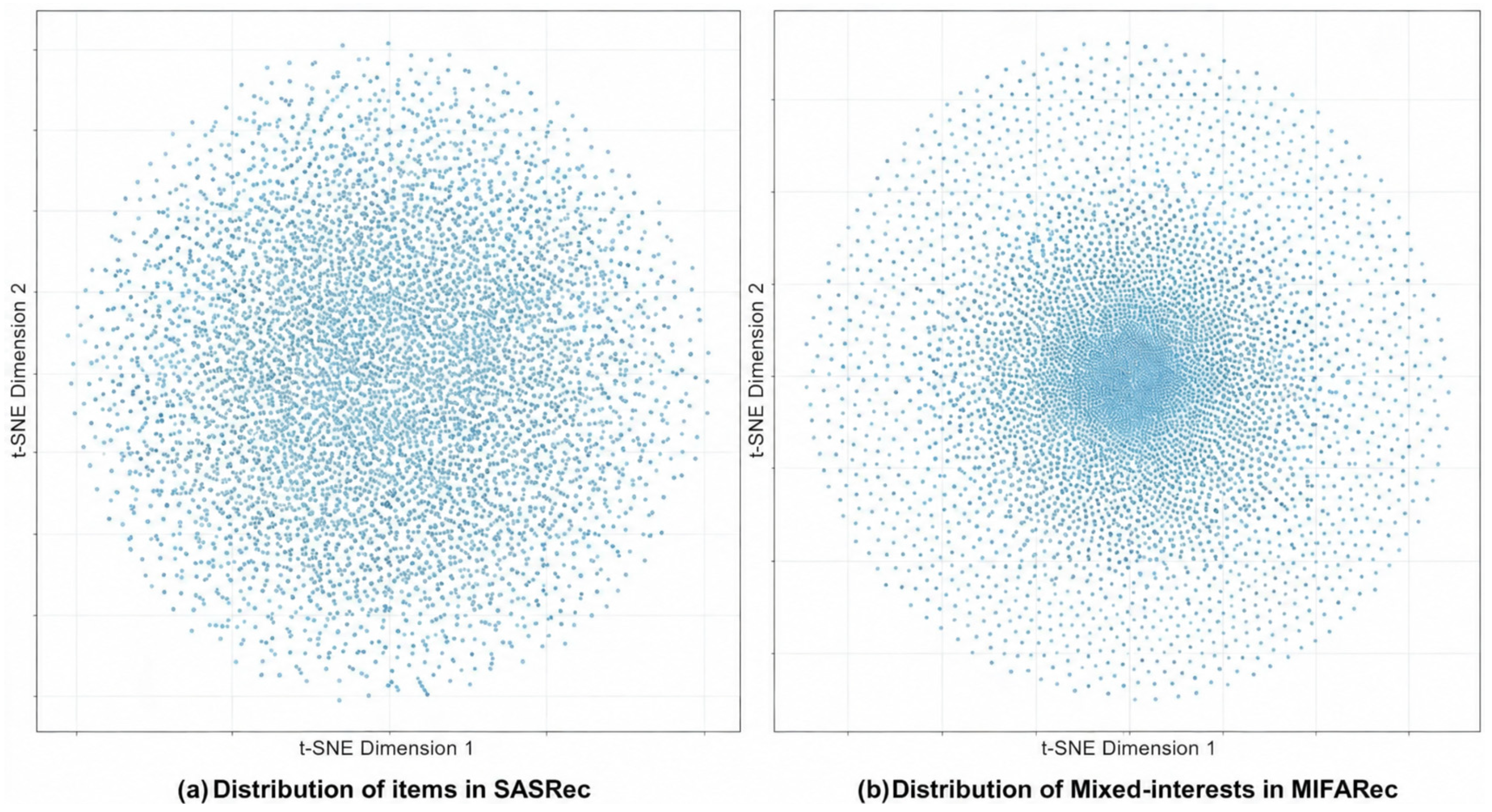
Mixed-interest mechanism. Mixed interests are built by aggregation of item embeddings. Therefore, the training of a single batch entails much more extensive parameter updates, which makes learning more efficient. Moreover, we applied t-SNE dimensionality reduction [32] to item embeddings of SASRec [8] and mixed-interest representations of MIFARec as shown in Figure 4. It can be noted that mixed-interest representations exhibit denser clustering with tighter inter-interest correlations, suggesting that items are effectively integrated. Localized clusters at the periphery of the distribution suggest that the learned representations may preserve similarities among niche interests associated with items already present in the training data. However, this visualization alone does not establish improved recommendation performance for low-frequency items.
Figure 4.
Distribution of item embeddings in SASRec and mixed-interests in MIFARec. (a) Distribution of items in SASRec; (b) Distribution of Mixed-Interests in MIFARec.
Fourier Analysis. The Fourier analysis layer first obtains the spectrum of each mixed-interest specificity within a session through a neural network and acquires their relative weights λ according to specific temporal features via Equation (6). To illustrate how this mechanism operates, we visualize a representative session from a real-world dataset. This example provides a qualitative illustration of the learned weighting behavior and is not intended as a quantitative evaluation across sessions.
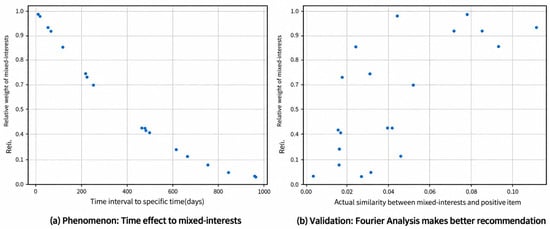
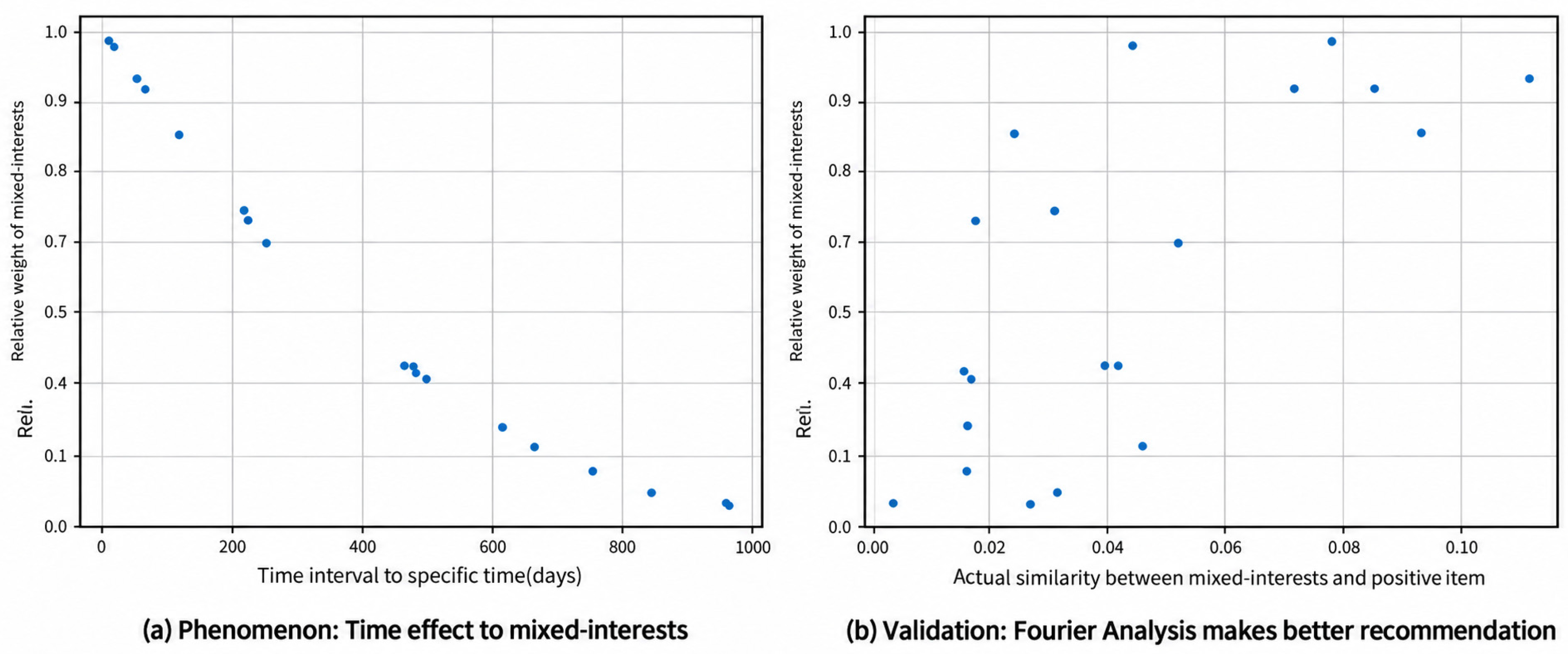
Figure 5a displays the mixed-interest distribution of a particular session, where the x-axis denotes the time interval between specific moments and mixed interests, and the y-axis denotes the relative weights λ of mixed interests that vary with the time interval in the illustrated session. The distribution can reflect the modeling results of temporal influences on mixed interests by the Fourier analysis layer. It can be observed that this session contains a complete set of 20 mixed interests, with their relative weights and corresponding specific time intervals following a distinct positive correlation.
Figure 5.
Analysis of the Fourier-based temporal weighting. (a) The relative weight λ of mixed interests varies with the time interval. (b) The approximate positive correlation between the relative weight and the actual similarity to the positive item suggests that the Fourier analysis layer captures meaningful temporal influence.
Figure 5b analyzes the real-world fitting effect of this session from an external observation perspective. Its x-axis denotes the similarity between mixed interests and positive labels, with the y-axis again indicating the relative weights λ of mixed interests. Based on real-world experience and scoring Equation (9), we believe that the distribution should exhibit a positive correlation, where mixed interests with higher similarity should be given greater relative weights. The observed distribution fundamentally aligns with the expectation. This observation provides qualitative support for the interpretation that MIFARec uses temporal interval features to adjust the relative weights of mixed interests. Compared with the average-weight baseline MIFARec-fb in Table 3, MIFARec’s adaptive mechanism elevates the ranking of positive samples, demonstrating superior temporal-specific recommendation capability. Notably, some interests still exhibit relatively high weights despite lower similarity levels, which we attribute to noise interference from historically irrelevant items.
5. Discussion and Limitations
Although MIFARec achieves competitive performance, several limitations of this study should be acknowledged. First, the item–item similarity matrix S is precomputed offline and remains static during training; it encodes population-level co-occurrence relationships and therefore serves as a practical proxy for, rather than a literal model of, each individual user’s lifelong interests, and newly arrived items or interactions cannot be reflected until the next offline update, which limits the adaptability of the system under cold-start scenarios. Second, constructing S has a time complexity of O(|I|2); although this step is executed offline and occupies only a small proportion of the overall computation, it may become a bottleneck for industrial-scale catalogs with millions of items, for which approximate nearest-neighbor search or incremental updates would be required. Third, the evaluation relies on the sampled-ranking protocol with 999 negative samples rather than full-catalog ranking, which is computationally efficient but may slightly overestimate the absolute metrics. Fourth, the Fourier analysis mechanism is currently validated through representative case visualizations, and a quantitative correlation analysis across multiple users, sessions, and datasets would further strengthen the evidence. Finally, historically irrelevant items may introduce noise interference into the mixed-interest representation, which may affect the fidelity of the modeled interests.
In future work, we plan to optimize the precomputed static similarity matrix during model learning, for example, by parameterizing it with a low-rank learnable factorization that is updated jointly with the recommendation objective, and to specifically suppress the identified noise interference through contrastive denoising or attention-based gating mechanisms. Full-catalog evaluation and quantitative temporal-correlation analyses on more datasets will also be conducted to further validate the proposed method.
6. Conclusions
In this work, we propose MIFARec, a Fourier analysis network based on mixed interests, which is applied to time-specific recommendation, a newly developing and promising task. We found that most existing research on sequential recommendation struggles to balance short-term and long-term interest features, and faces difficulties in fitting real interests within a fixed multi-interest framework. Time-aware sequential recommendation models tend to introduce irrelevant historical items as noise, making it challenging to model the temporal evolution of interests.
To address these issues, MIFARec leverages global item associations as a population-level proxy for longer-term preference patterns when modeling mixed interests within fixed-length sessions. This approach enhances the model’s ability to fit real-world patterns while ensuring that the computational complexity remains manageable. Furthermore, MIFARec introduces a non-linear time embedding index to maintain temporal similarity enhancement of interactions. The mixed-interest representation relies on a precomputed static similarity matrix, which limits its adaptability to evolving item relationships. A potential direction for future research is to introduce a learnable similarity matrix, such as a low-rank parameterization that can be jointly optimized with the recommendation objective. Furthermore, the interference caused by historically irrelevant items could be mitigated through contrastive denoising or attention-based gating mechanisms, potentially improving the robustness and accuracy of interest representations. These extensions will be explored in future work. Additionally, the Fourier analysis in MIFARec captures the temporal evolution characteristics of mixed interests while keeping the model architecture streamlined. Finally, MI- FARec illustrates consistent performance improvements along with favorable training efficiency in a series of experiments. The effectiveness of the model is also validated through ablation experiment designs and related analyses.
Author Contributions
Conceptualization, J.W. and W.L.; methodology, J.Z. and J.W.; software, J.Z.; validation, J.Z., X.Z. and T.X.; formal analysis, J.Z. and W.L.; investigation, X.Z., T.X. and S.T.; resources, W.L. and S.T.; data curation, J.Z., X.Z. and T.X.; writing—original draft preparation, J.Z. and J.W.; writing—review and editing, J.W., W.L. and S.T.; visualization, J.Z. and X.Z.; supervision, J.W. and W.L.; project administration, J.W. and S.T.; funding acquisition, J.W. and W.L. All authors have read and agreed to the published version of the manuscript.
Funding
This work is supported by the Guangdong S&T Programme Key-Area Research and Development Program of Guangdong Province (2025B0101120004), Guangdong Basic and Applied Basic Research Foundation (2024A1515010241, 2026A1515012382), Guangdong Provincial Education Science Planning Project (2025GXJK0588), and Talent Special Project of Guangdong Open University (RC1916).
Institutional Review Board Statement
Ethical review and approval were waived for this study due to the fact that this study only uses publicly available datasets and does not involve human participants or animal experiments.
Informed Consent Statement
Not applicable.
Data Availability Statement
The data presented in this study are derived from publicly available datasets. These data were derived from the following resources available in the public domain: the Video-Games and Beauty datasets are available from the Amazon Reviews dataset (https://nijianmo.github.io/amazon/index.html (accessed on 15 March 2025)); the NYC and TKY datasets are available from the Foursquare check-in dataset; and the Gowalla dataset is available from the publicly available Gowalla location-based social network dataset. All datasets were used in accordance with their respective terms of use and citation requirements.
Conflicts of Interest
The authors declare no conflict of interest.
References
- Boka, T.F.; Niu, Z.; Neupane, R.B. A Survey of Sequential Recommendation Systems: Techniques, Evaluation, and Future Directions. Inf. Syst. 2024, 125, 102427. [Google Scholar] [CrossRef] [Scilit]
- Wang, S.; Cao, L.; Wang, Y.; Sheng, Q.Z.; Orgun, M.A.; Lian, D. A Survey on Session-based Recommender Systems. ACM Comput. Surv. (CSUR) 2021, 54, 1–38. [Google Scholar] [CrossRef] [Scilit]
- Liu, H.; Wang, Y.; Zhang, Z.; Deng, J.; Chen, C.; Zhang, L.Y. Matrix factorization recommender based on adaptive Gaussian differential privacy for implicit feedback. Inf. Process. Manag. 2024, 61, 103720. [Google Scholar] [CrossRef] [Scilit]
- Feng, S.; Meng, F.; Chen, L.; Shang, S.; Ong, Y.S. ROTAN: A Rotation-based Temporal Attention Network for Time-Specific Next POI Recommendation. In Proceedings of the KDD’24: Proceedings of the 30th ACM SIGKDD Conference on Knowledge Discovery and Data Mining, Barcelona, Spain, 25–29 August 2024; pp. 759–770. [Google Scholar] [CrossRef] [Scilit]
- Wang, H.; Ma, S.; Dong, L.; Huang, S.; Zhang, D.; Wei, F. DeepNet: Scaling Transformers to 1,000 Layers. IEEE Trans. Pattern Anal. Mach. Intell. 2024, 46, 6761–6774. [Google Scholar] [CrossRef] [Scilit]
- Guo, M.-H.; Xu, T.-X.; Liu, J.-J.; Liu, Z.-N.; Jiang, P.-T.; Mu, T.-J.; Zhang, S.-H.; Martin, R.R.; Cheng, M.-M.; Hu, S.-M. Attention Mechanisms in Computer Vision: A Survey. Comput. Vis. Media 2022, 8, 331–368. [Google Scholar] [CrossRef] [Scilit]
- Vaswani, A.; Shazeer, N.; Parmar, N.; Uszkoreit, J.; Jones, L.; Gomez, A.N.; Kaiser, Ł.; Polosukhin, I. Attention Is All You Need. In Proceedings of the NeurIPS’17: Proceedings of the 31st International Conference on Neural Information Processing Systems, Long Beach, CA, USA, 4–9 December 2017; pp. 6000–6010. [Google Scholar]
- Kang, W.-C.; McAuley, J. Self-Attentive Sequential Recommendation. In Proceedings of the ICDM’18: Proceedings of the 2018 IEEE International Conference on Data Mining (ICDM), Singapore, 17–20 November 2018; pp. 197–206. [Google Scholar] [CrossRef] [Scilit]
- Zhu, X.; Zhang, Y.; Li, J.; Wang, J.; Lai, X. TCSR: Self-attention with time and category for session-based recommendation. Comput. Intell. 2024, 40, e12695. [Google Scholar] [CrossRef] [Scilit]
- Pi, Q.; Zhou, G.; Zhang, Y.; Wang, Z.; Ren, L.; Fan, Y.; Zhu, X.; Gai, K. Search-based User Interest Modeling with Lifelong Sequential Behavior Data for Click-Through Rate Prediction. In Proceedings of the CIKM’20: Proceedings of the 29th ACM International Conference on Information & Knowledge Management, Virtual, 19–23 October 2020; pp. 2685–2692. [Google Scholar] [CrossRef] [Scilit]
- Cheng, Y.; Fan, Y.; Wang, Y.; Li, X. Accurate Multi-Interest Modeling for Sequential Recommendation with Attention and Distillation Capsule Network. Expert Syst. Appl. 2024, 243, 122887. [Google Scholar] [CrossRef] [Scilit]
- Cen, Y.; Zhang, J.; Zou, X.; Zhou, C.; Yang, H.; Tang, J. Controllable multi-interest framework for recommendation. In Proceedings of the KDD’20: Proceedings of the 26th ACM SIGKDD International Conference on Knowledge Discovery & Data Mining, Virtual, 6–10 July 2020; pp. 2942–2951. [Google Scholar] [CrossRef] [Scilit]
- Wang, C.; Wang, Z.; Liu, Y.; Ge, Y.; Ma, W.; Zhang, M.; Liu, Y.; Feng, J.; Deng, C.; Ma, S. Target Interest Distillation for Multi-Interest Recommendation. In Proceedings of the CIKM’22: Proceedings of the 31st ACM International Conference on Information & Knowledge Management, Atlanta, GA, USA, 17–21 October 2022; pp. 2007–2016. [Google Scholar] [CrossRef] [Scilit]
- Sun, L.; Yu, C.; Liu, Y. Graph-enhanced bidirectional temporal attention network for sequential recommendation. Expert Syst. Appl. 2024, 251, 123974. [Google Scholar] [CrossRef] [Scilit]
- Li, J.; Wang, Y.; McAuley, J. Time interval aware self-attention for sequential recommendation. In Proceedings of the WSDM’20: Proceedings of the 13th International Conference on Web Search and Data Mining, Houston, TX, USA, 3–7 February 2020; pp. 322–330. [Google Scholar] [CrossRef] [Scilit]
- Li, X.; Wang, C.; Tong, B.; Tan, J.; Zeng, X.; Zhuang, T. Deep Time-Aware Item Evolution Network for Click-Through Rate Prediction. In Proceedings of the CIKM’20: Proceedings of the 29th ACM International Conference on Information & Knowledge Management, Virtual, 19–23 October 2020; pp. 785–794. [Google Scholar] [CrossRef] [Scilit]
- Zhang, Y.; Yang, B.; Liu, H.; Li, D. A time-aware self-attention based neural network model for sequential recommendation. Appl. Soft Comput. 2023, 133, 109894. [Google Scholar] [CrossRef] [Scilit]
- Tran, V.A.; Salha-Galvan, G.; Sguerra, B.; Hennequin, R. Attention Mixtures for Time-Aware Sequential Recommendation. In Proceedings of the SIGIR’23: Proceedings of the 46th International ACM SIGIR Conference on Research and Development in Information Retrieval, Taipei, China, 23–27 July 2023; pp. 1821–1826. [Google Scholar] [CrossRef] [Scilit]
- Zhou, K.; Yu, H.; Zhao, W.X.; Wen, J.-R. Filter-Enhanced MLP Is All You Need for Sequential Recommendation. In Proceedings of the WWW’22: Proceedings of the ACM Web Conference 2022, Virtual, 25–29 April 2022; pp. 2388–2399. [Google Scholar] [CrossRef] [Scilit]
- He, X.; Deng, K.; Wang, X.; Li, Y.; Zhang, Y.; Wang, M. LightGCN: Simplifying and powering graph convolution network for recommendation. In Proceedings of the SIGIR’20: Proceedings of the 43rd International ACM SIGIR Conference on Research and Development in Information Retrieval, Virtual, 25–30 July 2020; pp. 639–648. [Google Scholar] [CrossRef] [Scilit]
- Liu, W.; Liang, S.; Zhu, H.; Hou, L.; Yu, J.; Li, X.; Yin, J. Variational Kernel Density Estimation Recommendation Algorithm for Users with Diverse Activity Levels. In Database Systems for Advanced Applications: 29th International Conference, DASFAA 2024, Gifu, Japan, 2–5 July 2024; Part II; Springer Nature: Berlin/Heidelberger, Germany, 2024; pp. 3–18. [Google Scholar] [CrossRef] [Scilit]
- Fournier, Q.; Marceau Caron, G.; Aloise, D. A Practical Survey on Faster and Lighter Transformers. ACM Comput. Surv. 2023, 55, 1–40. [Google Scholar] [CrossRef] [Scilit]
- Feng, J.; Wang, K.; Miao, Q.; Xi, Y.; Xia, Z. Personalized recommendation with hybrid feedback by refining implicit data. Expert Syst. Appl. 2023, 232, 120855. [Google Scholar] [CrossRef] [Scilit]
- Wang, C.; Ren, Y.; Ma, W.; Zhang, M.; Liu, Y.; Ma, S. ReChorus: Comprehensive, Efficient, Flexible, and Lightweight Framework for Recommendation Algorithms. Ruan Jian Xue Bao/J. Softw. 2022, 33, 1430–1438. (In Chinese) [Google Scholar] [CrossRef]
- Ni, J.; Li, J.; McAuley, J. Justifying Recommendations using Distantly-Labeled Reviews and Fine-Grained Aspects. In Proceedings of the 2019 Conference on Empirical Methods in Natural Language Processing and the 9th International Joint Conference on Natural Language Processing (EMNLP-IJCNLP), Hong Kong, China, 3–7 November 2019; pp. 188–197. Available online: https://aclanthology.org/D19-1018.pdf (accessed on 29 September 2026).
- Sarwat, M.; Levandoski, J.J.; Eldawy, A.; Mokbel, M.F. LARS*: An Efficient and Scalable Location-Aware Recommender System. IEEE Trans. Knowl. Data Eng. 2014, 26, 1384–1399. [Google Scholar] [CrossRef] [Scilit]
- Qin, Y.; Wu, H.; Ju, W.; Luo, X.; Zhang, M. A Diffusion Model for POI Recommendation. ACM Trans. Inf. Syst. 2023, 42, 54. [Google Scholar] [CrossRef] [Scilit]
- Li, P.; de Rijke, M.; Xue, H.; Ao, S.; Song, Y.; Salim, F.D. Large Language Models for Next Point-of-Interest Recommendation. arXiv 2024, arXiv:2404.17591. [Google Scholar] [CrossRef] [Scilit]
- Tang, J.; Wang, K. Personalized top-n sequential recommendation via convolutional sequence embedding. In Proceedings of the WSDM’18: Proceedings of the Eleventh ACM International Conference on Web Search & Data Mining, Marina del Rey, CA, USA, 5–9 February 2018; pp. 565–573. [Google Scholar] [CrossRef] [Scilit]
- Hidasi, B.; Karatzoglou, A.; Baltrunas, L.; Tikk, D. Session-based recommendations with recurrent neural networks. arXiv 2015, arXiv:1511.06939. [Google Scholar] [CrossRef] [Scilit]
- Li, Z.; Sun, A.; Li, C. DifuRec: A Diffusion Model for Sequential Recommendation. ACM Trans. Inf. Syst. 2023, 42, 1–28. [Google Scholar] [CrossRef] [Scilit]
- Skrodzki, M.; van Geffen, H.; Chaves-De-Plaza, N.F.; Höllt, T.; Eisemann, E.; Hildebrandt, K. Accelerating Hyperbolic t-SNE. IEEE Trans. Vis. Comput. Graph. 2024, 30, 4403–4415. [Google Scholar] [CrossRef] [Scilit] [PubMed]

Disclaimer/Publisher’s Note: The statements, opinions and data contained in all publications are solely those of the individual author(s) and contributor(s) and not of MDPI and/or the editor(s). MDPI and/or the editor(s) disclaim responsibility for any injury to people or property resulting from any ideas, methods, instructions or products referred to in the content. |
© 2026 by the authors. Licensee MDPI, Basel, Switzerland. This article is an open access article distributed under the terms and conditions of the Creative Commons Attribution (CC BY) license.