


Abstract
The geometric morphology and dynamic evolution of the molten pool are key indicators of heat input, metal transfer, and solidification behavior during welding, making them critical for quality monitoring and process control. To address the challenges of molten pool image segmentation under complex conditions, including strong arc interference, blurred boundaries, small foreground regions, and significant shape variations, a MIG welding-based visual acquisition system is established to construct a multi-condition dataset. Based on this dataset, an efficient boundary-guided dual-branch network, WPSeg-Net, is proposed. The network employs ResNet-34 as the encoder, integrates a lightweight Transformer module for global context modeling, and adopts BiFPN for multi-scale feature fusion. A region branch and a boundary branch with a mutual guidance mechanism are further designed to improve segmentation accuracy and boundary refinement. Experimental results demonstrate that WPSeg-Net achieves an IoU of 92.83% and a Dice score of 96.28%, improving by 0.98% and 0.58% over DeepLabV3+, respectively. Meanwhile, the proposed method reduces the parameter size from 22.43 MB to 21.78 MB and decreases FLOPs from 62.25 G to 31.90 G, achieving a better balance between segmentation performance and computational efficiency.
1. Introduction
Welding is a fundamental process in modern industrial manufacturing and directly affects the structural reliability of critical components, including aerospace structures, ships, and pressure vessels [1]. In automated welding systems, the molten pool serves as the region where heat input interacts with the material, and its morphology, dynamic behavior, and geometric characteristics (e.g., width, length, and area) [2] provide important information about welding stability and weld formation quality. Therefore, accurate perception and continuous monitoring of the molten pool are essential for developing closed-loop welding control systems and advancing intelligent welding technologies [3]. However, reliable molten pool analysis remains challenging because image acquisition is often affected by complex disturbances, including strong arc radiation, fume interference, and metal spatter.
Recent advances in industrial cameras and optical components have promoted the development of machine vision-based molten pool monitoring systems. Existing studies in this field can be broadly divided into two categories. The first category focuses on improving molten pool image acquisition under harsh welding conditions. By optimizing filter wavelengths, lens configurations, and exposure strategies, researchers have attempted to obtain clearer molten pool contours and surface details. For example, Kim et al. developed an online molten pool imaging system for Gas Metal Arc Welding (GMAW) and evaluated its observation stability under different process parameters through spectral radiation analysis and no-reference image quality assessment [4]. The second category investigates welding process analysis and control based on visual information. These studies extract morphological and temporal characteristics from molten pool images to evaluate welding quality and regulate process parameters. Li et al. proposed an online welding quality diagnosis framework based on molten pool behavior prediction, which enabled early detection of typical welding defects [5]. Takahashi et al. employed ResNet50 to classify molten pool states in CO2 gas-shielded welding and combined the recognition results with a proportional–integral (PI) control strategy for penetration regulation and weld seam tracking [6]. These studies demonstrate the value of molten pool visual information for intelligent welding monitoring and control.
Despite these advances, accurately extracting the molten pool region from captured images remains a critical challenge. With the rapid development of deep learning, semantic segmentation methods have been introduced into molten pool analysis to achieve pixel-level localization. Compared with traditional approaches based on thresholding and edge detection, deep learning models generally provide stronger feature representation capability under complex conditions, such as arc interference and low contrast. Current research on molten pool segmentation mainly focuses on improving network architectures and enhancing feature extraction. Yang et al. combined convolutional neural networks with Transformer modules to capture global dependencies while preserving local texture information, leading to improved segmentation performance [7]. Qu et al. introduced a self-attention mechanism into the BiSeNet framework for efficient molten pool segmentation and further applied the segmentation results to penetration state prediction [8]. In application-oriented studies, Chandrasekhar et al. employed U-Net with advanced encoders, such as EfficientNet, to extract molten pool regions and provide geometric information for subsequent weld quality assessment [9]. Jorge et al. investigated lightweight detection and segmentation models to achieve a balance between accuracy and computational efficiency for real-time molten pool extraction [10]. Yu et al. further verified the effectiveness of deep learning-based segmentation networks for molten pool boundary detection under strong arc interference [11].
Although considerable progress has been achieved, several challenges remain when shifting the analysis focus from weld seam monitoring to molten pool region segmentation. First, molten pool images are frequently affected by intense arc radiation, spatter, and fumes, which reduce local contrast and cause information loss. Conventional convolutional neural networks mainly rely on local feature extraction and may have limited capability in modeling long-range dependencies under such conditions. Recent studies, such as TransUNet [12], have demonstrated the effectiveness of Transformer-based structures in capturing global contextual information, providing valuable insights for low-contrast image segmentation tasks. Second, the molten pool undergoes continuous morphological changes during welding due to variations in heat input, resulting in considerable differences in scale and shape. Traditional single-path feature pyramid structures may struggle to effectively integrate multi-scale information. The Bi-directional Feature Pyramid Network (BiFPN) proposed by Tan et al. [13] introduces bidirectional feature propagation and learnable fusion weights, offering an efficient solution for multi-scale feature representation. Furthermore, molten pool boundaries are often unclear, particularly near the liquid–solid transition region at the rear of the molten pool. A single segmentation branch may have difficulty maintaining both region consistency and boundary accuracy. To overcome this limitation, Takikawa et al. proposed Gated-SCNN [14], which introduces a dedicated boundary branch and establishes interaction between semantic and boundary information to improve contour representation.
Motivated by these observations, this paper proposes an effective boundary-aware semantic segmentation network, termed WPSeg-Net, for grayscale molten pool image segmentation. The proposed network adopts ResNet-34 [15] as the encoder backbone and integrates a lightweight Transformer module to capture global contextual information. A BiFPN-based feature fusion strategy is further introduced to improve multi-scale feature representation. In addition, a dual-branch decoder consisting of a region branch and a boundary branch is developed. The two branches interact through a mutual guidance mechanism, enabling joint optimization of molten pool regions and contour information. A joint loss function combining Dice Loss [16], Focal Loss [17], boundary Binary Cross-Entropy loss, and a consistency constraint is also designed to provide comprehensive supervision for region and boundary prediction.
The main contributions of this work are summarized as follows:
- A pixel-level annotated dataset for molten pool segmentation is established, including standardized preprocessing and data partitioning procedures, to support quantitative evaluation of segmentation models.
- A multi-scale feature extraction framework that combines a lightweight Transformer module and BiFPN is proposed to improve feature representation under strong arc interference and varying molten pool scales.
- A dual-branch decoder with region–boundary collaboration is developed. A mutual guidance mechanism is introduced to reduce the conflict between region consistency and boundary precision during segmentation.
- A joint loss function is designed by integrating region overlap supervision, hard example learning, boundary constraint, and prediction consistency, providing comprehensive optimization for molten pool segmentation.
- Extensive experiments on the constructed dataset demonstrate that the proposed method achieves superior performance in IoU, Dice, and boundary quality compared with several mainstream semantic segmentation models.
2. Molten Pool Image Acquisition
2.1. Experimental Platform for Molten Pool Image Acquisition
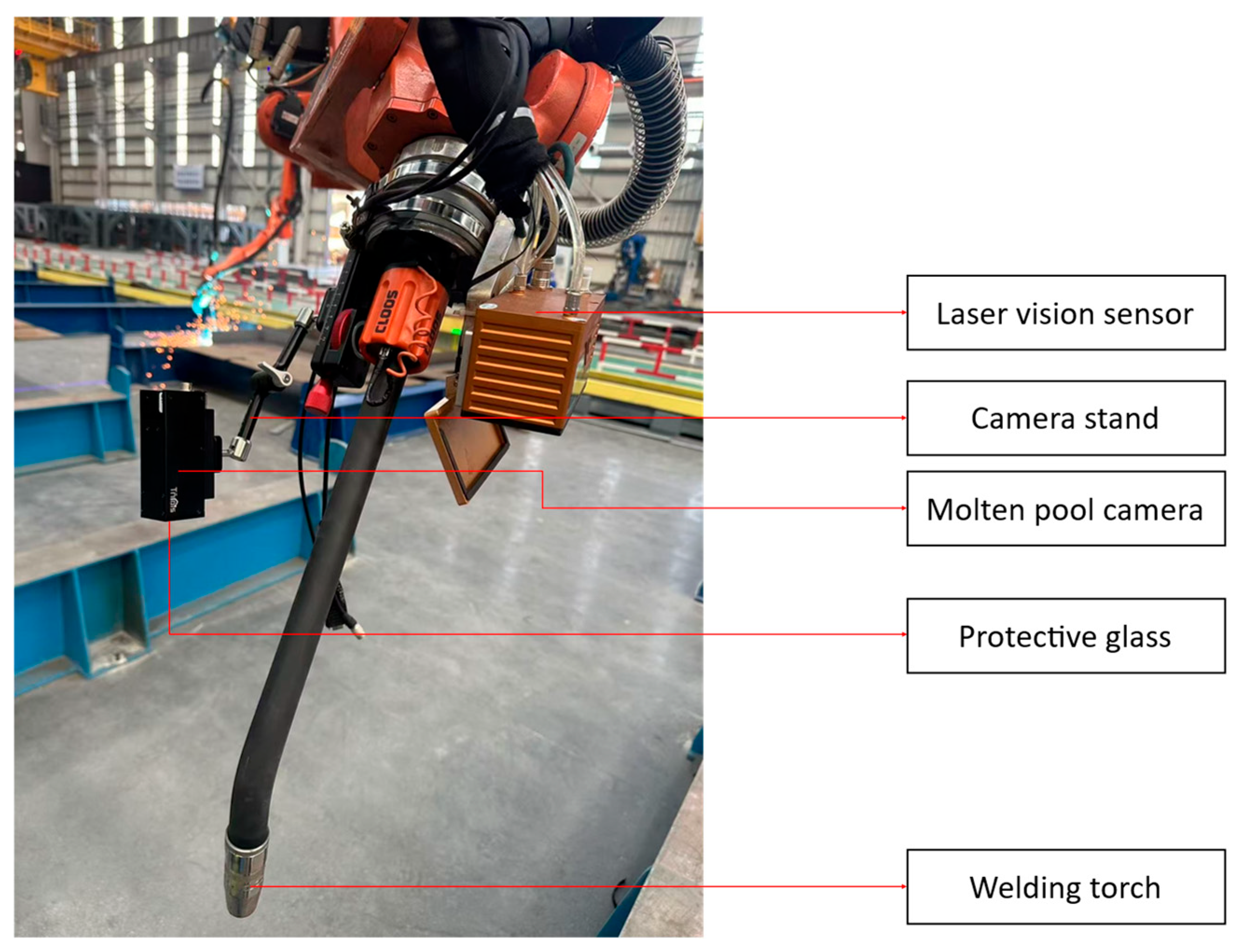
A molten pool visual sensing system based on Metal Inert Gas (MIG) welding was established to obtain stable, high-quality molten pool images. This system provides a reliable data foundation for subsequent image processing and semantic segmentation, as shown in Figure 1 [18,19]. The system mainly consists of a TANDIS MP200 molten pool camera (TANDIS, Nanjing, China), a CLOOS QIROX QRC-350 robotic arm(CLOOS, Haiger, Germany), a welding torch, and a computer for data acquisition, analysis, and processing. The molten pool camera enables high-resolution and high-speed imaging under strong arc conditions, clearly capturing key details such as the arc, molten pool, and droplet transfer during welding.
Figure 1.
MIG welding molten pool image acquisition system.
To ensure imaging quality and acquisition stability, auxiliary structures were further optimized. A laser vision sensor was installed beside the welding torch to acquire weld seam position and trajectory information, providing feedback for robotic motion control. The molten pool camera was mounted on a dedicated bracket at an appropriate observation angle to avoid direct arc interference while ensuring stable acquisition of molten pool dynamics. In addition, a 3 mm thick high-temperature-resistant protective glass with 90% transmittance was installed in front of the camera to shield against metal spatter, high-temperature fumes, and intense radiation, thereby reducing contamination and damage to the lens. The entire system operates synchronously, with the robotic arm driving the welding torch along a predefined trajectory while image acquisition is performed simultaneously.
Furthermore, key welding parameters—including welding current, shielding gas (argon) flow rate, and wire feeding speed—were selected as the main variables to investigate their influence on molten pool morphology and welding quality [20,21]. The selection of parameter ranges was based on the actual operating conditions of the MIG welding process and preliminary welding trials. In practical robotic MIG welding applications, the welding current generally determines the heat input and molten metal transfer behavior, while the wire feeding speed controls the deposition rate, and the shielding gas flow rate affects arc stability and protection effectiveness. Considering the material characteristics, welding torch configuration, and stable operating range of the experimental system, the current was selected within 100–140 A, the wire feeding speed within 2.5–3.5 mm/s, and the shielding gas flow rate within 10–20 L/min. These ranges cover typical stable welding states as well as several representative abnormal conditions, including insufficient heat input, excessive heat accumulation, unstable arc protection, and excessive metal deposition, thereby providing sufficient variation in molten pool morphology for dataset construction.
A further investigation into the influence of welding parameters on molten pool morphology and welding quality was conducted by selecting welding current, shielding gas flow rate, and wire feeding speed as primary variables. Each parameter was set at three levels, and an orthogonal experimental design was adopted to construct nine representative working conditions. Under consistent robotic trajectories, welding postures, and imaging settings, molten pool images were collected for different parameter combinations. The parameter configurations and corresponding welding states are summarized in Table 1.
Table 1.
Orthogonal design of welding parameters and corresponding weld conditions.
Experimental observations indicate that welding current has a significant influence on molten pool morphology. As the current increases, arc energy input rises significantly, leading to a larger molten pool area and increased brightness. At low current levels, insufficient energy results in poor welding stability, whereas excessive current may cause over-expansion of the molten pool and defects such as burn-through. The shielding gas flow rate primarily affects arc stability and protection effectiveness. Insufficient gas flow leads to arc fluctuations and inadequate shielding, resulting in defects such as porosity, while excessive flow may introduce turbulence and negatively impact arc stability. The wire feeding speed directly influences droplet transfer and molten metal supply. As the feeding speed increases, molten pool volume grows accordingly; however, excessive feeding may lead to metal accumulation and defects such as undercut.
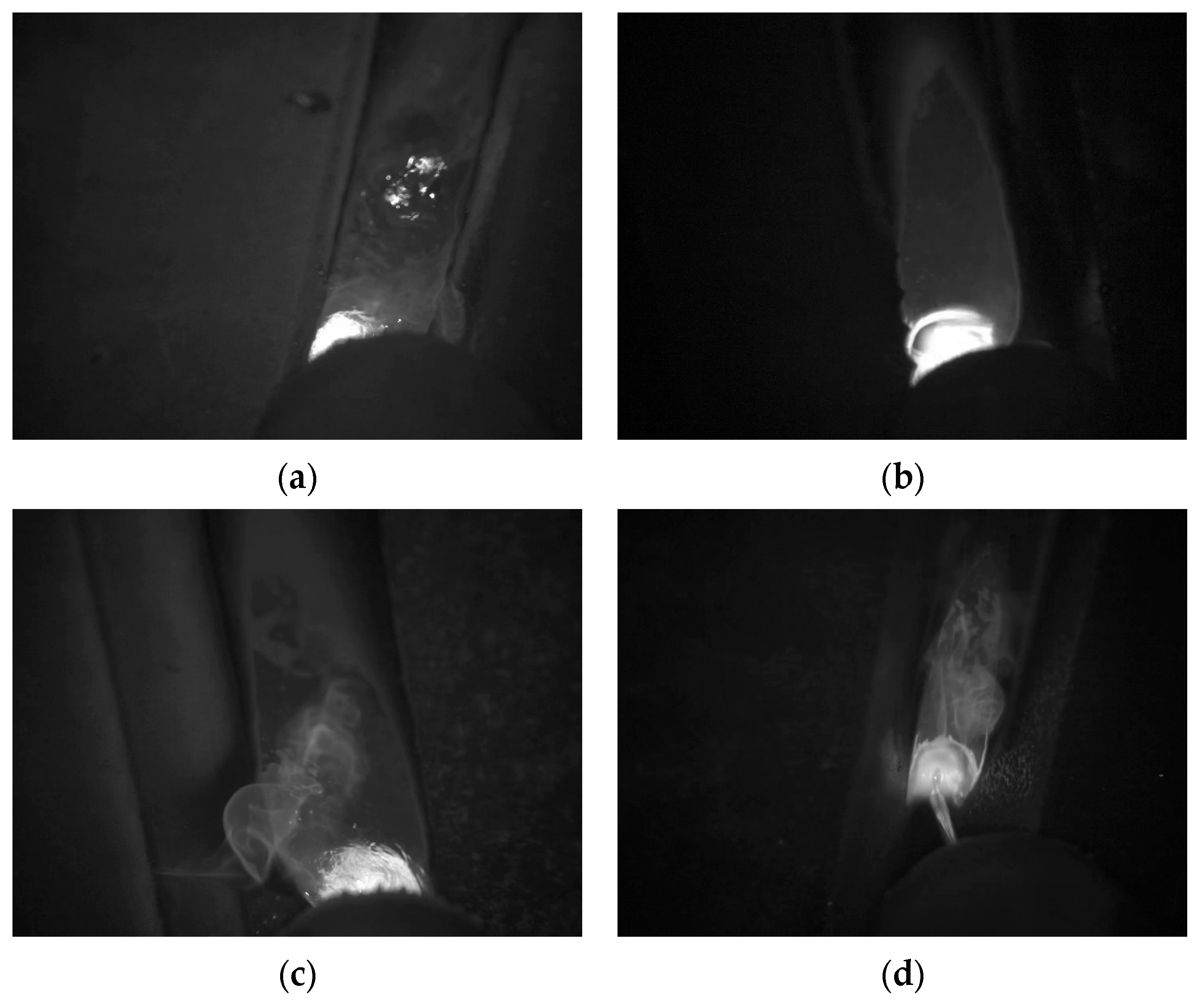
Based on different parameter combinations, welding states were annotated, including typical categories such as porosity, defect-free, undercut, and burn-through. Representative molten pool images corresponding to these conditions are shown in Figure 2. Significant differences in size, brightness distribution, and boundary morphology can be observed under varying process parameters. These variations not only reflect welding quality but are also directly manifested in image features.
Figure 2.
Representative molten pool images under different welding conditions. (a) porosity; (b) undercut; (c) defect-free; (d) burn-through.
Through the above experiments, a molten pool image dataset covering diverse welding conditions and imaging characteristics was obtained. The dataset exhibits strong diversity in morphology, brightness, and boundary complexity, providing a representative foundation for training and evaluating semantic segmentation models, and contributing to improved robustness and generalization under varying conditions.
2.2. Dataset Construction and Preprocessing
Based on the molten pool images collected in Section 2.1, a dataset for semantic segmentation was constructed. The raw data consist of paired .jpg images and manually verified .json polygon annotations. The entire dataset contains 1000 such image–annotation pairs. During preprocessing, polygon regions are converted into binary masks, where the molten pool is labeled as the foreground and the background as zero, forming pixel-level supervision labels. The annotation process was carefully designed to ensure the quality of pixel-level labels. All molten pool regions were initially annotated manually using LabelMe by one researcher with experience in welding image analysis. The annotation criteria were defined according to the visible molten pool boundary, including the molten metal region while excluding the surrounding arc region, spatter, and background noise. After the initial annotation, all labels were independently reviewed by another researcher to identify potential boundary errors and inconsistencies. During the verification process, 52 image annotations were further corrected, accounting for 5.2% of the total dataset. The identified inconsistencies were mainly caused by ambiguous molten pool boundaries under strong arc illumination, local reflections, and interference from spatter. After these corrections, the final annotations were jointly confirmed by both researchers. This procedure ensured that the generated masks provided reliable pixel-level supervision for semantic segmentation. The dataset is randomly split into training, validation, and test sets at a ratio of 8:1:1, ensuring no overlap among subsets.
To ensure consistent input dimensions, all images and masks were resized to 512 × 512 pixels. Bilinear interpolation was adopted for image resizing, whereas nearest-neighbor interpolation was applied to the corresponding masks to preserve the original label boundaries. The resized images were subsequently normalized to the range of [0, 1], and the binary masks were converted into single-channel tensors for network training [22].
During training, online data augmentation was employed to improve the model’s robustness against variations commonly encountered in welding processes. The augmentation operations included random horizontal and vertical flipping, rotations of 90°, 180°, and 270°, brightness and contrast adjustments, as well as Gaussian blur and Gaussian noise injection [23]. Geometric transformations were performed simultaneously on images and masks to maintain pixel-level correspondence, while photometric and noise-based operations were applied only to images. These augmentation techniques help the model better adapt to changes in molten pool orientation, arc fluctuations, and image noise.
Although the dataset contains 1000 image–annotation pairs, which is relatively limited compared with large-scale natural image datasets, it covers multiple welding conditions with variations in molten pool morphology, illumination intensity, and arc interference. Moreover, the proposed WPSeg-Net is designed as an effective segmentation framework with a moderate parameter size, reducing the risk of overfitting caused by excessive model complexity. The combination of careful annotation verification, online data augmentation, and comprehensive evaluation through ablation and comparison experiments provides sufficient support for validating the effectiveness of the proposed method under the investigated welding conditions. Nevertheless, expanding the dataset with additional welding processes and operating conditions remains an important direction for future work to further improve model generalization.
3. Approach
3.1. WPSeg-Net Overall Architecture
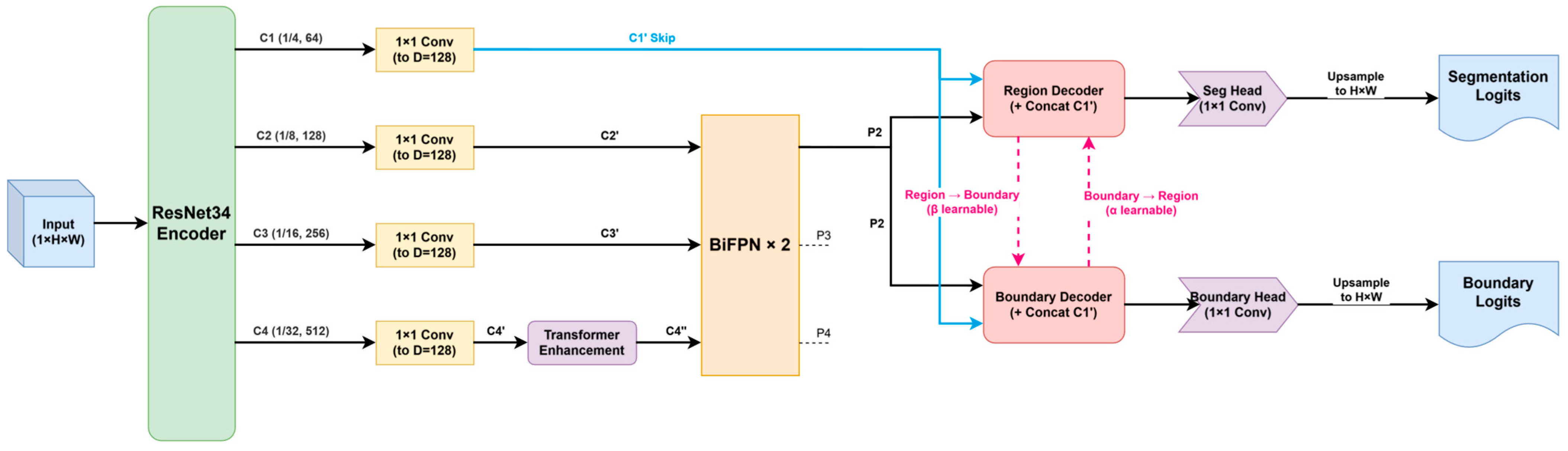
Considering the challenges in molten pool image segmentation, including small foreground regions, ambiguous boundaries, and severe arc interference, this study proposes an effective boundary-aware semantic segmentation network, termed WPSeg-Net. The overall architecture of the proposed model is presented in Figure 3. The network adopts an encoder–multi-scale fusion–dual-decoder collaborative framework, which improves both molten pool region segmentation accuracy and boundary localization capability while maintaining a controllable model complexity. The input of the model is a single-channel grayscale welding image X ∈ , and the outputs include a segmentation prediction and a boundary prediction .
Figure 3.
WPSeg-Net Overall Architecture Diagram.
Specifically, a ResNet-34 encoder is first employed to extract hierarchical features at four levels, denoted as C1, C2, C3, and C4. Although several lightweight backbones, such as MobileNetV3 and EfficientNet, have been developed for efficient visual tasks, ResNet-34 is selected in this work considering the characteristics of molten pool images. Compared with deeper networks, ResNet-34 provides sufficient feature extraction capability while maintaining moderate computational complexity. Its residual learning structure facilitates stable optimization and enables effective extraction of hierarchical features, which is beneficial for simultaneously capturing molten pool regions with large appearance variations and subtle boundary details. Moreover, the relatively regular feature hierarchy of ResNet-34 provides a suitable foundation for subsequent Transformer enhancement and BiFPN-based multi-scale fusion. A 1 × 1 convolution is then applied to project features from different levels into a unified channel dimension. To enhance global context modeling and suppress local noise interference, a lightweight Transformer module is introduced on the highest-level semantic feature C4. Subsequently, features from C2, C3, and C4 are fed into a Bi-directional Feature Pyramid Network (BiFPN) for adaptive bidirectional weighted fusion, generating multi-scale feature representations with both semantic consistency and spatial detail preservation.
In the decoding stage, a dual-branch architecture is adopted, consisting of a region branch and a boundary branch. The region branch is responsible for recovering the main molten pool region, while the boundary branch explicitly models the contour information. To further enhance their cooperation, a mutual guidance mechanism is introduced between the two branches. Specifically, boundary features are used to constrain region prediction, while region responses are fed back to refine boundary discrimination, thereby improving segmentation stability and geometric consistency in boundary transition areas. Finally, the network outputs segmentation logits and boundary logits, which are jointly optimized during training using region loss, boundary loss, and a consistency constraint.
Based on the overall architecture described above, the following sections provide a detailed introduction to the key components of the model, including feature extraction in the encoder, multi-scale feature fusion strategy, and the dual-branch collaborative decoding mechanism.
3.2. Multi-Scale Feature Extraction and Context Enhancement
ResNet-34 is employed as the backbone encoder to extract hierarchical features from molten pool images, enabling the network to capture both high-level semantic representations and fine-grained spatial details. Given an input grayscale image X ∈ , the encoder produces four-stage feature maps C1, C2, C3, and C4, where the spatial resolution is progressively reduced while the semantic abstraction level is gradually increased. The shallow feature C1 contains rich edge and texture information, which is beneficial for boundary recovery of the molten pool, whereas the deep feature C4 encodes stronger semantic representations, which help suppress background interference and false activations.
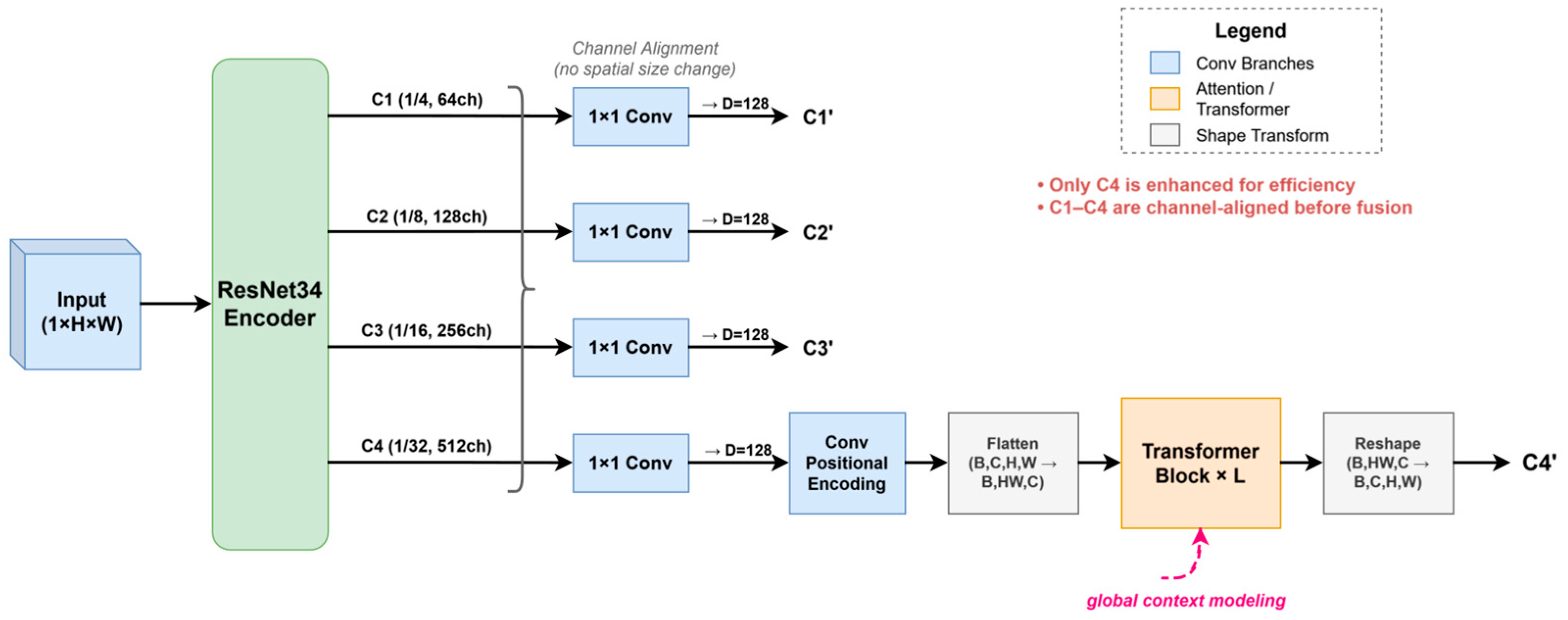
Since feature maps at different stages have inconsistent channel dimensions, a 1 × 1 convolution is first applied to C1, C2, C3, and C4 to align their channel dimensions to a fixed size of D = 128. This operation does not affect the spatial resolution of feature maps but performs channel-wise linear projection and reorganization, thereby reducing the computational complexity of subsequent fusion modules and improving cross-level consistency. It should be noted that the 1 × 1 convolution does not extract spatial neighborhood information; instead, it acts as a pixel-wise channel transformation operator for feature re-projection and dimensional adaptation.
On the high-level semantic branch, a lightweight context enhancement module (Lightweight Transformer Module) is introduced on C4 to model long-range dependencies. Specifically, convolutional positional encoding is first applied to C4 to inject local positional information. The resulting feature map is then flattened into a sequence and fed into a multi-head self-attention module and feed-forward network for global interaction, after which it is reshaped back into a 2D feature map C4′. Compared with convolution-based representations relying on local receptive fields, this module enhances global structural perception of the molten pool under conditions such as strong arc interference, low contrast, and partial occlusion, thereby reducing boundary discontinuities and region leakage.
To maintain a balance between representation capability and computational cost, lightweight Transformer layers are introduced only at the C4 stage, where the feature resolution is the lowest and semantic information is relatively rich. Instead of applying Transformer blocks across all feature levels, only one to two layers are employed to enhance high-level feature modeling while avoiding unnecessary computational overhead. This design achieves a complementary balance between local detail preservation in shallow layers and global context modeling in deep layers while maintaining computational efficiency. The overall multi-scale feature extraction and context enhancement module is illustrated in Figure 4.
Figure 4.
Multi-scale extraction and context enhancement module.
3.3. Bi-Directional Feature Pyramid Network (BiFPN)
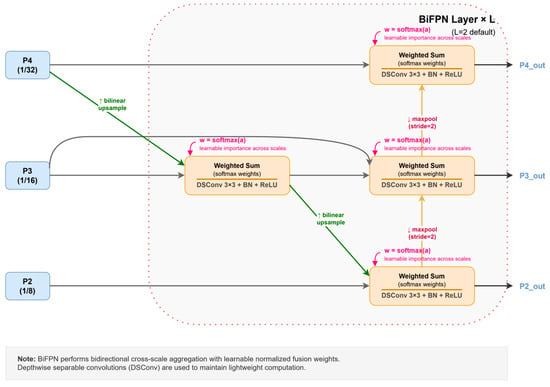
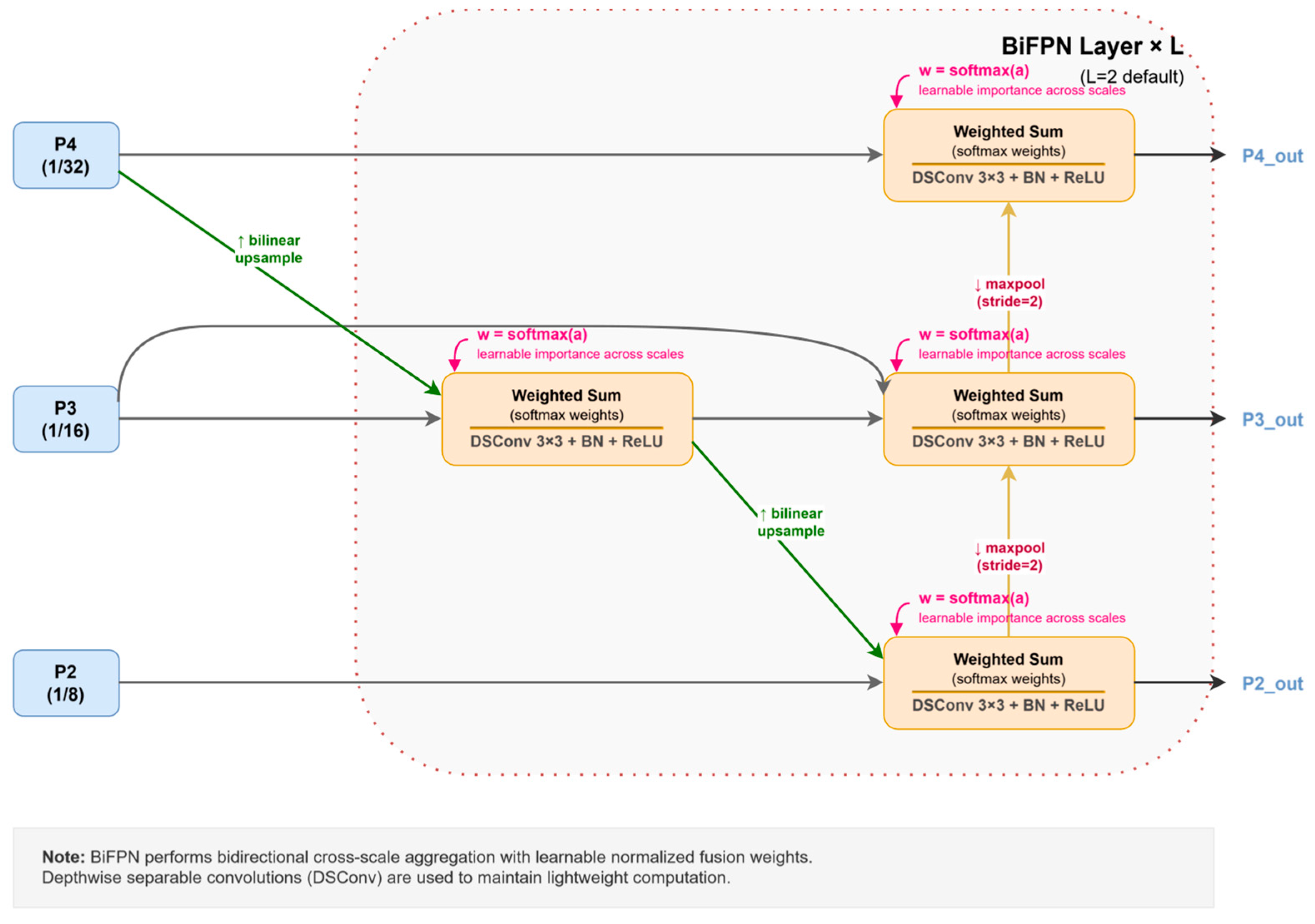
In the molten pool segmentation task, shallow features contain rich edge and texture details, while deep features encode high-level semantic information. However, a single-direction feature pyramid structure usually suffers from insufficient interaction between low-level spatial details and high-level semantic representations, making it difficult to simultaneously preserve fine-grained boundaries and maintain regional consistency. To address this issue, a Bi-directional Feature Pyramid Network (BiFPN) is constructed based on the channel-aligned features C2, C3, and C4′, enabling bidirectional information exchange across different feature scales. The BiFPN generates fused feature representations P2, P3, and P4 through top-down and bottom-up pathways.
Let the input features of the l-th BiFPN layer be represented as . In the top-down pathway, high-level semantic features are propagated to lower-level feature maps through upsampling, while in the bottom-up pathway, low-level spatial information is transferred back to higher-level feature maps through downsampling. Specifically, bilinear interpolation is adopted for the upsampling operations between adjacent pyramid levels, while max pooling with a stride of 2 is used for downsampling. These resolution adjustment operations introduce no additional learnable parameters, which helps maintain the effectiveness design objective of WPSeg-Net.
Unlike conventional feature pyramid structures that directly perform fixed-weight summation, BiFPN introduces learnable fusion weights at each feature aggregation node. The weights are normalized using the softmax function and applied to different input features for adaptive feature fusion, which can be formulated as:
where denotes the fused output feature, represents the weight of the i-th feature, is the learnable parameter, and denotes the i-th input feature. To further reduce computational overhead, depthwise separable convolutions are adopted in the feature transformation layers of BiFPN instead of standard convolutions, achieving a more efficient feature fusion process while maintaining feature representation capability. Through adaptive weighting, BiFPN can learn scale-dependent feature fusion patterns and dynamically optimize the contribution of different feature levels according to the characteristics of molten pool images. This adaptive fusion strategy improves the robustness of feature representation under complex arc interference conditions.
The overall structure of the proposed bidirectional feature fusion module is illustrated in Figure 5. Through repeated top-down and bottom-up information interaction, the fused features P2, P3, and P4 provide complementary spatial details and semantic information for subsequent region segmentation and boundary prediction branches. Furthermore, the learned fusion weights of BiFPN are analyzed in Section 4.2.2 to investigate the contribution patterns of different feature scales in molten pool segmentation.
Figure 5.
BiFPN structure diagram.
3.4. Region–Boundary Dual-Branch Decoding and Mutual Guidance Mechanism
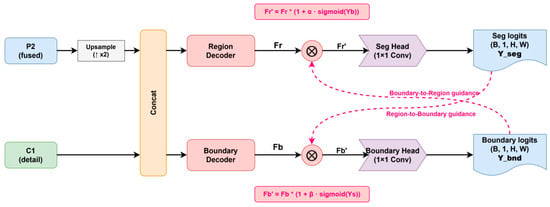
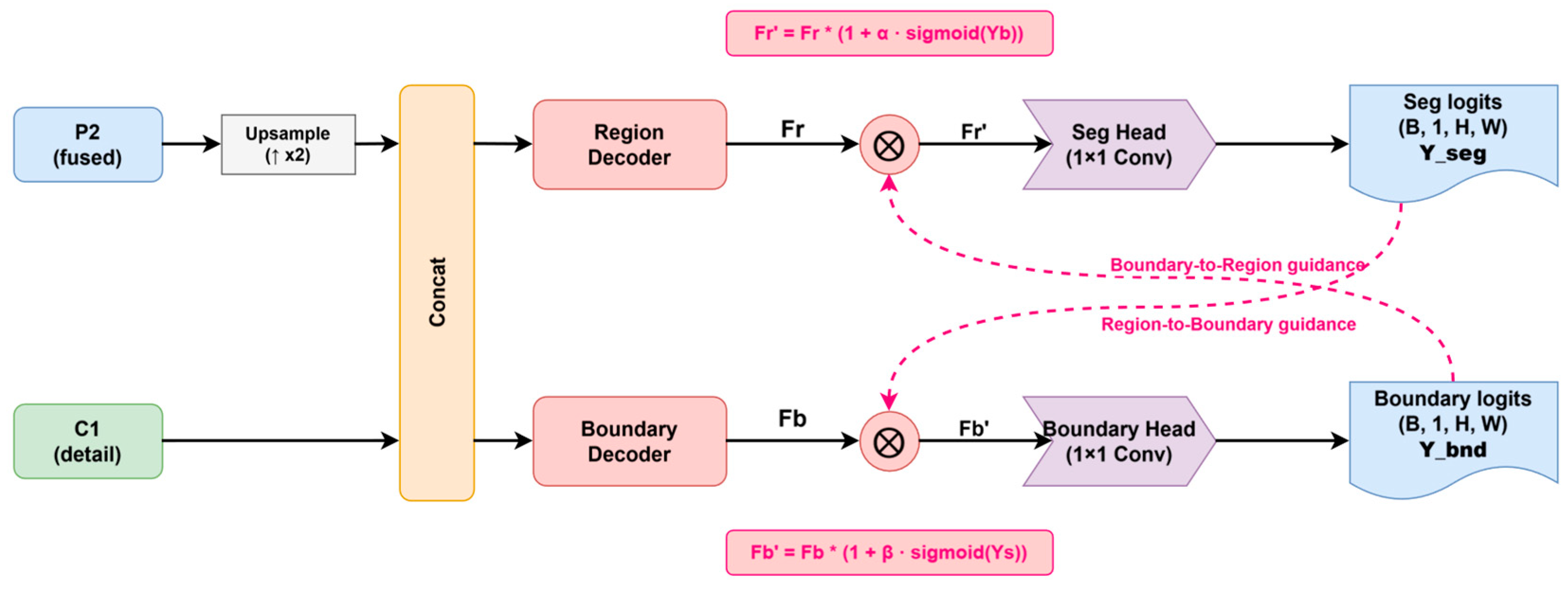
A dual-branch decoding architecture is developed upon the fused features to enhance both molten pool region prediction and boundary localization. The decoder consists of two complementary branches: a region segmentation branch for foreground prediction and a boundary prediction branch for contour refinement. Specifically, the intermediate–low-level fused feature P2 generated by the BiFPN is first upsampled to the same spatial resolution as the shallow feature C1, and then fed into the Region Decoder and the Boundary Decoder, respectively. Both branches share the same multi-scale semantic source but focus on different supervision objectives: the region branch emphasizes foreground–background consistency, while the boundary branch focuses on fine-grained modeling of contour transition areas.
3.4.1. Region Branch (Region Decoder)
The region branch adopts a lightweight convolutional decoding structure. The upsampled feature P2 is concatenated with C1 along the channel dimension, followed by depthwise separable convolution blocks for feature fusion. Finally, a 1 × 1 convolution is applied to produce the segmentation logits . This branch effectively recovers the main molten pool region while suppressing false positives in the background.
3.4.2. Boundary Branch (Boundary Decoder)
The boundary branch uses a similar input configuration as the region branch but maintains independent parameters to specifically learn edge transition patterns. After a series of lightweight convolutional layers, boundary logits are generated. Compared with implicit edge learning in a single segmentation branch, the explicit boundary branch provides stronger constraints on contour continuity and alleviates boundary discontinuities caused by low contrast and arc interference.
3.4.3. Mutual Guidance Mechanism
A mutual guidance mechanism is introduced to promote information exchange between the two branches during forward propagation. Unlike conventional dual-branch decoders that optimize different tasks independently, the proposed mechanism establishes bidirectional feature interaction, allowing each branch to provide complementary guidance to the other. Different from conventional dual-branch decoders that optimize multiple tasks separately, the proposed mechanism enables each branch to dynamically provide complementary information to the other branch through prediction-guided feature recalibration. The core idea is to reweight the features of one branch using the prediction-guided weighting map generated from the other branch:
where denotes the intermediate feature of the region branch, is a learnable coefficient, and represents the Sigmoid function. Specifically, the boundary prediction provides spatially adaptive contour awareness for the region branch. Regions with strong boundary responses receive larger enhancement weights, allowing the region decoder to distinguish foreground regions from ambiguous background areas, especially under low-contrast conditions.
where denotes the intermediate feature of the boundary branch, and is a learnable coefficient. Conversely, the region prediction provides semantic priors for the boundary branch. By incorporating region-level information, the boundary decoder can focus on edge responses located within the molten pool area and suppress false boundaries caused by arc illumination, reflections, and background interference.
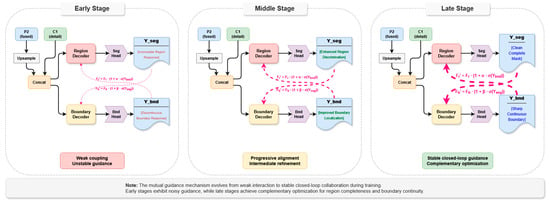
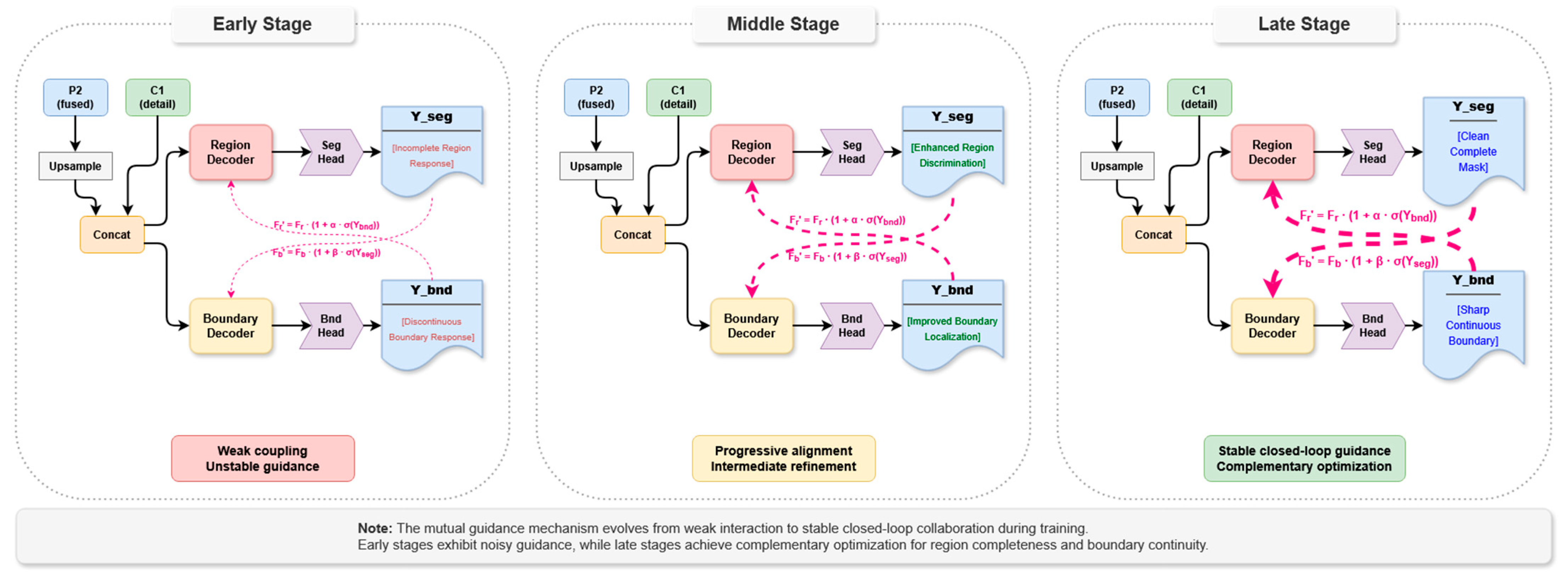
The feature-level interaction process of the proposed mutual guidance mechanism is illustrated in Figure 6, while its evolution during different training stages is further analyzed in Figure 7.
Figure 6.
Region-Boundary Dual-Branch Decoding and Mutual Guidance Mechanism.
Figure 7.
Training-stage Evolution of the Mutual Guidance Mechanism.
During training, the effectiveness of mutual guidance progressively improves as the feature representations of the two branches become more discriminative. As illustrated in Figure 7, in the early training stage, both branches mainly learn task-specific representations from the shared fused feature. Due to inaccurate predictions, the guidance information between the two branches is less reliable, resulting in incomplete region responses and discontinuous boundary localization.
In the middle training stage, the predictions generated by the two branches become more reliable, enabling effective bidirectional information exchange. The boundary branch provides contour-aware guidance to enhance region discrimination near molten pool boundaries, while the region branch supplies semantic constraints to reduce irrelevant edge responses in the boundary branch.
In the late training stage, the two branches gradually achieve stable closed-loop guidance. The region branch obtains improved contour awareness for complete molten pool segmentation, whereas the boundary branch benefits from semantic priors for continuous and accurate contour localization. The progressive refinement of feature representations and prediction responses illustrated in Figure 7 is consistent with the quantitative improvement observed in the ablation study, further demonstrating the effectiveness of the mutual guidance mechanism.
Through this design, the region and boundary branches form a closed-loop interaction: the region branch benefits from enhanced contour awareness, while the boundary branch gains more stable semantic priors. As a result, both region consistency and boundary accuracy are jointly improved, providing a more reliable representation for molten pool segmentation under complex welding conditions.
To quantitatively verify the effectiveness of the proposed mutual guidance mechanism, an ablation experiment was conducted by comparing the model with and without this module. As reported in Section 4.2.5, introducing the mutual guidance mechanism improved the IoU from 91.86% to 92.83%, representing an improvement of 0.97 percentage points. This improvement demonstrates that the bidirectional interaction between the region and boundary branches effectively enhances feature representation by integrating contour-aware information and semantic constraints. Therefore, the quantitative results further validate the effectiveness of the proposed closed-loop guidance strategy.
3.5. Joint Loss Function Design
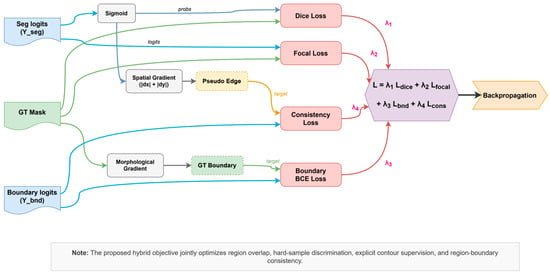
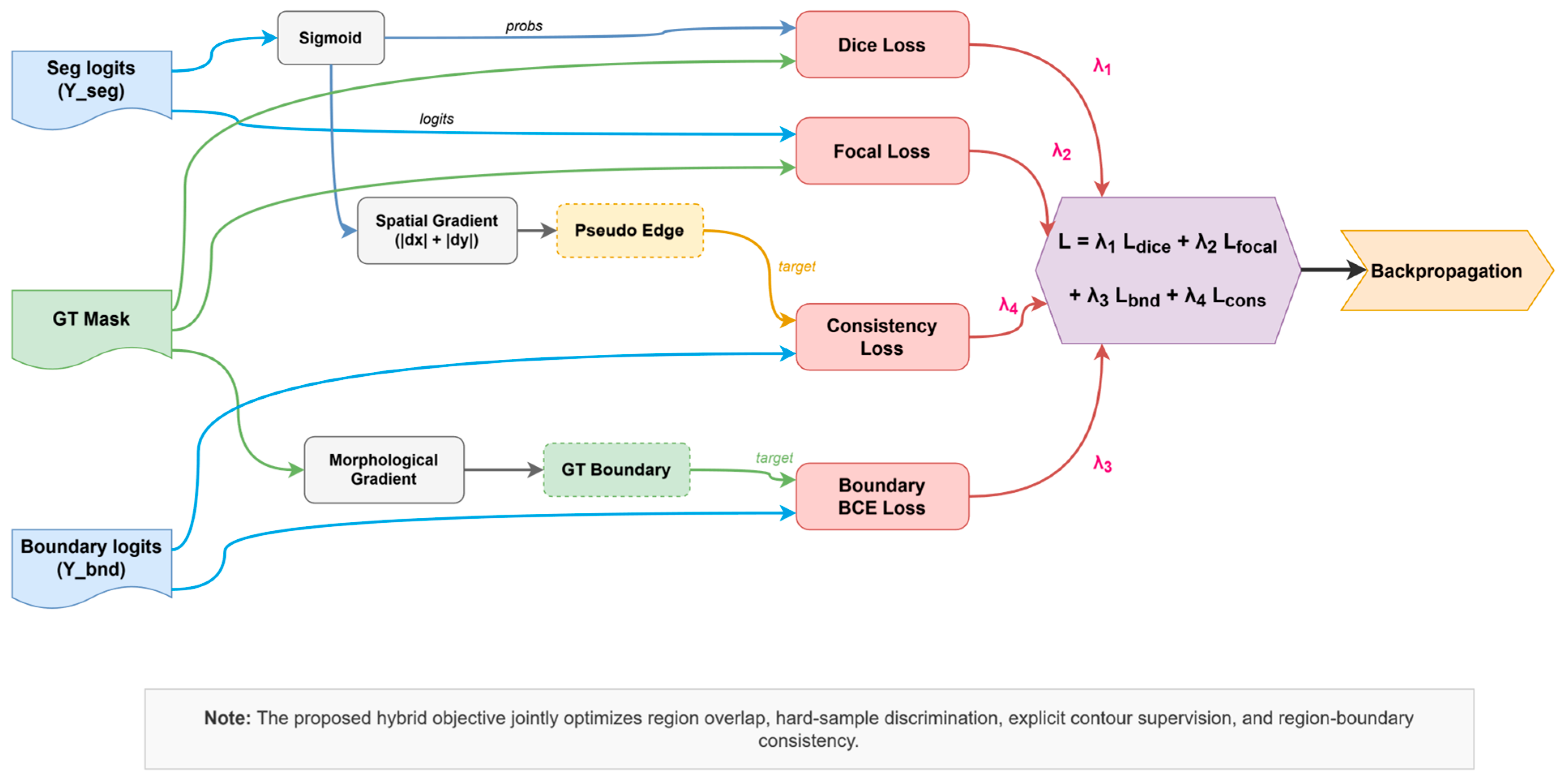
Given the challenges in molten pool segmentation, including small foreground regions, class imbalance, and ambiguous boundary transitions, a joint loss function with region–boundary collaborative optimization is adopted to jointly supervise the segmentation and boundary branches. The overall loss is defined as:
where λ1, λ2, λ3, and λ4 denote the weighting coefficients of each loss term. In this study, the coefficients are empirically set to (1.0, 1.0, 0.7, 0.3) based on the characteristics of molten pool segmentation and preliminary experiments. Specifically, Dice Loss and Focal Loss are assigned higher weights because region overlap and hard sample optimization directly determine segmentation accuracy under small foreground regions and class imbalance conditions. The Boundary Loss is assigned a relatively lower weight since it serves as auxiliary supervision for contour refinement, while the Consistency Loss is given the smallest weight to provide additional geometric constraints without dominating the optimization process.
3.5.1. Dice Loss
The Dice loss is used to optimize the overlap between the predicted mask and the ground truth mask, effectively alleviating the bias caused by small foreground regions. Let denote the predicted probability map and y the ground truth mask, then:
where is a smoothing term.
3.5.2. Binary Focal Loss
To enhance the learning of hard samples (e.g., boundary regions and low-contrast areas), the binary Focal loss is adopted:
where is the predicted probability corresponding to the ground truth class, is the class balancing factor, and is the focusing parameter. In this work, , .
3.5.3. Boundary Supervision Loss
The boundary branch output and the ground truth boundary map are supervised using the Binary Cross-Entropy with Logits (BCEWithLogits) loss:
The ground truth boundary map is generated from the segmentation mask y using a morphological gradient operation, providing explicit supervision for learning contour transition regions of the molten pool.
3.5.4. Region–Boundary Consistency Loss
To further enforce consistency between the predictions of the two branches, a consistency loss is introduced. Specifically, gradient-based edge responses are extracted from the segmentation probability map and aligned with the boundary branch output:
This term encourages geometric consistency between region and boundary predictions, reducing discrepancies such as accurate regions with coarse boundaries or sharp boundaries with fragmented regions.
The overall computation flow of the proposed joint loss is illustrated in Figure 8. In summary, the joint loss function jointly drives network optimization from four aspects—region overlap, hard sample emphasis, boundary supervision, and consistency constraint—thereby improving both segmentation accuracy and contour quality in molten pool segmentation tasks. The selected weighting strategy was also maintained consistently in all experiments to ensure reproducibility and fair comparison.
Figure 8.
Joint loss computation flowchart.
4. Experimental Results and Analysis
4.1. Experimental Setup and Evaluation Metrics
To ensure reproducibility and fair comparison, all models were trained and evaluated under a unified hardware and software environment. The experiments were conducted using an NVIDIA GPU for acceleration. Key configurations, including the Python version and deep learning framework, are summarized in Table 2. The proposed model was implemented using the PyTorch framework, and the Adam optimizer was adopted for parameter optimization during training.
Table 2.
Configuration of the training environment.
In the experimental settings, all comparison models were trained under the same dataset split and preprocessing conditions. The number of training epochs was set to 500, the learning rate to 1 × 10⁻⁴, and the batch size to 4, in order to minimize the influence of non-model factors on performance comparison. In addition, the number of model parameters was recorded during training for subsequent analysis.
To further evaluate the training efficiency of the proposed effective network, the training time was also recorded. Under the above experimental environment, WPSeg-Net required approximately 3 min per epoch, resulting in a total training time of approximately 25 h for 500 epochs. This indicates that the proposed model can achieve competitive segmentation performance without introducing excessive training overhead.
To comprehensively evaluate the performance of different models in the molten pool segmentation task, three widely used metrics were adopted: Intersection over Union (IoU), Dice coefficient (Dice), and Recall. These metrics assess segmentation performance from multiple perspectives, including segmentation accuracy, region overlap, and target completeness.
IoU measures the overlap between the predicted region and the ground truth, and is defined as:
where TP denotes the number of correctly predicted foreground pixels, FP represents the number of falsely predicted foreground pixels, and FN denotes the number of missed foreground pixels. A higher IoU indicates better agreement between prediction and ground truth.
The Dice coefficient evaluates the similarity between the predicted result and the ground truth, defined as:
Compared with IoU, Dice is more sensitive to small foreground regions, making it particularly suitable for molten pool segmentation tasks.
Recall measures the model’s ability to detect the target region and is defined as:
A higher Recall indicates fewer missed detections; however, excessively high Recall may be accompanied by increased false positives. Therefore, it should be analyzed jointly with IoU and Dice.
In summary, IoU emphasizes overall segmentation accuracy, Dice focuses on region overlap, and Recall reflects detection completeness. The combination of these metrics provides a more comprehensive and objective evaluation of model performance in molten pool segmentation tasks.
4.2. Results Evaluation
4.2.1. Computational Efficiency Analysis of Depthwise Separable Convolution
To quantitatively evaluate the effectiveness of depthwise separable convolution in reducing computational complexity, a comparative experiment was conducted by replacing all depthwise separable convolutions in BiFPN with standard convolutions while keeping other network components unchanged. The results are summarized in Table 3.
Table 3.
Computational efficiency comparison between standard convolution and depthwise separable convolution in BiFPN.
As shown in Table 3, replacing standard convolutions with depthwise separable convolutions reduces the parameters of BiFPN from 1.18 M to 0.14 M and decreases FLOPs from 3.77 G to 0.45 G, corresponding to reductions of 87.95% and 88.11%, respectively. Meanwhile, the inference speed increases from 252.08 FPS to 276.38 FPS, with latency reduced from 3.967 ms to 3.618 ms. These results indicate that depthwise separable convolution substantially decreases the computational burden of BiFPN while preserving efficient feature processing capability. Although the reduction in FLOPs is much larger than the improvement in inference speed, this difference is mainly caused by GPU memory access overhead and parallel execution efficiency. Therefore, the computational reduction provided by depthwise separable convolution does not directly translate into proportional speed acceleration.
4.2.2. Analysis of Learned BiFPN Fusion Weights
Based on the learnable fusion mechanism described in Section 3.3, the adaptive feature fusion behavior of BiFPN was further investigated by analyzing the learned fusion weights after training. Since BiFPN dynamically assigns different weights to input features at each fusion node, analyzing these weights can provide insights into how multi-scale features are adaptively integrated during molten pool segmentation. The averaged fusion weights of different BiFPN nodes are summarized in Table 4.
Table 4.
Average fusion weights learned by BiFPN after training.
The results show that the fusion weights learned by BiFPN are not uniformly distributed, indicating that the network adaptively adjusts the contribution of different feature levels rather than relying on fixed feature aggregation. In the top-down pathway, the P3 fusion node assigns slightly different weights to the two input features (0.543 and 0.457), indicating that BiFPN adaptively balances complementary information from different feature levels during feature reconstruction. Meanwhile, the P2 fusion node maintains a nearly balanced weight distribution (0.501 and 0.499), indicating that both semantic information and spatial details are important for recovering fine-grained boundaries.
For the bottom-up pathway, the fusion nodes exhibit a more balanced weight distribution among multiple input features. Specifically, the P3 bottom-up node assigns weights of 0.350, 0.325, and 0.325 to the three input features, while the P4 bottom-up node achieves an almost uniform distribution with weights of 0.332, 0.332, and 0.336. This indicates that the bottom-up fusion process integrates information from different feature levels rather than relying on a single dominant scale. Such a balanced feature aggregation strategy enables the network to simultaneously utilize detailed spatial information and high-level semantic representations, which is beneficial for accurately locating molten pool boundaries and maintaining region completeness.
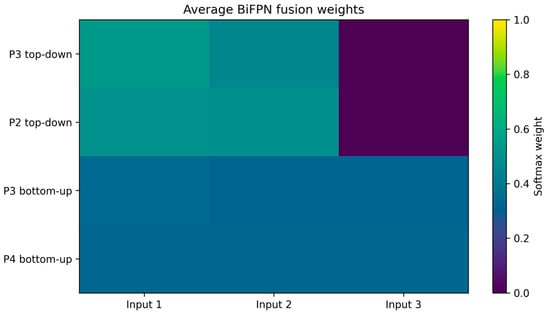
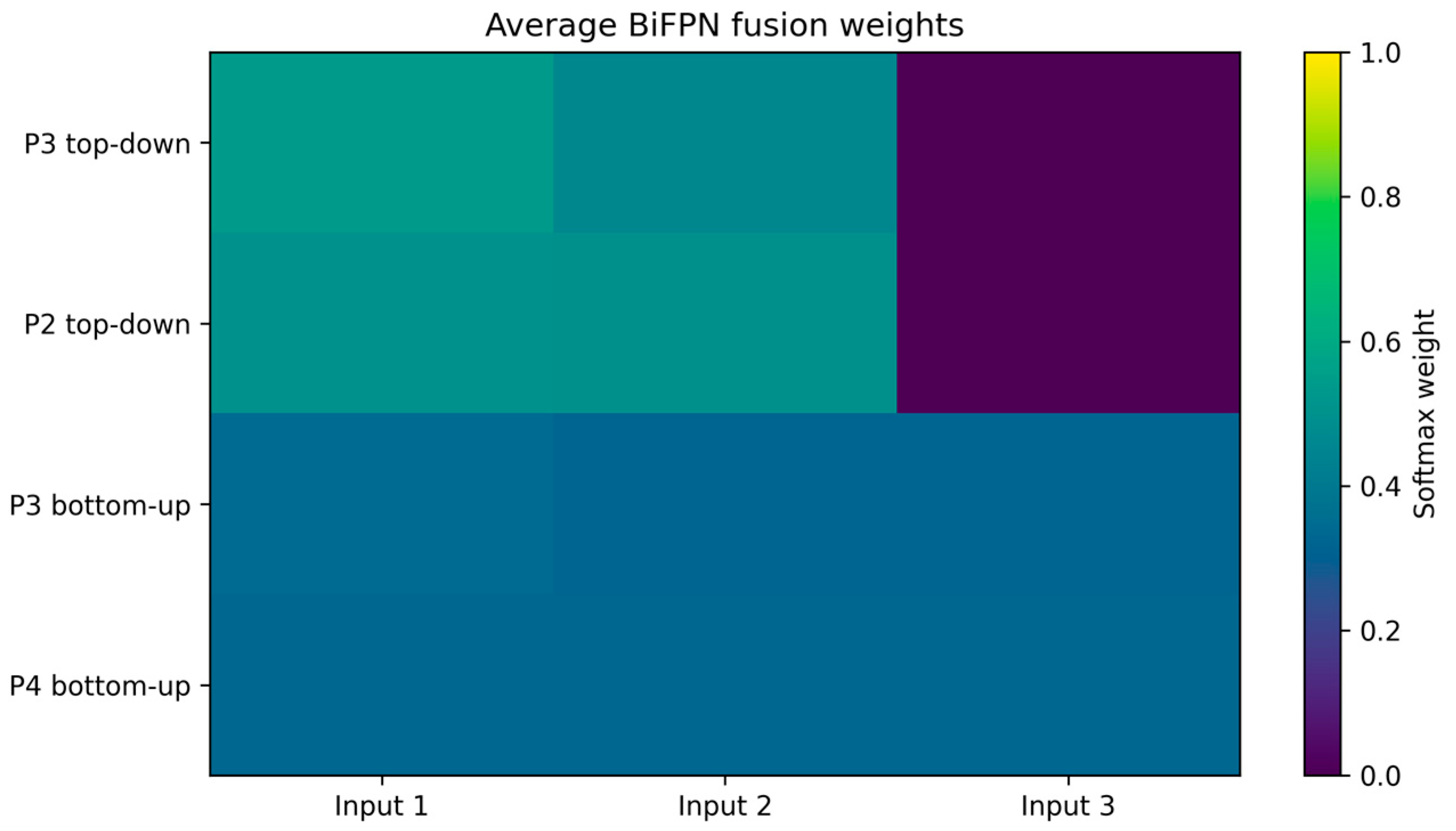
To provide a more intuitive visualization of the learned feature fusion behavior, the averaged BiFPN fusion weights are further illustrated as a heatmap in Figure 9.
Figure 9.
Heatmap visualization of averaged BiFPN fusion weights after training.
As shown in Figure 9, the fusion weight distribution among different BiFPN nodes is consistent with the quantitative results in Table 4. The top-down fusion nodes show slight differences between input features, indicating that semantic information and spatial details are adaptively balanced during feature reconstruction. In contrast, the bottom-up fusion nodes present relatively uniform weight distributions, demonstrating that multi-level features are jointly utilized during the progressive enhancement of semantic and spatial representations.
Overall, the learned weight distribution verifies that the proposed BiFPN module can adaptively optimize multi-scale feature fusion according to the characteristics of molten pool images. Instead of using manually predefined fusion rules, BiFPN dynamically adjusts the contribution of different feature levels during training. This adaptive fusion mechanism helps WPSeg-Net preserve fine boundary details while maintaining global region consistency, which contributes to the improved segmentation performance of WPSeg-Net under challenging welding conditions involving strong arc interference, blurred boundaries, and significant shape variations.
4.2.3. Analysis of Loss Function Convergence
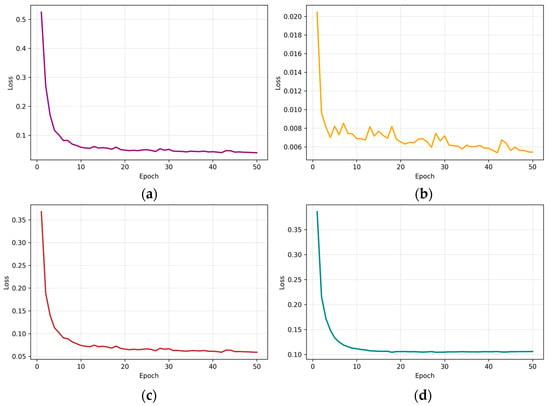
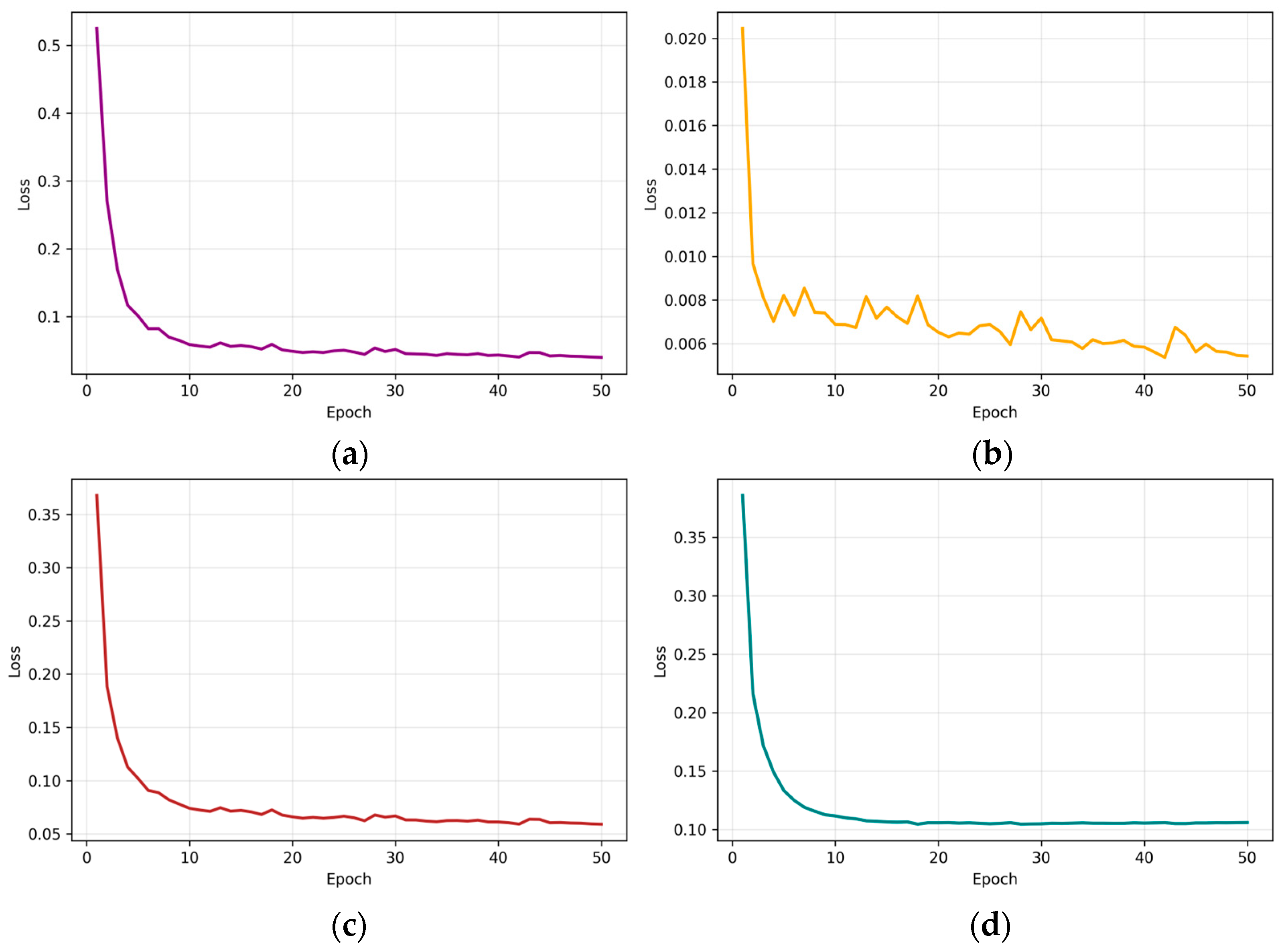
Based on the joint loss formulation described in Section 3.5, the optimization behavior of each loss component was further analyzed. The training curves of Dice Loss, Focal Loss, Boundary Loss, and Consistency Loss were recorded during the training process, as illustrated in Figure 10.
Figure 10.
Convergence curves of individual loss components during training. (a) Dice Loss; (b) Focal Loss; (c) Boundary Loss; (d) Consistency Loss.
As shown in Figure 10, all loss components gradually decrease during training and converge to stable values, indicating that the proposed multi-objective optimization strategy can effectively guide network learning. Specifically, Dice Loss decreases continuously in the early training stage, demonstrating progressive improvement in molten pool region overlap. The reduction of Focal Loss indicates that the network gradually enhances its ability to distinguish difficult samples, especially low-contrast regions and ambiguous areas caused by arc interference.
Meanwhile, the Boundary Loss exhibits a stable decreasing trend, confirming that the boundary branch can effectively learn contour information. The Consistency Loss also converges during training, indicating that the region prediction and boundary prediction become increasingly consistent through the mutual constraint mechanism.
Overall, the convergence behaviors of different loss components demonstrate that the proposed joint loss function provides effective supervision for jointly optimizing region accuracy, boundary localization, and prediction consistency.
4.2.4. Comparative Experimental Results
To evaluate the effectiveness of the proposed WPSeg-Net, four representative semantic segmentation models, including DeepLabV3+ [24], UNet++ [25], PSPNet [26], and SegFormer-B2 [27], were selected for comparison. These models represent different segmentation paradigms, including CNN-based encoder–decoder architectures and Transformer-based methods. For a fair comparison, all baseline models were re-implemented and trained from scratch on the same dataset using identical training and evaluation protocols, rather than directly adopting the results reported in their original publications. The same dataset partition, input resolution, data augmentation strategies, optimization algorithm, and evaluation metrics were applied to all models. During training, all networks were optimized under the same training schedule, including the number of epochs, optimizer settings, and learning rate strategy.
As shown in Table 5, WPSeg-Net achieves the highest IoU and Dice scores among all compared methods, reaching 92.83% and 96.28%, respectively. Compared with the strongest CNN-based competitor, DeepLabV3+, WPSeg-Net improves IoU and Dice by 0.98% and 0.58%, while reducing the number of parameters from 22.43 MB to 21.78 MB. These results demonstrate that the proposed architecture can achieve more accurate molten pool segmentation while maintaining a compact model size.
Table 5.
The Results of the Comparative Experiments.
Regarding Recall, UNet++ and PSPNet obtain slightly higher values than WPSeg-Net, reaching 96.22% and 96.16%, respectively. However, Recall only reflects the proportion of correctly detected foreground pixels and does not consider false-positive predictions. The higher IoU and Dice values achieved by WPSeg-Net indicate that it provides a better balance between target completeness and segmentation precision, reducing inaccurate predictions caused by arc interference and background noise.
In terms of computational efficiency, WPSeg-Net achieves a favorable balance between segmentation accuracy and model complexity. The proposed model contains only 21.78 MB parameters and requires 31.90 GFLOPs, which are lower than those of all comparison methods. Compared with DeepLabV3+, WPSeg-Net reduces the computational cost from 62.25 GFLOPs to 31.90 GFLOPs while improving IoU performance. This indicates that the proposed lightweight design, including the efficient feature fusion strategy and depthwise separable convolution, effectively reduces computational overhead without sacrificing segmentation capability.
Furthermore, the practical inference efficiency of different models was evaluated using FPS, latency, and peak GPU memory consumption. WPSeg-Net achieves an inference speed of 85.39 FPS with a latency of 11.71 ms, outperforming DeepLabV3+, UNet++, and SegFormer-B2 in terms of real-time processing capability. Meanwhile, the peak memory consumption of WPSeg-Net is only 378.22 MB, which is substantially lower than that of other compared models, especially Transformer-based SegFormer-B2. These results demonstrate that WPSeg-Net is more suitable for resource-constrained industrial inspection scenarios requiring efficient online segmentation.
Although lightweight backbone networks such as MobileNetV3 and EfficientNet have been widely explored for efficient visual tasks, ResNet-34 was selected as the encoder in this work, considering the characteristics of molten pool images and the overall network design. Unlike natural images, molten pool images usually contain strong illumination interference, blurred boundaries, and small foreground regions, requiring sufficient hierarchical feature extraction to preserve semantic information and spatial details. The residual architecture of ResNet-34 provides stable optimization and effective multi-scale feature representation with moderate complexity, which is suitable for subsequent feature enhancement through the lightweight Transformer module and BiFPN. Therefore, ResNet-34 provides an appropriate trade-off between representation capability and computational cost for the proposed WPSeg-Net.
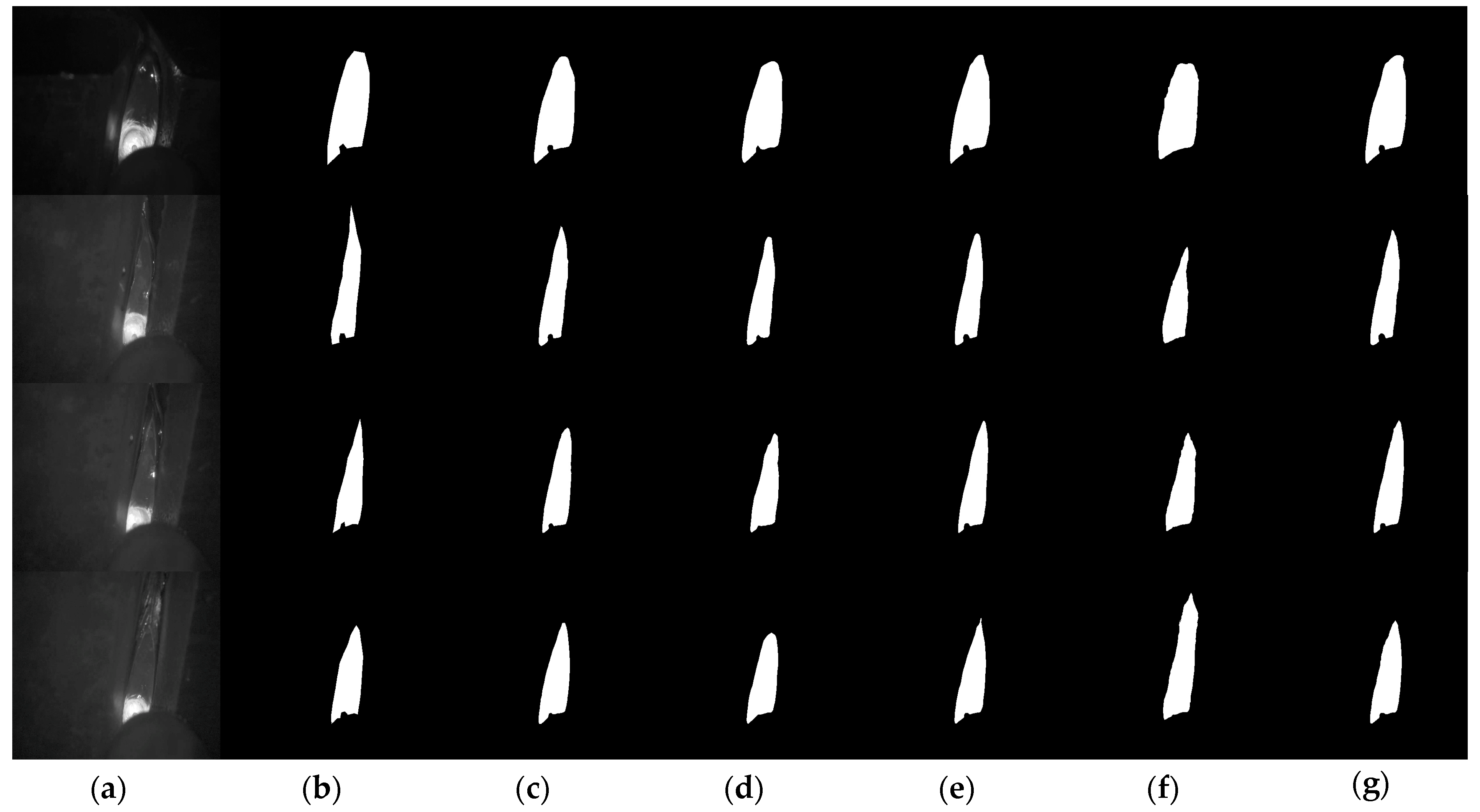
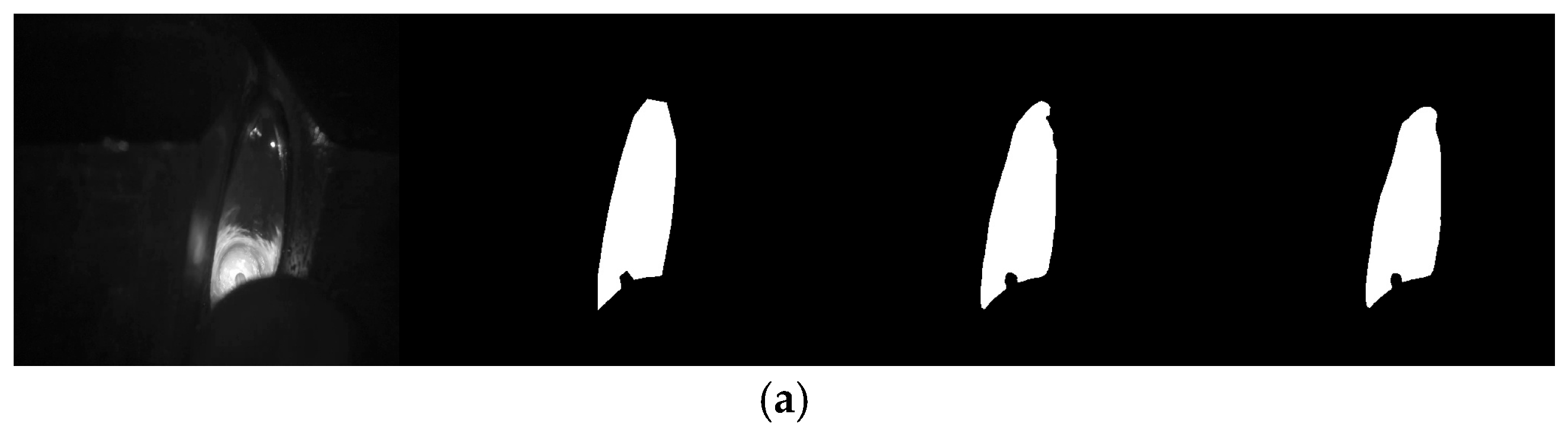
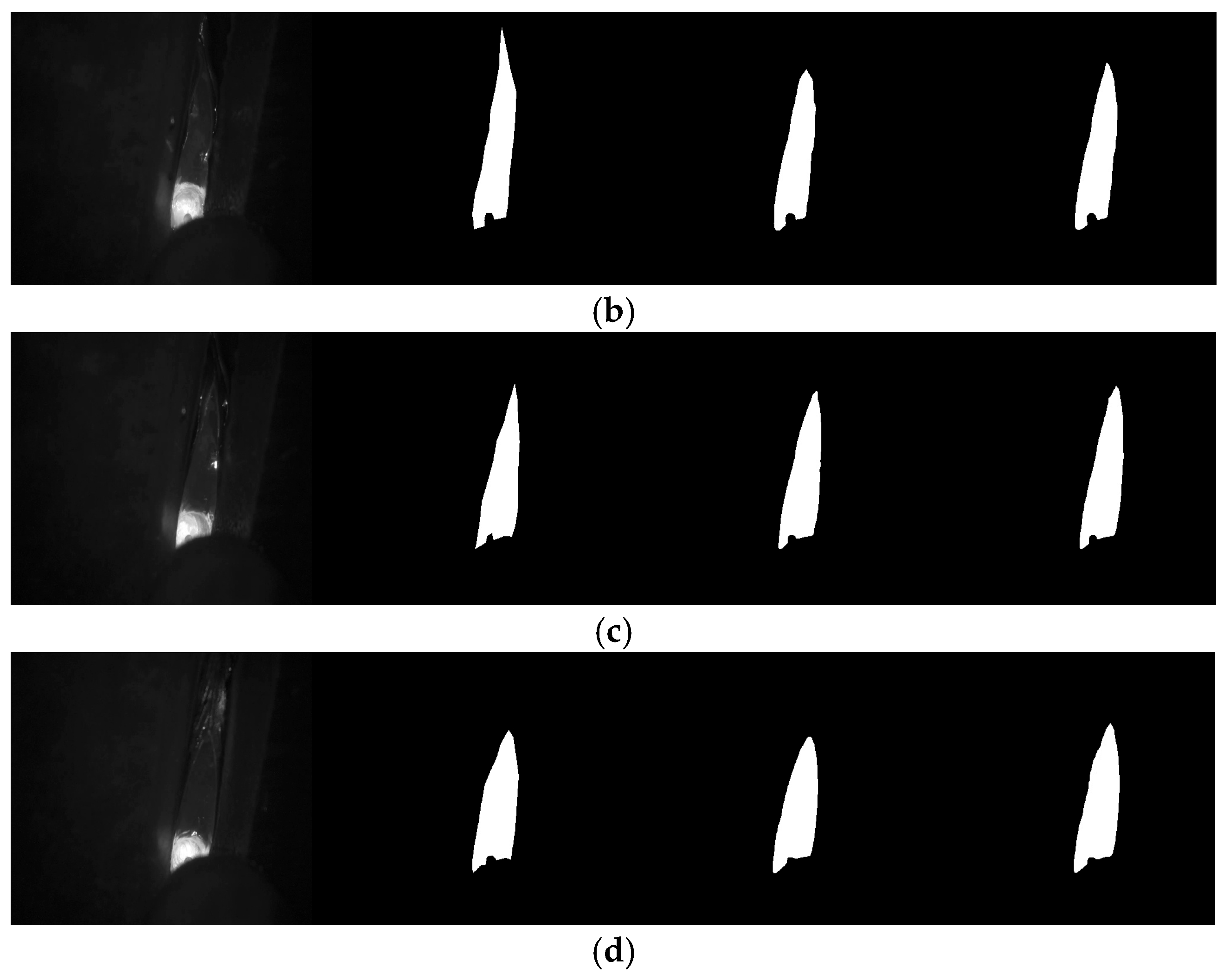
Figure 11 presents qualitative comparisons between WPSeg-Net and other segmentation methods. Under challenging conditions involving blurred boundaries and strong arc interference, some comparison models produce incomplete segmentation regions or boundary deviations. In contrast, WPSeg-Net generates more continuous molten pool regions and more accurate boundary localization, which is consistent with the quantitative evaluation results.
Figure 11.
Comparison of Test Results. (a) Input; (b) Label; (c) DeepLabV3+; (d) PSPNet; (e) UNet++; (f) SegFormer-B2; (g) WPSeg-Net.
4.2.5. Ablation Experimental Results
To investigate the contribution of each proposed component, ablation experiments were conducted by progressively integrating the lightweight Transformer, BiFPN, Boundary Decoder, and Mutual Guidance modules into the baseline model. All experiments were performed using the same dataset split and training strategy. The quantitative results are summarized in Table 6.
Table 6.
The Results of the Ablation Experiments.
The baseline model achieves an IoU of 88.62%, a Dice score of 93.96%, and a Recall of 93.44%. After introducing the lightweight Transformer module, the IoU increases by 1.95% to 90.57%, demonstrating that global context modeling improves feature representation under complex illumination variations. With the further integration of BiFPN, the IoU and Recall increase to 91.55% and 95.60%, respectively, indicating that multi-scale feature fusion effectively enhances the utilization of spatial details and semantic information. After adding the Boundary Decoder, the IoU reaches 91.86%, confirming that explicit boundary modeling contributes to more accurate molten pool contour localization. Finally, the Mutual Guidance mechanism further improves IoU and Dice to 92.83% and 96.28%, achieving gains of 4.21% and 2.32% compared with the baseline model. These results demonstrate that the interaction between region-level and boundary-level features effectively reduces segmentation ambiguity and improves prediction accuracy.
Although additional modules are introduced, the parameter number only increases from 21.05 MB to 21.78 MB. This indicates that the proposed components improve segmentation performance with limited computational overhead.
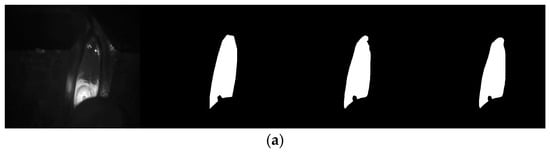
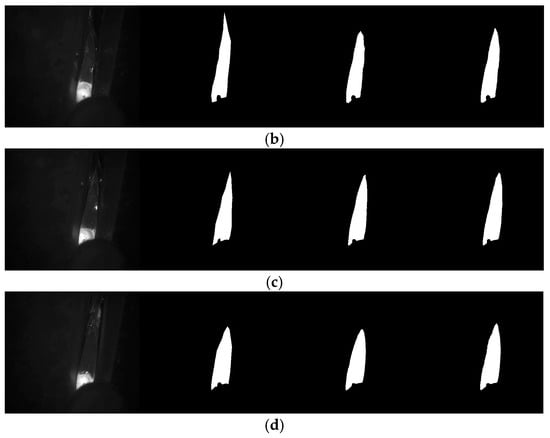
To further verify the effectiveness of the Mutual Guidance mechanism, qualitative comparisons between WPSeg-Net without Mutual Guidance and the complete WPSeg-Net are presented in Figure 12. As shown in Figure 12, the model without Mutual Guidance produces incomplete segmentation regions, inaccurate boundary localization, and small false-positive areas, particularly in regions with blurred transitions and strong arc interference. After introducing the Mutual Guidance mechanism, the predicted segmentation becomes closer to the ground truth, with improved boundary continuity and reduced erroneous predictions. This improvement is attributed to the bidirectional interaction between the region and boundary branches, where boundary features constrain region prediction while region features enhance boundary discrimination.
Figure 12.
Qualitative comparison of segmentation results with and without Mutual Guidance mechanism. (a) Input; (b) Label; (c) WPSeg-Net without Mutual Guidance; (d) WPSeg-Net.
5. Discussion
Molten pool segmentation is more challenging than conventional semantic segmentation tasks because the visual characteristics of molten pools are strongly influenced by welding conditions. Variations in arc radiation, heat input, material melting behavior, and surrounding interference may cause significant changes in image intensity distribution and target morphology. Therefore, segmentation models for molten pool images need to maintain accurate region perception while handling appearance variations and unclear boundaries. Previous studies have demonstrated the feasibility of deep learning-based approaches for molten pool analysis and welding process monitoring [7,8,9,10,11]. However, achieving a balance among local feature extraction, global context modeling, and boundary localization remains an important issue for reliable molten pool segmentation.
Existing studies on molten pool segmentation mainly rely on CNN-based architectures. U-Net-based frameworks with advanced encoders have been applied to extract molten pool regions and provide geometric information for subsequent welding quality evaluation [9]. BiSeNet-based methods have also been investigated to achieve efficient segmentation for real-time welding monitoring [8]. These approaches benefit from strong local feature extraction capability and relatively low implementation complexity, making them suitable for industrial vision tasks. However, convolution operations mainly focus on local receptive fields, which may limit the modeling of long-range dependencies when molten pool appearance changes significantly. For welding images containing non-uniform illumination and weak boundary transitions, relying only on local feature representation may affect the ability to capture complete structural information.
To improve global feature representation, Transformer-based structures have recently been introduced into molten pool segmentation. Yang et al. combined CNN and Transformer modules to enhance global dependency modeling while preserving local texture information [7]. TransUNet further verified the effectiveness of Transformer-based feature extraction in complex segmentation scenarios by capturing long-range relationships [12]. However, pure Transformer architectures usually involve higher computational requirements and may require more training data, which can be challenging for industrial applications with limited datasets. Therefore, WPSeg-Net adopts a CNN-Transformer hybrid architecture, where the Lightweight Transformer Module is introduced after the ResNet-34 encoder to enhance global context modeling without substantially increasing computational burden. Compared with using CNN or Transformer alone, this architecture provides a balance between local feature extraction capability and global representation ability.
Feature scale variation is another important challenge in molten pool segmentation. During welding, molten pool size and morphology may vary with changes in heat input and process parameters, resulting in differences in spatial scale. Traditional single-scale feature extraction strategies may not sufficiently preserve detailed information and semantic consistency simultaneously. The Bi-directional Feature Pyramid Network (BiFPN) proposed by Tan et al. provides an effective multi-scale feature fusion strategy through bidirectional information flow and adaptive feature weighting [13]. In WPSeg-Net, BiFPN facilitates interaction between shallow spatial features and deep semantic features, enabling more effective representation of molten pool regions with different scales. This multi-scale feature fusion strategy is particularly suitable for welding images, where both accurate localization and semantic understanding are required.
Boundary perception is another key factor affecting molten pool segmentation performance. Due to gradual intensity transitions between molten pool regions and surrounding backgrounds, especially near the tail region, boundary information is often ambiguous. A single segmentation branch may encounter difficulties in simultaneously maintaining region completeness and contour accuracy. Takikawa et al. proposed Gated-SCNN, which introduced an independent boundary branch to enhance shape representation and improve contour prediction [14]. Inspired by this idea, WPSeg-Net employs a dual-branch decoder consisting of a Region Decoder and a Boundary Decoder. The Region Decoder focuses on semantic consistency of molten pool regions, while the Boundary Decoder enhances boundary-related feature learning. Furthermore, the Mutual Guidance Mechanism enables interaction between the two branches, allowing region and boundary information to complement each other during optimization.
Compared with existing methods, WPSeg-Net aims to provide a practical solution that considers both segmentation accuracy and computational efficiency. CNN-based methods, such as U-Net variants and BiSeNet-based networks, have demonstrated effectiveness in industrial segmentation tasks but may have limitations in global context modeling [8,9]. Transformer-based approaches improve long-range dependency modeling but often introduce additional computational complexity [7,12]. The proposed hybrid architecture combines convolutional feature extraction with Transformer-based global representation, while the multi-scale and boundary-guided designs further improve its suitability for molten pool segmentation. Therefore, the proposed method does not focus on achieving the lowest model complexity, but rather on achieving an appropriate trade-off between segmentation performance and computational cost.
Although the proposed method shows promising performance under the investigated conditions, its application in broader industrial environments still requires further evaluation. First, the current validation is mainly conducted on a self-built MIG welding dataset, and differences in welding processes, materials, and equipment configurations may lead to distribution shifts between training data and practical scenarios. Second, industrial image acquisition systems may encounter additional disturbances, including protective glass contamination, smoke accumulation, illumination fluctuations, and changes in optical parameters. These factors may affect molten pool appearance and reduce segmentation consistency. Therefore, further validation under diverse production conditions is necessary before applying the model to wider welding scenarios.
Future research can focus on improving the adaptability and deployment capability of molten pool segmentation models. Domain adaptation and transfer learning strategies may help reduce performance degradation caused by differences between laboratory datasets and industrial environments. In addition, incorporating temporal information from welding image sequences is a potential direction because molten pool evolution contains dynamic characteristics that cannot be fully represented by single-image segmentation. Furthermore, optimizing network structures and inference strategies for industrial hardware constraints will be important for achieving real-time and reliable welding monitoring systems.
6. Conclusions
In this study, a molten pool image dataset was constructed for vision-based welding analysis, and a boundary-guided dual-branch segmentation network, termed WPSeg-Net, was proposed based on this dataset. The constructed dataset was collected from a robotic MIG welding system and contains molten pool images acquired under different welding conditions, providing pixel-level annotations for semantic segmentation research. This dataset establishes a foundation for investigating the challenges of molten pool segmentation, including unclear boundaries, illumination interference, and scale variations.
To improve segmentation performance, WPSeg-Net integrates a lightweight Transformer module, a Bi-directional Feature Pyramid Network (BiFPN), and a dual-branch decoder with a Mutual Guidance Mechanism. These components were designed to enhance global context modeling, multi-scale feature representation, and boundary-aware feature learning, respectively. Extensive experiments on the constructed dataset demonstrated that WPSeg-Net achieved an IoU of 92.83% and a Dice coefficient of 96.28%, outperforming several representative segmentation methods, including DeepLabV3+, UNet++, PSPNet, and SegFormer-B2. The ablation studies further verified the effectiveness of each proposed component, while the computational analysis showed that the model maintains a reasonable model complexity while achieving competitive segmentation performance.
Despite these promising results, the current evaluation is limited to the constructed MIG welding dataset. The generalization capability of the proposed method under other welding processes, different materials, imaging devices, and production environments requires further investigation. Future work will focus on expanding the dataset with more diverse welding scenarios and exploring domain adaptation and video-based segmentation approaches to improve the applicability of molten pool monitoring systems.
Overall, this study provides both a dedicated dataset and an effective segmentation framework for molten pool image analysis, offering a useful reference for future research on vision-based welding quality monitoring.
Author Contributions
Conceptualization, X.H.; methodology, X.H.; software, X.H.; validation, X.H.; formal analysis, X.H.; investigation, X.H.; resources, X.H.; data curation, X.H.; writing—original draft preparation, X.H.; writing—review and editing, X.H.; visualization, X.H.; supervision, J.H.; project administration, X.H.; funding acquisition, J.H., Y.W. and W.Z. All authors have read and agreed to the published version of the manuscript.
Funding
This work was supported by the National Natural Science Foundation of China (Grant No. 62573366).
Institutional Review Board Statement
Not applicable.
Informed Consent Statement
Not applicable.
Data Availability Statement
The data presented in this study are available on request from the corresponding author due to confidentiality restrictions associated with the industrial welding project.
Conflicts of Interest
Author Yongjing Wang was employed by China No. 5 Metallurgical Group Co., Ltd. Author Wanqiang Zhang was employed by Sichuan DiTing Artificial Intelligence Technology Co., Ltd. The remaining authors declare that the research was conducted in the absence of any commercial or financial relationships that could be construed as a potential conflict of interest.
References
- Rahadian, N. Advancements in welding technology: A comprehensive review of techniques, materials, and applications. J. PEP Bdg. 2025, 2, 62–110. [Google Scholar]
- Stoll, T.; Prudlik, R.; Birg, M.; Wudy, K. Influence of different beam shapes on melt pool geometry of single melt tracks on IN718. Prog. Addit. Manuf. 2025, 10, 2675–2690. [Google Scholar] [CrossRef] [Scilit]
- Mahadevan, R.; Jagan, A.; Pavithran, L.; Shrivastava, A.; Selvaraj, S.K. Intelligent welding by using machine learning techniques. Mater. Today Proc. 2021, 46, 7402–7410. [Google Scholar] [CrossRef] [Scilit]
- Kim, G.-G.; Kim, Y.-M.; Kim, D.-Y.; Park, J.-K.; Park, J.; Yu, J. Vision-based online molten pool image acquisition and assessment for quality monitoring in gas–metal arc welding. Appl. Sci. 2024, 14, 5998. [Google Scholar] [CrossRef] [Scilit]
- Lu, J.; Xie, H.; Chen, X.; Han, J.; Bai, L.; Zhao, Z. Online welding quality diagnosis based on molten pool behavior prediction. Opt. Lasers Eng. 2020, 126, 106126. [Google Scholar] [CrossRef] [Scilit]
- Takahashi, H.; Yamamoto, K.; Sumi, K. Detection of molten pool state using ResNet50 and control of molten pool penetration in CO2 gas shielded arc welding. Weld. World 2025, 69, 2711–2725. [Google Scholar] [CrossRef] [Scilit]
- Yang, L.; Wang, H.; Meng, W.; Pan, H. CvT-UNet: A weld pool segmentation method integrating a CNN and a transformer. Heliyon 2024, 10, e34738. [Google Scholar] [CrossRef] [Scilit] [PubMed]
- Qu, H.; Cai, Y. Improved semantic segmentation method for weld penetration prediction of TIG welding with dual ellipsoid heat source. Manuf. Lett. 2024, 41, 310–319. [Google Scholar] [CrossRef] [Scilit]
- Chandrasekhar, N.; Vasudevan, M.; Das, C.R. Deep learning based real-time prediction of depth of penetration during activated tungsten inert gas welding of 10 mm thick 316LN stainless steel. Sci. Rep. 2025, 16, 1810. [Google Scholar] [CrossRef] [Scilit] [PubMed]
- Jorge, V.L.; Boutaleb, Z.; Boutin, T.; Bendaoud, I.; Soulié, F.; Bordreuil, C. Deep learning-based YOLO applied to rear weld pool thermal monitoring of metallic materials in the GTAW process. Metals 2025, 15, 836. [Google Scholar] [CrossRef] [Scilit]
- Yu, R.; Kershaw, J.; Wang, P.; Zhang, Y. Real-time recognition of arc weld pool using image segmentation network. J. Manuf. Process. 2021, 72, 159–167. [Google Scholar] [CrossRef] [Scilit]
- Chen, J.; Lu, Y.; Yu, Q.; Luo, X.; Adeli, E.; Wang, Y.; Lu, L.; Yuille, A.L.; Zhou, Y. Transunet: Transformers make strong encoders for medical image segmentation. arXiv 2021, arXiv:2102.04306. [Google Scholar]
- Tan, M.; Pang, R.; Le, Q.V. EfficientDet: Scalable and efficient object detection. In Proceedings of the IEEE/CVF Conference on Computer Vision and Pattern Recognition (CVPR), Seattle, WA, USA, 13–19 June 2020; pp. 10781–10790. [Google Scholar] [CrossRef] [Scilit]
- Takikawa, T.; Acuna, D.; Jampani, V.; Fidler, S. Gated-SCNN: Gated shape CNNs for semantic segmentation. In Proceedings of the IEEE/CVF International Conference on Computer Vision (ICCV), Seoul, Republic of Korea, 27 October–2 November 2019; pp. 5229–5238. [Google Scholar]
- He, K.; Zhang, X.; Ren, S.; Sun, J. Deep residual learning for image recognition. In Proceedings of the IEEE Conference on Computer Vision and Pattern Recognition (CVPR), Las Vegas, NV, USA, 27–30 June 2016; pp. 770–778. [Google Scholar]
- Milletari, F.; Navab, N.; Ahmadi, S.-A. V-net: Fully convolutional neural networks for volumetric medical image segmentation. In Proceedings of the 2016 Fourth International Conference on 3D Vision (3DV), Stanford, CA, USA, 25–28 October 2016; pp. 565–571. [Google Scholar]
- Lin, T.; Goyal, P.; Girshick, R.; He, K.; Dollár, P. Focal loss for dense object detection. In Proceedings of the IEEE International Conference on Computer Vision (ICCV), Venice, Italy, 22–29 October 2017; pp. 2980–2988. [Google Scholar] [CrossRef] [Scilit]
- Xiong, J.; Shi, M.; Liu, Y.; Yin, Z. Virtual binocular vision sensing and control of molten pool width for gas metal arc additive manufactured thin-walled components. Addit. Manuf. 2020, 33, 101121. [Google Scholar] [CrossRef] [Scilit]
- Cheng, Y.; Society, A.W.; Wang, Q.; Jiao, W.; Xiao, J.; Chen, S.; Zhang, Y. Automated recognition of weld pool characteristics from active vision sensing. Weld. J. 2021, 100, 183S–192S. [Google Scholar] [CrossRef] [Scilit]
- Li, H.; Ma, Y.; Duan, M.; Wang, X.; Che, T. Defects detection of GMAW process based on convolutional neural network algorithm. Sci. Rep. 2023, 13, 21219. [Google Scholar] [CrossRef] [Scilit] [PubMed]
- Ma, G.; Yuan, H.; Yu, L.; He, Y. Monitoring of weld defects of visual sensing assisted GMAW process with galvanized steel. Mater. Manuf. Process. 2021, 36, 1178–1188. [Google Scholar] [CrossRef] [Scilit]
- Shorten, C.; Khoshgoftaar, T.M.; Furht, B. Text data augmentation for deep learning. J. Big Data 2021, 8, 101. [Google Scholar] [CrossRef] [Scilit] [PubMed]
- Kassam, S.A. Signal Detection in Non-Gaussian Noise; Springer: New York, NY, USA, 2012. [Google Scholar]
- Chen, L.C.; Zhu, Y.; Papandreou, G.; Schroff, F.; Adam, H. Encoder-decoder with atrous separable convolution for semantic image segmenta-tion. In Proceedings of ECCV; Springer: Cham, Switzerland, 2018; pp. 801–818. [Google Scholar]
- Zhou, Z.; Siddiquee, M.M.R.; Tajbakhsh, N.; Liang, J. UNet++: A nested U-Net architecture for medical image segmentation. In Deep Learning in Medical Image Analysis; Springer: Cham, Switzerland, 2018; pp. 3–11. [Google Scholar]
- Zhao, H.; Shi, J.; Qi, X.; Wang, X.; Jia, J. Pyramid scene parsing network. In Proceedings of the 2017 IEEE Conference on Computer Vision and Pattern Recognition, Honolulu, HI, USA, 21–26 July 2017; pp. 2881–2890. [Google Scholar] [CrossRef] [Scilit]
- Xie, E.; Wang, W.; Yu, Z.; Anandkumar, A.; Alvarez, J.M.; Luo, P. SegFormer: Simple and efficient design for semantic segmentation with transformers. Adv. Neural Inf. Process. Syst. 2021, 34, 12077–12090. [Google Scholar]

Disclaimer/Publisher’s Note: The statements, opinions and data contained in all publications are solely those of the individual author(s) and contributor(s) and not of MDPI and/or the editor(s). MDPI and/or the editor(s) disclaim responsibility for any injury to people or property resulting from any ideas, methods, instructions or products referred to in the content. |
© 2026 by the authors. Licensee MDPI, Basel, Switzerland. This article is an open access article distributed under the terms and conditions of the Creative Commons Attribution (CC BY) license.