


Featured Application
This study provides descriptive benchmarks on the evolution of elite HYROX© performance across seven competitive seasons (2018–2024). The findings offer coaches and athletes practical information on changes in race demands, pacing strategies, and segment-specific performance, contributing to evidence-based training and competition planning in hybrid fitness racing.
Abstract
HYROX© is a standardized fitness racing competition combining eight 1000 m runs with eight functional workout stations, placing demands on aerobic endurance, strength, and muscular endurance. Despite its rapid growth, performance analyses remain limited. To evaluate the seasonal evolution of elite HYROX performance standards across seven seasons (2018–2024) using the annual Top 50 PRO MEN performances, and to identify the race components contributing most to changes in overall performance. Data from the Top 50 PRO MEN performances in each season were obtained from the official HYROX database (n = 350). Performance data were selected independently within each season according to ranking position; across the dataset, 138 unique athletes were identified, of whom 46 appeared in more than one season and 92 appeared in a single season only. Therefore, the dataset reflects annual elite performance standards rather than repeated longitudinal measurements of the same individuals. Variables included total race time, cumulative running time, cumulative workout time, roxzone (transition) time, and segment splits. One- and two-way ANOVAs with Bonferroni corrections were applied. From 2018 to 2024, total race time decreased by 20.8% (−891.5 s, p < 0.001), with significant reductions in run + roxzone (−21.8%) and workout time (−19.2%) (p < 0.001). The largest time reductions were observed in Wall Balls (−34.6%) and Sled Pull (−29.3%). Among running segments, the greatest time reduction was observed in the final run (Run 8; −19.2%, −58.5 s, p < 0.001). Running split-time profiles became progressively more even despite persistent late-race decrements. Elite HYROX performance standards improved substantially across seasons, with reductions in total race time, running time, workout time, and roxzone time. These findings provide descriptive benchmarks for performance monitoring and competition planning in hybrid fitness racing.
1. Introduction
In recent seasons, hybrid fitness racing competitions have emerged as a prominent trend in the sports performance community. These events combine high-intensity functional exercises with traditional endurance modalities such as running, cycling, or rowing, thereby challenging both aerobic and anaerobic energy systems across varied movement patterns [1]. Notably, some of these competition formats have begun to receive formal recognition and organizational support, being incorporated under triathlon federations in certain countries under the designation of “hyathlon”, further reflecting their growing institutionalization and global expansion. One of the most rapidly growing formats in this category is HYROX©, a standardized competition that consists of eight alternating 1000 m running intervals and eight functional workout stations. HYROX originated in Germany in 2017 and has since expanded worldwide. Unlike CrossFit®, which emphasizes variability and unknown elements [2], HYROX follows a fixed sequence of events, allowing direct comparison of performance across athletes, events, and seasons.
Recent large-scale analyses have demonstrated the rapid global expansion of HYROX©, with participation exceeding 275,000 athletes across more than 140 events and 22 countries worldwide within its first competitive seasons [3]. This exponential growth, particularly following the COVID-19 pandemic, highlights the increasing demand for standardized hybrid fitness competitions and reinforces HYROX’s emergence as a globally established modality within the high-intensity functional training (HIFT) landscape. Despite this rapid expansion, scientific literature examining performance determinants and longitudinal adaptations in HYROX remains limited [3,4].
High-intensity functional training (HIFT) is a multimodal training approach characterized by the execution of functional, multi-joint movements at relatively high intensities with the aim of simultaneously developing multiple physical capacities, including aerobic fitness, muscular strength, power, and endurance [1]. Experimental and applied research has demonstrated that HIFT can improve physical work capacity, aerobic fitness, and overall physical performance across diverse populations and training contexts [5,6,7]. Furthermore, recent systematic reviews and meta-analyses have reported meaningful improvements in strength, power, endurance, agility, and sport-specific performance among both healthy individuals and trained athletes following HIFT interventions [6,7,8,9]. Given its standardized combination of repeated running bouts interspersed with strength-endurance tasks, HYROX shares several performance characteristics with other HIFT-based competitive formats, supporting its inclusion within this broader training and competition framework.
Previous research in hybrid fitness has indicated that aerobic endurance, muscle strength, and power are primary determinants of success, complemented by the ability to manage fatigue, sustain pacing, and tolerate metabolic stress [10]. Blood lactate concentrations exceeding 8 mmol/L and heart rates above 90% of maximum are commonly reported in high-level hybrid fitness formats such as CrossFit® Workout of the Day (WOD), including “as many repetitions as possible” (AMRAP) workouts such as Cindy and “round for time” (RFT) sessions such as Open 18.4 [10,11,12,13]. These physiological responses highlight the dual demand of muscular endurance and cardiovascular efficiency present in other hybrid exercise formats [1]. However, the distinct structure of HYROX, characterized by repeated running bouts, interspersed with standardized strength-endurance tasks, warrants specific investigation.
To date, only a limited number of studies have examined HYROX, primarily focusing on acute physiological responses, perceived exertion, and performance predictors [4]. However, none have explored the seasonal evolution of performance in elite athletes across multiple competitive seasons. Such analyses are essential not only for tracking the progression of competitive standards but also for describing changes in performance standards, technique execution, and pacing characteristics associated with the sport’s maturation. For this reason, the present investigation aimed to evaluate the seasonal evolution of elite HYROX performance standards across seven seasons (2018–2024) using the annual Top 50 PRO MEN performances, and to identify the race components contributing most to changes in overall performance. To the authors’ knowledge, this study provides the first multi-season and segment-resolved analysis of elite HYROX performance, leveraging the event’s standardized race structure to examine temporal trends across seven competitive seasons (2018–2024). We hypothesized that performance in the HYROX PRO MEN category would exhibit progressive improvements in overall performance across seasons, with larger reductions in completion times in selected workout components.
2. Materials and Methods
2.1. Study Design
This study employed a retrospective, cross-sectional observational design to examine the performance evolution of the top 50 in the PRO MEN category of HYROX competitions across seven consecutive seasons (2018 to 2024). The analysis focused on identifying seasonal changes in both total and segmental race times. Variables analysed included total race time, cumulative running time (8 × 1000 m intervals; total distance 8000 m), cumulative workout time, and roxzone (transition zone) time, as well as split times for each running interval and for all eight standardized workout stations (ski ergometer (1000 m), sled push (4 × 12.5 m, 202 kg), sled pull (4 × 12.5 m, 153 kg), burpee broad jumps (80 m), rowing (1000 m), farmer’s carry (200 m with 2 × 32 kg kettlebells), sandbag lunges (100 m, 30 kg), and wall balls (100 reps, 9 kg to 3 m target). Each HYROX event followed the standardized competition protocol established by the governing body (Upsolut Sports GmbH, Hamburg, Germany), consistent across all analysed seasons. Race timing was conducted with electronic chip systems integrated into bib numbers or ankle straps, recording the official total time from the start signal to the completion of the final Wall Ball repetition, with intermediate splits automatically registered at each run and workout station. Patient consent was waived because the study was based exclusively on publicly available competition results obtained from the official HYROX database. Analyses were conducted at an aggregated level, and no individual athlete was identified, contacted, or analyzed at a personal level in the manuscript.
2.2. Data Source, Inclusion Criteria and Processing
Best-performance data from the Top 50 PRO MEN athletes in each competitive season between 2018 and 2024 were retrieved from the official HYROX database [14] and included in the analysis, resulting in 350 season-level observations. For each season, the 50 fastest PRO MEN performances were selected according to ranking position, regardless of whether the athlete had appeared in previous or subsequent seasons. Therefore, the purpose of the analysis was to examine the evolution of elite HYROX performance standards across seasons, rather than to assess longitudinal changes within the same individuals. Across the 350 season-level observations, 138 unique athletes were identified. Of these, 46 athletes appeared in more than one season, whereas 92 athletes appeared in a single season only. This repeated appearance of some athletes reflects the structure of elite competition data and was treated as a characteristic of the annual Top 50 performance cohort. Accordingly, all results should be interpreted as comparisons of seasonal elite performance standards, not as within-athlete longitudinal adaptations.
Only performances from officially sanctioned HYROX events were included, and inclusion required complete time records for total time, running, workouts, and roxzone segments. A structured data cleaning protocol was applied to ensure consistency and eliminate erroneous entries. Exclusion criteria included missing split times for any running or workout segment, negative values for roxzone time indicating timing or entry errors, and outliers defined as values deviating more than ±25% from the annual mean for each split component. Given the high homogeneity expected among the Top 50 performances of each season, this threshold was applied as a conservative data-cleaning procedure to identify potentially erroneous records associated with timing inconsistencies or database-entry errors. When an observation met any exclusion criteria, it was removed and replaced by the next ranked athlete from the corresponding season to maintain a uniform sample of 50 performance data per season. However, no observations met the exclusion criteria after data cleaning; therefore, no replacements were required. After cleaning, the final dataset comprised a uniform sample of 50 best performances per season, ensuring consistency and comparability across seasons. As the dataset consisted exclusively of publicly available competition results obtained from the official HYROX database, and no individual athlete was identified or analyzed at a personal level, the study was exempt from institutional ethical approval and did not require informed consent, in accordance with established guidelines for the secondary use of public data [15].
2.3. Statistical Analysis
All performance data are presented in seconds and reported as means ± standard deviations. The normality of the data was verified using the Shapiro–Wilk test, and homogeneity of variances was assessed with Levene’s test. Separate one-way ANOVAs were conducted to evaluate the effect of competition season (2018–2024) on overall performance variables, individual running segments, and workout stations, enabling comparison of performance across seasons. Additionally, a two-way ANOVA (7 × 8, season × run segment) was performed including all running sections. Because performance data were selected independently each season according to ranking position, these analyses were interpreted as comparisons of annual elite performance standards rather than as longitudinal repeated-measures analyses of the same individuals. When a significant F value was observed, Bonferroni-adjusted post hoc tests were applied to examine pairwise differences. Effect sizes (ES) were calculated using Cohen’s d and interpreted as small (0.20–0.49), medium (0.50–0.79), and large (≥0.80). Eta squared (η2) was used to report the proportion of variance explained by season in the one-way ANOVAs. For the running split analysis, partial eta squared (η2p) for the main effects of season and running segment, and for the season × running segment interaction was calculated. Additionally, relative performance changes between seasons were expressed as percentage deltas (Δ). All analyses were performed using IBM SPSS Statistics (version 29.0; IBM Corp., Armonk, NY, USA). Statistical significance was set at p < 0.05.
3. Results
3.1. HYROX Performance Overview
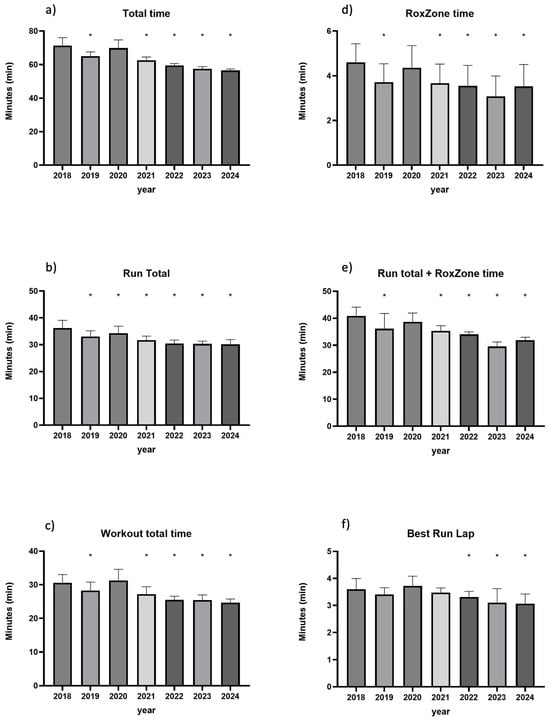
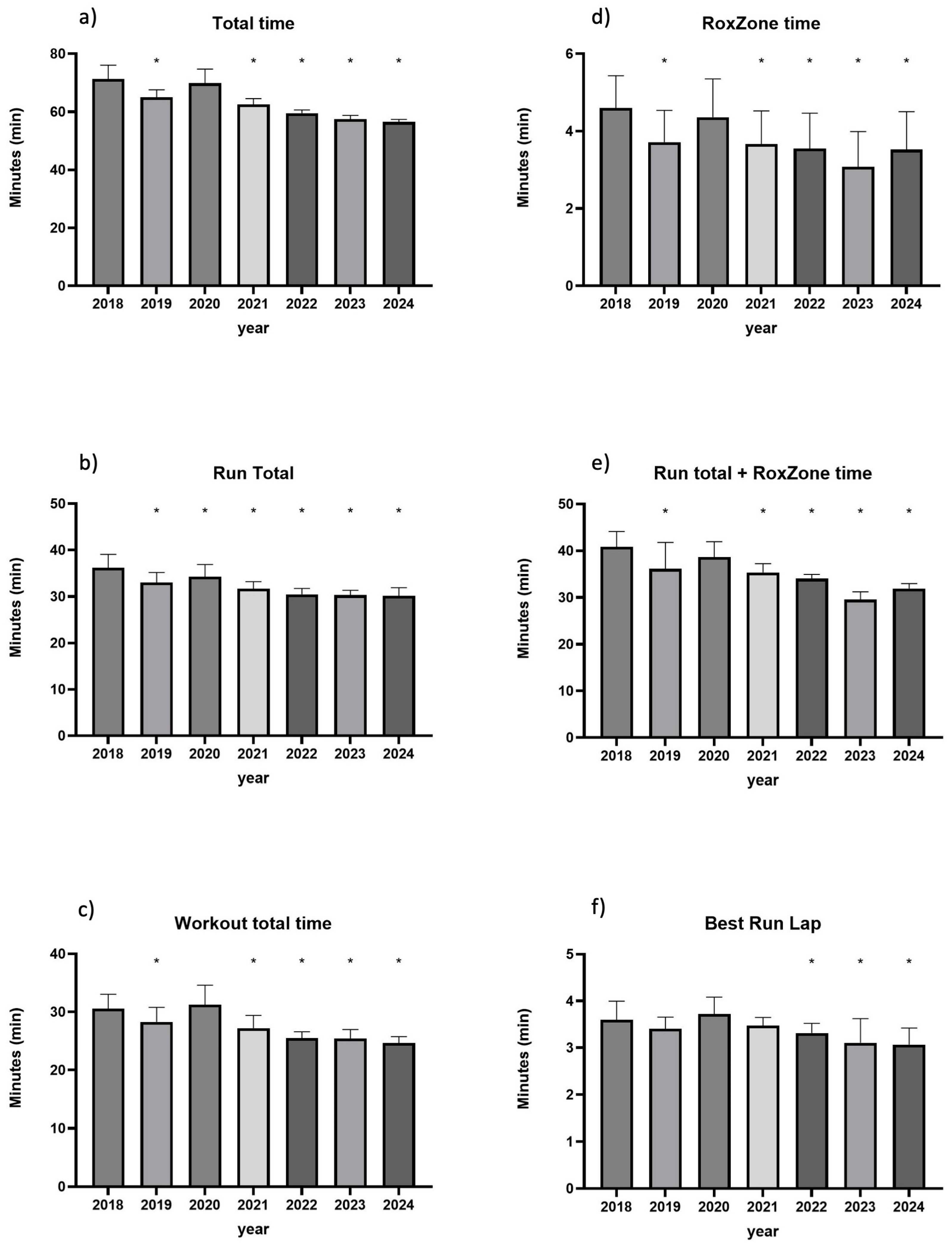
A significant effect of season was found for total race time (p < 0.001; η2 = 0.777), with post hoc analysis revealing an overall improvement from 2018 (71.35 ± 4.72 min) to 2024 (56.50 ± 0.92 min; p < 0.001; ES = 5.06; Δ = −20.8 ± 13.3%) and with statistically significant reductions in time in 2019, 2021, 2022, 2023 and 2024 (p < 0.001, Figure 1a). Similarly, cumulative running time showed a significant season main effect (p < 0.001; η2 = 0.540), with values decreasing from 2018 (36.22 ± 2.85 min) to 2024 (30.14 ± 1.77 min; p < 0.001; ES = 3.04; Δ = −16.8 ± 12.6%) and with statistically significant reductions in time in 2019, 2021, 2022, 2023 and 2024 (p < 0.001, Figure 1b). Cumulative workout total time also improved significantly across seasons (p < 0.001; η2 = 0.553), with a reduction from 2018 (30.54 ± 2.53 min) to 2024 (24.66 ± 1.08 min; p < 0.001; ES = 2.68; Δ = −19.2 ± 11.5%) and with statistically significant reductions in time in 2019, 2021, 2022, 2023 and 2024 (p < 0.001, Figure 1c). roxzone time also showed a significant main effect of the season (p < 0.001; η2 = 0.229), with a decrease from 2018 (4.60 ± 0.84 min) to 2024 (3.67 ± 0.66 min; p < 0.001; ES = 1.12; Δ = −20.2 ± 19.5%; Figure 1d). Cumulative Total Run + roxzone time showed a significant main effect of season (p < 0.001; η2 = 0.73), with values decreasing from 2018 (40.7 ± 3.6 min) to 2024 (31.9 ± 1.3 min; p < 0.001; ES = 3.05; Δ = −21.8%; Figure 1e). Significant reductions relative to 2018 were also observed in 2019, 2021, 2022, 2023 and 2024 (all p < 0.001). Finally, Best run exhibited a significant main effect of season (p < 0.001; η2 = 0.30). Mean values showed a progressive decline from 2018 (3.56 ± 0.4 min) to 2024 (3.06 ± 0.35 min; p < 0.001; ES = 1.26; Δ = −12.6%; Figure 1f). Post hoc Tukey comparisons confirmed that performances in 2022, 2023 and 2024 were significantly lower than those recorded in 2018, indicating a systematic improvement in performance over the latter seasons (p < 0.001).
Figure 1.
Performance trends in HYROX competitions in the PRO MEN category across seven seasons (2018–2024): (a) total race time, (b) cumulative running time, (c) cumulative workout time, (d) roxzone (transition) time, (e) total run + roxzone time (f) best lap time. Each subplot displays the mean ± SD per season for the top 50 finishers. * indicates statistically significant differences compared with the 2018 season (p < 0.001).
3.2. Evolution of Workout Performance by Stations
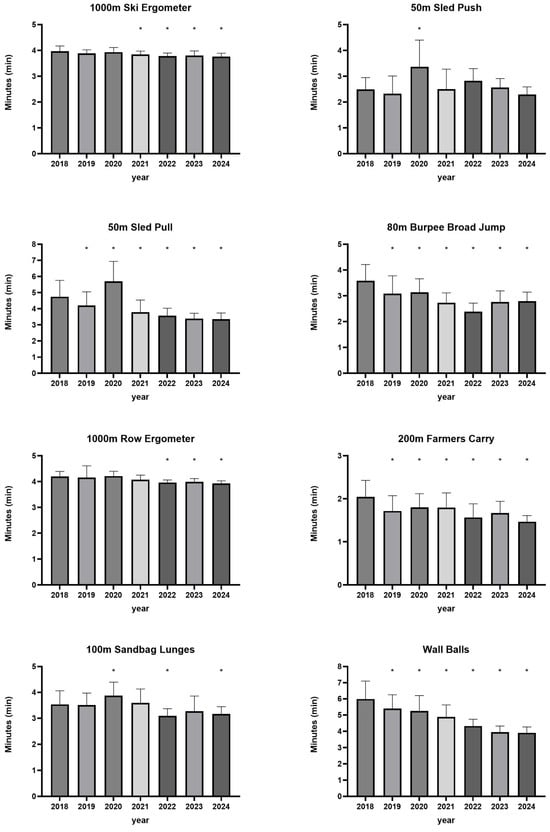
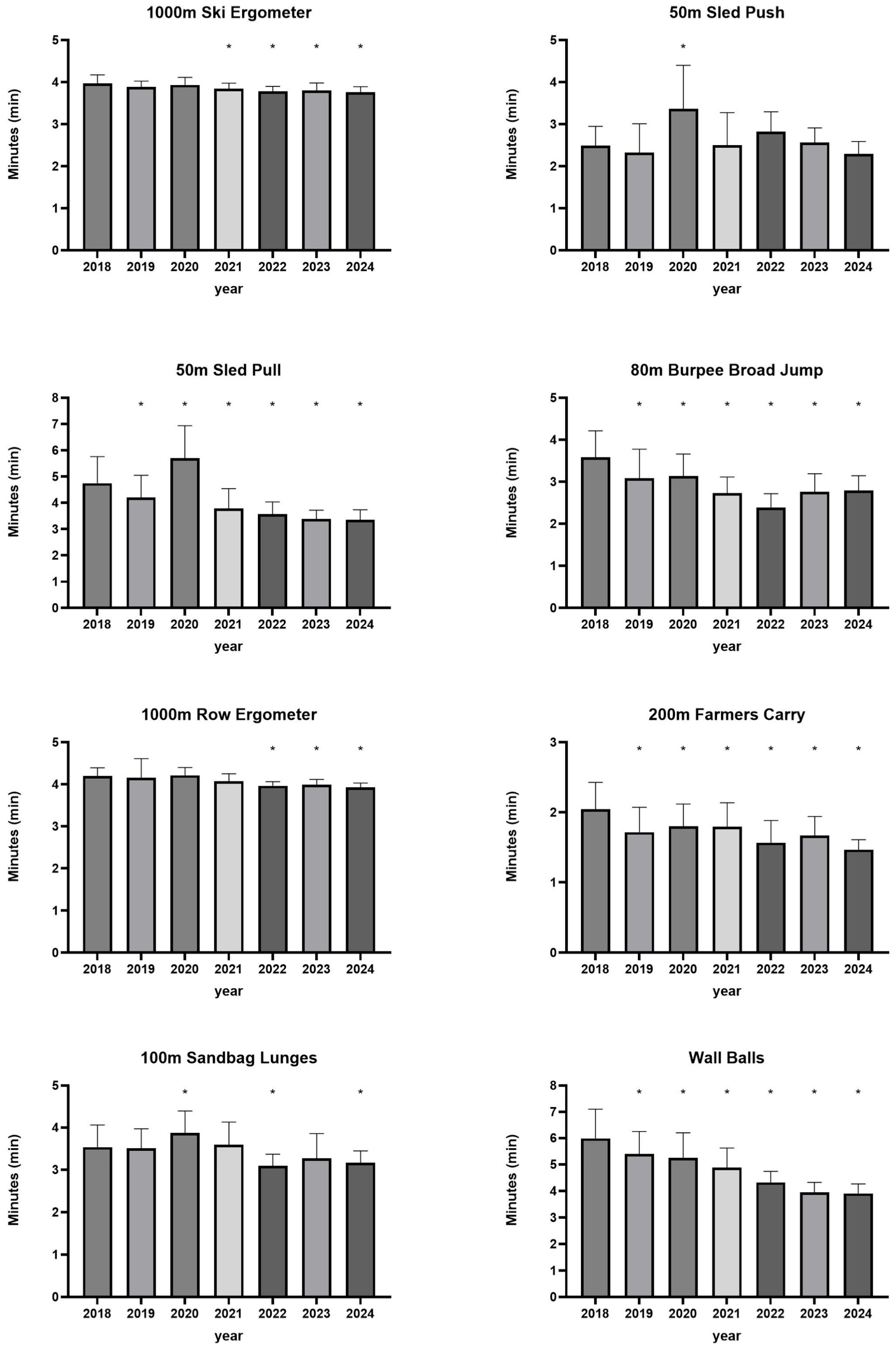
Significant effects of the season were found across all functional workout stations (Figure 2). In the skierg, a significant season effect was observed (p < 0.001; η2 = 0.170), with post hoc analysis showing an improvement from 2018 (3.96 ± 0.21 min) to 2024 (3.76 ± 0.13 min; p < 0.001; ES = 1.28; Δ = −5.1%). In sled push, although a significant effect of season was found (p < 0.001; η2 = 0.231), no significant difference was detected between 2018 (2.49 ± 0.46 min) and 2024 (2.29 ± 0.30 min; p = 1.000; ES = 0.31; Δ = −8.0%). In contrast, sled pull presented a significant effect of season (p < 0.001; η2 = 0.512), with a notable decrease from 2018 (4.74 ± 1.02 min) to 2024 (3.35 ± 0.39 min; p < 0.001; ES = 1.77; Δ = −29.3%). Burpee Broad Jumps also showed a significant season effect (p < 0.001; η2 = 0.344), with improved times from 2018 (3.59 ± 0.63 min) to 2024 (2.80 ± 0.35 min; p < 0.001; ES = 1.59; Δ = −21.9%). For the row ergometer, a significant main effect of season was observed (p < 0.001; η2 = 0.190), with performance improving from 2018 (4.20 ± 0.20 min) to 2024 (3.93 ± 0.10 min; p < 0.001; ES = 1.19; Δ = −6.9%). Farmers carry also showed a significant season effect (p < 0.001; η2 = 0.241), with a marked reduction from 2018 (2.04 ± 0.39 min) to 2024 (1.47 ± 0.14 min; p < 0.001; ES = 1.91; Δ = −28.2%). Sandbag lunges exhibited a significant effect of season (p = 0.002; η2 = 0.227), with values decreasing from 2018 (3.53 ± 0.53 min) to 2024 (3.16 ± 0.28 min; p = 0.002; ES = 0.78; Δ = −10.9%). Finally, wall balls showed one of the largest improvements (p < 0.001; η2 = 0.494), with performance increasing from 2018 (5.98 ± 1.12 min) to 2024 (3.91 ± 0.36 min; p < 0.001; ES = 2.74; Δ = −34.6%).
Figure 2.
Performance trends across seven seasons (2018–2024) in the PRO MEN category of HYROX competitions: mean split times for each of the eight workouts. Each subplot displays the mean ± SD per season for the top 50 finishers. * indicates statistically significant differences compared with the 2018 season (p < 0.001).
3.3. Evolution of Running Performance by Segment
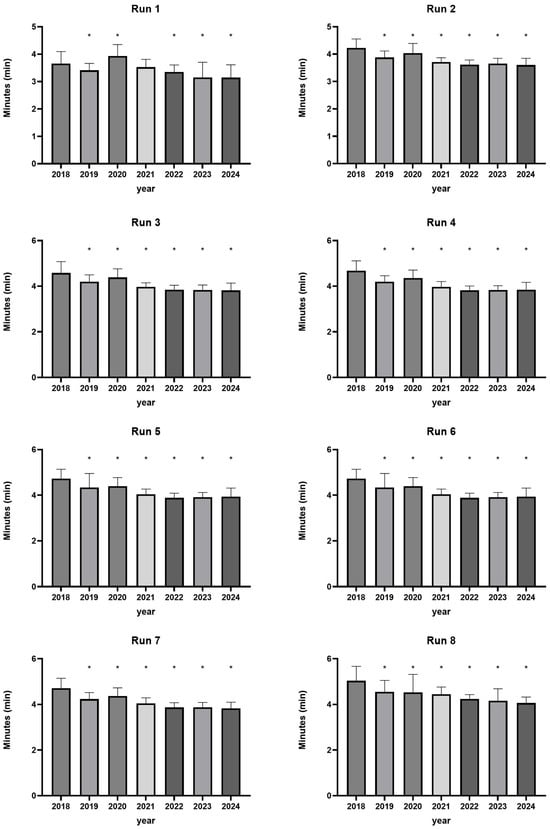
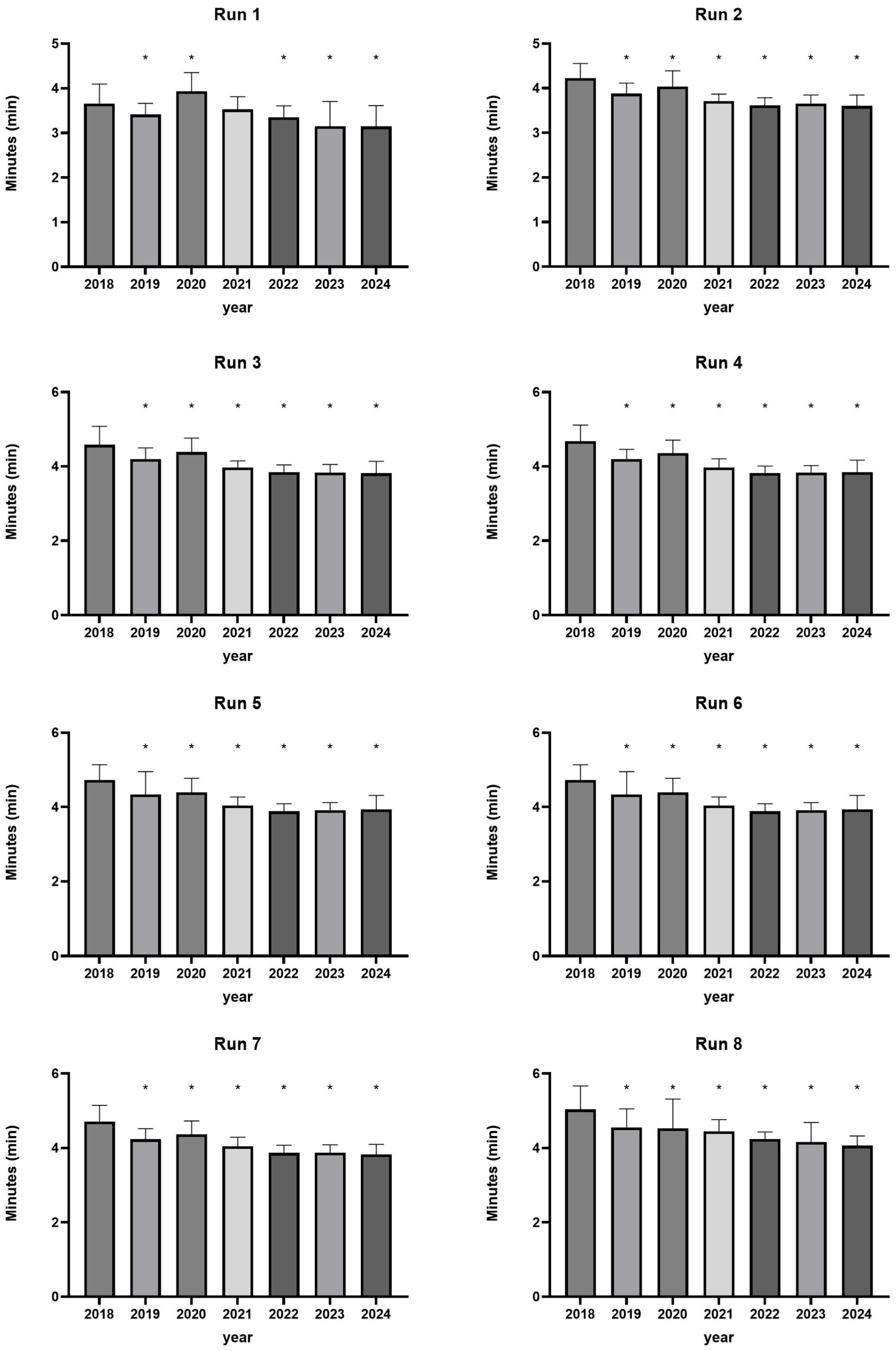
A significant main effect of run segment was found (p < 0.001; η2p = 0.522), indicating that performance varied depending on the specific running section. Additionally, a significant interaction between season and run segment was observed (p < 0.001; η2p = 0.120), indicating that performance improvements from 2018 to 2024 varied depending on the specific running section. Post hoc comparisons revealed significant reductions in time across all eight running segments and in all seasons (Figure 3). Specifically, Run 1 improved from 2018 (3.67 ± 0.44 min) to 2024 (3.15 ± 0.46 min; p < 0.001; ES = 1.14; Δ = −14.1%), while Run 2 showed a decrease from 2018 (4.23 ± 0.33 min) to 2024 (3.60 ± 0.25 min; p < 0.001; ES = 2.16; Δ = −15.0%). Run 3 improved from 2018 (4.58 ± 0.50 min) to 2024 (3.82 ± 0.32 min; p < 0.001; ES = 1.83; Δ = −16.7%). For Run 4, times declined from 2018 (4.68 ± 0.43 min) to 2024 (3.85 ± 0.33 min; p < 0.001; ES = 2.18; Δ = −17.8%). In the latter stages, Run 5 decreased from 2018 (4.73 ± 0.41 min) to 2024 (3.93 ± 0.37 min; p < 0.001; ES = 2.02; Δ = −16.9%), and Run 6 from 2018 (4.65 ± 0.41 min) to 2024 (3.90 ± 0.39 min; p < 0.001; ES = 1.85; Δ = −16.1%). Run 7 showed an improvement from 2018 (4.72 ± 0.43 min) to 2024 (3.83 ± 0.27 min; p < 0.001; ES = 2.47; Δ = −18.7%), and the greatest reduction was found in Run 8, from 2018 (5.03 ± 0.63 min) to 2024 (4.07 ± 0.26 min; p < 0.001; ES = 2.02; Δ = −19.2%).
Figure 3.
Performance trends across seven seasons (2018–2024) in the PRO MEN category of HYROX competitions: mean split times for each of the eight running segments (Run 1–Run 8). Each subplot displays the mean ± SD per season for the top 50 finishers. * indicates statistically significant differences compared with the 2018 season (p < 0.001).
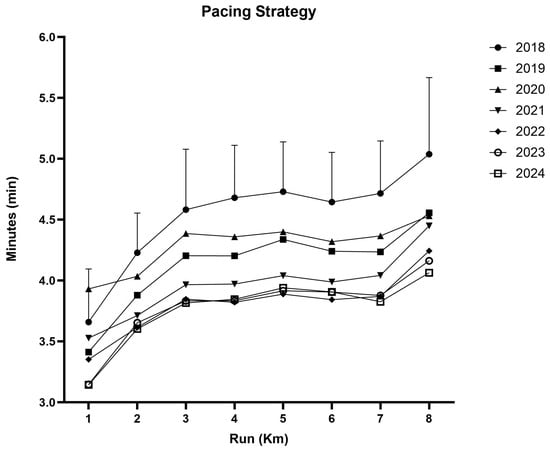
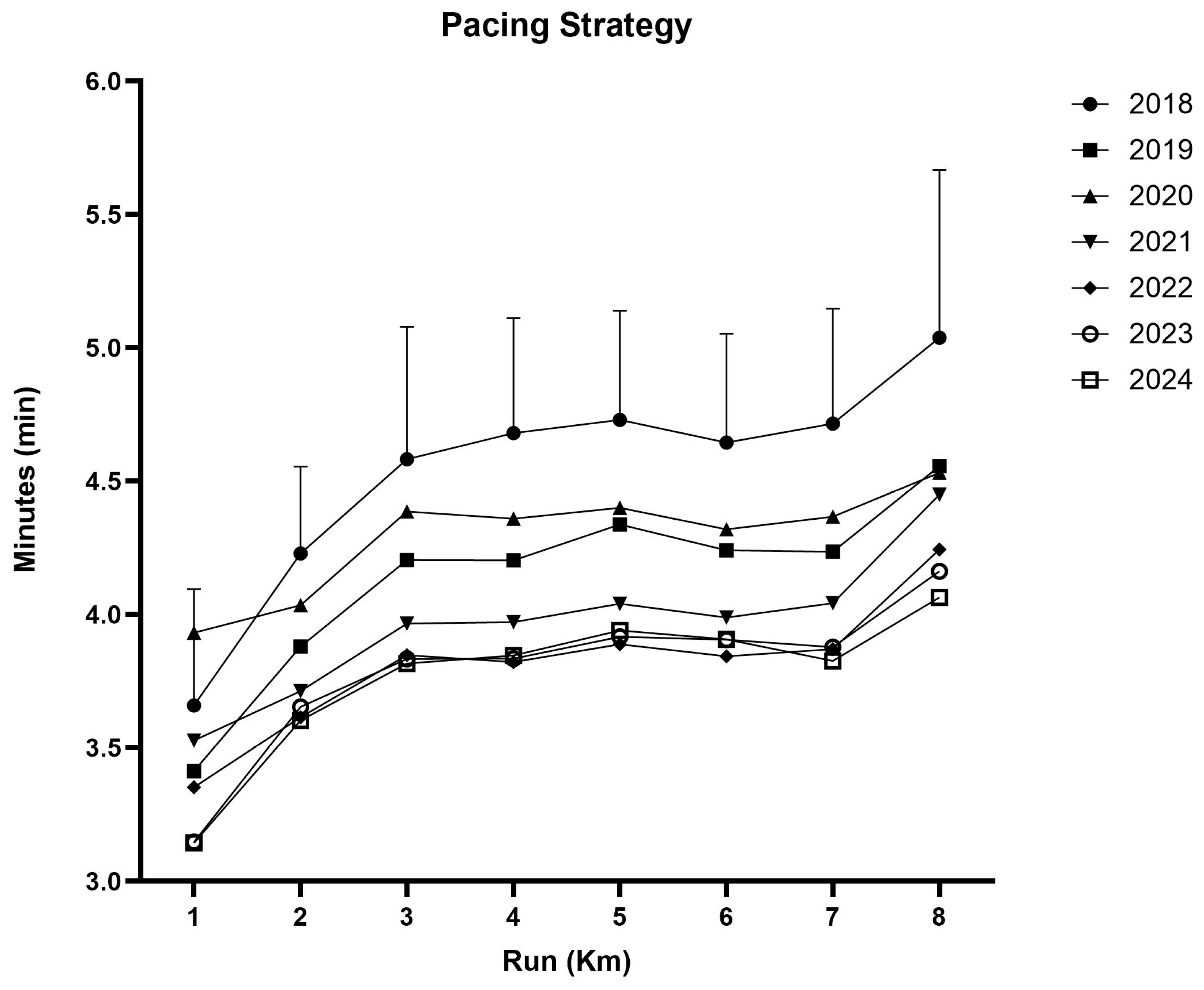
Across all seven seasons, running performance displayed a trend for a positive pacing profile, but this evolved from a pronounced fast-start with marked slowing in 2018–2020 to a much flatter and more even split-time distribution in 2021–2024, with the greatest gains observed in maintaining speed in the later runs, especially Run 8 (Figure 4).
Figure 4.
Mean running split times across segments (Run 1–Run 8) for each season (2018–2024), illustrating changes in running split-time distribution across seasons.
4. Discussion
This study provides the first seasonal, segment-specific analysis of elite HYROX performance across seven competitive seasons (2018–2024), focusing on the top 50 finishers in the PRO MEN category each season. Our primary aim was to evaluate how total race times and their components evolved and to identify which segments contributed most to overall improvements. Results revealed a substantial and consistent performance enhancement in all segments, with mean total time decreasing by 20.8% (−14.51 min). These improvements were distributed across all segments—workouts, running, and transitions indicating broad performance improvements across all measured race components. The greatest reductions were observed in the running and workout segments, with mean decreases of 6.1 and 5.9 min, respectively, from 2018 to 2024. These consistent improvements highlight substantial improvements across both running and workout components of HYROX competition, indicating progressively faster race performances across seasons. This pattern is consistent with the multidimensional performance demands previously described in HIFT-based competitions [8]. The most pronounced performance enhancements were observed in the workout domain, particularly in wall balls (−34.6%), sled pull (−29.3%), and farmer’s carry (−28.2%), while the greatest running improvement was found in the final segment, run 8 (−19.4%).
The performance improvements observed across all race components may also be interpreted within the broader context of the rapid global expansion of the sport. Recent large-scale analyses have reported exponential growth in HYROX participation, with over 275,000 athletes competing across more than 140 events and 22 countries worldwide [3]. This substantial increase in participation likely contributed to a progressive expansion of the talent pool, thereby elevating the competitive standard at the elite level. A larger participation base increases the probability of attracting athletes with higher performance potential and diverse competitive backgrounds. Consequently, competitive depth may increase over time, facilitating progressive improvements in elite performance standards. In this context, the consistent reductions in race time and the emergence of a more even running split-time distribution may reflect increased competitive depth, changes in athlete composition, accumulated competitive experience, or the progressive professionalization of the sport [3]. However, because no physiological, biomechanical, or training-load variables were collected, the present data cannot determine the mechanisms underlying these changes. Collectively, the performance trends observed from 2018 to 2024 suggest that the competitive standard in elite HYROX has increased across both running and workout-related components. Running segments, which account for a large proportion of total race time, became faster and showed a more even distribution across the race, whereas several workout stations exhibited marked reductions in completion time. From a practical standpoint, these findings support the importance of preparing athletes for both repeated running demands and standardized workout stations, while recognizing that the specific physiological mechanisms responsible for the observed improvements remain unknown.
These concurrent improvements indicate that elite HYROX performance has progressed in both race-related running and workout components across seasons. Although this pattern may be discussed in the context of concurrent endurance and strength demands [16,17,18,19], the present study did not assess physiological, biomechanical, or training-load variables. Therefore, the mechanisms underlying the observed performance improvements cannot be determined from the current dataset. Interestingly, these performance improvements were also accompanied by a more even pacing distribution, with flatter run-split slopes and reduced variability across segments, suggesting a more even distribution of running performance across race segments. However, this remains as a hypothesis and should be interpreted with caution as data reflects a descriptive change in race execution rather than showing direct evidence of improved physiological regulation or fatigue resistance.
The largest time reductions were observed in the workout domain, with an improvement of 19.2% (5.52 min) in cumulative workout time. As mentioned before, exercises like wall balls, sled pull, and farmer carry contributed most significantly. These findings indicate substantially shorter completion times across several workout stations [4]. Wall balls station, a high-repetition, compound task, emerged as the single greatest contributor to performance gains, highlighting the value of its substantial contribution to overall performance differences in the final stages of the race. Sled pull also showed marked reductions despite being affected by venue-dependent variables such as moquette texture, humidity, and surface friction. Although the weights are standardized, the resistance encountered can vary significantly, suggesting that the magnitude of athlete-related improvements cannot be determined from time-based data alone. The sled push did not show relevant improvements in performance compared to other workouts across the different years evaluated. One possible interpretation is that the sled push is one of the exercises with the greatest strength demands and is therefore less associated with overall race-speed improvements than other workout stations. In addition, contextual factors such as variations in the type of carpet surface and ambient humidity, as also observed with the sled pull may have influenced sled friction, introducing an uncontrolled additional load that could have masked potential adaptations. These effects are further compounded by the substantial load of 202 kg used in the sled.
While running time decreased by 16.8% (−6.05 min), it continued to represent more than 50% of total race time each season. Run 8 showed the greatest individual improvement among the running segments (−0.58 min) indicating that later-race running performance improved substantially across seasons. However, because no physiological, perceptual, or training-load measures were collected, this finding should not be interpreted as direct evidence of improved fatigue tolerance. Run 1 consistently registered the fastest times, likely due to its position at the start of the event when athletes have not yet completed the subsequent race components. Additionally, it precedes the first functional station, allowing for aggressive pacing without the immediate consequence of muscular compromise. These dynamics are consistent with the faster opening split observed across all seasons. Roxzone time decreased by 20.2% (−55.6 s), despite its relatively small proportion of total time. Future studies should investigate the biomechanical determinants of performance during HYROX-specific tasks. Across eight transitions, even marginal improvements can accumulate to competitive advantages. Reduced standard deviation in roxzone time (from 50.2 to 39.7 s) also indicates increased uniformity in execution and growing athlete familiarity with spatial layout and movement transitions.
Running performance remains a central component of overall HYROX performance because it represents the largest proportion of total race time. The observed changes indicate that faster early-race running speeds were maintained across seasons despite the repeated workout demands. However, the present data do not allow conclusions regarding the physiological sustainability or tactical superiority of any specific pacing strategy. Furthermore, the reduction in roxzone times underscores the importance of optimizing deceleration, orientation, and movement sequencing, as greater consistency in these elements can accumulate into meaningful competitive advantages. One of the most notable trends was the change in running split-time profiles across seasons. While early seasons were characterized by a distinctly positive pacing pattern, more recent seasons displayed progressively flatter profiles. In 2024, the pacing trend remained positive but was notably smoother and more uniform compared to previous years. This pattern is consistent with a more even distribution of running performance across race segments [20,21], although the present study cannot determine whether this change was due to improved pacing ability, greater race familiarity, athlete selection, or other unmeasured factors. However, when breaking down the structure of the event, it becomes evident that HYROX includes eight running segments, eight workouts, and a roxzone that also involves running. Of the eight workouts, two correspond to ergometer-based tasks, which in practice results in six strength-endurance stations and a total of eleven efforts with a high aerobic component. This distribution reinforces the predominantly aerobic nature of the competition and highlights the need to train the capacity to sustain high performance during intermittent efforts of aerobic character. Collectively, these findings underscore the progressive development of elite HYROX performance standards, with improvements not only in completion times but also in the distribution of performance across race components. These findings also contribute to the growing body of evidence describing performance evolution in HIFT-based competitive formats.
5. Conclusions
This repeated cross-sectional analysis of annual Top 50 PRO MEN HYROX performances from 2018 to 2024 shows a clear improvement in elite performance standards across seven competitive seasons. Total race time decreased by more than 20%, with significant reductions in workout time, running time, and roxzone time. The largest time reductions were observed in Wall Balls, Sled Pull, and Farmer’s Carry, whereas Run 8 showed the greatest reduction among running segments. These findings indicate that performance improvements occurred across all measured race components, particularly in selected workout stations and later running segments. However, because the study was based exclusively on publicly available split-time data, the physiological, biomechanical, and training-related mechanisms underlying these changes cannot be determined. Overall, the results provide descriptive benchmarks for coaches and athletes and highlight the need to prepare for the combined running, workout, and transition demands of elite HYROX competition.
6. Limitations and Practical Implications
Although this investigation provides an extensive seasonal evaluation of elite HYROX performance, several methodological considerations must be acknowledged. First, although some athletes appeared in more than one season, the study was designed to compare annual Top 50 performance cohorts rather than individual athlete trajectories. Consequently, the findings describe changes in elite performance standards across seasons and should not be interpreted as evidence of within-athlete longitudinal adaptation. Second, despite the event’s standardized structure defined by fixed exercises, prescribed loads, and a consistent sequence venue-specific characteristics, such as track layout, surface material, number of directional turns, and environmental conditions, may have introduced residual variability. Differences in circuit configuration, transition areas, and environmental conditions such as temperature and humidity may also have influenced performance outcomes. Therefore, part of the variability observed between seasons may reflect differences in competition settings rather than athlete-related factors alone. These contextual differences could influence pacing regulation, running economy, and perceived exertion, particularly within the running and roxzone segments. Third, performance in the sled push and sled pull stations is especially sensitive to surface-dependent resistance, which can fluctuate due to variations in friction, humidity, and carpet wear. Although official loads are standardized (202 kg for the sled push and 153 kg for the sled pull), the effective mechanical demand likely differed across venues. The absence of instrumented sled systems or standardized resistance measurements limits the precision of these assessments and may obscure the true magnitude of performance improvements across seasons. Furthermore, although the combined distance for running and roxzone remains nominally constant (8.7 km), minor discrepancies in individual segment lengths are inevitable. The first running segment tends to be slightly longer due to initial course design, whereas the final segment often extends until entering the Wall Ball station. Consequently, pacing and split-time data should be interpreted with caution. Finally, the analysis focused exclusively on the top 50 PRO MEN athletes, which enhanced data consistency but represents an important limitation because female athletes were not included. Therefore, the present findings cannot be directly generalized to women, as sex-related differences in pacing strategy, running and workout distribution, physiological responses, and performance development across years may exist. Future studies should examine whether similar temporal trends are present in PRO WOMEN athletes, as well as in age-group and recreational divisions.
Looking forward, future research should integrate physiological, biomechanical, and environmental parameters to better characterize the factors associated with elite HYROX performance. The implementation of real-time monitoring technologies including wearable metabolic sensors and instrumented sleds would enable more accurate assessments of workload distribution and mechanical efficiency. A key methodological factor for future analyses will be the change in competition carpets introduced from the 2025 World Championships onward. This modification may substantially alter surface friction and, consequently, the mechanical resistance experienced during the sled push and sled pull stations. From this point forward, temporal comparisons with previous seasons must account for this technical discontinuity, as apparent improvements in sled-related split times may partially reflect altered surface properties rather than athlete-related performance changes. From an applied perspective, training design should align with both the integrated physiological demands of HYROX and the individual metabolic profiles of each athlete. Given that the event comprises eight running segments, eight functional workouts, and transitional roxzone phases, most of which involve a substantial aerobic component, the present findings are consistent with the importance of aerobic capacity for successful HYROX performance. However, the study design does not allow identification of the specific physiological determinants responsible for the observed performance improvements across seasons. Nevertheless, maintaining performance across repeated workout stations is also likely to be important to avoid excessive decrements in overall race performance. At the elite level, where marginal gains may influence competitive outcomes, coaches may consider balancing aerobic endurance, strength-endurance, and recovery-oriented training strategies when preparing athletes for HYROX competition. HYROX thus represents a complex hybrid competition format that combines repeated running, functional workout stations, and transition phases, requiring athletes to maintain high performance across multiple race components.
Author Contributions
Conceptualization, J.G.-H. and J.D.C.; methodology, J.G.-H., J.S.d.C. and J.D.C.; validation, J.G.-H., S.A.-D., F.J.M.-G., A.M., A.F.-A., I.Y.-A., J.S.d.C. and J.D.C.; formal analysis, J.G.-H. and J.S.d.C.; investigation, J.G.-H.; resources, J.G.-H. and J.D.C.; data curation, J.G.-H.; writing—original draft preparation, J.G.-H.; writing—review and editing, all authors; visualization, J.G.-H.; supervision, J.D.C.; project administration, J.G.-H. All authors have read and agreed to the published version of the manuscript.
Funding
This research received no specific grant from any funding agency in the public, commercial, or not-for-profit sectors. Arturo Franco-Andrés received a scholarship from the Francisco de Vitoria University to support his PhD studies.
Institutional Review Board Statement
Not applicable.
Informed Consent Statement
Patient consent was waived because the study was based exclusively on publicly available competition results obtained from the official HYROX database. Analyses were conducted at an aggregated level, and no individual athlete was identified, contacted, or analyzed at a personal level in the manuscript.
Data Availability Statement
The data supporting the findings of this study were obtained from the publicly available official HYROX© competition database. The processed dataset used for the analyses (top 50 PRO MEN performances per season, 2018–2024) is available from the corresponding author upon reasonable request.
Acknowledgments
The authors would like to thank the HYROX© organization for maintaining accessible and standardized performance databases across seasons, which made this retrospective analysis possible. We also express our appreciation to the athletes and coaching professionals whose consistent participation and performance have contributed to the growth and data richness of the sport. Special thanks to the independent data reviewers who assisted in verifying segmental timing accuracy and ensuring methodological consistency during data processing.
Conflicts of Interest
The authors declare no conflicts of interest.
Abbreviations
The following abbreviations are used in this manuscript:
| Abbreviation | Definition |
| AMRAP | As many repetitions as possible |
| ANOVA | Analysis of variance |
| ES | Effect size |
| HIFT | High-intensity functional training |
| RFT | Round for time |
| SD | Standard deviation |
| η2 | Eta squared |
| η2p | Partial eta squared |
| Δ | Relative percentage change |
References
- Feito, Y.; Heinrich, K.M.; Butcher, S.J.; Carlos Poston, W.S. High-Intensity Functional Training (HIFT): Definition and Research Implications for Improved Fitness. Sports 2018, 6, 76. [Google Scholar] [CrossRef] [Scilit] [PubMed]
- Glassman, G. The CrossFit Level 1 Training Guide, 3rd ed.; CrossFit Incorporated: Washington, DC, USA, 2020. [Google Scholar]
- Fernández-Navarrete, I.; Ruiz-Alias, S.A.; Gómez-García, M.; Riquelme-Sebastián, L.; García-Pinillos, F. Hyrox©: A Descriptive Analysis of Participation Trends Among Over 275,000 Athletes in the New Fitness Modality. Res. Q. Exerc. Sport 2025, 97, 266–272. [Google Scholar] [CrossRef] [Scilit] [PubMed]
- Brandt, T.; Ebel, C.; Lebahn, C.; Schmidt, A. Acute Physiological Responses and Performance Determinants in Hyrox©—A New Running-Focused High Intensity Functional Fitness Trend. Front. Physiol. 2025, 16, 1519240. [Google Scholar] [CrossRef] [Scilit] [PubMed]
- Crawford, D.A.; Drake, N.B.; Carper, M.J.; Deblauw, J.; Heinrich, K.M. Are Changes in Physical Work Capacity Induced by High-Intensity Functional Training Related to Changes in Associated Physiologic Measures? Sports 2018, 6, 26. [Google Scholar] [CrossRef] [Scilit] [PubMed]
- Wilke, J.; Mohr, L. Chronic Effects of High-Intensity Functional Training on Motor Function: A Systematic Review with Multilevel Meta-Analysis. Sci. Rep. 2020, 10, 21680. [Google Scholar] [CrossRef] [Scilit] [PubMed]
- Helén, J.; Kyröläinen, H.; Ojanen, T.; Pihlainen, K.; Santtila, M.; Heikkinen, R.; Vaara, J.P. High-Intensity Functional Training Induces Superior Training Adaptations Compared With Traditional Military Physical Training. J. Strength Cond. Res. 2023, 37, 2477–2483. [Google Scholar] [CrossRef] [Scilit] [PubMed]
- Wang, X.; Soh, K.G.; Samsudin, S.; Deng, N.; Liu, X.; Zhao, Y.; Akbar, S. Effects of High-Intensity Functional Training on Physical Fitness and Sport-Specific Performance among the Athletes: A Systematic Review with Meta-Analysis. PLoS ONE 2023, 18, e0295531. [Google Scholar] [CrossRef] [Scilit] [PubMed]
- Wang, X.; Soh, K.G.; Zhang, L.; Liu, X.; Ma, S.; Zhao, Y.; Sun, C. Effects of High-Intensity Functional Training on Physical Fitness in Healthy Individuals: A Systematic Review with Meta-Analysis. BMC Public Health 2025, 25, 528. [Google Scholar] [CrossRef] [Scilit] [PubMed]
- Martínez-Gómez, R.; Valenzuela, P.L.; Alejo, L.B.; Gil-Cabrera, J.; Montalvo-Pérez, A.; Talavera, E.; Lucia, A.; Moral-González, S.; Barranco-Gil, D. Physiological Predictors of Competition Performance in CrossFit Athletes. Int. J. Environ. Res. Public Health 2020, 17, 3699. [Google Scholar] [CrossRef] [Scilit] [PubMed]
- Fernández, J.F.; Solana, R.S.; Moya, D.; Marin, J.M.S.; Ramón, M.M. Acute Physiological Responses during Crossfit® Workouts. Eur. J. Hum. Mov. 2015, 35, 114–124. [Google Scholar]
- de Sousa Neto, I.V.; de Sousa, N.M.F.; Neto, F.R.; Falk Neto, J.H.; Tibana, R.A. Time Course of Recovery Following CrossFit® Karen Benchmark Workout in Trained Men. Front. Physiol. 2022, 13, 899652. [Google Scholar] [CrossRef] [Scilit] [PubMed]
- Forte, L.D.M.; Freire, Y.G.C.; Júnior, J.S.D.S.; Melo, D.A.; Meireles, C.L.S. Physiological Responses After Two Different CrossFit Workouts. Biol. Sport 2022, 39, 231–236. [Google Scholar] [CrossRef] [Scilit] [PubMed]
- HYROXResults All Time Ranking. Available online: https://results.hyrox.com/season-8/?pid=list_overall&pidp=ranking_nav (accessed on 4 June 2025).
- Hayes, B.; Houghton, J.A. Ethics in Social Science and Humanities; European Commission: Brussels, Belgium, 2021. [Google Scholar]
- Fyfe, J.J.; Bishop, D.J.; Stepto, N.K. Interference between Concurrent Resistance and Endurance Exercise: Molecular Bases and the Role of Individual Training Variables. Sports Med. 2014, 44, 743–762. [Google Scholar] [CrossRef] [Scilit] [PubMed]
- Coffey, V.G.; Hawley, J.A. Concurrent Exercise Training: Do Opposites Distract? J. Physiol. 2017, 595, 2883–2896. [Google Scholar] [CrossRef] [Scilit] [PubMed]
- Hickson, R.C. Interference of Strength Development by Simultaneously Training for Strength and Endurance. Eur. J. Appl. Physiol. Occup. Physiol. 1980, 45, 255–263. [Google Scholar] [CrossRef] [Scilit] [PubMed]
- Wilson, J.M.; Marin, P.J.; Rhea, M.R.; Wilson, S.M.C.; Loenneke, J.P.; Anderson, J.C. Concurrent Training: A Meta-Analysis Examining Interference of Aerobic and Resistance Exercises. J. Strength Cond. Res. 2012, 26, 2293–2307. [Google Scholar] [CrossRef] [Scilit] [PubMed]
- Foster, C.; Schrager, M.; Snyder, A.C.; Thompson, N.N. Pacing Strategy and Athletic Performance. Sports Med. 1994, 17, 77–85. [Google Scholar] [CrossRef] [Scilit] [PubMed]
- Mauger, A.R.; Jones, A.M.; Williams, C.A. Influence of Feedback and Prior Experience on Pacing during a 4-Km Cycle Time Trial. Med. Sci. Sports Exerc. 2009, 41, 451–458. [Google Scholar] [CrossRef] [Scilit] [PubMed]
Disclaimer/Publisher’s Note: The statements, opinions and data contained in all publications are solely those of the individual author(s) and contributor(s) and not of MDPI and/or the editor(s). MDPI and/or the editor(s) disclaim responsibility for any injury to people or property resulting from any ideas, methods, instructions or products referred to in the content. |
© 2026 by the authors. Licensee MDPI, Basel, Switzerland. This article is an open access article distributed under the terms and conditions of the Creative Commons Attribution (CC BY) license.