On the Application of Scanning Electrochemical Probe Microscopies to Investigate Galvanic Corrosion Processes



Abstract
1. Introduction
2. Materials and Methods
2.1. Materials
2.2. Methods
3. Results and Discussion
3.1. Conventional Electrochemical Characterization of Galvanic Pairs
3.2. SVET Characterization of Galvanic Pairs
3.3. SECM Characterization of Galvanic Pairs
3.4. Final Remarks
4. Conclusions
- The individual study of each metal in a galvanic coupling system using potentiodynamic polarization allows us to understand its specific electrochemical behavior, thus facilitating the identification of the differences and effects that may occur when it is subjected to galvanic coupling conditions by application of the mixed potential theory. This leads to a deeper understanding of the electrochemical mechanisms involved in the initial phases of galvanic corrosion.
- The application of the mixed potential theory makes it possible to make predictions about the behavior of galvanic corrosion for individual metals or metallic phases when the corrosion process has kinetics controlled by polarization activation; that is, in the absence of passivity and precipitation of corrosion products. The main limitation of this method relies on the assumption that the anodic and cathodic processes are completely independent between the two metals, with the anodic corrosion reaction occurring exclusively on the less noble metal and the corresponding cathodic half-reaction only on the more noble metal. This cathodic half-reaction is considered identical to that which occurs in the corrosion process specific to each metal within the aggressive environment under consideration.
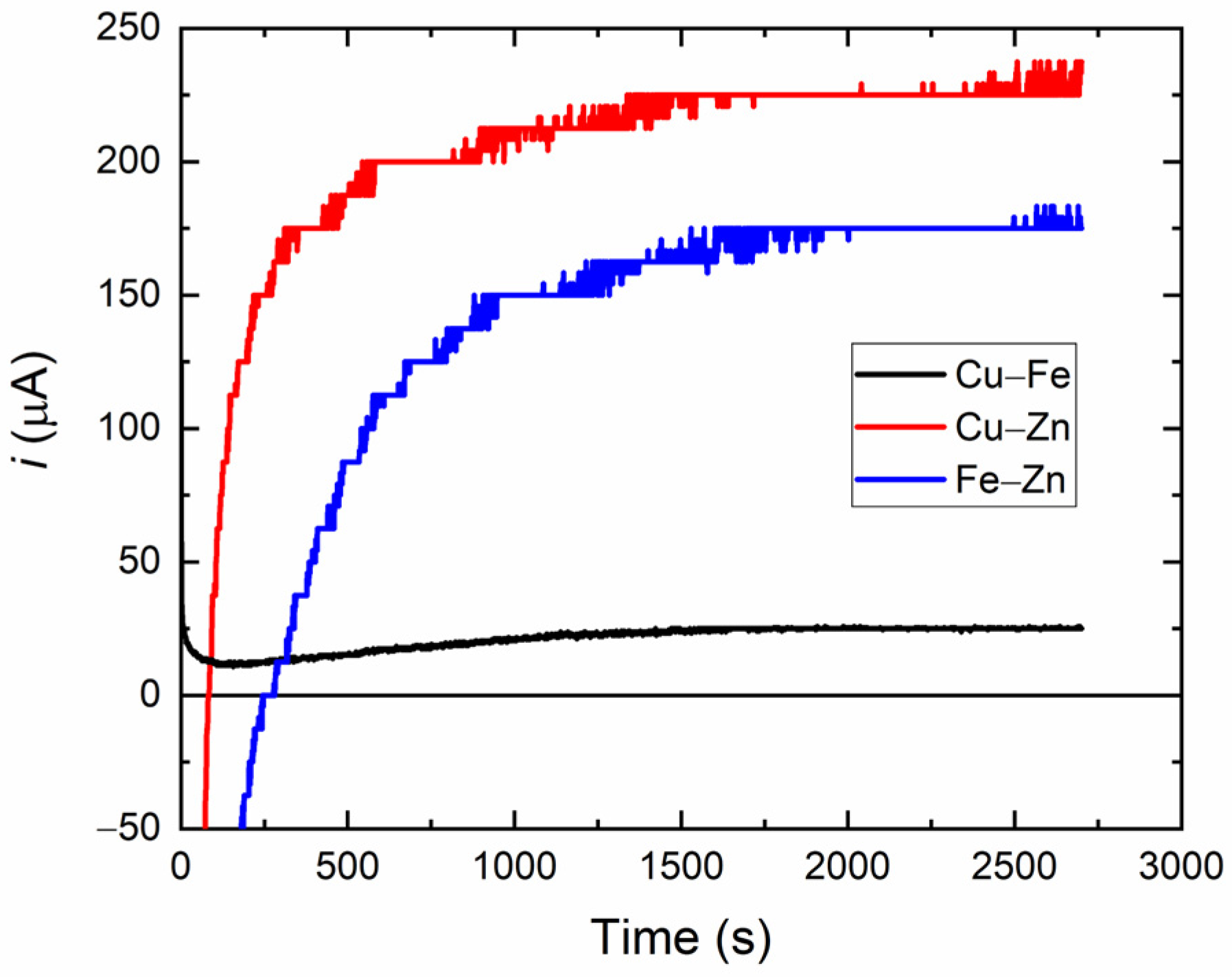
- Conventional electrochemical techniques allow adequate quantification of the phenomenon in terms of electrochemical parameters obtained by Tafel analysis of potentiodynamic polarization curves and by direct amperometric measurement of the current flowing in the electrical circuit linking the two metals.
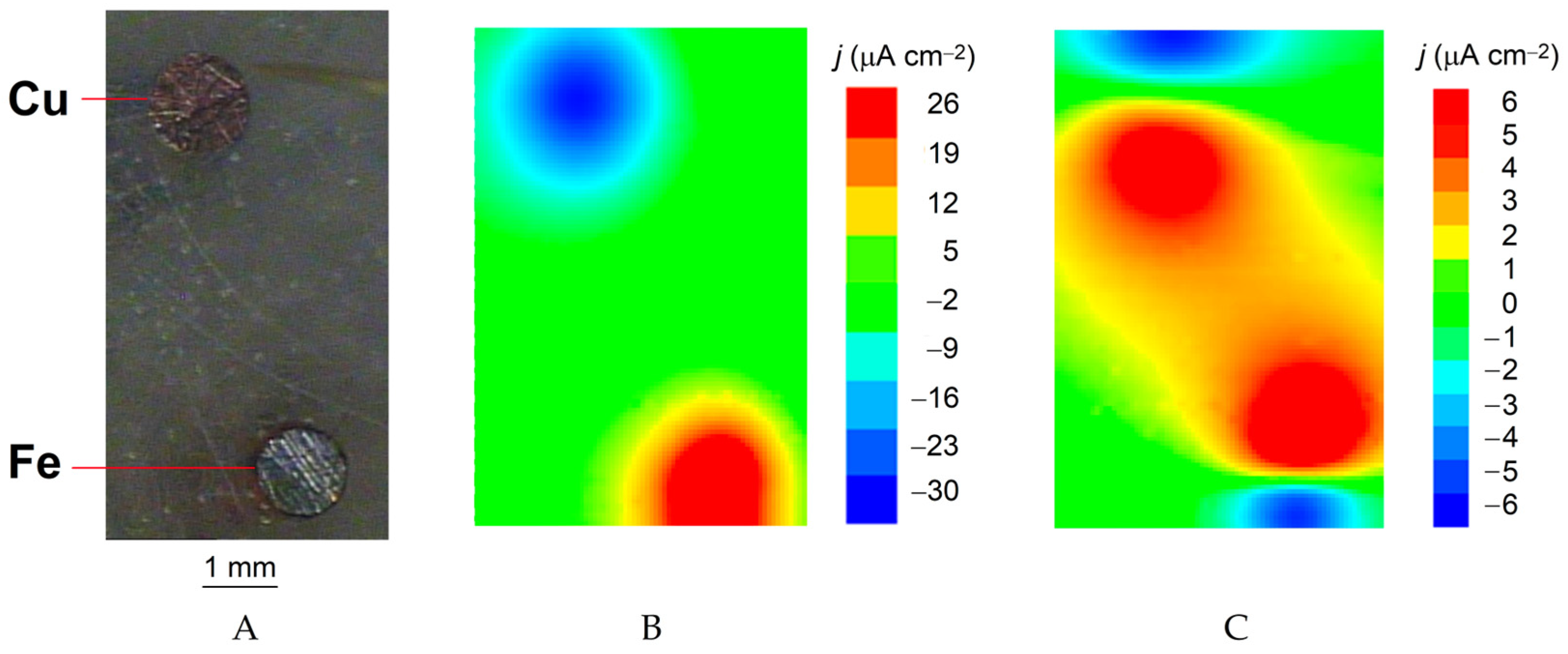
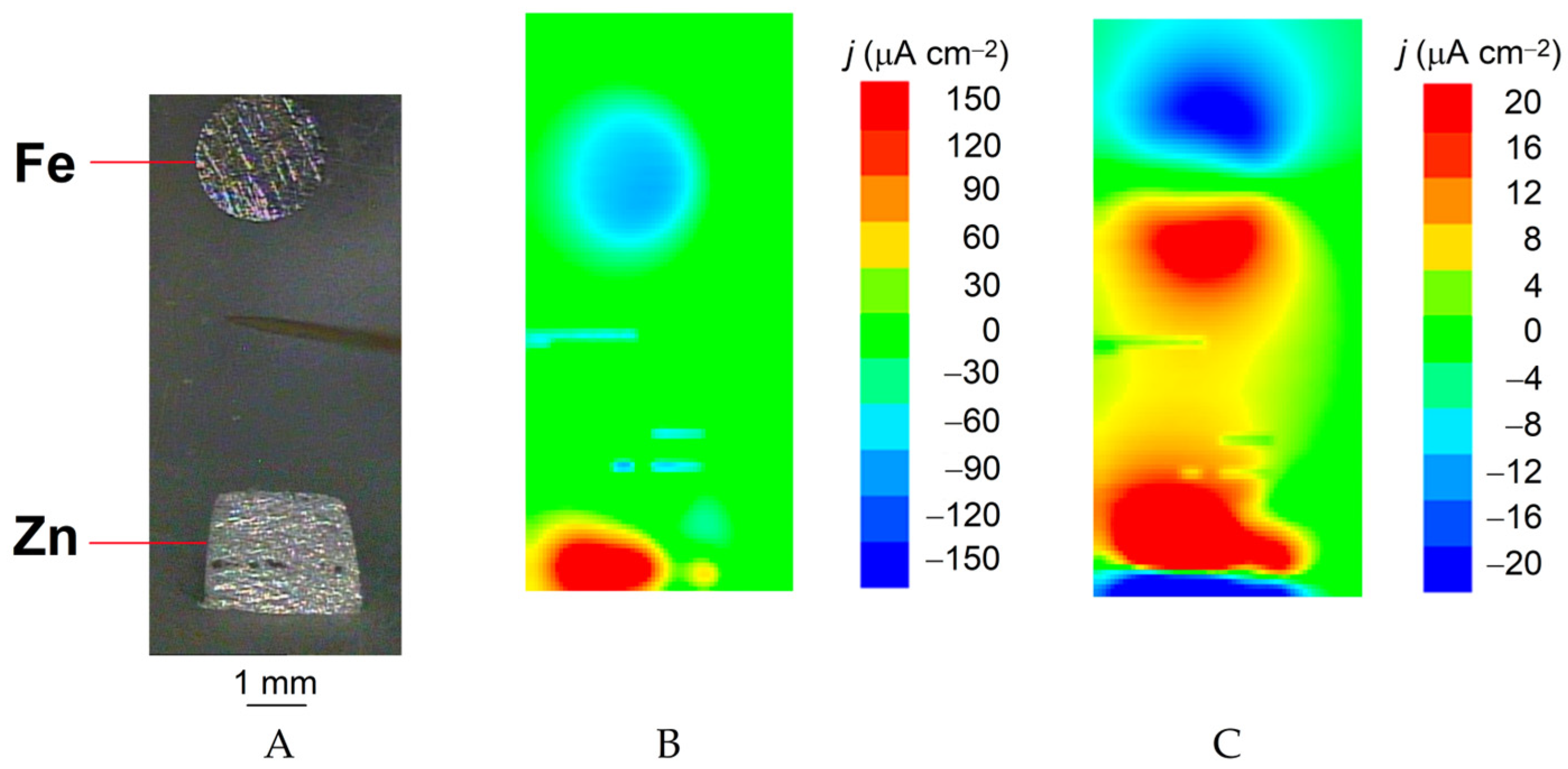
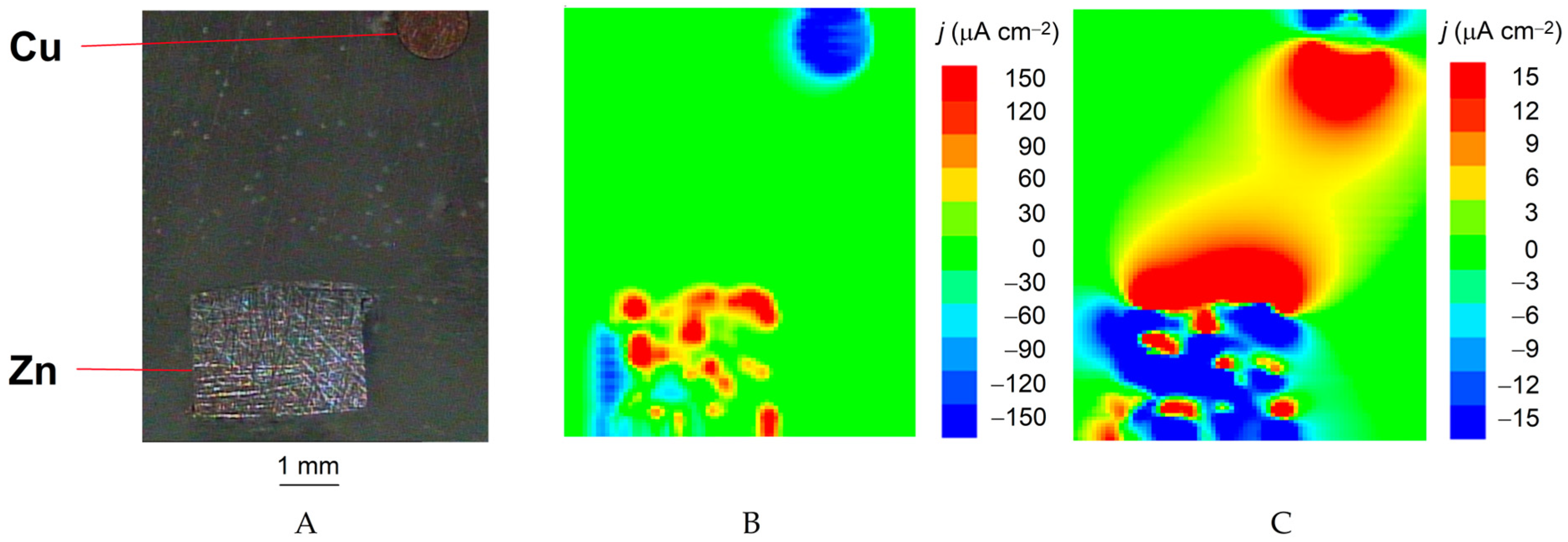
- The use of scanning microelectrochemical techniques to measure local potentials and ion densities has shown that the cathodic process also occurs in localized areas of the more reactive metal, albeit to a lesser extent than in the more noble metal. Therefore, conventional electrochemical measurements, which require separating the anodic and cathodic half-reactions at different electrodes, do not fully capture the intensity of corrosion processes occurring in a real galvanized assembly, even when it appears homogeneous to the naked eye. This calls into question mechanistic analyses that fail to consider localized and in situ information.
- Scanning microelectrochemical techniques should be used to delve deeper into both reaction mechanisms and protection procedures in any real-world corrosion process, particularly in alloys, joints and welds, going beyond the simple model pairs considered in this work, even when their corrosion distribution appear more homogeneous. This conclusion is not limited to the use of SVET and SECM, as other local microelectrochemical techniques, such as SIET or potentiometric SECM, can also contribute to the multiscale characterization of galvanic corrosion.
Author Contributions
Funding
Institutional Review Board Statement
Informed Consent Statement
Data Availability Statement
Conflicts of Interest
Abbreviations
| Ag/AgCl/KCl(sat.) | Saturated silver-silver chloride reference electrode |
| E | Potential |
| i | Current |
| j | Current density |
| OCP | Open circuit potential |
| PVC | Polyvinyl chloride |
| SCE | Saturated calomel reference electrode |
| SECM | Scanning electrochemical microscopy |
| SEPM | Scanning electrochemical probe microscopy |
| SVET | Scanning vibrating electrode technique |
| ZRA | Zero-resistance ammeter |
| βa | Tafel slope of the anodic branch in the polarization curve |
| βc | Tafel slope of the cathodic branch in the polarization curve |
| 2D | Two-dimensional |
| 3D | Three-dimensional |
References
- Elayaperumal, K.; Raja, V.S. Thermodynamics and kinetics of electrochemical corrosion. In Corrosion Failures: Theory, Case Studies and Applications; John Wiley & Sons: Hoboken, NJ, USA, 2015; pp. 25–40. [Google Scholar]
- Khan, A.; Qurashi, A.; Badeghaish, W.; Noui-Mehidi, M.N.; Aziz, M.A. Frontiers and challenges in electrochemical corrosion monitoring; surface and downhole applications. Sensors 2020, 20, 6583. [Google Scholar] [CrossRef]
- Xia, D.-H.; Deng, C.-M.; Macdonald, D.; Jamali, S.; Mills, D.; Luo, J.-L.; Strebl, M.G.; Amiri, M.; Jin, W.; Song, S.; et al. Electrochemical measurements used for assessment of corrosion and protection of metallic materials in the field: A critical review. J. Mater. Sci. Technol. 2022, 112, 151–183. [Google Scholar] [CrossRef]
- Sheetal; Sheetal, K.; Thakur, S.; Singh, A.K.; Singh, M.; Pani, B.; Saji, V.S. A review of electrochemical techniques for corrosion monitoring—Fundamentals and research updates. Crit. Rev. Anal. Chem. 2025, 55, 161–186. [Google Scholar] [CrossRef]
- Lamas, J.S.; Tacq, J.; Teerlink, B. Assessing the potential of electrochemical techniques for monitoring pitting corrosion in carbon steel for offshore structures. Electrochim. Acta 2026, 563, 148721. [Google Scholar] [CrossRef]
- Bastos, A.C.; Quevedo, M.C.; Karavai, O.V.; Ferreira, M.G.S. Review—On the application of the scanning vibrating electrode technique (SVET) to corrosion research. J. Electrochem. Soc. 2017, 164, C973–C990. [Google Scholar] [CrossRef]
- Hussain, A. Corrosion studies using the scanning vibrating electrode technique (SVET)—A brief review. Curr. Mater. Sci. 2021, 14, 125–130. [Google Scholar] [CrossRef]
- Bastos, A.C.; Ferreira, M.G.S. Application of the scanning vibrating electrode technique to the characterization of modern coatings. In Handbook of Modern Coating Technologies: Advanced Characterization Methods; Aliofkhazraei, M., Ali, N., Chipara, M., Laidani, N.B., De Hosson, J.T.M., Eds.; Elsevier: Amsterdam, The Netherlands, 2021; pp. 1–43. [Google Scholar]
- Payne, N.A.; Stephens, L.I.; Mauzeroll, J. The application of scanning electrochemical microscopy to corrosion research. Corrosion 2017, 73, 759–780. [Google Scholar] [CrossRef] [PubMed]
- Reddy, M.S.B.; Ponnamma, D.; Sadasivuni, K.K.; Aich, S.; Kailasa, S.; Parangusan, H.; Ibrahim, M.; Eldeib, S.; Shehata, O.; Ismail, M.; et al. Sensors in advancing the capabilities of corrosion detection: A review. Sens. Actuators A Phys. 2021, 332, 113086. [Google Scholar] [CrossRef]
- Traxler, I.; Singewald, T.D.; Schimo-Aichhorn, G.; Hild, S.; Valtiner, M. Scanning electrochemical microscopy methods (SECM) and ion-selective microelectrodes for corrosion studies. Corros. Rev. 2022, 40, 515–542. [Google Scholar] [CrossRef]
- Zoski, C.G. Review—Advances in scanning electrochemical microscopy (SECM). J. Electrochem. Soc. 2016, 163, H3088–H3100. [Google Scholar] [CrossRef]
- Polcari, D.; Dauphin-Ducharme, P.; Mauzeroll, J. Scanning electrochemical microscopy: A comprehensive review of experimental parameters from 1989 to 2015. Chem. Rev. 2016, 116, 13234–13278. [Google Scholar] [CrossRef]
- Skaanvik, S.A.; Gateman, S.M. Probing passivity of corroding metals using scanning electrochemical probe microscopy. Electrochem. Sci. Adv. 2024, 4, e2300014. [Google Scholar] [CrossRef]
- Tefashe, U.M.; Snowden, M.E.; Ducharme, P.D.; Danaie, M.; Botton, G.A.; Mauzeroll, J. Local flux of hydrogen from magnesium alloy corrosion investigated by scanning electrochemical microscopy. J. Electroanal. Chem. 2014, 720–721, 121–127. [Google Scholar] [CrossRef]
- González-García, Y.; Mol, J.M.C.; Muselle, T.; De Graeve, I.; Van Assche, G.; Scheltjens, G.; Van Mele, B.; Terryn, H. SECM study of defect repair in self-healing polymer coatings on metals. Electrochem. Commun. 2011, 13, 169–173. [Google Scholar] [CrossRef]
- Mansikkamäki, K.; Ahonen, P.; Fabricius, G.; Murtomäki, L.; Kontturi, K. Inhibitive effect of benzotriazole on copper surfaces studied by SECM. J. Electrochem. Soc. 2005, 152, B12–B16. [Google Scholar] [CrossRef][Green Version]
- Denuault, G.; Nagy, G.; Toth, K. Potentiometric probes. In Scanning Electrochemical Microscopy, 3rd ed.; Bard, A.J., Mirkin, M., Eds.; CRC Press: Boca Raton, FL, USA, 2022; pp. 207–241. [Google Scholar]
- Bastos, A. Application of SVET/SIET techniques to study healing processes in coated metal substrates. In Handbook of Sol-Gel Science and Technology—Processing, Characterization and Applications; Klein, L., Aparicio, M., Jitianu, A., Eds.; Springer: Cham, Switzerland, 2018; pp. 1727–1782. [Google Scholar]
- Filotás, D.; Asserghine, A.; Nagy, L.; Nagy, G. Short-term influence of interfering ion activity change on ion-selective micropipette electrode potential; another factor that can affect the time needed for imaging in potentiometric SECM. Electrochem. Commun. 2017, 77, 62–64. [Google Scholar] [CrossRef]
- Al-Jeda, M.; Mena-Morcillo, E.; Chen, A. Micro-sized pH sensors based on scanning electrochemical probe microscopy. Micromachines 2022, 13, 2143. [Google Scholar] [CrossRef]
- da Silva, R.M.P.; Izquierdo, J.; Milagre, M.X.; Antunes, R.A.; Souto, R.M.; Costa, I. Development of an Al3+ ion-selective microelectrode for the potentiometric microelectrochemical monitoring of corrosion sites on 2098-t351 aluminum alloy surfaces. Electrochim. Acta 2022, 415, 140260. [Google Scholar] [CrossRef]
- Dauphin-Ducherme, P.; Asmussen, R.M.; Shoesmith, D.W.; Mauzeroll, J. In-situ Mg2+ release monitored during magnesium alloy corrosion. J. Electroanal. Chem. 2015, 736, 61–68. [Google Scholar] [CrossRef]
- Souto, R.M.; González-García, Y.; Bastos, A.C.; Simões, A.M. Investigating corrosion processes in the micrometric range: A SVET study of the galvanic corrosion of zinc coupled with iron. Corros. Sci. 2007, 49, 4568–4580. [Google Scholar] [CrossRef]
- Marques, A.G.; Taryba, M.G.; Panão, A.S.; Lamaka, S.V.; Simões, A.M. Application of scanning electrode techniques for the evaluation of iron–zinc corrosion in nearly neutral chloride solutions. Corros. Sci. 2016, 104, 123–131. [Google Scholar] [CrossRef]
- Bastos, A.C.; Simões, A.M.; Ferreira, M.G. Corrosion of electrogalvanized steel in 0.1 M NaCl studied by SVET. Port. Electrochim. Acta 2003, 21, 371–387. [Google Scholar] [CrossRef]
- Huang, C.Z.; Li, H.; Xiao, Y.; Zhang, Q.H.; Liu, P.; Wu, L.; Cao, F.H. In-situ scanning electrochemical microscopy visualization of self-passivation in galvanized steel under aggressive environments. Colloids Surf. A Physicochem. Eng. Asp. 2025, 727, 138418. [Google Scholar] [CrossRef]
- Alvarez-Pampliega, A.; Lamaka, S.V.; Taryba, M.G.; Madani, M.; De Strycker, J.; Tourwé, E.; Ferreira, M.G.S.; Terryn, H. Cut-edge corrosion study on painted aluminum rich metallic coated steel by scanning vibrating electrode and micro-potentiometric techniques. Electrochim. Acta 2012, 61, 107–117. [Google Scholar] [CrossRef]
- Nguyen, T.T.; Akbarzadeh, S.; Thai, T.T.; Paint, Y.; Trinh, A.T.; Olivier, M.-G. Effect of cerium salts on the cut-edge of zinc-based sacrificial coatings: Influence of Al and Mg alloying elements on galvanic corrosion. J. Alloys Compd. 2024, 981, 173711. [Google Scholar] [CrossRef]
- Kallip, S.; Bastos, A.C.; Yasakau, K.A.; Zheludkevich, M.L.; Ferreira, M.G.S. Synergistic corrosion inhibition on galvanically coupled metallic materials. Electrochem. Commun. 2012, 20, 101–104. [Google Scholar] [CrossRef]
- Coelho, L.B.; Mouanga, M.; Druart, M.-E.; Recloux, I.; Cossement, D.; Olivier, M.-G. A SVET study of the inhibitive effects of benzotriazole and cerium chloride solely and combined on an aluminium/copper galvanic coupling model. Corros. Sci. 2016, 110, 143–156. [Google Scholar] [CrossRef]
- Coelho, L.B.; Taryba, M.; Alves, M.; Olivier, M.-G. Unveiling the effect of the electrodes area on the corrosion mechanism of a graphite—AA2024-T3 galvanic couple by localised electrochemistry. Electrochim. Acta 2018, 277, 9–19. [Google Scholar] [CrossRef]
- Xiao, Y.-H.; Huang, Q.-Y.; Zhao, T.-Y.; Li, X.-R.; Wu, L.-K.; Cao, F.-H. Phase-resolved in situ electrochemical and chemical mapping of 2205 duplex stainless steel corrosion via combined MECT-SECM approach. Electrochim. Acta 2025, 536, 146813. [Google Scholar] [CrossRef]
- del Olmo, R.; Bastos, A.; Yasakau, K.; Suhskova, A.; Arrabal, R.; Tedim, J. Corrosion inhibitor from nature: Fundamentals of tannic acid inhibition for AA2024 alloy. Appl. Surf. Sci. 2025, 680, 161434. [Google Scholar] [CrossRef]
- Trdan, U.; Logar, A.; Klobčar, D.; Milošev, I.; Kapun, B. Corrosion mitigation of AA6082, copper-ETP, and their galvanic couple using Ce(OAc)3, Na2SO4, and 1H-BTA in chloride solution. J. Mater. Res. Technol. 2026, 40, 2422–2436. [Google Scholar] [CrossRef]
- Yasakau, K.A.; Bastos, A.C.; Haffner, D.; Quandt, E.; Feyerabend, F.; Ferreira, M.G.S.; Zheludkevich, M.L. Sacrificial protection of Mg-based resorbable implant alloy by magnetron sputtered Mg5Gd alloy coating: A short-term study. Corros. Sci. 2021, 189, 109590. [Google Scholar] [CrossRef]
- Dai, X.; Wu, L.; Ci, W.; Yao, W.; Yuan, Y.; Xie, Z.; Jiang, B.; Wang, J.; Andrej, A.; Pan, F. Dual self-healing effects of salicylate intercalated MgAlY-LDHs film in-situ grown on the micro-arc oxidation coating on AZ31 alloys. Corros. Sci. 2023, 220, 111285. [Google Scholar] [CrossRef]
- Garg, V.; Magnan, M.; Zanna, S.; Seyeux, A.; Wiame, F.; Maurice, V.; Marcus, P. Corrosion inhibition mechanisms of 2-mercaptobenzothiazole on AA2024 T3 aluminium alloy. npj Mater. Degrad. 2025, 9, 100. [Google Scholar] [CrossRef]
- Adomniței, I.; Cimpoeșu, R.; Chicet, D.L.; Coteață, M.; Lupu, F.C.; Bejinariu, C.; Andrușcă, L.; Paraschiv, P.; Axinte, M.; Bădărău, G.; et al. Behavior of YSZ (high Y2O3 content) layer on Inconel to electro-chemical corrosion. Materials 2025, 18, 400. [Google Scholar] [CrossRef]
- del Olmo, R.; Neves, C.; Bastos, A.; Arrabal, R.; Tedim, J. Tannic acid loading into polyurethane and epoxy coatings: Active corrosion protection of AA2024 alloy. Surf. Interfaces 2025, 69, 106800. [Google Scholar] [CrossRef]
- Munteanu, C.; Cimpoeșu, R.; Lupu, F.-C.; Nazar, B.; Istrate, B.; Melnic, I.; Vitali, V. Corrosion and termal shock behavior of atmospheric plasma spraying coatings on agricultural disc harrows. Appl. Sci. 2026, 16, 3703. [Google Scholar] [CrossRef]
- Pagotto, J.F.; Montemor, M.F.; Recio, F.J.; Motheo, A.J.; Simões, A.M.; Herrasti, P. Visualisation of the galvanic effects at welds on carbon steel. J. Braz. Chem. Soc. 2015, 26, 667–675. [Google Scholar] [CrossRef]
- Nakatsugawa, I.; Chino, Y. Effect of NaCl concentration on the galvanic corrosion behavior of a magnesium AZX611/aluminum A6N01 alloy joint. J. Electrochem. Soc. 2020, 167, 061501. [Google Scholar] [CrossRef]
- Salleh, S.H.; Zeng, Z.R.; McNally, E.A.; Birbilis, N.; Musameh, M.; Venkatesan, K.; Kish, J.R.; McDermid, J.R.; Glover, C.F.; Williams, G.; et al. Local electrochemical behaviour of friction stir welded Mg-Al-Mn alloy joints. Corrosion 2021, 77, 183–191. [Google Scholar] [CrossRef] [PubMed]
- Wu, Y.T.; Cheng, I.-C.; Lin, C.S. Macro- and micro-galvanic corrosion of friction stir welding 6061-T6 Al and C1100 Cu dissimilar joints. J. Mater. Res. Technol. 2025, 34, 866–879. [Google Scholar] [CrossRef]
- Miller, L.G.; Efaw, C.M.; Schaller, R.F.; Higginbotham, K.; Johns, S.D.; Davis, P.H.; Graugnard, E.; Scully, J.R.; Hurley, M.F. Spatial mapping of the localized corrosion behavior of a magnesium alloy AZ31B tungsten inert gas weld. J. Magnes. Alloys 2025, 13, 193–206. [Google Scholar] [CrossRef]
- Zeng, J.; Sun, X.; Wang, R.; Luo, Y.; Yu, D.; Yan, H.; Yan, W.; Wang, Z.; Lin, X.; Wang, Y.; et al. A galvanic corrosion mechanism of the selected area grain boundary diffusion in sintered Nd-Fe-B. Mater. Lett. 2025, 384, 138070. [Google Scholar] [CrossRef]
- Park, S.; Kim, S.; Park, S.; Kim, G.; Jeong, C.; Jang, C.; Kim, J.H.; Gu, M. In-situ electrochemical investigation of pitting and interphase galvanic corrosion of duplex stainless steels via scanning electrochemical microscopy for dry storage canisters of spent nuclear fuels. Int. J. Energy Res. 2025, 2025, 2069514. [Google Scholar] [CrossRef]
- Thebault, F.; Vuillemin, B.; Oltra, R.; Allely, C.; Ogle, K. Reliability of numerical models for simulating galvanic corrosion processes. Electrochim. Acta 2012, 82, 349–355. [Google Scholar] [CrossRef]
- Charles-Granville, U.-E.; Marshall, R.S.; Moraes, C.V.; Glover, C.F.; Scully, J.R.; Kelly, R.G. Application of finite element modeling to macro-galvanic coupling of AA7050 and SS316: Validation using the scanning vibrating electrode technique. J. Electrochem. Soc. 2022, 169, 031502. [Google Scholar] [CrossRef]
- Souto, R.M.; Isaacs, H.S.; Izquierdo, J. Challenges to local potential measurement for chemical mapping with scanning microelectrochemical techniques due to the occurrence of galvanic coupling processes on magnesium alloys. Electrochim. Acta 2026, 557, 148492. [Google Scholar] [CrossRef]
- Deshpande, K.B. Experimental investigation of galvanic corrosion: Comparison between SVET and immersion techniques. Corros. Sci. 2010, 52, 2819–2826. [Google Scholar] [CrossRef]
- Margarit-Mattos, I.C.P.; Garcia, R.R.A.; Almeida, T.C.; Bandeira, M.C.E.; Mattos, O.R. A discussion of Tafel plots, linear polarisation, Evans and Wagner-Traud diagrams. Corros. Sci. 2026, 266, 113866. [Google Scholar] [CrossRef]
- Izquierdo, J.; Nagy, L.; González, S.; Santana, J.J.; Nagy, G.; Souto, R.M. Resolution of the apparent experimental discrepancies observed between SVET and SECM for the characterization of galvanic corrosion reactions. Electrochem. Commun. 2013, 27, 50–53. [Google Scholar] [CrossRef]



| Metal | Ecor (V vs. SCE) | jcor (A cm−2) | βc (mV dec−1) | βa (mV dec−1) |
|---|---|---|---|---|
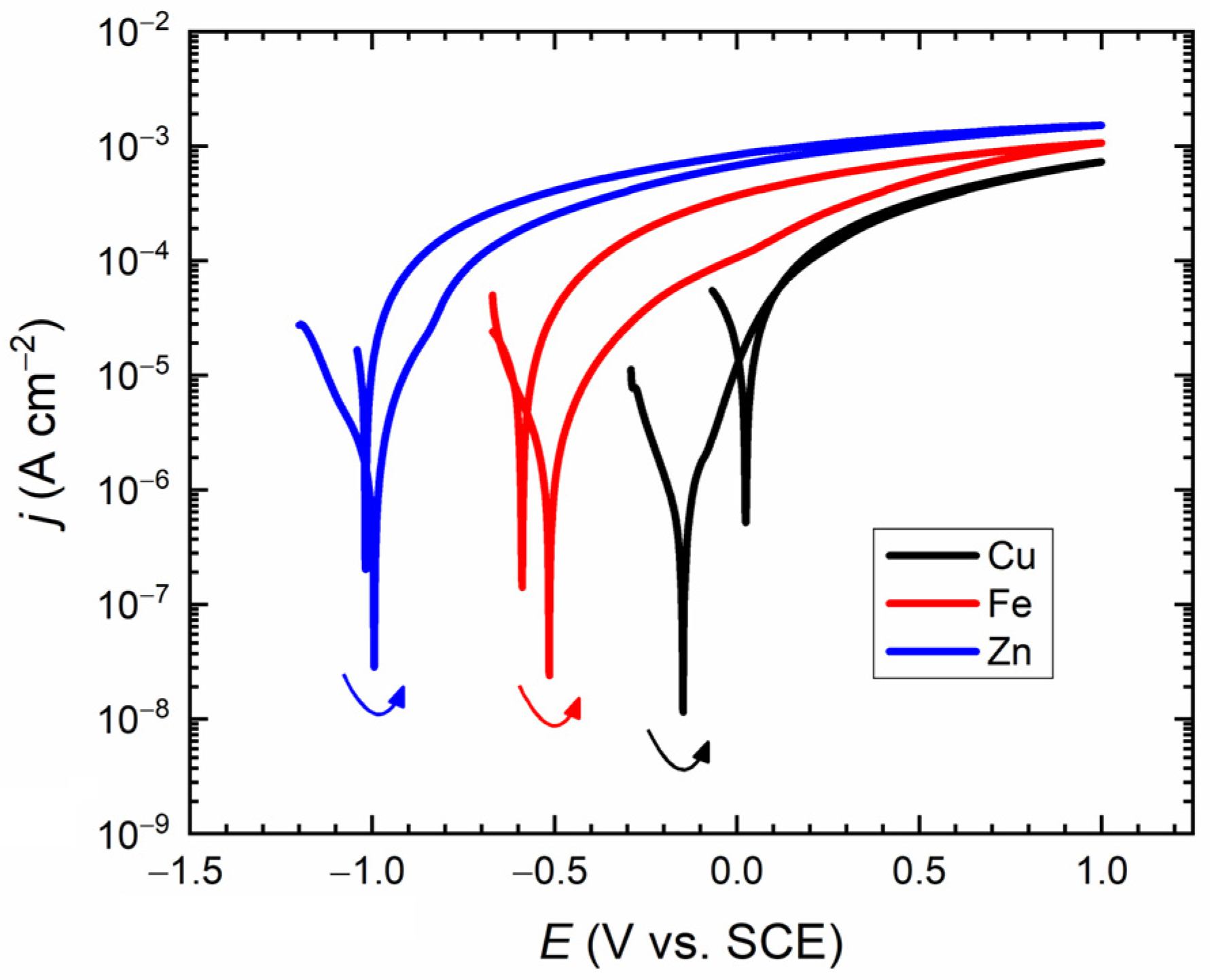
| Cu | −0.151 | 7.86 × 10⁻⁸ | −110 | 92.6 |
| Fe | −0.512 | 1.16 × 10⁻⁶ | −122 | 107 |
| Zn | −0.995 | 1.56 × 10⁻⁶ | −168 | 96.2 |
| Galvanic Pair | Calculation Using the Mixed Potential Approximation to the Polarization Curves of Individual Metals | |
|---|---|---|
| Ecor (V vs. SCE) | jcor (A cm−2) | |
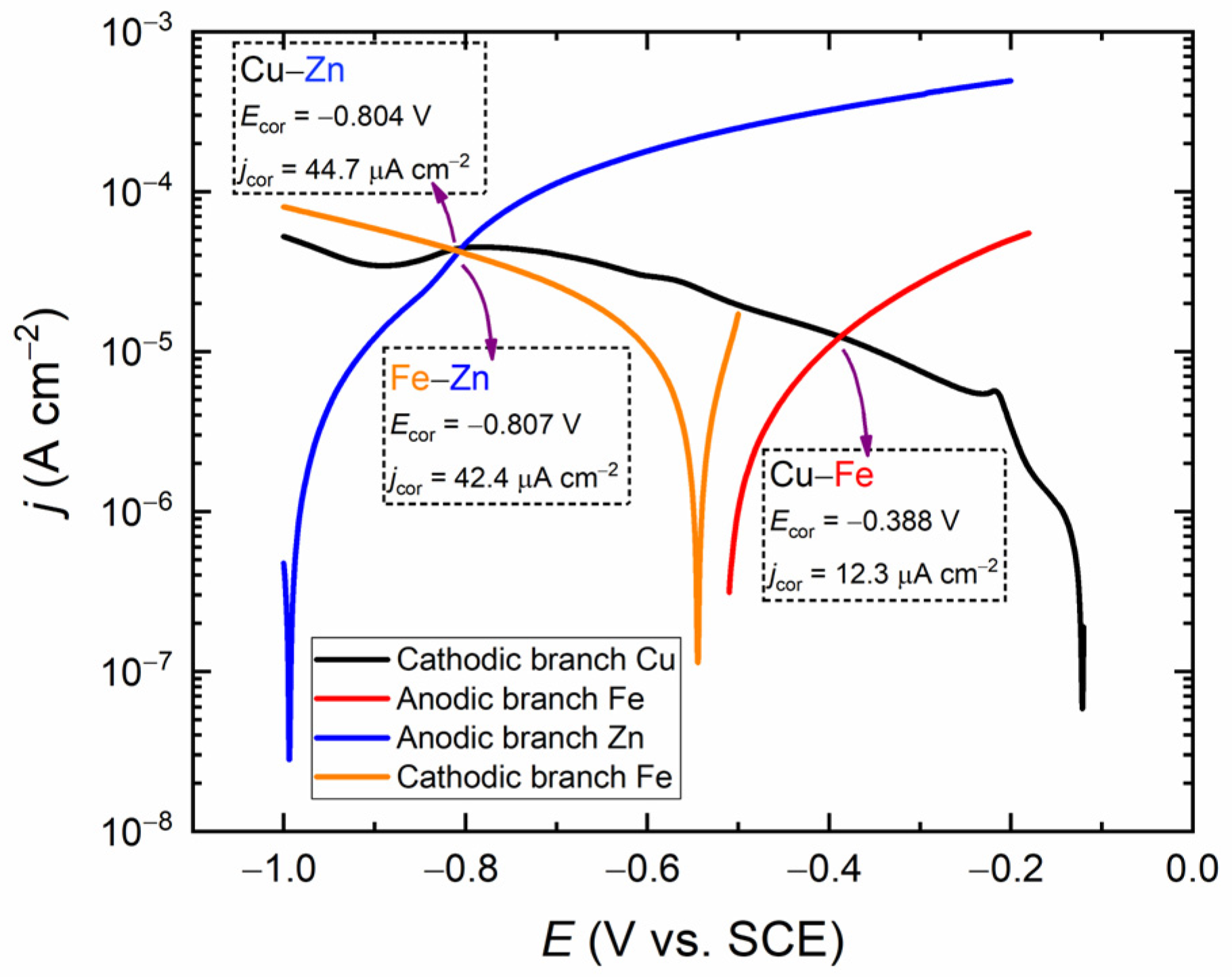
| Cu-Fe | −0.388 | 1.23 × 10⁻⁵ |
| Cu-Zn | −0.804 | 4.47 × 10⁻⁵ |
| Fe-Zn | −0.807 | 4.24 × 10⁻⁵ |
| Galvanic Pair | Ecor (V vs. SCE) | jcor (A cm−2) | βc (mV dec−1) | βa (mV dec−1) | jZRA (A cm−2) |
|---|---|---|---|---|---|
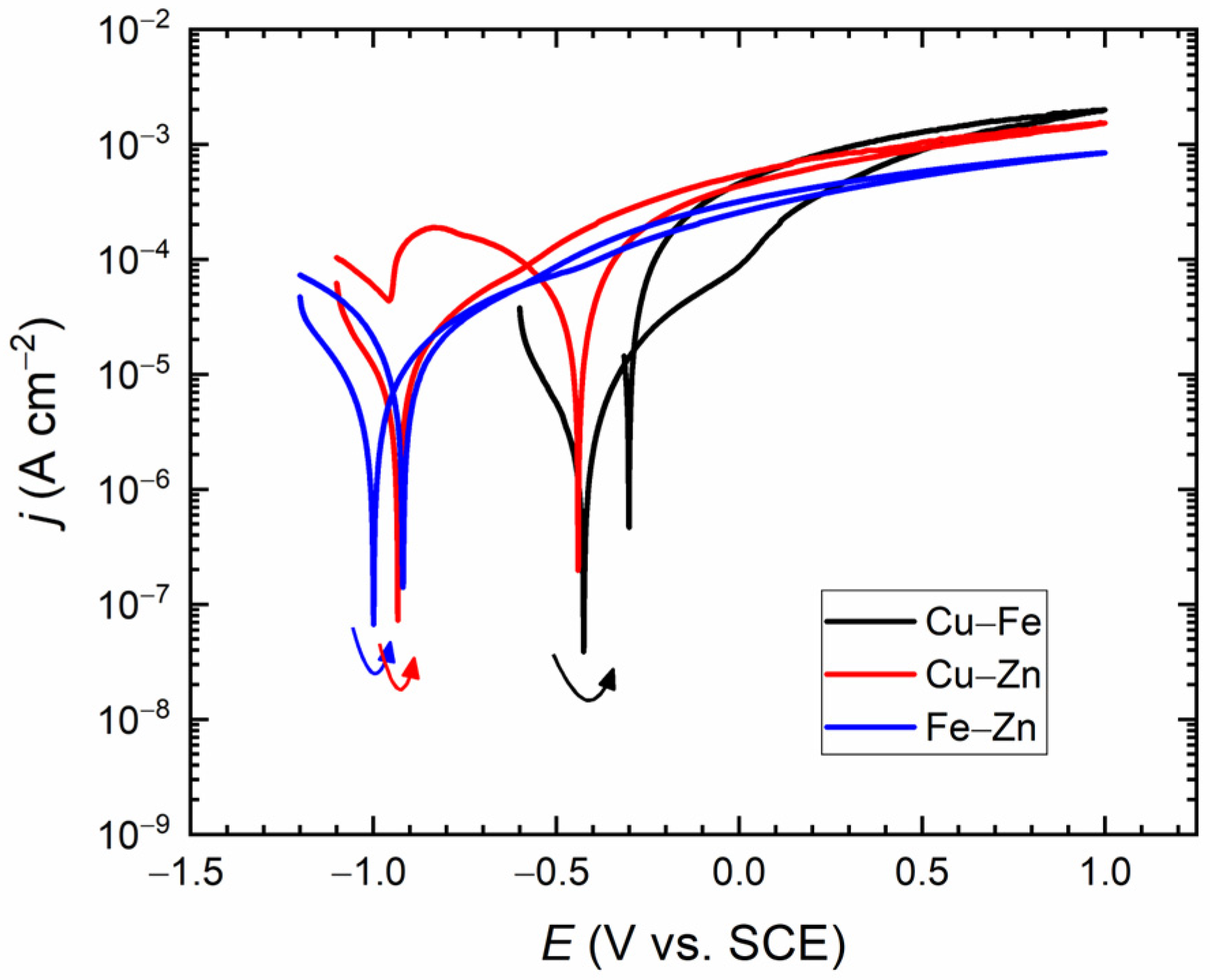
| Cu-Fe | −0.430 | 4.48 × 10⁻⁶ | −175 | 158 | 4.06 × 10⁻⁵ |
| Cu-Zn | −0.933 | 1.12 × 10⁻⁶ | −202 | 158 | 3.86 × 10⁻⁵ |
| Fe-Zn | −0.997 | 7.90 × 10⁻⁶ | −204 | 193 | 2.84 × 10⁻⁵ |
| Galvanic Pair | jmax (μA cm−2) | jmin (μA cm−2) |
|---|---|---|
| Cu-Fe | 46.4 | −28.9 |
| Cu-Zn | 350 | −265 |
| Fe-Zn | 238 | −106 |
| Galvanic Pair | jhor (μA cm−2) | 1 jcorr (μA cm−2) | 2 jcorr (μA cm−2) | jZRA (μA cm−2) |
|---|---|---|---|---|
| Cu-Fe | 3.2 × 10⁻⁶ | 1.23 × 10⁻⁵ | 4.48 × 10⁻⁶ | 4.06 × 10⁻⁶ |
| Cu-Zn | 7.3 × 10⁻⁶ | 4.47 × 10⁻⁵ | 1.12 × 10⁻⁶ | 2.84 × 10⁻⁵ |
| Fe-Zn | 5.4 × 10⁻⁶ | 4.24 × 10⁻⁵ | 7.90 × 10⁻⁶ | 3.86 × 10⁻⁵ |
Disclaimer/Publisher’s Note: The statements, opinions and data contained in all publications are solely those of the individual author(s) and contributor(s) and not of MDPI and/or the editor(s). MDPI and/or the editor(s) disclaim responsibility for any injury to people or property resulting from any ideas, methods, instructions or products referred to in the content. |
© 2026 by the authors. Licensee MDPI, Basel, Switzerland. This article is an open access article distributed under the terms and conditions of the Creative Commons Attribution (CC BY) license.
Share and Cite
Martín-Díaz, E.M.; Izquierdo, J.; Souto, R.M. On the Application of Scanning Electrochemical Probe Microscopies to Investigate Galvanic Corrosion Processes. Appl. Sci. 2026, 16, 5488. https://doi.org/10.3390/app16115488
Martín-Díaz EM, Izquierdo J, Souto RM. On the Application of Scanning Electrochemical Probe Microscopies to Investigate Galvanic Corrosion Processes. Applied Sciences. 2026; 16(11):5488. https://doi.org/10.3390/app16115488
Chicago/Turabian StyleMartín-Díaz, Eva M., Javier Izquierdo, and Ricardo M. Souto. 2026. "On the Application of Scanning Electrochemical Probe Microscopies to Investigate Galvanic Corrosion Processes" Applied Sciences 16, no. 11: 5488. https://doi.org/10.3390/app16115488
APA StyleMartín-Díaz, E. M., Izquierdo, J., & Souto, R. M. (2026). On the Application of Scanning Electrochemical Probe Microscopies to Investigate Galvanic Corrosion Processes. Applied Sciences, 16(11), 5488. https://doi.org/10.3390/app16115488