Article

Effects of Spatial and Visual Openness in Office Environments on EEG-Based Cognitive Efficiency

School of Architecture, Hanyang University, Seoul 04763, Republic of Korea
*
Author to whom correspondence should be addressed.
Appl. Sci. 2026, 16(11), 5221; https://doi.org/10.3390/app16115221
Submission received: 15 April 2026 / Revised: 19 May 2026 / Accepted: 19 May 2026 / Published: 22 May 2026

Abstract

Office openness comprises two physically distinct dimensions—spatial openness and visual openness—yet studies quantifying their independent contributions to cognitive efficiency at the individual level remain scarce. Prior research has predominantly reported group-mean effects, leaving bidirectional individual responses insufficiently examined. This study independently manipulated both dimensions and measured individual-level EEG responses in 24 adults using a 3 × 3 within-subject factorial design. The beta/alpha ratio change rate was computed as an index of cognitive efficiency. Substantial neurophysiological variation across conditions was confirmed in every participant. The absence of significant group-level effects was interpreted not as a lack of environmental influence but as the result of bidirectional individual responses canceling each other out in group averages. Spatial and visual openness induced response ranges of equivalent magnitude at the individual level, and individually optimal conditions were widely distributed across the nine experimental conditions. The correspondence rate between subjective preferences and EEG-identified optimal conditions did not exceed chance, and this bidirectional cancellation mechanism is proposed as an explanation for the contradictory findings that have long characterized open-office research. These results support design strategies that offer diverse combinations of spatial and visual openness within activity-based working environments, paired with feedback systems grounded in objective cognitive performance data.

1. Introduction

Open-plan offices have become a dominant spatial strategy worldwide, valued for their capacity to promote collaboration and enable the flexible utilization of space [1]. Contemporary knowledge workers spend an average of more than eight hours per day in office environments, and the efficiency with which they execute cognitive tasks during that time directly affects work performance. Although a growing body of research has examined how openness affects occupant concentration and task performance [2], studies that quantify the magnitude of openness effects at the individual level and systematically characterize the diversity of responses across individuals remain limited.
Open-plan offices refer to layouts in which multiple occupants share a space without fixed walls or partitions. Within this context, openness comprises two physically distinct dimensions. Spatial openness denotes the degree of physical enclosure determined by partial partitions or furniture arrangement, whereas visual openness refers to the visual connection with the external environment afforded by windows and blinds [3]. Prior research has largely compared wholly open versus wholly enclosed environments, and studies that systematically examine the independent contribution of each dimension to cognitive outcomes are scarce. “Cognitive efficiency,” as used here, denotes the capacity to process information and execute tasks with available cognitive resources [4].
Research investigating the relationship between openness and cognitive performance has yielded conflicting findings. Some studies report that greater openness enhances productivity [5], whereas others report the opposite [6]. Analyzing post-occupancy evaluation data, enclosed private offices outperformed open-plan layouts on most indicators of satisfaction with the indoor environment [1]. This variability suggests that the effects of openness may depend on context, task type, and individual characteristics [2,7]. Yet most existing studies have reported only group-mean outcomes. Consequently, inter-individual differences in response may go undetected in group-mean analyses, underscoring the need for individual-level approaches. If optimal conditions differ across individuals, design strategies that offer a range of environmental options are preferable to uniform configurations.
Capturing such variation at the individual level requires methods beyond subjective ratings and behavioral performance measures. Objective measures of cognitive function have revealed environmental effects that subjective assessments alone may not capture [8], and behavioral measures fail to detect differences in cognitive load when performance outcomes appear comparable across conditions [9]. Use of electroencephalogram (EEG) addresses these limitations by directly measuring cognitive processing, and the beta/alpha ratio has been validated as a reliable neurophysiological index of cognitive efficiency [10,11]. Advances in mobile EEG technology have made measurement feasible in real working environments, including architectural research contexts [12]. Nevertheless, no study to date has independently manipulated spatial and visual openness to quantify the effect of each dimension at the individual level.
This study aimed to empirically ascertain the effects of spatial and visual openness in office environments on cognitive efficiency as measured by EEG. To this end, a 3 × 3 (three levels of spatial openness defined by partition configuration × three levels of visual openness defined by blind aperture) within-subject factorial design was employed with 24 participants, independently manipulating both dimensions while recording EEG responses. Four specific objectives were pursued: quantifying response ranges at the individual level, comparing the relative contributions of the two dimensions, characterizing the distribution of individually optimal conditions, and assessing the correspondence between subjective preferences and objective optimal conditions.

2. Literature Review

2.1. The Evolution of Office Design and the Role of Openness

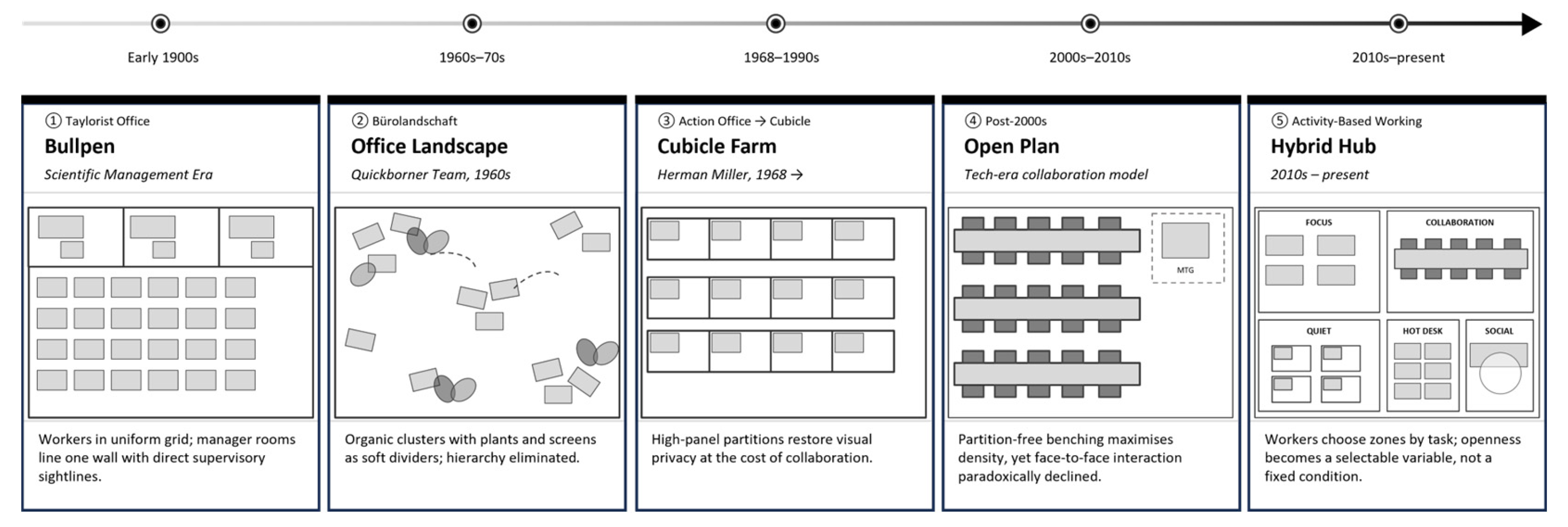
Office spatial layouts have evolved continuously since the Industrial Revolution, reflecting successive shifts in organizational logic and work practice [1]. The early twentieth-century bullpen office, designed around Frederick Taylor’s scientific management principles, prioritized supervisory oversight and standardized task execution but generated persistent problems, including noise exposure, insufficient privacy, and psychological stress [13]. The Bürolandschaft movement of the 1960s and Robert Propst’s “action office” responded to these limitations with organic, reconfigurable layouts; under corporate cost-reduction pressures, however, these were reduced to the cubicle office, which partially restored visual privacy while suppressing lateral communication [14]. From the 2000s onward, growth in the technology sector and an organizational emphasis on collaboration drove the re-emergence of open-plan offices. However, empirical findings diverged from expectations: removing walls reduced face-to-face interaction by approximately 70% while increasing electronic communication by 22–50% [15], and enclosed private offices outperformed open-plan layouts on most indicators of occupant satisfaction [2].
In response, office design has shifted toward the activity-based working (ABW) model, which eliminates assigned seating and enables occupants to select spatial zones according to task demands [16]. The effectiveness of ABW environments derives largely from occupants’ perceived control over their spatial conditions [17]. This trajectory of office design evolution is illustrated in Figure 1.
Empirical studies consistently demonstrate that openness is a consequential design variable within ABW environments. Higher openness levels are associated with increased perceived distraction and reduced work performance [6,18], while access to enclosed individual spaces improves cognitive task performance by 17–22% [19]. Openness thus directly mediates occupants’ spatial choices and work outcomes, and work performance is ultimately determined by cognitive efficiency—defined as the capacity to process information and execute tasks with available cognitive resources [4]. It is therefore necessary to examine, at a neurophysiological level, how openness acts upon occupants’ cognitive efficiency.

2.2. Spatial and Visual Dimensions of Openness

Office openness comprises two physically distinct dimensions: spatial openness and visual openness. Despite their conceptual distinctiveness, prior studies have rarely examined these dimensions independently. Spatial openness—defined by partition height, walls, and spatial configuration—has been the primary focus of open-plan office research [2], while visual openness, referring to connectivity with the external environment through windows and blinds, has been examined mainly in the context of daylighting and view access [3]. The independent contribution of each dimension to cognitive outcomes remains insufficiently characterized, and their conflation in prior research may partly explain the contradictory findings documented in the literature. Among the various environmental factors influencing cognitive efficiency in office settings, spatial and visual openness are particularly consequential, as they directly and independently determine the degree of physical enclosure and visual connectivity that occupants experience, and can be systematically adjusted through architectural design elements such as partition configuration [20] and blind or glazing systems [3].
One of the most rigorously controlled experimental tests of the effects of spatial openness has been reported in the literature [20]. Across three between-subjects experiments conducted in a windowless room—two measuring perseverance directly (Experiment 1: n = 65; Experiment 2: n = 60) and one testing the effort-allocation mechanism underlying this effect—the raised-partition condition significantly increased perseverance on difficult tasks compared with the lowered-partition condition. This effect was interpreted as reflecting reduced cognitive effort allocated to processing peripheral visual information. In a virtual reality-based study, systematically examined how spatial elements, including partition height, ceiling height, and contour shape, influenced 713 participants’ cognitive and aesthetic appraisals of safety, distraction, interaction, beauty, and pleasure [21]. Higher partitions were associated with greater perceived safety and reduced distraction, and the Bürolandschaft configuration significantly enhanced both perceived safety and interaction.
Access to natural light and outdoor views through windows exerts positive effects on cognitive performance, emotional wellbeing, and ocular health. A controlled crossover experiment demonstrated that ten office workers who performed tasks under three different window configurations over 14 weeks showed measurable differences in daily cognitive function [3]. Conditions providing access to natural light and outdoor views yielded significant improvements in working memory and inhibitory control, along with reductions in eye strain and increases in environmental satisfaction. A study of 100 office workers found that access to natural light and outdoor views was associated with significantly higher job satisfaction, with daylight amount and view quality emerging as particularly strong predictors [22]. Furthermore, proximity to windows has been shown to attenuate the negative aspects of open-plan offices, with satisfaction maximized when window proximity was combined with appropriate partition height [23]. The majority of existing studies on office layout either manipulate spatial and visual openness simultaneously or address only one dimension in isolation. Studies comparing enclosed private offices with open-plan layouts cannot isolate the independent contribution of each dimension, because removing partitions simultaneously alters window accessibility, spatial density, and noise levels [2]. Conversely, studies manipulating only spatial openness [19] hold visual openness constant as a control variable, precluding any examination of how the two dimensions interact. Similarly, studies manipulating only visual openness [3] maintain a fixed spatial configuration, making it impossible to explore potential interactions with the spatial dimension.
Only a small number of studies have independently manipulated both dimensions. A 2 × 2 design crossing window proximity with partition height was employed to examine the independent effects and interaction of each dimension, but each dimension was restricted to two levels, limiting the range of openness examined [23]. A field study varying workstation size, partition height, and window access was also conducted, but participants were measured in spaces to which they had been naturally assigned, resulting in insufficient experimental control [24]. Table 1 systematically compares the methodological characteristics of recently published experimental studies on office openness. Analysis of ten experimental studies revealed that four manipulated only spatial openness [19,21,22,24,25], two manipulated only visual openness [3,26], one examined both dimensions without independently manipulating them [23], and three involved a confounded combination of both dimensions.
In sum, questions regarding which of the two dimensions exerts a greater influence on cognitive efficiency, how they interact, and whether preferred combinations differ across individuals remain insufficiently resolved. The interaction effect observed by The interaction effect observed in a prior study suggests that the two dimensions may not operate in a simple additive fashion, pointing to the need for factorial designs that manipulate them independently [23]. Furthermore, given that existing studies have predominantly reported group-mean effects, approaches that measure the contribution of each dimension at the individual level are warranted.

2.3. Measurement Approaches and Individual Differences in Environmental Response

Methods for assessing the effects of office environments on cognitive efficiency have advanced through three complementary approaches—subjective ratings, behavioral performance measures, and neurophysiological measurement—each providing distinct information.
Subjective ratings assess occupant satisfaction, perceived productivity, and environmental comfort through post-occupancy surveys [2]. This approach enables large-scale data collection and provides direct insight into occupants’ lived experiences, making it practically useful. However, respondents may interpret rating scales differently [29], and contextual factors such as green building certification labels can bias assessments [30]. conditions with low volatile organic compounds (VOCs) and enhanced ventilation improved cognitive function scores by 61% and 101%, respectively, yet participants remained unaware of these changes—suggesting that subjective ratings may not adequately capture actual variation in cognitive efficiency [8].
Behavioral performance measures quantify task execution directly, providing objective indices. Using quiet individual spaces within an ABW environment improved cognitive task performance by 17–22% [19], consistent with evidence that access to quiet workspaces in open-plan offices yields measurable benefits for task performance and wellbeing [31]. Nevertheless, task selection is critical because different types of task are differentially affected by environmental conditions [32], and repeated exposure to the same task may introduce learning effects that confound performance outcomes [33]. Differences in mental workload can persist even when behavioral performance outcomes remain comparable across conditions, indicating that additional measurement methods are needed to detect cognitive burden that does not manifest in performance results [19].
To address these limitations, mobile EEG technology has been introduced into research on architectural environments. Because EEG measures brain activity directly with high temporal resolution, it provides information that neither subjective reports nor behavioral observation can capture [34]. Zhang et al. (2024) systematically reviewed evidence that EEG can support evidence-based design by measuring spatial perception, emotional responses, and cognitive load in research on indoor environments [11]. Studies combining subjective ratings with EEG have demonstrated that the two methods provide complementary information, enabling a more integrated understanding of environmental effects [34,35]. Each of the three approaches to measurement has distinct strengths and limitations. EEG complements subjective and behavioral measures by capturing neurophysiological responses that the other approaches cannot detect, thereby affording a more complete account of how office environments affect occupants.
Individual differences represent a critical factor in environmental response. Responses to open-plan offices have been shown to vary substantially across individuals depending on personal characteristics [7], and EEG evidence indicates that individuals with high noise sensitivity exhibit distinct auditory cortex processing patterns, suggesting that individual differences in environmental response have a neurophysiological basis [36]. Despite this, existing studies have predominantly reported group-mean outcomes without providing individual-level analyses [15]. If individuals respond to the same environment in opposing directions, their responses will cancel each other out in group averages, statistically obscuring genuine environmental effects. In such cases, a non-significant group-mean result may reflect a structural limitation of the analytical approach rather than an absence of environmental influence.
EEG is particularly well-suited to capturing individual-level response patterns of this kind. It enables direct measurement of each individual’s neurophysiological response and can be used to examine the relationship between subjective preferences and neurophysiological efficiency. Research that quantifies environmental effects at the individual level and characterizes how optimal conditions vary across individuals can elucidate response structures that group-mean analyses fail to detect, thereby providing a neurophysiological basis for the design of spatial openness in offices.

3. Methods

3.1. Experimental Design and Participants

A 3 × 3 within-subject factorial design was employed to examine the effects of spatial and visual openness on cognitive efficiency. This design was chosen because having each participant experience all nine conditions automatically controls for individual differences in baseline brain activity, personality, and cognitive ability, allowing environmental effects to be isolated [37], and because the research objectives—quantifying individual-level response ranges, characterizing optimal condition distributions, and assessing subjective–objective correspondence—required observation of each participant’s full response pattern across all conditions. Each condition was measured once per participant. Repeating all nine conditions would have extended the session to an impractical duration, introducing fatigue and learning effects that could have confounded the EEG signal; a single measurement per condition was therefore adopted as a pragmatic design choice.
The independent variables were spatial openness, operationalised as the degree of physical enclosure determined by partition configuration on three sides of the workstation, and visual openness, operationalised as window-to-exterior visual connectivity as manipulated through blind aperture. Findings should be interpreted within the scope of these operationalisations. Spatial openness was set at three levels: 0% (partitions on three sides: front, left, and right), 50% (front partition only), and 100% (no partitions). Visual openness was likewise set at three levels: 0%, 50%, and 100%, yielding nine experimental conditions in total. The two dimensions were manipulated independently because prior research has predominantly treated overall openness as a single variable, making it impossible to separate the relative contributions of physical enclosure and visual obstruction. Table 2 presents the nine conditions and their codes.
The dependent variable was the percentage change in the EEG-derived beta/alpha ratio relative to baseline. The beta/alpha ratio is a validated neurophysiological index of cognitive arousal and information-processing efficiency [4,10]. Increases in beta-band power are associated with sustained attention and execution of cognitive tasks, whereas decreases in alpha-band power reflect elevated cognitive load [38]; accordingly, an increase in the beta/alpha ratio indicates enhanced cognitive efficiency. While alternative metrics such as the theta/alpha ratio have been applied in mental workload research to capture task-difficulty-driven cognitive load [39], the beta/alpha ratio was selected in the present study because it simultaneously reflects both increased cortical activation (beta band) and reduced idling state (alpha band), making it particularly suited to detecting cognitive arousal changes induced by environmental conditions.
Twenty-four adults participated in the study (6 male, 18 female; mean age 26.8 years, SD = 3.2). All had normal or corrected-to-normal vision and reported no history of neurological or psychiatric disorders. Sample size was determined a priori using G*Power 3.1.9.7 (repeated-measures ANOVA; f = 0.24; α =0.05; power =0.80), yielding a minimum of 19 participants; the target was set at 24 to account for typical EEG attrition rates of 15–20%. The study was approved by the Institutional Review Board of the authors’ institution.
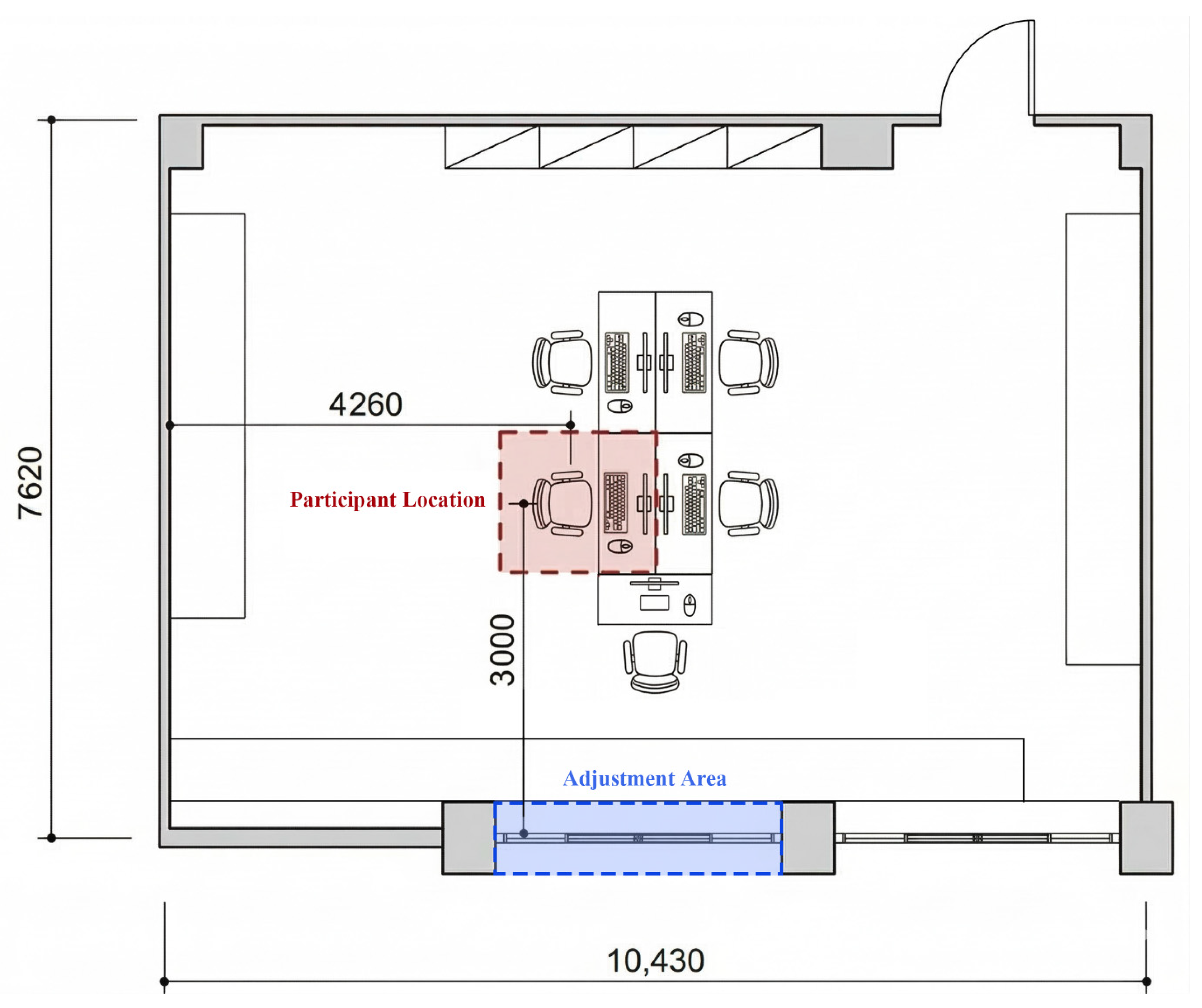
The experiment was conducted in a controlled laboratory room measuring 10,430 mm × 7620 mm with south-facing windows. Partitions measured 1200 mm in height and 1400 mm in width. In the 0% spatial openness condition, partitions were installed on three sides of the participant’s workstation; in the 50% condition, only the front partition was present; and in the 100% condition, all partitions were removed. Blinds were fully closed in the 0% visual openness condition, half-open in the 50% condition, and fully open in the 100% condition (Figure 2).
The experiment was conducted under consistent environmental conditions to minimise the influence of confounding variables on the two manipulated dimensions. The workstation was positioned perpendicular to the south-facing window wall, minimising the risk of direct or reflected glare. The external view consisted of a typical urban landscape. Illuminance ranged approximately 400–600 lux depending on blind condition. All sessions were conducted between 13:00 and 18:00 on days with stable weather conditions to minimise variation in natural light levels.
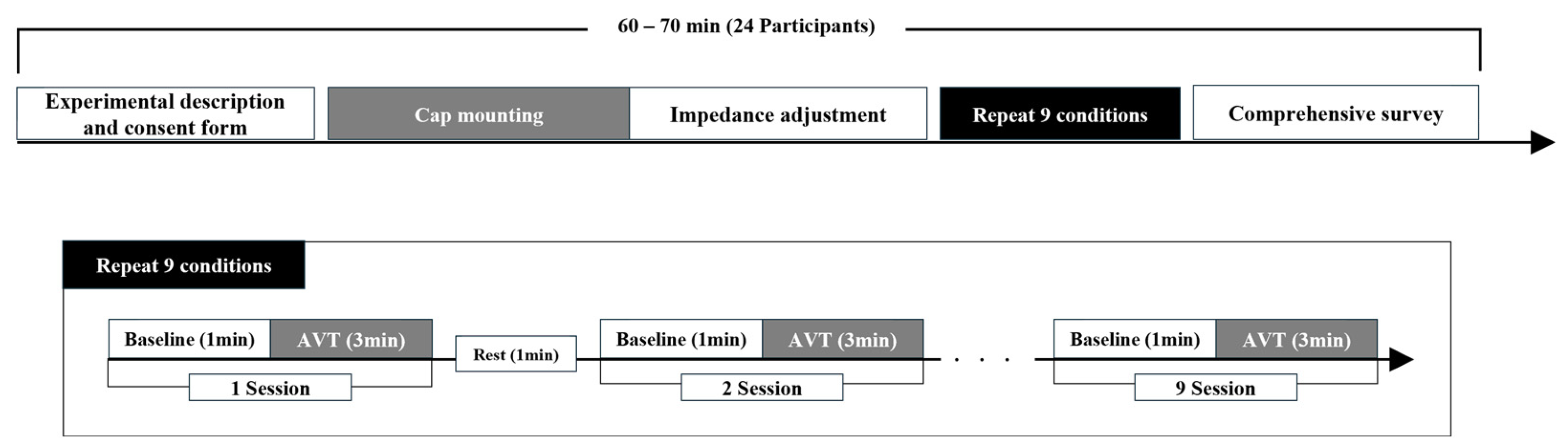
A one-minute baseline EEG recording was obtained under each participant’s first assigned condition. Baseline normalization controlled for inter-individual differences in absolute signal levels that would otherwise obscure genuine environmental effects [37]. Participants then completed the nine conditions in a counterbalanced order. Each condition comprised a one-minute baseline recording followed by three minutes of the arithmetic verification task (AVT), in which sequentially presented arithmetic equations were judged as correct or incorrect; up to 45 items were presented with a maximum of five seconds per item (Figure 3).
Upon completing each condition, participants rated the environment on a 7-point Likert scale across four items: concentration, visual comfort, visual privacy, and perceived spatial openness (1 = strongly disagree, 7 = strongly agree). At the end of the session, participants identified their most preferred, most focused, and most uncomfortable conditions and provided written explanations. These responses were used to assess the subjective–objective correspondence and to examine whether individuals could accurately identify their neurophysiologically optimal environment.

3.2. EEG Data Acquisition and Processing

EEG signals were recorded using the Neuroelectrics Enobio 32 wireless system, which comprises 32 channels arranged according to the international 10–20 electrode placement system [40] and samples data at 500 Hz. An average reference was applied [41,42].
Raw EEG data were preprocessed in MNE-Python (version 1.5) following a standard pipeline [43]. A 0.5–45 Hz bandpass filter was first applied to remove low-frequency drift and high-frequency noise [44]. Independent component analysis (ICA) was then used to eliminate physiological artifacts, including ocular movements and electromyographic activity [45]. Ocular components were identified by their characteristic high-loading pattern on frontal channels (Fp1, Fp2, AF3, AF4); a maximum of two artifactual components were removed per participant.
Preprocessed signals were decomposed into frequency bands. Spectral power in the delta (0.5–4 Hz), theta (4–8 Hz), alpha (8–13 Hz), beta (13–30 Hz), and gamma (30–45 Hz) bands was computed using Welch’s method [46] with a two-second window (1000 samples). Band power was calculated by integrating across the full four-minute task segment of each condition, treated as a continuous signal.
The beta/alpha ratio was computed at each channel by dividing beta-band power by alpha-band power [10], and then averaged across all 32 channels to yield a single index of overall cognitive arousal [4,47]. Global averaging provides a more noise-robust and stable index than region-specific measures [48].
Baseline normalization was performed using the percentage change formula:
C h a n g e   r a t e ( % ) = Condition   beta / alpha   ratio - Baseline   beta / alpha   ratio Baseline   beta / alpha   ratio × 100
This approach controls for inter-individual differences in absolute signal levels and quantifies each participant’s change relative to their own resting state [37].
For data quality control, channels with excessive electrode impedance were restored via spherical spline interpolation [49]. The final dataset comprised 24 participants × 9 conditions = 216 data points.

3.3. Statistical Analysis

A multi-level analytical approach was adopted to examine both group-mean effects and individual-level heterogeneity simultaneously [50,51]. In repeated-measures designs, multiple observations are collected from the same participant, making it difficult for simple group-mean analyses alone to adequately characterize the directionality and magnitude of individual responses [52]. All analyses were conducted in Python 3.10 using the Pingouin, statsmodels, and SciPy packages.
Group-level mean effects of spatial openness (three levels) and visual openness (three levels) were examined using a two-way repeated-measures ANOVA [51]. The dependent variable was the percentage change in the beta/alpha ratio relative to baseline. Sphericity was assessed with Mauchly’s test, and the Greenhouse–Geisser correction was applied where the assumption was violated. Effect size was reported as generalized eta-squared (η2G), which corrects for the overestimation inherent in partial η2 by including between-participant variance in the denominator [53,54]. Benchmarks of 0.01, 0.06, and 0.14 indicated small, medium, and large effects, respectively [55].
Individual-level environmental sensitivity was quantified using the response range, defined as the difference between the maximum and minimum beta/alpha ratio change rates across a participant’s nine conditions. Applying Cohen’s d in a max-minus-min fashion within a within-subject design produces inflated effect size estimates; response range was therefore adopted as an exploratory descriptive statistic for heterogeneity in individual responses rather than for inferential purposes.
To decompose the relative contributions of group-mean environmental effects and individual differences, a linear mixed-effects model was fitted with spatial and visual openness as fixed effects and participant as a random effect. The random-effects structure was determined via model comparison using the Akaike information criterion [AIC]; Ref. [56]: a random-intercept-only model (AIC = 1942.99) was preferred over a model with additional random slopes (AIC = 2024.10), as the random-slope variance was estimated at zero. Variance components were estimated by restricted maximum likelihood (REML). intraclass correlation coefficient (ICC) was derived from the between-participant and residual variance components and interpreted as a variance decomposition index—not a reliability coefficient—to distinguish whether non-significant group-mean results reflected an absence of environmental effects or statistical cancellation due to inter-individual heterogeneity. Marginal R2 (fixed effects only) and conditional R2 (fixed and random effects) were computed following the method of Ref. [57]; the difference between the two values directly reflects the magnitude of the individual-differences contribution (see Table 3 for all index definitions and benchmarks).
For the subjective–objective agreement analysis, each participant’s subjectively preferred condition was compared with their EEG-identified optimal condition, coded as a binary agreement variable. A binomial test evaluated whether the observed agreement rate exceeded the chance level of 1/9 ≈ 11.1% [58], with p < 0.05 indicating systematic agreement beyond chance. The individual-level linear relationship between subjective concentration ratings and objective beta/alpha ratio change was quantified using Pearson’s correlation coefficient.
To evaluate individual-level differences in response to each dimension, one dimension was held constant while the response range across the three levels of the other dimension was computed per participant; the two sets of ranges were compared using a paired-samples t-test. All tests were two-tailed with α = 0.05. Table 3 summarizes the purpose, definition, interpretive benchmarks, and supporting references for each statistical index.
An outlier analysis applying IQR-based criteria (Q1 − 1.5 × IQR, Q3 + 1.5 × IQR) to all 216 observations identified a single outlier: P04’s value in condition C05 (+89.3%), which exceeded the upper bound of +71.5%. Because this value reflects a genuine neurophysiological response rather than measurement error or protocol deviation, the full sample (N = 24) was retained for all analyses.

4. Results

4.1. Individual Level Effects of Openness on Cognitive Efficiency

Analysis of beta/alpha ratio change rates across the nine conditions revealed a clearly identifiable optimal condition and a lowest-efficiency condition for every participant. This indicates that, even after baseline normalization, neurophysiologically distinct environmental conditions exist at the individual level—that is, spatial and visual openness induced meaningful neurophysiological change in all participants. Table 4 presents the beta/alpha ratio change rates (%) across the nine conditions, individually optimal conditions, and response range values for all 24 participants.
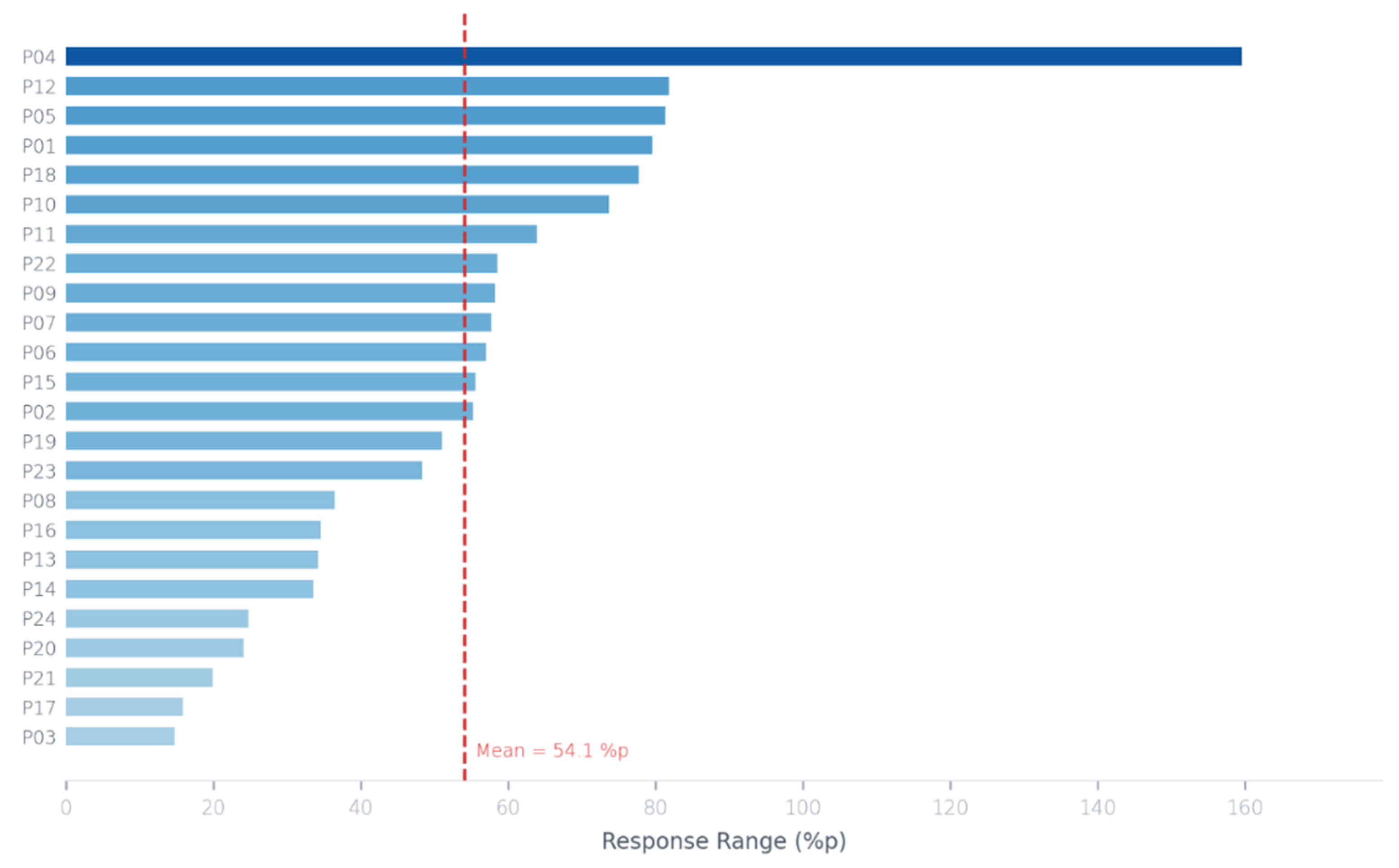
The response range—the difference in beta/alpha ratio change rate between each participant’s optimal and lowest-efficiency conditions across nine conditions—averaged 54.1 percentage points (pp; SD = 30.8 pp; range: 14.8–159.6 pp). The median was 55.4 pp, with a first quartile (Q1) of 34.1 pp and a third quartile (Q3) of 66.4 pp. A Q1 of 34.1 pp indicates that 75% of participants experienced inter-condition variation of at least 34 pp. The participant with the largest response range (P04) showed +89.3% in the optimal condition and −70.3% in the lowest-efficiency condition, yielding a total range of 159.6 pp; even the participant with the smallest range (P03) showed 14.8 pp of variation. Neurophysiological fluctuation across environmental conditions was thus confirmed in every participant; the structural interpretation of this variation is addressed through subsequent variance decomposition results (ICC, R2).
Figure 4 displays each participant’s response range in descending order. The substantial heterogeneity across individuals—ranging from P04 (159.6 pp) to P03 (14.8 pp)—and the even distribution of participants on either side of the mean line indicate that environmental effects were widespread at the individual level rather than driven by a small number of extreme cases.
At the group level, however, the two-way repeated-measures ANOVA yielded no statistically significant effects: main effect of spatial openness, F(2, 46) = 2.82, p =0.070, η2G = 0.024; main effect of visual openness, F(2, 46) = 0.39, p = 0.678, η2G = 0.002; interaction, F(4, 92) = 0.45, p = 0.775, η2G = 0.003. As an index that includes between-participant variance in its denominator, η2G corrects for the overestimation inherent in partial η2 [54]; all three η2G values fell below the small-effect benchmark. This indicates that the openness factors account for limited variance at the group-mean level.
To determine whether these non-significant results reflect an absence of environmental effects, variance decomposition was conducted via a linear mixed-effects model. The ICC was 0.455, indicating that approximately 46% of total variance originated from between-participant differences. ICC is defined as the ratio of between-participant variance to total variance [59]; ICC = 0.455 signifies that response levels differ substantially across participants even under identical environmental conditions. The marginal R2 was only 0.025, whereas the conditional R2 rose to 0.469. The difference between these two values (0.444) indicates that between-participant variance contributes far more to explaining total variance than the effects of environmental conditions do. The non-significant group-mean results are therefore interpreted not as an absence of environmental effects but as statistical cancellation resulting from heterogeneity in the direction of individual responses.
This bidirectional cancellation was confirmed in a condition-level subgroup analysis. Classifying participants in each condition as either an improvement group or a deterioration group relative to their individual mean revealed that both groups coexisted in all nine conditions. In condition C07 (no partition, blinds fully open), for example, the group mean was only +2.2 pp, yet the improvement group (n = 16) averaged +17.5 pp while the deterioration group (n = 8) averaged −28.6 pp. Opposite neurophysiological responses to the same physical environment were thus present across participants, and these opposing responses canceled each other out in group-mean analyses, attenuating the apparent average effect.
In sum, spatial and visual openness constitute environmental factors that induce a mean response range of 54.1 pp at the individual level. The variance decomposition results (ICC =0.455; conditional R2 =0.469 vs. marginal R2 =0.025) show that approximately 46% of total variation originates from between-participant differences, while environmental factors account for only 2.5% of variance on average. These findings indicate that group-mean approaches alone are insufficient for understanding the neurophysiological effects of office spatial openness, and that individual-level response structures must be considered in conjunction.

4.2. Comparative Contributions of Spatial and Visual Openness

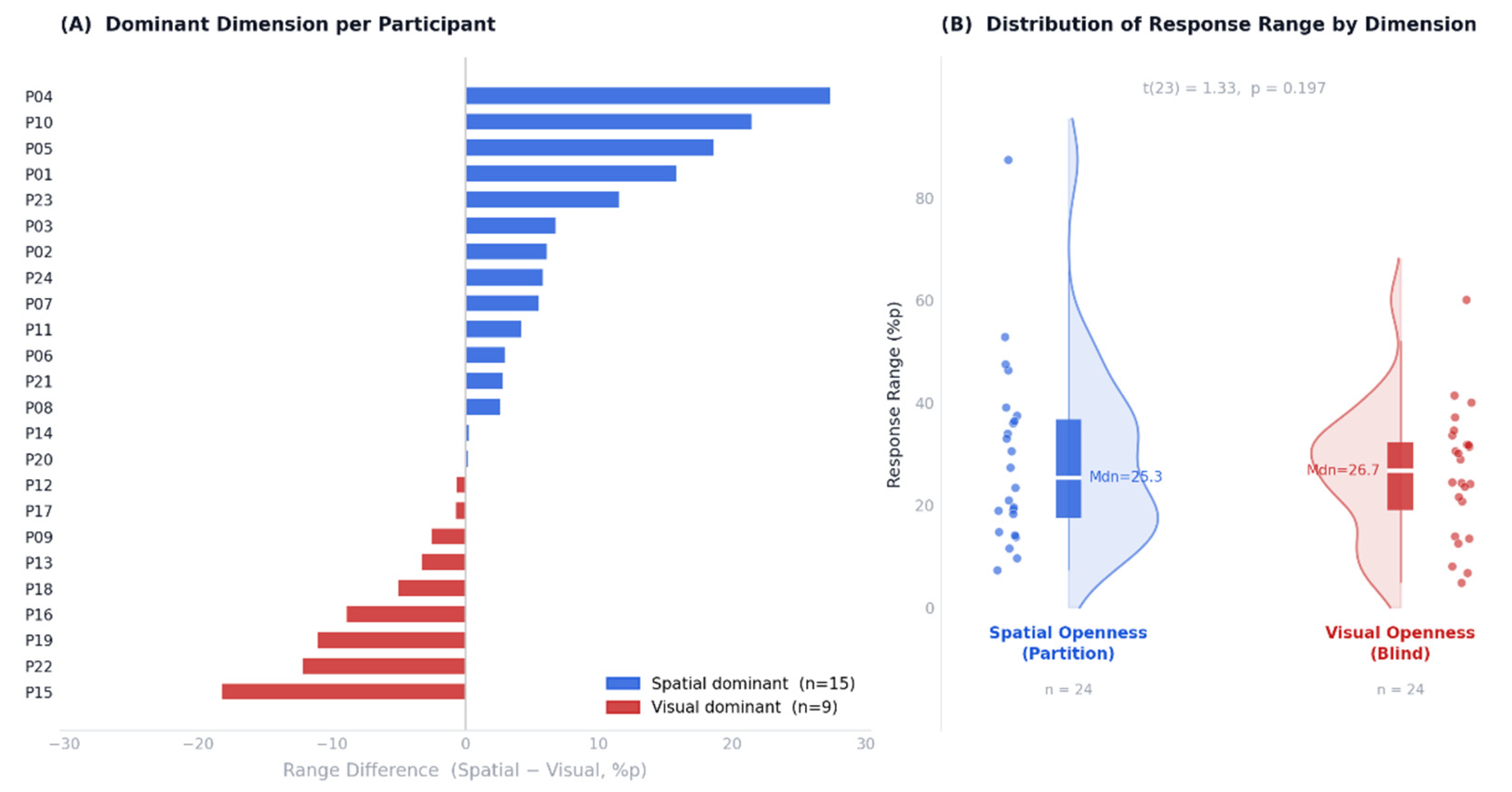
The effects of spatial and visual openness were analyzed at the individual level by holding one dimension constant and computing the response range across the three levels of the other dimension for each participant. The mean individual response range for spatial openness was 29.1 pp (SD = 17.7, Mdn = 25.3 pp, range: 7.3–87.4 pp), and for visual openness was 26.2 pp (SD = 12.6, Mdn = 26.7 pp, range: 4.8–60.0 pp). A paired-samples t-test indicated that the difference between the two dimensions was not statistically significant (t(23) = 1.33, p = 0.197), demonstrating that spatial and visual openness exert equivalent influences on cognitive efficiency at the group level.
At the group level, the highest mean across the nine conditions was observed in C04 (partition 50%, blinds fully open) at +7.7%, and the lowest in C03 (partition 100%, blinds fully closed) at −8.5%. Across levels of spatial openness, mean change rates were +0.4% for the no-partition condition, +3.9% for the half-partition condition, and −5.6% for the fully enclosed condition. This pattern is non-linear—the half-partition condition yielded the highest group mean, with the no-partition condition somewhat lower—but given that the main effect of spatial openness was non-significant (p = 0.070), these numerical differences should be interpreted as a consequence of the bidirectional cancellation identified in Section 4.1. Across levels of visual openness, the fully open blind condition had the highest mean at +1.1%, and the half-open condition the lowest at −1.8%. Simple main effects at each level were non-significant for both dimensions (spatial openness: F = 0.48–1.73, p = 0.185–0.620; visual openness: F = 0.01–0.30, p = 0.744–0.989), confirming that bidirectional cancellation operated equally across individual-level comparisons.
Analysis of the dominant dimension at the individual level revealed that 15 of 24 participants (62.5%) showed a larger response range for spatial openness than for visual openness (spatially dominant), while 9 (37.5%) showed the reverse (visually dominant). Among spatially dominant participants, the maximum difference between dimensions was +27.3 pp (P04: spatial 87.4 pp, visual 60.0 pp); among visually dominant participants, the maximum was 18.2 pp (P15: spatial 18.9 pp, visual 37.1 pp). Some participants showed near-equivalent sensitivity to both dimensions (P14: +0.3 pp; P20: +0.2 pp). Overall environmental sensitivity (response range) was comparable across groups (spatially dominant: M = 55.4 pp; visually dominant: M = 52.0 pp; t(22) = 0.25, p = 0.801), indicating that total neurophysiological responsiveness did not differ between groups regardless of which dimension was dominant (Figure 5).
Figure 5 presents two complementary views of these results. Panel A displays the difference between each participant’s spatial and visual response ranges (Spatial − Visual); blue bars indicate spatially dominant participants (n = 15) and red bars visually dominant participants (n = 9), with values distributed in both directions from zero. Panel B is a raincloud plot showing the response range distributions for both dimensions across all 24 participants; medians are indicated within each distribution. The two panels together illustrate that group means for the two dimensions are nearly equivalent while substantial heterogeneity exists at the individual level (t(23) = 1.33, p = 0.197).
A strong positive correlation was observed between individual response ranges for spatial and visual openness (r = 0.80, p < 0.001). This indicates that participants who responded sensitively to changes in spatial openness also tended to respond sensitively to changes in visual openness, suggesting that neurophysiological reactivity to environmental change may constitute an individual-specific trait spanning both dimensions. By contrast, neither the correlation between subjective perceived spatial openness ratings and EEG spatial response range (r = 0.01, p = 0.971) nor that between subjective visual comfort ratings and EEG visual response range (r = 0.18, p = 0.395) reached significance. Which dimension an individual is neurophysiologically more sensitive to is therefore unrelated to their subjective perception of sensitivity to that dimension.
These results demonstrate that spatial and visual openness exert equivalent effects on cognitive efficiency at the group level, yet the dominant dimension varies across individuals. From a design standpoint, this implies that environments permitting independent adjustment of only one dimension may fail to support the dimension to which a substantial proportion of users primarily respond. Configurations that allow both dimensions to be controlled independently can accommodate a broader range of users’ cognitive efficiency needs, and within activity-based working environments, offering diverse combinations of spatial and visual openness enables individuals to select settings that match their own response patterns.

4.3. Diversity of Individual Optimal Conditions and Subjective–Objective Mismatch

Analysis of the distribution of EEG-identified optimal conditions revealed that 7 of the 9 conditions served as the optimal condition for at least one participant (Table 5). No single condition was optimal for a majority of participants (12 or more), indicating that a uniform environmental design capable of simultaneously optimizing cognitive efficiency for all occupants is not achievable in principle.
The most frequently identified optimal condition was C07 (no partition, blinds fully open) with 6 participants (25.0%), followed by C04 (partition 50%, blinds fully open) with 5 (20.8%) and C06 (partition 50%, blinds fully closed) with 4 (16.7%). Neither C03 nor C09—both fully closed-blind conditions—was identified as optimal for any participant, though this pattern should be treated as directional given the sample size of 24. Only 2 participants (8.3%) identified the intermediate condition C05 as their optimal condition, contradicting the design intuition that middle-ground conditions are broadly acceptable.
The distribution of lowest-efficiency conditions was similarly heterogeneous. C01 (partition 100%, blinds fully open) was most frequent at 4 participants (16.7%), followed by C02, C03, C05, C06, and C08 at 3 each (12.5%). Notably, C07 was simultaneously the optimal condition for 6 participants and the lowest-efficiency condition for 2—demonstrating that the same physical environment can be neurophysiologically most advantageous for some individuals and most disadvantageous for others, a condition-level reconfirmation of the bidirectional cancellation established in Section 4.1.
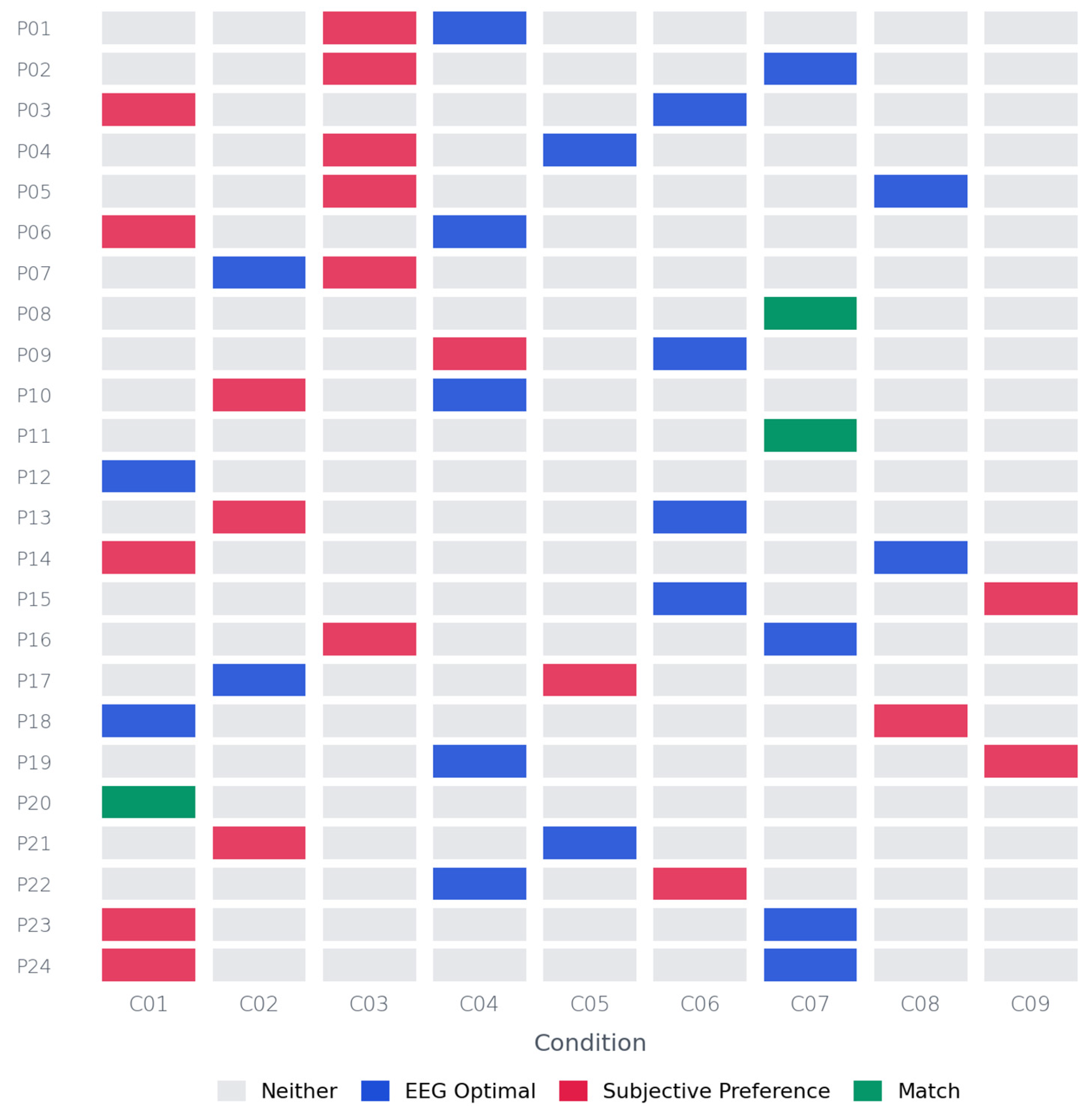
To assess the correspondence between subjective preferences and EEG-identified optimal conditions, each participant’s “most preferred condition” from the post-session survey was compared with their EEG-identified optimal condition. Only 3 of 24 participants (12.5%; P08, P11, P20) showed agreement; the remaining 21 (87.5%) did not. The observed agreement rate marginally exceeds the chance level of 1/9 = 11.1%, but a binomial test indicated no statistically significant difference (p = 0.508), demonstrating that participants were unable to accurately identify their neurophysiologically optimal condition through subjective appraisal alone.
Figure 6 plots each participant’s EEG-identified optimal condition (blue) and subjectively preferred condition (red) across the nine conditions. Green cells indicate agreement (P08, P11, P20). Red cells cluster toward the left (C01–C03, high-partition conditions), while blue cells are distributed across all nine conditions.
Table 6 presents a participant-by-participant comparison of EEG-identified optimal conditions and subjectively preferred conditions, with the corresponding beta/alpha ratio change rate. Agreement is indicated for P08, P11, and P20; all remaining participants showed disagreement.
Several patterns in Table 6 merit attention. Beta/alpha ratio change rates at the EEG-identified optimal condition ranged from −23.3% (P21) to +89.3% (P04). P17 and P21 recorded negative values across all nine conditions, meaning their beta/alpha ratio did not recover to baseline throughout the session; for these participants, the optimal condition is defined as the one with the smallest magnitude of decrease. Among subjectively preferred conditions, C03 and C01 were each selected by 6 participants, meaning 15 participants (62.5%) preferred high-partition enclosed conditions (C01–C03), while C07 (no partition) was the condition most frequently identified as optimal by EEG, at 6 participants (25.0%). Of the 21 mismatched participants, 8 (38.1%) showed reverse-direction mismatch, in which subjective preference and neurophysiological optimality were diametrically opposed in terms of spatial openness (see Table 6).
The two findings together—an agreement rate (12.5%) not exceeding chance (p = 0.508) and individually optimal conditions distributed across 7 of 9 conditions—demonstrate that subjective preferences alone are insufficient to identify an individual’s neurophysiologically optimal condition in terms of spatial openness in office design.

5. Discussion

The present study aimed to empirically ascertain the effects of spatial and visual openness in office environments on cognitive efficiency as measured by EEG at the individual level. Results across the four research objectives converge on a single consistent structure: individual-level responses are substantial and genuine, yet they are statistically canceled out in group-mean analyses because of heterogeneity in response direction.
Neither spatial openness nor visual openness reached significance in the group-level ANOVA, but this does not indicate an absence of environmental effects. Variance decomposition results (ICC = 0.455; marginal R2 = 0.025 vs. conditional R2 = 0.469) demonstrate that between-participant differences contribute far more to explaining total variance than environmental conditions do. This bidirectional cancellation structure offers a potential mechanistic explanation for the coexistence of contradictory findings that has characterized open-office research for decades—namely, reports that greater openness enhances productivity [5] alongside reports that it reduces productivity [6]. Studies reporting only group-mean results in the presence of opposing individual response directions may have arrived at null conclusions as a consequence of this structural limitation of group-mean analysis rather than a true absence of environmental effects.
The bidirectional cancellation observed here is consistent with prior evidence that individual differences in environmental response have a neurophysiological basis. Responses to open-plan offices have been shown to vary substantially across individuals depending on personal characteristics [7], and individuals with high noise sensitivity have been demonstrated to exhibit distinct auditory cortex processing patterns in response to the same acoustic environment [36]. The present findings extend this line of evidence by showing that opposing response directions are not idiosyncratic exceptions but a systematic structural feature of how office openness affects cognitive efficiency—one sufficiently prevalent to statistically cancel out genuine environmental effects at the group level.
A further notable finding is the strong positive correlation between individual response ranges for spatial and visual openness (r = 0.80, p < 0.001). This indicates that participants who responded sensitively to changes in one dimension also tended to respond sensitively to changes in the other, suggesting that neurophysiological reactivity to openness may constitute an individual-specific trait spanning both dimensions. This cross-dimensional consistency raises the question of what neurophysiological or psychological characteristics underlie individual environmental reactivity. Candidate variables may include sensory processing sensitivity, introversion, or trait anxiety, each of which has been associated with heightened physiological reactivity to environmental stimulation. If such predictors can be identified, data-driven design approaches that estimate each occupant’s optimal condition prospectively may become feasible.
The subjective–objective mismatch rate of 87.5% warrants particular attention. One plausible account of the mismatch is that occupants’ spatial preferences are shaped by aesthetic and social norms—such as the widespread association of enclosed spaces with professionalism or privacy—rather than by direct awareness of their cognitive efficiency under each condition. Because the beta/alpha ratio reflects neurophysiological processes that are not directly accessible to introspection, subjective appraisal alone cannot reliably identify the physiologically optimal environment. This interpretation is consistent with findings showing that substantial improvements in cognitive function produced by environmental changes went unnoticed by participants [8].
These findings carry two implications for the spatial design of offices. First, no single condition can simultaneously support the cognitive efficiency of all occupants, and the design convention that intermediate conditions are broadly acceptable lacks empirical support. Within activity-based working environments, offering diverse combinations of spatial and visual openness that can be independently adjusted represents a design strategy with genuine justification for accommodating the diversity of individual neurophysiological responses. Second, providing choice alone is insufficient given an 87.5% mismatch rate. If occupants select spaces based solely on subjective preference, they may repeatedly fail to access their neurophysiologically optimal conditions. A complementary feedback system linking spatial usage patterns with objective performance data is needed to help occupants become aware of changes in their own cognitive efficiency. Although no significant group-level effects were observed, the present findings demonstrate that spatial and visual openness are meaningfully associated with cognitive efficiency at the individual level. Future research should therefore investigate what neurophysiological or personal characteristics underlie these individual differences in environmental response.
The present study has several limitations. The laboratory setting did not replicate the complex contextual factors present in actual office environments, and the sample of 24 participants limits the ecological validity and generalizability of the findings. The four-minute measurement period per condition and the restriction to a single attentional task preclude conclusions about long-term adaptation or response patterns during creative and collaborative tasks. Each condition was measured only once per participant, limiting the reliability of individual-level responses and making it difficult to fully separate stable neurophysiological traits from single-measurement variability; future studies should address this through repeated measurements or more robust statistical models. Visual openness was operationalised solely through blind aperture, and luminance distribution, glare, and view quality were neither controlled nor measured, so their contributions to the observed individual differences cannot be fully excluded; findings related to visual openness should therefore be interpreted within the scope of this operationalisation and may have limited direct applicability to architectural design practice.
Future research should examine long-term tracking in real office environments, condition-by-task-type interactions in optimal conditions, predictors of individual-specific environmental reactivity, and whether data-driven feedback can improve occupants’ self-awareness of their cognitive efficiency.

Author Contributions

Conceptualization, N.H.P. and H.J.J.; methodology, N.H.P.; software, N.H.P.; validation, N.H.P. and H.J.J.; formal analysis, N.H.P.; investigation, N.H.P.; resources, H.J.J.; data curation, N.H.P.; writing—original draft preparation, N.H.P.; writing—review and editing, N.H.P. and H.J.J.; visualization, N.H.P.; supervision, H.J.J.; project administration, H.J.J.; funding acquisition, H.J.J. All authors have read and agreed to the published version of the manuscript.

Funding

This research was supported by a National Research Foundation of Korea (NRF) grant funded by the Korean government (MSIT) (No. RS-2022-NR070619).

Institutional Review Board Statement

The study was conducted in accordance with the Declaration of Helsinki, and the protocol was approved by the Institutional Review Board of Hanyang University (protocol code HYUIRB-202510-013, approved on 24 October 2025).

Data Availability Statement

The data presented in this study are available on request from the corresponding author. The data are not publicly available due to privacy and ethical restrictions.

Conflicts of Interest

The authors declare no conflict of interest.

Abbreviations

The following abbreviations are used in this manuscript:
ABWActivity-based working
AICAkaike information criterion
AVTArithmetic verification task
EEGElectroencephalogram
ICCIntraclass Correlation Coefficient
ppPercentage points
REMLRestricted Maximum Likelihood

References

  1. Duffy, F. The New Office; Conran Octopus: London, UK, 1997. [Google Scholar]
  2. Kim, J.; de Dear, R. Workspace satisfaction: The privacy–communication trade-off in open-plan offices. J. Environ. Psychol. 2013, 36, 18–26. [Google Scholar] [CrossRef]
  3. Jamrozik, A.; Clements, N.; Hasan, S.S.; Zhao, J.; Zhang, R.; Campanella, C.; Loftness, V.; Porter, P.; Ly, S.; Wang, S.; et al. Access to daylight and view in an office improves cognitive performance and satisfaction and reduces eyestrain: A controlled crossover study. Build. Environ. 2019, 165, 106379. [Google Scholar] [CrossRef]
  4. Gevins, A.; Smith, M.E. Neurophysiological measures of cognitive workload during human–computer interaction. Theor. Issues Ergon. Sci. 2003, 4, 113–131. [Google Scholar] [CrossRef]
  5. Brennan, A.; Chugh, J.S.; Kline, T. Traditional versus open office design: A longitudinal field study. Environ. Behav. 2002, 34, 279–299. [Google Scholar] [CrossRef]
  6. Seddigh, A.; Berntson, E.; Bodin Danielson, C.; Westerlund, H. Concentration requirements modify the effect of office type on indicators of health and performance. J. Environ. Psychol. 2014, 38, 167–174. [Google Scholar] [CrossRef]
  7. Maher, A.; von Hippel, C. Individual differences in employee reactions to open-plan offices. J. Environ. Psychol. 2005, 25, 219–229. [Google Scholar] [CrossRef]
  8. Allen, J.G.; MacNaughton, P.; Satish, U.; Santanam, S.; Vallarino, J.; Spengler, J.D. Associations of cognitive function scores with carbon dioxide, ventilation, and volatile organic compound exposures in office workers: A controlled exposure study of green and conventional office environments. Environ. Health Perspect. 2016, 124, 805–812. [Google Scholar] [CrossRef]
  9. Wang, X.; Li, D.; Menassa, C.C.; Kamat, V.R. Investigating the effect of indoor thermal environment on occupants’ mental workload and task performance using electroencephalogram. Build. Environ. 2019, 158, 120–132. [Google Scholar] [CrossRef]
  10. Klimesch, W. EEG alpha and theta oscillations reflect cognitive and memory performance: A review and analysis. Brain Res. Rev. 1999, 29, 169–195. [Google Scholar] [CrossRef]
  11. Zhang, N.; Liu, C.; Li, J.; Hou, K.; Shi, J.; Gao, W. A comprehensive review of research on indoor cognitive performance using electroencephalogram technology. Build. Environ. 2024, 257, 111555. [Google Scholar] [CrossRef]
  12. Wascher, E.; Reiser, J.; Rinkenauer, G.; Larrá, M.; Dreger, F.A.; Schneider, D.; Karthaus, M.; Getzmann, S.; Gutberlet, M.; Arnau, S. Neuroergonomics on the go: An evaluation of the potential of mobile EEG for workplace assessment and design. Hum. Factors 2023, 65, 86–106. [Google Scholar] [CrossRef] [PubMed]
  13. Sundstrom, E.; Burt, R.E.; Kamp, D. Privacy at work: Architectural correlates of job satisfaction and job performance. Acad. Manag. J. 1980, 23, 101–117. [Google Scholar] [CrossRef]
  14. Oldham, G.R. Effects of changes in workspace partitions and spatial density on employee reactions: A quasi-experiment. J. Appl. Psychol. 1988, 73, 253–258. [Google Scholar] [CrossRef]
  15. Bernstein, E.S.; Turban, S. The impact of the ‘open’ workspace on human collaboration. Philos. Trans. R. Soc. B 2018, 373, 20170239. [Google Scholar] [CrossRef] [PubMed]
  16. Engelen, L.; Chau, J.; Young, S.; Mackey, M.; Jeyapalan, D.; Bauman, A. Is activity-based working impacting health, work performance and perceptions? A systematic review. Build. Res. Inf. 2019, 47, 468–479. [Google Scholar] [CrossRef]
  17. Wohlers, C.; Hertel, G. Choosing where to work at work: Towards a theoretical model of benefits and risks of activity-based flexible offices. Ergonomics 2017, 60, 467–486. [Google Scholar] [CrossRef]
  18. Bäcklander, G.; Richter, A. Relationships of task–environment fit with office workers’ concentration and team functioning in activity-based working environments. Environ. Behav. 2022, 54, 971–1004. [Google Scholar] [CrossRef]
  19. Jahncke, H.; Hallman, D.M. Objective measures of cognitive performance in activity based workplaces and traditional office types. J. Environ. Psychol. 2020, 72, 101503. [Google Scholar] [CrossRef]
  20. Roberts, A.C.; Yap, H.S.; Kwok, K.W.; Car, J.; Soh, C.-K.; Christopoulos, G.I. The cubicle deconstructed: Simple visual enclosure improves perseverance. J. Environ. Psychol. 2019, 63, 60–73. [Google Scholar] [CrossRef]
  21. Gath-Morad, M.; Egli, S.; Grübel, J.; Steemers, K.; Hölscher, C.; Aguilar, L. Designing affective workplace environments: The impact of typology, contour, ceiling and partition height on cognitive and aesthetic appraisal. Build. Environ. 2024, 265, 111928. [Google Scholar] [CrossRef]
  22. Leather, P.; Pyrgas, M.; Beale, D.; Lawrence, C. Windows in the workplace: Sunlight, view, and occupational stress. Environ. Behav. 1998, 30, 739–762. [Google Scholar] [CrossRef]
  23. Yildirim, K.; Akalin-Baskaya, A.; Celebi, M. The effects of window proximity, partition height, and gender on perceptions of open-plan offices. J. Environ. Psychol. 2007, 27, 154–165. [Google Scholar] [CrossRef]
  24. Charles, K.E.; Veitch, J.A. Environmental Satisfaction in Open-Plan Environments: 2. Effects of Workstation Size, Partition Height and Windows (IRC-IR-845); National Research Council Canada, Institute for Research in Construction: Ottawa, ON, Canada, 2002. [Google Scholar] [CrossRef]
  25. Gao, X.; Geng, Y.; Spengler, J.D.; Long, J.; Liu, N.; Luo, Z.; Kalantari, S.; Zhuang, W. Evaluating the impact of spatial openness on stress recovery: A virtual reality experiment study with psychological and physiological measurements. Build. Environ. 2025, 269, 112434. [Google Scholar] [CrossRef]
  26. Boubekri, M.; Lee, J.; MacNaughton, P.; Woo, M.; Schuyler, L.; Tinianov, B.; Satish, U. The impact of optimized daylight and views on the sleep duration and cognitive performance of office workers. Int. J. Environ. Res. Public Health 2020, 17, 3219. [Google Scholar] [CrossRef]
  27. Fich, L.B.; Jönsson, P.; Kirkegaard, P.H.; Wallergård, M.; Garde, A.H.; Hansen, Å. Can architectural design alter the physiological reaction to psychosocial stress? A virtual TSST experiment. Physiol. Behav. 2014, 135, 91–97. [Google Scholar] [CrossRef] [PubMed]
  28. Vartanian, O.; Navarrete, G.; Chatterjee, A.; Fich, L.B.; Gonzalez-Mora, J.L.; Leder, H.; Modroño, C.; Nadal, M.; Rostrup, N.; Skov, M. Architectural design and the brain: Effects of ceiling height and perceived enclosure on beauty judgments and approach–avoidance decisions. J. Environ. Psychol. 2015, 41, 10–18. [Google Scholar] [CrossRef]
  29. Schweiker, M.; Fuchs, X.; Becker, S.; Shukuya, M.; Dovjak, M.; Hawighorst, M.; Kolarik, J. Challenging the assumptions for thermal sensation scales. Build. Res. Inf. 2017, 45, 572–589. [Google Scholar] [CrossRef]
  30. Holmgren, M.; Kabanshi, A.; Sörqvist, P. Occupant perception of ‘green’ buildings: Distinguishing physical and psychological factors. Build. Environ. 2017, 114, 140–147. [Google Scholar] [CrossRef]
  31. Haapakangas, A.; Hongisto, V.; Varjo, J.; Lahtinen, M. Benefits of quiet workspaces in open-plan offices: Evidence from two office relocations. J. Environ. Psychol. 2018, 56, 63–75. [Google Scholar] [CrossRef]
  32. Wargocki, P.; Wyon, D.P. Ten questions concerning thermal and indoor air quality effects on the performance of office work and schoolwork. Build. Environ. 2017, 112, 359–366. [Google Scholar] [CrossRef]
  33. Hongisto, V.; Haapakangas, A.; Varjo, J.; Helenius, R.; Koskela, H. Refurbishment of an open-plan office: Environmental and job satisfaction. J. Environ. Psychol. 2016, 45, 176–191. [Google Scholar] [CrossRef]
  34. Guan, H.; Hu, S.; Lu, M.; He, M.; Zhang, X.; Liu, G. Analysis of human electroencephalogram features in different indoor environments. Build. Environ. 2020, 186, 107328. [Google Scholar] [CrossRef]
  35. Lu, M.; Hu, S.; Mao, Z.; Liang, P.; Xin, S.; Guan, H. Research on work efficiency and light comfort based on EEG evaluation method. Build. Environ. 2020, 183, 107122. [Google Scholar] [CrossRef]
  36. Kliuchko, M.; Heinonen-Guzejev, M.; Vuust, P.; Tervaniemi, M.; Brattico, E. A window into the brain mechanisms associated with noise sensitivity. Sci. Rep. 2016, 6, 39236. [Google Scholar] [CrossRef]
  37. Kim, S. Cognitive efficiency in VR simulated natural indoor environments examined through EEG and affective responses. Sci. Rep. 2025, 15, 33398. [Google Scholar] [CrossRef] [PubMed]
  38. Puma, S.; Matton, N.; Paubel, P.-V.; Raufaste, É.; El-Yagoubi, R. Using theta and alpha band power to assess cognitive workload in multitasking environments. Int. J. Psychophysiol. 2018, 123, 111–120. [Google Scholar] [CrossRef]
  39. Raufi, B.; Longo, L. An evaluation of the EEG alpha-to-theta and theta-to-alpha band ratios as indexes of mental workload. Front. Neuroinform. 2022, 16, 861967. [Google Scholar] [CrossRef]
  40. Jasper, H.H. The ten-twenty electrode system of the International Federation. Electroencephalogr. Clin. Neurophysiol. 1958, 10, 371–375. [Google Scholar]
  41. Dong, L.; Li, F.; Liu, Q.; Wen, X.; Lai, Y.; Xu, P.; Yao, D. MATLAB toolboxes for reference electrode standardization technique (REST) of scalp EEG. Front. Neurosci. 2017, 11, 601. [Google Scholar] [CrossRef]
  42. Yao, D. A method to standardize a reference of scalp EEG recordings to a point at infinity. Physiol. Meas. 2001, 22, 693–711. [Google Scholar] [CrossRef]
  43. Oldham, G.R.; Brass, D.J. Employee reactions to an open-plan office: A naturally occurring quasi-experiment. Adm. Sci. Q. 1979, 24, 267–284. [Google Scholar] [CrossRef]
  44. Gramfort, A.; Luessi, M.; Larson, E.; Engemann, D.A.; Strohmeier, D.; Brodbeck, C.; Goj, R.; Jas, M.; Brooks, T.; Parkkonen, L.; et al. MEG and EEG data analysis with MNE-Python. Front. Neurosci. 2013, 7, 267. [Google Scholar] [CrossRef] [PubMed]
  45. Klug, M.; Berg, T.; Gramann, K. Optimizing EEG ICA decomposition with data cleaning in stationary and mobile experiments. Sci. Rep. 2024, 14, 14119. [Google Scholar] [CrossRef]
  46. Welch, P. The use of fast Fourier transform for the estimation of power spectra: A method based on time averaging over short, modified periodograms. IEEE Trans. Audio Electroacoust. 1967, 15, 70–73. [Google Scholar] [CrossRef]
  47. Gevins, A.; Smith, M.E.; McEvoy, L.; Yu, D. High-resolution EEG mapping of cortical activation related to working memory: Effects of task difficulty, type of processing, and practice. Cereb. Cortex 1997, 7, 374–385. [Google Scholar] [CrossRef]
  48. Nunez, P.L.; Srinivasan, R. Electric Fields of the Brain: The Neurophysics of EEG, 2nd ed.; Oxford University Press: Oxford, UK, 2006. [Google Scholar] [CrossRef]
  49. Perrin, F.; Pernier, J.; Bertrand, O.; Echallier, J.F. Spherical splines for scalp potential and current density mapping. Electroencephalogr. Clin. Neurophysiol. 1989, 72, 184–187. [Google Scholar] [CrossRef] [PubMed]
  50. Barr, D.J.; Levy, R.; Scheepers, C.; Tily, H.J. Random effects structure for confirmatory hypothesis testing: Keep it maximal. J. Mem. Lang. 2013, 68, 255–278. [Google Scholar] [CrossRef]
  51. Matuschek, H.; Kliegl, R.; Vasishth, S.; Baayen, H.; Bates, D. Balancing Type I error and power in linear mixed models. J. Mem. Lang. 2017, 94, 305–315. [Google Scholar] [CrossRef]
  52. Meteyard, L.; Davies, R.A.I. Best practice guidance for linear mixed-effects models in psychological science. J. Mem. Lang. 2020, 112, 104092. [Google Scholar] [CrossRef]
  53. Bakeman, R. Recommended effect size statistics for repeated measures designs. Behav. Res. Methods 2005, 37, 379–384. [Google Scholar] [CrossRef]
  54. Olejnik, S.; Algina, J. Generalized eta and omega squared statistics: Measures of effect size for some common research designs. Psychol. Methods 2003, 8, 434–447. [Google Scholar] [CrossRef]
  55. Lakens, D. Calculating and reporting effect sizes to facilitate cumulative science: A practical primer for t-tests and ANOVAs. Front. Psychol. 2013, 4, 863. [Google Scholar] [CrossRef]
  56. Akaike, H. A new look at the statistical model identification. IEEE Trans. Autom. Control 1974, 19, 716–723. [Google Scholar] [CrossRef]
  57. Nakagawa, S.; Schielzeth, H. A general and simple method for obtaining R2 from generalized linear mixed-effects models. Methods Ecol. Evol. 2013, 4, 133–142. [Google Scholar] [CrossRef]
  58. Koo, T.K.; Li, M.Y. A guideline of selecting and reporting intraclass correlation coefficients for reliability research. J. Chiropr. Med. 2016, 15, 155–163. [Google Scholar] [CrossRef]
  59. Shrout, P.E.; Fleiss, J.L. Intraclass correlations: Uses in assessing rater reliability. Psychol. Bull. 1979, 86, 420–428. [Google Scholar] [CrossRef]
  60. Siegel, S.; Castellan, N.J. Nonparametric Statistics for the Behavioral Sciences, 2nd ed.; McGraw-Hill: New York, NY, USA, 1988. [Google Scholar]
  61. Cohen, J. Statistical Power Analysis for the Behavioral Sciences, 2nd ed.; Lawrence Erlbaum Associates: Mahwah, NJ, USA, 1988. [Google Scholar]
Figure 1. Dominant spatial logics in office design from the early twentieth-century Taylorist bullpen to the contemporary activity-based working (ABW) model. Each type represents the prevailing organizational rationale of its era [1,13,14,15,16].
Applsci 16 05221 g001
Figure 2. Laboratory floor plan (10,430 mm × 7620 mm). The participant workstation (red-dashed boundary) was located at the center; the blind adjustment area (blue-dashed boundary) ran along the south-facing window wall.
Applsci 16 05221 g002
Figure 3. Experimental procedure (total session duration: 60–70 min). Each of the nine counterbalanced conditions consisted of a one-minute baseline recording followed by three minutes of AVT performance.
Applsci 16 05221 g003
Figure 4. Distribution of individual response ranges. Participants are ordered by descending response range; the red-dashed line indicates the group mean (54.1 pp).
Applsci 16 05221 g004
Figure 5. Individual response ranges for spatial and visual openness. (A) Range difference (Spatial − Visual) per participant; blue = spatially dominant (n = 15), red = visually dominant (n = 9). (B) Response range distributions by dimension (n = 24 each).
Applsci 16 05221 g005
Figure 6. Grid plot of EEG-identified optimal conditions and subjective preferences by participant. Blue: EEG-identified optimal condition; red: subjective preference; green: agreement (n = 3, 12.5%). Rows represent participants; columns represent the nine experimental conditions (C01–C09).
Applsci 16 05221 g006
Table 1. Methodological characteristics of experimental studies on office openness.
CategoryAuthorsSettingDesignNFocusSpatial
Type
Visual
Type
Outcome Measures
Spatial onlyOldham (1988)
[14]
FieldQuasi-
experiment
~24SpatialPartition height/
density
Subjective: privacy,
satisfaction
Roberts et al. (2019)
[20]
LaboratoryBetween-subjects~180SpatialPartition: 0.50 m/0.13 mBehavioral: persistence
Gath-Morad et al. (2024)
[21]
Online 3D modelBetween-subjects713SpatialPartition height × ceiling height × contourCognitive & aesthetic
appraisal;
isovist
Gao et al. (2025)
[25]
Virtual
Reality (Cave
Automatic
Virtual
Environment, VR-CAVE)
Within-subjects52Spatial3-level
interior openness
Physiological: EEG,
eye-tracking
Visual onlyJamrozik
et al. (2019)
[3]
LaboratoryCrossover10Visual3-level
enclosure conditions
Cognitive; subjective; physiological
Both
dimensions
Bernstein & Turban (2018)
[15]
FieldQuasi-
experiment
152MixedCubicle wall
removal
Visual
/acoustic simultaneous change
Behavioral:
interaction tracking
Yildirim
et al. (2007)
[23]
FieldQuasi-experiment (2 × 2)NRMixedPartition: 1.20 m/1.40 mWindow proximity: near/farSubjective:
satisfaction, privacy
Fich et al. (2014)
[27]
VR (CAVE)Between-subjects RCT49MixedRoom
enclosure: closed/
open
Aperture view
provided
Physiological: cortisol, heart rate variability (HRV)
Vartanian
et al. (2015)
[28]
2D images (functional magnetic resonance imaging, fMRI)2 × 2 within-subjects18MixedCeiling height × enclosureEnclosureNeural: fMRI; behavioral
Boubekri et al. (2020)
[26]
FieldCrossover30VisualElectrochromic (EC) glass/blindsCognitive; sleep
NR: not reported.
Table 2. Experimental conditions and condition codes for spatial and visual openness.
100%50%0%
Spatial openness
(Partition)
Applsci 16 05221 i001Applsci 16 05221 i002Applsci 16 05221 i003
Applsci 16 05221 i004Applsci 16 05221 i005Applsci 16 05221 i006
Visual openness
(Blind)
Applsci 16 05221 i007Applsci 16 05221 i008Applsci 16 05221 i009
Blind 100%Blind 50%Blind 0%
Partition 100%C01C02C03
Partition 50%C04C05C06
Partition 0%C07C08C09
Table 3. Statistical indices used in the present study.
Analysis PurposeIndexDefinitionInterpretive BenchmarksSource
Group-mean
effect
Two-way repeated-measures ANOVATests main effects of spatial openness (3 levels) × visual openness (3 levels) and their
interaction; Greenhouse–Geisser correction applied if sphericity is violated.
p < 0.05: significant group-mean effect; p ≥ 0.05: no significant
effect.
[53]; standard group-mean test for repeated-measures designs.
η2GProportion of total variance explained by a factor in
repeated-measures ANOVA; corrects for
overestimation by partial η2.
0.01 = small, 0.06 = medium, 0.14 = large [55].[53];
recommended by Bakeman (2005) as standard index for repeated-measures research.
Individual-differences contributionLinear mixed-effects modelFixed effects: spatial and visual openness; random
effect: participant. Random-intercept-only model
selected via AIC
comparison; variance
components estimated by REML.
Optimal model selected by AIC; random-intercept-only model adopted when random-slope variance = 0.[50,51]
ICCProportion of total variance attributable to between-
participant differences;
derived from variance
decomposition of the linear mixed-effects model.
<0.50 = low, 0.50–0.75 =
moderate,
0.75–0.90 = high,
≥0.90 = very high [58].
[58,59]
R2marginal/R2conditionalR2m: variance explained by fixed effects (environmental factors) alone. R2c: total
variance explained by fixed and random effects
(individual differences).
R2c − R2m reflects the
magnitude of the individual-differences contribution.
[57]; standard explanatory power indices for mixed-effects models.
Individual response rangeResponse rangeMaximum minus minimum beta/alpha ratio change rate across each participant’s nine conditions; reflects
absolute within-person
environmental sensitivity.
No established threshold; used to confirm individual-level
effects when group-mean
results are non-significant.
Descriptive
statistic for within-person variance in repeated-measures designs.
Subjective–objective agreementBinomial testTests whether the
agreement rate exceeds the chance level (1/9 ≈ 11.1%).
p < 0.05: systematic agreement; p ≥ 0.05: agreement not above chance.[60]
Pearson’s rStrength and direction of the linear relationship
between two variables.
0.10 = small, 0.30 = medium, 0.50 = large [60,61].Standard correlation index; Ref. [61] benchmarks used as
conservative
reference.
Table 4. Beta/alpha ratio change rates (%) across nine conditions by participant.
Partition 100%
(Spatially
Enclosed)
Partition 50%Partition 0%
(Spatially Open)
Optimal ConditionMax (%)Min (%)Response
Range (pp)
ParticipantC01
B100
C02
B50
C03
B0
C04
B100
C05
B50
C06
B0
C07
B100
C08
B50
C09
B0
P01−52.1−22.2−24.927.51.46.9−31.1−26.14.3C0427.5−52.179.6
P02−6.32.6−0.9810.3−2530.2121C0730.2−2555.2
P030.1−3.1−4.47.88.610.48.26.60.9C0610.4−4.414.8
P04−7.53.9−19.664.389.3−3.2−70.3−33.9−6.2C0589.3−70.3159.6
P05−53.1−26.79.1−1.20.2−3.47.328.323.8C0828.3−53.181.4
P0617.3−22.119.934.919.118.328.830.315.9C0434.9−22.157
P07−189.9−45.7−47.9−42.5−10.5−27.6−35.6−30.1C029.9−47.957.7
P08−32.2−9.9−5.4−13.4−32.2−16.34.3−9.5−12.2C074.3−32.236.5
P0939.9−5.4−9.817.622.145.629.7−12.627.9C0645.6−12.658.3
P10−18.1−0.7−29.437.68.129.1−7.4−36.1−0.3C0437.6−36.173.7
P1128.213.61.528.9−7.414.556.624.249.5C0756.6−7.464
P1261.425.143.224.73432.2−20.428.737.7C0161.4−20.481.9
P13−8.7−16.3−30.6−23−23.71.3−11.9−33−7.4C061.3−3334.2
P1425277.12628.327.532.140.822.4C0840.87.133.6
P15−18.3−20.9−0.9−12.1−46.59.1−1.7−37.6−5.4C069.1−46.555.6
P16−9.27.6−18.3−36.2−25.49.12.6−4.3C079.1−25.434.5
P17−23.9−8−18.9−16.8−14.8−18.5−18−17.7−13.6C02−8−23.915.9
P1821.5−11.7−20.3−10.14.7−56.3−16.94.7−1.8C0121.5−56.377.8
P199−0.2−18.632.47.54.117.810.8−16.7C0432.4−18.651
P2011.7−2.20.5−1.19645.4−12.4C0111.7−12.424.1
P21−39.6−43.2−41.7−35.5−23.3−38.9−37.1−36−37C05−23.3−43.219.9
P220.1−55−24.43.6−14.4−21−3.3−8.8−18.7C043.6−5558.6
P23−20.4−20.8−12.69.38.31.319.3−2.5−29.1C0719.3−29.148.4
P2427.345.939.826.825.228.85034.836.6C075025.224.8
Group mean−2.8−5.5−8.57.73.20.72.2−31.954.1
SD28.52222.125.828.224.229.125.422.930.8
Partition 100% = fully enclosed (spatial openness 0%); Partition 50% = front partition only; Partition 0% = no partitions (spatial openness 100%). B100/B50/B0 = blind fully open/half-open/fully closed. pp: percentage points. Green cells indicate the maximum beta/alpha ratio change rate (optimal condition) for each participant; red cells indicate the minimum (lowest-efficiency condition).
Table 5. Frequency of optimal and lowest-efficiency condition selections by condition.
ConditionPartitionBlindOptimal Selections (n)Lowest-Efficiency
Selections (n)
Rank
C07 (P0-B100)0%100%6 (25.0%)2 (8.3%)1
C04 (P50-B100)50%100%5 (20.8%)1 (4.2%)2
C06 (P50-B0)50%0%4 (16.7%)3 (12.5%)3
C01 (P100-B100)100%100%3 (12.5%)4 (16.7%)4
C02 (P100-B50)100%50%2 (8.3%)3 (12.5%)5
C05 (P50-B50)50%50%2 (8.3%)3 (12.5%)5
C08 (P0-B50)0%50%2 (8.3%)3 (12.5%)5
C03 (P100-B0)100%0%0 (0%)3 (12.5%)8
C09 (P0-B0)0%0%0 (0%)2 (8.3%)8
Table 6. Comparison of EEG-identified optimal conditions and subjective preferences by participant.
No.ParticipantEEG Optimal
Condition
β/α Change (%)Subjective PreferenceMatch
1P01C04 (P50·B100)+27.5C03 (P100·B0)X
2P02C07 (P0·B100)+30.2C03 (P100·B0)X
3P03C06 (P50·B0)+10.4C01 (P100·B100)X
4P04C05 (P50·B50)+89.3C03 (P100·B0)X
5P05C08 (P0·B50)+28.3C03 (P100·B0)X
6P06C04 (P50·B100)+34.9C01 (P100·B100)X
7P07C02 (P100·B50)+9.9C03 (P100·B0)X
8P08C07 (P0·B100)+4.3C07 (P0·B100)O
9P09C06 (P50·B0)+45.6C04 (P50·B100)X
10P10C04 (P50·B100)+37.6C02 (P100·B50)X
11P11C07 (P0·B100)+56.6C07 (P0·B100)O
12P12C01 (P100·B100)+61.4C01 (P100·B100)X *
13P13C06 (P50·B0)+1.3C02 (P100·B50)X
14P14C08 (P0·B50)+40.8C01 (P100·B100)X
15P15C06 (P50·B0)+9.1C09 (P0·B0)X
16P16C07 (P0·B100)+9.1C03 (P100·B0)X
17P17C02 (P100·B50)−8.0C05 (P50·B50)X
18P18C01 (P100·B100)+21.5C08 (P0·B50)X
19P19C04 (P50·B100)+32.4C09 (P0·B0)X
20P20C01 (P100·B100)+11.7C01 (P100·B100)O
21P21C05 (P50·B50)−23.3C02 (P100·B50)X
22P22C04 (P50·B100)+3.6C06 (P50·B0)X
23P23C07 (P0·B100)+19.3C01 (P100·B100)X
24P24C07 (P0·B100)+50.0C01 (P100·B100)X
* P12 selected both C01 and C09 as subjectively preferred conditions; as the preference was not exclusive to a single condition, this case was coded as a mismatch.
Disclaimer/Publisher’s Note: The statements, opinions and data contained in all publications are solely those of the individual author(s) and contributor(s) and not of MDPI and/or the editor(s). MDPI and/or the editor(s) disclaim responsibility for any injury to people or property resulting from any ideas, methods, instructions or products referred to in the content.