1. Introduction
With the rapid diffusion of generative AI on mobile devices, conversational AI is becoming an important form of mobile interaction. Its typical functions include chat-based question answering, voice interaction, text generation, image recognition, and image generation. Unlike traditional mobile applications that rely on menu selection, icon recognition, and hierarchical navigation, conversational AI uses natural language as the primary interaction channel, enabling users to express their needs through text or voice and receive system-generated content, suggestions, or feedback [
1,
2]. For older users, this interaction mode may reduce the operational burden associated with complex navigation and precise tapping, but it also introduces new challenges, including functional understanding, prompt formulation, evaluation of generated results, multi-turn dialogue management, privacy risk awareness, and error recovery [
3].
Existing research on conversational AI interfaces has mainly examined technology adoption, output quality, trust mechanisms, and user experience among general users, while paying insufficient attention to interface adaptation based on the physiological, cognitive, and behavioral characteristics of older users [
4]. Meanwhile, studies on age-friendly interface design have primarily focused on traditional application scenarios, such as health management, mobile healthcare, and digital information access. These studies have not yet fully addressed the specific challenges posed by conversational AI interfaces, including generated-content interpretation, multi-turn dialogue control, reliability assessment of system outputs, and users’ sense of control [
5,
6]. Research on older users’ online behavior and interface design further suggests that optimizing isolated interface elements is insufficient to meet their broader needs; instead, future design should move toward more context-sensitive and integrated age-friendly strategies [
7]. Therefore, this study focuses on conversational AI mobile application interfaces for older users and examines age-friendly requirements in intelligent interfaces that integrate chat-based question answering, voice interaction, text generation, image recognition, image generation, task reminders, and companion-style communication.
1.1. Conversational AI
Conversational AI refers to intelligent systems that support human–machine communication through natural language understanding, semantic generation, and interactive feedback. Typical examples include intelligent customer service systems, chatbots, voice assistants, and virtual dialogue agents [
8]. With the development of large language models and generative AI, conversational AI has moved beyond early rule-based question-answering systems and has gradually evolved into a more comprehensive form of interaction that supports text generation, knowledge-based question answering, information summarization, content rewriting, image understanding, and multi-turn task assistance. Existing studies indicate that interface design for generative AI applications is no longer limited to providing fixed functional entry points; rather, it must support user intent expression, content generation, feedback explanation, and continuous refinement [
9,
10]. Therefore, the design of conversational AI mobile interfaces should not simply follow the function-entry logic of traditional mobile applications. Instead, it should place greater emphasis on interaction processes such as generated-content explanation, feedback confirmation, and iterative task refinement.
Compared with traditional mobile applications, conversational AI interfaces are characterized by stronger natural language interaction, dynamic feedback, and flexible task structures. In terms of input, conversational AI mobile applications support text, voice, images, and multimodal forms of interaction, allowing users to express their needs more naturally rather than relying solely on menu selection or hierarchical navigation. In terms of interaction structure, the system shifts from relatively fixed linear workflows to multi-turn conversations and dynamic feedback, requiring users to supplement information, adjust instructions, and confirm results according to system responses. In terms of output, system feedback is no longer limited to static pages or standardized options, but may appear as generated text, visual content, operational suggestions, or explanatory information. In terms of user control, users need to judge whether system responses match their intentions and then decide whether to continue the interaction, cancel the operation, or revise the instruction [
11]. Because generated results are inherently uncertain, the interface should provide mechanisms for interpretation, confirmation, error correction, and risk warning. At the same time, generated outputs involve a degree of uncertainty, which makes explanation, confirmation, error correction, and risk-warning mechanisms necessary. Existing user experience research indicates that the quality of conversational AI interaction depends not only on response accuracy, but also on users’ sense of control, trust, perceived transparency, feedback clarity, expectation management, and emotional perception [
12,
13].
For older users, these interaction features have both benefits and challenges. On the one hand, natural language interaction and voice input can reduce the operational burden associated with menu navigation, hierarchical page switching, and precise tapping. Existing studies show that chatbots and voice assistants can improve usability for older users in contexts such as health data collection, hands-free control, and everyday communication [
14,
15]. On the other hand, the uncertainty of generated content, the need for continuous adjustment in multi-turn conversations, and unclear system capability boundaries may increase older users’ cognitive load and perceived risk. Relevant research further indicates that older users of conversational systems are concerned not only with usability, but also with privacy and security, response editability, opportunities for clarification, system reliability, and perceived control [
16,
17]. Therefore, the interface design of conversational AI mobile applications should not simply follow the function-entry and page-navigation logic of traditional mobile applications. Instead, it should place greater emphasis on intent expression, generated-content explanation, feedback confirmation, task correction, and user control.
1.2. Designing Age-Friendly Interfaces for Conversational Artificial Intelligence
The difficulties older users encounter when interacting with mobile applications are closely associated with age-related physiological, cognitive, and behavioral changes. As users age, they may experience declines in visual recognition, auditory perception, fine motor control, information processing speed, and working memory. These changes can affect their ability to understand and operate interface elements such as text, icons, buttons, page hierarchies, and task flows. Existing research indicates that age-related changes in visual, motor, and cognitive abilities are important sources of usability barriers in mobile application use among older adults [
18]. Therefore, mobile interface design should account for differences in older users’ perceptual, motor, and cognitive abilities, so as to support more stable and less burdensome interaction on mobile devices [
19].
Existing studies on age-friendly mobile applications have identified a relatively consistent set of design principles. These include improving text readability and visual contrast, enlarging buttons and touch targets, reducing page hierarchy, simplifying terminology, maintaining stable navigation structures, providing clear feedback, supporting voice input, and adding confirmation prompts. Systematic reviews suggest that age-friendly mobile application design should be grounded in usability testing with older users and should consider multiple dimensions, including assistance and training, navigation structure, visual presentation, cognitive load, and interaction methods [
20]. Recent research on mobile device usability among older adults further emphasizes the need to optimize readability, operational control, navigational clarity, and task support in an integrated manner [
21]. Therefore, age-friendly interface design should not be understood simply as font enlargement. Rather, it is a comprehensive design process that involves visual readability, operational accessibility, cognitive comprehensibility, confirmable feedback, and error recovery.
Age-friendly design also shows multidimensional characteristics across specific mobile application scenarios. Research on senior-friendly mobile news applications has summarized relevant strategies in terms of usability and navigation, visual presentation and readability, interaction, and touch control. It emphasizes that older adults’ user experience can be improved by reducing information complexity, enhancing the clarity of text and images, lowering the risk of accidental touches, and supporting voice interaction [
22]. In reading and information-retrieval applications, age-friendly interface design also needs to consider visual communication factors such as color use, image presentation, typography, layout, and interactive operations [
23]. This indicates that age-friendly interface design for older users should not be reduced to visual optimization alone. Rather, it requires comprehensive support across visual readability, operational accessibility, cognitive comprehensibility, confirmable feedback, and error recovery.
1.3. Kano-AHP Method
The interface requirements of elderly users for conversational AI mobile applications exhibit distinct differences. Some requirements constitute basic usability criteria; their absence is likely to lead to dissatisfaction. Others are directly related to task support and experience enhancement, and the extent to which they are met influences user satisfaction. Furthermore, whilst some requirements are not essential for initial use, they can enhance the product’s appeal, user trust and willingness to continue using it. Consequently, this paper must not only identify the interface needs of older users but also further determine the role attributes of different needs in shaping satisfaction and their design priorities. The KANO model is capable of revealing the non-linear relationship between the degree of need fulfilment and user satisfaction, and is therefore suitable for identifying user need attributes and analysing differences in user experience [
24].
However, the KANO model primarily explains requirement attributes and does not fully address requirement prioritization. In practical interface design, multiple types of requirements often coexist, whereas design resources are usually limited. In this context, identifying the KANO attribute of a requirement alone is insufficient for determining its relative importance in overall design decision-making. AHP is a multi-criteria decision-making method based on hierarchical structures and pairwise comparisons. It uses expert judgment to calculate indicator weights and establish relative priority rankings, making it suitable for determining priorities in complex design problems [
25]. Combining the KANO model with AHP therefore addresses two complementary questions: the KANO model clarifies how a requirement influences user satisfaction, while AHP determines the priority that the requirement should receive in design decisions.
Compared with using the KANO model alone, the KANO-AHP approach can further distinguish differences in importance among requirements within the same category. Although the KANO model can identify whether a requirement is must-be, one-dimensional, or attractive, requirements within the same category may still differ in design priority. Compared with using AHP alone, KANO-AHP also avoids treating all requirements as linear and homogeneous evaluation indicators. While AHP can calculate weights, it does not reveal the nonlinear relationship between requirement fulfillment and user satisfaction, nor can it distinguish whether a requirement functions as a basic condition whose absence may cause dissatisfaction or as a value-added element that enhances perceived experience when fulfilled. Existing integrated studies suggest that combining the KANO model with AHP makes it possible to first identify the satisfaction attributes of user requirements and then rank their importance, thereby transforming qualitative requirement classifications into actionable priority criteria for design decision-making [
26,
27].
This study does not adopt Fuzzy-AHP, DEMATEL, Kano-QFD, or TAM/UTAUT as primary methods, which is consistent with its research objectives. Fuzzy-AHP is mainly used to address ambiguity and uncertainty in expert judgments [
28], whereas this study does not aim to construct a fuzzy evaluation model. DEMATEL is typically applied to analyze causal relationships and interdependencies among indicators [
29], while this study focuses on identifying requirement attributes and determining design priorities rather than revealing causal structures among requirements. Kano-QFD is commonly used to translate customer requirements into engineering characteristics or product quality features, making it more suitable when specific product development goals and technical implementation conditions have already been defined [
30]. By contrast, this study remains focused on identifying interface requirements and translating them into design strategies. TAM and UTAUT primarily explain users’ intention to adopt technology [
31,
32], but they are less suited to examining the satisfaction attributes and design priorities of specific interface requirements. Therefore, KANO-AHP is more consistent with the objectives of this study, namely identifying requirement types and determining design priorities.
In summary, existing research has provided important foundations for understanding the interaction characteristics of conversational AI, usability issues in mobile interfaces for older users, and methods for prioritizing user requirements. Nevertheless, further research is still needed. First, studies on conversational AI have mainly examined trust formation, system transparency, generation quality, and interaction experience among general users, while paying insufficient attention to the specific difficulties older users face in understanding multi-turn dialogue, judging system capability boundaries, evaluating generated results, and recovering from errors. Second, research on age-friendly interface design has largely focused on traditional mobile application scenarios and on basic usability elements such as font size, icons, color contrast, and navigation structure. It has not yet fully addressed the new challenges introduced by generative and conversational interaction, including task guidance, content explanation, voice input support, and user control. Third, existing research on user requirements often remains limited to requirement identification or single-dimensional prioritization, with insufficient attention to both the role of different requirements in shaping satisfaction and their relative importance in design decisions.
In light of these gaps, it is necessary to establish a systematic framework for analyzing the requirements of older users in conversational AI mobile applications, one that integrates requirement identification with design priority assessment. Accordingly, this study addresses three analytical questions. First, what are the primary interface requirements of older users when using conversational AI mobile applications, and do these requirements extend beyond traditional age-friendly mobile design concerns such as visual readability, operational simplification, and clear navigation? Second, what roles do different interface requirements play in shaping user satisfaction, namely, do they primarily prevent dissatisfaction, enhance satisfaction, or increase experiential appeal? Third, under limited design resources, which requirements should be prioritized, and how can they be translated into design strategies for conversational AI interfaces for older users? Based on these questions, this study integrates the KANO model with AHP to reveal the core requirement structure of older users in conversational AI mobile application interfaces, clarify the satisfaction attributes and design priorities of different requirements, and provide an analytical basis for age-friendly interface optimization.
2. Materials and Methods
2.1. Research Process
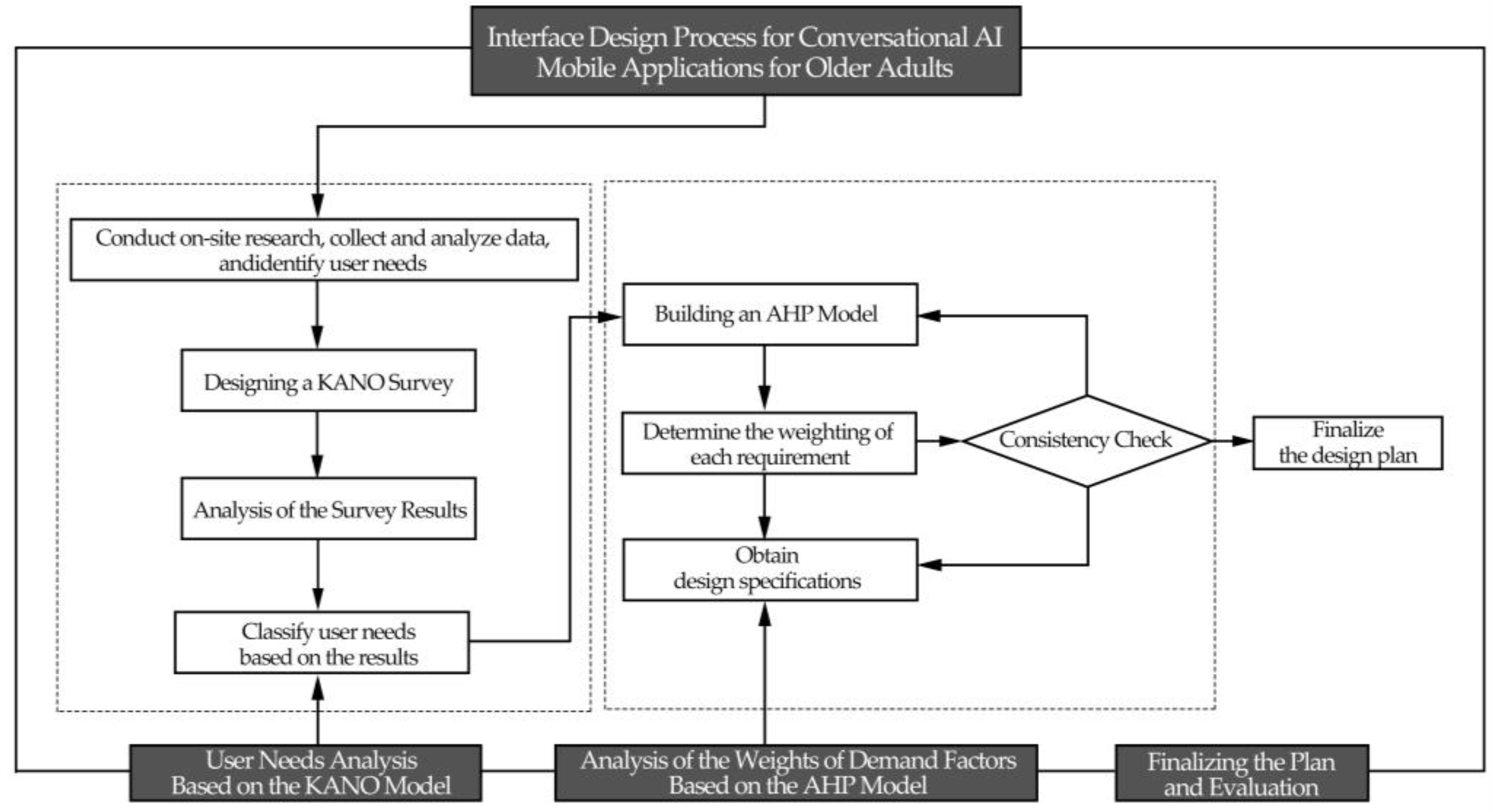
To address the analytical questions outlined above, this study establishes a four-stage research process: requirement identification, requirement classification, weight analysis, and design translation. First, literature analysis and user research are used to identify the core interface requirements of older users in conversational AI mobile applications and to examine how these requirements differ from traditional age-friendly design concerns. Second, the KANO model is applied to classify the roles of different requirements in shaping user satisfaction. Third, AHP is introduced to determine the relative design priority of each requirement. Finally, high-priority requirements are translated into interface optimization strategies. The overall research process is shown in
Figure 1.
After the questionnaires were collected, the attributes of each interface requirement were classified according to the KANO evaluation rules. Based on the response combinations for the functional and dysfunctional items of each requirement, the requirements were assigned to five categories: attractive, one-dimensional, must-be, indifferent, and reverse. The Better–Worse coefficient was then calculated to examine how the fulfillment or absence of each requirement affected user satisfaction and dissatisfaction.
On this basis, an Analytic Hierarchy Process (AHP) model was constructed. The overall research objective, requirement categories, and specific requirement indicators were defined as the goal level, criterion level, and alternative level, respectively. Experts used Saaty’s 1–9 ratio scale to conduct pairwise comparisons among indicators at the same level, thereby forming judgment matrices. The consistency of these matrices was then tested, and those that passed the consistency check were aggregated using the geometric mean method. Finally, the comprehensive weights and priority rankings of each requirement were calculated.
2.2. Extraction of Requirement Metrics and Questionnaire Design
Before the formal questionnaire was developed, this study conducted exploratory qualitative research to identify the potential interface needs of older users in conversational AI mobile applications. Focusing on conversational AI mobile applications, semi-structured interviews were used to examine usage barriers, functional understanding, generated outputs, interaction preferences, interface presentation, and perceived security. The main interview questions addressed the interface and operational difficulties that participants frequently encountered when using mobile applications in daily life, the types of functional support they expected from conversational AI applications, and the situations that caused concern when using intelligent applications or AI tools, as well as the interface prompts that could enhance their sense of security.
A total of 12 older users were interviewed. The inclusion criteria were as follows: participants were aged 60–69, had experience using smartphones, had continuously used or previously tried conversational AI mobile applications, were able to understand the interview questions and express their views verbally, and agreed to participate voluntarily. Users aged 60–69 were selected because, compared with adults aged 70 and above, they are generally more likely to have access to smartphones, possess mobile internet experience, and independently complete basic interaction tasks. They are therefore suitable as an initial sample for research on age-friendly design in conversational AI mobile applications. Previous studies have shown that smartphone acceptance and use among older adults are influenced by age, educational level, prior digital experience, and perceived usability, and that digital device proficiency and depth of use vary across older age groups [
33,
34].
Educational attainment was not used as an indicator of cognitive ability, but rather as a demographic variable for describing participants’ backgrounds and for observing possible differences in their understanding of interface text, functional descriptions, and operational procedures. The interviews were conducted in urban communities in Nanjing, community service centers in Wuxi, and village committee settings, with the aim of including participants from urban, suburban or county-level, and rural living environments. Relevant research indicates that older adults’ use of digital technologies in China is influenced by regional digital infrastructure, educational attainment, and community support [
35]. This study adopted one-on-one semi-structured interviews, with each interview lasting approximately 22–30 min, as shown in
Table 1.
In the specific procedure, the research team first developed an initial set of requirements based on literature analysis and semi-structured interview data. The five reviewers then independently examined the interview coding results and the preliminary requirement items. Their review focused on whether each item was supported by the interview materials, whether semantically similar items overlapped, whether the wording was overly abstract, whether the conceptual boundaries were clear, and whether the item could be translated into interface design strategies.
After collecting the reviewers’ feedback, the research team merged, deleted, and revised the initial items. Semantically similar items were integrated; for example, limited interface hierarchy, clear functional entry points, and concise page information were consolidated into interface simplicity. Broad statements that were difficult to translate into specific interface strategies, such as better user experience and smarter interaction, were removed. Items with overly abstract wording were revised into actionable design requirements; for instance, low error rate was reformulated as error-tolerant interaction design, and clear instructions were refined as clear functional descriptions. Through this process, the initial requirement items were distilled into 15 interface design requirements for conversational AI mobile applications, including four functional requirements, five operational requirements, four accessibility requirements, and two experience-related requirements, as shown in
Table 2.
To further clarify the differences between age-friendly interface design for conversational AI mobile applications and that for traditional mobile applications, this study conducted a secondary categorization after identifying the 15 interface requirements. This categorization was developed by the research team based on literature analysis, interview coding, and expert validation, and was cross-reviewed by five doctoral students with research experience in older users, interaction design, or smart product design.
The classification criteria included three dimensions. First, requirements primarily related to visual readability, touch accessibility, interface simplification, or low-interference operation were classified as foundational requirements for traditional age-friendly design. Second, requirements that are also relevant to traditional mobile applications but play an expanded role in conversational AI contexts, such as supporting natural language input, functional understanding, task guidance, or multimodal expression, were classified as extended requirements for conversational AI scenarios. Third, requirements directly derived from the characteristics of generative and conversational interaction, and closely related to content generation, result interpretation, system capability boundaries, error recovery, intelligent assistance, or users’ sense of control, were classified as conversational AI-specific design requirements. Based on these criteria, the 15 requirement indicators were divided into three categories: foundational requirements for traditional age-friendly design, extended requirements for conversational AI scenarios, and conversational AI-specific design requirements, as shown in
Table 3.
2.3. Participants
This study selected adults aged 60–69 as survey participants. This group represents the younger segment of the older adult population. Compared with adults aged 70 and above, they are generally more likely to have access to smartphones, use mobile internet services, and complete questionnaires and basic interaction tasks independently. Previous research indicates that age, educational level, usage experience, and perceived usability significantly influence smartphone acceptance and depth of use among older adults, and that access to and use of digital technologies vary across older age groups [
36]. Therefore, this study used adults aged 60–69 as the initial sample for examining age-friendly interface design in conversational AI mobile applications, with the aim of identifying their basic requirement structure and early adaptation characteristics in generative and conversational interaction contexts. A total of 160 questionnaires were collected. After two invalid responses were excluded, 158 valid questionnaires remained, resulting in a valid response rate of 98.75%. The demographic characteristics of the respondents are presented in
Table 4.
In the questionnaire design, this study adopted the paired functional and dysfunctional question format commonly used in the KANO model. For each user requirement, one functional item and one dysfunctional item were developed. For example, the functional item asked how respondents would feel if the conversational AI mobile application interface included the specified requirement, whereas the dysfunctional item asked how they would feel if the interface did not include it. A five-point response scale was used for both types of items, including dissatisfied, acceptable, neutral, expected, and satisfied. Respondents selected their answers according to their subjective perceptions.
2.4. AHP Expert Assessment and Data Processing
To further determine the relative importance of each requirement, this study applied the Analytic Hierarchy Process (AHP) to calculate weights for the requirement indicators classified by the KANO model. Because AHP weighting depends on experts’ pairwise comparisons of indicators at the same level, the professional background and composition of the expert panel can directly affect the validity of the judgment matrices. To ensure the expertise and diversity of the evaluation, 15 experts from different fields were invited to complete the pairwise comparison scoring.
The experts were selected according to four criteria. First, they had research or practical experience in older adult product design, interaction design, human–computer interaction, older user studies, or digital inclusion. Second, they had at least five years of relevant research or project experience. Third, they were familiar with at least one of the following areas: mobile application interface design, older users’ needs, or smart product interaction evaluation. Fourth, they had no direct conflict of interest with this study and were able to complete the judgment matrix scoring independently. The expert panel covered three main fields: older adult product design, interaction design, and older user research, as shown in
Table 5.
The Analytic Hierarchy Process (AHP) uses Saaty’s 1–9 scale to determine the relative importance of indicators at the same level through expert pairwise comparisons. In this study, 15 experts independently evaluated the criteria-level indicators and the alternative-level indicators under each criterion, generating individual judgment matrices. The research team then assessed the consistency of these matrices using the consistency ratio (CR), with CR < 0.1 set as the acceptable threshold. All 15 sets of judgment matrices met this criterion and were therefore included in the subsequent weight calculation.
The individual judgment matrices that passed the consistency test were aggregated using the geometric mean method to form a comprehensive judgment matrix. The weights of the criteria-level and alternative-level indicators were then calculated using the eigenvector method, and the comprehensive weight of each requirement was obtained through hierarchical multiplication. This procedure preserved differences among individual expert judgments while reducing the influence of extreme scores from any single expert, thereby improving the stability of the group decision-making results.
3. Results
3.1. KANO Results
To assess the internal consistency of the questionnaire data, this study used SPSSAU (
https://spssau.net/) to conduct reliability analysis on the formal questionnaire results. The overall Cronbach’s alpha coefficient was 0.861, exceeding the commonly accepted threshold of 0.7, which indicates good internal consistency and supports the use of the data for subsequent KANO classification analysis. It should be noted that the questionnaire was designed primarily to identify KANO requirement attributes rather than to measure latent variable structures; therefore, exploratory factor analysis was not used as a core validation procedure. The content validity of the questionnaire items was ensured through literature review, qualitative interviews, pre-test revisions, and expert validation. On this basis, KANO analysis was applied to classify the roles of different interface requirements in shaping user satisfaction. By analyzing the response combinations of functional and dysfunctional items, this study further identified whether each requirement mainly served to prevent dissatisfaction, enhance satisfaction, or increase experiential appeal.
The KANO results show that ease of use, absence of advertising interference, large icon design, and high-contrast colors were mainly classified by older users as must-be requirements, indicating that basic usability remains a prerequisite for age-friendly conversational AI interfaces. This finding is consistent with previous research on age-friendly mobile applications, which suggests that older users rely on clearly visible information, stable navigation paths, and low-distraction interfaces to reduce cognitive and operational burdens. In contrast to traditional mobile applications, clear functional explanations and voice interaction were classified as one-dimensional requirements in this study. This suggests that, in conversational AI contexts, older users are concerned not only with whether they can operate the system, but also with whether they can understand its functions and express their intentions with minimal effort. Image recognition, schedule reminders, and error-tolerant interaction were classified as attractive requirements, indicating that intelligent assistive functions have not yet become basic expectations for older users. Nevertheless, once basic usability is ensured, these functions can enhance product appeal and add value to the user experience.
Among the must-be requirements, ease of use accounted for the highest proportion, followed by absence of advertising interference, large icon design, and high-contrast colors. This indicates that older users tend to regard these elements as basic interface conditions. Deficiencies in these aspects may reduce their evaluation of the interface and should therefore be prioritized in design. The dissatisfaction coefficient for absence of advertising interference was −0.58, suggesting that excessive advertising is likely to cause user dissatisfaction. Among the one-dimensional requirements, health assessment had the highest proportion and the highest Better coefficient, indicating that improvements in this function are closely associated with increased user satisfaction. Voice interaction also showed both a relatively high Better coefficient and a high absolute Worse coefficient, suggesting that it can enhance satisfaction when provided, but may also lead to dissatisfaction when absent. Clear functional explanations similarly showed a strong positive effect on satisfaction, indicating that explanatory support is an important direction for improving the user experience of conversational AI interfaces. Among the attractive requirements, image recognition and multimodal interaction supporting Braille or simplified vocabulary accounted for relatively high proportions, and both showed high Better coefficients. This suggests that older users do not regard these functions as basic requirements, but they may perceive them as sources of product differentiation and innovation when provided.
For indifferent requirements, intuitive navigation design showed relatively low user sensitivity. This result appears to differ from existing usability research, which often emphasizes the importance of navigation structure. This finding should be interpreted in relation to the specific context of conversational AI mobile applications. First, because natural language interaction serves as the primary entry point, users can initiate some tasks directly through voice or text rather than relying entirely on hierarchical menus. As a result, they may be less likely to perceive navigation design as a direct factor affecting satisfaction. Second, in both interviews and questionnaires, older users were more sensitive to visible and immediate interface elements, such as text size, advertising interference, button recognition, functional explanations, and voice interaction. By contrast, navigation structure may be regarded as a default condition because it functions as a more fundamental and implicit component of usability. It tends to become noticeable only when it is absent, inconsistent, or confusing. Therefore, this study regards intuitive navigation design as a foundational and implicit usability condition. This finding also indicates that KANO classification primarily reflects users’ explicit perceptions of whether a requirement is fulfilled or absent, rather than the objective importance of that requirement within the interface system. In the case of intuitive navigation design, its value lies mainly in reducing disorientation, maintaining operational continuity, and supporting task return, rather than directly increasing satisfaction. In other words, some traditional usability factors may function differently in conversational AI contexts: although they may not directly enhance user satisfaction, they remain essential for maintaining task continuity, supporting error recovery, and ensuring interaction stability.
No reverse requirements were identified in this study, indicating that the 15 extracted design requirements were generally consistent with older users’ expectations and did not include elements that clearly conflicted with their preferences. The Better–Worse coefficients further show differentiated effects across requirements. Health assessment, image recognition, and multimodal interaction supporting Braille or simplified vocabulary had relatively high Better values, suggesting that these functions can substantially increase user satisfaction when provided. However, their relatively low Worse values indicate that their absence does not necessarily lead to strong dissatisfaction. These requirements are therefore more suitable for experience-enhancing features that contribute to product differentiation.
By contrast, absence of advertising interference, voice interaction, and clear functional explanations showed high absolute Worse values, indicating that their absence is more likely to cause dissatisfaction. These requirements should therefore be regarded as important design conditions for reducing barriers to use and maintaining basic user trust. Overall, the Better–Worse analysis distinguishes between requirements that primarily enhance satisfaction and those that primarily prevent dissatisfaction, providing an explanatory basis for the subsequent AHP weighting and priority ranking. The specific results are presented in
Table 6.
3.2. Analysis of User Requirement Weighting Based on the AHP Model
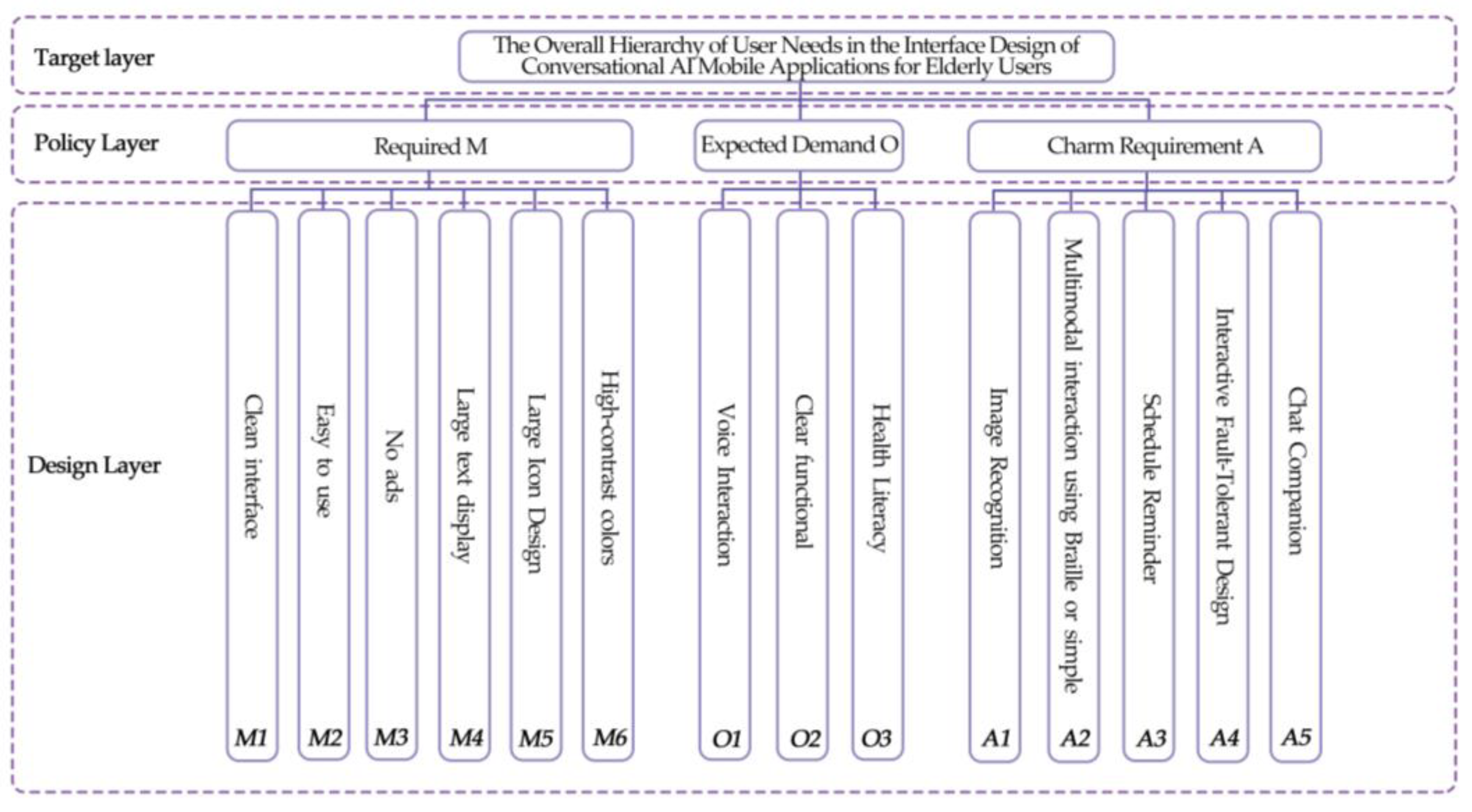
AHP weight analysis is used to determine the relative priority of each interface requirement when design resources are limited. By constructing the objective, criterion, and alternative layers, this study translates the KANO classification results into a priority ranking that can inform design decision-making. The goal level was used to define the overall objective of interface requirement decision-making for conversational AI mobile applications designed for older users. The criteria level divided this objective into three dimensions: must-be requirements, one-dimensional requirements, and attractive requirements. Based on the preceding KANO analysis, the alternative level further refined these dimensions into representative design elements and specific requirement indicators, as shown in
Figure 2.
To improve the stability of expert judgments, this study constructed individual judgment matrices from the pairwise comparison scores provided by 15 experts and aggregated them into a group judgment matrix using the geometric mean method. All judgment matrices passed the consistency test, indicating that the expert evaluations were logically consistent. To avoid overloading the main text with raw matrix data, the judgment matrices at each level and their corresponding consistency test results are provided in the
Appendix A, while the main text focuses on the weighted results and their interpretation.
At the criteria level, the weights of must-be, one-dimensional, and attractive requirements were 0.4114, 0.3284, and 0.2602, respectively. This indicates that interface design for conversational AI mobile applications for older adults should first ensure basic usability, then improve task support and satisfaction, and finally enhance experiential appeal through intelligent assistance and emotional support. In other words, age-friendly conversational AI interface design should not begin with intelligent feature innovation alone. It should be built on interface clarity, operational stability, and minimal interference. At the alternative level, the relative importance of requirements varied within each category. Among the must-be requirements, interface simplicity had the highest weight, followed by absence of advertising interference and ease of operation. This suggests that older users need an interface environment that is low in complexity, minimally distracting, and easy to operate. Among the one-dimensional requirements, clear functional explanations had the highest weight, followed by voice interaction and health assessment. This indicates that older users are concerned not only with whether functions are available, but also with whether they can understand their purpose, operating procedures, and generated results. Among the attractive requirements, error-tolerant interaction design had the highest weight, followed by image recognition and schedule reminders. This suggests that, in the uncertain interaction context of conversational AI, error prevention, secondary confirmation, and recovery mechanisms are important for enhancing older users’ trust and perceived control. By multiplying the criteria-level weights by the within-category weights at the alternative level, the comprehensive weight of each requirement relative to the overall objective was obtained. These comprehensive weights reflect the overall priority of different design requirements in conversational AI mobile applications for older adults, as shown in
Table 7.
The KANO classification and AHP weights reflect different dimensions of requirement analysis. KANO classification identifies the role of each requirement in shaping user satisfaction, namely whether it mainly prevents dissatisfaction, increases satisfaction, or creates additional experiential value. The Better–Worse coefficient further indicates the extent to which the fulfillment or absence of a requirement affects satisfaction and dissatisfaction. In contrast, the AHP composite weight reflects the relative importance of each requirement within the overall design objective. Therefore, this study does not simply place the KANO and AHP results side by side. Instead, it establishes design priorities through a logical sequence of requirement attributes, satisfaction effects, and composite weights.
Based on the comprehensive results, clear functional explanations received the highest overall weight, indicating that they represent the top design priority for older users when interacting with conversational AI interfaces. Interface simplicity and absence of advertising interference were classified as must-be requirements and also received relatively high overall weights. These requirements mainly function to reduce dissatisfaction and ensure basic usability and should therefore be prioritized as foundational interface specifications. Voice interaction was classified as a one-dimensional requirement and also showed a high weight, suggesting that low-effort input is an important pathway for improving older users’ experience with conversational AI. Although error-tolerant interaction design was classified as an attractive requirement, its high overall weight indicates that secondary confirmation, error prompts, and recovery mechanisms are important for building trust in conversational AI contexts where uncertainty and misunderstanding may occur.
Therefore, the integrated KANO-AHP analysis supports a three-level design strategy. First, high-weight must-be requirements should be prioritized to reduce dissatisfaction and maintain basic usability. Second, high-weight one-dimensional requirements should be optimized to improve task completion efficiency and user satisfaction. Third, high-weight attractive requirements should be selectively strengthened to enhance intelligent assistance, error-tolerant interaction, and users’ sense of control.
4. Discussion
The results of this study indicate that older users’ needs in conversational AI mobile application interfaces are not limited to visual enlargement or operational simplification. Instead, they form a hierarchical structure in which basic usability, functional comprehensibility, and intelligent assistance are progressively connected. The KANO classification results show that operational simplicity, absence of advertising interference, large icon design, and high-contrast colors were identified as must-be requirements, indicating that older users first prioritize interface clarity, operational stability, and low-interference interaction. This finding is consistent with research on age-friendly mobile application design, which suggests that mobile interfaces for older adults should reduce usage burden by controlling information complexity, improving visual clarity, and optimizing navigation and touch control [
37].
Unlike traditional mobile applications, this study found that clear functional explanations and voice interaction were classified as one-dimensional requirements and ranked highly in the AHP weighting results. This suggests that, in conversational AI contexts, the main challenges for older users are no longer limited to tapping accurately or locating functional entry points. Instead, they increasingly involve understanding system capabilities, assessing the reliability of generated outputs, and expressing intentions with minimal effort. This finding is consistent with research on generative AI user experience, which argues that generative AI applications differ from traditional software in their interaction patterns and should help users understand system capability boundaries, output uncertainty, and the feedback and control mechanisms involved in human-AI collaboration [
38]. Furthermore, human–AI interaction research emphasizes that intelligent systems should communicate their status during interaction, provide clear feedback, and help users form appropriate expectations. These mechanisms enable users to understand system uncertainty, correct errors, or regain control when the system produces inaccurate or unexpected responses [
39,
40].
Voice interaction showed a significant positive effect on satisfaction in this study, which is closely related to older users’ preference for low-effort input. Because conversational AI uses natural language as a primary interaction channel, it can reduce the burden associated with complex menu navigation and precise tapping. However, voice interaction should not be understood simply as a substitute for touch input. Its effectiveness also depends on recognition accuracy, dialect support, speech-rate control, feedback confirmation, and privacy protection. Recent studies on older adults’ use of voice assistants similarly indicate that acceptance of voice systems is shaped not only by learnability and usability, but also by privacy concerns, real-world usage contexts, learning processes, and long-term use experience [
41,
42]. Consequently, in conversational AI mobile applications, voice input should be combined with clear feedback, result confirmation, and undo mechanisms, rather than treated merely as a functional entry point. For older users, the value of voice interaction lies not only in reducing the number of taps, but also in lowering the effort required to express intent and establishing a verifiable feedback loop between system recognition, interpretation, and execution. If the system provides voice input without displaying recognition results, offering confirmation before execution, or supporting error correction, the voice function may instead increase the risk of incorrect operation.
At the level of attractive requirements, image recognition, schedule reminders, conversational companionship, and error-tolerant interaction reflect the intelligent assistance capabilities that distinguish conversational AI applications from traditional mobile applications. Among these requirements, error-tolerant interaction design received a relatively high AHP weight, indicating that older users particularly need error prevention, secondary confirmation, and recovery mechanisms in the uncertain interaction environment of conversational AI. This result can be explained by older users’ cautious operating behavior and higher sensitivity to risk. For general users, system misunderstandings or operational errors may only require minor corrections. For older users, however, such errors may cause greater anxiety and weaken their trust in the system and willingness to continue using it. Existing research indicates that human–computer trust is closely related to system comprehensibility, reliability, perceived control, data protection, and error risk. Therefore, error-tolerant interaction should not be regarded as an additional function, but as an important mechanism for enhancing older users’ sense of control, security, and trust [
43]. Human-centered artificial intelligence research further emphasizes that the reliability and safety of intelligent systems depend not only on algorithmic performance, but also on whether the interface provides users with sufficient opportunities for understanding, intervention, and recovery [
44].
Furthermore, intuitive navigation design was classified as an indifferent requirement in the KANO analysis. At first glance, this finding appears to differ from existing usability research, which generally emphasizes the importance of navigation structure. This result should be understood in relation to the interaction logic of conversational AI. Traditional mobile applications usually organize task flows through page hierarchies, functional entry points, and menu paths, meaning that navigation structure directly affects whether users can locate functions and complete operations. By contrast, conversational AI applications use natural language as the primary entry point, allowing some tasks to be initiated directly through voice or text. This reduces users’ reliance on hierarchical menus and page navigation. As a result, older users may be more sensitive to visible and immediately perceptible elements, such as voice input, functional descriptions, advertising interruptions, text size, and feedback confirmation, while navigation structure may not be actively identified as a central factor influencing satisfaction. Therefore, intuitive navigation design should not be understood as unimportant. Rather, it functions primarily as an underlying structural support. In design practice, navigation should remain a stable pathway that supports voice, text, and multimodal interaction, enabling users to return to a clear, stable, and predictable workflow when conversations fail, results are uncertain, or operations need to be repeated.
Overall, the findings of this study indicate that conversational AI mobile interfaces for older users should not simply adopt age-friendly design principles developed for traditional mobile applications, nor should they focus only on intelligent feature innovation. A more appropriate approach is to ensure basic usability while strengthening functional explanations, task guidance, voice input, generated-content feedback, and error-tolerant interaction mechanisms. The core of age-friendly design for conversational AI is therefore not merely the enlargement of interface elements. Rather, it lies in reducing visual complexity, lowering comprehension difficulty, and enhancing users’ sense of control, thereby helping older users develop a stable, trustworthy, and sustainable experience in generative and conversational interaction contexts. Research on human–computer interaction with large language models similarly emphasizes that users need interface-level mechanisms for reliability control, workflow support, interpretable feedback, and actionable correction in order to maintain active control over system outputs [
45].
Based on the above results and discussion, this study proposes a design framework for conversational AI mobile application interfaces for older users. The framework organizes the key challenges encountered by older users into four layers. The basic usability layer addresses visual recognition, accurate touch control, and stable operation. The functional understanding layer focuses on users’ understanding of system capabilities, usage instructions, and task paths. The generative interaction layer concerns low-effort intention expression and the interpretation of generated results. The control and trust layer addresses operation confirmation, error correction, and recovery mechanisms. The framework is presented in
Table 8.
As shown in
Table 8, the proposed framework integrates the basic usability requirements of traditional age-friendly interfaces with the generative interaction characteristics of conversational AI interfaces. It shifts the design focus from isolated interface element optimization to systematic user support. Based on this framework, this study identifies five design principles. First, visual and structural complexity should be reduced by highlighting core functions and minimizing distracting information. Second, cognitive load should be lowered through clear guidance, explicit feedback, and simplified workflows. Third, functional explanations and interpretations of generated results should be strengthened to support user understanding and decision-making. Fourth, multiple interaction methods, especially voice input, should be provided to accommodate older users with different ability levels. Fifth, intelligent assistance and error-tolerant mechanisms should be improved through secondary confirmation, undo and return functions, error prompts, risk warnings, recoverable operations, and appropriate emotional support, thereby enhancing users’ sense of control. Together, the framework and these principles provide a practical pathway from requirement identification to design implementation.
Furthermore, the value of this framework lies not in offering a static checklist of interface design items but in providing a structured basis for determining design priorities. The Basic Usability layer defines the minimum conditions that enable older users to access the system. The Functional Understanding layer concerns whether users can understand system capabilities and form appropriate expectations. The Generative Interaction layer focuses on whether users can express their needs effectively and understand generated results. The Control and Trust layer addresses users’ sense of security and willingness to continue using the system in uncertain interaction contexts. These four layers are not parallel but progressive. Insufficient basic usability may prevent users from entering the system; inadequate functional understanding may weaken their ability to assess system capabilities; unclear generative interaction may increase uncertainty during use; and insufficient control and trust mechanisms may reduce continued use intention. Therefore, the optimization of conversational AI interfaces for older users should first ensure basic usability, then strengthen functional explanations and task guidance, and finally enhance trust and long-term experience through intelligent assistance and error-tolerance mechanisms. In this way, the requirement classifications and weighting results derived from KANO-AHP can be translated into practical design decisions.
This study has several limitations. First, the sample mainly consists of younger older adults aged 60–69. Because this group generally has relatively greater smartphone experience and mobile internet literacy, the findings are more applicable to explaining the requirement structure and early adaptation characteristics of younger older adults with some digital experience. They cannot yet be fully generalized to adults aged 70 and above, or to groups with weaker digital literacy and more pronounced accessibility barriers. Second, the data were primarily derived from interviews, questionnaires, and expert judgments. The findings have not yet been validated through real product prototypes, long-term usage data, or task-based usability testing.
5. Conclusions
This study analyzes older users’ requirement structure for conversational AI mobile application interfaces from three dimensions: requirement identification, satisfaction attribute classification, and design priority determination. Its main contribution is to extend age-friendly interface design from traditional mobile application contexts to conversational AI contexts, and to use the KANO-AHP method to reveal the hierarchical structure and priority relationships of older users’ interface requirements. The results indicate that basic usability remains a prerequisite for older users to access intelligent interactive systems, while functional understanding, result evaluation, and error recovery are key factors shaping their sustained user experience. Therefore, conversational AI interfaces for older users should be guided by clear functional instructions, low-effort intent expression, comprehensible result feedback, and recoverable interaction mechanisms, rather than equating age-friendly design with visual enlargement, process simplification, or functional reduction. Future research could build on the priority structure and design principles proposed in this study by developing age-friendly conversational AI mobile interface prototypes. By incorporating subjective emotional evaluation and objective physiological measures, future studies could further examine older users’ cognitive load and emotional changes when interacting with conversational AI, thereby providing a deeper understanding of the mechanisms through which intelligent interaction experiences are formed.
Theoretically, this study addresses a limitation in existing age-friendly design research, which has often relied heavily on traditional usability indicators. It further demonstrates that older users’ needs in generative and conversational interaction are more strongly cognitive, process-oriented, and trust-oriented. Practically, the proposed priority framework provides a basis for interface optimization in conversational AI products. It can help designers allocate limited resources to interface elements that most directly affect users’ understanding, trust, and perceived control.