1. Introduction
The Vehicle Routing Problem (VRP), first formalized by Dantzig and Ramser [
1] as a generalization of the Traveling Salesman Problem, has given rise to a rich taxonomy of variants. The Capacitated VRP (CVRP) introduces vehicle-load limits and is the canonical reference variant for which exact and metaheuristic methods continue to advance [
2]; the VRP with Time Windows (VRPTW) adds customer-side temporal feasibility and remains a workhorse for both academic benchmarks and applied delivery problems [
3]; and the Multi-Depot VRP (MDVRP) couples customer-to-depot assignment with route construction across a fleet split among several geographically distinct depots [
4,
5]. Each captures specific structural features of real-world logistics and service operations.
Beyond these foundational variants, several research threads currently extend the VRP toward emerging operational realities. Two-echelon and satellite-based formulations decompose urban delivery into city-level transfers and last-mile distribution [
6]; green and electric VRPs incorporate energy consumption, charging infrastructure, and emissions into the objective and constraints [
7]; synchronization VRPs handle interdependent operations between vehicles, drivers, or facilities that must coincide in time and space [
8]; drone-aided routing combines ground vehicles with unmanned aerial vehicles to exploit complementary mobility profiles [
9]; and time-dependent VRPs allow travel times to vary with traffic conditions across the planning horizon [
10]. These threads collectively illustrate that the VRP literature is rapidly diversifying along technological and sustainability axes.
Despite this breadth, applied VRP research remains concentrated in developed-economy contexts [
11,
12,
13,
14], leaving a gap for settings where asymmetric road networks, heterogeneous fleet distributions, and rigid administrative partitioning create operational challenges that standard benchmarks do not reflect.
This paper is motivated by a concrete instance of that gap: the daily field-service routing operations of Algérie Telecom, the state-owned telecommunications provider of Algeria. The company maintains infrastructure across all 69 provinces through a network of Technical Centers (TCs), each dispatching dedicated Technical Teams (TTs) to handle customer maintenance requests. Under the current practice, each TC partitions its service territory into fixed sub-zones assigned permanently to individual TTs, and teams plan their own routes based on field experience. This rigid scheme has two measurable consequences: teams in adjacent zones cannot collaborate even when one is overloaded and the other is idle, and more critically, no formal mechanism exists to guarantee that high-priority customers are served before the working day ends.
The urgency of the latter failure is significant. Algérie Telecom serves two operationally distinct customer classes: Regular Customers (RCs), private residential users covered by a 48-h response commitment, and Priority Customers (PCs), comprising government agencies, security services, and critical enterprises whose operations cannot sustain prolonged outages and who require same-day service. Routing a team to a residential customer before attending to a nearby government agency is not merely suboptimal—it constitutes a service-level breach with administrative consequences. Yet distance-minimizing formulations are structurally unable to prevent it, and to our knowledge no existing MDVRP formulation makes this distinction explicit at the customer level.
Formally, the problem maps to an MDVRP in which TCs are depots. Standard cluster-first, route-second MDVRP methods [
15,
16] decompose the problem into a spatial assignment phase followed by independent per-depot routing. This decomposition introduces a structural tension: customers near depot boundaries are frequently misassigned by spatial clustering, yet the routing phase treats assignments as fixed and cannot correct them, even when doing so would reduce cost. Under real-road asymmetry and hard priority constraints, this limitation is particularly damaging.
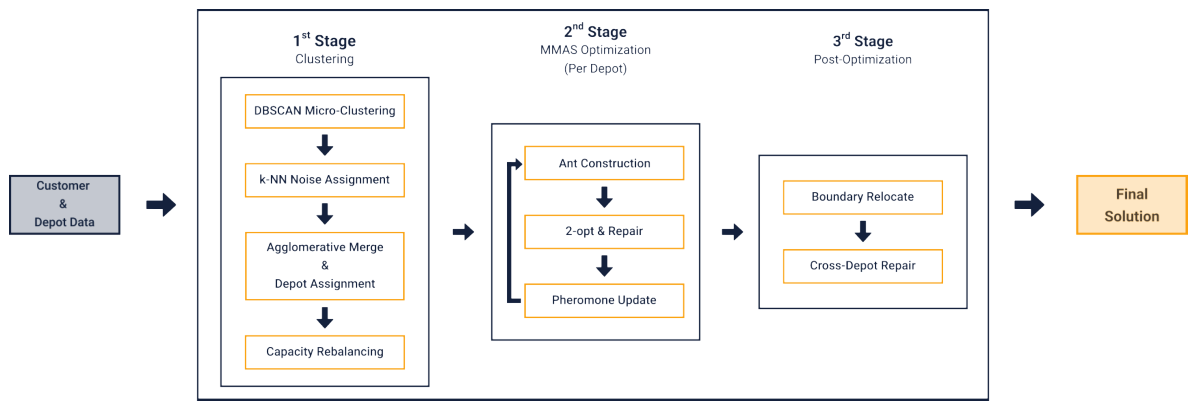
We address both gaps—the absence of a priority-aware MDVRP formulation and the misassignment problem inherent to the cluster-then-route paradigm—through an applied problem variant and a three-stage solution framework. The Multi-Depot VRP with Priority Requests (MDVRP-PR) models service urgency as a lexicographic hard constraint: every priority customer must be served before coverage and travel time are optimized. This is a stronger guarantee than weighted or soft-penalty approaches, because it structurally prevents any solution that leaves a priority customer unserved from being accepted, regardless of the travel-time savings it might offer. The solution framework integrates: (i) a road-distance-aware DBSCAN clustering stage with capacity-constrained merging, which distributes workload across the full fleet rather than producing geometrically compact but operationally imbalanced assignments; (ii) an enhanced Max-Min Ant System (MMAS) with a priority-first construction rule that reserves route capacity for priority customers during ant construction rather than relying on post-hoc repair; and (iii) a Boundary Relocate post-optimization operator that corrects depot misassignments using actual insertion and removal costs, explicitly bridging the assignment-routing gap that the clustering phase leaves open.
The primary contributions of this work are:
MDVRP-PR: to the best of our knowledge, the first MDVRP formulation in which priority is enforced as a structural admissibility constraint over the feasible region (lexicographic feasibility) rather than as a soft penalty, weighted reward, or time-window encoding. The formulation is motivated by and validated on real operational data from Algérie Telecom’s field service in the Guelma province, Algeria.
Topology-aware clustering: a hybrid DBSCAN-hierarchical assignment procedure that uses asymmetric road distances and capacity-constrained merging to achieve full fleet utilization, improving large-instance coverage by up to percentage points over sweep-based assignment on the studied case.
Priority-first MMAS: an enhanced Max-Min Ant System in which must-serve constraints are enforced structurally during construction, achieving 100% priority feasibility across all tested configurations at a route-time overhead below 5%.
Boundary Relocate operator: a cross-depot post-optimization move that evaluates relocation candidates by actual insertion and removal costs rather than geometric proximity, correcting the systematic misassignments that spatial clustering produces near depot boundaries.
The remainder of this paper is organized as follows:
Section 2 reviews related work;
Section 3 presents the formal problem definition;
Section 4 details the proposed methodology;
Section 5 and
Section 6 describe the experimental setup and results; and
Section 7 concludes.
2. Related Work
The literature directly relevant to this work spans three interconnected areas: the classical MDVRP and its benchmark methods, which establish the baseline against which our formulation is positioned; clustering-based decomposition strategies for MDVRP, whose structural limitations motivate our topology-aware assignment and Boundary Relocate operator; and ACO/MMAS-based solution frameworks, whose uniform construction rules motivate our priority-first extension. A fourth thread, priority and service-class modeling in VRP, is reviewed separately, as it most directly concerns our core problem novelty.
Table 1 summarizes the works reviewed across these threads, highlighting the features most relevant to our contributions.
2.1. Classical MDVRP: Formulations and Benchmark Methods
The classical MDVRP requires simultaneously determining customer-to-depot assignments and vehicle route sequences, two interdependent decisions that render it NP-hard. Early work established the solution templates that subsequent research has built upon. Renaud et al. [
16] proposed the first dedicated tabu search heuristic (FIND) for the MDVRP, structured into fast improvement and diversification phases, which remained competitive for nearly a decade. Cordeau et al. [
4] introduced a unified tabu search capable of solving the MDVRP, the Periodic VRP, and the Periodic MDVRP within a single framework, and their benchmark instances have since become the standard evaluation testbed for the problem. Ho et al. [
17] demonstrated that hybrid genetic algorithms benefit substantially from informed initialization: seeding with Clarke–Wright savings routes produced consistently stronger solutions than random initialization, pointing to the value of constructive heuristics within population-based methods.
The most competitive reference method for the classical problem remains the Hybrid Genetic Search with Adaptive Diversity Control (HGSADC) of Vidal et al. [
5]. It combines a biased fitness function that jointly ranks solution cost and population diversity, a periodic crossover operator for pattern assignment, and a dual-population management scheme. HGSADC achieves near-optimal solutions on the Cordeau benchmark instances and has served as the primary comparison baseline for over a decade. Azad et al. [
18] extended the base formulation to the Multi-Depot Periodic VRP with Interdependent Depot Operations, solving it with a memetic algorithm that combines pattern-assignment initialization and selective simulated annealing, achieving new best-known solutions on 7 of 10 benchmark instances. Mancini [
19] addressed a Multi-Depot Multi-Period VRP with a heterogeneous fleet using an ALNS matheuristic that solves an exact MIP subproblem at each iteration, reporting 8–10% cost improvements over a commercial solver. Lim et al. [
20] introduced the first complete MIP formulation for the Multi-Depot Split-Delivery VRP with heterogeneous vehicles; permitting multiple depot visits per customer reduces total travel distance by up to 16%. Chen and Yang [
21] reformulated the MDVRP as a bilevel optimisation that integrates urban traffic equilibrium, reducing delivery time by nearly 30% over distance-minimising methods, though the model requires a full origin-destination traffic matrix that is rarely available in practice.
Across all of these contributions, customer requests are treated as operationally homogeneous: no distinction is made between service classes that differ in response urgency, and no structural mechanism exists to prevent a lower-priority customer from being served before a higher-priority one.
2.2. Clustering-Based Decomposition for MDVRP
Given the NP-hardness of the MDVRP, the cluster-first, route-second paradigm is one of the most widely adopted solution strategies. It decomposes the problem into a depot-assignment phase followed by independent single-depot routing. While this approach substantially reduces computational complexity, solution quality depends critically on the clustering decisions, and purely spatial partitioning introduces two recurring structural limitations that are directly relevant to the present work.
The first is
workload imbalance. When the spatial distribution of customers does not align with depot capacities, nearest-depot or geometry-based assignment produces overloaded depots alongside underutilised ones. Gu et al. [
22] applied nearest-depot assignment as the first stage of a three-phase framework using an Artificial Bee Colony algorithm and explicitly acknowledged that fixing assignments prior to route construction may preclude globally optimal solutions. Tao et al. [
23] addressed a Multi-Depot Capacitated VRP with Order Split and Allocation using a Variable Neighbourhood Search with seven specialised operators, but relied on a pre-determined depot structure without adaptive load rebalancing. Wang et al. [
24] and Wang et al. [
25] both employ k-medoids clustering as a preprocessing step for collaborative multi-depot routing under dynamic demands; neither accounts for asymmetric road distances in the assignment phase, so workload imbalances persist whenever road geometry departs from Euclidean proximity.
The second is
boundary misassignment. Customers near service territory boundaries are frequently allocated to suboptimal depots by spatial clustering, and the routing phase—treating assignments as fixed—cannot correct these misallocations even when routing costs clearly favour an alternative depot. Stodola and Nohel [
26] proposed AACO-NC, currently the most competitive ACO-based method for the classical MDVRP, matching or exceeding best-known solutions on 18 of 23 Cordeau benchmark instances and establishing four new best-known results. Despite this strong performance, its clustering component is purely spatial, does not account for depot workload balance, and provides no mechanism to revise depot assignments once the clustering phase is complete. Yu et al. [
27] and Xu et al. [
28] likewise assign customers to the nearest depot without considering routing efficiency, and report that this oversimplification degrades solution quality on instances where customers are not spatially well-separated by depot.
These two weaknesses jointly motivate the topology-aware DBSCAN-based clustering with capacity-constrained merging proposed in Stage 1 of our framework, and the Boundary Relocate post-optimization operator in Stage 3, which corrects residual misassignments using actual route insertion and removal costs rather than geometric proximity.
A complementary line of recent work explores
dynamic decomposition that operates inside the metaheuristic loop rather than as a static first phase. Santini et al. [
29] repeatedly break the current elite solution into smaller subproblems by clustering its routes (e.g., on geographic barycenters), solve each subproblem from scratch with the same solver, and reassemble the improved fragments, reporting consistently stronger results than using decomposition only as pre- or post-processing. Their decomposition is therefore solution-driven and adaptive, whereas our Stage 1 decomposes at the customer level once before any routing, with the cross-depot Boundary Relocate operator in Stage 3 acting as the corrective mechanism. The two strategies are complementary rather than substitutes: the dynamic decomposition ofSantini et al. [
29] reorganizes
routes during search, while our pipeline reorganizes
depot assignments after construction. We do not claim methodological superiority over dynamic decomposition; we focus on the assignment side of the cluster-first paradigm, which is the locus of the boundary-misassignment failures observed in our applied case. Recent reviews of related research threads, including time-dependent vehicle routing [
10], indicate that adaptive within-loop decomposition and depot-aware structural correction are likely to be combined in future MDVRP work.
2.3. ACO and MMAS for Multi-Depot Routing
Ant Colony Optimisation, and the Max-Min Ant System (MMAS) in particular, has demonstrated strong performance across VRP variants. This is largely due to the natural alignment between pheromone-guided construction and the sequential, interdependent nature of routing decisions. MMAS improves upon basic ACO by bounding pheromone concentrations within a dynamic interval
and restricting updates to the best solutions found, thereby preventing premature stagnation while preserving exploitation of high-quality routes [
30].
Ting and Chen [
31] introduced the first ACO-based method for the MDVRPTW, proposing a dual pheromone system with separate matrices for customer-depot assignment and route sequencing, combined with simulated annealing for intensification; this yielded six new best-known solutions on Cordeau instances. Their design illustrates the value of separating assignment and sequencing signals in pheromone management, though the construction rule remains uniform across all customers. Niu et al. [
32] applied MMAS-based decomposition to the Multi-Depot Cumulative Capacitated VRP, maintaining a master pheromone matrix alongside subproblem-specific matrices and using pheromone trail smoothing combined with local search for perturbation; their analysis identified initialisation bias toward nearest-depot assignments and fixed subproblem boundaries as the principal limiting factors. Stodola and Nohel [
26] demonstrated that adaptive pheromone management calibrated to population entropy outperforms fixed-parameter ACO variants in the MDVRP context, establishing entropy-driven evaporation as a practically effective anti-stagnation mechanism.
A limitation shared by all existing ACO and MMAS formulations for multi-depot routing is that route construction applies a uniform probabilistic selection rule to all customers, with no mechanism to reserve route capacity for urgent service requests during construction. When must-serve constraints are handled at all, they are delegated to post-hoc repair, where insertion slots may already be scarce. The priority-first construction rule introduced in Stage 2 of our framework addresses this gap directly: whenever any priority customer remains feasible, the candidate set is restricted to priority customers only, so that must-serve constraints are enforced structurally during construction rather than corrected after the fact.
2.4. Priority and Service-Class Modeling in VRP
Priority and service-class differentiation in VRP has received limited but meaningful attention, primarily in single-depot settings and adjacent routing domains. Four main mechanisms appear in the literature.
Time-window tightening assigns narrow delivery windows to high-priority customers [
33]. It requires translating urgency into a numerical time commitment and does not constitute a hard must-serve guarantee: a solution that misses a tight window is penalised but not rejected.
Weighted objectives penalise late or missed service through cost coefficients [
12]. These formulations are structurally unable to prevent priority-infeasible solutions: a route that leaves a priority customer unserved may still be accepted when the associated travel-time saving is large enough.
Quantity-based priority encodes urgency through delivery rewards rather than scheduling: Wu et al. [
34] formulate a workload-consistent VRP under demand uncertainty in which each demand site
i carries a weight coefficient
that influences
how much supply it receives, so priority is expressed as distributional fairness rather than service order.
Tardiness-driven priority embeds urgency in the search procedure rather than in the model: Bock [
35] maintains a min-heap of partial solutions inside a branch-and-bound algorithm; at each insertion, a heuristic completion repeatedly appends the unserviced order with the highest priority
, which is derived from the earliest completion time attainable by some vehicle. The priority rule there acts as a tie-breaking device for fast feasibility, not as a structural admissibility constraint over the solution space.
Hard sequencing constraints, which force priority customers to be inserted before regular ones within each route, are the mechanism most closely aligned with our formulation, but their application in the multi-depot context has not, to our knowledge, been combined with a lexicographic admissibility rule that filters entire solutions out.
In field-service and emergency logistics, service urgency is operationally prevalent but rarely modeled as a formal routing constraint. Maintenance dispatch and telecommunications repair operations classify customers by response-time commitment [
14], yet the routing literature has not translated this classification into a structural priority constraint within an MDVRP framework. Emergency vehicle routing models do enforce hard response-time deadlines, but these are single-depot or network-flow formulations that do not address the assignment–routing interdependence of the multi-depot setting.
Our positioning relative to these threads is therefore narrower and more precise than a generic claim of novelty would suggest. Quantity-based priority [
34] answers a different question, namely
how much to deliver under demand uncertainty in a single-depot consistent VRP, with priority entering as a hierarchical reward in the objective rather than as a feasibility rule. Tardiness-driven priority [
35] concerns single-vehicle routing through connected service areas and embeds urgency as a heuristic completion device inside a branch-and-bound algorithm rather than as a constraint over the feasible region. Time-window-based priority encodings [
33] are most often deployed in multi-depot settings, but a missed window is penalised, not rejected. To the best of our knowledge, the MDVRP-PR introduced in this paper is the first MDVRP formulation in which priority is enforced as a structural admissibility constraint defining the feasible region (lexicographic feasibility): it combines this hard admissibility rule on priority customers with a topology-aware depot assignment and a cross-depot repair operator within a single operational pipeline. The resulting guarantee, that solutions leaving any priority customer unserved are rejected regardless of the travel-time savings they might offer, is motivated by the field-service operations of Algérie Telecom, where routing a vehicle to a residential customer before attending to a nearby government agency constitutes an administrative service-level breach whose consequences cannot be traded off against travel-time savings.
Table 1.
Summary of related MDVRP literature. PC = priority-customer treatment (No = none, Quantity = priority via delivered amount, Tardiness = priority as search-time tie-breaker, Hard lex. = lexicographic admissibility constraint); Cluster = clustering strategy (ND = nearest-depot, Km = k-medoids/k-means, Sp = spatial sectorization, DB+H = DBSCAN with capacity-constrained hierarchical merging, Dyn. = dynamic within-loop route decomposition, − = no clustering phase, · = decomposition without spatial clustering); XD-corr. = cross-depot correction after initial clustering; Pri.-cons. = construction rule that structurally enforces priority, during route building (Heur. = priority used only as a heuristic completion device, not as a hard rule).
Table 1.
Summary of related MDVRP literature. PC = priority-customer treatment (No = none, Quantity = priority via delivered amount, Tardiness = priority as search-time tie-breaker, Hard lex. = lexicographic admissibility constraint); Cluster = clustering strategy (ND = nearest-depot, Km = k-medoids/k-means, Sp = spatial sectorization, DB+H = DBSCAN with capacity-constrained hierarchical merging, Dyn. = dynamic within-loop route decomposition, − = no clustering phase, · = decomposition without spatial clustering); XD-corr. = cross-depot correction after initial clustering; Pri.-cons. = construction rule that structurally enforces priority, during route building (Heur. = priority used only as a heuristic completion device, not as a hard rule).
| Reference | Variant | PC | Cluster | XD-corr. | Pri.-cons. | Algorithm |
|---|
| Classical MDVRP and benchmark methods |
| Renaud et al. [16] | MDVRP | No | − | No | No | Tabu Search (FIND) |
| Cordeau et al. [4] | MDVRP/PVRP | No | − | No | No | Unified Tabu Search |
| Ho et al. [17] | MDVRP | No | − | No | No | Hybrid GA |
| Vidal et al. [5] | MDVRP/PVRP | No | − | No | No | HGSADC |
| Azad et al. [18] | MD Periodic+Interdep. | No | − | No | No | Memetic Algorithm |
| Mancini [19] | MD Multi-Period | No | − | No | No | ALNS Matheuristic |
| Lim et al. [20] | MD Split-Delivery | No | − | No | No | MIP + GA |
| Chen and Yang [21] | MDVRP + Traffic Eq. | No | − | No | No | Bilevel GA |
| Clustering-based decomposition |
| Yu et al. [27] | Dynamic MDVRP | No | ND | No | No | Improved ACO |
| Xu et al. [28] | Dynamic MDVRP | No | ND | No | No | Hybrid ACO |
| Gu et al. [22] | MDVRP | No | ND | No | No | ABC + Coevolution |
| Tao et al. [23] | MD-CVRP-OSA | No | · | No | No | VNS (7 operators) |
| Wang et al. [24] | Collab. MD Dynamic | No | Km | No | No | k-Medoids + Hybrid |
| Wang et al. [25] | Collab. MD Dynamic | No | Km | No | No | k-Medoids + Hybrid |
| ACO and MMAS-based methods |
| Ting and Chen [31] | MDVRPTW | No | · | No | No | MACS-SA (dual pheromone) |
| Niu et al. [32] | MD Cumul. CVRP | No | ND | No | No | MMAS + Decomposition |
| Stodola and Nohel [26] | MDVRP | No | Sp | No | No | AACO-NC (entropy PH) |
| Recent priority and decomposition formulations |
| Wu et al. [34] | VRP + workload/uncert. | Quantity | − | No | No | Branch-and-cut |
| Bock [35] | Connected service areas | Tardiness | · | No | Heur. | Branch-and-bound |
| Santini et al. [29] | VRP (dyn. decomp.) | No | Dyn. | N/A | No | Within-loop decomposition |
| This work |
| MDVRP-PR (Ours) | MD + Priority Req. | Hard lex. | DB+H | Yes | Yes | Our Method |
5. Numerical Experiments
This section describes the benchmark instances and the design of six experiments (with Experiment 3 expanded into five sub-experiments, 3a through 3e) conducted to evaluate the proposed framework. Results are presented in
Section 6.
5.1. Problem Instances
The approach is evaluated on a real-world case study involving a utility company in northeastern Algeria. The problem consists of scheduling daily maintenance visits across 47 municipalities served by four depots, each with a fixed vehicle fleet and an 8-h operating window (480 min). Customer locations, service-time requirements, and pre-existing depot/team assignments were provided by the company. Pairwise road distances (km) and travel times (min) were obtained via the Google Maps Distance Matrix API, capturing the actual road network rather than Euclidean approximations.
Table 4 summarizes the instance characteristics. Three dataset sizes were constructed by progressive sampling to test scalability under increasing fleet utilization. Service times average approximately 30 min per customer. Each customer record includes a pre-assigned depot and technician team, used in Experiments 4 and 5.
The vehicle fleet is distributed unevenly across depots (ranging from 2 to 5 vehicles per depot), reflecting the company’s actual operational structure.
Metrics and Protocol
Solutions are compared using the lexicographic objective (
1): a solution is preferred if it serves more priority customers; ties are broken by overall coverage, then by total time (travel + service). Auxiliary metrics reported include travel time, total distance, customer coverage (%), and priority feasibility (fraction of seeds in which all priority customers are served). Each experiment is replicated over 10 random seeds; results are reported as mean ± standard deviation.
The MMAS optimizer uses the balanced preset (
= 1,
= 2,
= 0.02,
ants, 100 iterations) throughout, where
is the number of customers assigned to depot
k. The parameter values follow the canonical recommendations of Stützle and Hoos [
30], who established
= 1 and
= 2 as the standard pheromone–heuristic balance for MMAS across routing problems, and
= 0.02 as a low evaporation rate suited to the bounded
update scheme that prevents premature convergence without requiring per-instance tuning. The number of ants is set to
m =
, matching the customer count at each depot, which Stützle and Hoos identify as a robust default that ensures adequate solution diversity relative to the search space size. The iteration limit of 100 was selected to balance solution quality and runtime within the operational constraint of a morning planning session: preliminary trials confirmed that the global-best solution stabilises well before iteration 100 on all three instance sizes, with no improvement observed beyond iteration 70 on average. The
=
value used in the pheromone bound calculations (Equation (
19)) likewise follows the original MMAS recommendation [
30].
All experiments were executed on a single machine equipped with an Intel(R) Core(TM) i7-10700KF CPU @ 3.8 GHz and 16 GB RAM, running Ubuntu 24.04 LTS. The framework was implemented in Python 3.12. Per-depot MMAS instances were solved sequentially (no parallelism).
5.2. Experiment 1: Clustering Method Comparison
Five first-stage clustering methods are compared, each followed by the same MMAS and post-optimization pipeline:
DBSCAN-Hierarchical (proposed): road-distance-based DBSCAN micro-clustering, k-NN noise assignment (k = 3), agglomerative merging into four depot groups, and capacity-aware rebalancing ( tolerance). Fully deterministic.
K-Means (Euclidean) [
41] (
K = 4): Euclidean coordinates, random initialization. This is the canonical
K-Means baseline; it ignores network topology.
K-Means (Network) (K = 4): K-Means run on a classical multidimensional-scaling embedding of the road-distance matrix used throughout the pipeline. This variant removes the metric mismatch between the baseline and our method, so any remaining performance gap reflects the grouping principle (centroid-based vs. density-based) rather than the input metric.
K-Medoids (PAM) [
24] (
K = 4): precomputed road-distance matrix.
Sweep (MDVRP) [
26]: Gillett–Miller angular sweep adapted for MDVRP following Tillman [
42]; each customer is assigned to its nearest depot by road distance, then sorted by polar angle. Fully deterministic.
All three datasets are tested with 10 seeds each ( runs).
5.3. Experiment 2: Post-Optimization Ablation
The marginal value of the Boundary Relocate and Cross-Depot Repair phases is assessed by comparing the full pipeline against a truncated variant that stops after MMAS. Both variants share identical clustering and seeds, enabling paired comparisons ( runs).
5.4. Experiment 3a: Priority-Customer Sensitivity
The proportion of hard-priority customers is varied from 0% to 50% in 5% increments. Priority customers are selected uniformly at random per seed. The hard constraint is enforced via a priority-first construction rule that restricts the ant’s candidate set to unvisited priority customers whenever any remain feasible. The full pipeline is executed for each configuration ( runs).
5.5. Experiment 3b: Priority-Aware vs. Priority-Blind MMAS
To quantify the combined contribution of the three priority mechanisms, each configuration is run twice under identical clustering and seeds. The priority-aware variant uses all three mechanisms: (i) candidate-set restriction to feasible priority customers during ant construction, (ii) lexicographic best-solution selection (unserved priority ≻ total unserved ≻ total time), and (iii) priority-first repair ordering. The priority-blind baseline is a standard MMAS that treats all feasible customers equally during construction, selects solutions by total time only, and repairs without priority ordering. Five priority levels (10–50% in 10% steps) are tested; 0% is excluded as both variants are identical without priority customers. This yields paired comparisons on priority feasibility, unserved priority count, total time, and coverage ( runs).
5.6. Experiment 3c: Isolated Mechanism Ablation
Experiment 3b confirms the combined contribution of the three priority mechanisms, but it does not isolate individual effects. Experiment 3c addresses this by testing each mechanism in isolation. Five variants are evaluated on the Large instance at priority levels 20%, 30%, and 40%: blind (no mechanisms), C_only (candidate-set restriction only), S_only (lexicographic selection only), R_only (priority-first repair ordering only), and aware (all three combined). This yields runs.
5.7. Experiments 3d and 3e: Stress Tests for the S_only Variant
Experiment 3c shows that S_only marginally dominates the combined aware variant on coverage in the 20– priority window with uniformly random priority assignment. Two stress experiments verify whether this advantage extends to operational regimes that the design of Experiment 3c does not exercise.
Experiment 3d (extended priority range). Same five variants as Experiment 3c, evaluated on the Large instance at priority levels , , , over 10 seeds ( runs). Tests whether S_only retains feasibility when the priority load is high enough that the unmodified MMAS construction frequently produces no priority-feasible solution.
Experiment 3e (spatially clustered priority). Same five variants on the Large instance at priority levels , , , but priority customers are sampled exclusively from the territory of the dominant TC (the depot serving the largest customer share, in our case), rather than uniformly across all customers. This simulates an outage or campaign concentrated in one geographic zone. runs.
5.8. Experiment 4: Assignment Flexibility
Three assignment scenarios are compared at 0% priority:
Baseline: algorithmic depot assignment (DBSCAN-Hierarchical) with cross-depot post-optimization.
Center-Fixed: customers locked to their pre-assigned depot; four independent single-depot subproblems.
Team-Fixed: customers locked to a specific (depot, vehicle) pair; one route per team with no inter-vehicle flexibility.
These scenarios represent a decreasing gradient of flexibility ( runs).
5.9. Experiment 5: Priority × Flexibility Interaction
A full factorial design crosses the three assignment scenarios with six priority levels (0–50% in 10% steps) across all datasets ( runs). This design estimates both main effects and their interaction, testing whether flexibility becomes more or less valuable as priority constraints tighten.
5.10. Experiment 6: Threshold Sensitivity
Question: Are the pipeline’s reported gains driven by implicit tuning of fixed thresholds, or are they robust across reasonable parameter ranges? Design: A one-at-a-time (OAT) sensitivity sweep over the seven main thresholds: the DBSCAN radius multiplier (around the data-driven default), , the Boundary Relocate filter parameters and , and the MMAS exploration coefficients , , . For each parameter we sweep four–five levels around the default while holding all other parameters fixed, and report the resulting variation in total time relative to the seed-to-seed noise floor estimated from a baseline pool of 10 independent runs at the default configuration. We complement the descriptive analysis with a Kruskal–Wallis test across levels per parameter. The Medium dataset is used (5 seeds per level) to keep computational cost bounded; the headline pipeline behaviour scales monotonically with instance size, so trends observed on Medium transfer to Small and Large.
5.11. Summary
Table 5 summarizes the experimental design.
6. Results and Discussion
6.1. Experiment 1: Clustering Method Comparison
Table 6 summarizes the full-pipeline results for the five clustering methods.
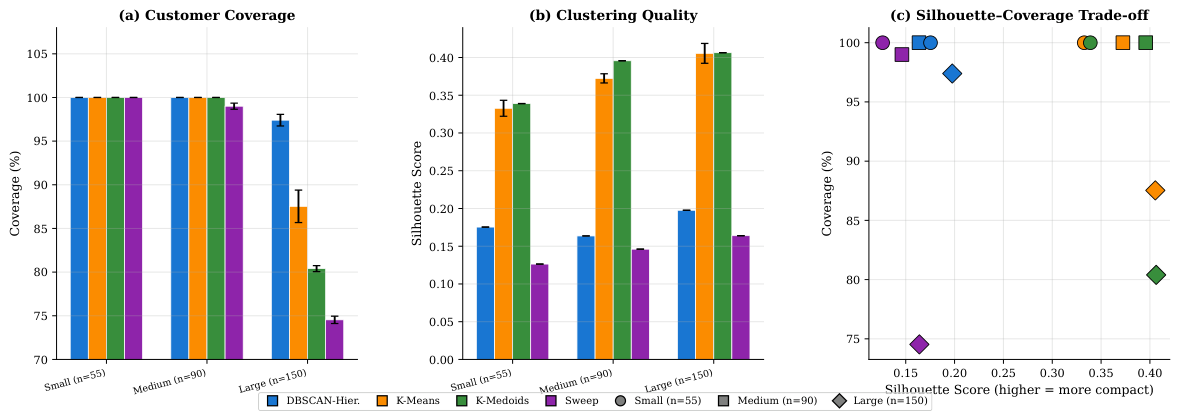
All five methods achieve ≥99% coverage on the Small and Medium instances. On the Large instance, where fleet utilization approaches saturation, DBSCAN-Hierarchical reaches coverage, substantially higher than K-Means (Eucl.) (, percentage points), K-Means (Net.) (, percentage points), K-Medoids (, percentage points), and Sweep (, percentage points). A Friedman test across the five methods confirms that these differences are statistically significant (, df , ), with Kendall’s indicating near-perfect rank consistency across the 10 seeds (a large effect by Cohen’s conventions). Post-hoc pairwise Wilcoxon signed-rank tests with Holm–Bonferroni correction show that every pair of methods differs significantly (all adjusted , effect size –, all classified as large).
The two K-Means variants differ only in the metric used by the centroid algorithm: the Euclidean variant operates on raw coordinates, while the Network variant operates on a classical-MDS embedding of the same road-distance matrix used by our pipeline, eliminating the metric bias of the Euclidean baseline. Their large-instance coverage differs by only percentage points (median paired pp, Wilcoxon ); both remain over 10 percentage points below DBSCAN-Hierarchical. This rules out the explanation that the proposed method’s advantage stems from comparing against a metrically-biased baseline.
The Routes column reveals the mechanism behind this advantage: on the Large instance, DBSCAN-Hierarchical activates all 13 available vehicles, whereas K-Means (Eucl.) uses , K-Means (Net.) , K-Medoids , and Sweep only . By producing topology-aware clusters that match the road network and capacity-balanced merging, DBSCAN-Hierarchical distributes workload across the full fleet, enabling it to reach peripheral customers that centroid-based methods leave unserved.
The silhouette–coverage trade-off is evident in
Figure 2c: both
K-Means variants and
K-Medoids produce the most geometrically compact clusters (silhouette
–
, panel (b)) but leave peripheral customers unservable within the 8-h window, as shown by their coverage collapse on the Large instance in panel (a). DBSCAN-Hierarchical’s lower silhouette (≈0.20) reflects topology-aware groupings that follow the road network, yielding the most graceful scalability (
) compared to
K-Medoids (
) and Sweep (
), as illustrated by the diverging curves in
Figure 2a. Importantly, the silhouette–coverage inversion persists when the road-distance metric is used inside
K-Means itself (Network variant), confirming that the pathology lies in the centroid-based grouping principle rather than in the input metric.
6.2. Experiment 2: Post-Optimization Ablation
Table 7 compares the full pipeline against a variant truncated after MMAS, reporting solution quality, fleet utilization, and the execution time of each pipeline phase.
The number of routes is identical in both variants, post-optimization does not alter fleet size. On Small and Medium, post-optimization saves 10–12 min of total route time without changing coverage (Wilcoxon for both, on Small and on Medium, both classified as large effects by Cohen’s conventions). On the Large instance, total time increases by min because the cross-depot repair rescues previously unserved customers (Wilcoxon , , large effect; Cohen’s ), trading a modest time increase for percentage points of coverage on the most capacity-constrained instance.
Table 8 details the wall-clock time contribution and objective change of each pipeline stage. The MMAS dominates runtime across all sizes (86–
of total wall time), while clustering and post-optimization together add at most
s and
s, respectively. The objective improvement attributable to each stage is reported as the reduction in total route time (negative = improvement) and the gain in coverage. Clustering drives coverage by determining fleet utilization; MMAS produces feasible routes; post-optimization trims residual time and rescues unserved customers on the hardest instance.
6.3. Experiment 3a: Priority-Customer Sensitivity
Across all 330 runs, the pipeline achieves
100% priority feasibility: every priority customer is served in every run.
Table 9 reports coverage and total route time across all priority levels.
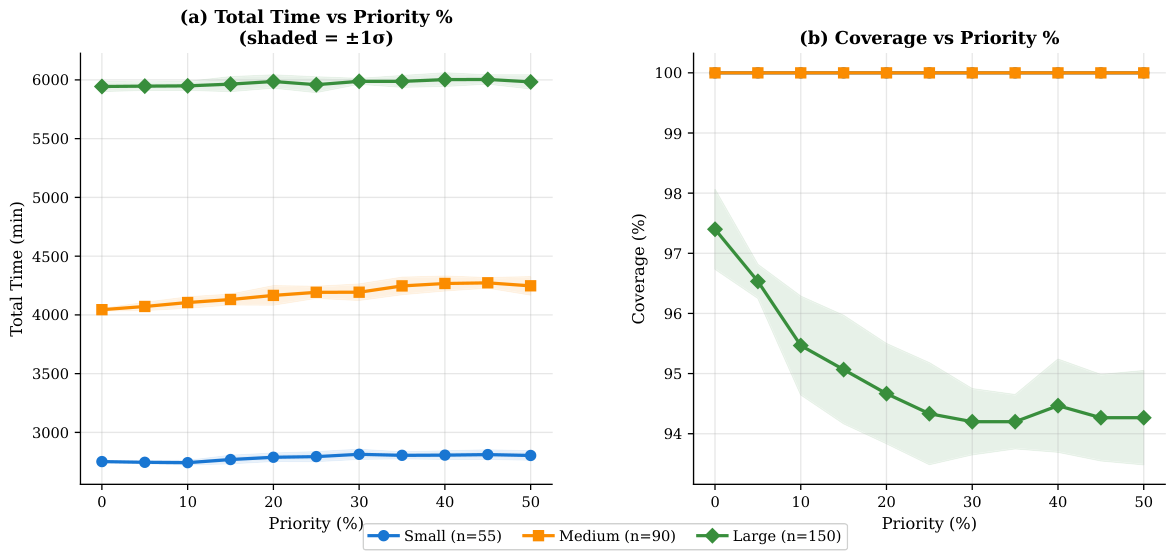
Figure 3a shows that total route time grows approximately linearly with the priority proportion across all three datasets, while panel (b) confirms that coverage remains stable: on Small and Medium it stays at 100% throughout, and on Large it declines by only
percentage points (from
to
), with all unserved customers being non-priority. The cost of priority grows approximately linearly with the priority proportion, remaining below 5% even at 50% priority.
6.4. Experiment 3b: Priority-Aware vs. Priority-Blind MMAS
Table 10 reports the paired comparison on the Large instance.
On Small and Medium, both variants achieve full priority service in all seeds at all priority levels (all 10/10), the repair phase alone suffices when fleet capacity is ample.
Table 10 therefore reports only the Large instance, where the variants diverge.
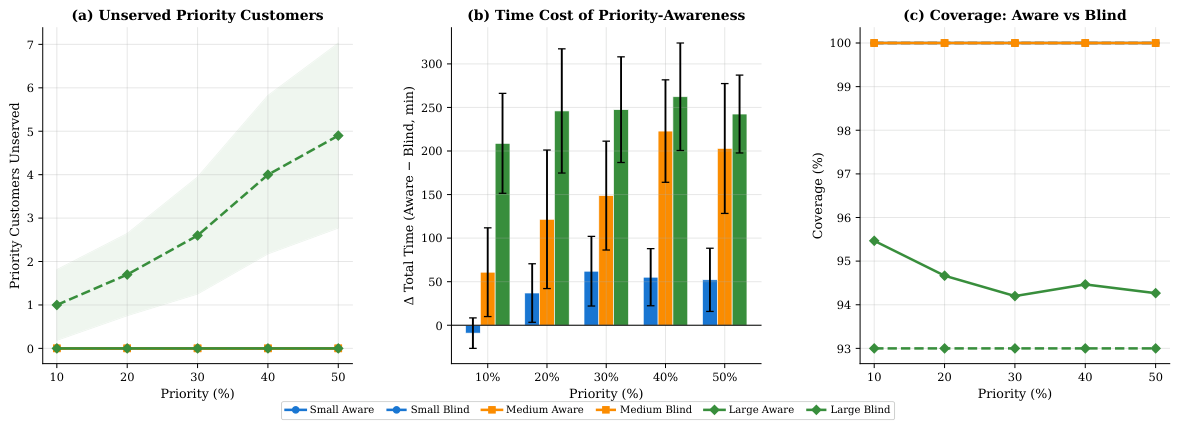
The Blind variant produces identical solutions regardless of the priority proportion (coverage , route time min at every level), because it ignores priority tags entirely during construction; only the random seed determines its output. By contrast, the Aware variant adapts its construction and solution selection to the priority structure, yielding – coverage. The coverage difference is statistically significant at all priority levels (Wilcoxon , Cohen’s –; Wilcoxon effect size –, all classified as large).
At 10% priority, only 3 out of 10 Blind seeds serve every priority customer; at ≥40%, none do, leaving up to priority customers unserved on average. The Aware variant achieves 10/10 across all levels, at a route-time overhead of 3.6–4.6%.
Remark. The comparison bundles three mechanisms (candidate-set restriction, lexicographic selection, priority-first repair). The observed improvement therefore reflects their combined effect; isolating individual contributions is left to future work.
Figure 4a shows the unserved priority count for both variants across priority levels: the Blind variant leaves up to
customers unserved on average at 50% priority, while the Aware variant consistently reaches zero. Panel (b) quantifies the route-time overhead of priority-awareness (
–262 min), which panel (c) contextualises as a by-product of serving more customers rather than of inefficiency, given that the Aware variant also achieves between
and
percentage points of additional coverage at every priority level.
6.5. Experiment 3c: Isolated Mechanism Ablation
Experiment 3b establishes that the three priority mechanisms together are necessary for feasibility, but it does not identify the individual contribution of each. Experiment 3c tests each mechanism in isolation to attribute the gains. Five variants are compared on the Large instance (n = 150) at priority levels 20%, 30%, and 40% over 10 seeds each (150 runs total): blind (no mechanisms), C_only (candidate-set restriction), S_only (lexicographic selection), R_only (priority-first repair), and aware (all three combined).
Table 11 reports feasibility counts and coverage per variant and priority level.
Three findings stand out. First, mechanism C alone suffices for full feasibility: enforcing priority-first candidate-set restriction during MMAS construction achieves 10/10 feasibility at every priority level. Second, mechanism S provides the largest coverage gain on the tested cells: lexicographic selection alone yields – coverage, pp above blind and pp above the full aware variant, at an equivalent – overhead. This is because S screens entire solutions on priority feasibility before accepting them, which incidentally retains the solutions covering the most regular customers. Third, mechanism R alone is insufficient: priority-first repair achieves only 1–4 feasible seeds, performing only marginally above blind, confirming that repair alone cannot compensate for a construction phase that ignores priority structure.
The apparent dominance of S_only over the combined
aware variant on the cells of Experiment 3c warrants a careful interpretation. Two stress experiments (3d and 3e,
Section 6.6) directly probe regimes outside the 20–
uniform-priority window of Experiment 3c, and the results identify the operational boundary at which S_only’s coverage advantage breaks down.
6.6. Experiments 3d and 3e: Stress Tests for the S_only Variant
Findings on Experiment 3d. S_only’s feasibility degrades monotonically with priority load, from at to at , at , and at . The combined aware variant retains feasibility at 50– and at . The feasibility gap between S_only and aware widens from 0 seeds at to seeds at . The coverage advantage of S_only over aware compresses in parallel, from pp at to pp at . This is the predicted failure mode: at high priority loads, the unmodified MMAS construction underlying S_only fails to produce a priority-feasible solution on a non-trivial fraction of seeds, and S has nothing to filter on. Mechanism C, by enforcing priority-first candidate-set restriction during construction, preserves feasibility in this regime; this is what aware delivers and S_only does not.
Findings on Experiment 3e. Under spatial clustering of priority customers in the dominant TC, both S_only and aware retain feasibility at all tested priority levels (10–); S_only retains a small coverage advantage of approximately pp. Spatial clustering at moderate priority loads alone does not break S_only on this configuration, although the residual blind feasibility (3–) is markedly worse than under uniform sampling at the same priority levels in Experiment 3c (compare blind feasibility at uniform vs. at clustered—the difference reflects the smaller absolute number of priority customers needed to be served when they are concentrated in a single TC’s territory).
Implication for the proposed configuration. The two stress experiments together resolve the interpretation of Experiment 3c. (i) Under high priority load (Experiment 3d), S_only loses up to seeds in feasibility while aware holds at 9–. (ii) Under spatial clustering at moderate priority load (Experiment 3e), the two variants are tied on feasibility and S_only’s coverage advantage is small. The combined aware variant is therefore retained as the proposed pipeline configuration: it absorbs a coverage cost of 1– pp in benign regimes (Experiment 3c) in exchange for measured robustness under high-load priority distributions (Experiment 3d). S_only remains a competitive, lower-overhead variant for deployments with empirically bounded priority loads (typically ≤50%); we discuss this explicitly in the conclusion as a deployment option.
6.7. Experiment 4: Assignment Flexibility
Table 14 compares the three assignment scenarios at 0% priority.
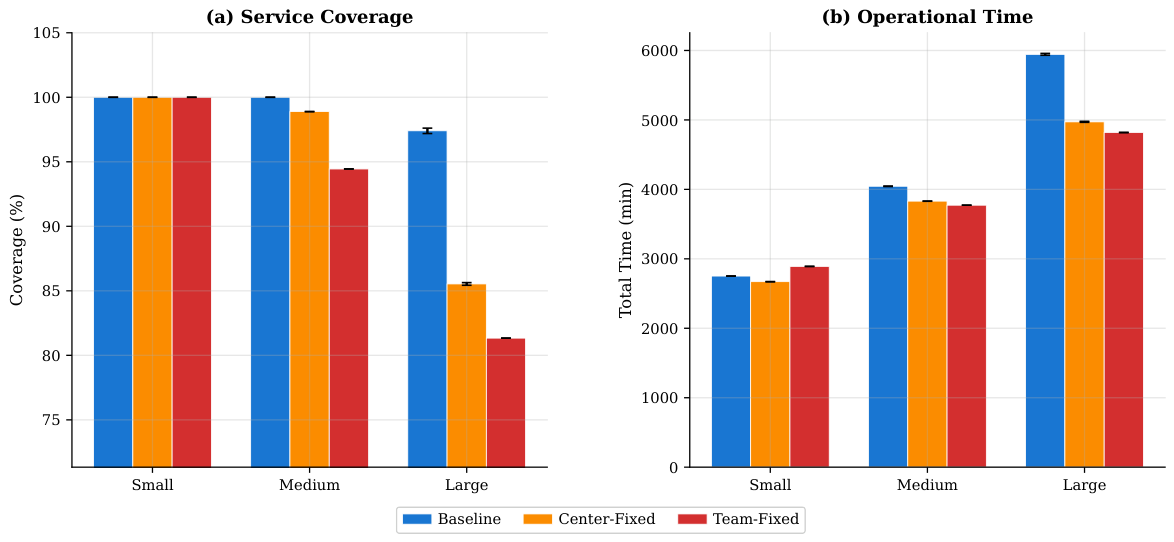
On the Large instance, the Baseline achieves coverage versus for Center-Fixed ( percentage points) and for Team-Fixed ( percentage points). A Friedman test confirms significant differences (, , Kendall’s , large effect with perfect rank consistency across seeds), and all pairwise comparisons are significant after Holm–Bonferroni correction (adjusted , Wilcoxon –, all large effects). The constrained scenarios show lower total time, but only because they serve fewer customers. The coverage gap between Baseline and Team-Fixed grows from 0 (Small) to (Medium) to percentage points (Large), confirming that the value of flexible assignment increases with fleet saturation.
Figure 5a makes the coverage–flexibility relationship explicit: on the Small instance all three scenarios overlap at 100%, but the lines diverge progressively as the instance grows, with Team-Fixed trailing the Baseline by
percentage points on Large. Panel (b) shows that the constrained scenarios report lower total operational time precisely because they serve fewer customers, a misleading advantage that the coverage panel corrects.
6.8. Experiment 5: Priority × Flexibility Interaction
Table 15 reports coverage and priority feasibility on the Large instance across all scenario–priority combinations.
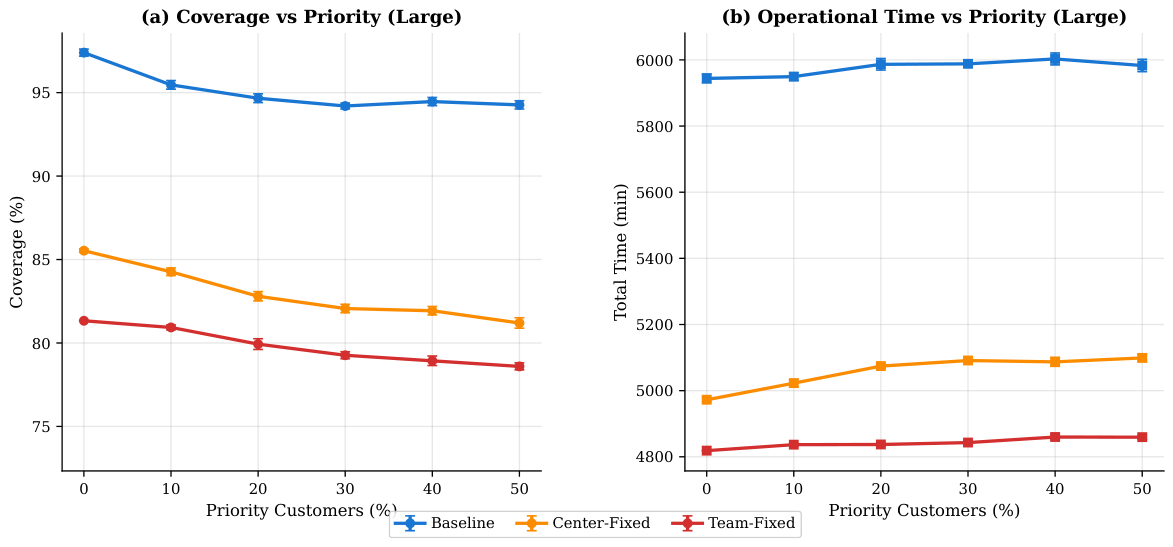
Priority and assignment rigidity interact super-additively. The coverage drop from 0% to 50% priority is percentage points for Baseline but percentage points for Center-Fixed. The lower panel counts in how many of the 10 seeds every priority customer was served (“—” at 0% indicates no priority customers exist). Baseline serves all priority customers in every seed at all priority levels (10/10). Center-Fixed fails in 1 seed at 50% priority (9/10). Team-Fixed degrades sharply: at 40% priority it fails in 1 seed, and at 50% it fails in 8 out of 10 seeds (only 2/10), while also achieving only coverage.
Figure 6a makes the super-additive interaction visible: the Baseline coverage curve is nearly flat as priority rises (a drop of only
percentage points from 0% to 50%), whereas the Team-Fixed curve steepens sharply, reaching
at 50% priority. Panel (b) shows the corresponding total-time trajectories; Team-Fixed’s lower time again reflects reduced coverage rather than routing efficiency, and its steep rise at high priority levels indicates the growing cost of forced feasibility under rigid assignment.
6.9. Experiment 6: Threshold Sensitivity
We assess robustness of the pipeline’s performance to its fixed thresholds by sweeping each of the seven parameters described in
Section 5.10 one-at-a-time around its default value, holding the others fixed. The seed-noise floor at the default configuration is
min on a mean total time of
min (coefficient of variation
across the 10 baseline seeds).
Table 16 reports for each parameter the range of mean total times observed across levels, normalised by
, together with the Kruskal–Wallis
p-value testing whether levels differ. A ratio
indicates that the parameter has no effect distinguishable from random seed variation; values
confirm that no statistically significant level effect is detected.
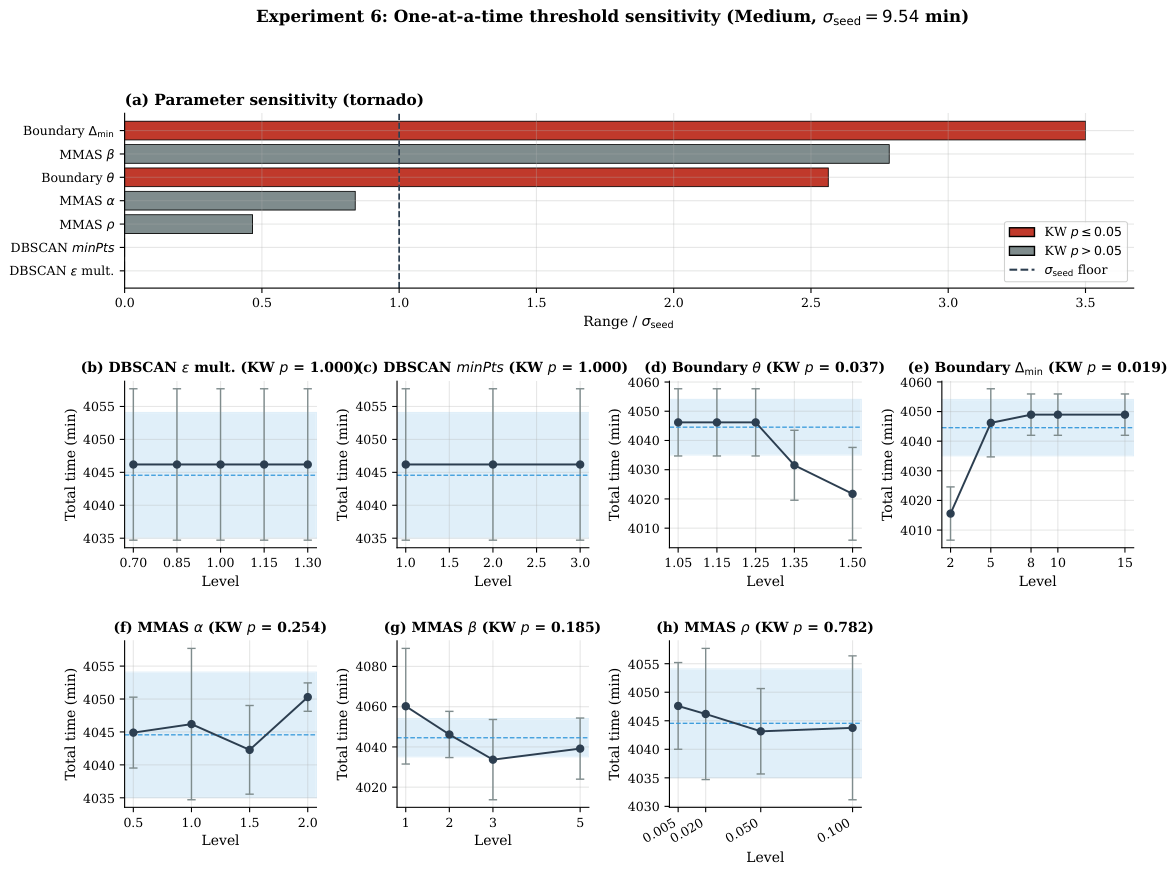
Three findings emerge. First, the two clustering thresholds (DBSCAN multiplier and ) produce identical depot assignments across the swept range, hence zero variation in total time, because the data-driven default formula and the capacity-constrained merging absorb local perturbations of the radius; extreme settings outside this range do break the merging pipeline (recorded as failures in the raw results), but those configurations lie far from any reasonable choice and are not in the table. Second, three of the remaining five parameters (MMAS , MMAS , in addition to the two clustering thresholds) have and Kruskal–Wallis : their effect on total time is empirically indistinguishable from random seed variation, so the corresponding default choices contribute no measurable advantage. Third, the Boundary Relocate filter parameters and do produce a statistically detectable effect ( and ), but the practical magnitude is small: the worst-to-best spread is min on and min on , that is, to the seed-noise floor and below of the mean total time. MMAS shows a comparable spread but no significant level effect (). Even the most sensitive thresholds therefore move the objective by less than the seed-to-seed difference between two clustering methods on the same instance, confirming that the pipeline’s headline gains are not the product of implicit tuning over the single applied case.
A confirmation run of the same OAT protocol on the Small dataset reproduces the qualitative finding: the seed-noise floor is even tighter ( min on a baseline mean of min, ), and none of the seven parameters produces a statistically significant level effect (all Kruskal–Wallis ). Absolute parameter-induced ranges remain below 13 min, that is, below of the mean total time on this instance. The pipeline is therefore robust to threshold choices across instance scales.
Figure 7 visualises these findings. Panel (a) is a tornado plot of
per parameter, with bars below the dashed
line falling within seed-noise; bars are coloured red where Kruskal–Wallis detects a level effect (
) and grey otherwise. Panel (b)–(h) plot the per-parameter response curves with the baseline
band shaded: five of the seven response curves remain inside the noise band over the entire swept range, and the two parameters with detectable level effects (
,
) move the objective by less than
of the baseline mean.
6.10. Discussion
The six experiments yield a coherent picture of how clustering, optimization, priority handling, and assignment flexibility jointly determine service quality. We organize the discussion around cross-cutting findings, then address limitations.
6.10.1. Clustering Drives Scalability
DBSCAN-Hierarchical’s topology-aware clusters enable full fleet utilization (13/13 vehicles on Large), which is the proximate cause of its
percentage points coverage advantage over Sweep. The silhouette–coverage inversion in
Figure 2c demonstrates that geometric compactness is a misleading proxy for operational quality in road-network settings. All coverage differences on the Large instance are statistically significant (Friedman
; all pairwise Holm-corrected
).
6.10.2. Post-Optimization Adapts to Saturation
Post-optimization saves 10–12 min on unsaturated instances (Small, Medium) and rescues unserved customers where fleet capacity is tight (Large), with both effects statistically significant (). Its role thus shifts from route smoothing to coverage recovery as the problem becomes harder.
6.10.3. Priority Robustness Requires All Three Mechanisms
The pipeline achieves 100% priority feasibility across all 330 tested configurations (Exp. 3a;
Figure 3b), at a route-time cost below 5%. Exp. 3b shows this guarantee is necessary: without the three priority mechanisms, feasibility collapses to 0/10 seeds on the Large instance at ≥40% priority (
Figure 4a; Wilcoxon
for coverage at every level,
Figure 4c). Exp. 3c isolates individual contributions: mechanism C (candidate-set restriction) alone achieves full feasibility; mechanism S (lexicographic selection) delivers the largest coverage gain (
–
,
pp above blind); mechanism R (repair ordering) alone is insufficient (1–4/10 feasible seeds). Exps. 3d and 3e probe the operational boundary of the lower-overhead S_only variant: at high priority loads (Exp. 3d,
priority), S_only’s feasibility degrades to
seeds while the combined
aware variant retains
, confirming that mechanism C’s structural guarantee is necessary at high load and not just defensive theory. Under spatially clustered priority (Exp. 3e), both variants retain full feasibility on the tested levels. The combined framework fuses these guarantees at a stable overhead below 5%.
6.10.4. Flexibility and Priority Interact Super-Additively
Experiments 1 and 4 together demonstrate that both clustering quality
and assignment flexibility are needed: neither alone is sufficient (
Figure 2a;
Figure 5a). Exp. 5 reveals that priority constraints amplify the damage of rigid assignment (
Figure 6a,b). The coverage drop from 0% to 50% priority is only
percentage points under flexible assignment but
percentage points under Center-Fixed. Team-Fixed at 50% priority collapses to 2/10 seeds with full priority service, the combined stress exceeds what either constraint imposes alone. These results show that the proposed framework’s value increases precisely when operational demands are highest.
6.10.5. Computational Performance
All experiments complete within practical time limits: the full pipeline executes in s for the Small instance (), s for Medium (), and s for Large (). DBSCAN-Hierarchical clustering itself adds negligible overhead (<0.6 s). The Baseline consistently deploys , , and routes on Small, Medium, and Large, respectively. These timings confirm suitability for operational deployment, where daily route plans are computed during morning planning sessions.
6.10.6. Comparison with Current Practice
Relative to the company’s manual Team-Fixed approach, the proposed pipeline improves coverage by percentage points on the Large instance ( vs. ) and achieves full priority service in all 10 seeds where Team-Fixed succeeds in only 2 out of 10. All computations complete in under 30 s per instance.
6.10.7. Limitations
Several limitations should be noted, and we organize them by which stage of the pipeline they affect. First, the two-phase geographic merging procedure (Stage 1, Algorithm 1, lines 6–7) is tailored to the four-depot configuration of Algérie Telecom in the Guelma region, which separates along an east–west and a north–south axis. Applying the pipeline to MDVRP instances with a different number of depots, depot layouts that do not separate along orthogonal geographic axes, or service areas with strongly non-convex boundaries would require substituting these two steps with a generic capacity-constrained agglomerative merger on the medoid distance matrix
; the remainder of Stage 1 (DBSCAN density clustering, medoid computation,
k-NN noise assignment, capacity rebalancing) is domain-general. Second, Stages 2 and 3 (the priority-aware MMAS construction, the lexicographic acceptance rule, and the Boundary Relocate operator) are independent of the depot layout and apply to any MDVRP-PR instance, but their broader benchmark validation against published MDVRP metaheuristics is left to future work, as standard MDVRP benchmarks do not include priority constraints or the service-time structure inherent to our problem. Third, the MMAS hyperparameters (
= 1,
= 2,
= 0.02, 100 iterations) were fixed at the canonical MMAS defaults of Stützle and Hoos [
30] and not tuned per instance, which may leave room for further improvement. Fourth, priority customers are selected uniformly at random in most of our experiments; Experiment 3e probes spatially clustered priority within a single TC’s territory, but other clustering patterns (multi-zone outbreaks, temporally bunched arrivals) are not exercised here. Fifth, the model is deterministic and static; stochastic travel times, dynamic customer arrivals, and vehicle breakdowns are not considered. Sixth, per-depot MMAS instances are solved sequentially; parallelizing across depots would reduce wall-clock time roughly proportionally. The evaluation accordingly reports an applied case study rather than a domain-general benchmark, and the internal ablation design (2135 runs across controlled variants) provides rigorous evidence for each proposed component within that scope.
7. Conclusions
This paper addressed the Multi-Depot Vehicle Routing Problem with Priority Requests (MDVRP-PR), a practically motivated variant in which a subset of customers must be guaranteed service while overall coverage is maximized subject to duration-constrained routes and an asymmetric, real-world road network. The problem was formalized with a lexicographic objective that encodes the operational priority hierarchy of a utility company (Algérie Télécom, Guelma, Algeria), and a three-stage pipeline was developed to solve it: hybrid DBSCAN-Hierarchical clustering for topology-aware depot assignment, an Enhanced Max-Min Ant System (MMAS) for per-depot route construction with integrated priority-aware mechanisms, and a Boundary Relocate post-optimization stage with global cross-depot repair.
Across 2135 controlled runs, four findings stand out. Topology-aware clustering drives scalability: on the Large instance (n = 150), the proposed method achieves coverage by activating the full 13-vehicle fleet, against for K-Means with Euclidean coordinates, for the unbiased K-Means variant operating on the same road-distance metric as our method, for K-Medoids on road distance, and for the MDVRP-adapted Sweep baseline (Friedman p < 0.001, Kendall’s W = 0.97; all pairwise Holm-corrected p < 0.05, Wilcoxon r = 0.75–). The silhouette–coverage inversion across these methods confirms that geometric cluster compactness is a misleading proxy for operational quality in road-network settings. Post-optimization shifts from route smoothing to coverage recovery as fleet utilization tightens, rescuing unserved customers on the hardest instance (p < 0.01). The three priority mechanisms together guarantee priority feasibility across all tested configurations, a guarantee that collapses entirely without them ( seeds at priority), at a route-time overhead of only –. Finally, flexibility and priority interact super-additively: rigid Team-Fixed assignment at priority degrades to coverage and seeds with full priority service, while the proposed framework maintains coverage with full priority service in all seeds. Against current company practice, the pipeline delivers a percentage point coverage gain within 28 s.
The evaluation is an applied case study on a single real instance rather than a domain-general benchmark; the internal ablation design (2135 runs across controlled variants) provides rigorous evidence for each proposed component within that scope. Future work should extend the evaluation to standard MDVRP benchmarks with diverse depot layouts, incorporate automated hyperparameter configuration, and address stochastic travel times and dynamic arrivals to further broaden applicability.




 ,
,