Modeling and Optimization of a Mixed-Model Two-Sided Assembly Line Balancing Problem Considering a Workstation-Sharing Mechanism


Abstract
1. Introduction
2. Literature Review
2.1. From SALBP to MTALBP
2.2. Metaheuristic Approaches in ALBP
2.3. The Issue of Balancing EVs and FVs from a Cross-Disciplinary Perspective
2.4. Summary
3. Mathematical Model
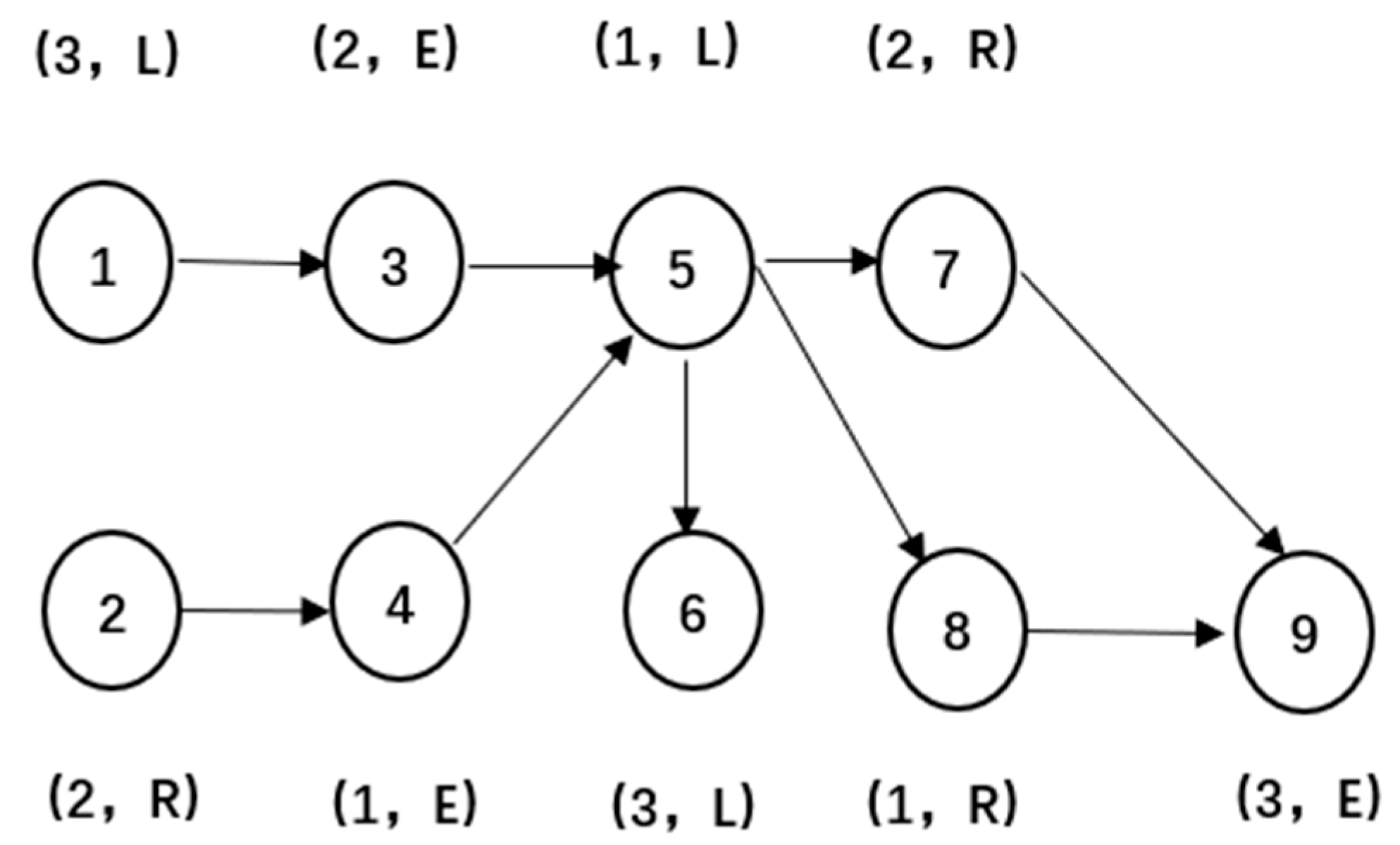
3.1. Problem Statement
3.2. Model Assumptions
- (1)
- The priority relationships of all tasks are known and remain unchanged.
- (2)
- Each task can only be assigned to a unique workstation and cannot be divided.
- (3)
- Any task can theoretically be assigned to any workstation (without considering space limitations).
- (4)
- The additional time consumption during the workstation switching for different product models is not considered.
- (5)
- The time consumed during the transportation of the product between workstations is not considered.
- (6)
- The standard operation time for all tasks is a fixed value that has been scientifically determined in advance.
- (7)
- The completion time of the task does not vary depending on the workstation or the worker.
- (8)
- The assembly line workers have consistent proficiency and can complete all types of tasks.
- (9)
- The time required for different workers to complete the same task is the same.
- (10)
- The total working hours allocated to each worker for their tasks must not exceed the cycle time.
- (11)
- One worker is assigned to each side of each workstation, and they respectively complete all the tasks assigned to their respective sides.
3.3. Mathematical Formulation
3.3.1. Notation Description
3.3.2. Model Formulation
3.3.3. Model Constraints
3.4. Model Summary and Discussion
4. Algorithm Design
4.1. Algorithm Procedure
4.1.1. Encoding
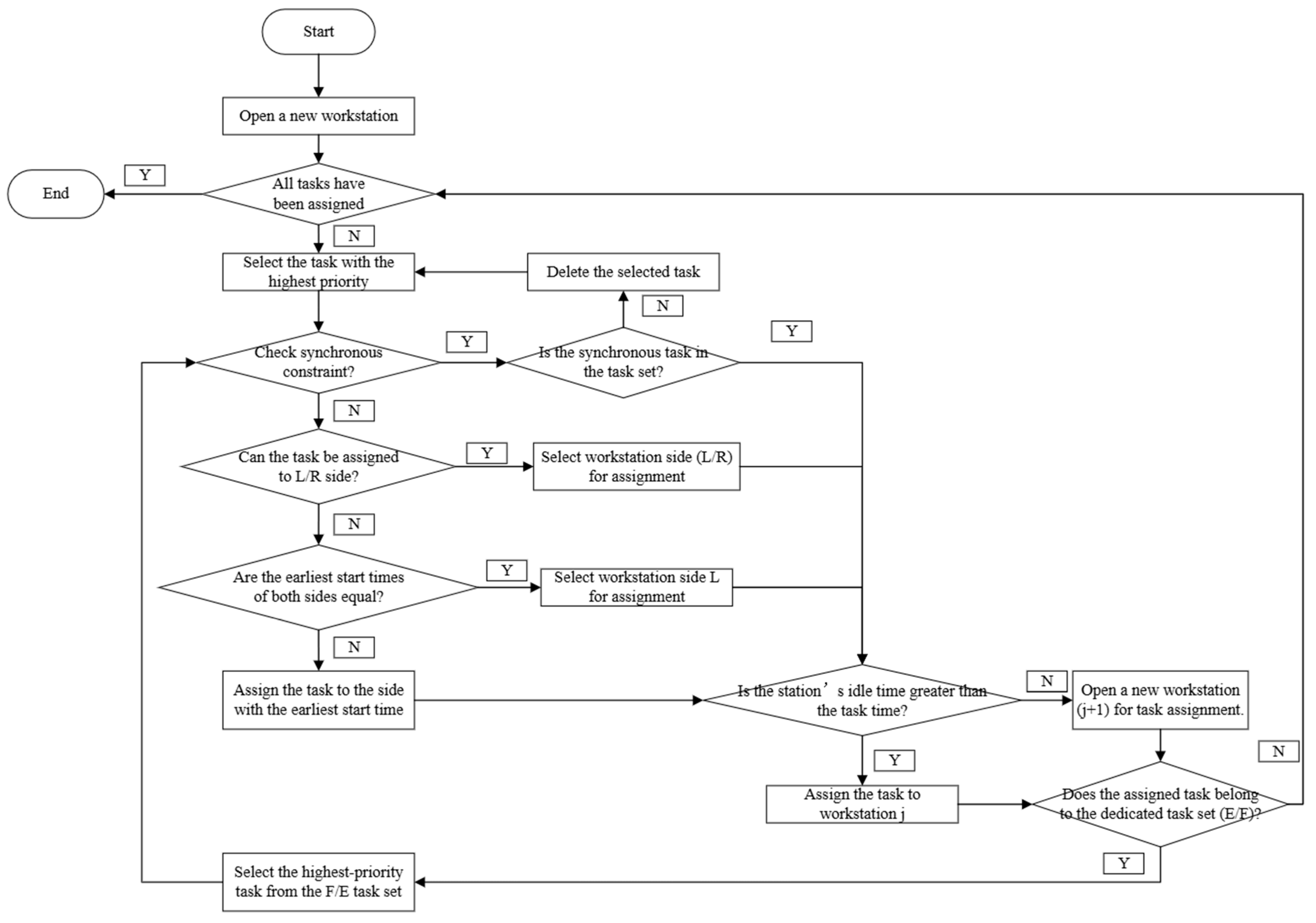
4.1.2. Decoding
4.1.3. Population Initialization
- (1)
- In the job element set , find the job elements without preceding job elements or whose preceding job elements have been assigned, and name them
- (2)
- Randomly select one job element from set to form a chromosome sequence, and remove the job element from the set
- (3)
- Repeat the above steps until all job elements in I have been assigned, completing the initialization of one complete chromosome.
- (4)
- According to the population size , repeat the above operation NP times, then initialize and form chromosomes.
4.1.4. Fitness Evaluation
4.2. Genetic Operators
4.2.1. Selection Operator
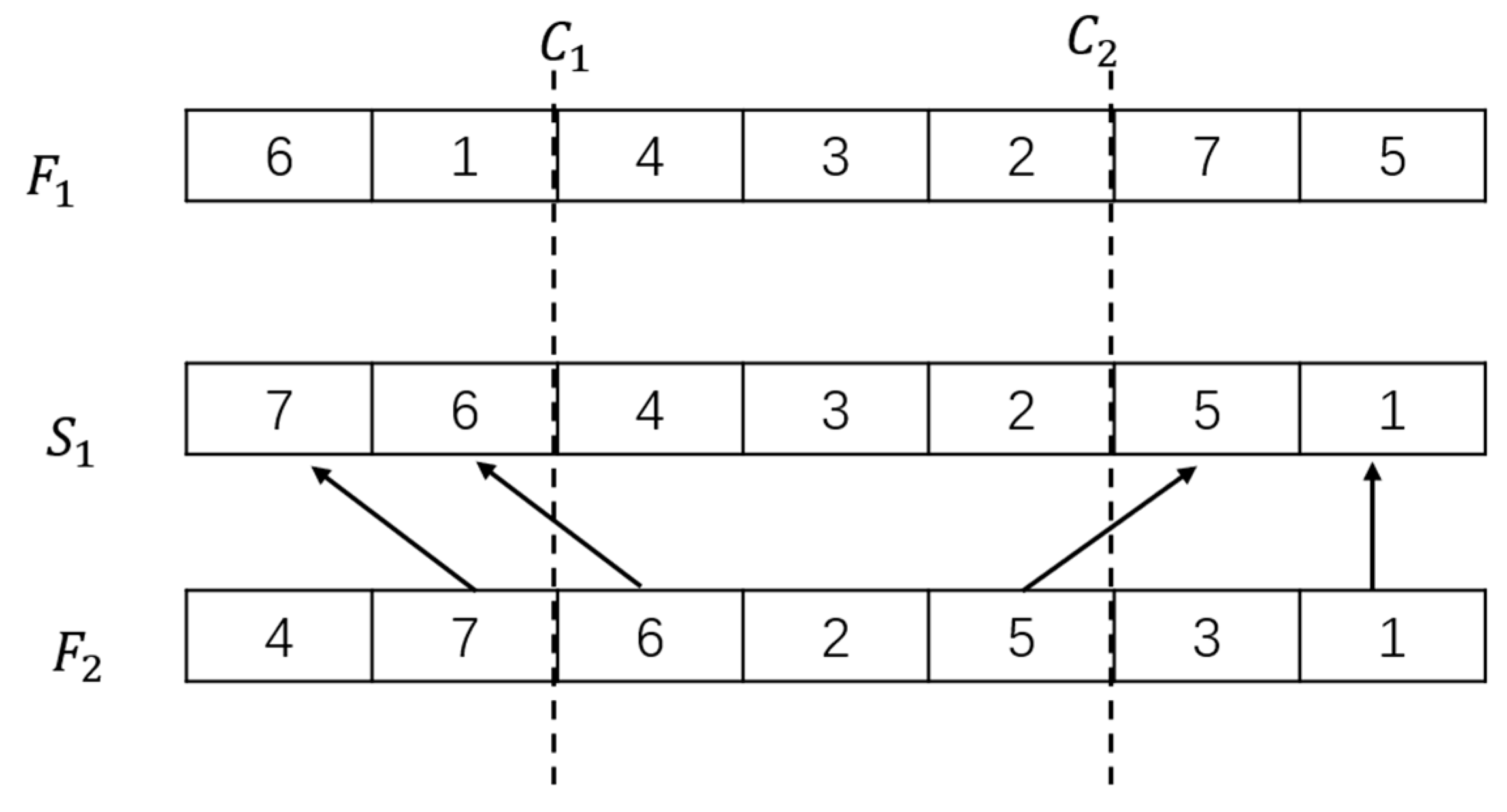
4.2.2. Crossover Operator
4.2.3. Mutation Operator
- (1)
- Randomly determine the variation point of the individual and traverse all the direct predecessors and successors of operation at position in the matrix , and determine their positions in the new chromosome.
- (2)
- Let the gene position of the last operation among all the immediate predecessors of operation be , and the gene position of the first operation among all the immediate successors be
- (3)
- Randomly insert the gene at into any position within the interval , generating a new individual.
4.3. Termination Criteria
4.4. Rationale for GA Component Selection
4.5. Pseudocode
| Input: I : set of tasks with precedence constraints ET, FT, PT : EV-exclusive, FV-exclusive, and shared task sets SC : set of synchronous task pairs CT : cycle time GA params : PopSize, MaxGen, Pc, Pm, EliteRate Output: BestSol : best decoded workstation assignment BestFit : best fitness value (penalty, #stations, smoothness) ----------------------------------------------------------- 1: // Initialization 2: Generate an initial population Pop of size PopSize. 3: t ← 0, BestFit ← +∞, BestSol ← ∅ 4: // Main GA loop 5: while t < MaxGen do 6: for each chromosome χ in Pop do 7: Sol ← DecodeSolution(χ, CT, SC, ET, FT, PT) 8: Fit(χ) ← EvaluateFitness(Sol) 9: end for 10: Sort Pop by Fit(χ) in ascending order 11: if Fit(Pop(1)) < BestFit then 12: BestFit ← Fit(Pop(1)) 13: BestSol ← decoded solution of Pop(1) 14: end if 15: EliteNum ← round(EliteRate × PopSize) 16: EliteSet ← first EliteNum chromosomes of Pop 17: ParentSet ← roulette-wheel selection of (PopSize − EliteNum) parents 18: Offspring ← ∅ 19: while |Offspring| < (PopSize − EliteNum) do 20: Select parents p1, p2 21: With probability Pc, apply order-based crossover (c1, c2) 22: Otherwise, c1 ← p1, c2 ← p2 23: With probability Pm, apply neighborhood insertion mutation to c1 and c2 24: Offspring ← Offspring ∪ {c1, c2} 25: end while 26: Truncate Offspring to required size if needed 27: Pop ← EliteSet ∪ Offspring 28: t ← t + 1 29: end while 30: return BestSol, BestFit ----------------------------------------------------------- |
5. Case Study
5.1. Case Background
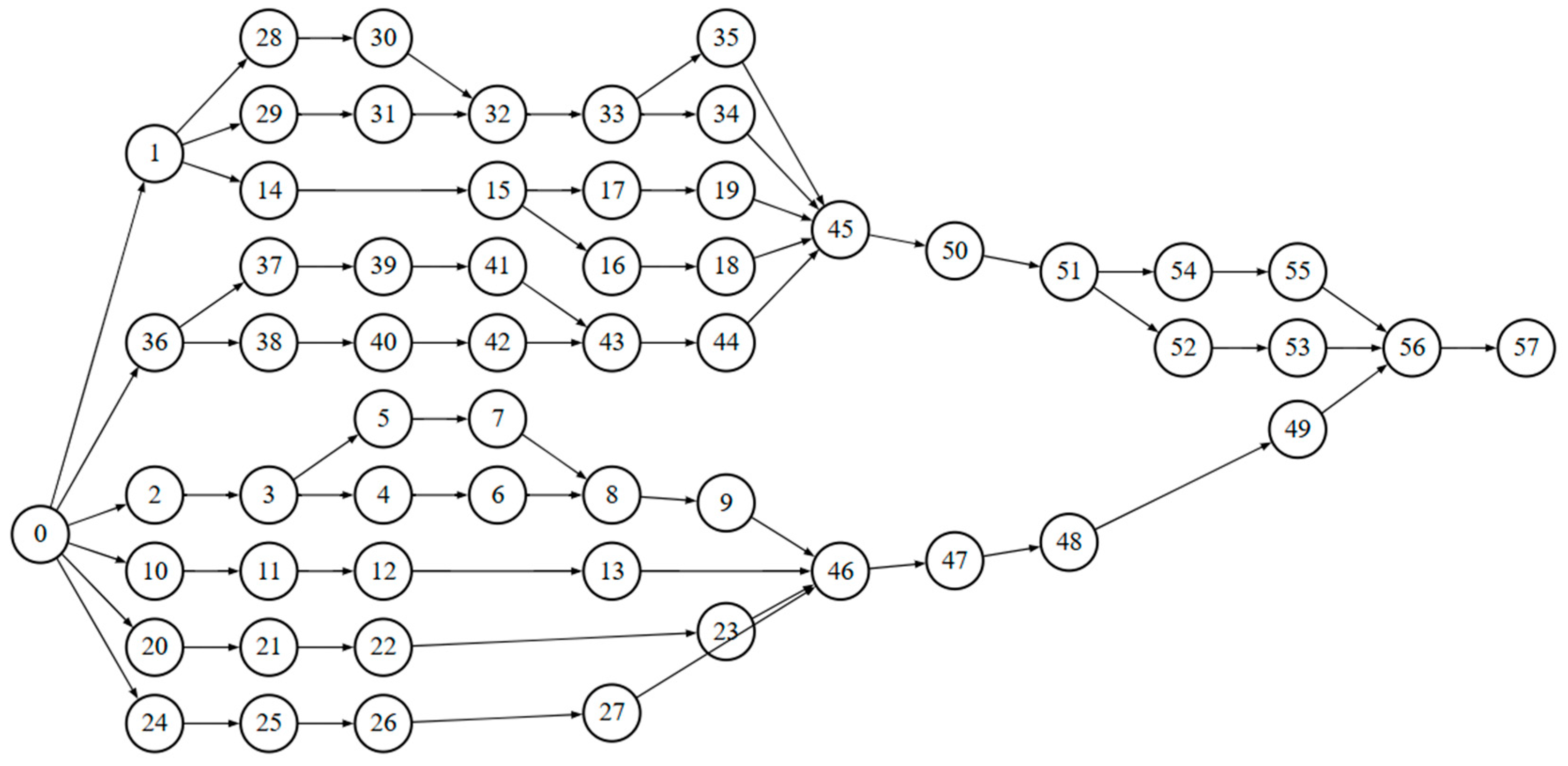
5.2. Data Description
5.3. Experimental Results and Analysis
6. Conclusions and Future Directions
6.1. Conclusion and Managerial Implications
6.2. Future Research Directions
Author Contributions
Funding
Institutional Review Board Statement
Informed Consent Statement
Data Availability Statement
Conflicts of Interest
Abbreviations
| NEV | New energy vehicle |
| FV | Fuel vehicle |
| EV | Electric vehicle |
| MTALBP | Mixed-model two-sided assembly line balancing problem |
| MTAL | Mixed-model two-sided assembly line |
| IGV | Improved genetic algorithm |
| ALBP | Assembly Line Balancing Problem |
| SALBP | Single-Model Assembly Line Balancing Problem |
| MALBP | Mixed-Model Assembly Line Balancing Problem |
| TALBP | Two-Sided Assembly Line Balancing Problem |
| GA | Genetic Algorithm |
| ET | EV-exclusive tasks |
| FT | FV-exclusive tasks |
Appendix A
Procedure DecodeSolution(χ, I, Pre, Side, Time, ET, FT, PT, SC, CT): Input: χ : precedence-feasible chromosome (task sequence) I : set of all tasks Pre : predecessor lists Pre(i) Side : fixed side of task i (1 = left, 2 = right, 0 = flexible) Time : processing time for each task ET, FT, PT : EV-exclusive, FV-exclusive, and shared tasks SC : synchronous task pairs (i, h) CT : cycle time of paired workstation Output: Sol : assignment of tasks to stations and sides Tjd : loads on each side of each station W1 : number of stations W2 : smoothness index penalty : infeasibility measure ----------------------------------------------------------- 1: // Initialization 2: Mark all tasks as unassigned 3: j ← 1 // current station 4: Open workstation j with empty buckets L and R: 5: cur{1} ← ∅, cur{2} ← ∅ 6: buckL ← (pt=0, et=0, ft=0) 7: buckR ← (pt=0, et=0, ft=0) 8: penalty ← 0 9: while there exist unassigned tasks do 10: // Step 1: Build candidate set 11: P ← { i ∈ I | all predecessors in Pre(i) are assigned } 12: // Step 2: Select next task according to priority in χ 13: oi ← first task in χ that belongs to P 14: // Step 3: Check synchronous constraint 15: if oi has a sync partner oh ∈ SC and oh ∈ P then 16: Determine sides for oi and oh according to Side 17: If both sides feasible and eff(newL) ≤ CT and eff(newR) ≤ CT then 18: Assign oi, oh to current station j 19: else 20: Open new station j ← j + 1 21: Assign oi and oh there 22: end if 23: Mark both tasks as assigned and continue to next iteration 24: end if 25: // Step 4: Non-synchronous task placement 26: s ← Side(oi) // fixed or flexible 27: Attempt to place oi to side s (if s = 0, evaluate both sides) 28: If placing oi exceeds CT on both sides: 29: Open new station j ← j + 1 30: Place oi into the new station 31: Mark oi as assigned 32: // Step 5: Workstation-sharing mechanism (EV/FV complement) 33: if oi ∈ ET or oi ∈ FT then 34: Determine complementary set: 35: If oi ∈ ET → Scomp ← FT 36: If oi ∈ FT → Scomp ← ET 37: Choose highest-priority ok ∈ (P ∩ Scomp) 38: if ok exists and adding ok to current station j does not violate CT then 39: Assign ok to the station (left or right depending on load) 40: Mark ok as assigned 41: Mark station j as a shared workstation 42: end if 43: end if 44: end while 45: // Step 6: Close station if needed 46: If current station j is not empty, finalize it 47: // Step 7: Compute performance indicators 48: W1 ← total number of stations 49: For each station j: 50: Compute loads TjL = eff(buckL) 51: Compute loads TjR = eff(buckR) 52: Append both to load vector L 53: W2 ← variance(L) 54: return Sol, Tjd, W1, W2, penalty ----------------------------------------------------------- Notes: - eff(b) = max(b.pt + b.et, b.pt + b.ft) defines the effective load used in MATLAB. - The procedure follows the actual implementation logic, including precedence, synchronization, side selection, load updates, and EV–FV workstation sharing. |
References
- Global EV Outlook 2025—Analysis. Available online: https://www.iea.org/reports/global-ev-outlook-2025 (accessed on 22 October 2025).
- Jia, G.; Zhang, Y.; Shen, S.; Liu, B.; Hu, X.; Wu, C. Load Balancing of Two-Sided Assembly Line Based on Deep Reinforcement Learning. Appl. Sci. 2023, 13, 7439. [Google Scholar] [CrossRef]
- Fattahi, P.; Roshani, A.; Roshani, A. A Mathematical Model and Ant Colony Algorithm for Multi-Manned Assembly Line Balancing Problem. Int. J. Adv. Manuf. Technol. 2011, 53, 363–378. [Google Scholar] [CrossRef]
- Biele, A.; Mönch, L. Hybrid Approaches to Optimize Mixed-Model Assembly Lines in Low-Volume Manufacturing. J. Heuristics 2018, 24, 49–81. [Google Scholar] [CrossRef]
- Çil, Z.A.; Mete, S.; Ağpak, K. Analysis of the Type II Robotic Mixed-Model Assembly Line Balancing Problem. Eng. Optim. 2017, 49, 990–1009. [Google Scholar] [CrossRef]
- Bautista, J.; Alfaro-Pozo, R.; Batalla-García, C. Minimizing Lost-Work Costs in a Mixed-Model Assembly Line. In Closing the Gap Between Practice and Research in Industrial Engineering; Viles, E., Ormazábal, M., Lleó, A., Eds.; Lecture Notes in Management and Industrial Engineering; Springer International Publishing: Cham, Switzerland, 2018; pp. 213–221. ISBN 978-3-319-58408-9. [Google Scholar]
- Bautista, J.; Pereira, J. A Dynamic Programming Based Heuristic for the Assembly Line Balancing Problem. Eur. J. Oper. Res. 2009, 194, 787–794. [Google Scholar] [CrossRef]
- Kim, Y.K.; Kim, Y.; Kim, Y.J. Two-Sided Assembly Line Balancing: A Genetic Algorithm Approach. Prod. Plan. Control 2000, 11, 44–53. [Google Scholar] [CrossRef]
- Khorasanian, D.; Hejazi, S.R.; Moslehi, G. Two-Sided Assembly Line Balancing Considering the Relationships between Tasks. Comput. Ind. Eng. 2013, 66, 1096–1105. [Google Scholar] [CrossRef]
- Kim, Y.K.; Song, W.S.; Kim, J.H. A Mathematical Model and a Genetic Algorithm for Two-Sided Assembly Line Balancing. Comput. Oper. Res. 2009, 36, 853–865. [Google Scholar] [CrossRef]
- Özcan, U.; Toklu, B. Balancing of Mixed-Model Two-Sided Assembly Lines. Comput. Ind. Eng. 2009, 57, 217–227. [Google Scholar] [CrossRef]
- Chutima, P.; Chimklai, P. Multi-Objective Two-Sided Mixed-Model Assembly Line Balancing Using Particle Swarm Optimisation with Negative Knowledge. Comput. Ind. Eng. 2012, 62, 39–55. [Google Scholar] [CrossRef]
- Delice, Y.; Kızılkaya Aydoğan, E.; Özcan, U.; İlkay, M.S. A Modified Particle Swarm Optimization Algorithm to Mixed-Model Two-Sided Assembly Line Balancing. J. Intell. Manuf. 2017, 28, 23–36. [Google Scholar] [CrossRef]
- Kucukkoc, I.; Zhang, D.Z. Mixed-Model Parallel Two-Sided Assembly Line Balancing Problem: A Flexible Agent-Based Ant Colony Optimization Approach. Comput. Ind. Eng. 2016, 97, 58–72. [Google Scholar] [CrossRef]
- Simaria, A.S.; Vilarinho, P.M. A Genetic Algorithm Based Approach to the Mixed-Model Assembly Line Balancing Problem of Type II. Comput. Ind. Eng. 2004, 47, 391–407. [Google Scholar] [CrossRef]
- Yuan, P.; Guan, M. Research on Type I Two-Sided Assembly Line Balancing Problem Based on Improved Fruit Fly Optimization Algorithm. Mod. Manuf. Eng. 2022, 499, 29. [Google Scholar]
- Duan, Y.; Su, T.; Zheng, C. A Two-Stage Method for Solving the Stochastic Two-Sided Mixed-Model Assembly Line Balancing Problem. Ind. Eng. J. 2016, 19, 134–142. [Google Scholar]
- Yadav, A.; Agrawal, S. Multi-Manned Assembly Line Balancing Using Exact Solution Approach—A Case Study of a Tricycle Assembly Line. Int. J. Serv. Oper. Manag. 2022, 41, 241–259. [Google Scholar] [CrossRef]
- Huang, H.; Jiang, C.; Ren, X.; Zhou, X. Research on Improving the Balance Problem of Multi Objective Bilateral Assembly Lines. Mech. Sci. Technol. 2021, 40, 900–908. [Google Scholar]
- Liao, S.-G.; Zhang, Y.-B.; Sang, C.-Y.; Liu, H. A Genetic Algorithm for Balancing and Sequencing of Mixed-Model Two-Sided Assembly Line with Unpaced Synchronous Transfer. Appl. Soft Comput. 2023, 146, 110638. [Google Scholar] [CrossRef]
- Wang, K.; Guan, S.; Yin, X.; Li, X.; Tang, H. Research on Mixed-model Assembly Line Balancing Optimization Based on Hybrid Genetic Tabu Search Algorithm. J. Syst. Simul. 2025, 37, 14. [Google Scholar]
- Lin, L.; Wei, L.; Liu, T.; Zhang, H.; Qin, P.; Leng, J.; Zhang, D.; Liu, Q. Hierarchical and Two-Stage Framework for the Paced Mixed-Model Assembly Line Balancing and Sequencing Problem Considering Ergonomic Risk. Eng. Optim. 2024, 56, 1098–1121. [Google Scholar] [CrossRef]
- Tanhaie, F. Applying a Multi-Objective Particle Swarm Optimization Algorithm for Sequencing and Balancing a Mixed-Model Assembly Line Problem with Setup Times Between Tasks. J. Appl. Res. Ind. Eng. 2024, 11, 350–368. [Google Scholar] [CrossRef]
- Belkharroubi, L.; Yahyaoui, K. Solving the Mixed-Model Assembly Line Balancing Problem Type-I Using a Hybrid Reactive GRASP. Prod. Manuf. Res. 2022, 10, 108–131. [Google Scholar] [CrossRef]
- Didden, J.B.H.C.; Lefeber, E.; Adan, I.J.B.F.; Panhuijzen, I.W.F. Genetic Algorithm and Decision Support for Assembly Line Balancing in the Automotive Industry. Int. J. Prod. Res. 2023, 61, 3377–3395. [Google Scholar] [CrossRef]
- Li, Y.; Liu, D.; Kucukkoc, I. Mixed-Model Assembly Line Balancing Problem Considering Learning Effect and Uncertain Demand. J. Comput. Appl. Math. 2023, 422, 114823. [Google Scholar] [CrossRef]
- Çimen, T.; Baykasoğlu, A.; Akyol, Ş. Assembly Line Rebalancing and Worker Assignment Considering Ergonomic Risks in an Automotive Parts Manufacturing Plant. Int. J. Ind. Eng. Comput. 2022, 13, 363–384. [Google Scholar] [CrossRef]
- Khan, W.A.; Chung, S.-H.; Ma, H.-L.; Liu, S.Q.; Chan, C.Y. A Novel Self-Organizing Constructive Neural Network for Estimating Aircraft Trip Fuel Consumption. Transp. Res. Part E Logist. Transp. Rev. 2019, 132, 72–96. [Google Scholar] [CrossRef]
- Khan, W.A.; Ma, H.-L.; Ouyang, X.; Mo, D.Y. Prediction of Aircraft Trajectory and the Associated Fuel Consumption Using Covariance Bidirectional Extreme Learning Machines. Transp. Res. Part E Logist. Transp. Rev. 2021, 145, 102189. [Google Scholar] [CrossRef]
- Ullah, M.; Khan, I.; Malik, A.I.; Khan, W.A.; Saleh, H. Optimizing Supply Chain Profit by Categorizing Non-Reworkable Defective Items. Arab. J. Sci. Eng. 2024, 49, 7611–7624. [Google Scholar] [CrossRef]
- Londe, M.A.; Pessoa, L.S.; Andrade, C.E.; Resende, M.G.C. Biased Random-Key Genetic Algorithms: A Review. Eur. J. Oper. Res. 2025, 321, 1–22. [Google Scholar] [CrossRef]
- Sánchez-Sosa, R.-A.; Chavero-Navarrete, E. Robotic Cell Layout Optimization Using a Genetic Algorithm. Appl. Sci. 2024, 14, 8605. [Google Scholar] [CrossRef]
- Chen, Z.; Xu, X.; Liu, H. Improved Dual-Population Genetic Algorithm: A Straightforward Optimizer Applied to Engineering Optimization. Sustainability 2023, 15, 14821. [Google Scholar] [CrossRef]



| Symbol | Meaning |
|---|---|
| Indices representing task operations | |
| Indices representing workstations | |
| Index representing the product type | |
| Indices representing sides of the workstation | |
| A paired workstation j operating on side d | |
| Set all tasks, | |
| Set of all paired workstations, | |
| M | Set representing the two product types (FV and EV), |
| D | Set indicating assembly directions (left and right sides), |
| Processing time of task i for product type m. | |
| Starting time of task i for product type m | |
| Finishing time of task i for product type m | |
| Cycle time of the assembly line | |
| Completion time of task i | |
| Set of tasks that must be assigned to the left side, | |
| Set of tasks that must be assigned to the right side, | |
| Set of tasks that can be assigned to either side, | |
| Set of immediate predecessors of task i | |
| Set of all predecessors of task i. | |
| Set of tasks without predecessors | |
| A sufficiently large positive constant (Big-M) | |
| Binary variable: equals 1 if task i is assigned to workstation j on side d; otherwise, 0. | |
| Binary variable: equals 1 if workstation j is used; otherwise, 0. | |
| Binary variable: equals 1 if workstation j is a shared (mixed) workstation; otherwise, 0. | |
| Set of synchronous task pairs that must be executed simultaneously on both sides, | |
| Set of EV-exclusive tasks | |
| Set of FV-exclusive tasks |
| Task ID | Operation Side | Task Time (s) | Immediate Predecessors | Task Set | Task ID | Operation Side | Task Time (s) | Immediate Predecessors | Task Set |
|---|---|---|---|---|---|---|---|---|---|
| 0 | 5 | - | 29 | 20 | 1 | ||||
| 1 | 30 | 0 | 30 | 20 | 28 | ||||
| 2 | 20 | 0 | 31 | 20 | 29 | ||||
| 3 | 6 | 2 | 32 | 32 | 30, 31 | ||||
| 4 | 24 | 3 | 33 | 32 | 32 | ||||
| 5 | 32 | 3 | 34 | 32 | 33 | ||||
| 6 | 15 | 4 | 35 | 32 | 33 | ||||
| 7 | 15 | 5 | 36 | 28 | 0 | ||||
| 8 | 24 | 6, 7 | 37 | 20 | 36 | ||||
| 9 | 15 | 8 | 38 | 20 | 36 | ||||
| 10 | 15 | 0 | 39 | 24 | 37 | ||||
| 11 | 24 | 10 | 40 | 24 | 38 | ||||
| 12 | 20 | 11 | 41 | 5 | 39 | ||||
| 13 | 20 | 12 | 42 | 5 | 40 | ||||
| 14 | 19 | 1 | 43 | 24 | 41, 42 | ||||
| 15 | 5 | 14 | 44 | 24 | 43 | ||||
| 16 | 10 | 15 | 45 | 16 | 34, 35, 18, 19, 44 | ||||
| 17 | 10 | 15 | 46 | 26 | 9, 13, 23, 27 | ||||
| 18 | 10 | 16 | 47 | 36 | 46 | ||||
| 19 | 10 | 17 | 48 | 20 | 47 | ||||
| 20 | 11 | 0 | 49 | 10 | 48 | ||||
| 21 | 13 | 20 | 50 | 25 | 45 | ||||
| 22 | 10 | 21 | 51 | 20 | 50 | ||||
| 23 | 7 | 22 | 52 | 13 | 51 | ||||
| 24 | 27 | 0 | 53 | 25 | 52 | ||||
| 25 | 24 | 24 | 54 | 15 | 51 | ||||
| 26 | 8 | 25 | 55 | 5 | 54 | ||||
| 27 | 3 | 26 | 56 | 20 | 49, 53, 55 | ||||
| 28 | 20 | 1 | 57 | 12 | 56 |
| Run | Stations | Idle Sum | Best Fitness |
|---|---|---|---|
| 1 | 9 | 60 | 906,014.8235 |
| 2 | 9 | 60 | 906,013.0588 |
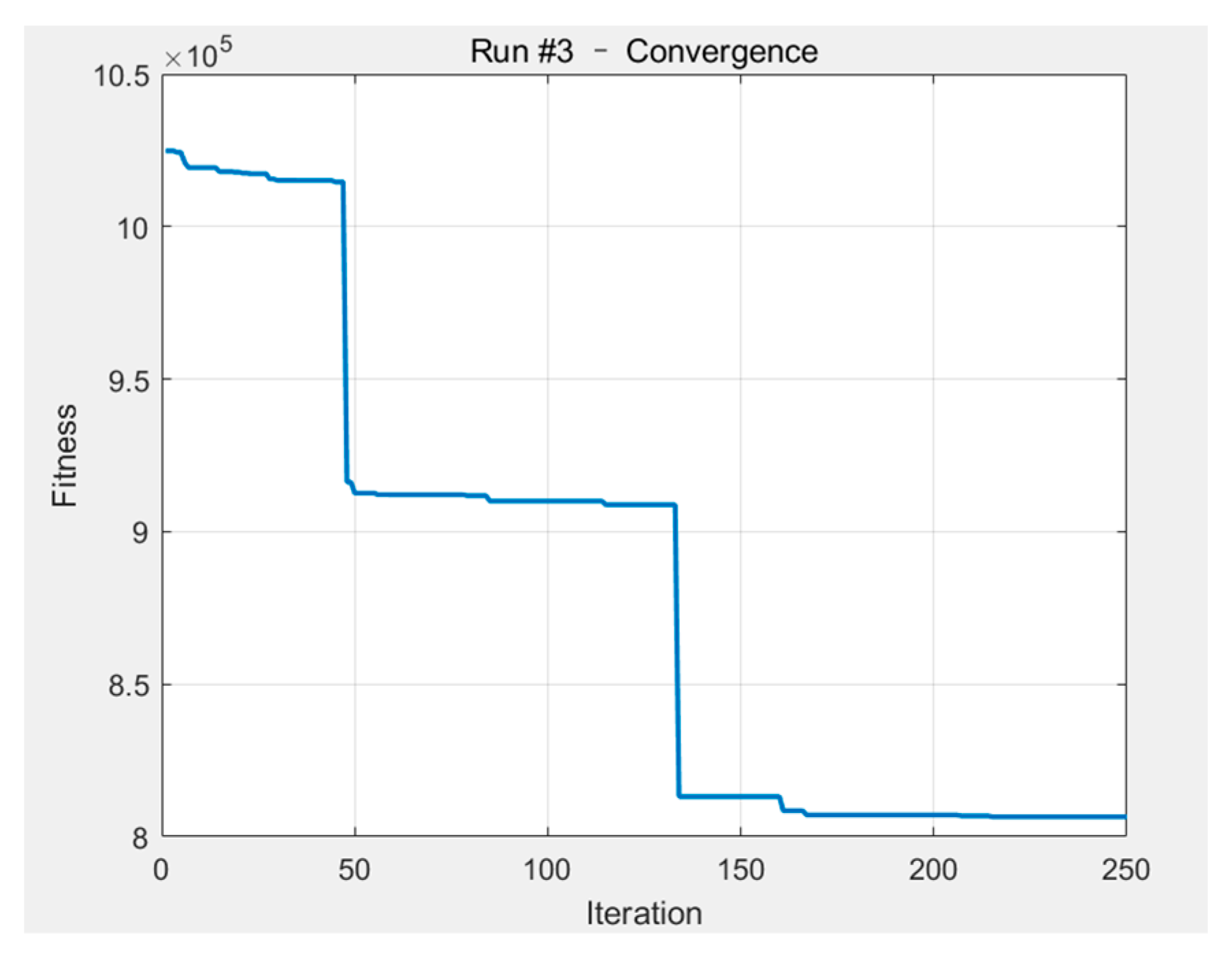
| 3 | 8 | 65 | 806,516.3292 |
| 4 | 8 | 83 | 808,319.0958 |
| 5 | 9 | 102 | 910,213.4118 |
| 6 | 9 | 48 | 904,804.8235 |
| 7 | 9 | 71 | 907,111.7026 |
| 8 | 9 | 105 | 910,520.0294 |
| 9 | 9 | 88 | 908,816.8105 |
| 10 | 9 | 90 | 909,015.1765 |
| 11 | 9 | 64 | 906,405.2026 |
| 12 | 8 | 77 | 807,714.8292 |
| 13 | 9 | 78 | 907,816.9412 |
| 14 | 9 | 87 | 908,722.8529 |
| 15 | 9 | 81 | 908,113.4412 |
| 16 | 9 | 82 | 908,215.4379 |
| 17 | 9 | 79 | 907,918.9575 |
| 18 | 9 | 105 | 910,515.9118 |
| 19 | 9 | 74 | 907,418.3399 |
| 20 | 8 | 66 | 806,614.5167 |
| Station | EV (Model 1) | FV (Model 1) | EV (Model 2) | FV (Model 2) |
|---|---|---|---|---|
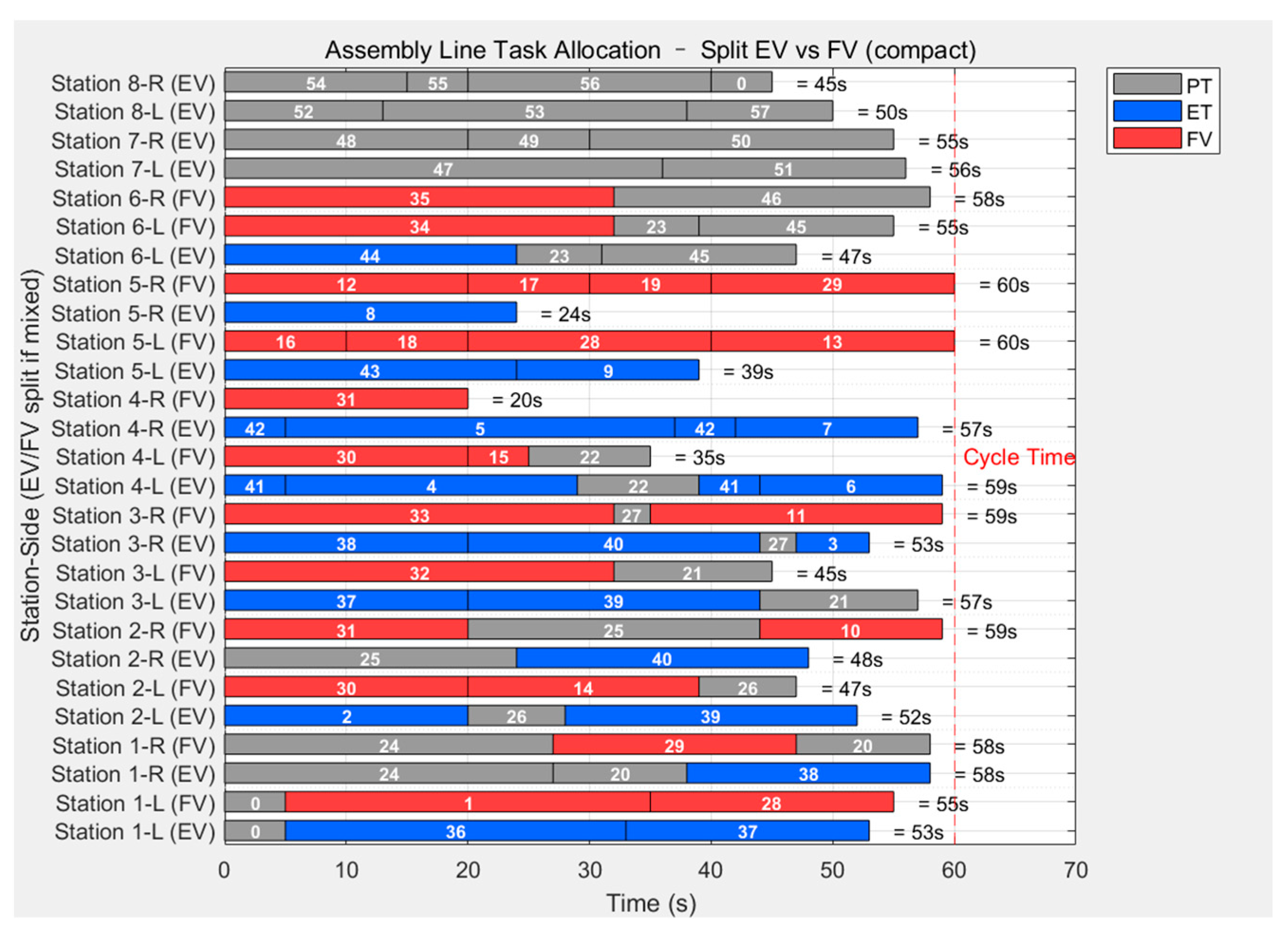
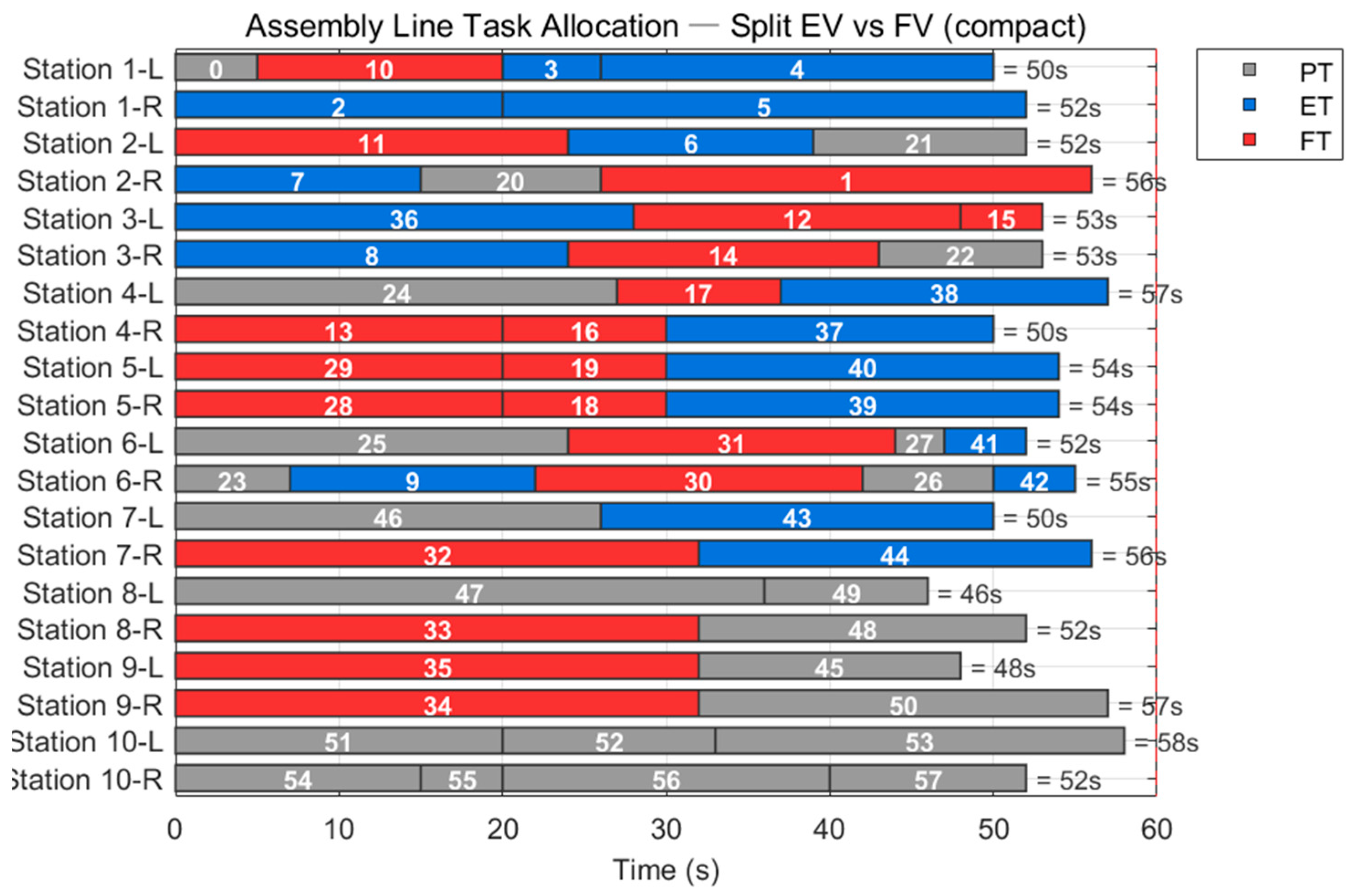
| Station1L | 35 | 20 | 53 | 55 |
| Station1R | 52 | 0 | 58 | 58 |
| Station2L | 37 | 28 | 52 | 47 |
| Station2R | 26 | 41 | 48 | 59 |
| Station3L | 28 | 25 | 57 | 45 |
| Station3R | 34 | 29 | 53 | 59 |
| Station4L | 47 | 37 | 59 | 35 |
| Station4R | 20 | 30 | 57 | 20 |
| Station5L | 24 | 30 | 39 | 60 |
| Station5R | 54 | 30 | 24 | 60 |
| Station6L | 32 | 47 | 47 | 55 |
| Station6R | 35 | 35 | 26 | 58 |
| Station7L | 50 | 26 | 56 | 56 |
| Station7R | 24 | 32 | 55 | 55 |
| Station8L | 46 | 46 | 50 | 50 |
| Station8R | 20 | 52 | 45 | 45 |
| Station9L | 16 | 48 | - | - |
| Station9R | 25 | 57 | - | - |
| Station10L | 58 | 58 | - | - |
| Station10R | 52 | 52 | - | - |
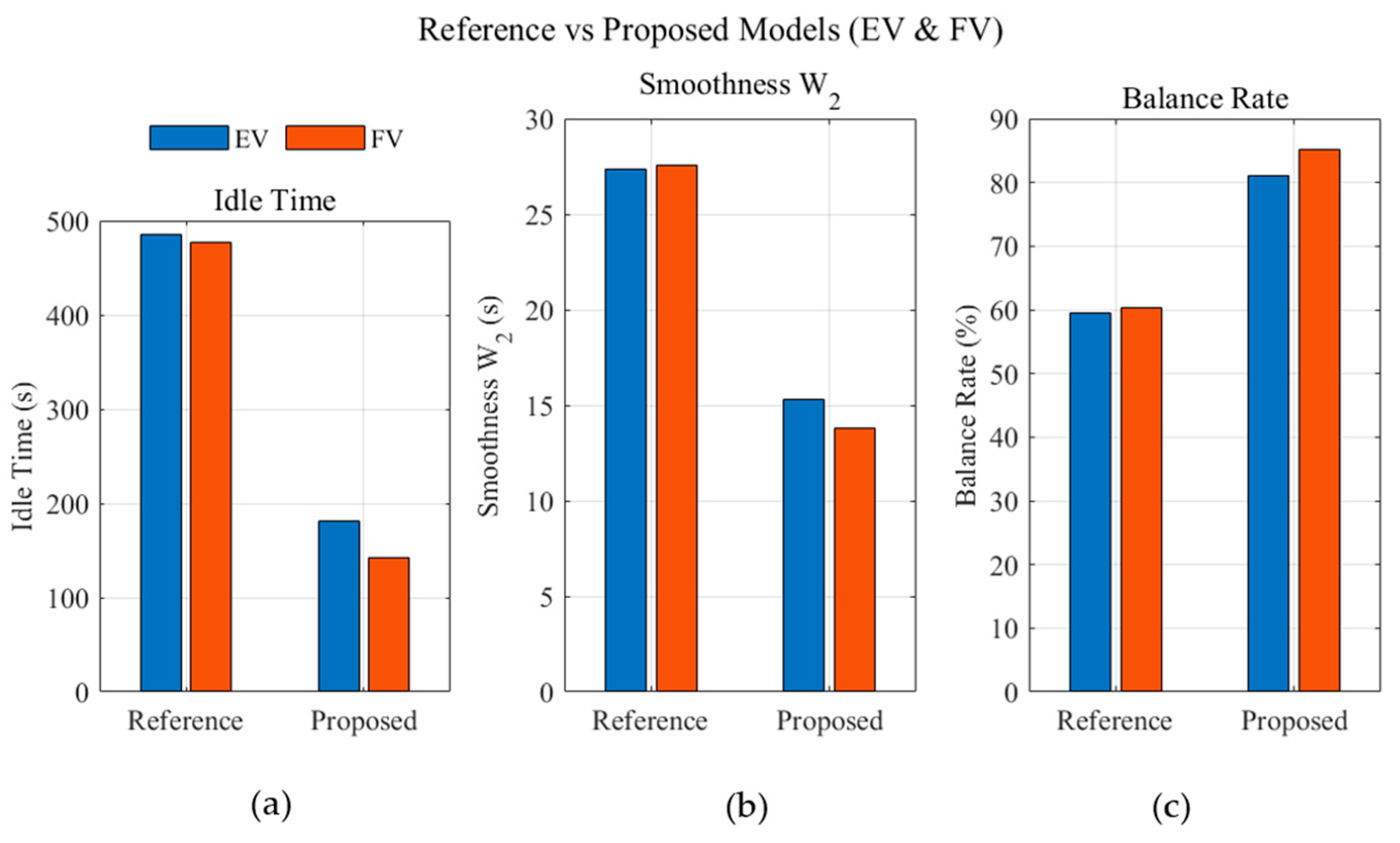
| Idle time | 485 | 477 | 181 | 143 |
| Model Type | Vehicle Type | No. of Workstations | Total Idle Time (s) | Smoothness Index (W2, s) | Line Balance Rate (%) |
|---|---|---|---|---|---|
| Reference model (without workstation sharing) | EV | 10 | 485 | 27.39 | 59.58 |
| Reference model (without workstation sharing) | FV | 10 | 477 | 27.58 | 60.25 |
| Proposed model (with workstation sharing) | EV | 8 | 181 | 15.32 | 81.15 |
| Proposed model (with workstation sharing) | FV | 8 | 143 | 13.80 | 85.10 |
Disclaimer/Publisher’s Note: The statements, opinions and data contained in all publications are solely those of the individual author(s) and contributor(s) and not of MDPI and/or the editor(s). MDPI and/or the editor(s) disclaim responsibility for any injury to people or property resulting from any ideas, methods, instructions or products referred to in the content. |
© 2025 by the authors. Licensee MDPI, Basel, Switzerland. This article is an open access article distributed under the terms and conditions of the Creative Commons Attribution (CC BY) license (https://creativecommons.org/licenses/by/4.0/).
Share and Cite
Hu, L.; Sukhotu, V. Modeling and Optimization of a Mixed-Model Two-Sided Assembly Line Balancing Problem Considering a Workstation-Sharing Mechanism. Appl. Sci. 2025, 15, 12809. https://doi.org/10.3390/app152312809
Hu L, Sukhotu V. Modeling and Optimization of a Mixed-Model Two-Sided Assembly Line Balancing Problem Considering a Workstation-Sharing Mechanism. Applied Sciences. 2025; 15(23):12809. https://doi.org/10.3390/app152312809
Chicago/Turabian StyleHu, Lingling, and Vatcharapol Sukhotu. 2025. "Modeling and Optimization of a Mixed-Model Two-Sided Assembly Line Balancing Problem Considering a Workstation-Sharing Mechanism" Applied Sciences 15, no. 23: 12809. https://doi.org/10.3390/app152312809
APA StyleHu, L., & Sukhotu, V. (2025). Modeling and Optimization of a Mixed-Model Two-Sided Assembly Line Balancing Problem Considering a Workstation-Sharing Mechanism. Applied Sciences, 15(23), 12809. https://doi.org/10.3390/app152312809