Forecasting and Fertilization Control of Agricultural Non-Point Source Pollution with Short-Term Meteorological Data

 , ,
, , 

Abstract
1. Introduction
2. Materials and Methods
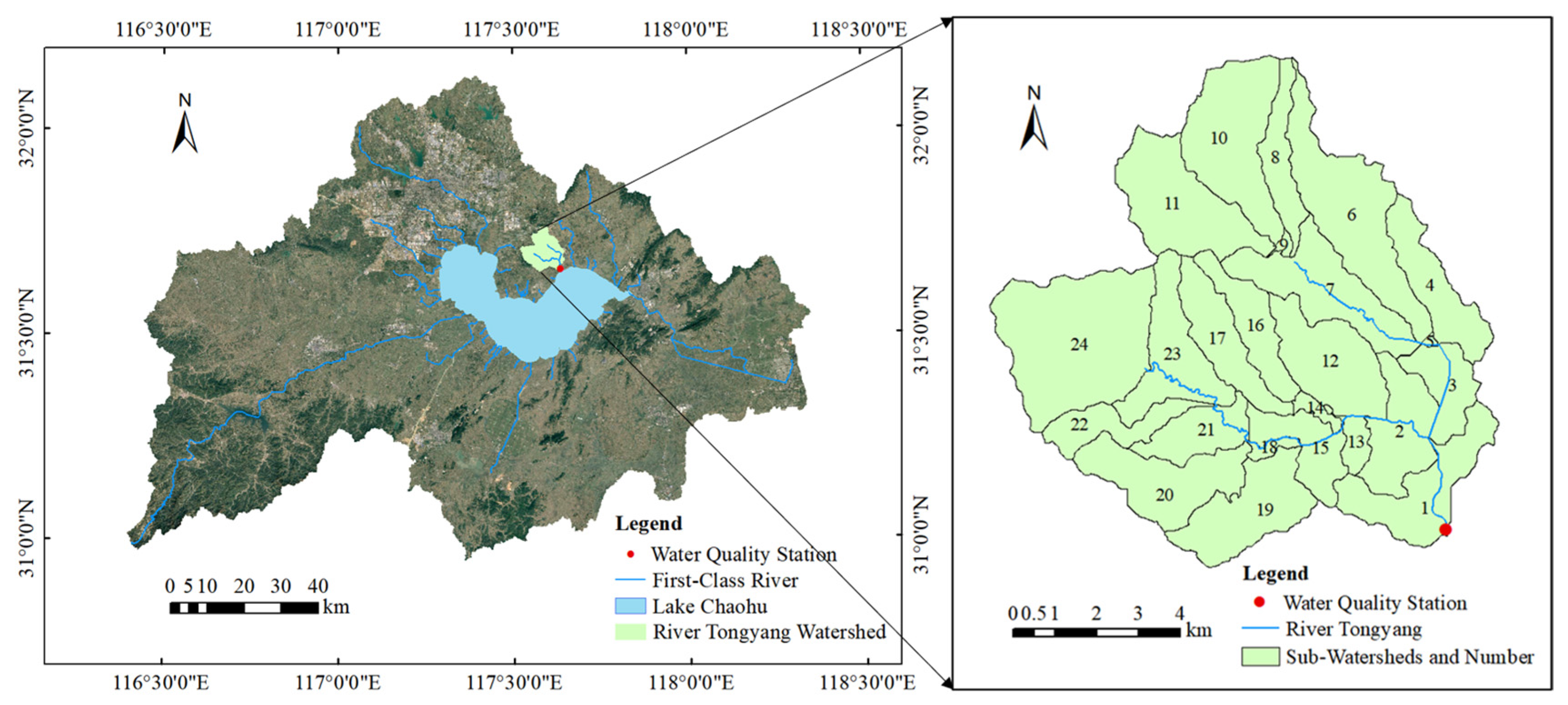
2.1. Research Area
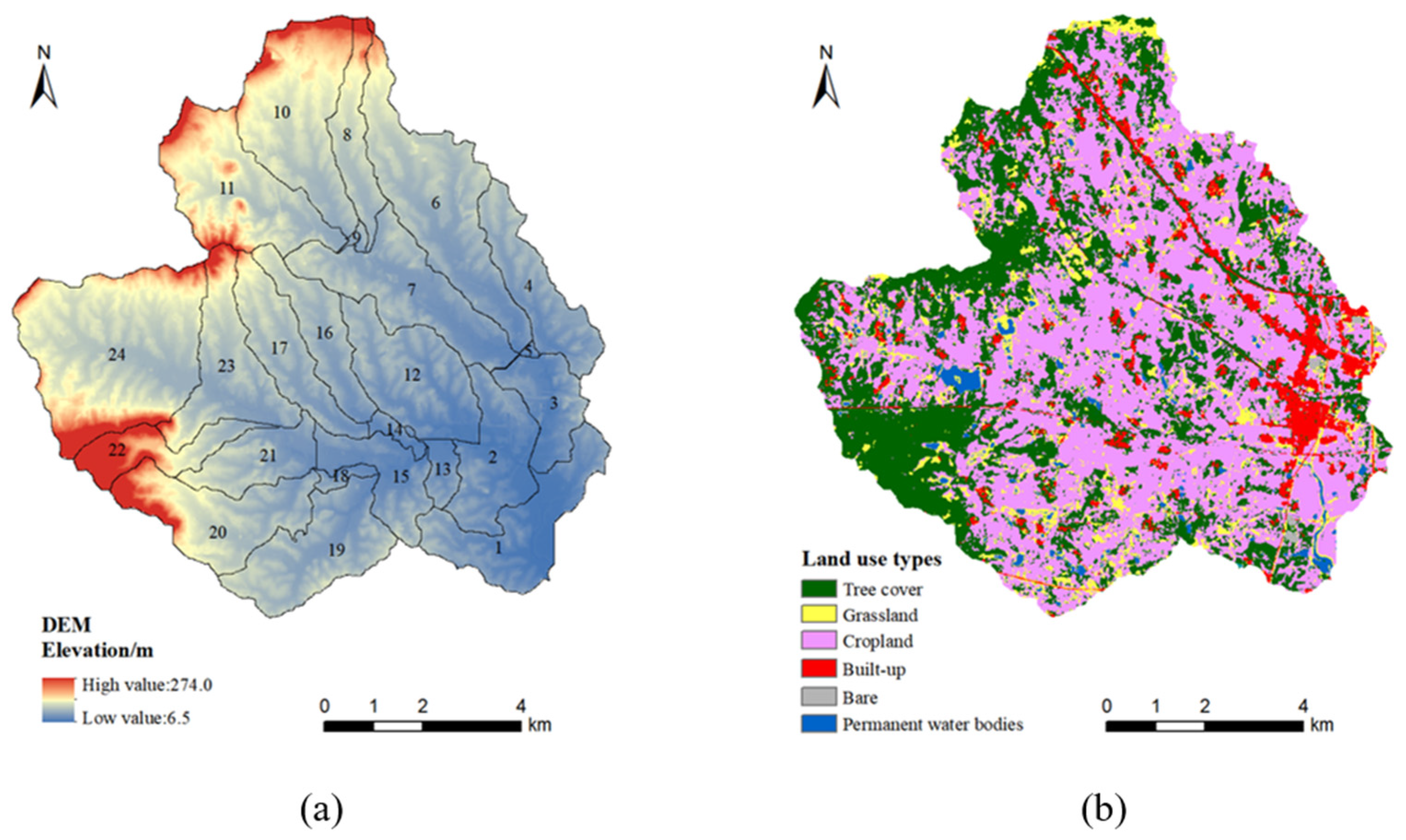
2.2. Introduction to Data Sources
2.3. Methods
2.3.1. Hydrological Response
- (a)
- Rainfall-runoff process. This study uses the SCS-CN model [23] for secondary rainfall-runoff calculations. This model can effectively consider the impact of underlying surface conditions of the watershed on the runoff process, and its calculation formula is as follows:
- (b)
- Hydrodynamic processes of river channels. River flow velocity is a key factor in determining the transport time of pollutants. During the dry period, hydrological measurements were conducted in the straight sections of the middle and upper reaches of the River Tongyang to obtain the flow velocity v1 and river cross-sectional data under baseflow conditions. Combined with the riverbed slope S extracted from the DEM, the Manning roughness coefficient n for this river section was back-calculated using the Manning formula [24]. At the same time, the baseflow discharge Qb was determined from measured data. In routine simulations, the river flow velocity on rainless days is taken as the baseflow velocity v1 determined by this n value and Qb.
2.3.2. Pollution Load Migration
- (a)
- Pollutant migration. This study is based on DEM data with a resolution of 30 m and uses GIS analysis tools to extract the river network of the River Tongyang Watershed and the flow path length Di from each plot i to the lake inlet. Combined with the flow velocity v output from the hydrological module, the time ti (days) required for pollutants to migrate from plot i to the lake inlet is calculated as follows:
- (b)
- Dynamic output coefficients and estimation of pollutant load. Pollutant output coefficients [26] are the key link connecting human activities to water pollution load. Extensive research has shown that output coefficients are not constant values; they strongly depend on rainfall intensity, prior soil moisture, farming practices, and the time interval between fertilization and rainfall events. To more scientifically characterize this dynamic process, a rainfall-adjusted dynamic output coefficient scheme is introduced. Since the migration and transformation processes of nitrogen and phosphorus are similar, the subsequent calculations and analyses in this paper will focus solely on total phosphorus concentration.
- (c)
- River channel migration and contribution to lake inlet concentration. During the migration of pollutants along the water flow, degradation occurs. To quantify this process, this study introduces the pollutant residual rate ηi (Equation (9)), which is based on a first-order kinetic model describing pollutant decay in the environmental model used in this study to quantify this effect [32]. Subsequently, Equation (10) calculates the contribution of the pollutant load from plot i to the total phosphorus concentration at the lake inlet. Finally, Equation (11) is used to calculate the total concentration increase generated by the n plots within the watershed.
2.3.3. Environmental Capacity Fertilization Prediction
- (a)
- Water environmental capacity is the maximum load of pollutants that a water body can accommodate while maintaining its functional objectives [36]. This study dynamically calculates the remaining environmental capacity, i.e., the allowable concentration increment, based on real-time water quality monitoring data at the River Tongyang’s lake inflow section, serving as a benchmark for fertilization warnings:
- (b)
- MPermit represents the mass of phosphorus that reaches the lake inlet after attenuation during river transport. Fertilizer phosphorus applied to farmland undergoes two major attenuations before reaching the lake inlet: first, surface runoff loss, as not all applied fertilizer is carried into rivers by runoff, a proportion described by the dynamic output coefficient Li; second, riverine transport loss, where pollutants entering the river degrade during transport, with the proportion reaching the lake inlet indicated by the residual rate ηi. Therefore, it is necessary to calculate the maximum allowable total phosphorus fertilizer application MTP based on the final permissible phosphorus mass at the lake outlet, MPermit. The total mass of phosphorus fertilizer applied to all plots in the watershed, after accounting for output and migration attenuation, should equal the permissible mass MPermit (Equation (15)), thereby determining the maximum allowable total phosphorus application (Equation (16)):
- (c)
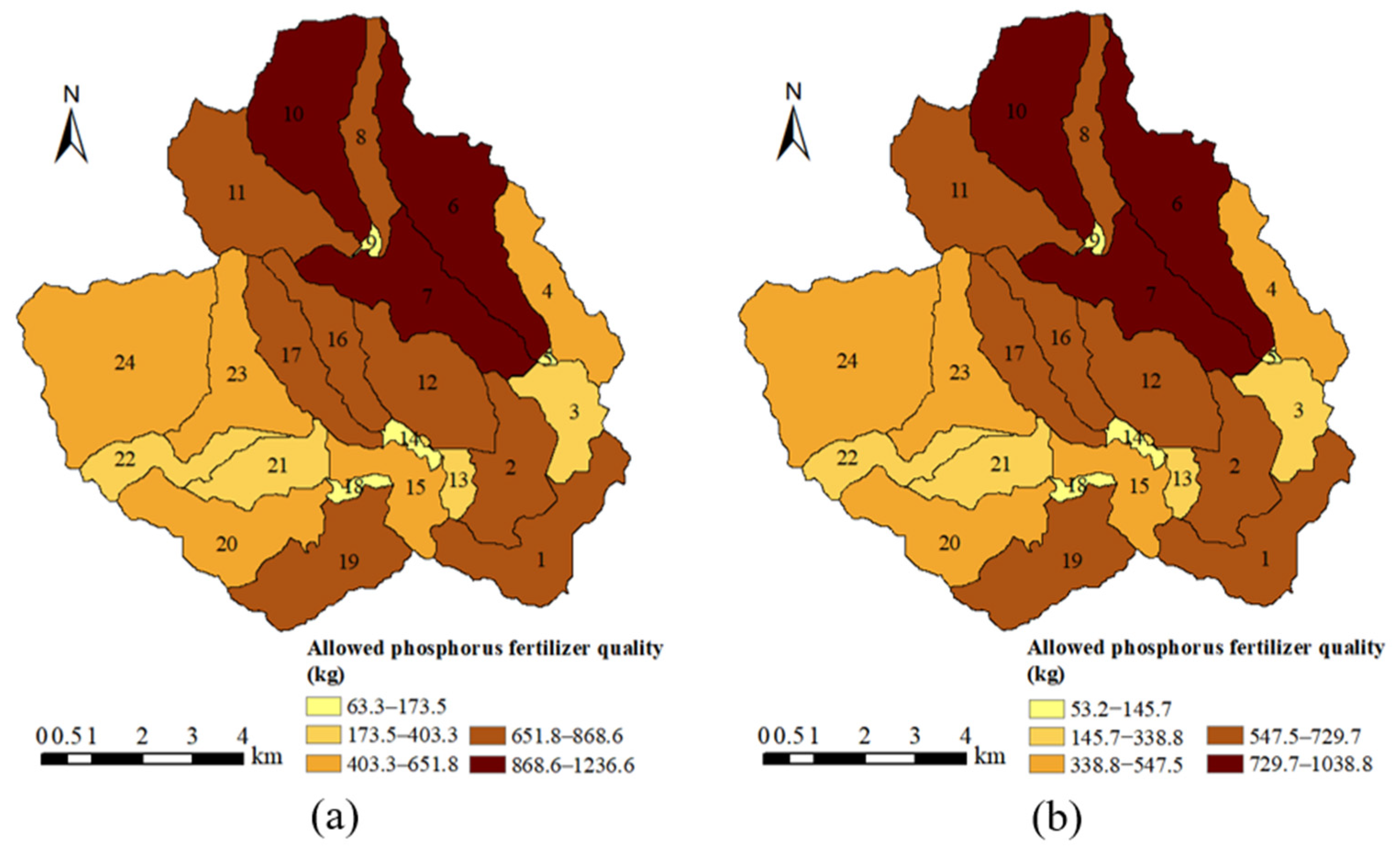
- The total phosphorus load allowed to enter the lake is contributed collectively by various plots within the watershed. To ensure fairness and practicability in quota allocation, this plan follows the principle of distribution according to the proportion of arable land area, allocating the maximum permissible fertilization amount for the entire watershed back to the plot level based on plot area. On this basis, it is further converted into the maximum recommended fertilization amount per mu that farmers can practically apply, and graded warnings are issued accordingly. This provides a scientific and implementable decision-making basis for the dynamic control and refined management of agricultural non-point source pollution in the River Tongyang watershed. Under the condition of satisfying environmental capacity constraints, the formulas for calculating the corresponding total fertilization amount and the fertilization amount for each plot are as follows:
- (d)
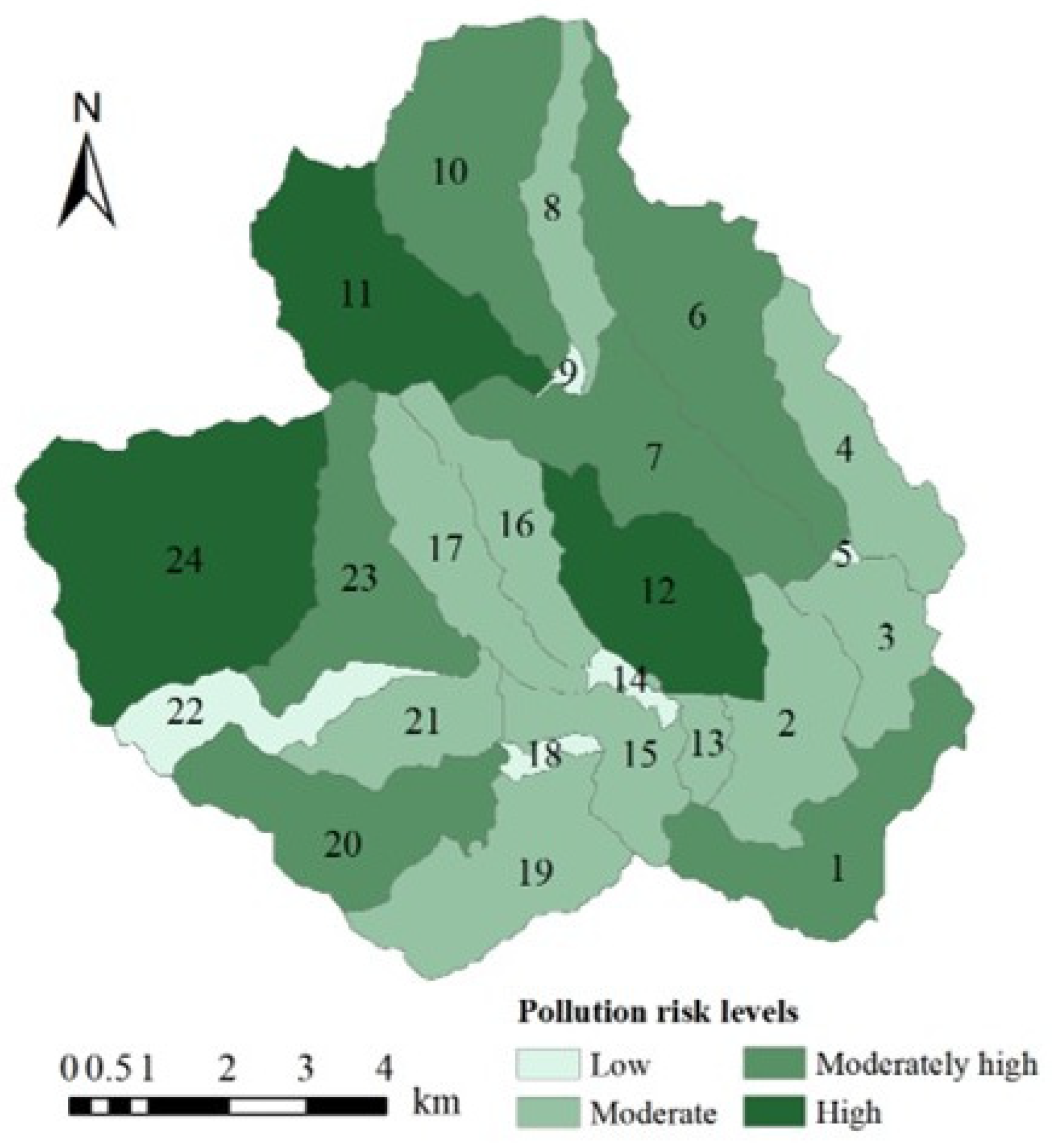
- To quantitatively analyze the impact of different plots on pollutant concentrations at lake inflows, this study introduces the concept of pollution potential. Here, pollution potential is defined as the potential contribution of the fertilizer applied per unit area of a plot to the pollutant concentration at the lake inflow, reflecting the relative intensity of a plot’s influence on downstream water quality changes. The pollution output of a plot primarily depends on the effect of its area, S. Under the same fertilization intensity and management conditions, a larger plot has a higher potential pollution source base. Secondly, the fertilizer applied to a plot must enter the river system through surface runoff, and its loss efficiency can be represented by a dynamic output coefficient, Li, indicating the proportion of fertilizer per unit area that reaches the river. This coefficient comprehensively reflects the cumulative influence of soil type, terrain slope, land use, and rainfall conditions on pollutant loss. Once pollutants enter the river, not all of them can migrate to the lake inflow; during transport, they are affected by multiple processes, including dilution, adsorption, sedimentation, and biological uptake. For this reason, the pollutant retention rate, ηi, is used to characterize the transport efficiency of pollutants from the river to the lake inflow, reflecting the attenuation effects caused by spatial differences in plots. Therefore, the total pollution potential of a plot for lake inflow concentration is proportional to the continuous interplay of these three factors; the product of these factors represents the contribution of the plot to the total phosphorus concentration at the lake inflow. The significance of this product is that when the fertilization per unit area of plot i is one unit, the theoretical contribution to the total phosphorus concentration at the lake inflow is:
3. Results
3.1. Model Accuracy Verification
3.2. Spatial Variation in Fertilization Limits and Pollution Risks in River Watersheds
4. Discussion
4.1. Selection of Pollutants and Setting of Environmental Factors
4.2. Research Limitations
4.3. Applications and Challenges of Agricultural Fertilization Management
5. Conclusions
- (1)
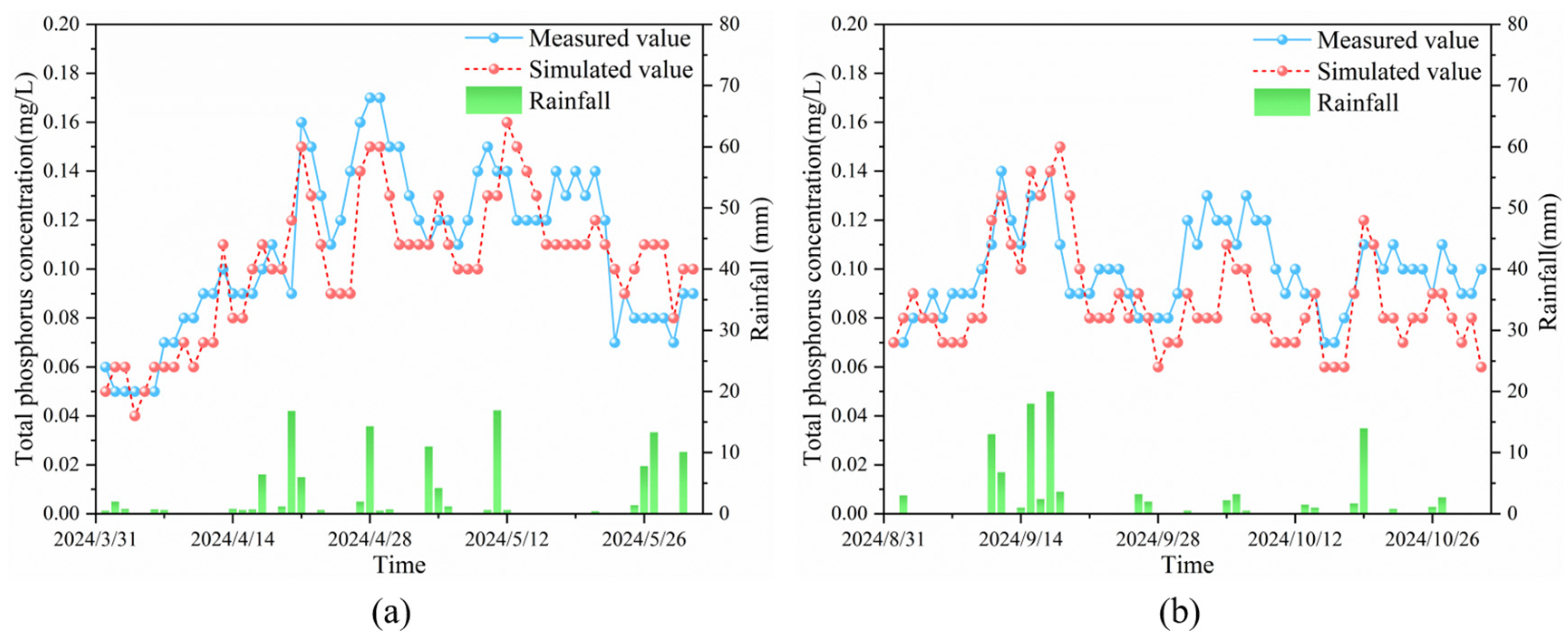
- This study established a hydrological response module and a pollution load and transport module to simulate the characteristics of total phosphorus output from agricultural non-point sources in the River Tongyang Watershed during rainfall events. A comparison between simulation results and monitoring data validated the model, achieving an R2 of 0.81, an RMSE of 0.06 mg/L, and a PBIAS of −7.4%. The results indicate that the model can accurately capture the peak response of total phosphorus concentration after rainfall events and its attenuation process, demonstrating strong temporal prediction capability and providing a reliable basis for the development of fertilization warning systems.
- (2)
- By introducing the concept of pollution potential, the contribution of different plots to pollutant concentrations at the lake inlet was quantitatively assessed, and the AGNPSP risk in the River Tongyang Watershed was classified into four categories: high risk, relatively high risk, medium risk, and low risk. The high-risk and relatively high-risk areas account for 70% of the total watershed area, mainly located in the mid-to-upper reaches with steep slopes, low soil permeability, strong runoff capacity, and proximity to the lake inlet, where the pollutant output intensity per unit area is significantly higher. In the mid-to-lower reaches, the plains are flat with good infiltration conditions and slower flow convergence, possessing strong nitrogen and phosphorus adsorption and retention capabilities, and thus lower migration risk. Overall, the agricultural non-point source pollution pressure in the River Tongyang Watershed is considerable, highlighting the need for further research on pollution mechanisms and control measures.
- (3)
- A calculation method for the fertilization limit that can be dynamically updated according to weather forecasts has been established. Based on meteorological data, the model can calculate the fertilization limit needed to meet water quality standards and refine control indicators to the plot level through a spatial allocation algorithm, achieving a shift from post-event evaluation to preemptive prevention. This study transforms abstract water quality standards into actionable fertilizer limits per unit area and, by integrating rainfall forecasts, enables the model to anticipate fertilization restrictions under different rainfall conditions. This provides a scientific basis for formulating dynamic and zoned management measures, supporting fertilizer scheduling at the watershed level, water quality protection, and the sustainable development of agriculture.
Author Contributions
Funding
Institutional Review Board Statement
Informed Consent Statement
Data Availability Statement
Conflicts of Interest
References
- Jiang, T.; Wang, M.; Zhang, W.; Zhu, C.; Wang, F. A comprehensive analysis of agricultural non-point source pollution in China: Current status, risk assessment and management strategies. Sustainability 2024, 16, 2515. [Google Scholar] [CrossRef]
- Guo, W.; Fu, Y.; Ruan, B.; Ge, H.; Zhao, N. Agricultural non-point source pollution in the Yongding River Basin. Ecol. Indic. Integr. Monit. Assess. Manag. 2014, 36, 254–261. [Google Scholar] [CrossRef]
- Wang, M.; Jiang, T.; Mao, Y.; Wang, F.; Yu, J.; Zhu, C. Current situation of agricultural non-point source pollution and its control. Water Air Soil Pollut. 2023, 234, 471. [Google Scholar] [CrossRef]
- Wang, M.; Yang, S.; Geng, R. Analysis on monitoring and practices of agricultural non-point source pollution control. Environ. Monit. China 2022, 38, 61–66. [Google Scholar] [CrossRef]
- Basnyat, P.; Teeter, L.D.; Lockaby, B.G.; Flynn, K. The use of remote sensing and GIS in watershed level analyses of non-point source pollution problems. For. Ecol. Manag. 2000, 128, 65–73. [Google Scholar] [CrossRef]
- Chowdary, V.M.; Yatindranath Kar, S.; Adiga, S. Modelling of non-point source pollution in a watershed using remote sensing and GIS. J. Indian Soc. Remote Sens. 2004, 32, 59–73. [Google Scholar] [CrossRef]
- Corwin, D.L.; Loague, K.; Ellsworth, T.R. GIS-based modeling of non-point source pollutants in the vadose zone. J. Soil Water Conserv. 1998, 53, 34–38. [Google Scholar] [CrossRef]
- Qiu, Y.; Huang, J.; Luo, J.; Xiao, Q.; Shen, M.; Xiao, P.; Peng, Z.; Jiao, Y.; Duan, H. Monitoring, simulation and early warning of cyanobacterial harmful algal blooms: An upgraded framework for eutrophic lakes. Environ. Res. 2025, 264, 120296. [Google Scholar] [CrossRef]
- Hussain, F.; Ahmed, S.; Muhammad Zaigham Abbas Naqvi, S.; Awais, M.; Zhang, Y.; Zhang, H.; Raghavan, V.; Zang, Y.; Zhao, G.; Hu, J. Agricultural non-point Source Pollution: Comprehensive Analysis of Sources and Assessment Methods. Agriculture 2025, 15, 531. [Google Scholar] [CrossRef]
- Zhang, L.; Huang, Z.; Xiao, W.; Zeng, L.-X.; Song, W.-M. Characteristics of nitrogen and phosphorus output in runoff and rainfall runoff in Lanlingxi watershed, Three Gorges Reservoir Area. Environ. Sci. 2018, 39, 792–799. [Google Scholar] [CrossRef]
- Gao, T.; Xie, H.; Wan, N.; Xiong, Z.; Hu, Z.; Lai, X. Simulation and source analysis of nonpoint source nitrogen and phosphorus pollution export in a typical agricultural catchment draining to Chaohu lake. J. Agro-Environ. Sci. 2022, 41, 2428–2438. [Google Scholar] [CrossRef]
- Wang, H.; Xu, Y.; Zhang, Q.; Lin, C.-W.; Zhai, L.-M.; Liu, H.-T.; Pu, B. Emission characteristics of nitrogen and phosphorus in a typical agricultural small watershed in Tuojiang River Basin. Environ. Sci. 2020, 41, 4547–4554. [Google Scholar] [CrossRef]
- Qiu, Y.; Duan, H.; Wan, N.; Huang, J.; Xue, K.; Peng, Z.; Xiao, P. Design and practice of a platform for monitoring, early-warning and simulation of algal blooms in Lake Chaohu. J. Lake Sci. 2022, 34, 38–48. [Google Scholar] [CrossRef]
- Sun, B.; Zhang, L.; Yang, L.; Zhang, F.; Norse, D.; Zhu, Z. Agricultural non-point source pollution in China: Causes and mitigation measures. Ambio 2012, 41, 370–379. [Google Scholar] [CrossRef] [PubMed]
- Chen, X.; Yang, X.; Dong, X.; Liu, E. Environmental changes in Chaohu Lake (southeast, China) since the mid 20th century: The interactive impacts of nutrients, hydrology and climate. Limnologica 2013, 43, 10–17. [Google Scholar] [CrossRef]
- Copernicus Global Digital Elevation Model. Available online: https://portal.opentopography.org/raster?opentopoID=OTSDEM.032021.4326.3 (accessed on 20 March 2025).
- Zanaga, D.; Van De Kerchove, R.; De Keersmaecker, W.; Brockmann, C.; Kirches, G.; Arino, O.; Wevers, J.; Cartus, O.; Santoro, M.; Fritz, S.; et al. ESA WorldCover 10 m 2021 v200. Available online: https://doi.org/10.5281/zenodo.7254221 (accessed on 20 March 2025).
- Chaohu Statistical Yearbook. Available online: https://www.chaohu.gov.cn/sjch/tjnj/11432223.html (accessed on 23 March 2025).
- Wang, J.; Xie, D.; Shao, J.; Ni, J.; Lei, P. Identification of source-sink risk pattern of agricultural non-point source pollution in cultivated land in Three Gorges Reservoir Area based on accumulative minimum resistance model. Trans. Chin. Soc. Agric. Eng. 2016, 32, 206–215. [Google Scholar] [CrossRef]
- Min, M.; Li, H.; Ma, T.; Miao, C. Will agricultural land scale management aggravate non-point source pollution?—Chaohu Lake Basin, China as a case study. Appl. Geogr. 2023, 158, 103056. [Google Scholar] [CrossRef]
- Liu, H.; Chen, J.; Zhang, L.; Sun, K.; Cao, W. Simulation effects of clean water corridor technology on the control of non-point source pollution in the Paihe River basin, Chaohu lake. Environ. Sci. Pollut. Res. 2021, 28, 23534–23546. [Google Scholar] [CrossRef]
- Lu, Y.; Dong, G.; Yang, R.; Sun, M.; Zhang, L.; Zhang, Y.; Yin, Y.; Li, X. Risk Evaluation of Agricultural Non-Point Source Pollution in Typical Hilly and Mountainous Areas: A Case Study of Yongchuan District, Chongqing City, China. Remote Sens. 2025, 17, 2525. [Google Scholar] [CrossRef]
- Mishra, S.K.; Singh, V.P. SCS-CN Method. In Soil Conservation Service Curve Number (SCS-CN) Methodology; Springer: Dordrecht, The Netherlands, 2003; pp. 84–146. [Google Scholar]
- Holland, P.G. Manning formula. In Encyclopedia of Hydrology and Water Resources; Springer: Dordrecht, The Netherlands, 2016; p. 475. [Google Scholar]
- Her, Y.; Heatwole, C. Two-dimensional continuous simulation of spatiotemporally varied hydrological processes using the time-area method. Hydrol. Process. 2016, 30, 751–770. [Google Scholar] [CrossRef]
- Yang, M.; Yang, Z. Pollutant transport model with large time-scale and estimation of land-use export coefficients at a watershed level. Water Environ. Res. 2024, 96, e11031. [Google Scholar] [CrossRef]
- Han, L.; Huo, F.; Sun, J. Method for calculating non-point source pollution distribution in plain rivers. Water Sci. Eng. 2011, 4, 83–91. [Google Scholar] [CrossRef]
- Wang, W.; Chen, L.; Shen, Z. Dynamic export coefficient model for evaluating the effects of environmental changes on non-point source pollution. Sci. Total Environ. 2020, 747, 141164. [Google Scholar] [CrossRef] [PubMed]
- Shrestha, S.; Kazama, F.; Newham, L.T.H.; Babel, M.; Clemente, R.; Ishidaira, H.; Nishida, K.; Sakamoto, Y. Catchment scale modelling of point source and non-point source pollution loads using pollutant export coefficients determined from long-term in-stream monitoring data. J. Hydro-Environ. Res. 2008, 2, 134–147. [Google Scholar] [CrossRef]
- Zhang, S.; Cheng, G.; Tan, Q.; Zhao, H.; Zhang, T. An agro-hydrological process-based export coefficient model for estimating monthly non-point source loads in a semiarid agricultural area. J. Clean. Prod. 2023, 385, 135519. [Google Scholar] [CrossRef]
- Wang, J.; Lü, G.; Guo, X.; Wang, Y.; Ding, S.; Wang, D. Conservation tillage and optimized fertilization reduce winter runoff losses of nitrogen and phosphorus from farmland in the Chaohu Lake region, China. Nutr. Cycl. Agroecosyst. 2015, 101, 93–106. [Google Scholar] [CrossRef]
- Sadef, Y.; Poulsen, T.G.; Bester, K. Modeling organic micro pollutant degradation kinetics during sewage sludge composting. Waste Manag. 2014, 34, 2007–2013. [Google Scholar] [CrossRef]
- Jing, Z.; Chen, H.; Cao, H.; Tang, J.; Li, R. Experimental and simulation studies on the attenuation coefficients of organic pollutants in “Han River and Three Tributaries” basin, China. IOP Conf. Ser. Earth Environ. Sci. 2021, 826, 012015. [Google Scholar] [CrossRef]
- Lai, Q.; Ma, J.; He, F.; Wei, G. Response model for urban area source pollution and water environmental quality in a river network region. Int. J. Environ. Res. Public Health 2022, 19, 10546. [Google Scholar] [CrossRef]
- Feng, S.; Li, X.; Deng, J. A study on degradation coefficients of pollutants in the upstream river network of the Lake Taihu Basin. Acta Sci. Circumstantiae 2016, 36, 3127–3136. [Google Scholar] [CrossRef]
- Li, Y.; Wang, H.; Deng, Y.; Liang, D.; Li, Y.; Gu, Q. Applying water environment capacity to assess the non-point source pollution risks in watersheds. Water Res. 2023, 240, 120092. [Google Scholar] [CrossRef]
- Legates, D.R.; McCabe, G.J., Jr. Evaluating the use of “goodness-of-fit” measures in hydrologic and hydroclimatic model validation. Water Resour. Res. 1999, 35, 233–241. [Google Scholar] [CrossRef]
- Van Liew, M.W.; Arnold, J.G.; Garbrecht, J.D. Hydrologic simulation on agricultural watersheds: Choosing between two models. Trans. ASAE 2003, 46, 1539–1551. [Google Scholar] [CrossRef]
- Moriasi, D.N.; Arnold, J.G.; Van Liew, M.W.; Bingner, R.L.; Harmel, R.D.; Veith, T.L. Model evaluation guidelines for systematic quantification of accuracy in watershed simulations. Trans. ASABE 2007, 50, 885–900. [Google Scholar] [CrossRef]
- Chi, Y.; Wu, L.; Li, R.; Gao, S. Characteristics of soil erosion and phosphorus loss from loessial sloping land under different measures during heavy rainstorms. J. Agro-Environ. Sci. 2020, 39, 2833–2843. [Google Scholar]
- Yu, D.; Dong, X.; Gao, S.; Jiang, Y.; Wei, C.; Peng, T.; Liu, J. Evaluation of nitrogen non-point source pollution risk in the Huaihe River Basin based on an improved minimum cumulative resistance model. Trans. Chin. Soc. Agric. Eng. 2024, 40, 226–235. [Google Scholar] [CrossRef]
- Wang, J.; Fu, Z.; Qiao, H.; Bi, Y.; Liu, F. Identifying the Spatial Risk Patterns of Agricultural Non-Point Source Pollution in a Basin of the Upper Yangtze River. Agronomy 2023, 13, 2776. [Google Scholar] [CrossRef]
- Xie, W.; Li, J.; Liu, Y.; Peng, K.; Zhang, K. Evaluation of ecological buffer zone based on landscape pattern for non-point source pollution control: A case study in Hanjiang River basin, China. J. Hydrol. 2023, 626, 130341. [Google Scholar] [CrossRef]




| Index | Indicator Description |
|---|---|
| Rainfall | An increase in rainfall will affect pollutant wash-off and runoff transport. |
| Slope | Slope affects surface runoff velocity and soil erosion intensity. |
| Land use type | Regulation of pollutant source intensity and transport characteristics under different utilization methods. |
| Digital elevation Model (DEM) | The impact of terrain elevation on pollutant transport pathways and accumulation effects. |
| Rainfall Level | Total Phosphorus Concentration at Lake Inlet (mg/L) | Allowed Phosphorus Fertilization Amount (kg/ha) | Suggestions |
|---|---|---|---|
| No rain | 0.10 | ≤50.0 | Fertilization can proceed as originally planned. |
| Light rain | 0.10 | ≤43.0 | Fertilization can basically proceed as planned. |
| Light rain | 0.15 | 30.5–34.5 | Slightly reduce the amount of fertilizer applied. |
| Moderate rain | 0.10 | 28.0–32.5 | Slightly reduce the amount of fertilizer applied. |
| Moderate rain | 0.15 | 16.5–21.0 | Fertilizer application needs to be greatly reduced. |
| Heavy rain or above | 0.10 | 0 | Fertilization is not recommended during heavy rain. |
| Others | ≥0.2 | 0 | Fertilization prohibited due to excessive concentration. |
Disclaimer/Publisher’s Note: The statements, opinions and data contained in all publications are solely those of the individual author(s) and contributor(s) and not of MDPI and/or the editor(s). MDPI and/or the editor(s) disclaim responsibility for any injury to people or property resulting from any ideas, methods, instructions or products referred to in the content. |
© 2025 by the authors. Licensee MDPI, Basel, Switzerland. This article is an open access article distributed under the terms and conditions of the Creative Commons Attribution (CC BY) license (https://creativecommons.org/licenses/by/4.0/).
Share and Cite
Wang, H.; Zhang, L.; Qiu, Y.; Nan, R.; Jin, Y.; Xie, J.; Xiao, Q.; Luo, J. Forecasting and Fertilization Control of Agricultural Non-Point Source Pollution with Short-Term Meteorological Data. Appl. Sci. 2025, 15, 12688. https://doi.org/10.3390/app152312688
Wang H, Zhang L, Qiu Y, Nan R, Jin Y, Xie J, Xiao Q, Luo J. Forecasting and Fertilization Control of Agricultural Non-Point Source Pollution with Short-Term Meteorological Data. Applied Sciences. 2025; 15(23):12688. https://doi.org/10.3390/app152312688
Chicago/Turabian StyleWang, Haoran, Liming Zhang, Yinguo Qiu, Ruigang Nan, Yan Jin, Jianing Xie, Qitao Xiao, and Juhua Luo. 2025. "Forecasting and Fertilization Control of Agricultural Non-Point Source Pollution with Short-Term Meteorological Data" Applied Sciences 15, no. 23: 12688. https://doi.org/10.3390/app152312688
APA StyleWang, H., Zhang, L., Qiu, Y., Nan, R., Jin, Y., Xie, J., Xiao, Q., & Luo, J. (2025). Forecasting and Fertilization Control of Agricultural Non-Point Source Pollution with Short-Term Meteorological Data. Applied Sciences, 15(23), 12688. https://doi.org/10.3390/app152312688