Article

Rowanberry Nectar—The Effect of Preparation Method, Sweetener Addition, and Storage Condition on Bioactive Compounds

1
Department of Bioprocess Engineering, Wrocław University of Economics and Business, 118/120 Komandorska Street, 53-345 Wrocław, Poland
2
Department of Food Technology and Nutrition, Wrocław University of Economics and Business, 53-345 Wrocław, Poland
3
Department of Fruit, Vegetable and Plant Nutraceutical Technology, Wrocław University of Environmental and Life Sciences, 37 Chełmońskiego Street, 51-630 Wrocław, Poland
*
Authors to whom correspondence should be addressed.
Appl. Sci. 2025, 15(23), 12674; https://doi.org/10.3390/app152312674
Submission received: 31 October 2025 / Revised: 24 November 2025 / Accepted: 27 November 2025 / Published: 29 November 2025

Abstract

Rowanberries (Sorbus aucuparia) are valued for their high content of bioactive compounds. This study examined the effects of sweeteners (sucrose, xylitol, erythritol, steviol glycosides), fruit pulp preparation (fresh vs. steamed), and storage conditions (4 °C and 30 °C, 3 months) on the composition of rowanberry nectars. Polyphenols were quantified using LC-PDA-QTOF/MS and UPLC-PDA-FL, and carotenoids, organic acids, antioxidant capacity (FRAP), and physicochemical properties were also determined. Steaming increased total polyphenol levels in nectars by 13–52%, with the highest values observed in formulations containing steviol glycosides (up to 1833 mg/100 mL). Changes in carotenoid content during storage varied depending on the sweetener type. In steamed nectars with erythritol stored at 4 °C, carotenoid levels remained close to those measured in the corresponding unsweetened steamed sample. Storage influenced turbidity and viscosity in all variants, with the largest viscosity increases recorded in stevia- and erythritol-sweetened nectars. Overall, the combined effects of fruit preparation, sweetener type, and storage determined the final composition and stability of rowanberry nectars.

1. Introduction

Rowanberries are trees or shrubs from the Rosaceae family. There are approximately 250 species of this plant known. Sorbus aucuparia, a common mountain ash found throughout almost all of Europe, grows up to 15 m high and has edible, small, round, bright red fruits and matte green leaves [1].
In ancient medicine and phytotherapy, rowanberries were used to treat liver and kidney problems, dropsy, obstruction, and gastrointestinal issues. In folk or alternative medicine, the fruits of S. aucuparia have been used as vasodilatory, anti-inflammatory, antidiarrheal, and appetite-improving agents, in the treatment of diabetes, metabolic disorders, nephrolithiasis, arthritis, gastrointestinal problems, liver, and gallbladder diseases [1,2,3].
Rowanberries are considered an essential source of bioactive compounds, mainly polyphenols (flavonoids, phenolic acids), as well as primarily vitamins and provitamins. Phenolic composition, just like other chemical compounds of Sorbus fruit, is different depending on plant genotypes and origin, e.g., the wild S. aucuparia contains much lower amounts of anthocyanins (0.12 mg/g dry matter) than sweet varieties such as Titan, Burka or Granatnaja (6.04; 5.64; and 2.14 mg/g dm, respectively) [4]. Consumption of phenolic compounds in the diet is associated with the prevention of chronic and degenerative diseases, which in developed countries are the leading cause of death and inability to work. Due to the health-promoting properties of phenolic compounds, the primary source of which are fruits and vegetables, daily consumption is recommended [5].
Bioactive compounds found in large quantities in rowanberries are chlorogenic acids (CGA), which are esters of quinic acid and trans-cinnamic acid residue, and caffeic acid, which are known as caffeoylquinic acids (CQAs). Three of the four caffeoylquinic acid isomers are present in plants: neochlorogenic acid (3-O-caffeoylquinic acid, 3-CQA), chlorogenic acid (5-O-caffeoylquinic acid, 5-CQA), and cryptochlorogenic acid (4-O-caffeoylquinic acid, 4-CQA) [6]. The main phenolic constituents in S. aucuparia are neochlorogenic acid and flavonols such as conjugates of quercetin and kaempferol. Chlorogenic acids have a beneficial effect on human health, among other things. By modulating the activity of the enzyme glucose-6-phosphatase, which is involved in glucose metabolism, they may have an impact on the treatment of diabetes [7]. It has also been proven to counteract the neuronal dysfunctions underlying the pathogenesis of Alzheimer’s disease and has beneficial properties in preventing obesity-related neurodegeneration [8]. It has also been shown that CGA can modulate the expression of antioxidant enzyme genes and, by inhibiting the expression of P-selectin in platelets, may reduce the risk of cardiovascular disease [9]. Additionally, CGA is reported to have antibacterial, anticancer, anti-inflammatory, and antiviral properties [10].
Rowan fruits are characterized by the highest total content of organic acids compared to other berries, and the dominant compound is malic acid [11]. Rowan fruits are rich in carotenoids, mainly β-carotene [12]. They contain vitamins A, B, E, K, P, PP, and in large quantities, vitamin C, as well as minerals such as potassium, calcium, magnesium, and phosphorus [1,13].
Rowanberries contain glucose, fructose, and sorbitol. Sorbitol is a sugar alcohol with a lower glycemic effect than glucose, but the presence of glucose means that consumption by people with diabetes should be considered with caution [13]. According to the International Diabetes Federation, 537 million people aged 20–79 suffered from diabetes in 2021, and this number is projected to reach 783 million by 2045 [14]. The widespread consumption of sugar-sweetened beverages is a major dietary concern. To reduce the impact of sucrose on health, sugar substitutes such as steviol glycosides, erythritol, xylitol, or sucralose are increasingly used in the food industry.
According to Regulation (EC) No 112/2001 [15], it is prohibited to sweeten fruit juices. If water and/or sugar or honey are added during the production of fruit juice, the product is called nectar, and the added sugar or honey may not exceed 20% of the total weight of the final product. As part of the research, the results of which are presented in this paper, erythritol (E 968), xylitol (E 967), and steviol glycosides (E 960) were added to individual variants of nectars. In accordance with applicable law, it can be added to food in the amounts of quantum satis, q.s., or a maximum of 100 mg/mL, respectively [16]. A variant with sucrose was also prepared. The basis for the production of nectars is juices, the content of which in the final product is also specified in the regulations. The minimum content of rowan fruit juice or puree in nectars is 30% [15].
The study aimed to evaluate the effect of sucrose and its substitutes (xylitol, erythritol, and steviol glycosides), fruit pulp preparation method, and storage conditions on rowanberries’ nectar bioactive compounds.

2. Materials and Methods

2.1. Reagents and Standards

The following chemical reagents were used for the analyses: quercetin-3-O-rutinoside, quercetin-3-O-glucoside, isorhamnetin-3-O-rutinoside, (+)-catechin, procyanidins A2, B1, B2, B4 and C1 were purchased from Extrasynthese (Lyon Nord, France), chlorogenic acid, neochlorogenic acid, cryptochlorogenic acid, caffeic acid, 1,5-di-O-caffeoyl quinic acid and carotenoids (xanthophyll, lycopene, carotene) were purchased from TRANSMIT GmbH (Giessen, Germany), oxalic and citric acids from Chem-Pur (Piekary Śląskie, Poland), malic acids from Merck KGAA (Darmstadt, Germany), 2,4,6-tris(2-pyridyl)-s-triazine (TPTZ) from Tokyo Chemical Industry Co., Ltd. (Tokyo, Japan), 6-hydroxy-2,5,7,8-tetramethylchroman-2-carboxylic acid (Trolox) from Sigma-Aldrich, Co. (St. Louis, MO, USA), iron(III) chloride (FeCl3) from Sigma-Aldrich Chemie GmbH (Steinheim, Germany), potassium sulfate (K2S2O8), acetic acid (CH3COOH), sodium acetate (CH3COONa), hydrochloric acid (HCl) from Chem-Pur (Piekary Śląskie, Poland). UPLC-grade water, prepared by HLPSMART 1000s system (Hydrolab, Gdańsk, Poland), was additionally filtered through a 0.22 µm membrane filter immediately before use.

2.2. Plant Materials

The rowanberries (Sorbus aucuparia L.) were manually harvested in the Lower Silesia region of Poland in October 2024. After harvesting, gently washed rowanberries (with clusters) were frozen at −20 °C and stored until the research began (ca. 1 month). The bioactive compounds characteristic of rowanberry fruit are presented in Table 1.

2.3. Fruit Nectars Preparation

After defrosting, rowanberries (Sorbus aucuparia L.) were manually de-clustered, steamed optionally, and processed using a slow juicer (Sana Supreme 727, Omega Sana, Ceske Budejovice, The Czech Republic). The juicing process yielded pulp used for nectar preparation, while peels and seeds were collected as by-products and discarded, as they were not included in this study. Steaming was performed in a Thermomix (TM6, Vorwerk, Wuppertal, Germany). The fruit was ground and heated with constant stirring to a pulp temperature of 90 °C.
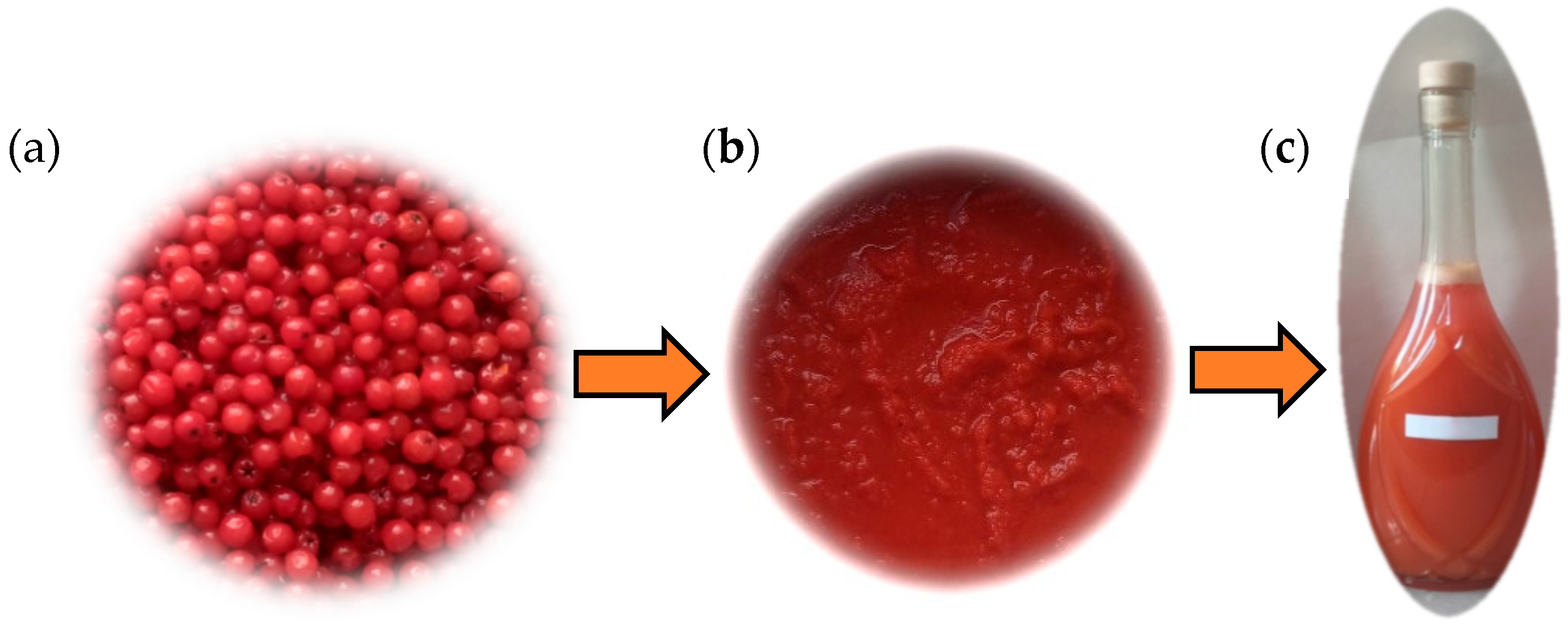
Five nectar formulations were prepared: one without sweetener (variant 1) and four with different sweeteners: (2) sucrose (20 g/L), (3) xylitol (20 g/L), (4) erythritol (26 g/L), and (5) steviol glycosides (0.066 g/L). Each variant was produced in two forms: from fresh rowanberry pulp (F) and from steamed pulp (S), with the pulp in both cases diluted in a 1:1 ratio with water (w/w) (Figure 1). In variant 2, the maximum dose of sucrose permitted by law was used. The doses of sweeteners were selected based on the degree of sweetness in relation to sucrose. A mixture of pulp, sweeteners, and water was heated to 85 °C for 2 min (Thermomix), then poured into 70 mL colorless jars. The jars were left for 10 min for pasteurization and subsequently cooled in a water bath to 20 °C. Samples were analyzed twice: immediately after preparation (0m) and after 3 months (3m) of storage at 4 °C and 30 °C (with no light exposure).

2.4. Physicochemical Analyses

Turbidity measurements were performed using a Turb® 750 T turbidimeter (WTW, Germany) in accordance with the nephelometric method. Prior to measurement, samples were centrifuged using a Sigma 4K centrifuge (Sigma Laborzentrifugen GmbH, Osterode am Harz, Germany) at 13,000 rpm for 15 min to remove suspended solids and ensure uniformity. After centrifugation, the supernatant was decimally diluted with deionized water to bring turbidity values within the linear measurement range of the instrument.
Each measurement was conducted in triplicate using clean, dust-free cuvettes. Turbidity was recorded in nephelometric turbidity units (NTU), and the average value of the three replicates was reported. The device was calibrated using standard calibration solutions provided by the manufacturer.
The total soluble solids (TSS) content, expressed as degrees Brix (°Brix), was determined using a digital refractometer (HI96801, Hanna Instruments, Woonsocket, RI, USA). A few drops of the sample were placed on the prism surface, and the measurement was conducted at a controlled temperature of 20 °C, with automatic temperature compensation enabled. Before each measurement, the refractometer was calibrated using distilled water, as instructed by the manufacturer. All measurements were performed in triplicate, and the mean °Brix values were reported. The device has a measurement range of 0–85 °Brix with an accuracy of ±0.2 °Brix.
The pH determination was carried out using a digital pH meter, MultiLine Multi 3510 IDS (WTW, Weilheim, Germany).
The dry matter content was determined using a moisture analyzer (OHAUS MB 25, OHAUS Corporation, Parsippany-Troy Hills, NJ, USA). Approximately 1 g of the sample was placed on the pan and dried at 105 °C until a constant weight was achieved, following standard gravimetric procedures. All measurements were performed in triplicate, and the results were expressed as the percentage of dry mass relative to the initial sample weight.
Viscosity was determined using a rotational viscometer (B-ONE Plus, Lamy Rheology Instruments, Champagne-au-Mont-d’Or, France). Measurements were performed using an appropriate spindle at a constant rotational speed of 250 rpm, at 20 ± 0.1 °C. Viscosity values were recorded after stabilization of the reading and expressed in mPa s−1. All measurements were performed in triplicate, and the average values are reported.

2.5. Organic Acids Analyses

The content of organic acids in the rowanberry nectars was determined using high-performance liquid chromatography (HPLC) following the method described by Wilk and Krzywonos [17]. Analyses were performed using a Knauer HPLC system (Berlin, Germany) equipped with a diode array detector (DAD). Separation was carried out on a Repromer H column (7.8 mm i.d. × 300 mm) using 0.009 M H2SO4 as the mobile phase at a flow rate of 1.0 mL·min−1. The column temperature was maintained at 50 °C, and detection was performed at a wavelength of 210 nm.

2.6. Analysis of Polyphenol Compounds

Extracts were prepared according to Teleszko and Wojdyło [18] by spreading approximately 0.5 g of freeze-dried nectar in a mixture containing HPLC-grade methanol (30 mL/100 mL), ascorbic acid (2.0 g/100 mL), and acetic acid (1.0 mL/100 mL of reagent). The mixtures were sonicated for 15 min, stored at 4 °C for 20 h, and then sonicated again for 15 min. After centrifugation, the supernatants were collected and filtered through 0.20 µm hydrophilic PTFE membranes (Millex Simplicity Filter; Merck, Germany).
Polyphenol content was analyzed according to the guidelines of Wojdyło et al. [19]. Flavan-3-ols, flavonols, and phenolic acids were analyzed using an ultra-performance liquid chromatography (Acquity UPLC System; Waters Corp., Milford, MA, USA) with a photodiode array detector (PDA), fluorescence detector (FL), and binary solvent manager. Before injection, the nectar samples were centrifuged at 15,000 rpm for 7 min at 4 °C using a Sigma 4K15 centrifuge (Sigma Laborzentrifugen GmbH, Osterode am Harz, Germany). The supernatants were filtered through 0.20 µm hydrophilic PTFE membranes (Millipore Millex Samplicity, Merck, Darmstadt, Germany). The prepared sample was separated in a BEH C18 column (2.1 × 100 mm, 1.7 µm; Waters Corp., Dublin, Ireland), at a flow rate of 0.45 mL/min at 30 °C with gradient elution of solvent A (2.0% formic acid) and solvent B (acetonitrile) for a duration of 15 min. All determinations were performed in triplicate and expressed as milligrams per 100 mL of the sample.

2.7. Analysis of Procyanidins by Phloroglucinolysis

Polymeric procyanidins were quantified using phloroglucinolysis followed by UPLC analysis, according to the procedure described by Wojdyło et al. [19,20].
Accurately weighed portions (0.05 g) of freeze-dried rowanberry nectar were placed into 2 mL Eppendorf tubes. To each sample, 0.8 mL of a methanolic phloroglucinol reagent (75 g/L phloroglucinol and 15 g/L ascorbic acid) was added, followed by 0.4 mL of methanolic HCl (0.3 mol/L). The tubes were sealed and incubated at 50 °C for 30 min in a thermo shaker (TS-100, BIOSAN) with continuous agitation. After incubation, the reaction was stopped by cooling the tubes in an ice bath and adding 0.6 mL of sodium acetate buffer (0.2 mol/L). Samples were centrifuged at 20,000× g for 10 min at 4 °C, and the supernatants were transferred to UPLC vials.
Analyses were performed using a UPLC-FL Acquity system (Waters Corp., Milford, MA, USA) equipped with a BEH C18 reversed-phase column (1.7 µm, 2.1 × 50 mm). The mobile phase consisted of 2.5% acetic acid in water (A) and acetonitrile (B), at a flow rate of 0.42 mL/min. Elution was as follows: 0–0.6 min, isocratic 2% B; 0.6–2.17 min, linear gradient 2–3% B; 2.17–3.22 min linear gradient 3–10% B; 3.22–5.00 min, linear gradient 10–15% B; 5.00 to 6.00 min column washing; and reconditioning for 1.50 min. The column temperature was maintained at 15 °C. Fluorescence detection was performed at λex = 278 nm and λem = 360 nm. Injection volume was 2 μL. The calibration curves which were based on peak area were established using (+)-catechin, (−)-epicatechin, and procyanidins B1 after phloroglucinol reaction as (+)-catechins and (−)-epicatechin-phloroglucinol adducts standards.
Identification and quantification were based on external calibration with (+)-catechin and (−)-epicatechin standards (Sigma-Aldrich, St. Louis, MO, USA) and commercially available procyanidin B2 and C1 standards. Calibration curves (R2 > 0.999) were prepared for monomer units and phloroglucinol adducts. Peaks corresponding to terminal units (catechin, epicatechin) and extension units (epicatechin–phloroglucinol adducts) were integrated separately.
The mean degree of polymerization (mDP) was calculated as the molar ratio of all flavan-3-ol units (extension units + terminal units) to terminal units, following the standard phloroglucinolysis approach. All results were expressed as mg/100 mL of nectar. Each determination was carried out in triplicate.

2.8. Identification and Quantification of Carotenoids

The extraction procedure of carotenoids was the same as that used by Tkacz et al. [21]. Briefly, the freeze-dried nectar powders were accurately weighed, and 10% magnesium carbonate (MgCO3) was added to each sample to prevent cis–trans isomerization. The samples were extracted in darkness using a 5 mL mixture of hexane, acetone, and methanol (2:1:1, v/v/v). After vortexing and centrifugation, the supernatants were collected, and the residues were re-extracted twice under the same conditions. All supernatants were pooled and evaporated to dryness under a stream of nitrogen using an XcelVap evaporator (Thermo Fisher Scientific, Waltham, MA, USA). The dried residues were then dissolved in 1.5 mL of methanol and filtered through a 0.45 µm nylon syringe filter (VWR International, Radnor, PA, USA). The extracts were analyzed for carotenoid content using LC-MS-PDA-Q/TOF and UPLC-PDA systems.
Identification and quantification of carotenoids were performed using UPLC-PDA-Q/TOF-MS and UPLC-PDA assays. The contents of tetraterpenoids were determined according to the method described by Tkacz et al. [21]. Identification was based on comparison of retention times and UV-Vis absorption spectra of the sample compounds with those of pure standards, using a wavelength of 450 nm for carotenoids. Quantification was performed using external calibration curves prepared from standard solutions with concentrations ranging from 0.05 to 0.50 mg/mL. The results were expressed as milligrams per 100 milliliters of rowanberry nectars (mg/100 mL).

2.9. Antioxidant Capacity by FRAP Assay

The samples for analysis were prepared as described previously by Wojdyło et al. [22]. Freeze-dried nectars (∼0.5 g) were mixed with 5 mL of methanol: H2O (80:20%, v/v) + 1% HCl, sonicated at 20 °C for 15 min, and left for 24 h at 4 °C. Then the extract was again sonicated for 15 min, and centrifuged at 15,000× g for 10 min.
The ferric reducing ability of plasma (FRAP) test, as described by Benzie and Strain [23], was used to determine the total antioxidant capacity of the nectars. The antioxidant capacity was expressed as millimoles of Trolox per liter (mM TE). Measurements by means of antioxidant capacity assays involved a DR 5000™ UV-Vis spectrophotometer (Hach Lange, London, ON, Canada).

2.10. Statistical Analysis

The results of the conducted research were subjected to statistical analysis using the Statistica software, version 13.3 (StatSoft, Kraków, Poland). The normality and homogeneity of variances were verified using the Shapiro–Wilk and the Levene’s tests, respectively. Multivariate analysis of variance (MANOVA) was applied to evaluate the effects of the tested factors and their interactions on the selected parameters, provided that the assumptions for parametric testing were fulfilled. Statistical significance was set at p < 0.05. The results were expressed as the mean of three determinations ± standard deviation (SD).

3. Results

3.1. Physicochemical Analyses

Table 2 presents the physicochemical characteristics of the analyzed rowanberry nectars.
The pH of rowanberry nectars varied between 3.35 and 3.48 across fresh samples. These results are within the range of pH values of rowanberries, for which, depending on the genotype, pH was determined to be in the range of 3.4–3.8 [24]. Minor pH increases were observed during storage, particularly at 4 °C, e.g., sample 1F increased from 3.37 to 3.55. However, the effect of storage temperature was not consistent across all variants. Steamed pulp samples (S) tended to have slightly higher initial pH values compared to fresh pulp (F).
As expected, the TSS content was significantly influenced by the type of sweetener used. Variants containing sucrose, xylitol, and erythritol (2–4) showed extract levels between 25 and 29 °Brix, whereas the unsweetened (1) and steviol glycosides-sweetened samples (5) exhibited values around 12–13 °Brix. Only minor fluctuations in extract content were recorded during storage, suggesting high stability of dissolved solids. No significant differences were observed between samples made from fresh or steamed pulp.
The dry matter (DM) content of the rowanberry nectars varied depending on the type of sweetener, fruit processing, and storage conditions. As expected, formulations containing sweeteners (except steviol glycosides) exhibited considerably higher DM values than unsweetened samples, confirming that the addition of solids from sugars or polyols markedly increased the concentration of dissolved and suspended substances. Furthermore, these substances may have strongly bound water and hinder its complete evaporation.
Among the fresh-pulp variants, the highest DM values were found in the sucrose- and erythritol-sweetened nectars (2F and 4F), 28.30% and 35.92%, respectively, while in the unsweetened control sample (1F) it was 17.39%. After three months of refrigerated storage, dry matter in these samples increased by 21.8% (2F) and 15.8% (4F), indicating water loss or structural reorganization leading to a denser matrix.
In contrast, the unsweetened and steviol glycosides-sweetened variants (1; 5) showed only minimal fluctuations during storage, suggesting relatively stable moisture retention and that low-dose non-nutritive sweeteners contribute negligibly to the total solids content.
The viscosity of rowanberry nectars varied markedly depending on fruit processing, sweetener type, and storage conditions (Table 2). In the initial samples, the unsweetened nectar from fresh pulp (F0) demonstrated the lowest viscosity among the fresh variants, while the steamed-pulp nectar (S0) displayed a higher viscosity relative to all sweetened S0 formulations, indicating the dominant effect of thermal treatment over sweetener addition. During storage, the viscosity of the sweetened F samples generally decreased; however, notable exceptions were observed for the steviol glycoside- and erythritol-sweetened nectars, where viscosity increased by 56.97% (3m 30) and 20.47% (3m 4), respectively. In contrast, for nectars prepared from steamed pulp, the absence of a sweetener led to a gradual decline in viscosity over time, whereas in the sweetened variants, viscosity either increased or remained stable compared to the initial (0) samples. In all cases, nectars prepared from steamed pulp (S) exhibited considerably higher viscosity values than those made from fresh pulp (F). Immediately after processing, the viscosity of unsweetened nectar 1S reached 74.0 mPa s−1, which was 127% higher than its fresh counterpart (1F = 32.6 mPa s−1). Among sweetened variants, sucrose- and polyol-based formulations also showed clear differences. After three months of cold storage, the viscosity of the sucrose-sweetened nectar (2S 3m 4) was 86% higher than that of the corresponding fresh variant (2F 3m 4). Similarly, erythritol-sweetened samples (4S 3m 4) maintained a 61% higher viscosity than their fresh-pulp equivalent, demonstrating the stabilizing influence of both heat treatment and these sweeteners.
Interestingly, steviol glycosides-sweetened nectars (5S) displayed a progressive increase in viscosity during storage, up to +14% at 30 °C relative to the initial value, while the fresh-pulp counterpart (5F) showed a twofold rise (from 33.7 to 52.9 mPa s−1). This may indicate polysaccharide restructuring or pectin–steviol interactions over time.
The significant increase in the viscosity of rowanberry nectar following fruit steaming at 90 °C can be attributed to thermal modifications of pectin structure and functionality. Pectin, the primary polysaccharide of fruit cell walls, plays a key role in determining the rheological properties of fruit-based beverages. Heat treatment at this temperature likely caused inactivation of endogenous pectin-degrading enzymes, such as pectin methylesterase and polygalacturonase, thereby preventing the depolymerization of homogalacturonan regions and preserving pectin integrity. Additionally, thermal solubilization of pectin from the cell wall matrix increased the fraction of water-soluble pectins, contributing to higher viscosity. Although heating above 70 °C may also induce limited non-enzymatic depolymerization (e.g., β-elimination), in this case, the positive effect of enzymatic inactivation outweighed the thermal degradation processes, leading to improved consistency [25].
The turbidity values of rowanberry nectars reflect the colloidal stability and the presence of fine light-scattering particles, such as solubilized pectins, proteins, and phenolic polysaccharide complexes. Despite the removal of larger suspended solids prior to measurement, substantial differences were observed between variants. The initial turbidity values were strongly affected by the method of fruit preparation.
Nectars made from steamed pulp (S) consistently exhibited higher turbidity than those made from fresh pulp (F). The highest initial value was observed for sucrose-sweetened steamed nectar (2S0 = 1460 NTU), which was approximately 17-fold greater than its fresh counterpart (2F0 = 85.1 NTU). Similarly, the unsweetened nectar from steamed pulp (1S0 = 1360 NTU) showed a >14-fold increase compared to 1F0 (96.1 NTU). This substantial rise in colloidal turbidity indicates that thermal softening of cell walls at 90 °C promoted the release and solubilization of cell-wall polysaccharides (mainly pectins and hemicelluloses) and other light-scattering macromolecules that remained dispersed after centrifugation [26].
During storage, a clear decrease in turbidity was observed across all formulations, independent of the sweetener type or storage temperature. For instance, turbidity in the sucrose-sweetened steamed nectar (2S) declined by 56% after 3 months at 4 °C and by 45% at 30 °C, while the unsweetened steamed nectar (1S) showed a similar reduction of about 48–46%. Fresh-pulp nectars also exhibited a noticeable decline in turbidity (on average 40–60%), indicating progressive particle aggregation and sedimentation, as well as potential coalescence of pectin–phenolic complexes during storage [27,28].
These results suggest that while thermal treatment initially enhances colloidal turbidity through solubilization of structural polysaccharides, storage leads to colloid destabilization and phase clarification, likely due to ongoing polymer–polymer interactions and gravity-induced settling.

3.2. Organic Acids

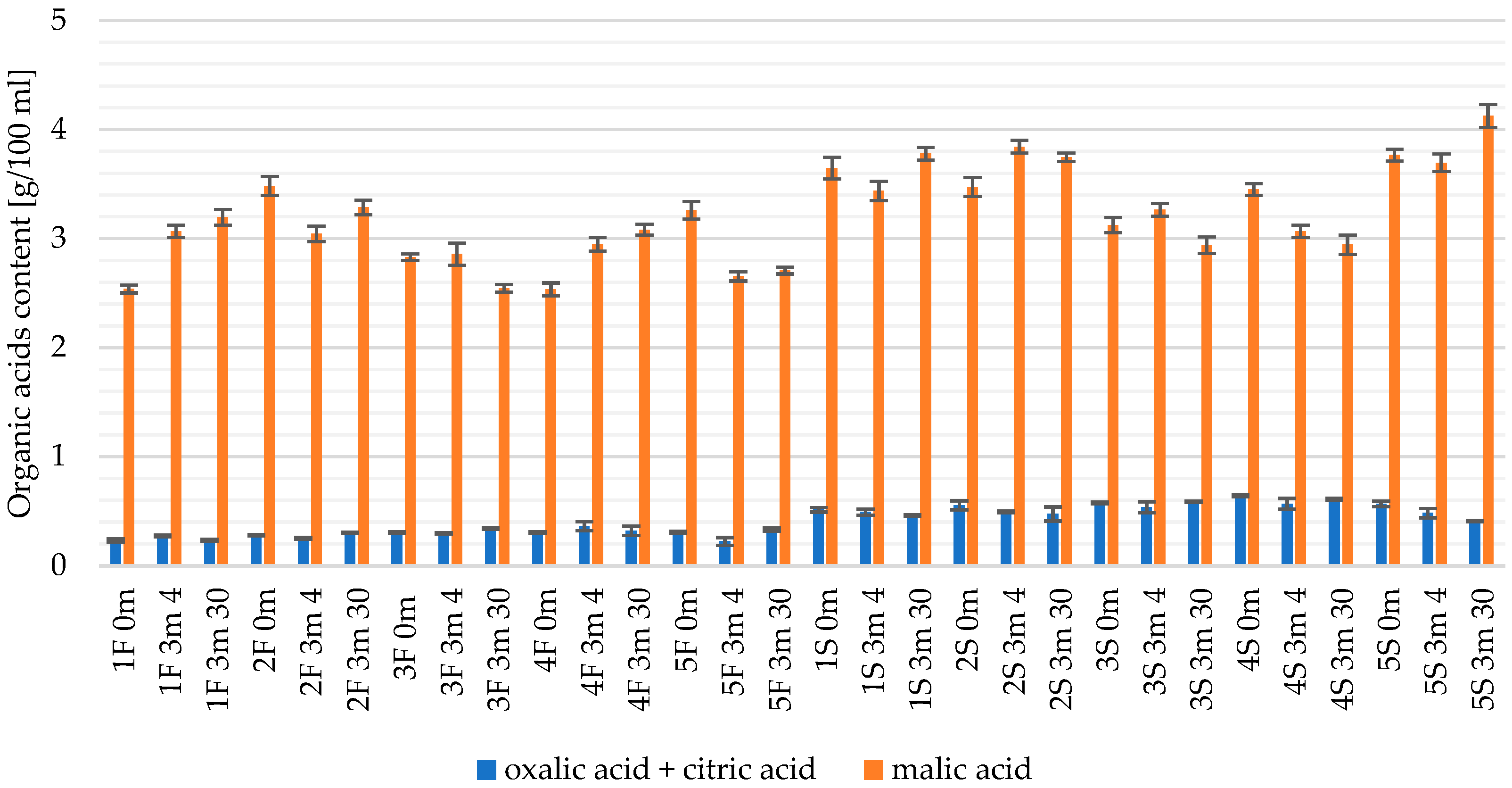
Three distinct peaks were identified in the chromatographic analysis: malic acid (MA), oxalic acid (OA), and citric acid (CA). The peaks corresponding to OA and CA partially overlapped under the applied analytical conditions; therefore, their combined concentration (OA + CA) was reported as a single value, calculated using the calibration curve for oxalic acid. The measured concentrations of MA in rowanberry nectars ranged from 2.54 to 4.13 g/100 mL, while OA + CA remained consistently below 0.65 g/100 mL across all formulations (Figure 2). Malic acid was identified as the predominant organic acid in the nectar samples, consistent with earlier reports indicating that MA is the major organic acid naturally present in rowanberry fruit [12,24]. Nectars prepared from steamed pulp (S) exhibited significantly higher levels of total organic acids (TOA)—ranging from 18.12% to 37.52%—compared to those made from fresh pulp (F). This increase is likely attributed to enhanced extractability during thermal treatment, a phenomenon supported by earlier findings in the literature. Prieciņa and Kārkliņa [29] observed an increase in total organic acids (TOA) in carrots after steam blanching for 3.0 min. Among other things, the authors observed a significant increase in malic acid, which increased from 168.19 mg·100 g−1 DW in fresh carrots to 1818.20 mg·100 g−1 DW. The primary mechanism that could cause an increase in detectable TOA content in fruit and vegetable raw materials and their processed products is thermally induced disruption of the plant matrix (cell wall breakdown). Heat treatment (such as blanching or steaming) facilitates the extraction of molecules that were previously bound to macromolecules or complexed within the cell–matrix. If certain organic acids were bound, blanching could release them into an extractable and detectable form by HPLC.
During storage at both 4 °C (refrigerated) and 30 °C, fluctuations in TOA content were observed, including both decreases and increases, depending on the nectar variant. Greater stability was noted in nectars prepared from steamed pulp compared to those made from the fresh pulp. The most pronounced changes in TOA relative to the initial values were observed in nectars from fresh fruit pulp: unsweetened (1F), sweetened with erythritol (4F), and with steviol glycosides (5F). It should be noted that in these samples, no statistically significant differences (p < 0.05) were found between storage at 4 °C and 30 °C (Figure 2). Interestingly, in nectars sweetened with xylitol—both from fresh and steamed pulp—the TOA content after refrigerated storage did not differ significantly (p < 0.05) from the initial level. Regardless of the storage temperature (3m 4 and 3m 30), no significant differences in TOA were observed in samples 1F, 4F, 5F, 2S, and 4S.
The results of the MANOVA (p < 0.05) demonstrated that the content of organic acids in rowanberry nectars was significantly influenced by all three experimental factors: fruit preparation method, type of sweetener, and storage conditions, as well as their interactions (Table A1).
The fruit preparation method had the strongest individual effect (F = 1825.0, p < 0.001), indicating that nectars made from steamed fruit pulp contained significantly different levels of organic acids compared to those made from fresh fruit, as confirmed by the obtained results (Figure 2). The type of sweetener also had a significant impact (F = 99.1, p < 0.001), confirming that various sweetening agents (sucrose, xylitol, erythritol, steviol glycosides) can alter the acidity profile of the final product.
Although the effect of storage conditions was statistically significant (F = 3.8, p = 0.028), its magnitude was lower, suggesting relatively minor changes in organic acid content depending on temperature and storage time.
Moreover, significant interaction effects were observed, indicating that the influence of the sweetener type on organic acid content was dependent on both the fruit processing method (F = 41.6, p < 0.001) and the storage conditions (F = 19.5, p < 0.001). The three-way interaction between sweetener, preparation, and storage (F = 40.2, p < 0.001) further emphasized the complexity of the system, demonstrating that the combined effect of these three factors significantly shaped the stability and levels of organic acids. In contrast, the interaction between preparation and storage was not statistically significant (F = 2.7, p = 0.073), suggesting that the effect of fruit treatment on acid content remained relatively stable regardless of storage conditions.

3.3. Bioactive Compounds

3.3.1. Carotenoids

The carotenoid content of rowan fruit varies depending on the variety, as well as the location and growing conditions. According to Zymone et al. [30], carotenoid concentrations varied by several dozen times across the analyzed rowanberry cultivars. In the present study, the raw fruit contained 2818.98 mg/100 g d.m. (Table 1). It should be noted, however, that the nectars were prepared by diluting the pulp with water in a 1:1 ratio, which inherently reduces the measurable concentration of carotenoids in the final product. After processing, the total carotenoid content in the nectars ranged from 24.74 to 490.41 mg/100 mL (Table 3), values that reflect both the dilution effect and the efficiency of carotenoid release into the aqueous matrix. The carotenoid profile of the nectars was dominated by lutein derivatives (LD) and total carotenes (TC). Trace amounts of xanthophylls (TX) were detected in several freshly prepared samples but fell below the detection limit after storage.
To the authors’ knowledge, no previous studies have reported the effect of sweetener addition on carotenoid content in fruit juices or nectars. However, significant differences were observed among the tested variants in the present study.
In nectars prepared from fresh pulp (F), the highest initial carotenoid contents were found in the unsweetened (1F), steviol glycosides-sweetened (5F), and with added erythritol (4F) variants, with values of 303.59, 244.33, and 240.41 mg/100 mL, respectively. Among the nectars tested, variant 1F showed the largest increase in carotenoid content, a 61% increase, during refrigerated storage after three months (3m 4). A similar trend was observed in variant 4F, with a 33% increase under the same conditions. Storage at 30 °C led to stabilization or significant decreases, as in the case of 5F, where total carotenoid content decreased by 13%. A similar pattern was observed in nectars made from steamed pulp (S). In these samples, the 4S and 1S variants showed a significant increase in carotenoid content after refrigerated storage, reaching 69% and 130% increases, respectively, after three months. However, during storage at 30 °C, carotenoid levels decreased significantly compared to the 3m 4 samples, with losses ranging from 35% to 40% depending on the variant.
In the unsweetened variants (1), higher TCD values were consistently observed in nectars prepared with fresh fruit pulp (F) at all time points, indicating that steaming the pulp reduced the measurable total carotenoid content in this formulation or promoted transformations (isomerization or oxidation) that lowered the detectable fraction of total trans-carotenoids. In contrast, in nectars sweetened with sucrose (2), an increase in carotenoid content was observed following steaming (difference (Δ) of 117.8 mg/100 mL), but this advantage largely disappeared after 3 months of refrigerated storage (Δ = +11.9) and reversed at 30 °C (Δ = −15.5), suggesting dynamic interactions between sucrose, processing, and temperature that influence both carotenoid extraction and stability during storage. Samples sweetened with xylitol prepared from steamed rowanberry pulp (3S) retained more carotenoids than their fresh counterparts (3F) throughout the study period. The advantage of steaming was greatest immediately after processing and partially decreased during storage, suggesting that fruit steaming and the addition of xylitol to the nectar promote initial carotenoid extraction or protection, but some degradation or redistribution occurs over time. Erythritol-sweetened samples (4) exhibited a temperature-dependent behavior: a moderate advantage of steaming at the beginning (Δ = +22.5), a pronounced advantage after refrigerated storage (Δ = +124.1), but a reversal of this trend at elevated temperature (Δ = −14.5). This indicates that the addition of erythritol, in combination with fruit pulp steaming, can strongly stabilize carotenoids under refrigerated conditions, while higher temperatures accelerate degradation processes that offset this benefit. Steviol glycosides-sweetened nectars (5) initially showed higher TC values in fresh samples (Δ = +76.3 for 0 m), but this advantage was lost during storage (Δ ≈ +13 and +6 for 3m 4 and 3m 30, respectively), suggesting that steaming promotes slow release or better retention of carotenoids in steviol glycosides preparations over time.
The susceptibility of carotenoids to degradation depends on several factors, including their chemical structure, the type of matrix, light exposure, temperature, water activity, and antioxidant content in food products [31]. In rowanberry nectars, storage-related variability in carotenoid content may result from intramolecular transformations and quantitative changes between individual carotenoid groups or isomers. Observed changes over time, reversals, or decreases in differences in carotenoid content indicate ongoing alterations in the composition of pigments during storage, possibly due to degradation or other factors. For example, variants prepared from steamed pulp, which initially contained higher carotenoid levels, tended to lose this advantage at 30 °C, consistent with accelerated thermal or oxidative degradation at elevated temperatures. Refrigerated storage was associated with increases in measured carotenoid content, presumably caused by pigment release, but the underlying mechanisms remain unclear and require further investigation.
This phenomenon was described by Tang and Chen [32], who analyzed the effect of time, temperature, and light exposure on the stability of carotenoid pigments in freeze-dried carrot extract. Their study indicated a significant relationship between the chemical structure of carotenoids and the direction and intensity of their transformations during storage. They found that the amount of all-trans-carotenoids in the freeze-dried product decreased with increasing temperature or exposure time. In samples stored in the dark, 13-cis carotenoid isomers predominated, while light exposure favored the synthesis of 9-cis compounds. Di-cis isomers, such as 13,15-di-cis-β-carotene, were formed during high-temperature storage of extracts. Nowacka et al. [33] studied the effect of storage time and temperature on carotenoid content in dried carrots. These researchers found that carotenoids in dried carrots degraded more rapidly at higher temperatures (25 and 40 °C), at which the reaction rate constant was approximately twice as high as at the lower storage temperature (4 °C).
It is worth noting that steaming the fruit pulp in most cases (nectars with sucrose, erythritol, xylitol) increased the release of carotenoids. This processing effect is consistent with previous research on fruit beverages. Dorothy et al. [34] cooked or steamed marula fruits before juicing them. Their studies showed that both forms of thermal processing had a positive effect on the total carotene content in marula juice compared to the control sample. The authors confirm that this treatment softens the fruit matrix, facilitating extraction and increasing the degree to which carotenes are released into the juice (increasing their extractability). It is worth noting that a higher carotene concentration was noted in the steamed sample compared to the boiled sample. This may be due to the steam’s ability to penetrate cellular and fiber structures, increasing the carotene concentration in the extracted juice. Steaming may also help break down carotenoid-protein complexes, increasing the amount of carotenoids in the juice.
The MANOVA results (Table A2) demonstrate that total carotenoid content in rowanberry nectars was significantly influenced by sweetener type, fruit preparation, and storage conditions (p < 0.05). Sweetener type had the largest effect, followed by storage and preparation, indicating that formulation and processing strongly determine carotenoid levels. All interaction terms, including sweetener × preparation, sweetener × storage, preparation × storage, and the three-way interaction, were significant, showing that the effects of individual factors are interdependent. These findings highlight the complex, context-dependent nature of carotenoid retention in rowanberry nectars and underscore the importance of considering combined effects of formulation, processing, and storage.

3.3.2. Flavonols

In the rowanberry nectars, the presence of quercetin and isorhamnetin glycosides was confirmed, with quercetin-3-O-rutinoside being the predominant flavonol in all samples (Table 4). Statistical analysis demonstrated that the content of the analyzed compounds was determined by several factors, including the method of pulp preparation applied in nectar production, the type of sweetening agent used, storage conditions, as well as interactions among these variables (Table A3).
The results clearly indicate that steaming of the fruit pulp had a beneficial effect on the flavonol content by enhancing their extraction from the plant matrix. In nectars produced from steamed pulp (S), the flavonol concentration was 4–8 times higher than in the samples prepared without this process. Interestingly, the addition of sweetening agents also exerted a favorable influence, and a synergistic effect between steaming and sweetener addition was evident. Within the group of nectars obtained from steamed pulp (S), the total flavonol content in the unsweetened sample (1S 0m) was more than fourfold higher compared to the nectar made from unsteamed pulp (1F 0m). In samples containing sweeteners, the levels of the analyzed compounds were 6–8 times higher than in their counterparts derived from unheated pulp. This effect was most pronounced in the nectar sweetened with steviol glycosides (5S 0m), where the flavonol concentration reached 8.76 mg/100 mL. For comparison, the corresponding product from unsteamed pulp (5F 0m) contained only 1.08 mg F/100 mL. Overall, all sweetened nectars (including those with sucrose, xylitol, and erythritol) prepared from steamed pulp exhibited significantly higher flavonol contents than the unsweetened sample (1S 0m).
Significant alterations in flavonol content were observed in all products during storage. In nectars prepared from unsteamed pulp (F), a general decrease in flavonol concentration was observed, with a higher degradation rate at 30 °C compared to refrigerated storage conditions (Table 4). The inclusion of sweetening agents in the formulation effectively reduced the rate of degradation. For instance, in the unsweetened nectar (1F), the polyphenol content decreased by 23% after three months of storage at 4 °C. In contrast, in sweetened variants, the reduction ranged from 5 to 8% (e.g., 3F 3m 4 with xylitol and 4F 3m 4 with erythritol). In the nectar containing steviol glycosides (5F), flavonols were the most stable, with their concentration remaining practically unchanged under refrigerated storage.
In nectars produced from steamed pulp (S), the effect of storage on flavonol content was less consistent. In nectars sweetened with xylitol (3S) and steviol glycosides (5S), the levels of the analyzed compounds were lower compared to fresh samples, regardless of storage temperature. Nevertheless, the extent of flavonol degradation was substantially greater at 30 °C than at 4 °C. In contrast, in unsweetened nectar (1S) and those containing sucrose (2S) or erythritol (4S) stored under refrigeration, an increase of 11–14% in flavonol content was observed. Conversely, storage at elevated temperature led to a decrease ranging from 5% (1S, 2S) to 17% (4S).
Steaming softens the cell walls of fruit, enhancing the release of phenolic compounds, including flavonols, into juices and purees. Studies on marula fruit have shown that steaming before juice extraction significantly increases the total phenolic content and antioxidant activity compared to un-steamed (control) samples. Boiling also increases phenolic content, but steaming is superior, as it avoids direct contact with water and better preserves bioactive compounds [34]. Juices from steamed pomegranate fruits had the highest phenolic recoveries, including flavonols, compared to juices from untreated or peeled fruits. Additional juice treatments (like filtration) reduced phenolic content, but steaming alone maximized recovery [35].

3.3.3. Flavan-3-Ols

The profile and content of flavan-3-ols in rowan nectars are presented in Table 5 and Table A4. Unsweetened nectar obtained from unsteamed fruit pulp contained (in total) more of the tested compounds (1F 0m; 19.80 mg/100 mL) than nectar from steamed pulp (1S 0m; 13.65 mg/100 mL). Except for procyanidin A2 and B1, whose concentrations slightly increased as a result of the thermal process, degradation of flavan-3-ols was common in the steamed sample. The effect of storage temperature on TF-ols was different for both samples. While a decrease in the concentration of the tested compounds was observed after 3 months in the 1F nectar (higher losses at 30 °C), the total flavan-3-ol content increased in the 1S nectar, with more of the tested compounds detected in the sample stored at higher temperatures. Generally, fewer polyphenols were detected in the samples containing added sweeteners than in the unsweetened samples. In nectars with polyols—xylitol (3) and erythritol (4)—both obtained from parboiled and unsteamed pulp—fewer flavan-3-ols were detected than in the products with sucrose and steviol glycosides. A common phenomenon observed in the tested nectars, particularly those steamed, was a significant increase in the percentage of flavan-3-ols in the samples stored at 30 °C.
In some fruits, steam or heat treatment can increase flavanol content or their extractability. For example, heating medlar fruit at 60 °C led to the highest flavanol content, likely due to enzyme inactivation (polyphenol oxidase) and improved release from cell structures [36]. Similarly, steaming chestnut fruit preserves or enhances flavonoid levels [37]. Steam explosion in citrus and sumac fruits also improved the recovery of certain flavanols and flavonoids [38,39,40]. In other cases, especially at higher temperatures or with prolonged heating, flavanol content decreases. For instance, drying honeysuckle berries at 75 °C resulted in a reduction of over 70% in flavanols [41]. Superheated steam treatment of Baccaurea pubera fruit reduced total flavonoid content by 16.5% [42]. Flavanol losses after processing were also observed in strawberries and apples, depending on the method and fruit part used [43].
Heat can inactivate or, if insufficient, leave active enzymes like polyphenol oxidase (PPO) and peroxidase (POD), which catalyze oxidative degradation of flavanols. Incomplete inactivation during mild heat treatment can lead to significant flavanol loss, while higher temperatures that fully inactivate these enzymes can help preserve or even increase flavanol content by preventing enzymatic breakdown [36,43,44,45]. Heat disrupts cell walls and membranes, releasing bound flavanols and increasing their extractability. This can result in higher measured flavanol content, especially when heat is applied to whole fruits or peels rich in these compounds [36,43,46]. Generally, flavanols are sensitive to high temperatures, with degradation rates increasing with temperature. Structural features, such as the presence of double bonds and glycosylation, influence thermal stability—glycosylated flavonoids are generally more heat-resistant [41,47,48].
Different sweeteners (sucrose, stevia, fructose, xylitol, erythritol, honey, jaggery, date syrup) can affect the stability and degradation rate of flavanols and other polyphenols during processing and storage. For example, in citrus–maqui beverages, stevia resulted in a higher loss of flavanones under light and room temperature conditions compared to sucrose. However, under refrigeration or darkness, both sweeteners exhibited similar losses [49]. In blackberry jams, xylitol slowed anthocyanin degradation, while fructose accelerated it; sucrose-containing jams had lower polyphenol content than those with fructose or xylitol [50]. The impact of sweeteners is often modulated by storage temperature, light exposure, and duration. Higher temperatures and light can accelerate flavanol degradation, especially with certain sweeteners [49,50].

3.3.4. Polymeric Procyanidins

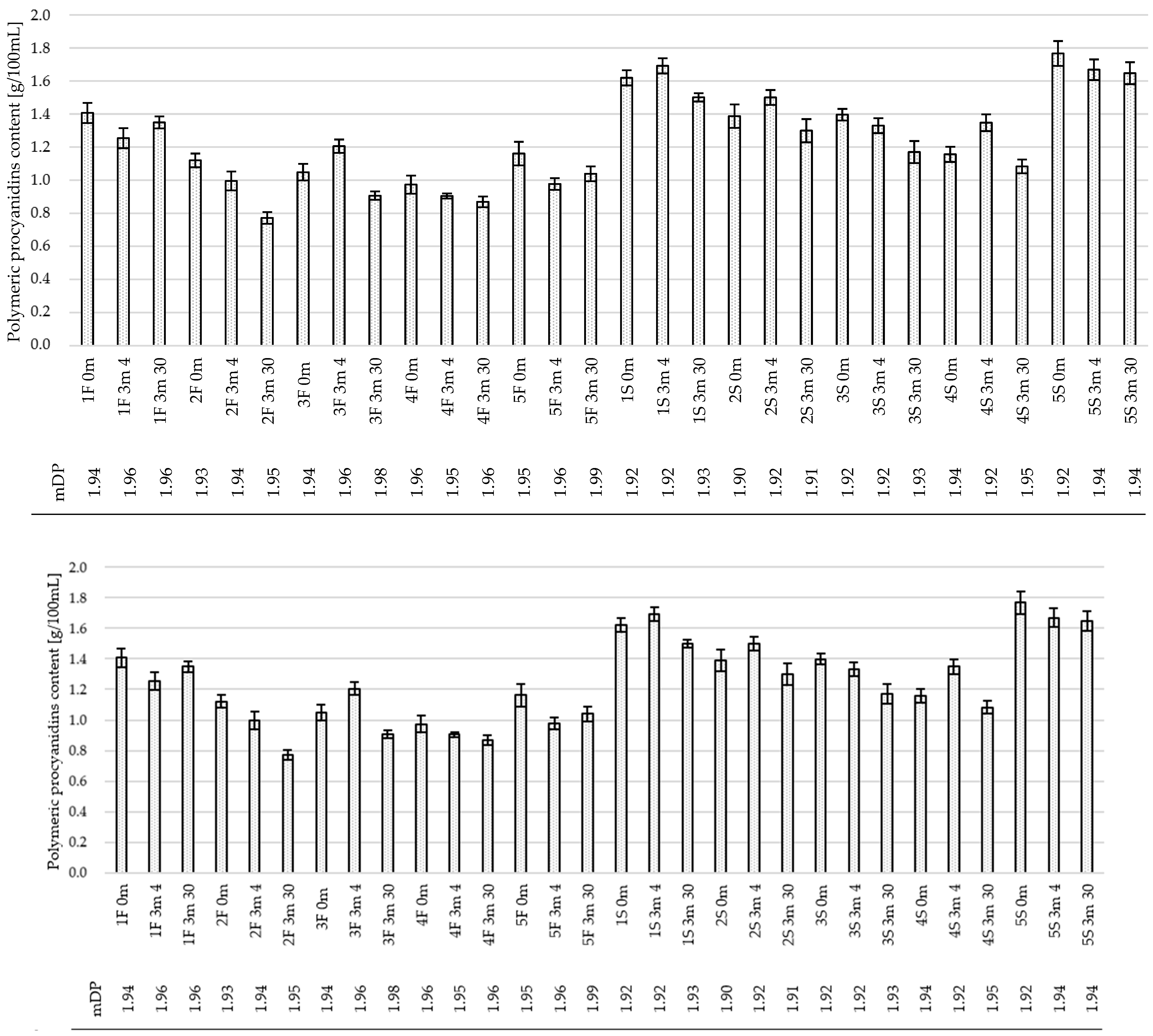
Polymeric procyanidins (PPCs) constitute a significant group of polyphenolic compounds present in rowanberries (Sorbus aucuparia L.). Rutkowska et al. [51] determined the total content of procyanidins, expressed as cyanidin chloride equivalents (CyE), determined by the n-butanol/HCl method in defatted acetone-water extract (1:1, v/v), at 1.702 g/100 g dm. The raw material used in the present study contained 8.147 g/100 g d.m. of procyanidins (Table 1). As the nectars were produced from pulp diluted with water, the concentrations measured in the final products were inherently lower, ranging from 0.772 to 1.767 g/100 mL depending on the sweetener type, fruit treatment, and storage conditions (Figure 3).
In all cases, nectars prepared from steamed fruit pulp (S) contained higher levels of PPC than those from fresh fruit pulp (F), suggesting that thermal treatment promoted the release of bound procyanidins from the cell–matrix. Similar observations were made by Kessy et al. [52], who analyzed the effect of different processing methods on the phenolic compound content and antioxidant activity in pericarp litchi. They found that the combination of steam blanching and drying at 60 °C significantly improved the release of phenolic compounds, including procyanidins, compared to drying alone, which caused significant losses. The positive effect of steam blanching on procyanidins is primarily explained by the inactivation of highly active endogenous enzymes characteristic of fresh plant materials, such as polyphenoloxidase and peroxidase. Inactivation of these enzymes prevents the degradation of phenolic compounds, including procyanidins, by inhibiting the catalysis of their oxidation. A second mechanism explaining the positive effect of blanching on procyanidin extraction is the physical change in the structure of the lychee pericarp during heat treatment, which facilitates the recovery of procyanidins bound to the cell–matrix, a phenomenon known as enhanced release of bound procyanidins.
At the initial stage (0 m), PPC levels in S nectars were on average 25–40% higher than in the corresponding F samples (Figure 3).
After three months of refrigerated storage (3m 4), the differences became more pronounced in most sweetened variants. The most significant increase was observed for samples sweetened with erythritol and steviol glycosides, representing up to 60–70% higher PPC content than their fresh-pulp counterparts. This suggests a protective effect of specific sweeteners, particularly erythritol and steviol glycosides.
Storage at 30 °C (3m 30) led to a general decline in PPC content in all samples, though S variants consistently retained 20–50% more PPCs than F ones, confirming that heat treatment improved the long-term stability of polymeric procyanidins. The effect was particularly evident in the sucrose (2S 3m 30 = 1.30 g/100 mL vs. 2F 3m 30 = 0.77 g/100 mL) and steviol glycosides (5S 3m 30 = 1.65 g/100 mL vs. 5F 3m 30 = 1.04 g/100 mL) variants.
Polymeric flavan-3-ols in rowan nectars consist mainly of (+)-catechin as the predominant constitutive unit of procyanidins. The mean degree of polymerization (mDP), reflecting the average number of flavan-3-ol units in procyanidin chains released during acid-catalyzed depolymerization, is a key parameter determining their bioavailability and bioactivity. In the present study, the mDP of the polymeric fraction ranged from 1.90 to 1.99. Such values are considerably lower than those reported for intact, native procyanidins, which typically exhibit mDP values exceeding 5. Some studies show that the molecular size plays a major role in determining the bioavailability of PPCs, which is 5–50% compared to the corresponding flavan-3-ol monomers. Furthermore, oligomeric PPCs are absorbed more slowly than monomeric flavan-3-ols [53]. According to the study by Hellström et al. [54], highly polymerized forms of procyanidins predominate in rowan fruit (248 mg/100 g of average, DP > 10), and the content of extractable and non-extractable procyanidins is 273 and 158 mg/100 g of average (DP = 20.8), respectively. In the analyzed nectars, a significant decrease in the degree of procyanidin polymerization was observed compared to the literature data for the raw material [54]. This could be due to the dilution of the juice with water or to differences resulting from the genotypic characteristics of the fruit; however, the determined DP of the procyanidins in the raw material was also only 1.92. The obtained results could therefore be, to some extent, a consequence of the intrinsic methodological limitations of the phloroglucinolysis procedure used for mDP quantification. Phloroglucinolysis depolymerizes procyanidins through nucleophilic cleavage under acidic conditions, producing terminal units (catechin/epicatechin) and phloroglucinol adducts. While this method provides a reliable estimate of average polymer length, it does not enable quantification of the size distribution of individual procyanidin fractions and is prone to side reactions such as epimerization and heterocyclic ring opening [55]. Additionally, substantial loss of polymeric procyanidins likely occurred during fruit pressing. Procyanidin polymers strongly associate with insoluble cell wall polysaccharides, making them prone to retention in pomace. Similar results were reported in the analysis of strawberry juice production [56]. These observations confirm the results of White et al. [57], who described the effect of individual stages of cranberry processing on the content of procyanidin polymers, among others, in juices. These authors noted that pressing resulted in a significant reduction in the content of polymeric procyanidins due to the separation of skins and seeds. The remaining content in the pomace was 43–52% polymeric procyanidins, 22–31% oligomeric compounds, and approximately 40% of the total procyanidins. This suggests that lower oligomers are more readily absorbed into the juice than polymerized forms of PPC [57]. According to Howard et al. [58], the greater retention of monomers and dimers during processing indicates that low molecular weight procyanidins bind less strongly to polysaccharides, cell wall proteins, or are more resistant to thermal degradation.
The MANOVA results (Table A5) indicate that all analyzed factors had a statistically significant effect (p < 0.001) on the polymeric procyanidin content in rowanberry nectars. Among the main factors, the sweetener type exerted the strongest individual influence (F = 81,071), which determines polymeric procyanidin levels, followed by fruit preparation (F = 36,449) and storage temperature (F = 2005), which modulate these effects through synergistic or antagonistic interactions.
Significant interaction effects were also observed between sweetener and preparation (F = 2872), sweetener and storage (F = 380), and, to a lesser extent, preparation and storage (F = 59), indicating that the impact of each sweetener on PPC retention depended both on the processing method and storage conditions. The three-way interaction (sweetener × preparation × storage) was also statistically significant (F = 241), confirming the complex, multivariate nature of PPC stability in the nectar system.
The stability of procyanidins even after long-term storage suggests that these compounds are relatively resistant to degradation and may play a significant role in their antioxidant potential.

3.3.5. Phenolic Acids

Phenolic acids were the second most abundant group of phenolic compounds, following flavan-3-ols (procyanidins, PAC), which predominated in all rowanberry nectar samples analyzed. As in the raw fruit, chlorogenic and neochlorogenic acids were the dominant phenolic acids in the nectars, whereas 1,5-di-O-caffeoylquinic acid occurred at substantially lower concentrations. Cryptochlorogenic and caffeic acids, which were detectable in raw fruit, were not identified in the nectars, most likely because their concentrations, after processing and dilution of the pulp, fell below the analytical detection limit (Table 1 and Table 6).
In the nectar prepared from fresh fruit pulp without added sweetener (1F), the highest initial concentration of phenolic acids was recorded; however, this variant also exhibited the most pronounced degradation during storage. After three months, the rowanberry nectars without sweeteners showed a 21% and 29% reduction in the content of these compounds when stored at 4 °C and 30 °C, respectively. In contrast, the nectar prepared from steamed fruit pulp without a sweetener (1S) demonstrated an increase in phenolic acid content, particularly during refrigerated storage, exhibiting a 16% rise.
Sweetened nectars prepared from fresh fruit pulp (F variants) exhibited, on average, lower phenolic acid content than those from steamed pulp (S variants). Notably, F2 and F4 samples (sweetened with sucrose and erythritol) displayed greater stability of phenolic acids during storage. In contrast, their steamed counterparts (S2 and S4) showed an increase in phenolic acid content after three months of refrigerated storage, likely due to enhanced release of bound phenolics from the fruit matrix.
Similar observations were made by Nowicka and Wojdyło [59], who studied the effect of sweeteners on the content of polyphenolic compounds in sour cherry purees. They reported that total phenolic acid content in unsweetened cherry puree was 111.53 mg/100 g dry matter (dm), while sucrose and erythritol addition reduced it—as in our study. Furthermore, for hydroxycinnamic acids specifically, after six months of storage at 4 °C, cherry puree sweetened with sucrose and erythritol contained 81.46 mg/100 g dm and 77.93 mg/100 g dm, respectively—both higher than the initial post-processing levels (sucrose: 70.24; erythritol: 74.63 mg/100 g dm). It can be concluded that although sweetener addition was associated with lower initial phenolic content, some formulations showed reduced losses during storage. Similar observations were reported in lyophilized apple purées, where samples with 5% sucrose retained chlorogenic acid content at levels comparable to unsweetened material after six months [60]. In the present study, regardless of the raw material processing method (fresh or steamed fruit pulp), nectars sweetened with xylitol and steviol glycosides exhibited a decline in total phenolic acids during storage. This decrease was particularly pronounced after three months at 30 °C. These results indicate that the stability of phenolic acids during storage varies among sweeteners. This suggests that the use of xylitol and steviol glycosides, despite their natural origin and favorable glycemic profiles, may contribute to a reduction in polyphenol stability, probably due to limited antioxidant or matrix-protective interactions compared to sugar alcohols like erythritol or disaccharides such as sucrose. Steviol glycosides, on the other hand, appear to have the least negative initial impact on the phenolic acid content.
Based on the MANOVA results for phenolic acid content, all examined factors and their interactions had a statistically significant effect (p < 0.001) on the variation in phenolic acids in the rowanberry nectar samples (Table A6). The most substantial individual influence was observed for the type of sweetener (F = 12,959.91, p < 0.001), followed by the fruit preparation method (F = 7494.41, p < 0.001) and storage conditions (F = 5508.79, p < 0.001). Additionally, all interaction effects were highly significant, including the sweetener × preparation (F = 2984.14), sweetener × storage (F = 813.94), preparation × storage (F = 1804.34), and the three-way interaction sweetener × preparation × storage (F = 970.57). These results indicate that the influence of sweetener type on phenolic acid content was strongly dependent on the processing method and storage conditions, confirming the complex behavior of phenolic compounds under different formulation and storage scenarios.
It is worth noting that, in most cases, the concentration of chlorogenic acids in rowanberry fruit is higher than the levels typically found in vegetables and other commonly consumed fruits [51,52,53,54,55,56,57,58,59,60,61,62].

3.4. Antioxidant Capacity

The antioxidant potential of fruit-based products is determined not only by the content of compounds naturally derived from the fruit but also by those formed as a result of transformations occurring during technological processing operations (such as crushing, steaming, blending, pasteurization). These processes do not necessarily lead to a reduction in antioxidant activity [63]. Food processing and storage can lead to a range of, at times, opposing impacts on antioxidant properties. These include the degradation of naturally present antioxidants, enhancement of the antioxidant activity of existing compounds, generation of new substances with antioxidant effects (such as Maillard reaction products), formation of new compounds with pro-oxidant effects (also Maillard reaction products), and various interactions between different components (for instance, between lipids and natural antioxidants or between lipids and Maillard reaction products) [64].
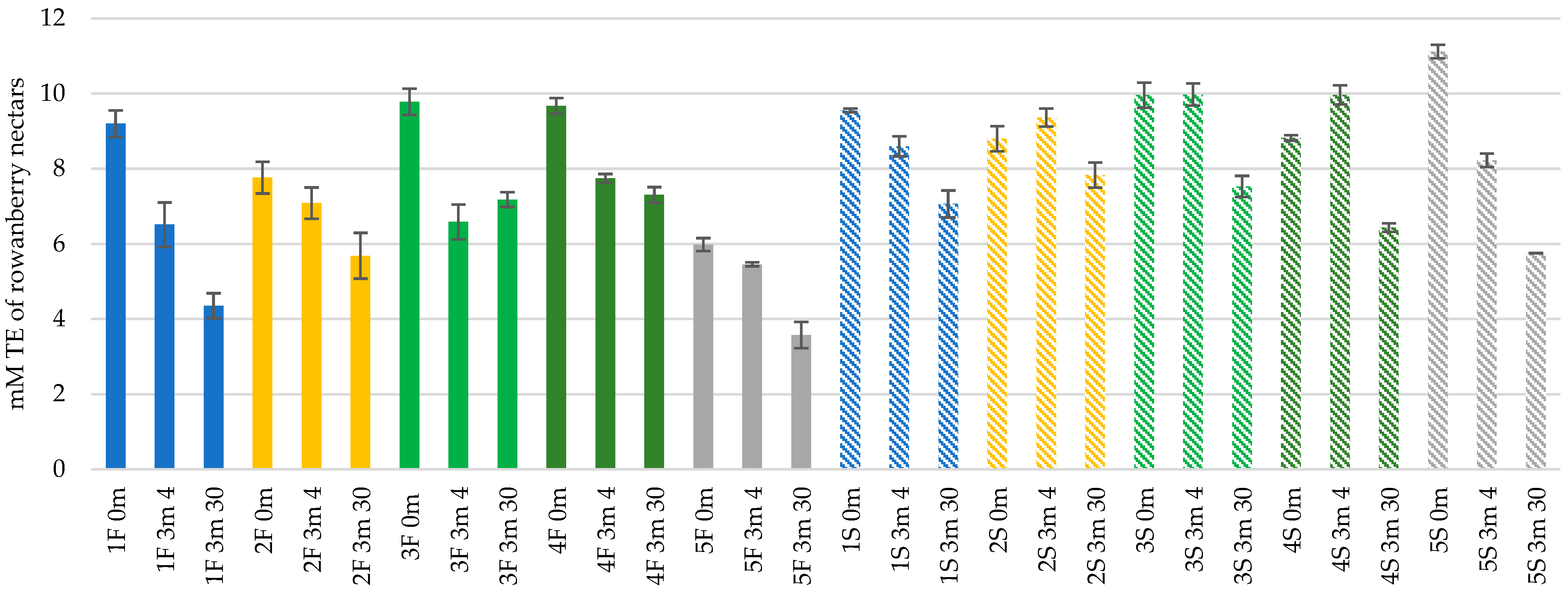
In relation to the results of our own research, nectars made from steamed rowanberry pulp were characterized by significantly (p < 0.05; Table A7) higher antioxidant activity in the FRAP test (±8.60 mM TE/L) than nectars made from unsteamed pulp (±6.93 mM TE/L). In the case of nectars made from unsteamed pulp, the addition of sweeteners—xylitol and erythritol (3N and 4N)—led to an increase in FRAP potential compared with the nectar without sweeteners (1N). Although antioxidant activity decreased during storage in 3N and 4N samples, their values remained significantly higher than those of the stored unsweetened nectar. While FRAP activity in the unsweetened nectar stored at 30 °C fell by more than 50%, the reductions in the samples containing xylitol and erythritol were smaller, amounting to approximately 26% and 24%, respectively. The effect of sucrose and steviol glycosides on changes in FRAP potential in rowanberry products made from unsteamed pulp was interesting. Although these nectars were characterized by lower antioxidant activity compared to unsweetened nectar, the recorded changes in the studied parameter after storage were significantly smaller, especially when the samples were stored at low temperatures (a reduction of approximately 9% in both cases).
In nectars prepared from steamed pulp without added sweeteners, the decrease in antioxidant activity was notably smaller compared to that observed in nectars made from unsweetened pulp. Furthermore, samples containing xylitol and steviosides (3S and 5S) exhibited higher FRAP activity values than the unsweetened nectar (1S) (Figure 4). Regarding the influence of storage conditions on the antioxidant activity of nectars derived from steamed pulp, a significant increase was recorded in samples containing sucrose and erythritol (2S and 4S; stored at 4 °C). Compared to other sweeteners used in the experiment, the addition of sucrose had the greatest impact on the antioxidant potential of nectars stored at 30 °C. In sample 2S 3m 30, the value of the tested parameter decreased by approximately 11% compared to the nectar before storage. At the same time, in the remaining cases, these losses ranged from 24 to 48% (for nectar with xylitol and steviol glycosides, respectively).
Shalaby et al. [65] tried to explain the mechanism of the influence of various sweeteners (saccharose, aspartame) on the antioxidant activity of polyphenols contained in black and green tea. The findings revealed that the addition of table sugar to green tea led to a noticeable reduction in antioxidant activity (from 95.8% to 90.6% at a sucrose concentration of 4.0%). In contrast, when the same amount of sugar was added to black tea, an increase in antioxidant activity was observed (from 87.0% to 91.9% with 4.0% sucrose). These authors used FTIR spectroscopy to analyze functional groups (carboxyl, hydroxyl, amide, ether, etc.) in tea samples with or without added sweeteners. For example, FTIR spectral analysis of green tea showed that the characteristic O–H stretching vibration band at 3439 cm−1 shifted to 3436 cm−1 when sucrose was added and to 3434 cm−1 with the addition of aspartame. In contrast, the O–H stretching vibration band at 3462 cm−1 in black tea shifted to 3435 cm−1 upon the addition of either sucrose or aspartame. The authors suggested that the significant increase in antioxidant activity of black tea could result from interactions between oxidized phenolic compounds and the sucrose molecule, leading to the formation of reduced phenolic compounds that can interact with DPPH or ABTS radicals. However, they did not investigate the antioxidant potential of FRAP [65]. Moreover, sweeteners may have antioxidant activity, as demonstrated by Hajihashemi et al. [66]. The authors investigated the radical scavenging activity of ascorbic acid, quercetin, stevioside (ST), rebaudioside A (Reb A), steviol glucuronide (SVglu), glucose, sucrose, hydroxytyrosol, metformin, and aspirin. In relation to sweeteners, ST, Reb A, SVglu, glucose, and sucrose exhibited hydroxyl radical (·OH) scavenging activity. Superoxide radicals were effectively neutralized by SVglu, ST, and Reb A, as well as aspirin [66].
The polyphenol content in products enables the assessment of their antioxidant properties, provided that their quantity, type, and origin are considered. Therefore, in complex systems, the activity of individual compounds cannot be considered in isolation; instead, the collective action of the entire group and the interactions occurring among them must be evaluated. Studies conducted by Hidalgo et al. [67] clearly indicated that these relationships are not always synergistic. The authors emphasized the close relationship between the antioxidant strength of a given compound and its structural characteristics. The effectiveness of an antioxidant also depends on the radical and its specific reaction mechanism, which is influenced, among others, by the presence of glycosidic residues in the polyphenol molecule, as well as the number and position of hydroxyl and methoxyl groups. Thus, the final antioxidant activity is determined by the combination of all these factors. Moreover, all the aforementioned structural features also affect the interactions between flavonoids [67].

4. Conclusions

The results showed that both the type of sweetener and the fruit preparation method had a significant impact on the content of bioactive compounds in rowanberry nectars. The study confirms the beneficial effect of thermal processing on the extraction of bioactive compounds. Steaming increased the total polyphenol content on average by 13% in the sugar-free nectar to 52% in the nectars with added stevia glycosides, which had the highest total polyphenol content. Good stability of these compounds during storage was also observed in this variant, with a maximum decrease of 7%. Regarding carotenoids, the variant with erythritol prepared from steamed pulp is noteworthy. After refrigeration, 90% of these compounds were detected compared to the sample without added sugar, which had the highest content. Overall, the combination of steaming with stevia glycosides proved most effective in preserving polyphenols in rowan nectars during storage, although erythritol could also be considered as a sucrose substitute.
Future research should focus on elucidating the mechanisms underlying the influence of sweetener addition on the content and stability of carotenoids and polyphenols in rowanberry nectars. In particular, studies should investigate how different classes of sweeteners—sugars, sugar alcohols, and non-caloric glycosides—affect the extractability, isomerization, and oxidative degradation of bioactive compounds during processing and storage. The monitoring of individual carotenoid isomers and degradation products should be investigated while examining their interactions with matrix components (e.g., pectins, phenolics, and proteins). Additionally, kinetic modeling of degradation under varying water activity and temperature conditions could help clarify the protective or destabilizing roles of specific sweeteners. Such insights would support the rational design of nectar formulations that optimize the retention of bioactive compounds and nutritional quality. Future studies should also incorporate multiple rowanberry cultivars to assess genotype-dependent variability in bioactive compound profiles and to extend the applicability of the present findings beyond a single raw material source.

Author Contributions

Conceptualization, M.W. and M.T.; methodology, M.W., M.T., P.N. and A.W.; software, M.W. and P.N.; formal analysis, M.W.; investigation, M.W., M.T., P.N., P.S. and A.W.; resources, M.W.; data curation, M.W., P.N. and A.W.; writing—original draft preparation, M.W. and M.T.; writing—review and editing, P.S.; visualization, M.W.; supervision, M.W. All authors have read and agreed to the published version of the manuscript.

Funding

This research received no external funding.

Institutional Review Board Statement

Not applicable.

Informed Consent Statement

Not applicable.

Data Availability Statement

The experimental data obtained in the study are available from the corresponding author on reasonable request.

Acknowledgments

The authors of the publication would like to thank Aniceta Ślęczka for technical support.

Conflicts of Interest

The authors declare no conflicts of interest.

Appendix A

Table A1. Results of MANOVA (p < 0.05) showing the effects of fruit preparation, sweetener addition, and storage conditions on total organic acid content.
EffectSSdfMSFp
Free parameter1180.80811180.808155,237.636<0.001
Sweetener3.01640.75499.116<0.001
Preparation13.882113.8821824.963<0.001
Storage0.05820.0293.7860.028
Sweetener × Preparation1.26540.31641.577<0.001
Sweetener × Storage1.18880.14819.519<0.001
Preparation × Storage0.04220.0212.7380.073
Sweetener × Preparation × Storage2.44580.30640.179<0.001
Table A2. Results of MANOVA (p < 0.05) showing the effects of fruit preparation, sweetener addition, and storage conditions on total carotenoid content.
EffectSSdfMSFp
Free parameter3,845,919.67113,845,919.6714,482,714.815<0.001
Sweetener1,161,316.8824290,329.221338,401.009<0.001
Preparation28.873128.87333.654<0.001
Storage111,289.292255,644.64664,858.110<0.001
Sweetener × Preparation63,803.315415,950.82918,591.916<0.001
Sweetener × Storage88,280.499811,035.06212,862.213<0.001
Preparation × Storage4290.49122145.2452500.448<0.001
Sweetener × Preparation × Storage36,073.67584509.2095255.830<0.001
Table A3. Results of MANOVA (p < 0.05) showing the effects of fruit preparation, sweetener addition, and storage conditions on flavonol content.
EffectSSdfMSFp
Free parameter1617.42811617.42838,425.777<0.001
Sweetener11.82942.95770.257<0.001
Preparation922.3531922.35321,912.645<0.001
Storage14.15127.075168.090<0.001
Sweetener × Preparation4.15041.03724.647<0.001
Sweetener × Storage1.77480.2225.267<0.001
Preparation × Storage8.59624.298102.112<0.001
Sweetener × Preparation × Storage2.74980.3448.163<0.001
Table A4. Results of MANOVA (p < 0.05) showing the effects of fruit preparation, sweetener addition, and storage conditions on total flavan-3-ol content.
EffectSSdfMSFp
Free parameter12,759.173112,759.17357,862.485<0.001
Sweetener738.6944184.674837.489<0.001
Preparation147.4641147.464668.744<0.001
Storage56.607228.304128.356<0.001
Sweetener × Preparation152.113438.028172.457<0.001
Sweetener × Storage66.45588.30737.672<0.001
Preparation × Storage10.73925.37024.351<0.001
Sweetener × Preparation × Storage99.597812.45056.459<0.001
Table A5. Results of MANOVA (p < 0.05) showing the effects of fruit preparation, sweetener addition, and storage conditions on polymeric procyanidin content.
EffectSSdfMSFp
Free parameter3109.05513109.0551,208,182.168<0.001
Sweetener834.4944208.62481,071.312<0.001
Preparation93.795193.79536,448.771<0.001
Storage10.32025.1602005.230<0.001
Sweetener × Preparation29.55847.3902871.598<0.001
Sweetener × Storage7.81580.977379.629<0.001
Preparation × Storage0.30320.15158.849<0.001
Sweetener × Preparation × Storage4.96380.620241.078<0.001
Table A6. Results of MANOVA (p < 0.05) showing the effects of fruit preparation, sweetener addition, and storage conditions on total phenolic acid content.
EffectSSdfMSFp
Free parameter103,723.8131103,723.8133,176,329.773<0.001
Sweetener1692.8364423.20912,959.914<0.001
Preparation244.7321244.7327494.411<0.001
Storage359.7822179.8915508.792<0.001
Sweetener × Preparation389.792497.4482984.143<0.001
Sweetener × Storage212.635826.579813.941<0.001
Preparation × Storage117.842258.9211804.336<0.001
Sweetener × Preparation × Storage253.553831.694970.567<0.001
Table A7. Results of MANOVA (p < 0.05) showing the effects of fruit preparation, sweetener addition, and storage conditions on antioxidant capacity.
EffectSSdfMSFp
Free parameter5423.08715423.08754,629.045<0.001
Sweetener37.23849.31093.779<0.001
Preparation62.960162.960634.220<0.001
Storage118.631259.315597.509<0.001
Sweetener × Preparation23.74645.93659.800<0.001
Sweetener × Storage15.02381.87818.916<0.001
Preparation × Storage8.66524.33343.644<0.001
Sweetener × Preparation × Storage23.80582.97629.975<0.001

References

  1. Olczyk, M.; Geszprych, A. Edible and medicinal plants of the genus Sorbus L. Post. Fitoter. 2017, 18, 278–285. [Google Scholar] [CrossRef]
  2. Olszewska, M. Separation of quercetin, sexangularetin, kaempferol and isorhamnetin for simultaneous HPLC determination of flavonoid aglycones in inflorescences, leaves and fruits of three Sorbus species. J. Pharm. Biomed. Anal. 2008, 48, 629–635. [Google Scholar] [CrossRef] [PubMed]
  3. Gil-Izquierdo, A.; Mellenthin, A. Identification and quantitation of flavonols in rowanberry (Sorbus aucuparia L.) juice. Eur. Food Res. Technol. 2001, 213, 12–17. [Google Scholar] [CrossRef]
  4. Kylli, P.; Nohynek, L.; Puupponen-Pimiä, R.; Westerlund-Wikström, B.; McDougall, G.; Stewart, D.; Heinonen, M. Rowanberry phenolics: Compositional analysis and bioactivities. J. Agric. Food Chem 2010, 58, 11985. [Google Scholar] [CrossRef]
  5. Santos-Buelga, C.; González-Paramás, A.M.; Oludemi, T.; Ayuda-Durán, B.; González-Manzano, S. Plant phenolics as functional food ingredients. Adv. Food Nutr. Res. 2019, 90, 183–257. [Google Scholar] [CrossRef]
  6. Liu, W.; Li, J.; Zhang, X.; Zu, Y.; Yang, Y.; Liu, W.; Xu, Z.; Gao, H.; Sun, X.; Jiang, X.; et al. Current advances in naturally occurring caffeoylquinic acids: Structure, bioactivity, and synthesis. J. Agric. Food Chem. 2020, 68, 10489–10516. [Google Scholar] [CrossRef] [PubMed]
  7. Yan, Y.; Zhou, X.; Guo, K.; Zhou, F.; Yang, H. Use of chlorogenic acid against diabetes mellitus and its complications. J. Immunol. Res. 2020, 2020, 9680508. [Google Scholar] [CrossRef]
  8. Amato, A.; Terzo, S.; Mulè, F. Natural compounds as beneficial antioxidant agents in neurodegenerative disorders: A focus on Alzheimer’s disease. Antioxidants 2019, 8, 608. [Google Scholar] [CrossRef]
  9. Fuentes, E.; Caballero, J.; Alarcón, M.; Rojas, A.; Palomo, I. Chlorogenic acid inhibits human platelet activation and thrombus formation. PLoS ONE 2014, 9, e90699. [Google Scholar] [CrossRef]
  10. Rojas-González, A.; Figueroa-Hernández, C.Y.; González-Rios, O.; Suárez-Quiroz, M.L.; González-Amaro, R.M.; Hernández-Estrada, Z.J.; Rayas-Duarte, P. Coffee chlorogenic acids incorporation for bioactivity enhancement of foods: A Review. Molecules 2022, 27, 3400. [Google Scholar] [CrossRef]
  11. Mikulic-Petkovsek, M.; Schmitzer, V.; Slatnar, A.; Stampar, F.; Veberic, R. Composition of sugars, organic acids, and total phenolics in 25 wild or cultivated berry species. J. Food Sci. 2012, 77, C1064–C1070. [Google Scholar] [CrossRef]
  12. Cristea, E.; Ghendov-Mosanu, A.; Patras, A.; Socaciu, C.; Pintea, A.; Tudor, C.; Sturza, R. The influence of temperature, storage conditions, pH, and ionic strength on the antioxidant activity and color parameters of rowan berry extracts. Molecules 2021, 26, 3786. [Google Scholar] [CrossRef] [PubMed]
  13. Arvinte, O.M.; Senila, L.; Becze, A.; Amariei, S. Rowanberry—A source of bioactive compounds and their biopharmaceutical properties. Plants 2023, 12, 3225. [Google Scholar] [CrossRef]
  14. Sun, H.; Saeedi, P.; Karuranga, S.; Pinkepank, M.; Ogurtsova, K.; Duncan, B.B.; Stein, C.; Basit, A.; Chan, J.C.N.; Mbanya, J.C.; et al. IDF Diabetes Atlas: Global, regional and country-level diabetes prevalence estimates for 2021 and projections for 2045. Diabetes Res. Clin. Pract. 2022, 183, 109119. [Google Scholar] [CrossRef]
  15. European Council. Council Directive 2001/112/EC of 20 December 2001 Relating to Fruit Juices and Certain Similar Products Intended for Human Consumption; European Council: Brussels, Belgium, 2001. [Google Scholar]
  16. European Council. Regulation (EC) No 1333/2008 of the European Parliament and of the Council of 16 December 2008 on Food Additives; European Council: Brussels, Belgium, 2008. [Google Scholar]
  17. Wilk, M.; Krzywonos, M. Distillery wastewater decolorization by Lactobacillus plantarum MiLAB393. Arch. Environ. Prot. 2020, 46, 76–84. [Google Scholar] [CrossRef]
  18. Teleszko, M.; Wojdyło, A. Comparison of phenolic compounds and antioxidant potential between selected edible fruits and their leaves. J. Funct. Foods 2015, 14, 736–746. [Google Scholar] [CrossRef]
  19. Wojdyło, A.; Nowicka, P.; Turkiewicz, I.P.; Tkacz, K. Profiling of polyphenols by LC-QTOF/ESI-MS, characteristics of nutritional compounds and in vitro effect on pancreatic lipase, α-glucosidase, α-amylase, cholinesterase and cyclooxygenase activities of sweet (Prunus avium) and sour (P. cerasus) cherries leaves and fruits. Ind. Crops Prod. 2021, 174, 114214. [Google Scholar] [CrossRef]
  20. Wojdyło, A.; Oszmiański, J.; Bielicki, P. Polyphenolic composition, antioxidant activity, and polyphenol oxidase (PPO) activity of quince (Cydonia oblonga Miller) varieties. J. Agric. Food Chem. 2013, 61, 2762–2772. [Google Scholar] [CrossRef] [PubMed]
  21. Tkacz, K.; Wojdyło, A.; Turkiewicz, I.P.; Ferreres, F.; Moreno, D.A.; Nowicka, P. UPLC-PDA-Q/TOF-MS profiling of phenolic and carotenoid compounds and their influence on anticholinergic potential for AChE and BuChE inhibition and on-line antioxidant activity of selected Hippophaë rhamnoides L. cultivars. Food Chem. 2020, 309, 125766. [Google Scholar] [CrossRef]
  22. Wojdyło, A.; Nowicka, P.; Bąbelewski, P. Phenolic and carotenoid profile of new goji cultivars and their anti-hyperglycemic, anti-aging and antioxidant properties. J. Funct. Foods 2018, 48, 632–642. [Google Scholar] [CrossRef]
  23. Benzie, I.F.F.; Strain, J.J. The ferric reducing ability of plasma (FRAP) as a measure of “antioxidant power”: The FRAP assay. Anal. Biochem. 1996, 239, 70–76. [Google Scholar] [CrossRef]
  24. Bozhuyuk, M.R. Morphological and biochemical diversity in fruits of rowanberry (Sorbus aucuparia L.) genotypes. Erwerbs-Obstbau 2021, 63, 431–435. [Google Scholar] [CrossRef]
  25. Liu, J.; Bi, J.; McClements, D.J.; Liu, X.; Yi, J.; Lyu, J.; Zhou, M.; Verkerk, R.; Dekker, M.; Wu, X.; et al. Impacts of thermal and non-thermal processing on structure and functionality of pectin in fruit- and vegetable- based products: A review. Carbohydr. Polym. 2020, 250, 116890. [Google Scholar] [CrossRef] [PubMed]
  26. Polak, N.; Kalisz, S.; Hać-Szymańczuk, E.; Kruszewski, B. Impact of conventional pasteurization, high temperature short time, ultra-high temperature, and storage time on physicochemical characteristics, bioactive compounds, antioxidant activity, and microbiological quality of fruit nectars. Foods 2024, 13, 3963. [Google Scholar] [CrossRef]
  27. Wang, H.; Yuan, J.; Chen, L.; Ban, Z.; Zheng, Y.; Jiang, Y.; Jiang, Y.; Li, X. Effects of fruit storage temperature and time on cloud stability of not from concentrated apple juice. Foods 2022, 11, 2568. [Google Scholar] [CrossRef]
  28. Zhang, X.; Li, M.; Zhao, W.; Gao, Z.; Wu, M.; Zhou, T.; Wu, C.; Zhou, K.; Han, X.; Zhou, Q. Hawthorn juice simulation system for pectin and polyphenol adsorption behavior: Kinetic modeling properties and identification of the interaction mechanism. Foods 2022, 11, 2813. [Google Scholar] [CrossRef]
  29. Prieciņa, L.; Kārkliņa, D. Influence of steam treatment and drying on carrots composition and concentration of phenolics, organic acids and carotenoids. Proc. Latv. Acad. Sci. 2018, 72, 103–112. [Google Scholar] [CrossRef]
  30. Zymone, K.; Raudone, L.; Raudonis, R.; Marksa, M.; Ivanauskas, L.; Janulis, V. Phytochemical profiling of fruit powders of twenty Sorbus L. cultivars. Molecules 2018, 23, 2593. [Google Scholar] [CrossRef]
  31. Rodriguez-Amaya, D.B. Stability of carotenoids during the storage of foods. In Shelf Life Studies of Foods and Beverages. Chemical, Biological, Physical and Nutritional Aspects; Charalambous, E., Ed.; Elsevier Science Publishers: Amsterdam, The Netherlands, 1993. [Google Scholar]
  32. Tang, Y.C.; Chen, B.H. Pigment change of freeze-dried carotenoid powder during storage. Food Chem. 2000, 69, 11–17. [Google Scholar] [CrossRef]
  33. Nowacka, M.; Witrowa-Raichert, D.; Strachota, W.; Sobczak, E. Changes in the content of vitamin C and carotenoids during dried carrot and potato storage. Acta Agrophysica 2011, 17, 165–175. [Google Scholar]
  34. Dorothy, M.Z.; Suinyuy, T.N.; Lubaale, J.; Peter, B.O. Physicochemical properties and antioxidant activities of marula fruit (Sclerocarya birrea subsp. Caffra) steamed and boiled before juice extraction. Food Sci. Nutr. 2023, 11, 4607–4615. [Google Scholar] [CrossRef]
  35. Fischer, U.; Dettmann, J.; Carle, R.; Kammerer, D. Impact of processing and storage on the phenolic profiles and contents of pomegranate (Punica granatum L.) juices. Eur. Food Res. Technol. 2011, 233, 797–816. [Google Scholar] [CrossRef]
  36. Mikulic-Petkovsek, M.; Jakljevic, K.; Veberic, R.; Hudina, M.; Rusjan, D. Changes in the fruit quality parameters of medlar fruit (Mespilus germanica L.) after heat treatment, storage, freezing or hoarfrost. Foods 2023, 12, 3077. [Google Scholar] [CrossRef]
  37. Liu, F.; Chang, X.; Hu, X.; Brennan, C.S.; Guo, X. Effect of thermal processing on phenolic profiles and antioxidant activities in Castanea mollissima. Int. J. Food Sci. Technol. 2017, 52, 439–447. [Google Scholar] [CrossRef]
  38. Chen, G.; Chen, H. Extraction and deglycosylation of flavonoids from sumac fruits using steam explosion. Food Chem. 2011, 126, 1934–1938. [Google Scholar] [CrossRef]
  39. Dorado, C.; Cameron, R.G.; Manthey, J.A. Study of static steam explosion of Citrus sinensis juice processing waste for the isolation of sugars, pectic hydrocolloids, flavonoids, and peel oil. Food Bioprocess. Technol. 2019, 12, 1293–1303. [Google Scholar] [CrossRef]
  40. Dorado, C.; Cameron, R.G.; Manthey, J.A.; Ferguson, K.L. Bench scale batch steam explosion of Florida red and white grapefruit juice processing residues. Future Foods 2011, 3, 100020. [Google Scholar] [CrossRef]
  41. Senica, M.; Stampar, F.; Ercisli, S.; Sladonja, B.; Poljuha, D.; Mikulic-Petkovsek, M. The impact of drying on bioactive compounds of blue honeysuckle berries (Lonicera caerulea var. edulis Turcz. ex Herder). Acta Bot. Croat. 2020, 79, 68–77. [Google Scholar] [CrossRef]
  42. Shaharuddin, S.; Husen, R.; Othman, A. Nutritional values of Baccaurea pubera and comparative evaluation of SHS treatment on its antioxidant properties. J. Food Sci. Technol. 2021, 58, 2360–2367. [Google Scholar] [CrossRef] [PubMed]
  43. Salazar-Orbea, G.L.; García-Villalba, R.; Bernal, M.J.; Hernández, A.; Tomás-Barberán, F.A.; Sánchez-Siles, L.M. Stability of phenolic compounds in apple and strawberry: Effect of different processing techniques in industrial set up. Food Chem. 2023, 401, 134099. [Google Scholar] [CrossRef]
  44. Gao, Y.; Xia, W.; Shao, P.; Wu, W.; Chen, H.; Fang, X.; Mu, H.; Xiao, J.; Gao, H. Impact of thermal processing on dietary flavonoids. Curr. Opin. Food Sci. 2022, 48, 100915. [Google Scholar] [CrossRef]
  45. Umair, M.; Jabeen, S.; Ke, Z.; Jabbar, S.; Javed, F.; Abid, M.; Khan, K.R.; Ji, Y.; Korma, S.A.; El-Saadony, M.T.; et al. Thermal treatment alternatives for enzymes inactivation in fruit juices: Recent breakthroughs and advancements. Ultrason. Sonochem. 2022, 86, 105999. [Google Scholar] [CrossRef] [PubMed]
  46. Liu, Y.; Deng, J.; Zhao, T.; Yang, X.; Zhang, J.; Yang, H. Bioavailability and mechanisms of dietary polyphenols affected by non-thermal processing technology in fruits and vegetables. Curr. Res. Food Sci. 2024, 8, 100715. [Google Scholar] [CrossRef] [PubMed]
  47. Liu, X.; Le Bourvellec, C.; Guyot, S.; Renard, C.M. Reactivity of flavanols: Their fate in physical food processing and recent advances in their analysis by depolymerization. Compr. Rev. Food Sci. Food Saf. 2021, 20, 4841–4880. [Google Scholar] [CrossRef] [PubMed]
  48. Chaaban, H.; Ioannou, I.; Chebil, L.; Slimane, M.; Gérardin, C.; Paris, C.; Charbonnel, C.; Chekir, L.; Ghoul, M. Effect of heat processing on thermal stability and antioxidant activity of six flavonoids. J. Food Proc. Preserv. 2017, 41, e13203. [Google Scholar] [CrossRef]
  49. Salar, F.J.; Agulló, V.; García-Viguera, C.; Domínguez-Perles, R. Stevia vs. sucrose: Influence on the phytochemical content of a citrus–maqui beverage—A shelf life study. Foods 2020, 9, 219. [Google Scholar] [CrossRef]
  50. Benedek, C.; Bodor, Z.; Merrill, V.T.; Kókai, Z.; Gere, A.; Kovacs, Z.; Dalmadi, I.; Abrankó, L. Effect of sweeteners and storage on compositional and sensory properties of blackberry jams. Eur. Food Res. Technol. 2020, 246, 2187–2204. [Google Scholar] [CrossRef]
  51. Rutkowska, J.; Antoniewska, A.; Martinez-Pineda, M.; Nawirska-Olszańska, A.; Zbikowska, A.; Baranowski, D. Black chokeberry fruit polyphenols: A valuable addition to reduce lipid oxidation of muffins containing xylitol. Antioxidants 2020, 9, 394. [Google Scholar] [CrossRef]
  52. Kessy, H.N.E.; Hu, Z.; Zhao, L.; Zhou, M. Effect of steam blanching and drying on phenolic compounds of litchi pericarp. Molecules 2016, 21, 729. [Google Scholar] [CrossRef]
  53. Holt, R.R.; Lazarus, S.A.; Sullards, M.C.; Zhu, Q.Y.; Schramm, D.D.; Hammerstone, J.F.; Fraga, C.G.; Schmitz, H.H.; Keen, C.L. Procyanidin dimer B2 [epicatechin-(4β-8)-epicatechin] in human plasma after the consumption of a flavanol-rich cocoa. Am. J. Clin. Nutr. 2002, 76, 798–804. [Google Scholar] [CrossRef]
  54. Hellström, J.K.; Törrönen, A.R.; Mattila, P.H. Proanthocyanidins in common food products of plant origin. J. Agric. Food Chem. 2009, 57, 7899–7906. [Google Scholar] [CrossRef]
  55. Gu, L. Analysis methods of proanthocyanidins. In Analysis of Antioxidant-Rich Phytochemicals; Xu, Z., Howard, L.R., Eds.; John Wiley & Sons Ltd.: Hoboken, NJ, USA, 2012; Chapter 8; pp. 247–274. [Google Scholar]
  56. Oszmiański, J.; Wojdyło, A.; Matuszewski, P. In polyphenols compounds changes in the industrial production process of concentrated strawberry juice. Żywność Nauka Technol. Jakość 2007, 1, 94–104. [Google Scholar]
  57. White, B.L.; Howard, L.R.; Prior, R.L. Impact of different stages of juice processing on the anthocyanin, flavonol, and procyanidin contents of cranberries. J. Agric. Food Chem. 2011, 59, 4692–4698. [Google Scholar] [CrossRef]
  58. Howard, L.R.; Prior, R.L.; Liyanage, R.; Lay, J.O. Processing and storage effect on berry polyphenols: Challenges and implications for bioactive properties. J. Agric. Food Chem. 2012, 60, 6678–6693. [Google Scholar] [CrossRef]
  59. Nowicka, P.; Wojdyło, A. Stability of phenolic compounds, antioxidant activity and colour through natural sweeteners addition during storage of sour cherry puree. Food Chem. 2016, 196, 925–934. [Google Scholar] [CrossRef]
  60. Loncaric, A.; Dugalic, K.; Mihaljevic, I.; Jakobek, L.; Pilizota, V. Effects of sugar addition on total polyphenol content and antioxidant activity of frozen and freeze-dried apple Purée. J. Agric. Food Chem. 2014, 62, 1674–1682. [Google Scholar] [CrossRef] [PubMed]
  61. Clifford, M.N. Chlorogenic acids and other cinnamates-nature, occurrence and dietary burden. J. Sci. Food Agric. 1999, 79, 362–372. [Google Scholar] [CrossRef]
  62. Hukkanen, A.T.; Pölönen, S.S.; Kärenlampi, S.O.; Kokko, H.I. Antioxidant capacity and phenolic content of sweet rowanberries. J. Agric. Food Chem. 2006, 54, 112–119. [Google Scholar] [CrossRef] [PubMed]
  63. Grajek, W. Changes in the antioxidant potential of plant raw materials in processing processes and during digestion. Food Sci. Technol. Qual. 2003, 10, 26–35. [Google Scholar]
  64. Nicoli, M.C.; Anese, M.; Parpinel, M. Influence of processing on the antioxidant properties of fruit and vegetables. Trends Food Sci. Technol. 1999, 10, 94–100. [Google Scholar] [CrossRef]
  65. Shalaby, E.A.; Mahmoud, G.I.; Shanab, S.M. Suggested mechanism for the effect of sweeteners on radical scavenging activity of phenolic compounds in black and green tea. Front. Life Sci. 2016, 9, 241–251. [Google Scholar] [CrossRef]
  66. Hajihashemi, S.; Geuns, J.M. Free radical scavenging activity of steviol glycosides, steviol glucuronide, hydroxytyrosol, metformin, aspirin and leaf extract of Stevia rebaudiana. Free Radic. Antioxid. 2013, 3, S34–S41. [Google Scholar] [CrossRef]
  67. Hidalgo, M.; Sánchez-Moreno, C.; de Pascual-Teresa, S. Flavonoid–flavonoid interaction and its effect on their antioxidant activity. Food Chem. 2010, 121, 691–696. [Google Scholar] [CrossRef]
Figure 1. (a) Plant material—Sorbus aucuparia; (b) fresh rowanberry pulp; (c) rowanberry nectar.
Applsci 15 12674 g001
Figure 2. Organic acid content (malic, citric, and oxalic acids) in rowanberry nectars prepared from fresh (F) and steamed (S) pulp, with different sweeteners (1—no sweetener, 2—sucrose, 3—xylitol, 4—erythritol, 5—steviol glycosides), before and after storage (0 or 3 months) under various conditions (4 °C or 30 °C).
Applsci 15 12674 g002
Figure 3. Polymeric procyanidins content in rowanberry nectars prepared from fresh (F) and steamed (S) pulp, with different sweeteners (1—no sweetener, 2—sucrose, 3—xylitol, 4—erythritol, 5—steviol glycosides), before and after storage (0 or 3 months) under various conditions (4 °C or 30 °C).
Applsci 15 12674 g003
Figure 4. The antioxidant capacity of rowanberry nectars prepared from fresh (F) and steamed (S) pulp, with different sweeteners (1—no sweetener, 2—sucrose, 3—xylitol, 4—erythritol, 5—steviol glycosides), before and after storage (0 or 3 months) under various conditions (4 °C or 30 °C).
Applsci 15 12674 g004
Table 1. Bioactive compounds characteristic of rowanberry (Sorbus aucuparia L.) fruit (expressed in mg per 100 g dry matter).
CompoundContent [mg/100 g dm]
CarotenoidsTotal xanthophyll1.08 ± 0.01
Lycopene and its derivatives175.89 ± 0.12
Total carotene2642.01 ± 1.25
TOTAL2818.98 ± 1.32
FlavonolsQuercetin -3-O-rutinoside38.11 ± 0.06
Quercetin-3-O-glucoside6.12 ± 0.02
Isorhamnetin-3-O-rutinoside3.00 ± 0.01
Isorhamnetin-3-O-glucoside1.70 ± 0.01
Others flavonols2.76 ± 0.02
TOTAL52.66 ± 0.07
Flavan-3-olsProcyanidin B18.78 ± 0.04
(+)Catechin4.21 ± 0.02
Procyanidin B424.42 ± 0.09
Procyanidin B230.62 ± 0.08
Procyanidin C119.88 ± 0.05
Procyanidin A221.31 ± 0.02
Others flavan-3-ols5.80 ± 0.01
TOTAL115.01 ± 0.14
Polymeric procyanidins 8147.18 ± 2.12
Phenolic acidsNeochlorogenic acid;106.67 ± 0.23
Chlorogenic acid133.23 ± 0.22
Cryptochlorogenic acid2.04 ± 0.01
Caffeic acid0.83 ± 0.01
1,5-di-O-Caffeoylquinic acid4.59 ± 0.05
Other phenolic acids9.60 ± 0.03
TOTAL256.95 ± 1.06
Table 2. Physicochemical characteristics of rowanberry nectars prepared from fresh (F) and steamed (S) pulp, with different sweeteners (1—no sweetener, 2—sucrose, 3—xylitol, 4—erythritol, 5—steviol glycosides), before and after storage (0 or 3 months) under various conditions (4 °C or 30 °C).
pHTSS [°Brix]Dry matter [%]Viscosity [mPa s−1]Turbidity [NTU]
03m 43m 3003m 43m 3003m 43m 3003m 43m 3003m 43m 30
1F3.37 ± 0.013.55 ± 0.023.46 ± 0.0212.2 ± 0.112.2 ± 0.111.7 ± 0.117.39 ± 0.1416.04 ± 0.0817.31 ± 0.1132.6 ± 0.139.7 ± 0.136.9 ± 0.496.1 ± 0.143.9 ± 0.379.6 ± 0.4
2F3.35 ± 0.023.46 ± 0.013.40 ± 0.0227.2 ± 0.227.4 ± 0.126.7 ± 0.128.30 ± 0.0934.48 ± 0.1536.52 ± 0.1038.2 ± 0.134.7 ± 0.237.9 ± 0.285.1 ± 0.252.0 ± 0.555.2 ± 0.6
3F3.42 ± 0.013.49 ± 0.013.44 ± 0.0325.9 ± 0.126.1 ± 0.225.5 ± 0.133.33 ± 0.2132.04 ± 0.1132.20 ± 0.2233.7 ± 0.140.6 ± 0.330.4 ± 0.2167.0 ± 1.096.7 ± 0.984.5 ± 0.8
4F3.47 ± 0.013.49 ± 0.023.46 ± 0.0128.1 ± 0.128.0 ± 0.227.4 ± 0.235.92 ± 0.1335.24 ± 0.2137.61 ± 0.2344.0 ± 0.137.7 ± 0.434.5 ± 0.1173.0 ± 1.487.9 ± 1.287.1 ± 2.1
5F3.40 ± 0.013.47 ± 0.013.38 ± 0.0212.1 ± 0.012.0 ± 0.211.4 ± 0.213.39 ± 0.1613.39 ± 0.0613.33 ± 0.1933.7 ± 0.234.2 ± 0.252.9 ± 0.3107.0 ± 0.953.8 ± 0.863.3 ± 0.6
1S3.46 ± 0.003.47 ± 0.023.39 ± 0.0113.0 ± 0.113.0 ± 0.112.6 ± 0.113.73 ± 0.0816.04 ± 0.1414.88 ± 0.1574.0 ± 0.270.8 ± 0.164.5 ± 0.11360.0 ± 6.0701.0 ± 3.0739.0 ± 2.0
2S3.44 ± 0.013.42 ± 0.003.37 ± 0.0127.4 ± 0.028.1 ± 0.127.6 ± 0.128.83 ± 0.1734.51 ± 0.1033.88 ± 0.0963.1 ± 0.364.8 ± 0.165.8 ± 0.21460.0 ± 2.0640.0 ± 2.5807.0 ± 3.2
3S3.45 ± 0.003.45 ± 0.003.38 ± 0.0226.7 ± 0.026.8 ± 0.026.3 ± 0.132.43 ± 0.1032.77 ± 0.1229.51 ± 0.1862.4 ± 0.267.6 ± 0.262.7 ± 0.11300.0 ± 5.0788.0 ± 4.2613.0 ± 2.0
4S3.48 ± 0.023.46 ± 0.013.43 ± 0.0128.6 ± 0.128.8 ± 0.128.3 ± 0.231.78 ± 0.2336.94 ± 0.0633.59 ± 0.1660.3 ± 0.260.8 ± 0.362.6 ± 0.31120.0 ± 2.5500.0 ± 3.0571.0 ± 1.0
5S3.45 ± 0.023.43 ± 0.013.37 ± 0.0012.2 ± 0.213.0 ± 0.112.6 ± 0.114.71 ± 0.0714.66 ± 0.0513.93 ± 0.2159.7 ± 0.163.7 ± 0.367.9 ± 0.11180.0 ± 2.0520.0 ± 4.0615.0 ± 2.0
Table 3. Carotenoid content in rowanberry nectars (expressed in mg per 100 mL) prepared from fresh (F) and steamed (S) pulp, with different sweeteners (1—no sweetener, 2—sucrose, 3—xylitol, 4—erythritol, 5—steviol glycosides), before and after storage (0 or 3 months) under various conditions (4 °C or 30 °C).
Carotenoids
SampleTXLDTCTCD
1F 0m0.25 ± 0.0127.05 ± 0.10276.30 ± 1.00303.59 ± 1.10
1F 3m 4n.d.26.19 ± 0.08464.22 ± 1.42490.41 ± 1.50
1F 3m 30n.d.33.35 ± 0.13319.53 ± 1.29352.88 ± 1.43
2F 0mn.d.1.46 ± 0.0624.42 ± 1.0225.88 ± 1.08
2F 3m 4n.d.4.19 ± 0.0189.35 ± 0.2793.54 ± 0.29
2F 3m 30n.d.3.84 ± 0.0283.90 ± 0.3887.74 ± 0.40
3F 0m n.d.1.33 ± 0.0023.41 ± 0.0724.74 ± 0.08
3F 3m 4n.d.3.37 ± 0.0369.73 ± 0.5273.11 ± 0.55
3F 3m 30n.d.3.66 ± 0.0147.69 ± 0.1551.35 ± 0.16
4F 0mn.d.18.20 ± 0.06222.21 ± 0.78240.41 ± 0.84
4F 3m 4n.d.18.80 ± 0.04302.08 ± 0.63320.88 ± 0.67
4F 3m 30n.d.21.56 ± 0.05323.75 ± 0.81345.31 ± 0.87
5F 0mn.d.26.41 ± 0.11217.92 ± 0.87244.33 ± 0.98
5F 3m 4n.d.16.64 ± 0.08224.79 ± 1.01241.43 ± 1.09
5F 3m 30n.d.11.72 ± 0.03201.27 ± 0.51212.99 ± 0.54
1S 0m0.15 ± 0.0016.25 ± 0.06161.85 ± 0.57178.25 ± 0.63
1S 3m 4n.d.20.43 ± 0.13388.81 ± 2.53409.24 ± 2.66
1S 3m 30n.d.15.18 ± 0.02250.67 ± 0.38265.85 ± 0.41
2S 0mn.d.18.02 ± 0.08125.66 ± 0.57143.67 ± 0.65
2S 3m 4n.d.8.89 ± 0.2296.56 ± 0.24105.45 ± 0.47
2S 3m 30n.d.4.89 ± 0.1767.39 ± 0.2472.28 ± 0.41
3S 0mn.d.5.95 ± 0.2166.64 ± 0.2372.59 ± 0.44
3S 3m 4n.d.4.74 ± 0.2683.05 ± 0.4687.79 ± 0.72
3S 3m 30n.d.4.23 ± 0.1971.79 ± 0.3276.02 ± 0.51
4S 0mn.d.17.37 ± 0.04245.50 ± 0.51262.87 ± 0.55
4S 3m 4n.d.19.65 ± 0.07425.32 ± 1.49444.97 ± 1.56
4S 3m 30n.d.16.49 ± 0.03314.30 ± 0.48330.79 ± 0.51
5S 0m0.15 ± 0.0113.75 ± 0.05154.09 ± 0.54167.99 ± 0.59
5S 3m 4n.d.11.76 ± 0.04242.61 ± 0.85254.37 ± 0.89
5S 3m 30n.d.12.90 ± 0.02206.46 ± 0.32219.36 ± 0.34
Abbreviations: TX—total xanthophyll; LD—lycopene and derivatives; TC—total carotene; TCD—total carotenoid; n.d.—not detected. Data are expressed as mean ± SD (n = 3).
Table 4. Flavonols content in rowanberry nectars (expressed in mg per 100 mL) prepared from fresh (F) and steamed (S) pulp, with different sweeteners (1—no sweetener, 2—sucrose, 3—xylitol, 4—erythritol, 5—steviol glycosides), before and after storage (0 or 3 months) under various conditions (4 °C or 30 °C).
Flavonols
SampleQ-O-RQ-O-GI-O-RI-O-GOFTF
1F 0m1.39 ± 0.060.27 ± 0.010.12 ± 0.000.06 ± 0.00n.d.1.85 ± 0.07
1F 3m 41.05 ± 0.030.21 ± 0.010.10 ± 0.000.05 ± 0.00n.d.1.41 ± 0.04
1F 3m 300.87 ± 0.040.19 ± 0.010.09 ± 0.000.05 ± 0.00n.d.1.20 ± 0.05
2F 0m0.78 ± 0.000.16 ± 0.010.07 ± 0.00n.d.n.d.1.02 ± 0.01
2F 3m 40.79 ± 0.020.16 ± 0.00n.d.n.d.n.d.0.95 ± 0.03
2F 3m 300.70 ± 0.030.15 ± 0.01n.d.n.d.n.d.0.85 ± 0.04
3F 0m 0.79 ± 0.020.20 ± 0.01n.d.n.d.n.d.0.99 ± 0.03
3F 3m 40.79 ± 0.060.15 ± 0.01n.d.n.d.n.d.0.94 ± 0.07
3F 3m 300.57 ± 0.020.11 ± 0.00n.d.n.d.n.d.0.67 ± 0.02
4F 0m0.81 ± 0.030.14 ± 0.00n.d.n.d.n.d.0.94 ± 0.03
4F 3m 40.73 ± 0.000.13 ± 0.00n.d.n.d.n.d.0.87 ± 0.00
4F 3m 300.72 ± 0.020.14 ± 0.00n.d.n.d.n.d.0.86 ± 0.02
5F 0m0.91 ± 0.040.16 ± 0.01n.d.n.d.n.d.1.08 ± 0.04
5F 3m 40.91 ± 0.040.18 ± 0.01n.d.n.d.n.d.1.09 ± 0.05
5F 3m 300.69 ± 0.020.16 ± 0.00n.d.n.d.n.d.0.84 ± 0.02
1S 0m5.70 ± 0.200.89 ± 0.030.66 ± 0.020.29 ± 0.010.23 ± 0.017.76 ± 0.27
1S 3m 46.37 ± 0.410.99 ± 0.060.76 ± 0.050.42 ± 0.030.34 ± 0.028.87 ± 0.58
1S 3m 305.08 ± 0.080.93 ± 0.010.64 ± 0.010.33 ± 0.010.40 ± ±0.017.39 ± 0.11
2S 0m5.12 ± 0.230.82 ± 0.040.58 ± 0.030.29 ± 0.010.24 ± 0.017.05 ± 0.32
2S 3m 45.87 ± 0.150.92 ± 0.020.64 ± 0.020.31 ± 0.010.30 ± 0.018.04 ± 0.20
2S 3m 304.57 ± 0.160.78 ± 0.030.61 ± 0.020.36 ± 0.010.35 ± 0.016.67 ± 0.23
3S 0m5.76 ± 0.20.92 ± 0.030.67 ± 0.020.31 ± 0.010.23 ± 0.017.90 ± 0.28
3S 3m 45.54 ± 0.310.89 ± 0.050.58 ± 0.030.30 ± 0.020.28 ± 0.027.59 ± 0.42
3S 3m 304.13 ± 0.190.75 ± 0.030.54 ± 0.020.30 ± 0.010.24 ± 0.015.96 ± 0.27
4S 0m4.95 ± 0.110.81 ± 0.020.50 ± 0.010.29 ± 0.010.20 ± 0.006.76 ± 0.14
4S 3m 45.45 ± 0.190.82 ± 0.030.59 ± 0.020.34 ± 0.010.30 ± 0.017.50 ± 0.26
4S 3m 303.95 ± 0.060.67 ± 0.010.47 ± 0.010.26 ± 0.000.28 ± 0.005.63 ± ±0.09
5S 0m6.46 ± 0.231.02 ± 0.040.62 ± 0.020.38 ± 0.010.28 ± 0.018.76 ± 0.31
5S 3m 46.39 ± 0.221.00 ± 0.040.65 ± 0.020.40 ± 0.010.28 ± 0.018.73 ± 0.31
5S 3m 304.66 ± 0.070.84 ± 0.010.63 ± 0.010.35 ± 0.010.34 ± 0.016.81 ± 0.10
Abbreviations: Q-O-R—Quercetin -3-O-rutinoside; Q-O-G—Quercetin-3-O-glucoside; I-O-R—Isorhamnetin-3-O-rutinoside; I-O-G—Isorhamnetin-3-O-glucoside; OF—Others flavonols; TF—Total flavonols; n.d.—not detected. Data are expressed as mean ± SD (n = 3).
Table 5. Flavan-3-ols content in rowanberry nectars (expressed in mg per 100 mL) prepared from fresh (F) and steamed (S) pulp, with different sweeteners (1—no sweetener, 2—sucrose, 3—xylitol, 4—erythritol, 5—steviol glycosides), before and after storage (0 or 3 months) under various conditions (4 °C or 30 °C).
Flavan-3-Ols
SamplePB1CATPB4PB2PC1PA2OF-OlsTF-Ols
1F 0m1.07 ± 0.040.85 ± 0.035.00 ± 0.204.55 ± 0.184.19 ± 0.173.45 ± 0.140.69 ± 0.0319.80 ± 0.80
1F 3m 40.85 ± 0.030.69 ± 0.023.95 ± 0.123.67 ± 0.113.18 ± 0.102.26 ± 0.071.48 ± 0.0516.09 ± 0.49
1F 3m 300.95 ± 0.040.46 ± 0.024.16 ± 0.176.19 ± 0.252.71 ± 0.110.69 ± 0.030.55 ± 0.0215.71 ± 0.64
2F 0m0.60 ± 0.02n.d.2.87 ± 0.122.52 ± 0.102.09 ± 0.091.66 ± 0.071.00 ± 0.0410.74 ± 0.45
2F 3m 40.64 ± 0.02n.d.2.97 ± 0.092.77 ± 0.08n.d.1.56 ± 0.050.83 ± 0.038.76 ± 0.27
2F 3m 300.82 ± 0.040.46 ± 0.022.93 ± 0.134.70 ± 0.211.62 ± 0.07n.d.2.11 ± 0.0912.63 ± 0.57
3F 0m 0.61 ± 0.02n.d.1.52 ± 0.052.52 ± 0.081.41 ± 0.041.99 ± 0.060.41 ± 0.018.44 ± 0.26
3F 3m 40.62 ± 0.05n.d.2.51 ± 0.192.67 ± 0.202.00 ± 0.151.52 ± 0.110.35 ± 0.039.66 ± 0.73
3F 3m 30n.d.n.d.2.12 ± 0.064.24 ± 0.13n.d.n.d.n.d.6.35 ± 0.19
4F 0mn.d.n.d.2.50 ± 0.092.57 ± 0.09n.d.n.d.n.d.5.08 ± 0.18
4F 3m 4n.d.n.d.2.18 ± 0.052.50 ± 0.05n.d.n.d.n.d.4.68 ± 0.10
4F 3m 30n.d.n.d.1.73 ± 0.044.74 ± 0.12n.d.n.d.n.d.6.48 ± 0.16
5F 0mn.d.n.d.2.44 ± 0.102.74 ± 0.112.19 ± 0.092.23 ± 0.09n.d.9.61 ± 0.38
5F 3m 4n.d.n.d.2.66 ± 0.122.81 ± 0.131.71 ± 0.082.01 ± 0.09n.d.9.19 ± 0.41
5F 3m 30n.d.n.d.0.63 ± 0.021.36 ± 0.0311.92 ± 0.302.04 ± 0.05n.d.15.95 ± 0.40
1S 0m1.21 ± 0.04n.d.2.49 ± 0.093.79 ± 0.132.70 ± 0.093.47 ± 0.12n.d.13.65 ± 0.48
1S 3m 4n.d.n.d.3.57 ± 0.234.79 ± 0.312.97 ± 0.194.00 ± 0.26n.d.15.33 ± 1.00
1S 3m 300.62 ± 0.01n.d.3.02 ± 0.056.76 ± 0.102.04 ± 0.033.23 ± 0.05n.d.15.67 ± 0.24
2S 0m1.08 ± 0.05n.d.2.38 ± 0.113.63 ± 0.161.42 ± 0.062.94 ± 0.13n.d.11.45 ± 0.52
2S 3m 41.38 ± 0.03n.d.2.92 ± 0.073.96 ± 0.102.15 ± 0.053.12 ± 0.08n.d.13.54 ± 0.32
2S 3m 301.32 ± 0.05n.d.2.43 ± 0.095.98 ± 0.211.82 ± 0.062.94 ± 0.101.45 ± 0.0515.93 ± 0.56
3S 0m1.22 ± 0.04n.d.2.95 ± 0.103.97 ± 0.142.16 ± 0.08n.d.n.d.10.31 ± 0.36
3S 3m 41.30 ± 0.07n.d.2.46 ± 0.143.81 ± 0.212.19 ± 0.12n.d.n.d.9.77 ± 0.54
3S 3m 301.11 ± 0.05n.d.1.98 ± 0.095.06 ± 0.231.74 ± 0.082.83 ± 0.13n.d.12.73 ± 0.57
4S 0m0.93 ± 0.02n.d.2.39 ± 0.053.47 ± 0.071.68 ± 0.042.52 ± 0.05n.d.10.99 ± 0.23
4S 3m 41.19 ± 0.04n.d.3.14 ± 0.112.43 ± 0.092.20 ± 0.08n.d.n.d.8.95 ± 0.31
4S 3m 301.05 ± 0.02n.d.2.19 ± 0.035.00 ± 0.081.43 ± 0.022.34 ± 0.04n.d.12.00 ± 0.18
5S 0m1.36 ± 0.05n.d.3.51 ± 0.124.27 ± 0.152.39 ± 0.084.01 ± 0.14n.d.15.54 ± 0.55
5S 3m 41.38 ± 0.05n.d.2.97 ± 0.104.49 ± 0.162.40 ± 0.083.81 ± 0.13n.d.15.05 ± 0.53
5S 3m 301.26 ± 0.02n.d.3.04 ± 0.056.09 ± 0.092.40 ± 0.043.78 ± 0.06n.d.16.57 ± 0.25
Abbreviations: PB1—Procyanidin B1; CAT—(+)Catechin; PB4—Procyanidin B4; PB2—Procyanidin B2; PC1—Procyanidin C1; PA2—Procyanidin A2; OF-ols—others flavan-3-ols; TF-ols—Total flavan-3-ols; n.d.—not detected. Data are expressed as mean ± SD (n = 3).
Table 6. Phenolic acids content in rowanberry nectars (expressed in mg per 100 mL) prepared from fresh (F) and steamed (S) pulp, with different sweeteners (1—no sweetener, 2—sucrose, 3—xylitol, 4—erythritol, 5—steviol glycosides), before and after storage (0 or 3 months) under various conditions (4 °C or 30 °C).
Phenolic Acids
SampleNAChACqAOPATPA
1F 0m22.87 ± 0.0928.53 ± 0.120.61 ± 0.021.02 ± 0.0453.03 ± 0.27
1F 3m 418.25 ± 0.0622.30 ± 0.070.44 ± 0.010.76 ± 0.0241.75 ± 0.16
1F 3m 3015.87 ± 0.0620.24 ± 0.080.34 ± 0.010.93 ± 0.0437.65 ± 0.21
2F 0m12.22 ± 0.0514.77 ± 0.060.31 ± 0.010.84 ± 0.0428.31 ± 0.17
2F 3m 413.02 ± 0.0415.75 ± 0.05n.d.0.81 ± 0.0229.58 ± 0.11
2F 3m 3012.50 ± 0.0615.71 ± 0.070.26 ± 0.010.79 ± 0.0429.27 ± 0.17
3F 0m13.53 ± 0.0416.59 ± 0.050.33 ± 0.010.96 ± 0.0331.41 ± 0.13
3F 3m 412.59 ± 0.0915.03 ± 0.110.27 ± 0.020.93 ± 0.0728.83 ± 0.30
3F 3m 3010.94 ± 0.0313.80 ± 0.040.19 ± 0.010.39 ± 0.0125.33 ± 0.09
4F 0m12.79 ± 0.0415.37 ± 0.050.29 ± 0.010.53 ± 0.0228.98 ± 0.13
4F 3m 411.91 ± 0.0214.50 ± 0.030.26 ± 0.010.50 ± 0.0127.17 ± 0.07
4F 3m 3012.78 ± 0.0315.80 ± 0.040.22 ± 0.010.42 ± 0.0129.22 ± 0.09
5F 0m14.57 ± 0.0617.80 ± 0.070.35 ± 0.010.57 ± 0.0233.30 ± 0.17
5F 3m 414.08 ± 0.0617.59 ± 0.080.41 ± 0.020.73 ± 0.0332.81 ± 0.19
5F 3m 3011.97 ± 0.0315.25 ± 0.040.28 ± 0.010.32 ± 0.0127.81 ± 0.08
1S 0m15.67 ± 0.0620.23 ± 0.070.71 ± 0.020.89 ± 0.0337.50 ± 0.18
1S 3m 418.15 ± 0.1223.59 ± 0.150.77 ± 0.051.04 ± 0.0743.54 ± 0.39
1S 3m 3015.65 ± 0.0220.83 ± 0.030.64 ± 0.010.86 ± 0.0137.99 ± 0.08
2S 0m13.46 ± 0.0616.97 ± 0.080.52 ± 0.020.64 ± 0.0331.59 ± 0.19
2S 3m 415.68 ± 0.0420.01 ± 0.050.62 ± 0.020.96 ± 0.0237.26 ± 0.13
2S 3m 3013.90 ± 0.0518.29 ± 0.060.49 ± 0.020.77 ± 0.0333.45 ± 0.16
3S 0m15.83 ± 0.0620.35 ± 0.070.66 ± 0.020.94 ± 0.0337.78 ± 0.18
3S 3m 414.91 ± 0.0819.03 ± 0.100.43 ± 0.020.92 ± 0.0535.29 ± 0.26
3S 3m 3012.27 ± 0.0616.12 ± 0.070.33 ± 0.010.69 ± 0.0329.40 ± 0.17
4S 0m13.08 ± 0.0316.62 ± 0.030.54 ± 0.010.77 ± 0.0231.01 ± 0.09
4S 3m 414.70 ± 0.0518.60 ± 0.070.56 ± 0.020.91 ± 0.0334.77 ± 0.17
4S 3m 3011.50 ± 0.0215.47 ± 0.020.43 ± 0.010.47 ± 0.0127.87 ± 0.05
5S 0m17.41 ± 0.0622.64 ± 0.080.79 ± 0.031.09 ± 0.0441.93 ± 0.21
5S 3m 417.00 ± 0.0622.26 ± 0.080.71 ± 0.021.19 ± 0.0441.15 ± 0.20
5S 3m 3013.75 ± 0.0218.50 ± 0.030.44 ± 0.010.62 ± 0.0133.30 ± 0.07
Abbreviations: NA—Neochlorogenic acid; ChA—Chlorogenic acid; CqA—1,5-di-O-Caffeoyl quinic acid; OPA—Other phenolic acids; TPA—Total phenolic acids; n.d.—not detected. Data are expressed as mean ± SD (n = 3).
Disclaimer/Publisher’s Note: The statements, opinions and data contained in all publications are solely those of the individual author(s) and contributor(s) and not of MDPI and/or the editor(s). MDPI and/or the editor(s) disclaim responsibility for any injury to people or property resulting from any ideas, methods, instructions or products referred to in the content.