You are currently viewing a new version of our website. To view the old version click .
Applied Sciences
  • Article
  • Open Access

29 November 2025

Effects of Angle of Attack and Feature-Preserving Reduced-Order Models for Canonical Bridge Deck Wakes


,
,
,
,
,
,
and
1
School of Civil Engineering, Shijiazhuang Tiedao University, Shijiazhuang 050043, China
2
China Railway Construction Bridge Engineering Bureau Group Co., Ltd., Tianjin 300308, China
3
Key Laboratory of Roads and Railway Engineering Safety Control, Shijiazhuang Tiedao University, Ministry of Education, Shijiazhuang 050043, China
4
Innovation Center for Wind Engineering and Wind Energy Technology of Hebei Province, Shijiazhuang 050043, China
This article belongs to the Section Civil Engineering

Abstract

Increasingly slender bridge decks are prone to wind-induced damage, where the complex interactions between the incoming wind, deck, and adjacent wake flows play a deciding role. However, the unsteady wake dynamics at small but realistic angles of attack and their compact reduced-order representation remain insufficiently understood. The unsteady wakes subject to angle of attack from 3° to 5° are investigated via Koopman analysis with the Dynamic Mode Decomposition (DMD), aiming to construct accurate reduced-order models for largely repeated canonical cases, while preserving physical and phenomenological fidelity. Instantaneous velocity and vorticity fields reveal a clear separation-reattachment cycle: leading edge separation bubbles form and migrate upstream at drag peaks, then collapse and reattach at drag valleys. Shear layers roll up into dual vortices that pair, merge with Kelvin–Helmholtz-type shear-layer instabilities, and alternately shed from the deck’s upper and lower surfaces, driving oscillatory wake deflection and attendant drag and lift fluctuations. DMD identifies four dominant modes that together account for over 90% of the turbulent kinetic energy: time averaged base flow, the fundamental vortex shedding mode, and two higher frequency shear-layer modes. Adequate truncation reduces data dimensionality by an order of magnitude while keeping the normalized error below 6%. The results demonstrate that a DMD-based reduced-order model built on Unsteady Reynolds Averaged Navier–Stokes (URANS) data can faithfully preserve both large-scale separation topology and fine-scale vortical structures across small angles of attack, providing a compact and accurate representation of bridge-deck wakes for repeated canonical configurations.

1. Introduction

As the span of bridges continues to increase, bridge structures tend to become more flexible and are highly sensitive to wind loads. Preventing wind-induced vibrations in large-span bridges is a key issue that needs to be addressed in bridge design [1,2]. When wind flows around the bridge deck, it creates a complex wake flow behind it. Under certain flow conditions, the shedding of vortices in the wake can induce wind-induced vibrations in the main girder of the bridge, which not only affects driving comfort and safety but also causes damage to the structure and components [3,4]. Wake flows often involve various complex flow phenomena, such as turbulence, nonlinearity, and randomness, making their characteristics difficult to capture [5,6].
Natural wind impinging on a bridge deck at specific angles of attack and yaw profoundly influences flow-separation behavior. Even minor changes in attack angle can significantly shift the separation point, alter downstream shear-layer thickness, and modify vortex-shedding modes [7]. Several studies have explored these effects. For example, Mannini used two-dimensional Unsteady Reynolds-Averaged Navier–Stokes equations (URANS) to demonstrate that the sharpness of the deck’s lower edges and the choice of turbulence-closure model critically govern separation and reattachment locations as well as aerodynamic coefficients [8]. Tang combined wind-tunnel experiments and Computational Fluid Dynamics (CFD) at high attack angles to show that a central slot enhances flutter stability at 0° AoA but permits upstream vortex penetration and low-speed torsional instability at 4–5° AoA [9]. Therefore, the angle of attack is critically important to the wind resistance performance of bridges.
Experiments are a highly efficient approach for examining bridge wake flows. Researchers typically use high-speed cameras and Particle Image Velocimetry (PIV) devices to capture the intricate and dynamic vortex and turbulent structures of the wake flow, allowing them to obtain detailed flow field data with high spatial and temporal resolution [10,11,12]. Chen et al. (2014), Park et al. (2017), and Wang et al. (2020) [13,14,15] have all used PIV experiments to study the wake effects in bridge systems. Although PIV experiments can provide visualizations of the flow field, aiding in the analysis of flow characteristics around bridges, they are often limited by operational environments, image quality, and high equipment costs [13,14,15].
With the continuous improvement of computer performance [16], CFD has become an important tool in wind engineering research [17,18,19]. Compared to experiments, CFD methods can intuitively display the spatiotemporal variations of complex wake flows on the bridge deck [20,21,22]. However, numerical wind engineering generates a large amount of high-dimensional and high-fidelity flow field data [23,24], which still presents a prominent challenge in flow field analysis [25].
Processing and storing large flow field datasets demands substantial computational resources [26]. For intricate fluid systems, the data processing and storage needs may exceed the capabilities of current computers. One way to tackle this issue is by employing reduced-order models (ROMs) [27,28,29]. ROMs can map high-dimensional data generated from experiments and numerical simulations to low-dimensional spaces and extract the main characteristics of the flow field, enabling further in-depth analysis and prediction of the flow field. This has been a frontier topic in fluid mechanics for the past decade [30]. Currently, Proper Orthogonal Decomposition (POD) and DMD are commonly utilized in flow field analysis among available ROMs [31,32]. Research has indicated that DMD may be more precise than POD in certain scenarios [33,34,35]. Nevertheless, unlike POD, the assessment of DMD modes requires consideration of both spatial and temporal factors regarding mode dominance.
Dynamic Mode Decomposition (DMD) offers a powerful reduced-order framework for capturing wake flow behavior by distilling complex dynamics into a small set of coherent modes, each characterized by a distinct spatial structure, temporal frequency, and growth or decay rate via singular-value decomposition. Although previous work has demonstrated DMD’s capability to accurately reconstruct wakes behind bluff bodies and bridge decks [19,36,37,38], most studies focus on experimental or LES data at zero or relatively large angles of attack. Its robustness and accuracy when applied to Reynolds-Averaged Navier–Stokes (RANS)-based simulations across varying, small but realistic attack angles have not yet been systematically assessed.
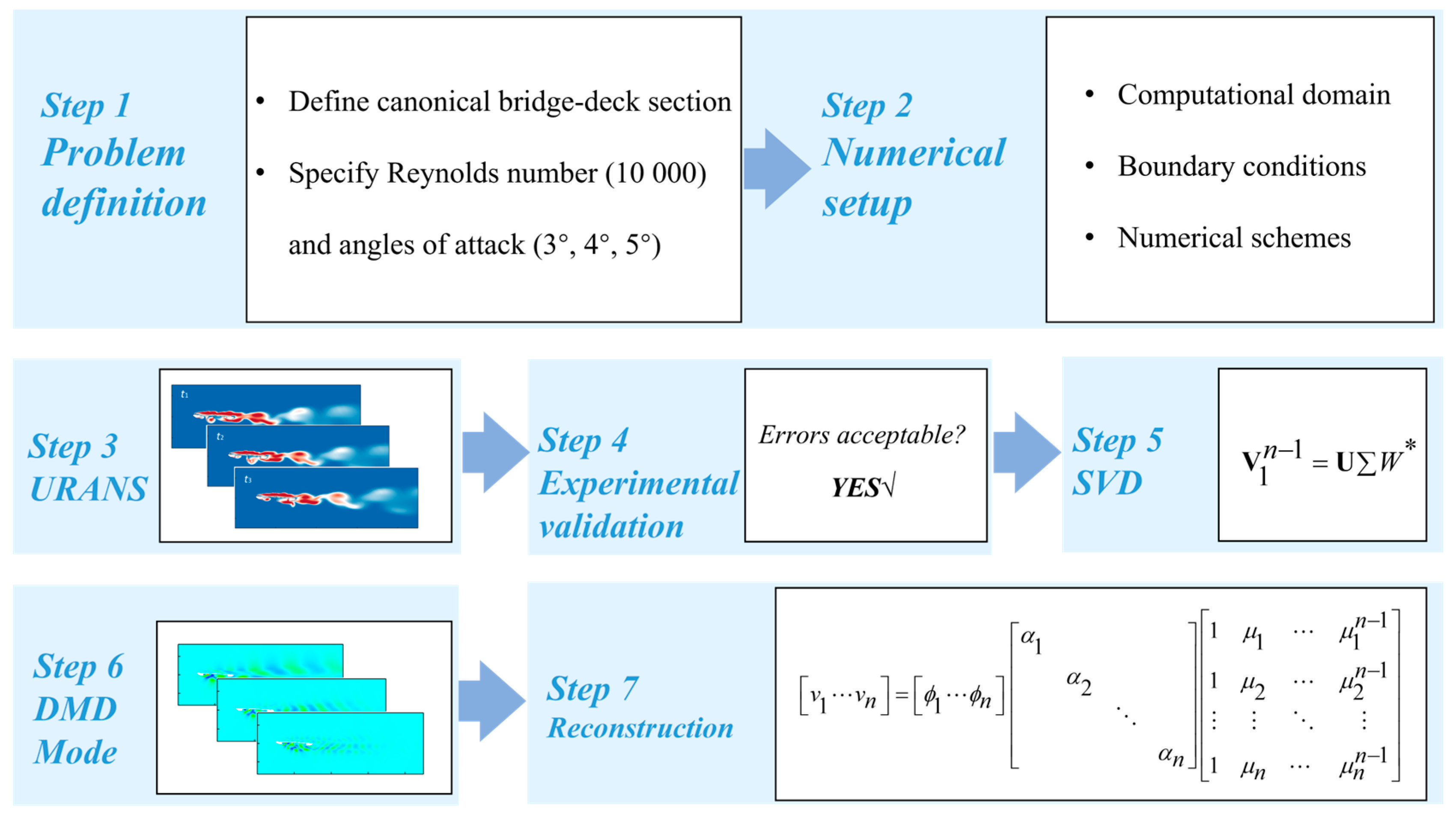
This study therefore combines RANS simulations with DMD analysis to characterize the deck–wake flow at three representative attack angles (3°, 4°, and 5°) and to develop a feature-preserving reduced-order model for these canonical configurations (Figure 1). The objectives of this study are (i) to clarify how small changes in angle of attack modify separation and reattachment, wake width and depth, turbulent kinetic energy, and Strouhal number, and (ii) to quantify the energy content, dominant frequencies, and reconstruction accuracy of a DMD-based reduced-order model built from the RANS results. For clarity, Section 2 details the numerical setup, including geometry, meshing, turbulence modelling and boundary conditions; Section 3 presents and discusses the numerical results; and Section 4 summarizes the key findings and outlines directions for future work.
Figure 1. Research flowchart.

2. Methodology

2.1. Governing Equations

In this study, the incompressible Navier–Stokes equations are employed as:
u i x i = 0 ,
u i t + ( u j u i x j ) = 1 ρ p x i + ν 2 u i x j 2 + f i ,
where u i represents the instantaneous velocity’s ith component, xi denotes the spatial coordinates, t is time, p stands for pressure, ρ denotes density, ν is the viscosity coefficient and fi is the i-th component of the body-force per unit mass.
The incompressible Unsteady Reynolds-averaged Navier–Stokes (URANS) equations are derived by time-averaging the Navier–Stokes equations, which are written in their form without body forces as:
u ¯ i x i = 0 ,
u ¯ i t + u ¯ j u ¯ i x j = x j ( p ¯ ρ δ i j + ν u ¯ i x j u i u j ¯ ) ,
while the equations bear resemblance to the Navier–Stokes equations, they include an extra term u i u j ¯ known as the Reynolds stress. An overbar (-) denotes a time-averaged quantity. This stress is a symmetric tensor that can be separated into isotropic and anisotropic components. The breakdown is as follows:
u i u j ¯ = 2 3 δ i j k + a i j ,
where The Reynolds stress anisotropy tensor is denoted as a i j , while the turbulent kinetic energy is represented by k , and the Kronecker delta is denoted as δ i j Consequently, a closure model is necessary for the anisotropy tensor. The most commonly utilized eddy viscosity models are k ε and k ω [39,40]. These models assume a linear correlation between the anisotropy tensor a i j and the mean strain rate tensor S ¯ i j ,
a i j = 2 ν t S ¯ i j ,
where ν t is the eddy-viscosity and S ¯ i j = 1 / 2 ( u ¯ i / x j + u ¯ j / x i ) .
The SST k ω turbulence model combines a free-flow k ε model and a near-wall k ω model, which has high accuracy and reliability. Therefore, the SST k ω turbulence model is used for numerical simulation of the main girder in this paper.

2.2. Numerical Setup

2.2.1. Test Case

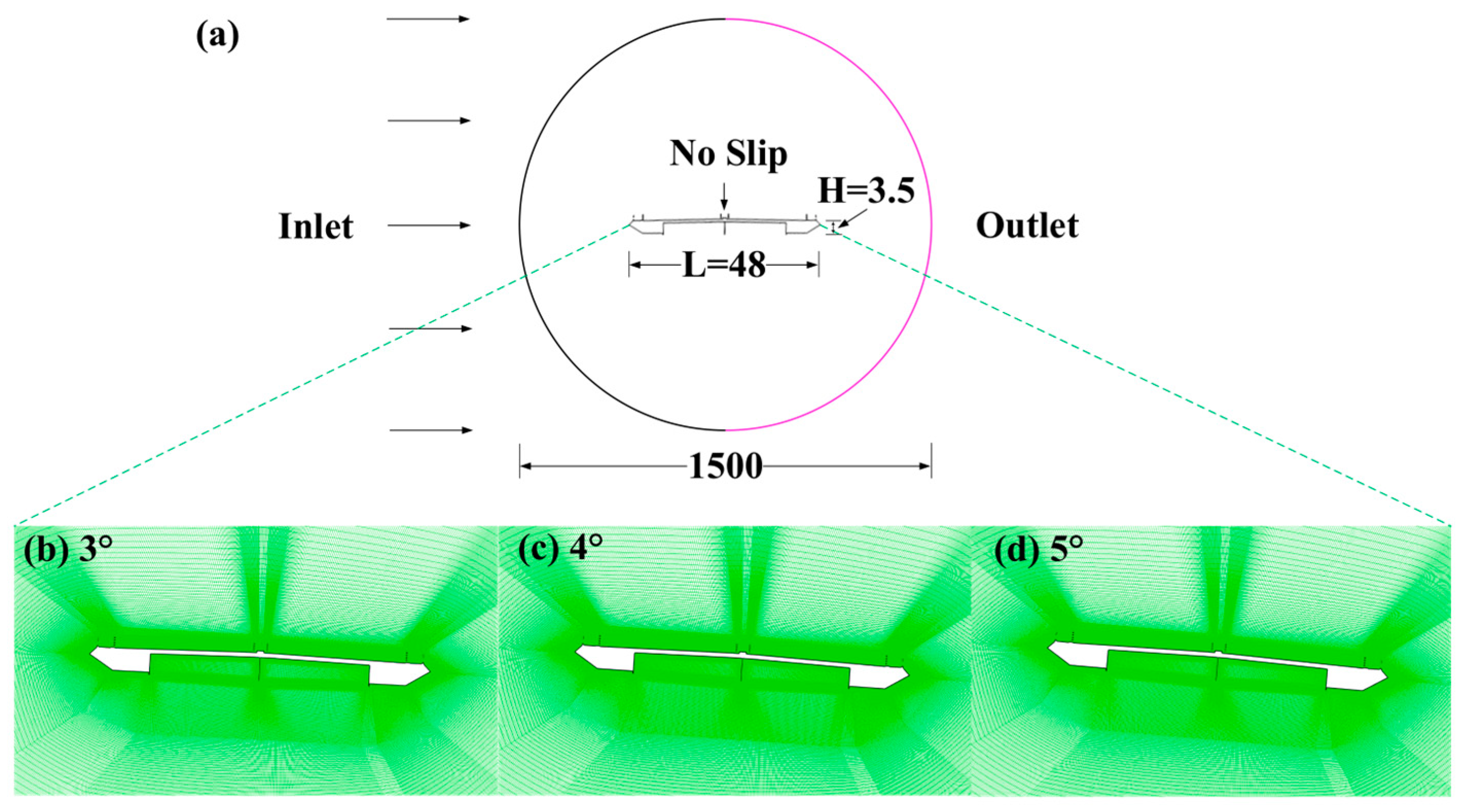
Numerical calculations are performed on the main girder of bridges to solve the turbulent flow structure problem in the main girder wake under different wind attack angles. The computational domain and boundary conditions of the main girder section model are shown in Figure 2a. The computational domain is a circular domain with a 1500 diameter. The left side serves as a velocity inlet with a uniform inflow U = 1 m/s and zero-gradient pressure, corresponding to a steady oncoming flow with prescribed speed. The right side is specified as a zero–pressure-gradient outflow boundary, where a fixed reference pressure and zero gradients of the velocity components are imposed so that vortical structures can convect out of the domain with minimal reflection. The upper and lower outer boundaries are treated as far-field slip boundaries, for which the normal velocity component is zero and the tangential stress vanishes, approximating an unbounded external flow. The main girder section has a width B = 48 and a height D = 3.5 m, and all deck surfaces are modelled as no-slip walls (U = 0) with wall functions for the SST k–ω turbulence model, representing the solid bridge deck. The main girder section has a width B = 48 and a height D = 3.5 m. This study uses the open-source platform OpenFOAM for numerical simulations. Numerical simulations of the two-dimensional bridge flow with wind attack angles of 3°, 4°, and 5° are conducted, and the grid refinement regions for the three cases of the main girder section are shown in Figure 2b–d.
Figure 2. Computational setup with (a) computational domain with boundary conditions, (b) refinement mesh for main girder section with an attack angle of 3° (c) refinement mesh for main girder section with an attack angle of 4°, and (d) refinement mesh for main girder section with an attack angle of 5°.

2.2.2. Validation of Simulation Results

In the present work, a two-dimensional sectional model of the bridge deck is adopted. This idealization focuses on the cross-sectional aerodynamics and wake dynamics of a canonical deck section and is widely used in experimental and numerical studies of bridge-deck flows when the main interest is in sectional forces and wake patterns rather than full three-dimensional responses. The 2D URANS formulation allows high spatial and temporal resolution at moderate computational cost, which is essential for resolving the dominant unsteady features and for generating time-resolved datasets suitable for DMD-based reduced-order modelling.
To ensure the reliability of our numerical simulation method, the comparison and verification are conducted between the numerical simulation results at a wind attack angle of 3° and the aerodynamic coefficient results from wind tunnel experiments, as shown in Table 1. The wind tunnel experiments are carried out in the high-speed test section of the STU-1 wind tunnel at Shijiazhuang Tiedao University. The test section has a width of 2.2 m and a height of 2 m, with a maximum wind speed exceeding 80 m/s. The instability of velocity, non-uniformity of velocity field, and turbulence intensity are all less than 0.2%, and the non-uniformity of the directional field is less than 0.2°. According to the theory of similarity experiments, the Reynolds number of the wind tunnel test and the Reynolds number of the numerical simulation are on the same order of magnitude. Additionally, the main girder section of the bridge has cl-ear edges and corners, and the separation point of the fluid is relatively fixed, indicating that the Reynolds number effect is not significant. Therefore, the scaled wind tunnel test results can be used to verify the numerical simulation in this study. The numerical model is considered validated when the differences between the simulated and measured mean drag and lift coefficients remain below 5% and 15%, respectively, and when the Strouhal number differs by less than 5% from the experimental value.
Table 1. The comparison and verification of the aerodynamic coefficients at a wind attack angle of 3°.
The results show that the relative error of the lift coefficient is 11.4% and the relative error of the drag coefficient is 0.5%, confirming the accuracy of our numerical simulation method. The larger deviation in lift compared with drag is mainly attributed to the use of a two-dimensional sectional URANS model with an SST k–ω turbulence closure, which cannot fully capture three-dimensional effects such as spanwise variations and end conditions that strongly influence the lift. These modelling limitations tend to have a smaller impact on the mean drag coefficient. Nevertheless, the dominant Strouhal number and the trends of the aerodynamic coefficients with changing angle of attack are reproduced accurately, indicating that the unsteady wake dynamics are well captured. Therefore, the present level of agreement is considered adequate for analyzing the wake dynamics and for developing the DMD-based reduced-order model. Based on this numerical simulation method, further calculations of the aerodynamic coefficients of the main girder structure are performed at wind attack angles of 4° and 5°.

2.3. Dynamic Mode Decomposition

Dynamic Mode Decomposition (DMD) method has been widely used in complex flow fields such as wake and separated flow fields. The method extracts coherent spatial structures with the same temporal frequency from the flow field, aiming to transform infinite-dimensional nonlinear control into infinite-dimensional linear control. The discrete data of the flow field is utilized to create the snapshot matrix needed for DMD. The flow field data is organized into a matrix denoted as V 1 n .
V 1 n = v 1 , v 2 , v 3 v n R m × n ,
where each (vi) is a column vector with (m) entries, and (n) represents the overall quantity of flow field data snapshots. It is assumed that there would be an operator (A), which subjects to (vi+1 = Avi). Then the matrix ( V 1 n ) can be expressed as:
V 1 n = v 1 , A v 1 , A 2 v 1 A n 1 v 1 ,
Therefore, it is assumed that v n could be expressed as a linear combination of the previous n − 1 linear-independent vectors according to
v n = a 1 v 1 + a 2 v 2 + + a n 1 v n 1 + r ,
The above formula yields
A V 1 n 1 = V 2 n = V 1 n 1 S + r e T ,
where e = ( 0 , 0 1 ) R n 1 , and the matrix S can be represented as:
S = 0       0                 0         a 1 1       0                 0         a 1                                   0       0                 1       a n 1 ,
By utilizing the QR-decomposition snapshot matrix V 1 n 1 , if y i is an eigenvector of S , then
ϕ i = V 1 n 1 y i ,
is an approximate eigenvector of A .
Because of the constraints of QR-decomposition, singular value decomposition (SVD) is utilized in place of QR-decomposition to analyze the original flow field data.
V 1 n 1 = U W * ,
The complete matrix is derived from Equations (10) and (13):
S ˜ = U H V 2 n W W 1 ,
where U H is a complex conjugate transpose of the basis U . The DMD modes are then obtained from the eigenvectors y i of V ˜ using the following expression ϕ i = U y i .
ϕ i = U y i ,
The snapshot matrix V 1 n can be expressed as:
v 1 v n = ϕ 1 ϕ n   α 1 α 2 α n 1 μ 1 μ 1 n 1 1 μ 2 μ 2 n 1 1 μ n   μ n n 1 ,
where the DMD mode ϕ i are governed by the Vandermonde matrix V a n d and of the eigenvalues μ i . The amplitude α i is obtained from the following optimization problem [41,42,43].
min α J ( α ) = min α V 1 n 1 ϕ D α V a n d F 2 ,

2.4. Data Availability

The flow-field datasets that support the findings of this study, including time-averaged velocity fields, representative instantaneous snapshots and the leading DMD modes for all three angles of attack, are available from the corresponding author upon reasonable request.

3. Results and Discussion

3.1. Flow Field Characteristics at Different Angles of Attack

3.1.1. Selection of Characteristic Time Instant

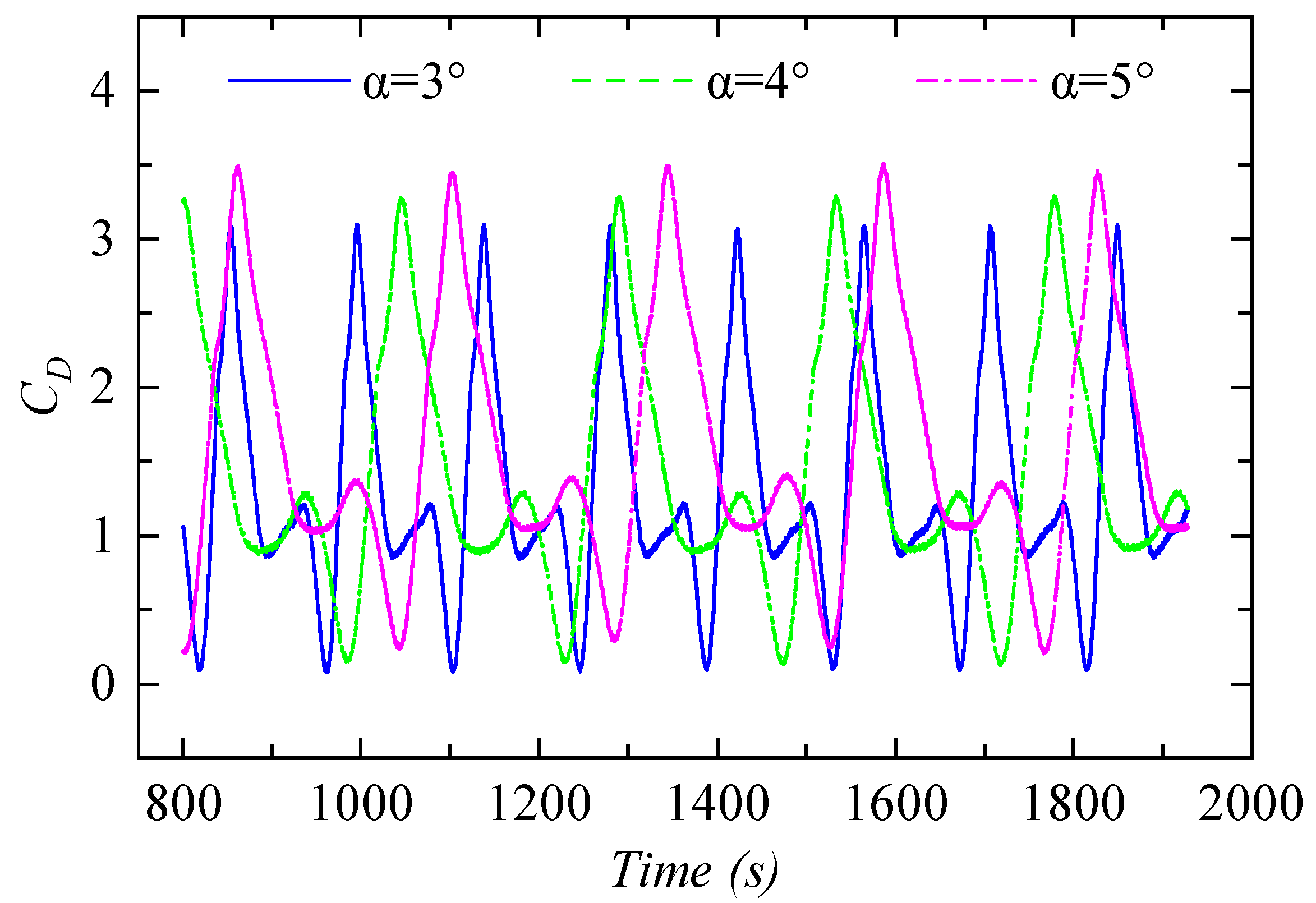
Figure 3 shows the variation trend of the drag coefficient ( C D ) of the bridge section under three attack angles. It can be seen that with the increase in the attack angle, the period and amplitude of ( C D ) are both increasing. This is because the increase in the attack angle of the bridge section will cause changes in the flow field distribution and characteristics, thus affecting the period and amplitude of the drag coefficient. Considering the large scale of the flow field data set, four periods are selected for data sampling for each of the three cases, which are used as input data for DMD algorithm.
Figure 3. Drag coefficient ( C D ) of the main girder section under three attack angles.
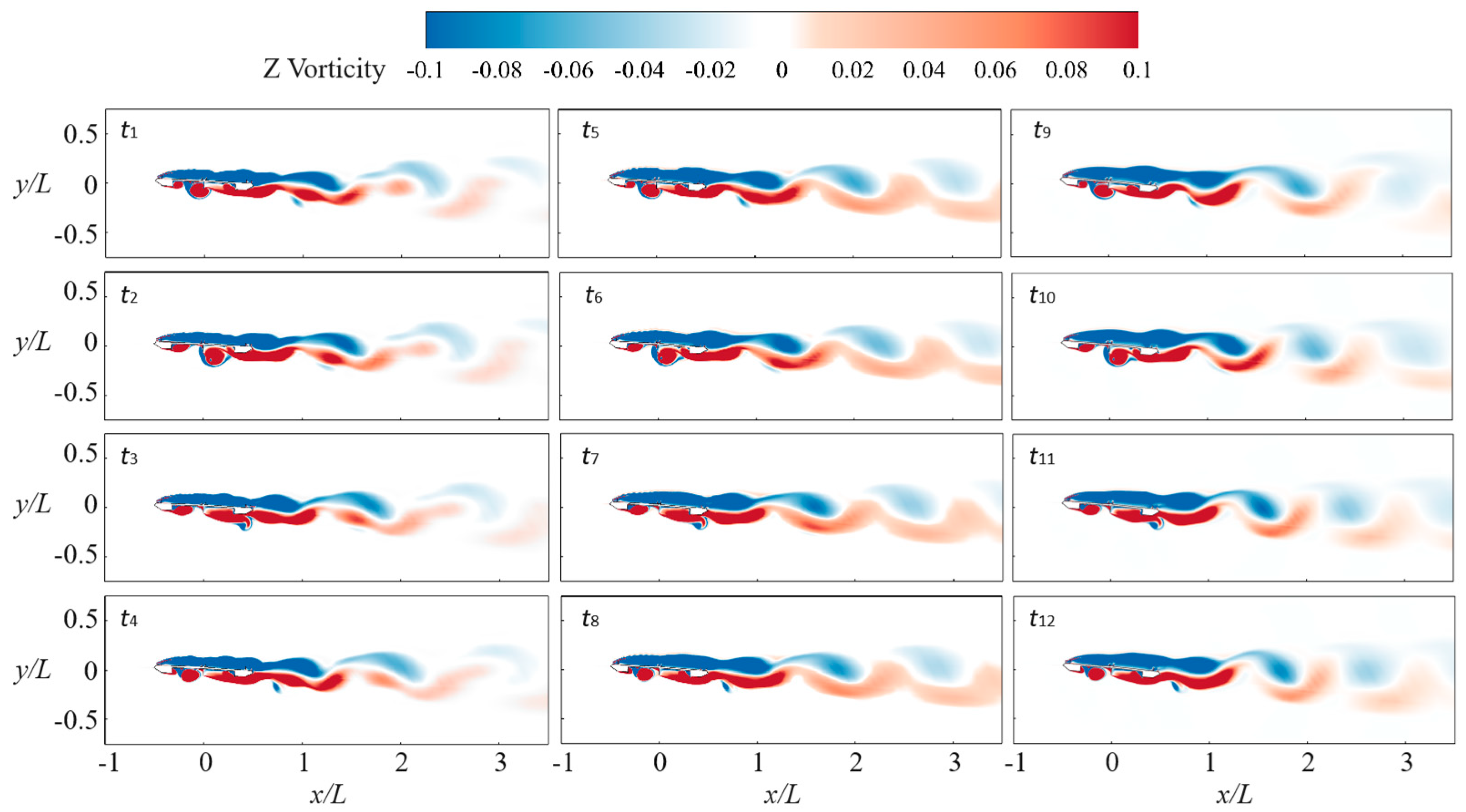
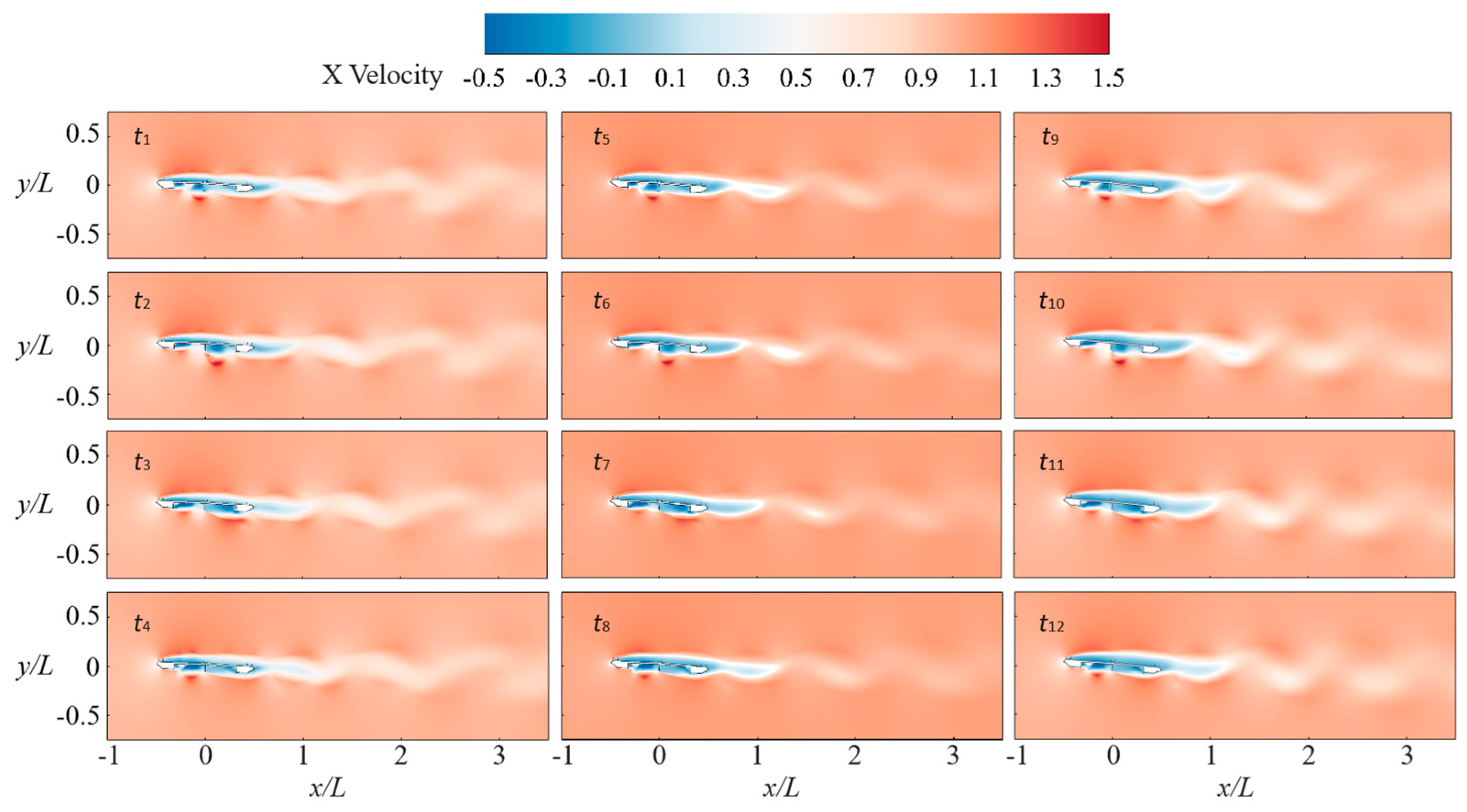
To comprehensively capture the separation–shedding–reattachment cycle, twelve critical instants were extracted from the drag time histories at AoA = 3°, 4°, and 5°-specifically two drag peaks and two drag valleys per curve (t1–t4 for 3°, t5–t8 for 4°, t9–t12 for 5°). These instants precisely correspond to the four physical stages of shear-layer roll-up initiation, primary vortex shedding, initial reattachment, and secondary separation, thus ensuring that no key phase is overlooked while systematically revealing how AoA modulates the cycle’s dynamics in subsequent analyses of velocity fields, streamlines, vorticity, and turbulent kinetic energy.

3.1.2. Comparison of Instantaneous Velocity Fields

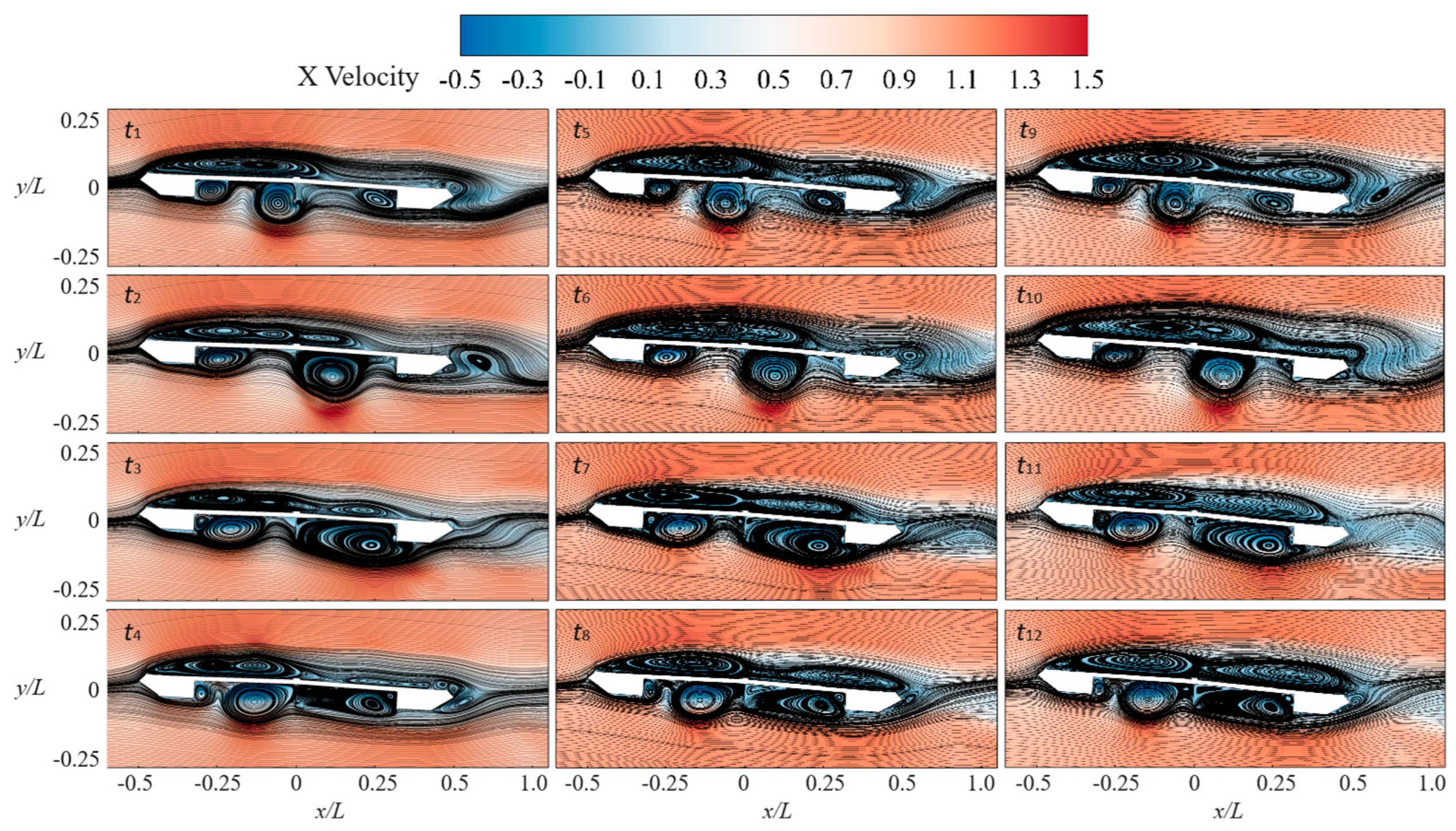
The instantaneous x-velocity fields (t1t12) reveal a pronounced leading-edge separation bubble that forms just downstream of the deck’s upstream edge and subsequently migrates upstream toward the very nose of the deck (Figure 4). During peak-drag instants, this separation bubble fully expands into a broad low-velocity, recirculating zone that envelops most of the deck’s front surface, with clear regions of flow reversal near the leading edge. The detached shear layer remains aloof over a large fraction of the chord, and reattachment is delayed until far downstream.
Figure 4. Mean Velocity Fields. (Non-dimensional streamwise velocity u / U ).
By contrast, at valley-drag instants the recirculation zone contracts dramatically: the separation bubble shrinks to occupy only 10% of the chord, and streamlines swiftly reattach to the deck surface closer to the leading edge. This cyclical expansion and collapse of the leading-edge bubble underpins the observed drag oscillations: a fully developed bubble suppresses the usual leading-edge suction peak and drives up pressure drag, whereas rapid reattachment temporarily alleviates pressure buildup and reduces drag. Moreover, the unsteady bubble dynamics concentrate a significant portion of the flow’s energy at a low frequency corresponding to the bubble’s growth-and-burst cycle, indicating that this separation–reattachment process is the dominant energetic flow mode in the wake.

3.1.3. Evolution of Streamline Patterns

The flow over the bridge deck undergoes a clear, multi-scale vortex-dynamics cycle (Figure 5). In the initial phase (e.g., t1), the windward shear layer separates from the leading edge and rapidly develops Kelvin–Helmholtz-type shear-layer instabilities, rolling up into nascent coherent vortex cores. By mid-cycle (around t5), these primary vortices have grown in size as they convect downstream toward the trailing edge, while the opposite shear layer on the deck’s leeward surface begins its own separation and roll-up, marking the onset of secondary vortex shedding. Later (around t9), the first vortex has fully detached into the wake, and an oppositely signed vortex matures near the deck, sustaining the alternating shedding pattern.
Figure 5. Instantaneous Velocity Fields. (Non-dimensional streamwise velocity u / U ).
This sequence of vortex roll-up, reattachment, and secondary shedding directly drives the bridge deck’s drag fluctuations: when a large vortex remains attached to the leeward side just before shedding, it creates an extensive low-pressure region that spikes pressure drag; once that vortex sheds into the wake, surface pressure partially recovers and drag temporarily decreases. Moreover, the expansion-and-burst cycle of these vortices concentrates much of the flow’s energy at a low frequency, indicating that this separation–reattachment cycle is the dominant energetic mode.

3.1.4. Z-Vorticity Distribution Features

In the 3–5°AoA wake, the separated shear layers on the windward and leeward sides of the deck undergo Kelvin–Helmholtz-type shear-layer instabilities roll-up into alternating vortices of opposite sign (Figure 6). Early in the cycle (e.g., t2), two like-signed cores form side by side as a dual-core vortex, indicating imminent merging. By mid-cycle (e.g., t6), these cores have fused into a single, coherent vortex that detaches and convects downstream, deflecting the wake laterally and stretching the recirculation bubble behind the deck. As this primary vortex moves away, the opposite shear layer begins its own roll-up, perpetuating the alternating shedding pattern.
Figure 6. Z-Vorticity Distribution Features. Z-vorticity ω z (1/s).
Later (e.g., t10), the opposite-signed vortex from the alternate shear layer grows, pairs, merges, and then sheds, driving the wake to deflect in the contrary direction and causing the centerline to meander. During valley phases (e.g., t12), nascent vortices briefly dominate, the recirculation region contracts, and flow reattachment begins before the next cycle. This dual-core formation–merging–shedding sequence governs the deck’s unsteady aerodynamic loading: a fully formed vortex creates an extensive low-pressure region and drag peak, while its shedding allows pressure recovery and a drag drop. The low-frequency expansion–burst rhythm concentrates energy at the shedding frequency, confirming that shear-layer vortex dynamics underlie the observed drag oscillations in the 3–5° AoA wake.

3.1.5. Turbulent Kinetic Energy Distribution and Evolution

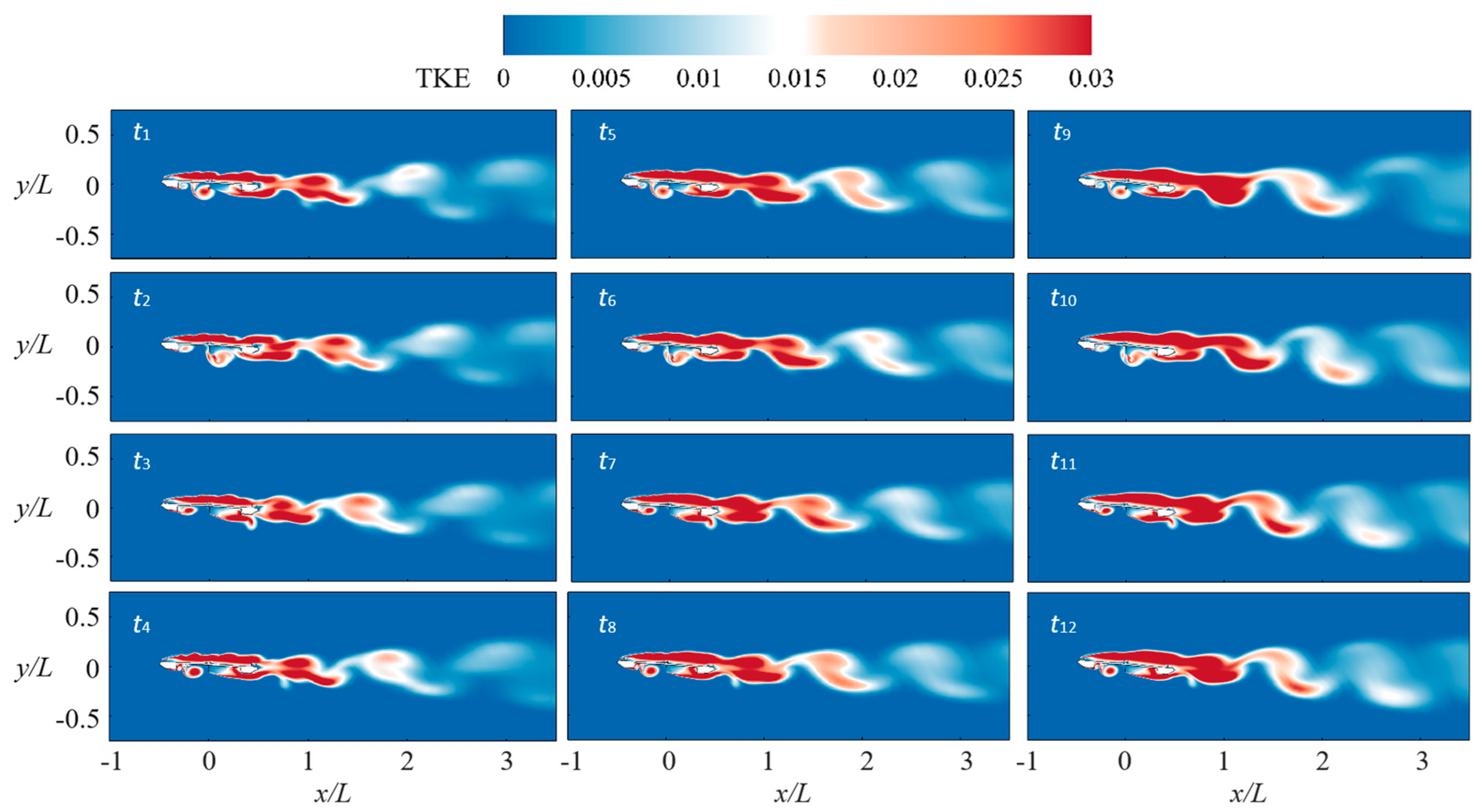
The turbulent kinetic energy (TKE) field reveals that energy injection originates at the shear layer crest and propagates downstream in chained vortical structures during vortex shedding, reaching peaks of k ≈ 0.025 at drag maxima; these peaks increase by approximately 70% as AoA rises from 3° to 5° and significantly broaden in spatial extent (Figure 7). During valley instants, TKE precipitously drops to 0.005, reflecting energy recovery and dissipation during reattachment. The periodic TKE peak-valley cycle matches the vorticity field’s rhythm, further corroborating the dominant role of shear layer vortex dynamics in TKE generation and transport, and elucidating the spatiotemporal energy redistribution in wake evolution.
Figure 7. The Turbulent Kinetic Energy Field. Turbulent kinetic energy k (m2/s2).

3.1.6. Comprehensive Physical-Mechanism Interpretation

At attack angles of 3–5°, the unsteady wake behind the bridge deck is driven by a self-sustaining cycle of shear-layer separation, vortex formation, and reattachment. Upon separation at the leading edge, a low-velocity bubble emerges and amplifies via Kelvin–Helmholtz-type shear-layer instabilities, rolling the shear layer into dual-core vortices. These vortices pair and coalesce into a single, coherent structure that convects downstream, imposing strong low-pressure pulses on the deck surface and producing drag peaks. Following shedding, this stored vortical energy rapidly dissipates. The turbulent kinetic energy declines and the separation bubble collapses. Then the shear layer reattach and the drag reach a trough. The alternate shear layer then initiates the same sequence, sustaining the wake’s periodic oscillation.
Increasing the angle of attack intensifies each phase: peak vorticity and TKE rise by approximately 70%, the separation bubble spans a larger chordwise extent, and the shedding frequency accelerates. Consequently, the separation-shedding-reattachment cycle shortens and the amplitude of drag and lift fluctuations grows. These results demonstrate that the timing and strength of shear-layer vortices directly govern the bridge-deck’s unsteady aerodynamic forces. Accordingly, passive control strategies, like trailing-edge splitter plates to promote early reattachment, hold promise for attenuating wake pulsations and stabilizing aerodynamic loading.

3.2. DMD Results and Discussion

3.2.1. FFT Analysis

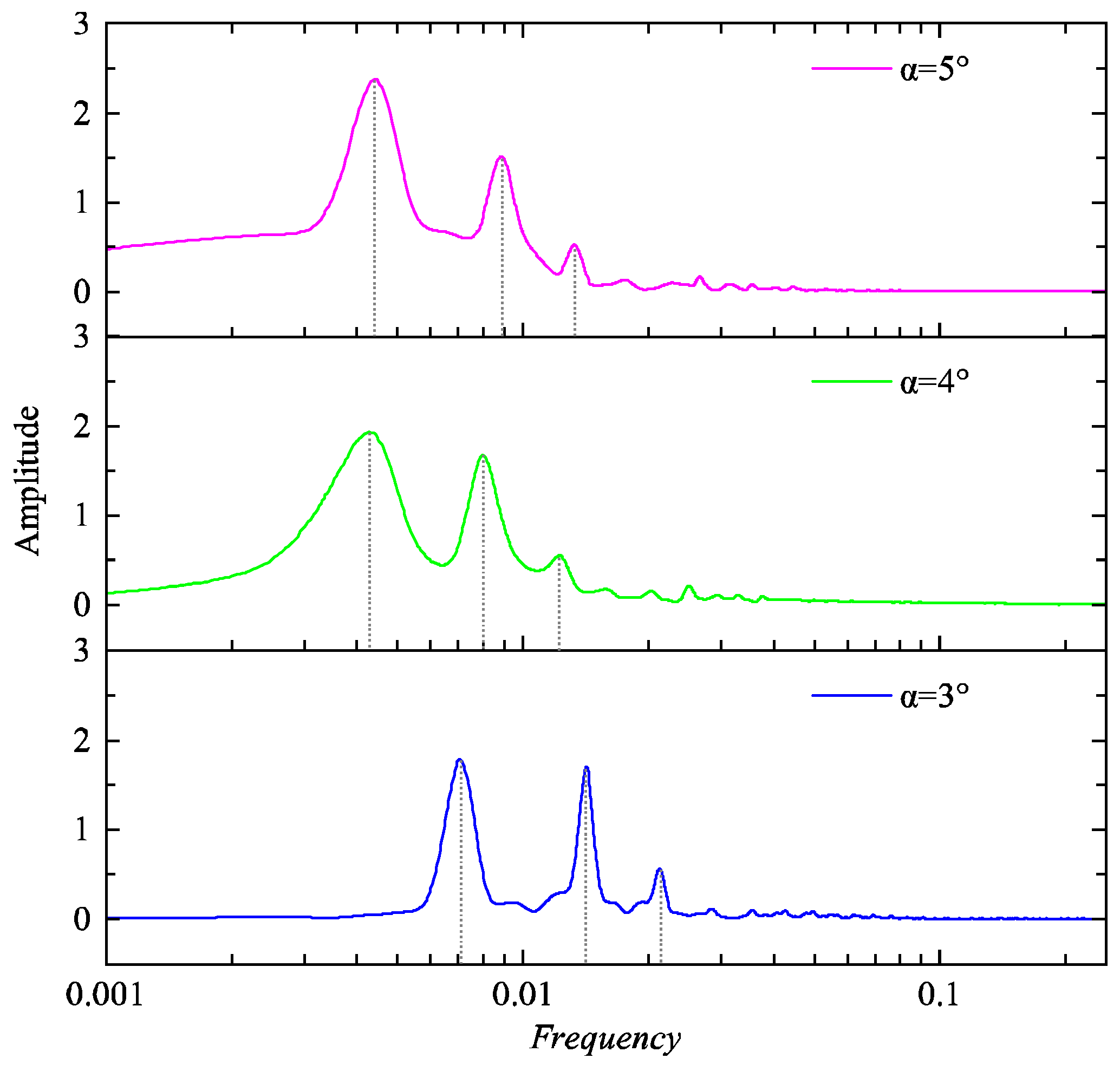
The drag coefficient undergoes Fast Fourier Transform (FFT) analysis, as shown in Figure 8. It is evident that three peaks are present in all cases, indicating the primary vortex shedding frequency. Since vortex shedding is the dominant driving force in the flow field configuration of the bridge section, the single peak revealed by the FFT analysis represents the three main vortex shedding frequencies. Additionally, some smaller peaks are visible beyond the fundamental vortex shedding frequency, which are associated with harmonic excitation and other fluid mechanisms.
Figure 8. Fast Fourier Transform (FFT) analysis for drag coefficient ( C D ) of the main girder section under three attack angles.

3.2.2. DMD Analysis

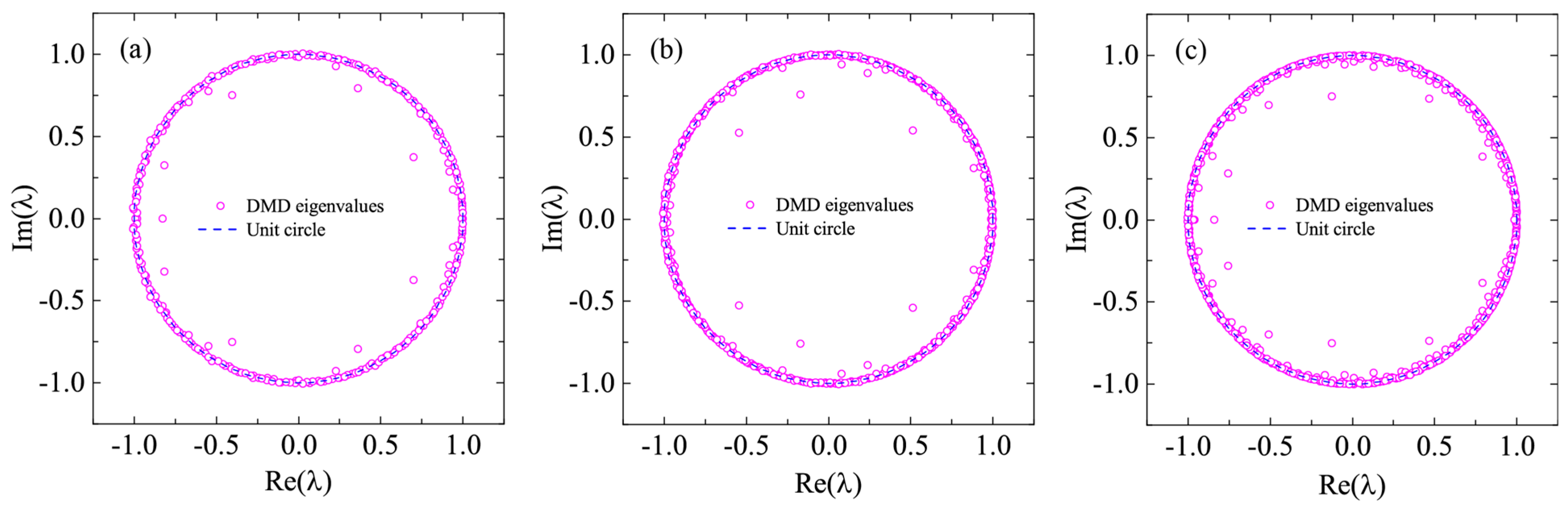
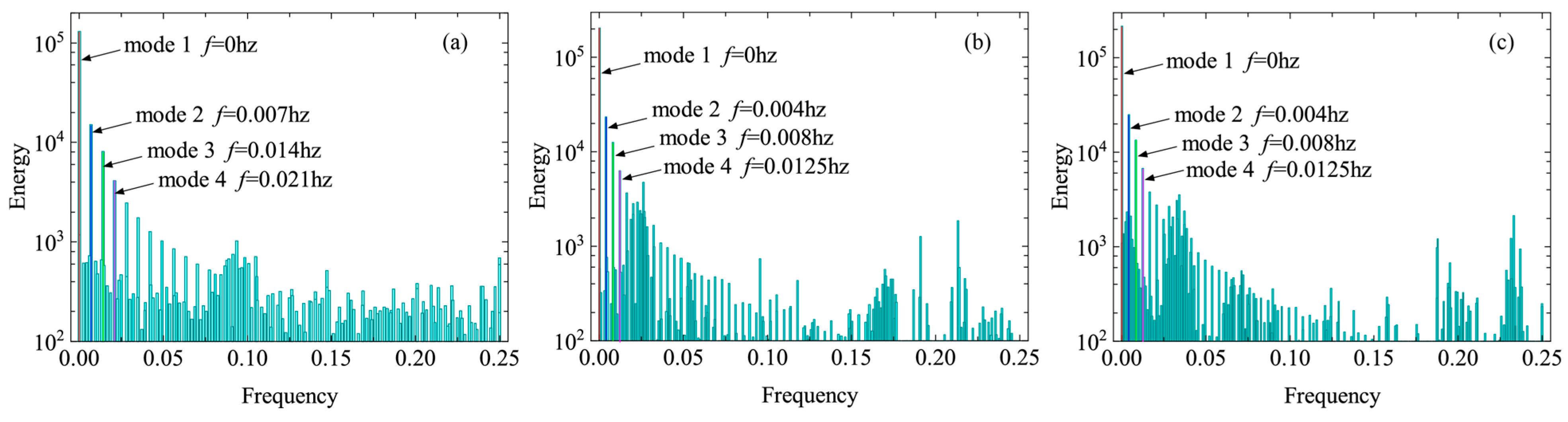
To obtain the original flow field snapshot sequence of the main girder wake, the velocity fields under three attack angles are extracted. The DMD method is used to analyze the axial velocity on the plane. For each angle of attack, the time-resolved URANS simulations are first advanced until initial transients have decayed and a statistically periodic regime is established. The vortex-shedding period T is then identified from the aerodynamic-coefficient histories, and instantaneous flow-field snapshots are collected over five consecutive shedding periods. The flow field is saved every two numerical time steps, so that each period contains N T / 2 snapshots, where N T is the number of time steps in one shedding period. In total, 5 N T / 2 snapshots of the streamwise velocity field are obtained for each angle of attack and arranged into the snapshot matrix used for the DMD analysis. In Figure 9, the eigenvalue distribution is depicted, with the real part of the eigenvalues represented on the horizontal axis and the imaginary part on the vertical axis. The blue dashed line in the figure indicates the unit circle, which signifies eigenvalue stability. Most eigenvalues are situated on the unit circle, while a few are within it, suggesting convergence or periodicity for these modes. Figure 10 presents the DMD energy spectrum. By ordering the modal energies, the first four modes are identified as the dominant contributors and their associated frequencies are extracted. Table 2 compares these DMD frequencies with the main peaks obtained from FFT of the velocity signals for all three angles of attack. For mode 1 the frequency is zero in both methods, corresponding to the time-averaged base flow. For modes 2–4, the relative differences between DMD and FFT frequencies remain within about 2.7–1.4% at 3°, 4.7–1.3% at 4°, and 6.9–5.3% at 5°. This close agreement demonstrates that the leading DMD modes accurately reproduce the primary vortex-shedding and its higher harmonics captured by the URANS simulations, providing a reliable basis for constructing the reduced-order model [42].
Figure 9. Distribution of eigenvalues at the attack angle of (a) 3°, (b) 4°, and (c) 5°, obtained by DMD.
Figure 10. Energy distribution at the attack angle of (a) 3°, (b) 4°, and (c) 5° in DMD mode.
Table 2. Comparison of main frequency from DMD and FFT under three attack angles.
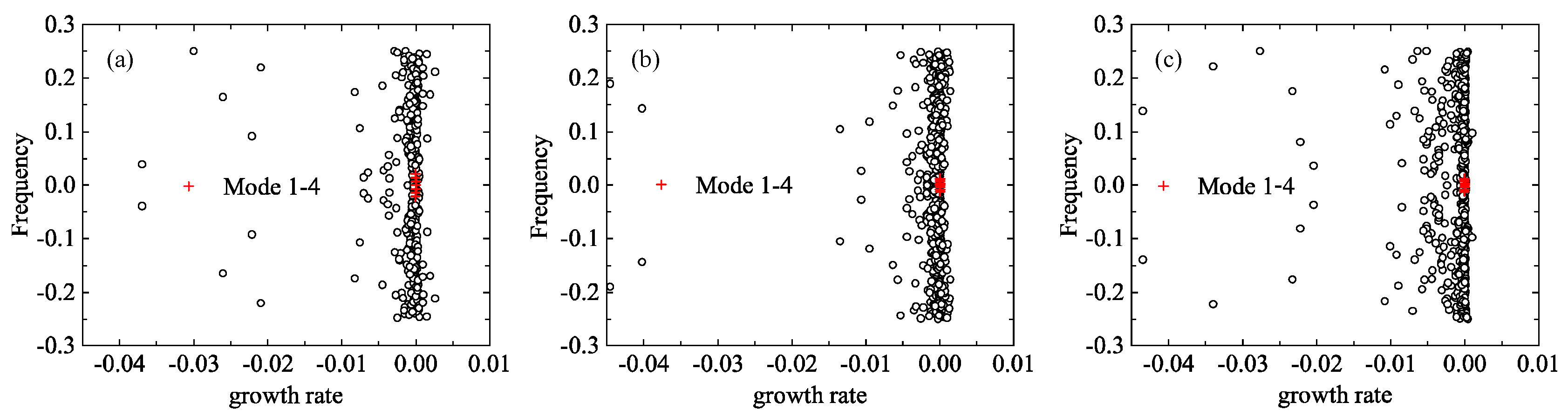
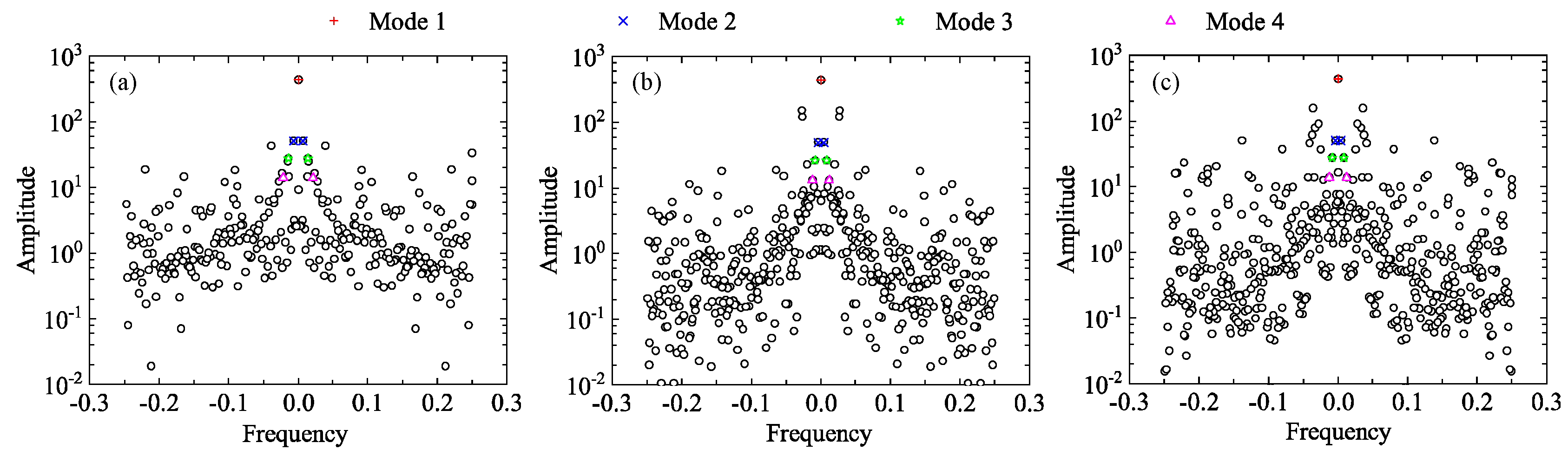
Figure 11 and Figure 12 show the relationships between frequency and growth/decay rate, and between frequency and amplitude, for all DMD eigenvectors at the three angles of attack. Because the eigenvalues come in complex-conjugate pairs, the frequency distribution is symmetric about zero, as commonly reported in DMD analyses of bluff-body wakes [41,42]. The amplitudes and growth rates of the eigenvectors are key indicators for selecting the dominant modes: the most relevant modes are those with growth rates close to zero (nearly neutrally stable) and relatively large amplitudes. As shown in Figure 12, Modes 1–4 stand out clearly from the background of low-amplitude modes, which confirms that these four modes govern the main unsteady dynamics of the bridge-deck wake. This selection strategy is consistent with previous DMD-based reduced-order studies, but is here applied to small-angle-of-attack bridge-deck flows.
Figure 11. DMD mode growth/decay rates and frequencies at the attack angle of (a) 3°, (b) 4°, and (c).
Figure 12. Amplitude–frequency relationship for all eigenvectors at the attack angle of (a) 3°, (b) 4°, and (c) 5°.
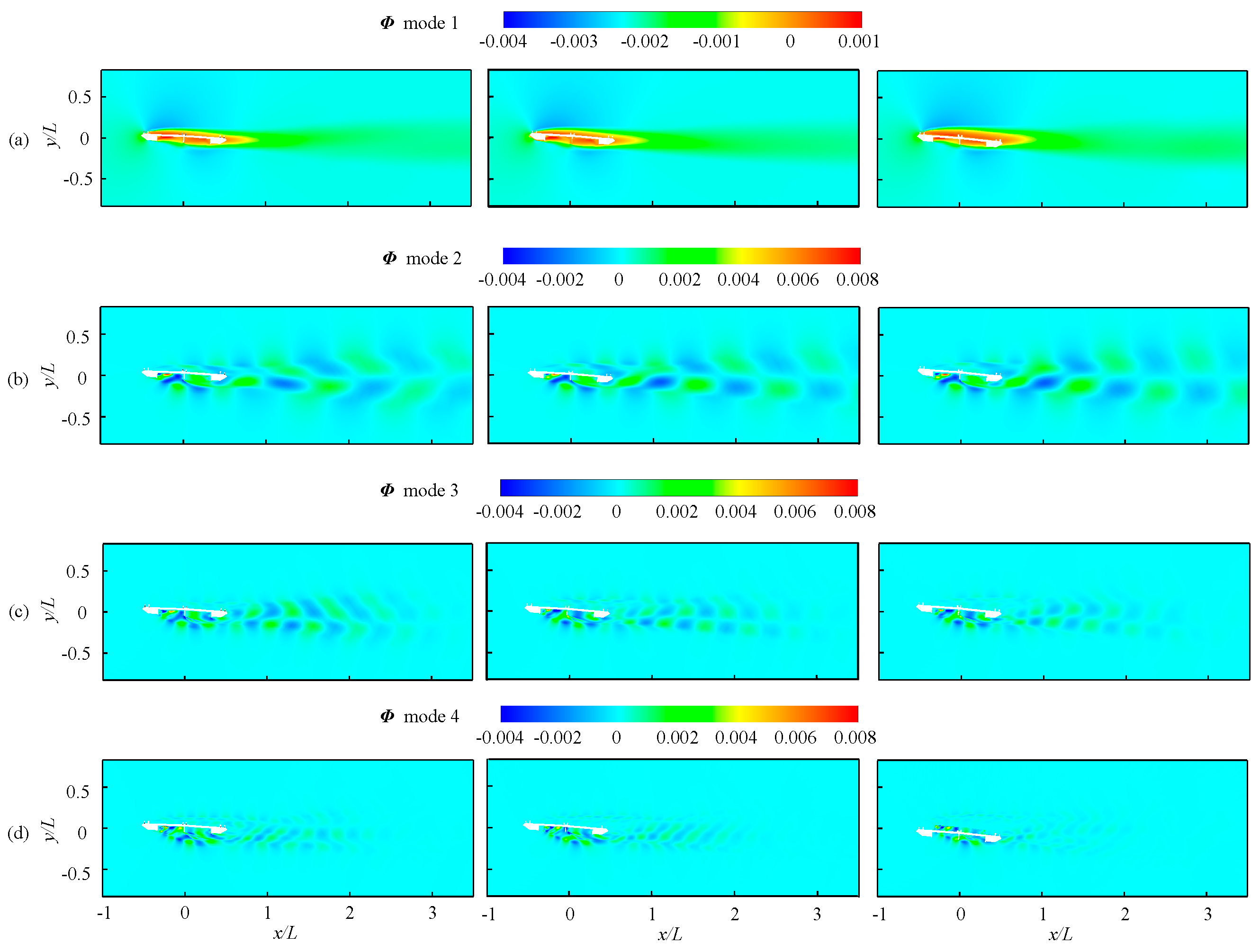
To further investigate the evolution of the wake, the spatial structures of the first four modes are plotted in Figure 13 for all three angles of attack. Mode 1 represents the time-averaged base flow and closely matches the mean-flow pattern in Figure 7, which explains why it contains the largest fraction of the total energy. Mode 2 corresponds to the primary vortex-shedding mode: it exhibits an antisymmetric pattern in the near wake that agrees with classical Kármán-type shedding observed in bridge-deck and bluff-body flows [31,32]. Modes 3 and 4 describe higher-frequency shear-layer oscillations that modulate the primary shedding and generate smaller-scale vortical structures downstream. Compared with published DMD analyses at zero or large angles of attack [43], the present results show how small changes in AoA (3–5°) alter the size of the separation bubble, the position of the shear layers, and the extent of wake deflection in these modes [44]. This demonstrates that the selected DMD modes not only provide a compact reduced-order representation but also capture physically meaningful coherent structures in the bridge-deck wake at small angles of attack [45,46].
Figure 13. The 1 to 4 DMD modes: (a) mode 1, (b) Figure 12. The 1 to 4 DMD modes: (a) mode 1, (b) mode 2, (c) mode 3, (d) mode 4 (Left: 3°; Middle: 4°; Right: 5°).

3.3. Reconstruction of Flow Fields

As DMD involves breaking down data into spatial and temporal components, it is important to evaluate the model. One way to do this is by using the model to recreate the flow field. If the reconstructed flow field closely aligns with the original input velocity field across all flow field frames, it indicates that the model has effectively captured the spatiotemporal characteristics of the original flow field and is thus accurate.
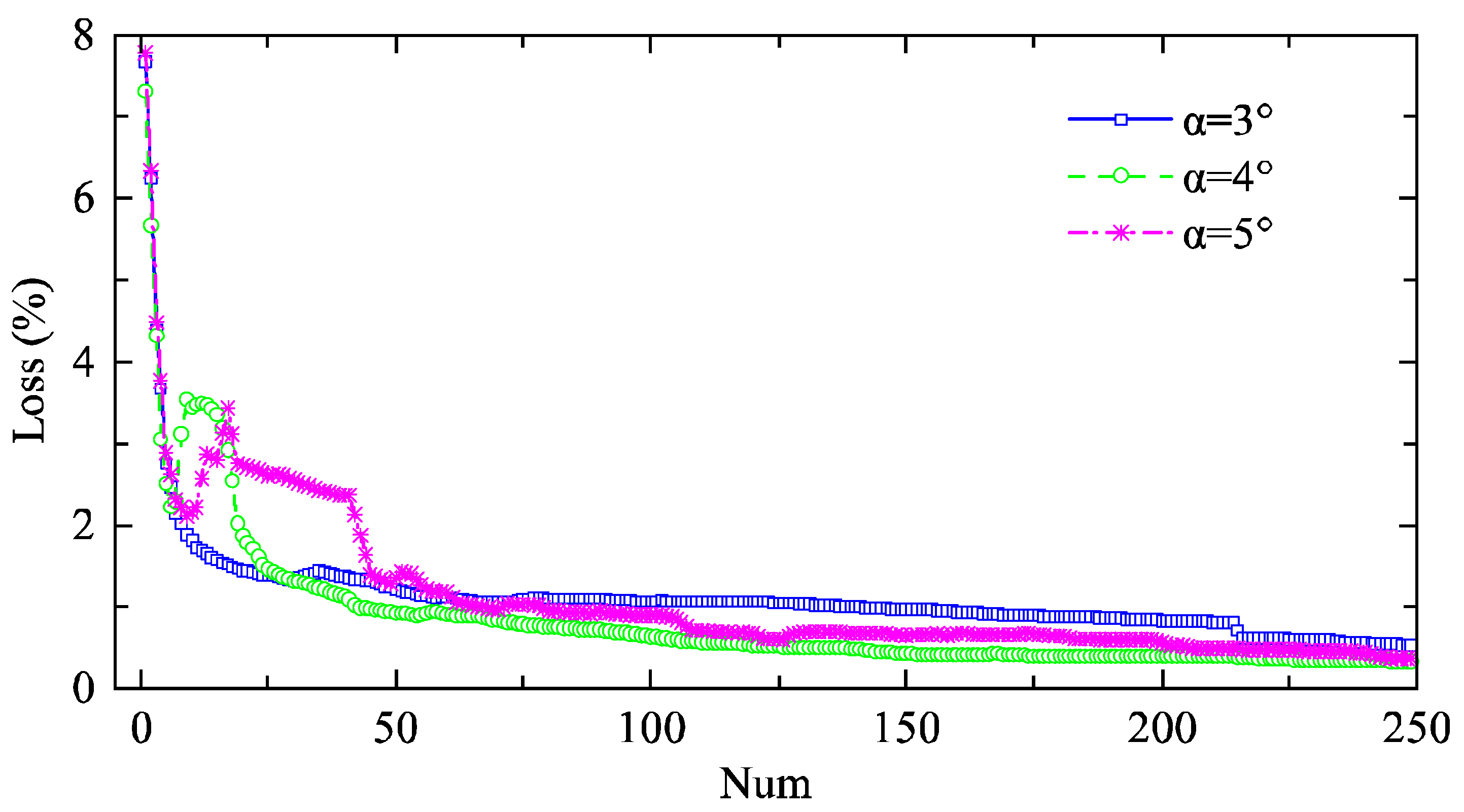
DMD has the ability to reconstruct the wake field by decreasing the order. The accuracy of the reconstructed flow field is determined by the number of modes chosen, with the loss function being defined as follows:
l o s s = X Φ D α V a n d X F · 100 % ,
Figure 14 illustrates the discrepancy between the reconstructed flow field and the original flow field for varying numbers of modes. As the number of modes increases, the disparity between the reconstructed and original flow fields gradually diminishes. When 200 modes are utilized, the difference between them is approximately 0.5%. It is important to note that Mode 1 encompasses the majority of information about the primary girder wake field, with errors of less than 8.0% compared to the original flow field. The error between the reconstructed flow field using the first four modes and the original flow field is less than 4.0%, which satisfies engineering standards. Consequently, the wake field is predominantly reconstructed using modes 1–4.
Figure 14. Loss function corresponding to selected number of modes under three attack angles.
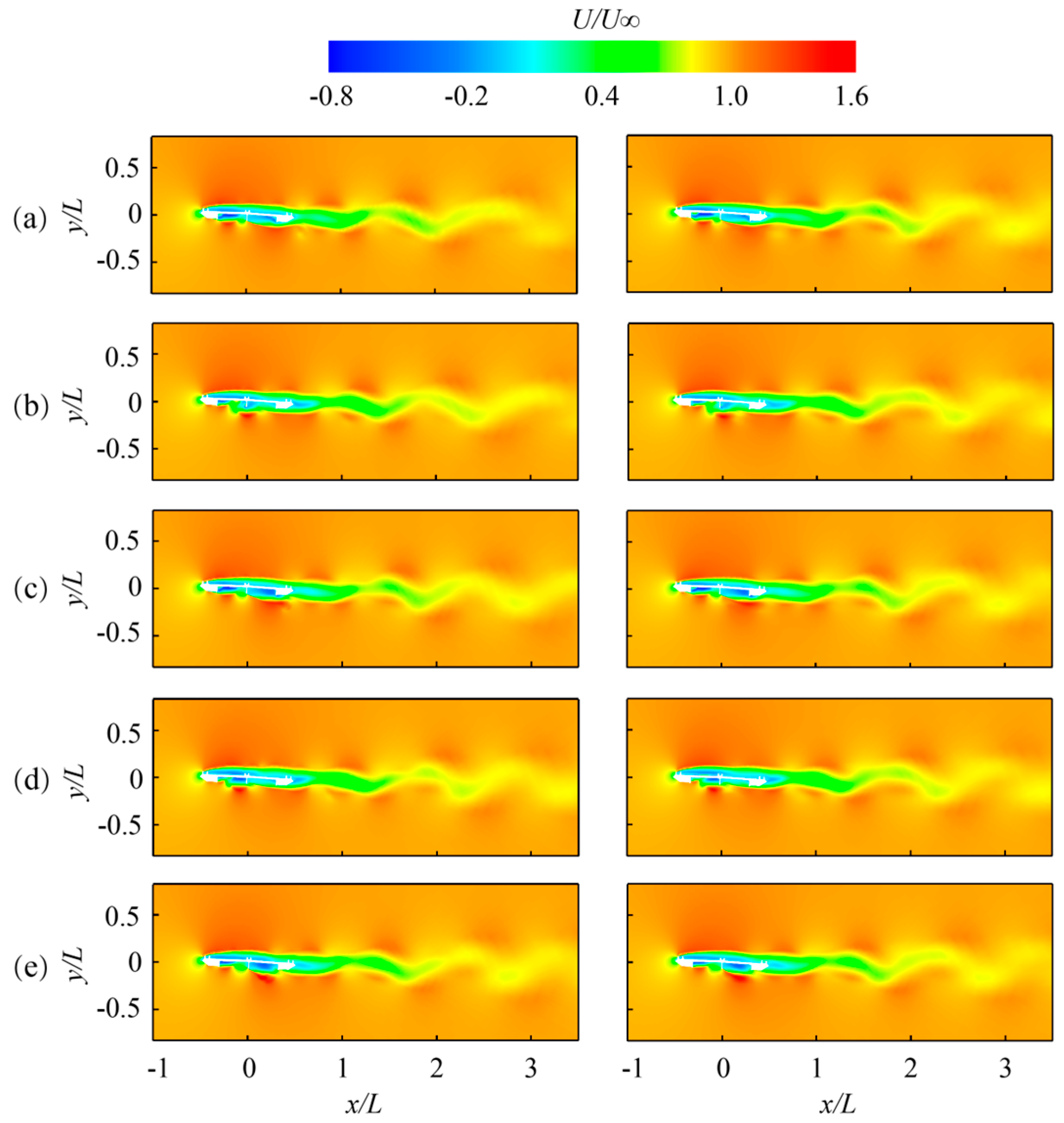
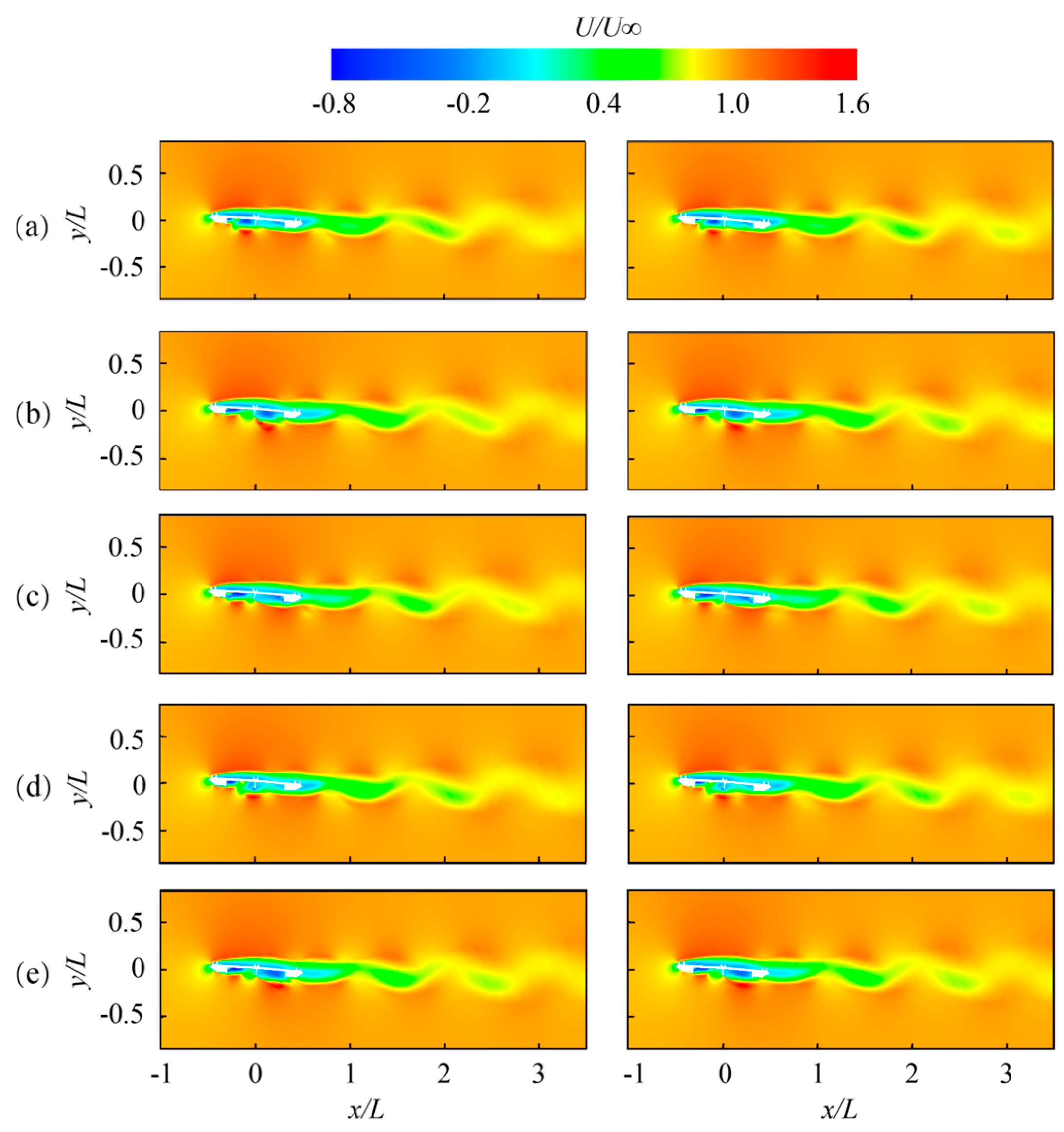
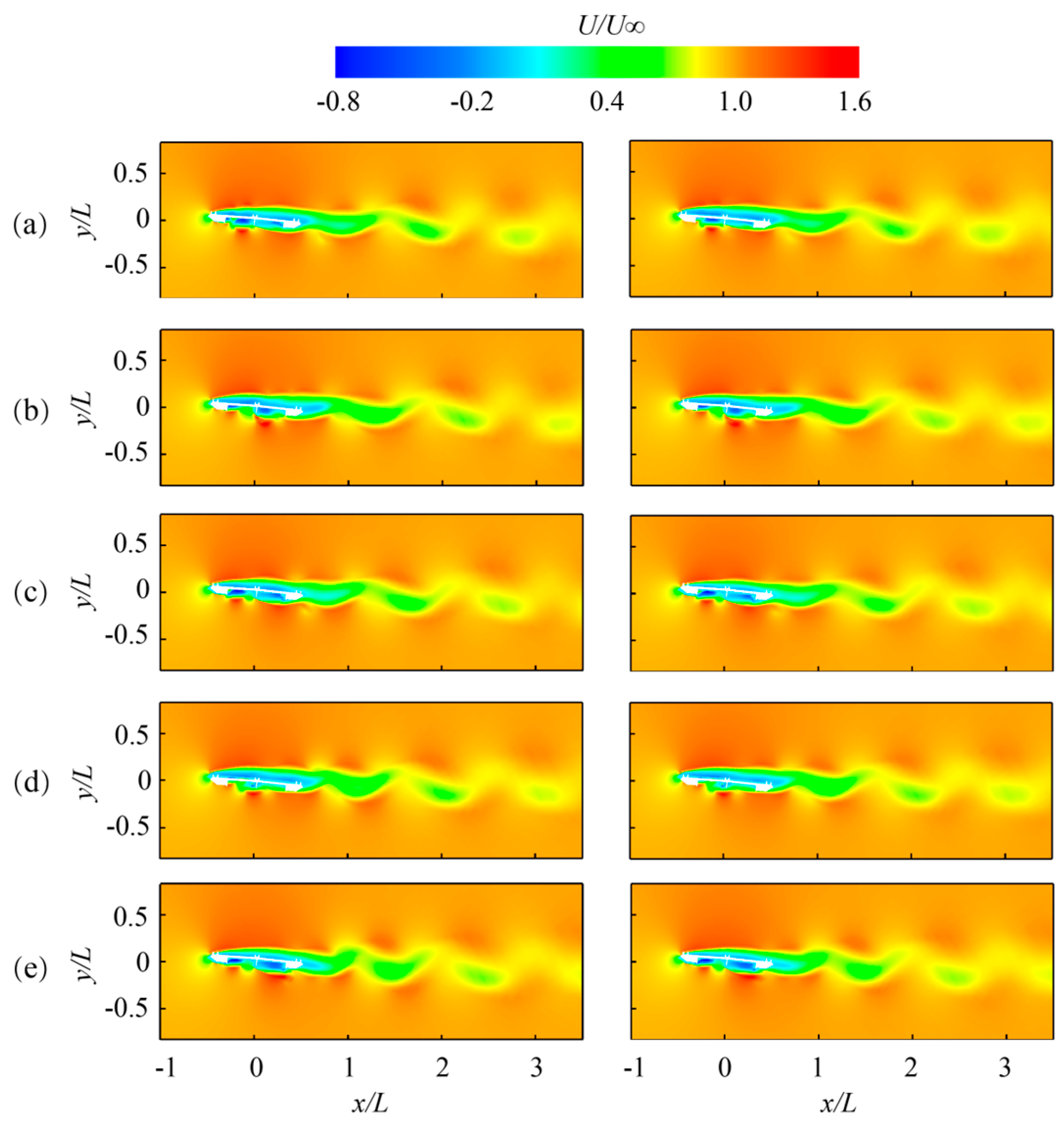
In this study, the first four DMD modes are retained to reconstruct the flow field, and five flow-field snapshots within one vortex-shedding period are selected to assess the reconstruction accuracy. Figure 15, Figure 16 and Figure 17 provide a visual comparison between the original and reconstructed streamwise-velocity fields at angles of attack of 3°, 4° and 5°, respectively. In each figure, the left column shows the URANS solution and the right column shows the DMD reconstruction, while the five rows correspond to the phases t = 1/5 T, 2/5 T, 3/5 T, 4/5 T and T within one period.
Figure 15. The velocity flow field reconstructed by the DMD method and its original velocity field at an attack angle of 3°: (a) t = 1/5 T, (b) t = 2/5 T, (c) t = 3/5 T, (d) t = 4/5 T, (e) t = T (left shows the original flow field and the right displays the reconstructed flow field).
Figure 16. The velocity flow field reconstructed by the DMD method and its original velocity field at an attack angle of 4°: (a) t = 1/5 T, (b) t = 2/5 T, (c) t = 3/5 T, (d) t = 4/5 T, (e) t = T (left shows the original flow field and the right displays the reconstructed flow field).
Figure 17. The velocity flow field reconstructed by the DMD method and its original velocity field at an attack angle of 5°: (a) t = 1/5 T, (b) t = 2/5 T, (c) t = 3/5 T, (d) t = 4/5 T, (e) t = T (left shows the original flow field and the right displays the reconstructed flow field).
For AoA = 3° (Figure 15), the DMD model reproduces both the size and position of the separation bubble on the deck, as well as the development of the shear layers and the alternating wake deflection at all five instants. At t = 1/5 T and 2/5 T the shear layers remain almost symmetric and the wake is only weakly deflected, whereas at t = 3/5 T and 4/5 T the lower and upper shear layers, respectively, roll up and generate a clearly deflected wake. At t = T the wake returns to a configuration similar to that at t = 0, completing the shedding cycle. The reconstructed fields match the original ones closely in all these phases, with only minor differences in the far wake.
For AoA = 4° and 5° (Figure 16 and Figure 17), the same level of agreement is observed. As the angle of attack increases, the separation bubble elongates and the wake deflection becomes more pronounced, but the DMD reconstruction still captures the low-velocity region behind the deck, the phase of the shear-layer roll-up and the position of the main vortices at each of the five instants. The largest discrepancies appear downstream of x/L ≳ 2, where small-scale vortical structures are partly filtered out by the truncation to four modes, which is consistent with the moderate reconstruction errors reported in Table 3 (all below 6%). Overall, the comparison across all subfigures in Figure 15, Figure 16 and Figure 17 demonstrates that the selected four modes provide a feature-preserving reduced-order representation that accurately reconstructs both the large-scale separation topology and the phase-resolved evolution of the wake throughout one shedding cycle for all three angles of attack.
Table 3. Reconstruction error percentages at three attack angles.
Besides comparing the reconstructed and original flow fields qualitatively, a quantitative assessment is provided by the percentage error between the two fields. The reconstruction errors for the five snapshots within one shedding period at the three angles of attack are listed in Table 3. The errors range from 4.06% to 5.97%, and all values remain below 6% for every instant and every angle of attack, with an overall mean of about 5%. This level of accuracy is comparable to, or better than, the reconstruction errors reported in previous DMD-based reduced-order studies of bluff-body and bridge-deck wakes using a similar number of modes. The small variation of the error with phase and angle of attack indicates that the four retained modes provide a robust and feature-preserving representation of the flow: they capture not only the dominant shedding cycle but also the evolution of the separation bubble and shear layers throughout one period.

4. Conclusions

This study combined two-dimensional URANS simulations with Dynamic Mode Decomposition (DMD) in a Koopman-analysis framework to investigate and reconstruct the unsteady wake of a canonical bridge-deck section at small, realistic angles of attack (3–5°). The objective was to clarify the dominant wake dynamics and to develop a compact, feature-preserving reduced-order model that can be replicated for repeated canonical configurations and, ultimately, extended to practical bridge-aerodynamics problems.
The main findings can be summarized as follows.
(1)
The URANS results reveal a robust separation–reattachment cycle that persists across all examined angles of attack. A leading-edge separation bubble forms and migrates upstream near drag maxima, then contracts and reattaches near drag minima. The separated shear layers roll up into large-scale vortices associated with Kelvin–Helmholtz-type shear-layer instabilities and alternately shed from the upper and lower surfaces of the deck, producing oscillatory wake deflection and corresponding fluctuations in drag and lift.
(2)
DMD applied to the streamwise-velocity snapshots identifies four dominant modes—the time-averaged base flow, the primary vortex-shedding mode, and two higher-frequency shear-layer modes—that together capture more than 90% of the wake kinetic energy. The dominant DMD frequencies agree closely with the main FFT peaks, confirming that these modes represent the essential unsteady dynamics of the wake.
(3)
Retaining only the four dominant modes reduces the data dimensionality by more than one order of magnitude while keeping the normalized reconstruction error below 6% for all five phases within one shedding period and for all three angles of attack. The reconstructed velocity fields accurately reproduce the size and position of the separation bubble, the roll-up of the shear layers, and the phase-dependent wake deflection, demonstrating that the proposed Koopman/DMD-based reduced-order model is both compact and physically interpretable.
Several limitations of the present work should be acknowledged. The simulations are two-dimensional and rely on an SST k–ω URANS closure; three-dimensional effects such as spanwise variations, end conditions and vortex dislocations, as well as fully resolved small-scale turbulence, are therefore not captured. Only a single canonical deck geometry and a narrow range of angles of attack (3–5°) are considered, and structural motion is neglected. Moreover, the DMD model is linear, so strongly nonlinear interactions and long-term phase drift outside the dominant shedding regime may be under-represented.
These limitations point to clear directions for future research. Extending the present framework to three-dimensional LES/DES or fully coupled fluid–structure simulations would allow the assessment of spanwise coherence and aeroelastic responses for realistic bridges. Applying the methodology to different deck sections and a wider range of wind conditions would further test its robustness and facilitate its use in real bridge case studies. In addition, incorporating nonlinear or multi-resolution variants of DMD, or coupling DMD with data-driven and machine-learning techniques, could enhance long-term predictive capability and enable control-oriented reduced-order models for applications such as rapid design optimization, real-time flow monitoring and vibration-mitigation strategies.

Author Contributions

Conceptualization, Q.L. and Z.Z.; methodology, S.L.; software, Z.Q.; validation, Y.C. and Z.Q.; investigation, J.Z. and L.A.; data curation, P.G.; writing—original draft preparation, S.L.; writing—review and editing, Z.Z. All authors have read and agreed to the published version of the manuscript.

Funding

This research was funded by the Natural Science Foundation of Hebei (E2025210087), the Regional Innovation and Development Joint Fund Project of National Natural Science Foundation of China (U25A20354), and the Outstanding Talents of the Yanzhao Golden Platform Talent Gathering Program of Hebei Province (Grant No. [2019] 63).

Institutional Review Board Statement

Not applicable.

Data Availability Statement

The original contributions presented in the study are included in the article, and further inquiries can be directed to the corresponding authors.

Conflicts of Interest

Author Jian Zhao, Luming An and Peng Guo were employed by the company China Railway Construction Bridge Engineering Bureau Group Co., Ltd. The remaining authors declare that the research was conducted in the absence of any commercial or financial relationships that could be construed as a potential conflict of interest.

Abbreviations

The following abbreviations are used in this manuscript:
DMDDynamic Mode Decomposition
URANSUnsteady Reynolds-Averaged Navier–Stokes equations
CFDComputational Fluid Dynamics
PIVParticle Image Velocimetry
ROMsReduced Order Models
PODProper Orthogonal Decomposition
RANSReynolds-Averaged Navier–Stokes equations

References

  1. Larsen, A.; Larose, G.L. Dynamic wind effects on suspension and cable-stayed bridges. J. Sound Vib. 2015, 334, 2–28. [Google Scholar] [CrossRef]
  2. Fujino, Y.; Siringoringo, D. Vibration Mechanisms and Controls of Long-Span Bridges: A Review. Struct. Eng. Int. 2013, 23, 248–268. [Google Scholar] [CrossRef]
  3. Wu, T.; Kareem, A. An overview of vortex-induced vibration (VIV) of bridge decks. Front. Struct. Civ. Eng. 2012, 6, 335–347. [Google Scholar] [CrossRef]
  4. Li, H.; Laima, S.; Jing, H. Reynolds number effects on aerodynamic characteristics and vortex-induced vibration of a twin-box girder. J. Fluids Struct. 2014, 50, 358–375. [Google Scholar] [CrossRef]
  5. Ma, W.; Liu, Q.; Macdonald, J.; Yan, X.; Zheng, Y. The effect of surface roughness on aerodynamic forces and vibrations for a circular cylinder in the critical Reynolds number range. J. Wind Eng. Ind. Aerodyn. 2019, 187, 61–72. [Google Scholar] [CrossRef]
  6. Sun, Y.; Liu, Q.; Shao, L.; Wang, Y.; Chang, X.; Liu, K. Experimental investigation of aerodynamic forces and vortex-induced vibrations of wavy cylinders at subcritical Reynolds numbers. Exp. Therm. Fluid Sci. 2023, 114, 110869. [Google Scholar] [CrossRef]
  7. Zhang, Y.; Liao, H.; Zhou, Q. Effects of additional static wind angle of attack on discrepancies between 2D and 3D flutter of suspension bridges. Eng. Struct. 2025, 333, 120137. [Google Scholar] [CrossRef]
  8. Mannini, C.; Šoda, A.; Voß, R.; Schewe, G. Unsteady RANS simulations of flow around a bridge section. J. Wind Eng. Ind. Aerodyn. 2010, 98, 742–753. [Google Scholar] [CrossRef]
  9. Tang, H.; Shum, K.; Li, Y. Investigation of flutter performance of a twin-box bridge girder at large angles of attack. J. Wind Eng. Ind. Aerodyn. 2019, 186, 192–203. [Google Scholar] [CrossRef]
  10. Wang, H.F.; Cao, H.L.; Zhou, Y. POD analysis of a finite-length cylinder near wake. Exp. Fluids 2014, 55, 1790. [Google Scholar] [CrossRef]
  11. Younis, M.Y.; Zhang, H.; Hu, B.; Muhammad, Z.; Mehmood, S. Investigation of different aspects of laminar horseshoe vortex system using PIV. J. Mech. Sci. Technol. 2014, 28, 527–537. [Google Scholar] [CrossRef]
  12. Gao, D.; Huang, Y.; Chen, W.-L.; Chen, G.; Li, H. Control of circular cylinder flow via bilateral splitter plates. Phys. Fluids 2019, 31, 057105. [Google Scholar] [CrossRef]
  13. Chen, W.-L.; Li, H.; Hu, H. An experimental study on the unsteady vortices and turbulent flow structures around twin-box-girder bridge deck models with different gap ratios. J. Wind Eng. Ind. Aerodyn. 2014, 132, 27–36. [Google Scholar] [CrossRef]
  14. Park, J.; Kim, S.; Kim, H.-K. Effect of gap distance on vortex-induced vibration in two parallel cable-stayed bridges. J. Wind. Eng. Ind. Aerodyn. 2017, 162, 35–44. [Google Scholar] [CrossRef]
  15. Wang, J.; Ma, C.; Li, Q.; Qin, H. Influence of gap width on buffeting force spatial correlation and aerodynamic admittance of twin-box bridge deck. J. Wind Eng. Ind. Aerodyn. 2020, 207, 104392. [Google Scholar] [CrossRef]
  16. Blocken, B. 50 years of Computational Wind Engineering: Past, present and future. J. Wind Eng. Ind. Aerodyn. 2014, 129, 69–102. [Google Scholar] [CrossRef]
  17. Stringer, R.; Zang, J.; Hillis, A. Unsteady RANS computations of flow around a circular cylinder for a wide range of Reynolds numbers. Ocean Eng. 2014, 87, 1–9. [Google Scholar] [CrossRef]
  18. Deng, T.; Chen, Z.; Fu, J.-Y.; Li, Y. An improved inflow turbulence generator for large eddy simulation evaluation of wind effects on tall buildings. Eng. Appl. Comput. Fluid Mech. 2023, 17, e2155704. [Google Scholar] [CrossRef]
  19. Lam, K.; Lin, Y.; Zou, L.; Liu, Y. Numerical study of flow patterns and force characteristics for square and rectangular cylinders with wavy surfaces. J. Fluids Struct. 2012, 28, 359–377. [Google Scholar] [CrossRef]
  20. Zhang, H.; Xin, D.; Ou, J. Wake control using spanwise-varying vortex generators on bridge decks: A computational study. J. Wind Eng. Ind. Aerodyn. 2019, 184, 185–197. [Google Scholar] [CrossRef]
  21. Song, J.-L.; Li, J.-W.; Xu, R.-Z.; Flay, R.G.J. Field measurements and CFD simulations of wind characteristics at the Yellow River bridge site in a converging-channel terrain. Eng. Appl. Comput. Fluid Mech. 2022, 16, 58–72. [Google Scholar] [CrossRef]
  22. Zhang, Z.; Wang, J.; Huang, R.; Qiu, R.; Chu, X.; Ye, S.; Wang, Y.; Liu, Q. Data-driven turbulence model for unsteady cavitating flow. Phys. Fluids 2023, 35, 015134. [Google Scholar] [CrossRef]
  23. Villalpando, F.; Reggio, M.; Ilinca, A. Numerical Study of Flow Around Iced Wind Turbine Airfoil. Eng. Appl. Comput. Fluid Mech. 2012, 6, 39–45. [Google Scholar] [CrossRef]
  24. Jing, H.; Zhang, J.; Liu, Q.; Wang, Y. LES study of flow field and aerodynamic forces on a circular cylinder at Re=3900 with focus on grid resolution. Wind Struct. 2023, 36, 175–200. [Google Scholar] [CrossRef]
  25. Bruno, L.; Khris, S. The Validity of 2D Numerical Simulations of Vertical Structures Around a Bridge Deck. Math. Comput. Model. 2003, 37, 795–828. [Google Scholar] [CrossRef]
  26. Hasegawa, K.; Fukami, K.; Murata, T.; Fukagata, K. Machine-learning-based reduced-order modeling for unsteady flows around bluff bodies of various shapes. Theor. Comput. Fluid Dyn. 2020, 34, 367–383. [Google Scholar] [CrossRef]
  27. Kherad, M.; Moayyedi, M.K.; Fotouhi, F. Reduced order framework for convection dominant and pure diffusive problems based on combination of deep long short-term memory and proper orthogonal decomposition/dynamic mode decomposition methods. Int. J. Numer. Methods Fluids 2021, 93, 853–873. [Google Scholar] [CrossRef]
  28. Kou, J.; Zhang, W. An improved criterion to select dominant modes from dynamic mode decomposition. Eur. J. Mech. B/Fluids 2017, 62, 109–129. [Google Scholar] [CrossRef]
  29. Li, T.; Wu, T.; Liu, Z. Nonlinear unsteady bridge aerodynamics: Reduced-order modeling based on deep LSTM networks. J. Wind Eng. Ind. Aerodyn. 2020, 198, 104116. [Google Scholar] [CrossRef]
  30. Zhang, B.; Ooka, R.; Kikumoto, H. Analysis of turbulent structures around a rectangular prism building model using spectral proper orthogonal decomposition. J. Wind Eng. Ind. Aerodyn. 2020, 206, 104213. [Google Scholar] [CrossRef]
  31. Zhang, B.; Ooka, R.; Kikumoto, H. Identification of three-dimensional flow features around a square-section building model via spectral proper orthogonal decomposition. Phys. Fluids 2021, 33, 035151. [Google Scholar] [CrossRef]
  32. Zhang, B.; Ooka, R.; Kikumoto, H. Spectral Proper Orthogonal Decomposition Analysis of Turbulent Flow in a Two-Dimensional Street Canyon and Its Role in Pollutant Removal. Bound. Layer Meteorol. 2022, 183, 97–123. [Google Scholar] [CrossRef]
  33. Rowley, C.W.; Dawson, S.T. Model Reduction for Flow Analysis and Control. Annu. Rev. Fluid Mech. 2017, 49, 387–417. [Google Scholar] [CrossRef]
  34. Zhang, B.; Hu, H.; Kikumoto, H.; Ooka, R. Turbulence-induced ventilation of an isolated building: Ventilation route identification using spectral proper orthogonal decomposition. Build. Environ. 2022, 223, 109471. [Google Scholar] [CrossRef]
  35. Zhang, B.; Zhou, L.; Tse, T.K.; Wang, L.; Niu, J.; Mak, C.M. Extended spectral proper orthogonal decomposition for analysis of correlated surrounding flow structures and wind load components of a building. J. Wind Eng. Ind. Aerodyn. 2023, 240, 105512. [Google Scholar] [CrossRef]
  36. Li, C.Y.; Tse, T.K.; Hu, G. Dynamic Mode Decomposition on pressure flow field analysis Flow field reconstruction accuracy and practical significance. J. Wind Eng. Ind. Aerodyn. 2020, 205, 104278. [Google Scholar] [CrossRef]
  37. Sun, C.; Tian, T.; Zhu, X.; Hua, O.; Du, Z. Investigation of the near wake of a horizontal-axis wind turbine model by dynamic mode decomposition. Energy 2021, 227, 120418. [Google Scholar] [CrossRef]
  38. Zhi, Y.; Qiu, R.; Huang, R.; Wang, Y. Dynamic mode decomposition and reconstruction of the transient propeller wake under a light loading condition. Ocean. Eng. 2023, 269, 113532. [Google Scholar] [CrossRef]
  39. Launder, B.; Sharma, B. Application of the energy-dissipation model of turbulence to the calculation of flow near a spinning disc. Lett. Heat Mass Transf. 1974, 1, 131–137. [Google Scholar] [CrossRef]
  40. Wilcox, D.C. Formulation of the k − ω Turbulence Model Revisited. AIAA J. 2008, 46, 2823–2838. [Google Scholar] [CrossRef]
  41. Chen, K.K.; Tu, J.H.; Rowley, C.W. Variants of dynamic mode decomposition: Boundary condition, Koopman, and Fourier analyses. J. Nonlinear Sci. 2012, 22, 887–915. [Google Scholar] [CrossRef]
  42. Jovanović, M.R.; Schmid, P.J.; Nichols, J.W. Sparsity-promoting dynamic mode decomposition. Phys. Fluids 2014, 26, 024103. [Google Scholar] [CrossRef]
  43. Qiu, R.; Huang, R.; Wang, Y.; Huang, C. Dynamic mode decomposition and reconstruction of transient cavitating flows around a Clark-Y hydrofoil. Theor. Appl. Mech. Lett. 2020, 10, 327–332. [Google Scholar] [CrossRef]
  44. Schmid, P.J. Dynamic mode decomposition of numerical and experimental data. J. Fluid Mech. 2010, 656, 5–28. [Google Scholar] [CrossRef]
  45. Schmid, P.J. Dynamic Mode Decomposition and Its Variants. Annu. Rev. Fluid Mech. 2022, 54, 225–254. [Google Scholar] [CrossRef]
  46. Zhang, Z.; Song, X.-D.; Ye, S.-R.; Wang, Y.-W.; Huang, C.-G.; An, Y.-R.; Chen, Y.-S. Application of deep learning method to Reynolds stress models of channel flow based on reduced-order modeling of DNS data. J. Hydrodyn. 2019, 31, 58–65. [Google Scholar] [CrossRef]
Disclaimer/Publisher’s Note: The statements, opinions and data contained in all publications are solely those of the individual author(s) and contributor(s) and not of MDPI and/or the editor(s). MDPI and/or the editor(s) disclaim responsibility for any injury to people or property resulting from any ideas, methods, instructions or products referred to in the content.

Article Metrics

Citations

Article Access Statistics

Multiple requests from the same IP address are counted as one view.