Article

A New Assessment Tool for Risk of Falling and Telerehabilitation in Neurological Diseases: A Randomized Controlled Ancillary Study


by
Letizia Castelli
1,
Chiara Iacovelli
2,
Anna Maria Malizia
3,
Claudia Loreti
2,*,
Lorenzo Biscotti
4,
Anna Rita Bentivoglio
1,5,
Paolo Calabresi
1,5 and
Silvia Giovannini
3,6,*
1
Department of Neurosciences, Università Cattolica del Sacro Cuore, 00168 Rome, Italy
2
Department of Emergency, Anaesthesiology and Intensive Care Medicine, Fondazione Policlinico Universitario A. Gemelli IRCCS, 00168 Rome, Italy
3
UOS Riabilitazione Post-Acuzie, Fondazione Policlinico Universitario A. Gemelli IRCCS, 00168 Rome, Italy
4
Unità Supporto Amministrativo Dipartimenti Universitari, Università Cattolica del Sacro Cuore, 00168 Rome, Italy
5
UOC Neurologia, Fondazione Policlinico Universitario A. Gemelli IRCCS, 00168 Rome, Italy
6
Department of Geriatrics and Orthopaedics, Università Cattolica del Sacro Cuore, 00168 Rome, Italy
*
Authors to whom correspondence should be addressed.
Appl. Sci. 2025, 15(20), 11247; https://doi.org/10.3390/app152011247
Submission received: 5 September 2025 / Revised: 8 October 2025 / Accepted: 20 October 2025 / Published: 20 October 2025
(This article belongs to the Special Issue Current Advances in Rehabilitation Technology)

Abstract

Recently, telerehabilitation has taken on a significant role in rehabilitation programs, with benefits in improving balance. Many neurological diseases are associated with an increased fall risk and, considering the impact of falls on quality of life, the aim of this study is to evaluate the ability of the Silver Index (via the hunova® robotic platform) to identify the fall risk and the effect of a telerehabilitation intervention (by ARC Intellicare) on fall risk in patients with neurological disorders. This is an ancillary study of a single-center, randomized controlled trial. Ninety patients with stroke, Multiple Sclerosis (MS), and Parkinson’s Disease (PD) participated, and were randomized into an ARC Intellicare group (experimental group) and a paper-based group (control group). Each group performed home treatment for 60 min a day, 3 days a week, for 8 weeks. Fall risk was assessed with clinical scales and hunova®. Data analysis showed a correlation between clinical scales and the Silver Index. Furthermore, only the MS patients in the experimental group showed a significant decrease in fall risk (p = 0.015). This study suggested that the Silver Index is a valid tool for assessing fall risk in neurological disorders. It also confirmed that ARC Intellicare is a useful tool for remote rehabilitation at home.

1. Introduction

Telerehabilitation is a branch of telemedicine that uses several types of technology to provide remote rehabilitation services through telecommunication technologies [1]. It can consist of interventions such as physical therapy and allows for the telemonitoring of health care providers and teleconsultation of patients, without their physical presence [2]. With the recent pandemic, the use of telerehabilitation has proven to be crucial in enabling therapeutic programs, both individual and group [3,4]. According to Appleby and colleagues [5], telerehabilitation can improve motor function, independence, activities of daily living, and quality of life as much as traditional face-to-face rehabilitation. The impact of popular rehabilitation techniques on the motor recovery of stroke patients was examined in a systematic review by Langhorne and colleagues [6]. Interventions such as task-specific exercise and training using a mobile platform have been shown to be useful. Similarly, progressive resistance and balance training has been shown to be useful in improving motor function in chronic stroke patients [7,8]. The intriguing conclusion of this systematic review is that telerehabilitation has no effect on balance. However, previous studies show that in-person therapy can effectively improve balance [9,10]. A recent review found that patients with stroke, Parkinson’s Disease (PD), and Multiple Sclerosis (MS) can benefit from telerehabilitation programs to improve balance and motor function [11].
Recently, the safety and efficacy of home-based rehabilitation treatment provided via the ARC Intellicare device (Henesis Srl, Parma, Italy) have been demonstrated in patients with stroke, PD, and MS [12]. ARC Intellicare is a Class I medical device designed for telerehabilitation activities. Bove and colleagues demonstrated that, compared to a paper-based protocol, ARC Intellicare-guided home rehabilitation was more effective in subacute stroke patients who did not experience falls [12]. In particular, the main results are attributable to an improvement in complex motor functions, such as walking, which is known to be closely related to the risk of falls [13,14]. Falls represent a serious public health problem worldwide [15]. The incidence of falls increases significantly with advancing age and frailty [16]. Many neurological diseases are linked to an increased risk of unintentional falls, which exacerbates neurological disability and increases with age [17]. Stroke, PD, and MS account for more than 58% of neurological disorders that cause disability-adjusted life years [18,19,20]. Because neurological diseases often include systems that affect balance and walking, falls in this context occur about twice as frequently as in the general population [21].
Optimal management of falls requires a multidisciplinary team consisting of physicians, physical therapists, occupational therapists, and caregivers [22,23]. Physiotherapy is one of the most effective nonpharmacological interdisciplinary interventions used successfully to improve balance and reduce the risk of falls [17,24,25]. Innovative technology, such as the hunova® robotic platform (Movendo Technology srl, Genoa, Italy) could help in assessing individuals’ risk of fall in several populations, including stroke, according to a specific index: the Silver Index [26,27,28]. Due to time, awareness, budget, remote location, adherence to therapy, and other factors, patients sometimes struggle to receive standard rehabilitation therapy [29]. Innovative technologies like telemedicine and telerehabilitation may help overcome access barriers.
Considering the results obtained by Bove and colleagues [12], the aim of this ancillary study is to evaluate the ability of the Silver Index to assess the risk of fall in different neurological populations compared to validated tools and to determine the effect of a telerehabilitation intervention using ARC Intellicare on the risk of falls in a population of patients with neurological disorders.

2. Materials and Methods

This is an ancillary study of a single-center, randomized controlled trial designed to explore the feasibility, in terms of efficacy, safety, and cost, of home telerehabilitation with ARC Intellicare (Henesis Srl, Parma, Italy) [30] in people with chronic neurological conditions. Ninety patients with central nervous system diseases were enrolled, according to the criteria reported in previous work [12]. To be included in the study, patients had to possess the following characteristics: diagnosis of PD, according to Movement Disorders Society criteria [31], aged between 50 and 75 years, clinical stage between 1 and 3 according to Hoehn and Yahr [32], and stable antiparkinsonian therapy for at least 30 days; diagnosis of MS according to McDonald 2017 criteria [33], aged between 18 and 60 years, and Expanded Disability Status Scale (EDSS) score between 3.5 and 6.5 [34]; or patients with stroke outcomes, occurred within the last 12 months, aged between 50 and 75 years, and modified Rankin Scale (mRS) score between 2 and 3 [35]. On the other hand, patients with a Mini Mental State Examination score < 24 [36], corticosteroid therapy or initiation of a new disease-modifying drug for MS in the three months prior to enrolment, seizures or recent history of dizziness and/or falls, Tinetti Balance Scale score < 19 [37], active and/or unstable comorbidities, symptomatic orthostatic hypotension, and severe orthopedic comorbidities were excluded.
Patients were randomized in a 1:1 ratio into two groups: the ARC Intellicare group (experimental group) underwent home telerehabilitation treatment with ARC Intellicare, while the paper-based protocol group (control group) underwent home rehabilitation treatment according to a paper-based protocol. All patients underwent home rehabilitation for 60 min a day, 3 days a week, for 8 weeks. ARC Intellicare is a device based on the combined use of multiple wearable inertial sensors, a mobile device, and artificial intelligence algorithms [38]. The home version of the device consists of a tablet, a set of five wearable Inertial Movement Unit (IMU) sensors, and a charging station, which are easy to use and allow users to follow a personalized home rehabilitation program. The device contains an extensive library of exercises which, in various combinations, can be used to determine a rehabilitation plan tailored to the needs of individual patients. Through the integrated audio–video channel, the system allows for both the viewing of exercise tutorials and video calls with the physiotherapist in case of need or for scheduled monitoring. Using the home version of ARC Intellicare, patients can be guided through the unsupervised performance of the proposed rehabilitation activities through simple instructions and video tutorials, automatically recording the number of repetitions performed. Data from IMU sensors worn by patients during the exercise session is transmitted to the tablet via Bluetooth. The ARC Intellicare device library contains a large number of exercises for mobility coordination, balance, and muscle strengthening that are already used in clinical practice [39].
Patients in the ARC Intellicare group and those in the paper-based protocol group performed the same exercises, despite the different methods of administration. Specifically, supine breathing dynamics exercises, seated trunk rotation exercises, upper limb exercises (flexion–extension, elevation, and abduction activities), and lower limb exercises (supine coordination activities, hip flexion, and step dynamics activation) were performed during the first four weeks. The exercise program was then updated to include four limb coordination exercises, trunk rotation, and breathing exercises, and lower limb load and momentum transfer from the fifth to the eighth week. All patients were evaluated at the beginning of the study (baseline, T0), at the end of the 8-week treatment period (T2) and after 4 weeks of observation (follow-up, T3).
The main study was designed to evaluate the efficacy and safety of ARC Intellicare in various neurological disorders, such as stroke, PD, and MS, whereas this ancillary study examined information on fall risk in patients who participated. In addition to evaluating the primary outcomes already discussed in the previous study [12], several clinical and instrumental assessments were performed to detect the effects of telerehabilitation with ARC Intellicare on the risk of falls, which is one of the major problems for neurological patients [15,17]. Therefore, all participants underwent a balance assessment using the Short Physical Performance Battery (SPPB) [40,41,42], the Timed Up and Go (TUG) [43,44,45], and the Tinetti scale [46,47,48,49]. In addition to this, a fall risk assessment was carried out using the hunova® robotic platform. Hunova® [50] is a robotic device for functional assessment of the ankle, lower limb, and trunk. It consists of two robotic platforms that allow for assessment and, if necessary, treatment in both standing and sitting positions, in static and/or dynamic conditions [51,52,53]. The robotic platforms are equipped with force sensors that can detect the displacement of the Center of Pressure (COP). In addition, trunk movements can be recorded and evaluated using an IMU sensor. Using hunova®, a risk of falling assessment was carried out using the Silver Index. This is an objective and validated assessment test, derived from a multifactorial fall risk model that predicts the risk of falling in older adults over the age of 65 living in the community [54]. The Silver Index uses both clinical parameters, such as age, number of recurrent falls, and walking speed, as well as biomechanical data recorded by hunova®, relating to static, dynamic, and reactive balance, sensory integration, limits of stability, and the transition from sitting to standing. The Silver Index returns a percentage value between 0 and 100, which corresponds to the risk of falling. Specifically, four risk categories have been identified: low risk (0–25%), medium–low risk (26–50%), medium–high risk (51–75%), and high risk (76–100%). The assessment of the risk of falling using hunova® was carried out at T0, T2, and T3 by physiotherapists assigned exclusively to the assessment of patients, who were blinded to the treatment. This study was conducted in accordance with specific national laws and the ethical standards outlined in the 1964 Declaration of Helsinki and its later amendments. The Institutional Ethics Committee approved the study protocol (Prot. 0014656/23, NCT06032468).

Statistical Analysis

Considering that the main study was designed as a feasibility study [12], and considering that the use of ARC Intellicare for the home treatment of patients with stroke, MS, and PD had never been explored, nor had the possibility of using the Silver Index as a tool for assessing the risk of falls in neurological populations been evaluated, no formal estimate of the sample size was made. However, based on Julious’s rules [55], 90 subjects (30 for stroke, 30 for PD, and 30 for MS) were included in the study and randomized into two groups (ARC Intellicare group and paper-based protocol group).
The sample was described in its clinical and demographic variables. Quantitative variables were summarized using the means and standard deviations (SD). The Shapiro–Wilk probability test was used to assess the normality of the distributions. Pearson’s correlation was performed between the Silver Index and the SPPB, the TUG, and the Tinetti scale for each group (stroke, PD, and MS).
Intra-group analysis was performed using repeated measures analysis of variance (RM-ANOVA) for the Silver Index recorded at T0, T2, and T3, considering the ARC Intellicare group and the paper-based protocol group. Repeated measures analysis of variance (RM-ANOVA) for the Silver Index recorded at T0, T2, and T3 was also used, considering the individual populations (stroke, PD, and MS). All analyses were corrected with Bonferroni adjustment for multiple comparisons. The statistical significance for each test was set at 0.05. The comparison between groups (ARC Intellicare vs. paper-based) was based on the application of two-way repeated measures analysis of variance (two-way RM ANOVA) for the Silver Index recorded at T0, T2, and T3. All analyses were corrected with Bonferroni adjustment for multiple comparisons. Values of p < 0.016 were considered significant. Statistical analysis was performed using SPSS v25 (IBM Corp., Armonk, NY, USA).

3. Results

Ninety patients were enrolled in the study according to the inclusion and exclusion criteria. Specifically, 30 patients with stroke, 30 with PD, and 30 with MS were enrolled. Patients were randomized in a 1:1 ratio: the ARC Intellicare group consisted of 44 patients, while the paper-based group consisted of 46. Thirteen patients dropped out of the study before its completion, not performing the follow-up evaluation for reasons already reported in the previous study [12]. Therefore, six patients from the ARC Intellicare group and seven from the paper-based group were excluded from the statistical analysis (Figure 1). At baseline, there were no statistically significant differences between the two groups (ARC Intellicare vs. paper-based, Table 1).
The whole sample had an average ±SD risk of falling of 26.11% ± 14.12% (score range: 5.58–63.05%). Specifically, stroke patients had an average ±SD risk of falling of 27.93% ± 13.00% (score range: 10.38–62.21%), PD patients had an average ±SD risk of falling of 25.76% ± 14.75% (score range: 8.18–63.05%), and MS patients had an average ±SD risk of falling of 25.52% ± 15.26% (score range: 5.58–63.00%).
First, a correlation analysis was performed between clinical assessments and instrumental assessment (Table 2).
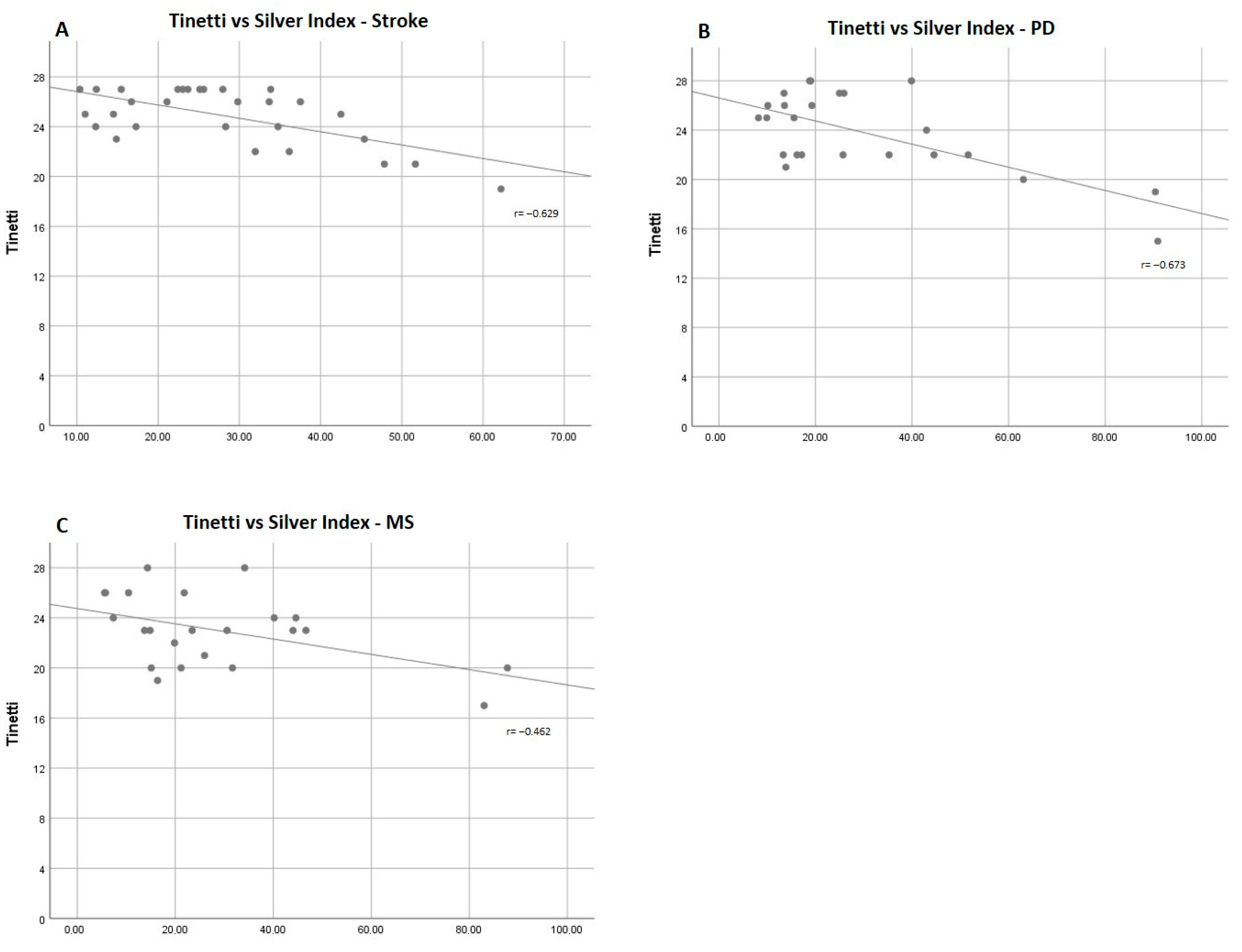
For stroke patients, Spearman’s correlation showed a moderate negative correlation between the Silver Index and the SPPB (r = −0.470) and between the Silver Index and the Tinetti scale (r = −0.629, Figure 2A), while a moderate positive correlation emerged between the Silver Index and the TUG (r = 0.341). In patients with PD, a moderate negative correlation was found between the Silver Index and the SPPB (r = −0.750) and between the Silver Index and the Tinetti scale (r = −0.673, Figure 2B), while a moderate positive correlation was found between the Silver Index and the TUG (r = 0.488). Similarly, in people with MS, a moderate negative correlation was found between the Silver Index and the SPPB (r = −0.747) and between the Silver Index and the Tinetti scale (r = −0.462, Figure 2C), and a moderate positive correlation was found between the Silver Index and the TUG (r = 0.441).
Secondly, considering the risk of falling in the whole population, analysis of variance for repeated measures of the Silver Index was performed. Table 3 shows the results of the RM-ANOVA for each group of patients, considering the risk of falling. Regarding stroke and PD patients, no statistically significant differences emerged for the ARC Intellicare group and the paper-based group at all times of assessment.
Considering the MS population, the repeated measures analysis of variance showed a statistically significant difference for the ARC Intellicare group (p = 0.006) but not for the paper-based group. Post hoc analysis showed a statistically significant decrease in the Silver Index between T0 and T2 (p = 0.015).
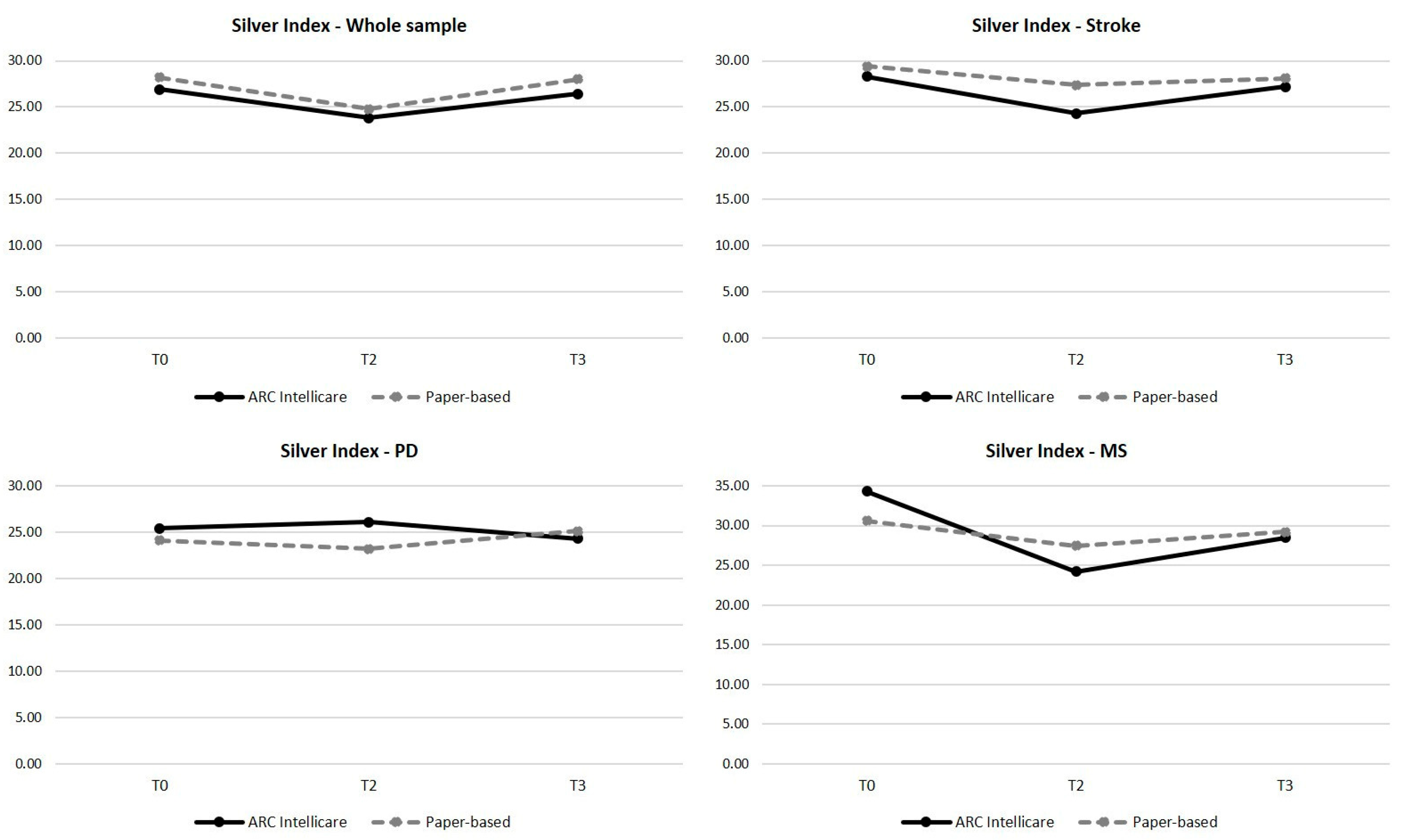
Figure 3 shows the trend of the Silver Index in the whole sample and in each population. The two-way RM ANOVA of the Silver Index did not show statistically significant results for each condition considered.

4. Discussion

The most common risk factors in patients with neurological diseases, in addition to a prior history of accidental falls, include balance and gait problems, lower limb weakness, sensory disturbances, and visual impairments [56]. To reduce the risk of falling, in addition to the pharmacological approach, rehabilitation is essential, also using telerehabilitation [57].
Firstly, this study analyzed the effectiveness of the Silver Index in identifying the risk of falling in three different neurological populations. Patients with stroke, PD, and MS were evaluated, most of whom did not report a history of accidental falls. All three populations examined had a medium–low risk of falling with a wide range of values: this could be related to both the small sample size of each disease population and the fact that these are populations of non-fallers, as reported in the previously published study [12]. Considering stroke patients, the Silver Index showed a moderate negative correlation with the Tinetti and the SPPB.
The Tinetti scale and the SPPB are validated tools and used to assess balance and identify the risk of falls [58,59]. The study found that lower Silver Index scores (lower risk of falling) are associated with higher Tinetti and SPPB scores, which confirmed a lower risk of falls. In addition, the Silver Index showed a moderate positive correlation with the TUG. The TUG is a functional test that assesses the risk of falling [60]: higher Silver Index scores (greater risk of falling) are associated with higher TUG values (higher risk of falling). Similar results were found in populations with PD and MS: the Silver Index showed a moderate negative correlation with the Tinetti and the SPPB, and a moderate positive correlation with the TUG.
The findings of the present study highlighted a significative relationship between the Silver Index, a validated tool to estimate fall risk in older adults [54], and the clinical outcome to assess balance. These results suggest that the Silver Index could be considered a useful tool for quantifying the risk of falling in different populations with neurological disorders. Further studies should be conducted to confirm this suggestion. It is important to note that although the Silver Index showed a correlation with clinical scales and was therefore able to quantify the risk of falls, the patients evaluated were not prone to falls. While it would be advisable to expand the sample in future studies to include subjects prone to falls, it is interesting to note that even subjects not prone to falls still have a medium–low risk of falling. This detail is interesting because it suggests that the use of the hunova® robotic platform, and, in particular, the Silver Index, can be useful in identifying a population of patients who, due to the conditions of their pathology, are prone to falling but do not “yet” fall. In this way, it will be possible to objectively identify at-risk populations and, potentially, intervene quickly from a rehabilitation perspective to minimize the risk of falls.
Secondly, this study analyzed the effect of telerehabilitation treatment provided with ARC Intellicare compared with paper-based home rehabilitation treatment. The study conducted by Bove and colleagues [12] highlighted how, in stroke patients, device-guided telerehabilitation was associated with better results, particularly in terms of walking, while no significant results were found in the PD and MS populations. As widely documented in the literature, walking difficulties are closely related to falls after stroke [13] and physiotherapy is able to reduce the risk of falling [61], with an impact on patients’ quality of life. Data analysis from this ancillary study showed that at the end of treatment, regardless of treatment group, there was a decrease in the risk of falling in all patients, although this was not statistically significant. However, considering the individual neurological populations, the study showed stability in the risk of falls in patients with PD, a non-statistically significant decrease in the risk of falls in patients with stroke, and a significant reduction in the risk of falls in patients with MS. Specifically, the trend towards a reduced risk of falling observed in patients with stroke and MS could be related to the type of rehabilitation strategy used. Patients who performed rehabilitation activities using ARC Intellicare received real-time feedback on their exercise performance during rehabilitation treatment, allowing for continuous monitoring and correction of the rehabilitation activities performed, feedback that patients who underwent paper-based treatment did not receive [62]. However, although not significantly, it would appear that the results obtained with this type of telerehabilitation activity are not maintained in the medium term. In the PD population, however, the risk of falling remained stable at the end of the treatment period, showing no significant change in the risk of falling at the end of the observation period, as if more time were needed to achieve a change in acquired behaviors. The findings of the present studies confirmed that home-based telerehabilitation is an effective strategy to improve balance and prevent falls in neurological diseases [63,64,65,66,67].
The findings of this study are interesting, especially since the rehabilitation approach was not specifically aimed at reducing falls. This study found that ARC Intellicare rehabilitation reduced the risk of falls in patients with MS and could potentially reduce the risk of falls in patients with stroke. It is possible that the statistically significant reduction in the risk of falling in people with MS is linked to the characteristics of the disease itself. MS is a disease characterized by phenotypic heterogeneity and damage/remyelination mechanisms which, especially in non-primary progressive forms, allow for greater neural reorganization and functional compensation. These characteristics can be “exploited” more efficiently in a home exercise program that provides sensory feedback and targeted repetition [12]. Furthermore, the mechanisms that cause falls in the three neurological conditions can influence recovery. In the PD population, falls are frequently associated with “episodic” phenomena such as freezing of gait and dopaminergic fluctuations; these paroxysmal events are less predictable and less susceptible to persistent improvements achieved only with motor exercises based on repetition and feedback [68]. In stroke patients, on the other hand, falls are often the result of motor asymmetry, postural instability, and lack of coordination. The presence of a permanent focal lesion makes it more difficult to respond to generalized rehabilitation interventions: highly personalized rehabilitation interventions can enhance central reorganization mechanisms. In the MS population, many factors that contribute to the risk of falling (e.g., impaired proprioception and reduced postural strategy) may respond more linearly to interventions that increase motor control, step planning ability, and dynamic stability [19]. However, it appears that patients were unable to maintain the results achieved through the rehabilitation protocol in the medium term [69]. The exercises proposed in this study were mainly aimed at improving trunk stability and coordination. The relationship between trunk impairment and the risk of falling is well known in the literature: the inability to maintain trunk control affects balance and gait in individuals with neurological disorders such as stroke, MS, and PD [70,71,72,73]. Therefore, it can be hypothesized that the reduction in the risk of falling is attributable to the type of activity performed.
With the aging population and the increasing difficulty of accessing rehabilitation services, it becomes progressively more important to identify new strategies to convey tailored rehabilitation programs. This study demonstrated how ARC Intellicare is a useful tool for the enjoyment of rehabilitation at home, while maintaining monitoring of the proposed rehabilitation activities and contact with the physical therapist. In a sample of neurological patients, activities performed with ARC Intellicare reduced the risk of falling.
The results that emerged from this study can have two interpretations. The first is that the type of exercises chosen may have played a crucial role in improving trunk control, as assessed by previous research [74]. The second is directly related to the type of instrument used: the use of a technological tool that can monitor exercise and provide real-time feedback on the quality of movement execution is certainly useful, especially for patients who have reduced mobility due to neurological disorders.
The main study attempted to standardize the exercise program to facilitate comparison between patient groups, but this could limit therapeutic utility for populations with different impairments and disease-specific needs. Therefore, future studies could include disease- and cognitive impairment-specific tasks [75,76]. In addition, when prescribing an exercise program to reduce fall risk, it would be appropriate to include activities that integrate sensory systems, such as dual-task activities [77], to “train” patients to perform multiple activities at once and activities that simulate real activities of daily living. Another limitation is sample size: future studies should include more patients to establish the fall risk effect of ARC Intellicare-delivered telerehabilitation.

5. Conclusions

The findings of the present ancillary study suggest that the Silver Index could be considered an effective and valid tool for assessing the risk of falls in neurological disorders, capable of determining the risk of falls even in a population of non-fallers. Furthermore, according with the results of the paper by Bove and colleagues, ARC Intellicare can be considered to be a useful tool to assist and motivate patients with chronic neurological diseases in remote home rehabilitation.

Author Contributions

Conceptualization, L.C. and S.G.; methodology, C.L.; formal analysis, C.I.; investigation, L.C. and A.M.M.; data curation, L.C. and L.B.; writing—original draft preparation, L.C.; writing—review and editing, L.C., C.L., L.B. and S.G.; visualization, A.R.B. and P.C.; supervision, S.G.; project administration, A.R.B. and P.C.; funding acquisition, P.C. All authors have read and agreed to the published version of the manuscript.

Funding

This work was supported by the Italian Ministry of Health, Direzione Generale dei Dispositivi Medici e del Servizio Farmaceutico, project “Realizzazione di un progetto pilota da effettuarsi nell’ambito di un programma di fattibilità precoce su dispositivi medici da utilizzarsi nel settore nella neurologia”, 2019.

Institutional Review Board Statement

The study was conducted in accordance with the Declaration of Helsinki and approved by the local Ethics Committee (Prot. n. 0014656/23, NCT06032468, approved on 11 May 2023).

Informed Consent Statement

Informed consent was obtained from all subjects involved in the study.

Data Availability Statement

The raw data supporting the conclusions of this article will be made available by the authors on request.

Acknowledgments

The authors would like to thank Henesis Srl, as a partner in this project, who provided the devices and technical assistance. The authors would also like to thank Assunta Bianco, Francesco Bove, Giulia Di Lazzaro, Martina Petracca, Serena Fragapane, Anna Tarquini Guetti, Giovanni Ferrarin, and Edouard Vidal for their technical support. Lastly, the authors would like to thank all patients for participating in the study.

Conflicts of Interest

The authors declare no conflicts of interest.

References

  1. Kringle, E.; Trammell, M.; Brown, E.D. Telerehabilitation Strategies and Resources for Rehabilitation Professionals. Arch. Phys. Med. Rehabil. 2023, 104, 2191–2197. [Google Scholar] [CrossRef]
  2. Agostini, M.; Moja, L.; Banzi, R.; Pistotti, V.; Tonin, P.; Venneri, A.; Turolla, A. Telerehabilitation and Recovery of Motor Function: A Systematic Review and Meta-Analysis. J. Telemed. Telecare 2015, 21, 202–213. [Google Scholar] [CrossRef]
  3. Bennell, K.L.; Lawford, B.J.; Metcalf, B.; Mackenzie, D.; Russell, T.; van den Berg, M.; Finnin, K.; Crowther, S.; Aiken, J.; Fleming, J.; et al. Physiotherapists and Patients Report Positive Experiences Overall with Telehealth during the COVID-19 Pandemic: A Mixed-Methods Study. J. Physiother. 2021, 67, 201–209. [Google Scholar] [CrossRef] [PubMed]
  4. Seron, P.; Oliveros, M.J.; Gutierrez-Arias, R.; Fuentes-Aspe, R.; Torres-Castro, R.C.; Merino-Osorio, C.; Nahuelhual, P.; Inostroza, J.; Jalil, Y.; Solano, R.; et al. Effectiveness of Telerehabilitation in Physical Therapy: A Rapid Overview. Phys. Ther. 2021, 101, pzab053. [Google Scholar] [CrossRef]
  5. Appleby, E.; Gill, S.T.; Hayes, L.K.; Walker, T.L.; Walsh, M.; Kumar, S. Effectiveness of Telerehabilitation in the Management of Adults with Stroke: A Systematic Review. PLoS ONE 2019, 14, e0225150. [Google Scholar] [CrossRef] [PubMed]
  6. Langhorne, P.; Coupar, F.; Pollock, A. Motor Recovery after Stroke: A Systematic Review. Lancet Neurol. 2009, 8, 741–754. [Google Scholar] [CrossRef] [PubMed]
  7. Vahlberg, B.; Lindmark, B.; Zetterberg, L.; Hellström, K.; Cederholm, T. Body Composition and Physical Function after Progressive Resistance and Balance Training among Older Adults after Stroke: An Exploratory Randomized Controlled Trial. Disabil. Rehabil. 2017, 39, 1207–1214. [Google Scholar] [CrossRef]
  8. Amirbekova, M.; Kispayeva, T.; Adomaviciene, A.; Eszhanova, L.; Bolshakova, I.; Ospanova, Z. Systematic Review and Meta-Analysis of Effectiveness of Robotic Therapy in the Recovery of Motor Functions after Stroke. Front. Hum. Neurosci. 2025, 19, 1622661. [Google Scholar] [CrossRef]
  9. van Duijnhoven, H.J.R.; Heeren, A.; Peters, M.A.M.; Veerbeek, J.M.; Kwakkel, G.; Geurts, A.C.H.; Weerdesteyn, V. Effects of Exercise Therapy on Balance Capacity in Chronic Stroke. Stroke 2016, 47, 2603–2610. [Google Scholar] [CrossRef]
  10. Todhunter-Brown, A.; Sellers, C.E.; Baer, G.D.; Choo, P.L.; Cowie, J.; Cheyne, J.D.; Langhorne, P.; Brown, J.; Morris, J.; Campbell, P. Physical Rehabilitation Approaches for the Recovery of Function and Mobility Following Stroke. Cochrane Database Syst. Rev. 2025, 2, CD001920. [Google Scholar] [CrossRef]
  11. Federico, S.; Cacciante, L.; Cieślik, B.; Turolla, A.; Agostini, M.; Kiper, P.; Picelli, A. Telerehabilitation for Neurological Motor Impairment: A Systematic Review and Meta-Analysis on Quality of Life, Satisfaction, and Acceptance in Stroke, Multiple Sclerosis, and Parkinson’s Disease. J. Clin. Med. 2024, 13, 299. [Google Scholar] [CrossRef]
  12. Bove, F.; Di Lazzaro, G.; Petracca, M.; Lo Monaco, M.R.; Ricciardi, D.; Di Caro, F.; Fragapane, S.; Giovannini, S.; Iacovelli, C.; Castelli, L.; et al. An Early Feasibility Study for Neurological Devices: The ARCTRAN Study. Neurol. Sci. 2025, 46, 5221–5233. [Google Scholar] [CrossRef]
  13. Bower, K.; Thilarajah, S.; Pua, Y.-H.; Williams, G.; Tan, D.; Mentiplay, B.; Denehy, L.; Clark, R. Dynamic Balance and Instrumented Gait Variables Are Independent Predictors of Falls Following Stroke. J. Neuroeng. Rehabil. 2019, 16, 3. [Google Scholar] [CrossRef] [PubMed]
  14. Saunders, D.H.; Mead, G.E.; Fitzsimons, C.; Kelly, P.; van Wijck, F.; Verschuren, O.; Backx, K.; English, C. Interventions for Reducing Sedentary Behaviour in People with Stroke. Cochrane Database Syst. Rev. 2021, 6, CD012996. [Google Scholar] [CrossRef]
  15. World Health Organization Falls. Available online: https://www.who.int/news-room/fact-sheets/detail/falls (accessed on 5 September 2025).
  16. Giovannini, S.; Brau, F.; Galluzzo, V.; Santagada, D.A.; Loreti, C.; Biscotti, L.; Laudisio, A.; Zuccalà, G.; Bernabei, R. Falls among Older Adults: Screening, Identification, Rehabilitation, and Management. Appl. Sci. 2022, 12, 7934. [Google Scholar] [CrossRef]
  17. Tinetti, M.E.; Kumar, C. The Patient Who Falls: “It’s Always a Trade-Off”. JAMA—J. Am. Med. Assoc. 2010, 303, 258–266. [Google Scholar] [CrossRef]
  18. Hulbert, S.; Chivers-Seymour, K.; Summers, R.; Lamb, S.; Goodwin, V.; Rochester, L.; Nieuwboer, A.; Rowsell, A.; Ewing, S.; Ashburn, A. ‘PDSAFE’—A Multi-Dimensional Model of Falls-Rehabilitation for People with Parkinson’s. A Mixed Methods Analysis of Therapists’ Delivery and Experience. Physiotherapy 2021, 110, 77–84. [Google Scholar] [CrossRef]
  19. Coote, S.; Comber, L.; Quinn, G.; Santoyo-Medina, C.; Kalron, A.; Gunn, H. Falls in People with Multiple Sclerosis: Risk Identification, Intervention, and Future Directions. Int. J. MS Care 2020, 22, 247–255. [Google Scholar] [CrossRef]
  20. Mansfield, A.; Wong, J.S.; McIlroy, W.E.; Biasin, L.; Brunton, K.; Bayley, M.; Inness, E.L. Do Measures of Reactive Balance Control Predict Falls in People with Stroke Returning to the Community? Physiotherapy 2015, 101, 373–380. [Google Scholar] [CrossRef]
  21. Stolze, H.; Klebe, S.; Zechlin, C.; Baecker, C.; Friege, L.; Deuschl, G. Falls in Frequent Neurological Diseases: Prevalence, Risk Factors and Aetiology. J. Neurol. 2004, 251, 79–84. [Google Scholar] [CrossRef] [PubMed]
  22. Rubenstein, L.Z.; Josephson, K.R. Falls and Their Prevention in Elderly People: What Does the Evidence Show? Med. Clin. N. Am. 2006, 90, 807–824. [Google Scholar] [CrossRef]
  23. Ehrhardt, A.; Hostettler, P.; Widmer, L.; Reuter, K.; Petersen, J.A.; Straumann, D.; Filli, L. Fall-Related Functional Impairments in Patients with Neurological Gait Disorder. Sci. Rep. 2020, 10, 21120. [Google Scholar] [CrossRef]
  24. Sherrington, C.; Fairhall, N.J.; Wallbank, G.K.; Tiedemann, A.; Michaleff, Z.A.; Howard, K.; Clemson, L.; Hopewell, S.; Lamb, S.E. Exercise for Preventing Falls in Older People Living in the Community. Cochrane Database Syst. Rev. 2019, 1, CD012424. [Google Scholar] [CrossRef]
  25. Papalia, G.F.; Papalia, R.; Balzani, L.A.D.; Torre, G.; Zampogna, B.; Vasta, S.; Fossati, C.; Alifano, A.M.; Denaro, V. The Effects of Physical Exercise on Balance and Prevention of Falls in Older People: A Systematic Review and Meta-Analysis. J. Clin. Med. 2020, 9, 2595. [Google Scholar] [CrossRef]
  26. Morat, T.; Snyders, M.; Kroeber, P.; De Luca, A.; Squeri, V.; Hochheim, M.; Ramm, P.; Breitkopf, A.; Hollmann, M.; Zijlstra, W. Evaluation of a Novel Technology-Supported Fall Prevention Intervention—Study Protocol of a Multi-Centre Randomised Controlled Trial in Older Adults at Increased Risk of Falls. BMC Geriatr. 2023, 23, 103. [Google Scholar] [CrossRef]
  27. Niedermair, I.; Schwertfeger, J. Community Stroke Interventions Do Not Address Participation and Environment for Stroke Survivors: Exploring Stroke Self-Management Interventions Using the ICF Framework. Arch. Phys. Med. Rehabil. 2025, 106, e67–e68. [Google Scholar] [CrossRef]
  28. Karunakaran, K.K.; Pamula, S.; Tendolkar, P.; Chen, P.; Suviseshamuthu, E.S. Preliminary Validation of an Objective Fall-Risk Assessment for Individuals with Stroke. In Proceedings of the 2024 46th Annual International Conference of the IEEE Engineering in Medicine and Biology Society (EMBC), Orlando, FL, USA, 15–19 July 2024; IEEE: New York, NY, USA, 2024; pp. 1–4. [Google Scholar]
  29. World Health Organization Rehabilitation. World Report On Disability; WHO Press, Ed.; WHO Press: Geneve, Switzerland, 2011; pp. 93–134. ISBN 9789241564182. [Google Scholar]
  30. ARC Intellicare—Dispositivo Medico Di Teleriabilitazione. Available online: https://www.arc-intellicare.com/ (accessed on 23 September 2025).
  31. Postuma, R.B.; Berg, D.; Stern, M.; Poewe, W.; Olanow, C.W.; Oertel, W.; Obeso, J.; Marek, K.; Litvan, I.; Lang, A.E.; et al. MDS Clinical Diagnostic Criteria for Parkinson’s Disease. Mov. Disord. 2015, 30, 1591–1601. [Google Scholar] [CrossRef] [PubMed]
  32. Hoehn, M.M.; Yahr, M.D. Parkinsonism: Onset, Progression and Mortality. Neurology 1967, 17, 427–442. [Google Scholar] [CrossRef] [PubMed]
  33. Thompson, A.J.; Banwell, B.L.; Barkhof, F.; Carroll, W.M.; Coetzee, T.; Comi, G.; Correale, J.; Fazekas, F.; Filippi, M.; Freedman, M.S.; et al. Diagnosis of Multiple Sclerosis: 2017 Revisions of the McDonald Criteria. Lancet Neurol. 2018, 17, 162–173. [Google Scholar] [CrossRef] [PubMed]
  34. Kurtzke, J.F. Rating Neurologic Impairment in Multiple Sclerosis: An Expanded Disability Status Scale (EDSS). Neurology 1983, 33, 1444–1452. [Google Scholar] [CrossRef]
  35. Wilson, J.T.L.; Hareendran, A.; Hendry, A.; Potter, J.; Bone, I.; Muir, K.W. Reliability of the Modified Rankin Scale across Multiple Raters: Benefits of a Structured Interview. Stroke 2005, 36, 777–781. [Google Scholar] [CrossRef] [PubMed]
  36. Folstein, M.F.; Folstein, S.E.; McHugh, P.R. “Mini-Mental State”. A Practical Method for Grading the Cognitive State of Patients for the Clinician. J. Psychiatr. Res. 1975, 12, 189–198. [Google Scholar] [CrossRef]
  37. Tinetti, M.E. Performance-Oriented Assessment of Mobility Problems in Elderly Patients. J. Am. Geriatr. Soc. 1986, 34, 119–126. [Google Scholar] [CrossRef]
  38. Capecci, M.; Cima, R.; Barbini, F.A.; Mantoan, A.; Sernissi, F.; Lai, S.; Fava, R.; Tagliapietra, L.; Ascari, L.; Izzo, R.N.; et al. Telerehabilitation with ARC Intellicare to Cope with Motor and Respiratory Disabilities: Results about the Process, Usability, and Clinical Effect of the “Ricominciare” Pilot Study. Sensors 2023, 23, 7238. [Google Scholar] [CrossRef]
  39. Ceravolo, M.G.; Arienti, C.; de Sire, A.; Andrenelli, E.; Negrini, F.; Lazzarini, S.G.; Patrini, M.; Negrini, S. Rehabilitation and COVID-19: The Cochrane Rehabilitation 2020 Rapid Living Systematic Review. Eur. J. Phys. Rehabil. Med. 2020, 56, 642–651. [Google Scholar] [CrossRef]
  40. Stookey, A.D.; Katzel, L.I.; Steinbrenner, G.; Shaughnessy, M.; Ivey, F.M. The Short Physical Performance Battery as a Predictor of Functional Capacity after Stroke. J. Stroke Cerebrovasc. Dis. 2014, 23, 130–135. [Google Scholar] [CrossRef]
  41. Motl, R.W.; Learmonth, Y.C.; Wójcicki, T.R.; Fanning, J.; Hubbard, E.A.; Kinnett-Hopkins, D.; Roberts, S.A.; McAuley, E. Preliminary Validation of the Short Physical Performance Battery in Older Adults with Multiple Sclerosis: Secondary Data Analysis. BMC Geriatr. 2015, 15, 157. [Google Scholar] [CrossRef]
  42. Tanji, H.; Gruber-Baldini, A.L.; Anderson, K.E.; Pretzer-Aboff, I.; Reich, S.G.; Fishman, P.S.; Weiner, W.J.; Shulman, L.M. A Comparative Study of Physical Performance Measures in Parkinson’s Disease. Mov. Disord. 2008, 23, 1897–1905. [Google Scholar] [CrossRef]
  43. Persson, C.U.; Danielsson, A.; Sunnerhagen, K.S.; Grimby-Ekman, A.; Hansson, P.O. Timed Up & Go as a Measure for Longitudinal Change in Mobility after Stroke—Postural Stroke Study in Gothenburg (POSTGOT). J. Neuroeng. Rehabil. 2014, 11, 83. [Google Scholar] [CrossRef] [PubMed]
  44. Sebastião, E.; Sandroff, B.M.; Learmonth, Y.C.; Motl, R.W. Validity of the Timed Up and Go Test as a Measure of Functional Mobility in Persons with Multiple Sclerosis. Arch. Phys. Med. Rehabil. 2016, 97, 1072–1077. [Google Scholar] [CrossRef] [PubMed]
  45. Nocera, J.R.; Stegemöller, E.L.; Malaty, I.A.; Okun, M.S.; Marsiske, M.; Hass, C.J. Using the Timed up & Go Test in a Clinical Setting to Predict Falling in Parkinson’s Disease. Arch. Phys. Med. Rehabil. 2013, 94, 1300–1305. [Google Scholar] [CrossRef]
  46. Canbek, J.; Fulk, G.; Nof, L.; Echternach, J. Test-Retest Reliability and Construct Validity of the Tinetti Performance-Oriented Mobility Assessment in People with Stroke. J. Neurol. Phys. Ther. 2013, 37, 14–19. [Google Scholar] [CrossRef] [PubMed]
  47. Tesio, L.; Perucca, L.; Franchignoni, F.P.; Battaglia, M.A. A Short Measure of Balance in Multiple Sclerosis: Validation through Rasch Analysis. Funct. Neurol. 1997, 12, 255–265. [Google Scholar]
  48. Besios, T.; Nikolaos, A.; Vassilios, G.; Giorgos, M. Comparative reliability of tinetti mobility test and tug tests in people with neurological disorders. Int. J. Physiother. 2019, 6, 251–255. [Google Scholar] [CrossRef]
  49. Contreras, A.; Grandas, F. Risk of Falls in Parkinson’s Disease: A Cross-Sectional Study of 160 Patients. Park. Dis. 2012, 2012, 362572. [Google Scholar] [CrossRef]
  50. Saglia, J.A.; De Luca, A.; Squeri, V.; Ciaccia, L.; Sanfilippo, C.; Ungaro, S.; De Michieli, L. De Design and Development of a Novel Core, Balance and Lower Limb Rehabilitation Robot: Hunova®. In Proceedings of the IEEE 16th International Conference on Rehabilitation Robotics (ICORR), Toronto, ON, Canada, 24–28 June 2019; IEEE: New York, NY, USA, 2019; pp. 417–422. [Google Scholar]
  51. Castelli, L.; Iacovelli, C.; Loreti, C.; Malizia, A.M.; Barone Ricciardelli, I.; Tomaino, A.; Fusco, A.; Biscotti, L.; Padua, L.; Giovannini, S. Robotic-Assisted Rehabilitation for Balance in Stroke Patients (ROAR-S): Effects of Cognitive, Motor and Functional Outcomes. Eur. Rev. Med. Pharmacol. Sci. 2023, 27, 8198–8211. [Google Scholar] [CrossRef] [PubMed]
  52. Castelli, L.; Iacovelli, C.; Ciccone, S.; Geracitano, V.; Loreti, C.; Fusco, A.; Biscotti, L.; Padua, L.; Giovannini, S. RObotic-Assisted Rehabilitation of Lower Limbs for Orthopedic Patients (ROAR-O): A Randomized Controlled Trial. Appl. Sci. 2023, 13, 13208. [Google Scholar] [CrossRef]
  53. Giovannini, S.; Iacovelli, C.; Brau, F.; Loreti, C.; Fusco, A.; Caliandro, P.; Biscotti, L.; Padua, L.; Bernabei, R.; Castelli, L. RObotic-Assisted Rehabilitation for Balance and Gait in Stroke Patients (ROAR-S): Study Protocol for a Preliminary Randomized Controlled Trial. Trials 2022, 23, 872. [Google Scholar] [CrossRef]
  54. Cella, A.; de Luca, A.; Squeri, V.; Parodi, S.; Vallone, F.; Giorgeschi, A.; Senesi, B.; Zigoura, E.; Quispe Guerrero, K.L.; Siri, G.; et al. Development and Validation of a Robotic Multifactorial Fall-Risk Predictive Model: A One-Year Prospective Study in Community-Dwelling Older Adults. PLoS ONE 2020, 15, e0234904. [Google Scholar] [CrossRef]
  55. Julious, S.A. Sample Size of 12 per Group Rule of Thumb for a Pilot Study. Pharm. Stat. 2005, 4, 287–291. [Google Scholar] [CrossRef]
  56. Thurman, D.J.; Stevens, J.A.; Rao, J.K. Practice Parameter: Assessing Patients in a Neurology Practice for Risk of Falls (an Evidence-Based Review). Neurology 2008, 70, 473–479. [Google Scholar] [CrossRef]
  57. Said, C.M.; Ramage, E.; McDonald, C.E.; Bicknell, E.; Hitch, D.; Fini, N.A.; Bower, K.J.; Lynch, E.; Vogel, A.P.; English, K.; et al. Co-Designing Resources for Rehabilitation via Telehealth for People with Moderate to Severe Disability Post Stroke. Physiotherapy 2024, 123, 109–117. [Google Scholar] [CrossRef] [PubMed]
  58. Cassidy, B.; Arena, S. The Short Physical Performance Battery as a Predictor of Functional Decline. Home Healthc. Now 2022, 40, 168–169. [Google Scholar] [CrossRef] [PubMed]
  59. Raîche, M.; Hébert, R.; Prince, F.; Corriveau, H. Screening Older Adults at Risk of Falling with the Tinetti Balance Scale. Lancet 2000, 356, 1001–1002. [Google Scholar] [CrossRef]
  60. Shumway-Cook, A.; Brauer, S.; Woollacott, M. Predicting the Probability for Falls in Community-Dwelling Older Adults Using the Timed Up & Go Test. Phys. Ther. 2000, 80, 896–903. [Google Scholar] [CrossRef]
  61. Denissen, S.; Staring, W.; Kunkel, D.; Pickering, R.M.; Lennon, S.; Geurts, A.C.; Weerdesteyn, V.; Verheyden, G.S. Interventions for Preventing Falls in People after Stroke. Cochrane Database Syst. Rev. 2019, 2019, CD008728. [Google Scholar] [CrossRef]
  62. Kwon, I.-H.; Shin, W.-S.; Choi, K.-S.; Lee, M.-S. Effects of Real-Time Feedback Methods on Static Balance Training in Stroke Patients: A Randomized Controlled Trial. Healthcare 2024, 12, 767. [Google Scholar] [CrossRef]
  63. Thwaites, C.; Nayyar, R.; Blennerhassett, J.; Egerton, T.; Tan, J.; Bower, K. Is Telehealth an Effective and Feasible Option for Improving Falls-Related Outcomes in Community-Dwelling Adults with Neurological Conditions? A Systematic Review and Meta-Analysis. Clin. Rehabil. 2023, 37, 17–46. [Google Scholar] [CrossRef] [PubMed]
  64. Chen, S.C.; Lin, C.H.; Su, S.W.; Chang, Y.T.; Lai, C.H. Feasibility and Effect of Interactive Telerehabilitation on Balance in Individuals with Chronic Stroke: A Pilot Study. J. Neuroeng. Rehabil. 2021, 18, 71. [Google Scholar] [CrossRef]
  65. Afshari, M.; Hernandez, A.V.; Joyce, J.M.; Hauptschein, A.W.; Trenkle, K.L.; Stebbins, G.T.; Goetz, C.G. A Novel Home-Based Telerehabilitation Program Targeting Fall Prevention in Parkinson Disease: A Preliminary Trial. Neurol. Clin. Pract. 2024, 14, e200246. [Google Scholar] [CrossRef]
  66. Alayat, M.S.; Almatrafi, N.A.; Almutairi, A.A.; El Fiky, A.A.R.; Elsodany, A.M. The Effectiveness of Telerehabilitation on Balance and Functional Mobility in Patients with Stroke: A Systematic Review and Meta-Analysis. Int. J. Telerehabil. 2022, 14, e6532. [Google Scholar] [CrossRef]
  67. Doherty, F.; Powell, P.; McBride, C.; Monaghan, K. Physical Telerehabilitation Interventions for Gait and Balance in Multiple Sclerosis: A Scoping Review. J. Neurol. Sci. 2024, 456, 122827. [Google Scholar] [CrossRef] [PubMed]
  68. Herman, T.; Barer, Y.; Bitan, M.; Sobol, S.; Giladi, N.; Hausdorff, J.M. A Meta-Analysis Identifies Factors Predicting the Future Development of Freezing of Gait in Parkinson’s Disease. Npj Park. Dis. 2023, 9, 158. [Google Scholar] [CrossRef]
  69. Castelli, L.; Giovannini, S.; Iacovelli, C.; Fusco, A.; Pastorino, R.; Marafon, D.P.; Pozzilli, C.; Padua, L. Training-Dependent Plasticity and Far Transfer Effect Enhanced by Bobath Rehabilitation in Multiple Sclerosis. Mult. Scler. Relat. Disord. 2022, 68, 104241. [Google Scholar] [CrossRef]
  70. Alzahrani, N.; Bamutraf, O.; Mukhtar, S.; Mazi, A.; Jawad, A.; Khan, A.; Alqarni, A.M.; Basuodan, R.; Khan, F. Exploring Key Factors Associated with Falls in People with Multiple Sclerosis: The Role of Trunk Impairment and Other Contributing Factors. Heliyon 2024, 10, e39589. [Google Scholar] [CrossRef]
  71. Verheyden, G.; Nieuwboer, A.; De Wit, L.; Feys, H.; Schuback, B.; Baert, I.; Jenni, W.; Schupp, W.; Thijs, V.; De Weerdt, W. Trunk Performance after Stroke: An Eye Catching Predictor of Functional Outcome. J. Neurol. Neurosurg. Psychiatry 2006, 78, 694–698. [Google Scholar] [CrossRef]
  72. Karthikbabu, S.; Chakrapani, M.; Ganeshan, S.; Rakshith, K.C.; Nafeez, S.; Prem, V. A Review on Assessment and Treatment of the Trunk in Stroke: A Need or Luxury. Neural Regen. Res. 2012, 7, 1974–1977. [Google Scholar] [CrossRef] [PubMed]
  73. Artigas, N.R.; Franco, C.; Leão, P.; Rieder, C.R.M. Postural Instability and Falls Are More Frequent in Parkinson’s Disease Patients with Worse Trunk Mobility. Arq. Neuro-Psiquiatr. 2016, 74, 519–523. [Google Scholar] [CrossRef] [PubMed]
  74. Castelli, L.; Loreti, C.; Malizia, A.M.; Iacovelli, C.; Renzi, S.; Fioravanti, L.; Amoruso, V.; Paolasso, I.; Di Caro, F.; Padua, L.; et al. The Impact of RObotic Assisted Rehabilitation on Trunk Control in Patients with Severe Acquired Brain Injury (ROAR-SABI). Appl. Sci. 2025, 15, 2539. [Google Scholar] [CrossRef]
  75. Finnegan, S.; Bruce, J.; Skelton, D.A.; Withers, E.J.; Lamb, S.E. Development and Delivery of an Exercise Programme for Falls Prevention: The Prevention of Falls Injury Trial (PreFIT). Physiotherapy 2018, 104, 72–79. [Google Scholar] [CrossRef]
  76. Finnegan, S.; Seers, K.; Bruce, J. Long-Term Follow-up of Exercise Interventions Aimed at Preventing Falls in Older People Living in the Community: A Systematic Review and Meta-Analysis. Physiotherapy 2019, 105, 187–199. [Google Scholar] [CrossRef] [PubMed]
  77. Muir-Hunter, S.W.; Wittwer, J.E. Dual-Task Testing to Predict Falls in Community-Dwelling Older Adults: A Systematic Review. Physiotherapy 2016, 102, 29–40. [Google Scholar] [CrossRef] [PubMed]
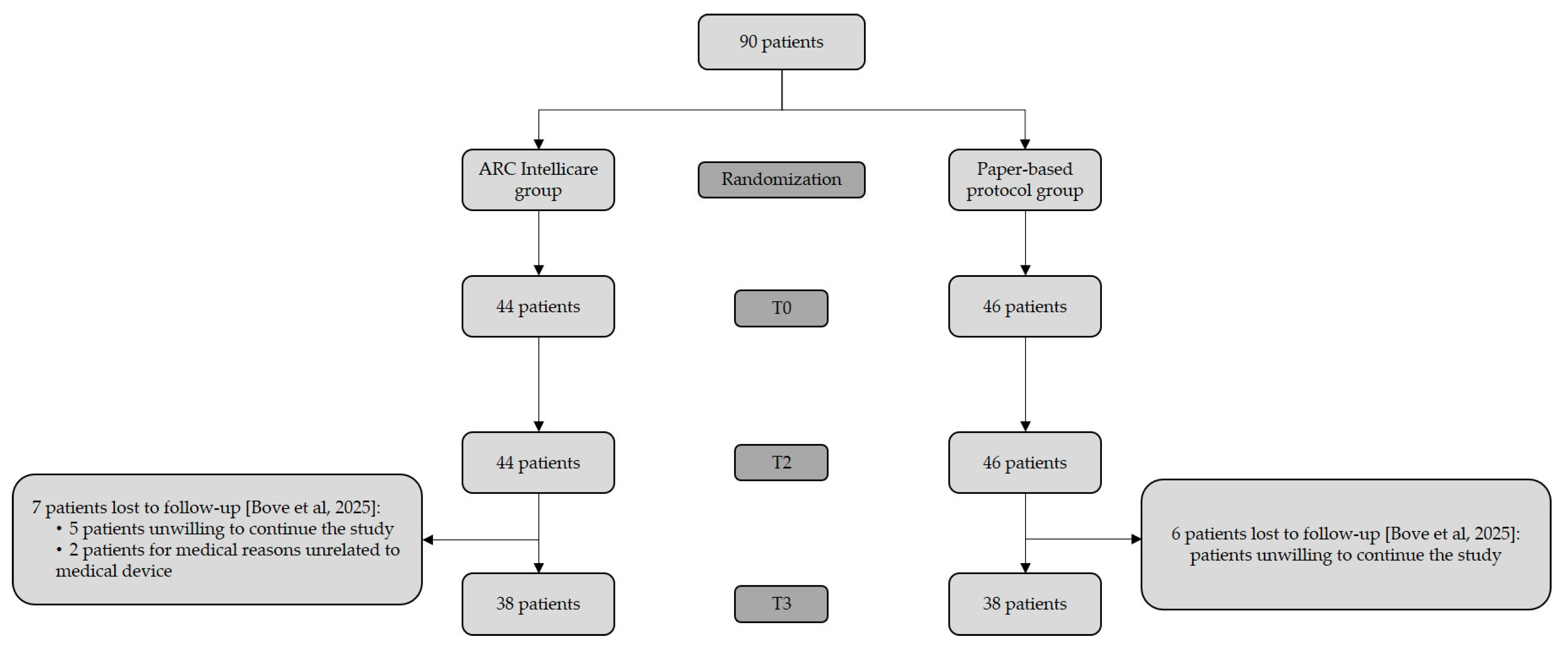
Figure 1. Flowchart of the study. Bove et al. Neurol. Sci. 2025, 10.1007/s10072-025-08367-5 [12].
Applsci 15 11247 g001
Figure 2. Correlation between Tinetti scale and Silver Index in stroke (A), PD (B), and MS (C) population.
Applsci 15 11247 g002
Figure 3. Trend of the Silver Index at different assessment times in the whole sample and in the three neurological disorders.
Applsci 15 11247 g003
Table 1. Sample characteristics at baseline.
ARC Intellicare
Group
Paper-Based
Group
Whole samplen = 43n = 46
Gender, n (%)
  Male
  Female

24 (55.81%)
19 (44.19%)

22 (47.83%)
24 (52.17%)
Age (yr), mean ± SD56.93 ± 13.0155.15 ± 13.87
BMI, mean ± SD24.66 ± 12.9924.58 ± 14.04
Falls, n (%)
  No falls
  At least one fall in the last 12 months
  More than two falls in the last 12 months

39 (43.33%)
4 (4.44%)
2 (2.22%)

35 (38.89%)
5 (5.56%)
5 (5.56%)
SPPB T0, mean ± SD8.64 ± 2.078.68 ± 2.09
TUG, mean ± SD30.99 ± 33.2637.14 ± 35.78
TINETTI total score T0, mean ± SD24.77 ± 2.6225.30 ± 2.47
SILVER INDEX T0, mean ± SD26.90 ± 17.9028.20 ± 13.10
Stroken = 14n = 15
Gender, n (%)
  Male
  Female

9 (64.29%)
5 (35.71%)

9 (60.00%)
6 (40.00%)
Age (yr), mean ± SD63.93 ± 7.8764.33 ± 7.35
BMI, mean ± SD23.62 ± 4.0025.95 ± 3.58
Falls, N (%)
  No falls
  At least one fall in the last 12 months
  More than two falls in the last 12 months

14 (15.56%)00

14 (15.56%)
1 (1.11%)
1 (1.11%)
DOD (yr), mean ± SD3.82 ± 0.471.73 ± 0.46
MRS T0, mean ± SD2.14 ± 0.362.33 ± 0.49
SPPB T0, mean ± SD8.57 ± 1.748.07 ± 2.49
TUG, mean ± SD24.59 ± 28.5929.21 ± 28.86
TINETTI total score T0, mean ± SD25.14 ± 1.8325.73 ± 2.28
SILVER INDEX T0, mean ± SD28.30 ± 12.2029.40 ± 9.13
Parkinson’s Diseasen = 14n = 16
Gender, n (%)
  Male
  Female

9 (62.28%)
5 (35.71%)

8 (50%)
8 (50%)
Age (yr), mean ± SD66.07 ± 5.6661.93 ± 6.20
BMI, mean ± SD25.00 ± 7.5823.9 ± 2.50
Falls, n (%)
  No falls
  At least one fall in the last 12 months
  More than two falls in the last 12 months

15 (16.67%)
1 (1.11%)
0 (0%)

12 (13.33%)
1 (1.11%)
1 (1.11%)
DOD (yr), mean ± SD6.14 ± 1.886.50 ± 3.10
mean ± SD1.93 ± 0.582.09 ± 0.46
SPPB T0, mean ± SD9.81 ± 1.809.29 ± 1.68
TUG, mean ± SD44.33 ± 39.8828.30 ± 34.32
TINETTI total score T0, mean ± SD25.79 ± 1.8125.19 ± 2.64
SILVER INDEX T0, mean ± SD25.40 ± 15.6024.10 ± 14.50
Multiple Sclerosisn = 15n = 15
Gender, n (%)
  Male
  Female

6 (40%)
9 (60%)

5 (33.33%)
10 (66.67%)
Age (yr), mean ± SD41.87 ± 6.6938.73 ± 9.57
BMI, mean ± SD22.4 ± 6.5821.03 ± 6.45
Falls, n (%)
  No falls
  At least one fall in the last 12 months
  More than two falls in the last 12 months

10 (11.11%)
3 (3.33%)
2 (2.22)

9 (10.00%)
3 (3.33%)
3 (3.33%)
DOD (yr), mean ± SD3.83 ± 6.814.21 ± 9.09
EDSS T0, mean ± SD3.87 ± 1.283,84 ± 1,03
SPPB T0, mean ± SD7.47 ± 2.038.73 ± 1.94
TUG, mean ± SD22.76 ± 26.3953.31 ± 39.75
TINETTI total score T0, mean ± SD23.47 ± 3.3825.00 ± 1.46
SILVER INDEX T0, mean ± SD34.30 ± 23.9030.60 ± 16.40
BMI: Body Mass Index; DOD: Duration Of Disease; H&Y: Hoen & Yahr; EDSS: Expanded Disability Status Scale; SPPB: Short Physical Performance Battery; TUG: Timed Up and Go.
Table 2. Pearson’s correlation between Silver and clinical outcomes for each neurological population.
Mean ± SDrp Value
Stroke
SPPB8.31 ± 2.14−0.4700.010
TUG27.30 ± 28.310.3410.071
Tinetti25.47 ± 2.06−0.629<0.001
Parkinson’s Disease
SPPB9.57 ± 1.74−0.750<0.001
TUG36.85 ± 37.640.4880.013
Tinetti25.47 ± 2.21−0.673<0.001
Multiple Sclerosis
SPPB8.10 ± 2.06−0.747<0.001
TUG38.03 ± 36.610.4410.035
SPPB: Short Physical Performance Battery; TUG: Timed Up and Go. r values: 0.2–0.3: weak correlation; 0.3–0.5: moderate correlation; above 0.5: high correlation. In bold, significant values for p < 0.05.
Table 3. Repeated measures ANOVA and post hoc analysis for the Silver Index in the whole sample and in each neurological population.
Post Hoc Test
T0
Mean ± SD
T2
Mean ± SD
T3
Mean ± SD
p ValueT0 vs. T2T2 vs. T3
ARC Intellicare group
Whole Sample26.90 ± 17.9023.80 ± 13.8026.40 ± 16.600.227--
Stroke28.30 ± 12.2024.30 ± 14.4027.21 ± 17.800.425--
Parkinson’s Disease25.40 ± 15.6026.10 ± 14.4024.30 ± 10.100.222--
Multiple sclerosis34.30 ± 23.9024.20 ± 13.8028.49 ± 26.300.0060.0150.357
Paper-based group
Whole Sample28.20 ± 13.1024.80 ± 15.4028.00 ± 18.200.932--
stroke29.40 ± 9.1327.40 ± 20.1028.10 ± 15.800.164--
Parkinson’s Disease24.10 ± 14.5023.20 ± 10.6025.10 ± 15.000.928--
Multiple Sclerosis30.60 ± 16.4027.45 ± 14.0029.20 ± 23.000.587--
In bold, significant values for p < 0.0016.
Disclaimer/Publisher’s Note: The statements, opinions and data contained in all publications are solely those of the individual author(s) and contributor(s) and not of MDPI and/or the editor(s). MDPI and/or the editor(s) disclaim responsibility for any injury to people or property resulting from any ideas, methods, instructions or products referred to in the content.