Article

Identification of Interactions Between the Effects of Geodynamic Activity and Changes in Radon Concentration as Markers of Seismic Events


by
Lidia Fijałkowska-Lichwa
1,*,
Damian Kasza
1,
Marcin Zając
1,
Tadeusz A. Przylibski
1 and
Marek Kaczorowski
2
1
Faculty of Geoengineering, Mining and Geology, Wrocław University of Science and Technology, Wybrzeże S. Wyspiańskiego 27, 50-370 Wrocław, Poland
2
Space Research Centre, Polish Academy of Sciences, Bartycka 18A, 00-716 Warsaw, Poland
*
Author to whom correspondence should be addressed.
Appl. Sci. 2025, 15(15), 8199; https://doi.org/10.3390/app15158199
Submission received: 9 June 2025 / Revised: 21 July 2025 / Accepted: 21 July 2025 / Published: 23 July 2025

Abstract

This article describes the interactions between radon emissions and tectonic movements that accompany seismic activity as a function of time. The interpretation is based on advanced data analysis methods, such as Fourier wavelet transform, SGolay correlation analysis, and time-based data categorization. The dataset comprised the measurement results of 222Rn activity concentrations and the effects of the tectonic activity of rock masses acquired from two water-tube tiltmeters and five SRDN-3 radon probes. The analysis included four seismic events with moderate and light magnitudes (≥4.0), with a hypocenter at a depth of 1–10 km, located approximately 75 km from the research site. Each seismic shock had a different distribution of rock mass phases recorded by the integrated (probe-tiltmeter) measurement system. The results indicate that at the research site, the radon-tectonic signal is best identified between 25 and 48 h and between 49 and 72 h before the seismic shock. Positive correlations between the tectonic signal and the radon signal associated with the tension phase in the rock mass and negative correlations between the tectonic signal and the radon signal associated with the compression phase allow the description of the behavior of the rock mass before the seismic shock. Mixed correlations (positive and negative) indicate that both the stress and strain phases of the rock mass are recorded. The observed correlations seem particularly promising, as they can be recorded already 1–3 days before the seismic event, allowing an appropriately early response to the expected seismic event.

1. Introduction

Universal methods allowing highly accurate forecasts of the time of seismic shocks have been researched for over four decades in Europe [1,2,3,4] and around the world [5,6,7,8,9,10,11,12]. The research methodology and modeling of geodynamic phenomena have so far been based on the identification (including comprehensive analysis) of the behavior of geochemical precursors: 222Rn, CO2, He, H2, CH4, N2, Ar, Pb, Cl, and SO4 [13]. The most promising precursor is radon, which is present in water [14,15,16,17], soil air [18,19,20], and the atmospheres of closed, isolated objects located in fault zones [21,22] or underground research observatories [23,24,25,26]. The use of radon in geophysical research consists of observations of the anomalous behavior of this gas, which typically occurs in short, usually hourly time intervals, as large fluctuations in its activity concentration. In the vast majority of cases, such anomalous behavior manifested as a sudden increase or decrease in radon concentration values is due to meteorological phenomena, such as atmospheric temperature and pressure, rainfall (mainly heavy), and wind force and direction [27,28,29,30,31]. These factors cause the concentration of 222Rn activity to be subject to temporal fluctuations, with a clearly visible seasonal or cyclical trend that is independent of seismic activity. Based on such observations, the identification of changes (including anomalies) induced solely by seismic activity requires the decomposition of the radon signal and filtering of data representing seasonal or cyclical trends [1,28,32,33,34,35].
Similar regularities were also observed as a result of studies conducted continuously since 2014 on the interaction of the radon signal and the geodynamic signal in the system of faults present in the space of the underground Geodynamic Laboratory of the Space Research Center of the Polish Academy of Sciences (GL SRC PAS) located under the Książ Castle in Wałbrzych, Poland [24]. The results of early research performed at this site [36,37,38,39,40,41,42,43] confirmed that changes in the stress state in the rock mass due to tectonic activity (changes in the compression—extension phases) cause fluctuations in radon exhalation from rocks into the air filling the GL SRC PAS excavations. This phenomenon is manifested by changes in the concentration of 222Rn activity in the air present in the excavations. These changes have nearly identical characteristics as a function of time at all measurement points, indicating that they occur within the entire volume of the rock mass in the analyzed area. Gas is exchanged between the lithosphere and atmosphere in excavations not only through active fault zones but also through the entire fractured surface of the rocks forming the roof, floor, and sidewalls of underground excavations [24].
The objective of this study was to identify the nature of statistically significant positive or negative interactions between geodynamic and radon signals observed during seismic events. The results are expected to be an important step towards identifying the similarities and differences in the signals recorded by measurement instruments before and after a seismic shock. Ultimately, they allow the nature of the interaction to be linked to the phases of tension or compression of the rock mass occurring at a given time before and after an event. The authors hope that the results will contribute to improving earthquake forecast methods, which are of great importance, especially in densely populated seismic areas.
In light of the well-documented analyses in the literature focusing on the relationship between geochemical and tectonic changes, this study examined the correlation between rock mass deformation and variations in radon activity concentration, taking into account four selected seismic events of tectonic origin. The analysis focused on anomalies in radon activity concentration present in the atmosphere of an underground facility, which occurred before and after tectonic shocks during a 168 h observation period (covering seven 24-h cycles). The methodological approach, which aimed to isolate the radon response to rock mass loading (tension–compression), provides evidence of a reproducible relationship between geophysical and geochemical phenomena. This, in turn, helps clarify the mechanism of geochemical precursor phenomena preceding earthquakes and is consistent with the findings of Omori and co-authors [44].

2. Study Area

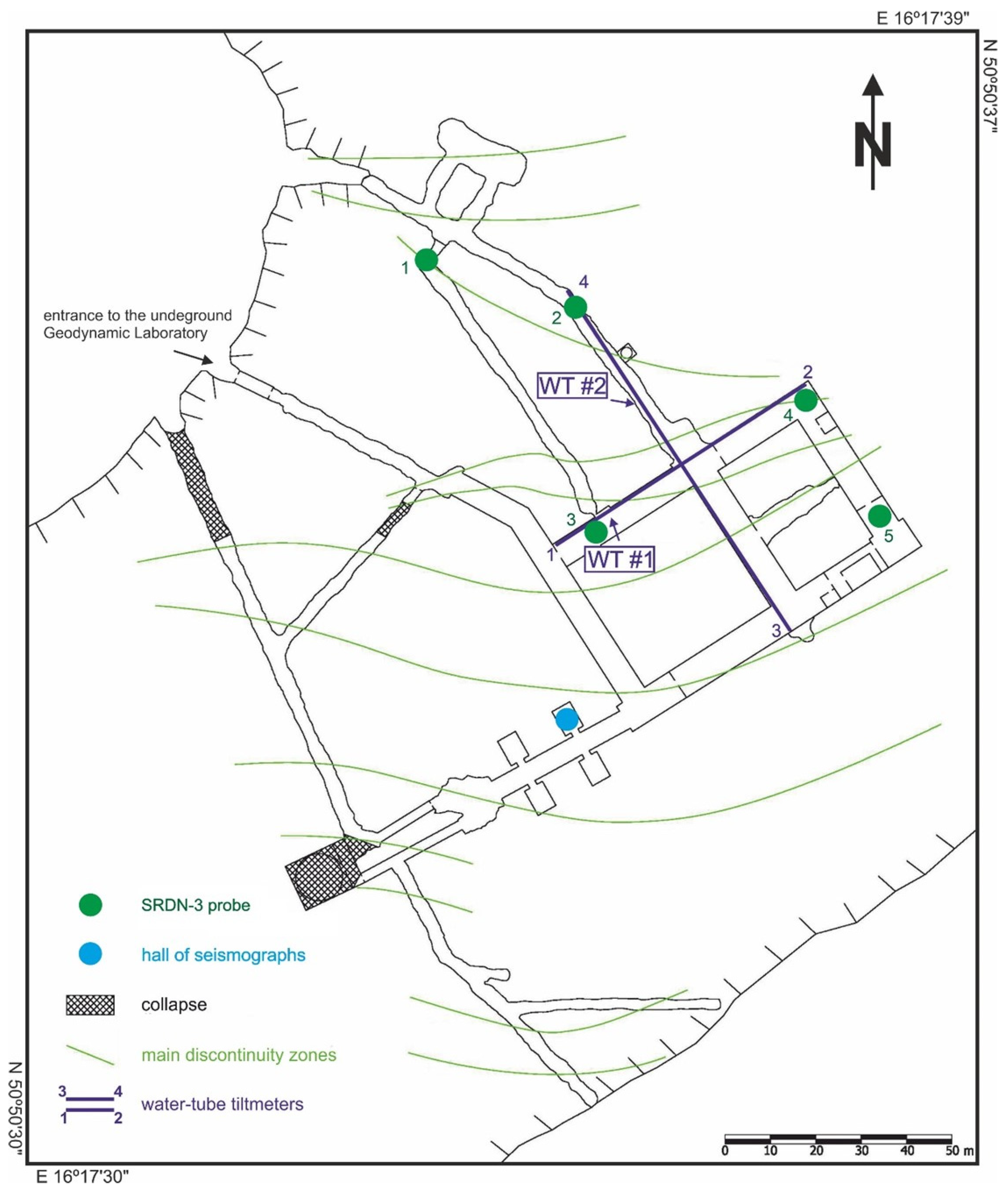
The study was performed in the Geodynamic Laboratory of the Space Research Centre of the Polish Academy of Sciences, which is a well-known and documented research site [24,38,45,46,47,48,49] and the only such area in Poland. It consists of a system of passageways (Figure 1) forming an approximately regular grid with a total length of approx. 950 m. The advantage of this research site lies in the well-documented and precisely characterized geodynamic phenomena determining both various types of rock dislocation effects along the identified fault zones and the intensity variations of the 222Rn exhalation from the pore space and rock fractures to the fault zone and to the atmosphere of the underground passageways [24,36]. The SRC PAS Geodynamic Laboratory is located in a practically aseismic region, which is an additional advantage because tectonic shocks are recorded very rarely. Therefore, they do not need to be isolated from many consecutive events occurring in a short time, and their overlapping effects, recorded in the form of geodynamic and radon signals, do not need to be separated.
The Geodynamic Laboratory in Książ is located within the city limits of Wałbrzych. in the SW part of Poland, in the central part of the Sudety Mountains, which constitute the NE part of the vast crystalline Czech Massif. The Czech massif extends across the Czech Republic, Poland, Germany, and Austria in Central Europe. From the perspective of the geological units forming the Sudety Mountains, the GL SRC PAS is located in the central part of the Świebodzice Basin structural unit (ŚB). The Świebodzice Basin is cut by a dense network of faults, which also serve as boundaries separating the ŚB from the neighboring units (Figure 1) [50,51,52,53].
The Świebodzice depression comprises mainly Lower Carboniferous and also Upper Devonian formations. They are sedimentary clastic rocks classified as the Pogorzała, Pełcznica, Chwaliszów, and Książ formations. The northern part of the depression shows overthrusts of epimetamorphic rocks of the Kaczawa Complex.

3. Materials and Methods

The results became the basis for the authors to continue their research with the use of more advanced mathematical methods, which allowed a more accurate analysis of changes both in the tectonic activity and in the 222Rn activity concentration, as well as of their interaction in the context of the recognized seismic events. This task involved an extensive analysis based on signal synthesis using the Fourier wavelet transform and data correlation analysis using the SGolay technique. The strength of statistically significant relationships was compared using the time shift in relation to the identified seismic events and categorization in relation to the measurement location of the radon-tectonic signal.
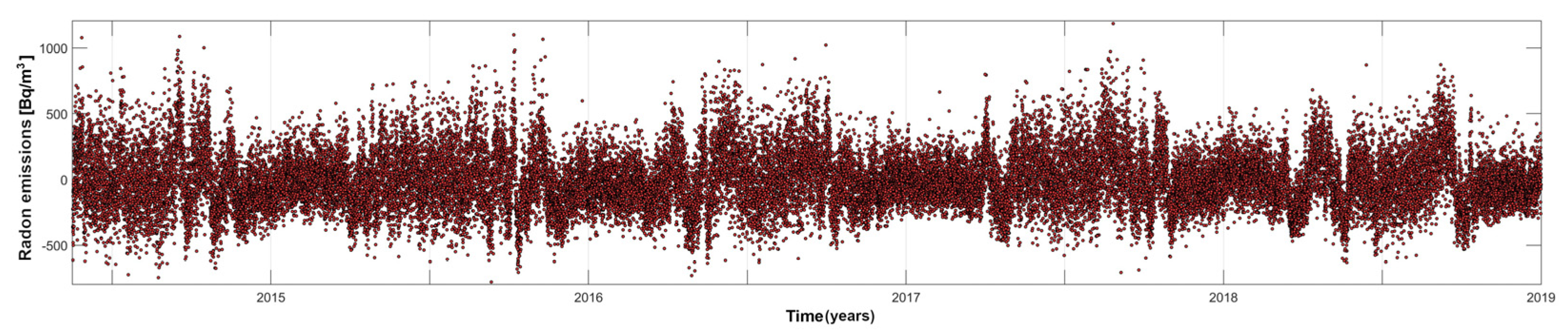
The interaction between the radon concentration and tectonic activity of the rock mass was analyzed using time series data recorded from May 2014 to December 2018. The time-series data consisted of the results of simultaneous measurements of both 222Rn activity concentration and changes in tectonic activity. The radon concentration data were recorded using five Polish SRDN-3 semiconductor detector probes operating in a 1 h mode (they recorded the mean concentration of 222Rn activity on an hourly basis). The probes are described in detail by Przylibski et al. [54].
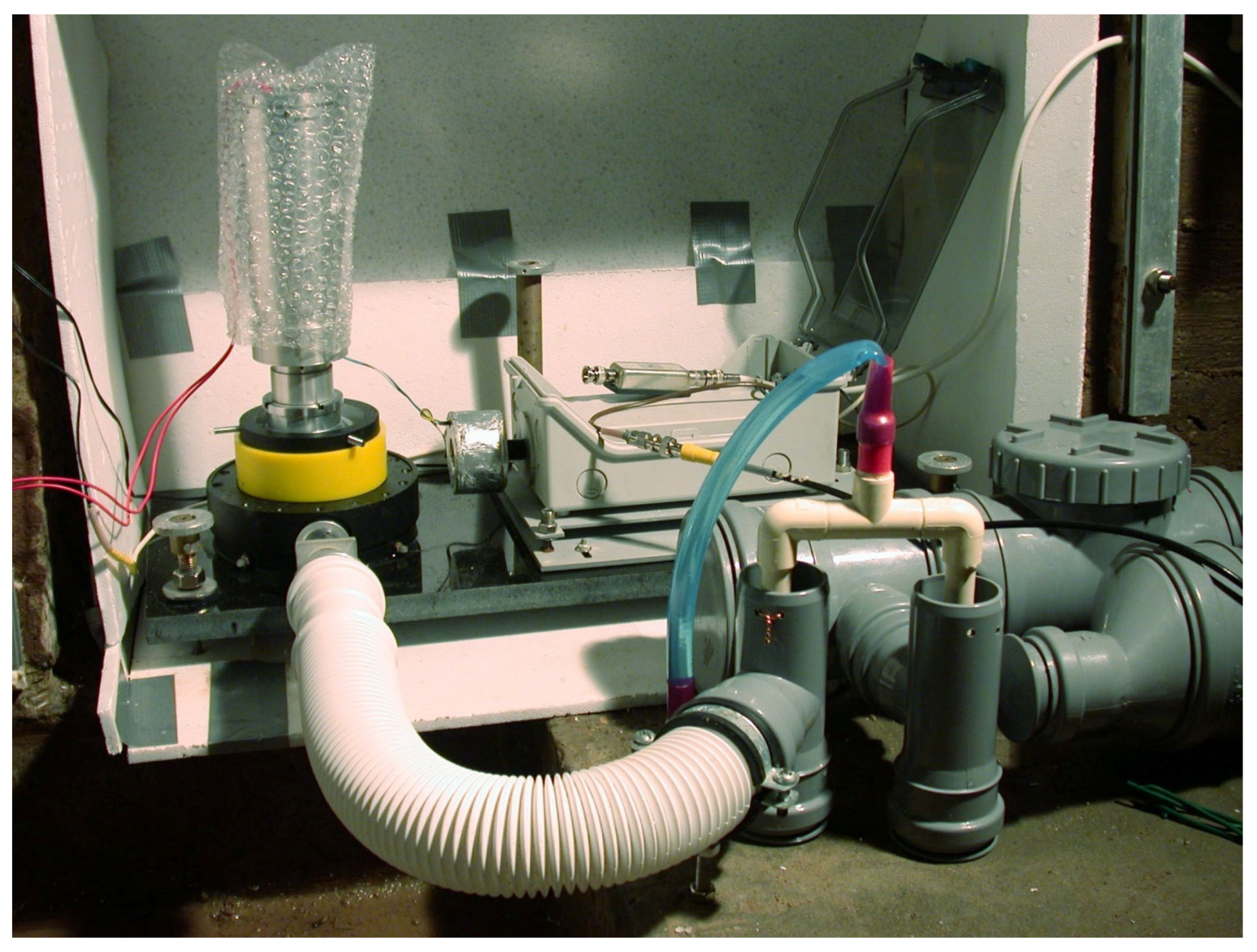
The tectonic activity of the rock mass was measured using two water-tube (WT) tiltmeters that were installed and activated in 2003 at the GL SRC PAS. The tiltmeters have been operated continuously since their installation (with short service and maintenance breaks), providing data in time series for over 20 years. The hydrodynamic systems of the tiltmeters consist of two pipes that intersect at an angle of 90°. The azimuths of the pipes were 58.6° (tiltmeter no. 01-02—WT1) and 148.6° (tiltmeter no. 03-04—WT2), respectively. The lengths of the WT1 tiltmeter pipe were 65.24 and of the WT2—93.51 m (Figure 1). The cross-sections of the pipes were circular, with a diameter of 10 cm [37,55]. Owing to their properties, the WT hydrodynamic system can record geodynamic signals from 5 × 10⁻³ Hz to infinity without significant phase delays, i.e., in real time (for phenomena with these frequencies, water level changes are of an equilibrium nature). The measurement sensor consists of interferometers installed at the ends of both water tube tiltmeters (Figure 2). The measurement interval for each sensor was 10 s [37]. The phase analysis of the interferometric images applied in this study ensures the measurement accuracy of water level changes within the range of single nanometers, i.e., 10−9 m.

3.1. Dataset

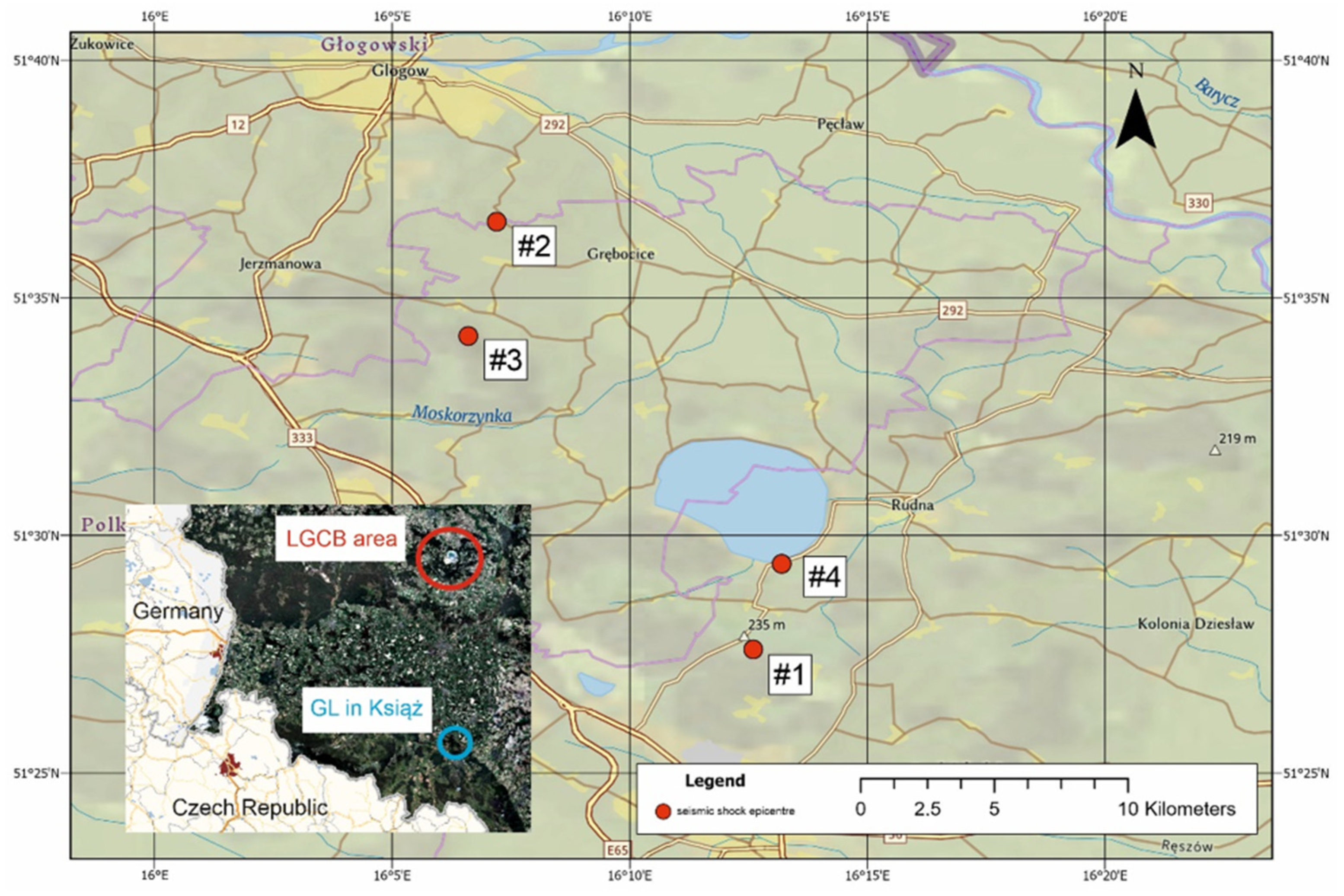
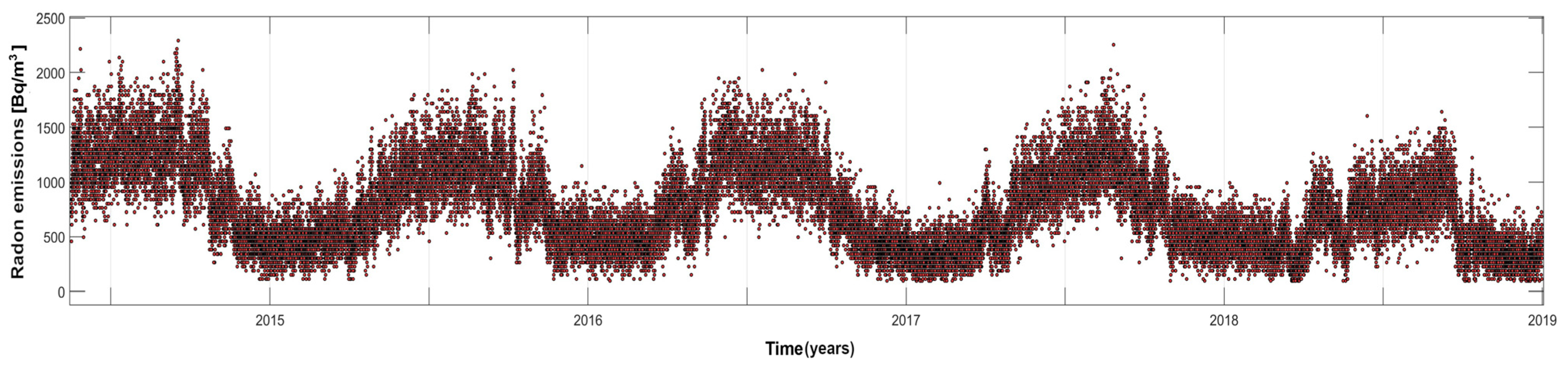
The input dataset originally consisted of 40,533 radon (Table 1A) and tectonic data records (81,066 data records). Considering the effect of the four recorded seismic events, this set was limited to the period from 15 June 2015 to 12 November 2015 (Table 1B; Figure 3). The above time range and the four seismic shocks were selected primarily because the data recorded by the main measurement sensors, i.e., the water-tube tiltmeters and radon probes, were uninterrupted and continuous. Moreover, as indicated by Kaczorowski et al. [43], the character of the selected seismic events was clearly geodynamic (which was related to changes in the stress state of the rock mass resulting from changes in the large-scale stress field), and not local, resulting from mining operations located several dozen kilometers in a straight line from the study area (the Legnica-Glogow Copper Belt), where copper ore is extracted in several deep underground mines. The selection was also motivated by the moderate magnitude of the events (≥4.0), which significantly exceeds the magnitudes of shocks resulting from the release of energy in the vicinity of mining excavations due to rock mass relaxation (usually below magnitude 2.0). The hypocenters of the seismic events selected by the authors for their analysis were located at a depth of 1–10 km (all in the LGCB area), and the average distance between the GL SRC PAS in Książ and the epicenters of the events was ~75 km.

3.2. Time Series Decomposition

In the analyzed case, the sampling process was performed for phenomena defined as continuous, i.e., rock mass movements and radon emissions from the rock mass. We cannot precisely identify the individual processes controlling both phenomena, but with the use of instruments, we can sample the sum of all processes over time. The data obtained from both measurement systems form a time series (a sampled signal—the sum of the influences of various phenomena): geodynamic in the case of the tiltmeters and representing 222Rn activity concentration in the case of the SRDN-3 radon probes. Subsequently, elements of signal processing theory were applied, including wavelet analysis and Fast Fourier Transform (FFT) filtering. The only difference was the resolution, which in the case of the tested object was expressed in minutes and hours (Figure 4) instead of megahertz.
This study was based on time series C consisting of two superimposed signals (1),
C(x) = f(x) + ω(x)
where f(x) is the signal from the radon detector originating directly from the rock mass movement, and ω(x) is the noise.
In the case of electronic systems sampling the function, the sources of noise were identified as interferences inside the device/system, limitations of the transducers and cables, and interferences from external sources. As a result of such a sampling technique, it was possible to collect the values of the function f(x), which contained information about the variability of a particular phenomenon. The function C(x) itself was also the sum of other functions, g(x), h(x)…z(x), which had a direct impact on the phenomenon. The usefulness of the time series was verified using a processing procedure.
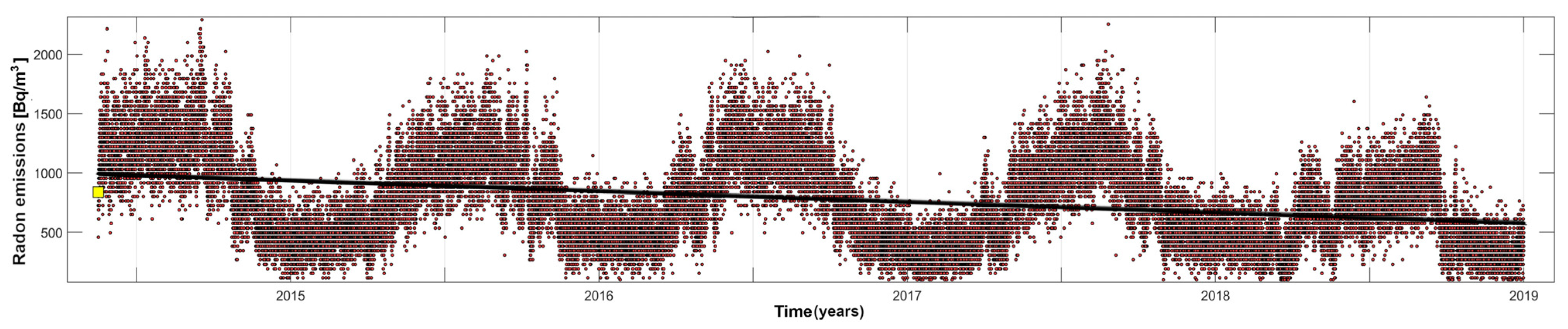
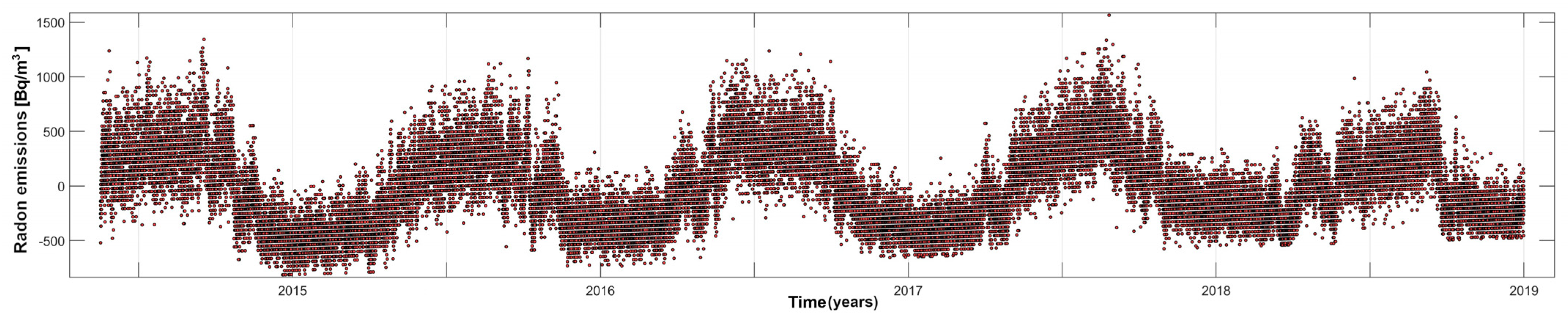
The first step in processing the time series was to determine the residuals of the signals, whose linear trends had to be identified. The FFT and wavelet analyses of non-stationary series require a special approach [57]. In the analyzed case, removing the linear trend was sufficient. Reduction was required only for the time series of the 222Rn activity concentration. Due to its characteristics, i.e., a large number of data points and a negligible number of outlier observations, the least squares method was sufficient (Figure 5). Although the processing procedure was performed for signals recorded by all SRDN-3 probes, it is exemplified here only for the signal from probe no. 2.
The least squares method (LSM) is a classical statistical tool used to fit a function, most often a linear function, to a set of measurement points. In the context of time series analysis, it enables the estimation of a linear trend in the data, which is useful for identifying long-term changes in environmental radon levels. Let us assume a series of measurement data in the form: (t1, x1), (t2, x2), …, (tₙ, xₙ), where tᵢ denotes the measurement time, and xᵢ the signal value. The aim of the method is to find a straight line (2),
x t = a t + b
The sum of the squared deviations of the actual values xᵢ from the values predicted by the model is minimized (3).
S = i = 1 n x i a t i b 2
To find the coefficients a (slope) and b (intercept), one must solve the system of normal Equations (4) and (5).
a = n t i x i t i x i n t i 2 t i 2
b = x i a t i n
Once the coefficients are determined, the fitted line can be used to predict values at future time points, assess long-term trends, or remove the trend component for further analysis of signal residuals.
The least squares method assumes linearity of the model, as well as independence and constant variance of the measurement errors.
The stationarity of all data in the time series (for probes no. 2–6) was proven using the Dickey-Fuller test [58].
The Augmented Dickey-Fuller (ADF) test is a statistical test used to determine whether a time series is stationary, i.e., whether its statistical properties (mean, variance, autocorrelation) remain constant over time. It is an extension of the Dickey-Fuller test that accounts for higher-order autoregressive processes by including the lagged differences of the dependent variable. The general regression equation for the ADF test is (6),
                              y t = α + β t + γ y t 1 + ( δ i y t i ) + ε t ,       f o r   i = 1   t o   p                                      
where:
  • yₜ—value of the time series at time t,
  • Δyₜ = yₜyt−1—first difference of the series,
  • α—constant term (drift),
  • βt—deterministic time trend (optional),
  • γ—coefficient on the lagged level of the series (used to test for a unit root),
  • δᵢ—coefficients on lagged differences (adjust for autocorrelation),
  • εₜ—white noise error term,
  • p—number of lagged difference terms included.
In all cases, the H0 null hypothesis about the unit root was rejected Table 2.
The removal of the linear trend allowed the residuals to be represented with a clearly seasonal character (Figure 6).
After the linear components were reduced, a periodicity analysis was performed on the radon time series. As mentioned above, the total study period was four months, and it was further divided into approx. 1-month sub-periods. Thus, seasonality had to be removed from the series so that it did not disturb the short-term variability (the function inflection points could disturb the correlations).
The most commonly used method for determining periodicity is the Fourier Transform (FT), which allows the identification of repetitive components contained in the signal. The transform provides global information on the frequencies present in the signal. The Fourier Transform decomposes the signal x(t) into orthogonal trigonometric functions (7),
X F T f =   x t e j 2 π f t d t
which provides a global frequency distribution over the entire signal x(t). Nevertheless, there exists a function that enables the inverse operation, i.e., with knowledge of the above-mentioned distribution XFT(f), it is possible to reconstruct the original signal (8).
x t =   X F T f e j 2 π f t d f
In order for the calculations to be feasible, the analyzed signal must satisfy the Dirichlet conditions, meaning, among other things, that it must be at least piecewise continuous. This condition is not met by the signals we analyze, as they are sampled at discrete time intervals. Therefore, the Discrete Fourier Transform (DFT) is applied (9),
X D F T f n = 1 N k = 0 N 1   x k e j 2 π k Δ T
which also has its inverse form (10):
x k = 1 Δ T f n = 0 N 1 T   X D F T f n e j 2 π f n k Δ T
For each frequency k, the result of the transform X(f) is a complex number, from which the following can be calculated (11) and (12),
A t = 2 N X f
ϕ t = arg X f
where:
  • A k —the amplitude of the component at frequency ( k ) ,
  • ϕ k —phase of this component,
  • X f —the magnitude of the complex number ( X f ) ,
  • arg X f —argument (phase angle of complex number ( X f ) .
The amplitude indicates the strength (energy) of a given frequency in the signal, while the phase describes the temporal shift of that component [59,60]. The signal from the radon sensors contained 40,531 samples with an hourly resolution, making it a large dataset. Fourier Transform for such large data volumes is computationally expensive, which is why the Fast Fourier Transform (FFT) is used. The FFT requires the number of samples to be adjusted to N = 2 m. This can be performed in two ways: by trimming the signal to the required number of samples or by zero-padding the data up to that number. However, this leads to a problem known as spectral leakage, where energy from a signal component spreads into neighboring frequencies (causing reduced amplitude). The solution is to apply a window function, which sharpens the frequency components within the window but also introduces additional periodicity into the signal [59].
Another issue is aliasing, which may result in fundamental frequencies being misrepresented as different ones. The solution is to sample the signal properly—according to Shannon’s sampling theorem—at a rate at least twice the highest frequency of interest. In the case of radon sensor data, the sampling frequency far exceeds that necessary for detecting a primary frequency of one year.
Wavelet analysis is an alternative method for signal analysis. This approach offers significantly more capabilities, including local and multiscale analyses. Sampled signals from “geo” sources often contain frequencies arising from different interrelated processes. Therefore, continuous wavelet analysis was selected as the most appropriate method because its key advantage is that it operates in both the frequency and time domains. This is particularly important due to the large amount of data and the likelihood of frequency components appearing and disappearing over time.
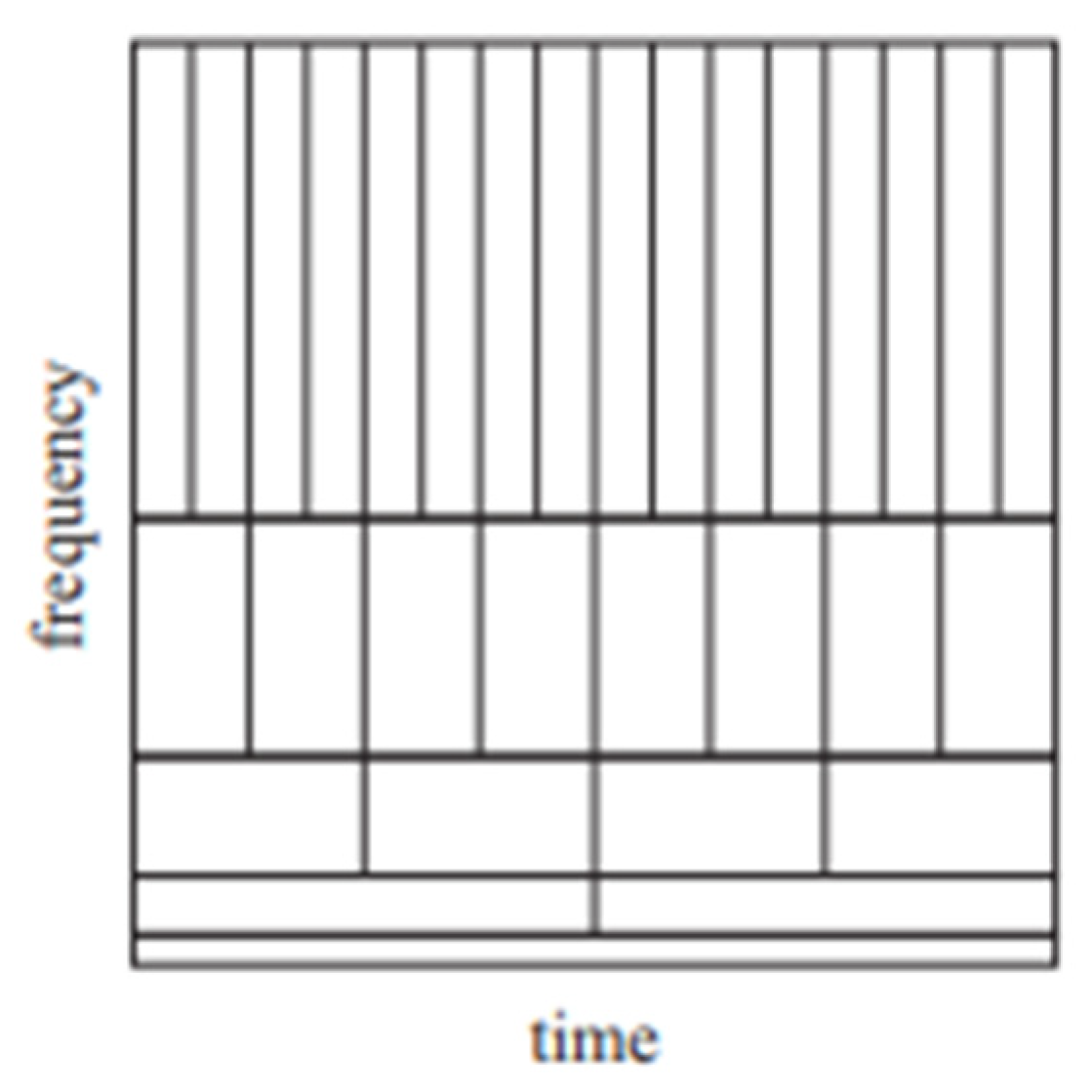
Figure 7 presents the theoretical distribution of frequency over time, where low frequencies (at the bottom of the image) are present throughout the entire signal, while higher frequencies (moving upward) may appear or disappear. This example illustrates the use of the Continuous Wavelet Transform (CWT), which analyzes the signal across all frequencies within a defined range (typically from the lowest to selected higher frequencies).
There is also the Discrete Wavelet Transform (DWT), which is particularly useful for tasks such as signal smoothing.
In Fourier analysis, the fundamental functions used to examine the frequency components are sine and cosine waves. In the case of wavelets, there is significantly greater flexibility in the choice of analysis functions [59,60].
The following formula defines the Continuous Wavelet Transform (13),
X W T a , b = 1 a   x t ψ * t b b d t
where:
  • a—denotes the scale,
  • b—the time shift,
  • ψ—the mother wavelet,
  • ψ(t)—the complex conjugate of the wavelet function.
The principle behind this analysis is straightforward: the mother wavelet is scaled by the coefficient a (which changes the frequency) and shifted along the time axis by window b. The correlation between the wavelet function ψ and the analyzed signal is then computed. These correlations are used to calculate the coefficients for each frequency. The CWT coefficients are complex numbers. Based on these, the following fundamental signal characteristics are determined:
-
Local amplitude: A a , b = W a , b
-
Local phase: ϕ a , b = a r g W a , b
-
Local power: P a , b = W a , b
The mother wavelet must satisfy the following criteria:
1.
The wavelet must have finite energy (14).
E =   | ψ ( t ) | 2 d t <
2.
The wavelet must not contain a zero (DC) frequency component, i.e., the average value of the wavelet should be zero (15).
C ψ = 0   | ψ ^ ( f ) | 2 f d f <
3.
For complex wavelets, the Fourier transform must be real and must vanish for negative frequencies [59].
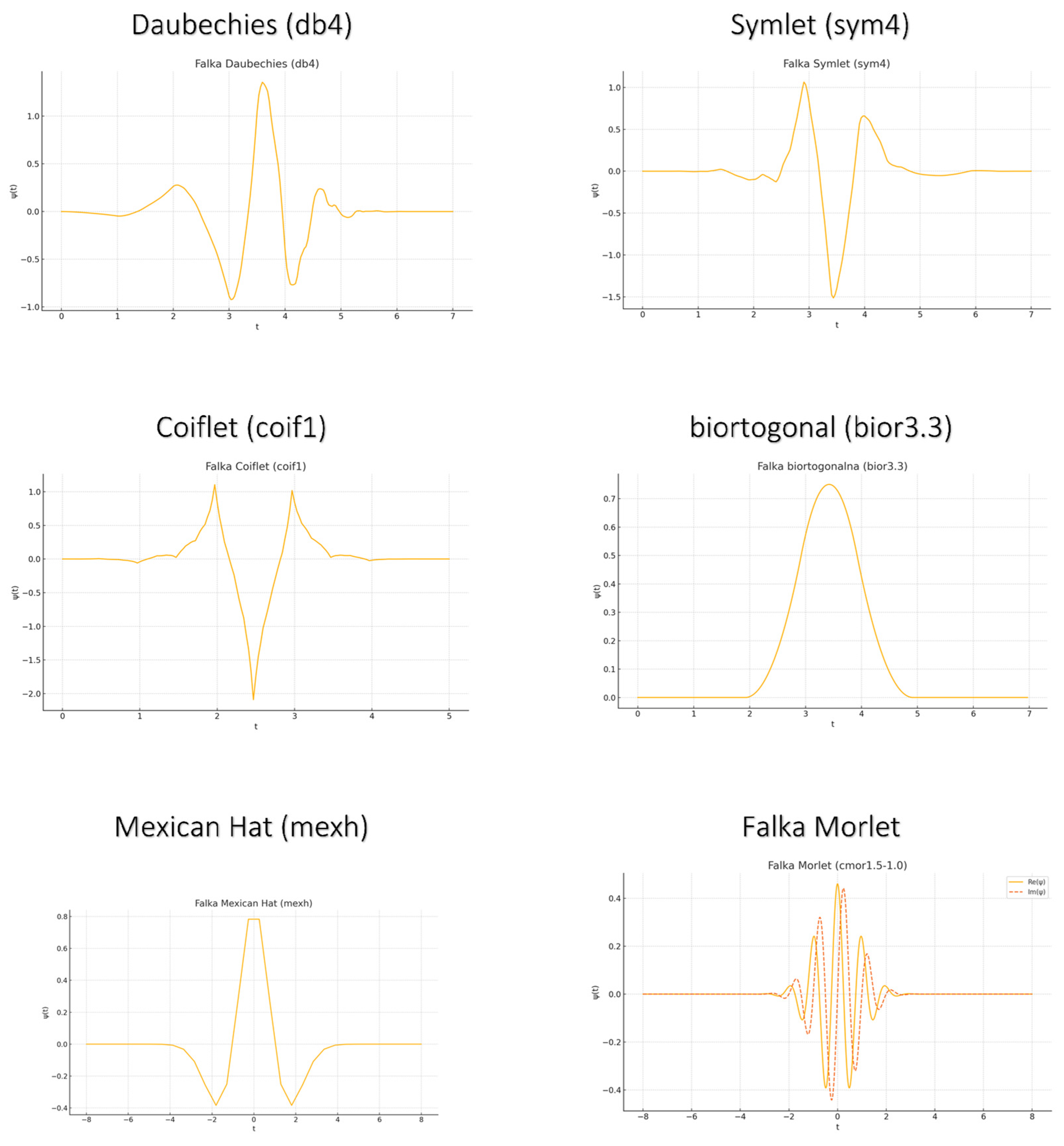
The choice of mother wavelet depends on the type of data being analyzed (Figure 8). For example:
-
Daubechies (dbN)—used in data compression (e.g., JPEG2000), denoising EEG and ECG signals, and in geophysics.
-
Symlets—applied in image and signal analysis, where preserving symmetry and ensuring high-quality reconstruction are important.
-
Coiflets—used in biomedical studies, speech signal analysis, and in the analysis of non-stationary signals with varying trends.
-
Biorthogonal wavelets—ideal for image compression and encoding, as they allow for accurate reconstruction and symmetric transformations.
-
Mexican Hat and Morlet—used in geophysics (e.g., earthquake analysis), astronomy (point source detection), and image processing (edge and contour detection).
There also exists a function, as in the case of Fourier analysis, that enables the inverse transform (16).
x t = 1 C ψ 2     X W T τ , s 1 s 2 ψ t τ s d τ d s
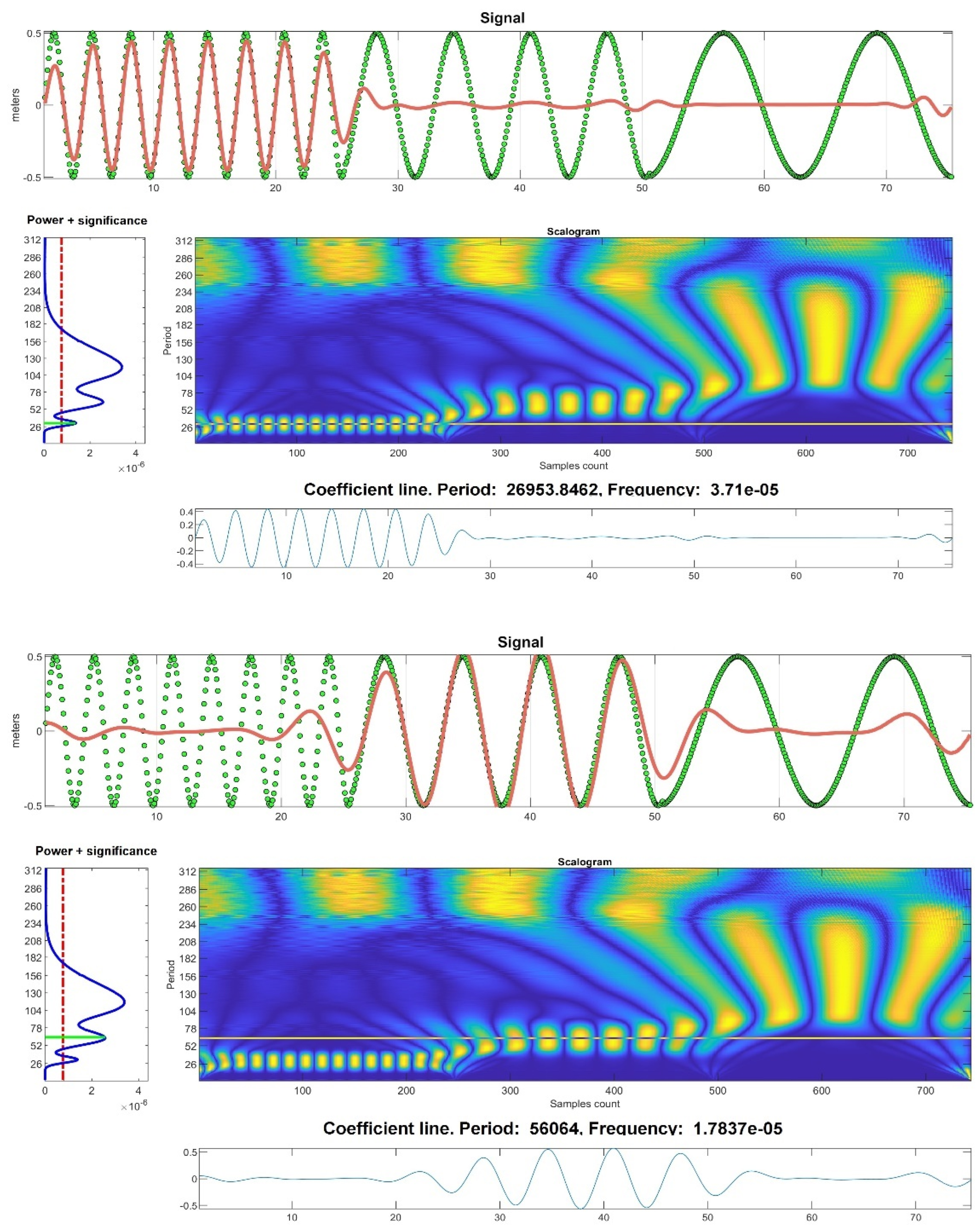
Below is a scalogram (Figure 9) of an artificial signal composed of three consecutive functions, conducted using the Morlet wavelet (17).
Ψ σ ( t ) = c σ π 1 4 e 1 2 t 2 e i σ t κ σ
As shown, this wavelet provides excellent localization of frequencies in time, making it highly useful for the analysis of oscillations and the detection of sinusoids. Additionally—and importantly—not every time series is stationary, and this wavelet yields good results even when analyzing non-stationary sequences.
The output of this wavelet transform consists of complex numbers, which, similar to the Fourier transform, allow for the easy extraction of amplitude and phase information at a specific frequency. Therefore, it is frequently used in studies of processes occurring on and within the Earth’s crust [61,62].
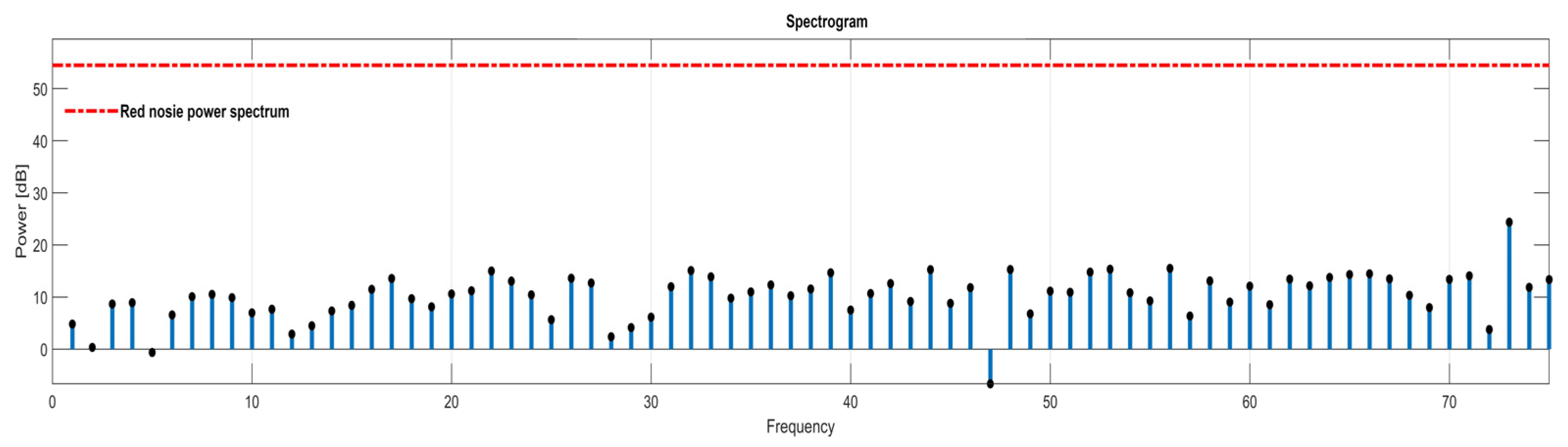
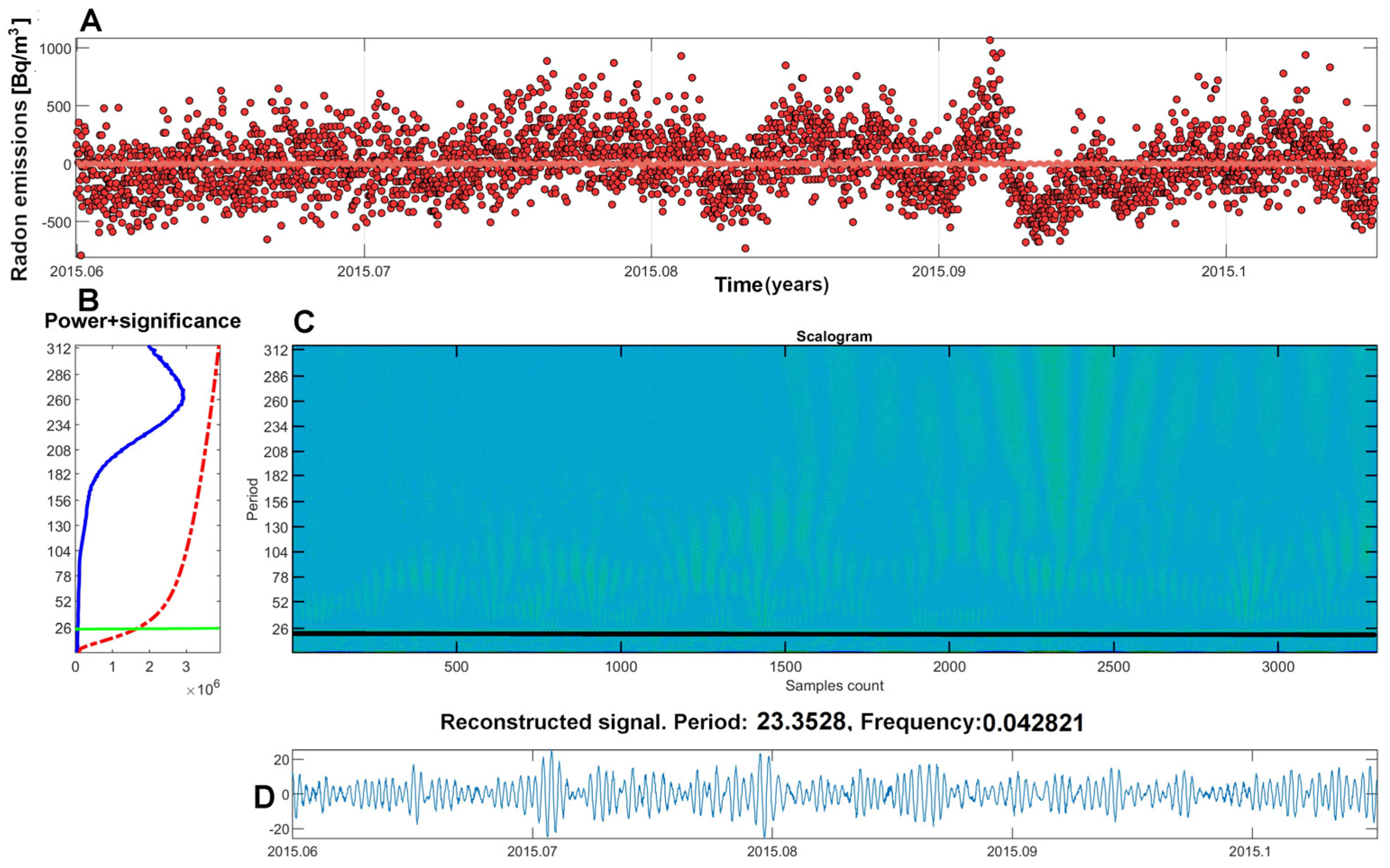
The analysis was performed using MATLAB under license no. 40911196. The graph in Figure 10 shows the results of the signal processing using the selected wavelet. The Morlet wavelet method was also applied to the periodicity analysis of all SRDN-3 probes [63,64], and the results are presented in Table 3. For most radon probes, the period slightly exceeded one calendar year. This was due to the high level of noise in the data. The signal-to-noise ratio (SNR) for all probes did not exceed 1.7 dB (Figure 11). The reduction of the series by a 365-day period was observed to leave high frequencies, but of low significance and an unknown source.
When interpreting the results of the spectral analysis, it is challenging to identify which frequencies are significant. Phenomena of “geo”-type origin are often characterized by red noise; therefore, it is reasonable to compare the spectral characteristics of our signal to that of red noise [64] (18).
S ( f ) = σ 2 1 + ϕ 2 2 ϕ c o s 2 π f / f s
If a power peak at a given frequency exceeds the corresponding red noise level, the detected signal component can be considered significant. Figure 11 shows the spectrum of the analyzed signal along with the power of the red noise (represented by the red dashed line). It is evident that none of the signal components exceeded the red noise power.
The subsequent wavelet analysis performed on a time series shortened to five months included the period from 1 June 2015, to the end of November 2015. As the 1-day period could begin or end before or after the date included in the analysis, the analyzed time period was extended by ¼ (Figure 12). Although the analyses did not show a 24-h period with significance exceeding the noise spectrum in the analyzed time, they indicated a residual period of about 260 h, which was also below the significance level (Figure 12).

3.3. Data Correlation

The signal from the SRDN-3 radon probes had a very high noise level; therefore, in the subsequent stages of the analysis, it was transformed, i.e., smoothed. The aim of this procedure was to remove high frequencies (below 1 day) that dominated in the radon time series. The signals from the water tube tiltmeters had a very smooth flow and frequencies higher than 1 day. Two methods were used: discrete wavelet analysis and Savitzky–Golay filtering.
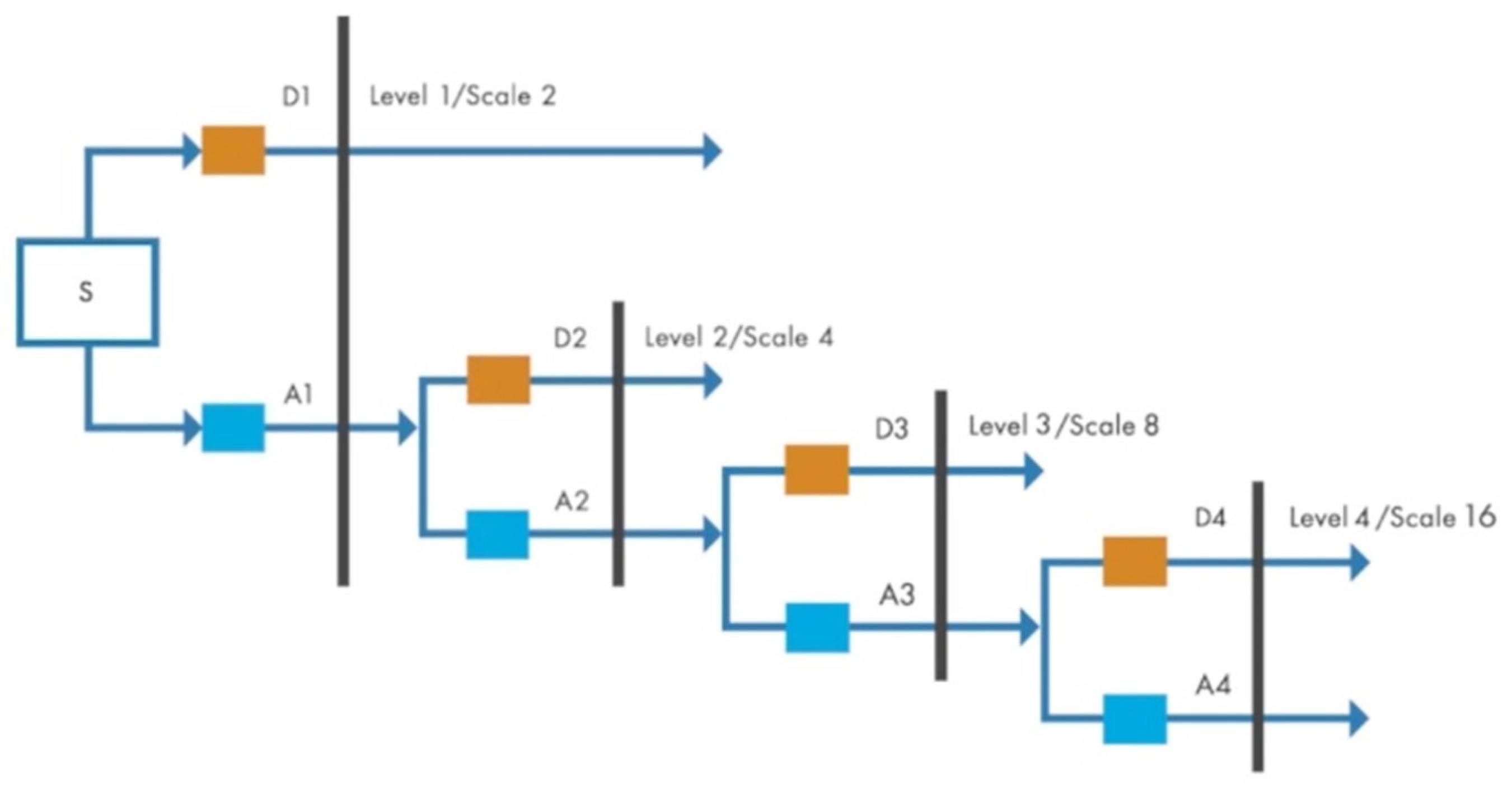
The first method was based on the decomposition of the signal by passing it through two filters: a high-pass and a low-pass filter. Depending on the n level of decomposition, this operation needs to be repeated n times on the signals generated using the high-pass filter (Figure 13).
High-frequency signals were filtered (smoothed) by eliminating signals with frequencies above a certain signal strength threshold. Each time, the signals with higher frequencies were cut so that the final signal had only lower frequencies than those of the original signal. For this purpose, it was necessary to select an appropriate wavelet, its scale, decomposition level, and the method of selecting the frequency cut-off threshold.
The filtering (smoothing) of high-frequency signals is based on eliminating components with frequencies above a certain signal power threshold. In each step, the filtering removed higher-frequency components, such that the final signal retained only lower frequencies compared to the original. Therefore, an appropriate wavelet, its scale, the level of decomposition, and a method for selecting the cutoff threshold must be chosen [62].
Denoising signals using wavelet decomposition requires the selection of an appropriate mother wavelet. It should be characterized by a sufficient number of vanishing moments, depending on the complexity of the signal and the nature of the noise. A commonly used family for such purposes is the Daubechies wavelets (dbN—where N indicates the level). The higher the level, the greater the number of vanishing moments, which enables the approximation of more complex signals and higher order polynomials [61,62].
For example, the db1 wavelet with one vanishing moment can approximate a polynomial with one term, db2, with two terms, and so on. The more complex the waveform, the higher the degree. In our study, the exact approximated function is unknown; however, based on the signal’s behavior, a high polynomial complexity can be assumed. Therefore, the wavelet level was set to db8. Additionally, the higher the order of the dbN wavelet, the smoother its shape is.
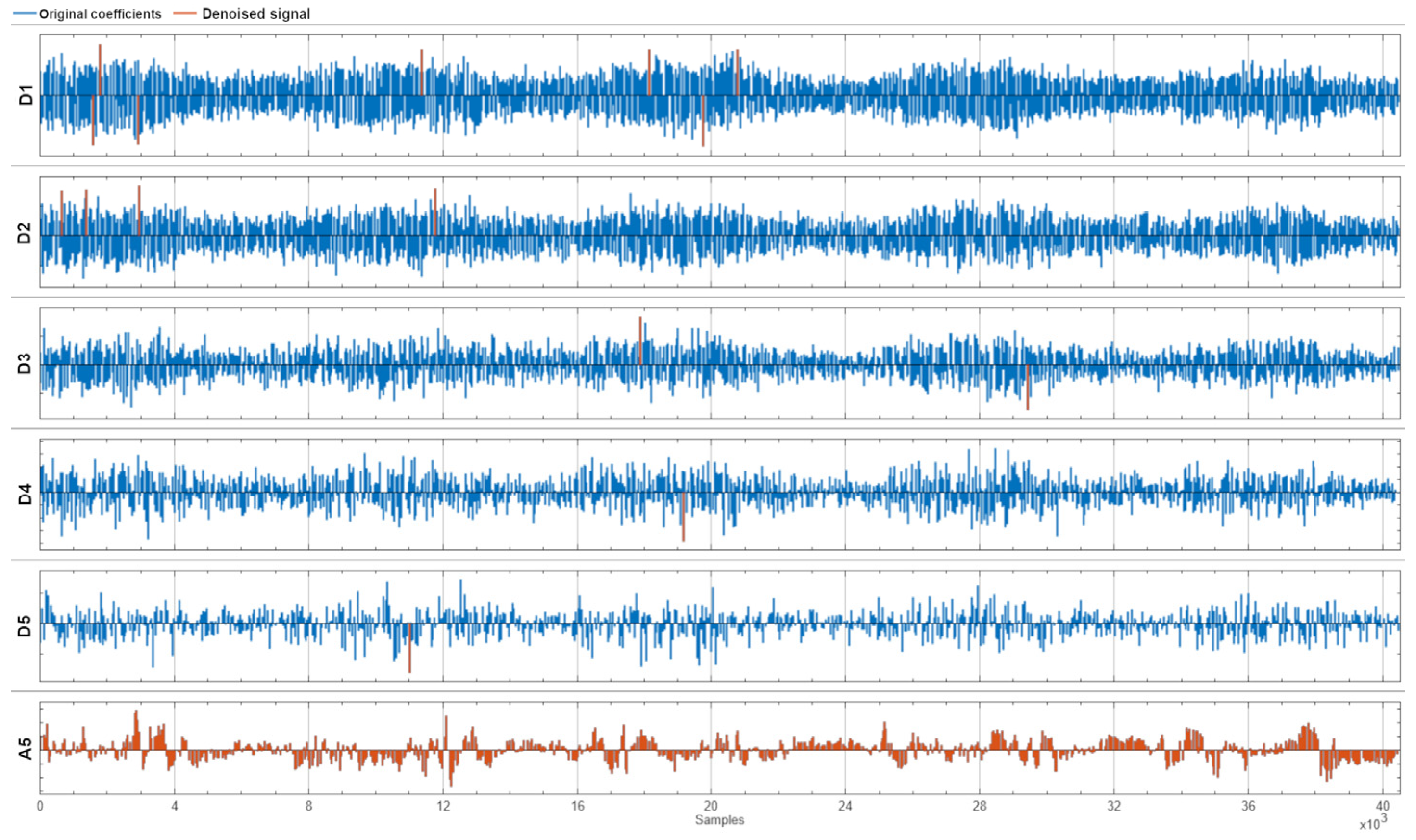
When denoising a signal using DWT, the signal is decomposed into successive components (a decomposition level of n = 5 was chosen as the optimal), each representing increasingly lower frequencies. To perform denoising, some of these high-frequency components must be removed. This is a crucial part of the process—setting an appropriate high-frequency cut-off threshold. The most commonly used thresholding methods are “hard” and “soft” thresholding methods.
Hard thresholding involves zeroing out the high-frequency components while retaining the rest of the signal (19).
a m ( x ) = 1   i f   | x | T 0   i f   | x | < T .
Soft thresholding involves removing high-frequency components below a defined threshold, reducing the energy of intermediate frequencies, and retaining the low-frequency components (20).
ρ T ( x ) = x T   i f   x T x + T   i f   x T 0         i f   | x | T .
Universal thresholding involves determining an appropriate threshold, which is given by T = σ 2 l o g e N , where σ is the estimated standard deviation of the noise, and N is the number of samples in the signal [63,64].
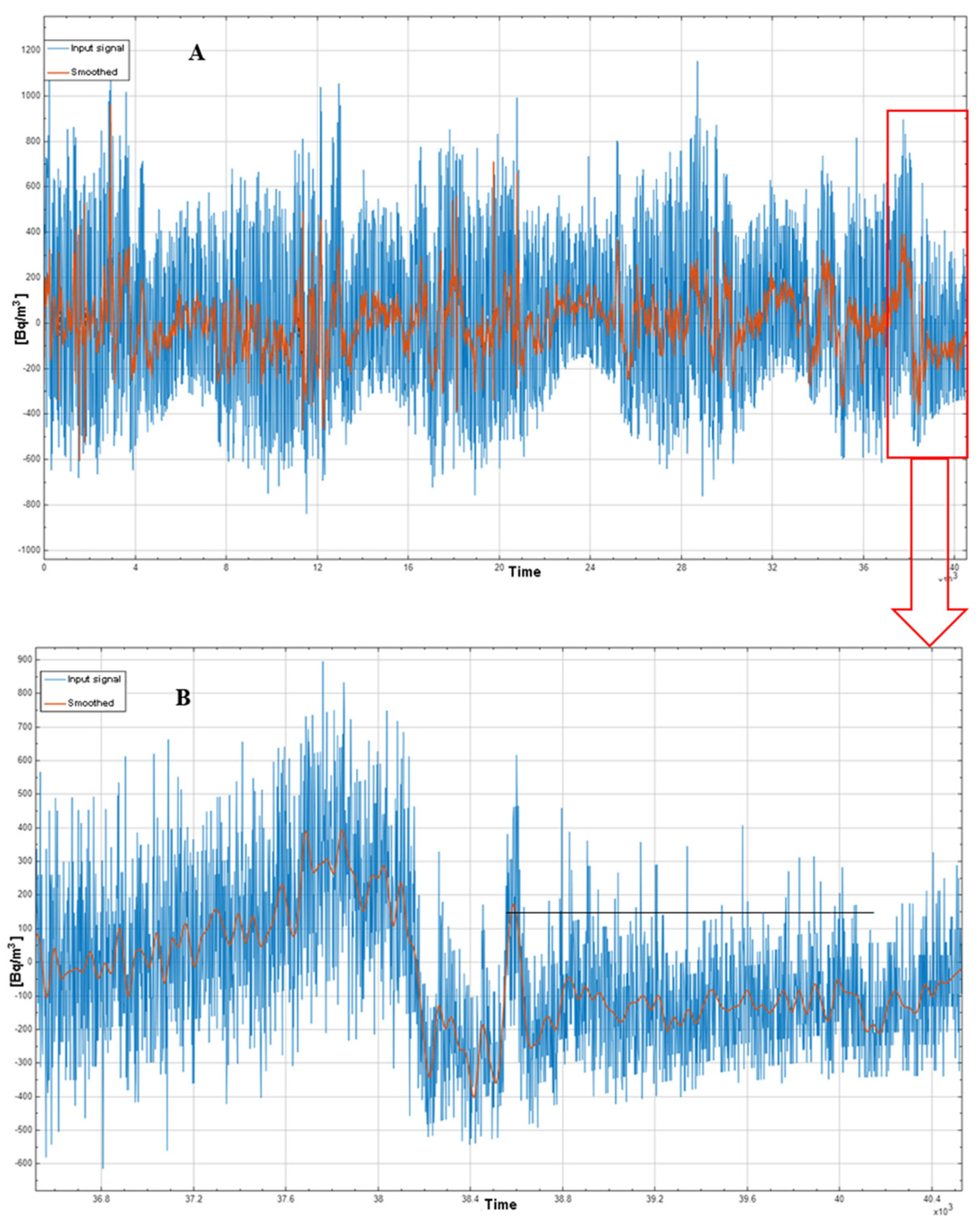
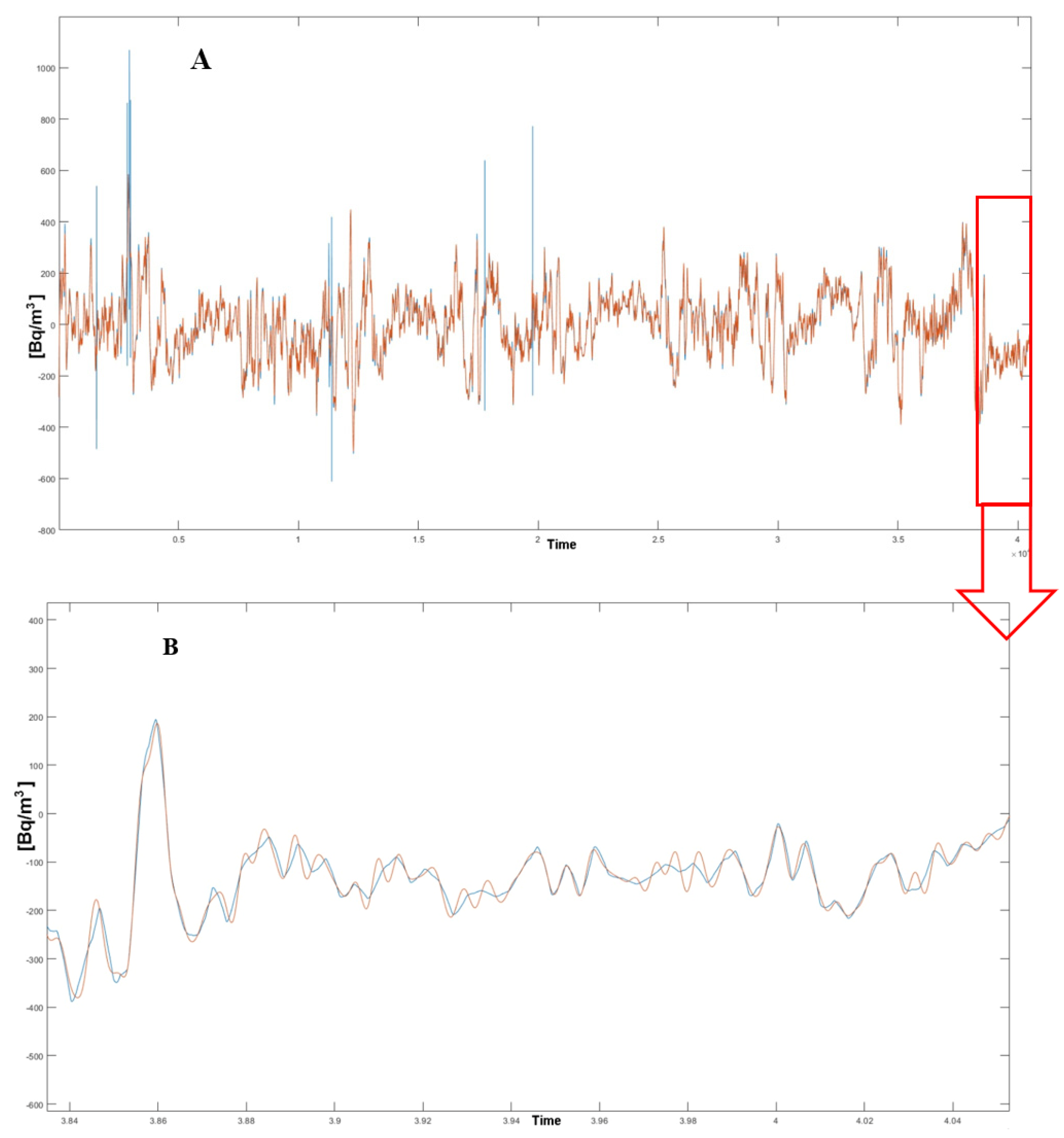
In the case of signals from radon probes, the db8 wavelet was selected with the “universal” cut-off threshold and the “hard” rule. The db8 wavelet was continuous and allowed approximations similar to 4th degree polynomials. Level 5 of the decomposition provided access to useful high frequencies without cutting the useful low frequencies (i.e., at a maximum of 24 h). According to Luo and Zhang [65], the threshold was assumed as the “universal threshold.” The selected hard programming rule did not affect the amplitudes during decomposition at the individual levels (Figure 14). A comparison of the original signal (Figure 15A) and denoised signal (Figure 15B) indicated that the signal smoothed using wavelet decomposition was continuous at every point, even in the locations of sharp peaks from the radon probe.
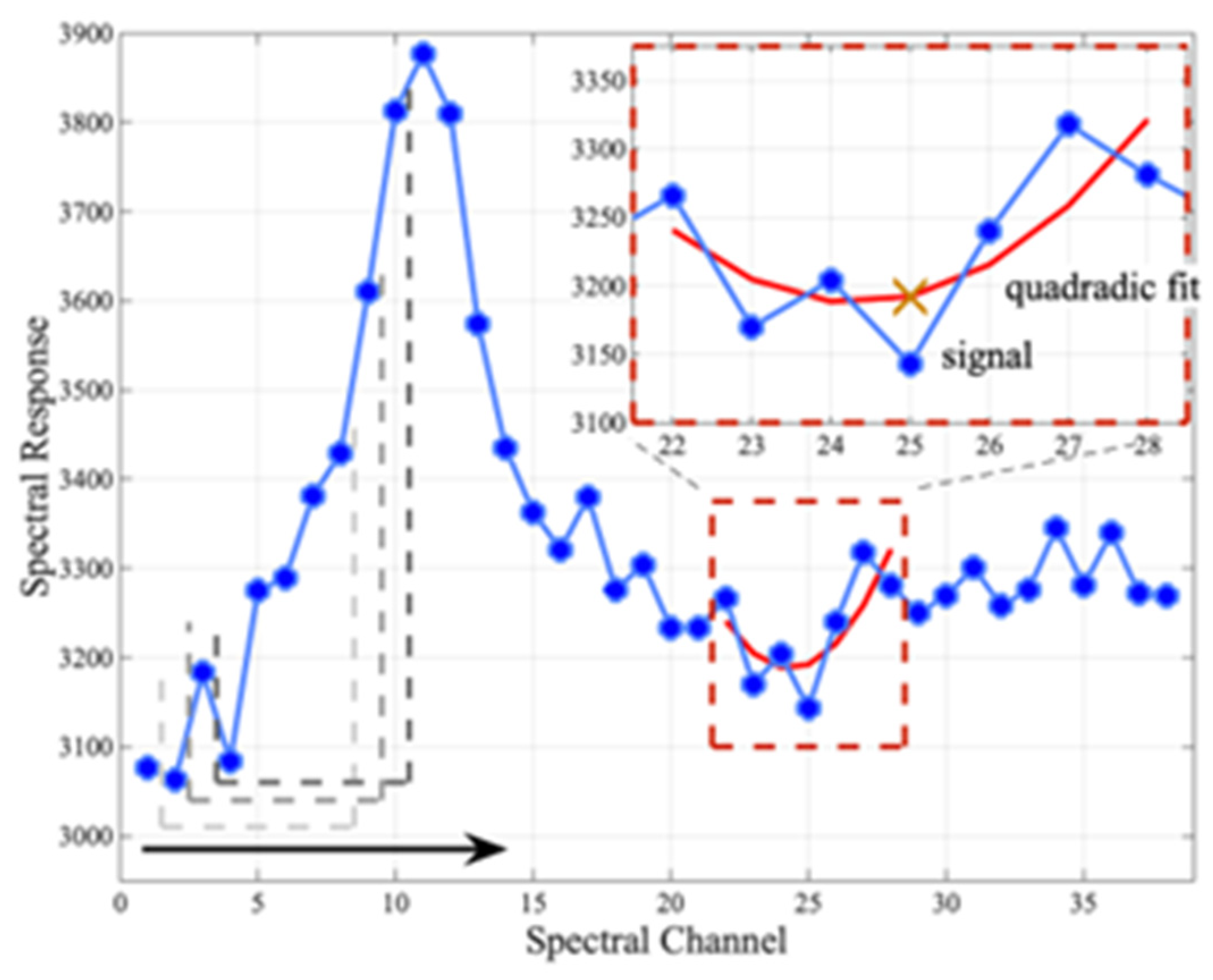
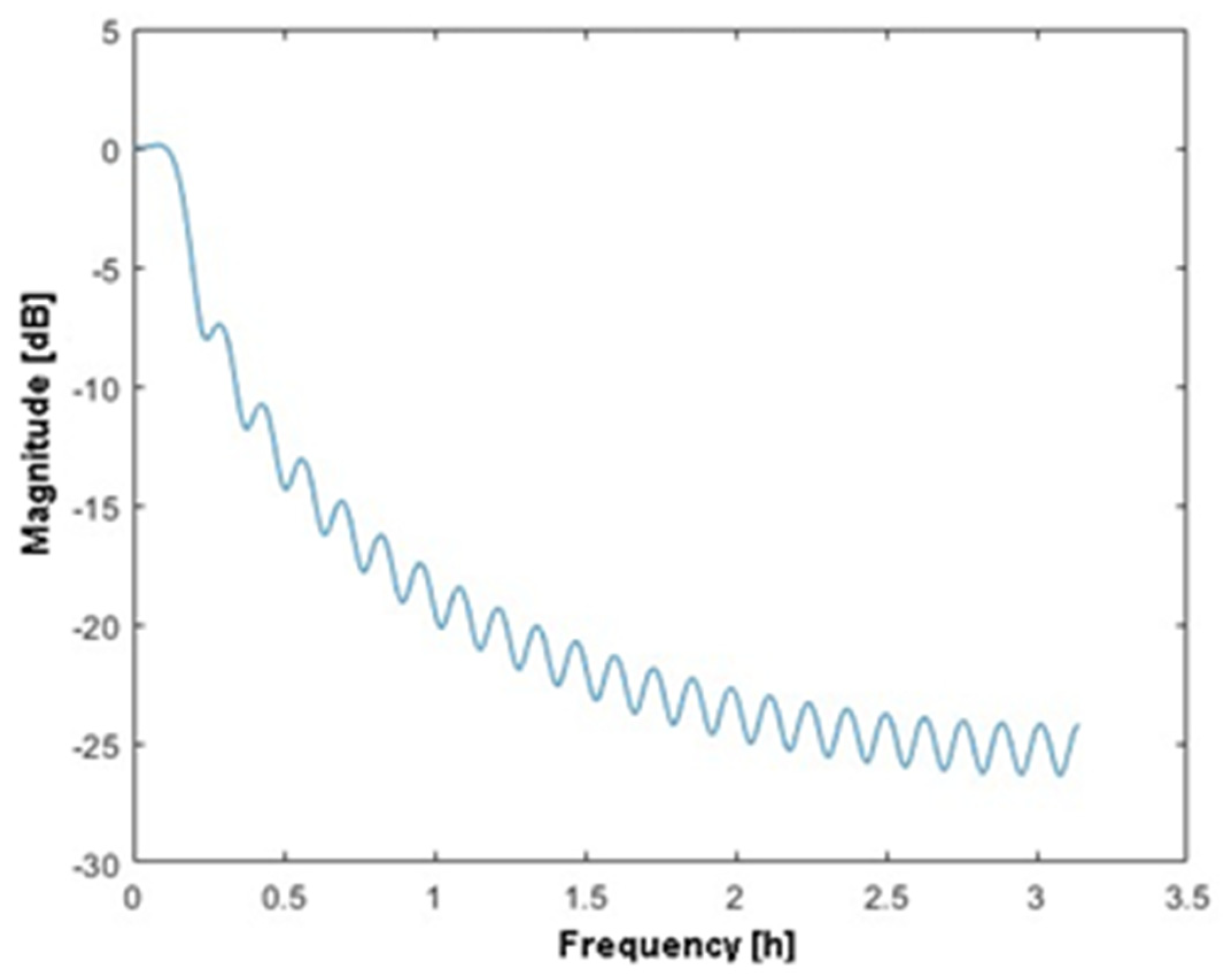
In order to obtain an appropriate sensitivity of the filter to the bends occurring in the signal, the operation of the filter (Figure 16) in the case of radon sequences was based on a 3rd-degree polynomial. The 2nd degree would be insufficiently sensitive, and the 4th degree—oversensitive, causing either excessively long frequencies to be filtered or excessively short frequencies to be preserved. The frame length was set at 49 h, which corresponds to two days (the filter required an odd frame length, and therefore one hour was added), thus allowing the smoothing of periods below one day (Figure 17).
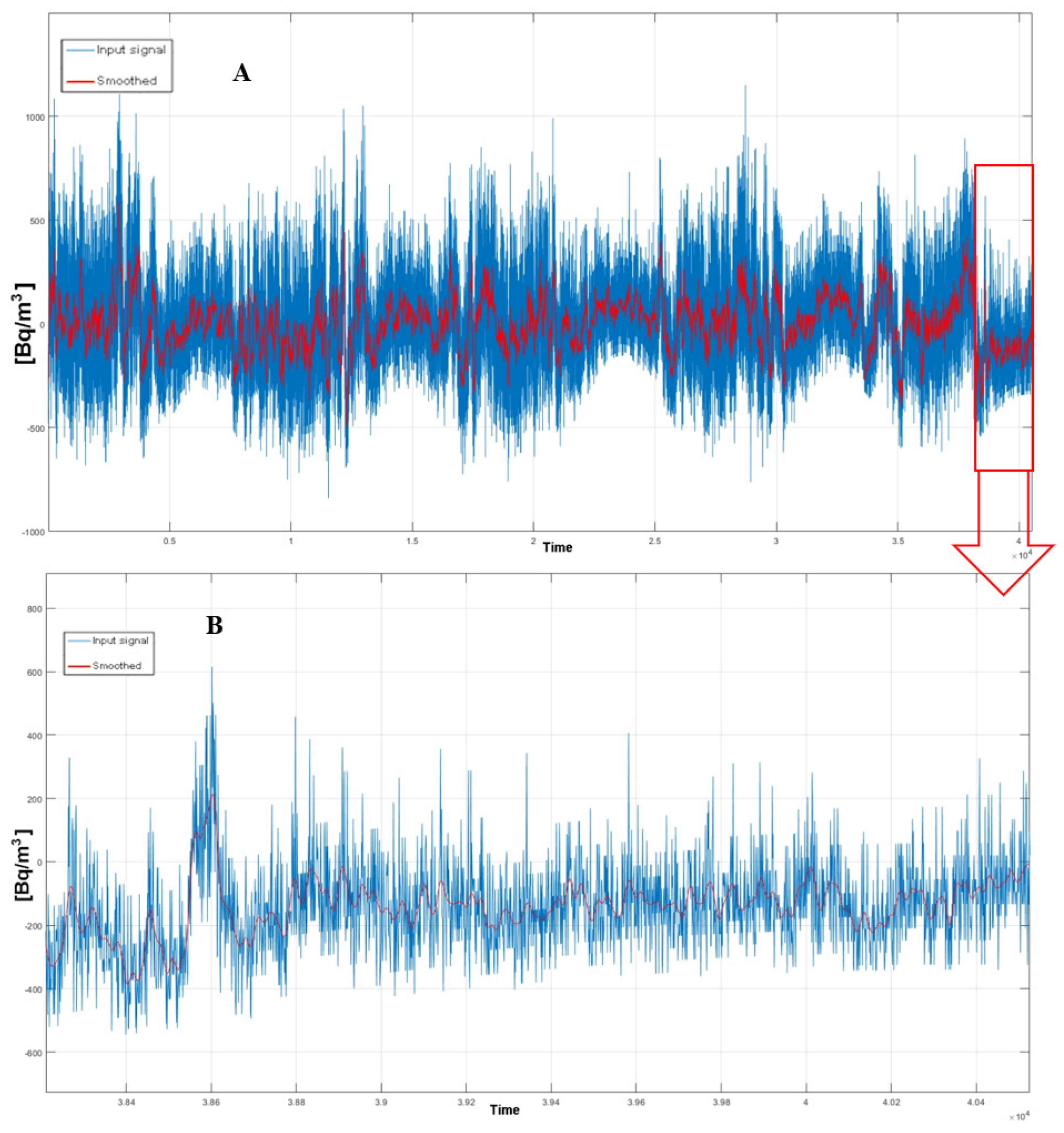
A comparison between wavelet decomposition and the SGolay filter (Figure 18) did not show any significant differences between the methods (Figure 19). In the wavelet method (Figure 15A), artifacts sometimes appeared in the form of peaks in places of large inflections, while the SGolay method (Figure 18) was more sensitive to low frequencies. Nevertheless, the flow of the filtered signals was sufficiently similar to allow either of the two methods to be used in further analyses, i.e., to find correlations between the radon signal and the tiltmeter signal (Figure 19).

3.4. Correlation Confirmation Tool

The interactions between the 222Rn activity concentration and the tectonic activity of the rock mass were analyzed using the data categorization method. The interactions described by the correlation coefficient value were compiled into 24-h data blocks in seven time intervals counted forward and backward relative to the time of the seismic event. The data were compiled at time intervals of 1–24, 25–48, 49–72, 73–96, 97–120, 121–144, and 145–168 h before the seismic event. The interactions occurring after the seismic event were also analyzed in the same time ranges, starting from the event counted as 1 h and 24 h after its occurrence. As a result, subsequent interval blocks could be described in a manner identical to the data from before the seismic event.
Fourteen time-ordered sets, each comprising 1920 data points, were obtained. Each dataset was filtered from the correlation coefficient value indicating a statistically insignificant relationship, i.e., from values lower than 0.4. In effect, the response time of the probe and tiltmeter and the direction of this relationship (positive or negative correlation) could be clearly shown.
The datasets were developed for the interactions obtained between five radon concentration detectors and four WT channels in relation to four seismic events. The analysis also included the values of the correlation coefficients determined using the SGolay technique.

4. Results and Discussion

A detailed analysis of each of the 24-h datasets allowed some similarities and differences to be indicated in the interactions recorded by the SRDN-3 and WT channels before and after the occurrence of the four seismic events. For clarity, the description below follows the nomenclature of “channels 1–4” to refer to the four water-tube tiltmeter sensors, and “probes 2–6” to refer to the five SRDN-3 probes.

4.1. Interactions Prior to the Seismic Event

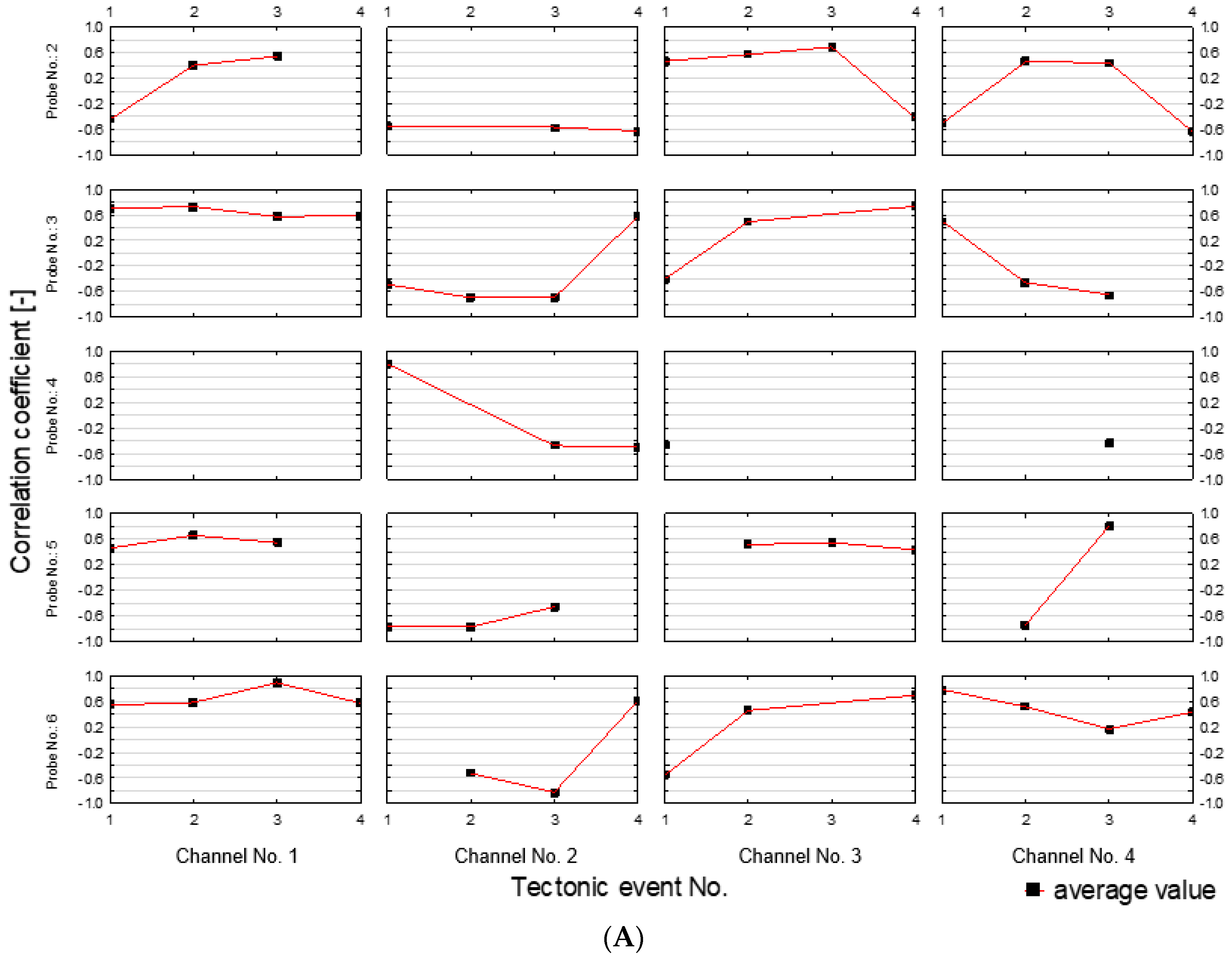
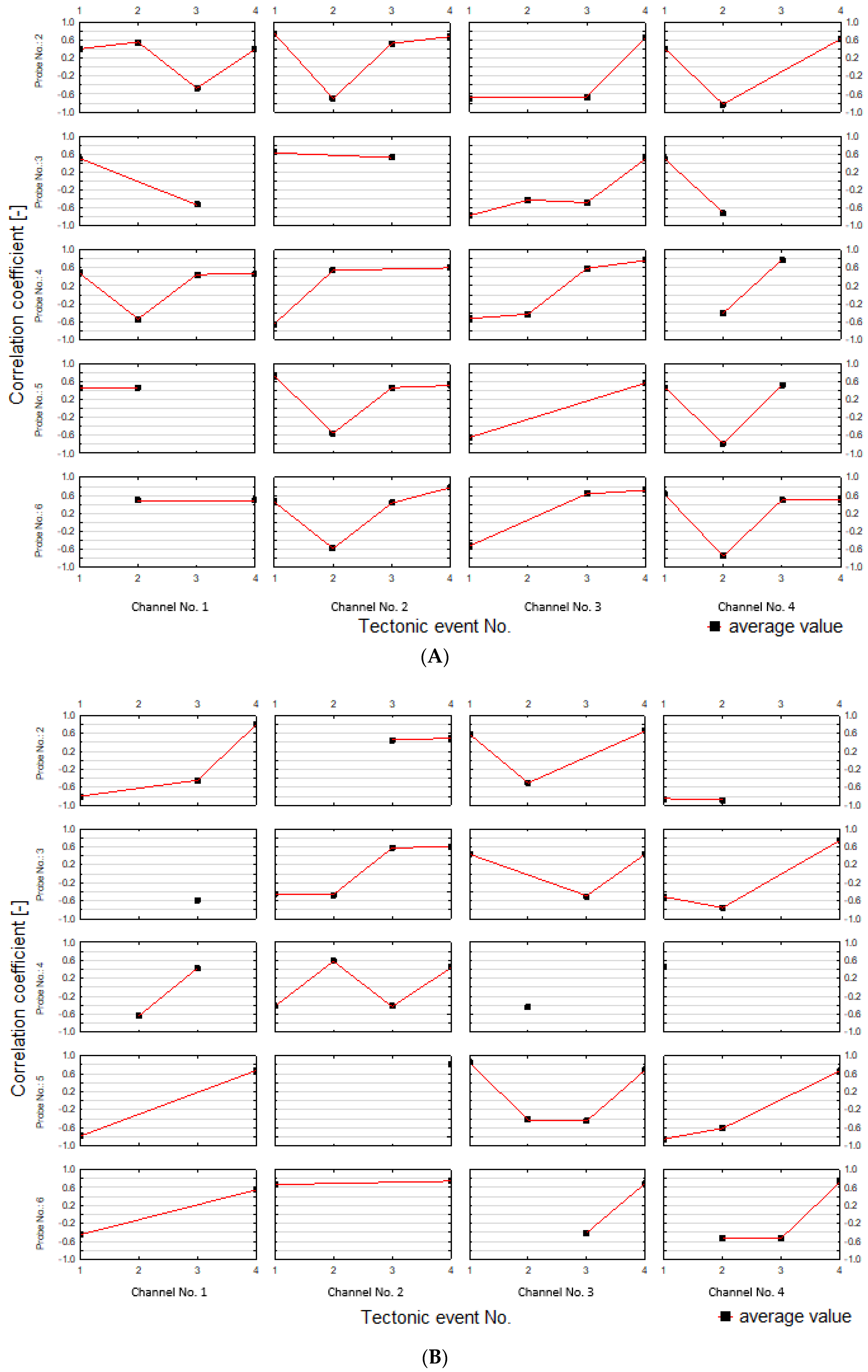
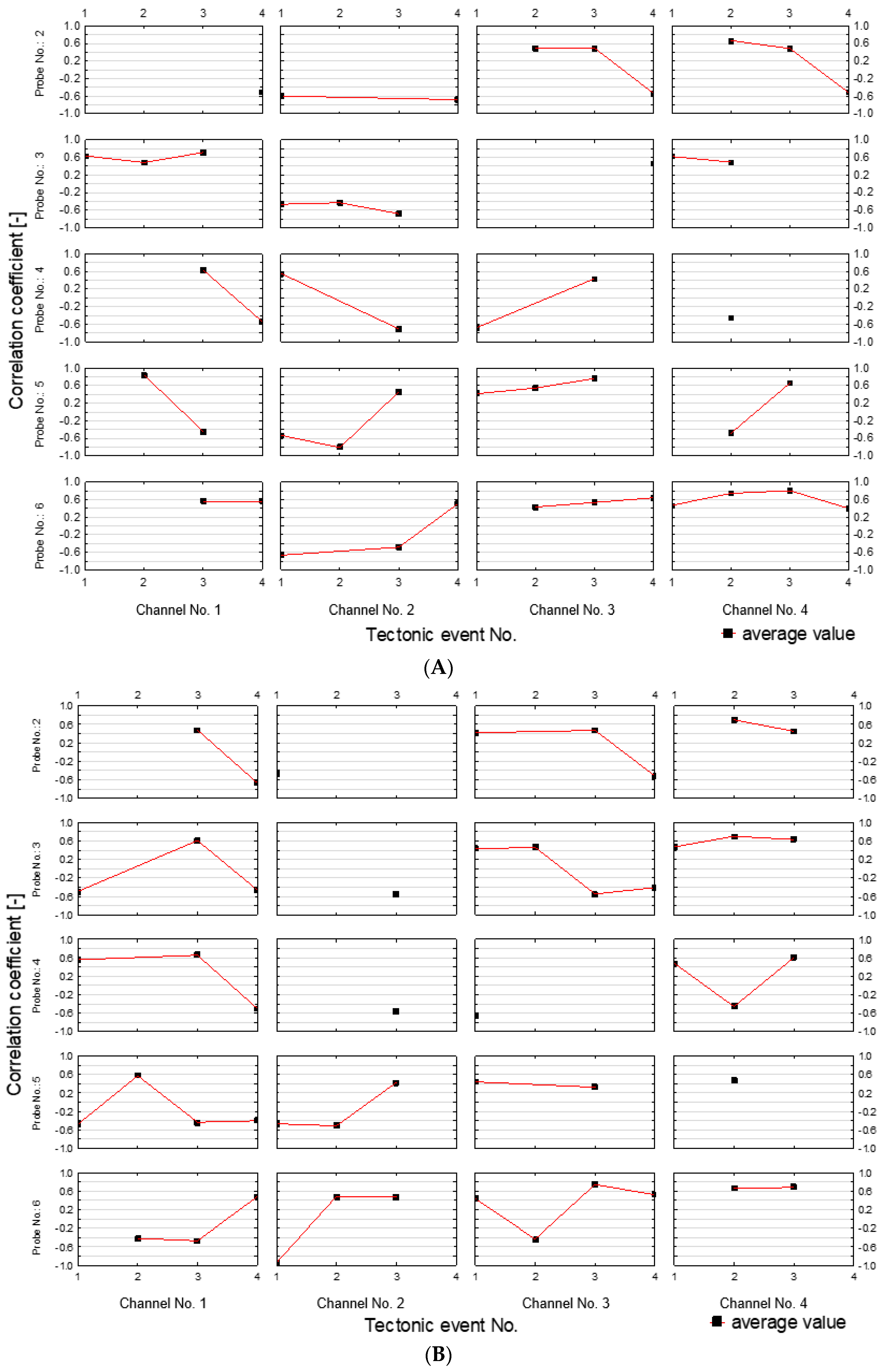
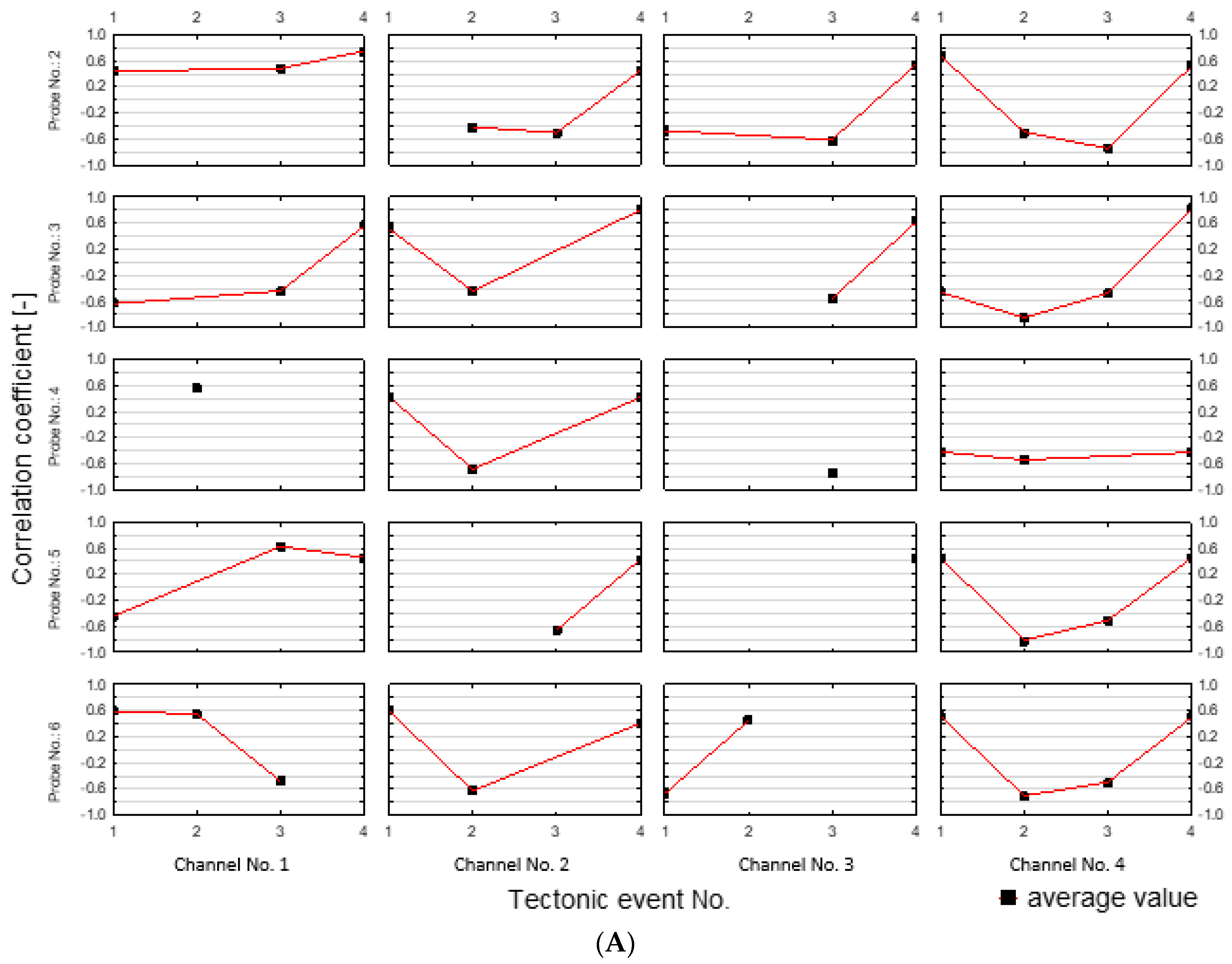
In the first interval block (1–24 h), the input dataset was filtered in order to remove 1126 data points (58.6% of the set) with a correlation coefficient lower than 0.4. After the data were filtered, they were divided according to the correlation direction. A total of 475 data points showed positive correlations, whereas 319 data points showed negative correlations. Solely positive correlations were observed in channels 1, 3, and 4. On channel 1, a positive correlation was observed for the signals from probes 3 and 6. Channel 3—was formed by probes 3, 5, and 6. Channel 4 was obtained from probes 3 and 6. Solely negative correlations were observed between the signal from probe 2 and the signal from channel 1, between the signals from probes 2 and 3 and the signal from channel 2, and between the signal from probe 4 and the signal from channel 4. In the remaining cases, the correlations were mixed. Both positive and negative correlations were most frequently observed in channel 2. Between 1 and 24 h prior to the event, the observed correlations of the signals from channel 1 and the signals from probes 3 and 5 were opposite to the correlations observed for these probes on channel 2. This phenomenon was observed prior to three subsequent seismic events for the signal from channels 1 and 2, which correlated with the signal from probe 3. For probe 5, this phenomenon occurred prior to events no. 2 and 3. Identical interactions were observed for the signal on channels 3 and 4 correlated with the signal from probe 2 prior to events no. 2, 3, and 4. They were negative prior to event no. 4 and positive prior to events no. 2 and 3. The signals from these channels were positively correlated with the signal from probe 6 prior to events 2, 3, and 4 (Figure 20A). Such a situation may confirm the radon response to changes in the stress field associated with increased pore pressure and reduced effective stress in the fracture and fault zones. The emission from the rock mass, induced by the redistribution of compressional and extensional stresses, has been described in the work of Omori and co-authors [44].
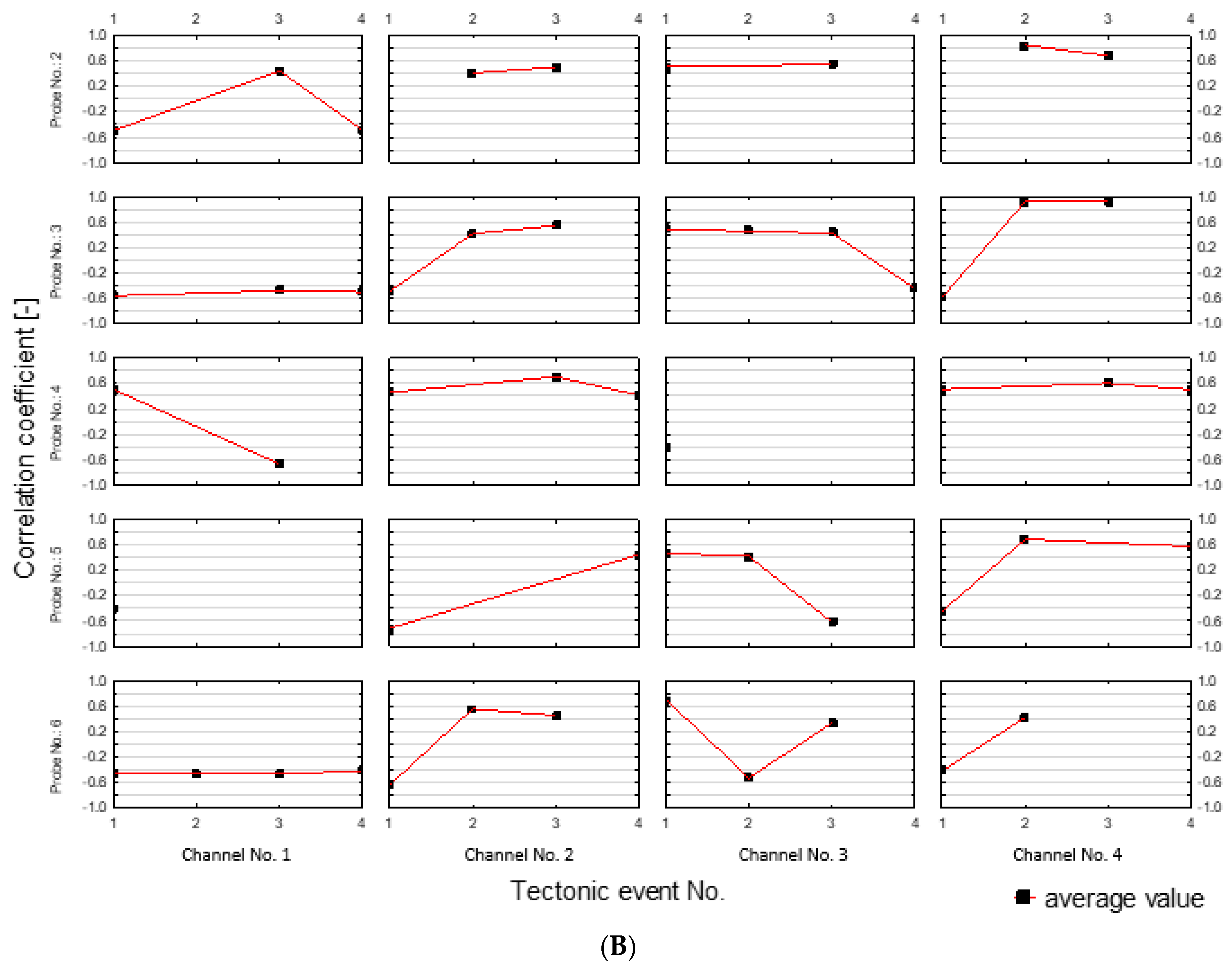
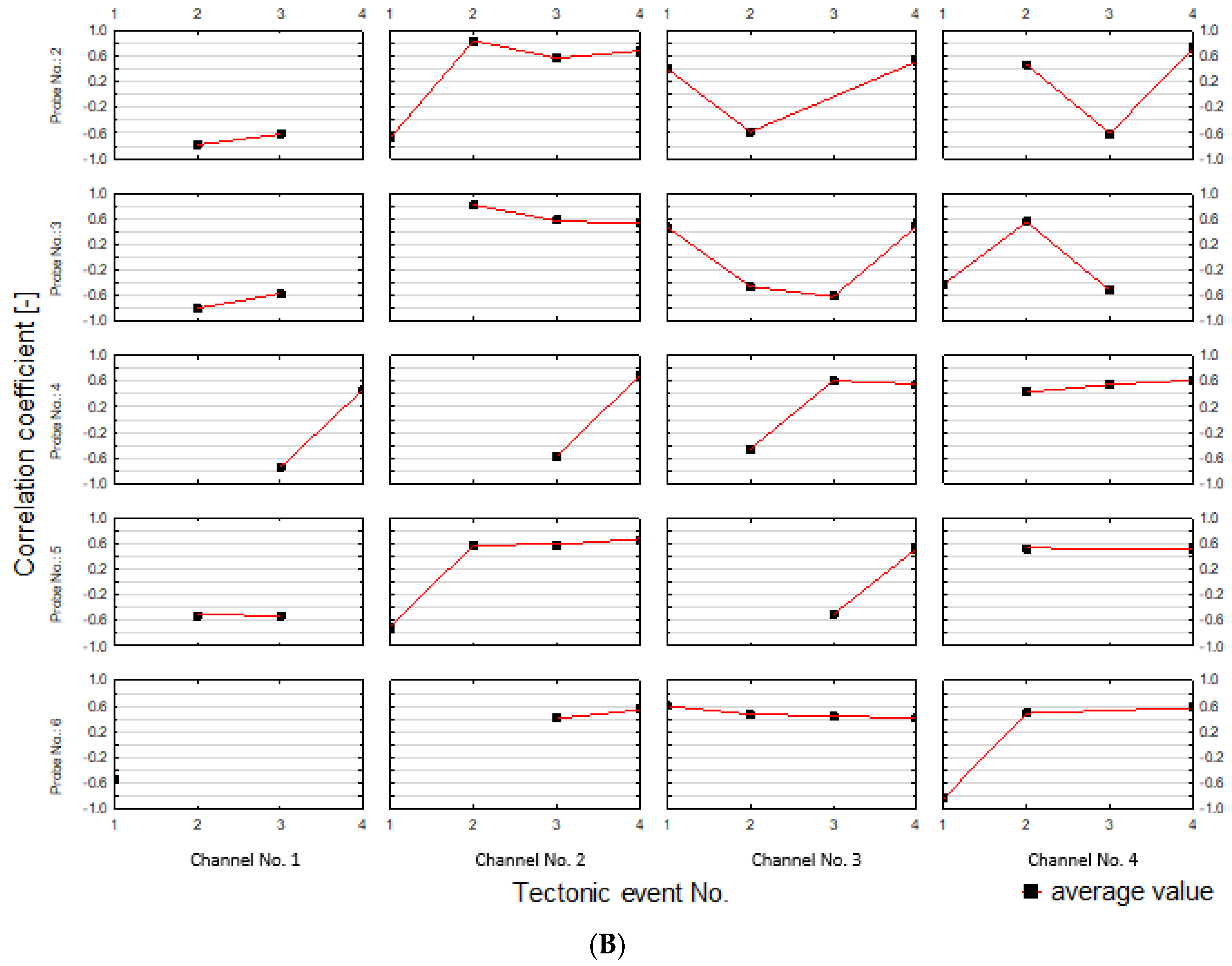
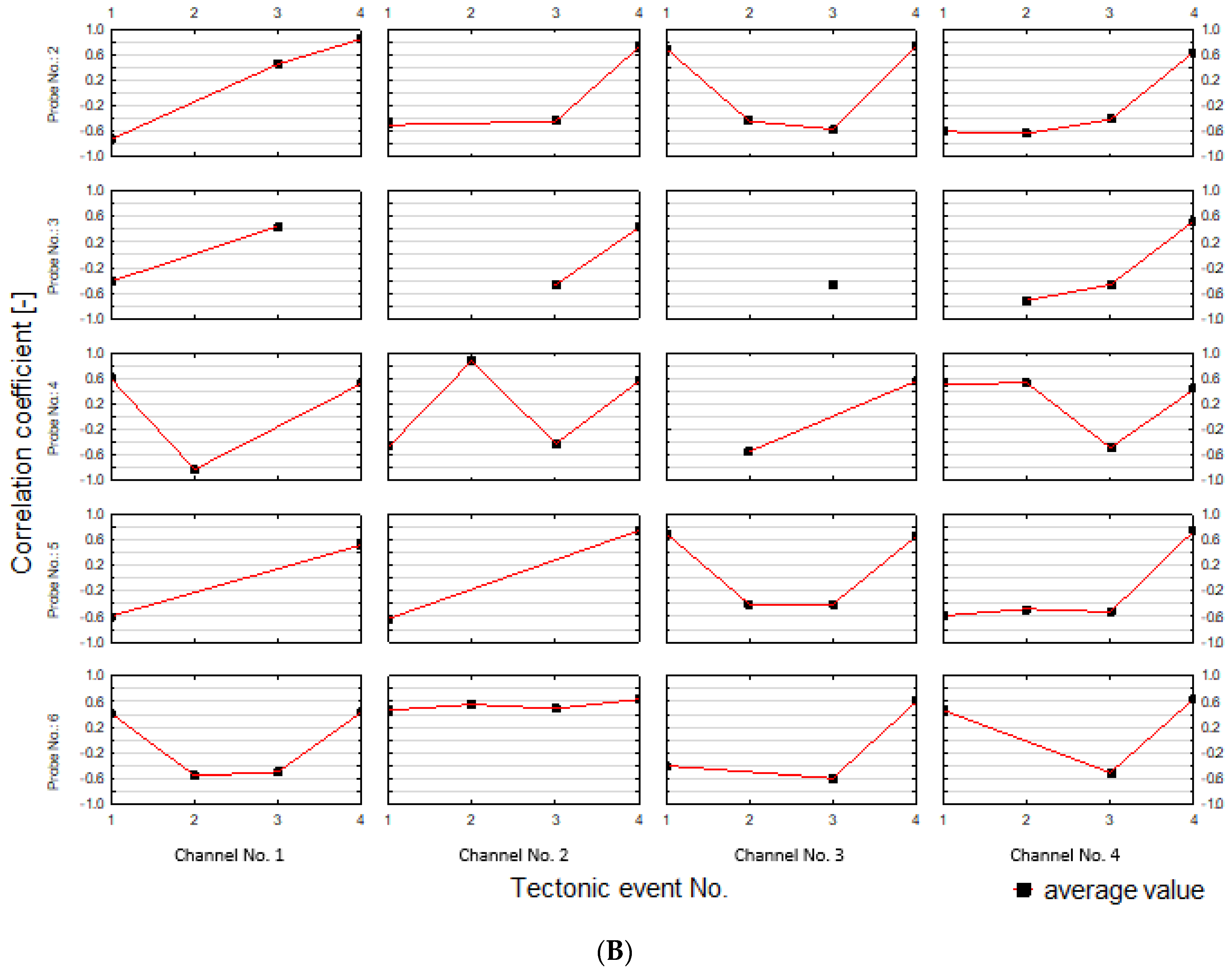
The analyses of the signals from 25 to 48 h prior to the seismic event included 547 data points with positive correlations and 355 data points with negative correlations. A total of 902 data points were analyzed, representing 47% of the input dataset. The signal from probe 4 was not related to the signal on channel 1. Solely positive correlations were observed between the signal from channel 1 and the signals from probes 3, 5, and 6. The signal from channel 3 was correlated with the signals from probes 2, 3, and 5. The signal from channel 4, on the other hand, was correlated only with the signal from probe 6. These relationships were observed for 24 h. Solely negative correlations were observed between the signals from probes 2 and 5 and the signal from channel 2, and between the signal from probe 4 and the signals from channels 3 and 4. On channel 2, this correlation persisted for 24 h. However, correlations in channels 3 and 4 were observed for 14 and 18 h, respectively. The signals from the remaining detector probes were correlated both positively and negatively with the signals from the channels that recorded tectonic activity. Such correlations were most frequently observed in channels 2 and 4. Between 25 and 48 h, an identical signal correlation was observed for probes 3, 5, and 6 on channel 1 and for probe 6 on channel 4 prior to events no. 1, 2, and 4. In each case, the correlations were positive. The signal from channel 2 was negatively correlated with the signals from probes 3, 5, and 6. A positive correlation was observed between the signals from channels 1, 2, and 3 and the signals from probes 3 and 5, as well as between the signals from channels 2 and 3 and the signal from probe 6. The signal on channel 2 and the signals from probes 3 and 6 were positively correlated with event no. 4. The signal on channel 3 was negatively correlated with the signals from probes 3 and 6 prior to event no. 1, and positively correlated prior to events no. 2 and 4 (Figure 21A).
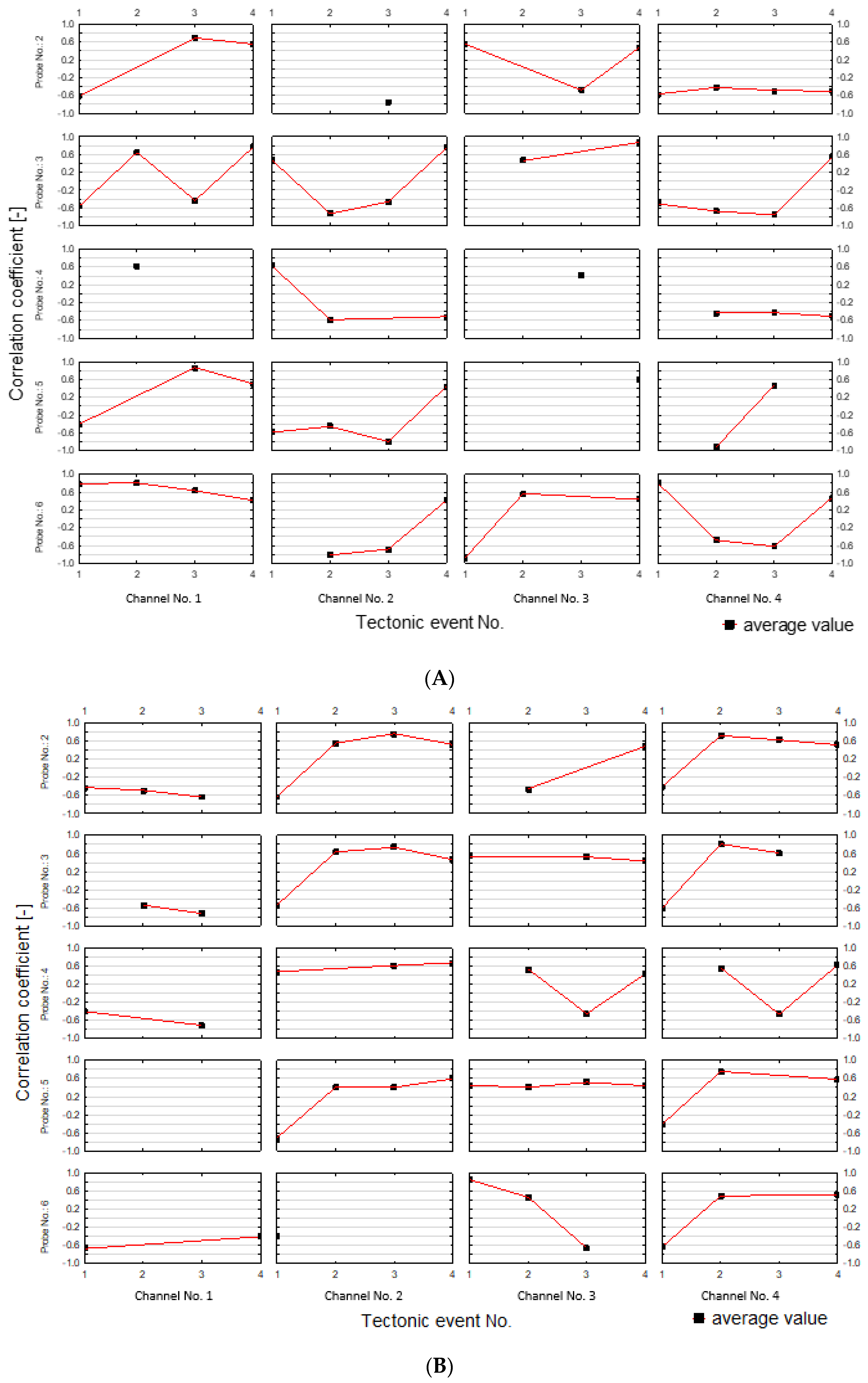
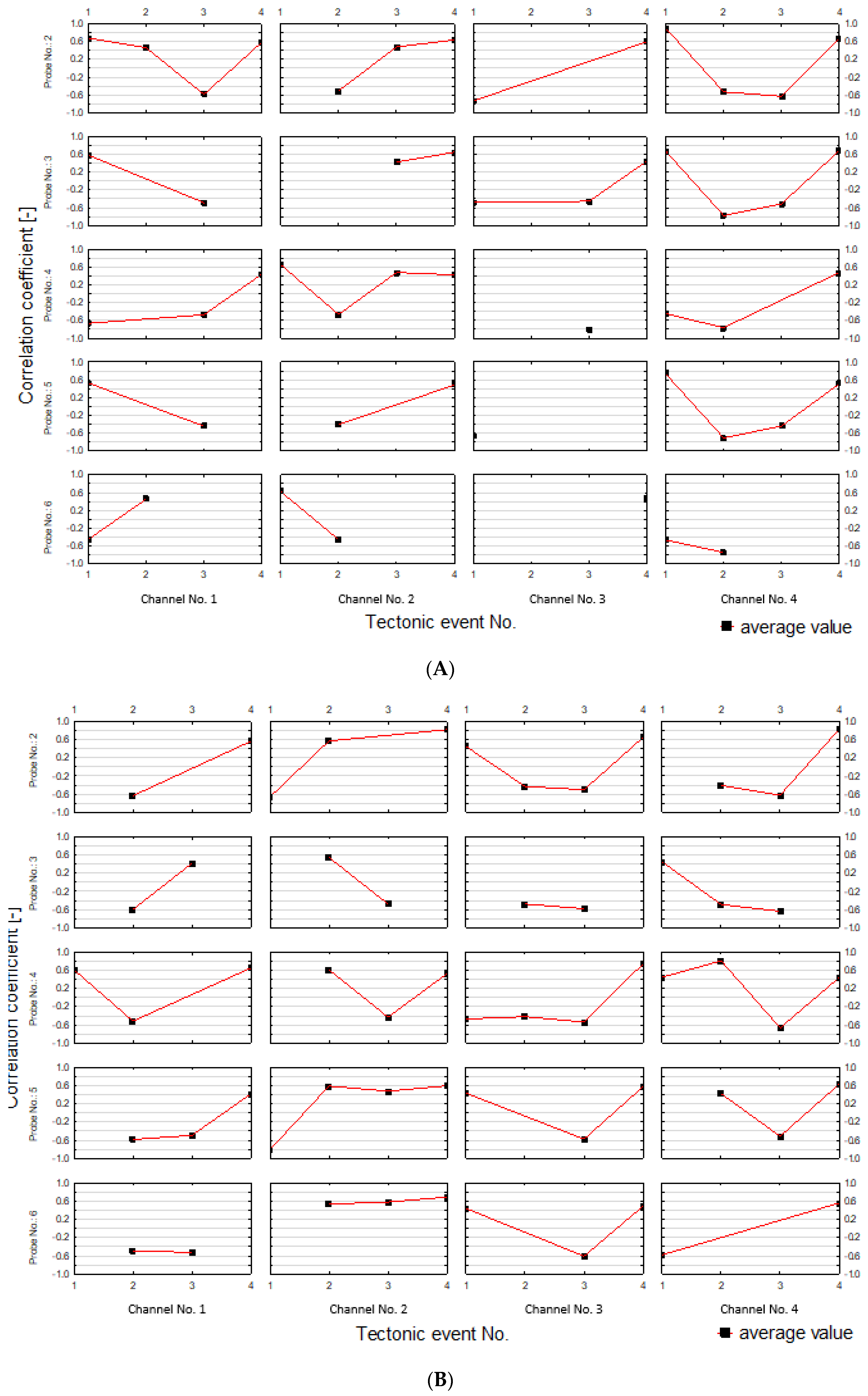
In the third interval block (49–72 h), the correlations were analyzed based on 888 data (approx. 46% of input set). Of these, 452 data points showed a positive correlation and 436 data points showed a negative correlation. Between 49 and 72 h prior to the seismic events, the signals recorded by the radon probes were correlated with the signals from each tectonic activity channel. A solely positive correlation was observed between the signals from probes 4, 5, and 6 and the signal on channel 1, as well as between the signals from probes 3, 4, and 5 and the signal on channel 3. Except for the signal from probe 4, which correlated with the signal on channel 3 (correlated between 56 and 62 h), the duration of the positive correlations for the remaining signals was similar at 24 h. Solely negative correlations, on the other hand, were observed between the signals from probes 2 and 6 and the signal from channel 2, and between the signals from probes 2 and 4 and the signal from channel 4. The duration of these correlations was also 24 h. In the case of the remaining sensors, the correlations were inconsistent. Such correlations were observed mainly for the signals from channels 2 and 4. Between 49 and 72 h, the signals from probes 2 and 5 were negatively correlated with the signal on channel 1 prior to event no. 1, and positively correlated prior to events no. 3 and 4. The signal from channel 4 was negatively correlated with the signals from probes 2, 3, 4, and 6 prior to events no. 2 and 3. In addition, the signal on channel 4 and the signals from probes 3 and 6 were positively correlated prior to event no. 4. The signal on channel 2 was positively correlated with the signals from probes 3, 5, and 6 prior to event no. 4 and negatively correlated prior to events no. 2 and 3 (Figure 22A).
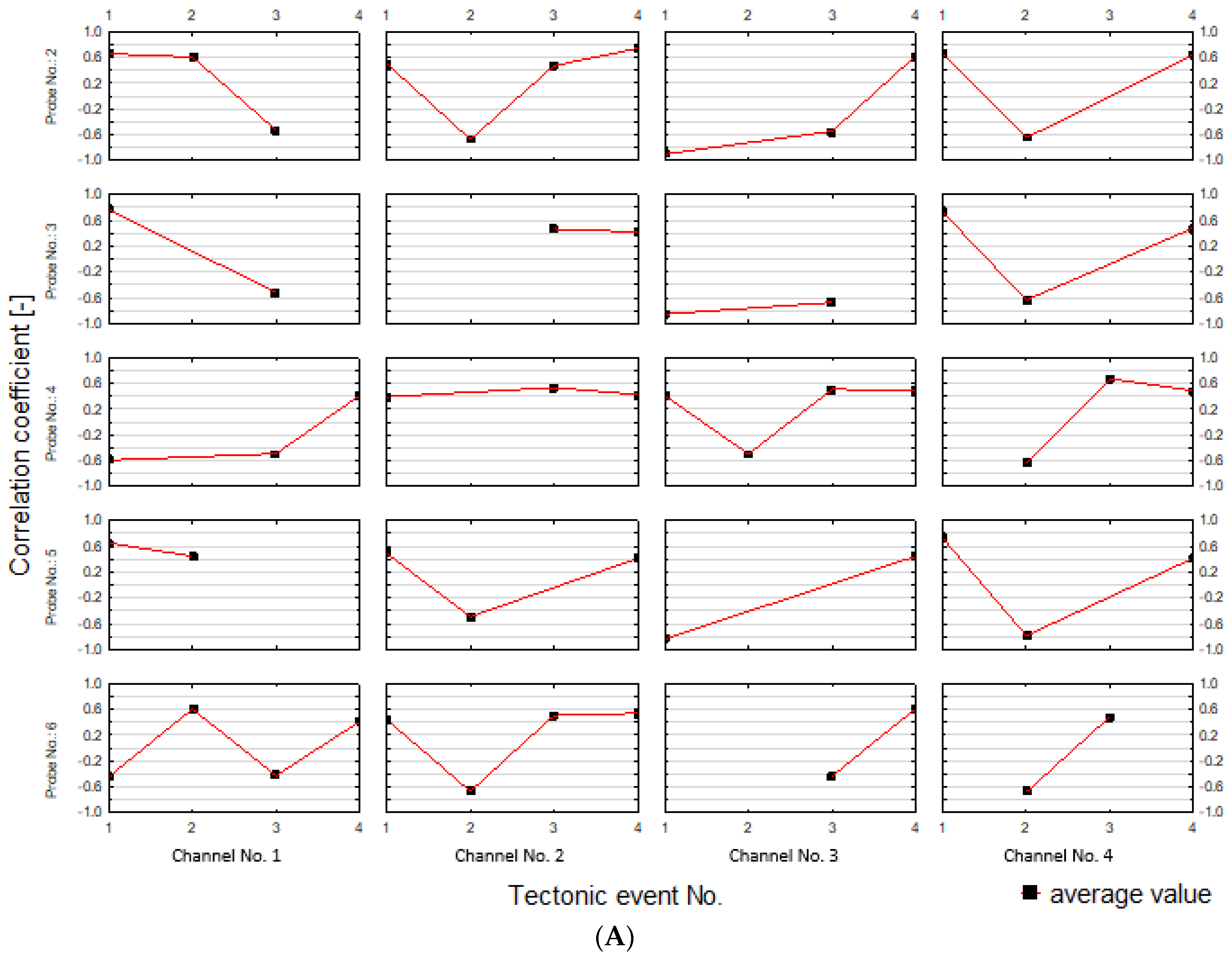
The characteristics of the interactions between 73 and 96 h prior to the seismic events were analyzed based on 777 data points, i.e., 40.5% of the 1920-data set. Of the set, 18.5% (355 data) represented positive correlations, and 22% (422 data) represented negative correlations. Only positive correlations were observed for the signals on channels 1 and 3. The correlations for the signal from channel 1 and the signals from probes 2 and 4 had the longest duration of 24 h. This duration was shorter (only 6 h) for the signal on channel 3. This signal was positively correlated with that of probe 5. Solely negative correlations were observed between the signal from probe 4 and the signals from channels 3 and 4. In the first case, the correlation time was shorter—17 h. In the second case, the time was 24 h. The remaining correlations were both positive and negative. Typically, such correlations were observed for the signal on channel 2. Between 73 and 96 h prior to seismic events no. 1 and 4, the signals from probes 3, 4, and 6 were positively correlated with the signal from channel 2. However, this correlation was negative prior to event no. 2. The signal on channel 4 was positively correlated with the signals from probes 2, 3, 5, and 6 prior to event no. 4 and negatively correlated prior to events no. 2 and 3 (Figure 23A).
The interactions between the signals from the radon probes and the tectonic activity channels 97–120 h prior to the seismic events were analyzed based on 879 data points, representing 45.8% of the input dataset. Of this set, 24.5% were positively correlated, and 21.3% were negatively correlated. For the period of 97 to 120 h prior to the events, only positive correlations were observed between the signal from probe 3 and the signal on channel 2, and between the signal from probe 6 and the signal on channel 3. In the first case, such a correlation was observed for 24 h, and in the second case, for 10 h. Solely negative correlations were observed between the signals from probes 4 and 5 and the signal from channel 3, and between the signal on channel 4 and the signal from probe 6. The correlation between the signals from probe 4 and channel 3 continued for only 12 h. Two negative correlations were observed at 24 h. The signal from channel 2 was positively correlated with the signals from probes 2 and 4 prior to events no. 2 and 4, and negatively correlated prior to event no. 2. The signal from channel 4 was positively correlated with the signals from probes 2, 3, and 5 prior to events 1 and 4. In contrast, the correlation was negative prior to events 2 and 3 (Figure 24A).
The coefficients of the interactions observed between 121 and 144 h prior to the seismic events were analyzed based on 55% of the input dataset. Only positive correlations were observed between the signals from channels 1 and 2 and the signals from probes 5 and 4, respectively. The correlations continued similarly for 24 h. Only the signals from probes 3 and channel 3 were negatively correlated The 426 data showed negative correlations, and the 630 data showed positive correlations. Between 121 and 144 h, the correlations were positive for signals from channels 2, 3, and 4 prior to events no. 1, 3, and 4. Negative correlations were observed prior to event no. 2 (Figure 25A). The signal on channel 2 was positively correlated with the signals from probes 2, 5, and 6. The signal from channel 3 was positively correlated with the signal from Probe 4, and the signal from channel 4 was correlated with the signals from Probes 2, 3, and 5 (Figure 25A).
The correlations recorded between 145 and 168 h prior to the seismic events were analyzed based on 794 data points, representing 41.3% of the input dataset. Of the set, 16.6% (319 data) represented negative correlations, and 24.7% (475 data) represented positive correlations. No solely negative correlations were observed. The signal on channel 1 correlated positively with the signals from probes 5 and 6, and the signal from channel 2 correlated with the signal from probe 3. The durations of the signal correlations differed. In the case of the signal from probe 6, the time was 24 h. For the two remaining probes, the times were 12 h (probe 5) and 7 h (probe 3). In the last interval block, significant correlations were observed between the signals on channel 2 and the signals on channel 4. In both cases, the signals were correlated with those from probes 2, 5, and 6. The correlations have similar characteristics for each of them. The signals from the probes were positively correlated prior to events no. 1, 3, and 4. Negative correlations, however, were observed prior to event no. 2. The signal from channel 1 was negatively correlated with the signals from probes 2 and 3 prior to events 1 and 3 and positively correlated prior to event no. 4 (Figure 26A).

4.2. Interactions After the Seismic Event

Between 1 and 24 h after the seismic events, a positive correlation was observed for 78 data points and a negative correlation—for 578 data points. This dataset represented approximately 34% of the input dataset. Practically all signals from the seismic activity channels were negatively correlated with those from the probes. The interaction duration varied in each case. Positive correlations were only observed between the signal from probe 4 and the signal on channel 1, between the signals from probes 3, 5, and 6 and the signal on channel 3, and between the signals from probes 3 and 4 and the signal on channel 4. In each case, the duration of the correlation was different. Between 1 and 24 h after the seismic events, correlations were observed only between the signals from probe 5 and channel 3. Shorter interactions, from 5 to 24 h and from 8 to 24 h were observed between the signal from channel 1 and the signal from probe 4, and between the signal from channel 4 and the signal from probe 4, respectively. The remaining positive correlations lasted for 3–6 h. Negative correlations were observed between the signal from channel 2 and the signals from all radon probes. For probes 2, 3, 4, and 6, the duration time was similar, between 10 and 15 h. In the case of the signal from probe 5, interactions were observed between 18 and 24 h. The signal from probe 2 was negatively correlated with the signals from channels 1, 2, and 3. Identical interactions were observed after events no. 1 (positive), no. 2 (negative) and no. 3 (positive) between the signals from probes 4 and 6 and the signals from channels 4 and 3, respectively. In contrast, the signals from channels 1 and 3 had an identical (positive) correlation only after event no. 1. The signals from probes 2 and 4 were correlated with the signals from channels 4 and 1, respectively. After event no. 3, the signals from probes 4 and 6 were correlated with the signals from channels 4 and 3, respectively. In contrast, the signals from probes 2 and 4 correlated with the signals from channels 4 and 1, respectively. The signal from probe 6 was correlated with the signals on channels 2 and 4, and the signal from probes 2 and 3 was only correlated with the signal from channel 4 (Figure 20B).
Between 25 and 48 h after each of the four seismic events, a significant correlation was observed for 772 data points (38.6% of the input data), of which 442 correlations were positive and 300 were negative. Positive correlations were observed twice for the signals from channels 2 and 4. The signal from channel 2 was positively correlated for 4 h with the signal from probe 2 and for 24 h with that from probe 4. The signal from channel 4 was also positively correlated with the signals from probes 2 and 4. However, the correlation time in both cases was 24 h. The signal from channel 3 remained positively correlated with the signal from probe 2 for 24 h. No correlations were observed between the signals from channels 1 and probe 5 and those from channels 3 and 4. In the remaining cases the correlations were mixed. After events no. 2 and 3, identical correlations were observed between the signals from probes 2, 3, and 6 and the signal from channel 2, between the signal from probe 3 and the signals from channels 3 and 4, and between the signals from probes 2 and 3 and the signal from channel 4. All correlations were positive (Figure 21B).
The data analyzed for 49 and 72 h after the seismic events contained 596 positively correlated data and 302 negatively correlated data. They accounted for 46.8% of the input dataset. Between 49 and 72 h after the events, an identical reaction was observed for probes 2, 3, and 4. Positive correlations were observed between the signals from probes 2, 3, and 5 and the signal on channel 2, between the signal from probe 5 and the signal from channel 3, and between the signal from probe 2 and the signal on channel 4. No statistically significant correlations were observed between the signal on Channel 1 and the signal from each probe, or between the signal on Channel 2 and the signal from probe 6. No negative correlations were observed between the signals from the channels and probes. However, solely positive correlations were observed between the signal from channel 3 and the signal from probe 3, between the signals on channels 2 and 3 and the signal from probe 4, and between the signals on channels 3 and 4 and the signal from probe 5. The duration of the correlation between the signal from probe 4 and the signal from channel 3 was 54–72 h after the event. In the remaining cases, the correlation persisted for over 24 h. The other signals from the probes were both positively and negatively correlated with the signals on channels 2, 3, and 4. The duration of these correlations was different. The longest duration of 24 h was observed between the signal on channel 2 and the signals from probes 2, 3, and 5 (Figure 22B).
From 73 to 96 h after the seismic events, the correlations between the signals from the channels and probes were analyzed based on 951 data points, representing 49.5% of the input data set. The signal from channel 1 was negatively correlated with the signals from probes 2, 3, 5, and 6. Except for the signal from probe 6, the correlation durations were 24 h. Solely positive correlations were observed between the signal from channel 2 and the signals from probes 3 and 5, between the signal from channel 3 and the signal from probe 6, and between the signal from channel 4 and the signals from probes 4 and 5. In these cases, the correlations persisted for 24 h. No statistically significant correlations were observed between the signals from the probes and channels. Except for the discussed cases, the correlations were mixed. After events no. 2, 3, and 4, probes 2, 3, and 5 showed identical responses. Their signals were correlated with those from channel 2. The signal from channel 3 was correlated with that from probe 6. The signal from probe 4 was correlated with that from channel 4. The correlations were positive (Figure 23B).
The subsequent 24 h (97–120 h) after the seismic event also showed statistically significant correlations. A total of 884 data points were analyzed, representing 46% of the input dataset. Identical interactions were observed after events 2 and 4. The signals from probes 2, 4, 5, and 6 correlated with the signal on channel 2. The signal from channel 4 was correlated with the signals from probes 4 and 5. In both cases, the correlations were positive. Solely negative correlations were observed between the signals from probes 3 and 4 and the signal from channel 1, and between the signal from probe 3 and the signal from channel 3. For the signal from probe 3, the duration of the correlation was from 97 to 111 h, and for the signal on channel 3, it was similar, from 97 to 117 h after the event. In contrast, the correlation between the signals from channel 1 and probe 6 lasted for 24 h. The signals from probe 6 and from channel 2 were only positively correlated. The significance of the correlations was practically constant (from 0.6 to 0.7) over 24 h. The remaining correlations were mixed, and their durations ranged between 7 and 10 h (Figure 24B).
Between 121 and 144 h after the event, only positive correlations were observed between the signal on channel 2 and the signal from probe 6, and between the signal on channel 3 and the signal from probe 5. The analyses were based on 971 data points, representing 50.6% of the total input dataset. Identical interactions were observed after all four seismic events between the signal from probe 6 and the signal from channel 3 and between the signals from probes 2 and 5 and the signal from channel 3. Negative correlations were observed after events 2 and 3, and positive correlations after events 1 and 4. Otherwise, the signals from the radon probes and seismic activity channels correlated positively and negatively. The correlations were observed for the longest time on channels 3 and 4, from 12 to 24 h (Figure 25B).
Between 145 and 168 h after the seismic events, statistically significant correlations were found for 784 data points, i.e., for 40.6% of the input data. They showed solely positive correlations between the signals from probes 2, 5, and 6 and the signal from channel 2. The signal from channel 3 was positively correlated with the signal from probe 6, and the signal from channel 4 was correlated with the signal from probe 4. Solely negative correlations were observed between the signal on channel 1 and the signals from probes 3 and 4, between the signal on channel 3 and the signal from probe 4, and between the signal on channel 4 and the signal from probe 2. In each of these cases, the negative correlations continued for periods from 153 to 168 h, 145 to 160 h, 145 to 149 h, and 1 to 24 h, respectively. Except for the above-mentioned solely positive or negative correlations, the remaining relationships were mixed. The correlation time was the longest for channel 4. Between 145 and 168 h, identical correlations were observed after events no. 1, 2, and 4. Correlations were observed between the signal from probe 3 and the signal from channel 2, and between the signals from probes 3 and 5 and the signal from channel 4. After seismic events nos. 1 and 2, the correlations were negative, and after seismic event no. 4, they were positive (Figure 26B).
The signals from the probes were both positively and negatively correlated with the signals from the channels over the entire observation period. These correlations occur in alternative order and have various durations (from several up to 24 h) in each 24-h interval block. Solely positive interactions for the probe-tiltmeter system were observed more frequently both before and after the seismic events. The only exception here is the interactions of the signal on channel 1, which is not positively correlated with any of the probe signals between 49 and 72 h after the event (Table 4). Solely negative correlations were observed in all interval blocks after the seismic events. However, they were observed only for the first 145 h prior to the events. At certain time intervals, some of the signals from the probe-tiltmeter system were observed to have both proportional and inversely proportional correlations, both before and after the seismic events. A proportional correlation between the signals from the probes and the signals from the seismic activity channels before and after the event was observed between 1 and 24 h. In both cases, the signal from channel 3 was positively correlated with the signals from probes 5 and 6. Additionally, the interactions frequently involve the same channels but with different probes. Between 1 and 24 h prior to the event, the signal on channel 4 was positively correlated with the signals from both probes 3 and 6, and after the event, only with the signal from probe 3. Between 25 and 48 h, positive correlations were observed between the probe and channel signals before and after the event. In the first case, the signal on channel 3 was positively correlated with the signals from probes 2, 3, and 5, and the signal from channel 4 was positively correlated with the signal from probe 6. However, after the event, the correlations are maintained between the signals from channel 3 and probe 2, as well as between the signals from channel 4 and probes 2 and 4. Between 49 and 72 h before and after the event, similarities were observed in both positive and negative correlations. Prior to the event, the signal from channel 3 was positively correlated with the signals from probes 3 and 5, and after the event, with signals from probes 3, 5, and 4. The only negative correlation before the event was between the signals from Channels 2 and Probes 2 and 6. However, after the event, the correlation was only observed with the signal from probe 6. Between 73 and 96 h, both before and after the event, no similarities in the correlations were observed. From 97 to 120 h, the signal from Channel 2 correlated positively, and the signal from Channel 3 correlated negatively with the probe signals both before and after the event. Between 121 and 144 h before and after the event, only positive correlations were observed between the signal on channel 2 and the probe signals. However, the correlations were solely negative between the signals on channel 3 and probe 3. Between 145 and 168 h before and after the event, only positive correlations were observed between the signals on channel 4 and probe 4. The signal on channel 2 was positively correlated with the signals from all probes.
The study also presented the correlation patterns at both ends of the pipes comprising the seismic activity measurement system. Between 25 and 48 h prior to the event, the signal on channel 1 was positively correlated with the signals from probes 3, 4, 5, and 6. At this time, the signal on channel 2 (the second end of the system) was negatively correlated with the signals from probes 5 and 2. Between 49 and 72 h prior to the event, the signal from channel 1 was positively correlated with the signals from probes 4, 5, and 6. The signal on channel 2 was inversely proportional to the signals from Probes 2 and 6. The relationships were also different on both ends of the 3–4 channel system. The signal on channel 3 positively correlated with the signals from probes 3 and 5, and the signal on channel 4 negatively correlated with the signals from probes 2 and 4. Both positive and negative correlations were observed on both ends of the 1–2 system between 25 and 48 h, 73 and 96 h, 97 and 120 h, and between 145 and 168 h after the seismic event. In the first case, the signal on channel 2 was positively correlated with the signals from probes 2 and 4, and the signal on channel 1 was negatively correlated with the signals from probes 3 and 6. In the second case, the signal on channel 2 was positively correlated with the signals from probes 3 and 6, and the signal on channel 1 was negatively correlated with the signals from probes 2, 3, 5, and 6. In the third case, the signal on channel 2 was positively correlated with the signal from probe 6, and the signal on channel 1 was negatively correlated with the signals from probes 3 and 6. In the last case, the signal on channel 2 was positively correlated with the signals from probes 2, 4, 5, and 6, and the signal on channel 1 was negatively correlated with the signals from probes 3 and 4 (Table 4).
Each of the analyzed seismic events had different shock characteristics, which were measured using the probe-tiltmeter system both before and after the event. Before and after event no. 3, over the first 24 h, the positive correlations assigned to the tension phase of the rock mass were indicated by the signals from probe 6 and channels 3 and 4. The same measurement set indicates a positive correlation before and a negative correlation after event no. 2. In the time range between 25 and 48 h, the signal on channel 2 and the signals from probes 3 and 6 were negatively correlated before and positively correlated after events no. 2 and 3. An identical relationship was observed before and after events no. 2 and 3 between the signals from channel 4 and probe 4. A similar activity level was also observed before and after events 2 and 3 between the signals from channel 2 and probes 3 and 5. This correlation was negative before and positive after the event. Before and after events no. 2 and 4, the signal from probe 2 was positively correlated with the signal from channel 2. Between 73 and 96 h, the interactions between the probes and the channels were different before and after the seismic event. Prior to event no. 2, the correlations were negative between the signals from channel 2 and probe 3. After the event, this correlation was reversed. The signal from probe 3 before and after event no. 4 was positively correlated with the signal from channel 2. The signal from channel 4 correlated with the probe signals before and after events no. 2, 3, and 4. Prior to the event, this correlation was observed for signals from probes 2, 3, 5, and 6, and after the event, only with the signal from probe 4. The correlation before the event was negative, negative, and positive. However, after the event, it was always positive. In the time range From 97 to 120 h after the event, interactions were observed for the signal on channels 2 and 4. Prior to the event, the signal from channel 2 correlated positively with the signal from probe 4. After the event, a similar correlation was observed with the signals from probes 2, 4, 5, and 6. At the same time, before events 1 and 4, the signal from channel 4 was positively correlated with the signals from probes 2, 3, and 5. After events no. 2 and 3, it was negatively correlated with the signals from probes 2, 3, and 5. After events no. 2 and 4, the signal from channel 4 was positively correlated with the signals from probes 4 and 5. Between 121 and 144 h, correlations were observed only for the signal on channel 1, both before and after all four events. Except for event no. 2, all events showed positive correlations. Prior to the event, the signal from channel 3 was positively correlated with the signal from probe 4, and after the event, with signals from probes 2 and 5. After event no. 3, the correlation was inversely proportional (negative). Between 145 and 168 h, the correlation of the signal from channel 2 with the signals from probes 2, 5, and 6 was positive after events no. 1, 3, and 4, and negative after event no. 2. The signal from channel 2 was also negatively correlated with the signal from probe 3 after events no. 1 and 2 (negatively), as well as 4 (positively).

5. Conclusions

Radon-tectonic signals were used to evaluate seismic phenomena through decomposition using the Fourier wavelet transform, data correlation via the Savitzky–Golay (SGolay) method, and time-based data categorization. The results show that the decomposition of a time series allows the identification of the percentage of data describing interactions between radon concentration values and the effects of the tectonic activity of the rock mass measured using water-tube tiltmeters. In accordance with the research assumption, for the correlation coefficient above 0.4, this percentage is on average only approx. 45% of the data recorded before, and approx. 44% of the data recorded after the seismic event. The interactions between the time series data from the radon probes and water-tube tiltmeters were demonstrated to occur continuously over each of the 168 h of the observations performed prior to the seismic event. These interactions may not be detectable within the first 48 h after a seismic event. The interaction between the probe and channel system varies with time.
We observed that over the entire analyzed period, interactions between the recorded signals could be identified with the rock mass tension (positive correlations) and compression (negative correlations) phases. Mixed correlations (positive and negative) indicate that both the stress and strain phases of the rock mass were recorded. Positive and systematic correlations were observed for signals from channels 1, 2, and 3 between 25 and 48 h prior to the seismic event. The correlations with the signals from channels 3 and 4 were solely negative between 73 and 120 h prior to the seismic event. After the seismic event, such a systematic character was observed only in the case of positive correlations for channels 2, 3, and 4 between 25 and 96 h.
The results indicate that at the research site, the radon-tectonic signal was best identified between 25 and 48 and between 49 and 72 h before the seismic shock. Each seismic shock had a different distribution of rock mass phases recorded by the integrated (probe-tiltmeter) measurement system. The phases were most evident before and after events no. 2 and 3.
Particularly promising are the results showing the correlation between the tectonic signal recorded by a system of four perpendicular water-tube tiltmeters and the adjacent probes measuring the concentration of 222Rn activity. The combined registration system of the tectonic and radon signals from nine detectors allowed a coherent representation of the rock mass behavior, in particular for the periods of 2–3 days and 1–2 days prior to the seismic event. Positive correlations between the tectonic and radon signals associated with the tension phase in the rock mass and negative correlations between the tectonic and radon signals associated with the compression phase allow for the description of the behavior of the rock mass before the seismic shock. The observed covariations (correlations) seem particularly promising, as they can be recorded already 1–3 days before the seismic event, allowing an appropriately early response to the expected seismic event. The observed correlation appears to be a valid indicator of the time of occurrence of a future earthquake.

Author Contributions

T.A.P. and M.K. are the originators and initiators of the research. L.F.-L. is the initiator and the author of the first version of the manuscript. L.F.-L. made graphs and figures and prepared correlation analyses and dataset for interpretation and discussion. D.K. wrote Section 3.1. M.Z. wrote Section 3.2. and Section 3.3. T.A.P. and M.K. helped in interpreting the obtained results. All authors have read and agreed to the published version of the manuscript.

Funding

This paper has received funding from the Polish Ministry of Science and Higher Education: Subsidy 2025 for WUST.

Institutional Review Board Statement

Not applicable.

Informed Consent Statement

Not applicable.

Data Availability Statement

The raw data supporting the conclusions of this article will be made available by the authors on request.

Conflicts of Interest

The authors declare no conflicts of interest.

References

  1. Petraki, E.; Nikolopoulos, D.; Panagiotaras, D.; Cantzos, D.; Yannakopoulos, P.; Nomicos, C.; Stonham, J. Radon-222: A Potential Short-Term Earthquake Precursor. J. Earth Sci. Clim. Change 2015, 6, 282. [Google Scholar] [CrossRef]
  2. Keskin, S.; Külahcı, F. ARIMA Model Simulation for Total Electron Content, Earthquake and Radon Relationship Identification. Nat. Hazards 2023, 115, 1955–1976. [Google Scholar] [CrossRef]
  3. Muhammad, A.; Külahcı, F.; Birel, S. Investigating Radon and TEC Anomalies Relative to Earthquakes via AI Models. J. Atmos. Sol.-Terr. Phys. 2023, 245, 106037. [Google Scholar] [CrossRef]
  4. Papachristodoulou, C.; Stamoulis, K.; Ioannides, K. Temporal Variation of Soil Gas Radon Associated with Seismic Activity: A Case Study in NW Greece. Pure Appl. Geophys. 2020, 177, 821–836. [Google Scholar] [CrossRef]
  5. Tareen, A.D.K.; Nadeem, M.S.A.; Kearfott, K.J.; Abbas, K.; Khawaja, M.A.; Rafique, M. Descriptive Analysis and Earthquake Prediction Using Boxplot Interpretation of Soil Radon Time Series Data. Appl. Radiat. Isot. 2019, 154, 108861. [Google Scholar] [CrossRef] [PubMed]
  6. Chetia, T.; Baruah, S.; Dey, C.; Baruah, S.; Sharma, S. Seismic Induced Soil Gas Radon Anomalies Observed at Multiparametric Geophysical Observatory, Tezpur (Eastern Himalaya), India: An Appraisal of Probable Model for Earthquake Forecasting Based on Peak of Radon Anomalies. Nat. Hazards 2022, 111, 3071–3098. [Google Scholar] [CrossRef]
  7. Huang, P.; Lv, W.; Huang, R.; Luo, Q.; Yang, Y. Earthquake Precursors: A Review of Key Factors Influencing Radon Concentration. J. Environ. Radioact. 2024, 271, 107310. [Google Scholar] [CrossRef] [PubMed]
  8. Morales-Simfors, N.; Wyss, R.A.; Bundschuh, J. Recent Progress in Radon-Based Monitoring as Seismic and Volcanic Precursor: A Critical Review. Crit. Rev. Environ. Sci. Technol. 2020, 50, 979–1012. [Google Scholar] [CrossRef]
  9. Haider, T.; Barkat, A.; Hayat, U.; Ali, A.; Awais, M.; Alam, A.; Rehman, K.; Shah, M.A. Identification of Radon Anomalies Induced by Earthquake Activity Using Intelligent Systems. J. Geochem. Explor. 2021, 222, 106709. [Google Scholar] [CrossRef]
  10. Zhang, S.; Shi, Z.; Wan, G.; Yan, R.; Zhang, Z. Groundwater Radon Precursor Anomalies Identification by Decision Tree Method. Appl. Geochem. 2020, 121, 104696. [Google Scholar] [CrossRef]
  11. Kamislioglu, M. The Use of Chaotic Approaches for the Nonlinear Analysis of Soil Radon Gas (222Rn) Known as an Earthquake Precursor: Finite Impulse Response (FIR) Application. Arab. J. Geosci. 2021, 14, 617. [Google Scholar] [CrossRef]
  12. Jin, X.; Bu, J.; Qiu, G.; Ma, L.; Chen, Z.; Chen, T.; Wu, J.; Pan, B.; Ji, H.; Tian, J.; et al. Non-Normal Distribution of Radon and Residual Radon and Short-Term Abnormal Precursors of Residual Radon Before Major Earthquakes. Earth Sci. Inform. 2022, 15, 2495–2511. [Google Scholar] [CrossRef]
  13. Woith, H. Radon Earthquake Precursor: A Short Review. Eur. Phys. J. Spec. Top. 2015, 224, 611–627. [Google Scholar] [CrossRef]
  14. Kawabata, K.; Sato, T.; Takahashi, H.A.; Tsunomori, F.; Hosono, T.; Takahashi, M.; Kitamura, Y. Changes in Groundwater Radon Concentrations Caused by the 2016 Kumamoto Earthquake. J. Hydrol. 2020, 584, 124712. [Google Scholar] [CrossRef]
  15. Lee, J.-K. A Comprehensive Approach to a Variability Analysis Between Earthquake Activity and Hydro-Environmental Factors on the Korean Peninsula. Earthq. Eng. Eng. Vib. 2023, 22, 937–950. [Google Scholar] [CrossRef]
  16. Zhao, Y.; Liu, Z.; Li, Y.; Hu, L.; Chen, Z.; Sun, F.; Lu, C. A Case Study of 10 Years Groundwater Radon Monitoring along the Eastern Margin of the Tibetan Plateau and in Its Adjacent Regions: Implications for Earthquake Surveillance. Appl. Geochem. 2021, 131, 105014. [Google Scholar] [CrossRef]
  17. Zhang, S.; Shi, Z.; Wang, G.; Yan, R.; Zhang, Z. Application of the Extreme Gradient Boosting Method to Quantitatively Analyze the Mechanism of Radon Anomalous Change in Banglazhang Hot Spring before the Lijiang Mw 7.0 Earthquake. J. Hydrol. 2022, 612, 128249. [Google Scholar] [CrossRef]
  18. Arora, B.R.; Kumar, A.; Walia, V.; Yang, T.K.; Fu, C.-C.; Liu, T.-K.; Wen, K.-L.; Chen, C.-H. Assessment of the Response of the Meteorological/Hydrological Parameters on the Soil Gas Radon Emission at Hsinchu, Northern Taiwan: A Prerequisite to Identify Earthquake Precursors. J. Asian Earth Sci. 2017, 149, 49–63. [Google Scholar] [CrossRef]
  19. Deb, A.; Gazi, M.; Ghosh, J.; Chowdhury, S.; Barman, C. Monitoring of Soil Radon by SSNTD in Eastern India in Search of Possible Earthquake Precursor. J. Environ. Radioact. 2018, 184–185, 63–70. [Google Scholar] [CrossRef] [PubMed]
  20. Walia, V.; Kumar, A.; Chowdhury, S.; Lin, S.-J.; Fu, C.-C. Earthquake Precursory Study Using Decomposition Technique: Time Series Soil Radon Monitoring Data from the San-Jie Station in Northern Taiwan. J. Radioanal. Nucl. Chem. 2023. [Google Scholar] [CrossRef]
  21. Shafique, B.; Kearfott, K.J.; Tareen, A.D.K.; Rafique, M.; Aziz, W.; Naeem, S.F. Time Series Analysis and Risk Assessment of Domestic Radon: Data Collected in Dwellings along Fault Lines. Indoor Built Environ. 2016, 25, 397–406. [Google Scholar] [CrossRef]
  22. Taheri, M.; Baradaran, S.; Jafarizadeh, M. Increased Radon Concentration in Katalekhor Tourist Cave during an Earthquake Compared with 10 Years of Follow-Up Data. J. Radioanal. Nucl. Chem. 2020, 326, 911–918. [Google Scholar] [CrossRef]
  23. Mentes, G. Observation of Local Tectonic Movements by a Quartz-Tube Extensometer in the Sopronbánfalva Geodynamic Observatory, in Hungary—Validation of Extensometric Data by Tidal Analysis and Simultaneous Radon Concentration Measurements. J. Geodyn. 2012, 58, 38–43. [Google Scholar] [CrossRef]
  24. Przylibski, T.A.; Kaczorowski, M.; Fijałkowska-Lichwa, L.; Kasza, D.; Zdunek, R.; Wronowski, R. Testing of 222Rn Application for Recognizing Tectonic Events Observed on Water-Tube Tiltmeters in Underground Geodynamic Laboratory of Space Research Centre at Książ (the Sudetes, SW Poland). Appl. Radiat. Isot. 2020, 163, 108967. [Google Scholar] [CrossRef] [PubMed]
  25. Sahoo, S.K.; Katlamudi, M.; Barman, C.; Lakshmi, G.U. Identification of Earthquake Precursors in Soil Radon-222 Data of Kutch, Gujarat, India Using Empirical Mode Decomposition Based Hilbert-Huang Transform. J. Environ. Radioact. 2020, 222, 106353. [Google Scholar] [CrossRef] [PubMed]
  26. Shukla, V.; Chauhan, V.; Kumar, N.; Hazarika, D. Assessment of Rn-222 Continuous Time Series for the Identification of Anomalous Changes during Moderate Earthquakes of the Garhwal Himalaya. Appl. Radiat. Isot. 2020, 166, 109327. [Google Scholar] [CrossRef] [PubMed]
  27. Przylibski, T.A. Radon Concentration Changes in the Air of Two Caves in Poland. J. Environ. Radioact. 1999, 45, 81–94. [Google Scholar] [CrossRef]
  28. Kumar, A.; Walia, V.; Arora, B.R.; Yang, T.F.; Lin, S.-J.; Fu, C.-C.; Chen, C.-H.; Wen, K.-L. Identifications and Removal of Diurnal and Semidiurnal Variations in Radon Time Series Data of Hsinhua Monitoring Station in SW Taiwan Using Singular Spectrum Analysis. Nat. Hazards 2015, 79, 317–330. [Google Scholar] [CrossRef]
  29. Walia, V.; Su, T.C.; Fu, C.C.; Yang, T.F. Spatial Variations of Radon and Helium Concentrations in Soil-Gas across the Shan-Chiao Fault, North Taiwan. Radiat. Meas. 2005, 40, 513–516. [Google Scholar] [CrossRef]
  30. Ghosh, D.; Deb, A.; Sengupta, R. Anomalous Radon Emission as Precursor of Earthquake. J. Appl. Geophys. 2009, 69, 67–81. [Google Scholar] [CrossRef]
  31. Fijałkowska-Lichwa, L.; Przylibski, T.A. Assessment of Occupational Exposure from Radon in the Newly Formed Underground Tourist Route under Książ Castle, Poland. Radiat. Environ. Biophys. 2021, 60, 329–345. [Google Scholar] [CrossRef] [PubMed]
  32. Przylibski, T.A.; Wyłomańska, A.; Zimroz, R.; Fijałkowska-Lichwa, L. Application of Spectral Decomposition of 222Rn Activity Concentration Signal Series Measured in Niedźwiedzia Cave to Identification of Mechanism Responsible for Different Time-Period Variations. Appl. Radiat. Isot. 2015, 104, 74–86. [Google Scholar] [CrossRef] [PubMed]
  33. Barman, C.; Ghose, D.; Sinha, B.; Deb, A. Detection of Earthquake Induced Radon Precursors by Hilbert Huang Transform. J. Appl. Geophys. 2016, 133, 123–131. [Google Scholar] [CrossRef]
  34. Rasheed, A.; Osama, M.; Nikolopoulos, D.; Rafique, M. Singular Spectral and Control Chart Analysis of Soil Radon and Thoron Time Series for Forecasting Seismic Activities. J. Atmos. Sol.-Terr. Phys. 2023, 249, 106108. [Google Scholar] [CrossRef]
  35. Chowdhury, S.; Deb, A.; Barman, C.; Nurujjaman, M.; Bora, D.K. Simultaneous Monitoring of Soil 222Rn in the Eastern Himalayas and the Geothermal Region of Eastern India: An Earthquake Precursor. Nat. Hazards 2022, 112, 1477–1502. [Google Scholar] [CrossRef]
  36. Fijałkowska-Lichwa, L.; Przylibski, T.A. First Radon Measurements and Occupational Exposure Assessments in Underground Geodynamic Laboratory the Polish Academy of Sciences Space Research Centre in Książ Castle (SW Poland). J. Environ. Radioact. 2016, 165, 253–269. [Google Scholar] [CrossRef] [PubMed]
  37. Kaczorowski, M. High-Resolution Wide-Range Tiltmeter: Observations of Earth Free Oscillations Excited by the 26 December 2004 Sumatra–Andaman Earthquake. In Earthquake Source Asymmetry, Structural Media and Rotation Effects; Teisseyre, R., Majewski, E., Takeo, M., Eds.; Springer: Berlin/Heidelberg, Germany, 2006; pp. 493–520. [Google Scholar]
  38. Kasza, D.; Kaczorowski, M.; Zdunek, R.; Wronowski, R. The Damages of Książ Castle Architecture in Relation to Routes of Recognized Tectonic Faults and Indications of Recent Tectonic Activity of Świebodzice Depression Orogen—Central Sudetes, SW Poland. Acta Geodyn. Geomater. 2014, 11, 225–234. [Google Scholar] [CrossRef]
  39. Zdunek, R.; Kaczorowski, M.; Kasza, D.; Wronowski, R. Preliminary Interpretation of Determined Movements of KSIA and KSI1 GPS Stations in Context of Collected Information about Świebodzice Trough Tectonics. Acta Geodyn. Geomater. 2014, 11, 305–315. [Google Scholar] [CrossRef][Green Version]
  40. Kasza, D.; Kowalski, A.; Wojewoda, J.; Kaczorowski, M. Indicators of Recent Geodynamic Activity in the Książ Castle Area (Świebodzice Unit, Sudetes) in the Light of Structural Analysis and Geodetic Measurements. E3S Web Conf. 2018, 29, 00021. [Google Scholar] [CrossRef]
  41. Kaczorowski, M.; Kasza, D.; Zdunek, R.; Wronowski, R. Application of Observations of Recent Tectonic Activity in the Świebodzice Depression (The Sudetes, SW Poland) in Assessing Seismic Hazard in the Fore-Sudetic Monocline. E3S Web Conf. 2018, 55, 00001. [Google Scholar] [CrossRef]
  42. Kaczorowski, M.; Kasza, D.; Zdunek, R.; Rudnicki, M.; Wronowski, R. Time Dependencies Between Tectonic Activity of Świebodzice Depression (SW Poland) and Seismic Activity in Poland and Czech Mining Regions. E3S Web Conf. 2019, 105, 02001. [Google Scholar] [CrossRef]
  43. Kaczorowski, M.; Kasza, D.; Zdunek, R.; Wronowski, R. Time Distribution of Strong Seismic Events in the Fore-Sudetic Monocline in Context of Signals Registered by Water-Tube Gauges in Książ Geodynamic Laboratory. Sensors 2021, 21, 1603. [Google Scholar] [CrossRef] [PubMed]
  44. Omori, Y.; Nagahama, H.; Yasuoka, Y.; Muto, J. Radon Degassing Triggered by Tidal Loading before an Earthquake. Sci. Rep. 2021, 11, 4092. [Google Scholar] [CrossRef] [PubMed]
  45. Kaczorowski, M. The Long Water-Tube Clinometer in Książ Geophysical Station. Promotion of the Works. Artif. Satell. 1999, 34, 171–191. [Google Scholar]
  46. Kaczorowski, M. The Results of Preliminary Tilt Measurements by Use of the Long Water-Tube Clinometer in Książ Geophysical Station. Artif. Satell. 1999, 34, 193–201. [Google Scholar]
  47. Kaczorowski, M. Discussion on Strong Non-Tidal Signals Registered by Horizontal Pendulums and Water Tube Tiltmeters in Geodynamic Laboratory of PAS in Książ. Acta Geodyn. Geomater. 2009, 6, 369–381. [Google Scholar]
  48. Kaczorowski, M.; Wojewoda, J. Neotectonic Activity Interpreted from a Long Water-Tube Tiltmeter Record at the SRC Geodynamic Laboratory in Książ, Central Sudetes, SW Poland. Acta Geodyn. Geomater. 2011, 8, 249–261. [Google Scholar]
  49. Kaczorowski, M.; Olszak, T.; Walo, J.; Barlik, M. Research of Absolute Gravity Variations on Geodynamic Laboratory in Książ in the Period 2007–2011. Artif. Satell. Planet. Geod. 2012, 48, 169–176. [Google Scholar] [CrossRef]
  50. Teisseyre, H. Depresja Świebodzic jako Jednostka Geologiczna. Biul. Inst. Geol. 1956, 106, 5–60. (In Polish) [Google Scholar]
  51. Porębski, S.J. Świebodzice Succession (Upper Devonian–Lower Carboniferous, Western Sudetes): A Prograding, Mass-Flow Dominated Fan-Delta Complex. Geol. Sudet. 1981, 16, 99–190. [Google Scholar]
  52. Wojewoda, J. Jednostka Świebodzic (Sudety)—Strukturalne Anomalie Przebiegu Dolin Rzecznych. In Proceedings of the VI Polska Konferencja Sedymentologiczna POKOS 6—“Granice Sedymentologii”, Chęciny–Rzepka, Poland, 28 June–1 July 2016; Tom Streszczeń: 2016. pp. 145–148. (In Polish). [Google Scholar]
  53. Wojewoda, J. O Konieczności Wykonania Drugiej Edycji “Szczegółowej Mapy Geologicznej Sudetów” w Skali 1:25 000—Przykłady Rewizji Budowy Geologicznej z Wykorzystaniem Podkładu Lidarowego Numerycznego Modelu Powierzchni Terenu. Prz. Geol. 2016, 64, 597–603. (In Polish) [Google Scholar]
  54. Przylibski, T.A.; Bartak, J.; Kochowska, E.; Fijałkowska-Lichwa, L.; Kozak, K.; Mazur, J. New SRDN-3 Probes with a Semiconductor Detector for Measuring Radon Activity Concentration in Underground Spaces. J. Radioanal. Nucl. Chem. 2010, 285, 599–609. [Google Scholar] [CrossRef]
  55. Kaczorowski, M. Water Tube Tiltmeter in Low Silesian Geophysical Observatory: Results of Preliminary Observations. Artif. Satell. 2004, 39, 147–154. [Google Scholar]
  56. EMSC. The European-Mediterranean Seismological Centre. Available online: https://www.emsc-csem.org/ (accessed on 12 February 2024).
  57. Singh, P. The Fourier Decomposition Method for Nonlinear and Non-Stationary Time Series Analysis. Proc. R. Soc. A 2017, 473, 20160871. [Google Scholar] [CrossRef] [PubMed]
  58. Dickey, D.A.; Fuller, W.A. Distribution of the Estimators for Autoregressive Time Series with a Unit Root. J. Am. Stat. Assoc. 1979, 74, 427–431. [Google Scholar] [PubMed]
  59. Merry, R.J.E. Wavelet Theory and Applications: A Literature Study; DCT Rapporten; Technische Universiteit Eindhoven: Eindhoven, The Netherland, 2005; Volume 2005.053. [Google Scholar]
  60. Tan, L.; Chen, Y.; Wu, F. Research on Speech Signal Denoising Algorithm Based on Wavelet Analysis. J. Phys. Conf. Ser. 2020, 1627, 012027. [Google Scholar] [CrossRef]
  61. Sahoo, G.R.; Freed, J.H.; Srivastava, M. Optimal Wavelet Selection for Signal Denoising. IEEE Access 2024, 12, 45369–45380. [Google Scholar] [CrossRef] [PubMed] [PubMed Central]
  62. Peng, Z.; Wang, G. Study on Optimal Selection of Wavelet Vanishing Moments for ECG Denoising. Sci. Rep. 2017, 7, 4564. [Google Scholar] [CrossRef] [PubMed]
  63. Daubechies, I. Ten Lectures on Wavelets; SIAM: Philadelphia, PA, USA, 1992. [Google Scholar]
  64. Xu, Y.; Burton, P.W. Himalayan Tectonic Belt: Morlet Wavelet Variation and Seismic Harmony. Pure Appl. Geophys. 2021, 178, 3471–3488. [Google Scholar] [CrossRef]
  65. Luo, G.; Zhang, D. Wavelet Denoising. In Advances in Wavelet Theory and Their Applications in Engineering, Physics and Technology; InTech: Rijeka, Croatia, 2012. [Google Scholar] [CrossRef]
  66. Gallagher, N. Savitzky–Golay Smoothing and Differentiation Filter. ResearchGate 2020. Available online: https://www.researchgate.net/publication/338518012_Savitzky-Golay_Smoothing_and_Differentiation_Filter?channel=doi&linkId=5e18ed8592851c8364c2ddd0&showFulltext=true (accessed on 20 May 2025).
Figure 1. Map of the GL SRC PAS excavations with the indicated main discontinuity zones and the locations of the measuring apparatus, based on Przylibski et al. [24].
Applsci 15 08199 g001
Figure 2. View of the measuring module on each end of the water-tube tiltmeter (photo taken by M. Kaczorowski).
Applsci 15 08199 g002
Figure 3. Schematic representation of the locations of the analyzed events Legend: #—events no. 1, 2, 3, and 4. Red points—event epicenters (based on OpenStreetMap data).
Applsci 15 08199 g003
Figure 4. Raw data from probe SRDN-3 no 2.
Applsci 15 08199 g004
Figure 5. Trend line for radon probe SRDN-3 No. 2.
Applsci 15 08199 g005
Figure 6. Residues for radon probe SRDN-3 No. 2.
Applsci 15 08199 g006
Figure 7. Multiresolution in the time–frequency domain.
Applsci 15 08199 g007
Figure 8. Examples of the shapes of different wavelets.
Applsci 15 08199 g008
Figure 9. Scalograms and reconstructed signals in a concatenated time series. Explanations: top figure - green dots indicate the analyzed signal, pink line indicates the reconstructed signal at the selected frequency. The middle figure: on the left, the sum of the energy at each frequency is marked in blue. The red line indicates the power of the red noise. If the peaks on the blue line exceed the power of the noise, this indicates the signal’s significance. The green line indicates the selected scale/frequency. The middle figure on the right: a scalogram shows the signal energy for each scale/frequency. The line indicates the selected frequency. The green line and the line in the scalogram are the same line, representing the selected frequency. The bottom figure—the reconstructed signal itself. Explanations: e-05 means 10−5.
Applsci 15 08199 g009
Figure 10. Radon probe SRDN-3 No. 2 with removed period-related trend.
Applsci 15 08199 g010
Figure 11. Spectrogram with significance levels.
Applsci 15 08199 g011
Figure 12. Scalogram and 24 h signal reconstruction together with significance level Legend: (A)—signal having a particular frequency, applied to data from probe SRDN-3 No. 2, (B)—power graph for a particular scale together with noise power (red line), (C)—scalogram showing frequencies occurring in a time series within a particular range, (D)—reconstructed signal with a period of about 24 h. Explanations: top figure (A)—green dots indicate the analyzed signal, pink line indicates the recon-structed signal at the selected frequency. The middle figure on the left (B), the sum of the energy at each frequency is marked in blue. The red line indicates the power of the red noise. If the peaks on the blue line exceed the power of the noise, this indicates the signal’s significance. The green line indicates the selected scale/frequency. The middle figure on the right (C) a scalogram shows the signal energy for each scale/frequency. The line indicates the selected frequency. The green line and the line in the scalogram are the same line, representing the selected frequency. The bottom figure (D)—the reconstructed signal itself.
Applsci 15 08199 g012
Figure 13. Schematic diagram showing discrete signal decomposition Legend: A—approximations at a set numerical deconstruction level, D—detail of the signal at a set numerical deconstruction level.
Applsci 15 08199 g013
Figure 14. Coefficients of discrete wavelet analysis on five levels. Explanation: D1-D5—details of the signal after decomposition using the discrete wavelet transform. A5 indicates approximation of the smoothed signal.
Applsci 15 08199 g014
Figure 15. Signal from probe SRDN-3 No. 2: original and denoised with wavelet decomposition (A), zoom on the area indicated with the frame (B). Explanations: blue line indicates input signal. Red line indicates smoothing.
Applsci 15 08199 g015
Figure 16. Operation of the SGolay filter [66] with an example of fitting the quadratic function (red line) into the local data frame (blue points).
Applsci 15 08199 g016
Figure 17. Frequency response of the SGolay filter.
Applsci 15 08199 g017
Figure 18. Signal from probe SRDN-3 No. 2: original and denoised with the SGolay filter (A), zoom on the area indicated with the frame (B).
Applsci 15 08199 g018
Figure 19. Comparison of the signals from probe SRDN-3 No. 2: denoised with the wavelet decomposition and with the SGolay filter (A), zoom of the area of the red frame (B).
Applsci 15 08199 g019
Figure 20. (A) Comparison of the correlations between radon signals recorded by the probes and signals of tectonic activity in the rock mass observed on individual channels from 1 to 24 h before four seismic events, excluding correlation. Coefficients at a statistically insignificant level, i.e., <0.4. Correlation indicated with red line. (B) Comparison of the correlations between radon signals recorded by the probes and signals of tectonic activity in the rock mass observed on individual channels from 1 to 24 h after four seismic events, excluding correlation. Coefficients at a statistically insignificant level, i.e., <0.4. Correlation indicated with red line.
Applsci 15 08199 g020
Figure 21. (A) Comparison of the correlations between radon signals recorded by the probes and signals of tectonic activity in the rock mass observed on individual channels from 25 to 48 h, four seismic events, excluding correlation coefficients at a statistically insignificant level, i.e., <0.4. Correlation indicated with red line. (B) Comparison of the correlations between radon signals recorded by the probes and signals of tectonic activity in the rock mass observed on individual channels from 25 to 48 after four seismic events, excluding correlation coefficients at a statistically insignificant level, i.e., <0.4. Correlation indicated with red line.
Applsci 15 08199 g021aApplsci 15 08199 g021b
Figure 22. (A) Comparison of the correlations between radon signals recorded by the probes and signals of tectonic activity in the rock mass observed on individual channels from 49 to 72 h before four seismic events, excluding correlation coefficients at a statistically insignificant level, i.e., <0.4. Correlation indicated with red line. (B) Comparison of the correlations between radon signals recorded by the probes and signals of tectonic activity in the rock mass observed on individual channels from 49 to 72 h after four seismic events, excluding correlation coefficients at a statistically insignificant level, i.e., <0.4. Correlation indicated with red line.
Applsci 15 08199 g022
Figure 23. (A) Comparison of the correlations between radon signals recorded by the probes and signals of tectonic activity in the rock mass observed on individual channels from 73 to 96 h before four seismic events, excluding correlation coefficients at a statistically insignificant level, i.e., <0.4. Correlation indicated with red line. (B) Comparison of the correlations between radon signals recorded by the probes and signals of tectonic activity in the rock mass observed on individual channels from 73 to 96 h after four seismic events, excluding correlation coefficients at a statistically insignificant level, i.e., <0.4. Correlation indicated with red line.
Applsci 15 08199 g023aApplsci 15 08199 g023b
Figure 24. (A) Comparison of the correlations between radon signals recorded by the probes and signals of tectonic activity in the rock mass observed on individual channels from 97 to 120 h before four seismic events, excluding correlation coefficients at a statistically insignificant level, i.e., <0.4. Correlation indicated with red line. (B) Comparison of the correlations between radon signals recorded by the probes and signals of tectonic activity in the rock mass observed on individual channels from 97 to 120 h after four seismic events, excluding correlation coefficients at a statistically insignificant level, i.e., <0.4. Correlation indicated with red line.
Applsci 15 08199 g024
Figure 25. (A) Comparison of the correlations between radon signals recorded by the probes and signals of tectonic activity in the rock mass observed on individual channels from 121 to 144 h before four seismic events, excluding correlation coefficients at a statistically insignificant level, i.e., <0.4. Correlation indicated with red line. (B) Comparison of the correlations between radon signals recorded by the probes and signals of tectonic activity in the rock mass observed on individual channels from 121 to 144 h after (B) four seismic events, excluding correlation coefficients at a statistically insignificant level, i.e., <0.4. Correlation indicated with red line.
Applsci 15 08199 g025aApplsci 15 08199 g025b
Figure 26. (A) Comparison of the correlations between radon signals recorded by the probes and signals of tectonic activity in the rock mass observed on individual channels from 145 to 168 h before four seismic events, excluding correlation coefficients at a statistically insignificant level, i.e., <0.4. Correlation indicated with red line. (B) Comparison of the correlations between radon signals recorded by the probes and signals of tectonic activity in the rock mass observed on individual channels from 145 to 168 h after four seismic events, excluding correlation coefficients at a statistically insignificant level, i.e., <0.4. Correlation indicated with red line.
Applsci 15 08199 g026
Table 1. (A) Descriptive statistics of the radon signal dataset recorded from May 2014 to December 2018. (B) Information on selected seismic events (based on EMSC database [56]).
(A)
SRDN-3 No.Average Value [Bq/m3]Median Value [Bq/m3]Minimum Value [Bq/m3]Maximum Value [Bq/m3]Range [Bq/m3]Standard Deviation [Bq/m3]Standard Error of the Mean [Bq/m3]
277472596.5229121953761.87
397191194.8274626524011.99
425212627101.0535052498484.21
568160496.3213220363671.82
660353195.0210020053271.63
(B)
IDDateTime (UTC)LatitudeLongitudeRegion NameDepth [km]Magnitude TypeMagnitude
122 June 201504:17:0151.46016.210POLAND10ML4.0
208 July 201506:53:1851.61016.120POLAND1ML4.4
319 July 201519:18:0451.57016.110POLAND1ML4.1
429 October 201502:26:5351.49016.220POLAND1ML4.0
Table 2. Dickey−Fuller test, data after removing the periodic component.
SRDN-3 No. 2SRDN-3 No. 3SRDN-3 No. 4SRDN-3 No. 5SRDN-3 No. 6
p Value0.00010.00010.00010.00010.0001
c Value−1.9416−1.9416−1.9416−1.9416−1.9416
statistic−39.2701−35.7463−37.8563−40.8262−39.0372
Null hypothesisrejectedrejectedrejectedrejectedrejected
Table 3. Time periods defined for individual radon probes.
SRDN-3 No. 2SRDN-3 No. 3SRDN-3 No. 4SRDN-3 No. 5SRDN-3 No. 6
Period [day]365.5367.2376.8372.3369.5
Table 4. Interactions for the two ends of the probe-tiltmeter system over subsequent 24-h interval blocks of observations performed before and after the seismic event.
Range of Time Observations [h]Channel No.Correlation CourseSRDN-3 No.
Before seismic activity
1–24---
25–481+3, 4, 5, 6
2-5, 2
49–721+4, 5, 6
2-2, 6
3+3, 5
4-2, 4
73–96---
97–120---
121–144---
145–168---
After seismic activity
1–24---
25–482+2, 4
1-3, 6
49–72---
73–962+3, 6
1-2, 3, 5, 6
97–1202+6
1-3, 6
121–144---
145–1682+2, 4, 5, 6
1-3, 4
Disclaimer/Publisher’s Note: The statements, opinions and data contained in all publications are solely those of the individual author(s) and contributor(s) and not of MDPI and/or the editor(s). MDPI and/or the editor(s) disclaim responsibility for any injury to people or property resulting from any ideas, methods, instructions or products referred to in the content.