Artificial Intelligence and Robotics Led Technological Tremors: A Seismic Shift towards Digitizing the Legal Ecosystem
 , , , and
Abstract
1. Introduction
- (a)
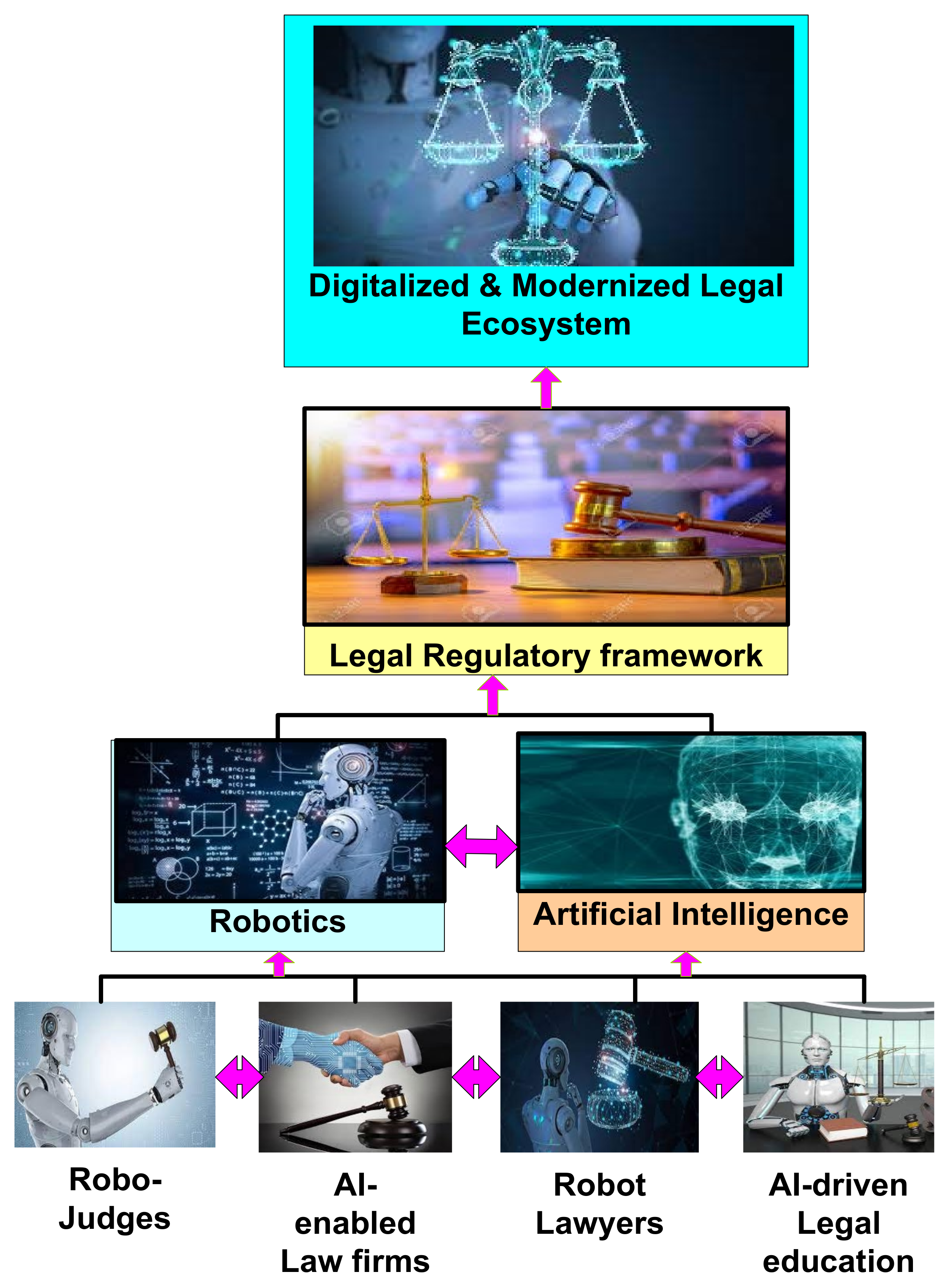
- The objective of the study is to understand the technological cornerstone of AI and Robotics in modernising and revolutionising the legal ecosystem.
- (b)
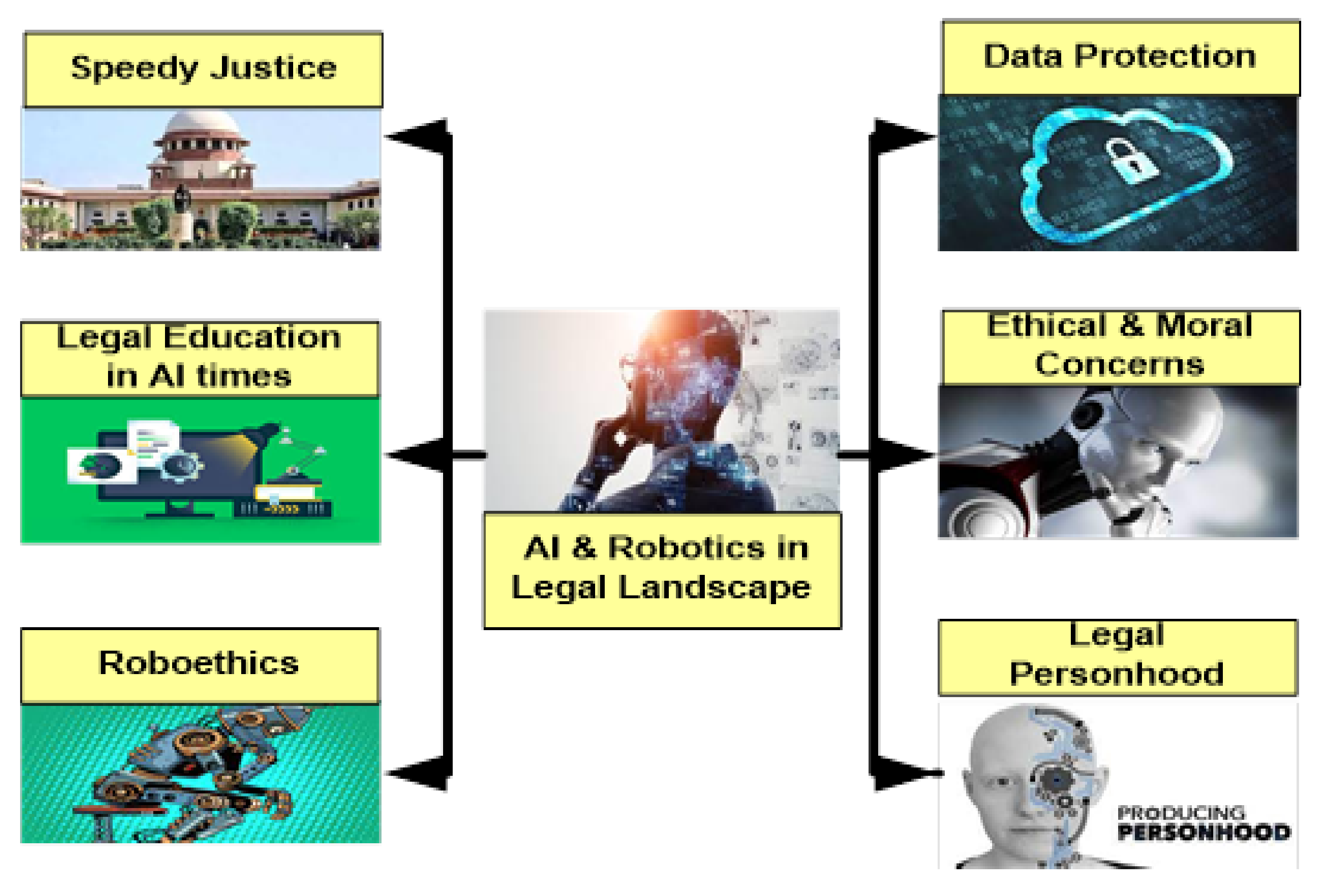
- In this study, the interaction of AI and Robotics with the law, as well as the associated legal concerns about privacy, legal personhood, data protection, evidence gathering, and so on, are considered and analysed in terms of the technological implications in the legal ecosystem in order to suggest the appropriate legal transformation.
- (c)
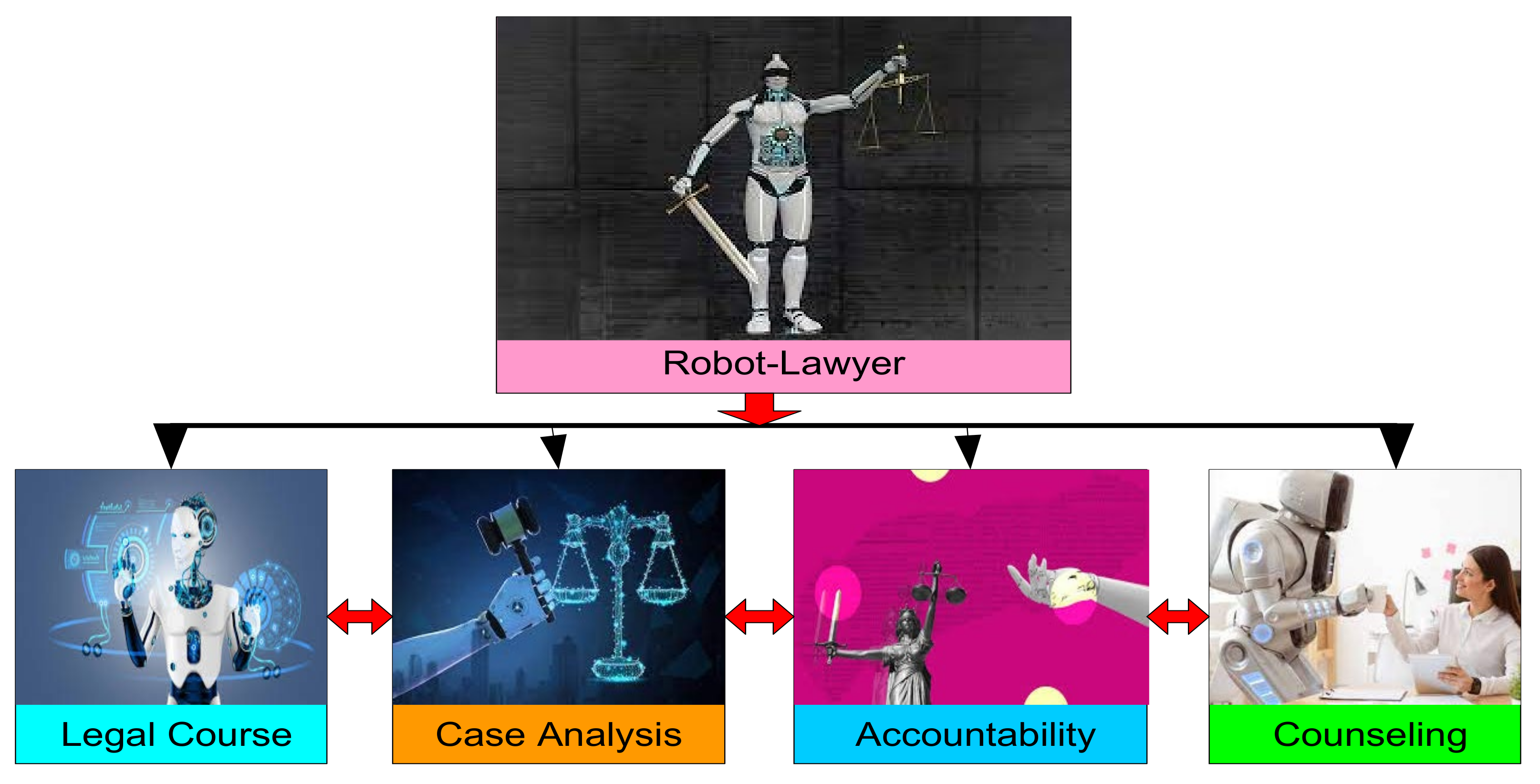
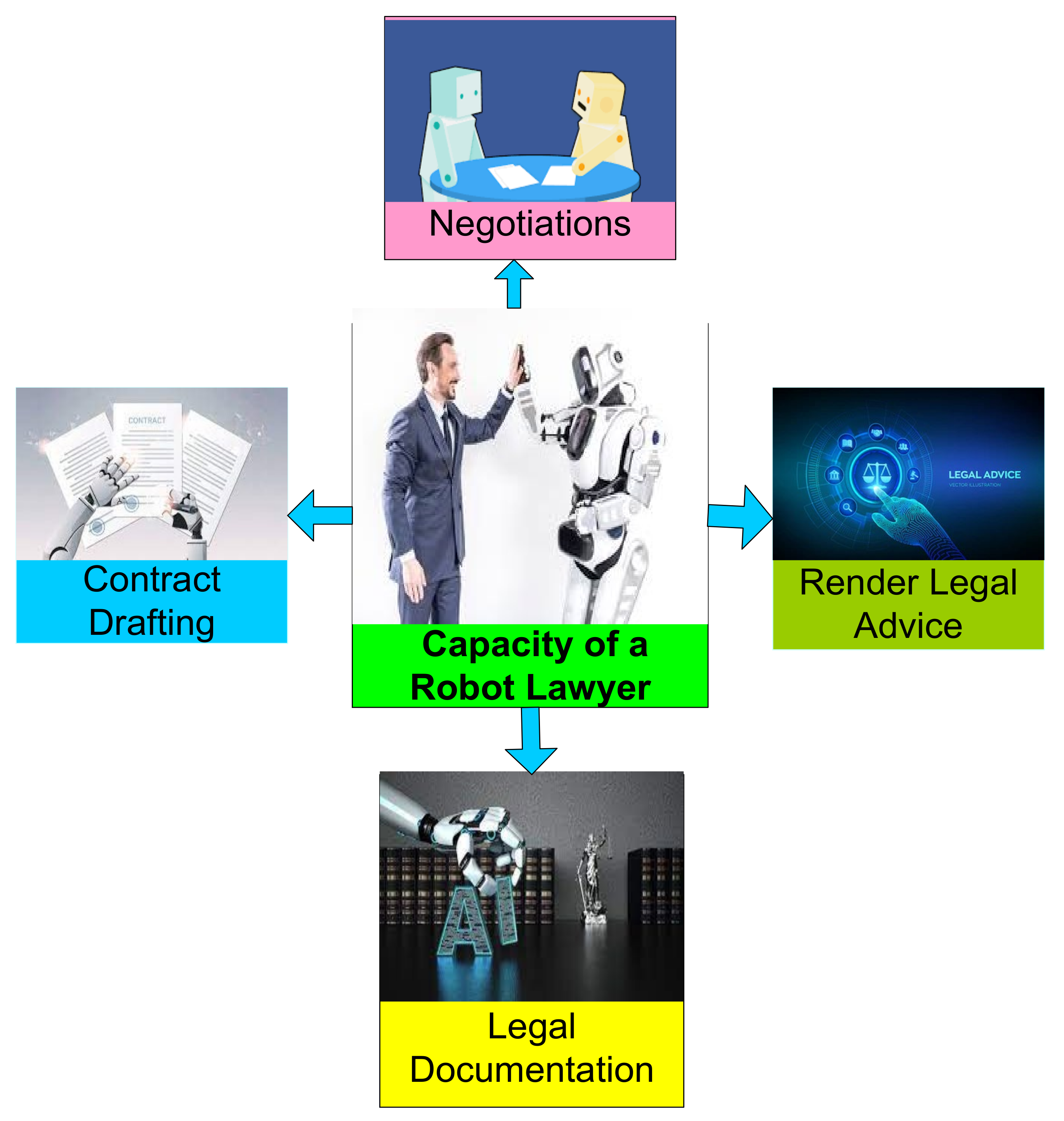
- In addition to this, the study identified key AI-assisted tools and tools that are playing vital role in contract drafting, vetting of contracts, case laws research, contract evaluation, rendering legal advice, etc.
2. Legal Overview of AI-Driven Technological Revamp in the Legal Ecosystem
3. The Symbiotic Interface of AI & Robotics with Law
4. Ethical Sword of Damocles Hanging over the Incorporation of Robots and AI Technologies
5. AI and Robotics Propelled Technological Impetus Compelling the Transformation of the Legal Ecosystem and Landscape
6. Examination of the EU Law on AI & Corresponding Legal Concerns
7. Beneficial Manifestations of AI & Robotics in Augmenting Legal Apparatus

| Company | Tools | Description |
|---|---|---|
| CasaMine [101] | CaseIQ | CaseMine is a platform for legal research and analysis based on the NCR. It uses AI to help find links between case laws. It helps to search for more than just keywords. The CaseIQ software is a “virtual legal research assistant” that automatically looks at the language of the brief and feeds it into a complex algorithm that predicts what might be missing from the brief or what other arguments could be made. CaseIQ gives suggestions in acts, keywords, or essential court cases to make the research more thorough and in-depth. |
| Canvass Analytics [102] | Canvass AI Platform | This tool helps industries grow by using analytics and predictions to help people make decisions based on data from operations. As a result, it improves the system’s programs for making things, keeping them in good shape, and managing energy. |
| eBrevia, Inc. [103] | eBrevia | In eBrevia, AI combines Machine Learning and Natural Language Processing to pull out relevant information from legal contracts and other documents. This makes due diligence and lease abstraction much faster and more accurate, which helps lawyers with their analysis. |
| Equivant (formerly Northpointe) [104] | COMPAS Algorithm | It’s an algorithm for gauging how likely it is that the defendant will conduct further crimes. Using a secret algorithm gives the inmate the specific guidance they need, which may include details about the Case that will be relevant at the sentence. |
| Everlaw [105] | Everlaw | Everlaw is a cloud-based technology in the electronic discovery that offers full lifecycle assistance. It helps establish scenes, evaluate evidence, and structure arguments. The software can use as many as 109 languages to translate documents. |
| Evisort [106] | Evisort | Evisort accelerates contract creation and management with NLP. AI-powered data search. It extracts contract data to simplify data collecting. Evisort tracks contract renewal and approval to improve workflow accountability. The software has a sophisticated text search and auto-alerts of important dates to prevent unnecessary costs or missed chances. |
| Hyperlex [107] | Hyperlex | Hyperlex monitors and manages contracts. From creativity to discussions, it helps. Comparisons help negotiate the best deal. Hyperlex simplifies contract validation by digitizing it. It sets expiry reminders. The programme analyses a contract’s clauses and language to prevent disagreement. |
| JPMorgan [108] | COIN | JPMorgan uses machine learning to automate its law firms. JPMorgan announced it has created and deployed COIN, which automates contract document evaluation. First, the corporation used the tool to analyse its credit contracts. Image recognition software identifies agreement patterns. The software evaluates contracts that took lawyers 360,000 h in s. The algorithm is more accurate than humans. COIN enhances contract review accuracy. Therefore, the bank’s investment in technology is also about quality. |
| Kira Systems [109] | Kira | By tracking the files of attorneys and judges, this site gives a better idea of who stands a better chance of winning the Case. |
| LawGeex [110] | LawGeex | LawGeex asserts that its software can validate contracts by determining whether or not they adhere to previously established guidelines. If they do not meet the requirements, the AI will offer suggestions for revision and acceptance. According to the organization, this is accomplished through a combination of machine learning, text analytics, statistical benchmarks, and the legal expertise of lawyers. |
| LexisNexis Legal & Professional [111] | Lexis Nexis Verdict and Settlement Analyser | Predicting and assessing success rates and modified case strategies help reduce error rates, improving the results of legal actions. |
| Legal Robot [112] | Legal Robot | Contract Analytics is a San Francisco-based AI firm Legal Robot’s response to the expanding field of contract evaluation software. The company claims its beta software can use machine learning and AI to convert legal content into numerical form and flag errors directly on the document. |
| Legal Risk Management AI [113] | 30-min Case Evaluator | This platform helps lawyers create Bots that automate the conversation and draft legal information of lawyer and client, and it also helps with guidance in the legal field and advice, making legal service more seamless. |
| Legal Geek [114] | Legal Geek | By automating the contract review process, Legal Geek gives lawyers more time to close better deals and build strong businesses. It helps solve problems by cutting down on time and money and providing up-to-date legal support, such as reviewing and writing contracts. |
| Luminance [115] | Luminance | An inconsistency in the provided document can be identified with the help of a pattern recognition algorithm. To identify potential danger in any of the scenarios described in the set of documents and to identify the occurrence of similar problems, sophisticated statistical probability analysis is performed. The Luminance technology sifts through contracts and legal documents, extracting the most relevant and salient details. In particular, it does not require training to read papers written in any language. |
| Leverton [116] | Leverton | Leverton is an AI-based law company primarily concentrating on the documentation associated with substantial real estate holdings. Because it is a platform for data extraction, it extracts all pertinent data, manages documents for reasoning-based decision-making, and uncovers and analyses data. This program, hosted on the cloud, can quickly scan contracts in twenty different languages. |
| Lex Machina, Inc. [117] | Lex Machina | It is helpful for quickly estimating the financial value of a case and the risks involved from both parties’ points of view during the litigation process. The program can examine arguments from both sides of a case by simulating jury instructions. When both the plaintiff and the defendant have less evidence to work with, the tool can be invaluable in hastening the process of reaching a mutually agreeable settlement out of court. If you need to examine a personal injury case, this edition is the one to choose. |
| Nearlaw.com [118] | NearLaw | AI is used to help lawyers, law firms, and companies find cases with the help of NearLaw. It figures out how vital Case Ranking is by using NLP technology. Most programming is done with Python, and the tech stack is built with Ruby. The tech team has also made a model only used for legal documents, judgments acts, and statutes. |
| Pensieve [119] | Mitra | Pensieve runs an AI-powered legal research platform called Mitra. It uses AI and Natural Language Processing to make law firms more efficient and has also been turned into an accelerator program. |
| Premonition [120] | Premonition AI | Lex machine, a subsidiary of LexisNexis, is a platform that offers data modeling services and predicts case outcomes using data collected from prior proceedings. |
| Rocket Lawyer Inc. [121] | Rocket Lawyer | Rocket Lawyer is an online legal technology company that offers services such as estate plans, reviewing legal documents, and checking your legal health. The site also has a list of lawyers that people and small businesses can call to discuss legal issues. It gives account holders access to online legal forms and helps with articles. It also offers consumers and businesses access to lawyers who can look over their legal documents, answer questions, and do other legal work. |
| Ross Intelligence [122] | Ross Intelligence | ROSS Intelligence develops AI-powered products for lawyers. Every lawsuit needs legal research. Links, cases, and material can overwhelm lawyers with limited research time. Lawyers can use ROSS Intelligence’s natural language search to get reading recommendations, case law, and secondary resources. |
| SpotDraft [123] | SpotDraft | SpotDraft is an AI-powered platform where clients can write and sign contracts, send automated reminders, payments, and more. It can look at legal documents and tell users where they need to negotiate. |
| Thomson Reuters Westlaw [124] | Westlaw Case Evaluator | Cases, court records, rulings, and agreement tendencies are analysed and estimated using the program. The ability to negotiate and reach an agreement is also provided. |
8. Recommendations
- (a)
- Legal Infrastructure
- (b)
- Regulatory framework
- (c)
- Law firms & Lawyers
- (d)
- Robot lawyers & Robo ethics
- (e)
- Legal Education
9. Conclusions
Author Contributions
Funding
Institutional Review Board Statement
Informed Consent Statement
Data Availability Statement
Conflicts of Interest
References
- Robbins, J. When Smart Is Not: Technology and Michio Kaku’s The Future of the Mind [Leading Edge]. IEEE Technol. Soc. Mag. 2016, 35, 29–31. [Google Scholar] [CrossRef]
- Relling, D. Doing Justice with Information Technology. Inf. Commun. Technol. Law 2006, 15, 189–200. [Google Scholar] [CrossRef]
- O’Sullivan, K.; Clark, S.; Marshall, K.; MacLachlan, M. A Just Digital framework to ensure equitable achievement of the Sustainable Development Goals. Nat. Commun. 2021, 12, 6345. [Google Scholar] [CrossRef] [PubMed]
- Adshead, D.; Thacker, S.; Fuldauer, L.I.; Hall, J.W. Delivering on the Sustainable Development Goals through long-term infrastructure planning. Glob. Environ. Chang. 2019, 59, 101975. [Google Scholar] [CrossRef]
- Hope, K.R., Jr. Peace, justice and inclusive institutions: Overcoming challenges to the implementation of Sustainable Development Goal 16. Glob. Chang. Peace Secur. 2019, 32, 57–77. [Google Scholar] [CrossRef]
- Mihret, E.T. Robotics and Artificial Intelligence. Int. J. Artif. Intell. Mach. Learn. 2020, 10, 57–78. [Google Scholar] [CrossRef]
- Nikolskaia, K.; Naumov, V. Artificial Intelligence in Law. In Proceedings of the 2020 International Multi-Conference on Industrial Engineering and Modern Technologies (FarEastCon), Vladivostok, Russia, 6–9 October 2020; pp. 18–21. [Google Scholar] [CrossRef]
- Mccapra, A. 326—Conservation in the age of the robot. J. Inst. Conserv. 2017, 40, 190–197. [Google Scholar] [CrossRef]
- Xie, Y. Application of Deep Neural Network Algorithm in the Analysis of Legal Precedent Citation Basis. Mob. Inf. Syst. 2022, 2022, 3383428. [Google Scholar] [CrossRef]
- Bues, M.-M.; Matthaei, E. LegalTech on the Rise: Technology Changes Legal Work Behaviours, But Does Not Replace Its Profession. In Liquid Legal: Transforming Legal into a Business Savvy, Information Enabled and Performance Driven Industry, 1st ed.; Kai, J., Schindler, D., Strathausen, R., Eds.; Springer: New York, NY, USA, 2017; pp. 89–109. [Google Scholar]
- Sloan, E. Robotics at War. Survival 2015, 57, 107–120. [Google Scholar] [CrossRef]
- Rutkin, A. AI will see you in court. New Sci. 2016, 229, 22. [Google Scholar] [CrossRef]
- Lee, J.; Davari, H.; Singh, J.; Pandhare, V. Industrial Artificial Intelligence for industry 4.0-based manufacturing systems. Manuf. Lett. 2018, 18, 20–23. [Google Scholar] [CrossRef]
- Zhang, Y.; Balochian, S.; Agarwal, P.; Bhatnagar, V.; Housheya, O.J. Artificial Intelligence and Its Applications 2014. Math. Probl. Eng. 2016, 2016, 3871575. [Google Scholar] [CrossRef]
- Dwivedi, Y.K.; Hughes, L.; Ismagilova, E.; Aarts, G.; Coombs, C.; Crick, T.; Duan, Y.; Dwivedi, R.; Edwards, J.; Eirug, A.; et al. Artificial Intelligence (AI): Multidisciplinary perspectives on emerging challenges, opportunities, and agenda for research, practice and policy. Int. J. Inf. Manag. 2019, 57, 101994. [Google Scholar] [CrossRef]
- Rajan, K.; Saffiotti, A. Towards a science of integrated AI and Robotics. Artif. Intell. 2017, 247, 1–9. [Google Scholar] [CrossRef]
- Ishii, K. Comparative legal study on privacy and personal data protection for robots equipped with artificial intelligence: Looking at functional and technological aspects. AI Soc. 2017, 34, 509–533. [Google Scholar] [CrossRef]
- Villaronga, E.F.; Kieseberg, P.; Li, T. Humans forget, machines remember: Artificial intelligence and the right to be forgotten. Comput. Law Secur. Rev. 2018, 34, 304–313. [Google Scholar] [CrossRef]
- Gordon, J.S. Building Moral Robots: Ethical Pitfalls and Challenges. Sci. Eng. Ethics 2020, 26, 141–157. [Google Scholar] [CrossRef]
- Hantrais, L.; Lenihan, A.T. Social dimensions of evidence-based policy in a digital society. Contemp. Soc. Sci. 2021, 16, 141–155. [Google Scholar] [CrossRef]
- Zekos, G.I. AI and Politics. In Political, Economic and Legal Effects of Artificial Intelligence: Governance, Digital Economy and Society; Springer International Publishing: Cham, Switzerland, 2022. [Google Scholar]
- Ishihara, K.; Fukushi, T. Introduction: Roboethics as an Emerging Field of Ethics of Technology. Account. Res. 2010, 17, 273–277. [Google Scholar] [CrossRef]
- Salmerón-Manzano, E. Legaltech and Lawtech: Global Perspectives, Challenges, and Opportunities. Laws 2021, 10, 24. [Google Scholar] [CrossRef]
- Fortes, P.R.B. Paths to Digital Justice: Judicial Robots, Algorithmic Decision-Making, and Due Process. Asian J. Law Soc. 2020, 7, 453–469. [Google Scholar] [CrossRef]
- Simmler, M.; Markwalder, N. Guilty Robots?–Rethinking the Nature of Culpability and Legal Personhood in an Age of Artificial Intelligence. Crim. Law Forum 2018, 30, 1–31. [Google Scholar] [CrossRef]
- McLachlan, S.; Kyrimi, E.; Dube, K.; Fenton, N.; Webley, L.C. Lawmaps: Enabling legal AI development through visualisation of the implicit structure of legislation and lawyerly process. Artif. Intell. Law 2022, 1–26. [Google Scholar] [CrossRef]
- Brunette, E.S.; Flemmer, R.; Flemmer, C. A Review of Artificial Intelligence. In Proceedings of the 4th International Conference on Autonomous Robots and Agents, Wellington, New Zealand, 10–12 February 2009. [Google Scholar]
- Zhang, C.; Lu, Y. Study on Artificial Intelligence: The State of the Art and Future Prospects. J. Ind. Inf. Integr. 2021, 23, 100224. [Google Scholar] [CrossRef]
- Mitchell, M. Artificial Intelligence Hits the Barrier of Meaning. Information 2019, 10, 51. [Google Scholar] [CrossRef]
- Brady, M. Robotics and Artificial Intelligence. In Robotics and Artificial Intelligence; Brady, M., Gerhardt, L.A., Davidson, H.F., Eds.; Springer: Berlin/Heidelberg, Germany, 1984; pp. 47–63. [Google Scholar] [CrossRef]
- Simpson, B. Special issue: Disrupting technology, disruptive norms: The role of law in a digital world. Inf. Commun. Technol. Law 2017, 26, 1–5. [Google Scholar] [CrossRef][Green Version]
- Karnouskos, S. Symbiosis with artificial intelligence via the prism of law, robots, and society. Artif. Intell. Law 2021, 30, 93–115. [Google Scholar] [CrossRef]
- Ashrafian, H. AIonAI: A Humanitarian Law of Artificial Intelligence and Robotics. Sci. Eng. Ethics 2014, 21, 29–40. [Google Scholar] [CrossRef]
- McNally, P.; Inayatullah, S. The rights of robots: Technology, culture and law in the 21st century. Futures 1988, 20, 119–136. [Google Scholar] [CrossRef]
- Bennett, B.; Daly, A. Recognising rights for robots: Can we? Will we? Should we? Law, Innov. Technol. 2020, 12, 60–80. [Google Scholar] [CrossRef]
- Loh, J. Responsibility and Robot Ethics: A Critical Overview. Philosophies 2019, 4, 58. [Google Scholar] [CrossRef]
- Janoski-Haehlen, E. Robots, Blockchain, ESI, Oh My!: Why Law Schools Are (or Should Be) Teaching Legal Technology. Leg. Ref. Serv. Q. 2019, 38, 77–101. [Google Scholar] [CrossRef]
- Tata, C. The Application of Judicial Intelligence and ‘Rules’ to Systems Supporting Discretionary Judicial Decision-Making. Artif. Intell. Law 1998, 6, 203–230. [Google Scholar] [CrossRef]
- Villaronga, E.F. ISO 13482: 2014 and Its Confusing Categories: Building a Bridge between Law and Robotics. In New Trends in Medical and Service Robots; Wenger, P., Chevallereau, C., Pisla, D., Bleuler, H., Rodić, A., Eds.; Springer International Publishing: Cham, Switzerland, 2014. [Google Scholar]
- Dervanović, D.I. Inhuman Lawyer: Developing Artificial Intelligence in the Legal Profession. In Robotics, AI and the Future of Law; Corrales, M., Fenwick, M., Forgó, N., Eds.; Springer: Singapore, 2018; pp. 209–234. [Google Scholar] [CrossRef]
- Linna, D.W. Evaluating Artificial Intelligence for Legal Services: Can “Soft Law” Lead to Enforceable Standards for Effectiveness? IEEE Technol. Soc. Mag. 2021, 40, 37–51. [Google Scholar] [CrossRef]
- Greenleaf, G.; Mowbray, A.; Chung, P. Building sustainable free legal advisory systems: Experiences from the history of AI & law. Comput. Law Secur. Rev. 2018, 34, 314–326. [Google Scholar] [CrossRef]
- Deltsova, N.V. Artificial Intelligence Technologies in the Field of Legal Services: Relevant Aspects. In Current Achievements, Challenges and Digital Chances of Knowledge Based Economy; Ashmarina, S.I., Mantulenko, V.V., Eds.; Springer: Cham, Switzerland, 2021; Volume 133, pp. 389–396. [Google Scholar]
- Gordon, T.F.; Walton, D. Legal reasoning with argumentation schemes. In Proceedings of the 12th International Conference on Artificial Intelligence and Law, Barcelona, Spain, 8–12 June 2009. [Google Scholar] [CrossRef]
- Ashley, K.; Branting, K.; Margolis, H.; Sunstein, C.R. Legal Reasoning and Artificial Intelligence: How Computers “Think” Like Lawyers. Univ. Chic. Law Sch. Roundtable 2001, 8, 1–28. [Google Scholar]
- Okamoto, K.S. Teaching Transactional Lawyering. SSRN Electron. J. 2009, 1, 69. [Google Scholar] [CrossRef][Green Version]
- Golding, M.P. The Logical Force of Arguments by Analogy in Common Law Reasoning. In Legal Reasoning, Legal Theory and Rights; Routledge: Oxfordshire, UK, 2007; pp. 67–69. [Google Scholar] [CrossRef]
- Sharma, G.D.; Yadav, A.; Chopra, R. Artificial intelligence and effective governance: A review, critique and research agenda. Sustain. Futures 2020, 2, 100004. [Google Scholar] [CrossRef]
- Ceccaroni, L.; Bibby, J.; Roger, E.; Flemons, P.; Michael, K.; Fagan, L.; Oliver, J.L. Opportunities and Risks for Citizen Science in the Age of Artificial Intelligence. Citiz. Science. Theory Pract. 2019, 4, 29. [Google Scholar] [CrossRef]
- Charles, J. AI and law enforcement. IEEE Intell. Syst. 1998, 13, 77–80. [Google Scholar] [CrossRef]
- Kathrani, P. An ‘Existential’ Shift? Technology and Some Questions for the Legal Profession. Leg. Ethics 2017, 20, 144–146. [Google Scholar] [CrossRef]
- Ashrafian, H. Artificial Intelligence and Robot Responsibilities: Innovating Beyond Rights. Sci. Eng. Ethics 2014, 21, 317–326. [Google Scholar] [CrossRef]
- Persaud, P.; Varde, A.S.; Wang, W. Can Robots Get Some Human Rights? A Cross-Disciplinary Discussion. J. Robot. 2021, 2021, 5461703. [Google Scholar] [CrossRef]
- Coeckelbergh, M. Robot rights? Towards a social-relational justification of moral consideration. Ethics Inf. Technol. 2010, 12, 209–221. [Google Scholar] [CrossRef]
- Sandewall, E. Ethics, Human Rights, the Intelligent Robot, and its Subsystem for Moral Beliefs. Int. J. Soc. Robot. 2019, 13, 557–567. [Google Scholar] [CrossRef]
- Gordon, J.-S.; Pasvenskiene, A. Human rights for robots? A literature review. AI Ethics 2021, 1, 579–591. [Google Scholar] [CrossRef]
- Robertson, J. Human Rights VS. Robot Rights: Forecasts from Japan. Crit. Asian Stud. 2014, 46, 571–598. [Google Scholar] [CrossRef]
- Dickens, B.; Cook, R. Legal and ethical issues in telemedicine and robotics. Int. J. Gynecol. Obstet. 2006, 94, 73–78. [Google Scholar] [CrossRef]
- Urquhart, L.; Reedman-Flint, D.; Leesakul, N. Responsible Domestic Robotics: Exploring Ethical Implications of Robots in the Home. J. Inf. Commun. Ethics Soc. 2019, 17, 246–272. [Google Scholar] [CrossRef]
- Bertolini, A.; Aiello, G. Robot companions: A legal and ethical analysis. Inf. Soc. 2018, 34, 130–140. [Google Scholar] [CrossRef]
- Bogue, R. Robot Ethics and Law: Part One: Ethics. Ind. Robot. Int. J. Robot. Res. Appl. 2014, 41, 335–339. [Google Scholar] [CrossRef]
- Danaher, J. Robots, law and the retribution gap. Ethics Inf. Technol. 2016, 18, 299–309. [Google Scholar] [CrossRef]
- Levy, D. The Ethical Treatment of Artificially Conscious Robots. Int. J. Soc. Robot. 2009, 1, 209–216. [Google Scholar] [CrossRef]
- Kaplan, A.; Haenlein, M. Rulers of the World, Unite! The Challenges and Opportunities of Artificial Intelligence. Bus. Horiz. 2019, 63, 37–50. [Google Scholar] [CrossRef]
- Księżak, P.; Wojtczak, S. AI versus robot: In search of a domain for the new European civil law. Law, Innov. Technol. 2020, 12, 297–317. [Google Scholar] [CrossRef]
- Tymchuk, Y.A.; Shkalenko, A.V. Analysis of the Impact of Robotic Legal Services on the Changing Institutional Environment of Economy and Law. In “Smart Technologies" for Society, State and Economy; Popkova, E.G., Sergi, B.S., Eds.; Springer International Publishing: Cham, Switzerland, 2021; Volume 155, pp. 1146–1158. [Google Scholar]
- Dutta, V.; Zielińska, T. Cybersecurity of Robotic Systems: Leading Challenges and Robotic System Design Methodology. Electronics 2021, 10, 2850. [Google Scholar] [CrossRef]
- Wischmeyer, T.; Rademacher, T. (Eds.) Regulating Artificial Intelligence; Springer Nature: Cham, Switzerland, 2019. [Google Scholar] [CrossRef]
- Caserta, S. Digitalization of the Legal Field and the Future of Large Law Firms. Laws 2020, 9, 14. [Google Scholar] [CrossRef]
- Donleavy, G.D. Evaluating the potential of office robotics. Long Range Plan. 1994, 27, 119–127. [Google Scholar] [CrossRef]
- Xu, N.; Wang, K.-J.; Lin, C.-Y. Technology Acceptance Model for Lawyer Robots with AI: A Quantitative Survey. Int. J. Soc. Robot. 2022, 14, 1043–1055. [Google Scholar] [CrossRef]
- Ho, J.-H.; Lee, G.-G.; Lu, M.-T. Exploring the Implementation of a Legal AI Bot for Sustainable Development in Legal Advisory Institutions. Sustainability 2020, 12, 5991. [Google Scholar] [CrossRef]
- Zhu, K.; Zheng, L. Based on Artificial Intelligence in the Judicial Field Operation Status and Countermeasure Analysis. Math. Probl. Eng. 2021, 2021, 9017181. [Google Scholar] [CrossRef]
- Sheliazhenko, Y. Computer Modeling of Personal Autonomy and Legal Equilibrium. In Cybernetics and Algorithms in Intelligent Systems; Silhavy, R., Ed.; Springer International Publishing: Cham, Switzerland, 2019; Volume 765, pp. 74–81. [Google Scholar] [CrossRef]
- Epifanova, T.V.; Vovchenko, N.G.; Toporov, D.A.; Pozdnyshov, A.N. Development of Legal Education and Machine-Readable Law in the Conditions of Economy Digitization. In Digital Economy: Complexity and Variety vs. Rationality, Proceedings of the Institute of Scientific Communications Conference 2020, Volgograd, Russia, 19–20 March 2020; Popkova, E., Sergi, B., Eds.; Springer International Publishing: Cham, Switzerland, 2020; Volume 87, pp. 971–979. [Google Scholar]
- Rajamaki, J.; Knuuttila, J. Law Enforcement Authorities’ Legal Digital Evidence Gathering: Legal, Integrity and Chain-of-Custody Requirement. In Proceedings of the 2013 European Intelligence and Security Informatics Conference, Uppsala, Sweden, 12–14 August 2013; pp. 198–203. [Google Scholar]
- Chan, S.; Camp, L.J. Law enforcement surveillance in the network society. IEEE Technol. Soc. Mag. 2002, 21, 22–30. [Google Scholar] [CrossRef]
- Langford, M. Taming the Digital Leviathan: Automated Decision-Making and International Human Rights. AJIL Unbound 2020, 114, 141–146. [Google Scholar] [CrossRef]
- Pagallo, U. Vital, Sophia, and Co.—The Quest for the Legal Personhood of Robots. Information 2018, 9, 230. [Google Scholar] [CrossRef]
- Solaiman, S.M. Legal personality of robots, corporations, idols and chimpanzees: A quest for legitimacy. Artif. Intell. Law 2016, 25, 155–179. [Google Scholar] [CrossRef]
- Vermeys, N. The Computer As the Court: How Will Artificial Intelligence Affect Judicial Processes? In New Pathways to Civil Justice in Europe: Challenges of Access to Justice, 1st edition; Kramer, X., Biard, A., Hoevenaars, J., Themeli, E., Eds.; Springer International Publishing: Cham, Switzerland, 2021; pp. 61–80. [Google Scholar]
- Gynnild, A. The Robot Eye Witness: Extending Visual Journalism through Drone Surveillance. Digit. Journal. 2014, 2, 334–343. [Google Scholar] [CrossRef]
- Pagallo, U. The Impact of Domestic Robots on Privacy and Data Protection, and the Troubles with Legal Regulation by Design. In Data Protection on the Move; Gutwirth, S., Leenes, R., De Hert, P., Eds.; Springer: Dordrecht, The Netherlands, 2016; pp. 387–410. [Google Scholar]
- Veale, M.; Borgesius, F.Z. Demystifying the Draft EU Artificial Intelligence Act—Analysing the good, the bad, and the unclear elements of the proposed approach. Comput. Law Rev. Int. 2021, 22, 97–112. [Google Scholar] [CrossRef]
- Explanatory Memorandum of the AIA, COM (2021) 206 Final. Available online: https://eur-lex.europa.eu/legal-content/EN/ALL/?uri=celex:52021PC0206 (accessed on 25 August 2022).
- Ebers, M.; Hoch, V.R.S.; Rosenkranz, F.; Ruschemeier, H.; Steinrötter, B. The European Commission’s Proposal for an Artificial Intelligence Act—A Critical Assessment by Members of the Robotics and AI Law Society (RAILS). J 2021, 4, 589–603. [Google Scholar] [CrossRef]
- Spindler, G. Der Vorschlag der EU-Kommission für eine Verordnung zur Regulierung der Künstlichen Intelligenz (KI-VO-E)—Ansatz, Instrumente, Qualität und Kontext. Comput. Und Recht 2021, 37, 361–374. (In German) [Google Scholar] [CrossRef]
- Wendehorst, C.; Duller, Y. European Parliament’s Policy Department for Citizens’ Rights and Constitutional Affairs. Biometric Recognition and Behavioural Detection, Assessing the Ethical Aspects of Biometric Recognition and Behavioural Detection Techniques with a Focus on Their Current and Future Use in Public Spaces. 2021. European Parliament Website. Available online: http://www.europarl.europa.eu/supporting-analyses (accessed on 29 September 2021).
- Ploeg, I.V.D. Security in the danger zone: Normative issues of next-generation biometrics. In Second Generation Biometrics: The Ethical, Legal and Social Context; Mordini, E., Tzovaras, D., Eds.; Springer: Dordrecht, The Netherlands, 2012; pp. 287–303. [Google Scholar]
- Grützmacher, M. Die zivilrechtliche Haftung für KI nach dem Entwurf der geplanten KI-VO—Potentielle zivilrechtliche Auswirkungen des geplanten KI-Sicherheitsrechts: Ein neues Schutzgesetz iSv § 823 Abs. 2 BGB am Horizont. Comput. Und Recht 2021, 37, 433–444. (In German) [Google Scholar] [CrossRef]
- EDPB-EDPS, Joint Opinion 5/2021 on the Proposal for a Regulation of the European Parliament and of the Council Laying down Harmonised Rules on Artificial Intelligence (Artificial Intelligence Act). European Data Protection Board Website. 2021. Available online: https://edpb.europa.eu/our-work-tools/our-documents/edpbedps-joint-opinion/edpb-edps-joint-opinion-52021-proposal_en (accessed on 20 August 2022).
- Ermakova, E.P.; Frolova, E.E. Using Artificial Intelligence in Dispute Resolution. In Smart Technologies for the Digitisation of Industry: Entrepreneurial Environment; Inshakova, A.O., Frolova, E.E., Eds.; Springer: Singapore, 2022; Volume 254, pp. 131–142. [Google Scholar] [CrossRef]
- Pagallo, U. What Robots Want: Autonomous Machines, Codes and New Frontiers of Legal Responsibility. In Human Law and Computer Law: Comparative Perspectives; Hildebrandt, M., Gaakeer, J., Eds.; Springer: Dordrecht, The Netherlands, 2013; pp. 47–65. [Google Scholar] [CrossRef]
- De Sousa, W.G.; Fidelis, R.A.; Bermejo, P.H.D.S.; Gonçalo, A.G.d.S.; Melo, B.D.S. Artificial intelligence and speedy trial in the judiciary: Myth, reality or need? A case study in the Brazilian Supreme Court (STF). Gov. Inf. Q. 2021, 39, 101660. [Google Scholar] [CrossRef]
- Khasianov, A.; Alimova, I.; Marchenko, A.; Nurhambetova, G.; Tutubalina, E.; Zuev, D. Lawyer’s Intellectual Tool for Analysis of Legal Documents in Russian. In Proceedings of the 2018 International Conference on Artificial Intelligence Applications and Innovations (IC-AIAI), Nicosia, Cyprus, 31 October–2 November 2018; pp. 42–46. [Google Scholar] [CrossRef]
- Stockdale, M.; Mitchell, R. Legal Advice Privilege and Artificial Legal Intelligence: Can Robots Give Privileged Legal Advice? Int. J. Evid. Proof 2019, 23, 422–439. [Google Scholar] [CrossRef]
- Xu, N.; Wang, K.-J. Adopting robot lawyer? The extending artificial intelligence robot lawyer technology acceptance model for legal industry by an exploratory study. J. Manag. Organ. 2019, 27, 867–885. [Google Scholar] [CrossRef]
- Hongdao, Q.; Bibi, S.; Khan, A.; Ardito, L.; Khaskheli, M.B. Legal Technologies in Action: The Future of the Legal Market in Light of Disruptive Innovations. Sustainability 2019, 11, 1015. [Google Scholar] [CrossRef]
- Roper, V.; Dunn, D.R.; Rasiah, S. Revisiting “Pressing Problems in the Law: What Is the Law School for?” 20 Years On. Law Teach. 2020, 54, 455–464. [Google Scholar] [CrossRef]
- Sil, R.; Roy, A.; Bhushan, B.; Mazumdar, A.K. Artificial intelligence and machine learning based legal application: The state-of-the-art and future research trends. In Proceedings of the 2019 International Conference on Computing, Communication and Intelligent Systems (ICCCIS), Greater Noida, India, 18–19 October 2019; pp. 57–62. [Google Scholar]
- CaseMine Home Page. Available online: https://casemine.com/ (accessed on 10 September 2022).
- CanVass Home Page. Available online: https://www.canvass.io/ (accessed on 10 September 2022).
- eBrevia Home Page. Available online: https://ebrevia.com/ (accessed on 10 September 2022).
- Equivant Home Page. Available online: https://www.equivant.com/ (accessed on 10 September 2022).
- Everlaw Home Page. Available online: https://www.everlaw.com/ (accessed on 10 September 2022).
- Evisort Home Page. Available online: https://www.evisort.com/ (accessed on 10 September 2022).
- Hyperlex Home Page. Available online: https://hyperlex.ai/en/ (accessed on 10 September 2022).
- Sabharwal, C.L.; Anjum, B. Robo-revolution in the financial sector. In Proceedings of the 2018 International Conference on 770 Computational Science and Computational Intelligence (CSCI), Las Vegas, NV, USA, 12–14 December 2018. [Google Scholar]
- Kira Home Page. Available online: https://kirasystems.com/ (accessed on 10 September 2022).
- Lawgeex Home Page. Available online: https://www.lawgeex.com/ (accessed on 10 September 2022).
- LexisNexis Home Page. Available online: https://www.lexisnexis.com/en-us/gateway.page (accessed on 10 September 2022).
- Legal Robot Home Page. Available online: https://legalrobot.com/ (accessed on 10 September 2022).
- Win Before Trial Home Page. Available online: http://www.winbeforetrial.com (accessed on 10 September 2022).
- Legal Geek Home Page. Available online: https://www.legalgeek.co/ (accessed on 10 September 2022).
- Luminance Home Page. Available online: https://www.luminance.com (accessed on 10 September 2022).
- Leverton AI Home Page. Available online: https://www.leverton.ai/ (accessed on 10 September 2022).
- Lex Machina Home Page. Available online: https://lexmachina.com/ (accessed on 10 September 2022).
- NearLaw Home Page. Available online: https://nearlaw.com/ (accessed on 10 September 2022).
- Pensieve Home Page. Available online: https://pensieve.co.in/ (accessed on 10 September 2022).
- Premonition AI Home Page. Available online: https://premonition.ai/ (accessed on 10 September 2022).
- Rocket Lawyer Home Page. Available online: https://www.rocketlawyer.com/ (accessed on 10 September 2022).
- Ross Intelligence About Us Page. Available online: https://www.rossintelligence.com/about-us (accessed on 10 September 2022).
- SpotDraft Home Page. Available online: https://spotdraft.com/ (accessed on 10 September 2022).
- Thomson Reuters Legal Home Page. Available online: https://legal.thomsonreuters.com/en (accessed on 10 September 2022).
- Re, R.M.; Solow-Niederman, A. Developing artificially intelligent justice. Stanf. Technol. Law Rev. 2019, 22, 242. [Google Scholar]
- Zhong, H.; Xiao, C.; Tu, C.; Zhang, T.; Liu, Z.; Sun, M. How does NLP benefit legal system: A summary of legal artificial intelligence. arXiv 2004, arXiv:2004.12158. [Google Scholar]

Publisher’s Note: MDPI stays neutral with regard to jurisdictional claims in published maps and institutional affiliations. |
© 2022 by the authors. Licensee MDPI, Basel, Switzerland. This article is an open access article distributed under the terms and conditions of the Creative Commons Attribution (CC BY) license (https://creativecommons.org/licenses/by/4.0/).
Share and Cite
Bhatt, H.; Bahuguna, R.; Singh, R.; Gehlot, A.; Akram, S.V.; Priyadarshi, N.; Twala, B. Artificial Intelligence and Robotics Led Technological Tremors: A Seismic Shift towards Digitizing the Legal Ecosystem. Appl. Sci. 2022, 12, 11687. https://doi.org/10.3390/app122211687
Bhatt H, Bahuguna R, Singh R, Gehlot A, Akram SV, Priyadarshi N, Twala B. Artificial Intelligence and Robotics Led Technological Tremors: A Seismic Shift towards Digitizing the Legal Ecosystem. Applied Sciences. 2022; 12(22):11687. https://doi.org/10.3390/app122211687
Chicago/Turabian StyleBhatt, Hitesh, Rajesh Bahuguna, Rajesh Singh, Anita Gehlot, Shaik Vaseem Akram, Neeraj Priyadarshi, and Bhekisipho Twala. 2022. "Artificial Intelligence and Robotics Led Technological Tremors: A Seismic Shift towards Digitizing the Legal Ecosystem" Applied Sciences 12, no. 22: 11687. https://doi.org/10.3390/app122211687
APA StyleBhatt, H., Bahuguna, R., Singh, R., Gehlot, A., Akram, S. V., Priyadarshi, N., & Twala, B. (2022). Artificial Intelligence and Robotics Led Technological Tremors: A Seismic Shift towards Digitizing the Legal Ecosystem. Applied Sciences, 12(22), 11687. https://doi.org/10.3390/app122211687