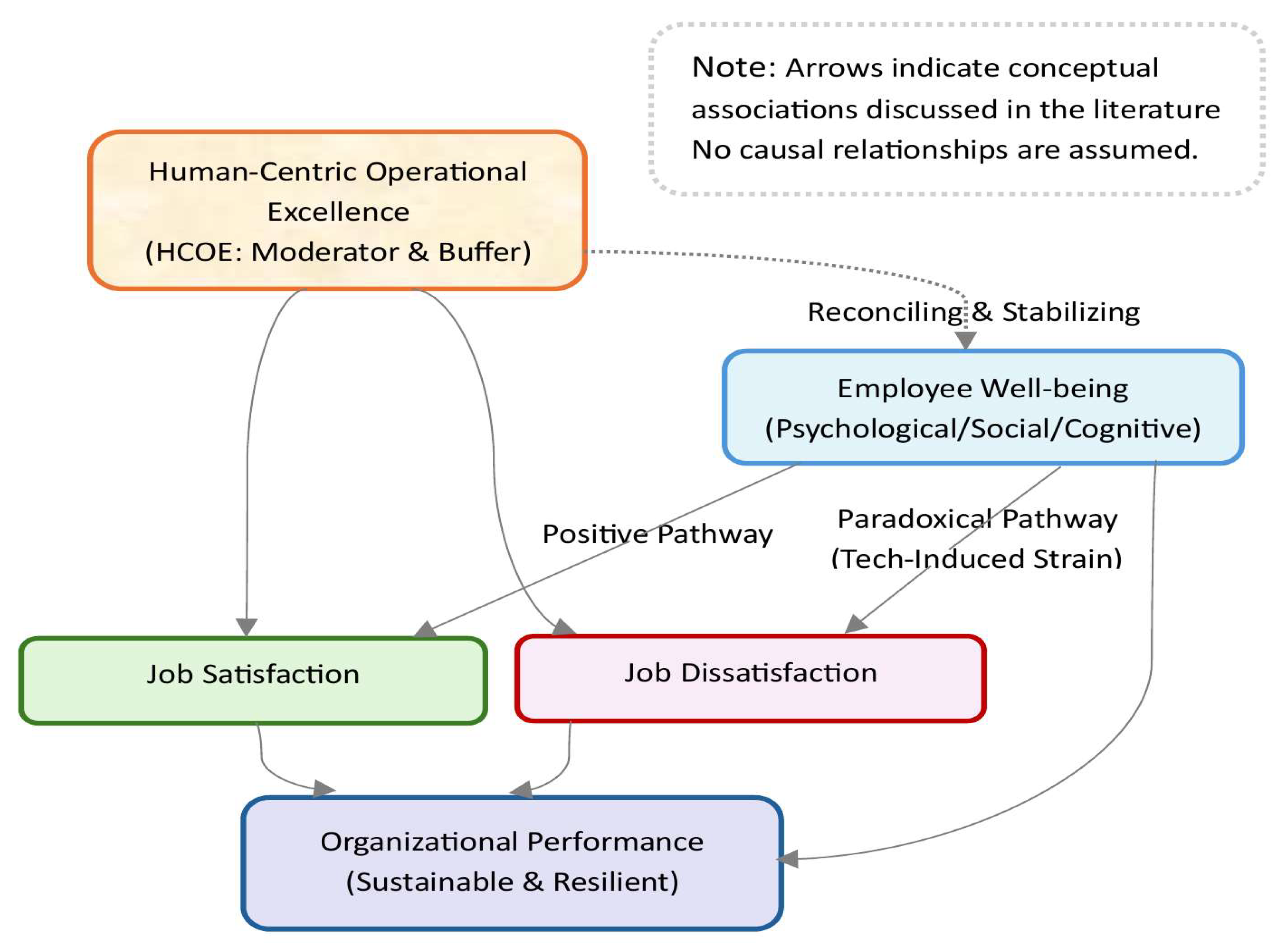
Employee Well-Being, Job Satisfaction and Organizational Performance: An Integrative Review Through the Lens of Industry 5.0




Abstract
1. Introduction
- RQ1. How are employee well-being and job satisfaction conceptualized in the industry 5.0 literature, and what conceptual fragmentation emerges across studies?
- RQ2. How does the literature link employee well-being and job satisfaction to organizational performance in Industry 5.0 contexts, and what contextual conditions shape these relationships?
- RQ3. How is human-centric operational excellence positioned as an interpretive lens in the literature on employee well-being, job satisfaction, and organizational performance within Industry 5.0 work systems?
2. Theoretical Background
2.1. Employee Well-Being in Digitally Mediated Work Systems
2.2. Job Satisfaction and Dissatisfaction in Digitally Mediated Work Systems
2.3. Industry 5.0 as a Context for Human-Centric Work Systems and Operational Excellence
3. Methodological Approach
- Integrative Review Design and PRISMA-Guided Screening
- b.
- Literature Search Strategy
- c.
- Inclusion and Exclusion Criteria
- d.
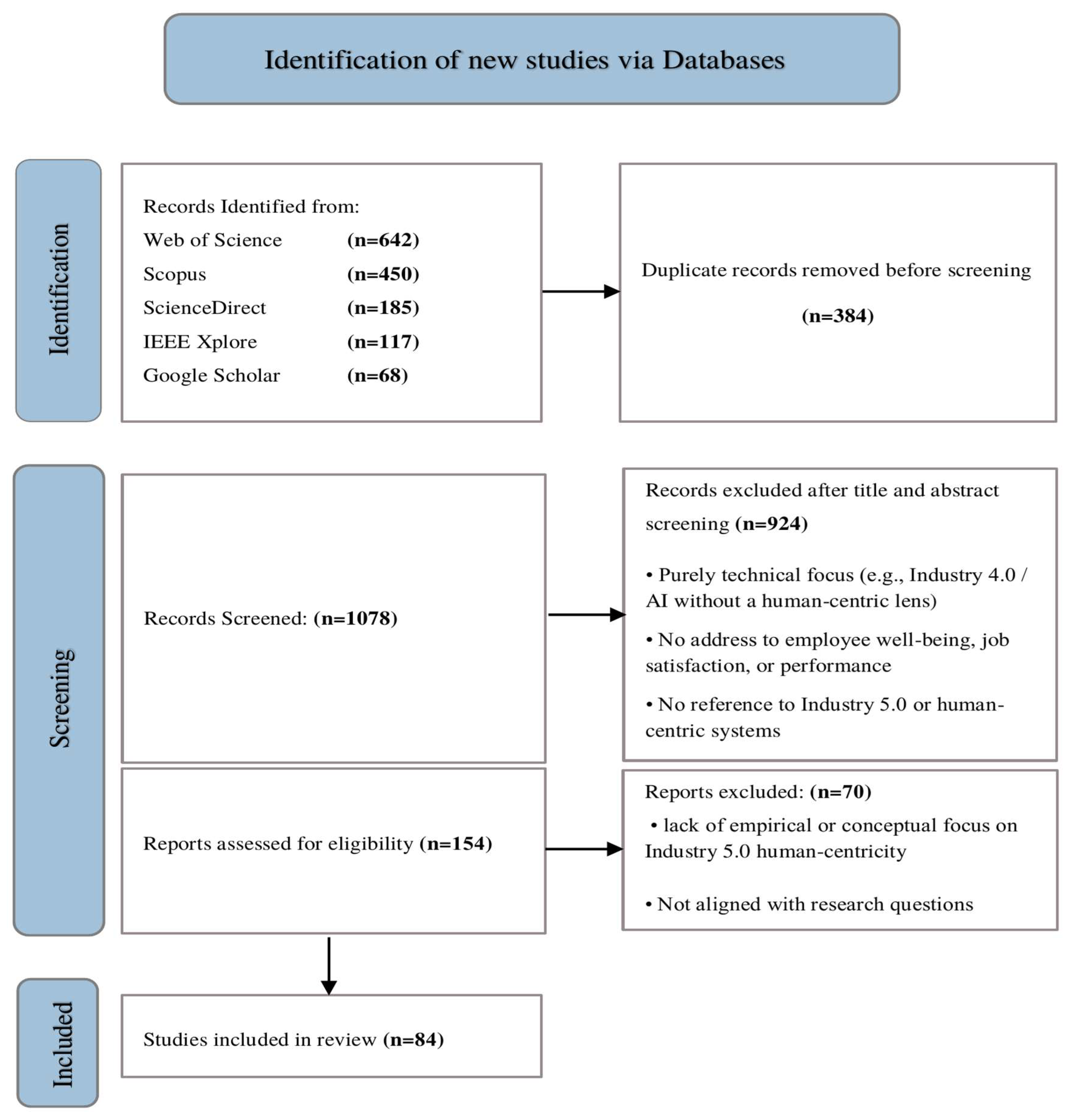
- Screening and Selection Process (PRISMA 2020-Compliant)
- e.
- Quality Appraisal and Rigor
- f.
- Data Analysis and Thematic Synthesis
4. Results: Thematic Synthesis of Literature
- a.
- Descriptive Summary of Included Studies
- i.
- Characteristics of Sampled Studies
- ii.
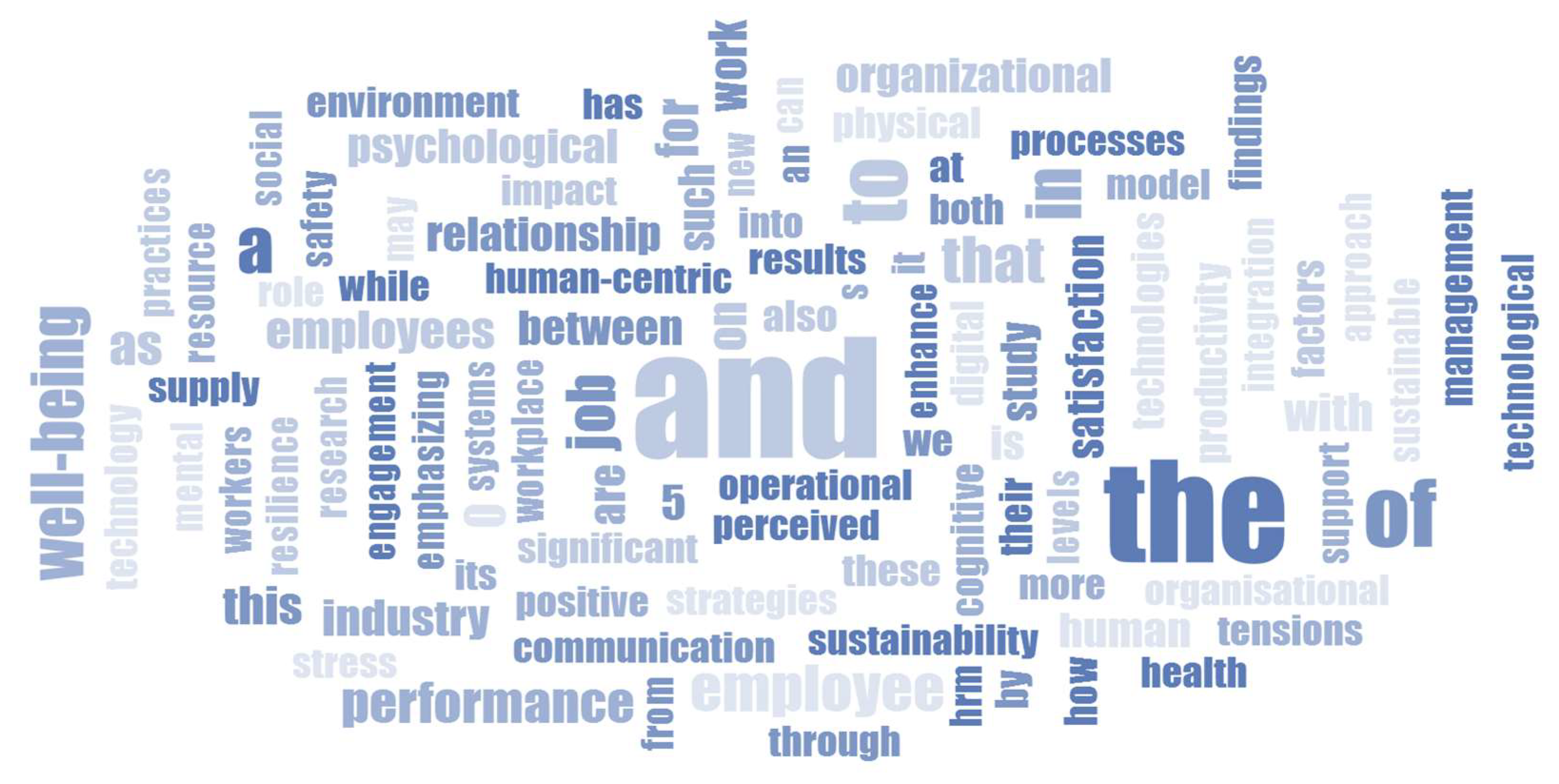
- Initial Thematic Coding Overview
- b.
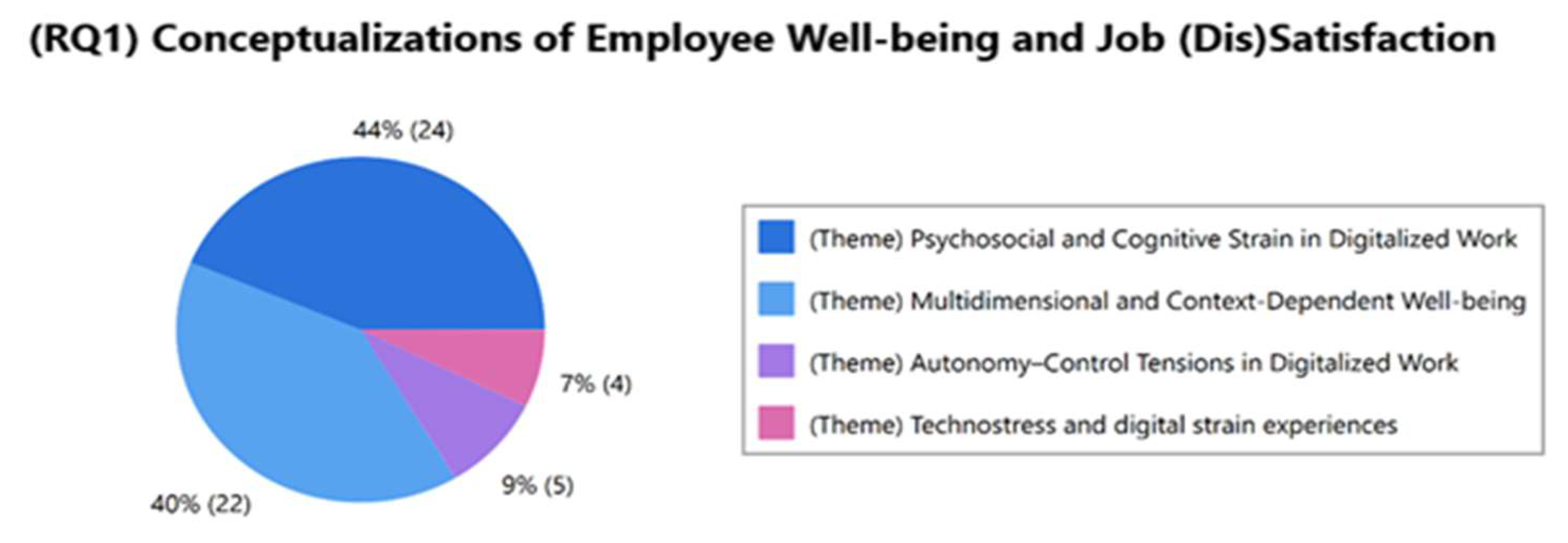
- Reconceptualizing Employee Well-being and Job satisfaction in Industry 5.0 (RQ1)
- i.
- The Role of Meaningful Work
- ii.
- Dimensional Nature of Well-being in Digitally Mediated Work
- c.
- Paradoxical Dynamics in Human–Technology Interaction (RQ1)
- i.
- Sources of Technostress and Digital Fatigue.
- ii.
- The Autonomy–Control Paradox: Algorithmic Management vs. Employee Agency
- iii.
- The Collaboration Paradox: Human–Cobot Synergy and Job Security Risks
- d.
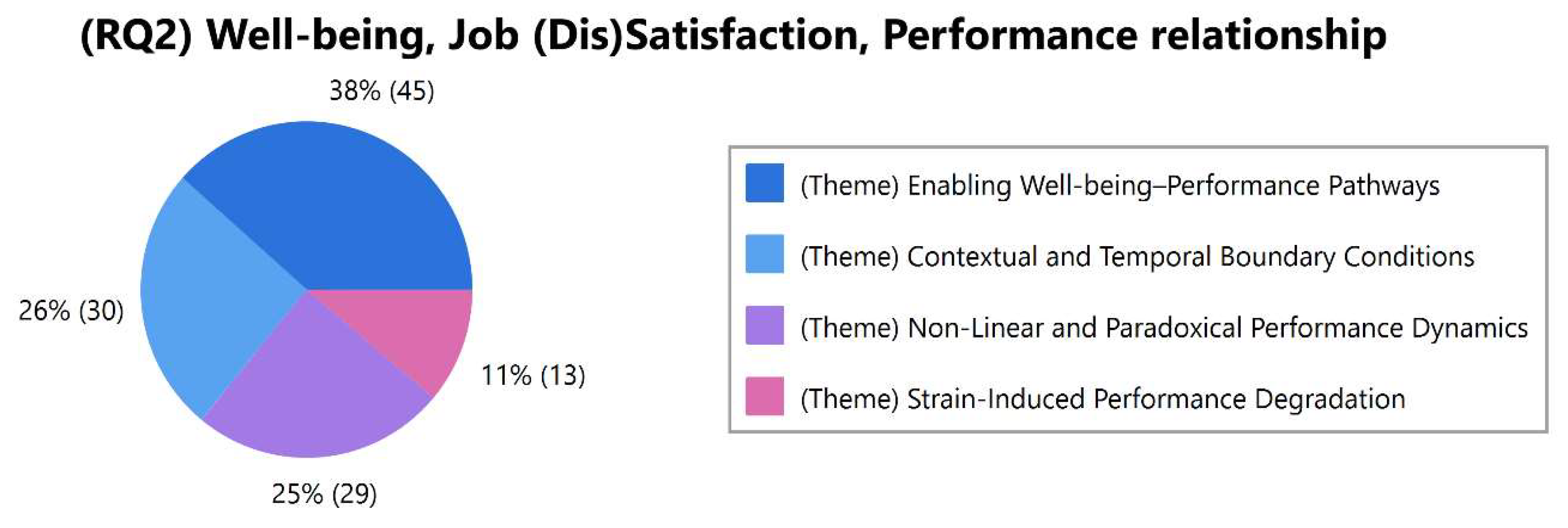
- Performance Implications of Well-being and Job satisfaction (RQ2)
- i.
- Individual-Level Outcomes: Creativity, Resilience, and Digital Fluency
- ii.
- Organizational-Level Outcomes: Sustainable Productivity and Social Value
- iii.
- Non-Linear and Contingent Relationships: Coexistence of High Performance with Low Well-being
5. Human-Centric Operational Excellence (HCOE): An Integrative Interpretive Framework
- a.
- HCOE: Conceptual Foundations, Core Dimensions, and Operating Conditions
- b.
- Propositions for Future Research
6. Discussion
6.1. Integrative Interpretation of the Well-Being–(Dis)Satisfaction–Performance Nexus
6.2. Managerial and Policy Implications
6.3. Limitations of the Review
7. Conclusions
Author Contributions
Funding
Institutional Review Board Statement
Informed Consent Statement
Data Availability Statement
Conflicts of Interest
Appendix A. Coding Framework Resulting from Inductive Thematic Synthesis
| Research Question | Theme | Sub-Theme | Representative Codes | No. of Studies (n = 84) |
| RQ1 | Psychosocial and cognitive strain in digitalized work | Cognitive and emotional strain | Cognitive workload and mental fatigue; psychological strain and emotional exhaustion | 21 |
| RQ1 | Multidimensional and context-dependent well-being | Conceptual properties of well-being | Multidimensional and context-dependent well-being | 20 |
| RQ1 | Technostress and digital strain experiences | Digital strain experiences | Technostress; digital strain | 22 |
| RQ1 | Autonomy–control tensions in digitalized work | Autonomy–control paradox | Autonomy versus control in digitalized work | 5 |
| RQ2 | Enabling well-being–performance pathways | Positive and mediated effects | Positive well-being–performance associations; job satisfaction as a mediator of performance outcomes | 31 |
| RQ2 | Strain-induced performance degradation | Performance erosion mechanisms | Burnout and fatigue undermining performance quality; technostress impairing productivity and decision quality | 12 |
| RQ2 | Non-linear and paradoxical performance dynamics | Paradoxical coexistence | Non-linear and paradoxical performance effects; performance gains coexisting with employee strain | 24 |
| RQ2 | Contextual and temporal boundary conditions | Contextual and temporal moderators | Contextual moderators shaping well-being–performance links; short-term efficiency versus long-term human sustainability | 27 |
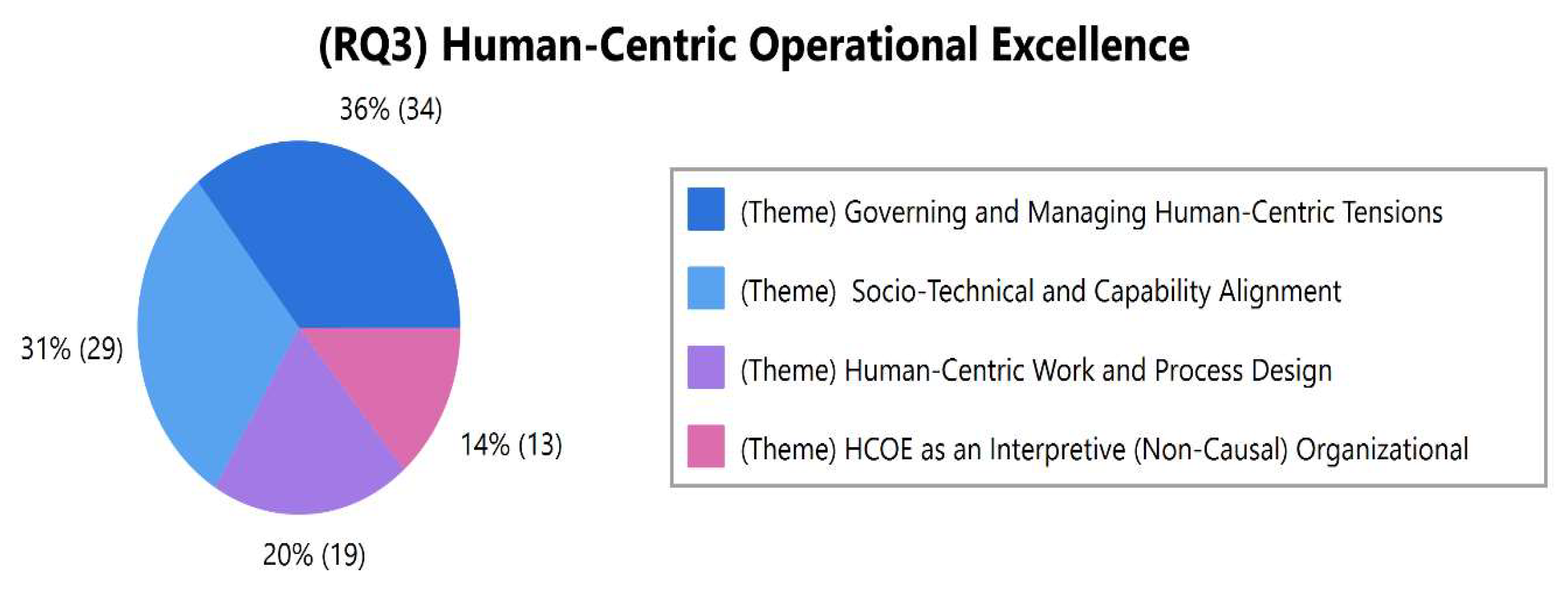
| RQ3 | Human-centric work and process design | Human-centered system design | Human-centric work system and process design; meaningful work design; employee participation and voice | 19 |
| RQ3 | Socio-technical and capability alignment | Human–technology integration | Socio-technical alignment; human–technology collaboration and augmentation logic; continuous capability development and reskilling | 18 |
| RQ3 | Governing and managing human-centric tensions | Governance and ethical safeguards | Balancing operational efficiency with employee well-being; Ethical governance of advanced digital technologies | 27 |
| RQ3 | HCOE as an interpretive lens | Non-causal integrative perspective | HCOE as an interpretive (non-causal) organizational lens | 13 |
References
- Adel, A. (2022). Future of industry 5.0 in society: Human-centric solutions, challenges and prospective research areas. Journal of Cloud Computing, 11, 40. [Google Scholar] [CrossRef]
- Alves, J., Lima, T. M., & Gaspar, P. D. (2023). Is industry 5.0 a human-centred approach? A systematic review. Processes, 11(1), 193. [Google Scholar] [CrossRef]
- Antonaci, F. G., Olivetti, E. C., Marcolin, F., Angelica, I., Jimenez, C., Eynard, B., Vezzetti, E., & Moos, S. (2024). Workplace well-being in Industry 5.0: A worker-centered systematic review. Sensors, 24(17), 5473. [Google Scholar] [CrossRef]
- Bassi, G., Orso, V., Salcuni, S., & Gamberini, L. (2025). Understanding workers’ well-being and cognitive load in human-cobot collaboration: Systematic review. Journal of Medical Internet Research, 27, e75658. [Google Scholar] [CrossRef]
- Bhoir, M., & Sinha, V. (2024). Employee well-being human resource practices: A systematic literature review and directions for future research. Future Business Journal, 10(1), 95. [Google Scholar] [CrossRef]
- Brayfield, A. H., & Rothe, H. F. (1951). An index of job satisfaction. Journal of Applied Psychology, 35(5), 307–311. [Google Scholar] [CrossRef]
- Caiado, R. G. G., Scavarda, L. F., Azevedo, B. D., Nascimento, D. L. de M., & Quelhas, O. L. G. (2022). Challenges and Benefits of sustainable Industry 4.0 for operations and supply chain management—A framework headed toward the 2030 agenda. Sustainability, 14(2), 830. [Google Scholar] [CrossRef]
- Cameron, L. D. (2024). The making of the ”Good Bad“ job: How algorithmic management manufactures consent through constant and confined choices. Administrative Science Quarterly, 69(2), 458–514. [Google Scholar] [CrossRef]
- Carvalho, A. M., Sampaio, P., Rebentisch, E., Carvalho, J. Á., & Saraiva, P. (2019). Operational excellence, organisational culture and agility: The missing link? Total Quality Management and Business Excellence, 30(13–14), 1495–1514. [Google Scholar] [CrossRef]
- Carvalho, A. M., Sampaio, P., Rebentisch, E., Carvalho, J. Á., & Saraiva, P. (2021). The influence of operational excellence on the culture and agility of organizations: Evidence from industry. International Journal of Quality and Reliability Management, 38(7), 1520–1549. [Google Scholar] [CrossRef]
- Dacre, N., Yan, J., Frei, R., Al-Mhdawi, M. K. S., & Dong, H. (2024). Advancing sustainable manufacturing: A systematic exploration of Industry 5.0 supply chains for sustainability, human-centricity, and resilience. Production Planning and Control, 36(11), 1499–1528. [Google Scholar] [CrossRef]
- Dehbozorgi, M. H., Postell, J., Ward, D., Leardi, C., Sullivan, B. P., & Rossi, M. (2024). Human in the loop: Revolutionizing Industry 5.0 with design thinking and systems thinking. Proceedings of the Design Society, 4, 245–254. [Google Scholar] [CrossRef]
- Delfanti, A. (2021). Machinic dispossession and augmented despotism: Digital work in an Amazon warehouse. New Media & Society, 23(1), 39–55. [Google Scholar] [CrossRef]
- Diener, E., Heintzelman, S. J., Kushlev, K., Tay, L., Wirtz, D., & Lutes, L. D. (2017). Findings all psychologists should know from the new science on subjective well-being. Canadian Psychology, 58(2), 87–104. [Google Scholar] [CrossRef]
- Fisher, C. D. (2014). Conceptualizing and measuring wellbeing at work (pp. 1–25). John Wiley & Sons, Inc. [Google Scholar]
- Fraboni, F., Brendel, H., & Pietrantoni, L. (2023). Evaluating organizational guidelnes for enhancing psychological well-being, safety, and performance in technology integration. Sustainability, 15(10), 8113. [Google Scholar] [CrossRef]
- Gao, H., Xue, X., Zhu, H., & Huang, Q. (2025). Exploring the digitalization paradox: The impact of digital technology convergence on manufacturing firm performance. Journal of Manufacturing Technology Management, 36(2), 277–306. [Google Scholar] [CrossRef]
- Ghazy, K., & Fedorova, A. (2022). The evolution of well-being approach within the Industry 5.0 concept. Human Progress, 8(3), 12. [Google Scholar] [CrossRef]
- Ghobakhloo, M., Fathi, M., Okwir, S., & Al-emran, M. (2025). Adaptive social manufacturing: A human-centric, resilient, and sustainable framework for advancing Industry 5.0. International Journal of Production Research, 64(3), 1127–1160. [Google Scholar] [CrossRef]
- Gomaa, A. H. (2025). Achieving operational excellence in manufacturing supply chains using lean six sigma: A case study approach. International Journal of Lean Six Sigma, 17(2), 614–648. [Google Scholar] [CrossRef]
- Grabowska, S., Saniuk, S., & Gajdzik, B. (2022). Industry 5.0: Improving humanization and sustainability of Industry 4.0. Scientometrics, 127(6), 3117–3144. [Google Scholar] [CrossRef]
- Grant, A. M., Christianson, M. K., & Price, R. H. (2007). Happiness, health, or relationships? Managerial practices and employee well-being tradeoffs executive overview. Academy of Management Perspectives, 21, 51–63. [Google Scholar] [CrossRef]
- Grosse, E. H., Sgarbossa, F., Berlin, C., & Neumann, W. P. (2023). Human-centric production and logistics system design and management: Transitioning from Industry 4.0 to Industry 5.0. International Journal of Production Research, 61(22), 7749–7759. [Google Scholar] [CrossRef]
- Guest, D. E. (2017). Human resource management and employee well-being: Towards a new analytic framework. Human Resource Management Journal, 27, 22–38. [Google Scholar] [CrossRef]
- Ho, H., & Kuvaas, B. (2020). Human resource management systems, employee well-being, and firm performance from the mutual gains and critical perspectives: The well-being paradox. Human Resource Management, 59(3), 235–253. [Google Scholar] [CrossRef]
- Hong, Q. N., Fàbregues, S., Bartlett, G., Boardman, F., Cargo, M., Dagenais, P., Gagnon, M. P., Griffiths, F., Nicolau, B., O’Cathain, A., & Rousseau, M. C. (2018). The mixed methods appraisal tool (MMAT) version 2018 for information professionals and researchers. Education for Information, 34, 285–291. [Google Scholar] [CrossRef]
- Hussain, Z., Ibrahim, S., & Vasudevan, A. (2025). Exploring the effect of Industry 5.0 human-centric sustainability and green knowledge automation in enhancing green process adaptability: The mediating role of sustainable human-tech interaction. Journal of Cleaner Production, 537, 147240. [Google Scholar] [CrossRef]
- Ivanov, D. (2023). The Industry 5.0 framework: Viability-based integration of the resilience, sustainability, and human-centricity perspectives. International Journal of Production Research, 61(5), 1683–1695. [Google Scholar] [CrossRef]
- Jarrahi, M. H., Newlands, G., Lee, M. K., Wolf, C. T., Kinder, E., & Sutherland, W. (2021). Algorithmic management in a work context. Big Data & Society, 8(2), 1–14. [Google Scholar] [CrossRef]
- John-Loh, F. W. (2025). Modelling employee well-being: A quantitative comparison of the hedonic, eudaimonic, social, JD-R, and PERMA frameworks in occupational settings. International Journal of Innovative Science and Research Technology, 10(6), 1380–1390. [Google Scholar] [CrossRef]
- Judge, T. A., Weiss, H. M., Kammeyer-mueller, J. D., & Hulin, C. L. (2017). Job attitudes, job satisfaction, and job affect: A century of continuity and of change. Journal of Applied Psychology, 102(3), 356–374. [Google Scholar] [CrossRef]
- Kaasinen, E., Anttila, A., Heikkilä, P., Laarni, J., Koskinen, H., & Väätänen, A. (2022). Smooth and resilient human—Machine teamwork as an Industry 5.0 design challenge. Sustainability, 14(5), 2773. [Google Scholar] [CrossRef]
- Karbouj, B., Schuster, P. S. T., Blumhagen, M., & Krüger, J. (2024, October 28–31). Optimizing human-robot collaboration in Industry 5.0: A comparative study of communication mediums and their impact on worker well-being and productivity [Conference session]. Proceedings—2024 IEEE 6th International Conference on Cognitive Machine Intelligence, CogMI 2024, Washington, DC, USA. [Google Scholar] [CrossRef]
- Khatun, A., Bharti, V., & Tiwari, M. (2022). Effects of work stress on psychological well-being and job satisfaction: A review. In Revisioning and reconstructing paradigms and advances in Industry 5.0 (pp. 101–109). Kolkata Press Book. Available online: https://www.researchgate.net/publication/361486312 (accessed on 26 April 2026).
- Kinder, E., & Carolina, N. (2019). Gig platforms, tensions, alliances and ecosystems: An actor-network perspective. Proceedings of the ACM on Human-Computer Interaction, 3, 212. [Google Scholar] [CrossRef]
- Krekel, C., Ward, G., & De Neve, J.-E. (2019). Employee wellbeing, productivity, and firm performance. SSRN Electronic Journal, 4. [Google Scholar] [CrossRef]
- Kundi, Y. M., Aboramadan, M., Elhamalawi, E. M. I., & Shahid, S. (2020). Employee psychological well-being and job performance: Exploring mediating and moderating mechanisms. International Journal of Organizational Analysis, 29(3), 736–754. [Google Scholar] [CrossRef]
- Loon, M., Otaye-Ebede, L., & Stewart, J. (2019). The paradox of employee psychological well-being practices: An integrative literature review and new directions for research. International Journal of Human Resource Management, 30(1), 156–187. [Google Scholar] [CrossRef]
- Maciaszczyk, M., Makieła, Z., & Miśkiewicz, R. (2023). Industry 5.0. In Innovation in the digital economy (pp. 51–61). Routledge. [Google Scholar] [CrossRef]
- Maulidina, S. (2025). Relationship between job satisfaction and well being in employees: Systematic review. Indonesian Journal of Educational and Psychological Sciences, 3, 259–270. [Google Scholar] [CrossRef]
- Meijerink, J., & Bondarouk, T. (2023). Human resource management review the duality of algorithmic management: Toward a research agenda on HRM algorithms, autonomy and value creation. Human Resource Management Review, 33(1), 100876. [Google Scholar] [CrossRef]
- Memon, A. H., Khahro, S. H., Memon, N. A., Memon, Z. A., & Mustafa, A. (2023). Relationship between job satisfaction and employee performance in the construction industry of Pakistan. Sustainability, 15(11), 8699. [Google Scholar] [CrossRef]
- Mueller, K., & Mueller, E. (2020). Developing and analysing different definitions of operational excellence. Leadership, Education, Personality: An Interdisciplinary Journal, 2(2), 75–80. [Google Scholar] [CrossRef]
- Muttaqin, I. (2025). Human-centered ergonomic design in Industry 5.0: Enhancing productivity and worker wellbeing. Jurnal Riset Teknologi Pencegahan, 16(1), 41–50. [Google Scholar] [CrossRef]
- Nahavandi, S. (2019). Industry 5.0—A human-centric solution. Sustainability, 11(16), 4371. [Google Scholar] [CrossRef]
- Oeij, P. R. A., Lenaerts, K., Dhondt, S., Van Dijk, W., Schartinger, D., Sorko, S. R., & Warhurst, C. (2024). A Conceptual framework for workforce skills for Industry 5.0: Implications for research, policy and practice. Journal of Innovation Management, 12(1), 205–233. [Google Scholar] [CrossRef]
- Pacheco, D. A. d. J., & Iwaszczenko, B. (2024). Unravelling human-centric tensions towards Industry 5.0: Literature review, resolution strategies and research agenda. Digital Business, 4(2), 100090. [Google Scholar] [CrossRef]
- Page, M. J., Mckenzie, J. E., Bossuyt, P. M., Boutron, I., Hoffmann, C., Mulrow, C. D., Shamseer, L., Tetzlaff, J. M., Akl, E. A., Brennan, S. E., Chou, R., Glanville, J., Grimshaw, J. M., Hróbjartsson, A., Lalu, M. M., Li, T., Loder, E. W., Mayo-wilson, E., Mcdonald, S., … Moher, D. (2021). The PRISMA 2020 statement: An updated guideline for reporting systematic reviews Systematic reviews and Meta-Analyses. BMJ, 372, n71. [Google Scholar] [CrossRef]
- Parker, S. K., & Grote, G. (2022). Automation, algorithms, and beyond: Why work design matters more than ever in a digital world. Applied Psychology, 71(4), 1171–1204. [Google Scholar] [CrossRef]
- Passalacqua, M., Pellerin, R., Magnani, F., & Doyon, P. (2025). Human-centred AI in Industry 5.0: A systematic review (Vol. 7543). Taylor & Francis. [Google Scholar] [CrossRef]
- Pathak, A., Shivhare, M., & Kumar, D. (2024, November 13–15). Smart educational ecosystems: Tailoring employee training with AI and IoT in the Industry 5.0 landscape. 2024 4th International Conference on Technological Advancements in Computational Sciences (ICTACS), Tashkent, Uzbekistan. [Google Scholar] [CrossRef]
- Rahmi, K. H., Fahrudina, A., Supriyadia, T., Herlina, E., Rosilawati, R., & Ningrum, S. R. (2025). Technostress and cognitive fatigue: Reducing digital strain for improved employee well-being: A literature review. Multidisciplinary Reviews, 8(12), 2025380. [Google Scholar] [CrossRef]
- Ramadan Wardiansyah, D., Khusniyah Indrawati, N., & Tri Kurniawati, D. (2024). The effect of employee motivation and employee engagement on job performance mediated by job satisfaction. International Journal of Research in Business and Social Science, 13(1), 220–231. [Google Scholar] [CrossRef]
- Rosca, C., & Stancu, A. (2024). Fusing machine learning and AI to create a framework for employee well-being in the era of Industry 5.0. Applied Sciences, 14(23), 10835. [Google Scholar] [CrossRef]
- Rosenblat, A., & Stark, L. (2016). Algorithmic labor and information asymmetries: A case study of uber’s drivers. International Journal of Communication, 10, 3758–3784. [Google Scholar]
- Saeed, B., Tasmin, R., Mehmood, A., & Hafeez, A. (2020). Exploring the impact of transformational leadership and human resource practices on operational excellence mediated by knowledge sharing: A conceptual framework. International Journal of Scientific and Technology Research, 9(2), 4458–4468. [Google Scholar]
- Salas-Vallina, A., Alegre, J., & López-Cabrales, Á. (2021). The challenge of increasing employees’ well-being and performance: How human resource management practices and engaging leadership work together toward reaching this goal. Human Resource Management, 60(3), 333–347. [Google Scholar] [CrossRef]
- Sawhney, R., Treviño-Martinez, S., de Anda, E. M., Tortorella, G. L., & Pourkhalili, O. (2020). A conceptual people-centric framework for sustainable operational excellence. Open Journal of Business and Management, 8(3), 1034–1058. [Google Scholar] [CrossRef]
- Shabur, A., Shahriar, A., & Anjuman, M. (2025). From automation to collaboration: Exploring the impact of industry 5.0 on sustainable manufacturing. Discover Sustainability, 6(1), 341. [Google Scholar] [CrossRef]
- Shamsi, M., Iakovleva, T., Olsen, E., & Bagozzi, R. P. (2021). Employees’ work-related well-being during COVID-19 pandemic: An integrated perspective of technology acceptance model and JDR theory. International Journal of Environmental Research and Public Health, 18(22), 11888. [Google Scholar] [CrossRef]
- Sharma, V. K., Sachdeva, A., & Singh, L. P. (2021). A meta analysis of sustainable supply chain management from different aspects. International Journal of Supply and Operations Management, 8(3), 289–313. [Google Scholar] [CrossRef]
- Shin, D. S., & Jeong, B. Y. (2020). Relationship between negative work situation, work-family conflict, sleep-related problems, and job dissatisfaction in the truck drivers. Sustainability, 12(19), 8114. [Google Scholar] [CrossRef]
- Shirish, A. (2021). Cognitive-affective appraisal of technostressors by ICT-based mobile workers and their impacts on technostrain. Human Systems Management, 40(2), 265–285. [Google Scholar] [CrossRef]
- Smith, W. K., & Lewis, M. W. (2011). Toward a theory of paradox: A dynamic equilibrium model of organizing. Academy of Management Review, 36(2), 381–403. [Google Scholar] [CrossRef]
- Snyder, H. (2019). Literature review as a research methodology: An overview and guidelines. Journal of Business Research, 104, 333–339. [Google Scholar] [CrossRef]
- Solves, I. M., & Verdu, A. (2024). Industry 5.0’s pillars and lean six sigma: Mapping the current interrelationship and future research directions. International Journal of Productivity and Performance Management, 74(4), 1347–1364. [Google Scholar] [CrossRef]
- Stynen, D., & Semeijn, J. (2023). Paradoxical leadership and well-being in turbulent times: A time-lagged study. Frontiers in Psychology, 14, 1148822. [Google Scholar] [CrossRef]
- Sunarsih, N. (2025). Optimizing human capital in Industry 5.0: A structural analysis of the effects of work ethics, motivation, and job satisfaction on employee performance. Society, 13(1), 114–131. [Google Scholar] [CrossRef]
- Sunn, C. Y., Peng, C. N., Qing, S. Z., Norhayati, W., Othman, B. W., Yusop, Y. M., & Anuar, M. (2024). Factors affecting job dissatisfaction in Asia: A systematic review. International Journal of Academic Research in Business and Social Sciences, 14(11), 1112–1127. [Google Scholar] [CrossRef]
- Supriyadi, T., Sulistiasih, S., Rahmi, K. H., Pramono, B., & Fahrudin, A. (2025). The impact of digital fatigue on employee productivity and well-being: A scoping literature review. Environment and Social Psychology, 10(2). [Google Scholar] [CrossRef]
- Torraco, R. J. (2016). Writing integrative literature reviews: Using the past and present to explore the future. Human Resource Development Review, 15(4), 404–428. [Google Scholar] [CrossRef]
- Trstenjak, M., Benešova, A., & Opetuk, T. (2025a). Human factors and ergonomics in Industry 5.0—A systematic literature review. Applied Sciences, 15(4), 2123. [Google Scholar] [CrossRef]
- Trstenjak, M., Opetuk, T., Đukić, G., & Cajner, H. (2025b). Use of artificial intelligence (AI) in the workplace ergonomics of Industry 5.0. Tehnički Glasnik, 19(2), 335–340. [Google Scholar] [CrossRef]
- Viljoen, A., Przybilla, L., Hein, A., Keilbach, A., & Krcmar, H. (2024). Unpacking digital transformation tensions through workers’ perceptions: A technological frame and paradox theory approach. Proceedings of the Annual Hawaii International Conference on System Sciences, 1(1994), 4858–4867. [Google Scholar] [CrossRef]
- Villani, V., Picone, M., Mamei, M., & Sabattini, L. (2025). A digital twin driven human-centric ecosystem for Industry 5.0. IEEE Transactions on Automation Science and Engineering, 22, 11291–11303. [Google Scholar] [CrossRef]
- Villar, A., Paladini, S., & Buckley, O. (2023). Towards supply chain 5.0: Redesigning supply chains as resilient, sustainable, and human-centric systems in a post-pandemic world. In Operations research forum (Vol. 4). Springer International Publishing. [Google Scholar] [CrossRef]
- Wang, M., Hill, A., & Hwang, K. (2023, September 6–8). Job satisfaction, supply chain agility and firm sustainability post COVID-19. Logistics Research Network (LRN) Conference 2023, Edinburgh, UK. [Google Scholar]
- Wang, X., & Long, L. (2025). The innovation paradox in human-AI symbiosis: Ambidextrous effects of AI technology adoption on innovative behavior. Frontiers in Artificial Intelligence, 8, 1635246. [Google Scholar] [CrossRef]
- Whittemore, R., & Knafl, K. (2005). The integrative review: Updated methodology. Broome, 1993, 546–553. [Google Scholar] [CrossRef]
- Wood, A. J. (2021). Algorithmic management consequences for work organisation and working conditions. JRC working papers series on labour, education and technology, No. 2021/07. European Commission. Available online: https://publications.jrc.ec.europa.eu/repository/handle/JRC124874 (accessed on 26 April 2026).
- Yang, Y., Obrenovic, B., Kamotho, D. W., Godinic, D., & Ostic, D. (2024). Enhancing job performance: The critical roles of well-being, satisfaction, and trust in supervisor. Behavioral Sciences, 14(8), 688. [Google Scholar] [CrossRef]
- Zhang, Z., Ye, B., Qiu, Z., Zhang, H., & Yu, C. (2022). Does technostress increase R & D employees’ knowledge hiding in the digital era? Frontiers in Psychology, 13, 873846. [Google Scholar] [CrossRef]




| Concept Block | Search Terms (with Boolean Operators and Wildcards) | Example Full String (Scopus/Web of Science Syntax) |
|---|---|---|
| Industry 5.0 & Technology | “Industry 5.0” OR “Industry 5” OR “human-centric manufactur*” OR “human-machine collaboration*” OR “human–machine collaboration*” OR cobot* OR “collaborative robot*” OR “AI at work” OR “artificial intelligence” workplace OR “digital transformation” OR technostress OR “techno-stress” OR “cognitive augmentation” | (“Industry 5.0” OR “Industry 5” OR cobot* OR “human-machine collaboration*”) |
| Employee Well-being | wellbeing OR “well-being” OR “well being” OR “employee well-being” OR “psychological well-being” OR “worker well-being” OR “emotional exhaustion” OR burnout | (wellbeing OR “well-being” OR “employee well-being” OR burnout) |
| Job (Dis)Satisfaction & Attitudes | “job satisfaction” OR “work satisfaction” OR “employee satisfaction” OR “job dissatisfaction” OR dissatisf* OR “work attitudes” OR “job attitudes” OR “employee engagement” | (“job satisfaction” OR dissatisf* OR “work attitudes”) |
| Performance Outcomes | performance OR productivity OR “organizational performance” OR “firm performance” OR “employee performance” OR “operational performance” OR “sustainable performance” | (performance OR productivity OR “organizational performance”) |
| Human-Centric Operational Excellence | “human-centric*” OR “human-centered” OR “human-centric operational excellence” OR HCOE OR “employee involvement” OR “employee participation” OR “employee voice” OR “ethical technology” OR “digital literacy” | (“human-centric*” OR HCOE OR “employee participation” OR “ethical technology”) |
| Final Combined String (example used in Scopus & WoS—January 2025) | TITLE-ABS-KEY ((“Industry 5.0” OR “Industry 5” OR cobot* OR “human-machine collaboration*”) AND (wellbeing OR “well-being” OR burnout) AND (“job satisfaction” OR dissatisf*) AND (performance OR productivity) AND (“human-centric*” OR HCOE OR “employee participation”)) AND PUBYEAR > 2014 AND LANGUAGE (English) AND DOCTYPE |
| Category | Subcategory | Number | Percentage (%) |
|---|---|---|---|
| Publication Year | Before 2022 | 27 | 32 |
| 2022–2023 | 19 | 23 | |
| 2024–2025 | 38 | 45 | |
| Methodological Approach | Conceptual/framework | 32 | 38 |
| Systematic & scoping reviews | 12 | 14 | |
| Qualitative empirical | 18 | 21 | |
| Quantitative empirical | 22 | 26 | |
| Primary Focus | Industry 5.0 human centricity & paradoxes | 39 | 46 |
| Manufacturing, cobots & AI systems | 24 | 29 | |
| HRM & organizational behavior | 21 | 25 | |
| Geographical distribution | European | 47 | 56 |
| Asia | 22 | 26 | |
| North American | 9 | 11 | |
| Multi-regional | 6 | 7 |
Disclaimer/Publisher’s Note: The statements, opinions and data contained in all publications are solely those of the individual author(s) and contributor(s) and not of MDPI and/or the editor(s). MDPI and/or the editor(s) disclaim responsibility for any injury to people or property resulting from any ideas, methods, instructions or products referred to in the content. |
© 2026 by the authors. Licensee MDPI, Basel, Switzerland. This article is an open access article distributed under the terms and conditions of the Creative Commons Attribution (CC BY) license.
Share and Cite
Amiri, Z.; Matias, J.C.O.; Pimentel, C.O. Employee Well-Being, Job Satisfaction and Organizational Performance: An Integrative Review Through the Lens of Industry 5.0. Adm. Sci. 2026, 16, 247. https://doi.org/10.3390/admsci16060247
Amiri Z, Matias JCO, Pimentel CO. Employee Well-Being, Job Satisfaction and Organizational Performance: An Integrative Review Through the Lens of Industry 5.0. Administrative Sciences. 2026; 16(6):247. https://doi.org/10.3390/admsci16060247
Chicago/Turabian StyleAmiri, Zahra, João Carlos O. Matias, and Carina O. Pimentel. 2026. "Employee Well-Being, Job Satisfaction and Organizational Performance: An Integrative Review Through the Lens of Industry 5.0" Administrative Sciences 16, no. 6: 247. https://doi.org/10.3390/admsci16060247
APA StyleAmiri, Z., Matias, J. C. O., & Pimentel, C. O. (2026). Employee Well-Being, Job Satisfaction and Organizational Performance: An Integrative Review Through the Lens of Industry 5.0. Administrative Sciences, 16(6), 247. https://doi.org/10.3390/admsci16060247