


Abstract
Value co-creation is essential for the success and sustainability of Small and Medium Enterprises (SMEs), enabling them to integrate resources and knowledge from multiple stakeholders, such as customers, suppliers, and universities, to develop innovative offerings. However, research drawing on Service-Dominant Logic (SDL) and Resource-Based View (RBV) has devoted limited attention to how entrepreneurial ecosystem cooperation and marketing innovation jointly shape SME value co-creation, particularly in smaller and peripheral economies. This study examines the impact of entrepreneurial ecosystems (EEs) on value co-creation in SMEs, focusing on the moderating role of marketing innovation. EEs provide SMEs with access to new knowledge, technologies, and financial resources, which support innovation and enhance their competitiveness. Using microdata from the Portuguese Community Innovation Survey (CIS) 2020 and logistic regression models, we investigate how cooperation with key stakeholders (universities, customers, suppliers, consultants, competitors and government agencies) affects the likelihood that SMEs engage in value co-creation with users. The results show that ecosystem cooperation significantly contributes to value co-creation, with cooperation with universities, customers and suppliers exerting the strongest effects. Marketing innovation further strengthens the association between ecosystem cooperation and value co-creation, especially for knowledge-intensive and market-oriented partners. Theoretically, the study extends SDL by applying its multi-actor value co-creation perspective to entrepreneurial ecosystem configurations and specifying how cooperation with distinct actors activates co-creation mechanisms in SMEs. It extends RBV by conceptualising ecosystem cooperation as an externally orchestrated bundle of strategic resources and by positioning marketing innovation as a dynamic capability that shapes the returns to such cooperation. The findings also provide practical guidance for SMEs and policymakers seeking to design ecosystems and marketing strategies that support collaborative innovation in the knowledge economy.
1. Introduction
Value co-creation is essential for the success and sustainability of Small and Medium Enterprises (SMEs) as it enables them to integrate resources and knowledge from various stakeholders, such as customers, suppliers, and partners, to develop more relevant and innovative offerings (Kim et al., 2020; Lopez et al., 2024). In an increasingly competitive and dynamic business environment, SMEs face significant challenges due to resource constraints, and co-creation provides an effective solution to overcome these barriers (Eikebrokk et al., 2021). By actively involving customers in the value creation process, SMEs not only improve their products and services but also strengthen their relationships with consumers, fostering loyalty and engagement (Nasution et al., 2022; Royo-Vela & Serrano, 2021). Moreover, co-creation allows SMEs to access new sources of knowledge and innovation, which can be a decisive factor for improving competitiveness, adapting to market changes, and ensuring sustainable growth (Kim et al., 2020; Nasution et al., 2022).
Entrepreneurial ecosystems (EEs) create a conducive environment for SMEs to engage in value co-creation by facilitating interactions with various stakeholders, such as universities, government institutions, and support organisations. Through collaboration with other actors within entrepreneurial ecosystems, SMEs can overcome resource limitations and create value more efficiently, contributing to their long-term resilience and success (Ngongoni et al., 2017; Radziwon & Bogers, 2019). These ecosystems provide access to new knowledge, technologies, and financial resources, driving innovation and enhancing the competitiveness of SMEs (Ngongoni et al., 2017; Radziwon & Bogers, 2019). Intermediary organisations play a vital role in facilitating knowledge flow and collaboration between stakeholders, helping SMEs maximise the value they can create (Ferreira et al., 2023; Re & Magnani, 2022). Digital transformation has also emerged as a key factor within these ecosystems, enabling SMEs to collaborate more effectively through digital platforms and emerging technologies, such as data analytics (Eikebrokk et al., 2021). In the context of the digital economy, EEs foster organisational economic growth through factors like improved performance, supportive government policies, and collaborative partnerships (Guimarães et al., 2023). These ecosystems should be understood as a systemic phenomenon involving cooperation among suppliers, universities, customers, and research institutions, which together help enhance the performance and sustainability of SMEs (Ferreira et al., 2023).
While SMEs benefit from entrepreneurial ecosystems, the integration of marketing innovation within these contexts remains a critical element for enhancing value co-creation. Marketing innovation can improve SMEs’ performance and competitiveness while facilitating adaptation to market changes and customising offerings. The adoption of digital platforms and more dynamic interactions with consumers allows SMEs to respond quickly to new market demands (Sánchez-Gutiérrez et al., 2019). Additionally, marketing innovation not only fosters growth in normal times but also strengthens SMEs’ resilience during crises, as evidenced during the COVID-19 pandemic (Lopez et al., 2024).
Although entrepreneurial ecosystem research has examined how networks, institutions and support structures shape SME development (Santos et al., 2025; Spigel, 2017), it has paid limited attention to how these ecosystems enable firms to develop and deploy marketing innovation as a strategic response to resource constraints and environmental turbulence. Existing ecosystem studies tend to conceptualise innovation in broad terms, often neglecting marketing innovation as a moderator that shapes how cooperation with different actors translates into superior performance. Likewise, most value co-creation research grounded in Service-Dominant Logic has focused on B2C or digital platform contexts (Theodoraki & Catanzaro, 2022), overlooking industrial and B2B SMEs embedded in peripheral entrepreneurial ecosystems (Grama-Vigouroux et al., 2022). As a result, the literature still lacks clarity on how cooperation with diverse actors—such as universities, customers, suppliers, consultants, competitors and public agencies—activates value co-creation mechanisms and how these mechanisms interact with marketing innovation to influence SME performance (Audretsch et al., 2025; Filippelli et al., 2025).
To address this gap, the study integrates the Resource-Based View (Barney, 1991) and Service-Dominant Logic (Vargo & Lusch, 2004) to explain how cooperation within entrepreneurial ecosystems shapes value co-creation in SMEs and how this relationship varies across different types of ecosystem actors. RBV is advanced by conceptualising ecosystem cooperation as a relational mechanism that enables SMEs to access and combine complementary external resources through partnerships with universities, customers, suppliers, consultants, competitors and government actors—resources they cannot obtain or develop solely through internal capabilities. SDL is extended by applying its multi-actor value co-creation perspective to these ecosystem configurations, positioning SMEs as resource-integrating actors whose co-creation activities emerge from collaboration with diverse partners. Building on this integrated framework, the study empirically tests whether cooperation with each ecosystem actor increases SMEs’ value co-creation (H1 and H1a–H1f) and examines whether marketing innovation strengthens these effects by amplifying the value derived from such cooperation (H2 and H2a–H2f). This theoretical integration is reflected in the following research questions: (RQ1) How does cooperation with different ecosystem actors influence SMEs’ value co-creation activities? (RQ2) Does value co-creation mediate the relationship between ecosystem cooperation and SME performance? (RQ3) Does marketing innovation moderate the impact of ecosystem cooperation on value co-creation?
This study contributes to the academic literature in several ways. First, it advances theory on entrepreneurial ecosystems and value co-creation by integrating Resource-Based View, Service-Dominant Logic and Social Exchange Theory into a unified framework and testing their joint implications for SMEs (Barney, 1991; Blau, 1968; Vargo & Lusch, 2004; Ngongoni et al., 2017; Radziwon & Bogers, 2019). Second, it unpacks how entrepreneurial ecosystems operate in practice by showing that different ecosystem actors (universities, customers, suppliers, consultants, competitors and government) have asymmetric effects on value co-creation, rather than contributing in a uniform way (Eikebrokk et al., 2021; Re & Magnani, 2022). Third, it conceptualises and tests marketing innovation as a dynamic capability that moderates the relationship between ecosystem cooperation and value co-creation, moving beyond studies that treat marketing innovation in isolation (Kim et al., 2020; Lopez et al., 2024; Sánchez-Gutiérrez et al., 2019). Finally, by using microdata from a comprehensive innovation survey and an ecosystem integration index, the study provides empirically grounded evidence on the mechanisms through which ecosystem cooperation and marketing innovation jointly shape value co-creation in SMEs.
2. Literature Review
2.1. Theoretical Background
Entrepreneurial ecosystems provide SMEs with access to external knowledge, capabilities, networks and legitimacy that they cannot generate internally (Santos et al., 2025; Spigel, 2017). From a Resource-Based View (RBV) perspective (Barney, 1991), cooperation with ecosystem actors functions as a mechanism through which firms obtain heterogeneous and complementary resources that support innovation and growth. These resources include technological expertise from universities, market information from customers, operational know-how from suppliers and regulatory or institutional support from government agencies (Audretsch et al., 2025; Filippelli et al., 2025). Ecosystem cooperation therefore expands the bundle of strategic resources available to SMEs, mitigating resource scarcity and enhancing their capacity to innovate and compete.
Service-Dominant Logic (SDL) argues that value emerges through the integration of resources in interaction with multiple actors (Payne et al., 2008; Vargo & Lusch, 2004). In this perspective, SMEs do not create value in isolation but by engaging in co-creation practices with ecosystem partners, combining knowledge, skills, technologies and experiences. Universities contribute exploratory knowledge, customers offer contextual insights and feedback, suppliers bring technical problem-solving capabilities and consultants support knowledge absorption (Galvagno & Dalli, 2014; Theodoraki & Catanzaro, 2022). SDL therefore complements RBV by explaining how accessed resources are transformed into innovative value propositions through ongoing interaction and resource integration.
Cooperation within entrepreneurial ecosystems is sustained by relational norms such as reciprocity, trust and mutual commitment, as explained by Social Exchange Theory (SET). These mechanisms reduce perceived risks and create expectations of long-term mutual benefit, which are essential for collaborative innovation (Bengtsson & Kock, 2014; Ratten, 2020). Relationships with customers rely on reciprocal feedback loops; suppliers and consultants collaborate through mutual problem-solving; competitors engage in coopetition when trust-based arrangements mitigate opportunism; and public agencies provide stability and legitimacy that reinforce cooperative behaviour (Spigel, 2017).
Taken together, SDL, RBV and Social Exchange Theory provide a robust framework for understanding how value co-creation occurs in entrepreneurial ecosystems. They emphasise the importance of dynamic interactions, resource integration and reciprocal relationships among SMEs and their stakeholders. By drawing on these resources and collaborations, SMEs can foster innovation, enhance their competitiveness and support long-term sustainability within the ecosystem (Eikebrokk et al., 2021; Filippelli et al., 2025; Guimarães et al., 2023; Ratten, 2020). Building on this theoretical background, the next subsection develops the research model and hypotheses regarding ecosystem cooperation, value co-creation, marketing innovation and SME performance.
2.2. Value Co-Creation
Value co-creation extends beyond dyadic firm–customer relationships and encompasses broader configurations of firms and stakeholders that jointly develop innovative solutions and business opportunities (Babu et al., 2020; Kim et al., 2020; Schmidt et al., 2021). In entrepreneurial ecosystems, value co-creation reflects how SMEs integrate resources obtained from diverse actors into new or improved offerings, supporting resilience, innovation and longer-term competitiveness.
From a Service-Dominant Logic perspective, value arises through interaction and resource integration among multiple actors rather than through one-way value delivery (Payne et al., 2008; Vargo & Lusch, 2004). Customers contribute contextual usage insights and feedback, suppliers and business partners provide technical and operational expertise, and other stakeholders, such as consultants and support organisations, facilitate problem-solving and knowledge transfer. This is particularly relevant for SMEs, which often face resource constraints and must collaborate with external partners to overcome limitations and create value (Kim et al., 2020; Schmidt et al., 2021).
Value co-creation also represents an important strategic response in periods of crisis or environmental turbulence, enabling SMEs to reconfigure value propositions more rapidly by leveraging collaborative networks (Ratten et al., 2021). Through joint experimentation, co-design and iterative feedback with ecosystem actors, SMEs can adapt to shocks, explore new opportunities and strengthen their competitive position.
2.3. Entrepreneurial Ecosystems and Co-Creation of Value
Entrepreneurial ecosystems (EEs) play a crucial role in fostering the development and growth of small and medium-sized enterprises (SMEs) by facilitating the flow of information, knowledge and resources among a diverse set of stakeholders (Acs et al., 2017; O’Connor et al., 2018). Firms interact with customers, suppliers, universities, government agencies and support organisations in a dynamic environment where collaboration and resource exchange underpin innovation. The functioning of an EE depends not only on its structural elements but also on the quality of relationships among actors, which are guided by shared goals, values and cultural norms (Porter & Kramer, 2018; Santos et al., 2025; Spigel, 2017).
Effective orchestration within these ecosystems—whereby key actors coordinate resources, activities and relationships—can significantly shape ecosystem performance and the distribution of benefits among participants (Martins & Hukampal Singh, 2023; Roundy, 2021; Santos et al., 2025). Ecosystem actors do not contribute to value co-creation homogeneously: their roles, resources and network positions lead to differentiated influences on collaborative processes (Adner & Kapoor, 2010; Inada, 2024; Zeng et al., 2010). Co-creation in EEs involves mutual learning, knowledge sharing and the combination of diverse resources to foster innovation and help SMEs overcome structural constraints (Audretsch et al., 2025; Theodoraki & Catanzaro, 2022). Digital platforms and networks further enable SMEs to access external knowledge and partners more efficiently, reinforcing innovation and sustainable growth (Eikebrokk et al., 2021; Filippelli et al., 2025).
In sum, entrepreneurial ecosystems provide SMEs with access to heterogeneous and complementary resources, but the contribution of each type of actor depends on its relational position and role within the network (Audretsch et al., 2025; Santos et al., 2025; Spigel, 2017). The next subsection builds on this view by detailing how cooperation with specific ecosystem actors is expected to influence SMEs’ value co-creation and by developing the associated hypotheses.
2.4. Hypotheses Development and Research Model
Drawing on the integrated theoretical background, this study proposes that cooperation within entrepreneurial ecosystems enhances SMEs’ value co-creation activities and that marketing innovation acts as a dynamic capability that shapes this relationship. From a Resource-Based View (RBV), cooperation with ecosystem actors expands the stock of strategic resources available to SMEs, including technological knowledge, market information, operational know-how and institutional support (Audretsch et al., 2025; Barney, 1991; Filippelli et al., 2025; Santos et al., 2025; Spigel, 2017). Service-Dominant Logic (SDL) explains how these resources are integrated through interaction and co-creation practices with multiple stakeholders (Galvagno & Dalli, 2014; Payne et al., 2008; Vargo & Lusch, 2004), while Social Exchange Theory highlights the relational norms of reciprocity, trust and mutual commitment that sustain cooperation over time (Bengtsson & Kock, 2014; Ratten, 2020). Within this integrated lens, cooperation with different ecosystem actors is expected to play a distinct but complementary role in shaping SMEs’ value co-creation.
Entrepreneurial ecosystems connect SMEs with a variety of actors, such as universities and research centres, customers, suppliers, consultants, competitors and government agencies, enabling firms to access heterogeneous and complementary resources (Acs et al., 2017; O’Connor et al., 2018; Santos et al., 2025). When SMEs intensify cooperation with these actors, they can more easily engage in co-creation practices such as joint problem-solving, co-design of products and services, experimentation and iterative feedback processes (Galvagno & Dalli, 2014; Theodoraki & Catanzaro, 2022). From an RBV perspective, such cooperation mitigates resource scarcity and strengthens the basis for innovation and competitive advantage, while SDL emphasises that the benefits of cooperation materialise through resource integration and interactive value formation (Payne et al., 2008; Vargo & Lusch, 2004).
Different ecosystem actors contribute different types of resources and relational conditions. Universities and research centres provide scientific and technological knowledge, research projects and skilled human capital, which support experimentation, technology transfer and the creation of new ventures with SMEs (Cai et al., 2020; Guimarães et al., 2023; Inada, 2024). Customers contribute usage information, needs and preferences, participating in co-design activities and feedback loops that help firms refine products, services and experiences (Tuan & Doan, 2025). Suppliers typically offer technical know-how, materials and process innovations that can be co-developed and integrated into SMEs’ operations, improving quality, efficiency and sustainability (Adner & Kapoor, 2010; Filippelli et al., 2025). Consultants act as boundary spanners, helping SMEs diagnose problems, structure cooperative projects and translate specialised knowledge into actionable business solutions (Eikebrokk et al., 2021; Mersico et al., 2023; Pattinson & Dawson, 2024). Competitors may engage in coopetition, collaborating in pre-competitive initiatives, alliances or joint ventures that allow risk sharing and access to new markets, although these relationships may also create tension and coordination challenges (Bengtsson & Kock, 2014; Fernandes et al., 2019; Ritala et al., 2013; Veiga et al., 2024). Government agencies provide programmes, funding schemes and regulatory frameworks that reduce uncertainty and create favourable conditions for collaboration and innovation (Ferreira et al., 2023; Spigel, 2017).
Taken together, these arguments suggest that entrepreneurial ecosystems and cooperation with each specific actor should positively influence SMEs’ value co-creation:
H1.
Entrepreneurial ecosystems have a positive impact on value co-creation in SMEs.
H1a.
Cooperation with universities and research centres has a positive impact on value co-creation.
H1b.
Cooperation with customers has a positive impact on value co-creation.
H1c.
Cooperation with suppliers has a positive impact on value co-creation.
H1d.
Cooperation with consultants has a positive impact on value co-creation.
H1e.
Cooperation with competitors has a positive impact on value co-creation.
H1f.
Cooperation with government has a positive impact on value co-creation.
Marketing innovation refers to the implementation of new marketing methods involving significant changes in product or service design, placement, promotion or pricing (OECD & Eurostat, 2006). In entrepreneurial ecosystems, marketing innovation enables SMEs to develop new ways of engaging with customers and other stakeholders, often supported by digital technologies such as social media, e-commerce platforms and data-driven campaigns (Eikebrokk et al., 2021; Galvagno & Dalli, 2014; Purchase & Volery, 2020). From an RBV perspective, marketing innovation can be understood as a dynamic capability that allows SMEs to reconfigure and deploy the resources accessed through ecosystem cooperation in more effective and differentiated ways (Ratten, 2020). SDL further suggests that marketing innovation shapes how resource integration and value co-creation occur by enabling new interaction formats, co-design processes and feedback mechanisms with stakeholders (Payne et al., 2008; Vargo & Lusch, 2004).
In this sense, marketing innovation is expected to strengthen the positive relationship between ecosystem cooperation and value co-creation because it enhances firms’ ability to translate accessed resources into compelling value propositions and co-created offerings. When SMEs cooperate with universities, research centres and consultants, marketing innovation can help translate complex scientific and technical knowledge into market-oriented solutions. In cooperation with customers, it can amplify feedback loops and co-design practices. In partnerships with suppliers and competitors, it can influence how jointly developed solutions are positioned and communicated in the market. In relationships with government, it can shape how policy support and funding are leveraged into new or improved market offerings. Accordingly, we hypothesise:
H2.
Marketing innovations positively moderate the relationship between entrepreneurial ecosystems and value co-creation in SMEs.
H2a.
Marketing innovations positively moderate the relationship between cooperation with universities and research centres and value co-creation.
H2b.
Marketing innovations positively moderate the relationship between cooperation with customers and value co-creation.
H2c.
Marketing innovations positively moderate the relationship between cooperation with suppliers and value co-creation.
H2d.
Marketing innovations positively moderate the relationship between cooperation with consultants and value co-creation.
H2e.
Marketing innovations positively moderate the relationship between cooperation with competitors and value co-creation.
H2f.
Marketing innovations positively moderate the relationship between cooperation with government and value co-creation.
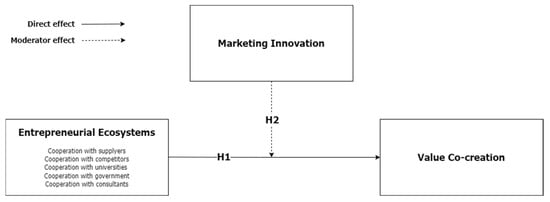
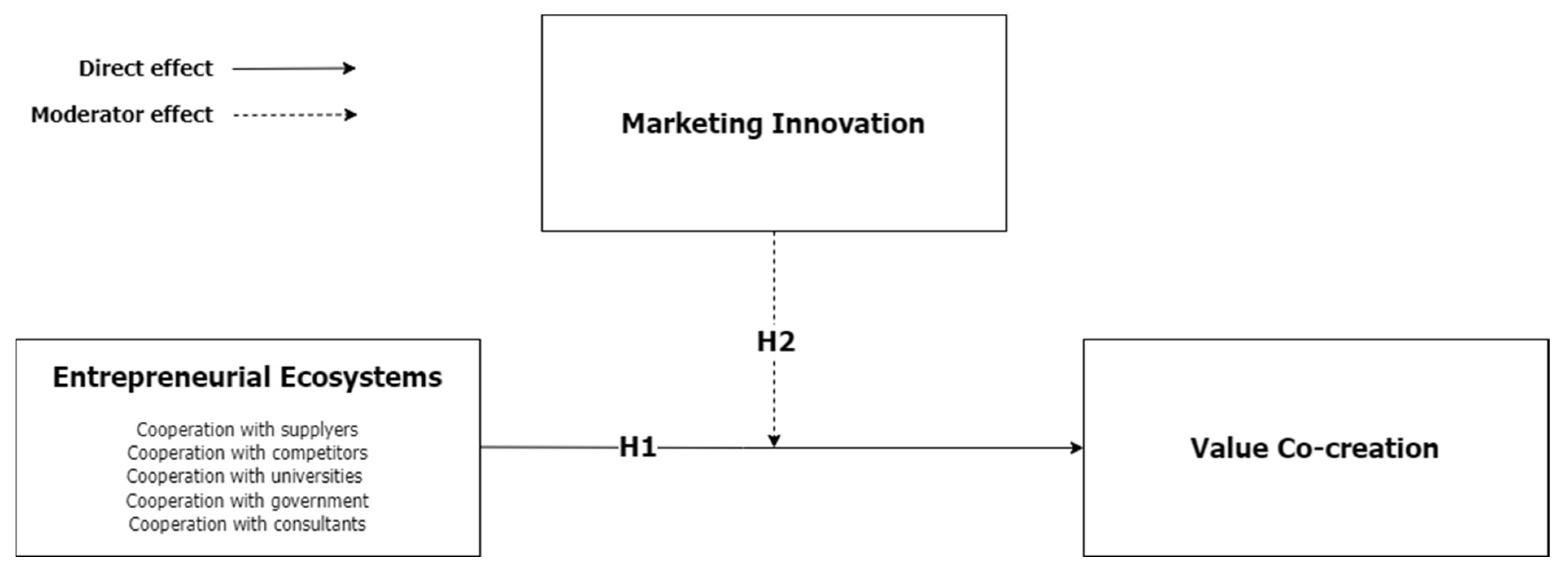
The proposed research model is summarised in Figure 1, which depicts the direct effects of ecosystem cooperation on value co-creation (H1 and H1a–H1f) and the moderating role of marketing innovation on these relationships (H2 and H2a–H2f), grounded in the integrated RBV–SDL–SET framework.
Figure 1.
Conceptual model.
3. Methodology
3.1. Sample and Data
The data used in this research were sourced from the Community Innovation Survey 2020 (CIS 2020), which was conducted by the National Institute of Statistics (INE) in Portugal. The CIS 2020 survey adheres to the conceptual guidelines set out in the Oslo Manual and follows the methodological standards recommended by the Statistical Office of the European Communities (OECD & Eurostat, 2018). It provides an in-depth overview of companies, including information on their industry sectors, business affiliations, market size, and geographic presence. Additionally, the survey covers companies’ strategic decisions, including their product and process innovations, as well as their sources of information and cooperation with external partners. The target population consists of active companies operating in Portugal and employing 10 or more individuals, primarily in sectors A to S (excluding section O) of the CAE Rev.3 classification.
The reference period for the cooperation and innovation variables is 2018–2020, following standard practice in innovation surveys that adopt a three-year observation window. Data collection was conducted between September and December 2019, that is, before the COVID-19 pandemic. Consequently, the cooperation patterns reported by firms reflect pre-pandemic conditions, and the 2018–2020 window should be interpreted as a standard three-year horizon rather than as a period dominated by crisis-related behaviours.
In Portugal, the data collection for CIS 2020 was carried out in 2019, before the COVID-19 pandemic, with a total of 13,509 companies participating, from which the sample for this study was drawn. For this research, the sample includes 12,761 SMEs. As shown in Table 1, the sample covers SMEs from different NACE sections and size classes. In terms of sectoral distribution, firms are mainly concentrated in manufacturing and knowledge-intensive services, with additional representation from trade and other service activities. Regarding firm size, most respondents are micro and small enterprises, followed by medium-sized firms, which is consistent with the overall structure of the SME population in the country. No single NACE section or size class clearly dominates the sample, which reduces the risk that the estimated relationships are driven by a specific sector or firm-size group.
Table 1.
SMEs characteristics.
As the CIS 2020 data are cross-sectional and based on a single survey wave, the empirical analysis captures associations rather than strong causal effects. Although logistic regression allows us to model the probability that SMEs engage in value co-creation as a function of ecosystem cooperation and marketing innovation, issues such as unobserved heterogeneity and potential reciprocal causality cannot be fully ruled out. The results should therefore be interpreted as conditional relationships, given the observed firm characteristics.
3.2. Variables
To measure value co-creation, we used a dependent variable related to the active involvement of users in the creation process. This variable was assessed through a specific question in the questionnaire, which focused on the period from 2018 to 2020, asking whether the company offered products or services developed in collaboration with users, where users played an active role in the creation of the idea, design, and development of the product. The response to this question was binary, with respondents selecting either “No” or “Yes”. This binary operationalisation is consistent with the CIS design and the Oslo Manual guidelines, which focus on whether firms engage in specific innovation and cooperation practices over a three-year reference period. Accordingly, our measure captures the occurrence of value co-creation rather than its intensity or frequency.
To evaluate the level of integration in entrepreneurial ecosystems, we used a specific question from the questionnaire, “Indicate the type of innovation cooperation partner, by geographic location,” as independent variable. This question provided several options, including: (1) Consultants, commercial laboratories, or private research institutes; (2) Suppliers of equipment, materials, components, or software; (3) Client companies; (4) Competing companies; (5) Universities or public research institutes; and (6) Public sector customers. The ecosystem integration index was constructed as an additive composite index by assigning one point to each observed cooperation tie by partner type and geographic scope. We adopt equal weights for three main reasons. First, the six partner types and the three geographic scopes are conceptualised as complementary channels through which SMEs access knowledge, resources, and market opportunities in the ecosystem, and there is no clear theoretical basis to privilege some ties over others ex ante. Second, we do not have reliable external information (e.g., on the intensity or value of each tie) that would allow for a non-arbitrary differentiated weighting scheme. Third, equal weighting is a transparent and widely used practice in the construction of composite indices when dimensions are conceptually related but not hierarchically ordered, and it is consistent with prior innovation studies that operationalise the breadth of external linkages as a simple count of cooperation or search channels (Nardo et al., 2008; Greco et al., 2019; Laursen & Salter, 2006). Consistent with this approach, Ferreira et al. (2023) and Guimarães et al. (2023) explicitly adopt equal-weighted composite measures of firms’ cooperation ties, treating the different partner types and geographic scopes as complementary facets of SMEs’ integration in entrepreneurial ecosystems. Accordingly, the variable measuring inclusion in entrepreneurial ecosystems was created as a cumulative index, incorporating these six types of partners across three geographic categories (Portugal, other EU/EFTA countries, and non-EU/EFTA countries). Scores range from 0 to 18 overall and from 0 to 3 for each partner type.
The moderating variable corresponds to marketing innovation. To measure this variable, we used a specific question from the questionnaire that asked, “During the period from 2018 to 2020, indicate whether the company has introduced new marketing methods for promotion, packaging, pricing, product placement, or new or improved after-sales services that differ significantly from previous methods.” The answer to this question was binary, that is, respondents could choose “No” or “Yes”. The binary indicator for marketing innovation follows the CIS specification and identifies whether firms introduced at least one marketing innovation during 2018–2020. The variable therefore distinguishes between adopters and non-adopters, aligning with the survey’s innovation/no-innovation logic.
Several control variables were included to enhance the predictive power of the model. These variables, which refer to the company’s profile, include the economic activity (Agriculture, forestry, and fisheries; Extractive industries; Industry; Supply of electricity, gas, steam, and air conditioning; Water supply, sewerage, waste management, and remediation; Construction; Wholesale and retail trade; Trade and services); Integration in a Portuguese business group (No; Yes); Integration in a foreign business group (No; Yes); and Business turnover in 2020 (measured as the logarithm of the turnover in thousands of euros). These control variables are included to account for structural heterogeneity across firms. Sector dummies capture differences in technological regimes and competitive conditions across industries; firm turnover (log) proxies firm size and resource availability; and group affiliation (domestic or foreign) reflects access to group-level resources, networks and coordination mechanisms. More detailed indicators, such as R&D intensity or digital capability, are not available with sufficient coverage in the CIS 2020 dataset for Portugal and would substantially reduce the effective sample size if used as additional controls.
3.3. Data Analysis
Given that the dependent variable in this study, value co-creation is measured as a binary indicator (1 = firm reports co-creation activities with ecosystem partners; 0 = otherwise), we adopted multivariate logistic regression as the main empirical strategy. Logistic regression is particularly appropriate when the objective is to model the probability of an event as a function of a set of explanatory variables and when the error term is not normally distributed, as is typically the case with binary outcomes (Cameron & Trivedi, 2005). In our context, the model estimates how changes in entrepreneurial ecosystem cooperation and marketing innovation affect the likelihood that SMEs engage in value co-creation, while controlling for firm-level characteristics.
The logit specification models the log-odds of engaging in value co-creation as a linear combination of the explanatory variables. In practical terms, this allows interpretation of the estimated coefficient in terms of its effect on the odds of co-creation, holding other variables constant. We first estimate baseline models that include the overall measure of ecosystem cooperation and the control variables in order to assess the direct association between ecosystem integration and value co-creation. We then extend these models by disaggregating ecosystem cooperation into cooperation with specific actors (universities and research centres, customers, suppliers, consultants, competitors and government agencies), which allows us to test the set of hypotheses H1a–H1f. Finally, to examine the moderating role of marketing innovation, we introduce the marketing innovation indicator and its interaction with the ecosystem cooperation variables, which operationalises the hypotheses H2 and H2a–H2f within the same logit framework.
To ensure the validity of the estimates, we examined the usual diagnostic aspects of logistic regression. Multicollinearity among the explanatory variables was assessed through variance inflation factors (VIFs), and all VIF values remained below conventional thresholds, suggesting that collinearity is unlikely to distort the coefficients. We also considered standard goodness-of-fit and significance criteria, including likelihood-ratio tests and pseudo-R2 measures, alongside the sign and statistical significance of the estimated coefficients. This combination of model specification, interaction terms and diagnostics follows established practice for binary outcome models and provides a coherent empirical strategy to test the proposed hypotheses (Cameron & Trivedi, 2005). All models were estimated with robust standard errors to account for potential heteroskedasticity in the error term (Cameron & Trivedi, 2005).
To assess the robustness of the findings, we estimated alternative model specifications. First, we re-estimated the main models using probit instead of logit; the signs and statistical significance of the key coefficients remained unchanged. Second, we compared specifications using the aggregate entrepreneurial ecosystem index with those using the six disaggregated cooperation variables, which again led to consistent conclusions. For each specification, we report standard diagnostic measures, including pseudo-R2, AIC and BIC, to assess model fit.
4. Results
Table 2 presents the descriptive statistics and correlation matrix for the variables used in the analysis. The means and standard deviations are consistent with the bounded nature of the indicators, and the observed ranges do not suggest the presence of extreme outliers. The correlations between the different ecosystem cooperation variables are positive and of moderate magnitude, reflecting the fact that firms that cooperate with one type of actor tend to cooperate with others as well. All correlation coefficients are statistically significant at p < 0.001, as indicated in Table 2. The diagonal elements for the independent variables report the variance inflation factors (VIFs), which are all well below conventional thresholds, suggesting that multicollinearity is unlikely to distort the regression estimates.
Table 2.
Descriptive statistics and correlation matrix (VIF on the diagonal).
Logistic regression was employed to analyse the relationships between the constructs in our study, with the path coefficients presented in Table 3. As shown in Table 3, the odds ratios for the different cooperation variables point to meaningful differences in the likelihood of value co-creation. Overall ecosystem cooperation (H1) is positively associated with value co-creation in SMEs (OR = 1.477; p < 0.01), indicating that more integrated firms are more likely to engage in co-creation activities. At the disaggregated level, cooperation with universities (H1a) increases the odds of co-creation by around 56% (OR = 1.564; p < 0.01), underscoring the importance of academic and research partners in the value creation process. Cooperation with customers (H1b) and suppliers (H1c) shows even stronger effects (OR = 2.244 and OR = 2.292; both p < 0.01), meaning that firms collaborating with these market- and production-oriented partners have more than twice the odds of reporting co-creation compared with non-cooperating firms, ceteris paribus. These results suggest that technical and market-oriented partners play a particularly central role in shaping SMEs’ engagement in co-creation activities. By contrast, cooperation with consultants (H1d) does not reach conventional significance levels (OR = 1.245; p = 0.071), pointing to a more heterogeneous or weaker association with co-creation. The coefficient for cooperation with competitors (H1e) is marginal and below 1 (OR = 0.621; p = 0.055), providing only weak and context-dependent evidence of a negative relationship. Finally, cooperation with government (H1f) is not significantly associated with value co-creation in the estimated models (OR = 1.265; p = 0.382).
Table 3.
Logistic models.
Comparing Model 1, which uses the aggregate entrepreneurial ecosystem index, with Model 2, which includes the six disaggregated cooperation variables, shows that the composite index captures a clear and positive association between ecosystem integration and value co-creation in SMEs. However, the disaggregated specification reveals that this aggregate effect is mainly driven by cooperation with customers and suppliers and, to a lesser extent, with universities, while cooperation with consultants, competitors and government does not exhibit a systematic association with co-creation. This pattern suggests that the index is a useful summary measure of ecosystem integration, but that the separate components provide additional insight into which specific partnerships are most relevant for value co-creation.
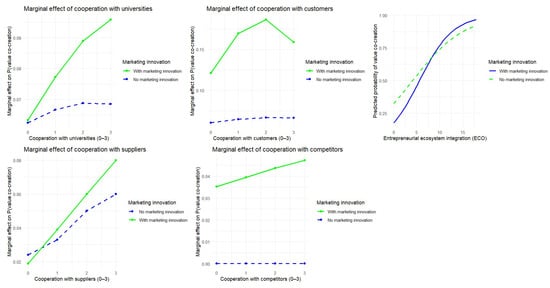
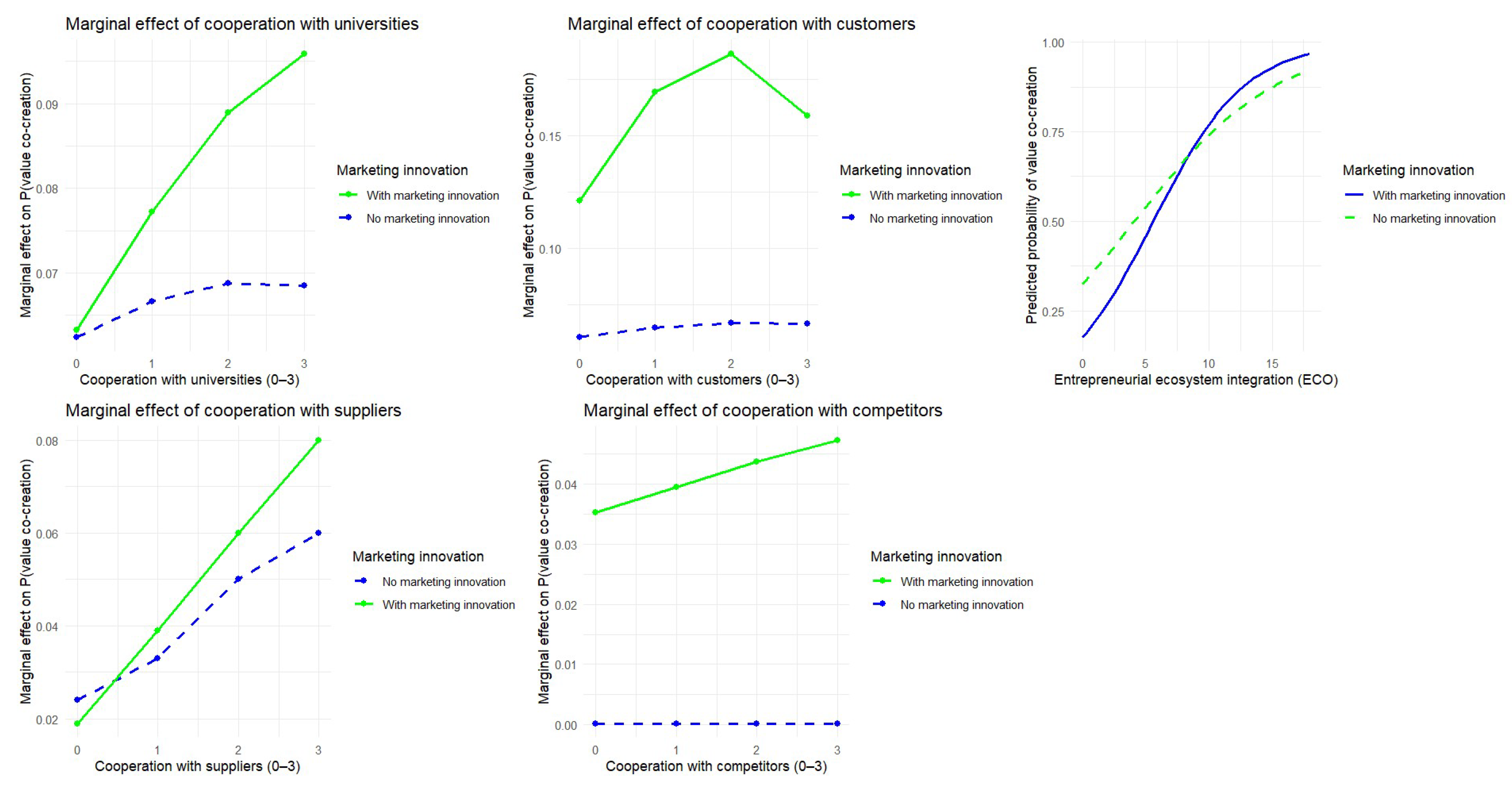
Marketing innovation has a strong direct association with value co-creation (OR = 2.276; p < 0.01), indicating that firms introducing marketing innovations have markedly higher odds of engaging in co-creation than non-innovators. In addition, the interaction between entrepreneurial ecosystems and marketing innovation (H2) is positive and significant (OR = 1.187; p < 0.01), showing that ecosystem cooperation is more strongly associated with value co-creation among firms that innovate in marketing. At the disaggregated level, the interaction terms show that marketing innovation amplifies the positive effects of cooperation with universities (H2a: OR = 1.314; p = 0.038), customers (H2b: OR = 1.602; p = 0.002) and suppliers (H2c: OR = 1.785; p < 0.01). In other words, for firms that innovate in marketing, partnerships with knowledge-intensive and market-oriented actors translate more strongly into value co-creation. By contrast, the interaction between cooperation with consultants and marketing innovation (H2d) is not statistically significant (OR = 1.187; p = 0.268), suggesting that marketing innovation does not systematically reinforce the co-creation effect of consultant relationships. The interaction with competitors (H2e) is positive and significant (OR = 2.313; p = 0.002), indicating that, when present, marketing innovation can considerably intensify the co-creation returns of cooperative arrangements, although such cooperation remains relatively uncommon. The moderating effect of marketing innovation on cooperation with government (H2f) is not significant (OR = 1.270; p = 0.413), implying that policy-related partnerships do not become more co-creation-oriented simply because firms engage in marketing innovation. Figure 2 illustrates how entrepreneurial ecosystem integration and cooperation with universities, customers, suppliers and government relate to the probability of value co-creation in SMEs, comparing firms with and without marketing innovation.
Figure 2.
Predicted probability of value co-creation by entrepreneurial ecosystem integration and cooperation with key actors, conditional on marketing innovation.
Regarding the control variables, group affiliation and workforce qualifications also show relevant patterns. SMEs with a higher share of employees holding tertiary education degrees (50–75% and 75–100%) exhibit significantly higher odds of value co-creation (OR = 1.378; p < 0.01; OR = 1.463; p < 0.01, respectively), suggesting that human capital intensity facilitates the adoption and implementation of co-creation practices.
5. Discussion
The findings of this study show the significant role of EEs in fostering value co-creation within SMEs. The results reinforce that entrepreneurial ecosystems have a positive impact on value co-creation, supporting the literature that emphasises the importance of these ecosystems in promoting innovation and collaboration (Ngongoni et al., 2017; Radziwon & Bogers, 2019). Entrepreneurial ecosystems create environments conducive to resource integration and knowledge exchange, allowing SMEs to overcome resource limitations and enhance their competitiveness (Eikebrokk et al., 2021). The collaboration between SMEs and key stakeholders such as universities, suppliers, and customers is essential for driving value creation (Santos et al., 2025). These findings align with earlier research that highlights the crucial role of collaborative networks in fostering innovation and sustaining business growth (Guimarães et al., 2023). Particularly, cooperation with universities, customers, and suppliers was found to significantly enhance value co-creation, underlining the value of these partnerships in the innovation process. Universities provide vital access to cutting-edge research, technological advancements, and talent, which SMEs can leverage to improve their products and services (Filippelli et al., 2025; Theodoraki et al., 2018). Customer involvement enables SMEs to tailor their offerings to market needs, and supplier relationships offer critical resources that boost the innovation capacity of SMEs (Ratten, 2020). This supports the view of Spigel (2017) and Ratten et al. (2021) that collaboration with these actors plays a key role in the value creation process within entrepreneurial ecosystems. These findings can be interpreted through the integrated RBV–SDL–SET lens adopted in this study. From an RBV perspective, cooperation with universities, customers and suppliers expands SMEs’ access to strategic resources such as advanced knowledge, market intelligence and operational capabilities, which are difficult to develop internally. SDL helps explain how these resources are transformed into value through multi-actor interaction and co-creation processes, while Social Exchange Theory highlights the role of trust, reciprocity and long-term relational norms that sustain these collaborative arrangements over time.
However, cooperation with consultants did not have a significant effect on value co-creation, suggesting that their role may be more context-dependent. While consultants offer external knowledge and expertise, their impact on value co-creation might vary depending on the specific needs and nature of the firm, which contrasts with the findings of Eikebrokk et al. (2021) that highlight the importance of consultants in driving business model improvements. Similarly, the relationship between cooperation with competitors and value co-creation was marginally significant, showing that coopetition might not always provide consistent benefits for SMEs. This is consistent with research by Fernandes et al. (2019) and Veiga et al. (2024), who suggest that the impact of coopetition depends on industry characteristics and the dynamics of the competitive relationship. Moreover, cooperation with the government did not significantly influence value co-creation, suggesting that government partnerships might have a less direct effect on value creation compared to more active business-to-business collaborations (Guimarães et al., 2023). The asymmetric results across cooperation types suggest that not all partnerships contribute to value co-creation through the same mechanisms. Customer and supplier relationships are deeply embedded in day-to-day operations and market interactions, which facilitate continuous knowledge flows, iterative feedback and joint problem-solving. By contrast, consultants and government agencies often intervene more episodically and at a greater distance from operational routines, which may limit their direct contribution to co-creation unless firms possess strong absorptive capacity and clearly defined collaboration goals.
The moderating role of marketing innovation was found to significantly influence the relationship between entrepreneurial ecosystems and value co-creation. Marketing innovation, particularly through the adoption of new promotional strategies and digital platforms, enhances the ability of SMEs to engage with stakeholders and adapt their offerings to evolving market demands (Sánchez-Gutiérrez et al., 2019). This supports the work of Ratten (2020) and Galvagno and Dalli (2014), who emphasise that marketing innovations are critical in enabling SMEs to strengthen their relationships with customers, suppliers, and other ecosystem partners. Digital platforms, which provide avenues for real-time customer engagement and feedback, play a significant role in amplifying the co-creation process, as noted by Eikebrokk et al. (2021).
The interaction between marketing innovation and cooperation with universities, customers, and suppliers was found to significantly enhance value co-creation. This highlights the importance of integrating marketing innovations within collaborative relationships to foster more effective engagement with stakeholders and improve value creation (Theodoraki & Catanzaro, 2022). These results further support the idea that marketing innovation serves as a bridge between SMEs and their partners, enabling the efficient exchange of knowledge and resources and driving innovation (Sánchez-Gutiérrez et al., 2019; Galvagno & Dalli, 2014). In contrast, the interaction between marketing innovation and cooperation with consultants did not show a significant effect, which may reflect the fact that consultants’ contributions are often more focused on strategic advice and business management rather than marketing or customer engagement strategies (Eikebrokk et al., 2021).
The relationship between marketing innovation and cooperation with competitors was significant only in certain contexts, which may suggest that the effectiveness of coopetition depends on the nature of the competitive environment. In some industries, firms might find value in collaborating with competitors, while in others, competitive pressures might limit the potential for co-creating value (Bengtsson & Kock, 2014; Veiga et al., 2024). Lastly, the interaction with government was not found to significantly affect value co-creation, reinforcing the notion that government collaboration may not be strongly influenced by marketing innovations and may play a more peripheral role in the value creation process (Spigel, 2017; Santos et al., 2025). In this sense, marketing innovation can be seen as a mechanism that improves SMEs’ capacity to absorb and deploy external knowledge by structuring how information is collected, processed and translated into market offerings. Digital tools and data-driven campaigns reduce information asymmetries, reinforce relational trust through more transparent and frequent interactions, and support orchestration efforts by aligning stakeholders around shared value propositions.
Our results also point to the orchestration capacity of specific actors within the ecosystem. Universities, customers and suppliers act as intermediaries that connect otherwise dispersed resources and coordinate joint initiatives, effectively orchestrating knowledge integration and collaborative experimentation. This helps explain why cooperation with these partners exerts a stronger influence on value co-creation than cooperation with more peripheral or institutional actors.
This study makes several important theoretical contributions to the literature on EEs, value co-creation, and marketing innovation in SMEs. First, it extends the understanding of how entrepreneurial ecosystems influence value co-creation within SMEs, providing empirical evidence that cooperation with key ecosystem actors such as universities, customers, and suppliers positively impacts value creation. This supports and enriches existing theories, including Service-Dominant Logic (Vargo & Lusch, 2004), Resource-Based View (Barney, 1991), and Social Exchange Theory (Blau, 1968), which emphasise the importance of resource integration, dynamic interactions, and reciprocal relationships in value creation. Second, this study highlights the moderating role of marketing innovation in enhancing the impact of entrepreneurial ecosystems on value co-creation. By integrating marketing innovation into the ecosystem framework, this research contributes to understanding how SMEs can leverage new marketing strategies, particularly digital platforms, to enhance their collaborations and create value more effectively. This contribution expands upon previous studies that have examined marketing innovation in isolation, demonstrating its importance within the broader context of entrepreneurial ecosystems (Sánchez-Gutiérrez et al., 2019).
From a practical standpoint, this research provides valuable insights for SME managers and policymakers aiming to foster innovation and value co-creation. For practitioners, the study emphasises the importance of building and nurturing collaborations with key stakeholders, such as universities, customers, and suppliers, to drive innovation and improve market competitiveness. SMEs can enhance their value co-creation capacity by engaging in partnerships that allow them to integrate external knowledge, resources, and expertise. The sectoral composition of the sample also matters: knowledge-intensive services and more innovative manufacturing activities are particularly well positioned to benefit from ecosystem cooperation, whereas SMEs in more traditional sectors may require stronger support to develop the capabilities needed to engage in co-creation.
Furthermore, the study underscores the role of marketing innovation in improving SMEs’ ability to engage with stakeholders, adapt to changing market demands, and strengthen their competitive advantage. SMEs are encouraged to invest in new marketing strategies, including digital marketing platforms and customer engagement tools, to maximise their potential for value co-creation. For policymakers, the findings suggest that creating and supporting entrepreneurial ecosystems that facilitate collaboration among various actors, including academic institutions, suppliers, and customers, can lead to greater innovation and economic growth. This research also provides a deeper understanding of how policies that promote marketing innovation and collaboration in entrepreneurial ecosystems can contribute to the success and resilience of SMEs in an increasingly digital economy. Policy interventions should therefore differentiate between cooperation types and geographic levels. Instruments that foster university–industry collaboration, supplier integration or structured customer involvement are likely to have more immediate effects on co-creation than generic ecosystem support. Moreover, combining local and national programmes with EU-level schemes can help SMEs leverage both proximity-based networks and broader international opportunities, while recognising that aggregate ecosystem indicators may mask important differences between specific partnership configurations.
6. Conclusions
This study aimed to investigate the impact of entrepreneurial ecosystems (EEs) on value co-creation in SMEs, with a particular focus on the role of marketing innovation as a moderating factor. The primary objectives were to assess how cooperation with key stakeholders within these ecosystems, such as universities, customers, and suppliers, influences the ability of SMEs to co-create value and to explore how marketing innovations enhance this process.
The study offers three main contributions. From a theoretical perspective, it extends the integration of RBV and SDL by conceptualising entrepreneurial ecosystem cooperation as an externally orchestrated bundle of strategic resources and by showing that value emerges from the way these resources are integrated through multi-actor interactions. By incorporating Social Exchange Theory, the results also emphasise the role of relational norms such as trust and reciprocity in sustaining co-creation, while the asymmetric effects across cooperation types (stronger for customers and suppliers than for consultants or government) underline that not all ecosystem ties operate through the same mechanisms. From a methodological perspective, the research uses CIS 2020 microdata to construct and compare a composite ecosystem integration index and its six cooperation components and estimates logit models with interaction terms whose interpretation is supported by marginal effects and predicted probability plots. This combined use of aggregate and disaggregated measures, together with graphical evidence, provides a more nuanced picture of how different cooperation configurations relate to value co-creation. From a practical and policy perspective, the findings suggest that ecosystem policies should move beyond generic support for collaboration and prioritise partnerships that demonstrably foster co-creation, such as customer–supplier integration and university–SME collaboration under marketing innovation initiatives. Concrete actions may include the design of university–SME marketing innovation labs, support schemes that incentivise co-design with customers, and programmes that help SMEs to embed digital marketing tools in their ecosystem relationships.
Several limitations need to be acknowledged. First, the use of cross-sectional data from CIS 2020 and logistic regression models implies that the estimated relationships are associational rather than strictly causal. The binary measure of value co-creation captures whether firms engage in co-creation but cannot reflect its intensity, frequency or qualitative characteristics, which is a conceptual restriction. In addition, potential endogeneity cannot be ruled out: more innovative firms may be both more likely to engage in co-creation and more attractive as partners, creating possible reverse causality between cooperation and value co-creation. Second, the empirical analysis focuses on Portuguese SMEs embedded in a specific national and European policy context, which may limit the generalisation of the findings to other countries or ecosystem structures. Third, as with other CIS-based studies, the analysis is exposed to potential omitted variable bias and unobserved heterogeneity: relevant firm-level factors such as organisational culture, leadership style or internal absorptive capacity are not directly measured, even though they are likely to condition how firms benefit from ecosystem cooperation and marketing innovation. Finally, survey-based measures may also be affected by reporting differences across firms, which further reinforces the need for cautious interpretation of the results.
These limitations open avenues for future research. Longitudinal and multilevel designs could better capture the dynamic and nested nature of value co-creation, following how changes in ecosystem conditions influence firms’ co-creation behaviours and, in turn, customer and market outcomes. Methodologically, propensity score matching (e.g., using regional or sectoral variables as instruments) could be used to address selection and robustness issues, while structural equation modelling would allow the inclusion of latent constructs related to cooperation quality, marketing innovation capabilities and co-creation practices. Future work may also explore non-linear relations and sector–ecosystem interaction terms to better account for heterogeneity across industries and ecosystem types and conduct comparative studies across countries to understand how different institutional and policy contexts shape the role of entrepreneurial ecosystems and marketing innovation in SME value co-creation.
Author Contributions
Conceptualisation, V.S.C., J.A., F.S.R., A.C.M. and P.M.V.; methodology, V.S.C. and P.M.V.; software, P.M.V.; validation, V.S.C., J.A., F.S.R., A.C.M. and P.M.V.; formal analysis, A.C.M. and P.M.V.; investigation, J.A. and F.S.R.; data curation, P.M.V.; writing—original draft preparation, V.S.C., J.A. and F.S.R.; writing—review and editing, V.S.C., J.A., F.S.R., A.C.M. and P.M.V.; visualisation, F.S.R. and A.C.M.; supervision, P.M.V.; project administration, P.M.V. All authors have read and agreed to the published version of the manuscript.
Funding
This research was funded by the Fundação para a Ciência e Tecnologia (FCT) grant number [UIDB/04630/2020; DOI identifier 10.54499/UIDP/04630/2020].
Institutional Review Board Statement
Not applicable.
Informed Consent Statement
Not applicable.
Data Availability Statement
This study uses confidential microdata provided by Statistics Portugal (INE) under a specific data access agreement. Due to legal and confidentiality restrictions imposed by INE, these microdata cannot be made publicly available. Researchers may request access to similar data directly from INE.
Acknowledgments
During the preparation of this manuscript/study, the authors used ChatGPT (4.o) for the purposes of polishing and refining the text. The authors have reviewed and edited the output and take full responsibility for the content of this publication.
Conflicts of Interest
The authors declare no conflicts of interest.
Abbreviations
| CIS | Multidisciplinary Digital Publishing Institute |
| CI | Directory of open access journals |
| EEs | entrepreneurial ecosystems |
| INE | National Institute of Statistics |
| NA | Not Applicable |
| OR | Odds Ratio |
| RBV | Resource-Based View |
| SMEs | Small and Medium Enterprises |
| SD | Standard Deviation |
| VIF | Variance Inflation Factor |
References
- Acs, Z. J., Stam, E., Audretsch, D. B., & O’Connor, A. (2017). The lineages of the entrepreneurial ecosystem approach. Small Business Economics, 49(1), 1–10. [Google Scholar] [CrossRef] [Scilit]
- Adner, R., & Kapoor, R. (2010). Value creation in innovation ecosystems: How the structure of technological interdependence affects firm performance in new technology generations. Strategic Management Journal, 31(3), 306–333. [Google Scholar] [CrossRef]
- Audretsch, D. B., Belitski, M., & Herzig, M. (2025). The jazz jam session improvisation model of stakeholder engagement in entrepreneurial ecosystems. Journal of Small Business Management, 63(5), 1949–1977. [Google Scholar] [CrossRef] [Scilit]
- Babu, M. M., Dey, B. L., Rahman, M., Roy, S. K., Syed Alwi, S. F., & Kamal, M. M. (2020). Value co-creation through social innovation: A study of sustainable strategic alliance in telecommunication and financial services sectors in Bangladesh. Industrial Marketing Management, 89, 13–27. [Google Scholar] [CrossRef] [Scilit]
- Barney, J. B. (1991). Firm resources and sustained competitive advantage. Journal of Management, 17(1), 99–120. [Google Scholar] [CrossRef] [Scilit]
- Bengtsson, M., & Kock, S. (2014). Coopetition-Quo vadis? Past accomplishments and future challenges. Industrial Marketing Management, 43(2, SI), 180–188. [Google Scholar] [CrossRef] [Scilit]
- Blau, P. M. (1968). Social exchange. International Encyclopedia of the Social Sciences, 7(4), 452–457. [Google Scholar]
- Cai, Y., Ma, J., & Chen, Q. (2020). Higher education in innovation ecosystems. Sustainability, 12(11), 4376. [Google Scholar] [CrossRef] [Scilit]
- Cameron, A. C., & Trivedi, P. K. (2005). Microeconometrics: Methods and applications. Cambridge University Press. [Google Scholar]
- Eikebrokk, T. R., Garmann-Johnsen, N. F., & Olsen, D. H. (2021). Co-creation in networks of SMEs: A conceptual model of the co-creation process. Procedia Computer Science, 181, 360–366. [Google Scholar] [CrossRef] [Scilit]
- Fernandes, C., Ferreira, J., Veiga, P. M., & Marques, C. (2019). The effects of coopetition on the innovation activities and performances of firms: Some empirical evidence. Competitiveness Review, 29(5), 622–645. [Google Scholar] [CrossRef] [Scilit]
- Ferreira, J. J. M., Fernandes, C. I., & Veiga, P. M. (2023). The role of entrepreneurial ecosystems in the SME internationalization. Journal of Business Research, 157, 113603. [Google Scholar] [CrossRef] [Scilit]
- Filippelli, S., Troise, C., Bigliardi, B., & Corvello, V. (2025). Examining the influence of entrepreneurial ecosystem pressure on the economic, social, and environmental orientation of startups. Technological Forecasting and Social Change, 210(2025), 123900. [Google Scholar] [CrossRef] [Scilit]
- Galvagno, M., & Dalli, D. (2014). Theory of value co-creation: A systematic literature review. Managing Service Quality, 24(6), 643–683. [Google Scholar] [CrossRef] [Scilit]
- Grama-Vigouroux, S., Saidi, S., Berthinier-Poncet, A., Lwango, A., & Sellami, M. (2022). Influence of entrepreneurial ecosystems on innovation ecosystems in peripheral regions: The case of the champagne-ardenne region. Industry and Innovation, 29(9), 1045–1074. [Google Scholar] [CrossRef] [Scilit]
- Greco, S., Ishizaka, A., Tasiou, M., & Torrisi, G. (2019). On the methodological framework of composite indices: A review of the issues of weighting, aggregation, and robustness. Social Indicators Research, 141(1), 61–94. [Google Scholar] [CrossRef] [Scilit]
- Guimarães, J. da S., Fernandes, C., Veiga, P. M., & Ramadani, V. (2023). The relationship between entrepreneurial ecosystems and digital transformation. FIIB Business Review, 14(1), 28–42. [Google Scholar] [CrossRef] [Scilit]
- Inada, Y. (2024). Unlocking value co-creation in entrepreneurial ecosystems: The vital role of institutions. Administrative Sciences, 14(5), 82. [Google Scholar] [CrossRef] [Scilit]
- Kim, D. W., Trimi, S., Hong, S. G., & Lim, S. (2020). Effects of co-creation on organizational performance of small and medium manufacturers. Journal of Business Research, 109, 574–584. [Google Scholar] [CrossRef] [Scilit]
- Laursen, K., & Salter, A. (2006). Open for innovation: The role of openness in explaining innovation performance among U.K. manufacturing firms. Strategic Management Journal, 27(2), 131–150. [Google Scholar] [CrossRef] [Scilit]
- Lopez, E., Flecha-Ortiz, J. A., Santos-Corrada, M., & Dones, V. (2024). The role of organizational resilience in SME service innovation and value co-creation. Journal of Services Marketing, 38(4), 443–459. [Google Scholar] [CrossRef] [Scilit]
- Martins, J. T., & Hukampal Singh, S. (2023). Boundary organisations in regional innovation systems: Traversing knowledge boundaries for industry 4.0 regional transformations. R&D Management, 53(3), 364–390. [Google Scholar] [CrossRef] [Scilit]
- Mersico, L., Carloni, E., Bocconcelli, R., & Pagano, A. (2023). From knowledge broker to solution provider in the Industry 4.0 setting: The innovation path of a small consulting firm. Journal of Business & Industrial Marketing, 38(6), 1390–1406. [Google Scholar] [CrossRef] [Scilit]
- Nardo, M., Saisana, M., Saltelli, A., Tarantola, S., Hoffman, A., & Giovannini, E. (2008). Handbook on constructing composite indicators: Methodology and user guide. OECD Publishing. [Google Scholar] [CrossRef] [Scilit]
- Nasution, M. D. T. P., Rini, E. S., Sembiring, B. K. F., & Silalahi, A. S. (2022). Open innovation, crowdsourcing, and co-creation: Advancing the service marketing activities of indonesian small and medium enterprises. In Studies on entrepreneurship, structural change and industrial dynamics (pp. 125–143). Springer International Publishing. [Google Scholar] [CrossRef] [Scilit]
- Ngongoni, C. N., Grobbelaar, S. S., & Schutte, C. S. L. (2017). The role of open innovation intermediaries in entrepreneurial ecosystems design. South African Journal of Industrial Engineering, 28(3), 56–65. [Google Scholar] [CrossRef] [Scilit]
- O’Connor, A., Stam, E., Sussan, F., & Audretsch, D. B. (Eds.). (2018). Entrepreneurial ecosystems: The foundations of place-based renewal. In Entrepreneurial ecosystems: Place-based transformations and transitions (pp. 1–21). Springer International Publishing. [Google Scholar] [CrossRef] [Scilit]
- OECD & Eurostat. (2006). Oslo manual: Guidelines for collecting and interpreting innovation data (3rd ed.). OECD Publishing. [Google Scholar] [CrossRef] [Scilit]
- OECD & Eurostat. (2018). Oslo manual 2018: Guidelines for collecting, reporting and using data on innovation (4th ed.). The Measurement of Scientific, Technological and Innovation Activities, OECD Publishing. [Google Scholar] [CrossRef] [Scilit]
- Pattinson, S., & Dawson, P. (2024). The ties that bind: How boundary spanners create value in science-based SMEs. British Journal of Management, 35(1), 464–486. [Google Scholar] [CrossRef] [Scilit]
- Payne, A. F., Storbacka, K., & Frow, P. (2008). Managing the co-creation of value. Journal of the Academy of Marketing Science, 36(1), 83–96. [Google Scholar] [CrossRef] [Scilit]
- Porter, M. E., & Kramer, M. R. (2018). Creating shared value: How to reinvent capitalism—And unleash a wave of innovation and growth. In Managing sustainable business: An executive education case and textbook (pp. 323–346). Springer. [Google Scholar]
- Purchase, S., & Volery, T. (2020). Marketing innovation: A systematic review. Journal of Marketing Management, 36(9–10), 763–793. [Google Scholar] [CrossRef] [Scilit]
- Radziwon, A., & Bogers, M. (2019). Open innovation in SMEs: Exploring inter-organizational relationships in an ecosystem. Technological Forecasting and Social Change, 146, 573–587. [Google Scholar] [CrossRef] [Scilit]
- Ratten, V. (2020). Entrepreneurial ecosystems: Future research trends. Thunderbird International Business Review, 62(5), 623–628. [Google Scholar] [CrossRef] [Scilit]
- Ratten, V., da Silva Braga, V. L., & da Encarnação Marques, C. S. (2021). Sport entrepreneurship and value co-creation in times of crisis: The COVID-19 pandemic. Journal of Business Research, 133(2021), 265–274. [Google Scholar] [CrossRef] [Scilit]
- Re, B., & Magnani, G. (2022). Value co-creation in circular entrepreneurship: An exploratory study on born circular SMEs. Journal of Business Research, 147, 189–207. [Google Scholar] [CrossRef] [Scilit]
- Ritala, P., Agouridas, V., Assimakopoulos, D., & Gies, O. (2013). Value co-creation and capture in innovation ecosystems: The case of the emerging cloud computing industry. International Journal of Technology Management, 63(3–4), 244–267. [Google Scholar] [CrossRef] [Scilit]
- Roundy, P. T. (2021). Leadership in startup communities: How incubator leaders develop a regional entrepreneurial ecosystem. Journal of Management Development, 40(3), 190–208. [Google Scholar] [CrossRef] [Scilit]
- Royo-Vela, M., & Serrano, M. V. (2021). Value co-creation process and measurement in 4.0 SMEs: An exploratory research in a B2B marketing innovation context. Administrative Sciences, 11(1), 20. [Google Scholar] [CrossRef] [Scilit]
- Santos, J. B., Fischer, B. B., Alves, A. C., & Roundy, P. T. (2025). Unpacking the nature of orchestrator coherence in entrepreneurial ecosystems. Entrepreneurship Theory and Practice, 49(4), 1098–1128. [Google Scholar] [CrossRef] [Scilit]
- Sánchez-Gutiérrez, J., Cabanelas, P., Lampón, J. F., & González-Alvarado, T. E. (2019). The impact on competitiveness of customer value creation through relationship capabilities and marketing innovation. Journal of Business and Industrial Marketing, 34(3), 618–627. [Google Scholar] [CrossRef] [Scilit]
- Schmidt, M.-C., Veile, J. W., Müller, J. M., & Voigt, K.-I. (2021). Ecosystems 4.0: Redesigning global value chains. The International Journal of Logistics Management, 32(4), 1124–1149. [Google Scholar] [CrossRef] [Scilit]
- Spigel, B. (2017). The relational organization of entrepreneurial ecosystems. Entrepreneurship Theory and Practice, 41(1), 49–72. [Google Scholar] [CrossRef] [Scilit]
- Theodoraki, C., & Catanzaro, A. (2022). Widening the borders of entrepreneurial ecosystem through the international lens. Journal of Technology Transfer, 47(2), 383–406. [Google Scholar] [CrossRef] [Scilit]
- Theodoraki, C., Messeghem, K., & Rice, M. P. (2018). A social capital approach to the development of sustainable entrepreneurial ecosystems: An explorative study. Small Business Economics, 51(1), 153–170. [Google Scholar] [CrossRef] [Scilit]
- Tuan, N. M., & Doan, D. T. (2025). Customer value co-creation practices for community well-being in e-commerce platform: An information-based perspective. Journal of Open Innovation: Technology, Market, and Complexity, 11(1), 100488. [Google Scholar] [CrossRef] [Scilit]
- Vargo, S. L., & Lusch, R. F. (2004). Evolving to a new dominant logic for marketing. Journal of Marketing, 68(1), 1–17. [Google Scholar] [CrossRef] [Scilit]
- Veiga, P. M., Herrera-Ballesteros, J., & de las Heras-Rosas, C. (2024). Cooperation and coopetition, determinants of openness in product innovation and human resource management. Comparative study between Spain-Portugal. Technology in Society, 78, 102667. [Google Scholar] [CrossRef] [Scilit]
- Zeng, S. X., Xie, X. M., & Tam, C. M. (2010). Relationship between cooperation networks and innovation performance of SMEs. Technovation, 30(3), 181–194. [Google Scholar] [CrossRef] [Scilit]

Disclaimer/Publisher’s Note: The statements, opinions and data contained in all publications are solely those of the individual author(s) and contributor(s) and not of MDPI and/or the editor(s). MDPI and/or the editor(s) disclaim responsibility for any injury to people or property resulting from any ideas, methods, instructions or products referred to in the content. |
© 2025 by the authors. Licensee MDPI, Basel, Switzerland. This article is an open access article distributed under the terms and conditions of the Creative Commons Attribution (CC BY) license (https://creativecommons.org/licenses/by/4.0/).