

Remote Work and Employee Attitudes: The Role of Reward Allocation in European SMEs




Abstract
1. Introduction
2. Theoretical Framework
2.1. Remote Work and Digital Transformation
2.2. Influences of Remote Work and Reward Allocation
2.3. Remote Work and Employees’ Attitudes in SMEs
3. Methodology
3.1. Questionnaire and Measurements
3.2. Scale Measurement
3.2.1. Reward Allocation
3.2.2. Employee Attitudes in SMEs
3.2.3. Control Variables
3.3. Sampling and Data Gathering
3.4. Data Analysis
4. Results
4.1. Measurement Model Testing
4.2. Structural and Model Assessing
5. Discussion
6. Conclusions
7. Implications
7.1. Theoretical Implications
7.2. Practical Implications
8. Limitations and Future Research
Author Contributions
Funding
Institutional Review Board Statement
Informed Consent Statement
Data Availability Statement
Acknowledgments
Conflicts of Interest
Abbreviations
| RW | Remote Work |
| JS | Job Satisfaction |
| WFP | Workforce Promotion |
| WP | Worker Performance |
| SA | Salary Adjustments |
| SMES | Small and Medium Enterprises |
References
- Adamovic, M., Gahan, P., Olsen, J., Gulyas, A., Shallcross, D., & Mendoza, A. (2022). Exploring the adoption of virtual work: The role of virtual work self-efficacy and virtual work climate. International Journal of Human Resource Management, 33(17), 3492–3525. [Google Scholar] [CrossRef]
- Aggarwal, S. (2024). Impact of dimensions of organisational culture on employee satisfaction and performance level in select organisations. IIMB Management Review, 36, 230–238. [Google Scholar] [CrossRef]
- Ahluwalia, R., Unnava, H. R., & Burnkrant, R. E. (2001). The moderating role of commitment on the spillover effect of marketing communications. Journal of Marketing Research, 38(4), 458–470. [Google Scholar] [CrossRef]
- Akter, T., Uddin, M. S., Rahman, R., Uddin, M. S., Islam, M. R., Faisal-E-Alam, M., & Rahman, M. M. (2024). The moderating effect of system quality on the relationship between customer satisfaction and purchase intention: PLS-SEM & fsQCA approaches. Journal of Open Innovation: Technology, Market, and Complexity, 10, 100381. [Google Scholar] [CrossRef]
- Alifuddin, N. A., & Ibrahim, D. (2021). Studies on the impact of work from home during COVID-19 pandemic: A systematic literature review. Jurnal Komunikasi Borneo (JKoB), 9, 60–80. [Google Scholar] [CrossRef]
- Allen, N. J., & Meyer, J. P. (2000). The measurement and antecedents of affective, continuance, and normative commitment to the organization. Journal of Occupational Psychology, 63(1), 1–18. [Google Scholar] [CrossRef]
- Al Sabei, S. D., Labrague, L. J., Miner Ross, A., Karkada, S., Albashayreh, A., Al Masroori, F., & Al Hashmi, N. (2020). Nursing work environment, turnover intention, job burnout, and quality of care: The moderating role of job satisfaction. Journal of Nursing Scholarship, 52, 95–104. [Google Scholar] [CrossRef]
- Alshibly, H., & Alzubi, K. N. (2022). Unlock the black box of remote e-working effectiveness and e-HRM practices effect on organizational commitment. Cogent Business & Management 9, 2153546. [Google Scholar] [CrossRef]
- Altuna, O. K., & Arslan, F. (2016). Impact of the number of scale points on data characteristics and respondents’ evaluations: An experimental design approach using 5-point and 7-point likert-type scales. International Journal of Market Research, (55), 1–20. [Google Scholar] [CrossRef]
- Angelici, M., & Profeta, P. (2023). Smart working: Work flexibility without constraints. Management Science 70, 1343–2022. [Google Scholar]
- Astorquiza-Bustos, B., & Quintero-Peña, J. (2023). Who can work from home? A remote working index for an emerging economy. Telecommunications Policy, 47(10), 102669. [Google Scholar] [CrossRef]
- Balamurugan, G., & Priyanka, S. (2023). Conceptual framework on successful implementation of hybrid work model for virtual IT employees. International Journal of Engineering Technologies and Management Research, 10(4), 14–21. [Google Scholar] [CrossRef]
- Beehner, C. G., & Blackwell, M. J. (2016). The impact of workplace spirituality on food service worker turnover intention. Journal of Management, Spirituality & Religion, 13(4), 304–323. [Google Scholar] [CrossRef]
- Bhusan, R. M. B. (2024). The spectre of generative AI over advertising, marketing, and branding. Journal of Future Media Studies, 1(1), 1–10. [Google Scholar]
- Brenninkmeijer, V., & Hekkert-Koning, M. (2015). The relationships between regulatory focus, job crafting and work outcomes. Career Development International, 20(2), 147–162. [Google Scholar] [CrossRef]
- Capone, V., Schettino, G., Marino, L., Camerlingo, C., Smith, A., & Depolo, M. (2024). The new normal of remote work: Exploring individual and organizational factors affecting work-related outcomes and well-being in academia. Frontiers in Psychology, 15, 1340094. [Google Scholar] [CrossRef]
- Cenamor, J., Parida, V., & Wincent, J. (2019). How entrepreneurial SMEs compete through digital platforms: The roles of digital platform capability, network capability and ambidexterity. Journal of Business Research, 100, 196–206. [Google Scholar] [CrossRef]
- Charalampous, M., Grant, C. A., Tramontano, C., & Michailidis, E. (2018). Systematically reviewing remote e-workers’ well-being at work: A multidimensional approach. European Journal of Work & Organizational Psychology, 28(1), 51–73. [Google Scholar] [CrossRef]
- Chatterjee, S., Chaudhuri, R., & Vrontis, D. (2022). Does remote work flexibility enhance organization performance? Moderating role of organization policy and top management support. Journal of Business Research, 139, 1501–1512. [Google Scholar] [CrossRef]
- Corgnet, B., Martin, L., Ndodjang, P., & Sutan, A. (2019). On the merit of equal pay: Performance manipulation and incentive setting. European Economic Review, 113, 23–45. [Google Scholar] [CrossRef]
- Crowley, F., & Doran, J. (2020). COVID-19, occupational social distancing and remote working potential: An occupation, sector, and regional perspective. Regional Science Policy & Practice, 12(6), 1211–1235. [Google Scholar] [CrossRef]
- Çam, O., & Yıldırım, S. (2010). Job satisfaction in nurses and effective factors: Review. Turkiye Klinikleri Journal of Nursing Sciences, 2(1), 64–70. [Google Scholar]
- Daouda, O. S., Hocine, M. N., & Temime, L. (2021). Determinants of healthcare worker turnover in intensive care units: A micro-macro multilevel analysis. PLoS ONE, 16(5), e0251779. [Google Scholar] [CrossRef] [PubMed]
- Dawes, J. (2008). Do data characteristics change according to the number of scale points used? An experiment using 5-point, 7-point and 10-point scales. International Journal of Market Research, 50, 104–161. [Google Scholar] [CrossRef]
- Day, N. E. (2011). Perceived pay communication, justice, and pay satisfaction. Employee Relations, 33(5), 476–497. [Google Scholar] [CrossRef]
- Delanoeije, J., & Verbruggen, M. (2020). Between-person and within-person effects of telework: A quasi-field experiment. European Journal of Work and Organizational Psychology, 29(6), 795–808. [Google Scholar] [CrossRef]
- Dolnicar, S. (2021). 5/7-point Likert scales aren’t always the best option: Their validity is undermined by lack of reliability, response style bias, long completion times and limitations to permissible statistical procedures. Annals of Tourism Research, 91, 103297. [Google Scholar] [CrossRef]
- Donnelly, R., & Johns, J. (2020). Recontextualizing remote working and its HRM in the digital economy: An integrated framework for theory and practice. The International Journal of Human Resource Management, 32(1), 84–105. [Google Scholar] [CrossRef]
- Downes, R., Daellenbach, U., & Donnelly, N. (2024). Pastoral control in remote work. Scandinavian Journal of Management, 40(4), 101366. [Google Scholar] [CrossRef]
- Du, Y., Habuer, & Fujiwara, T. (2024). Optimizing cell phone recycling process: Unraveling rational and emotional drivers of consumer recycling participation using PLS-SEM and fs-QCA. Process Safety and Environmental Protection, 191, 218–233. [Google Scholar] [CrossRef]
- Falk, A., & Fischbacher, U. (2006). A theory of reciprocity. Games and Economic Behavior, 54(2), 293–315. [Google Scholar] [CrossRef]
- Fornell, C., & Larcker, D. F. (1981). Evaluating structural equation models with unobservable variables and measurement error. Journal of Marketing Research, 18(1), 39–50. [Google Scholar] [CrossRef]
- Gandrita, A., Bastos, B., Gandrita, D. M., & Costa, D. (2022). Digitalization through pandemic crisis: Effects on technology, processes & human capital. Journal of Management and Business: Research and Practice, 14(2), 1–15. [Google Scholar] [CrossRef]
- Gandrita, D. M. (2024). Technology and family business: From conceptualization to implementation in strategic planning—A perspective article. Journal of Family Business Management, 14(2), 332–336. [Google Scholar] [CrossRef]
- Gandrita, D. M., Gandrita, A., & Rosado, D. P. (2025a). Challenges and strategies of gamification in family businesses: The moderating effects of supervision and engagement. European Business Review, 37(3), 397–416. [Google Scholar] [CrossRef]
- Gandrita, D. M., Rosado, D. P., & Gandrita, A. (2025b). AI integration and strategic planning: Fostering inclusivity and strategic evolution in the workplace. Thunderbird International Business Review, Advance online publication. [Google Scholar] [CrossRef]
- Gellis, Z. D. (2001). Job stress among academic health center and community hospital social workers. Administration in Social Work, 25(3), 17–33. [Google Scholar] [CrossRef]
- Genquiang, L., Yueying, T., Yong, M., & Min, L. (2024). Change or paradox: The double-edged sword effect of organizational crisis on employee behavior. Journal of Organizational Change Management, 37(2), 439–462. [Google Scholar] [CrossRef]
- Gualano, M. R., Santoro, P. E., Borrelli, I., Rossi, M. F., Amantea, C., Daniele, A., & Moscato, A. (2023). TElewoRk-RelAted stress (TERRA), psychological and physical strain of working from home during the COVID-19 pandemic: A systematic review Workplace. Health Safety, 71(2), 58–67. [Google Scholar] [CrossRef]
- Günday, F., Taş, A., Abacıgil, F., & Arslantaş, H. (2022). Factors affecting job satisfaction and quality of work life in nurses: A cross-sectional study. Journal of Adnan Menderes University Health Science Faculty, 6(2), 216–232. [Google Scholar] [CrossRef]
- Hair, J. F., Howard, M. C., & Nitzl, C. (2020). Assessing measurement model quality in PLS-SEM using confirmatory composite analysis. Journal of Business Research, 109, 101–110. [Google Scholar] [CrossRef]
- He, J., & He, F. (2025). Acquisition of financial resources, dynamic capabilities, and embedding in corporate ecosystem platforms. Finance Research Letters, 86, 108451. [Google Scholar] [CrossRef]
- Henseler, J., Ringle, C. M., & Sarstedt, M. (2015). A new criterion for assessing discriminant validity in variance-based structural equation modeling. Journal of the Academy of Marketing Science, 43, 115–135. [Google Scholar] [CrossRef]
- Hoey, S., Peeters, T., & van Ours, J. C. (2023). The impact of absent co-workers on productivity in teams. Labour Economics, 83, 102400. [Google Scholar] [CrossRef]
- Huang, X., Iun, J., Liu, A., & Gong, Y. (2010). Does participative leadership enhance work performance by inducing empowerment or trust? The differential effects on managerial and non-managerial subordinates. Journal of Organizational Behavior, 31(1), 122–143. [Google Scholar] [CrossRef]
- Iogansen, X., Malik, J. K., Lee, Y., & Circella, G. (2024). Change in work arrangement during the COVID-19 pandemic: A large shift to remote and hybrid work. Transportation Research Interdisciplinary Perspectives, 25, 100969. [Google Scholar] [CrossRef]
- Ishii, K., Yamamoto, I., & Nakayama, M. (2023). Potential benefits and determinants of remote work during the COVID-19 pandemic: Evidence from Japanese Household Panel Data. Journal of the Japanese and International Economies, 70, 101285. [Google Scholar] [CrossRef]
- Joshi, A. W. (2025). How and when incentives and collaboration are effective in fostering supplier component innovation: Insights from social exchange theory. Journal of Business Research, 189, 115131. [Google Scholar] [CrossRef]
- Kaiser, U., Schnurr, B., Fuchs, C., Schreier, M., & van Osselaer, S. M. J. (2025). Signatures and de-objectification: How asking individual producers to sign their work increases work performance and work satisfaction. International Journal of Research in Marketing. [Google Scholar] [CrossRef]
- Kerman, K., Korunka, C., & Tement, S. (2022). Work and home boundary violations during the COVID-19 pandemic: The role of segmentation preferences and unfinished tasks. Applied Psychology, 71(3), 784–806. [Google Scholar] [CrossRef]
- Kim, H. S., & Jang, S. C. (2020). The effect of increasing employee compensation on firm performance: Evidence from the restaurant industry. International Journal of Hospitality Management, 88, 102523. [Google Scholar] [CrossRef]
- Kirchner, K., Ipsen, C., & Hansen, J. P. (2021). COVID-19 leadership challenges in knowledge work. Knowledge Management Research & Practice, 9(4), 493–500. [Google Scholar] [CrossRef]
- Kock, N. (2020). WarpPLS user manual: Version 7.0. ScriptWarp Systems. Available online: http://www.scriptwarp.com/warppls/UserManual_v_7_0.pdf (accessed on 12 November 2025).
- Kortsch, T., Rehwaldt, R., Schwake, M. E., & Licari, C. (2022). Does remote work make people happy? Effects of flexibilization of work location and working hours on happiness at work and affective commitment in the German banking sector. International Journal of Environmental Research and Public Health, 19, 159117. [Google Scholar] [CrossRef]
- Kossek, E. E., Ruderman, M. N., Braddy, P. W., & Hannum, K. M. (2012). Work–nonwork boundary management profiles: A person-centered approach. Journal of Vocational Behavior, 81(1), 112–128. [Google Scholar] [CrossRef]
- Kurtaliqi, F., Miltgen, C. L., Viglia, G., & Pantin-Sohier, G. (2024). Using advanced mixed methods approaches: Combining PLS-SEM and qualitative studies. Journal of Business Research, 172, 114464. [Google Scholar] [CrossRef]
- Lambert, C. E., Arbuckle, S. A., & Holden, R. R. (2016). The Marlowe–Crowne social desirability scale outperforms the BIDR impression management scale for identifying fakers. Journal of Research in Personality, 61, 80–86. [Google Scholar] [CrossRef]
- Li, L., & Roloff, M. E. (2008). ‘Organizational culture and compensation systems: An examination of job applicants’ attraction to organizations’. International Journal of Organizational Analysis, 15(3), 210–230. [Google Scholar] [CrossRef]
- Lim, W. M. (2020). An equity theory perspective of online group buying. Journal of Retailing and Consumer Services, 54, 101729. [Google Scholar] [CrossRef]
- Lu, C., & Niu, Y. (2022). Do companies compare employees’ salaries? Evidence from state-owned enterprise groups. China Journal of Accounting Research, 15(3), 100252. [Google Scholar] [CrossRef]
- Magnan, M., & Martin, D. (2019). Executive compensation and employee remuneration: The flexible principles of justice in pay. Journal of Business Ethics, 160(1), 89–105. [Google Scholar] [CrossRef]
- Marino-Romero, J. A., Palos-Sanchez, P. R., & Velicia-Martín, F. (2024). Evolution of digital transformation in SMEs management through a bibliometric analysis. Technological Forecasting and Social Change, 199, 123014. [Google Scholar] [CrossRef]
- May, D. R., Gilson, R. L., & Harter, L. M. (2004). The psychological conditions of meaningfulness, safety, availability, and the engagement of the human spirit at work. Journal of Occupational and Organizational Psychology, 7(1), 11–37. [Google Scholar] [CrossRef]
- Molino, M., Ingusci, E., Signore, F., Manuti, A., Giancaspro, M. L., Russo, V., Zito, M., & Cortese, C. G. (2020). Wellbeing costs of technology use during COVID-19 remote working: An investigation using the Italian translation of the technostress creators scale. Sustainability, 12(15), 5911. [Google Scholar] [CrossRef]
- Neubert, M. J., Kacmar, K. M., Carlson, D. S., Chonko, L. B., & Roberts, J. A. (2008). Regulatory focus as a mediator of the influence of initiating structure and servant leadership on employee behavior. Journal of Applied Psychology, 93(6), 1220–1233. [Google Scholar] [CrossRef]
- Ng, P. M., Lit, K. K., & Cheung, C. T. (2022). Remote work as a new normal? The technology-organization-environment (TOE) context. Technology in Society, 70, 102022. [Google Scholar] [CrossRef]
- Okafor, C. J., & Chimereze, C. (2020). Brain drain among Nigerian nurses: Implications to the migrating nurse and the home country. International Journal of Research and Scientific Innovation (IJRSI), 7(1), 15–21. [Google Scholar]
- Okawara, M., Hirashima, K., Igarashi, Y., Mafune, K., Muramatsu, K., Nagata, T., & Ishimaru, T. (2023). Impact of COVID-19 infection on work functioning in Japanese workers: A prospective cohort study. Safety and Health at Work, 4(14), 445–450. [Google Scholar] [CrossRef]
- Okojie, G., Alam, A. S. A. F., Begum, H., Ismail, I. R., & Sadik-Zada, E. R. (2024). Social support as a mediator between selected trait engagement and employee engagement. Social Sciences & Humanities Open, 10, 101080. [Google Scholar] [CrossRef]
- Orlandi, L., Veglianti, E., Zardini, A., & Rossignoli, C. (2024). Enhancing employees’ remote work experience: Exploring the role of organizational job resource. Technological Forecasting and Social Change, 199, 123075. [Google Scholar] [CrossRef]
- Pattnaik, L., & Jena, L. K. (2020). Mindfulness, remote engagement and employee morale: Conceptual analysis to address the “new normal”. International Journal of Organizational Analysis, 29(1). [Google Scholar] [CrossRef]
- Perry, S. J., Rubino, C., & Hunter, E. M. (2018). Stress in remote work: Two studies testing the demand-control-person model. European Journal of Work and Organizational Psychology, 27(5), 577–593. [Google Scholar] [CrossRef]
- Pham, T. T. L., Liao, G.-Y., Shih, S.-P., Cheng, T. C. E., & Teng, C.-I. (2024). How gaming team participation fosters consumers’ social networks, communication, and commitment. Journal of Retailing and Consumer Services, 81, 103962. [Google Scholar] [CrossRef]
- Podder, P., & Saha, H. (2024). Mediating effects of occupational self-efficacy on the relationship of authentic leadership and job engagement. Business Analyst Journal, 45(1), 41–59. [Google Scholar] [CrossRef]
- Powell, S. I. (2006). Amin Rajan: Promotion of workforce diversity. Human Resource Management International Digest, 14(3), 22–25. [Google Scholar] [CrossRef]
- Pugh, G. L. (2016). Job satisfaction and turnover intent among hospital social workers in the United States. Social Work in Health Care, 55(7), 485–502. [Google Scholar] [CrossRef] [PubMed]
- Saks, A. M. (2021). Caring human resources management and employee engagement. Human Resource Management Review, 32, 100835. [Google Scholar] [CrossRef]
- Schaufeli, W. B., Martínez, I. M., Marques Pinto, A., Salanova, M., & Bakker, A. B. (2002a). Burnout and engagement in university students: A cross-national study. Journal of Cross-Cultural Psychology, 33(5), 464–481. [Google Scholar] [CrossRef]
- Schaufeli, W. B., Salanova, M., & González-Romá, V. (2002b). The measurement of engagement and burnout: A two-sample confirmatory factor analytic approach. Journal of Happiness Studies, 3(1), 71–92. [Google Scholar] [CrossRef]
- Scheuer, L. J., & Thaler, J. (2024). Strategic communication in organizational change: Exploring the impact of two-sided messages on legitimacy judgments and commitment to change. European Management Journal, 43, 797–811. [Google Scholar] [CrossRef]
- Schneckenberg, D., Benitez, J., Klos, C., Velamuri, V. K., & Spieth, P. (2021). Value creation and appropriation of software vendors: A digital innovation model for cloud computing. Information & Management, 58(4), 103463. [Google Scholar] [CrossRef]
- Shdaifat, E., Shudayfat, T., Al-Shdayfat, N., & Alshowkan, A. (2023). Understanding the mediating effects of commitment and performance on the relationship between job satisfaction and engagement among nurses. The Open Nursing Journal, 17, 1–23. [Google Scholar] [CrossRef]
- Shoss, M. K. (2017). Job insecurity: An integrative review and agenda for future research. Journal of Management, 43(6), 1911–1939. [Google Scholar] [CrossRef]
- Sobaih, A. E., Ibrahim, Y., & Gabry, G. (2019). Unlocking the black box: Psychological contract fulfillment as a mediator between HRM practices and job performance. Tourism Management Perspectives, 30, 171–181. [Google Scholar] [CrossRef]
- Soliman, M., Di Virgilio, F., Figueiredo, R., & Sousa, M. J. (2021). The impact of workplace spirituality on lecturers’ attitudes in tourism and hospitality higher education institutions. Tourism Management Perspectives, 38, 100826. [Google Scholar] [CrossRef]
- Soltani Mandolakani, F., & Singleton, P. A. (2024). Electric vehicle charging infrastructure deployment: A discussion of equity and justice theories and accessibility measurement. Transportation Research Interdisciplinary Perspectives, 24, 101072. [Google Scholar] [CrossRef]
- Soluk, J., & Kammerlander, N. (2021). Digital transformation in family-owned Mittelstand firms: A dynamic capabilities perspective. European Journal of Information Systems, 30(6), 676–711. [Google Scholar] [CrossRef]
- Stoddard, C. (2005). Adjusting teacher salaries for the cost of living: The effect on salary comparisons and policy conclusions. Economics of Education Review, 24(3), 323–339. [Google Scholar] [CrossRef]
- Taboroši, S., Strukan, E., Poštin, J., Konjikušić, M., & Nikolić, M. (2020). Organizational commitment and trust at work by remote employees. Journal of Engineering Management, 10, 48–60. [Google Scholar] [CrossRef]
- Tahlyan, D., Mahmassani, H., Stathopoulos, A., Said, M., Shaheen, S., Walker, J., & Johnson, B. (2024). In-person, hybrid or remote? Employers’ perspectives on the future of work post-pandemic. Transportation Research Part A: Policy and Practice, 190, 104273. [Google Scholar] [CrossRef]
- Tenaw, Z., Siyoum, M., Tsegaye, B., Werba, T. B., & Bitew, Z. W. (2021). Health professionals job satisfaction and associated factors in Ethiopia: A systematic review and meta-analysis. Health Services Research and Managerial Epidemiology, 8, 1–12. [Google Scholar] [CrossRef]
- Thau, S., Rozin, D. R., Pitesa, M., Mitchell, M. S., & Pillutla, M. M. (2015). Unethical for the sake of the group: Risk of social exclusion and unethical pro-group behavior. Journal of Applied Psychology, 100(1), 98–113. [Google Scholar] [CrossRef]
- Torre, T., & Sarti, D. (2019). Themes and trends in smart working research: A systematic analysis of academic contributions HRM 4.0 for Human-centered Organizations. Advances Series in Management, 23, 177–200. [Google Scholar] [CrossRef]
- Triguero-Sánchez, R., Peña-Vinces, J., & Matos Ferreira, J. J. (2022). The effect of collectivism-based organisational culture on employee commitment in public organisations. Socio-Economic Planning Sciences, 83, 101335. [Google Scholar] [CrossRef]
- Udayasuriyan, G., & Balaji, K. (2023). Remote working—A boon or bane with regards to employee’s performance and job satisfaction. Journal of Propulsion Technology, 44(4). [Google Scholar] [CrossRef]
- Vaithilingam, S., Ong, C. S., Moisescu, O. I., & Nair, M. S. (2024). Robustness checks in PLS-SEM: A review of recent practices and recommendations for future applications in business research. Journal of Business Research, 173, 114465. [Google Scholar] [CrossRef]
- Wang, Z., Song, Y., & Jiang, F. (2024). Are they more proactive or less engaged? Understanding employees’ career proactivity after promotion failure through an attribution lens. Journal of Vocational Behavior, 155, 104061. [Google Scholar] [CrossRef]
- Yadav, A., & Dhar, R. L. (2021). Linking frontline hotel employees’ job crafting to service recovery performance: The roles of harmonious passion, promotion focus, hotel work experience, and gender. Journal of Hospitality and Tourism Management, 47, 485–495. [Google Scholar] [CrossRef]
- Yang, L., Holtz, D., Jaffe, S., Suri, S., Sinha, S., Weston, J., Joyce, C., Shah, N., Sherman, K., Hecht, B., & Teevan, J. (2022). The effects of remote work on collaboration among information workers. Nature Human Behavior, 6(1), 43–54. [Google Scholar] [CrossRef] [PubMed]
- Yun, J. J., Zhao, X., Park, K., & Shi, L. (2020). Sustainability condition of open innovation: Dynamic growth of Alibaba from SME to large enterprise. Sustainability, 12(11), 4379. [Google Scholar] [CrossRef]
- Zhang, Y., Xu, W., Yoon, S., Chen, W., & Parmenter, S. (2024). Workplace support, job autonomy, and turnover intention among child welfare workers in China: The mediating role of job satisfaction. Child Protection and Practice, 2, 100027. [Google Scholar] [CrossRef]
- Zhong, L., Wayne, S. J., & Liden, R. C. (2016). Job engagement perceived organizational support, high-performance human resource practices, and cultural value orientations: A cross-level investigation. Journal of Organizational Behavior, 37(6), 823–844. [Google Scholar] [CrossRef]
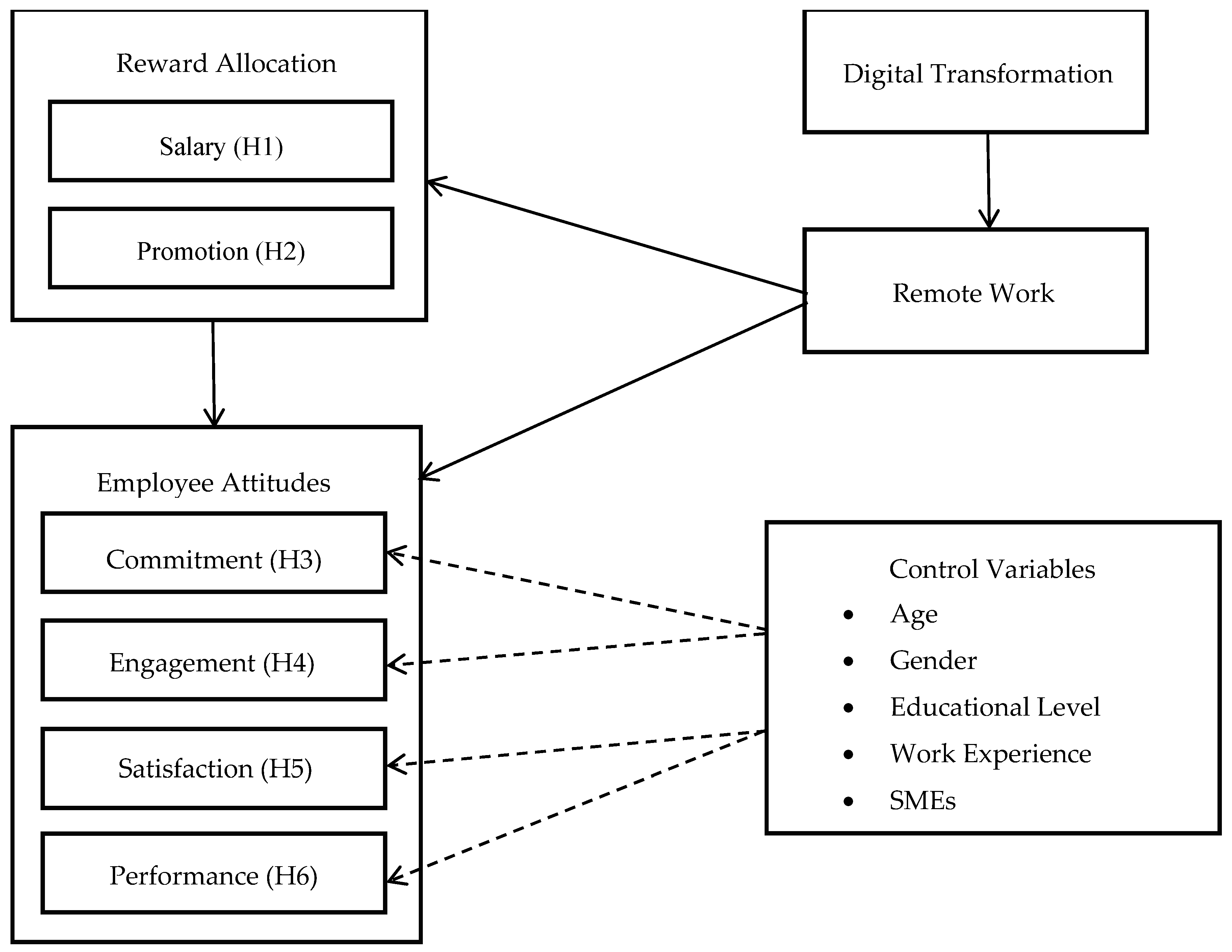
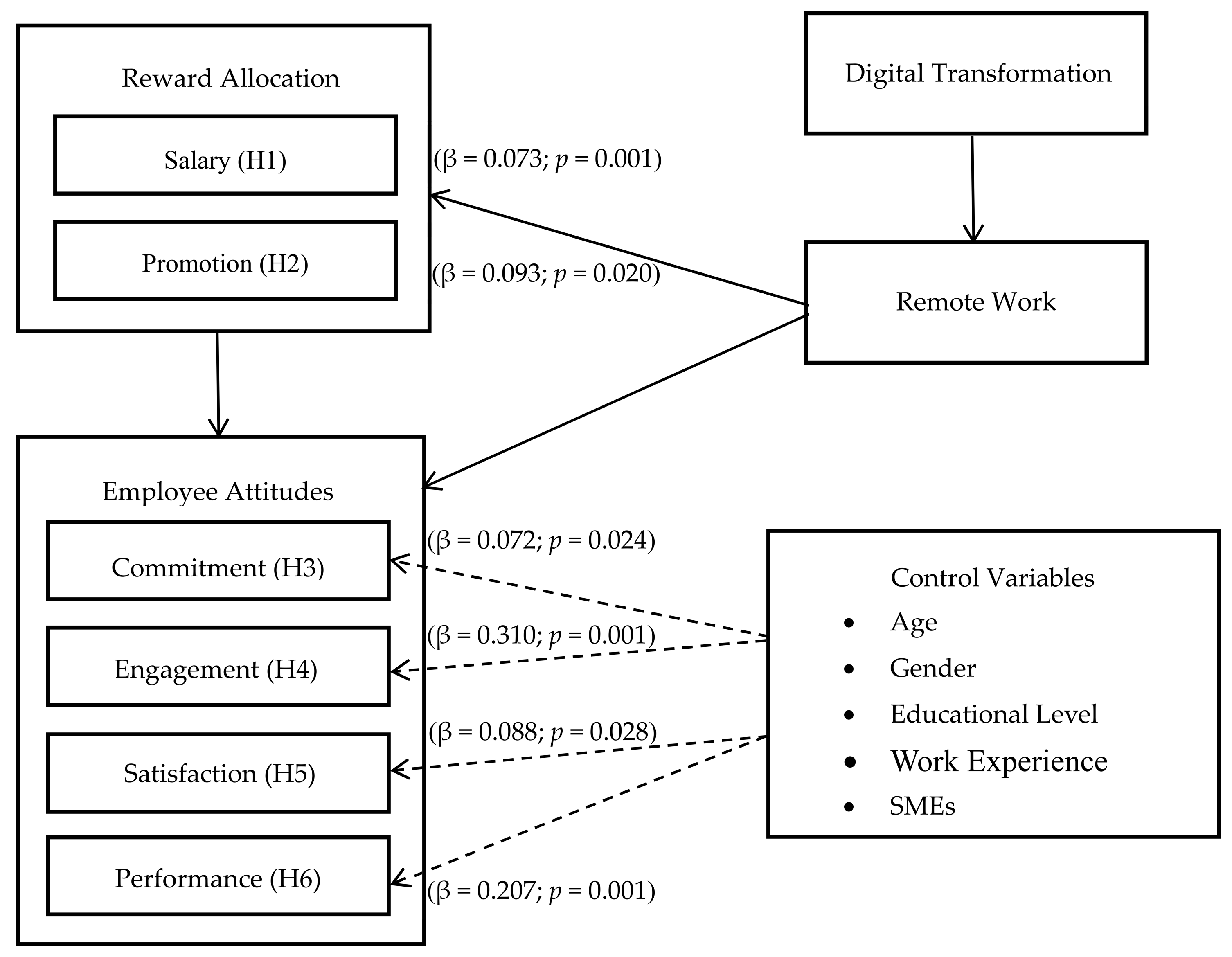

| Characteristic | Classification | Frequency (n = 615) | Percentage (100%) |
|---|---|---|---|
| Gender | Female | 225 | 36.59 |
| Male | 390 | 63.41 | |
| Age | 18–25 | 198 | 32.2 |
| 26–35 | 261 | 42.44 | |
| 36–45 | 90 | 14.63 | |
| 46–55 | 42 | 6.83 | |
| 56–65 | 15 | 2.44 | |
| Over 65 | 9 | 1.46 | |
| Country | Portugal | 156 | 25.37 |
| Poland | 174 | 28.29 | |
| United Kingdom | 120 | 19.51 | |
| Spain | 60 | 9.76 | |
| Greece | 57 | 9.27 | |
| Belgium | 6 | 0.98 | |
| Germany | 12 | 1.95 | |
| France | 12 | 1.95 | |
| Ireland | 9 | 1.46 | |
| Finland | 3 | 0.49 | |
| Netherlands | 3 | 0.49 | |
| Lithuania | 3 | 0.48 | |
| Education | Basic education | 6 | 0.98 |
| Secondary | 150 | 24.39 | |
| Bachelor’s degree | 219 | 35.61 | |
| Master’s degree | 198 | 32.2 | |
| Ph.D. | 27 | 4.39 | |
| Other | 15 | 2.43 | |
| Industry | Technological | 204 | 33.17 |
| Management | 36 | 5.85 | |
| Pharmaceutical | 21 | 3.41 | |
| Logistics | 27 | 4.39 | |
| Retail | 39 | 6.34 | |
| Education | 69 | 11.22 | |
| Tourism | 24 | 3.9 | |
| Food and Beverage | 9 | 1.48 | |
| Electronic | 15 | 2.44 | |
| * Other | 171 | 27.8 | |
| Department | Financial | 45 | 7.32 |
| Human Resources | 45 | 7.32 | |
| Sales | 69 | 11.22 | |
| Logistics | 42 | 6.83 | |
| Marketing | 36 | 5.85 | |
| * Other | 378 | 61.46 | |
| Work Experience | Less than 5 Years | 285 | 46.34 |
| 5–10 years | 171 | 27.7 | |
| More than 10 Years | 159 | 25.85 | |
| Institution Type | Private | 429 | 69.76 |
| Public | 153 | 24.88 | |
| Non-profit | 33 | 5.36 | |
| Company Size | SMEs | 384 | 62.44 |
| Large | 231 | 37.56 | |
| Total | 615 | 100% |
| Variable | Indicator | Factor Loading | AVE | α | CR | |
|---|---|---|---|---|---|---|
| Remote work (RW) | 0.411 | 0.753 | 0.826 | |||
| RW1 | 0.614 | |||||
| RW2 | 0.745 | |||||
| RW3 | 0.619 | |||||
| RW4 | 0.515 | |||||
| RW5 | 0.758 | |||||
| RW6 | 0.709 | |||||
| RW7 | 0.469 | |||||
| Reward Allocation | Salary Adjustments (SA) | 0.400 | 0.734 | 0.814 | ||
| SA1 | 0.717 | |||||
| SA2 | 0.173 | |||||
| SA3 | 0.744 | |||||
| SA4 | 0.675 | |||||
| SA5 | 0.774 | |||||
| SA6 | 0.700 | |||||
| SA7 | 0.746 | |||||
| SA8 | 0.045 | |||||
| Workforce Promotion (WFP) | 0.386 | 0.730 | 0.811 | |||
| WFP1 | 0.775 | |||||
| WFP2 | 0.696 | |||||
| WFP3 | 0.409 | |||||
| WFP4 | 0.745 | |||||
| WFP5 | 0.283 | |||||
| WFP6 | 0.792 | |||||
| WFP7 | 0.745 | |||||
| WFP8 | 0.143 | |||||
| Employee Attitudes | Commitment (COM) | 0.502 | 0.819 | 0.869 | ||
| COM1 | 0.735 | |||||
| COM2 | 0.626 | |||||
| COM3 | 0.757 | |||||
| COM4 | 0.782 | |||||
| COM5 | 0.285 | |||||
| COM6 | 0.806 | |||||
| COM7 | 0.815 | |||||
| Engagement (ENG) | 0.482 | 0.820 | 0.866 | |||
| ENG 1 | 0.683 | |||||
| ENG 2 | 0.690 | |||||
| ENG 3 | 0.717 | |||||
| ENG 4 | 0.663 | |||||
| ENG 5 | 0.704 | |||||
| ENG 6 | 0.758 | |||||
| ENG7 | 0.636 | |||||
| Job Satisfaction (JS) | 0.532 | 0.850 | 0.887 | |||
| JS1 | 0.787 | |||||
| JS2 | 0.677 | |||||
| JS3 | 0.536 | |||||
| JS4 | 0.772 | |||||
| JS5 | 0.777 | |||||
| JS6 | 0.742 | |||||
| JS7 | 0.782 | |||||
| Worker Performance (WP) | 0.607 | 0.835 | 0.885 | |||
| WP1 | 0.814 | |||||
| WP2 | 0.864 | |||||
| WP3 | 0.704 | |||||
| WP4 | 0.675 | |||||
| WP5 | 0.822 |
| Construct | RW | SA | WFP | COM | ENG | JS | WP |
|---|---|---|---|---|---|---|---|
| RW | 1 | ||||||
| SA | 1 | ||||||
| WFP | 0.597 | 1 | |||||
| COM | 0.452 | 0.728 | 1 | ||||
| ENG | 0.586 | 0.657 | 0.549 | 1 | |||
| JS | 0.564 | 0.757 | 0.599 | 0.720 | 1 | ||
| WP | 0.491 | 0.856 | 0.885 | 0.765 | 0.833 | 1 |
| Average path coefficient (APC) | 0.682 | p < 0.001 |
| Average R-Square (ARS) | 0.473 | p < 0.001 |
| Average adjusted R-Square (AARS) | 0.471 | p < 0.001 |
| Average full collinearity VIF (AFVIF) | 2.114 | <5.0, acceptable |
| Tenenhaus GOf (GoF) | 0.523 | >0.36, large |
| Sympson’s paradox ratio (SPR) | 1.000 | Ideally |
| R-Squared contribution ratio (RSCR) | 1.000 | Ideally |
| Statistical suppression ration (SSR) | 1.000 | Ideally |
| Nonlinear bivariate causality direction ratio (NLBCDR) | 1.000 | Acceptable if >0.7 |
| Hypothesis | Path Coefficients (β) | p-Value | Effect Size (f2) | Results | |
|---|---|---|---|---|---|
| H1 | RW → SA | 0.073 | <0.001 | 0.005 | Supported |
| H2 | RW → WFP | 0.093 | <0.020 | 0.009 | Supported |
| H3 | RW → COM | 0.072 | <0.024 | 0.005 | Supported |
| H4 | RW → ENG | 0.310 | <0.001 | 0.115 | Supported |
| H5 | RW → JS | 0.088 | <0.028 | 0.025 | Supported |
| H6 | RW → WP | 0.207 | <0.001 | 0.047 | Supported |
| Hypothesis | Path Coefficients (β) | (β) | f2 | α | |
|---|---|---|---|---|---|
| H1 | RW → SA | 0.073 | 0.005 | Low effect size | 0.734 |
| H2 | RW → WFP | 0.093 | 0.009 | Low effect size | 0.730 |
| H3 | RW → COM | 0.072 | 0.005 | Low effect size | 0.819 |
| H4 | RW → ENG | 0.310 | 0.115 | Small to Medium effect | 0.820 |
| H5 | RW → JS | 0.088 | 0.025 | Small effect size | 0.850 |
| H6 | RW → WP | 0.207 | 0.047 | Small effect size | 0.835 |
Disclaimer/Publisher’s Note: The statements, opinions and data contained in all publications are solely those of the individual author(s) and contributor(s) and not of MDPI and/or the editor(s). MDPI and/or the editor(s) disclaim responsibility for any injury to people or property resulting from any ideas, methods, instructions or products referred to in the content. |
© 2025 by the authors. Licensee MDPI, Basel, Switzerland. This article is an open access article distributed under the terms and conditions of the Creative Commons Attribution (CC BY) license (https://creativecommons.org/licenses/by/4.0/).
Share and Cite
Gandrita, D.M.; Gandrita, A.; Rosado, D.P. Remote Work and Employee Attitudes: The Role of Reward Allocation in European SMEs. Adm. Sci. 2025, 15, 467. https://doi.org/10.3390/admsci15120467
Gandrita DM, Gandrita A, Rosado DP. Remote Work and Employee Attitudes: The Role of Reward Allocation in European SMEs. Administrative Sciences. 2025; 15(12):467. https://doi.org/10.3390/admsci15120467
Chicago/Turabian StyleGandrita, Daniel Mandel, Ana Gandrita, and David Pascoal Rosado. 2025. "Remote Work and Employee Attitudes: The Role of Reward Allocation in European SMEs" Administrative Sciences 15, no. 12: 467. https://doi.org/10.3390/admsci15120467
APA StyleGandrita, D. M., Gandrita, A., & Rosado, D. P. (2025). Remote Work and Employee Attitudes: The Role of Reward Allocation in European SMEs. Administrative Sciences, 15(12), 467. https://doi.org/10.3390/admsci15120467