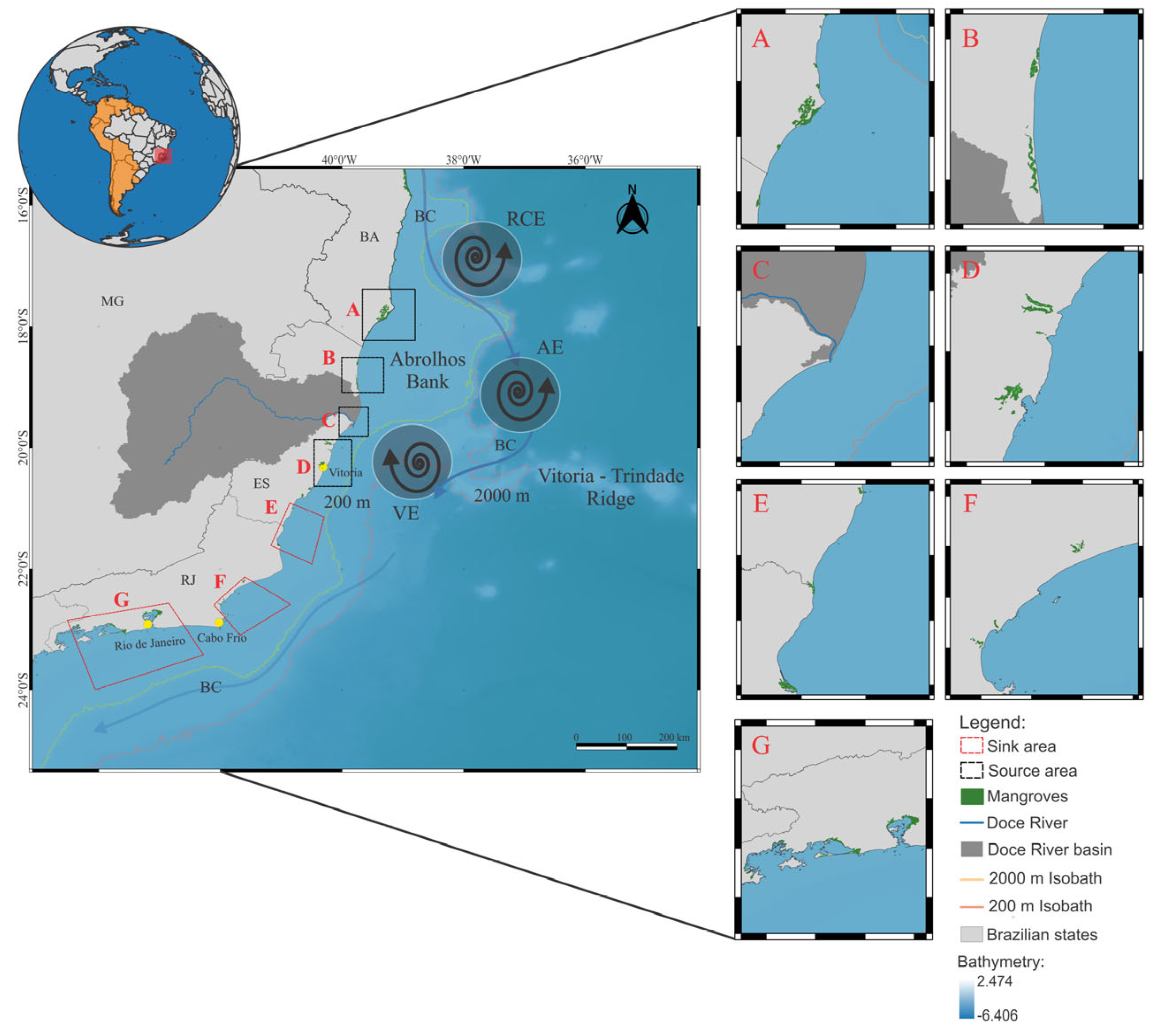

Connectivity of Mangrove Crab Populations Reveals Potential Exposure of Larvae to Metalloid Pollutants
 , , ,
, , ,  , , , , , , , and
Abstract
1. Introduction
2. Materials and Methods
2.1. Larval Dispersion Modeling
2.1.1. Hydrodynamic Model
2.1.2. Lagrangian Model
2.2. Larval Exposure Assessment
2.2.1. In Situ Data and NOEC Index
2.2.2. Larval Exposure Metric
2.3. Connectivity Among Mangrove Populations
3. Results
3.1. Variability of Dispersion Trajectories and Distances Traveled by Larvae
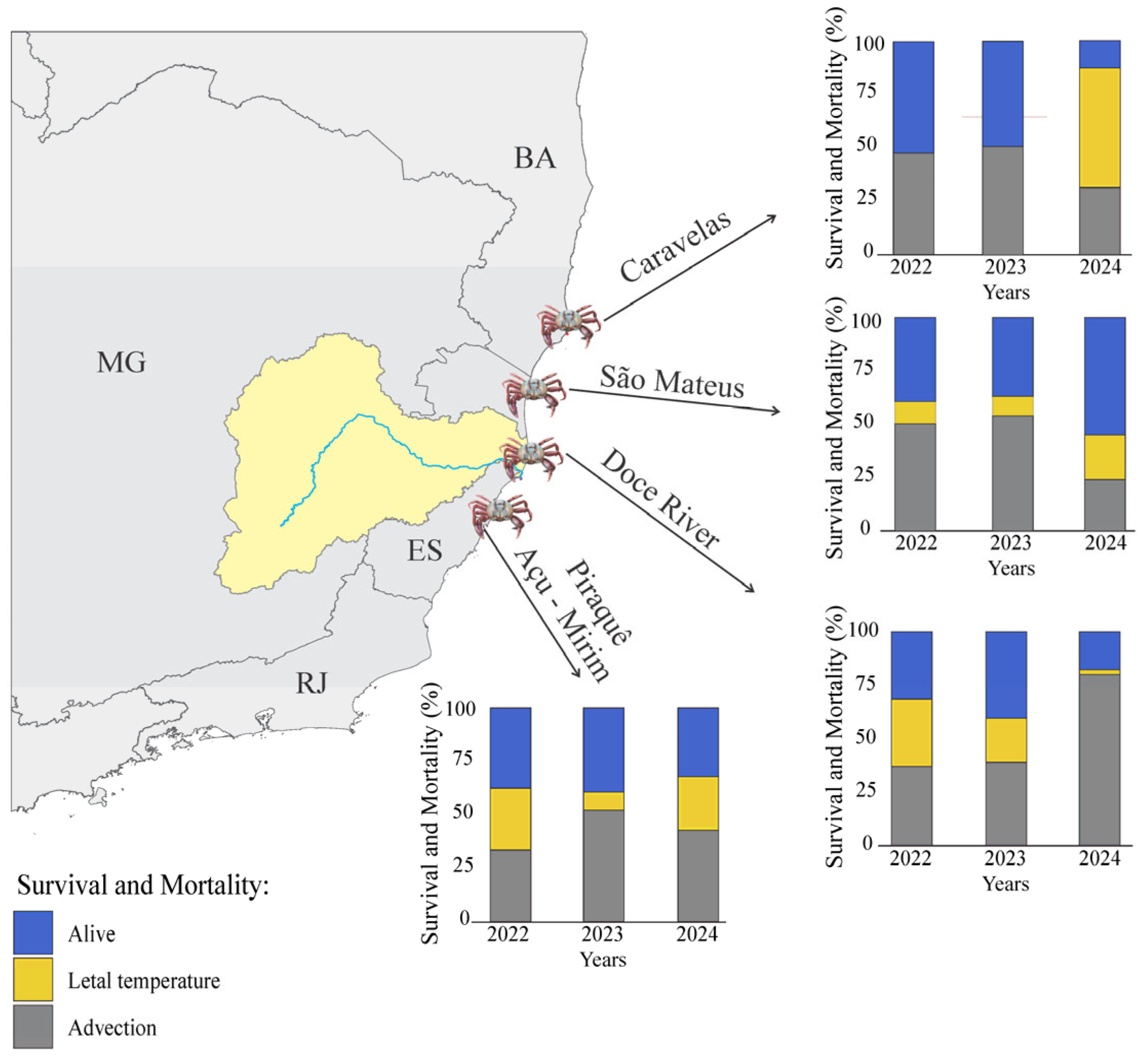
Survival Rates and Sources of Larval Mortality
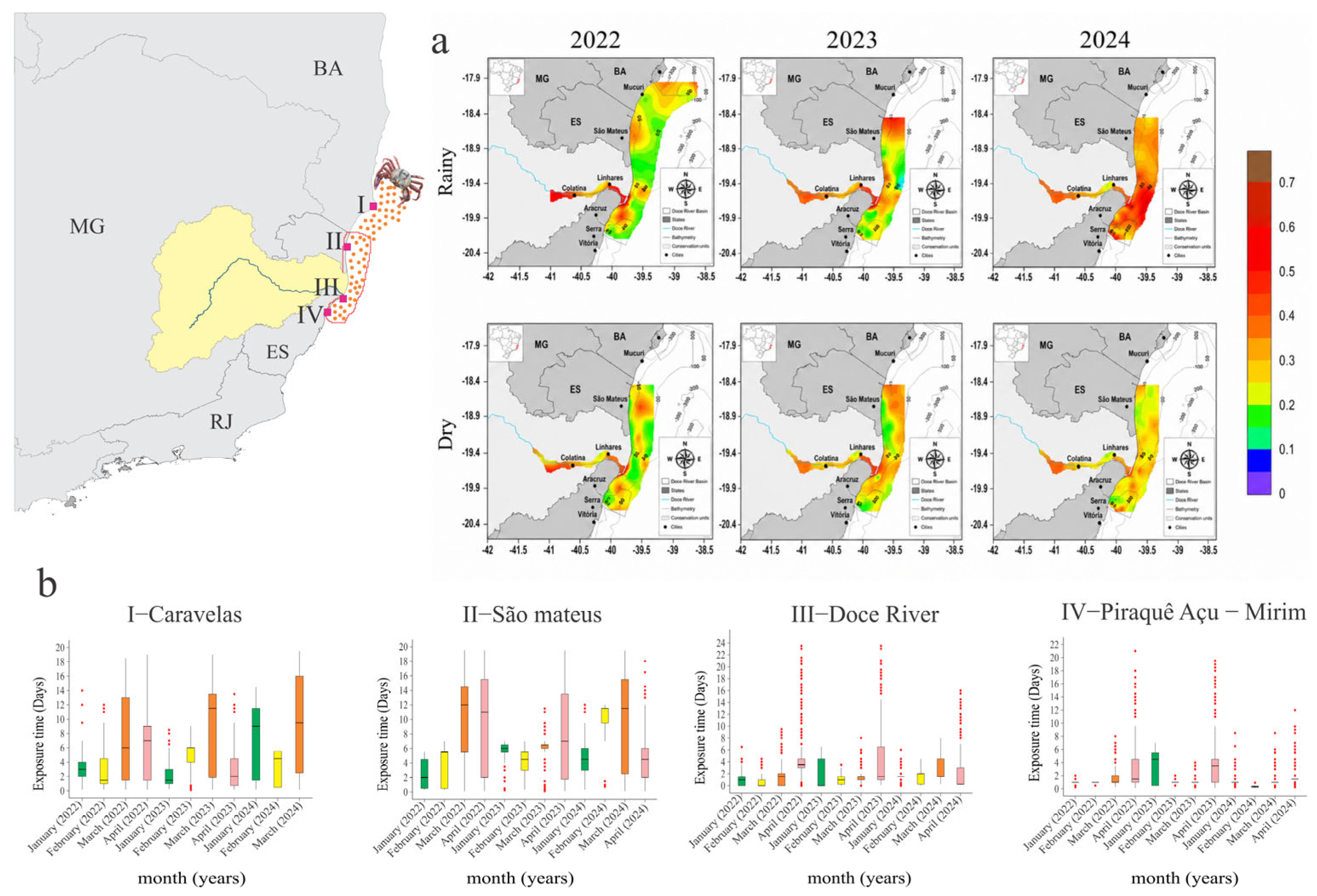
3.2. Potential Exposure of Larvae to Toxic Metaloids
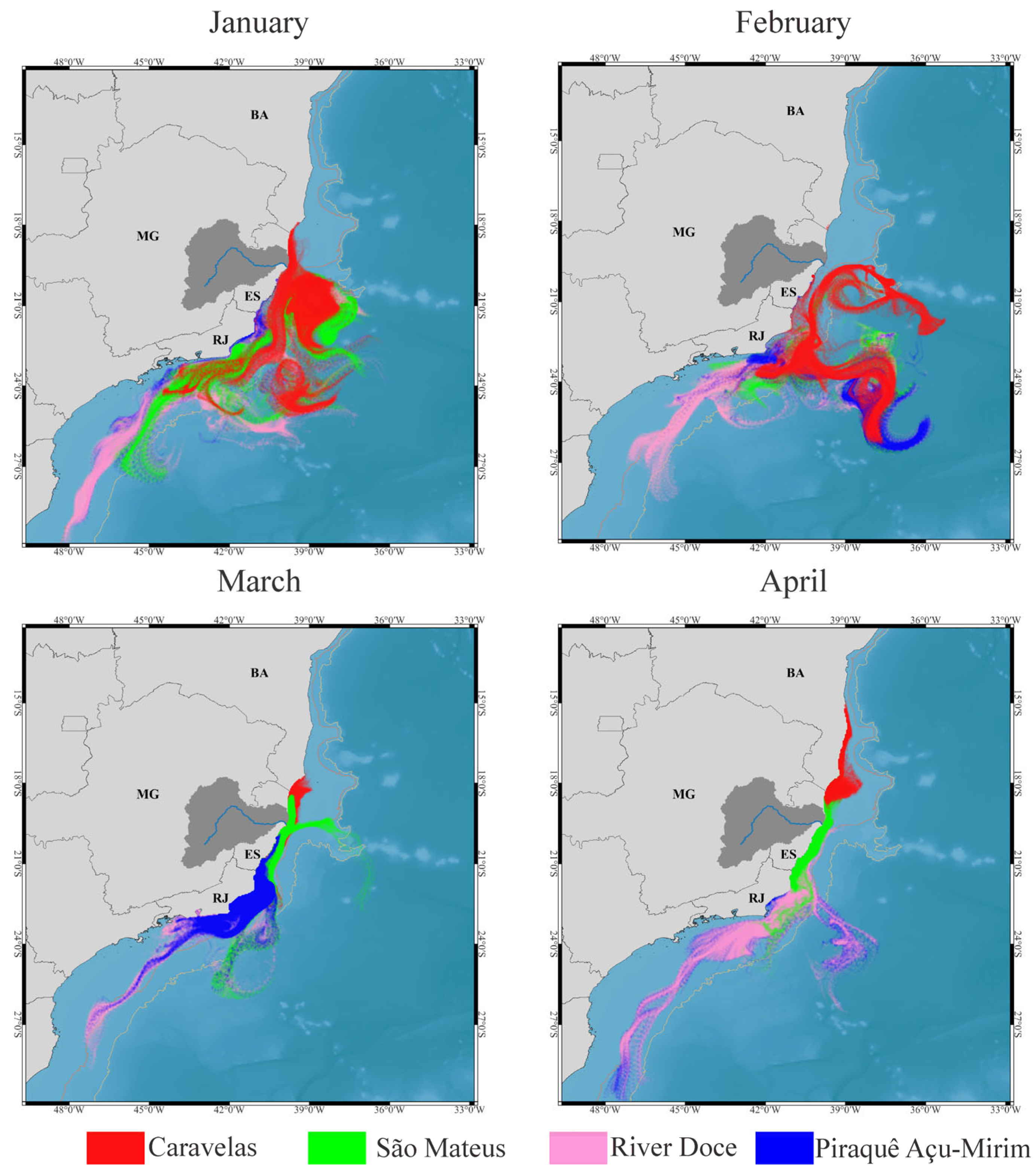
3.3. Spatial and Temporal Variability of Larvae Destination
Connectivity of Mangrove Recruitment Habitats
4. Discussion
5. Conclusions
Supplementary Materials
Author Contributions
Funding
Data Availability Statement
Acknowledgments
Conflicts of Interest
References
- Duarte, E.B.; Neves, M.A.; de Oliveira, F.B.; Martins, M.E.; de Oliveira, C.H.R.; Burak, D.L.; Orlando, M.T.D.; Rangel, C.V.G.T. Trace metals in Rio Doce sediments before and after the collapse of the Fundão iron ore tailings dam, southeastern Brazil. Chemosphere 2020, 262, 127879. [Google Scholar] [CrossRef]
- Richard, E.d.C.; Estrada, G.C.D.; Bechtold, J.-P.; Duarte, H.d.A.; Maioli, B.G.; de Freitas, A.H.A.; Warner, K.E.; Figueiredo, L.H.M. Water and sediment quality in the coastal zone around the mouth of the Doce River after the Fundão tailings dam failure. Integr. Environ. Assess. Manag. 2020, 16, 643–654. [Google Scholar] [CrossRef] [PubMed]
- Miller, M.E.; Ghisolfi, R.D.; Barroso, G.F. Remote sensing monitoring of mining tailings in the fluvial–estuarine–coastal ocean continuum of the lower Doce River Valley (Brazil). Environ. Monit. Assess. 2023, 195, 542. [Google Scholar] [CrossRef] [PubMed]
- Soares, K.M.; Rodrigues, M.B.; Rodrigues, V.G.S.; Kasemodel, M.C.; Silva, V.C.G. A systematic review of the environmental impacts of the Fundão dam rupture in Mariana (Minas Gerais, Brazil). Environ. Sci. Pollut. Res. 2025, 32, 17364–17392. [Google Scholar] [CrossRef]
- Marta-Almeida, M.; Mendes, R.; Amorim, F.N.; Cirano, M.; Dias, J.M. Fundão dam collapse: Oceanic dispersion of River Doce after the greatest Brazilian environmental accident. Mar. Pollut. Bull. 2016, 112, 359–364. [Google Scholar] [CrossRef]
- Francini-Filho, R.B.; Cordeiro, M.C.; Omachi, C.Y.; Rocha, A.M.; Bahiense, L.; Garcia, G.D.; Tschoeke, D.; de Almeida, M.G.; Rangel, T.P.; De Oliveira, B.C.V.; et al. Remote sensing, isotopic composition and metagenomics analyses revealed Doce River ore plume reached the southern Abrolhos Bank Reefs. Sci. Total Environ. 2019, 697, 134038. [Google Scholar] [CrossRef]
- Rudorff, N.; Rudorff, C.M.; Kampel, M.; Ortiz, G. Remote sensing monitoring of the impact of a major mining wastewater disaster on the turbidity of the Doce River plume off the eastern Brazilian coast. ISPRS J. Photogramm. Remote Sens. 2018, 145, 349–361. [Google Scholar] [CrossRef]
- Magris, R.A.; Marta-Almeida, M.; Monteiro, J.A.F.; Ban, N.C. A modelling approach to assess the impact of land mining on marine biodiversity: Assessment in coastal catchments experiencing catastrophic events (SW Brazil). Sci. Total Environ. 2019, 659, 828–840. [Google Scholar] [CrossRef]
- Tognella, M.M.P.; Falqueto, A.R.; Espinoza, H.D.C.F.; Gontijo, I.; Gontijo, A.B.P.L.; Fernandes, A.A.; Schmildt, E.R.; Soares, M.L.G.; Chaves, F.O.; Schmidt, A.J.; et al. Mangroves as traps for environmental damage to metals: The case study of the Fundão Dam. Sci. Total Environ. 2022, 806, 150452. [Google Scholar] [CrossRef]
- Condini, M.V.; Pichler, H.A.; de Oliveira-Filho, R.R.; Cattani, A.P.; Andrades, R.; Vilar, C.C.; Joyeux, J.-C.; Soeth, M.; De Biasi, J.B.; Eggertsen, L.; et al. Marine fish assemblages of eastern Brazil: An update after the world’s largest mining disaster and suggestions of functional groups for biomonitoring long-lasting effects. Sci. Total Environ. 2022, 807, 150987. [Google Scholar] [CrossRef]
- Oliveira, F.B.d.; Neves, M.A.; Pontes, J.L.; de Oliveira, C.H.R.; Duarte, E.B.; Machado, L.E. Monitoring deposition and resuspension of the iron ore tailings in the Doce River after the Fundão dam rupture. Rev. Ambient. Água 2025, 20, e3026. [Google Scholar] [CrossRef]
- Carmo, F.F.; Kamino, L.H.Y.; Junior, R.T.; Campos, I.C.; Silvino, G.; Pinto, C.E.F. Fundão tailings dam failures: The environmental tragedy of the largest technological disaster of Brazilian mining in a global context. Perspect. Ecol. Conserv. 2017, 15, 145–151. [Google Scholar] [CrossRef]
- Franks, D.M.; Stringer, M.; Torres-Cruz, L.A.; Baker, E.; Valenta, R.; Thygesen, K.; Matthews, A.; Howchin, J.; Barrie, S. Tailings facility disclosures reveal stability risks. Sci. Rep. 2021, 11, 5353. [Google Scholar] [CrossRef] [PubMed]
- Instituto Brasileiro do Meio Ambiente e dos Recursos Naturais Renováveis (IBAMA). Laudo Técnico Preliminar: Impactos Ambientais Decorrentes do Desastre Envolvendo o Rompimento da Barragem de Fundão, em Mariana, Minas Gerais [Preliminary Technical Report: Environmental Impacts Resulting from the Fundão Dam Collapse in Mariana, Minas Gerais]; IBAMA: Brasília, Brazil, 2015. [Google Scholar]
- Lima, K.O.O.; Tognella, M.M.P.; Schmidt, A.J.; Schmildt, E.R.; Porto, L.A.; Almeida Filho, E.; Gontijo, I. Baseline study of Ucides cordatus populations and the contribution to the management of these social and economic resources. Wetlands 2023, 43, 28. [Google Scholar] [CrossRef]
- Pascoalini, S.S.; Lopes, D.M.d.S.; Falqueto, A.R.; D’aDdazio, V.; Fernandes, A.A.; da Rosa, M.B.; Gontijo, A.B.P.L.; Soares, M.L.G.; Gontijo, I.; Schmildt, E.R.; et al. Iron and manganese concentrations in leaf tissues of Rhizophora mangle (Rhizophoraceae): Implications for energetic metabolism. Rev. Biol. Trop. 2024, 72, e56835. [Google Scholar] [CrossRef]
- Costa, E.S.; Cagnin, R.C.; da Silva, C.A.; Longhini, C.M.; Sá, F.; Lima, A.T.; de Oliveira Gomes, L.E.; Bernardino, A.F.; Neto, R.R. Iron ore tailings as a source of nutrients to the coastal zone. Mar. Pollut. Bull. 2021, 171, 112725. [Google Scholar] [CrossRef]
- Nascimento, R.L.; Alves, P.R.; Di Domenico, M.; Braga, A.A.; de Paiva, P.C.; Orlando, M.T.D.; Cavichini, A.S.; Longhini, C.M.; Martins, C.C.; Neto, R.R.; et al. The Fundão dam failure: Iron ore tailing impact on marine benthic macrofauna. Sci. Total Environ. 2022, 838, 156205. [Google Scholar] [CrossRef]
- Diele, K.; Koch, V.; Saint-Paul, U. Population structure, catch composition and CPUE of the artisanally harvested mangrove crab Ucides cordatus (Ocypodidae) in the Caeté estuary, North Brazil: Indications for overfishing? Aquat. Living Resour. 2005, 18, 169–178. [Google Scholar] [CrossRef]
- Oliveira-Neto, J.F.; Pie, M.R.; Boeger, W.A.; Ostrensky, A.; Baggio, R.A. Population genetics and evolutionary demography of Ucides cordatus (Decapoda: Ocypodidae). Mar. Ecol. 2007, 28, 460–469. [Google Scholar] [CrossRef]
- Firmo, A.; Tognella, M.; Silva, S.; Barboza, R.; Alves, R. Capture and commercialization of blue land crabs (“guaiamum”) Cardisoma guanhumi (Latreille, 1825) along the coast of Bahia State, Brazil: An ethnoecological approach. J. Ethnobiol. Ethnomed. 2012, 8, 12. [Google Scholar] [CrossRef]
- Nascimento, D.M.; Alves, R.R.N.; Barboza, R.R.D.; Schmidt, A.J.; Diele, K.; Mourão, J.S. Commercial relationships between intermediaries and harvesters of the mangrove crab Ucides cordatus (Linnaeus, 1763) in the Mamanguape River Estuary, Brazil, and their socio-ecological implications. Ecol. Econ. 2017, 131, 44–51. [Google Scholar] [CrossRef]
- Bromenschenkel, V.C.S.; Tognella, M.M.P. Population estimate and extractive potential of uçá crab in the post-closed season: Subsidies for management in a conservation unit of sustainable use. Res. Soc. Dev. 2020, 9, e25791210992. [Google Scholar] [CrossRef]
- Pescinelli, R.A.; Freitas, F.; Costa, R.C.; Hilesheim, J.C.; Dieh, F.L.; Branco, J.O. Assessment of population biology, size–weight relationship, condition factor, and spatial distribution of the mangrove crab Ucides cordatus (Crustacea: Ocypodidae) in southern Brazil. Acta Zool. 2023, 104, 323–333. [Google Scholar] [CrossRef]
- Souza, F.V.B.d.; Pinheiro, M.A.A. Biology, trophic chain, and ethnobiological calendar of the mangrove crab Ucides cordatus (Linnaeus, 1763) (Brachyura, Ocypodidae), according to the perception of catchers in Itanhaém, São Paulo, Brazil. Nauplius 2022, 30, e2022017. [Google Scholar] [CrossRef]
- Rodrigues, M.D.; Hebling, N.J. Ucides cordatus cordatus (Linnaeus, 1763) (Crustacea, Decapoda): Complete larval development under laboratory conditions and its systematic position. Rev. Bras. Zool. 1989, 6, 147–166. [Google Scholar] [CrossRef]
- Diele, K.; Simith, D.J.B. Effects of substrata and conspecific odour on the metamorphosis of mangrove crab megalopae, Ucides cordatus (Ocypodidae). J. Exp. Mar. Biol. Ecol. 2007, 348, 174–182. [Google Scholar] [CrossRef]
- Schmidt, A.J.; Diele, K. First field record of mangrove crab Ucides cordatus (Crustacea: Decapoda: Ucididae) recruits co-inhabiting burrows of conspecific crabs. Zoologia 2009, 26, 792–794. [Google Scholar] [CrossRef]
- Melo, G.A.S. Identification Manual of Brachyura (Crabs and Swimming Crabs) from the Brazilian Coast; Editora Plêiade: São Paulo, Brazil, 1996. [Google Scholar]
- Britto, F.; Schmidt, A.J.; Carvalho, A.M.F.; Vasconcelos, C.C.M.P.; Farias, A.M.; Bentzen, P.; Diniz, F.M. Population connectivity and larval dispersal of the exploited mangrove crab Ucides cordatus along the Brazilian coast. PeerJ 2018, 6, e4702. [Google Scholar] [CrossRef]
- Banaee, M.; Zeidi, A.; Mikušková, N.; Faggio, C. Assessing metal toxicity on crustaceans in aquatic ecosystems: A comprehensive review. Biol. Trace Elem. Res. 2024, 202, 5743–5761. [Google Scholar] [CrossRef]
- Ventura-Lima, J.; Bogo, M.R.; Monserrat, J.M. Accumulation, biotransformation, and biochemical responses after exposure to arsenite and arsenate in the estuarine polychaete Laeonereis acuta (Nereididae). Environ. Sci. Pollut. Res. 2011, 18, 1270–1278. [Google Scholar] [CrossRef]
- Ramos, R.J.; Leite, G.R. Disposition of trace elements in the mangrove ecosystem and their effects on Ucides cordatus (Linnaeus, 1763) (Crustacea, Decapoda). Biometals 2022, 35, 853–873. [Google Scholar] [CrossRef] [PubMed]
- Fernandes, L.F.L.; Paiva, T.R.M.; Longhini, C.M.; Pereira, J.B.; Ghisolfi, R.D.; Lázaro, G.C.S.; Rocha, G.M. Marine zooplankton dynamics after a major mining dam rupture in the Doce River, southeastern Brazil: Rapid response to a changing environment. Sci. Total Environ. 2020, 736, 139621. [Google Scholar] [CrossRef]
- Bonecker, A.C.T.; Menezes, B.S.; Junior, C.D.; da Silva, C.A.; Ancona, C.M.; Dias, C.d.O.; Longhini, C.M.; Costa, E.S.; Sá, F.; Lázaro, G.C.S.; et al. An integrated study of the plankton community after four years of the Fundão dam disaster. Sci. Total Environ. 2022, 806, 150613. [Google Scholar] [CrossRef] [PubMed]
- Rocha, G.M.; Salvador, B.; Laino, P.d.S.; Santos, G.H.C.; Demoner, L.E.; da Conceição, L.R.; Teixeira-Amaral, P.; Mill, G.N.; Ghisolfi, R.D.; Costa, E.S.; et al. Responses of marine zooplankton indicators after five years of a dam rupture in the Doce River, southeastern Brazil. Sci. Total Environ. 2022, 806, 151249. [Google Scholar] [CrossRef]
- Fernandes, T.d.S.; Neto, J.A.d.S.; Dornelas, M.E.; Lima, P.H.P.; Cescon, A.L.F.; Gobbo, M.Z.; Barcelos, R.M.; Batista-Silva, H. Biological, physicochemical, and social impacts resulting from the rupture of the Fundão dam. Rev. Ambient. Água 2025, 20, e3045. [Google Scholar] [CrossRef]
- Mortimer, M.R.; Miller, G.J. Susceptibility of larval and juvenile instars of the sand crab, Portunus pelagicus (L.), to seawater contaminated by chromium, nickel or copper. Aust. J. Mar. Freshw. Res. 1994, 45, 1107–1121. [Google Scholar] [CrossRef]
- Roe, R.A.L.; Tran, T.K.A.; Schreider, M.J.; MacFarlane, G.R. Assessment of the effects of sediment-associated metals and metalloids on mangrove macroinvertebrate assemblages. Water Air Soil Pollut. 2020, 231, 352. [Google Scholar] [CrossRef]
- Silva, M.R.; Faial, K.C.; Freitas, A.C.; Fernandes, M.E. Use of the gonadal structures of the mangrove crab Ucides cordatus as a biomarker for environmental contamination by metals. Mar. Pollut. Bull. 2024, 198, 115862. [Google Scholar] [CrossRef]
- Marques, J.A.; Costa, S.R.; Maraschi, A.C.; Vieira, C.E.; Costa, P.G.; Martins, C.d.M.G.; Santos, H.F.; Souza, M.M.; Sandrini, J.Z.; Bianchini, A. Biochemical response and metals bioaccumulation in planktonic communities from marine areas impacted by the Fundão mine dam rupture (southeast Brazil). Sci. Total Environ. 2022, 806, 150727. [Google Scholar] [CrossRef]
- Rodrigues, R.R.; Rothstein, L.M.; Wimbush, M. Seasonal variability of the South Equatorial Current bifurcation in the Atlantic Ocean: A numerical study. J. Phys. Oceanogr. 2007, 37, 16–30. [Google Scholar] [CrossRef]
- Luko, C.D.; da Silveira, I.C.A.; Simoes-Sousa, I.T.; Araujo, J.M.; Tandon, A. Revisiting the Atlantic South Equatorial Current. J. Geophys. Res. Ocean. 2021, 126, e2021JC017387. [Google Scholar] [CrossRef]
- Soutelino, R.G.; Gangopadhyay, A.; da Silveira, I.C.A. The roles of vertical shear and topography on the eddy formation near the site of origin of the Brazil Current. Cont. Shelf Res. 2013, 70, 46–60. [Google Scholar] [CrossRef]
- Arruda, W.Z.; da Silveira, I.C.A. Dipole-induced Central Water extrusions south of Abrolhos Bank (Brazil, 20.5° S). Cont. Shelf Res. 2019, 188, 103976. [Google Scholar] [CrossRef]
- Schmidt, A.J.; Diele, K. Intraspecific facilitation of the recruitment of a burrowing mangrove crab species along an environmental gradient. Ocean Coast. Res. 2024, 72, e23039. [Google Scholar] [CrossRef]
- Coppo, G.C.; Gabriel, F.A.; Mazzuco, A.C.A.; Queiroz, H.M.; Barcellos, D.; Ferreira, T.O.; Bernardino, A.F. Long-term impacts on estuarine benthic assemblages (2015–2020) after a mine tailing spill in SE Brazil. Mar. Pollut. Bull. 2023, 196, 115616. [Google Scholar] [CrossRef]
- Bastos, A.C.; Quaresma, V.S.; Marangoni, M.B.; D’Agostini, D.P.; Bourguignon, S.N.; Cetto, P.H.; Collins, M. Shelf morphology as an indicator of sedimentary regimes: A synthesis from a mixed siliciclastic–carbonate shelf on the eastern Brazilian margin. J. S. Am. Earth Sci. 2015, 63, 125–136. [Google Scholar] [CrossRef]
- Silveira, I.C.A.; Calado, L.; Castro, B.M.; Cirano, M.; Lima, J.A.M.; Mascarenhas, A.D.S. On the baroclinic structure of the Brazil Current–Intermediate Western Boundary Current system at 22–23° S. Geophys. Res. Lett. 2004, 31, L14308. [Google Scholar] [CrossRef]
- Auclair, F.; Benshila, R.; Bordois, L.; Boutet, M.; Brémond, M.; Caillaud, M.; Cambon, G.; Capet, X.; Debreu, L.; Ducousso, N.; et al. Coastal and Regional Ocean Community Model (1.2.1); Zenodo: Geneva, Switzerland, 2022. [Google Scholar]
- Jullien, S.; Caillaud, M.; Benshila, R.; Bordois, L.; Cambon, G.; Dumas, F.; Le Gentil, S.; Lemarié, F.; Marchesiello, P.; Theetten, S.; et al. CROCO Technical and Numerical Documentation (2.1.0); Zenodo: Geneva, Switzerland, 2025. [Google Scholar]
- Shchepetkin, A.F.; McWilliams, J.C. The regional oceanic modeling system (ROMS): A split-explicit, free-surface, topography-following-coordinate oceanic model. Ocean Model. 2005, 9, 347–404. [Google Scholar] [CrossRef]
- Debreu, L.; Marchesiello, P.; Penven, P.; Cambon, G. Two-way nesting in split-explicit ocean models: Algorithms, implementation and validation. Ocean Model. 2012, 49–50, 1–21. [Google Scholar] [CrossRef]
- GEBCO Compilation Group. GEBCO 2024 Grid; British Oceanographic Data Centre: Liverpool, UK, 2024; Available online: https://www.gebco.net/data-products-gridded-bathymetry-data/gebco2024-grid (accessed on 10 December 2025). [CrossRef]
- Hersbach, H.; Bell, B.; Berrisford, P.; Biavati, G.; Horányi, A.; Muñoz Sabater, J.; Nicolas, J.; Peubey, C.; Radu, R.; Rozum, I.; et al. ERA5 Hourly Data on Single Levels from 1940 to Present; Copernicus Climate Change Service (C3S) Climate Data Store (CDS): Reading, UK, 2023. [Google Scholar] [CrossRef]
- Egbert, G.; Erofeeva, S. Efficient inverse modeling of barotropic ocean tides. J. Atmos. Ocean. Technol. 2002, 19, 183–204. [Google Scholar] [CrossRef]
- HYCOM Consortium. Hybrid Coordinate Ocean Model (HYCOM); Center for Ocean-Atmospheric Prediction Studies (COAPS); Florida State University: Tallahassee, FL, USA; Available online: https://www.hycom.org/ (accessed on 12 May 2026).
- Lett, C.; Verley, P.; Mullon, C.; Parada, C.; Brochier, T.; Penven, P.; Blanke, B. A Lagrangian tool for modelling ichthyoplankton dynamics. Environ. Model. Softw. 2008, 23, 1210–1214. [Google Scholar] [CrossRef]
- Diele, K. Life History and Population Structure of the Exploited Mangrove Crab Ucides cordatus cordatus (Decapoda: Brachyura) in the Caeté Estuary, North Brazil. Ph.D. Thesis, University of Bremen, Bremen, Germany, 2000. [Google Scholar]
- Goes, P.; Branco, J.O.; Pinheiro, M.A.A.; Barbieri, E.; Costa, D.; Fernandes, L.L. Bioecology of uçá crab, Ucides cordatus (Linnaeus, 1763), in Vitória Bay, Espírito Santo, Brazil. Braz. J. Oceanogr. 2010, 58, 153–163. [Google Scholar] [CrossRef]
- Silva, U.T. Population Recovery of the Mangrove Crab Ucides cordatus (Linnaeus, 1763) Through the Release of Immature Stages in Anthropogenically Impacted Areas. Ph.D. Thesis, Universidade Federal do Paraná, Curitiba, Brazil, 2007. [Google Scholar]
- Cottens, K.F.; Silva, U.A.; Becker, A.G.; Iosafat, P. Variation in survival rate and development time of Ucides cordatus (Linnaeus, 1763) larvae cultured under different temperatures. Bol. Téc. Cient. CEPNOR 2010, 10, 67–78. [Google Scholar]
- Peliz, A.; Marchesiello, P.; Dubert, J.; Marta-Almeida, M.; Roy, C.; Queiroga, H. A study of crab larvae dispersal on the Western Iberian Shelf: Physical processes. J. Mar. Syst. 2007, 68, 215–236. [Google Scholar] [CrossRef]
- Posthuma, L.; van Gils, J.; Zijp, M.C.; van de Meent, D.I.K.; de Zwart, D. Species sensitivity distributions for use in environmental protection, assessment, and management of aquatic ecosystems for 12,386 chemicals. Environ. Toxicol. Chem. 2019, 38, 905–917. [Google Scholar] [CrossRef]
- Alvares, C.A.; Stape, J.L.; Sentelhas, P.C.; Gonçalves, J.L.M.; Sparovek, G. Köppen’s climate classification map for Brazil. Meteorol. Z. 2013, 22, 711–728. [Google Scholar] [CrossRef]
- Bunting, P.J.; Rosenqvist, A.; Lucas, R.M.; Rebelo, L.M.; Hilarides, L.; Thomas, N.; Hardy, A.; Itoh, T.; Shimada, M.; Finlayson, C.M. The Global Mangrove Watch—A new 2010 baseline of mangrove extent. Remote Sens. 2018, 10, 1669. [Google Scholar] [CrossRef]
- Ventura, R.; Silva, U.A.T.; Perbiche-Neves, G.; Ostrensky, A.; Boeger, W.A.P.; Pie, M.R. Duration of the pre-settlement period of the mangrove crab Ucides cordatus (Decapoda: Ocypodidae) under laboratory conditions. Braz. Arch. Biol. Technol. 2008, 51, 957–962. [Google Scholar] [CrossRef]
- Castelao, R.M.; Barth, J.A. Upwelling around Cabo Frio, Brazil: The importance of wind stress curl. Geophys. Res. Lett. 2006, 33, L03602. [Google Scholar] [CrossRef]
- Bravo, L.; Ramos, M.; Astudillo, O.; Dewitte, B.; Goubanova, K. Seasonal variability of the Ekman transport and pumping in the upwelling system off central-northern Chile (~30° S). Ocean Sci. 2016, 12, 1049–1065. [Google Scholar] [CrossRef]
- Song, H.; Marshall, J.; McGillicuddy, D.J.; Seo, H. Impact of current–wind interaction on vertical processes in the Southern Ocean. J. Geophys. Res. Ocean. 2020, 125, e2020JC016046. [Google Scholar] [CrossRef]
- Ghisolfi, R.D.; da Silva, M.P.; dos Santos, F.T.; Servino, R.N.; Cirano, M.; Thompson, F.L. Physical forcing mechanisms controlling the variability of chlorophyll-a over the Royal-Charlotte and Abrolhos Banks—Eastern Brazilian Shelf. PLoS ONE 2015, 10, e0117082. [Google Scholar] [CrossRef] [PubMed]
- Campos, E.J.D.; Velhote, D.; da Silveira, I.C.A. Shelf break upwelling driven by Brazil Current cyclonic meanders. Geophys. Res. Lett. 2000, 27, 751–754. [Google Scholar] [CrossRef]
- Castro-Filho, B.M.; Lorenzzetti, J.A.; Silveira, I.C.A.; Miranda, L.B.; Rossi-Wongtschowski, C.L.D.B. Thermohaline structure and circulation in the region between Cabo de São Tomé (RJ) and Chuí (RS). In The Oceanographic Environment of the Continental Shelf and Slope in the Southeast–South Region of Brazil; Rossi-Wongtschowski, C.L.D.B., Madureira, L.S.P., Eds.; EDUSP: São Paulo, Brazil, 2006. [Google Scholar]
- Mazzini, P.L.F.; Barth, J.A. A comparison of mechanisms generating vertical transport in the Brazilian coastal upwelling regions. J. Geophys. Res. Ocean. 2013, 118, 5977–5993. [Google Scholar] [CrossRef]
- Bonecker, S.L.C.; Araujo, A.V.; Carvalho, P.F.; Dias, C.O.; Fernandes, L.F.; Migotto, A.E.; Oliveira, O.M.P. Horizontal and vertical distribution of mesozooplankton species richness and composition down to 2300 m in the Southwest Atlantic Ocean. Zoologia 2014, 31, 445–462. [Google Scholar] [CrossRef]
- Franco, B.C.; Defeo, O.; Piola, A.R.; Barreiro, M.; Yang, H.; Ortega, L.; Möller, O.O. Climate change impacts on the atmospheric circulation, ocean, and fisheries in the southwest South Atlantic Ocean: A review. Clim. Change 2020, 162, 2359–2377. [Google Scholar] [CrossRef]
- Hatje, V.; Masqué, P.; Patire, V.F.; Dórea, A.; Barros, F. Blue carbon stocks, accumulation rates, and associated spatial variability in Brazilian mangroves. Limnol. Oceanogr. 2021, 66, 321–334. [Google Scholar] [CrossRef]
- Pezzi, L.P.; Souza, R.B.; Santini, M.F.; Miller, A.J.; Carvalho, J.T.; Parise, C.K.; Rubert, J. Oceanic eddy-induced modifications to air–sea heat and CO2 fluxes in the Brazil–Malvinas Confluence. Sci. Rep. 2021, 11, 10648. [Google Scholar] [CrossRef]
- Araujo, G.S.; Rocha, L.A.; Lastrucci, N.S.; Luiz, O.J.; Di Dario, F.; Floeter, S.R. The Amazon–Orinoco barrier as a driver of reef-fish speciation in the Western Atlantic through time. J. Biogeogr. 2022, 49, 1407–1419. [Google Scholar] [CrossRef]





| Parameters | U. cordatus | References |
|---|---|---|
| Total number of released particles | 96.000 | - |
| Pelagic larval duration | 30 days | [59] |
| Spawning season | January to April | [59,60] |
| Lunar phases | After the full and new moon | [59] |
| Diel vertical migration depth | −20 (day) to −30 (night) m | [61] |
| Temperature optimum range | (20 °C to 30 °C) | [26,62] |
| Turbulent dissipation rate | 1 × 10⁻⁹ m2·s−3 | [63] |
| Sunset and sunrise | 6:00 and 18:00 | - |
| Coastline behavior | Bouncing | - |
| Advection method | Runge–Kutta 4 | - |
| Simulation years | 2022 to 2024 | - |
Disclaimer/Publisher’s Note: The statements, opinions and data contained in all publications are solely those of the individual author(s) and contributor(s) and not of MDPI and/or the editor(s). MDPI and/or the editor(s) disclaim responsibility for any injury to people or property resulting from any ideas, methods, instructions or products referred to in the content. |
© 2026 by the authors. Licensee MDPI, Basel, Switzerland. This article is an open access article distributed under the terms and conditions of the Creative Commons Attribution (CC BY) license.
Share and Cite
Gouveia, N.d.A.; Fonseca, S.A.R.d.; Mota, L.d.F.; Santana, M.S.; Gherardi, D.F.M.; Di Domenico, M.; Oliveira, K.S.S.; Bom, F.C.; Simões, N.R.; Pinha, G.D.; et al. Connectivity of Mangrove Crab Populations Reveals Potential Exposure of Larvae to Metalloid Pollutants. Environments 2026, 13, 282. https://doi.org/10.3390/environments13050282
Gouveia NdA, Fonseca SARd, Mota LdF, Santana MS, Gherardi DFM, Di Domenico M, Oliveira KSS, Bom FC, Simões NR, Pinha GD, et al. Connectivity of Mangrove Crab Populations Reveals Potential Exposure of Larvae to Metalloid Pollutants. Environments. 2026; 13(5):282. https://doi.org/10.3390/environments13050282
Chicago/Turabian StyleGouveia, Nelson de Almeida, Sabrina Aparecida Ramos da Fonseca, Lucas de Farias Mota, Manuela Santos Santana, Douglas Francisco Marcolino Gherardi, Maikon Di Domenico, Kyssyane Samihra Santos Oliveira, Fábio Cavalca Bom, Nadson Ressyé Simões, Gisele Daiane Pinha, and et al. 2026. "Connectivity of Mangrove Crab Populations Reveals Potential Exposure of Larvae to Metalloid Pollutants" Environments 13, no. 5: 282. https://doi.org/10.3390/environments13050282
APA StyleGouveia, N. d. A., Fonseca, S. A. R. d., Mota, L. d. F., Santana, M. S., Gherardi, D. F. M., Di Domenico, M., Oliveira, K. S. S., Bom, F. C., Simões, N. R., Pinha, G. D., Ghisolfi, R. D., Tognella, M. M. P., Sá, F., Costa, F. d. M., Saraiva, I. C., Ribeiro, F. C. P., Altoé Porto, L., Lima, K. O. d. O., & Ferreira, B. P. (2026). Connectivity of Mangrove Crab Populations Reveals Potential Exposure of Larvae to Metalloid Pollutants. Environments, 13(5), 282. https://doi.org/10.3390/environments13050282