
Review

Wanted Dead or Alive: Enhancing Spatiotemporal Resolution of Environmental Nucleic Acid Techniques in Macro-Organism Biosecurity

1
Wagga Wagga Agricultural Institute, New South Wales Department of Primary Industries and Regional Development, Wagga Wagga, NSW 2650, Australia
2
College of Life Sciences, Fujian Agriculture and Forestry University, Fuzhou 350004, China
*
Author to whom correspondence should be addressed.
Environments 2026, 13(5), 281; https://doi.org/10.3390/environments13050281

Submission received: 17 April 2026 / Revised: 15 May 2026 / Accepted: 15 May 2026 / Published: 18 May 2026

Abstract

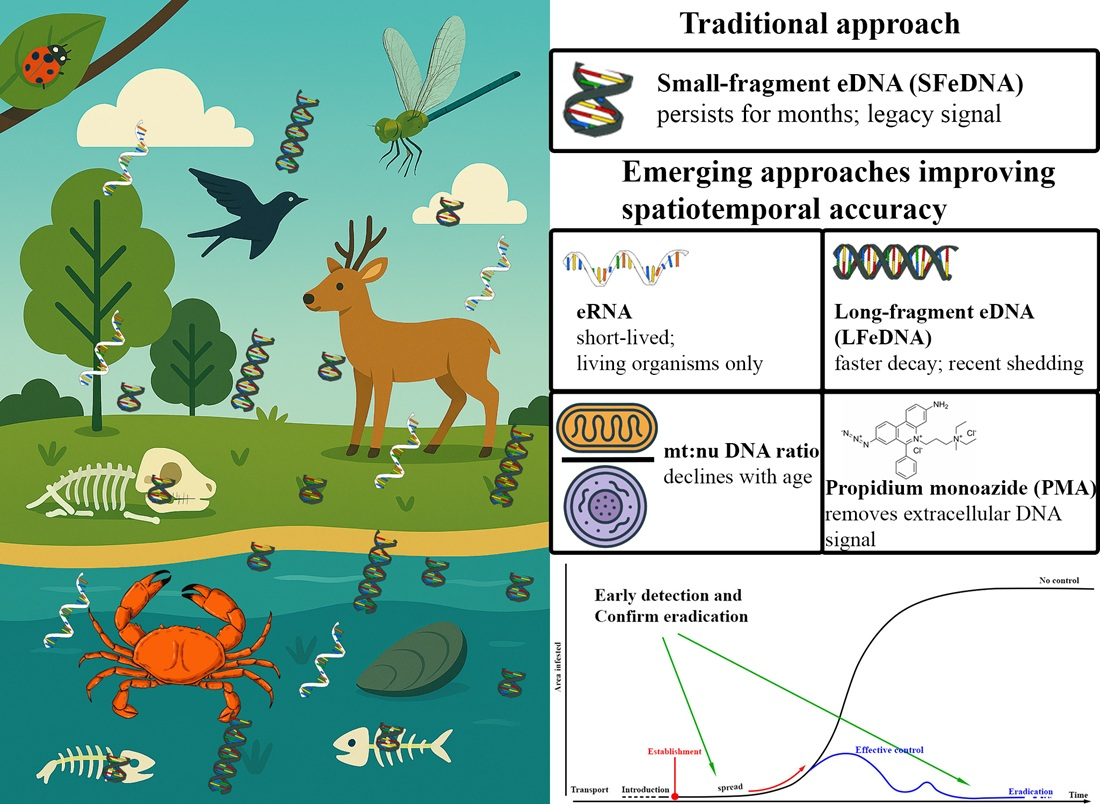
Highly sensitive and non-invasive detection of macroorganisms using environmental nucleic acids (eNA) has transformed biosecurity surveillance. However, the persistence of legacy DNA compromises the spatiotemporal accuracy of environmental DNA (eDNA)-based detection, leading to false indications of contemporary species presence. This review critically evaluates emerging molecular approaches aimed at improving the temporal resolution of eNA signals and distinguishing living organisms from historical residues. We examine environmental RNA (eRNA), long-fragment eDNA (LFeDNA), propidium monoazide (PMA) treatment, and organelle-to-nuclear DNA ratios as indicators of eDNA age, assessing their principles, technical challenges, and practical potential. While eRNA offers the strongest theoretical link to organism viability, its application is constrained by rapid decay and stringent handling requirements. LFeDNA presents a more practical alternative but requires careful assay design. PMA treatment has shown limited effectiveness in excluding legacy DNA, whereas organelle-to-nuclear DNA ratios remain promising but underexplored. We identify key research priorities needed to transition these approaches from experimental studies to operational biosecurity tools. Addressing these gaps will improve interpretation of eNA signals, enabling more accurate detection of living invasive organisms and enhancing the reliability of biosecurity surveillance.

Graphical Abstract

1. Introduction

Biological invasions pose growing pressure on agricultural production and natural ecosystems, necessitating increased efforts in biosecurity and invasive species management. The total cost of global biological invasions since 1960 has been estimated at USD 95.3 billion for management and USD 1130.6 billion for damage [1]. Effective management of invasive species depends on early detection and rapid response to disrupt the invasion curve [2]. Advanced monitoring technologies such as detection of environmental DNA (eDNA) and environmental RNA (eRNA) are increasingly being investigated and applied to assist in early detection of invasive species.
Environmental nucleic acids (eNA), including eDNA and eRNA, are residual genetic materials shed by organisms and obtained directly from environmental samples. They can provide a range of demographic and ecological information about target species within a given habitat [3]. eDNA sampling in conjunction with metabarcode or similar broad assay sequencing approaches has long been used for detection and classification of microorganisms [4] and has, over the past decade, been widely applied for macro-organism surveillance, especially in aquatic environments for both biosecurity [3] and biodiversity studies [5].
However, the use of eDNA differs fundamentally between biodiversity research and biosecurity surveillance. In biodiversity and ecological studies, eDNA is commonly used to characterise community composition, typically through α- and β-diversity patterns. Analytical outcomes in these contexts are therefore often dominated by taxa that contribute the largest proportion of sequence reads, which are frequently interpreted as reflecting relatively abundant species [6,7]. Sites yielding strong signals from threatened or ecologically important taxa are commonly prioritised, as these are assumed to indicate larger populations [8]. Consequently, when trade-offs must be made, accuracy (i.e., minimising false positives) is often favoured over sensitivity to support efficient resource allocation.
In contrast, biosecurity surveillance typically prioritises sensitivity, as the primary objective is the early detection of rare, newly introduced non-indigenous species (NIS), which may only leave trace genetic signatures in the environment. Any confirmed detection, regardless of signal strength, can trigger management responses aimed at rapid containment or eradication [9,10]. Accordingly, the ability to detect NIS at trace levels early along the invasion curve is crucial for effective intervention [3].
The presence of legacy DNA can significantly confound the interpretation of eDNA analyses, especially for biosecurity purposes. Legacy DNA is the residual DNA that persists at a location after an organism has died or relocated. If detected during surveillance sampling, legacy DNA can lead to a false positive alert of the contemporary presence of a target organism that has long been extirpated from a specific area [11,12]. It can persist in the environment for days after an organism is no longer present [13] and potentially for months and years when the decaying remains of a deceased organism are present, under favourable environmental conditions [14]. Legacy DNA can be transported by processes in the environment and detected far from its original source [15]. To enhance biosecurity surveillance of invasive macro-organisms, it is essential to differentiate between legacy and contemporary eNA signals. This differentiation will enable accurate inference of the presence of living organisms, thereby improving the evaluation of eradication initiatives and preventing resource misallocation caused by false detections.
To minimise the impact of legacy DNA and improve the reliability of eNA analysis for the detection of living organisms, researchers have explored several emerging approaches, including the use of eRNA [16], long fragment eDNA (LFeDNA) [15], genomic ratios [17] for estimating DNA age, and chemical treatments such as propidium monoazide (PMA) to inhibit amplification of extracellular templates [18].
These approaches hold promise for improving the spatiotemporal resolution of eNA detection. However, their capacity to overcome the confounding effects of legacy DNA remains underexplored, particularly in the context of biosecurity applications. This review examines the current state of these eNA-based methods, evaluates their effectiveness in identifying living organisms, and assesses their potential for improving biosecurity surveillance and invasive species management.

2. eRNA

As a spatiotemporally more precise approach, eRNA benefits from its lower persistence in the environment compared with eDNA [19,20,21,22,23]. This characteristic of rapid decay minimises the legacy signals, allowing eRNA to serve as a reliable indicator of the recent presence of living organisms (Table 1).
eRNA sampling and analyses have been used for over two decades to investigate microorganism communities [24,25], but their application to macroorganisms is more recent [26,27]. eRNA is present in the environment as free molecules, bound to proteins, enclosed within extracellular vesicles, or contained within intact cells [16]. Although eRNA can be obtained from all environments, aquatic systems offer unique advantages for representative, replicable, and relatively homogenised sampling. The natural mixing of water facilitates the dispersal of genetic material, making it easier to detect eRNA from a broader area and reducing localised variability compared to more heterogeneous environments such as soil or air [28,29,30].
eRNA workflows share many similarities with eDNA workflows, including sample collection and filtration. However, due to RNA’s inherent instability and rapid decay, additional steps are required to incorporate RNA preservatives during sample collection and use of reverse transcription reactions following RNA extraction. Preservatives like RNAlater [31,32] or RNA extraction buffers [33] are commonly used, especially in samples from aquatic environments, while terrestrial applications remain underexplored. The requirement of simultaneous RNA preservation during sample collection hinders the application of long-term eNA sampling systems, such as the Big Spring Number Eight dust sampler [34]. Primer selection for reverse transcription is also critical, with random hexamers and specific primers generally preferred over oligo-dT primers due to the fragmented nature of environmental RNA [35]. Many of these aspects of eRNA application and longevity have been reviewed previously [36,37]. Here, we focus on reported targeted (i.e., species-specific) and non-targeted approaches for eRNA detection and their potential to distinguish signals from live versus dead organisms, with implications for biosecurity.

2.1. Non-Targeted eRNA Research

The majority of eRNA research has adopted a non-targeted approach, such as metabarcode sequencing, for biodiversity assessment [29,30]. It offers a much broader spectrum of detection compared to approaches targeted to one or few selected organisms. eRNA metabarcoding has been successfully used for the identification of microscopic-scale eukaryotes and bacteria [38,39,40,41]. This is not surprising, given that intact microorganisms containing undegraded intracellular RNA can be readily obtained during sampling. In contrast, RNA of macroorganisms released into the environment is generally subject to rapid degradation due to the widespread presence of highly stable RNase.
Currently, eRNA metabarcoding of macroorganisms remains largely at the proof-of-concept stage, with studies conducted either under controlled conditions or in the field to evaluate its reliability for species detection. Among the limited number of eRNA studies targeting meso- or macro-organisms, many were conducted in parallel with eDNA metabarcoding efforts [29,33,42,43,44,45]. Interestingly, parallel eRNA and eDNA metabarcoding surveys have frequently identified non-overlapping subsets of species, with some taxa detected exclusively by eRNA and others detected only by eDNA [42,43]. This may reflect the facility of using eRNA to only signal the presence of live organisms as opposed to legacy DNA. Alternatively, it may reflect methodological differences between the assay of eRNA and eDNA. For example, high expression levels of target transcripts, especially ribosomal RNA (rRNA), and/or biases introduced during reverse transcription may enhance the signal of some low-abundance species in eRNA analysis that remain undetected in eDNA analysis. In some studies, the actual species present in the sampled environments were unknown, making it impossible to determine whether the species detected by the eRNA approaches were true or false positives [42,43].
Table 1. Comparison of eNA-based approaches for enhancing spatiotemporal resolution in macro-organism surveillance. Comparisons are qualitative, as performance metrics depend strongly on assay design, sequencing depth, and environmental context rather than being intrinsic properties of each approach.
MethodSpatiotemporal ResolutionDecay RateTechnical ComplexitySuitability for Field ConditionsCost per SampleKey Limitations and Potential Applications
SFeDNAWeeks after organism removal; potentially up to several years if deceased targets persist [14]SlowLowHigh; robust and well-established for field applicationsLowLower Spatiotemporal resolution. Well suited for early detection of new incursions, but limited for confirming recent presence or demonstrating eradication.
erRNAUp to three days after organism removal [23,46]; persistence in the presence of deceased targets remains uncertainFastMediumLimited; challenges in sample preservation, storage, and transport; long-term autonomous sampling currently unavailable.LowrRNA sequences are highly conserved, limiting species-level resolution and increasing the risk of cross-reactivity with non-target taxa. Assays may also be affected by the presence of abundant and high-integrity microbial RNA in environmental samples (Supplementary Table S1).
emRNADetectable up to 24 h after organism removal [23,46]; persistence in the presence of deceased targets remains uncertainFastestMediumLimited; challenges in sample preservation, storage, and transport; long-term autonomous sampling currently unavailable.LowProvides very high spatiotemporal resolution, but transcripts are typically low in abundance and degrade rapidly compared with erRNA.
LFeDNAUp to three days after organism removal; persistence in the presence of deceased targets remains uncertainGenerally faster than SeDNA but slower than erRNA [46]LowModerate; similar collection and storage workflows to SFeDNA, but maintaining integrity of long fragments can be challenging under ambient conditionsLowOffers a balance between spatiotemporal resolution and technical complexity, with improved species discrimination [47,48]. However, applications are limited by the availability of long-fragment reference sequences and incompatibility with short-read sequencing platforms. Designing efficient targeted assays remains challenging.
PMAUncertainIntracellular vs.. extracellular eDNAUnder developmentuncertainLowEffectiveness depends on complete suppression of extracellular DNA, which has not yet been consistently demonstrated for macro-organisms in complex environmental matrices [18,49]. Current applications require substantial optimisation and validation before reliable interpretation of results is possible.
Mt:nu ratioUncertainMt vs. Nu eDNAHighPotentially suitable if nanopore sequencing pipelines are well-developedHighProvides unbiased sequencing data and may correlate with biomass but typically requires higher sequencing depth compared with standard metabarcoding workflow, reducing throughput. Applications are currently limited by incomplete whole-genome reference databases.
To address this issue, traditional field survey (TFS) has been incorporated into recent studies [31,33,44,50]. When comparing eRNA surveillance data, TFS provides a form of quality control to distinguish true positives from false positives and evaluate the performance of eRNA metabarcoding (as well as eDNA metabarcoding). For example, sensitivity is defined as the proportion of true positives detected relative to the number of positives observed in TFS [51]. Interestingly, eRNA surveillance data rarely show complete agreement with the results of TFS. In several reports, over 50% of the species recorded in TFS were not detected by eRNA approaches [33,50], and in one study, the detection rate was less than 10% [51]. Miyata, et al. [31] have reported 100% recovery of TFS fish species using eRNA metabarcoding at one of their sampling sites. The contrasting outcomes across sites highlight an important caveat: eRNA metabarcoding can achieve complete target recovery, but only under specific environmental and methodological conditions. Promisingly, follow-up research by Miyata, et al. [52] with more detailed TFS data suggested that an additional eight species detected by eRNA metabarcoding were actually true positives but undetected in the initial TFS [52]. Incorporation of these additional detections increased the positive predictive value of eRNA metabarcoding from 43.6% to 57.7% [52]. This example highlights the potential benefit to be obtained from the procedure, where species detected by eRNA metabarcoding in some cases may go overlooked during standard TFS. Conversely, species recorded in TFS but undetected by eRNA metabarcoding in some cases may reflect differences in the timing of organism presence relative to the sampling windows of the two methods [33,50]. In these cases, it remains unclear whether these species were genuinely absent at the time of eRNA sampling (i.e., true negatives) or present but not detected due to limitations in non-targeted eRNA metabarcoding sensitivity (i.e., false negatives).
As discussed above, non-targeted eRNA research needs to address the issues of low sensitivity and high false positive and false negative rates. High false positive rates may result from a poor-quality reference database or low read count thresholds. This complicates the interpretation of eRNA metabarcoding results, as positive detections of NIS will require further validation, especially for biosecurity purposes. Too many false positives will potentially lead to unnecessary management actions, misallocation of resources, and erosion of stakeholder trust in biosecurity programmes.
Conversely, false negatives are typically a sensitivity issue. For example, eRNA metabarcoding was less sensitive than digital PCR and failed to detect the presence of the target species Sabella spallanzanii (Gmelin, 1791) [42]. While increasing sequencing depth and reducing the read count threshold may improve metabarcoding sensitivity, this comes at the cost of higher expenses and increased false positive detections. Increasing the number of samples, sampling sites, and sampling events over time can also improve sensitivity but is usually limited by available resources.
Overall, rather than immediately applying eRNA metabarcoding in real-world biosecurity scenarios, eRNA metabarcoding deserves more rigorous evaluation using mock communities, which is a common practice in eDNA metabarcoding research [53]. A waterbody with a well-documented species inventory, for example, a commercial aquarium, would be an ideal starting point to confirm the sensitivity and reliability of a non-targeted eRNA approach for the detection of an organism’s living presence.

2.2. Targeted eRNA Research

Targeted eRNA research generally uses probe-based qPCR or digital PCR (dPCR) approaches. Although detection is usually limited to one or few species due to constraints of current detection platforms and the prerequisite development of specific assays for each target taxon, targeted eRNA analysis offers greater sensitivity than metabarcoding [42]. This has already been widely reported in eDNA research [54,55]. In addition, false positives in qPCR or digital PCR-based targeted analysis can be ruled out much more easily using negative controls, robust assay design and Sanger sequencing of the amplified products. To date, targeted eRNA approaches have not been validated in field-based biosecurity settings to demonstrate that a positive eRNA signal reliably indicates the presence of living target organisms.
The first targeted eRNA research of macroorganisms was conducted on grass carp, where only a trace amount of eRNA was detected using a generic 18S rRNA SYBR green assay, while a specific cytochrome oxidase B (CytB) assay failed to detect any signal [26]. Subsequent studies on fanworm, club tunicate [19], molluscs [56], and fish, including Danio rerio (Hamilton, 1822) [22,57,58,59], Plecoglossus altivelis (Temminck & Schlegel, 1846) [32,60], Oryzias latipes (Temminck & Schlegel, 1846) [61], and Anguilla species [62], detected more abundant eRNA. However, studies on the aquatic weed Hydrocharis laevigatum (Humb. & Bonpl. ex Willd.) Heine, 1982 [63], and amphibians [28] only detected very limited or no eRNA signal.
The choice of genes to assay is critical to the success of eRNA detection. Species-informative genes used in faunal studies typically include rRNA targets, mitochondrial cytochrome c oxidase subunit I (COI) and cytB genes, while plant eRNA research has so far been limited to chloroplast-encoded targets, with rpoB being the only gene tested to date. Nuclear and mitochondrial rRNA genes have consistently yielded large quantities of eRNA across various studies [56,58,60,62], whereas messenger RNA (mRNA) targets have generally produced much lower and only marginally detectable signals [28,62,63,64]. The only reported exception was in fanworm and club tunicate, where up to 27,192 copies/mL of COI eRNA were detected [19]. Based on these results, researchers have concluded that rRNA genes are more suitable eRNA targets than mRNA [56].
However, this conclusion should be interpreted with caution. rRNA genes are highly conserved across taxa, meaning that assays targeting rRNA require rigorous validation to ensure specificity before field application. In particular, some regions of rRNA genes are so conserved that they closely match sequences from unexpected non-target microorganisms. For example, many published rRNA assays show high similarity of primers and probes to a wide range of bacterial taxa [23,46,58,60,62], some of which are highly abundant in various environments (Supplementary Table S1).
Although individual non-target species may not contain all primer and probe binding sites to generate a qPCR signal, abundant non-target DNA and cDNA, such as bacterial sequences with high similarity, can still compete for primers and probes during PCR. This competition can reduce amplification efficiency and compromise the reliability of quantitative results. Therefore, when using rRNA sequences for targeted analysis, it is critical to check for potential mismatches arising from co-occurring microorganisms in the sampling environment.
As living microorganisms are inevitably collected during eRNA sampling, the highly fragmented RNA from target macroorganisms will have to compete with high-quality RNA from these microorganisms for primers and probes. Such impacts on assay performance may go unnoticed during assay development and optimisation where synthetic DNA is used. However, when the assay is applied to environmental samples, especially for biosecurity purposes, low-abundance NIS RNA might become undetectable due to the competition of highly abundant microbial RNA.
To reduce the risk of cross-reactivity and assay competition from abundant bacterial rRNA, targeted eRNA surveillance could adopt multi-marker strategies, where detections are supported by signals from more than one independent locus to increase confidence and reduce single-marker artefacts. In practice, this may include supplementing rRNA targets with additional markers that are less prone to bacterial cross-amplification, such as eukaryote mitochondrial loci (e.g., COI, cytB) or other validated taxon-specific targets. In addition, selective reduction of bacterial rRNA (e.g., rRNA depletion prior to reverse transcription) or blocking strategies during amplification (e.g., sequence-specific blocking oligonucleotides or PNA clamps) may help improve macroorganism eRNA detectability in microbe-rich environmental samples, although these approaches require further optimisation and validation. Any depletion or blocking approaches must be carefully designed and empirically validated to avoid unintended suppression of the target organism signal.
Other than qPCR or dPCR, recombinase polymerase amplification (RPA) has recently been used for eNA detection in fish species, such as common carp (Cyprinus carpio Linnaeus, 1758) and medaka (Oryzias latipes) [65]. The target sequences were amplified using RPA, followed by CRISPR-Cas13 detection. Both RPA and Cas13 (or other Cas enzyme) reactions are isothermal, making this method highly promising for field-based applications, without the need for expensive laboratory equipment. Although the authors did not specifically test this approach on eRNA, a similar workflow may be feasible, as enzymatic DNA removal, reverse transcription, RPA, and Cas13 detection can all be performed isothermally at ~37 °C. In principle, this could enable in-field processing and reduce or eliminate the need for RNA stabilisation during transport and storage.
In summary, environmental mRNA (emRNA) is only detectable for a few hours after the removal of the targeted organism [23,46]. While this short lifespan may support a strong correlation between eRNA detection and the presence of living organisms, successful emRNA detection has often required high target organism densities [28,62,63,64]. This raises questions about the practicality of emRNA detection in real-world biosecurity scenarios, where visual detection or remote sensing may be sufficient when target species are abundant. In contrast, environmental rRNA (erRNA) can persist up to three days under laboratory conditions and is typically more abundant [23,46], making it a more promising target for detecting low abundance NIS in biosecurity applications compared with emRNA. However, assay development for erRNA requires careful validation to avoid cross-reactivity with not only the closely related species but also with highly abundant non-target species such as bacteria (Table 1). In addition, the persistence of macroorganism eRNA in substrates such as biofilm [19] and sediment is poorly understood. It is also unclear how long eRNA signals persist after organism death, particularly when carcasses or plant residues remain in the environment. Understanding these dynamics is crucial for evaluating the success of management interventions such as pesticide or herbicide applications.

3. Long Fragment eDNA (LFeDNA)

LFeDNA is an emerging research area in eDNA studies. Currently, there is no agreed definition of “long fragment”, with reported sizes ranging from 400 bp to 3000 bp across studies [15,18,46,66]. Like eRNA, LFeDNA decays faster than typical short-fragment eDNA (SFeDNA, typically < 200 bp). This rapid decay provides better spatiotemporal resolution, as confirmed in multiple studies [15,46,66]. Importantly, LFeDNA is more stable than eRNA [46], making it easier to collect, store, extract and detect (Table 1).

3.1. LFeDNA Decay

Studies in marine systems consistently show that LFeDNA decays faster than SFeDNA [46,66]. For example, Brandão-Dias, et al. [46] evaluated the degradation of four mitochondrial DNA fragments (79, 146, 390, and 2746 bp) from the bottlenose dolphin (Tursiops truncatus (Montagu, 1821)). The results demonstrated a clear inverse relationship between fragment length and persistence: the longest fragment (2746 bp) fell below the detection limit within three days, whereas the shortest fragment (79 bp) remained detectable for over eight days following animal removal. The same study also compared the persistence of eDNA with erRNA and emRNA, showing that both emRNA and erRNA had much higher decay rates compared with the 2746 bp LFeDNA fragment. Though unreported, similar patterns in freshwater systems may be expected: LFeDNA likely degrades faster than SFeDNA but slower than eRNA, as observed in marine systems.

3.2. Detection Approaches for LFeDNA

Research on LFeDNA often uses targeted detection approaches such as qPCR [15,66] or dPCR [46]. For example, Jo, et al. [66] reported that LFeDNA (719 bp) outperformed SFeDNA (127 bp) by reducing signals from carcasses and wastewater from upstream fish markets, providing a more accurate reflection of fish biomass. Instead of relying solely on LFeDNA concentration, the ratio of SFeDNA (126 bp) to LFeDNA (412 bp) has also been used to infer the age of eDNA for Antarctica krill [15].
Non-targeted approaches like metabarcoding are less common for LFeDNA, mainly because of the read-length limitations of short-read sequencing platforms. Bista et al. [48] used full-length (658 bp) and short (235 bp) COI eDNA fragments to investigate Chironomidae species diversity. LFeDNA detected fewer OTUs than SFeDNA but showed a significant correlation with time in the initial analysis. However, due to low sequence coverage, the LFeDNA data did not pass stringent filtering criteria and were excluded from the final metabarcoding dataset [48]. This highlights a key dilemma in metabarcoding of LFeDNA and other nucleic acid targets: lowering sequence filtering thresholds boosts sensitivity for detecting low-copy sequence variants from rare species, but it also increases the chance of including false variants. On the other hand, stricter thresholds that eliminate low sequence copies for better accuracy may lead to the exclusion of sequences from rare species. This trade-off between accuracy and sensitivity is particularly problematic for biosecurity purposes, where there is often a greater need to confidently detect rare exotic taxa during early stages of bio-invasion.
Long-read sequencing platforms like Oxford Nanopore are increasingly used for eDNA studies, often as a cost-effective alternative to short-read metabarcoding [67,68,69,70,71,72,73]. LFeDNA has only recently been investigated using nanopore sequencing through long-read metabarcoding [47,74,75] and long-read shotgun sequencing [76,77,78]. Longer amplicons provide more informative alleles and offer improved species-level resolution compared with shorter amplicons [47,74]. Therefore, in some cases, LFeDNA detects more species and produces fewer false positives than SFeDNA—not because of higher sensitivity, but because longer fragments enable more accurate species assignment to reference databases [47]. However, LFeDNA detected fewer species in real environmental samples compared with the 170 bp MiFish amplicon [47]. Similar sensitivity issues occurred in “catch water” (holding tank water), where LFeDNA failed to detect low-abundance species detected by SFeDNA [74].
Another significant point is that these two LFeDNA studies had sampled from water bodies (aquariums and catch water) where all species present were visually documented during eDNA sampling [47,74]. This resolves the issue of using historical TFS data which may not reflect real-time species composition. Therefore, these experiments enable a clear indication of false negatives. Both studies failed to detect documented low-abundance species, and the absences were attributed to the low sensitivity of the metabarcoding analyses. Therefore, similar to eRNA metabarcoding, LFeDNA metabarcoding also needs to address the sensitivity issue before being applied to the detection of low abundance NIS in biosecurity applications. Interestingly, in a controlled aquarium study, Scomber scombrus Linnaeus, 1758, a fish species used as feed, was observed at high coverage [47], demonstrating that legacy DNA can remain detectable under certain conditions using LFeDNA metabarcoding. This situation is similar to the scenario where NIS have been managed with dead tissue remaining in the environment. Therefore, it is important to conduct follow-up research on how long the LFeDNA signal persists after an organism has deceased and during the decomposition process in the environment.
In addition to the long-read metabarcoding, long-read shotgun sequencing has recently been applied to macroorganism eDNA [76,77,78,79]. This metagenomic approach avoids PCR-based target enrichment, speeding up workflows and eliminating amplification bias. The eDNA of the species of interest is, therefore, quantifiable with a metagenomic approach [77]. Long-read shotgun sequencing has been successfully applied on nanopore platforms for broad-spectrum species detection across water, air, sand, and soil samples [76,77,78,79]. It was able to achieve similar species compositions compared with short-read shotgun sequencing [78]. Long-read shotgun sequencing also enables population genetics analysis, extending eDNA research beyond species detection [76]. As the ratio between LFeDNA and SFeDNA can indicate the age of eDNA [15], future work could calculate the quantity and ratio of short and long sequences generated from long-read metagenomics to determine the potential association between fragment-length profiles and the recent (live) presence/absence of various species. However, long-read shotgun sequencing requires existing reference genomes for species identification, which is not always available, especially for pest species. In addition, shotgun sequencing typically requires much greater total sequencing depth per sample than metabarcoding, resulting in lower sample throughput and higher per-sample cost. If similar sequencing depth was applied, LFeDNA metabarcoding might eventually achieve the desired sensitivity for rare NIS detection.
In summary, LFeDNA demonstrates better spatiotemporal precision than SFeDNA [66]. Targeted analysis has exhibited strong associations between LFeDNA quantity and recent species presence [66]. However, it is worth pointing out that the LFeDNA qPCR assays in these studies had very high efficiency and a low limit of detection (LOD), which is difficult to achieve for long-amplicon qPCR. dPCR, which provides absolute quantification without standard curves (therefore less reliant on amplification efficiency), may be more suitable for LFeDNA detection. In addition, long-read metabarcoding and metagenomics for eDNA are still in their infancy. LFeDNA metabarcoding typically faces sensitivity issues for low-abundance species [47,48,74], compounded by strong sequencing biases [75]. Increasing sequencing depth can improve sensitivity but comes with extra cost. Long-read metagenomics shows promise in species detection, with the ability to detect population-level genetic diversity [78]. Further research is urged to build comprehensive reference genomes, especially for pest species, to allow reliable species assignment for biosecurity purposes. Further research should also explore using unbiased metagenomic data to model LFeDNA/SFeDNA ratios as indicators of eDNA age, improving spatiotemporal resolution in biosecurity monitoring.

4. Other Technology for Recent eDNA Signal Detection

Propidium monoazide (PMA) is a chemical that binds to dsDNA and prevents its amplification during PCR [80]. If cells or organelles remain intact, their DNA is protected by membranes from binding to PMA. Theoretically, this means that DNA from intact cells, representing recently released material, can still be amplified, whereas older extracellular DNA (e.g., free or particle-bound legacy DNA) will be bound and inhibited during PCR. PMA has been widely used in bacterial and phytoplankton studies for selective analysis of viable bacterial communities [80], accurate enumeration of live bacteria [81] and revealing viable microbiomes [82]. However, PMA has rarely been applied to eNA detection of macro-organisms [18,49]. Hirohara, et al. [18] tested PMA for Danio rerio eDNA and found that while PMA significantly reduced signals from extracellular and disrupted cell-derived DNA, it did not completely eliminate them. Similar inconclusive results were reported for zebra mussels (Dreissena polymorpha (Pallas, 1771)), where PMA treatment yielded inconsistent outcomes, including amplification in some treated samples while corresponding untreated controls failed to amplify [49]. The activity of PMA is influenced by factors such as PMA concentration, photoactivation duration [83], sample turbidity, ionic strength and pH [84]. Notably, even in bacterial systems, where PMA application is relatively well established, studies have reported nonspecific inhibition of amplification from live cells as well as incomplete suppression of amplification from dead cells [85,86,87]. Together, these observations indicate that substantial methodological uncertainty remains and that further optimisation and validation are required before PMA can be reliably applied in macro-organism biosecurity contexts (Table 1).
In addition to chemical treatments like PMA, the ratio of organellar DNA to nuclear DNA, normalised for genome size, may serve as an indicator of eDNA age (Table 1). McCauley, et al. [17] reported that mitochondrial (mt) DNA degrades faster than nuclear (nu) DNA, causing the mt: nu ratio to decline over time. This trend was confirmed by both unbiased shotgun sequencing and qPCR in human samples, where the ratio dropped from over 5000 in tissue samples to negative (mt DNA not detected) in eDNA samples not directly linked to a living organism. Similar patterns were observed in many other eukaryotes—including fungi, plants, fish, and mammals—where mt: nu ratios were high in tissue and decreased after DNA left the organism [17]. McCauley, et al. [17] hypothesised that after release from the source organism, apoptotic pathways lead to degradation of the mitochondrial membrane. Without the protection of the mitochondrial membrane, mtDNA degrades faster than nuDNA. Thus, a high mt: nu ratio suggests recently released DNA, whereas a low ratio indicates older, degraded material. Importantly, this phenomenon is not only found in aquatic systems but is also observed in terrestrial systems such as air, sand, soil, and ice [17], helping to address the longstanding aquatic bias in eNA research. To apply this approach, further research should test whether mt: nu ratios can reliably predict eDNA age under controlled conditions and develop regression models for the species of interest. Such models could then guide field applications to estimate how long a target species has been present in the environment.

5. Conclusions

Environmental nucleic acids (eNA) are powerful tools for early detection of invasive species, but the persistence of legacy DNA remains a major challenge for achieving high spatiotemporal accuracy in biosecurity surveillance. This review discussed some encouraging eNA methods for distinguishing living and dead organisms, a critical requirement for biosecurity applications.
Emerging approaches targeting eRNA and LFeDNA show strong potential to reduce legacy DNA signals by targeting molecules that degrade rapidly or reflect cellular integrity. eRNA provides a strong theoretical link to living organisms and can even reveal physiological states or life stages, yet its practical application is constrained by stringent technical requirements, rapid-decay, and low abundance. In contrast, LFeDNA, as another rapid decay molecule, is technically less demanding and closely linked with recent organism presence, but careful assay design is necessary to achieve sufficient assay efficiency. Metabarcoding and metagenomic workflows for both molecules enable multi-species detection but require improved reference databases and strategies to address sensitivity issues. Approaches such as PMA treatment and organelle-to-nuclear DNA ratios have also shown potential for identifying fresher eDNA and estimating eDNA age, although both require further optimisation and validation before they can be applied reliably in biosecurity contexts. For high-priority biosecurity threats, integrating multiple eNA-based approaches with TFS remains essential for increasing detection opportunities and confidence, validating organism presence, and guiding effective management responses.
To advance methods from experimental studies to operational biosecurity applications, further research could focus on:
(1) Validating correlations between copy numbers of eRNA, LFeDNA, or other eNA fragments purported to reflect living targets and organism viability under controlled conditions that mimic real-world scenarios.
(2) Improving sensitivity and cost-efficiency of eRNA and LFeDNA metabarcoding, including strategies to overcome amplification and sequencing biases. Sensitivity issues are frequently reported for low-abundance species, which are often the primary targets in biosecurity surveillance.
(3) Exploring LFeDNA/SFeDNA ratios and organelle-to-nuclear DNA ratios under controlled mesocosm experiments to establish the regression models linking these ratios with environmental conditions and time.
(4) Investigating the application of these tools in terrestrial environments, where biosecurity risks are equally important but remain much less explored using eNA technology. This will require addressing unique challenges such as heterogeneous substrates, lower nucleic acid concentrations, and the absence of standardised sampling protocols, as highlighted in previous reviews [3].
(5) Expanding reference sequence databases, especially for curated specimens, to support reliable species-level assignment in metabarcoding and metagenomic workflows and reduce misidentifications and false positives. This later analytical requirement is, of course, common to all species identification activities that involve or rely on species-specific DNA sequence targets.

Supplementary Materials

The following supporting information can be downloaded at: https://www.mdpi.com/article/10.3390/environments13050281/s1, Table S1: Species specific assays used in targeted environmental ribosomal RNA (erRNA) analyses. The primer and probe sequences were BLAST against Bacteria (taxid:2) in GenBank. Examples of bacterial species showing high similarity are listed with identities and the environments where these bacteria can be found. Annealing temperatures used in the original study (Ta in original publication (°C)) are compared with the estimated melting temperatures of the oligos on a non-targeted bacterial species (Tm with mismatch (°C)). If Tm with mismatch is below 55 °C, the oligo is considered specific here [23,46,56,58,60,62].

Author Contributions

Conceptualization, X.Z.; Data curation, X.Z.; Visualization, X.Z. and L.L.; Writing—original draft, X.Z. and L.L.; Writing—review & editing. X.Z., L.L., K.L.B., H.W. and D.G.; Supervision, H.W. and D.G.; Project administration, H.W.; Funding acquisition H.W. All authors have read and agreed to the published version of the manuscript.

Funding

This research was funded by New South Wales Department of Primary Industries and Regional Development.

Data Availability Statement

The original contributions presented in this study are included in the article and Supplementary Material. Further inquiries can be directed to the corresponding author.

Acknowledgments

We acknowledge Stephen B. Johnson (New South Wales Department of Primary Industries and Regional Development) reviewed a pre-submission version of the manuscript.

Conflicts of Interest

The authors declare no conflict of interest.

References

  1. Cuthbert, R.N.; Diagne, C.; Hudgins, E.J.; Turbelin, A.; Ahmed, D.A.; Albert, C.; Bodey, T.W.; Briski, E.; Essl, F.; Haubrock, P.J.; et al. Biological invasion costs reveal insufficient proactive management worldwide. Sci. Total Environ. 2022, 819, 153404. [Google Scholar] [CrossRef]
  2. Venette, R.C.; Gordon, D.R.; Juzwik, J.; Koch, F.H.; Liebhold, A.M.; Peterson, R.K.D.; Sing, S.E.; Yemshanov, D. Early intervention strategies for invasive species management: Connections between risk assessment, prevention efforts, eradication, and other rapid responses. In Invasive Species in Forests and Rangelands of the United States: A Comprehensive Science Synthesis for the United States Forest Sector; Poland, T.M., Patel-Weynand, T., Finch, D.M., Miniat, C.F., Hayes, D.C., Lopez, V.M., Eds.; Springer International Publishing: Cham, Switzerland, 2021; pp. 111–131. [Google Scholar]
  3. Bell, K.L.; Campos, M.; Hoffmann, B.D.; Encinas-Viso, F.; Hunter, G.C.; Webber, B.L. Environmental DNA methods for biosecurity and invasion biology in terrestrial ecosystems: Progress, pitfalls, and prospects. Sci. Total Environ. 2024, 926, 171810. [Google Scholar] [CrossRef]
  4. Tessler, M.; Cunningham, S.W.; Ingala, M.R.; Warring, S.D.; Brugler, M.R. An environmental DNA primer for microbial and restoration ecology. Microb. Ecol. 2023, 85, 796–808. [Google Scholar] [CrossRef]
  5. Taberlet, P.; Bonin, A.; Zinger, L.; Coissac, E. Environmental DNA: For Biodiversity Research and Monitoring; Oxford University Press: Oxford, UK, 2018. [Google Scholar]
  6. Shirazi, S.; Meyer, R.S.; Shapiro, B. Revisiting the effect of PCR replication and sequencing depth on biodiversity metrics in environmental DNA metabarcoding. Ecol. Evol. 2021, 11, 15766–15779. [Google Scholar] [CrossRef]
  7. Skelton, J.; Cauvin, A.; Hunter, M.E. Environmental DNA metabarcoding read numbers and their variability predict species abundance, but weakly in non-dominant species. Environ. DNA 2023, 5, 1092–1104. [Google Scholar] [CrossRef]
  8. Wee, A.K.S.; Salmo, S.G., III; Sivakumar, K.; Then, A.Y.-H.; Basyuni, M.; Fall, J.; Habib, K.A.; Isowa, Y.; Leopardas, V.; Peer, N.; et al. Prospects and challenges of environmental DNA (eDNA) metabarcoding in mangrove restoration in Southeast Asia. Front. Mar. Sci. 2023, 10, 1033258. [Google Scholar] [CrossRef]
  9. Brian, J.I.; Aldridge, D.C. Both presence–absence and abundance models provide important and different information about parasite infracommunities. Parasitol. Res. 2021, 120, 3933–3937. [Google Scholar] [CrossRef]
  10. Schwindt, E.; August, T.A.; Vanderhoeven, S.; McGeoch, M.A.; Bacher, S.; Galil, B.S.; Genovesi, P.; Hulme, P.E.; Ikeda, T.; Lenzner, B.; et al. Overwhelming evidence galvanizes a global consensus on the need for action against Invasive Alien Species. Biol. Invasions 2024, 26, 621–626. [Google Scholar] [CrossRef]
  11. Strickler, K.M.; Fremier, A.K.; Goldberg, C.S. Quantifying effects of UV-B, temperature, and pH on eDNA degradation in aquatic microcosms. Biol. Conserv. 2015, 183, 85–92. [Google Scholar] [CrossRef]
  12. Tsuji, S.; Ushio, M.; Sakurai, S.; Minamoto, T.; Yamanaka, H. Water temperature-dependent degradation of environmental DNA and its relation to bacterial abundance. PLoS ONE 2017, 12, e0176608. [Google Scholar] [CrossRef]
  13. Lamb, P.D.; Fonseca, V.G.; Maxwell, D.L.; Nnanatu, C.C. Systematic review and meta-analysis: Water type and temperature affect environmental DNA decay. Mol. Ecol. Resour. 2022, 22, 2494–2505. [Google Scholar] [CrossRef]
  14. Bell, K.L.; Xiaocheng, Z.; Wu, H.; Gopurenko, D. Persistence and decay of environmental DNA and the implications for weed biosecurity surveillance. In Proceedings of the 23rd Australasian Weeds Conference, Brisbane, QLD, Australia, 25–29 August 2024; p. 61. [Google Scholar]
  15. Suter, L.; Wotherspoon, S.; Kawaguchi, S.; King, R.; MacDonald, A.J.; Nester, G.M.; Polanowski, A.M.; Raymond, B.; Deagle, B.E. Environmental DNA of Antarctic krill (Euphausia superba): Measuring DNA fragmentation adds a temporal aspect to quantitative surveys. Environ. DNA 2023, 5, 945–959. [Google Scholar] [CrossRef]
  16. Cristescu, M.E. Can environmental RNA revolutionize biodiversity science? Trends Ecol. Evol. 2019, 34, 694–697. [Google Scholar] [CrossRef]
  17. McCauley, M.; Koda, S.A.; Loesgen, S.; Duffy, D.J. Multicellular species environmental DNA (eDNA) research constrained by overfocus on mitochondrial DNA. Sci. Total Environ. 2024, 912, 169550. [Google Scholar] [CrossRef]
  18. Hirohara, T.; Tsuri, K.; Miyagawa, K.; Paine, R.T.R.; Yamanaka, H. The application of PMA (propidium monoazide) to different target sequence lengths of zebrafish eDNA: A new approach aimed toward improving environmental DNA ecology and biological surveillance. Front. Ecol. Evol. 2021, 9, 632973. [Google Scholar] [CrossRef]
  19. Wood, S.A.; Biessy, L.; Latchford, J.L.; Zaiko, A.; von Ammon, U.; Audrezet, F.; Cristescu, M.E.; Pochon, X. Release and degradation of environmental DNA and RNA in a marine system. Sci. Total Environ. 2020, 704, 135314. [Google Scholar] [CrossRef] [PubMed]
  20. Misutka, M.D.; Glover, C.N.; Brush, M.; Goss, G.G.; Veilleux, H.D. A validated and optimized environmental DNA and RNA assay to detect Arctic grayling (Thymallus arcticus). Environ. DNA 2023, 5, 1378–1392. [Google Scholar] [CrossRef]
  21. Kagzi, K.; Hechler, R.M.; Fussmann, G.F.; Cristescu, M.E. Environmental RNA degrades more rapidly than environmental DNA across a broad range of pH conditions. Mol. Ecol. Resour. 2022, 22, 2640–2650. [Google Scholar] [CrossRef]
  22. Jo, T.; Tsuri, K.; Hirohara, T.; Yamanaka, H. Warm temperature and alkaline conditions accelerate environmental RNA degradation. Environ. DNA 2023, 5, 836–848. [Google Scholar] [CrossRef]
  23. Morgado-Gamero, W.B.; Tournayre, O.; Cristescu, M.E. Comparative decay dynamics and detectability of eDNA and eRNA in connected and isolated freshwater mesocosms using digital PCR. Mol. Ecol. Resour. 2025, 25, e70028. [Google Scholar] [CrossRef]
  24. Botero, L.M.; D’Imperio, S.; Burr, M.; McDermott, T.R.; Young, M.; Hassett, D.J. Poly(A) Polymerase modification and reverse transcriptase PCR amplification of environmental RNA. Appl. Environ. Microbiol. 2005, 71, 1267–1275. [Google Scholar] [CrossRef]
  25. Garrido, P.; González-Toril, E.; García-Moyano, A.; Moreno-Paz, M.; Amils, R.; Parro, V. An oligonucleotide prokaryotic acidophile microarray: Its validation and its use to monitor seasonal variations in extreme acidic environments with total environmental RNA. Environ. Microbiol. 2008, 10, 836–850. [Google Scholar] [CrossRef]
  26. Finn, J.B. Environmental DNA (eDNA) and Environmental RNA (eRNA) Markers for Detection of Grass Carp (Ctenopharyngodon idella). Master’s Thesis, University of Windsor, Windsor, ON, Canada, 2018. [Google Scholar]
  27. Laroche, O.; Wood, S.A.; Tremblay, L.A.; Ellis, J.I.; Lear, G.; Pochon, X. A cross-taxa study using environmental DNA/RNA metabarcoding to measure biological impacts of offshore oil and gas drilling and production operations. Mar. Pollut. Bull. 2018, 127, 97–107. [Google Scholar] [CrossRef]
  28. Parsley, M.B.; Goldberg, C.S. Environmental RNA can distinguish life stages in amphibian populations. Mol. Ecol. Resour. 2024, 24, e13857. [Google Scholar] [CrossRef] [PubMed]
  29. Zhang, Y.; Qiu, Y.; Liu, K.; Zhong, W.; Yang, J.; Altermatt, F.; Zhang, X. Evaluating eDNA and eRNA metabarcoding for aquatic biodiversity assessment: From bacteria to vertebrates. Environ. Sci. Ecotechnol. 2024, 21, 100441. [Google Scholar] [CrossRef]
  30. Ye, P.; Cheng, J.; Lo, L.S.H.; Liu, J.; Li, C.; So, K.J.Y.; Xia, F.; Yan, M.; Wang, J.; U, C.; et al. Environmental DNA/RNA metabarcoding for noninvasive and comprehensive monitoring and assessment of marine fishes. Mar. Pollut. Bull. 2025, 211, 117422. [Google Scholar] [CrossRef]
  31. Miyata, K.; Inoue, Y.; Amano, Y.; Nishioka, T.; Yamane, M.; Kawaguchi, T.; Morita, O.; Honda, H. Fish environmental RNA enables precise ecological surveys with high positive predictivity. Ecol. Indic. 2021, 128, 107796. [Google Scholar] [CrossRef]
  32. Jo, T.S.; Ozaki, Y.; Matsuda, N.; Yamanaka, H. Assessment of allometry in environmental DNA and RNA production from ayu (Plecoglossus altivelis) in an experimental condition using mitochondrial and nuclear gene markers. Environ. DNA 2024, 6, e70052. [Google Scholar] [CrossRef]
  33. Li, W.; Jia, H.; Zhang, H. Evaluating the effectiveness of the eRNA technique in monitoring fish biodiversity—A case study in the Qingdao offshore, China. Glob. Ecol. Conserv. 2024, 51, e02888. [Google Scholar] [CrossRef]
  34. Johnson, M.D.; Cox, R.D.; Grisham, B.A.; Lucia, D.; Barnes, M.A. Airborne eDNA reflects human activity and seasonal changes on a landscape scale. Front. Environ. Sci. 2021, 8, 11. [Google Scholar] [CrossRef]
  35. Jo, T.; Matsuda, N.; Hirohara, T.; Yamanaka, H. Simple and efficient preservation of fish environmental RNA in filtered water samples via RNAlater. Res. Sq. 2022. [Google Scholar] [CrossRef]
  36. Bunholi, I.V.; Foster, N.R.; Casey, J.M. Environmental DNA and RNA in aquatic community ecology: Toward methodological standardization. Environ. DNA 2023, 5, 1133–1147. [Google Scholar] [CrossRef]
  37. Ahi, E.P.; Schenekar, T. The promise of environmental RNA research beyond mRNA. Mol. Ecol. 2025, 34, e17787. [Google Scholar] [CrossRef]
  38. Adamo, M.; Voyron, S.; Chialva, M.; Marmeisse, R.; Girlanda, M. Metabarcoding on both environmental DNA and RNA highlights differences between fungal communities sampled in different habitats. PLoS ONE 2021, 15, e0244682. [Google Scholar] [CrossRef]
  39. Giroux, M.S.; Reichman, J.R.; Langknecht, T.; Burgess, R.M.; Ho, K.T. Environmental RNA as a tool for marine community biodiversity assessments. Sci. Rep. 2022, 12, 17782. [Google Scholar] [CrossRef] [PubMed]
  40. Greco, M.; Lejzerowicz, F.; Reo, E.; Caruso, A.; Maccotta, A.; Coccioni, R.; Pawlowski, J.; Frontalini, F. Environmental RNA outperforms eDNA metabarcoding in assessing impact of marine pollution: A chromium-spiked mesocosm test. Chemosphere 2022, 298, 134239. [Google Scholar] [CrossRef] [PubMed]
  41. Qiao, L.; Zhao, A.; Yuan, T.; Guo, Y.; Chen, Y.; Li, T.; Ren, C. Assessment of responses of cultured benthic foraminiferal communities to copper pollution through environmental RNA metabarcoding analysis. Environ. Toxicol. Chem. 2025, 44, 159–168. [Google Scholar] [CrossRef]
  42. von Ammon, U.; Wood, S.A.; Laroche, O.; Zaiko, A.; Lavery, S.D.; Inglis, G.J.; Pochon, X. Linking environmental DNA and RNA for improved detection of the marine invasive fanworm Sabella spallanzanii. Front. Mar. Sci. 2019, 6, 621. [Google Scholar] [CrossRef]
  43. Kitahashi, T.; Sugime, S.; Inomata, K.; Nishijima, M.; Kato, S.; Yamamoto, H. Meiofaunal diversity at a seamount in the Pacific ocean: A comprehensive study using environmental DNA and RNA. Deep Sea Res. Part I Oceanogr. Res. Pap. 2020, 160, 103253. [Google Scholar] [CrossRef]
  44. Littlefair, J.E.; Rennie, M.D.; Cristescu, M.E. Environmental nucleic acids: A field-based comparison for monitoring freshwater habitats using eDNA and eRNA. Mol. Ecol. Resour. 2022, 22, 2928–2940. [Google Scholar] [CrossRef]
  45. Kagzi, K.; Millette, K.; Hleap, J.; Fugère, V.; Plas, M.v.d.; Gonzalez, A.; Fussman, G.F.; Cristescu, M. A molecular snapshot in time: eRNA recovers similar diversity but captures species turnover more rapidly than eDNA across an acid-base gradient. Authorea 2024. preprint. [Google Scholar] [CrossRef]
  46. Brandão-Dias, P.F.P.; Shaffer, M.; Guri, G.; Parsons, K.M.; Kelly, R.P.; Allan, E.A. Differential decay of multiple environmental nucleic acid components. Sci. Rep. 2025, 15, 26791. [Google Scholar] [CrossRef]
  47. Doorenspleet, K.; Jansen, L.; Oosterbroek, S.; Kamermans, P.; Bos, O.; Wurz, E.; Murk, A.; Nijland, R. The long and the short of it: Nanopore-based eDNA metabarcoding of marine vertebrates works; sensitivity and species-level assignment depend on amplicon lengths. Mol. Ecol. Resour. 2025, 25, e14079. [Google Scholar] [CrossRef]
  48. Bista, I.; Carvalho, G.R.; Walsh, K.; Seymour, M.; Hajibabaei, M.; Lallias, D.; Christmas, M.; Creer, S. Annual time-series analysis of aqueous eDNA reveals ecologically relevant dynamics of lake ecosystem biodiversity. Nat. Commun. 2017, 8, 14087. [Google Scholar] [CrossRef]
  49. Lance, R.; Carr, M. Detecting eDNA of Invasive Dreissenid Mussels: Report on Capital Investment Project; ERDC/TN ANSRP-12-2; U.S. Army Engineer Research and Development Center: Vicksburg, MS, USA, 2012. [Google Scholar]
  50. An, H.-E.; Mun, M.-H.; Kim, C.-B. Metabarcoding by combining environmental DNA with environmental RNA to monitor fish species in the Han River, Korea. Fishes 2023, 8, 550. [Google Scholar] [CrossRef]
  51. Miyata, K.; Inoue, Y.; Amano, Y.; Nishioka, T.; Nagaike, T.; Kawaguchi, T.; Morita, O.; Yamane, M.; Honda, H. Comparative environmental RNA and DNA metabarcoding analysis of river algae and arthropods for ecological surveys and water quality assessment. Sci. Rep. 2022, 12, 19828. [Google Scholar] [CrossRef]
  52. Miyata, K.; Kusakabe, Y.; Inoue, Y.; Yamane, M.; Honda, H. Validation of fish environmental RNA metabarcoding analysis for ecological surveys by additional traditional field surveys in the Naka River. Front. Ecol. Evol. 2025, 13, 1540001. [Google Scholar] [CrossRef]
  53. Morey, K.C.; Bartley, T.J.; Hanner, R.H. Validating environmental DNA metabarcoding for marine fishes in diverse ecosystems using a public aquarium. Environ. DNA 2020, 2, 330–342. [Google Scholar] [CrossRef]
  54. Harper, L.R.; Handley, L.L.; Hahn, C.; Boonham, N.; Rees, H.C.; Gough, K.C.; Lewis, E.; Adams, I.P.; Brotherton, P.; Phillips, S.; et al. Needle in a haystack? A comparison of eDNA metabarcoding and targeted qPCR for detection of the great crested newt (Triturus cristatus). Ecol. Evol. 2018, 8, 6330–6341. [Google Scholar] [CrossRef] [PubMed]
  55. McColl-Gausden, E.F.; Weeks, A.R.; Coleman, R.; Song, S.; Tingley, R. Using hierarchical models to compare the sensitivity of metabarcoding and qPCR for eDNA detection. Ecol. Inform. 2023, 75, 102072. [Google Scholar] [CrossRef]
  56. Marshall, N.T.; Vanderploeg, H.A.; Chaganti, S.R. Environmental (e)RNA advances the reliability of eDNA by predicting its age. Sci. Rep. 2021, 11, 2769. [Google Scholar] [CrossRef]
  57. Jo, T.S. Methodological considerations for aqueous environmental RNA collection, preservation, and extraction. Anal. Sci. 2023, 39, 1711–1718. [Google Scholar] [CrossRef]
  58. Jo, T.S. Validating post-enrichment steps in environmental RNA analysis for improving its availability from water samples. Funct. Integr. Genom. 2023, 23, 338. [Google Scholar] [CrossRef]
  59. Jo, T.S. Larger particle size distribution of environmental RNA compared to environmental DNA: A case study targeting the mitochondrial cytochrome b gene in zebrafish (Danio rerio) using experimental aquariums. Sci. Nat. 2024, 111, 18. [Google Scholar] [CrossRef]
  60. Jo, T.S.; Matsuda, N.; Hirohara, T.; Yamanaka, H. Comparative evaluation for the performance of environmental DNA and RNA analyses targeting mitochondrial and nuclear genes from ayu (Plecoglossus altivelis). Environ. Monit. Assess. 2024, 196, 374. [Google Scholar] [CrossRef]
  61. Hiki, K.; Watanabe, H.; Yamamoto, H. Relative gene expression analysis of catalase in environmental RNA from Japanese medaka exposed to toxic chemicals. Environ. DNA 2024, 6, e532. [Google Scholar] [CrossRef]
  62. Che-Pelicier, A.; Hampton, H.G.; Sabadel, A.J.M.; Thomson Laing, G.; Miller, T.; Pochon, X. Release and degradation of environmental DNA and RNA From eels in Aotearoa New Zealand. Environ. DNA 2025, 7, e70128. [Google Scholar] [CrossRef]
  63. Zhu, X.; Bell, K.L.; Wu, H.; Gopurenko, D. An issue of life or death: A qPCR-based environmental RNA (eRNA) approach might not be suitable for aquatic weed biosecurity. Soc. Sci. Res. Netw. 2024. preprint. [Google Scholar] [CrossRef]
  64. Lindsay, D.L.; Mylroie, J.E.; Gust, K.A.; Cowan, E.M.; Lance, R.F. Pattern of Detections Across Multiple Environmental Messenger RNAs (e-mRNAs) in Stressor-Exposed Zebrafish (Danio rerio). Ecol. Evol. 2026, 16, e72986. [Google Scholar] [CrossRef]
  65. Yang, J.; Matsushita, S.; Xia, F.; Yoshizawa, S.; Iwasaki, W. Rapid, easy, sensitive, low-cost and on-site detection of environmental DNA and RNA using CRISPR-Cas13. Methods Ecol. Evol. 2024, 15, 1408–1421. [Google Scholar] [CrossRef]
  66. Jo, T.; Murakami, H.; Masuda, R.; Sakata, M.K.; Yamamoto, S.; Minamoto, T. Rapid degradation of longer DNA fragments enables the improved estimation of distribution and biomass using environmental DNA. Mol. Ecol. Resour. 2017, 17, e25–e33. [Google Scholar] [CrossRef] [PubMed]
  67. Gygax, D.; Ramirez, S.; Chibesa, M.; Simpamba, T.; Riffel, M.; Riffel, T.; Srivathsan, A.; Nijland, R.; Urban, L. Evaluation of nanopore sequencing for increasing accessibility of eDNA studies in biodiverse countries. PLoS ONE 2025, 20, e0333994. [Google Scholar] [CrossRef]
  68. Munian, K.; Ramli, F.F.; Othman, N.; Mahyudin, N.A.A.; Sariyati, N.H.; Abdullah-Fauzi, N.A.F.; Haris, H.; Ilham-Norhakim, M.L.; Abdul-Latiff, M.A.B. Environmental DNA metabarcoding of freshwater fish in Malaysian tropical rivers using short-read nanopore sequencing as a potential biomonitoring tool. Mol. Ecol. Resour. 2024, 24, e13936. [Google Scholar] [CrossRef] [PubMed]
  69. Kasmi, Y.; Neumann, H.; Haslob, H.; Blancke, T.; Möckel, B.; Postel, U.; Hanel, R. Comparative analysis of bottom trawl and nanopore sequencing in fish biodiversity assessment: The sylt outer reef example. Mar. Environ. Res. 2024, 199, 106602. [Google Scholar] [CrossRef]
  70. Harris, S.E.; Whitehurst, A.; Buehrer, M.; Lonker, S.; Veverka, B.; Nagy, C. Efficient multiplexing of pollinator metabarcodes using Oxford nanopore MinION sequencing: Insights for meadow management from floral environmental DNA. bioRxiv 2023. preprint. [Google Scholar] [CrossRef]
  71. Malik, M.D.A.; Ambariyanto, A.; Hartati, R.; Nursalim, N.; Kholilah, N.; Kurniasih, E.M.; Anggoro, A.W.; Prasetia, R.; Syamsyuni, Y.; Muh, F.; et al. eDNA uncovers hidden fish diversity in the coral reef ecosystems of Karimunjawa National Park, Indonesia. Reg. Stud. Mar. Sci. 2025, 81, 103945. [Google Scholar] [CrossRef]
  72. Nneji, L.M.; Oladipo, S.O.; Nneji, I.C.; Atofarati, O.T.; Asiamah, M.K.; Adelakun, K.M. Evaluating eDNA metabarcoding for fish biodiversity assessment in Nigerian aquatic ecosystems: Potential, limitations, and comparisons with traditional methods. J. Freshwat. Ecol. 2025, 40, 2541689. [Google Scholar] [CrossRef]
  73. Egeter, B.; Veríssimo, J.; Lopes-Lima, M.; Chaves, C.; Pinto, J.; Riccardi, N.; Beja, P.; Fonseca, N.A. Speeding up the detection of invasive bivalve species using environmental DNA: A Nanopore and Illumina sequencing comparison. Mol. Ecol. Resour. 2022, 22, 2232–2247. [Google Scholar] [CrossRef]
  74. Maggini, S.; Jacobsen, M.W.; Urban, P.; Hansen, B.K.; Kielgast, J.; Bekkevold, D.; Jardim, E.; Martinsohn, J.T.; Carvalho, G.R.; Nielsen, E.E.; et al. Nanopore environmental DNA sequencing of catch water for estimating species composition in demersal bottom trawl fisheries. Environ. DNA 2024, 6, e555. [Google Scholar] [CrossRef]
  75. Tibone, M.; Stefanni, S.; Aguzzi, J.; O’Neill, B.; Mirimin, L. A multi-marker fish eDNA metabarcoding study comparing Illumina and Nanopore high-throughput sequencing platforms. Authorea 2025. preprint. [Google Scholar] [CrossRef]
  76. Koda, S.A.; McCauley, M.; Farrell, J.A.; Duffy, I.J.; Duffy, F.G.; Loesgen, S.; Whilde, J.; Duffy, D.J. A novel eDNA approach for rare species monitoring: Application of long-read shotgun sequencing to Lynx rufus soil pawprints. Biol. Conserv. 2023, 287, 110315. [Google Scholar] [CrossRef]
  77. Nousias, O.; Duffy, F.G.; Duffy, I.J.; Whilde, J.; Duffy, D.J. Long-read nanopore shotgun eDNA sequencing for river biodiversity, pollution and environmental health monitoring. bioRxiv 2024. preprint. [Google Scholar] [CrossRef]
  78. Nousias, O.; McCauley, M.; Stammnitz, M.R.; Farrell, J.A.; Koda, S.A.; Summers, V.; Eastman, C.B.; Duffy, F.G.; Duffy, I.J.; Whilde, J.; et al. Shotgun sequencing of airborne eDNA achieves rapid assessment of whole biomes, population genetics and genomic variation. Nat. Ecol. Evol. 2025, 9, 1043–1060. [Google Scholar] [CrossRef]
  79. Whitmore, L.; McCauley, M.; Farrell, J.A.; Stammnitz, M.R.; Koda, S.A.; Mashkour, N.; Summers, V.; Osborne, T.; Whilde, J.; Duffy, D.J. Inadvertent human genomic bycatch and intentional capture raise beneficial applications and ethical concerns with environmental DNA. Nat. Ecol. Evol. 2023, 7, 873–888. [Google Scholar] [CrossRef]
  80. Nocker, A.; Sossa-Fernandez, P.; Burr Mark, D.; Camper Anne, K. Use of propidium monoazide for live/dead distinction in microbial ecology. Appl. Environ. Microbiol. 2007, 73, 5111–5117. [Google Scholar] [CrossRef] [PubMed]
  81. Takahashi, H.; Kasuga, R.; Miya, S.; Miyamura, N.; Kuda, T.; Kimura, B. Efficacy of propidium monoazide on quantitative real-time PCR-based enumeration of Staphylococcus aureus live cells treated with various sanitizers. J. Food Prot. 2018, 81, 1815–1820. [Google Scholar] [CrossRef] [PubMed]
  82. Ni, J.; Hatori, S.; Wang, Y.; Li, Y.Y.; Kubota, K. Uncovering viable microbiome in anaerobic sludge digesters by propidium monoazide (PMA)-PCR. Microb. Ecol. 2020, 79, 925–932. [Google Scholar] [CrossRef]
  83. Kendra, S.; Czucz Varga, J.; Gaálová-Radochová, B.; Bujdáková, H. Practical application of PMA–qPCR assay for determination of viable cells of inter-species biofilm of Candida albicansStaphylococcus aureus. Biol. Methods Protoc. 2024, 9, bpae081. [Google Scholar] [CrossRef]
  84. Wang, Y.; Yan, Y.; Thompson, K.N.; Bae, S.; Accorsi, E.K.; Zhang, Y.; Shen, J.; Vlamakis, H.; Hartmann, E.M.; Huttenhower, C. Whole microbial community viability is not quantitatively reflected by propidium monoazide sequencing approach. Microbiome 2021, 9, 17. [Google Scholar] [CrossRef]
  85. Fittipaldi, M.; Codony, F.; Adrados, B.; Camper, A.K.; Morató, J. Viable real-time PCR in environmental samples: Can all data be interpreted directly? Microb. Ecol. 2011, 61, 7–12. [Google Scholar] [CrossRef] [PubMed]
  86. Kaur, S.; Bran, L.; Rudakov, G.; Wang, J.; Verma, M.S. Propidium monoazide is unreliable for quantitative live–dead molecular assays. Anal. Chem. 2025, 97, 2914–2921. [Google Scholar] [CrossRef] [PubMed]
  87. Liu, Y.; Mustapha, A. Detection of viable Escherichia coli O157:H7 in ground beef by propidium monoazide real-time PCR. Int. J. Food Microbiol. 2014, 170, 48–54. [Google Scholar] [CrossRef] [PubMed]
Disclaimer/Publisher’s Note: The statements, opinions and data contained in all publications are solely those of the individual author(s) and contributor(s) and not of MDPI and/or the editor(s). MDPI and/or the editor(s) disclaim responsibility for any injury to people or property resulting from any ideas, methods, instructions or products referred to in the content.