Academic Identity and Self-Regulation Strategies During the Transition to College: The Roles of Quiet Ego and Self-Esteem

Abstract
1. Introduction
1.1. Self-Regulation Strategies
1.2. Self-Related Processes
2. Materials and Methods
2.1. Participants and Procedures
2.2. Measures
3. Results
3.1. Analytic Strategy
3.2. Descriptive Results
3.3. Multiple Regression Results
4. Discussion
Funding
Institutional Review Board Statement
Informed Consent Statement
Data Availability Statement
Acknowledgments
Conflicts of Interest
Abbreviations
| AI | Academic Identity |
| QE | Quiet Ego |
| SE | Self-Esteem |
| CR | Cognitive Reappraisal |
| SH | Self-Handicapping |
| SA | Self-Affirmation |
Appendix A

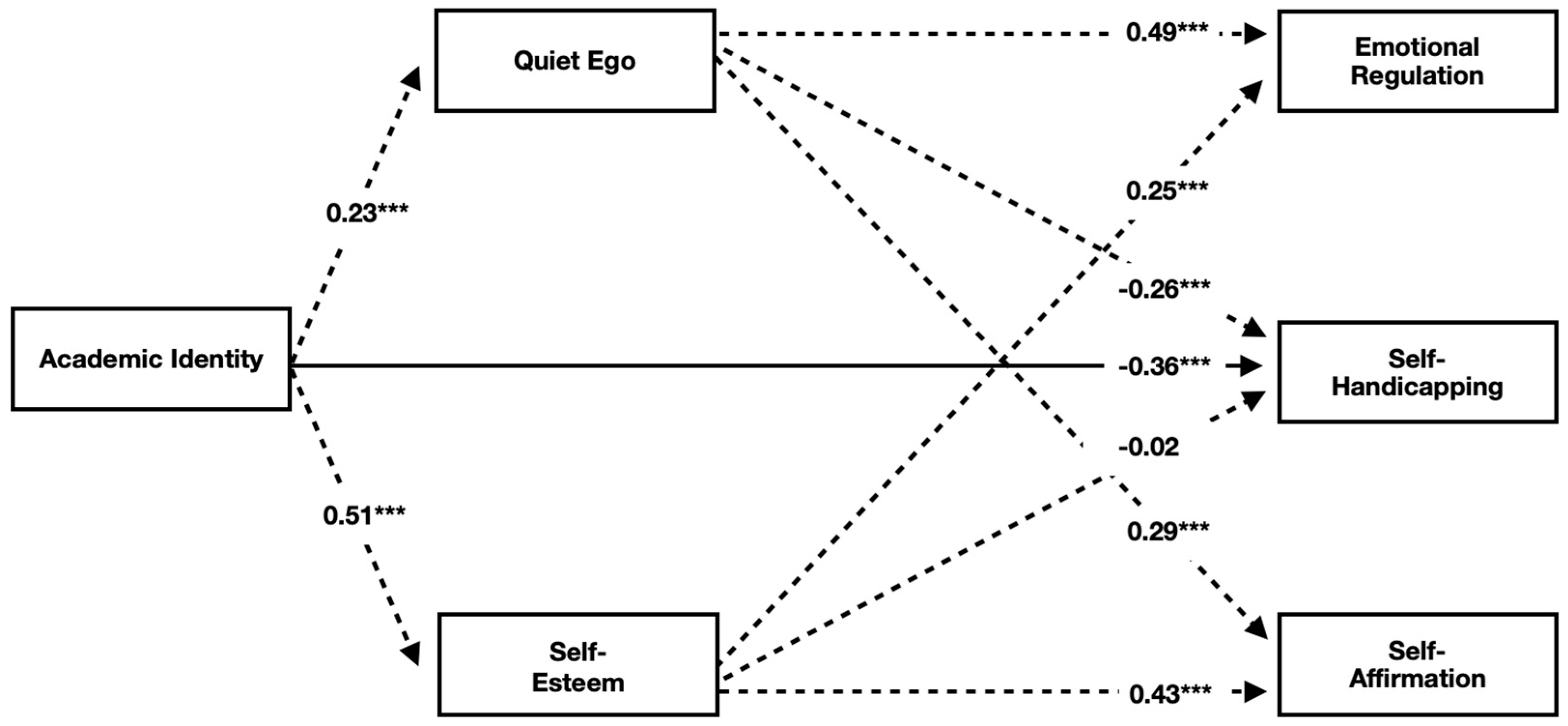
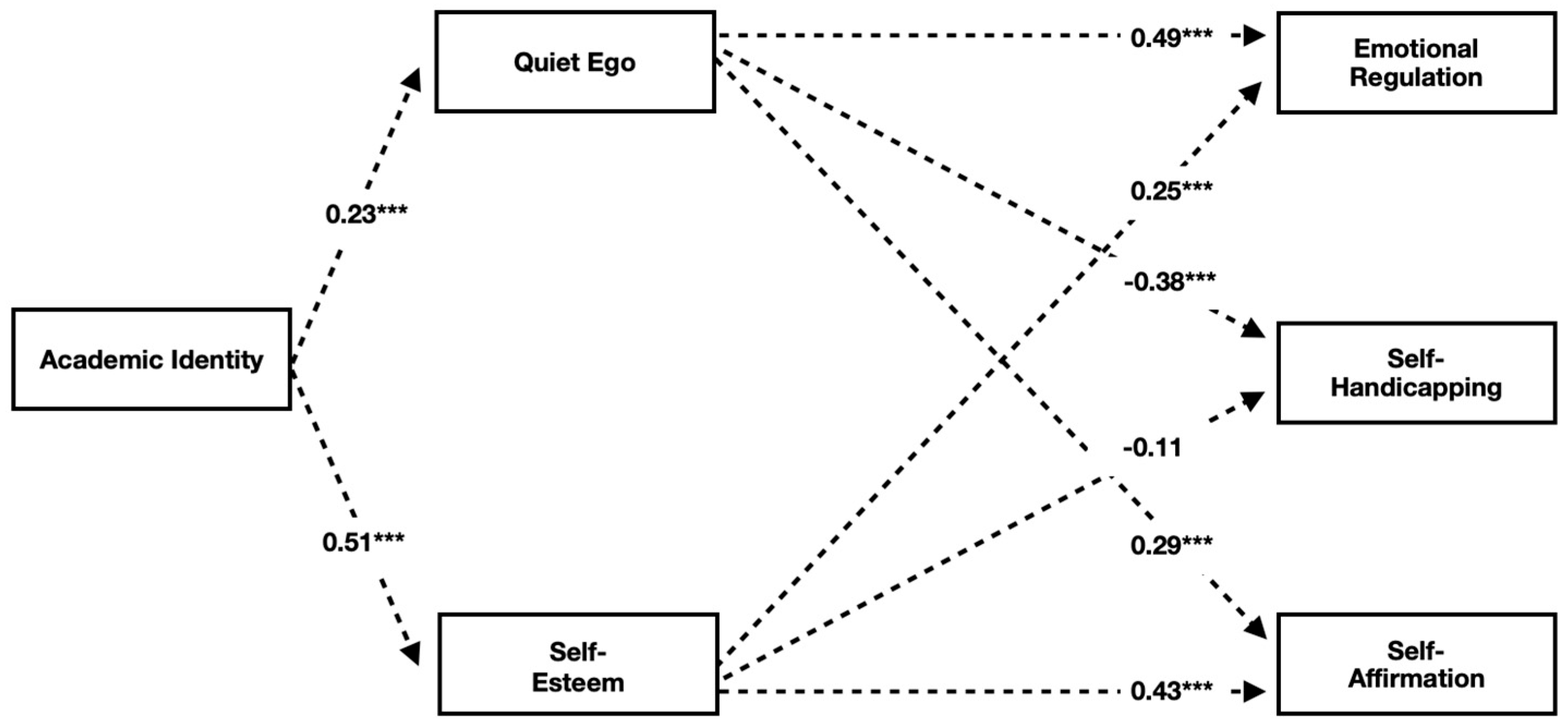
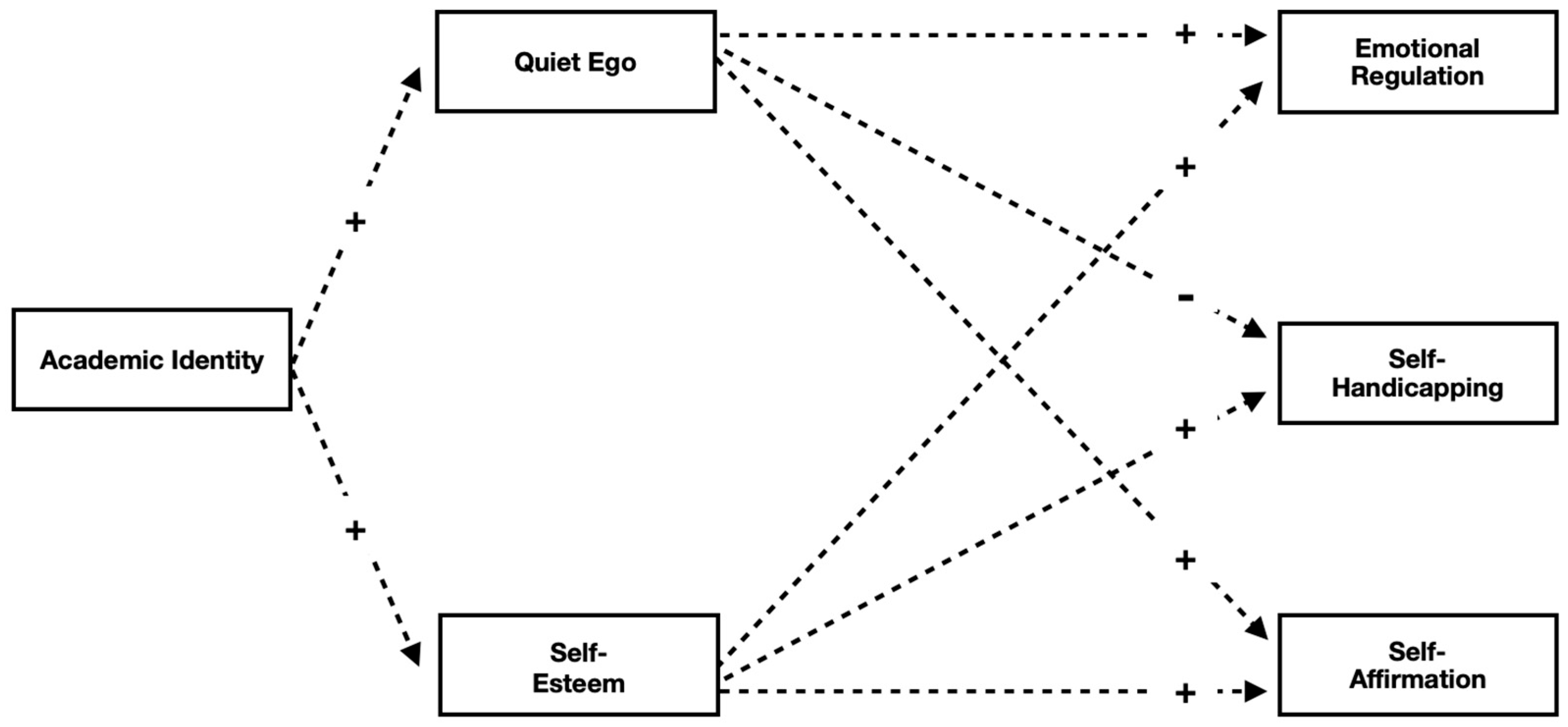
| Hypothesized Model | Final Model | ||
|---|---|---|---|
| Fit Indices | Parameters | 20 | 21 |
| Chi-Square (X2) | 17.713 | 1.779 | |
| df | 5 | 4 | |
| p | 0.003 | 0.776 | |
| X2/df † | 3.54 | 0.445 | |
| CFI | 0.966 | 1.00 | |
| TLI | 0.899 | 1.02 | |
| RMSEA | 0.085 | 0.000 | |
| [90% CI] | [0.044, 0.133] | [0.000, 0.053] | |
| SRMR | 0.039 | 0.000 | |
| Paths | AI → QE | 0.227 [0.160, 0.294] | 0.227 [0.160, 0.294] |
| AI → SE | 0.514 [0.390, 0.639] | 0.514 [0.390, 0.639] | |
| QE → ER | 0.487 [0.327, 0.647] | 0.487 [0.327, 0.647] | |
| SE → ER | 0.249 [0.150, 0.349] | 0.249 [0.150, 0.349] | |
| QE → SH | −0.375 [−0.621, −0.130] | −0.256 [−0.500, −0.012] | |
| SE → SH | −0.110 [−0.260, 0.039] | −0.022 [−0.187, 0.144] | |
| QE → SA | 0.291 [0.146, 0.436] | 0.291 [0.146, 0.436] | |
| SE → SA | 0.433 [0.361, 0.505] | 0.433 [0.361, 0.505] | |
| AI → SH | --- | −0.364 [−0.557, −0.171] | |
| Indirect Effects | AI to ER via QE | 0.111 [0.062, 0.160] | 0.111 [0.064, 0.160] |
| AI to ER via SE | 0.128 [0.074, 0.183] | 0.128 [0.074, 0.183] | |
| AI to SH via QE | −0.085 [−0.148, −0.023] | −0.058 [−0.114, −0.002] | |
| AI to SH via SE | −0.057 [−0.135, 0.021] | −0.011 [−0.096, 0.074] | |
| AI to SA via QE | 0.066 [0.029, 0.103] | 0.066 [0.029, 0.103] | |
| AI to SA via SE | 0.223 [0.157, 0.289] | 0.223 [0.157, 0.289] |
| 1 | The three highest loading items reported for each identity status were used (cf., Was & Isaacson, 2008). Participants responded to each of the items 195 on a 5-point scale (1 = not at all like me; 5 = very much like me). The three achieved identity 196 items were “Although I have many priorities, learning in school is always one of my most 197 important goals,” “A college education is a high priority for me and I’m willing to make the sacrifices,” and “I know why I am in college and have clear goals I want to achieve.” The remaining nine items reflected the identity statuses that were low in exploration and/or commitment (i.e., less mature statuses) and included “I don’t have clear priorities for school and life. I usually just go with the flow” (diffused identity), “My priorities in school are in transition. Some days I am serious, other days I have other priorities” (moratorium identity), and “When I do poorly on a test I get upset and worry what friends and family might think of me” (foreclosed identity). |
| 2 | Moratorium, diffused, and foreclosed items were reversed. Eigenvalue for a single factor solution was 3.35, capturing 28% of the variance across the 12 items. |
References
- Abdellatif, M. S. (2023). The mediating role of passion in the relationships between academic identity and psychological flourishing of university students. Information Sciences Letters, 12(1), 299–313. [Google Scholar] [CrossRef]
- Bauer, J. J., & Weatherbie, K. J. (2023). The quiet ego and human flourishing. Journal of Happiness Studies: An Interdisciplinary Forum on Subjective Well-Being, 24(8), 2499–2530. [Google Scholar] [CrossRef]
- Baumeister, R. F., Campbell, J. D., Krueger, J. I., & Vohs, K. D. (2003). Does high self-esteem cause better performance, interpersonal success, happiness, or healthier lifestyles? Psychological Science in the Public Interest, 4(1), 1–44. [Google Scholar] [CrossRef]
- Berglas, S., & Jones, E. E. (1978). Drug choice as a self-handicapping strategy in response to noncontingent success. Journal of Personality and Social Psychology, 36(4), 405–417. [Google Scholar] [CrossRef]
- Bernabei, L., Silvestrini, C., Grimaldi, L. A., Piserchia, V., Riggio, F., Marino, G., Valente, D., & Pompili, E. (2024). Psychometric properties of the Quiet Ego Scale (iQES) within the Italian cultural context. Frontiers in Psychology, 15, 1348965. [Google Scholar] [CrossRef]
- Berzonsky, M. D. (1992). Identity style and coping strategies. Journal of Personality, 60(4), 771–788. [Google Scholar] [CrossRef]
- Berzonsky, M. D. (1997). Identity development, control theory and self-regulation: An individual differences perspective. Journal of Adolescent Research, 12(3), 347–353. [Google Scholar] [CrossRef]
- Brady, S. T., Hard, B. M., & Gross, J. J. (2018). Reappraising test anxiety increases academic performance of first-year college students. Journal of Educational Psychology, 110(3), 395–406. [Google Scholar] [CrossRef]
- Chorba, K., Was, C. A., & Isaacson, R. M. (2012). Individual differences in academic identity and self-handicapping in under-graduate college students. Individual Differences Research, 10(2), 60–68. [Google Scholar] [CrossRef]
- Cohen, G. L., Garcia, J., Apfel, N., & Master, A. (2006). Reducing the racial achievement gap: A social-psychological intervention. Science, 313(5791), 1307–1310. [Google Scholar] [CrossRef] [PubMed]
- Cohen, G. L., & Sherman, D. K. (2014). The psychology of change: Self-affirmation and social psychological intervention. Annual Review of Psychology, 65, 333–371. [Google Scholar] [CrossRef]
- Cohen, J., Cohen, P., West, S. G., & Aiken, L. S. (2003). Applied multiple regression/correlation analysis for the behavioral sciences (3rd ed.). Lawrence Erlbaum. [Google Scholar]
- Critcher, C. R., & Dunning, D. (2015). Self-affirmations provide a broader perspective on self-threat. Personality and Social Psychology Bulletin, 41(1), 3–18. [Google Scholar] [CrossRef] [PubMed]
- Crocker, J., Niiya, Y., & Mischkowski, D. (2008). Why does writing about important values reduce defensiveness? Psychological Science, 19(7), 740–747. [Google Scholar] [CrossRef]
- Crocker, J., & Park, L. E. (2004). The costly pursuit of self-esteem. Psychological Bulletin, 130(3), 392–414. [Google Scholar] [CrossRef]
- Cutuli, D. (2014). Cognitive reappraisal and expressive suppression strategies in emotion regulation: An overview on their modulatory effects and neural correlates. Frontiers in Systems Neuroscience, 8, 175. [Google Scholar] [CrossRef]
- Dastjerdi, R., Farshidfar, Z., & Haji-abadi, M. (2022). Academic identity status and psychological well-being among medical sciences students. Future of Medical Education Journal, 12(1), 41–45. [Google Scholar] [CrossRef]
- Davis, G. M., Hanzsek-Brill, M. B., Petzold, M. C., & Robinson, D. H. (2019). Students’ sense of belonging: The development of a predictive retention model. Journal of the Scholarship of Teaching and Learning, 19(1), 117–127. [Google Scholar] [CrossRef]
- Escobar-Soler, C., Berrios, R., Peñaloza-Díaz, G., Melis-Rivera, C., Caqueo-Urízar, A., Ponce-Correa, F., & Flores, J. (2024). Effectiveness of self-affirmation interventions in educational settings: A meta-analysis. Healthcare, 12(1), 3. [Google Scholar] [CrossRef]
- Gross, J. J., & John, O. P. (2003). Individual differences in two emotion regulation processes: Implications for affect, relationships, and well-being. Journal of Personality and Social Psychology, 85(2), 348–362. [Google Scholar] [CrossRef] [PubMed]
- Harris, P. R., Griffin, D. W., Napper, L. E., Bond, R., Schüz, B., Stride, C., & Brearley, I. (2019). Individual differences in self-affirmation: Distinguishing self-affirmation from positive self-regard. Self and Identity, 18(5), 589–630. [Google Scholar] [CrossRef]
- Hejazi, E., Gholamali Lavasani, M., Amani, H., & Was, C. A. (2012). Academic identity status, goal orientation, and academic achievement among high school students. Journal of Research in Education, 22(1), 291–320. [Google Scholar]
- Henrich, J., Heine, S. J., & Norenzayan, A. (2010). The weirdest people in the world? Behavioral and Brain Sciences, 33(2–3), 61–83. [Google Scholar] [CrossRef] [PubMed]
- Hepper, E. G., Sedikides, C., & Cai, H. (2011). Self-enhancement and self-protection strategies in China: Cultural expressions of a fundamental human motive. Journal of Cross-Cultural Psychology, 44(1), 5–23. [Google Scholar] [CrossRef]
- Kernis, M. H., Lakey, C. E., & Heppner, W. L. (2008). Secure versus fragile high self-esteem as a predictor of verbal defensiveness: Converging findings across three different markers. Journal of Personality, 76(3), 477–512. [Google Scholar] [CrossRef]
- Kesebir, P. (2014). A quiet ego quiets death anxiety: Humility as an existential anxiety buffer. Journal of Personality and Social Psychology, 106(4), 610–623. [Google Scholar] [CrossRef]
- Le, H.-G., Sok, S., & Heng, K. (2024). The benefits of peer mentoring in higher education. Findings from a systematic review. Journal of Learning Development in Higher Education, 31, 1–29. [Google Scholar] [CrossRef]
- Lilgendahl, J. P., & McLean, K. C. (2020). Narrative identity processes and patterns of adjustment across the transition to college: A developmentally contextualized approach. Journal of Personality and Social Psychology, 119(4), 960–977. [Google Scholar] [CrossRef] [PubMed]
- Liu, G., Isbell, L. M., Constantino, M. J., & Leidner, B. (2022). Quiet Ego intervention enhances flourishing by increasing quiet ego characteristics and trait emotional intelligence: A randomized experiment. Journal of Happiness Studies, 23(7), 3605–3623. [Google Scholar] [CrossRef] [PubMed]
- Luyckx, K., Klimstra, T. A., Duriez, B., Van Petegem, S., Beyers, W., Teppers, E., & Goossens, L. (2013). Personal identity processes and self-esteem: Temporal sequences in high school and college students. Journal of Research in Personality, 47(2), 159–170. [Google Scholar] [CrossRef]
- Marcia, J. E. (1966). Development and validation of ego-identity status. Journal of Personality and Social Psychology, 3(5), 551–558. [Google Scholar] [CrossRef]
- Miyake, A., Kost-Smith, L. E., Finkelstein, N. D., Pollock, S. J., Cohen, G. L., & Ito, T. A. (2010). Reducing the gender achievement gap in college science: A classroom study of values affirmation. Science, 330(6008), 1234–1237. [Google Scholar] [CrossRef] [PubMed]
- Murphy, M. C., Gopalan, M., Carter, E. R., Emerson, K. T. U., Bottoms, B. L., & Walton, G. M. (2020). A customized belonging intervention improves retention of socially disadvantaged students at a broad-access university. Science Advances, 6(29), eaba4677. [Google Scholar] [CrossRef]
- Neff, K. D., & Vonk, R. (2009). Self-compassion versus global self-esteem: Two different ways of relating to oneself. Journal of Personality, 77(1), 23–50. [Google Scholar] [CrossRef] [PubMed]
- Orlofsky, J. L. (1978). Identity formation, nAchievement, and fear of success in college men and women. Journal of Youth and Adolescence, 7, 49–62. [Google Scholar] [CrossRef]
- Padgett, R. D., & Keup, J. R. (2011). 2009 National survey of first-year seminars: Ongoing efforts to support students in transition (Research Reports on College Transitions No. 2). University of South Carolina, National Resource Center for the First-Year Experience and Students in Transition. [Google Scholar]
- Pekrun, R. (2006). The control-value theory of achievement emotions: Assumptions, corollaries, and implications for educational research and practice. Educational Psychology Review, 18, 315–341. [Google Scholar] [CrossRef]
- Pietersma, S., & Dijkstra, A. (2012). Cognitive self-affirmation inclination: An individual difference in dealing with self-threats. British Journal of Social Psychology, 51(1), 33–51. [Google Scholar] [CrossRef]
- Pradhan, R. K., Anand, P., Jandu, K., Sabu, S., & Ahmad, A. (2025). Embracing quiet ego for flourishing: Mediating role of authenticity and voluntary simplicity. Cogent Psychology, 12(1), 2460322. [Google Scholar] [CrossRef]
- Rogawski, M., Simonsmeier, B. A., & Buecker, S. (2025). The quiet ego: A meta-analytical review. Journal of Happiness Studies, 26, 112. [Google Scholar] [CrossRef]
- Rosenberg, M. (1965). Society and the adolescent self-image. Princeton University Press. [Google Scholar]
- Ryeng, M. S., Kroger, J., & Martinussen, M. (2013). Identity status and self-esteem: A meta-analysis. Identity: An International Journal of Theory and Research, 13(3), 201–213. [Google Scholar] [CrossRef]
- Schwartz, S. J., Beyers, W., Luyckx, K., Soenens, B., Zamboanga, B. L., Forthun, L. F., Hardy, S. A., Vazsonyi, A. T., Ham, L. S., Kim, S. Y., Whitbourne, S. K., & Waterman, A. S. (2010). Examining the light and dark sides of emerging adults’ identity: A study of identity status differences in positive and negative psychosocial functioning. Journal of Youth and Adolescence, 40(7), 839–859. [Google Scholar] [CrossRef]
- Schwinger, M., Wirthwein, L., Lemmer, G., & Steinmayr, R. (2014). Academic self-handicapping and achievement: A meta-analysis. Journal of Educational Psychology, 106(3), 744–761. [Google Scholar] [CrossRef]
- Sherman, D. K., & Cohen, G. L. (2006). The psychology of self-defense: Self-affirmation theory. In M. P. Zanna (Ed.), Advances in experimental social psychology (Vol. 38, pp. 183–242). Academic Press. [Google Scholar] [CrossRef]
- Steele, C. M. (1988). The psychology of self-affirmation: Sustaining the integrity of the self. In Advances in experimental social psychology (Vol. 21, pp. 261–302). Academic Press. [Google Scholar] [CrossRef]
- Tangney, J. P., Baumeister, R. F., & Boone, A. L. (2004). High self-control predicts good adjustment, less pathology, better grades, and interpersonal success. Journal of Personality, 72(2), 271–324. [Google Scholar] [CrossRef]
- Taylor, S. E., Lerner, J. S., Sherman, D. K., Sage, R. M., & McDowell, M. K. (2003). Portrait of the self enhancer: Well adjusted and well liked or maladjusted and friendless? Journal of Personality and Social Psychology, 84(1), 165–176. [Google Scholar] [CrossRef]
- Tice, D. M. (1991). Esteem protection or enhancement? Self-handicapping motives and attributions differ by trait self-esteem. Journal of Personality and Social Psychology, 60(5), 711–725. [Google Scholar] [CrossRef]
- Urdan, T. (2004). Predictors of academic self-handicapping and achievement: Examining achievement goals, classroom goal structures, and culture. Journal of Educational Psychology, 96(2), 251–264. [Google Scholar] [CrossRef]
- Was, C. A. (2009). Academic identity status and the relationship to achievement goal orientation. Electronic Journal of Research in Educational Psychology, 7(2), 627–652. [Google Scholar]
- Was, C. A., & Isaacson, R. M. (2008). The development of a measure of academic identity status. Journal of Research in Education, 18, 94–105. [Google Scholar]
- Wayment, H. A. (2025). Affirming the less defended self: Quiet ego reminders reduce implicit self-other bias. Journal of Happiness Studies, 26, 68. [Google Scholar] [CrossRef]
- Wayment, H. A., & Bauer, J. J. (2017). The quiet ego: Motives for self–other balance and growth in relation to well-being. Journal of Happiness Studies, 19(3), 881–896. [Google Scholar] [CrossRef]
- Wayment, H. A., Bauer, J. J., & Sylaska, K. (2015). The quiet ego scale: Measuring the compassionate self-identity. Journal of Happiness Studies, 16(4), 999–1033. [Google Scholar] [CrossRef]
- Wayment, H. A., & Cavolo, K. M. (2018). Quiet ego, self-regulatory skills, and perceived stress in college students. Journal of American College Health, 67(2), 92–96. [Google Scholar] [CrossRef] [PubMed]
- Wayment, H. A., Huffman, A. H., & Eiler, B. E. (2019). Quiet ego workshop and improved health and well-being in a sample of hospital employees. Applied Nursing Research, 49, 80–85. [Google Scholar] [CrossRef] [PubMed]
- Wayment, H. A., West, T. N., & Craddock, E. B. (2016). Compassionate values as a resource during the transition to college: Quiet ego, compassionate goals, and self-compassion. Journal of The First-Year Experience & Students in Transition, 28(2), 93–114. [Google Scholar] [CrossRef]
- Wu, Z., Spreckelsen, T. F., & Cohen, G. L. (2021). A meta-analysis of the effect of values affirmation on academic achievement. Journal of Social Issues, 77(3), 702–750. [Google Scholar] [CrossRef]
- Zhang, Y., Chen, B., Hu, X., & Wang, M. (2025). The impact of self-affirmation interventions on well-being: A meta-analysis. American Psychologist. Advance online publication. [Google Scholar] [CrossRef] [PubMed]

| Measure | N | M | SD |
|---|---|---|---|
| Academic Identity | 352 | 3.74 | 0.61 |
| Quiet Ego | 352 | 3.58 | 0.43 |
| Self-Esteem | 350 | 3.31 | 0.78 |
| Cognitive Reappraisal | 348 | 3.49 | 0.70 |
| Self-Handicapping | 340 | 2.59 | 0.93 |
| Self-Affirmation | 352 | 2.90 | 0.69 |
| Variable | AI | QE | SE | CR | SH |
|---|---|---|---|---|---|
| Academic ID (AI) | --- | ||||
| Quiet Ego (QE) | 0.322 *** | --- | |||
| Self-Esteem (SE) | 0.379 *** | 0.290 *** | --- | ||
| Cognitive Reappraisal (CR) | 0.149 ** | 0.374 *** | 0.357 *** | --- | |
| Self-Handicapping (SH) | −0.285 ** | −0.204 ** | −0.147 ** | −0.078 | --- |
| Self-Affirmation (SA) | 0.237 *** | 0.335 *** | 0.554 *** | 0.438 *** | −0.076 |
Disclaimer/Publisher’s Note: The statements, opinions and data contained in all publications are solely those of the individual author(s) and contributor(s) and not of MDPI and/or the editor(s). MDPI and/or the editor(s) disclaim responsibility for any injury to people or property resulting from any ideas, methods, instructions or products referred to in the content. |
© 2026 by the author. Licensee MDPI, Basel, Switzerland. This article is an open access article distributed under the terms and conditions of the Creative Commons Attribution (CC BY) license.
Share and Cite
Wayment, H.A. Academic Identity and Self-Regulation Strategies During the Transition to College: The Roles of Quiet Ego and Self-Esteem. Behav. Sci. 2026, 16, 489. https://doi.org/10.3390/bs16040489
Wayment HA. Academic Identity and Self-Regulation Strategies During the Transition to College: The Roles of Quiet Ego and Self-Esteem. Behavioral Sciences. 2026; 16(4):489. https://doi.org/10.3390/bs16040489
Chicago/Turabian StyleWayment, Heidi A. 2026. "Academic Identity and Self-Regulation Strategies During the Transition to College: The Roles of Quiet Ego and Self-Esteem" Behavioral Sciences 16, no. 4: 489. https://doi.org/10.3390/bs16040489
APA StyleWayment, H. A. (2026). Academic Identity and Self-Regulation Strategies During the Transition to College: The Roles of Quiet Ego and Self-Esteem. Behavioral Sciences, 16(4), 489. https://doi.org/10.3390/bs16040489