
Article

Crustal Structure of the South Tibet Rift System from Receiver Function Analysis
1
Geodynamics Laboratory, School of Science, Xizang University, Lhasa 850000, China
2
Institute of Tibetan Plateau Research, Chinese Academy of Sciences, Beijing 100101, China
3
Tibet Museum of Natural Science, Lhasa 850000, China
*
Author to whom correspondence should be addressed.
Geosciences 2026, 16(5), 198; https://doi.org/10.3390/geosciences16050198
Submission received: 13 February 2026 / Revised: 27 April 2026 / Accepted: 1 May 2026 / Published: 15 May 2026
(This article belongs to the Special Issue Applied Geophysics for Geohazards Investigations)

Abstract

The Tibetan Plateau, formed by the Indian-Eurasian collision, is dissected by the north-south trending South Tibet Rift system, but the formation mechanism of these rifts within a continuing compressional setting remains debated. Using P-wave receiver functions and joint inversion with surface wave dispersion along a ~230 km broadband seismic profile crossing the Nyima-Tingri Rift (NTR) and Xianza-Dingjie Rift (XDR), we investigated the detailed crustal structure beneath the Himalayan and Lhasa terranes. Our results reveal three key findings: (1) The crustal thickness ranges from 60 to 80 km, with the XDR exhibiting a pronounced Moho uplift (~10 km) beneath the rift axis, whereas the Moho beneath the NTR remains flat and continuous, indicating contrasting evolutionary stages. (2) A mid-crustal low-velocity layer at ~30 km depth is consistently observed west of 87.2° E, suggesting the presence of partial melt or fluids that decouple upper crustal deformation from mantle flow. (3) A prominent intracrustal discontinuity at 50–70 km depth produces a “Moho doublet” pattern; we interpreted this as the subducted Indian lower crust in the Himalayan terrane but as the relict Tibetan Moho in the Lhasa terrane, reflecting progressive northward modification. Collectively, these observations demonstrate that the north-south structures in southern Tibet lack the deep structural characteristics of mature rifts and instead represent an “infant stage” of extension. Their formation is best explained by east-west crustal stretching driven by an ongoing north-south convergence and eastward flow of lower crustal and upper mantle materials rather than by classical lithosphere-scale rifting.

1. Introduction

The Indian plate strongly compresses and collides with the plastic Eurasian plate, making the Tibetan Plateau the most intense collision orogen in the world. The South Tibet rift system is the product of the transformation of the structure from near north-south compression to east-west extension, which is roughly confined between the Himalayan terrane in the south and the Qiangtang terrane in the north [1,2,3]. Distributed from east to west in southern Tibet are the Sangril-Cuna Rift (220 km long, N15° E trend), Yadong-Guru Rift (500 km long, N30–35° E trend), Xianza-Dingjie Rift (350 km long, N15–20° E trend), Nyima-Tingri Rift (360 km long, N30° E trend), and the Longol Rift (about 200 km long and N10° E trend). Among these five rifts, except the Cuna Rift, which develops in the Himalayan terrane, the other four developed between the Himalayan Terrane and the Lhasa Terrane, extend to the High Himalaya, and pass through the Southern Tibet fragmentation system [4]. In addition, these rifts also show the development of regions of shallow seismicity [5], associated with late Cenozoic magmatism and metal deposits [6]. At present, the South Tibet rifts are the longest and the most studied rift valleys in the East-Valley Dew of Central Asia.
There is no common understanding of the initial formation time of the South Tibet rifts. Combined with previous research results, the formation time of the South Tibet rifts ranges from 8 Ma to ~23 Ma, and the activity time of these rifts is different. However, the fault activity time of the same rift in different regions is similar, indicating that the formation mechanism of the South Tibet rifts is the same, and the activity time of the South Tibet rifts is relatively early on the whole [7,8,9,10]. In addition, the activity time of the Yadong-Dew Rift Valley is relatively late (8~10 Ma) [11]. In the deep structure of the South Tibet rifts, the Indian plate may have subducted under the Himalayan terrane and the Lhasa terrane, resulting in the thickening of the Tibetan Plateau lithosphere [12,13,14,15]. At present, there are several views on the formation mechanism of the southern Tibet rifts: (1) gravitational collapse [16,17]; (2) the escape model under strong compression from near north to south [18]; (3) bottom traction caused by the oblique subduction of the Indian plate [19]; (4) material flow in the upper mantle generates crustal tension [20]; (5) the internal rupture of Tibet, caused by the extrusion of the Indian plate and the Eurasian Plate [21]; and the northward extension of the Indian plate into the plastic crust of the Tibetan Plateau [22]. Despite their significance, the deep crustal structure beneath these rifts remains poorly resolved. Previous geophysical studies in southern Tibet have largely focused on either the Himalayan terrane or the Lhasa terrane separately, and a systematic comparison of the Moho geometry, crustal velocity structure, and the nature of intracrustal discontinuities across two representative rifts (NTR and XDR) within a single transect is still lacking. In particular, it remains unclear whether these rifts share a common deep structural style or represent different evolutionary stages, and how their formation relates to the underthrusting Indian plate and the mid-crustal low-velocity layer. To address these gaps, we analyzed new seismic data from the ANTILOPE-III project to: (1) image the detailed Moho topography and crustal thickness variations beneath the Nyima-Tingri (NTR) and Xianza-Dingjie (XDR) rifts; (2) characterize the seismic velocity structure of the crust, particularly the presence and extent of mid-crustal low-velocity layers (LVLs); and (3) compare the deep structure of the two rifts to constrain their relative evolution and test the proposed models for rift formation models against our new structural images. By linking surface geology with deep seismic imaging, this study provides new insights into the dynamics of continental rifting in a collisional orogen and the debated origin of the South Tibet rift system.

2. Study Area and Methods

2.1. Regional Overview

The Nyima-Tingri Rift is mainly composed of three lake basins from south to north, namely Dengqianggou, Dengruoyco, and Xuruoyco, so it is also called the Dengruoyco-Xuruoyco Rift. It is about 700 km long. The Nyima-Tingri Rift Valley is located in the middle of the entire southern Tibet Rift system, cutting the Tethys Himalaya and the Yarlung Zangbo suture zone, connecting with the Dingri Graben of the Himalayan massif to the south and the Rongma area of the Qiangtang Massif to the north. The relatively stable shallow sea carbonate rocks and clastic rocks of the Paleozoic Carboniferous and Permian are mainly exposed. The Mesozoic Jurassic and Cretaceous are mainly composed of intermediate-basic volcanic rocks. Due to the intense magmatic activity and volcanism in the Cenozoic, the main body of the Gangdise volcanic magmatic arc zone was formed. Miocene alkaline volcanic rocks are mainly exposed on both sides of the rift, and Pleistocene and Holocene lacustrine sediments are mainly developed inside the rift [23,24].
The Xianza-Dingjie Rift (some people call it the Pengqu-Xianza Rift) stretches from Pengqu Township, Dingjie County, in the Himalayan massif in the south, to Xianza County, Lhasa Massif in the north (it may also extend to Qiangtang Massif), with a total length of about 360 km. The normal faults in the southern segment of the Xianza-Dingjie Rift have typical dissociation fault properties, with the upper wall composed of unmetamorphic or extremely low metamorphic fault blocks, and the footwall composed of mylonitic light-colored granite and mylonitic gneiss [25]. Many hot springs developed in the Xianza area and gradually entered the seismically active period. Since 1994, many earthquakes of a magnitude of 6 or above have occurred, forming a seismically active area with large intensity and high frequency [26].

2.2. Data Source

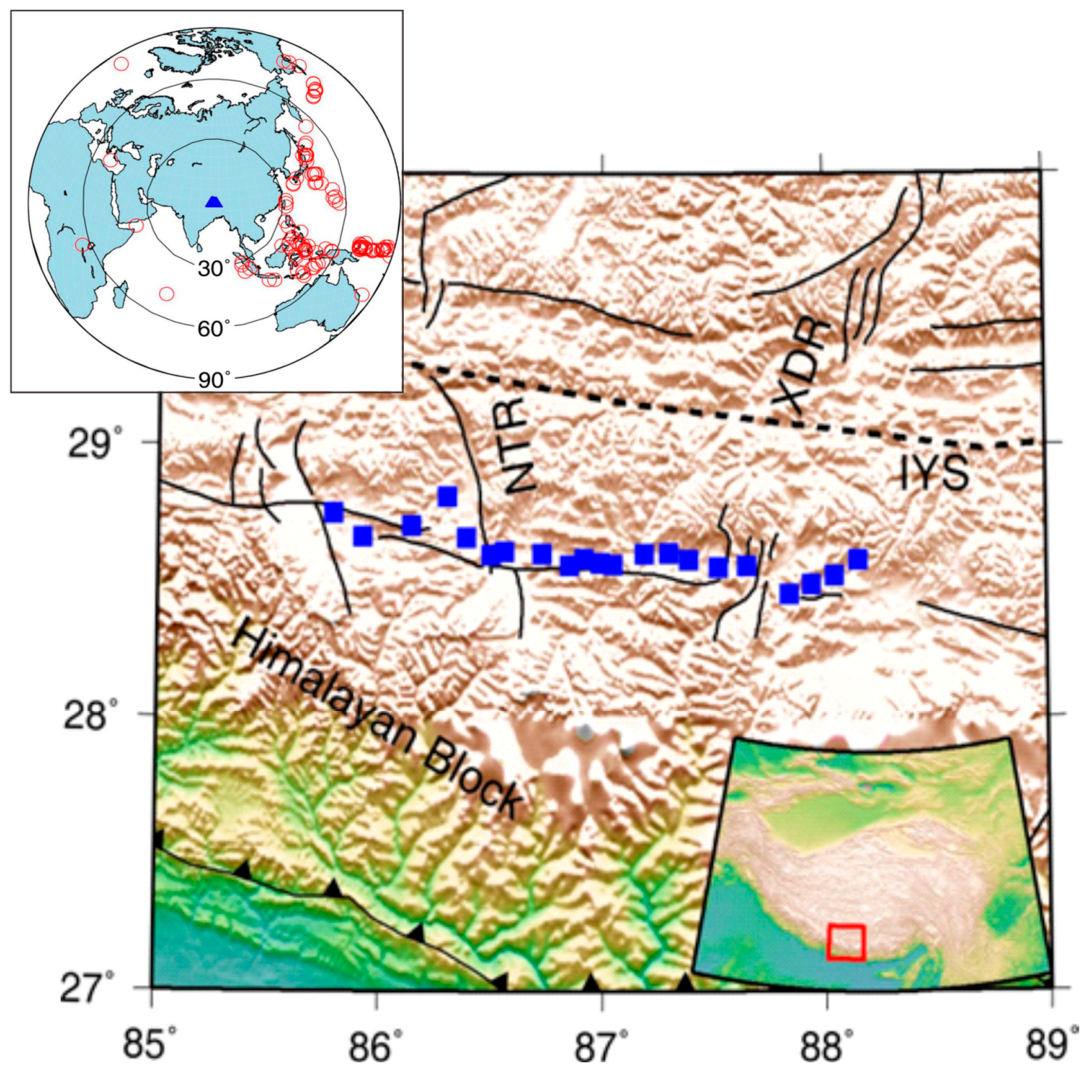
In order to study the crust–mantle structure and dynamic processes of the Tibetan Plateau, a series of exploration research programs, such as the Hi-CLIMB, INDEPTH, and ANTILOPE programs, have been carried out in and around the Tibetan Plateau [27]. These projects provide a lot of seismological evidence for the study of the deep structure of the Tibetan Plateau. Data from the middle part of the ANTILOPE-III project were obtained from 22 broadband mobile seismic stations located on the northern side and 30 stations on the southern side of IYZ (Figure 1) in the Himalayan block across the Nyima-Tingri rift and Xianza-Dingjie rifts during 2014 and 2015.
The operating system we use is Linux, the programming language we use is C++, and the plotting script used in the figures is GMT6 [28,29].

2.3. Methods

2.3.1. P-Wave Receiver Function Extraction

The P-wave receiver function is the travel time obtained after removing factors such as the source, path, and instrument response from P-wave propagation. The P-wave receiver function provides information on the Ps’ converted waves and their multiple reflections (PpPs, PsPs + PpSs, etc.) generated by velocity discontinuities in the crust and mantle beneath seismic stations [30,31]. The calculation of receiver functions is accomplished through coordinate rotation and deconvolution. Initially, receiver functions were extracted by directly deconvolving the rotated components of the horizontal components with the vertical component. Deconvolution methods are mainly divided into frequency-domain deconvolution and time-domain deconvolution. Frequency-domain deconvolution is relatively simple to compute, but due to the limited nature of actual seismic data containing random noise, and the spectrum of the vertical component often approaching zero, the division operation in the frequency domain becomes unstable. Therefore, we used a time-domain deconvolution algorithm to extract receiver functions [32,33].
In receiver function processing, we first resample the teleseismic waveform data, typically at a sampling rate of 20 Hz for teleseismic events, and apply a bandpass filter with a range of 0.02 Hz to 2 Hz to the data. Next, we perform coordinate rotation and extract receiver functions using time-domain deconvolution with a Gaussian filter parameter of 2.5. Before stacking, we applied moveout correction. We used the modified global 1D velocity model IASP91, with a reference epicentral distance of 67 (equivalent to a slowness of 6.4 s/deg), a crustal thickness of 70 km, an average Vp of 6.2 km/s, and a Vp/Vs ratio of 1.732.

2.3.2. Calculation of Crustal (H) Thickness and Vp/Vs Ratio

The Moho, which is the interface between the crust and the mantle, represents the most significant global velocity discontinuity. When teleseismic P-wave rays traverse the Moho, a portion of the P-wave converts to an Sp-wave and continues to propagate. Furthermore, within the crust, these waves reflect to form multiples (PpPs, PpSs + PsPs). Considering a single-layer crust model with uniform properties, the travel times of the Ps and PpPs converted phases at the Moho can be expressed as follows:
T P s = H V s 2 p 2 V P 2 p 2
T P p P s = H V s 2 p 2 + V P 2 p 2
where H represents the Moho depth, Vp is the P-wave velocity, Vs is the S-wave velocity, and p is the ray parameter. If we select the travel time difference between the Moho Ps converted wave and the PpPs reflected phase, the following formula can be used to calculate H and the Vp/Vs ratio:
H = T P p P s T P s / 2 V P 2 p 2
V p V s = T P p P s + T P s T P p P s T P s 2 T P p P s + T P s T P p P s T P s 2 1 p 2 V p 2
In this study, the H-κ stacking method was applied to estimate the Moho depth (H) and bulk Vp/Vs ratio (κ) beneath each seismic station [34,35,36,37]. The grid search method was employed, with a search range of 40–90 km for H and 1.5–2.0 for κ. The stacking was performed using the Ps, PpPs, and PpSs + PsPs phases, with weighting factors set to 0.5, 0.3, and 0.2, respectively. Only receiver functions with high signal-to-noise ratios were selected for stacking. To ensure the reliability of the results, we manually inspected each receiver function and excluded those with unclear or inconsistent converted phases. The final H and κ values for each station were determined based on the maximum stacking amplitude in the H-κ domain. The Vp/Vs ratio derived from H-κ stacking was used as an initial constraint in the joint inversion, but it was allowed to vary within ±0.05 during inversion.

2.3.3. Joint Inversion of Receiver Functions and Surface Wave Dispersion for S-Wave Velocity

The Rayleigh wave-phase velocity dispersion curves used in the joint inversion were derived from ambient noise tomography. Continuous seismic waveform data, recorded by the same broadband seismic stations from September 2014 to August 2015, were used for ambient noise analysis. The data processing followed the standard procedure described by Bensen et al. [38]. The processing workflow began with instrument response removal and downsampling to 1 Hz, followed by temporal normalization to reduce the influence of earthquakes and instrumental irregularities. Spectral whitening was then applied to broaden the frequency content, after which cross-correlation of daily seismic records for all station pairs was performed to retrieve empirical Green’s functions. The cross-correlations were stacked over the entire observation period to enhance the signal-to-noise ratio, and Rayleigh wave-phase velocity dispersion curves were subsequently extracted using frequency–time analysis (FTAN). The resulting dispersion curves were interpolated onto a 0.5 × 0.5 grid using the method of Barmin et al. [39]. For each seismic station used in the joint inversion, we extracted the Rayleigh wave-phase velocity dispersion curve (period range of 8–65 s) from the nearest grid point.
Inversions of receiver functions for velocity structure are categorized into linear inversion [40] and nonlinear inversion [41]. Linear inversion methods utilize the phase and amplitude information of receiver function waves within the same time window, enabling the retrieval of velocity parameter models with relatively high radial resolution. The inversion results of linear inversion methods suffer from non-uniqueness, although the linearized inversion method computes very quickly. However, it is highly dependent on the initial S-wave velocity model. Nonlinear inversion effectively reduces the dependence on the initial S-wave velocity model. The development of joint inversion methods has also effectively mitigated model non-uniqueness. Julia et al. [42] developed a joint inversion method for receiver functions and surface wave dispersion, which is an iterative damped least-squares algorithm. Leveraging the respective sensitivities of surface wave dispersion to the medium’s S-wave velocity and receiver functions to interface depths, this joint method achieves complementary advantages of receiver function and surface wave methods, reducing non-uniqueness issues and yielding more accurate velocity structures.
This study investigates the S-wave velocity structure within the crust beneath the TD profile using joint inversion of receiver functions and surface wave dispersion. After extracting teleseismic waveform data within the required time window, surface wave dispersion data on a 0.5 × 0.5 grid were obtained using ambient noise imaging methods. For each seismic station used in the study, we extracted the Rayleigh wave-phase velocity dispersion curve (8–65 s) from the grid point nearest to the station for the joint inversion. After preparing the P-wave receiver function and Rayleigh wave-phase velocity dispersion curve data for each station, we employed the iterative damped least-squares linear inversion method to jointly invert these two datasets, obtaining the crustal S-wave velocity structure model beneath each station. Details, such as the initial model, number of iterations, and weighting factors for the two datasets involved in the joint inversion process, were adjusted based on actual data processing conditions. In the joint inversion, different weights affect the waveforms; the fit of the receiver functions is significantly influenced by the weight ratio, while the surface wave dispersion is less affected. Receiver functions for two frequency bands were calculated using Gaussian parameters α = 2.5 and 1.0, respectively, where a larger Gaussian parameter yields better receiver function waveforms. In the inversion, thinner layers favor fitting receiver functions, while thicker layers favor fitting surface wave dispersion.

2.3.4. Common Conversion Point (CCP) Stacking Migration

The Common Conversion Point (CCP) stacking migration method is widely used to image discontinuities such as the Moho from teleseismic receiver functions [35,43]. This method projects the Ps’ converted phases from receiver functions back to the depth where the conversion occurred, based on the ray parameters and a reference velocity model. By stacking the converted energy from multiple events at common spatial bins, the continuity and geometry of subsurface interfaces can be resolved. With the development of digital seismographs and portable seismic array observation technology, to improve the resolution of structural imaging results, Yuan et al. [33] developed the receiver function migration imaging technique based on Common Conversion Point (CCP) stacking. This method was subsequently used to study and detect crustal depths and investigate their regional variation characteristics [44]. Through continuous theoretical development and practical application, the receiver function method has gradually evolved and improved. In this study, we applied CCP stacking to image the Moho geometry and intracrustal discontinuities along the profile. The following processing steps were performed:
Moveout correction: All receiver functions were corrected to a reference epicentral distance of 67 (slowness of 6.4 s/deg) using the IASP91 velocity model to account for slowness variations. Ray tracing: For each receiver function sample, the conversion point was calculated using 1D ray tracing with a modified IASP91 model, assuming a crustal thickness of 70 km, an average Vp of 6.2 km/s, and a Vp/Vs ratio of 1.732. Grid setup: The profile was divided into horizontal bins with a spacing of 2 km and vertical bins of 2 km. Stacking: Amplitude contributions from all receiver functions were stacked within a rectangle area of 5 km radius around each grid node.

3. Results

3.1. P-Receiver Functions

3.1.1. Single Station Receiver Functions and the Moho Doublet

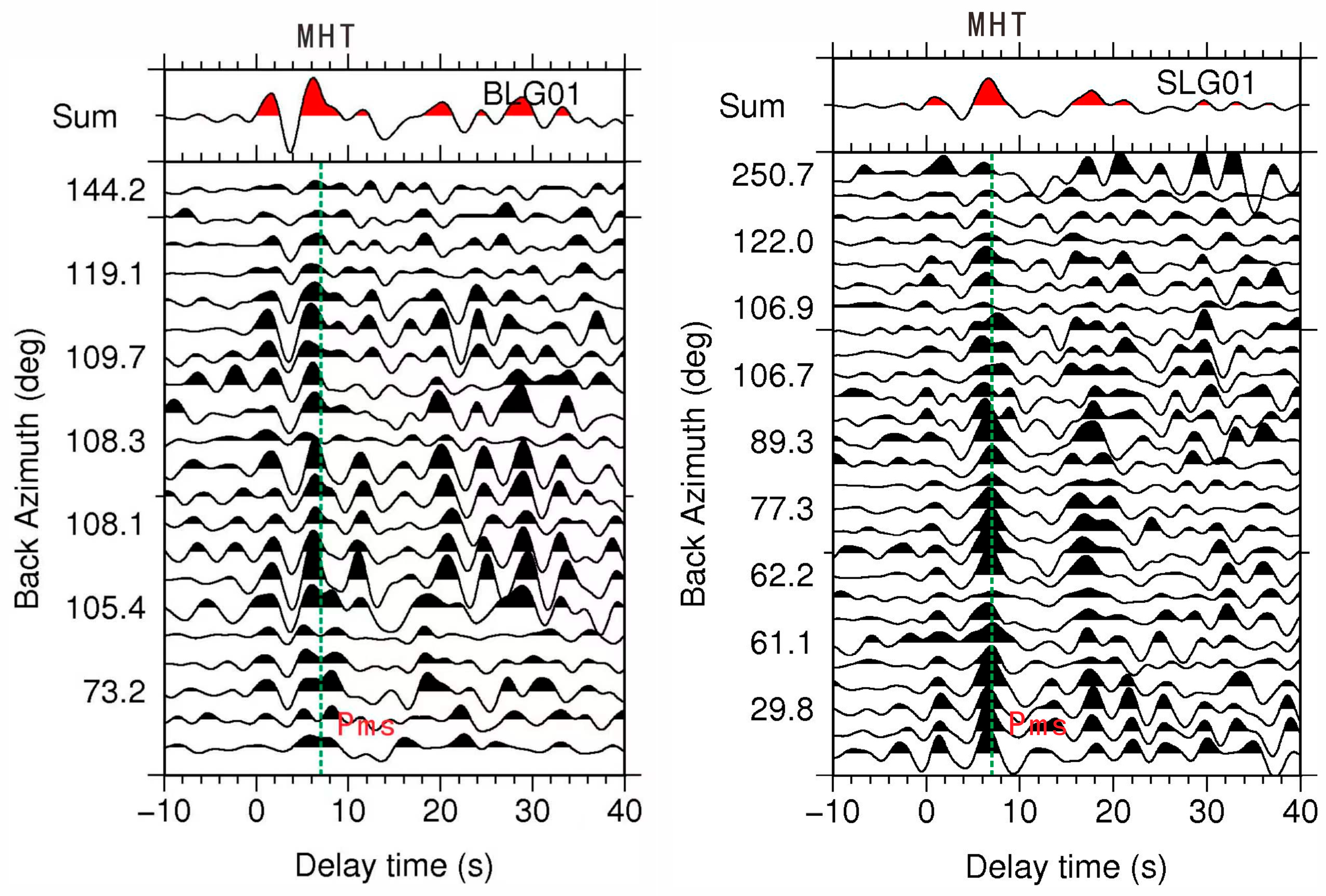
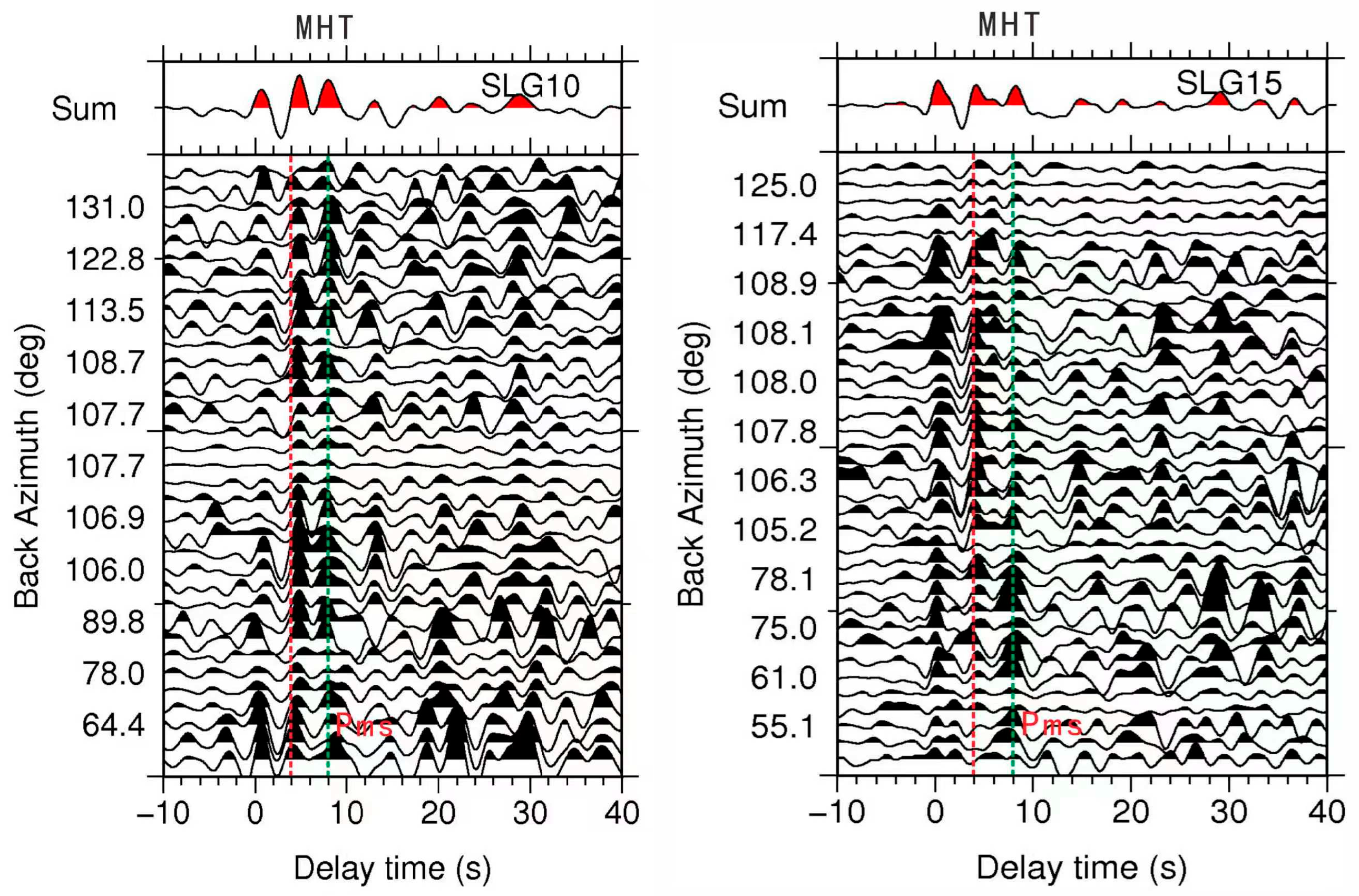
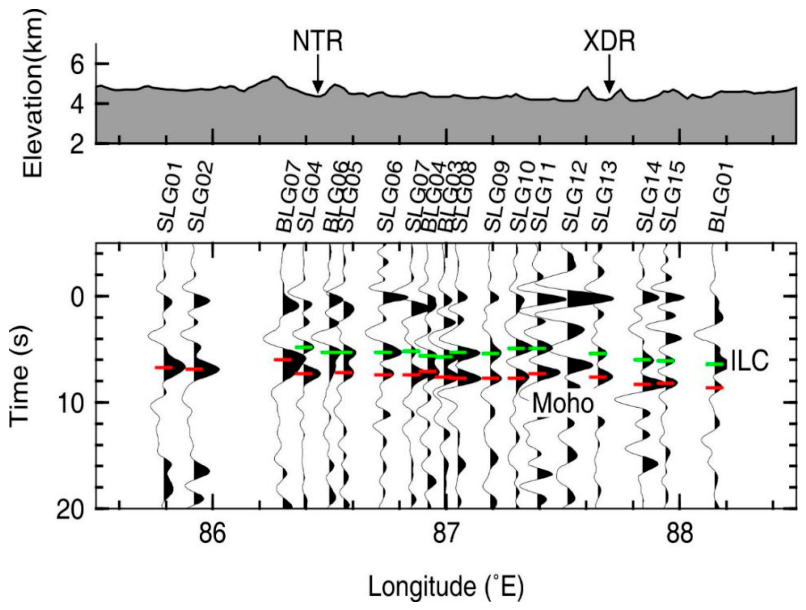
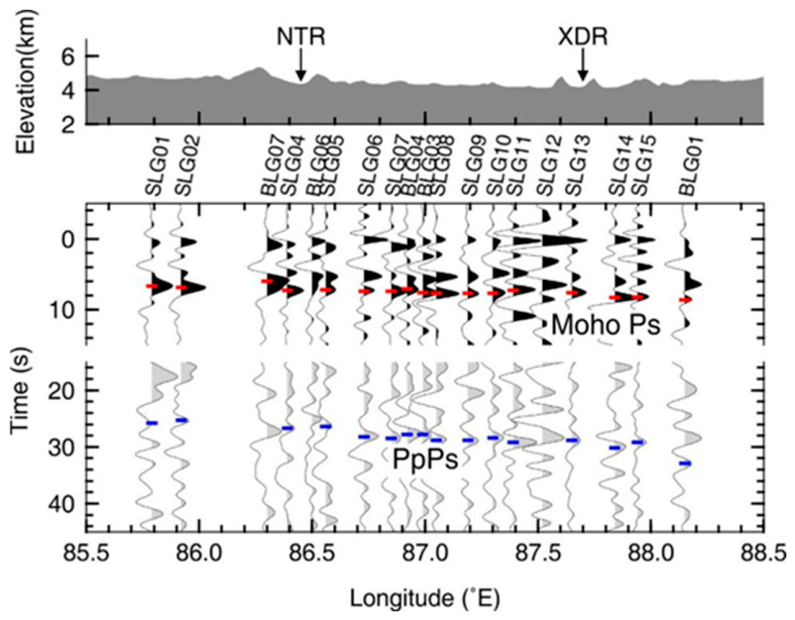
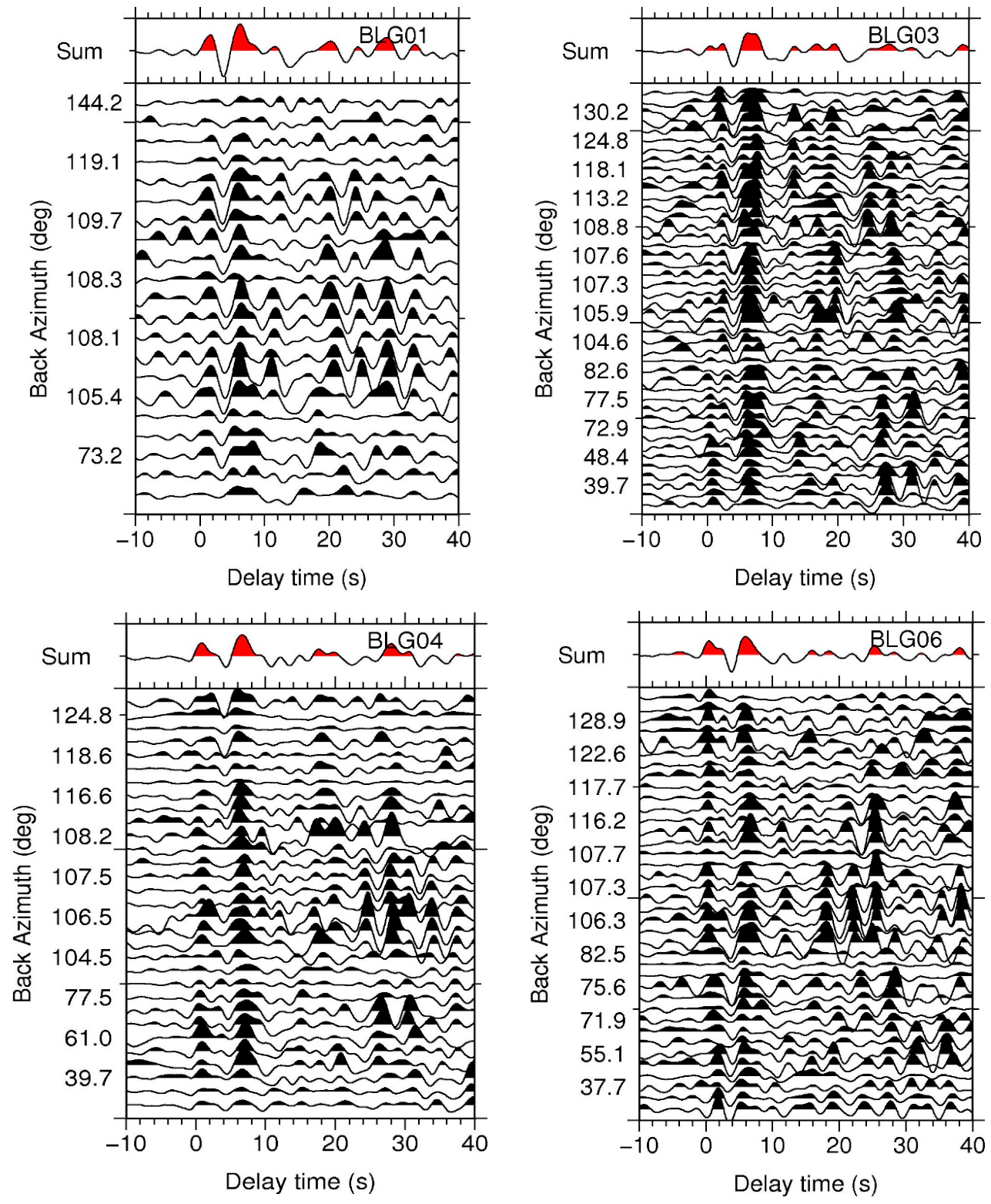
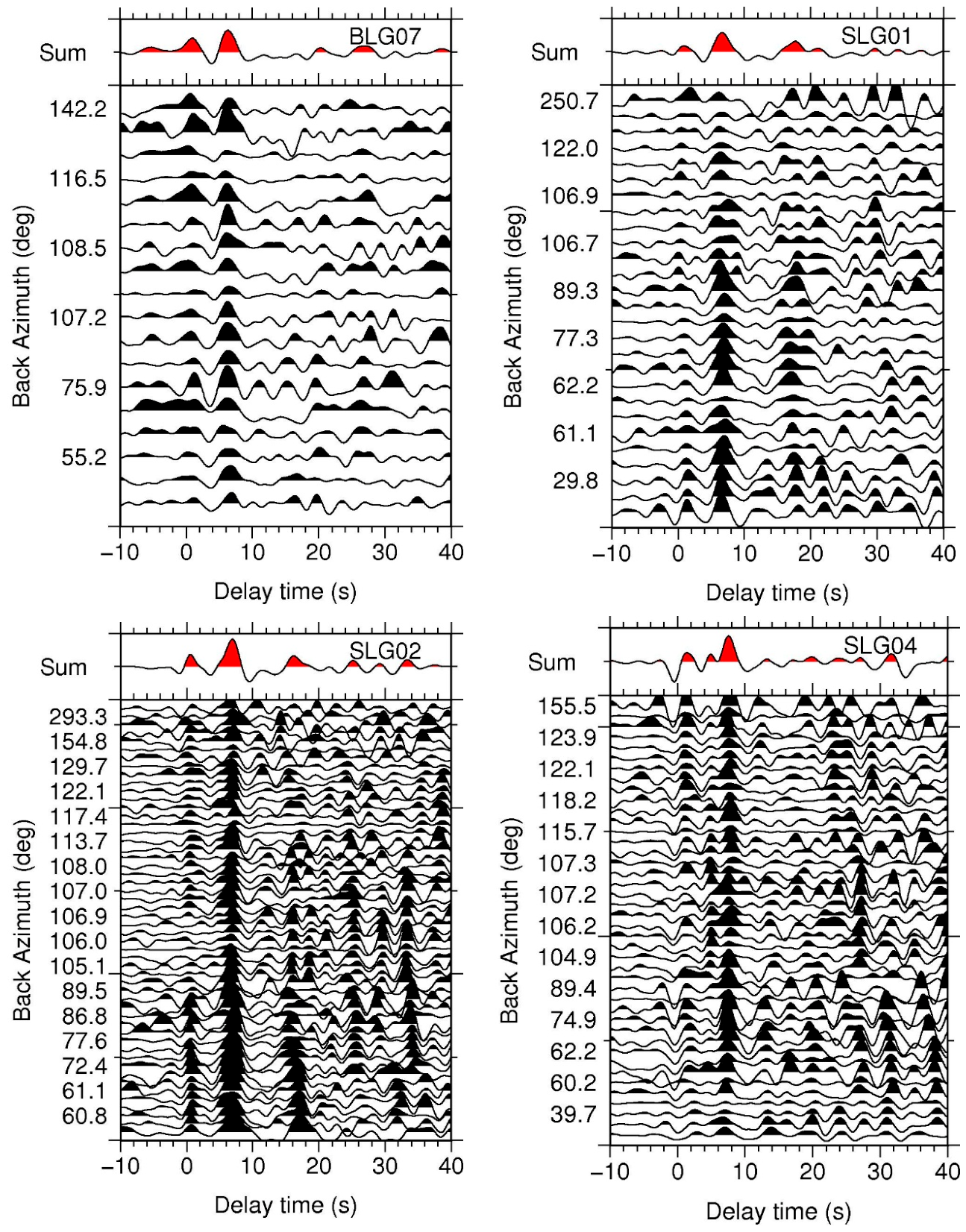
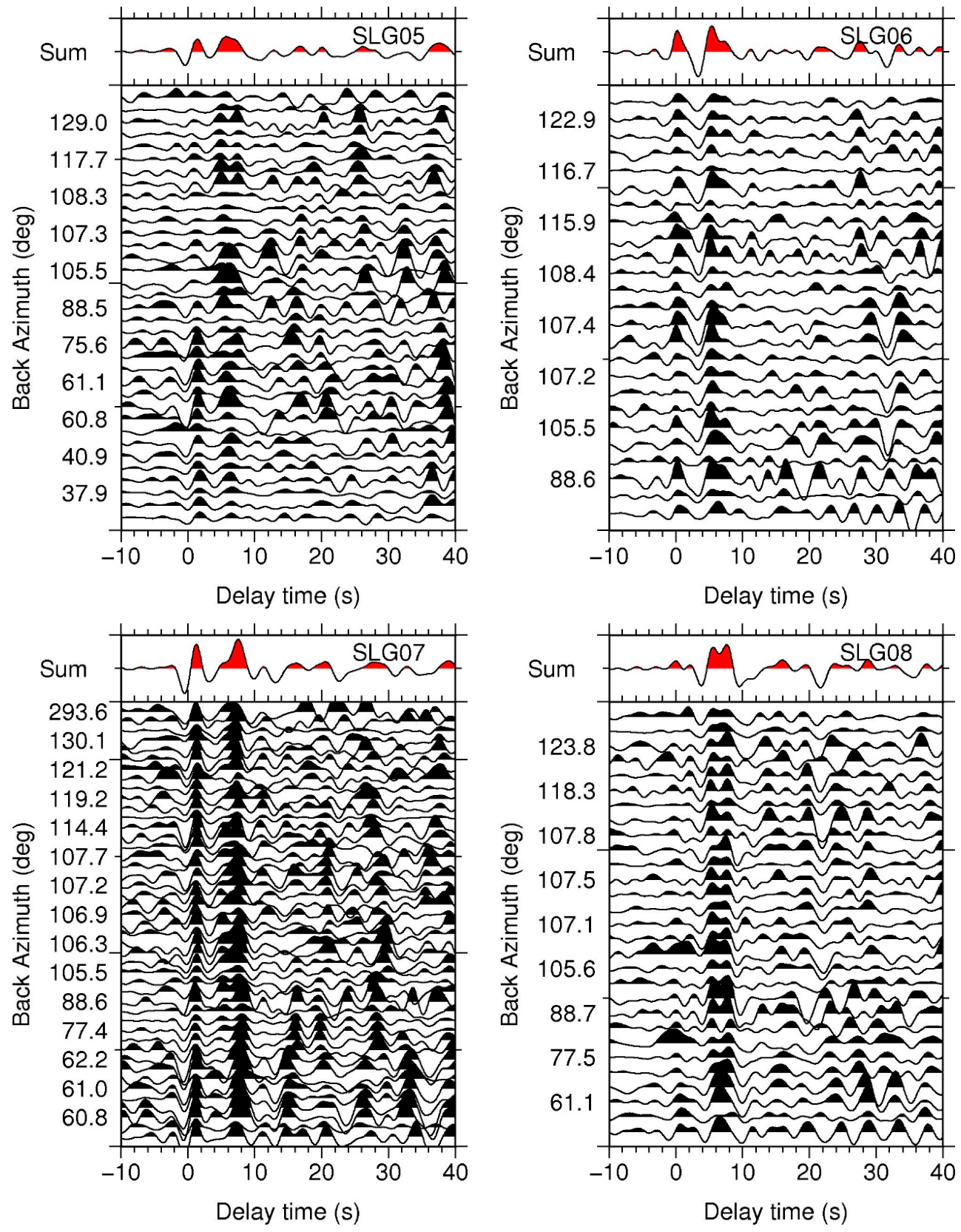
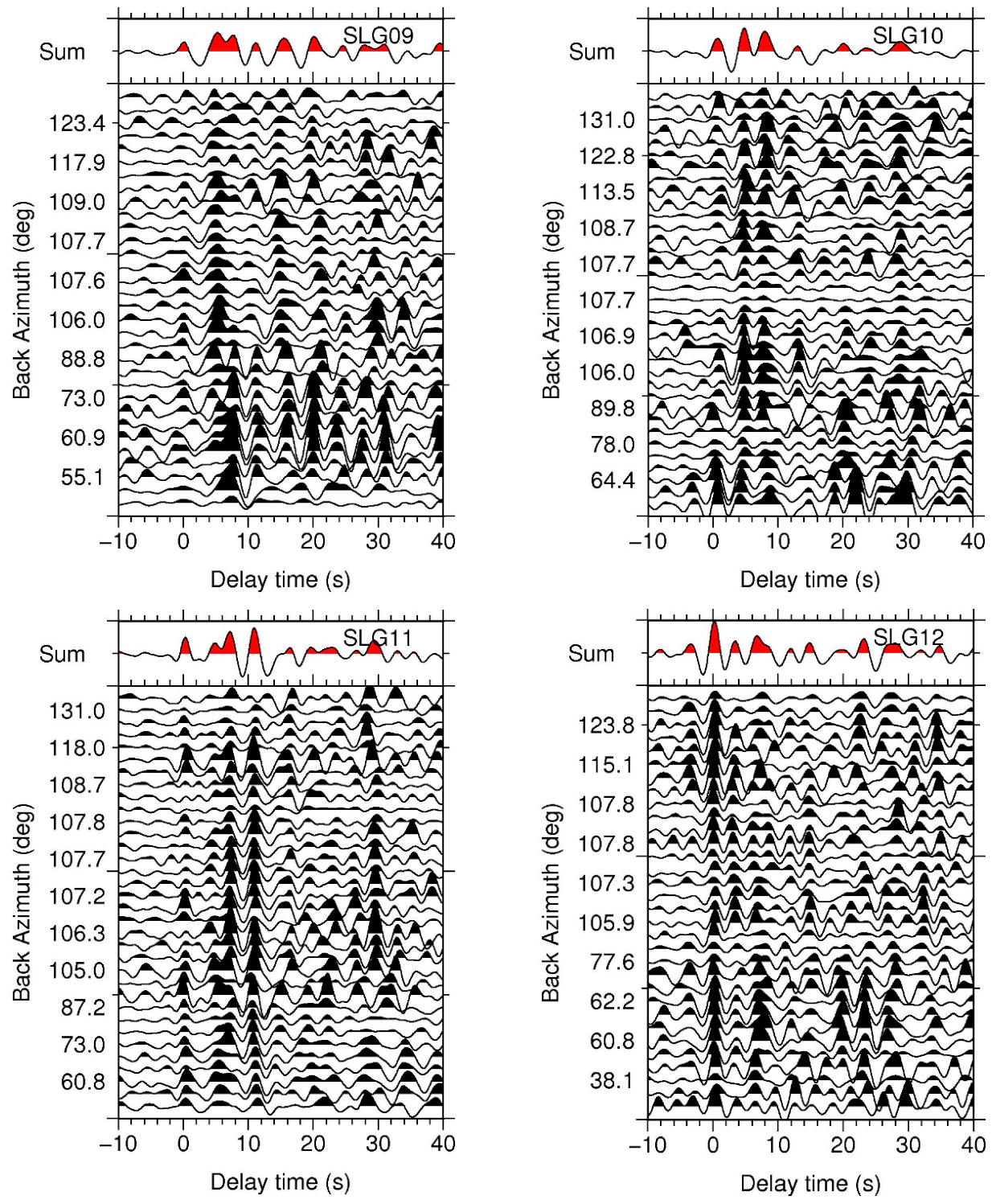
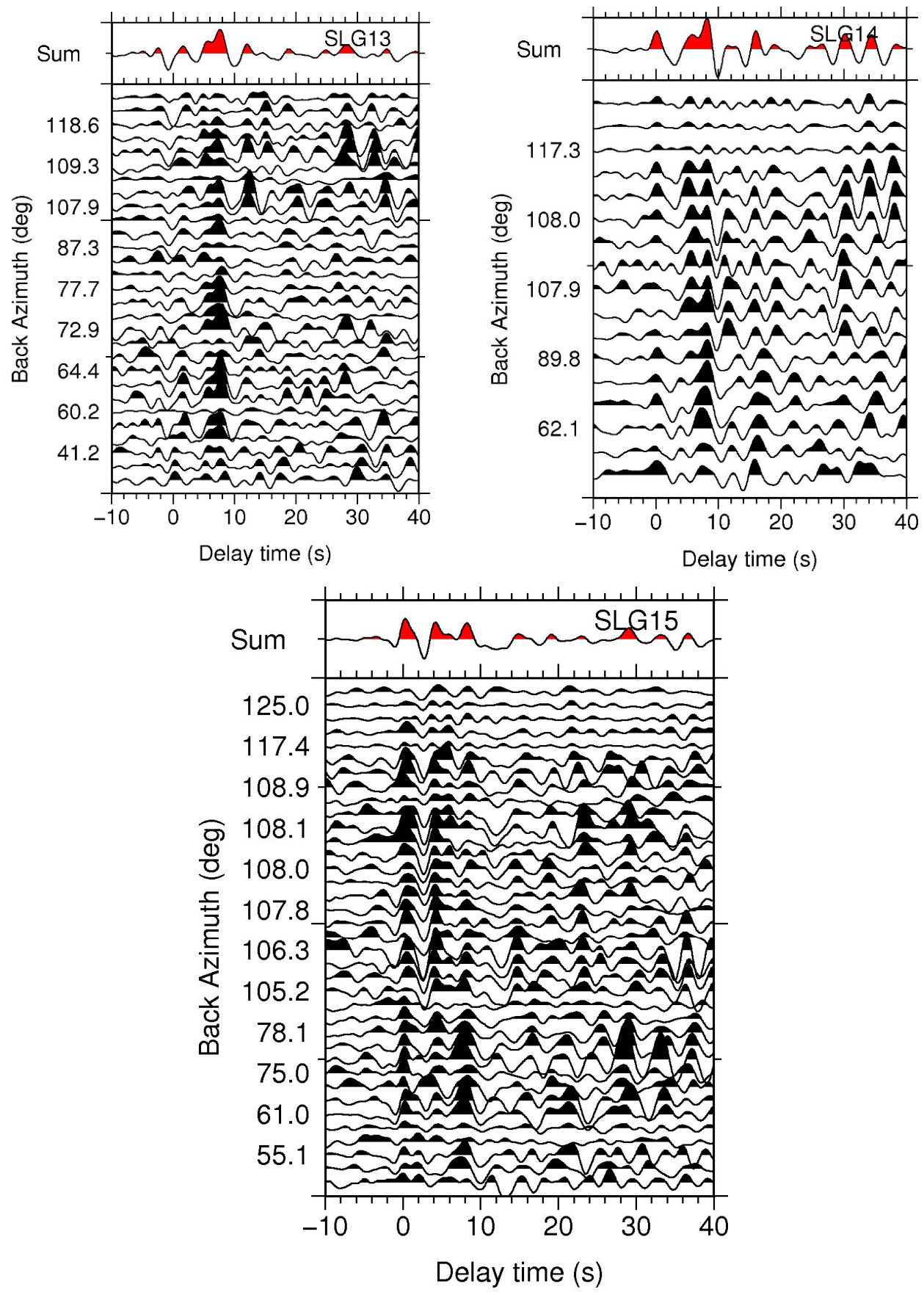
The receiver functions from individual stations reveal a complex pattern of converted phases that suggests a multi-layered crust–mantle transition beneath the study area (receiver function results for all stations are shown in Figure A1). At stations BLG01 and SLG01 (Figure 2), the primary Ps’ converted phase from the Moho arrives at approximately 7 s, with a weak arrival at about 1 s that we attribute to sedimentary cover and exclude from further analysis. More importantly, stations SLG10 and SLG15 (Figure 3) exhibit two distinct positive arrivals at approximately 4 s and 8 s rather than a single Moho Ps phase. This double-peak pattern is also evident in the stacked receiver function profile (Figure 4), where two coherent energy bands are visible at approximately 6–7 s and 9–10 s across multiple stations. This feature, commonly termed the “Moho doublet” or “double Moho” [45], indicates the presence of two sub-parallel velocity discontinuities within the depth range of 40–70 km. All station waveforms and related parameters used in the study are provided in Appendix A.
The doublet is not uniformly observed at all azimuths; for some events, only the earlier phase at approximately 6 s or the later phase at approximately 8 s is visible, suggesting that the two interfaces may have different dip angles or anisotropic properties. Stacking across multiple events enhances both phases, confirming their robustness as structural features rather than processing artifacts. Previous studies have interpreted this doublet as evidence for underthrust Indian lower crust, with the upper interface representing the top of the underthrust slab and the lower interface representing the Indian Moho [46]. Our observations support this interpretation but also reveal significant lateral variations in the strength and continuity of these interfaces, which we explore in subsequent sections.

3.1.2. Crustal Thickness and Vp/Vs Ratio from H-κ Stacking

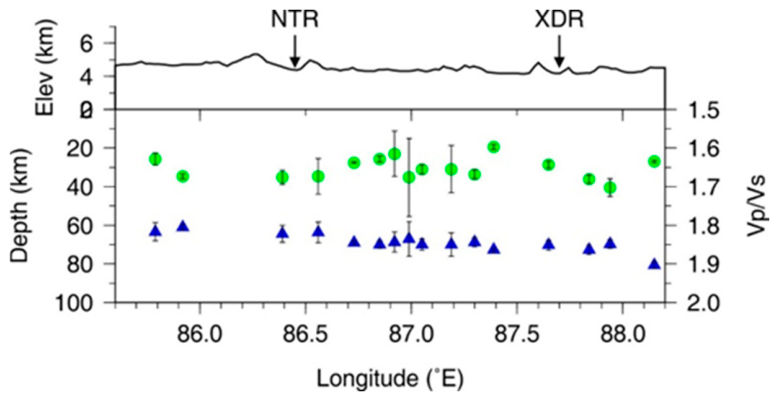
To quantitatively determine the crustal thickness and bulk Vp/Vs ratio beneath each station, we applied the H-κ stacking method of Zhu and Kanamori [33], and the related H-κ stacking results are shown in Table A1. Figure 5 shows the stacked receiver functions after correcting for the moveout of the Ps and PpPs phases, with the aligned Moho conversions clearly visible as coherent energy bands. The order of Ps and PpPs travel time of Moho station is shown from small to large, and used to calculate the crust thickness and wave velocity ratio (Figure 6). The resulting crustal thickness values range from 61.0 to 80.6 km, with the thickest crust (80.6 km) observed at station BLG01 and the thinnest (60.1 km) at station SLG02 (Figure 5). The Vp/Vs ratios range from 1.60 to 1.75, with an average of approximately 1.68, indicating a felsic to intermediate bulk composition for the crust beneath the study area and arguing against widespread mafic underplating.
A clear west-to-east trend is evident in the crustal thickness distribution. From approximately 85.8° E to 86.8° E, the Moho depth ranges from 63 to 70 km, with a value of about 67 km near 85.8° E. The crust then thickens to approximately 72 km near 87.5° E, before thinning slightly to about 69 km at 87.9° E. This pattern suggests that the Moho shallows locally near the rift axes, particularly in the vicinity of the Xianza-Dingjie Rift. No systematic variation in the Vp/Vs ratio is observed across the rifts, suggesting that bulk crustal composition is not the primary control on the observed structural differences. Our Moho depth estimates are consistent with previous seismic studies in southern Tibet [47,48,49], validating the reliability of our receiver function analysis.
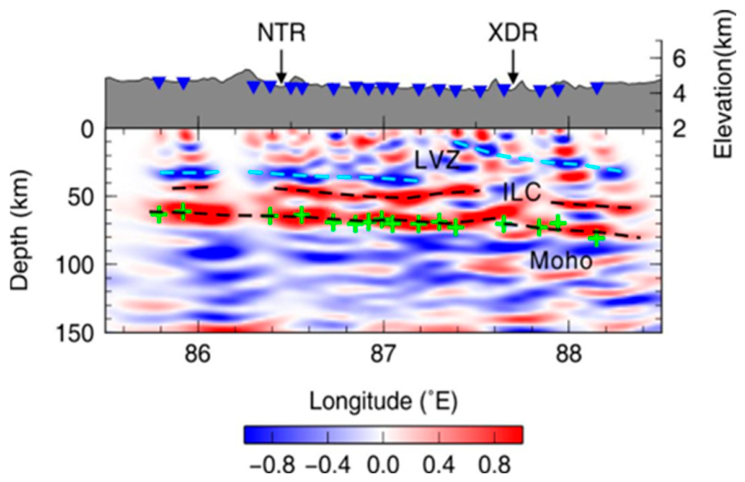
Common Conversion Point stacking migration provides a continuous image of discontinuity surfaces along the profile (Figure 7), revealing striking differences between the Nyima-Tingri and Xianza-Dingjie rift systems. In the CCP image, a prominent discontinuity is observed at depths of 40 to 50 km above the region where the Moho is offset, similar to the “double Moho” phenomenon noted in previous studies. Xu et al. [46] interpreted this discontinuity as the subducting Indian lower crust. This interface is at a weak west of the Nyima-Tingri Rift and appears truncated by the Xianza-Dingjie Rift on the eastern part of the profile, consistent with the joint inversion results.
Beneath the Nyima-Tingri Rift, the Moho is flat and continuous, varying smoothly between approximately 70 and 75 km. The intracrustal discontinuity is weak or absent, suggesting minimal underthrusting or modification. The mid-crustal low-velocity layer is well developed and sub-horizontal. This structural style implies that the Nyima-Tingri Rift is a relatively young feature that has not significantly perturbed the deep crust, which is consistent with an early stage of rifting where extension is confined to the upper and middle crusts.

3.1.3. CCP Migration Images and Contrasting Rift Structures

In contrast, beneath the Xianza-Dingjie Rift, the Moho exhibits a pronounced uplift of approximately 10 km beneath the rift axis, shallowing from about 75 km to 65 km. The intracrustal discontinuity is strong and continuous, and appears to be offset by the rift, suggesting that the Xianza-Dingjie Rift cuts through this interface. The low-velocity layer is present but more disrupted than beneath the Nyima-Tingri Rift. This structural style indicates significant mantle involvement and a more evolved stage of rifting, implying that the Xianza-Dingjie Rift is an older, more mature structure that has penetrated the entire lithosphere.
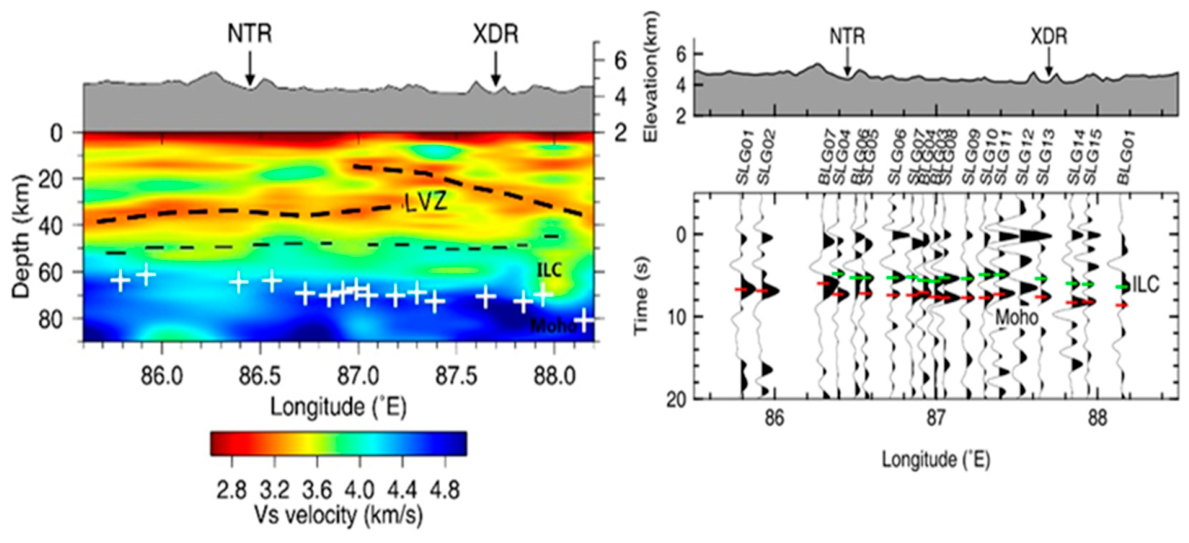
Throughout the profile, continuous low-velocity layers are observed at depths of approximately 30 km, corresponding to the “bright spot” structures identified on active source seismic profiles [50,51] and likely indicating partial melt or aqueous fluids [52,53]. The Moho depth gradually deepens from approximately 60 km to 80 km from west to east, with local shallowing near the Xianza-Dingjie rift system, while the structure remains relatively simple near the Nyima-Tingri Rift (Figure 7).

3.2. S-Wave Velocity Model from Joint Inversion of Receiver Functions and Surface Wave Dispersion

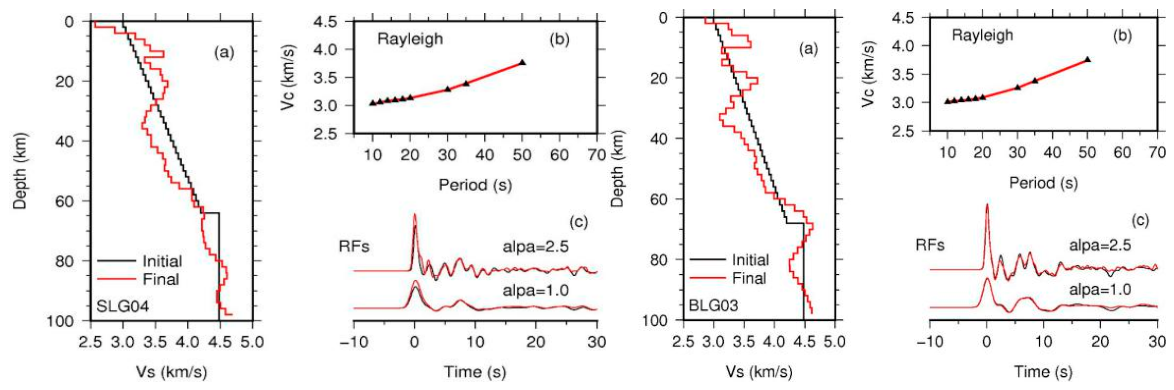
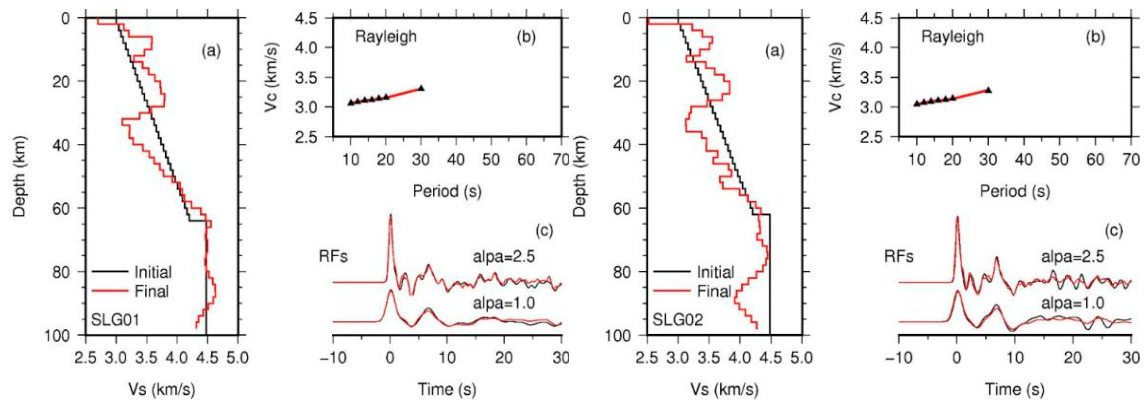
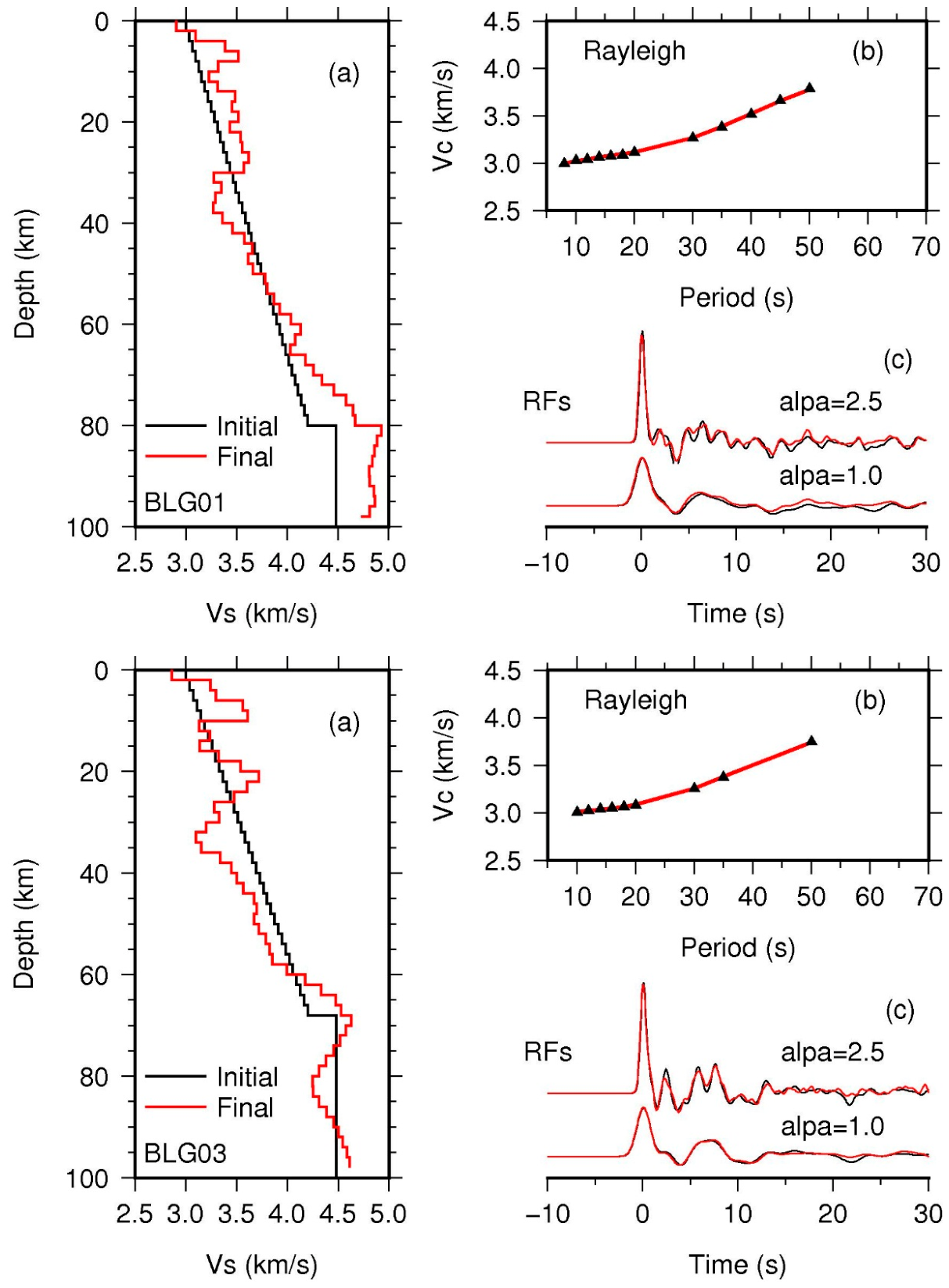
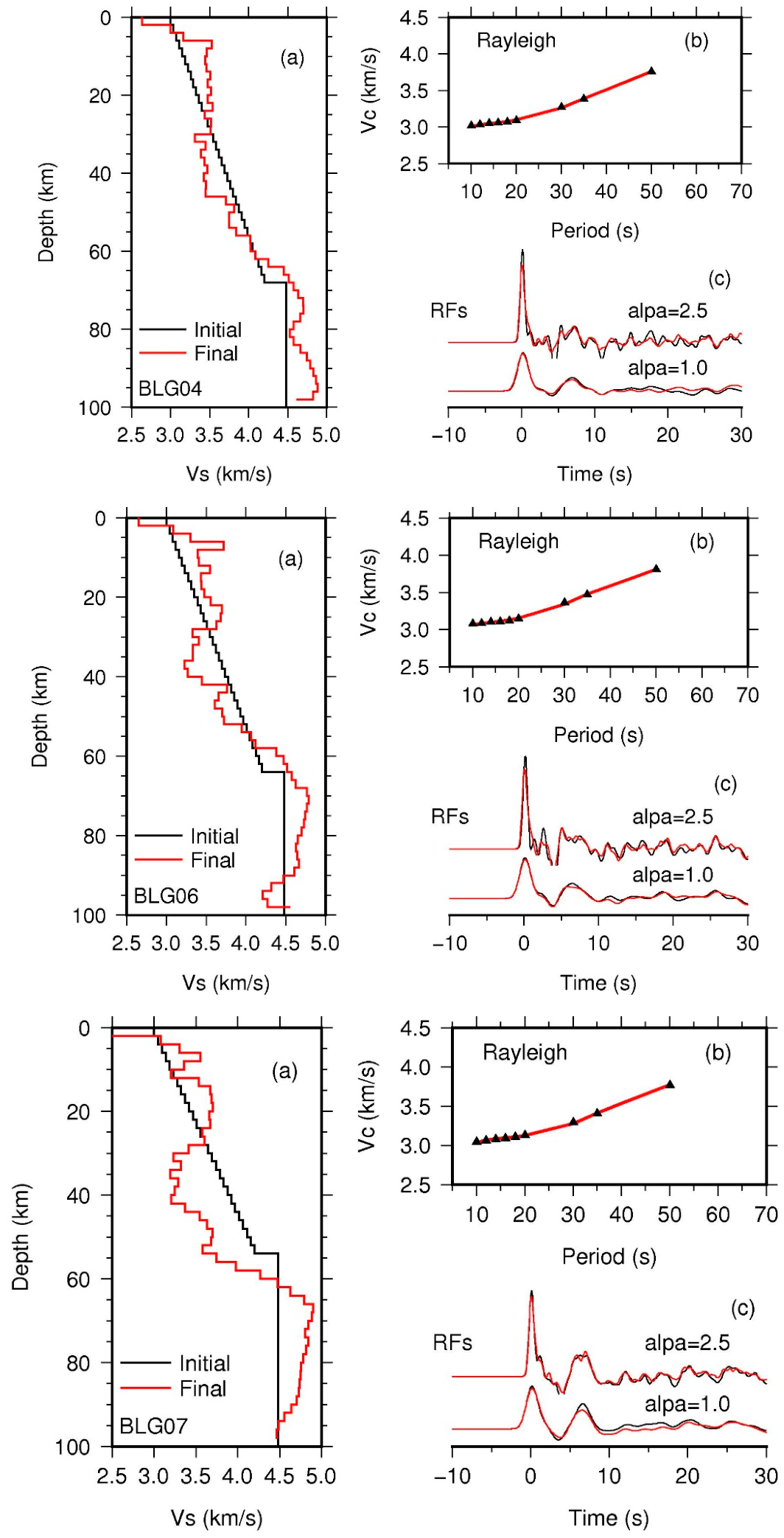
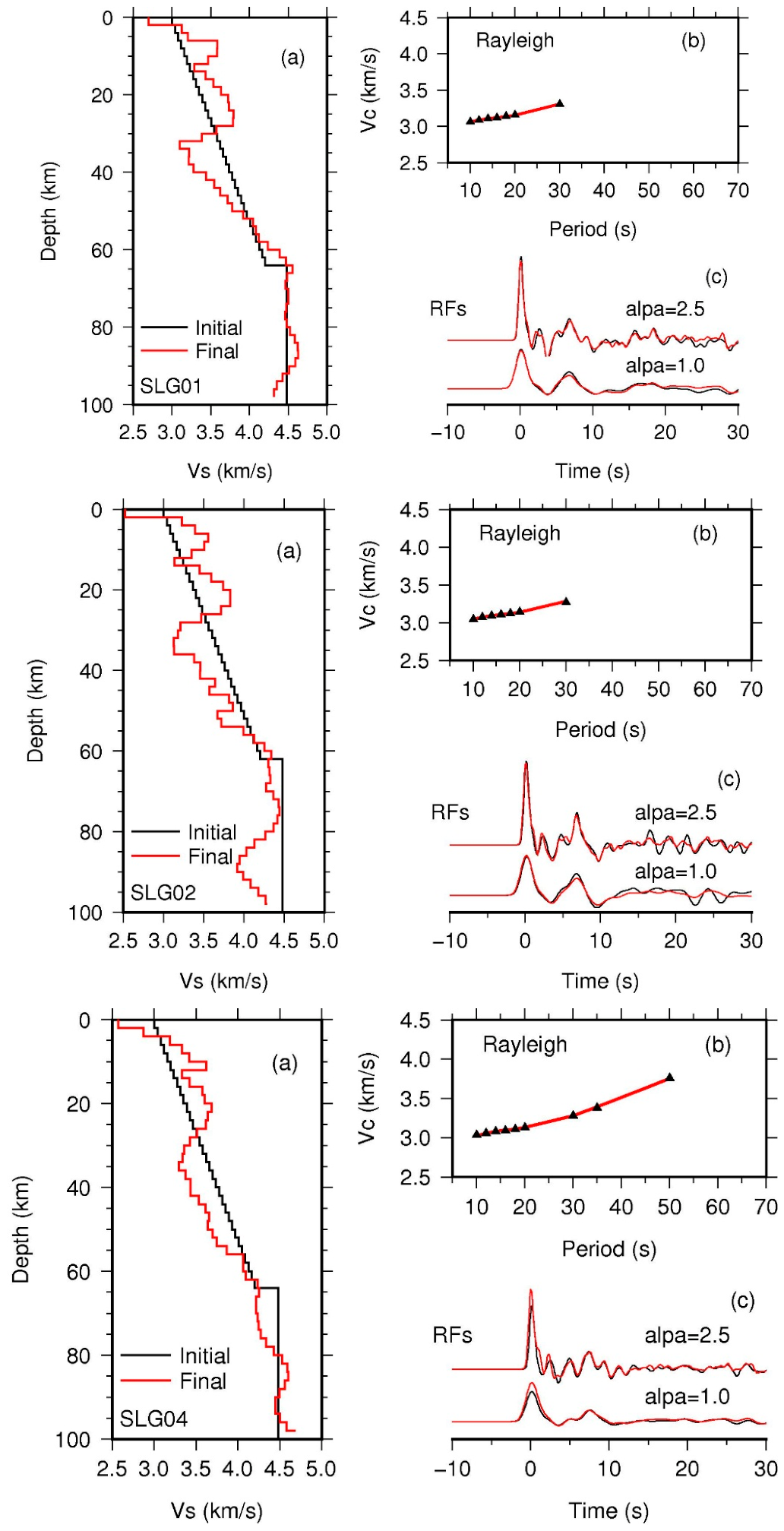
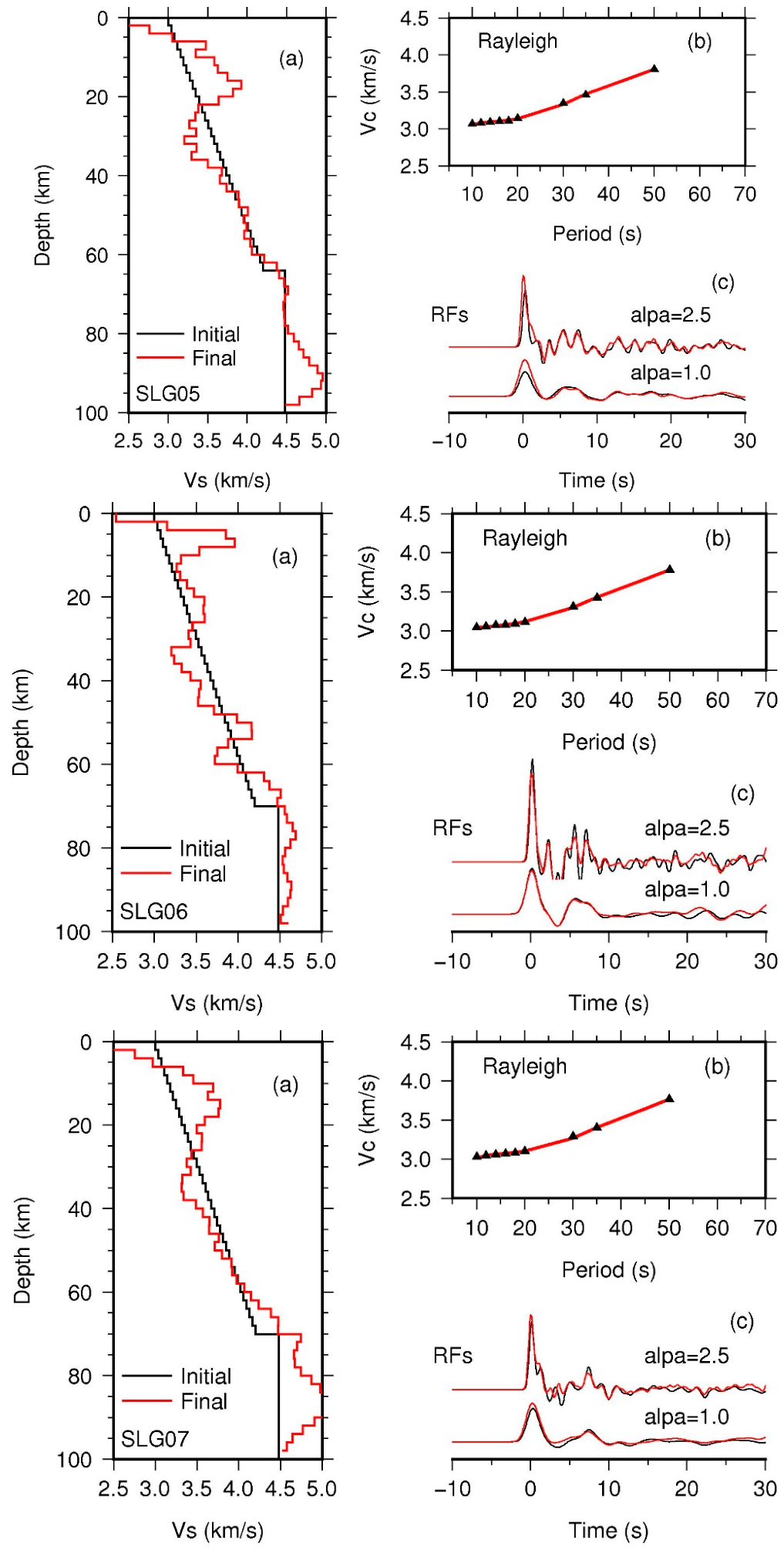
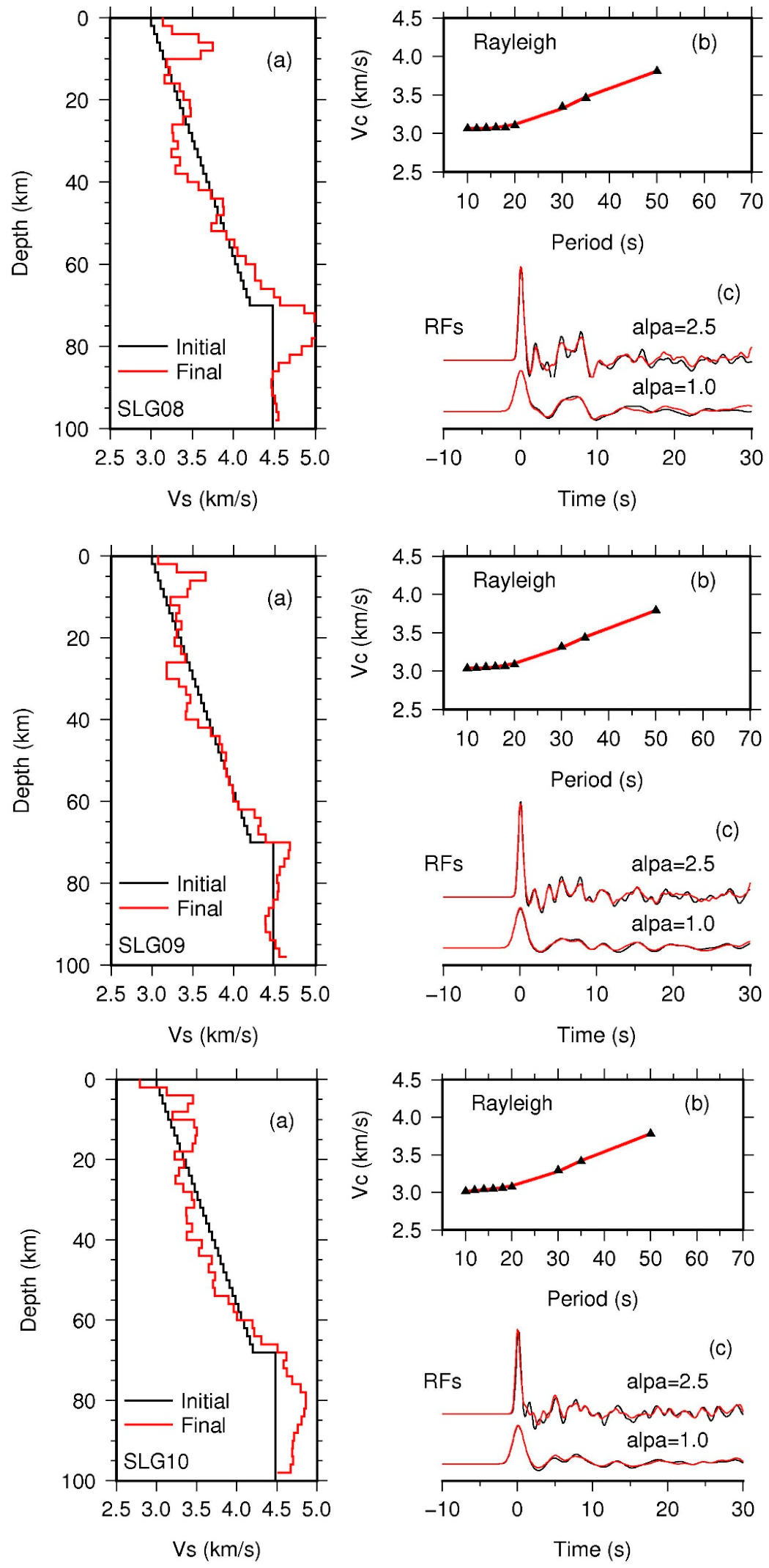
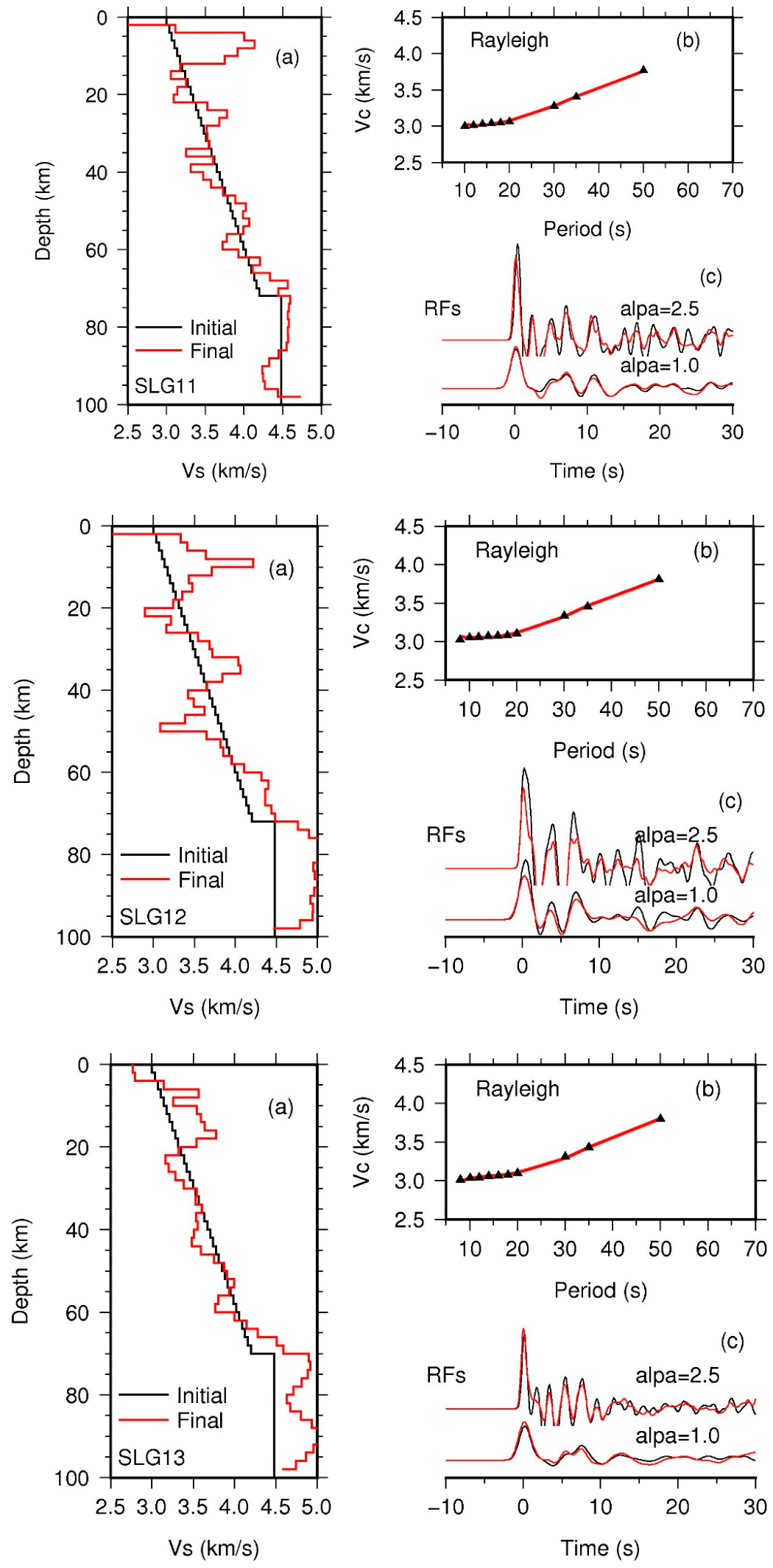
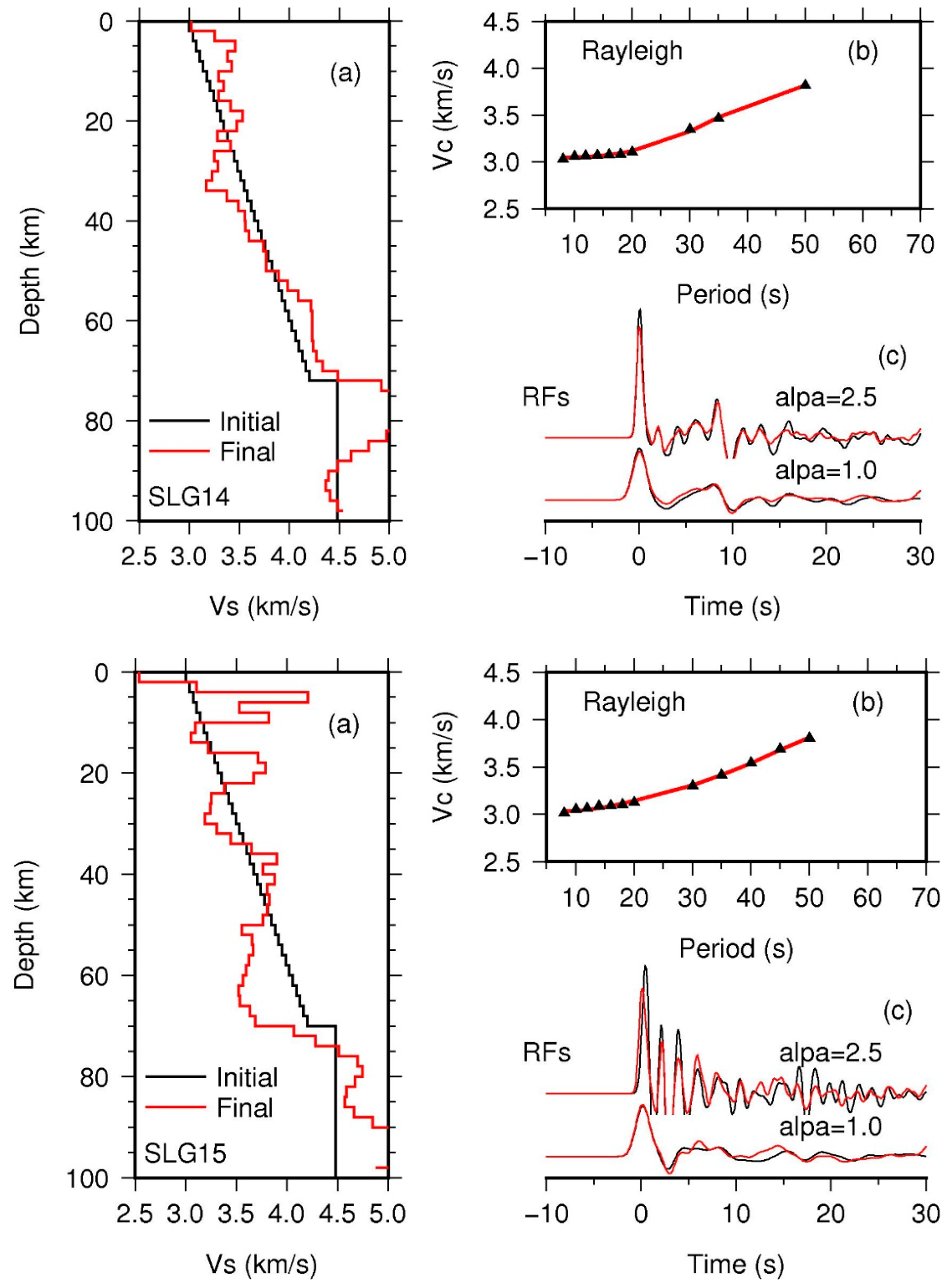
Joint inversion can improve the resolution of deep structures and accurately characterize complex structures [54,55,56,57]. In the results of the joint inversion (The joint inversion results for all stations are shown in Figure A2), the velocity structure of most stations in the depth range of 30 km to 40 km below the studied area shows a low-velocity layer (Figure 8). Except for the shorter surface wave dispersion fitting period of SLG01 and SLG02 stations (Figure 9), other stations have no influence on dispersion fitting when the Gaussian coefficient changes but have a greater influence on the fitting of the receiver function. In order to better receive high-frequency information, we used a larger value of the Gaussian parameter (alpha = 2.5). The joint inversion results of other stations are provided in Appendix A.
There are some weak high-velocity features at depths of 5–15 km. There is a continuous low-velocity layer in the crust at a depth of about 30 km below the station. In addition to the Moho at 60–80 km, a velocity discontinuity interface parallel to the Moho was also found about 50 km below the station, and the corresponding Ps conversion wave-phase travel time of these two discontinuity interfaces was about 6 s and 8 s, respectively. This structure is commonly known as the South Tibet doublet. It has also been suggested that this discontinuity is subducted from the lower crust of India. In general, the velocity of the middle and lower crusts is gradually increasing from west to east, indicating that the eastern crust is cooler and harder than the western one (Figure 10).

4. Discussion

4.1. Comparison of Two Rifts in Lhasa Terrane and Himalayan Terrane

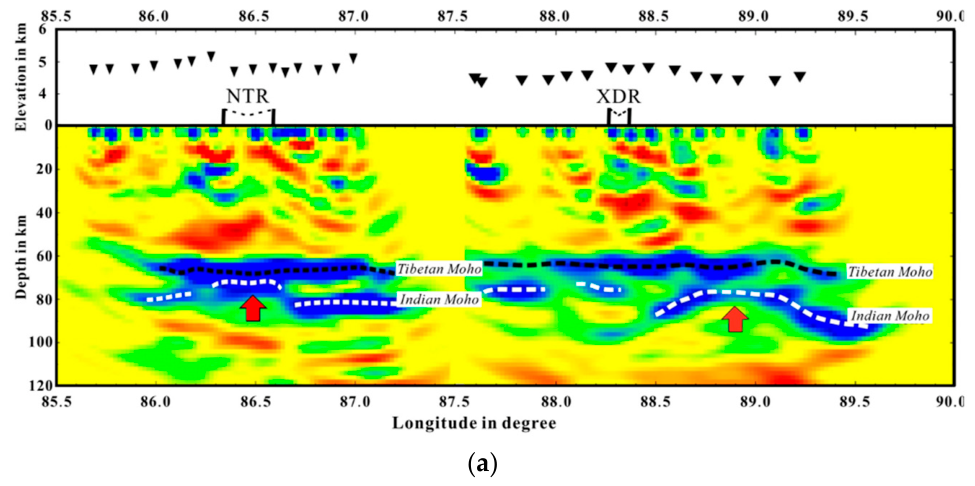
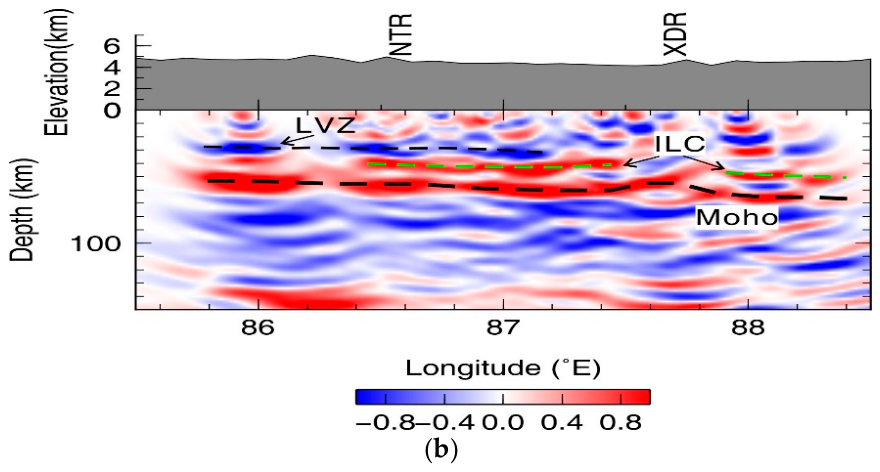
The main results of this paper are similar to those of the Nyima-Tingri and Xianza-Dingjie rifts studied by Liu [11] on the Lhasa terrae (Figure 11). The depth of the Moho interface below the rift region is about 70 km, and there is a large low-velocity layer and an in-crust discontinuity interface roughly parallel to the Moho surface below the studied region. The Nyima-Tingri rifts on the two terranes are not significantly modified by deep materials on the Moho, while the Moho fluctuation of the Xianza-Dingjie rifts is relatively large. However, the Moho fluctuation of the two rifts on the Himalayan terranes is much smaller than that of the two rifts on the Lhasa terranes, which means that the rifts have the characteristics of north–south segmentation.
The fluctuation of the Moho beneath two rifts in the Lhasa terrane is larger than that in the Himalayan terrane because of the limitation of the data or the depth of the asthenosphere in the Himalayan tectonic belt is larger, while the asthenosphere in the Lhasa terrane is sharply uplifted. Alternatively, in the process of subduction of the Indian plate, the subduction angle is high in the east and low in the west, resulting in the tearing of the Indian plate during subduction, resulting in the different subduction distances of the plate (shorter in the east and longer in the west), and the difference in the tectonic changes in the lithosphere on the Tibetan Plateau [13].

4.2. Origin of the Intracrustal Discontinuity: Indian Lower Crust or Tibetan Moho?

One of the most intriguing features revealed by our receiver function images is a prominent intracrustal discontinuity at ~50–70 km depth, running sub-parallel to the Moho and producing a “Moho doublet” pattern (Figure 9 and Figure 10). The origin of this interface has been debated, with two main interpretations: (1) it represents the subducted Indian lower crust [58], or (2) it is a relic Moho or a metamorphic front within the Tibetan crust. Our data allow us to evaluate these hypotheses across different terranes, revealing contrasting characteristics between the Himalayan and Lhasa terranes.
In the Himalayan terrane (south of the Indus–Yarlung suture), we observed two clear, coherent interfaces. Based on the Ps travel times (~6 s and ~8 s, Figure 3 and Figure 4) corresponding to depths consistent with a double-layered crustal column, the relatively high S-wave velocities (3.8–4.2 km/s) between them from joint inversion (Figure 9), and the regional context of Indian plate underthrusting [13,20], we interpret the upper interface as the subducted Indian lower crust and the lower interface as the Moho of the underthrust Indian plate. In contrast, within the Lhasa terrane (north of the suture), the intracrustal discontinuity is weaker and less continuous; we tentatively interpret it as the Tibetan Moho partially overprinted by underplated material or a phase-change boundary. This terrane difference likely reflects progressive heating and metamorphism of the underthrust Indian crust as it moves northward, eventually losing its seismic identity.

4.3. Formation Mechanism of South Tibet Rifts

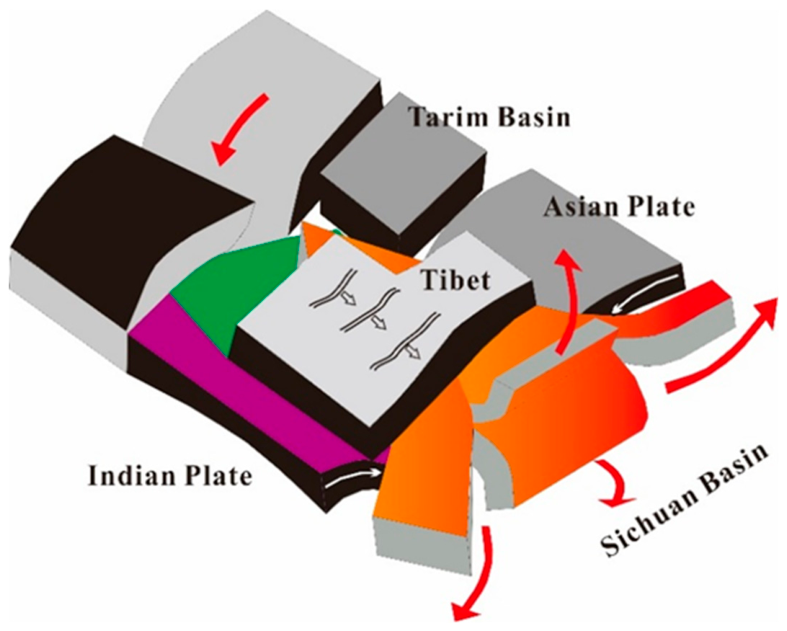
A schematic cross-section summarizing our interpretation is presented in Figure 12, and we emphasize that this interface remains an important target for future multi-disciplinary studies combining seismology, petrology, and thermomechanical modeling.
Our results are consistent with models that invoke eastward crustal and mantle flow combined with basal traction from the underthrusting Indian plate. However, we acknowledge that alternative models cannot be entirely ruled out based on our data alone. It also explains the presence of extensional structures, but it does not readily account for the observed eastward variation in crustal thickness and the asymmetric Moho uplift beneath the XDR. Similarly, the oblique subduction model [19] could produce localized extension, but it offers less explanation for the continuous mid-crustal low-velocity layer that we imaged across the profile. The key lines of evidence that favor the eastward flow model include (1) the presence of a mid-crustal low-velocity layer (LVZ) at a ~30 km depth (Figure 9 and Figure 10), which provides a weak zone that can decouple upper crustal deformation from mantle flow; (2) the eastward increase in crustal S-wave velocities (Figure 9), suggesting cooler and more rigid crust in the east, which may influence the direction of flow; and (3) the contrasting Moho geometries between the NTR and XDR, which imply different stages of mantle involvement. While these observations are compatible with the eastward flow model, we emphasize that further geophysical and geodynamic modeling are needed to test the relative contributions of various mechanisms.
Under continuing north–south compression from the Indian indentation, the presence of a weak mid-crustal low-velocity layer at ~30 km depth plays a critical role in the formation of the South Tibet rifts. This LVZ, which is interpreted as a region of partial melt or aqueous fluids [50], serves as a decoupling horizon that mechanically separates the brittle upper crust from the more ductile lower crust and underlying mantle. By reducing the frictional coupling between these layers, the LVZ allows the lower crust and lithospheric mantle to flow independently in response to lateral pressure gradients, while the upper crust remains relatively coherent. This decoupling is essential for transmitting mantle flow-induced basal traction to the upper crust, where it manifests as east–west extensional stresses.
Several studies have documented the pattern of eastward mantle flow beneath southern Tibet using various seismic anisotropy methods. SKS splitting measurements reveal consistent east-west-oriented fast polarization directions across the Lhasa terrane, indicating a coherent mantle flow parallel to the direction of lithospheric extrusion. P-wave tomography further images a low-velocity zone in the upper mantle beneath southern Tibet that extends eastward, interpreted as a channel of hot, flowing material. These independent lines of evidence support the interpretation that the mantle lithosphere beneath the Lhasa terrane is actively flowing eastward, driven by the pressure gradient between the thick Tibetan crust and the free eastern margin.
The XDR, possibly an older structure, has had more time to accumulate mantle modification, consistent with its reported earlier activity (~18–23 Ma) compared to NTR (~13–18 Ma) (Kapp, P et al., 2008; Liu, 2013) [4,11]. The weaker expression of Moho uplift in the Himalayan terrane suggests that the Indian lithospheric mantle remains coupled to the crust, limiting deep modification (Figure 11), whereas the Lhasa terrane lithosphere is hotter and more ductile, allowing mantle flow to influence the Moho.
In this context, the South Tibet rifts are not classical continental rifts formed by pure extension but rather extensional structures within a compressional regime—an “infant stage” manifestation of deep lithospheric processes. The weak mid-crustal LVZ allows the lower crust and lithospheric mantle to flow eastward, driven by the pressure gradient between the thick Tibetan crust and the free eastern margin. This eastward flow creates basal traction on the upper crust, generating east-west extensional stresses that are localized by pre-existing structures. The differential flow velocity between the deep and shallow layers explains the observed misalignment between surface rift expression and deeper Moho architecture. Therefore, the South Tibet rifts represent an “infant stage”, where crustal thinning and mantle upwelling have not yet fully developed.

4.4. Relationship Between Surface Rift Geometry and Moho Topography

A key question in understanding the South Tibet rift system is whether the surface expression of the rifts is directly linked to deep crustal or mantle structures. Our receiver function images provide an opportunity to examine this relationship across the NTR and XDR.
Beneath the Nyima-Tingri Rift (NTR), the Moho is remarkably flat and continuous (Figure 10), showing no resolvable shallowing or disruption coincident with the surface trace of the rift. This indicates that the NTR is a purely upper crustal extensional feature that has not yet penetrated the full crustal column. The decoupling between surface deformation and Moho geometry suggests the presence of a mechanically weak layer—likely the mid-crustal low-velocity zone (LVZ) at ~30 km depth (Figure 9)—that accommodates strain and prevents vertical propagation of extensional faults to the base of the crust.
Beneath the Xianza-Dingjie Rift (XDR), the relationship is more complex. While the Moho exhibits a localized shallowing of ~10 km beneath the rift axis (Figure 10), this uplift is not precisely aligned with the surface expression of the XDR but is offset by ~20–30 km to the east. This misalignment suggests that the deep crustal response to extension is not simply a vertical projection of surface structures. Instead, we interpret this as evidence for asymmetric extension or the influence of pre-existing lithospheric heterogeneities (e.g., terrane boundaries, suture zones) that localize strain at depth.
The lack of a one-to-one correlation between surface rift locations and Moho topography has important implications for rift models. If the South Tibet rifts were classical, lithosphere-scale extensional features, we would expect the Moho to shallow directly beneath the rift axes due to crustal thinning and isostatic rebound. The absence of such a relationship—particularly for the NTR—supports the interpretation that these structures are crustal-scale, not lithospheric-scale, and that the mantle lithosphere beneath the Lhasa terrane remains largely intact.

5. Conclusions

We have found that the depth of the Moho interface below the profile is approximately 60–80 km, and from west to east (from NTR to XDR), the crustal thickness of the Himalayan terrain gradually thickens. A continuous low-velocity layer exists in the crust at a depth of about 30 km west of 87.2° E, the formation of which may indicate partial melting or the presence of free water in the crust. Meanwhile, a crustal discontinuity is present at a depth of 60–70 km beneath the study area, which is interpreted as the subducted Indian lower crust in the Himalayan terrane and the Tibetan Moho in the Lhasa terrane. The Moho of the Nyima–Tingri Rift is relatively flat, whereas that of the Xianza–Dingjie Rift exhibits strong variations, suggesting that the Xianza–Dingjie Rift has been more strongly deformed by mantle materials. Furthermore, the north–south trending structures in southern Tibet do not exhibit the deep structural characteristics typical of mature continental rifts [20]; even where surface expressions resemble rifts, our observations indicate that they most likely represent an “infant stage” of extension, in which crustal thinning and mantle upwelling have not yet fully developed. The formation of these structures is most consistent with a combination of east–west crustal stretching related to the ongoing north–south convergence and the eastward flow of lower crustal and upper mantle materials. However, the precise role of each mechanism and whether the surface geometry of the rifts is directly controlled by deeper mantle processes require further investigation.

Author Contributions

Conceptualization, T.Y. and T.S.; Methodology, J.Z., J.T. and J.L.; Software, K.Z. and T.J.; Validation, T.Y.; Formal analysis, J.T. and H.L.; Investigation, J.Z., H.L., S.H., K.Z. and T.J.; Data curation, S.H. and J.L.; Writing—original draft preparation, T.Y.; Writing—review and editing, J.Z. and J.T.; Visualization, T.Y. and T.S.; Project administration, J.Z.; Funding acquisition, J.Z.; Supervision, J.Z. All authors have read and agreed to the published version of the manuscript.

Funding

This research is funded by Key Projects of the National Natural Science Foundation of China [grant number 42230307].

Institutional Review Board Statement

Not applicable.

Informed Consent Statement

Not applicable.

Data Availability Statement

The data that support the findings of this study are available from the corresponding author upon reasonable request.

Acknowledgments

We thank the ANTILOPE-III project team for seismic data collection and preprocessing. We are grateful to the editor and reviewers for their constructive comments, which significantly improved this manuscript.

Conflicts of Interest

The remaining authors declare that the research was conducted in the absence of any commercial or financial relationships that could be construed as a potential conflict of interest.

Appendix A

Table A1. The TD profile comprehensive information table.
Station NameLatitudeLongitudeTps
(s)
TPpPs
(s)
Moho
(km)
Error (km)kErrorRF (pcs)
SLG0128.7585.796.725.863.3831.551.6290.01627
SLG0228.6785.926.925.361.060.491.6730.00652
SLG0428.6686.397.326.764.3791.461.6760.01842
SLG0528.6186.567.226.463.7151.761.6730.04635
SLG0628.6186.737.428.269.0240.351.6380.00225
SLG0728.5686.857.428.570.020.651.6290.00745
BLG0428.5986.927.127.868.6931.761.6150.05931
BLG0328.5786.997.627.867.0332.981.6760.10144
SLG0828.5787.057.728.870.020.981.6550.01229
SLG0928.687.197.728.870.022.051.6550.06132
SLG1028.6187.37.728.468.6930.811.6680.01135
SLG1128.5887.397.329.272.6750.281.5970.00634
SLG1328.5687.657.628.870.3520.871.6430.0129
SLG1428.4687.848.330.272.6750.781.6810.01117
SLG1528.4987.948.229.269.6880.791.7020.02337
BLG0128.5888.158.632.980.6390.61.6350.00321
Figure A1. Ps converted wave travel time diagram of receiver functions of a single station. The sum is the average receive function obtained by stacking.
Geosciences 16 00198 g0a1aGeosciences 16 00198 g0a1bGeosciences 16 00198 g0a1cGeosciences 16 00198 g0a1dGeosciences 16 00198 g0a1e
Figure A2. Results of joint inversion of the receiver function and surface wave dispersion at a single station. (a) The inversion of the S-wave velocity structure (red line) and the initial model of a linear increase in velocity (black line). (b) The fit between the observed value of the phase velocity dispersion curve (black triangle) and the theoretical value of the model derived from the inversion (red line). (c) The fitting result of the observed value of the receiver function (black line) and the theoretical value of the model derived from the inversion (red line). The black triangles are seismic stations.
Geosciences 16 00198 g0a2aGeosciences 16 00198 g0a2bGeosciences 16 00198 g0a2cGeosciences 16 00198 g0a2dGeosciences 16 00198 g0a2eGeosciences 16 00198 g0a2fGeosciences 16 00198 g0a2g

References

  1. Seeber, L.; Pecher, A. Strain partitioning along the Himalayan arc and the Nanga Parbat antiform. Geology 1998, 26, 791. [Google Scholar] [CrossRef]
  2. Yin, A. Mode of Cenozoic east-west extension in Tibet suggesting a common origin of rifts in Asia during the Indo-Asian collision. J. Geophys. Res. Solid Earth 2000, 105, 21745–21759. [Google Scholar] [CrossRef]
  3. Zhang, J.J. A review on the extensional structures in the northern Himalaya and southern Tibet. Geol. Bull. China 2007, 26, 639–649. [Google Scholar]
  4. Ding, L.; Yue, Y.H.; Cai, F.L.; Xu, X.X.; Zhang, Q.H.; Lai, Q.Z. 40Ar/39Ar geochronology, geochemical and Sr-Nd-O isotopic characteristics of the high-Mg ultrapotassic rocks in Lhasa Block of Tibet: Implications in the onset time and depth of NS-striking rift system. Acta Geol. Sin. 2006, 80, 1252–1265. [Google Scholar]
  5. Yin, A.; Harrison, T.M. Geologic evolution of the Himalayan-Tibetan orogen. Annu. Rev. Earth Planet. Sci. 2003, 28, 211–280. [Google Scholar] [CrossRef]
  6. Hou, Z.Q.; Duan, L.F.; Lu, Y.J.; Zheng, Y.; Zhu, D.; Yang, Z.; Yang, Z.; Wang, B.; Pei, Y.; Zhao, Z.; et al. Lithospheric architecture of the Lhasa Terrane and its control on oredeposits in the Himalayan-Tibetan Orogen. Econ. Geol. 2015, 110, 1541–1575. [Google Scholar] [CrossRef]
  7. Harrison, T.M.; Copeland, P.; Kidd, W.S.F.; Lovera, O.M. Activation of the Nyainqentanghla Shear Zone: Implications for uplift of the southern Tibetan Plateau. Tectonics 1995, 14, 658–676. [Google Scholar] [CrossRef]
  8. Garzione, C.N.; Dettman, D.L.; Quade, J.; DeCelles, P.G.; Butler, R.F. High times on the plateau: Paleoelevation of the Thakkhola graben, Nepal. Geology 2000, 28, 339–342. [Google Scholar] [CrossRef]
  9. Williams, H.; Turner, S.; Kelley, S.; Harris, N. Age and composition of dikes in Southern Tibet: New constraints on the timing of east-west extension and its relationship to postcollisional volcanism. Geology 2001, 29, 188–193. [Google Scholar] [CrossRef]
  10. Hou, Z.; Zheng, Y.; Zeng, L. Post-collisional, K-rich mafic magmatism in south Tibet: Constraints on Indian slab-to-wedge transport processes and plateau uplift. Contrib. Mineral. Petrol. 2013, 165, 1311–1340. [Google Scholar]
  11. Liu, Q.M. Deep Structure and Formation Mechanism of the Rifts in Southern Tibet; University of Chinese Academy of Sciences: Beijing, China, 2013. [Google Scholar]
  12. Zhao, W.; Mechie, J.; Brown, L.D.; Guo, J.; Haines, S.; Hearn, T.; Klemperer, S.L.; Ma, Y.S.; Meissner, R.; Nelson, K.D.; et al. Crustal structure of central Tibet as derived from project INDEPTH wide-angle seismic data. Geophys. J. Int. 2001, 145, 486–498. [Google Scholar] [CrossRef]
  13. Chen, Y.; Li, W.; Yuan, X.; Badal, J.; Teng, J. Tearing of the Indian lithospheric slab beneath southern Tibet revealed by SKS-wave splitting measurements. Earth Planet. Sci. Lett. 2015, 413, 13–24. [Google Scholar] [CrossRef]
  14. Zhang, Y.; Wang, X.; Li, J. Deep structure of the Yadong-Gulu rift, southern Tibet: Constraints from seismic tomography. Tectonophysics 2012, 574–575, 112–120. [Google Scholar]
  15. Shi, D.; Zhao, J.; Liang, X. Lithospheric thickening and rifting in southern Tibet: A synthesis of geophysical and geological data. Earth Sci. Rev. 2015, 149, 156–172. [Google Scholar]
  16. Harrison, T.M.; Copeland, P.; Kidd, W.S.F.; Yin, A. Raising Tibet. Science 1992, 225, 1663–1670. [Google Scholar] [CrossRef]
  17. Coleman, M.; Hodges, K. Evidence for Tibetan plateau uplift before 14 Myr ago from a new minimum age for east and west extension. Nature 1995, 374, 49–52. [Google Scholar] [CrossRef]
  18. Lee, J.; Whitehouse, M.J. Onset of mid-crustal extensional flow in southern Tibet: Evidence from U/Pb zircon ages. Geology 2007, 35, 45–48. [Google Scholar] [CrossRef]
  19. Tian, X.; Chen, Y.; Tseng, T.L.; Klemperer, S.L.; Thybo, H.; Liu, Z.; Xu, T.; Liang, X.; Bai, Z.; Zhang, X.; et al. Weakly coupled lithospheric extension in southern Tibet. Earth Planet. Sci. Lett. 2015, 430, 171–177. [Google Scholar] [CrossRef]
  20. Zhao, J.M.; Yuan, X.H.; Liu, H.B.; Kumar, P.; Pei, S.; Kind, R.; Zhang, Z.; Teng, J.; Ding, L.; Gao, X.; et al. The boundary between the Indian and Asian tectonic plates below Tibet. Proc. Natl. Acad. Sci. USA 2010, 107, 11229–11233. [Google Scholar] [CrossRef]
  21. Kapp, P.; Guynn, J.H. Indian punch rifts Tibet. Geology 2004, 32, 993–996. [Google Scholar] [CrossRef]
  22. Bendick, R.; Bilham, R. How perfect is the Himalayan arc? Geology 2001, 29, 791–794. [Google Scholar] [CrossRef]
  23. Cao, S.H.; Li, D.W.; Yu, Z.Z.; Xu, Z.F.; Tang, F.L. Characteristics and Genesis of the N-S Trending Graben of Tangra Yumco-Xuruco in the Gangdese, Tibet. Earth Sci. 2009, 34, 42–48. [Google Scholar]
  24. Wolff, R.; Hetzel, R.; Dunkl, I.; Xu, Q.; Bröcker, M.; Anczkiewicz, A.A. High-Angle Normal Faulting at the Tangra Yumco Graben (Southern Tibet) Since ~15 Ma. J. Geol. 2019, 127, 15–36. [Google Scholar] [CrossRef]
  25. Zhang, J.J.; Guo, L.; Ding, L. The relationship between the middle and southern parts structure characteristics of the shenzha-dingjie normal fault system with the southern Tibet detachment system. Chin. Sci. Bull. 2002, 47, 738–743. [Google Scholar]
  26. Li, C.; Zhai, Q.G.; Xu, F.; Zhu, Z. Kinematic Characteristics of the Chazangco-Xainza N-S Trending Active Tectonic Zone in Tibet. Geol. Rev. 2005, 51, 353–359. [Google Scholar]
  27. Zhao, J.; Zhang, P.; Zhang, X.; Yuan, X.; Kind, R.; van der HILST, R.; Gan, W.; Sun, J.; Deng, T.; Liu, H.; et al. Crust-mantle structure and geodynamic processes in western China and their constraints on resources and environment: Research progress of the ANTILOPE Project. Earth Sci. Front. 2021, 28, 230–259. [Google Scholar]
  28. Wessel, P.; Luis, J.F.; Uieda, L.; Scharroo, R.; Wobbe, F.; Smith, W.H.F.; Tian, D. The Generic Mapping Tools Version 6. Geochem. Geophys. Geosystems 2019, 20, 5556–5564. [Google Scholar] [CrossRef]
  29. Wessel, P.; Smith, W.H.F.; Scharroo, R.; Luis, J.; Wobbe, F. Generic Mapping Tools: Improved Version Released. Eos Trans. Am. Geophys. Union 2013, 94, 409–410. [Google Scholar] [CrossRef]
  30. Vinnik, L.P. Detection of waves converted from P to SV in the mantle. Phys. Earth Planet. Inter. 1977, 15, 39–45. [Google Scholar] [CrossRef]
  31. Langston, C.A. Structure under Mount Rainier, Washington, inferred from teleseismic body waves. J. Geophys. Res. Solid Earth 1979, 84, 4749–4762. [Google Scholar] [CrossRef]
  32. Ligorrla, J.P.; Ammon, C.J. Iterative deconvolution and receiver-function estimation. Bull. Seismol. Soc. Am. 1999, 89, 1395–1400. [Google Scholar] [CrossRef]
  33. Yuan, X.; Ni, J.; Kind, R.; Mechie, J.; Sandvol, E. Lithospheric and upper mantle structure of southern Tibet from a seismological passive source experiment. J. Geophys. Res. Solid Earth 1997, 102, 27491–27500. [Google Scholar] [CrossRef]
  34. Zandt, G.; Ammon, C.J. Continental crust composition constrained by measurements of crustal Poisson’s ratio. Nature 1995, 374, 152–154. [Google Scholar] [CrossRef]
  35. Zhu, L.; Kanamori, H. Moho depth variation in southern California from teleseismic receiver functions. J. Geophys. Res. Solid Earth 2000, 105, 2969–2980. [Google Scholar] [CrossRef]
  36. Wu, C.L.; Xu, T.; Tian, X.B.; Mitchell, R.N.; Lin, J.; Yang, J.; Wang, X.; Lu, Z. Underthrusting of Tarim Lower Crust Beneath the Tibetan Plateau Revealed by Receiver Function Imaging. Geophys. Res. Lett. 2024, 51, e2024GL108220. [Google Scholar] [CrossRef]
  37. Wang, C.Y.; Sandvol, E.; Zhu, L.; Lou, H.; Yao, Z.; Luo, X. Lateral variation of crustal structure in the Ordos block and surrounding regions, North China, and its tectonic implications. Earth Planet. Sci. Lett. 2014, 387, 198–211. [Google Scholar] [CrossRef]
  38. Bensen, G.D.; Ritzwoller, M.H.; Barmin, M.P.; Levshin, A.L.; Lin, F.; Moschetti, M.P.; Shapiro, N.M.; Yang, Y. Processing seismic ambient noise data to obtain reliable broad-band surface wave dispersion measurements. Geophys. J. Int. 2007, 169, 1239–1260. [Google Scholar] [CrossRef]
  39. Barmin, M.P.; Ritzwoller, M.H.; Levshin, A.L. A fast and reliable method for surface wave tomography. Pure Appl. Geophys. 2001, 158, 1351–1375. [Google Scholar] [CrossRef]
  40. Randall, G.E. Efficient calculation of complete differential seismograms for laterally homogeneous earth models. Geophys. J. Int. 1994, 118, 245–254. [Google Scholar] [CrossRef]
  41. Sambridge, M. Geophysical inversion with a neighbourhood algorithm—II. Appraising the ensemble. Geophys. J. R. Astron. Soc. 2003, 138, 727–746. [Google Scholar] [CrossRef]
  42. Julia, J.; Ammon, C.J.; Herrmann, R.B.; Correig, A.M. Joint inversion of receiver function and surface wave dispersion observations. Geophys. J. Int. 2000, 143, 99–112. [Google Scholar] [CrossRef]
  43. Nie, S.T.; Tian, X.B.; Wei, Y.H.; Li, Y.; Zhang, L.; Li, J. Crustal Modification Processes of the South China Block by Paleo-Pacific Plate Subduction: Constraints from High-Resolution Crustal Structure. J. Geophys. Res. Solid Earth 2025, 130, e2025JB031609. [Google Scholar] [CrossRef]
  44. Wu, H.X.; Sui, S.Y.; Shen, W.S. Incorporating H-κ Stacking With Monte Carlo Joint Inversion of Multiple Seismic Observables: A Case Study for the Northwestern US. J. Geophys. Res. Solid Earth 2024, 129, e2023JB027952. [Google Scholar] [CrossRef]
  45. Kind, R.; Yuan, X.; Saul, J.; Nelson, D.; Sobolev, S.V.; Mechie, J.; Zhao, W.; Kosarev, G.; Ni, J.; Achauer, U.; et al. Seismic images of crust and upper mantle beneath Tibet: Evidence for Eurasian plate subduction. Science 2002, 298, 1219. [Google Scholar] [CrossRef]
  46. Xu, Q.; Zhao, J.M.; Yuan, X.H.; Liu, H.; Pei, S. Detailed Configuration of the Underthrusting Indian Lithosphere Beneath Western Tibet Revealed by Receiver Function Images. J. Geophys. Res. Solid Earth 2017, 122, 8257–8269. [Google Scholar] [CrossRef]
  47. Xiong, S.B.; Teng, J.W.; Yin, Z.X. Crustal Thickness and Moho Relief in the Tibetan Plateau Region. In Abstracts of Papers from the Institute of Geophysics, Chinese Academy of Sciences; Chinese Academy of Sciences: Beijing, China, 1989. [Google Scholar]
  48. Teng, J.W.; Xiong, S.B.; Yin, Z.X.; Xu, Z.X.; Wang, X.J.; Lu, D.Y. Crustal Structure and Velocity Distribution Beneath the Northern Region of the Himalayas. Chin. J. Geophys. 1983, 6, 525–540. [Google Scholar]
  49. Zeng, R.S.; Ding, Z.F.; Wu, Q.J. Crustal Structure and the Continent-Continent Collision Process of the Himala-yas-Qilian Mountains. Chin. J. Geophys. 1998, 41, 49–60. [Google Scholar]
  50. Hauck, M.L.; Nelson, K.D.; Brown, L.D.; Zhao, W.; Ross, A.R. Crustal structure of the Himalayan orogen at ~90 east longitude from Project INDEPTH deep reflection profiles. Tectonics 1998, 17, 481–500. [Google Scholar] [CrossRef]
  51. Makovsky, Y.; Klemperer, S.L.; Ratschbacher, L.; Brown, L.D.; Li, M.; Zhao, W.; Meng, F. INDEPTH Wide-Angle Reflection Observation of P-Wave-to-S-Wave Conversion from Crustal Bright Spots in Tibet. Science 1996, 274, 1690–1691. [Google Scholar] [CrossRef]
  52. Nelson, K.D.; Zhao, W.; Brown, L.D.; Kuo, J.; Che, J.; Liu, X.; Klemperer, S.L.; Makovsky, Y.; Meissner, R.; Mechie, J.; et al. Partially Molten Middle Crust Beneath Southern Tibet: Synthesis of Project INDEPTH Results. Science 1996, 274, 1684–1688. [Google Scholar] [CrossRef]
  53. Hetenyi, G.; Vergne, J.; Bollinger, L.; Cattin, R. Discontinuous low-velocity zones in southern Tibet question the viability of the channel flow model. In Growth and Collapse of the Tibetan Plateau; Geological Society London Special Publications: London, UK, 2011; Volume 353, pp. 99–108. [Google Scholar]
  54. Böhm, G.; Affatato, A.; Brancatelli, G.; Forlin, E.; Meneghini, F.; Baradello, L.; Corubolo, P. 3D P-wave and S-wave velocity model for the characterisation of the subsurface beneath the village of Arquata del Tronto (central Italy). Bull. Geophys. Oceanogr. 2025, 66, 217–232. [Google Scholar] [CrossRef]
  55. Steiner, B.; Saenger, E.H.; Schmalholz, S.M. Time-reverse imaging with limited S-wave velocity model information. Geophysics 2011, 76, MA33–MA40. [Google Scholar] [CrossRef]
  56. Tang, Z.; Julià, J.; Mai, P.M.; Mooney, W.D.; Wu, Y.Q. Shear-Wave Velocity Structure Beneath Northeast China from Joint Inversion of Receiver Functions and Rayleigh Wave Phase Velocities: Implications for Intraplate Volcanism. J. Geophys. Res. Solid Earth 2022, 127, e2022JB023956. [Google Scholar] [CrossRef]
  57. Tan, J.Y.; Langston, C.A.; Ni, S.D. Shallow Shear-Wave Velocity Structure in Oklahoma Based on the Joint Inversion of Ambient Noise Dispersion and Teleseismic P-Wave Receiver Functions. Bull. Seismol. Soc. Am. 2021, 111, 654–670. [Google Scholar] [CrossRef]
  58. Nabelek, J.; Hetenyi, G.; Vergne, J.; Sapkota, S.; Kafle, B.; Jiang, M.; Su, H.; Chen, J.; Huang, B.-S. Underplating in the Himalaya-Tibet collision zone revealed by the Hi-CLIMB experiment. Science 2009, 325, 1371. [Google Scholar] [CrossRef]
Figure 1. Location of the broadband seismic observation section (middle part of ANTILOPE-III) crossing the rifts in a north-south direction in the Himalayas. The blue squares represent the locations of the broadband seismometers deployed for this study. The red box in the inset shows the position of the study area on the Tibetan Plateau. NTR: Nima-Tingri Rift; XDR: Xianza-Dingjie Rift; IYS: Indo-Yarlung Zangbo suture zone. The upper left subfigure shows the distribution of teleseismic events used in the study. The blue rectangle indicates the location of the study area, and the red circle indicates the location of the seismic event.
Geosciences 16 00198 g001
Figure 2. Ps converted wave travel time diagram of receiver functions of stations BLG01 and SLG01. The sum is the average receive function obtained by stacking. The green vertical dashed lines indicate the arrival times of the Ps’ converted wave at the MHT (ILC) fault and the Moho. MHT: Main Himalayan Thrust; ILC: Indian Lower Crust.
Geosciences 16 00198 g002
Figure 3. Ps converted wave travel time diagram of receiver functions of stations SLG10 and SLG15. The sum is the average receive function obtained by stacking. The red and green vertical dashed lines indicate the arrival times of the Ps’ converted wave at the MHT (ILC) fault and the Moho. MHT: Main Himalayan Thrust; ILC: Indian Lower Crust.
Geosciences 16 00198 g003
Figure 4. Time profile of tele-seismic P-wave receiver function constructed by single station stacking. ILC: Indian Lower Crust; NTR: Nyima-Tingri Rift; XDR: Xianza-Dingjie Rift.
Geosciences 16 00198 g004
Figure 5. Receiver function stacking after time difference correction of Ps and PpPs at each station. NTR: Nyima-Tingri Rift; XDR: Xianza-Dingjie Rift.
Geosciences 16 00198 g005
Figure 6. Crustal thickness and wave velocity ratio calculated using the actual travel time of Ps and PpPs of Moho. NTR: Nyima-Tingri Rift; XDR: Xianza-Dingjie Rift. “Green circles represent the Vp/Vs ratio, blue triangles represent the crustal thickness, and black vertical bars (black I) represent the estimated crustal thickness, assuming Vp/Vs = 1.732 and Vp = 6.2 km/s”.
Geosciences 16 00198 g006
Figure 7. Tele-seismic P-wave receiver function of profile. Red denotes high-velocity zones of seismic wave propagation, while blue denotes low-velocity zones. Blue and black dashed lines represent the LVZ, ILC, and Moho. (+) indicates the stacked Moho depth, calculated from the arrival times of Moho Ps and PpPs phases. NTR: Nyima-Tingri rift; XDR: Xianza-Dingjie rift; ILC: Indian lower crust; LVZ: low-velocity zone.
Geosciences 16 00198 g007
Figure 8. Results of the joint inversion of the receiver function and the surface wave dispersion in stations SLA04 and BLG03. (a) The inversion of the S-wave velocity structure (red line) and the initial model of a linear increase in velocity (black line). (b) The fit between the observed value of the phase velocity dispersion curve (black triangle) and the theoretical value of the model derived from the inversion (red line). (c) The fitting result of the observed value of the receiver function (black line) and the theoretical value of the model derived from the inversion (red line).
Geosciences 16 00198 g008
Figure 9. Results of the joint inversion of the receiver function and the surface wave dispersion in stations SLA01 and SLG02. (a) The inversion of the S-wave velocity structure (red line) and the initial model of a linear increase in velocity (black line). (b) The fit between the observed value of the phase velocity dispersion curve (black triangle) and the theoretical value of the model derived from the inversion (red line). (c) The fitting result of the observed value of the receiver function (black line) and the theoretical value of the model derived from the inversion (red line).
Geosciences 16 00198 g009
Figure 10. S-wave velocity structure and P-wave receiver function stacking image of the profile. Black dashed lines represent the LVZ and ILC. (+) denotes the stacked Moho depth calculated from the arrival times of the Moho Ps and PpPs phases. Green and red dashed lines indicate the arrival times of the Ps converted wave at the ILC fault and the Moho. NTR: Nyima-Tingri Rift; XDR: Xianza-Dingjie Rift; ILC: Indian Lower Crust; LVZ: low-velocity layer.
Geosciences 16 00198 g010
Figure 11. Comparison of the Nyima-Tingri Rift and Xianza-Dingjie Rift in Himalayan with those in the Lahsa Block. (a) The rift in the Lahsa Block north of the Yarlung Zangbo suture. There is no direct link between the “rifts” on the surface and those on the upper mantle. Black dashed lines represent the ILC. The white dashed lines denote the stacked Moho depth calculated from the arrival times of the Moho Ps and PpPs phases. (b) The rift in the Himalayan southern Yarlung Zangbo suture by the CCP stacking offset image. green and black dashed lines represent the ILC, LVZ, and Moho. NTR: Nyima-Tingri Rift; XDR: Xianza-Dingjie Rift; ILC: Indian lower crust; LVZ: low-velocity layer. Source of the figure [11].
Geosciences 16 00198 g011aGeosciences 16 00198 g011b
Figure 12. The formation model of south-north mega-structures developed in southern Tibet. The compression and eastward migration of crust–mantle material are responsible for the formation of the rifts in southern Tibet [20].
Geosciences 16 00198 g012
Disclaimer/Publisher’s Note: The statements, opinions and data contained in all publications are solely those of the individual author(s) and contributor(s) and not of MDPI and/or the editor(s). MDPI and/or the editor(s) disclaim responsibility for any injury to people or property resulting from any ideas, methods, instructions or products referred to in the content.