
Article

Terahertz Time-Domain Spectroscopy in Molybdenum Exploration: A Case Study of the Dengshang Deposit, North China Craton

1
State Key Laboratory of Geological Processes and Mineral Resources, Frontiers Science Center for Deep-time Digital Earth, China University of Geosciences, Beijing 100083, China
2
North China Center for Geoscience Innovation, Tianjin Center, China Geological Survey, Tianjin 300170, China
3
Department of Geological Engineering, Karadeniz Technical University, Trabzon 61100, Turkey
4
The Fourth Geological Team of Hebei Bureau of Geology and Mineral Resources, Chengde 067000, China
*
Author to whom correspondence should be addressed.
Geosciences 2026, 16(5), 187; https://doi.org/10.3390/geosciences16050187
Submission received: 2 April 2026 / Revised: 30 April 2026 / Accepted: 2 May 2026 / Published: 7 May 2026
(This article belongs to the Special Issue Isotope Geochemistry: New Techniques and Applications)

Abstract

Porphyry-type deposits are characterized by well-developed alteration zoning, among which potassic alteration is closely associated with mineralization and represents a key target for prospecting and exploration. The Dengshang molybdenum deposit is a porphyry-type deposit within the Yanliao molybdenum metallogenic belt. Characterized by deep burial and unclear alteration zoning, it presents challenges for prospecting and exploration. This study integrates field surveys, petrographic analysis, and terahertz time-domain spectroscopy (THz-TDS) to characterize the altered wall rocks and molybdenite ores, aiming to support deep prospecting. The main findings reveal a clear spatial gradient from potassic to propylitic alteration zones within and around the rhyolite porphyry intrusion. THz-TDS reveals that the THz spectral characteristics of potassic-altered wall rocks are closely related to the structure of minerals and the intensity of hydrothermal alteration. Propylitically altered wall rocks exhibit distinctive spectral signatures in the terahertz band. For molybdenite ores, the molybdenite content shows a negative correlation with THz amplitude and a positive correlation with both the absorption coefficient and refractive index. This study proposes that the lower refractive index and absorption coefficient of potassic wall rocks, coupled with the higher values in ores, reflect the spatial position of the ore body. Additionally, the characteristic THz spectral curve of propylitically altered rocks can aid in delineating ore body boundaries. These findings hold practical guiding significance for prospecting and exploration.

1. Introduction

Porphyry-type deposits supply nearly 50% of the world’s molybdenum and thus provide economic value [1,2,3,4,5]. They commonly exhibit well-developed hydrothermal alteration zoning, typically characterized from the interior outward by potassic, propylitic, and argillic alteration zones [6,7,8]. The potassic alteration zone serves as the primary host for molybdenum ore bodies [9,10,11]. The spatial distribution and intensity of wall rock alteration zoning are key indicators for prospecting and exploration in porphyry-type deposits [12]. The Yanliao molybdenum metallogenic belt is located along the northern margin of the North China Craton [13,14]. It is characterized by intense tectono-magmatic activity and represents the second-largest molybdenum belt in China [15,16]. To date, over 20 molybdenum deposits have been discovered within this belt, including the Dengshang, Sadaigoumen, and Xiaojiayingzi deposits [14,17]. Prolonged mining has led to a sharp decline in near-surface mineral resources, making the prospecting and exploration for deep and peripheral concealed ore bodies crucial for ensuring resource sustainability. The Dengshang molybdenum deposit is situated in the central segment of the Yanliao molybdenum metallogenic belt [18]. Magmatic rocks in the mining area are dominated by rhyolite porphyry, and the molybdenum ore bodies are mainly hosted within this lithology, occurring as stratiform-like or vein-type structures. These represent deeply buried concealed deposits [18]. Previous studies have primarily focused on the diagenetic age and genesis of the Dengshang deposit, while research on its wall rock alteration and prospecting indicators remains insufficient.
Terahertz spectra, located between infrared and microwave radiations, possess unique properties including high penetration, low photon energy, and high coherence [19,20,21]. They exhibit high sensitivity to lattice vibrations and polar molecular structures, demonstrating significant advantages in mineral identification. This technology can penetrate most non-polar, non-metallic materials, allowing direct acquisition of characteristic THz absorption spectra and optical parameters (e.g., refractive index and absorption coefficient) of minerals [22,23]. This provides a novel technical approach for delineating altered wall rocks in porphyry deposits and for prospecting and exploration.
This study selects the altered wall rocks and ores from the Dengshang deposit as its research focus. By integrating field geological surveys, petrographic analysis, and terahertz time-domain spectroscopy, it aims to: define the alteration zoning of the wall rocks, elucidate the THz spectral characteristics of different alteration types and the ore bodies, and thereby provide new methodological support and a technical basis for deep mineral resource exploration.

2. Geological Setting

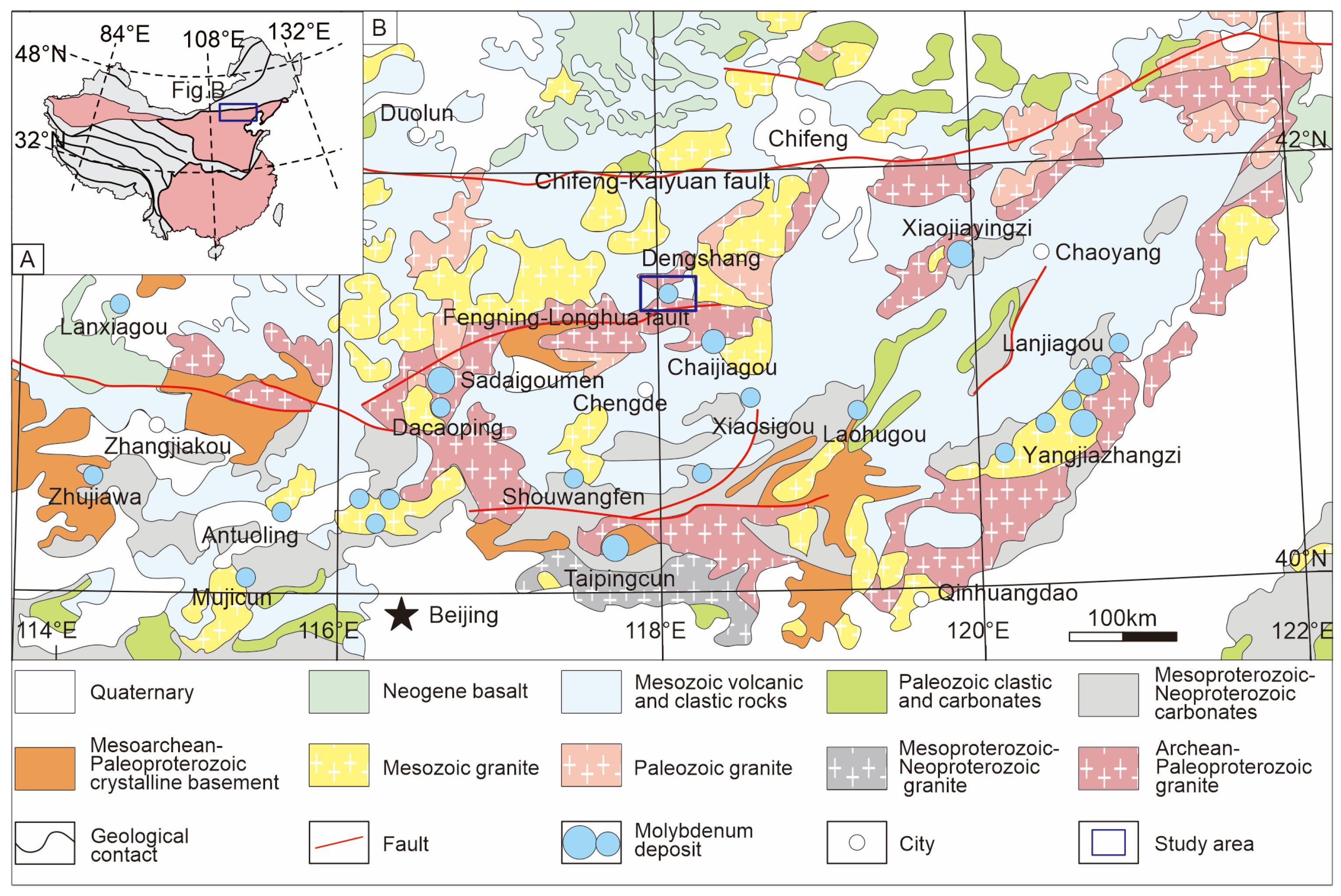
The study area lies within the Yanliao molybdenum metallogenic belt along the northern margin of the North China Craton (Figure 1A) [24]. The exposed strata in the mining district primarily consist of Archean metamorphic rocks, Mesozoic volcanic rocks, clastic rocks, and sedimentary rocks. Quaternary sediments unconformably overlie the metamorphic basement and granite intrusions (Figure 1B) [25]. Magmatic rocks are widely distributed across the area, predominantly intermediate to acidic intrusive rocks, which can be categorized into three main phases [14]. The first phase is the Luliangian phase, comprising mid- to deep-intrusive facies rocks trending east–west. These mainly include biotite diorite, plagiogranite, and granodiorite. These intrusions exhibit varying degrees of migmatization, with local development of gneissic structures. The second phase is the Indosinian phase, characterized by granite intrusions emplaced into Archean migmatized gneiss and migmatite, occurring as deep intrusive stocks. The third phase is the Yanshanian phase, featuring intermediate acidic intrusive rocks, representing the most intense magmatic activity in the region. These intrusions are controlled by E–W trending fault structures and include rhyolite porphyry and quartz porphyry. The structural framework of the region is complex, with widespread development of folds and faults [26]. Major fault systems include the approximately N–S-trending Great Hinggan–Taihangshan fault, the nearly E–W-trending Chifeng–Kangbao–Kaiyuan fault, and the N–E-trending Fengning-Longhua fault [27].
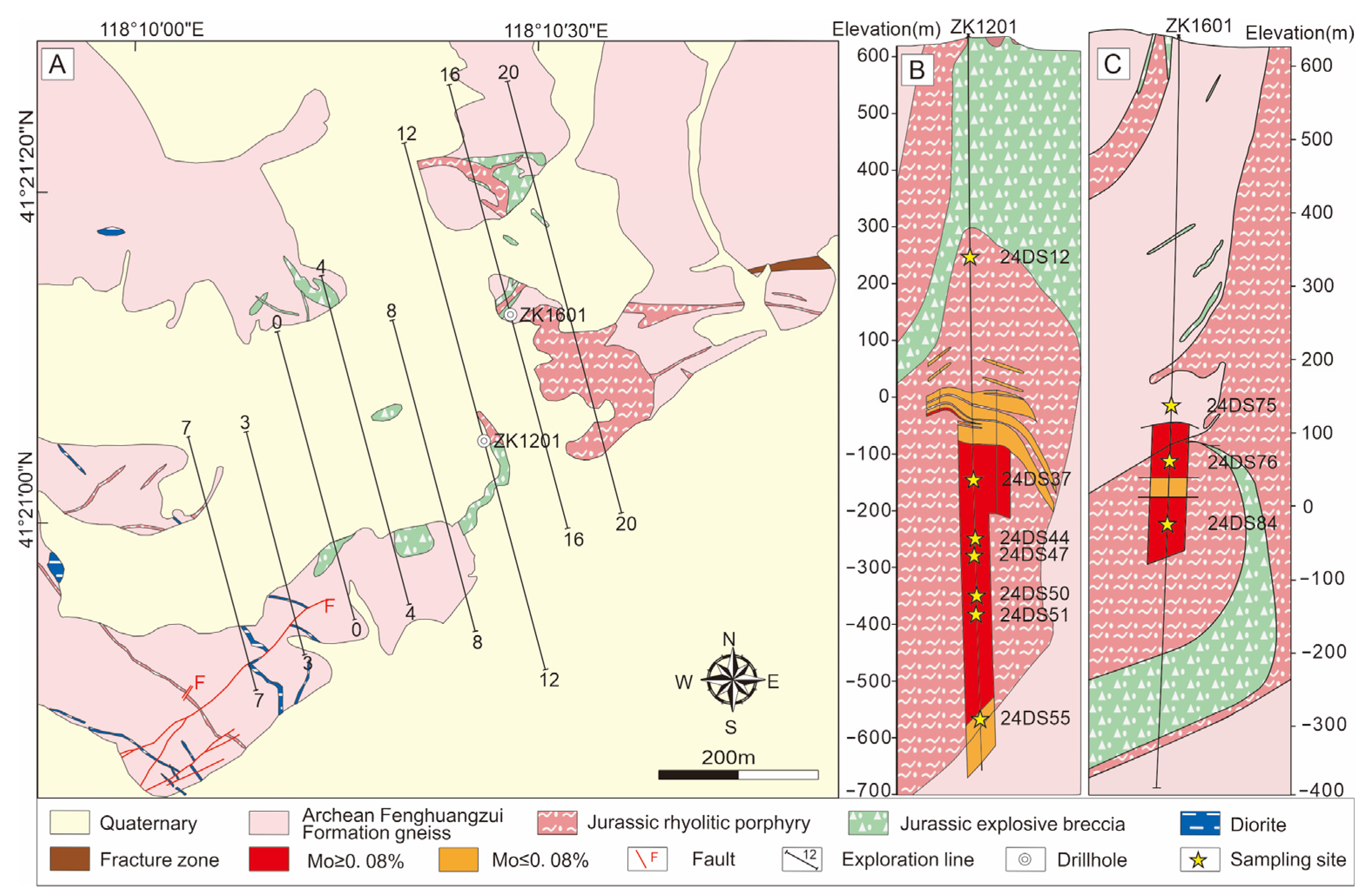
The Dengshang molybdenum deposit is situated in the central segment of the Yanliao molybdenum metallogenic belt, north of the Fengning–Longhua fault. It has an estimated cumulative molybdenum resource of 5108.6 tons, with an average ore grade of 0.106%, indicating favorable exploration potential. The exposed strata in the mining area primarily consist of the Archean biotite–hornblende–plagioclase gneiss of the Fenghuangzui Formation, Dantaizi Group, tuff of the Dabeigou Formation, and Quaternary Holocene slope wash and alluvial–proluvial deposits. The structural activity in the mining area is directly controlled by the Fengning–Longhua fault to the south, resulting in a series of N–E-trending secondary faults and fold structures. Magmatic rocks in the area are dominated by rhyolite porphyry, associated with crypto-explosive breccia, followed by smaller-scale intermediate to acidic dikes (Figure 2A). The molybdenum ore bodies are mainly hosted within the rhyolite porphyry, which has a diagenetic age of 168.3 ± 1.2 Ma [18]. The ore bodies occur as stratiform-like or vein-type structures, with elevations ranging from −100 to −600 m, classifying them as deeply buried concealed deposits (Figure 2B,C). The Dengshang deposit exhibits typical wall rock alteration, primarily including potassic and propylitic alteration. Ore textures are mainly stockwork and veinlet types.

3. Method

3.1. Experimental Instrumentation

This study employed a transmission-mode THz-TDS system (KG-TIS-C-20-S-TA, Daheng New Epoch Technology Corporation, Beijing, China). The system comprised a femtosecond laser, photoconductive antennas, a delay stage control system, and other ancillary equipment. The experiments were conducted at China University of Geosciences (Beijing). The femtosecond laser was a Ti: sapphire laser with a central wavelength of 800 nm, a pulse width of 100 fs, and a repetition rate of 80 MHz [28,29]. The effective spectral range of this laser system is 0.1–3.5 THz, with an average output power of 500 mW. During measurements, the laboratory humidity was maintained below 5%, significantly reducing absorption interference from water vapor [19]. A reference signal was acquired by measuring air (no sample) under identical conditions.
The physical basis of this system lies in the direct detection of the terahertz pulse’s time-domain electric field signal. This signal is then converted into the frequency-domain spectrum via the Fourier transform, allowing for the simultaneous acquisition of both amplitude and phase information, which determines the optical parameters of the measured sample, such as its absorption coefficient and refractive index [28].

3.2. Experimental Principle

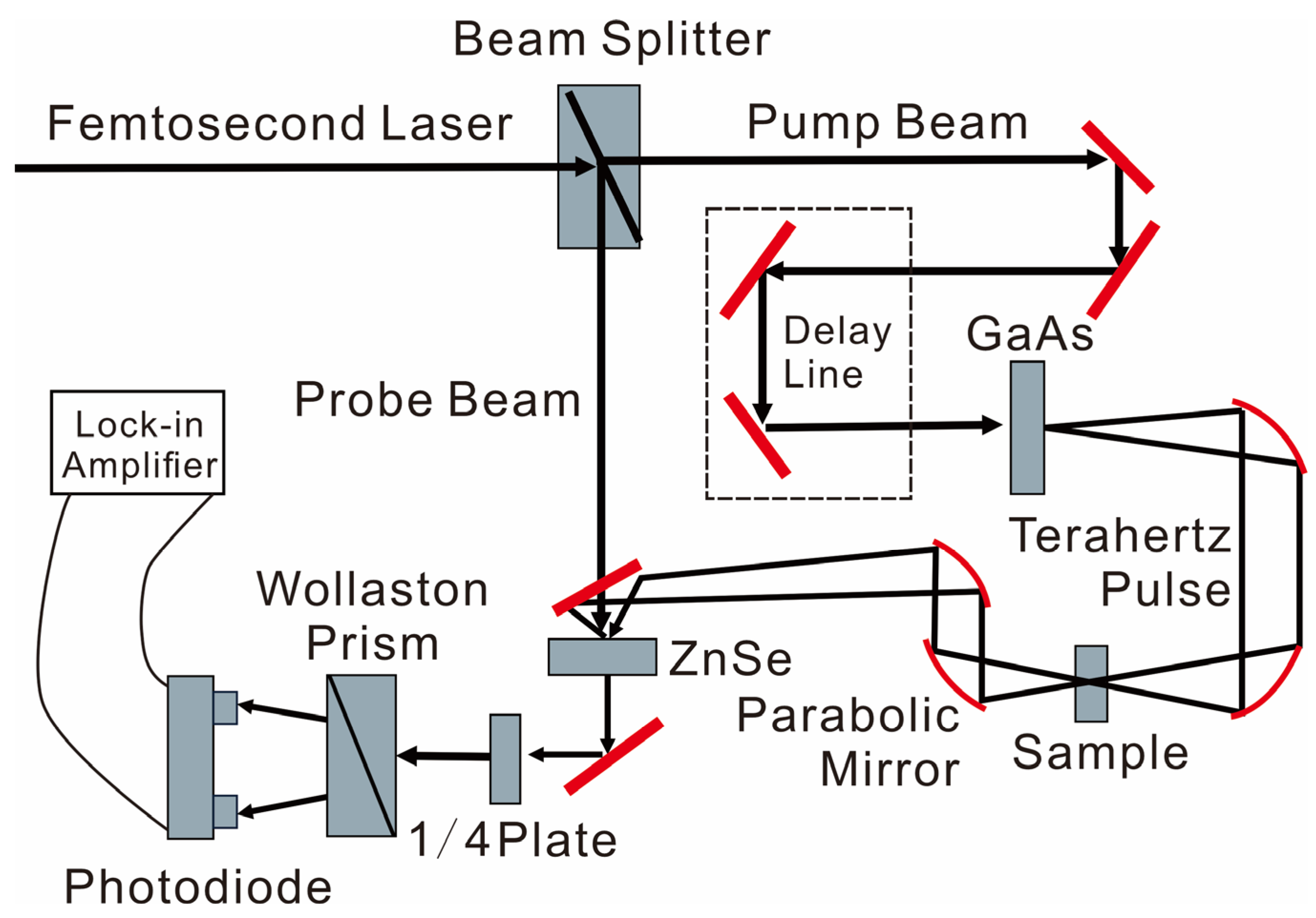
A terahertz time-domain spectrometer consists of a femtosecond laser, a terahertz emitter, a terahertz detector, a delay stage controller, and other components (Figure 3) [30]. The process begins with the femtosecond laser emitting a beam approximately 4 mm in diameter. This beam is split by a beam splitter into two paths. The higher-energy beam, serving as the pump, is directed to the emitter to generate a terahertz electric field pulse. The signal interacts with the sample along the second, lower-energy path, which is controlled by a delay system. When this probe beam reaches the detector, it excites a photocurrent. By adjusting the optical delay line to vary the time difference between the pump and probe pulses, the temporal waveform of the terahertz pulse is scanned. The recorded time-domain data is then subjected to Fourier transform to obtain the frequency-domain spectrum. By comparing the signals with and without the sample, optical properties such as transmittance, refractive index, absorption coefficient, and dielectric constant can be derived [31].
The optical response function of the sample is obtained by comparing the spectra of the reference and sample signals. This function incorporates the refractive index n(ω) and the absorption coefficient α(ω) [30].
n ω = ϕ ( ω ) c ω d + 1
α ω = 2 d l n 4 n ( ω ) A ω [ n ω + 1 ] 2
where ω is the angular frequency; A(ω) is the amplitude ratio of the sample signal to the reference signal; φ(ω) is the phase difference between the sample signal and the reference signal; d is the thickness of the sample; and c is the speed of light in a vacuum [30].

3.3. Sample Selection and Preparation

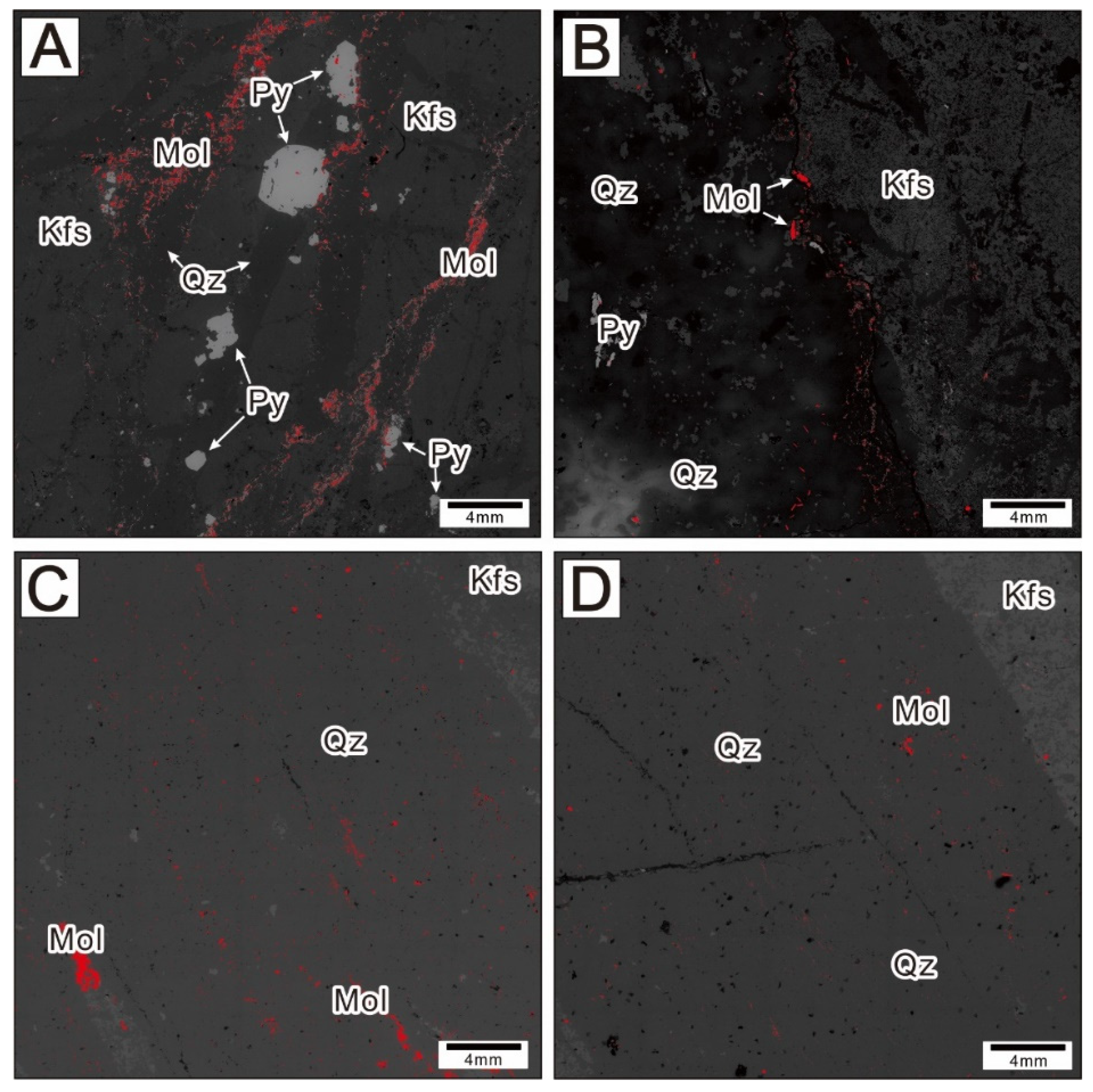
We conducted the THz-TDS analyses on typical altered wall rocks and ore bodies from the Dengshang molybdenum deposit. To precisely characterize the response of different minerals and their assemblages to THz radiation, multiple representative sampling points were selected for comparative analysis. Based on alteration and ore types, the collected samples from the deposit were categorized into three groups: potassic-altered wall rocks, propylitic-altered wall rocks, and molybdenite ores. To preserve and obtain in situ geological information, an in situ measurement method was designed. Geological samples were prepared as polished 20 mm × 35 mm thin sections, each ground to a thickness of approximately 1 mm. The potassic-altered rhyolite porphyry samples were further subdivided into two categories: distal mineralization and proximal mineralization. The propylitic-altered rhyolite porphyry samples were also divided into two types: proximal mineralization and distal mineralization. Backscattered electron (BSE) images of the measurement points were extracted and analyzed using ImageJ software (ImageJ 1.54i). The molybdenite content at each point was quantified, and based on the relative content, the molybdenite ore samples were classified into high molybdenite content, medium molybdenite content, and low molybdenite content (Table 1).

4. Results

4.1. Petrography of Ore and Alteration

The Dengshang molybdenum deposit exhibits typical spatially zoned hydrothermal alteration. The alteration primarily develops within the rhyolite porphyry intrusion and its periphery, progressing from an inner potassic alteration zone to an outer propylitic alteration zone. Additionally, localized occurrences of silicification, sericitization, and argillic alteration are present in the deposit, but these types lack distinct spatial zonation.
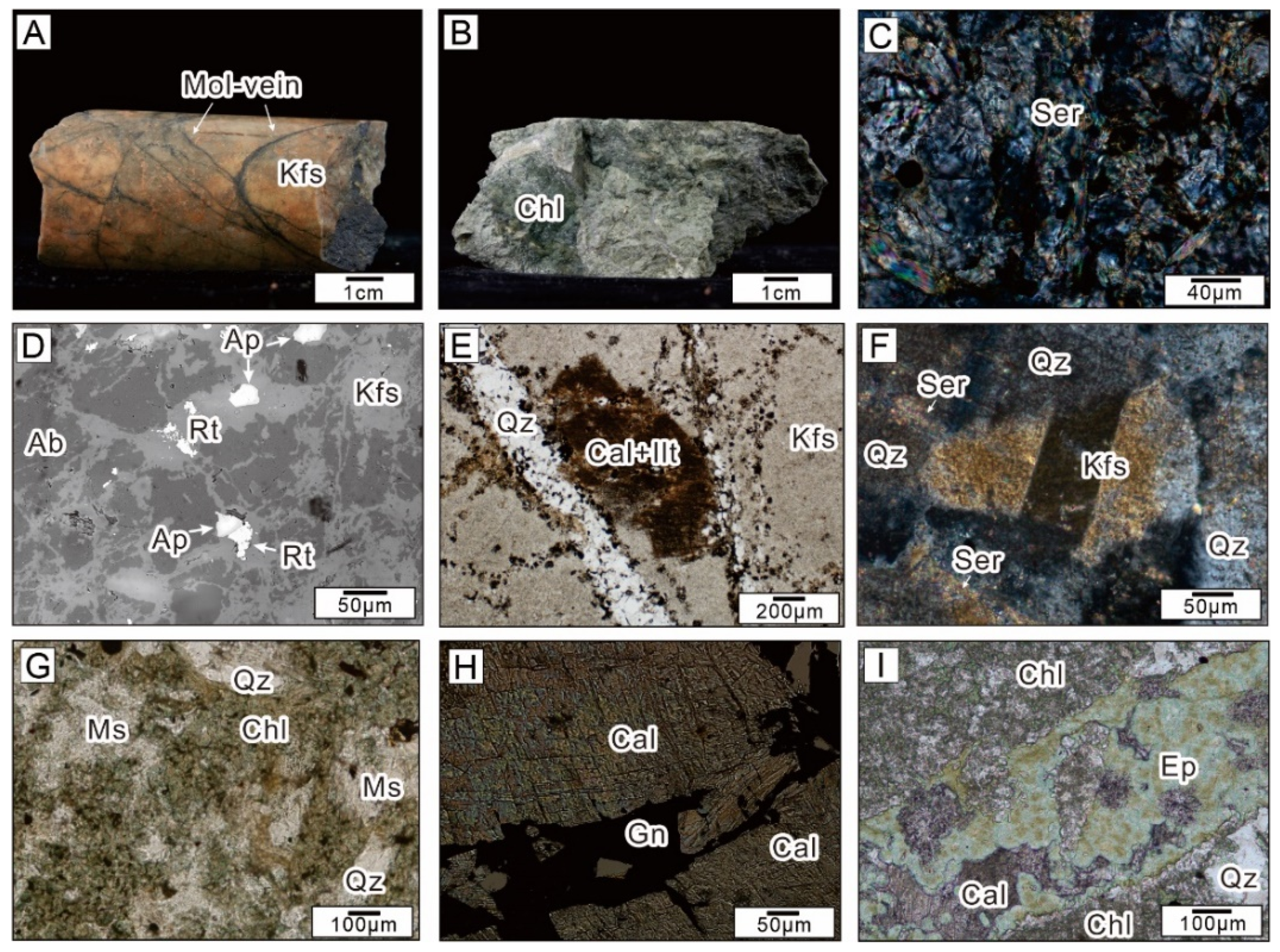
Potassic alteration is predominantly developed within the core of the rhyolite porphyry intrusion. The alteration intensity is generally high, with altered rocks exhibiting a deep red to light red color (Figure 4A). This alteration is characterized by the development of minerals such as potassium feldspar and sericite (Figure 4D–F). Potassic alteration is the hydrothermal alteration type most closely associated with mineralization. Areas of intense potassic alteration typically correspond to higher molybdenum grades. Propylitic alteration is primarily developed in the deep parts and periphery of the rhyolite porphyry intrusion, with minor occurrences also present in its shallow portions. The overall intensity of propylitic alteration is relatively weak, though locally stronger. The altered rocks exhibit a light green color (Figure 4B). The main alteration minerals are chlorite, epidote, and calcite, associated with minerals such as sericite, quartz, and clay minerals (Figure 4G–I).
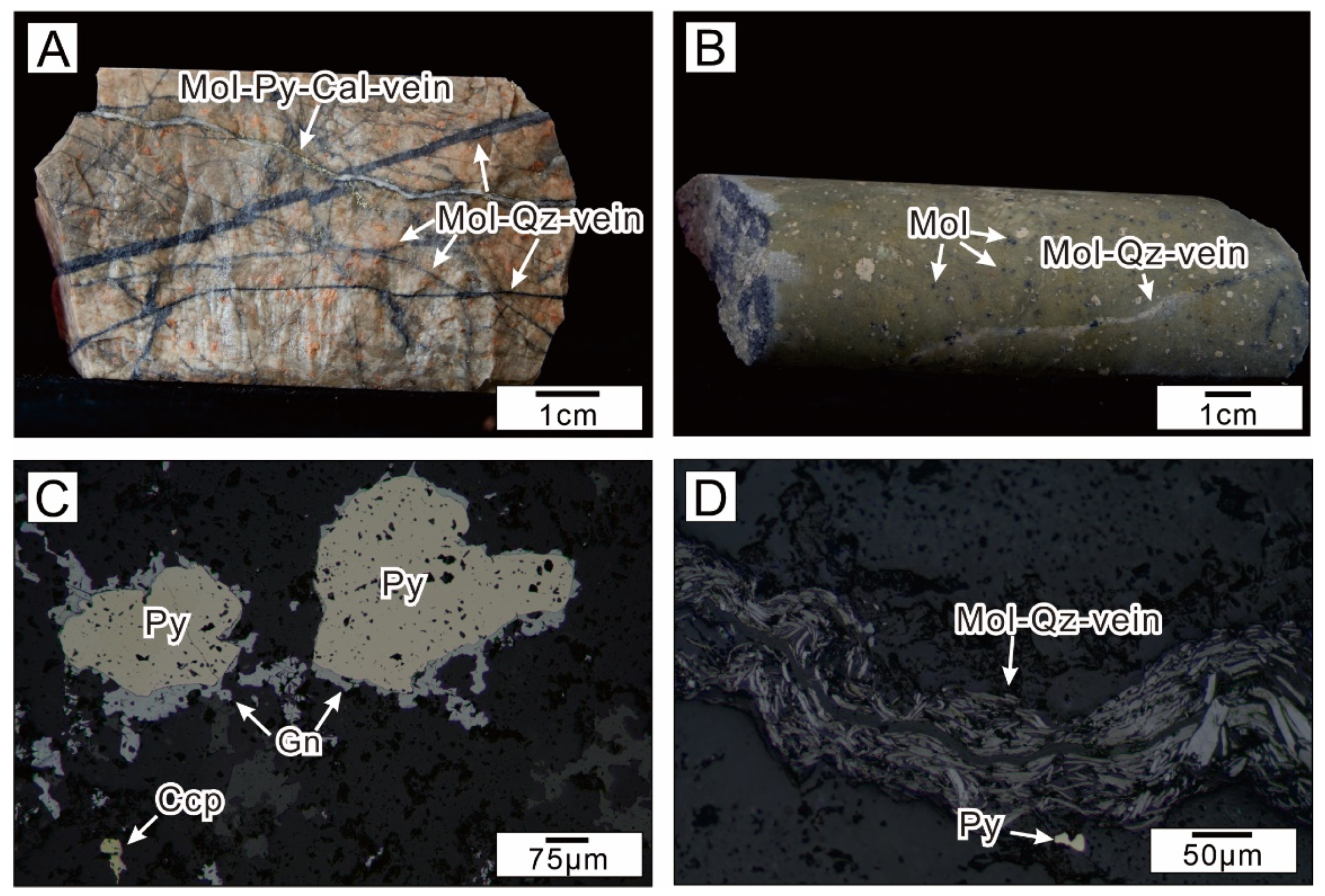
The molybdenum ore bodies in the Dengshang deposit are primarily hosted within the rhyolite porphyry. They predominantly occur as veins, with minor disseminated mineralization (Figure 5A,B). Metallic minerals include molybdenite, pyrite, chalcopyrite, and galena (Figure 5C,D). Non-metallic minerals consist mainly of quartz, albite, potassium feldspar, sericite, and chlorite (Figure 4C–I). The ore exhibits predominantly lepidoblastic to flaky textures and veinlet to stockwork structures (Figure 5D).

4.2. Terahertz Time-Domain Spectroscopy

4.2.1. Potassic Alteration

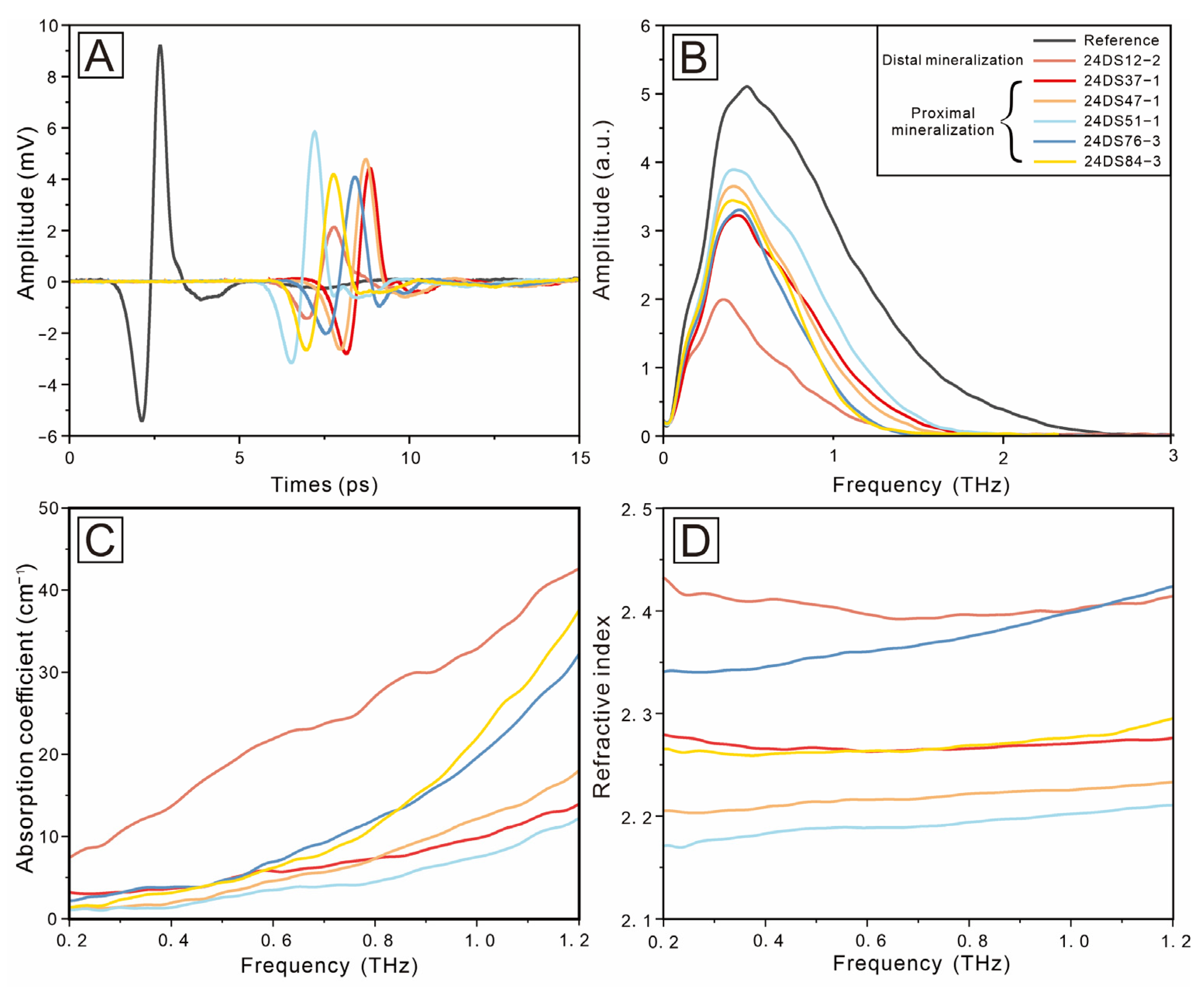
In the time-domain amplitude spectra, the oscillation onset of the potassic-altered rhyolite porphyry exhibits a time delay compared to the reference line, and the oscillation intensity is lower. This is primarily because the refractive index of the rock is greater than that of the air. For samples of equal thickness, the optical path length of the terahertz wave traversing the rock is longer than that through air, resulting in a time delay of the rock’s signal relative to the reference signal. The amplitude attenuation is caused by absorption and reflection losses of the terahertz wave within the rock (Figure 6A). Both the amplitude intensity and width of the potassic-altered rocks are smaller than those of the reference line. Their peak amplitude ranges from 2.025 to 3.917. The distal sample shows the minimum amplitude intensity. The spectral range of the potassic-altered rocks is approximately 0.2–1.2 THz (Figure 6B). Within the 0.2–1.2 THz range, the absorption coefficient for all samples varies from 0.809 to 36.651 cm−1, generally increasing with frequency without distinct peaks. A notable difference occurs at 1.1 THz, where the absorption coefficient of the distal sample is significantly higher than that of the proximal samples (Figure 6C). In the same frequency range, the refractive index of the samples ranges from 2.167 to 2.434, showing minor variation. For most samples, it generally increases with frequency (Figure 6D).

4.2.2. Propylitic Alteration

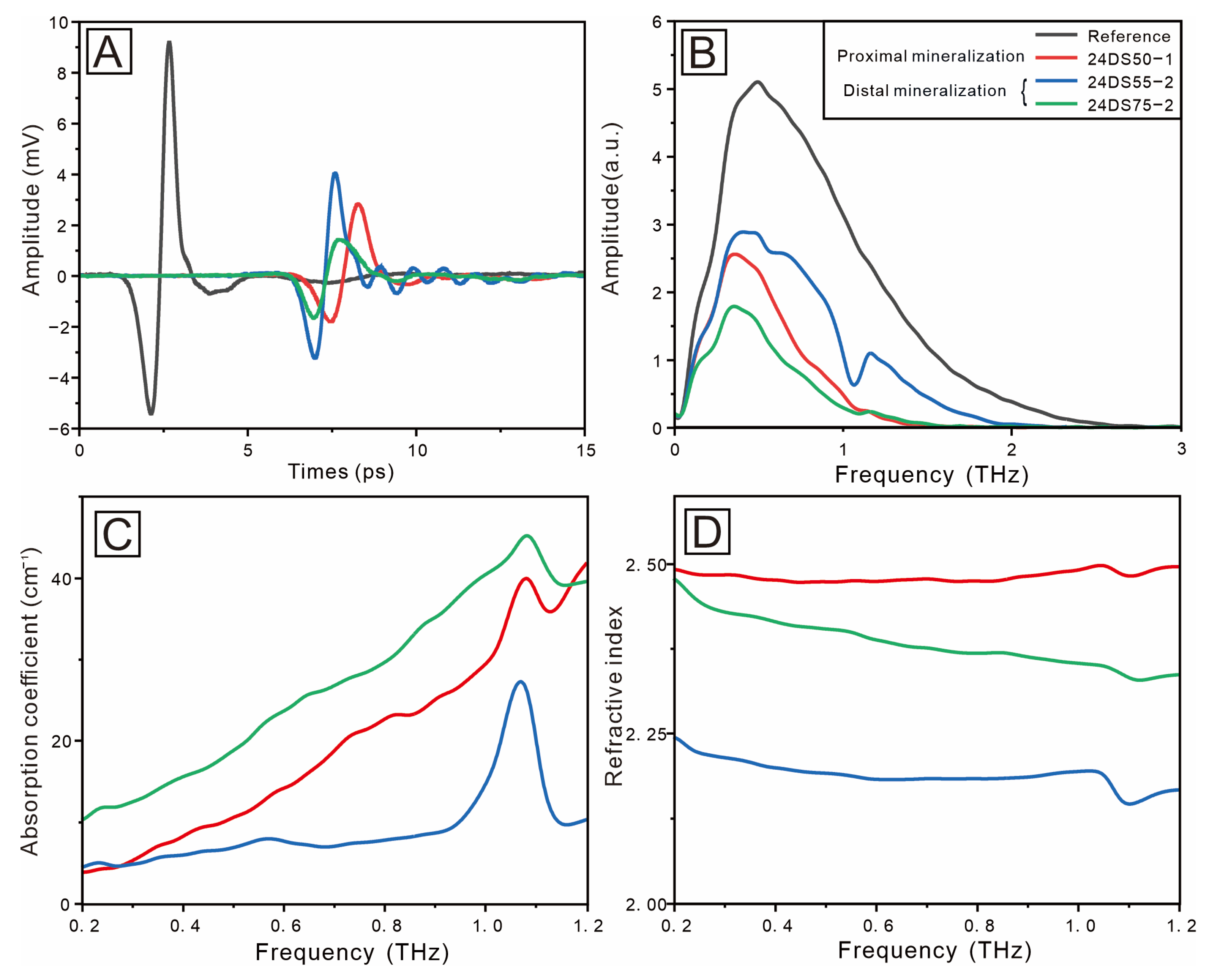
In the time-domain amplitude spectra, compared to the reference line, the propylitically altered wall rocks also exhibit a delayed oscillation onset. This delay is slightly later than that observed in the potassic-altered rocks. Their oscillation intensity is lower than the reference line (Figure 7A). Both the amplitude intensity and width of the propylitically altered rocks are smaller than those of the reference line, with peak amplitude values ranging from 1.828 to 2.901. The spectral range of these rocks is approximately 0.2–1.2 THz. The amplitude spectrum exhibits two peaks: a higher and more variable first peak occurring between 0.3 and 0.5 THz, and a second, lower peak near 1.14 THz (Figure 7B). Within the 0.2–1.2 THz range, the absorption coefficient of the samples varies from 3.694 to 46.593 cm−1. For all samples, the absorption coefficient shows an increasing trend up to approximately 1.07 THz, where it peaks, followed by a decreasing trend (Figure 7C). In the same frequency range, the refractive index of the samples ranges from 2.144 to 2.500. The overall refractive index profile is relatively flat, with a noticeable drop occurring at 1.05 THz. Generally, no significant differences in absorption coefficient or refractive index are observed between the two sample types (Figure 7D).

4.2.3. Molybdenite Ore

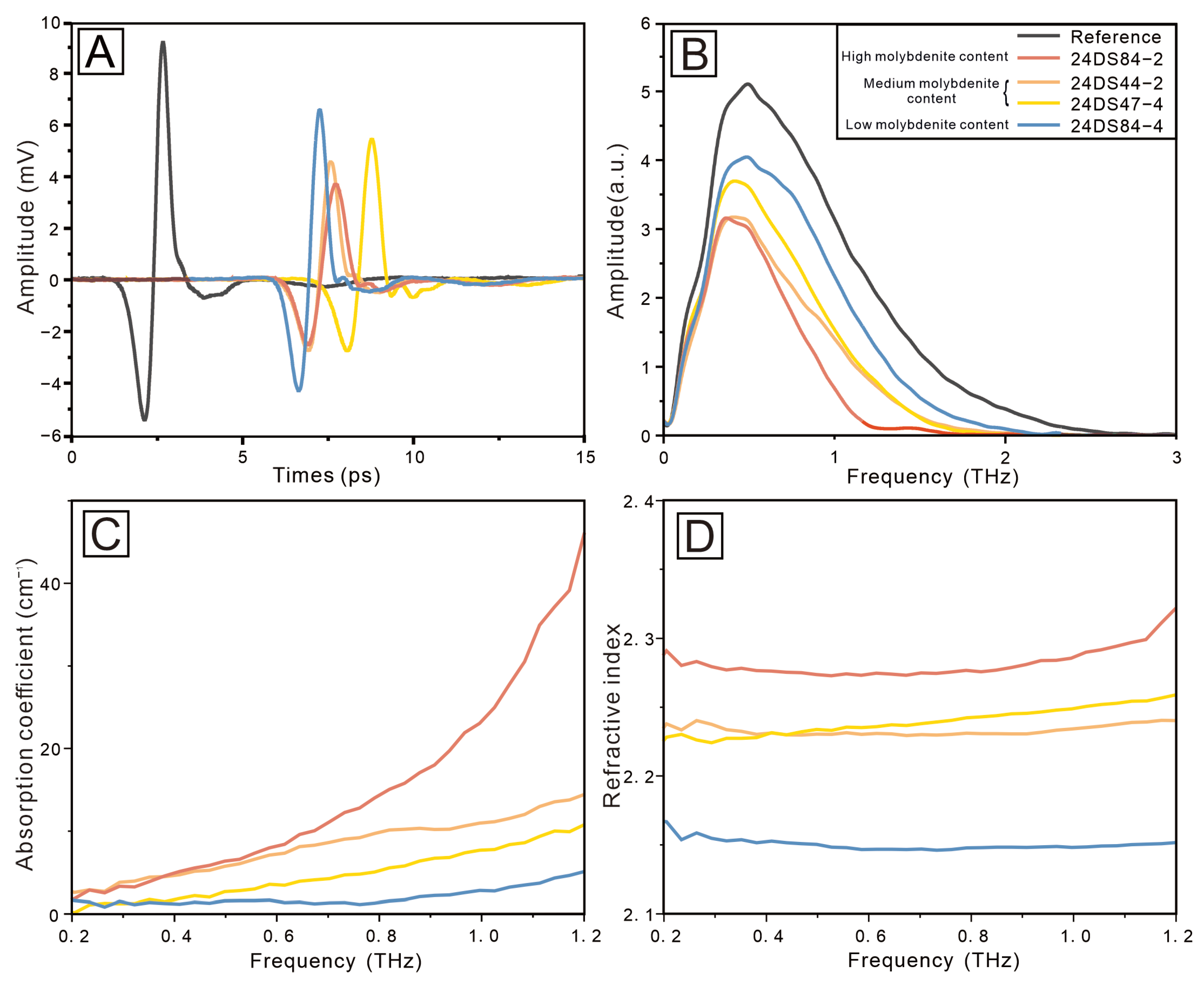
In the time-domain amplitude spectra, compared to the reference line, molybdenite ores also exhibit a delayed oscillation onset. However, this onset occurs earlier than that of the wall rocks. Their oscillation intensity is lower than the reference line but higher than that of the wall rocks. Notably, the lower the ore grade, the higher the oscillation intensity (Figure 8A). The variation in amplitude follows the same trend as the oscillation intensity, with peak amplitude values ranging from 3.187 to 4.084. The spectral range of the molybdenite ores is approximately 0.2–1.2 THz (Figure 8B). Within the 0.2–1.2 THz range, the absorption coefficient of the ores varies from 0.152 to 30.467 cm−1, showing a generally increasing trend without distinct peaks (Figure 8C). In the same frequency range, the refractive index of the samples ranges from 2.146 to 2.294. The overall refractive index profile is relatively flat but displays several specific variations between 0.2 and 0.4 THz (Figure 8D). Both the refractive index and absorption coefficient increase correspondingly with rising molybdenite content.

5. Discussion

Wall rock alteration is the result of interaction between ore-forming fluids and the surrounding rock [32,33]. Its mineral assemblages, chemical compositions, and textural characteristics reflect the nature and evolution of the ore-forming fluids, serving as a crucial guide for mineral exploration [34,35]. The spatial variation in hydrothermal alteration mineral assemblages intuitively reflects changes in the physicochemical conditions during the hydrothermal process [36]. Porphyry deposits often develop zoned alteration halos around the ore body, typically exhibiting, from the hydrothermal conduit outward, potassic, phyllic, and propylitic alteration zones, with local overprinting [6,37]. Exploration methods targeting alteration minerals and zoning primarily include short-wave infrared (SWIR) spectroscopy, thermal infrared (TIR) spectroscopy, and geochemical analysis [38,39,40,41,42]. SWIR spectroscopy can rapidly acquire spectral characteristics of alteration minerals such as calcite, chlorite, and sericite, providing a basis for exploration [43,44]. For example, in the Demingding Cu–Mo deposit, SWIR studies indicate that shorter 2200 nm absorption peak positions (Pos2200) and higher crystallinity (IC values) can point to the hydrothermal center [45]. TIR spectroscopy can identify anhydrous silicate minerals [46] and carbonate minerals [47,48] and is therefore used in exploration [49]. Taking the Jiama porphyry–skarn copper polymetallic deposit in Tibet as an example, a garnet “T” absorption peak (>11,500 nm) > 11,500 nm can indicate skarn copper mineralization [50]. Changes in the chemical composition of minerals during mineralization reflect the evolution of ore-forming fluid composition and provide clues for exploration [51]. Trace elements in quartz from global porphyry systems show that quartz in the ore body center has higher Ti content and relatively lower Li, Al, Ge, As, and Sb contents, effectively indicating mineralization [52].
Terahertz time-domain spectroscopy can detect the types and contents of alteration and ore minerals, representing a novel method for mineral exploration [21,31]. Chlorite, as a low-temperature alteration mineral, exhibits a distinct absorption peak at 1.15 THz, with its refractive index decreasing from 2.52 to 2.43 in this frequency range, which can serve as an identifier for chlorite [22]. As the pyrophyllite content increases from 50% to 70%, the intensity of the absorption peak at 1.10 THz correspondingly strengthens, indicating that THz-TDS can detect variations in pyrophyllite content [22]. Similarly, with increasing pyrite content, its amplitude gradually decreases and the absorption peak time prolongs [53]. Furthermore, THz-TDS can detect the water content in minerals [20,54,55]. For example, the refractive index and absorption coefficient of calcium sulfate (CaSO4) and plagioclase in the terahertz band increase with higher water content [31]. These findings demonstrate that THz-TDS exhibits spectral differences among various minerals, providing a basis for identifying alteration zoning and indicating the ore body center.
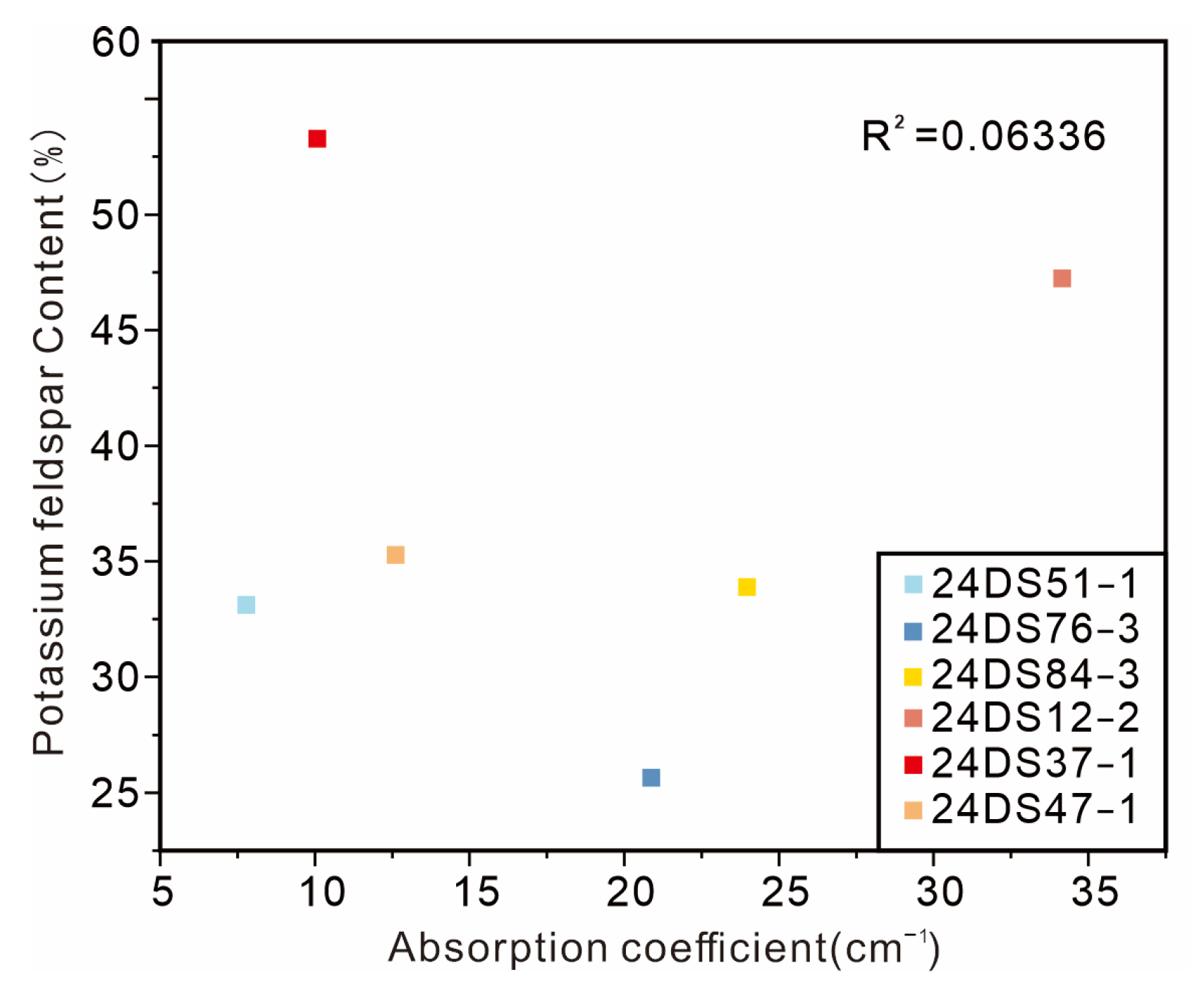
The Dengshang molybdenite deposit exhibits typical alteration zoning spatially. From the intrusive center outward, a potassic zone and a propylitic zone are developed sequentially, with local overprinting of silicification, phyllic alteration, and argillic alteration. Within the potassic alteration zone, differences exist in the THz spectral characteristics between distal and proximal rhyolite porphyry samples. Distal rhyolite porphyry samples show higher absorption coefficients and refractive indices, while proximal samples exhibit lower absorption coefficients and refractive indices, with relatively higher amplitude intensity. This may be related to changes in the morphology and texture of potassium feldspar. Potassium feldspar in the distal zone is well-crystallized, mostly euhedral, and has a larger grain size (Figure 4F). In contrast, potassium feldspar near the ore body and within it is highly fragmented, mostly subhedral to anhedral, and has a smaller grain size (Figure 4E). Additionally, the analysis of backscattered electron images using ImageJ (Figure 9) reveals a low correlation coefficient (R2 = 0.06336) between the absorption coefficient at 1.02 THz and potassium feldspar content [56,57]. Despite the limited sample size, this suggests no significant correlation. Therefore, the differences in THz spectral characteristics of potassic rhyolite porphyry samples are primarily controlled by the morphology and texture of potassium feldspar, rather than its content.
Hydrothermal alteration not only modifies the morphology and texture of potassium feldspar but also changes its water content. Compared to proximal rhyolite porphyry samples, the distal ones exhibit significantly higher absorption coefficients and refractive indices, indicating higher water content in the distal potassic rhyolite porphyry samples [20,58]. The ore body area is the center of ore-forming fluid migration and precipitation, where intense water–rock interaction occurs [59,60,61,62]. Hydrothermal alteration not only causes changes in the mineral composition of wall rocks but also involves variations in physicochemical conditions (temperature, pressure, pH, fluid salinity, etc.), leading to fragmentation, dissolution, and recrystallization of primary minerals, resulting in potassium feldspar with poor crystallinity and small grain size [63,64,65,66,67]. Hydrothermal alteration processes can lead to reduced mineral crystallinity and the development of microfractures [68,69]. These microtextural changes affect the scattering and non-resonant absorption of terahertz waves, thereby causing a decrease in the absorption coefficient and refractive index. The spectral variations in potassic rhyolite porphyry samples in the terahertz band reflect the evolution of mineral composition and rock texture from the ore body to the surrounding rock, providing a basis for identifying the intensity of potassic alteration and, consequently, estimating the relative distance to the ore body center using THz-TDS.
Propylitic rhyolite porphyry samples exhibit distinctive THz-TDS response characteristics, characterized by a bimodal structure in the frequency-domain amplitude spectrum, an obvious peak in the absorption coefficient near 1.07 THz, and a marked decrease in the refractive index at around 1.05 THz (Figure 7). These features effectively distinguish propylitic alteration from other types, thus aiding in the identification and delineation of propylitic alteration zones. This characteristic is related to the terahertz spectral features of typical alteration minerals in propylitic rocks, such as chlorite. Chlorite shows a distinct absorption peak near 1.1 THz, closely associated with lattice resonance; within this frequency range, its refractive index shows a significant decrease, indicating anomalous dispersion that retards the propagation of high-frequency light [22]. Propylitic alteration is a medium-to-low temperature hydrothermal alteration [70,71]. In porphyry deposits, it primarily develops on the periphery of the ore body, marking the boundary area of ore distribution. Therefore, the identification and delineation of propylitic rhyolite porphyry samples using THz spectroscopy can indirectly constrain the ore body boundary and further narrow down exploration targets.
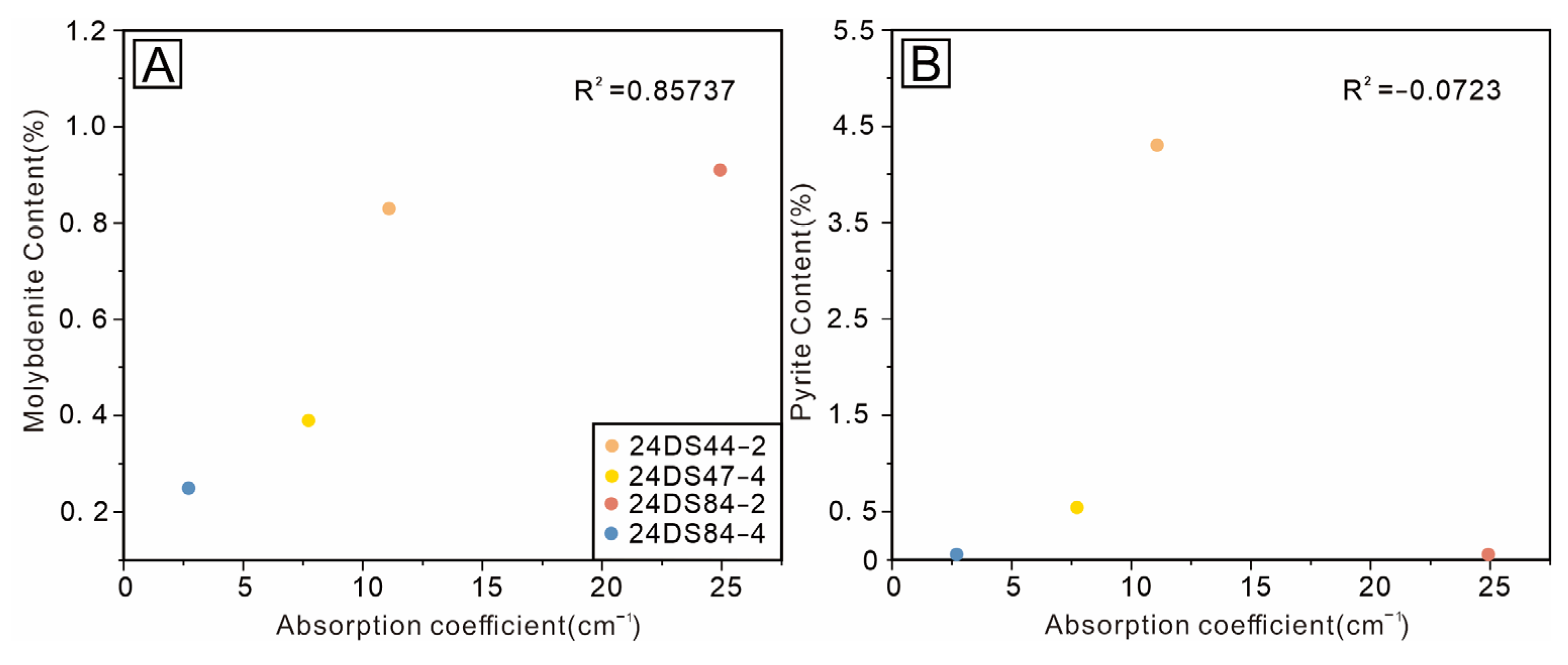
Compared to altered wall rocks, molybdenite ore exhibits earlier time-domain oscillations, higher amplitude intensity, and several specific variations in refractive index within the 0.2–0.4 THz range. The correlation analysis between molybdenite content and the absorption coefficient at 1.02 THz, processed and analyzed using ImageJ (Figure 10), shows a clear linear relationship. As molybdenite content increases, the amplitude of the THz time-domain spectrum decreases, while the absorption coefficient and refractive index increase. The correlation coefficient between molybdenite content and the absorption coefficient at 1.02 THz is 0.85737 (Figure 11A), indicating a positive correlation. This phenomenon may be related to the semiconducting properties of molybdenite and its layered crystal structure [72]. The dielectric response exhibited by molybdenite in the terahertz band is attributed to free carrier absorption and interfacial polarization effects resulting from its high electrical conductivity. As the molybdenite content in the ore increases, the ore’s electrical conductivity rises, enhancing the energy attenuation of terahertz waves during transmission, which macroscopically manifests as an increased absorption coefficient. Concurrently, the increase in refractive index is closely related to molybdenite’s high dielectric constant, reflecting its enhanced retarding effect on the velocity of terahertz waves [73,74]. Pyrite content in the ore was analyzed using ImageJ software, yielding a correlation coefficient of −0.0723 with the absorption coefficient at 1.02 THz (Figure 11B). This result indicates that, in this study, pyrite content has a minor effect on the terahertz analysis and measurements, whereas molybdenite content is the dominant factor influencing the terahertz spectral response. Furthermore, the refractive index exhibits distinct inflection points at 0.205 THz, 0.23 THz, 0.26 THz, and 0.32 THz, but without a consistent trend. This variation may be related to the signal-to-noise ratio of the terahertz time-domain spectroscopy measurements. In summary, THz-TDS analysis can not only efficiently identify molybdenite and distinguish mineralized from unmineralized rocks but also reflect mineralization intensity and evaluate ore grade. This provides a basis for rapid drill core logging, ore grade estimation, and deep exploration potential assessment.

6. Conclusions

In the Dengshang molybdenum deposit, wall rock alteration is primarily developed within the rhyolite porphyry and its periphery. From the inner to outer parts, a potassic zone and a propylitic zone are developed, with local occurrences of silicification, phyllic alteration, and argillic alteration. The trends of increasing amplitude, decreasing absorption coefficient, and decreasing refractive index from distal to proximal potassic wall rocks indicate that the THz spectral characteristics of potassic alteration are controlled by the morphology and texture of potassium feldspar and the alteration intensity, serving as a viable prospecting indicator. Propylitic wall rocks exhibit two distinct peaks in amplitude within the 0–2 THz range, an absorption coefficient peak near 1.07 THz and a rapid decline in refractive index at around 1.05 THz. These features can serve as indicators for identifying peripheral alteration zones of the ore body. Molybdenite content in molybdenite ore shows a negative correlation with THz amplitude and a positive correlation with both absorption coefficient and refractive index, effectively indicating the location and intensity of mineralization. This study demonstrates that THz-TDS can effectively identify different types of altered wall rocks and ore in the Dengshang molybdenum deposit, providing technical support for delineating alteration zoning in porphyry molybdenum deposits, locating ore bodies, and conducting deep mineral exploration.

Supplementary Materials

The following supporting information can be downloaded at: https://www.mdpi.com/article/10.3390/geosciences16050187/s1, Table S1: Amplitude, absorption coefficients and refractive index data of transmission terahertz time-domain spectra analysis for potassic alteration samples; Table S2: Amplitude, absorption coefficients and refractive index data of transmission terahertz time-domain spectra analysis for propylitic alteration samples; Table S3: Amplitude, absorption coefficients and refractive index data of transmission terahertz time-domain spectra analysis for molybdenite samples.

Author Contributions

Conceptualization and writing, X.-X.L. and S.-S.L.; methodology, Z.-Y.Z. and H.-C.H.; investigation, X.-X.L., J.-H.Z., Z.-E.T., Q.-F.M. and Z.-H.P.; review and editing, S.-S.L., M.T. and Z.-Y.Z.; funding acquisition, S.-S.L., K.-F.Q. and Q.-F.M.; data curation, X.-X.L., Z.-E.T. and C.-X.L. All authors have read and agreed to the published version of the manuscript.

Funding

This research was funded by Talent Cultivation Fund from North China Center for Geoscience Innovation of China Geological Survey (2024HBPJ-G03), Hebei Bureau of Geology and Mineral Resources Exploration (No. 13000025P003294103391), Young Elite Scientists Sponsorship Program of BAST (BYESS2024122), and the Fundamental Research Funds for the Central Universities (2-9-2023-055).

Data Availability Statement

All data supporting this study are contained within the article and its Supplementary Materials.

Acknowledgments

We sincerely appreciate the editors, for their editorial handling of our manuscript. We also extend our gratitude to three reviewers for their critical, thorough, and highly constructive reviews, which significantly improved the quality of the manuscript. Sincere thanks to Hao-Cheng Yu for his invaluable guidance. Special thanks to Hong-tao Wen for his guidance on image processing and to Xian-fa Xue, Jia-dong Ma, Zi-yue Gao, Chang Fan, and Yi-zi Zou for their support and assistance in manuscript preparation. Thanks to Jia-nan Fu, Lian Zhang, and Jie Wang for their help in revising the manuscript.

Conflicts of Interest

The authors declare no conflicts of interest.

References

  1. Deng, J.; Wang, Q. Gold mineralization in China: Metallogenic provinces, deposit types and tectonic framework. Gondwana Res. 2016, 36, 219–274. [Google Scholar] [CrossRef]
  2. Halter, W.E.; Pettke, T.; Heinrich, C.A. The origin of Cu/Au ratios in porphyry-type ore deposits. Science 2002, 296, 1844–1846. [Google Scholar] [CrossRef]
  3. Sinclair, W. Porphyry deposits. In Mineral Deposits of Canada: A Synthesis of Major Deposit-Types, District Metallogeny, the Evolution of Geological Provinces, and Exploration Methods; Special Publication; Geological Association of Canada, Mineral Deposits Division: St. John’s, NL, USA, 2007; Volume 5, pp. 223–243. [Google Scholar]
  4. Eliopoulos, D.G.; Economou-Eliopoulos, M.; Zelyaskova-Panayiotova, M. Critical Factors Controlling Pd and Pt Potential in Porphyry Cu–Au Deposits: Evidence from the Balkan Peninsula. Geosciences 2014, 4, 31–49. [Google Scholar] [CrossRef]
  5. Sillitoe, R.H. Porphyry copper systems. Econ. Geol. 2010, 105, 3–41. [Google Scholar] [CrossRef]
  6. Lowell, J.D.; Guilbert, J.M. Lateral and vertical alteration-mineralization zoning in porphyry ore deposits. Econ. Geol. 1970, 65, 373–408. [Google Scholar] [CrossRef]
  7. Gustafson, L.B.; Hunt, J.P. The porphyry copper deposit at El Salvador, Chile. Econ. Geol. 1975, 70, 857–912. [Google Scholar] [CrossRef]
  8. Seedorff, E.; Dilles, J.H.; Proffett, J.M.; Einaudi, M.T.; Zurcher, L.; Stavast, W.J.; Johnson, D.A.; Barton, M.D. Porphyry deposits: Characteristics and origin of hypogene features. In Economic Geology: One Hundredth Anniversary Volume, 1905–2005; Society of Economic Geologists, Inc.: Littleton, CO, USA, 2005. [Google Scholar]
  9. Qiu, K.-F.; Romer, R.L.; Long, Z.-Y.; Yu, H.-C.; Turner, S.; Wan, R.-Q.; Li, X.-Q.; Gao, Z.-Y.; Deng, J. Potassium isotopes as a tracer of hydrothermal alteration in ore systems. Geochim. Cosmochim. Acta 2024, 368, 185–196. [Google Scholar] [CrossRef]
  10. Launay, G.; Sizaret, S.; Guillou-Frottier, L.; Gloaguen, E.; Pinto, F. Deciphering fluid flow at the magmatic-hydrothermal transition: A case study from the world-class Panasqueira W–Sn–(Cu) ore deposit (Portugal). Earth Planet. Sci. Lett. 2018, 499, 1–12. [Google Scholar] [CrossRef]
  11. Ulrich, T.; Heinrich, C.A. Geology and alteration geochemistry of the porphyry Cu-Au deposit at Bajo de la Alumbrera, Argentina. Econ. Geol. 2001, 96, 1719–1742. [Google Scholar] [CrossRef]
  12. Fu, Z.; Song, Y.; Lu, Y. Ore-controlling geology condition and prospecting information of Donggou Mo deposit in Ruyang, Henan Province. Geophys. Prospect. 2006, 42, 33–38. [Google Scholar]
  13. Chen, P.; Zeng, Q.; Zhou, T. Petrogenesis and Mo prospecting significance of Sadaigoumen granites on the northern margin of the North China Craton. J. Geochem. Explor. 2020, 214, 106536. [Google Scholar] [CrossRef]
  14. Dai, J.; Mao, J.; Zhao, C.; Xie, G.; Yang, F.; Wang, Y. New U–Pb and Re–Os age data and the geodynamic setting of the Xiaojiayingzi Mo (Fe) deposit, western Liaoning province, Northeastern China. Ore Geol. Rev. 2009, 35, 235–244. [Google Scholar] [CrossRef]
  15. Li, S.-S.; Santosh, M.; Cen, K.; Teng, X.-M.; He, X.-F. Neoarchean convergent margin tectonics associated with microblock amalgamation in the North China Craton: Evidence from the Yishui Complex. Gondwana Res. 2016, 38, 113–131. [Google Scholar] [CrossRef]
  16. Li, S.-S.; Palin, R.M.; Santosh, M. Contrasting mechanisms and timescales of subduction and exhumation as recorded by Paleoproterozoic and late Paleozoic high-pressure granulites in the North China Craton. Geol. Soc. Am. Bull. 2023, 135, 29–47. [Google Scholar] [CrossRef]
  17. Sun, Z.; Wang, Z.; Yu, H.; Yu, X.; Liu, G.; Wang, C. Geochronology, geochemistry, and Hf Isotope of the granites from the Mo deposits in Fengning region, China: Implications for tectonic evolution and mineralization of the North China Craton. Arab. J. Geosci. 2019, 12, 434. [Google Scholar] [CrossRef]
  18. Zhou, J.-H.; Ju, N.; Miao, Q.-F.; Teng, Z.-E.; Wang, X.-D.; Li, X.-X.; Li, M.-L.; Liu, S.-M. Petrogenesis of Rhyolitic Porphyry Hosting the Newly Discovered Dengshang Mo Deposit, Northern Hebei Province. Minerals 2026, 16, 249. [Google Scholar] [CrossRef]
  19. Huang, H.; Wang, D.; Li, W.; Rong, L.; Taylor, Z.D.; Deng, Q.; Li, B.; Wang, Y.; Wu, W.; Panezai, S. Continuous-wave terahertz multi-plane in-line digital holography. Opt. Lasers Eng. 2017, 94, 76–81. [Google Scholar] [CrossRef]
  20. Li, S.S.; Qiu, K.F.; Hernández-Uribe, D.; Gao, Y.X.; Santosh, M.; Huang, H.C.; Zheng, Z.Y.; Zhang, Z.L.; Gao, S.C. Water Recycling in the Deep Earth: Insights From Integrated μ-XRF, THz-TDS Spectroscopy, TG, and DCS of High-Pressure Granulite. J. Geophys. Res. Solid Earth 2023, 128, e2022JB025915. [Google Scholar] [CrossRef]
  21. Huang, H.; Liu, Z.; Ruggiero, M.T.; Zheng, Z.; Qiu, K.; Li, S.; Zhang, Z.; Zhang, Z. Terahertz geoscience: THz time-domain spectroscopy for mineral materials. Cryst. Growth Des. 2025, 25, 3578–3594. [Google Scholar] [CrossRef]
  22. Huang, H.; Li, X.; Zheng, Z.; Fan, H.; Liu, C.; Yuan, E.; Gu, J.; Ma, Y.; Xu, Q.; Panezai, S. Holographic characterization of typical silicate minerals by terahertz time-domain spectroscopy. Appl. Clay Sci. 2025, 267, 107720. [Google Scholar] [CrossRef]
  23. Huang, H.; Huang, H.; Zheng, Z.; Gao, L. Insights into infrared crystal phase characteristics based on deep learning holography with attention residual network. J. Mater. Chem. A 2025, 13, 6009–6019. [Google Scholar] [CrossRef]
  24. Zhang, S.-H.; Zhao, Y.; Li, X.-H.; Ernst, R.E.; Yang, Z.-Y. The 1.33–1.30 Ga Yanliao large igneous province in the North China Craton: Implications for reconstruction of the Nuna (Columbia) supercontinent, and specifically with the North Australian Craton. Earth Planet. Sci. Lett. 2017, 465, 112–125. [Google Scholar] [CrossRef]
  25. Wu, G.; Li, X.; Xu, L.; Wang, G.; Liu, J.; Zhang, T.; Quan, Z.; Wu, H.; Li, T.; Zeng, Q. Age, geochemistry, and Sr–Nd–Hf–Pb isotopes of the Caosiyao porphyry Mo deposit in Inner Mongolia, China. Ore Geol. Rev. 2017, 81, 706–727. [Google Scholar] [CrossRef]
  26. Wang, W.; Liu, S.; Santosh, M.; Deng, Z.; Guo, B.; Zhao, Y.; Zhang, S.; Yang, P.; Bai, X.; Guo, R. Late Paleoproterozoic geodynamics of the North China Craton: Geochemical and zircon U–Pb–Hf records from a volcanic suite in the Yanliao rift. Gondwana Res. 2015, 27, 300–325. [Google Scholar] [CrossRef]
  27. Chen, P.; Zeng, Q.; Zhou, L.; Zhou, T. Fluid inclusion evidence for hydrothermal evolution of the Sadaigoumen porphyry Mo deposit on the northern margin of the north China Craton. Ore Geol. Rev. 2021, 134, 104145. [Google Scholar] [CrossRef]
  28. Huang, H.; Wang, D.; Rong, L.; Panezai, S.; Zhang, D.; Qiu, P.; Gao, L.; Gao, H.; Zheng, H.; Zheng, Z. Continuous-wave off-axis and in-line terahertz digital holography with phase unwrapping and phase autofocusing. Opt. Commun. 2018, 426, 612–622. [Google Scholar] [CrossRef]
  29. Zhang, T.; Zheng, Z.; Zhang, M.; Gao, C.; Li, S.; Huang, H.; Qiu, Q.; Zhang, Z.; Qiu, K. Quantitative analysis of CeO2-associated mineral composites based on terahertz time-domain spectroscopy technology. J. Opt. Soc. Am. B 2025, 42, 2842–2848. [Google Scholar] [CrossRef]
  30. Cheng, H.; Huang, H.-c.; Yang, M.-f.; Yang, M.-h.; Yan, H.; Panezai, S.; Zheng, Z.-Y.; Zhang, Z.; Zhang, Z.-l. Characterization of the remediation of chromium ion contamination with bentonite by terahertz time-domain spectroscopy. Sci. Rep. 2022, 12, 11149. [Google Scholar] [CrossRef]
  31. Huang, R.; Zheng, Z.; Gao, C.; Zhang, T.; Zhang, M.; Li, S.; Huang, H.; Qiu, K. Effect of crystal-water on the optical and dielectric characteristics of calcium sulfate in the THz band. Opt. Express 2024, 32, 13552–13561. [Google Scholar] [CrossRef]
  32. Muntean, J.L.; Einaudi, M.T. Porphyry gold deposits of the Refugio district, Maricunga belt, northern Chile. Econ. Geol. 2000, 95, 1445–1472. [Google Scholar] [CrossRef]
  33. Schwartz, G.M. Hydrothermal alteration. Econ. Geol. 1959, 54, 161–183. [Google Scholar] [CrossRef]
  34. Kerrich, R.; Goldfarb, R.; Groves, D.; Garwin, S.; Jia, Y. The characteristics, origins, and geodynamic settings of supergiant gold metallogenic provinces. Sci. China Ser. D Earth Sci. 2000, 43, 1–68. [Google Scholar] [CrossRef]
  35. Hemley, J.J.; Jones, W. Chemical aspects of hydrothermal alteration with emphasis on hydrogen metasomatism. Econ. Geol. 1964, 59, 538–569. [Google Scholar] [CrossRef]
  36. Richards, J. Tectono-magmatic precursors for porphyry Cu-(Mo-Au) deposit formation. Econ. Geol. 2003, 98, 1515–1533. [Google Scholar] [CrossRef]
  37. Sillitoe, R.H. The tops and bottoms of porphyry copper deposits. Econ. Geol. 1973, 68, 799–815. [Google Scholar] [CrossRef]
  38. Halley, S.; Dilles, J.H.; Tosdal, R.M. Footprints: Hydrothermal alteration and geochemical dispersion around porphyry copper deposits. SEG Newsl. 2015, 100, 1–17. [Google Scholar] [CrossRef]
  39. Warren, I.; Simmons, S.F.; Mauk, J.L. Whole-rock geochemical techniques for evaluating hydrothermal alteration, mass changes, and compositional gradients associated with epithermal Au-Ag mineralization. Econ. Geol. 2007, 102, 923–948. [Google Scholar] [CrossRef]
  40. Di Tommaso, I.; Rubinstein, N. Hydrothermal alteration mapping using ASTER data in the Infiernillo porphyry deposit, Argentina. Ore Geol. Rev. 2007, 32, 275–290. [Google Scholar] [CrossRef]
  41. Ferrier, G.; Naden, J.; Ganas, A.; Kemp, S.; Pope, R. Identification of Multi-Style Hydrothermal Alteration Using Integrated Compositional and Topographic Remote Sensing Datasets. Geosciences 2016, 6, 36. [Google Scholar] [CrossRef]
  42. Tanaka, S.; Tsuru, H.; Someno, K.; Yamaguchi, Y. Identification of Alteration Minerals from Unstable Reflectance Spectra Using a Deep Learning Method. Geosciences 2019, 9, 195. [Google Scholar] [CrossRef]
  43. Zhou, Y.; Wang, T.; Fan, F.; Chen, S.; Guo, W.; Xing, G.; Sun, J.; Xiao, F. Advances on Exploration Indicators of Mineral VNIR-SWIR Spectroscopy and Chemistry: A Review. Minerals 2022, 12, 958. [Google Scholar] [CrossRef]
  44. Xu, Q.-J.; Ye, F.-W.; Liu, S.-F.; Zhang, Z.-X.; Zhang, C. Hyperspectral Alteration Information from Drill Cores and Deep Uranium Exploration in the Baiyanghe Uranium Deposit in the Xuemisitan Area, Xinjiang, China. Remote Sens. 2017, 9, 451. [Google Scholar] [CrossRef]
  45. Ren, H.; Zheng, Y.; Wu, S.; Wang, D.; Zuo, L.; Chen, L.; Gao, F.; Wei, J.; Wang, S.; Shu, D. Short-wavelength infrared characteristics and composition of white mica in the Demingding porphyry Cu-Mo deposit, Gangdese belt, Tibet: Implications for mineral exploration. Ore Geol. Rev. 2024, 164, 105833. [Google Scholar] [CrossRef]
  46. Christensen, P.R.; Bandfield, J.L.; Hamilton, V.E.; Howard, D.A.; Lane, M.D.; Piatek, J.L.; Ruff, S.W.; Stefanov, W.L. A thermal emission spectral library of rock-forming minerals. J. Geophys. Res. Planets 2000, 105, 9735–9739. [Google Scholar] [CrossRef]
  47. Green, D.; Schodlok, M. Characterisation of carbonate minerals from hyperspectral TIR scanning using features at 14 000 and 11 300 nm. Aust. J. Earth Sci. 2016, 63, 951–957. [Google Scholar] [CrossRef]
  48. Zaini, N.; Van der Meer, F.; Van der Werff, H. Effect of Grain Size and Mineral Mixing on Carbonate Absorption Features in the SWIR and TIR Wavelength Regions. Remote Sens. 2012, 4, 987–1003. [Google Scholar] [CrossRef]
  49. Dai, J.; Zhao, L.; Lin, B.; Tang, P.; Fu, M. Thermal infrared spectroscopy studies on skarn minerals for exploration of the Jiama Cu-Mo deposit, Tibet, China. Ore Geol. Rev. 2023, 157, 105437. [Google Scholar] [CrossRef]
  50. Zhao, L.; Dai, J.; Lin, B.; Liu, T.; Fu, M. Short− wave− thermal infrared spectra characteristics of altered minerals from the Jiama 3000m deep borehole in Tibet. Acta Geol. Sin. 2023, 97, 1342–1359. [Google Scholar]
  51. Şener, M.; Gevrek, A.I. Distribution and significance of hydrothermal alteration minerals in the Tuzla hydrothermal system, Canakkale, Turkey. J. Volcanol. Geotherm. Res. 2000, 96, 215–228. [Google Scholar] [CrossRef]
  52. Chang, Z.; Hedenquist, J.W.; White, N.C.; Cooke, D.R.; Roach, M.; Deyell, C.L.; Garcia, J., Jr.; Gemmell, J.B.; McKnight, S.; Cuison, A.L. Exploration tools for linked porphyry and epithermal deposits: Example from the Mankayan intrusion-centered Cu-Au district, Luzon, Philippines. Econ. Geol. 2011, 106, 1365–1398. [Google Scholar] [CrossRef]
  53. Zhang, T.; Song, C.; Zheng, Z.-Y.; Zhang, S.-Q.; Huang, H.-C.; Shen, J.-F.; Li, X.-W. Characterization of pyrolytic properties of pyrite in the terahertz frequency band. Appl. Geophys. 2025, 22, 1351–1358. [Google Scholar] [CrossRef]
  54. Ma, Y.; Huang, H.; Hao, S.; Qiu, K.; Gao, H.; Gao, L.; Tang, W.; Zhang, Z.; Zheng, Z. Insights into the water status in hydrous minerals using terahertz time-domain spectroscopy. Sci. Rep. 2019, 9, 9265. [Google Scholar] [CrossRef]
  55. Yang, M.; Zhang, S.; Huang, H.; Ma, Y.; Hao, S.; Zhang, Z.; Zheng, Z. Insights into a mineral resource chlorite mica carbonate schist by terahertz spectroscopy technology. Energies 2022, 15, 6314. [Google Scholar] [CrossRef]
  56. Rasband, W.S. ImageJ. 2011. Available online: http://imagej.nih.gov/ij/ (accessed on 9 October 2025).
  57. Ferreira, T.; Rasband, W. ImageJ User Guide; National Institutes of Health: Bethesda, MD, USA, 2011.
  58. Libowitzky, E.; Rossman, G.R. An IR absorption calibration for water in minerals. Am. Mineral. 1997, 82, 1111–1115. [Google Scholar] [CrossRef]
  59. Gao, J.; Klemd, R.; Zhu, M.; Wang, X.; Li, J.; Wan, B.; Xiao, W.; Zeng, Q.; Shen, P.; Sun, J. Large-scale porphyry-type mineralization in the Central Asian metallogenic domain: A review. J. Asian Earth Sci. 2018, 165, 7–36. [Google Scholar] [CrossRef]
  60. Cannell, J.; Cooke, D.R.; Walshe, J.L.; Stein, H. Geology, mineralization, alteration, and structural evolution of the El Teniente porphyry Cu-Mo deposit. Econ. Geol. 2005, 100, 979–1003. [Google Scholar] [CrossRef]
  61. Sotnikov, V.I.; Berzina, A.N.; Economou-Eliopoulos, M.; Eliopoulos, D.G. Palladium, platinum and gold distribution in porphyry Cu±Mo deposits of Russia and Mongolia. Ore Geol. Rev. 2001, 18, 95–111. [Google Scholar] [CrossRef]
  62. Mathieu, L. Quantifying Hydrothermal Alteration: A Review of Methods. Geosciences 2018, 8, 245. [Google Scholar] [CrossRef]
  63. Qiu, K.-F.; Marsh, E.; Yu, H.-C.; Pfaff, K.; Gulbransen, C.; Gou, Z.-Y.; Li, N. Fluid and metal sources of the Wenquan porphyry molybdenum deposit, Western Qinling, NW China. Ore Geol. Rev. 2017, 86, 459–473. [Google Scholar] [CrossRef]
  64. Long, Z.-Y.; Moynier, F.; Debret, B.; Qiu, K.-F.; Dai, W.; Sun, H.-X.; Deng, J.; Bertrand, H.; Burton, K.; Inglis, E. Heavy potassium isotopes in carbonatites reveal oceanic crust subduction as the driver of deep carbon cycling. Sci. Adv. 2025, 11, eadt1023. [Google Scholar] [CrossRef] [PubMed]
  65. Qiu, K.-F.; Romer, R.L.; Long, Z.-Y.; Williams-Jones, A.E.; Yu, H.-C.; Turner, S.; Wang, Q.-F.; Li, S.-S.; Zhang, J.-Y.; Duan, H.-R. The role of an oxidized lithospheric mantle in gold mobilization. Sci. Adv. 2024, 10, eado6262. [Google Scholar] [CrossRef]
  66. Liu, Y.-H.; Mao, J.; Hu, J.; Ma, J.-D.; Wang, L.; Xu, D.-M.; Zhao, Z.-X.; Bishikwabo, G.K.; Gamboa-Herrera, J.; Fan, C. Element migration and hydrothermal alteration of the Tuwaishan orogenic gold deposit in West Hainan Island, South China. Ore Geol. Rev. 2025, 180, 106568. [Google Scholar] [CrossRef]
  67. Liu, Y.-H.; Mao, J.; Miggins, D.P.; Qiu, K.-F.; Hu, J.; Wang, L.; Xu, D.-M.; Goldfarb, R.J. 40Ar/39Ar geochronology constraints on formation of the Tuwaishan orogenic gold deposit, Hainan Island, China. Ore Geol. Rev. 2020, 120, 103438. [Google Scholar] [CrossRef]
  68. Sydnes, M.; Fjeldskaar, W.; Grunnaleite, I.; Løtveit, I.F.; Mjelde, R. The Influence of Magmatic Intrusions on Diagenetic Processes and Stress Accumulation. Geosciences 2019, 9, 477. [Google Scholar] [CrossRef]
  69. Qiu, K.-F.; Deng, J.; Yu, H.-C.; Wu, M.-Q.; Wang, Y.; Zhang, L.; Goldfarb, R. Identifying hydrothermal quartz vein generations in the Taiyangshan porphyry Cu-Mo deposit (West Qinling, China) using cathodoluminescence, trace element geochemistry, and fluid inclusions. Ore Geol. Rev. 2021, 128, 103882. [Google Scholar] [CrossRef]
  70. Sillitoe, R.H. Gold-rich porphyry deposits: Descriptive and genetic models and their role in exploration and discovery. In Gold in 2000; Society of Economic Geologists, Inc.: Littleton, CO, USA, 2000. [Google Scholar]
  71. Cui, T.; Yu, H.-C.; Jowitt, S.M.; Li, Z.-S.; Wei, X.-L.; Zou, S.-H.; Bo, J.-W.; Pei, L.; Li, S.-S.; Nassif, M.T. Chlorite composition records the formation of increased oxygen fugacity-induced disseminated gold mineralization within the Guocheng gold deposit, China. Geol. Soc. Am. Bull. 2025, 137, 4786–4800. [Google Scholar] [CrossRef]
  72. Frondel, J.W.; Wickman, F.E. Molybdenite polytypes in theory and occurrence. II. Some naturally-occurring polytypes of molybdenite. Am. Mineral. J. Earth Planet. Mater. 1970, 55, 1857–1875. [Google Scholar]
  73. Sharma, S.; Khandelwal, A.; Amaladass, E.P.; Saminathan, A.; Ramjan, S.K.; Jayabalan, J.; Mani, A.; Chattopadhyay, M.K. Studies on DC transport and terahertz conductivity of granular molybdenum thin films for microwave radiation detector applications. J. Appl. Phys. 2020, 128, 183901. [Google Scholar] [CrossRef]
  74. Qi, M.; Wang, P.; Peng, W.; Wang, W.; Cao, Y.; Zhang, L.; Huang, Y. Selective flotation of chalcopyrite and molybdenite: A review of depressant applications. Green Smart Min. Eng. 2026, 3, 27–40. [Google Scholar] [CrossRef]
Figure 1. Reginal map showing the lithologies of the study area (A) and the geological sketch map of the Yanliao Mo belt (B) [25].
Geosciences 16 00187 g001
Figure 2. Sketch map of the Dengshang Mo deposit (A) with corresponding cross-section along line 12 (B) and line 16 (C). Modified after [18].
Geosciences 16 00187 g002
Figure 3. Schematic diagram of terahertz time-domain spectroscopy experimental setup. Modified after [30].
Geosciences 16 00187 g003
Figure 4. Photographs of hand specimens and mineral assemblages from the Dengshang alteration zone. (A) Potassic hand specimens, (B) propylitic hand specimen, (C) interference colors of sericite, (D) BSE image of the potassic rock, (E,F) interference colors of the potassic rocks, (GI) interference colors of the propylitic rocks. Mol = molybdenite, Kfs = potassium feldspar, Chl = chlorite, Ser = sericite, Ap = apatite, Rt = rutile, Ab = albite, Cal = calcite, Ilt = illite, Qz = quartz, Gn = galena, and Ep = epidote.
Geosciences 16 00187 g004
Figure 5. Characteristics of ore bodies in the Dengshang deposit. (A,B) Hand specimen of different types of molybdenite veins and disseminated molybdenite, (C,D) emission colors of different metallic minerals. Mol= molybdenite, Qz = quartz, Cal = calcite, Gn = galena, Py = pyrite, and Ccp = chalcopyrite.
Geosciences 16 00187 g005
Figure 6. Results of potassic alteration samples. (A) Time-domain amplitude spectrum; (B) frequency-domain amplitude spectrum; (C) frequency-absorption coefficient spectrum; (D) frequency-refractive index spectrum.
Geosciences 16 00187 g006
Figure 7. Results of propylitic alteration samples. (A) Time-domain amplitude spectrum; (B) frequency-domain amplitude spectrum; (C) frequency-absorption coefficient spectrum; (D) frequency-refractive index spectrum.
Geosciences 16 00187 g007
Figure 8. Results of molybdenite ore samples. (A) Time-domain amplitude spectrum; (B) frequency-domain amplitude spectrum; (C) frequency-absorption coefficient spectrum; (D) frequency-refractive index spectrum.
Geosciences 16 00187 g008
Figure 9. Scatter plot of potassium feldspar content versus 1.02 THz absorption coefficient.
Geosciences 16 00187 g009
Figure 10. Molybdenite identification results from ore backscattered electron images using ImageJ software. (A) BSE image of 24DS44-2, (B) BSE image of 24DS47-2, (C) BSE image of 24DS4-2, (D) BSE image of 24DS84-4. Mol = molybdenite, Qz = quartz, Py = pyrite, and Kfs = potassium feldspar.
Geosciences 16 00187 g010
Figure 11. (A) Scatter plot of molybdenite content versus 1.02 THz absorption coefficient. (B) Scatter plot of pyrite content versus 1.02 THz absorption coefficient.
Geosciences 16 00187 g011
Table 1. Sample information in detail.
Sample TypeClassificationSample NumberSampling LocationElevation (m)
Potassic-altered
rhyolite porphyry
Distal mineralization24DS12-2ZK1201243.9
Proximal mineralization24DS37-1ZK1201−167
24DS47-1ZK1201−294.14
24DS51-1ZK1201−382
24DS76-3ZK160195
24DS84-3ZK1601−20
Propylitic-altered
rhyolite porphyry
Distal mineralization24DS75-2ZK1601137
Proximal mineralization24DS50-1ZK1201−362.6
24DS55-2ZK1201−593.2
Molybdenite oreHigh molybdenite content24DS84-2ZK1601−20
Medium molybdenite content24DS44-2ZK1201−283.56
24DS47-2ZK1201−294.14
Low molybdenite content24DS84-4ZK1601−20
Disclaimer/Publisher’s Note: The statements, opinions and data contained in all publications are solely those of the individual author(s) and contributor(s) and not of MDPI and/or the editor(s). MDPI and/or the editor(s) disclaim responsibility for any injury to people or property resulting from any ideas, methods, instructions or products referred to in the content.