1. Introduction
Shallow void spaces, such as caverns in karst or mining galleries, can pose a threat in terms of sinkhole development. It is important to detect the position, size and shape of such cavities to eliminate or mitigate the sinkhole hazard, particularly in urban areas. Several near-surface geophysical methods can be deployed to detect shallow cavities. One of them is microgravimetry. The density contrast of void (air-filled) or water-filled space relative to the surrounding rock or soil environment is strong enough to produce pronounced detectable lows in the gravity data, which can serve the identification and specification of hidden underground cavities.
In recent years, the expansion of infrastructure into complex karst and historically undermined terrains has escalated risks associated with sinkhole formation. Of particular concern are areas of high human activity (which by itself can cause land degradation and sinkholes, e.g., [
1,
2,
3]), threatening logistical infrastructure, agricultural lands, and urban development. Identification and classification of these subsurface areas is important for the overall hazard assessment and subsequent mitigation strategies [
4,
5,
6,
7]. Similarly, our study area is situated within the central urban zone of Valaská village. Given the potential risk to public safety and infrastructure, mapping the extent of possible threats is an important task. Defining similar ground hazards is a standard part of contemporary civil engineering. In a similar application [
8], the authors simulated the influence of concealed karstic spaces on the stability and integrity of adjacent tunnels using a finite difference software tool. Alternatively, other non-geophysical tools can be applied, e.g., ortho-imagery [
9], remote sensing techniques such as LiDAR or InSAR mapping [
10,
11,
12]. Development of mitigation strategies for potential ground collapse remains a highly relevant and evolving research topic (e.g., [
13]).
Microgravimetry has long been used to detect cavities in shallow subsurface, specifically in karst or undermined areas (e.g., [
14,
15,
16,
17,
18,
19,
20,
21,
22,
23,
24,
25]). A major advantage of gravimetry in detecting cavities is its ability to detect their anomalous manifestations even at greater depths. Omnes [
14] presents model calculations for a sphere with a radius of 10 m and an upper edge depth of 10 m, producing an anomaly with an amplitude of negative 30 μGal. Various geoelectrical methods, such as electrical resistivity tomography (ERT) or imaging (e.g., [
18,
19,
21,
26,
27,
28,
29,
30]), ground penetrating radar (GPR) (e.g., [
26]), their combination [
31], seismic refraction tomography or seismic reflection (e.g., [
27,
32]) and other geophysical methods (e.g., [
17,
19,
33,
34,
35,
36]) have also been applied for detection of sinkholes or cave space
The gravity data for such a purpose are collected with a high resolution at the level of 1 m. By high resolution, we mean either irregularly spaced observation points with average spacing at the level of 1 m, or a regular rectangular grid of observation points with spacing at the level of 1 m. The data are observed with relative gravimeters at the highest achievable accuracy. When using the present-day gravimeters, indoors or in the field under calm conditions (no strong winds, no strong anthropogenic noise), accuracy at the level of 5 μGal (1 μGal = 10−8 m/s2) is achievable. Gravimetric work at this level of accuracy is usually referred to as microgravimetry.
The gravity data are typically observed on the topographic surface. Consequently, they are strongly affected by the gravitational effect of the terrain (topographic masses), especially in areas of rugged surface relief. In searching for subsurface cavities, this effect is unwanted, as it masks the gravitational effect of the cavities. The effect of topographic masses is therefore removed from the observed data. This correction is computed in the neighbourhood of the studied area covered by data points, i.e., to a certain radial distance from each data point (typically 167 km). Sophisticated numerical methods exist for computing this correction. In this study, we use a specific implementation in the form of Toposk software [
37]. The observed gravity data corrected for the effect of topographic masses are referred to as the “complete Bouguer anomalies,” abbreviated as “CBA data”.
The CBA data can be affected by deeper density contrast boundaries, which produce a gravitational effect that is an unwanted signal in the context of the search for shallow cavities. This effect can be removed by correcting the CBA data for a computed regional, usually planar, trend. The “detrended” CBA data are often referred to as “residual CBA data” or simply “residual Bouguer anomalies” (RBA data). Occasionally, the RBA data are called “local Bouguer anomaly” (LBA). The RBA data represent the signal (gravitational effect) of the local shallow subsurface density distribution. If cavities (void space) are present in the shallow subsurface, then the RBA field (map) is dominated by gravity lows of the cavities, because they represent the strongest density contrast of the shallow subsurface.
The remaining task is to translate the gravity lows of the RBA map into a 3D model of the subsurface cavities. This task involves solving the inverse gravimetric problem. Various approaches, methods and techniques exist to accomplish this task. We shall not give a comprehensive review of them here. Instead, we shall focus on just one of them, which is based on partitioning the subsurface into a set of layered right-rectangular prisms (cells) with sizes adequately related to the resolution of the gravity data on the surface, and iterative exploration and filling of those cells by a preselected density contrast (both positive and negative).
Throughout the iterative inversion process, the aggregations of filled cells form growing source bodies. The process ends when the gravitational effect of the model source bodies reaches an adequate fit to the observed gravity data. Actually, the data fit is not the only condition in this iterative least-squares adjustment (LSA) inversion procedure. The data fit is complemented by forcing the solution (the “Growth model” as the result of the growth process) to be compact, which is a specific form of regularizing the inverse problem. Forcing the solution towards compactness is achieved by minimizing the total mass of (both the positive and the negative contrast) source bodies. The balance between minimizing the data misfit and minimizing the total mass is controlled by the so-called balance factor, which provides weighting between the two minimizations throughout the iterative inversion process.
This inversion process, called “Growth”, was developed by Camacho [
38]. Originally, it served for inverting CBA data in crustal structural studies. It was improved and upgraded in the GROWTH-2 [
39,
40], GROWTH-3 [
41] and GROWTH-23 [
42] implementations. A special version of Growth inversion, GROWTH-dg [
43], was designed for the specific needs of volcano gravimetry that typically faces sparse, low in number, scattered 4D microgravity data (spatiotemporal gravity changes) with low signal-to-noise ratio, observed in volcanic areas and usually associated with volcanic unrest (e.g., [
44]. A particular version of the Growth inversion, operating with a cloud of spheres, possibly partly overlapping, had been applied to detect cave space in karst [
45]. A comprehensive review of the Growth inversion approach, its historical developments and applicability across diverse earth science disciplines was given recently in [
46]. The capabilities of Growth inversion for sinkhole hazard identification in undermined or urban areas were also investigated in [
47,
48]. Here we use the GROWTH-dg implementation of the inversion approach, as described in
Section 3.
2. Sinkhole Hazard in Karst Area—Village of Valaská (Slovakia)
The village of Valaská near the town of Brezno in the Hron river valley of central Slovakia (see
Figure 1 and the
Supplementary Materials for its geographical location) is prone to sinkhole hazard due to an underground watercourse in karst. Surface subsidence and small sinkholes had been observed by the inhabitants of Valaská around the Tajch spring since time immemorial. In 1964, a sinkhole accident occurred (see the
Supplementary Materials). Farmer Michal Havrila returned on the evening of 21 September from the field and stalled his horse in the barn. Subsequently, the horse suddenly sank into a 9 m deep hollow [
49]. The next day, the horse was pulled up by the speleologist rescue, yet it was dead. The speleologists explored the sinkhole cavern. At the bottom of the 9 m deep cavern, a debris cone of clay and rock was found. The slanted bottom entered a water pool 3 m deep. This cavern (hall) was interconnected with a neighbouring one, also containing a water pool. As revealed by later exploration, these caverns are part of a larger cave system. None of the halls had a limestone ceiling (see the cross-section in the
Supplementary Materials, Figure S5). The ceiling was of solidified gravel and clay of the Hron river bench. The cavern spaces were created by elevated underground water levels and tend to attain shapes of karstic chimneys.
According to Putiška [
50], engineering-geological and hydrogeological exploration of the subsurface of Valaská was carried out with the assistance of speleologists and scuba divers in 1965 [
51]. In 1972, the findings were summarized by Kubíny [
52]. It was concluded that those findings had confirmed large-scale high-degree karstification of the Valaská underground in the forefront of the Tajch spring and the existence of deep, extensive underground water pools. During anomalously high rainfall or flash floods, the underground water level may rise by as much as 7 m and erode the ceiling of the system of caverns, which can lead to surface subsidence or even sinkholes.
To mitigate the hazards in Valaská, engineering geologists conducted drilling works to lower the level of underground water, in order to lower the threat of the creation of new cavern space (hence sinkholes) by erosion due to elevated groundwater levels. In 1968, a new sinkhole developed several metres from the spot where the horse had sunk. It was a 4 m wide pit, 10 m deep. We were not able to identify its exact location based on historical records or testimonies. New boreholes were executed to lower the groundwater level further. These mitigation works, however, had not eliminated the sinkhole hazard in Valaská. The authorities issued an order to tear down houses in the zone of highest threat, establishing an exclusion zone lot.
In 2016, geophysical exploration was carried out [
50]. In 2019, a new sinkhole developed. Though this one was minor, its occurrence demonstrates that the risk is ongoing due to continuing underground water action. Because of the large volume of the void space of the cave system due to karstification, it was not possible to fill in the void space. Also, the infill would destroy the unique and delicate natural cave system and possibly contaminate the groundwater. Instead, following the exploration of the 1960s, three houses were torn down on the most risk-exposed lot, which was later protected by a fence to prohibit access. The existing sinkholes were roofed by concrete construction components that were further covered by about 2 m of backfill. Also, the surface depressions due to subsidence were backfilled. The debris of the torn-down houses was used as the backfill material.
Sometime prior to 2016, the lot started to be utilized as a playground for kids. This stopped after the 2016 exploration, when the playground was moved to a new, stable lot over the road. The sinkhole-threatened lot was turned into an exclusion zone again.
The geophysical exploration of 2016 [
50] comprised dipole electromagnetic profiling (DEMP), microgravimetry, electric resistivity tomography (ERT), georadar (GPR), and refraction seismics. None of the methods (DEMP, ERT, GPR, seismics) has identified or mapped any void space itself, due to their limited depth range (down to a depth of 10 m for all methods listed). The geological interpretation of the ERT profiles, composed into a 3D structural geological model based on resistivity, mapped out in 3D the karstified limestones below the affected area.
We focus here on the gravity data of the 2016 microgravimetric survey [
50] on the emptied lot on which historical sinkholes occurred. It consists of 499 gravity points with a spacing of 2 m in the central part of the lot and 3 m in the remaining part. The error of observed gravity was estimated at 3 μGal (1 μGal = 10
−8 m/s
2). Gravity points were precisely geodetically positioned using a total station and GNSS observations. Horizontal coordinates (easting and northing) are referenced in the S-JTSK coordinate system. The accuracy of the 3D position is around 2 cm in all three components, estimated from the applied positioning method using Real Time Kinematic (RTK) Global Navigation Satellite System (GNSS) utilizing the Slovak real-time positioning service SKPOS (
https://skpos.gku.sk/en/ (accessed on 28 February 2026)). Gravity measurements were corrected for the instrument drift. The gravity survey was carried out in dry conditions; no correction for hydrological effects was applied. Residual complete Bouguer anomalies (RBA data) were compiled by removing the planar trend. The reference density of 2000 kg/m
3 was used in the correction for topographic masses (terrain). The accuracy of the RBA data was estimated at 10 μGal. The RBA map (
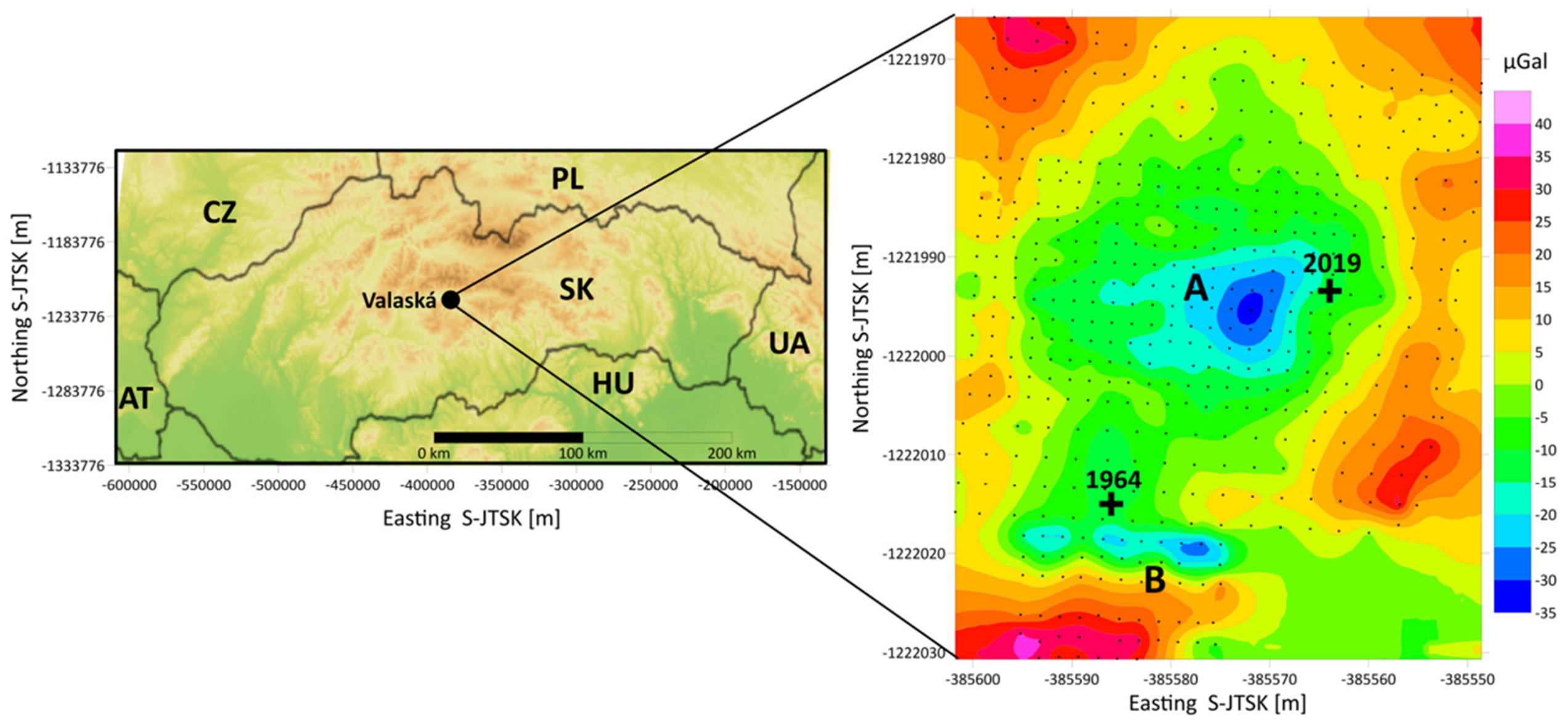
Figure 1) exhibits a pronounced gravity low of about 35 μGal in the centre of the lot (labelled “A”) and an alignment of three smaller gravity lows at the southern end of the lot, the middle one (labelled “B”) being correlated with the 1964 sinkhole, in which the horse sank. The location of this sinkhole remains somewhat inexact, as it was estimated only by referring to old maps.
We took the gravity data presented in
Figure 1 to perform the Growth inversion in order to identify void space (cavities). We use the GROWTH-dg software to seek homogeneous sources.
3. Growth Inversion for Microgravimetric Cavity Detection
We have already tested the applicability and benefits of the Growth inversion for the detection of shallow void space. We have tested the use of Growth in archeological prospection for microgravimetric detection of crypts or tombs in churches. We managed to successfully detect the known crypts in the St. Nicolas basilica of the Trnava town [
46] and in the St. George church of the Svätý Jur town [
47] in SW Slovakia. We have also tested the use of Growth for microgravimetric detection of sinkhole hazard in undermined areas at active or abandoned coal mines. At the abandoned coal mine of Wolfsberg (Austria), we could successfully detect the top part of a void space that potentially could lead to a sinkhole [
46]. At the coal mine in Koš in the Upper Nitra valley of central Slovakia, we were able to successfully detect the back-filled sinkhole [
47]. We confirmed an ongoing sinkhole hazard at the abandoned brown coal mine Čáry in the Slovak part of the Vienna Basin and detected the shallow subsurface mining corridors [
48]. We also focused on sinkhole hazard in densely populated urban areas in a case study in the Pincesor quarters of the Senec town (SW Slovakia), threatened by an extensive complex of mostly unknown underground cellars [
47].
In the mentioned case studies, we were searching for cavities already known, meaning we had the “ground truth” to test our approach. This allowed for testing the capabilities of the Growth inversion in recovering the known cavities, indicating the pros and cons of the approach for such a purpose. In addition, this facilitated important lessons learned about the adjustment of the free user-adjustable inversion parameters of the Growth method in those particular case-specific situations and conditions of the near-surface investigations.
We do not present here a complete, detailed description of the Growth inversion methodology with its mathematical apparatus and numerical implementation. For that, we refer the reader to [
43]. A comprehensive conceptual review of the Growth inversion approach was recently given in [
46], see also the
Supplementary Materials. Below, we only touch on the key features of this inversion approach and the role of the user-adjustable inversion parameters that shape the resulting model.
For our study presented here, we use the GROWTH-dg implementation [
43] of the inversion approach. The advantage of the GROWTH-dg tool lies in the option to seek homogenous source bodies of pre-specified density contrasts, which suits well the search for cavities. The density contrast can be pre-set prior to running the inversion. In our Valaská caverns search, we use the contrast of −2000 kg/m
3 for void space relative to the sediments or −1670 kg/m
3 for water-filled caverns relative to limestone.
The Growth solution is a subsurface density contrast distribution model represented by a set of right-rectangular prisms (cells) filled with positive and negative constant density contrasts. The aggregations of filled cells form source bodies.
The key, user-adjustable parameter of Growth inversion is the balance factor (λ). It governs the weight between minimizing the data misfit and maximizing the compactness of the model. The value of λ is pre-set by the user prior to running the inversion and rules the nature and shape of the model, as well as the level of data misfit. Small values of λ produce overfitting models, in which the data noise is translated into model noise in terms of scattered, isolated filled prisms or shaggy shapes of source bodies. High values of λ result in over-regularized (over-compacted) models with a smaller number of source bodies, which attain rounder shapes and may be falsely vertically shifted towards greater depths. We use the adjective “tight-fit” for models that have a misfit r.m.s. close to, or slightly smaller than, the uncertainty (standard deviation) of the input gravity (RBA in our case) data. Tight-fit models are on the verge of a compact model becoming an overfitting model.
Another important feature of Growth inversion is the option to co-adjust during the inversion run an offset or planar trend in the input gravity data. Growth offers a useful feature for suppressing or eliminating bad data in the gravity input by means of iterative reweighting controlled by the B (for “blunder”) parameter. Such data points can be identified on the running screen as having large misfit residuals. We demonstrate the usefulness of this feature in our Valaská case study below.
Another interesting feature of Growth in its GROWTH-dg implementation is the depth weighting functionality controlled by the D (for “depth”) parameter. When the depth weighting is enabled, the positive (red cells) source bodies are always pushed and squeezed towards greater depth (the limit being the bottom boundary of the model domain), while the negative (blue cells) source bodies are pushed and squeezed towards shallower depth (the limit being the topographic surface). From our previous test case studies, we learned by experience that in the case of flat surficial bodies (their upper boundary coinciding with the topographic surface), strong depth weighting is a must. In other cases, weak or moderate depth weighting may sometimes help better recover the true vertical position and depth span of the source bodies.
All the user-adjustable inversion parameters have an impact on the character and shape of the solution. This offers the user the opportunity to prepare a whole suite of various solutions with more or less acceptable data misfit and a diverse degree of compactness, and then discriminate the individual solutions within the suite based on constraints or external knowledge (if available) or simply based on expectations and experience. This is the benefit of the Growth inversion. Also, the user can observe how the Growth solution responds to the changing values of the individual inversion parameters, which may provide hints on the nature of the actual sources.
The variability of the free user-adjustable inversion parameters producing a suite of various Growth models, yet within the limits of reasonable data fit (acceptable misfit), clearly demonstrates the ambiguity of purely gravimetric inversion. This highlights the need for incorporating external constraints or for integration with other geophysical methods to reduce the ambiguity or to discriminate among the diverse solutions. The variability of the admissible solutions in the case of the Valaská data will be presented in
Section 4.
Growth was coded to work with UTM coordinates of the input gravity data. If the input gravity is positioned or referenced in different coordinate systems, such as in our case, the Slovak national system of S-JTSK, the easting (X) and northing (Y) coordinates must first be transformed into UTM in the input gravity file. Then, for visualization purposes, they can be transformed back to S-JTSK in the output (MOD) file.
Growth was not originally designed for 3D microgravimetry. When working with microgravity data that have an average spacing or grid step of the order of one metre or smaller, Growth might generate cells in the subsurface partition with dimensions below 1 m. This is a problem for Growth, which may result in the output MOD file lacking lines for filled cells with cell size (one cell dimension) smaller than 1 m. This problem can be overcome by using a little trick of upscaling the model domain. The 3D coordinates of data points in the input gravity file are multiplied by an integer n. This results in inflating the dimensions of the subsurface cells by n, inflating the volume of the cells by n-cubed, and inflating the squared distance between gravity data points and positions of cells by n-squared. This implies upscaling the gravitational effect of a cell (gravity at a data point) by a factor of n (n-cubed divided by n-squared). Vice versa, while keeping the gravity value (by not upscaling it in the input file), it implies downscaling the density contrast by a factor of n (upscaling by 1/n). Upon completing the inversion run, prior to visualizing the solution, everything (3D coordinates, cell sizes, and density contrast) is brought back by reverting the upscaling in the MOD file.
4. Growth Model of the Karstic Cavities in the Village of Valaská
We have run Growth inversions on the gravity data presented in
Figure 1. Since we are seeking void spaces of a known density contrast (−2000 kg/m
3), we used the GHROWTH-dg software and 1 level of density contrasts, corresponding to homogenous models. To run the Growth inversion, the easting (X) and northing (Y) coordinates of the data points in the input gravity file were first transformed into UTM. To display the Growth solutions (models), the (X, Y) coordinates were transformed back to S-JTSK. We used the upscaling described in
Section 3 with
n = 10. All inversions were run for an average cell size of 1.5 m (15 m in the upscaled representation). All inversions in GROWTH-dg were run for homogenous source bodies with a density contrast of −2000 kg/m
3, which is the contrast of air relative to the rock medium at the site (−200 kg/m
3 in the upscaling).
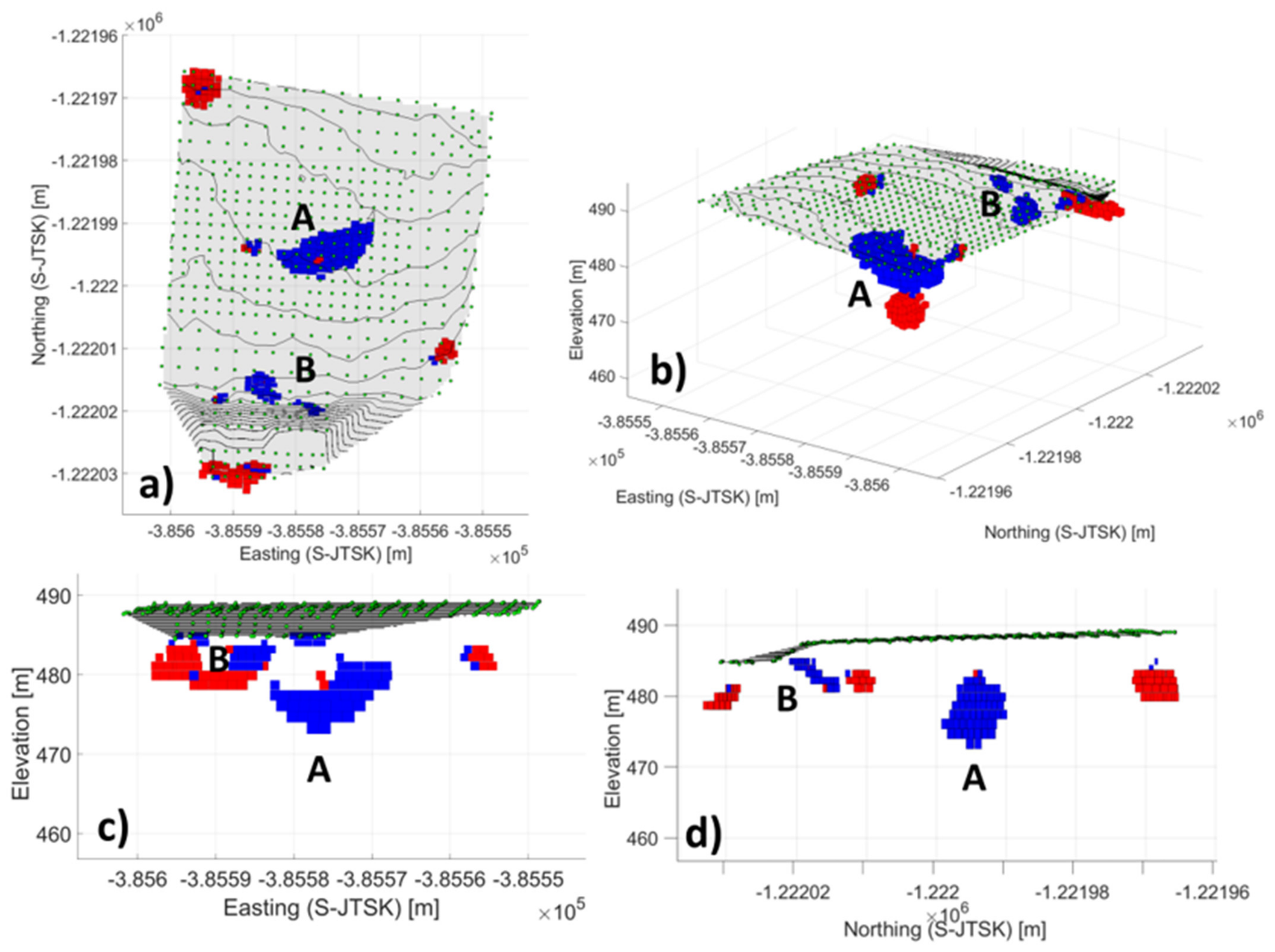
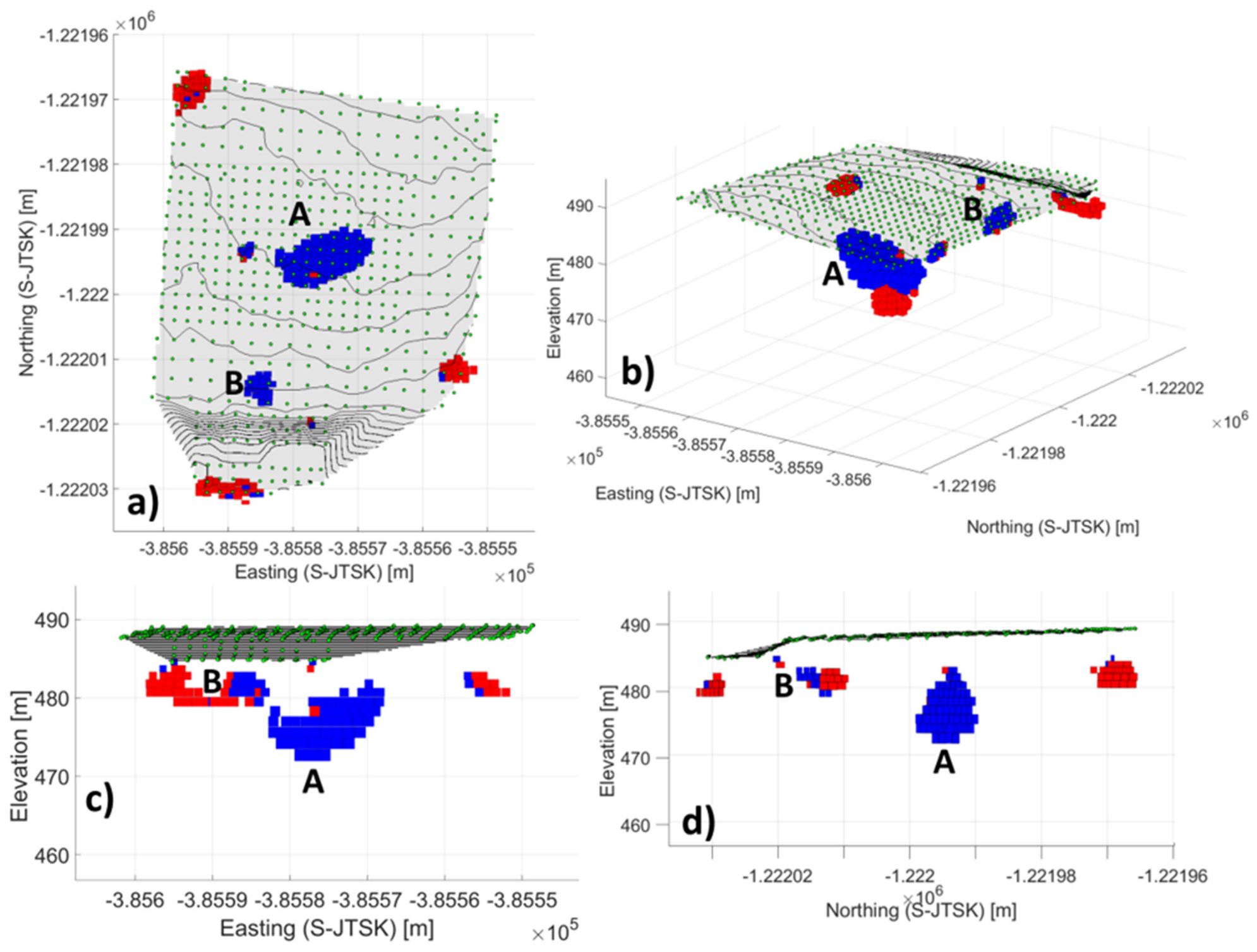
All inversions were run with co-adjusted offset and trend, i.e., with planar trend removal. All inversions were run without depth weighting. The blue (negative contrast) source bodies represent void spaces and are the main target of our search. The red (positive contrast) source bodies appear at the border of the data area and represent artefacts, due to incompletely removed trend, which in reality may depart from planar. They do not represent real source bodies of geological origin.
GROWTH-dg suggested the default value of balance factor λ = 30. The model for λ = 30 turned out to be over-fitting and noisy with tousled (shaggy) source bodies. We therefore increased the balance factor to λ = 60, which resulted in a tight-fit (residuals: r.m.s. = 7 μGal, max = 21 μGal) compact model presented in
Figure 2 (see also
Figure S3 in the Supplementary Materials).
The cavern labelled A, related to the central gravity low of the 2016 RBA data, spans depths from about 483 m a.s.l. (5 m below surface) to about 474 m a.s.l. (14 m below surface). Viewed from south or north, it has a sort of horseshoe shape. The smaller cavity, related to the 1964 sinkhole, or whatever was leftover of it in 2016 (after partial infill and surficial cover), labelled B, spans vertically from about 2 or 3 m below surface to about 8 m below surface.
In this solution, a line of high misfit residuals appears at the edge of the steep terrain slope at the southern end of the data area, lying in the proximity of the gravity low labelled B associated with the 1964 sinkhole (see
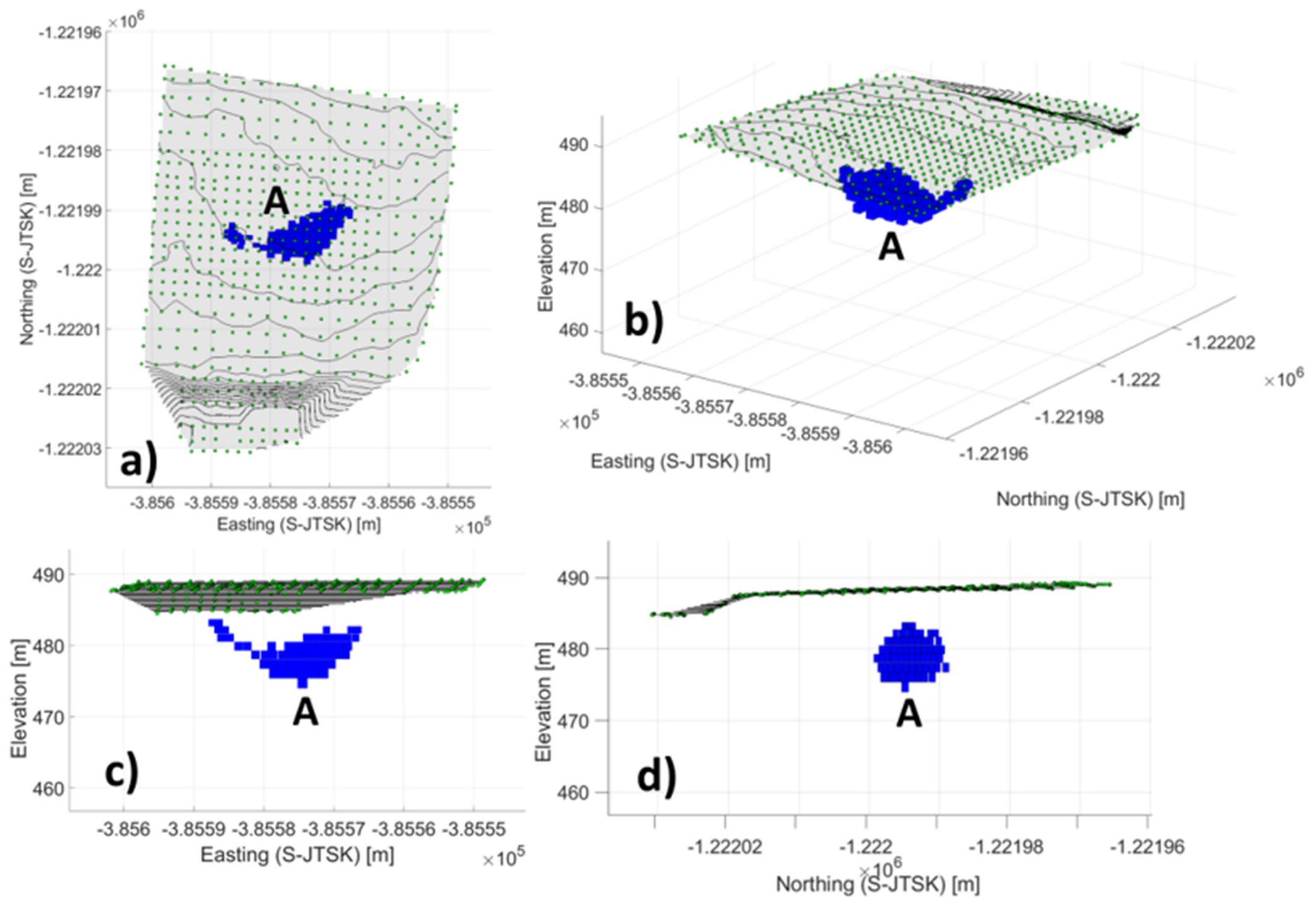
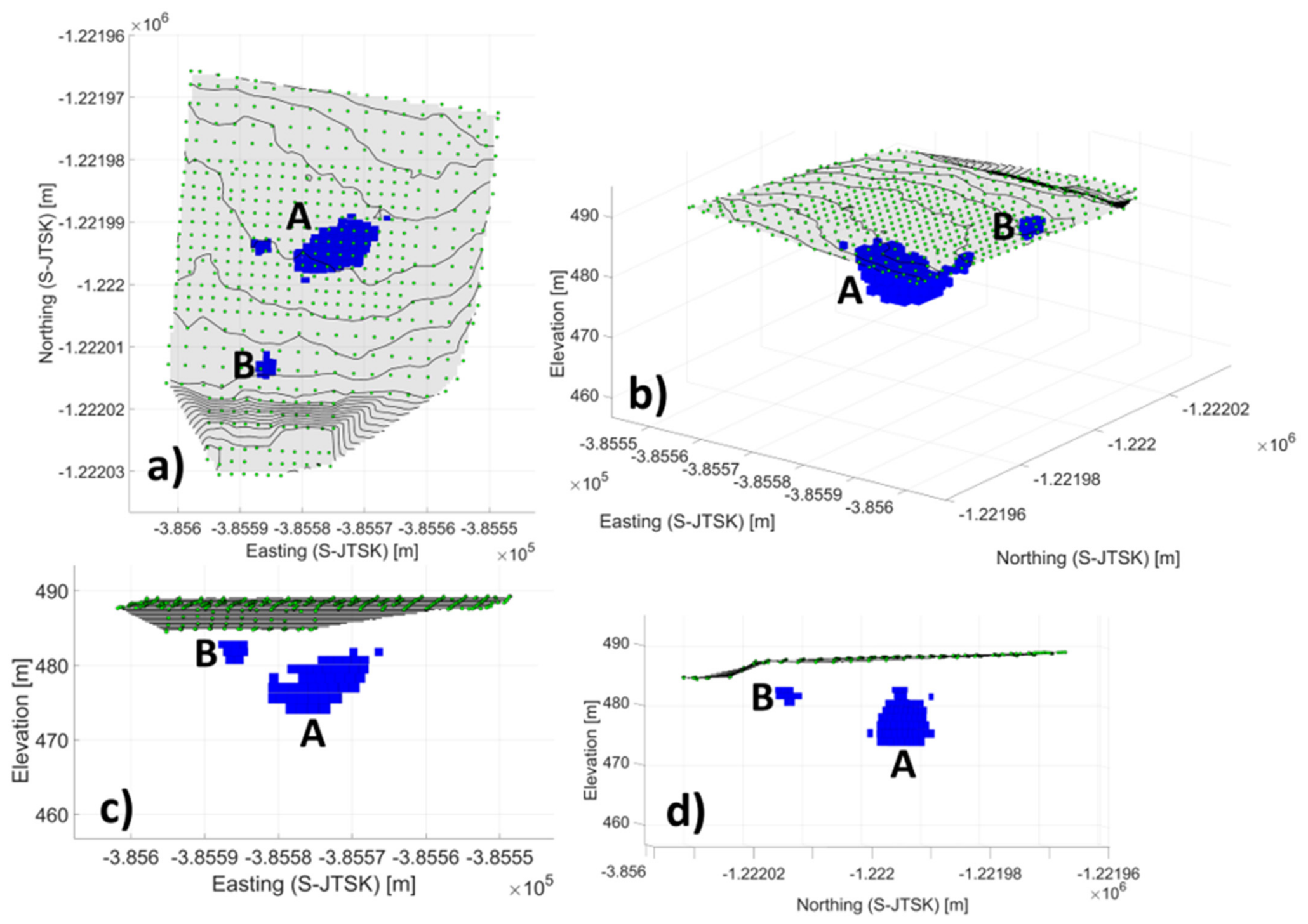
Figure S3 in the Supplementary Materials). High misfit residuals might indicate “bad input data” (outliers). Therefore, we also ran inversions with an enabled iterative residuals reweighting feature with various strengths of the outlier suppression or elimination (various values of parameter B). A tight-fit (residuals: r.m.s. = 6 μGal, max = 9 μGal) compact model (λ = 60) with co-adjusted (removed) planar trend, no depth weighting, and a very strong residuals reweighting (B = 1.3) is presented in
Figure 3 (see also
Figure S4 in the Supplementary Materials). This very strong residuals reweighting resulted in eliminating the cavern B from the model. It also eliminated the red (positive contrast) source bodies at the circumference of the data area. When medium or weak residuals reweighting was applied (not presented here), the models also contained the cavern B, but it was smaller than when applying no residuals reweighting.
Even a strong residuals reweighting has not completely eliminated the worst misfit residuals at the southern end of the lot (see
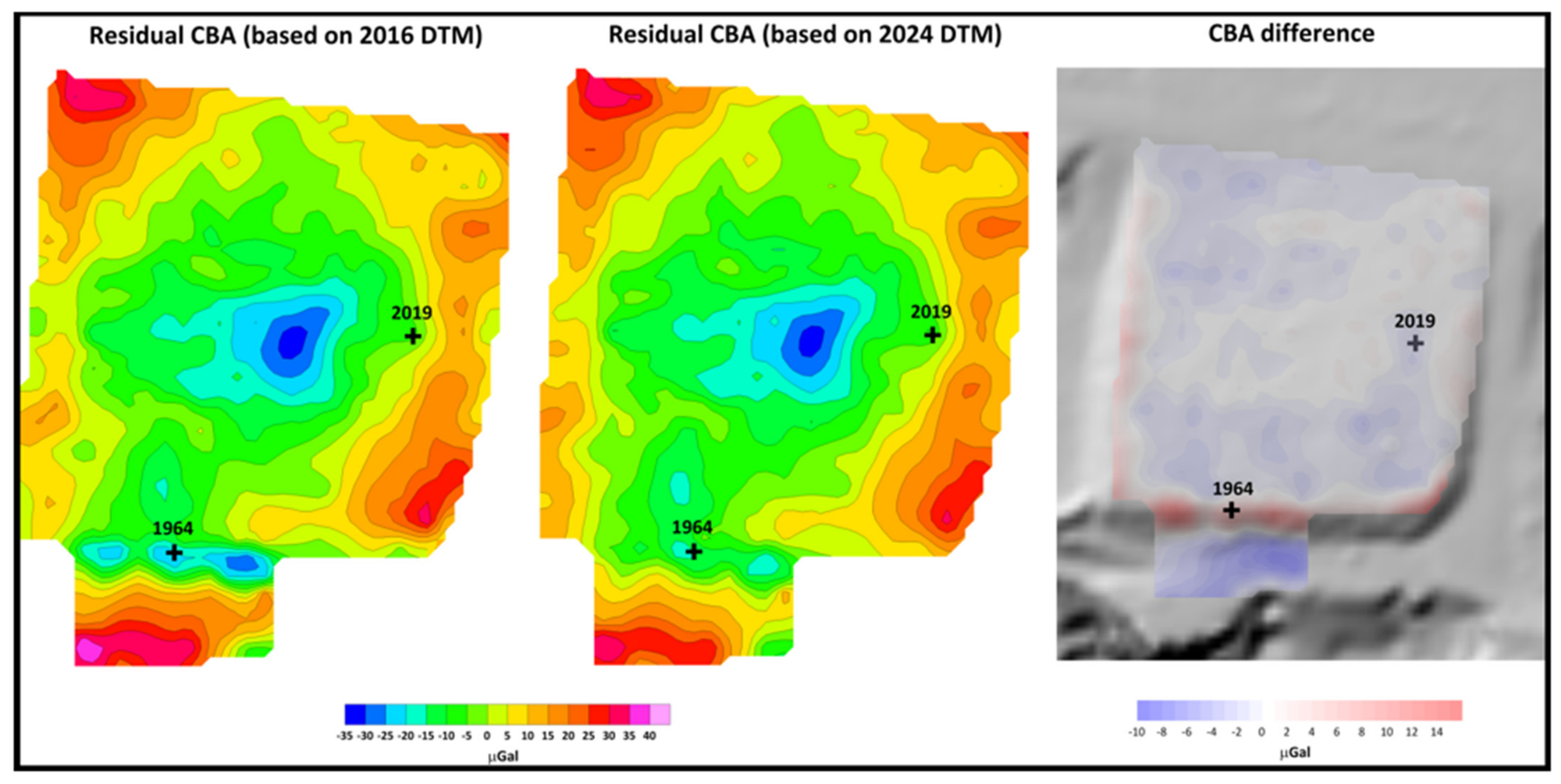
Figure S4 in the Supplementary Materials). These data points are close to a terrain edge (steep slope). This brought up suspicion that the poor quality of the data here may be related to the terrain correction in the CBA data. Out of curiosity, we compiled a new residual CBA dataset with terrain correction based on the most recent LiDAR-derived digital terrain model (DTM) that was not available in 2016. The new residual CBA (RBA) map compared to that of 2016 is shown in
Figure 4. It is clear that the quality of the DTM affects the RBA map in the vicinity of the steep slope (terrain edge) at the southern end of the lot, and consequently, the character of cavern B identified by the inversion.
The DTM 2016 with a resolution of 2 × 2 m was created from LiDAR data acquired by the National Forest Centre (
https://web.nlcsk.org/en/ (accessed on 28 March 2026)) with an overall density of 0.3 points/m
2 on the ground and vertical accuracy of 20 cm on the solid surface (such as roads). On the other hand, the DTM 2024 with a resolution of 1 × 1 m was created from LiDAR data acquired by Geodesy, Cartography and Cadastre Authority of the Slovak Republic (
https://www.skgeodesy.sk/en/ (accessed on 28 February 2026)) with an overall density of 20 points/m
2 on the ground and vertical accuracy of 5 cm on the solid surface. Height differences (observed vs. DTM) at our measurement (gravity) points confirm the higher quality of the newer DTM. Height differences relative to DTM 2024 do not exceed ±20 cm (with r.m.s. of 4 cm). In contrast, height differences relative to DTM 2016 locally reach almost 1 m (with r.m.s. of 20 cm). The largest differences are on the edges of the measured site (especially on the southern edge), which is subsequently reflected in differences in CBA (see
Figure 4).
We ran the Growth inversion on this new RBA dataset with the same inversion parameters as those of the compact homogenous model presented in
Figure 2. The resulting model (with misfit: r.m.s. = 6 μGal, max = 20 μGal) is presented in
Figure 5 (see also
Figure S11 in the Supplementary Materials). This solution is very similar to the solution based on 2016 RBA data with moderate residuals reweighting (not presented here). That means that the partial inadequacy of the 2016 RBA data at the edge of the steep slope can be suppressed or counteracted by the moderate residuals reweighting feature of Growth.
Even the newly compiled residual CBA data with the use of the 2024-LiDAR-based DTM are not completely free of the effect of the steep slope (see
Figure S11 in the Supplementary Materials). Therefore, we run another inversion with engaged residuals reweighting even on the data based on the 2024 DTM. In
Figure 6 (see also
Figure S12 in the Supplementary Materials), we present a similar Growth model to that of
Figure 5, with the same inversion parameters, this time with engaged fairly strong iterative reweighting of residuals (B = 1.6).
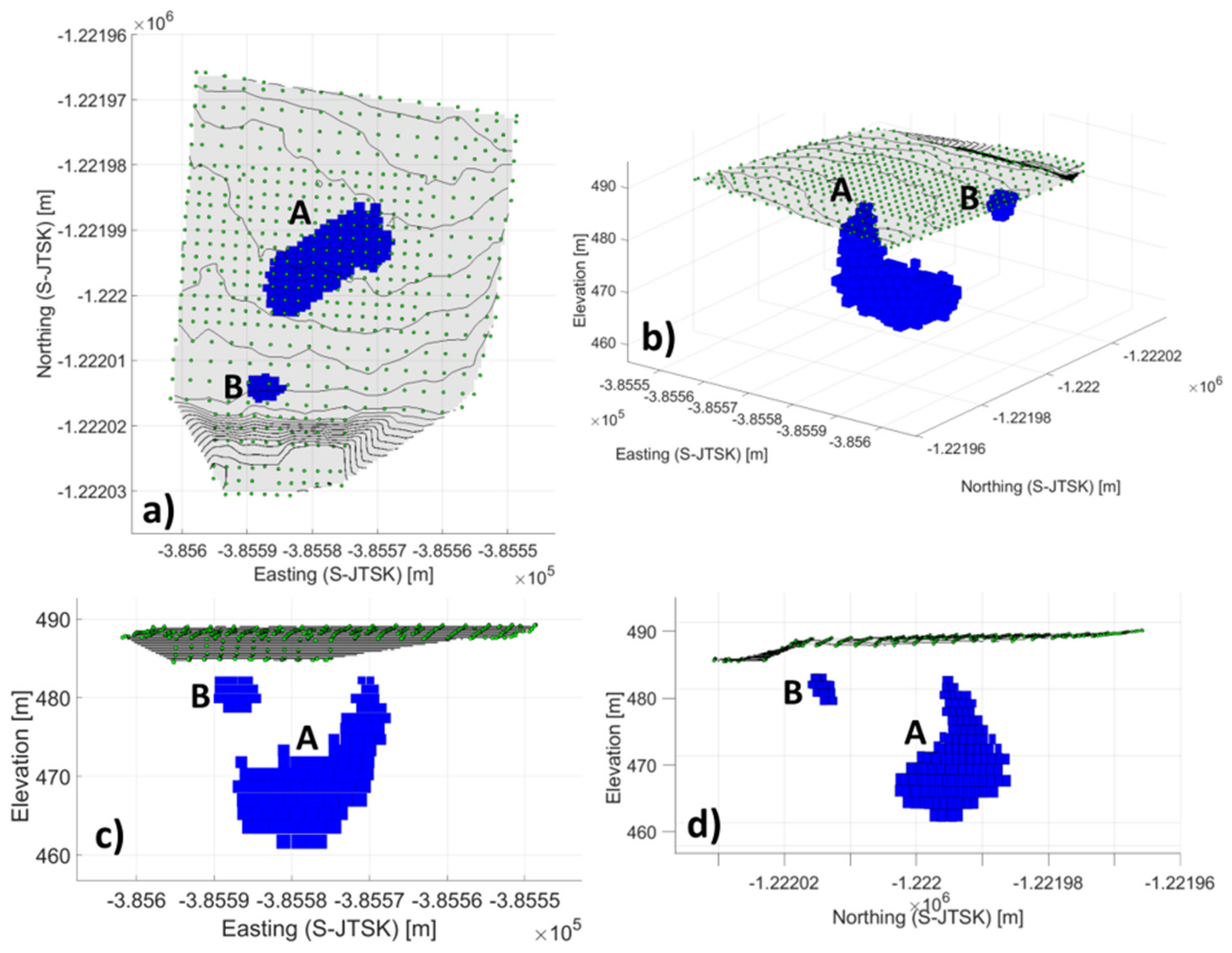
Since the residual CBA data are relative in terms of offset, we also tested adding a negative 20 μGal offset (an arbitrarily chosen value) to the residual CBA data. Upon inversion of such data, we obtained larger and deeper-reaching caverns A and B, cf. the Growth model of
Figure 7 (see also
Figure S13 in the Supplementary Materials). This illustrates another level of ambiguity of purely gravimetric interpretation.
5. Discussion
As for selecting the optimal values of the free user-adjustable inversion parameters in the Growth inversion approach, we proceeded as follows. First, we fixed the density contrast for cavities (air) based on the knowledge of the background density of the rock environment (estimated at 2000 kg/m3, which was also used in the Bouguer corrections). Then we fixed the balance factor value using a trial-and-error process while watching the behaviour of misfit residuals (r.m.s. and max values, as well as spatial distribution), the shape of the autocorrelation function (the closer to zero at nearly zero distance the better), and finally also the behaviour of the model (to be at the verge between compact and scattered—tight-fit yet not overfitting). Tight fit means that the r.m.s. of misfit residuals is about the same as the standard deviation of the input gravity data. We engaged the co-adjustment of planar trend in order to remove any leftover planar regional trend from the RBA data. We used no depth-weighting (D = 0), as we did not find any reason for engaging it. We eventually applied iterative re-weighting (bad data suppression), since the data points close to the sharp edge at the southern end of the lot produced large misfit residuals.
Next, we discuss how sensitive the solutions, in terms of the detected cavities (their position, size and shape), are to the values of the user-adjustable Growth inversion parameters. We fixed the density contrast (parameter Δρ); thus, we do not analyze the sensitivity of the solution to the value of the density contrast. We consider only tight-fit solutions that are respective to the balance factor λ = 60 (arrived at by trial-and-error), therefore we do not analyze the sensitivity of the solution to the balance factor value. We consider only solutions with engaged co-adjustment of planar trend; hence, we do not analyze the sensitivity of the solution to not co-adjusting the planar trend. We consider only solutions without depth weighting (D = 0); therefore, we do not analyze the sensitivity of the solution to the value of the D parameter (aka the strength of depth weighting).
The sensitivity of the solution to the iterative reweighting of residuals (aka blunder suppression/elimination) is manifested in
Figure 2 and
Figure 3, where
Figure 2 presents the solution without reweighting (one end of the line of solutions), while
Figure 3 shows the solution with strong reweighting (B = 1.3) representing the other end of the line of solutions. The same was done for solutions produced by inversion of RBA data compiled with the new, better DEM. The sensitivity of the solution for these data to the iterative reweighting of residuals is manifested in
Figure 5 and
Figure 6, where
Figure 5 presents the solution without reweighting (one end of the line of solutions), while
Figure 6 shows the solution with strong reweighting (B = 1.6) representing the other end of the line of solutions. The strong reweighting (solution in
Figure 3) resulted in eliminating even the signal of cavity B, and consequently, cavity B is absent in this solution. In the case of the DEM-improved RBA data, the residuals reweighting does not eliminate cavity B from the solution, and has less impact on it (strong reweighting only slightly shrinks the volume of cavity B). Cavity A remains quite insensitive to the residuals reweighting across all four above solutions.
Another level of ambiguity is introduced into the gravimetric solution by the fact that residual CBA (RBA) data are relative in terms of their offset/trend. Any arbitrary introduced offset has an impact on the solution. We demonstrate this by the solution of
Figure 7, which is based on RBA data to which a negative offset of 20 μGal was added. The added negative offset added to the volume and depth reach of the two cavities.
Since the gravimetric method yields an ambiguous interpretation, cross-validation by other geophysical methods or structural geological (such as speleological) cognition is essential. We correlate our gravimetric models with the findings reported by Kubíny [
52] and with the geophysical exploration of Putiška [
50]. No follow-up geophysical work has been performed at the site since 2016.
Direct confrontation of our Growth gravimetric models of the cavities (labelled A and B) with the ERT results [
30] is not possible, as the ERT interpretation did not identify any cavities. It only mapped out the karstified limestones. Resistivity methods in general should detect air-filled underground voids such as cave space due to the resistivity contrast (theoretically infinite resistivity in the ERT image), as documented by many published works. Putiška et al. [
29] present a comparison of the detectability of cavities by several types of electrode arrays. From the electrical array analysis for model situations, it turns out that a dipole–dipole and a combined pole-dipole give the best results among other electrical arrays. They also show how significantly the effect of a thin conductive layer around the cavity distorts the resistivity image of the cavity, by which the resistive anomaly can be turned into a conductive one, if the thin layer is more conductive than the background environment.
Direct confrontation of our Growth gravimetric models of the cavities (A and B) with the GPR results [
50] is not possible either, as GPR exploration did not reveal any cavities. It could only delineate the thickness of terrace gravels and slope deposits, providing independent depth constraints that helped refine the ERT model, which was subject to inversion-related smoothing. In zones with high clay content, strong signal attenuation was observed, confirming the presence of conductive, clay-rich infill—a finding consistent with the ERT results.
With respect to Growth solutions, we better distinguish between the uncertainty of a solution and the ambiguity of a solution. By uncertainty of the Growth solution, we mean the uncertainty of the value of the density contrast of each individual filled cell of the Growth solution that can be determined from the a posteriori covariance matrix. However, such information is quite meaningless, taking into account the nature of Growth solutions—source bodies formed by aggregations of filled cells. The above-mentioned uncertainty tells us nothing about the uncertainty in the position, size (volume) and shape (geometry) of each source body. On the other hand, by the ambiguity of the Growth solution, we mean the variability within this solution that produces different solutions that still remain acceptable in terms of the misfit residuals they produce (measured by the r.m.s. of misfit residuals being at the value of the standard deviation of the input gravity data).
Features (structural elements with their parameters) that remain stable (the same) across the line (spectrum) of acceptable Growth models can be considered more certain (trustworthy), while features that vary more widely across the line of acceptable Growth models are seen as less certain.
The existence of cavity A based on Growth inversion can be considered certain. The size and position of cavity A across the four solutions (
Figure 2,
Figure 3,
Figure 5 and
Figure 6) remain stable. Its top-most narrower part reaches about 483 m a.s.l. (ca. 5 m below surface) not only across the four mentioned solutions, but also in the solution of
Figure 7, in which the arbitrary negative offset (of 20 μGal) was added. We consider this cavity as a high risk of a sudden collapse sinkhole. We assume that we are catching only the top part (vertical span of about 10 m) of cavity A and that it might extend deeper with a larger volume at greater depth (as perhaps indicated by the solution of
Figure 7).
The existence of cavity B is less certain but still likely, as it is present in three solutions (
Figure 2,
Figure 5 and
Figure 6) and even in that based on the offset-added data (
Figure 7) and likely coincides with the remains of the 1964 sinkhole.
It is the position of the top boundary (ceiling) of a cavity, which is critical in sudden collapse sinkhole hazard assessment in Valaská. When it crosses the interface between limestone and surficial sediments (loess clay and clayey gravel), the depth of which varies between 5 and 9 m below the surface, the risk grows.
Our Growth-derived gravimetric models of the cavities (labelled A and B) are in general agreement with the findings of Kubíny [
52]. Based on geological, geomorphological and speleological works, Kubíny has assumed the presence of underground ponds and caverns even before 1956. Subsequent speleological (including scuba-diving) exploration [
51] confirmed the cave space in the Valaská subsurface. In the sinkhole accident of 21 September 1964, the horse had sunk into a roughly 1 m wide, 9 m deep karst chimney. Below this 9 m deep sinkhole, a cavity was found to the side of it, another 20 m deep, which was filled with water and explored by divers. The bottom part of this cavern was connected with a fast-flowing underground river (see
Supplementary Materials, Figure S5). In the autumn of 1968 and in February of 1969, two new sinkholes appeared near that of 1964. The preliminary exploration has confirmed a high-degree karstification of limestones below the Valaská village in the forefield of the Tajch spring, and the existence of deep and extensive underground water pools [
52].
These underground spaces are associated with NNE–SSW trending tectonic fractures to which the main underground river of Valaská is linked. Along this system, other caverns and galleries are expected, due to pressure erosion by water, which are filled by water up to the hydrostatic level. To them also belong karst cavities detected by boreholes V2, V3 and ŠV2 (see
Figures S5–S10 in the Supplementary Materials). Borehole V2 went through the intensively karstified limestones, partially filled with lime, from 8.3 to 18 m depth. Karst cavities in Valaská, associated with the known sinkholes, are up to 30 m deep and up to 10 m wide [
52].
The report of Kubíny [
52] concludes with recommendations for mitigating the sinkhole hazard. The degree of karstification (one third of the limestone volume estimated as cavities) in the highest threat zone (zone I in the map of
Figure S6 in the Supplementary Materials) is such that the area cannot be made safe by filling in the caverns (infill material estimated at 70 million m
3). Instead, Kubíny proposes to make the cave system with underground ponds accessible to the public, with the entry built at the little shaft ŠV-1 and the exit at the sinkhole-1 (see the map in the
Supplementary Materials).
For additional depth estimation to the source of the main local gravity low labelled “A”, we used the 3D Euler deconvolution method [
53] with incorporated regularized derivatives [
54]. Using a predefined structural index value of 2 (respective to a spherical source in gravimetry), we obtained a cluster of solutions at a depth of approximately 6 m below the surface (see
Figure S14 in the Supplementary Materials [
55,
56,
57]). By comparing these depth solutions with the results of the Growth inversion, we see that the Euler deconvolution method estimates the depth close to the top boundary of the detected cavity, as is often the case in the practical applications of the Euler method ([
58,
59]), catching the upper bound of the sources.
We make the following inferences from our Growth models. We have detected the presence of the top part of the secured (covered-up) cavern, adjacent to the 1964 sinkhole (cavity B). We have detected the presence of a larger cavern related to the central-most pronounced gravity low (cavity A). We speculate that this cavern is associated with the 1968 and 1969 sinkholes, though their exact location cannot be identified or validated. Our speculation is supported by the fact that the 1968 sinkhole was considerably bigger (4 by 10 m) than the 1964 sinkhole (1 by 9 m), while likewise our detected cavern A compares in size to cavern B. Even as for cavern A, we assume that we are catching only its top part, not the whole cavern, which likely extends down to the underground river at 30 m below the surface.
The density contrast −2000 kg/m3 used in our inversion is that of the air against the density of quaternary sediments. This fits well with the situation of the empty top parts of the caverns (to ca. 10 m below the surface). Deeper down, the situation is characterized by water-filled caverns in a limestone background, yielding a density contrast of −1670 kg/m3. Therefore, we also ran the inversions with this contrast (not presented here). The change in contrast did not have much effect on the character of the solutions. The detected caverns were slightly larger, but of similar shapes and depth spans.




 ,
,