1. Introduction
The accelerated global transition toward clean energy systems, digital infrastructure, and advanced manufacturing has placed Critical Raw Materials (CRMs) at the center of strategic, economic, and environmental considerations. CRMs are essential for renewable energy technologies, battery systems, and high-performance industrial applications, yet their supply chains remain vulnerable to geopolitical constraints and environmental challenges. In response, the European Union has emphasized sustainable and responsible extraction through initiatives such as the European Green Deal and the Critical Raw Materials Act. These policy frameworks highlight the need for mining practices that ensure environmental protection, transparency, and long-term resource stewardship, while simultaneously demanding a highly skilled workforce capable of operating within increasingly complex regulatory and technological environments.
Within this context, mining engineering education faces the dual challenge of providing strong theoretical foundations while ensuring practical, field-oriented competence. Traditional training methods rely heavily on physical site visits and in situ observations, which, although invaluable, are often constrained by safety considerations, access restrictions, logistical costs, and confidentiality issues. Virtual Reality (VR) has emerged as a powerful tool to address these limitations by enabling immersive, interactive representations of mining environments that can be accessed safely and repeatedly [
1,
2]. By simulating real operational conditions, VR bridges the gap between classroom-based instruction and experiential learning.
Early applications of VR in mining and geoscience focused primarily on immersive visualization and spatial understanding. Bellanca et al. [
2] demonstrated the use of VR environments to simulate mining scenarios for research and safety training, while Stothard and Laurence [
3] showed how immersive visualization systems can effectively communicate principles of sustainable mining. Subsequent studies expanded this scope, highlighting VR’s capacity to improve safety awareness, spatial cognition, and learning outcomes across different user groups and experience levels [
4,
5]. These studies established VR as a valuable pedagogical and professional tool, particularly in domains where spatial complexity and hazard awareness are critical.
Recent advances in imaging technologies, computing power, and data analytics have further expanded the potential of VR-based systems. High-resolution panoramic imagery and photogrammetric techniques now enable not only realistic visualization but also the extraction of quantitative information from immersive datasets. As emphasized by Strzałkowski et al. [
1], modern VR applications increasingly intersect with data-driven engineering workflows, opening opportunities for analytical use beyond visualization. However, the systematic integration of image-based analysis within VR environments remains relatively underexplored in mining training and environmental management.
In parallel, machine learning (ML) has become a key enabler for extracting value from complex and imperfect datasets in the fields of engineering and environmental sciences. Supervised learning approaches are well suited to correcting systematic biases in image-derived measurements and to predicting physical parameters where direct observations are limited or incomplete. Previous research in related engineering fields has shown that ML can significantly enhance measurement accuracy and decision support when combined with imaging data and ground truth validation [
6,
7,
8,
9,
10,
11]. Despite this potential, the combined use of immersive VR imagery, quantitative image analysis, and ML-based validation has not yet been fully exploited in the context of mining operations and post mining environmental assessment.
This gap is particularly evident in mine closure and rehabilitation contexts, where quantitative monitoring of landforms such as pit lakes is required to demonstrate environmental compliance and long-term stability [
6,
7,
8,
9,
10,
11,
12]. Pit lakes represent a common post-mining land use option, yet their assessment typically relies on field surveys or remote sensing campaigns that can be resource intensive. The integration of image-based measurements derived from immersive VR environments with ML-based correction and validation offers a promising complementary approach, capable of supporting both training and environmental monitoring within a unified framework.
Building on these developments, this study presents outcomes of the IMMERSE project as an integrated VR-based training and analytical ecosystem. The developed Virtual Excursions (VEs) not only provide immersive learning experiences across the mining life cycle but also enable quantitative extraction of geometric information from high-resolution panoramic imagery. By validating image-based pit lake measurements against ground truth data using supervised machine learning and standardized performance metrics, the proposed framework extends the role of VR from a visualization tool to a reproducible, data-driven method supporting sustainable mining practices. Thus, VR is not used merely for presentation of results, but as the source environment from which the image data for quantitative analysis are derived. Accordingly, the contribution of the present study is twofold but clearly differentiated. The Virtual Excursions serve as immersive educational tools, whereas the panoramic imagery derived from them constitutes the input for the quantitative assessment of pit lake geometry, providing an integrated education and research framework.
In doing so, this work aligns immersive education with emerging digital and analytical approaches, reinforcing VR’s contribution to sustainable CRM exploitation, mine closure evaluation, and ESG-compliant decision-making. The following sections describe the materials, methods, results, and implications of this integrated approach in detail.
2. Materials and Methods
The study area is a rehabilitated pit lake located in a mining district in Euboea, Greece, within the former LARCO GMMSA mining site, where nickeliferous laterite ore was originally extracted through open-pit mining before the site entered its post-mining rehabilitation phase. The development of Virtual Excursions (VEs) followed a structured workflow that blends rigorous field acquisition, reproducible image processing, careful VR authoring, and intentional pedagogical integration. Initially, fieldwork focused on identifying vantage points that captured the operational sequence and the relevant geotechnical or environmental context (e.g., excavation fronts, ore-handling nodes, comminution modules, rehabilitation plots). Imagery acquisition relied on 360° panoramic cameras capable of high-resolution, low-noise capture under variable illumination. In practice, the XPhase Pro S2/X2 (HY Innovation Ltd, HuiZhou, Guangdong, China) platform was favored for static, high-fidelity panoramas that would later anchor explanatory overlays, while the Insta360 X4 (Arashi Vision Inc. Shenzhen, Guangdong, China) was used when flexibility, rapid repositioning, or video capture of short operational sequences was required [
13,
14].
Raw captures underwent a two-stage post-processing pipeline. Initially, orientation calibration and stitching were performed to produce geometrically consistent equirectangular panoramas. This preliminary step was performed using Hugin (v2024.0.0) image stitching software (SourceForge), which allowed precise control over lens parameters, control points, and seam optimization; careful use of Hugin’s optimizer minimized parallax artifacts common in confined underground headings and around near-field objects [
15]. Subsequently, radiometric adjustments and clarity enhancement were applied in ACDSee (Photo Studio Ultimate 2024) to normalize color rendition across sequences, reduce haze, and bring out lithological textures and surface features essential for geotechnical or process interpretation [
16]. In instances where capture conditions varied across a site visit, batch profiles were created to ensure tonal and color consistency within each VE.
Authoring and interaction design were implemented in Pano2VR 7.1.11, selected for its robust hotspot logic, node graphing, and multi-device output that preserves smooth navigation on head-mounted displays and standard browsers alike [
17]. In all created VEs, info-points are placed at specific locations inside the VE, providing the field information required. Moreover, navigation points have been set allowing each operator to know the exact location in accordance with Google maps. The scientific material has been added to the VE as a pop-up.
2.1. Image Processing and Feature Extraction
Image-based estimation of pit lake geometry was conducted using high-resolution 360° panoramic imagery acquired during the development of the Virtual Excursions (VEs) and implemented within the Pano2VR platform. Pano2VR served as the environment for organizing and visualizing the panoramic scenes, while quantitative assessment was based on their spatially referenced image content. Each panorama was referenced using known camera parameters and visible control features of known dimensions. Thus, pixel-based image measurements were converted into actual physical dimensions through spatial referencing and scale constraints provided by these control features. Prior to analysis, the images underwent radiometric normalization and geometric calibration to reduce illumination and lens-distortion effects. Pit lake shorelines were delineated using a semi-automatic procedure, supported by edge detection and color/texture gradients, with manual refinement in areas affected by shadow, vegetation, low contrast, or partial occlusion. Accordingly, the shoreline boundaries were not obtained through either a purely manual or a fully automatic black-box approach, but through a semi-automatic extraction process combined with targeted manual correction. The extracted shoreline was then projected onto a horizontal reference plane, assuming locally planar water geometry. This planar projection constituted the geometric model used to derive corrected pit lake dimensions, including surface area, shoreline length, mean diameter, and maximum diameter. In geomatics terms, the combined calibration, scaling, shoreline delineation, and planar projection procedure defines the planimetric accuracy of the extracted pit-lake boundary and the derived geometric parameters. Accordingly, the deviations reported in this study should be interpreted as residual planimetric error remaining after image calibration and feature extraction, prior to the subsequent supervised machine-learning-based correction step.
While this workflow provides a consistent and efficient means of quantifying pit lake geometry, image-based estimates remain subject to several sources of uncertainty. Perspective distortion inherent to panoramic imaging, partial shoreline occlusion due to topography or vegetation, variable illumination conditions, simplifications introduced by projection onto a horizontal reference plane, and non-uniform camera-to-object distances can all influence the accuracy of extracted measurements. These uncertainties are particularly pronounced for irregularly shaped pit lakes and complex post-mining terrains, leading to systematic underestimation or overestimation of geometric parameters. To overcome these limitations and enhance measurement reliability, machine learning is employed as a correction and validation mechanism. By learning the relationship between image-derived features and ground truth measurements, the machine learning framework compensates for systematic distortions associated with imaging conditions and shoreline complexity, enabling the transition from qualitative visualization to quantitatively robust environmental assessment.
2.2. Machine Learning Method Application
The machine learning task addressed in this study is formulated as a supervised multiple linear regression problem [
18,
19], where the objective is to predict continuous-valued geometric parameters for a part of the pit lake from image-derived features. Multiple linear regression was considered appropriate because the purpose of the correction step was to reduce systematic bias between image-derived and ground-truth measurements rather than to model highly complex nonlinear behavior. Given the limited sample size and the geometric nature of the predictors, multiple linear regression provides a simple, interpretable, and reproducible framework for site-specific bias correction [
20,
21].
The feature vector used for regression consisted of the image-derived geometric descriptors extracted from the panoramic imagery, specifically the initial estimates of pit lake surface area, shoreline length, mean diameter, and maximum diameter obtained after calibration, shoreline delineation, and planar projection. Specifically, given a set of training samples , the aim is to estimate a linear function that maps an input feature vector , extracted from panoramic imagery, to a real-valued target variable , representing a ground-truth pit lake metric such as surface area, shoreline length, or characteristic diameter. The regression model is developed using paired observations consisting of image-based estimates and corresponding ground-truth measurements obtained from field surveys and official mine-closure records.
In this framework, the relationship between predictors and target variable is expressed as
where
is the intercept,
are the regression coefficients, and
is the random error term. The model coefficients are estimated using the ordinary least squares method, which minimizes the sum of squared differences between observed and predicted values. Predicted values
are then compared with the corresponding true values
, and model performance is evaluated using Root Mean Square Error (RMSE) and the coefficient of determination (
).
Τhe regression model was formulated as a multiple linear regression estimated by ordinary least squares. Thus, no additional hyperparameter tuning was required. To limit overfitting given the small sample size, model complexity was intentionally controlled by restricting the predictor set to the main image-derived geometric descriptors only, thereby maintaining a parsimonious and fully interpretable regression structure. Uncertainty in the image-derived predictors propagates through the multiple linear regression model to the corrected outputs through the fitted coefficients; although confidence or prediction bounds could in principle be estimated within this framework, they were not quantified in the present study and would require a larger dataset and a more explicit characterization of the underlying image-measurement errors.
By framing pit lake geometry estimation as a supervised multiple linear regression task, the proposed approach provides a transparent and reproducible means of correcting systematic deviations in image-based measurements. In addition, the linear form of the model allows straightforward interpretation of the contribution of each image-derived predictor to the final estimated pit lake geometry, thereby supporting both methodological clarity and practical applicability in cases where complete ground-truth data are unavailable.
The integration of image processing with supervised machine learning transforms immersive VR imagery from a qualitative visualization tool into a quantitative monitoring framework. While image-based methods provide rapid, low-cost geometric estimates, field sampling and machine learning substantially improve accuracy by correcting systematic distortions related to perspective and scene complexity. The use of standardized validation metrics ensures transparency and reproducibility, supporting the application of this methodology in environmental monitoring, mine-closure assessment, and ESG oriented reporting.
From a technical perspective, the workflow is intentionally reproducible: camera rigs and stabilization practices [
12,
13], stitching and calibration conventions [
10], enhancement profiles [
15], and interactive authoring templates [
22] together form a living methods manual that trainers can adopt and adapt to their education field. This modular workflow allows the independent updating or replacement of individual components (image acquisition, processing, immersive visualization, and quantitative analysis) without disrupting the overall pipeline. As a result, the methodology supports consistent replication across different mining sites and institutional settings, while maintaining flexibility to accommodate site-specific conditions, available equipment, and evolving regulatory or training requirements.
3. Results and Discussion
The results of Virtual Excursion (VE) development can be grouped into three main categories: (i) VEs simulating mining operations, (ii) VEs enabling quantitative analysis and validation of mining and post-mining features through image-based measurements and machine learning correction, and (iii) VEs illustrating environmental rehabilitation and sustainable management practices in line with the 4Rs policy, particularly the reuse of by-products. Together, these categories address key gaps in traditional mining education by combining immersive visualization with validated quantitative assessment, while supporting sustainable development and ESG oriented decision-making.
Considering the impact of a mining company’s Environmental Management Strategy on Social Approval and the trust gained from each regional Authorized Environmental Inspection Organization, emphasis is placed on the Mining to Closure action plan. Therefore, by deepening cooperation between the scientific representatives from the Technical University of Crete and the administration of the LARCO GMMSA mining company, the VEs demonstrating the implemented Environmental Management practices were created. These VEs provide clear scientific knowledge on this essential subject of study to mining engineers [
23,
24,
25]. It is strongly believed that this combined training tool directly transfers young engineers to the field, teaching them about on-site conditions and exposing them to the associated risks and potential challenges they will face. As a result, they will be more ready to provide engineering solutions.
The developed Virtual Excursions (VEs) successfully captured high-resolution, immersive representations of post-mining pit lakes and rehabilitated areas at the LARCO GMMSA Euboea mine site.
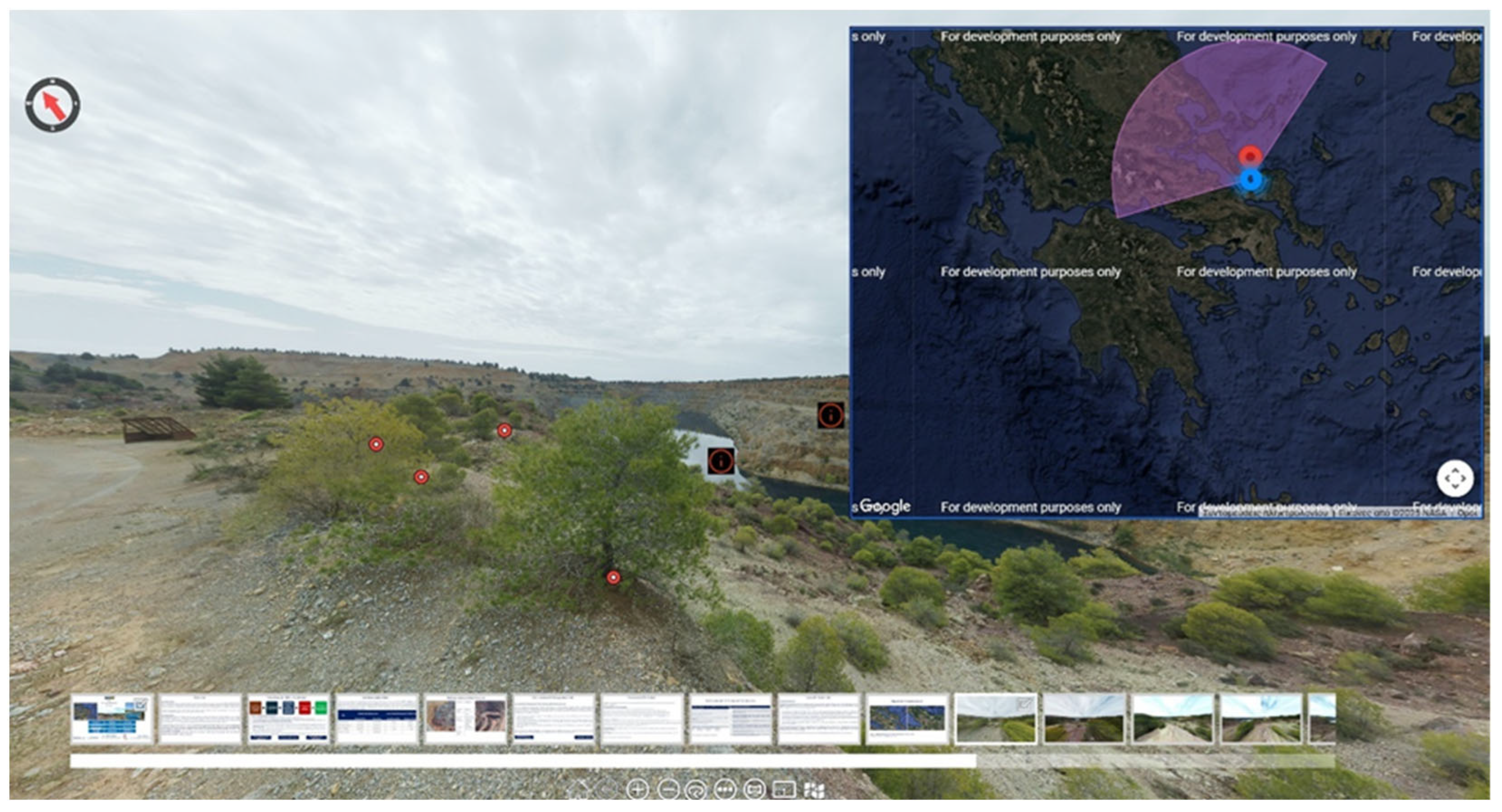
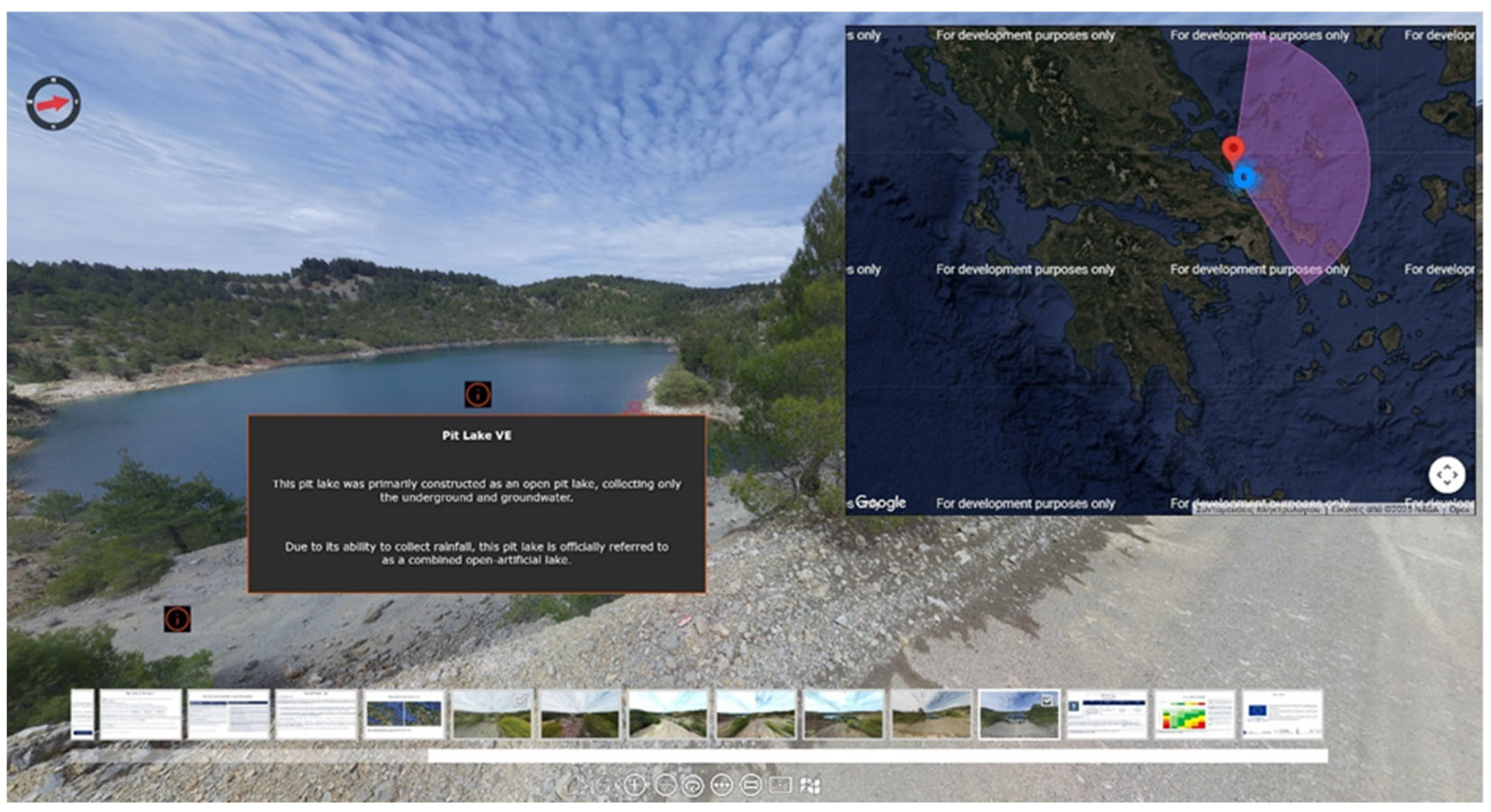
Figure 1 and
Figure 2 present representative 360° panoramic views of rehabilitated pit lake areas, illustrating both the spatial extent of the water bodies and their surrounding geomorphological context. Navigational points and localized information points embedded within the VEs enable users to explore the pit lake environment interactively while accessing site-specific technical and environmental information.
Beyond their educational value, these immersive panoramas provided the basis for quantitative image-based analysis. Shoreline boundaries were clearly identifiable across the majority of analyzed scenes, allowing the extraction of key geometric parameters, including pit lake surface area, shoreline length, and characteristic diameters. The panoramic format proved particularly effective in conveying the full spatial context of the pit lakes, enabling consistent delineation of shoreline geometry even in complex terrains. However, initial image-based estimates exhibited systematic deviations from ground truth values, primarily due to perspective distortion, partial shoreline occlusion, and variations in camera-to-object distance.
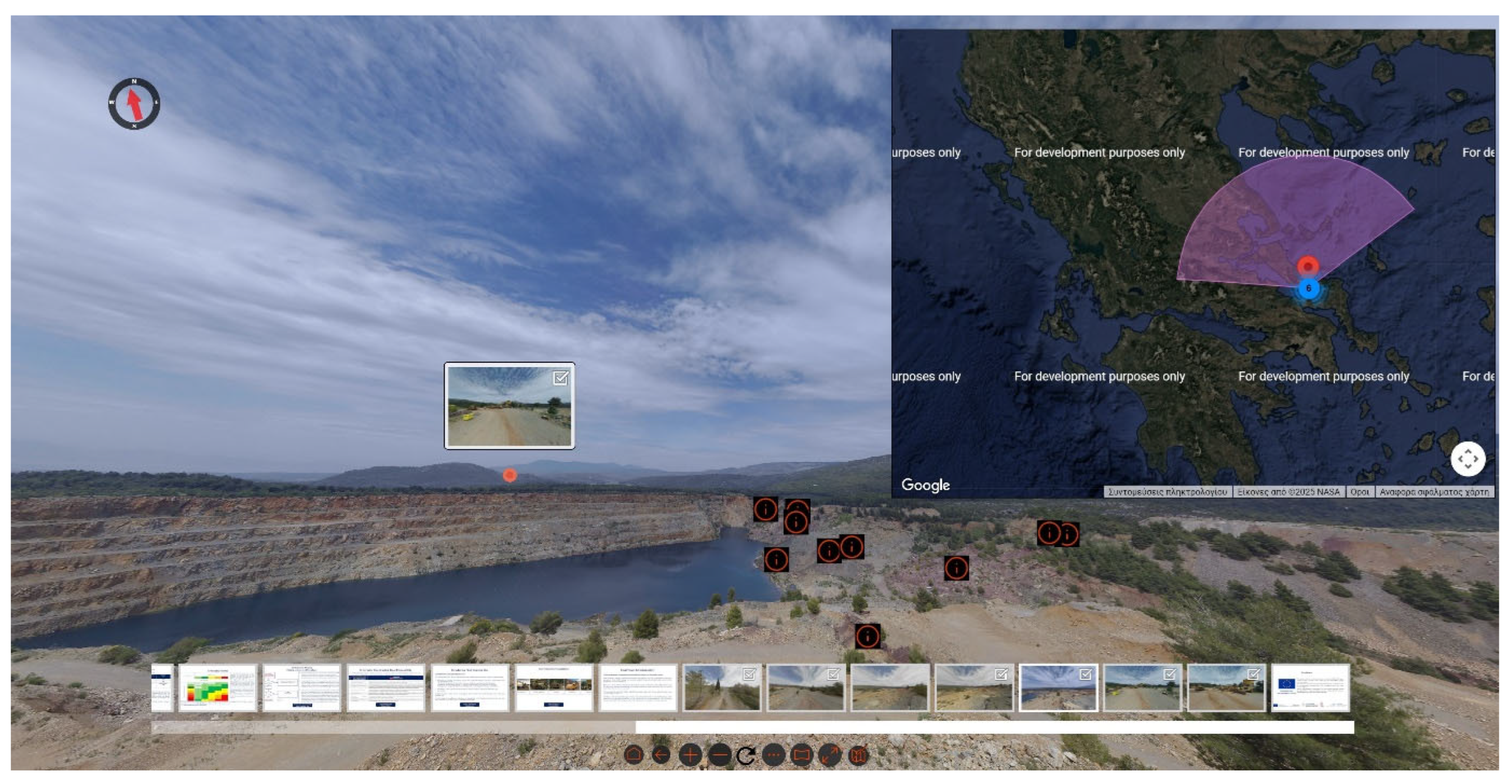
To evaluate and improve the accuracy of image-derived measurements, ground truth data at 21 locations (
Figure 1,
Figure 2 and
Figure 3) were obtained from field surveys and official mine-closure documentation was used as reference benchmark with an average of 5–8% deviation. The comparison between image-based estimates and ground truth measurements revealed a consistent underestimation of pit lake dimensions, particularly regarding surface area and shoreline length. These discrepancies highlighted the limitations of relying solely on image-based measurements for quantitative environmental assessment.
The application of supervised machine learning (ML) regression (in Matlab
® environment) significantly improved measurement accuracy [
6,
7,
26,
27,
28,
29,
30,
31]. The image-based geometric measurements were corrected against ground-truth observations using parameter-specific multiple linear regression, with each ground-truth metric modeled as a linear function of the image-derived descriptors. By training models on paired image-derived features and ground truth data, systematic biases related to imaging conditions and shoreline complexity were effectively corrected. Equation (2) shows an example of the calibration model used to predict the ground-truth value of a selected pit lake metric from the set of image-derived geometric measurements. The sign of each fitted regression coefficient indicates the direction of the predictor’s influence on the corrected output, whereas its magnitude reflects its relative contribution within the model.
where
denotes the corrected pit lake metric, and the coefficients indicate the direction and relative contribution of the image-derived predictors to the corrected output. In this example, all coefficients are positive, suggesting that increases in the image-derived descriptors are associated with increases in the corrected estimate, while the larger coefficient for surface area indicates a stronger contribution within the fitted model.
Table 1 summarizes, for each pit lake geometric parameter, the ground-truth reference value, the corresponding image-based estimate, the value after multiple linear regression correction, and the associated error statistics. RMSE was calculated from the differences between predicted and reference values, improvement (%) was computed from the relative reduction in RMSE after correction, and
expresses the goodness of fit between corrected estimates and ground-truth measurements. Validation metrics demonstrated substantial performance gains following ML correction, as summarized in the corresponding results table (
Table 1).
The quantitative results demonstrate that direct image-based measurements derived from immersive panoramic imagery consistently underestimate pit lake geometric parameters when compared to ground truth data. This systematic deviation is primarily attributed to perspective distortion, partial shoreline occlusion, and variations in camera-to-object distance inherent in panoramic image acquisition. Despite these limitations, image-based estimates provide a robust first-order approximation of pit lake geometry and establish a reliable baseline for further correction. The application of supervised machine learning regression markedly enhances the accuracy of these estimates. As shown in
Table 1, machine learning corrected results reduce Root Mean Square Error (RMSE) values by more than 50% across all evaluated parameters, including surface area, shoreline length, and characteristic diameters. The corresponding coefficients of determination (
) exceed 0.90, indicating strong agreement between corrected estimates and ground truth measurements and confirming the model’s ability to capture non-linear relationships between imaging conditions and true pit lake geometry. The corrected measurements align closely with field derived data, supporting their suitability for quantitative assessment of rehabilitation effectiveness and post-mining landform stability. When interpreted in conjunction with the immersive visual context provided in
Figure 1,
Figure 2 and
Figure 3, these results confirm that Virtual Excursions can function not only as educational tools but also as reliable, data-driven instruments for environmental monitoring, mine closure evaluation, and ESG-oriented reporting.
The dataset comprised 21 observation points from a single pit lake; therefore, model robustness was assessed through leave-one-out cross-validation, which is appropriate for limited datasets because each observation is used once for testing and the remaining observations are used for calibration. This procedure provides an internal estimate of prediction stability;
equal to 84%. Although it does not by itself demonstrate transferability beyond the calibration site, the proposed workflow produced encouraging results for the pit lakes examined at the LARCO GMMSA Euboea Mine. Therefore, the reported reductions in RMSE and high
values (
Table 1) should be interpreted as evidence of local method applicability rather than definitive proof of universal robustness or generalizability. Further validation using larger datasets and additional post-mining landforms is required before broader conclusions can be drawn. Application to other or multiple sites would require retraining or recalibrating the regression model using site-specific reference data to account for differences in pit-lake morphology, imaging conditions, and reclamation characteristics; broader generalization could be further strengthened by stratifying the analysis according to lake type or by incorporating additional predictors.
The validated quantitative results complement the qualitative insights provided by the immersive VEs.
Figure 1 and
Figure 2 illustrate pit lakes formed as part of the rehabilitation strategy at the Isoma post-mine site, while
Figure 3 demonstrates the final disposal site area, highlighting the broader environmental management framework within which pit lake formation occurs. Together, these figures show how immersive visualization, quantitative image analysis, and ML-based validation can be integrated into a unified assessment of post-mining land use [
30,
31].
The ability to quantify pit lake geometry directly within the VR environment enhances the evaluation of rehabilitation effectiveness. Metrics such as surface area and shoreline length provide objective indicators of water body stability, landform integration, and compliance with approved closure plans [
30]. When combined with immersive visualization, these metrics allow both technical experts and non-specialist stakeholders to assess rehabilitation outcomes in an intuitive yet scientifically grounded manner [
31].
Image acquisition and processing to ML validation can be reproducible and transferable. The standardized image processing protocol and the modular ML framework allowed site-specific calibration by combining field monitoring and innovative quantitative tools. The integration of quantitative validation within the immersive environment represents a key advancement over traditional VR applications, which typically focus solely on visualization. Importantly, the results demonstrate that immersive VR datasets can support both training objectives and quantitative environmental monitoring. Nevertheless, the present results demonstrate clear improvement relative to the uncorrected image-based estimates. Future work should compare the multiple linear regression correction against other approaches to quantify the added value of the proposed ML step more explicitly.
Although the developed Virtual Excursions also provide educational and training value, the main contribution of this work lies in demonstrating that VR-derived panoramic imagery can support quantitative environmental assessment when combined with ground-truth validation and machine learning correction. This dual use capability significantly enhances the value of VR technologies in mining engineering education and practice. The integration of Virtual Reality (VR) into mining engineering education, as demonstrated by the IMMERSE project and the Envi-Stat platform, represents a significant step forward in preparing future professionals to meet the challenges of Critical Raw Materials (CRMs) exploitation, rehabilitation design and evaluation. This innovative mining engineering program, providing an immersive learning experience, has the potential to establish a standard procedure to be implemented at every phase of the LOM to ensure compliance with the Circular Economy’s principles and the 4Rs Policy, in close association between universities and mining companies.
4. Conclusions
This study demonstrates that Virtual Reality (VR)–based Virtual Excursions (VEs), when combined with quantitative image analysis and machine learning validation, can extend beyond immersive visualization to support reproducible, data-driven assessment of mining and post-mining environments. Within the framework of the IMMERSE project and the Envi-Stat platform, high-resolution panoramic imagery was successfully used to extract geometric characteristics of rehabilitated pit lakes, transforming VR datasets into analytically valuable resources. The results show that direct image-based measurements provide reliable first-order estimates of pit lake geometry but are affected by systematic distortions related to perspective and visibility constraints. The application of supervised machine learning regression effectively corrects these biases, achieving substantial reductions in error and strong agreement with ground truth data, as confirmed by RMSE and validation metrics. Although performed in a single site, this integrated approach enables accurate quantification of pit lake surface area, shoreline length, and characteristic diameters, supporting objective evaluation of rehabilitation outcomes. However, the reported results should be interpreted as evidence of site-specific applicability rather than as proof of broader generalizability.
Beyond technical performance, the proposed workflow is intentionally modular and reproducible, encompassing standardized image acquisition, processing, immersive authoring, and machine learning validation. This design allows adoption and adaptation by academic institutions, mining operators, and regulatory bodies, facilitating consistent application across different sites and conditions. The ability to combine immersive visualization with validated quantitative analysis enhances transparency, supports mine closure assessment, and contributes to ESG-compliant reporting.
From an educational perspective, the developed VEs can enrich mining engineering curricula by linking theoretical concepts with immersive, site-specific experiences while simultaneously exposing students to modern data-driven assessment techniques. This dual educational and analytical capability positions VR as a strategic tool in the digital transformation of mining education and practice. In the context of the European Green Deal and the Critical Raw Materials Act, the presented methodology highlights how immersive technologies, integrated with image analysis and machine learning, can support sustainable resource management and responsible mine closure. Future work will focus on expanding the dataset across multiple sites, incorporating temporal monitoring for change detection, and further refining machine learning models to support long-term environmental monitoring and decision support.





 ,
,