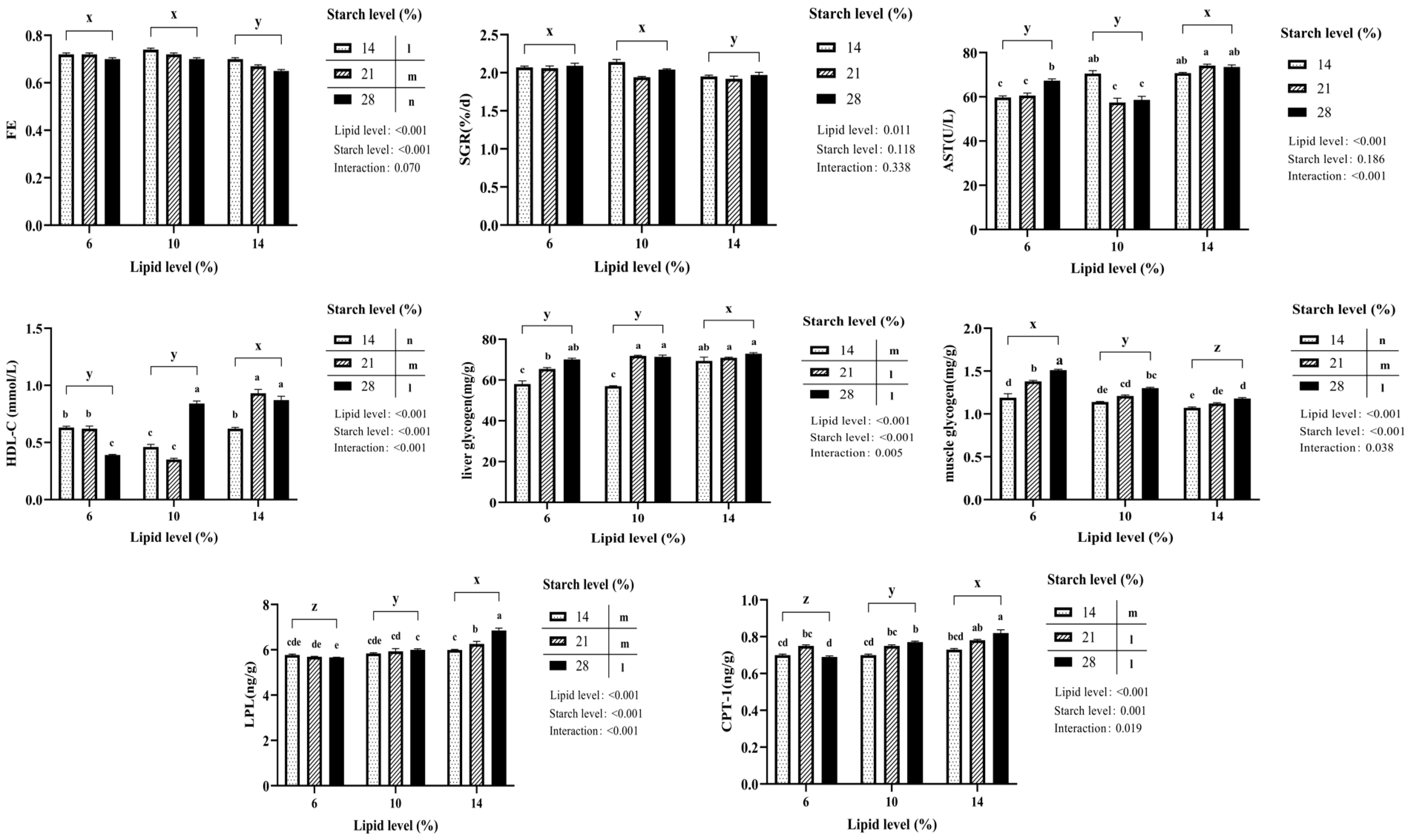
Effects of Varying Dietary Lipid and Starch Levels on Growth Performance, Biochemical Components, and Hepatic Glycolipid Metabolism in Hybrid Grouper (Epinephelus lanceolatus ♂ × E. fuscoguttatus ♀)


Simple Summary
Abstract
1. Introduction
2. Materials and Methods
2.1. Diet Preparation
2.2. Daily Feeding and Management
2.3. Sampling Procedure and Index Measurement
2.4. Index Measurement
2.5. Calculations
2.6. Statistical Analysis
3. Results
3.1. Growth Performance
3.2. Liver and Muscle Composition
3.3. Serum Parameters
3.4. Hepatic Glycolipid Metabolism
4. Discussion
5. Conclusions
Author Contributions
Funding
Institutional Review Board Statement
Informed Consent Statement
Data Availability Statement
Conflicts of Interest
References
- Chen, M.; Ye, J.; Yang, W.; Wang, K. Growth, Feed Utilization and Blood Metabolic Responses to Different Amylose-Amylopectin Ratio Fed Diets in Tilapia (Oreochromis niloticus). Asian Australas. J. Anim. Sci. 2013, 26, 1160–1171. [Google Scholar] [CrossRef] [PubMed]
- Manam, V.K. Fish Feed Nutrition and Its Management in Aquaculture. Int. J. Fish. Aquat. Stud. 2023, 11, 58–61. [Google Scholar] [CrossRef]
- National Research Council. Nutrient Requirements of Fish and Shrimp; National Academies Press: Washington, DC, USA, 2011; p. 13039. [Google Scholar]
- Wang, X.; Chen, M.; Wang, K.; Ye, J. Growth and Metabolic Responses in Nile Tilapia (Oreochromis niloticus) Subjected to Varied Starch and Protein Levels of Diets. Ital. J. Anim. Sci. 2017, 16, 308–316. [Google Scholar] [CrossRef]
- Castro, C.; Corraze, G.; Pérez-Jiménez, A.; Larroquet, L.; Cluzeaud, M.; Panserat, S.; Oliva-Teles, A. Dietary Carbohydrate and Lipid Source Affect Cholesterol Metabolism of European Sea Bass (Dicentrarchus labrax) Juveniles. Br. J. Nutr. 2015, 114, 1143–1156. [Google Scholar] [CrossRef]
- Basto-Silva, C.; Enes, P.; Oliva-Teles, A.; Capilla, E.; Guerreiro, I. Dietary Protein/Carbohydrate Ratio and Feeding Frequency Affect Feed Utilization, Intermediary Metabolism, and Economic Efficiency of Gilthead Seabream (Sparus aurata) Juveniles. Aquaculture 2022, 554, 738182. [Google Scholar] [CrossRef]
- Hemre, G.I.; Mommsen, T.P.; Krogdahl, Å. Carbohydrates in Fish Nutrition: Effects on Growth, Glucose Metabolism and Hepatic Enzymes: Carbohydrates in Fish Nutrition. Aquac. Nutr. 2002, 8, 175–194. [Google Scholar] [CrossRef]
- Yang, X.; Guo, X.; Dong, X.; Yang, Q.; Liu, H.; Zhang, S.; Tan, B.; Chi, S. How Do Different Dietary Carbohydrate/Lipid Ratios Influence Intestinal Morphology and Glycolipid Metabolism Capacity in Hybrid Grouper (Epinephelus fuscoguttatus ♀ × E. lanceolatus ♂). Fishes 2023, 8, 467. [Google Scholar] [CrossRef]
- Yang, Y.; Liu, T.; Zhang, J.; Wang, Y.; Han, T.; Wang, J. Effects of Digestible Carbohydrate Levels on Growth Performance, Feed Utilization, Body Composition, and Biochemical Indices of Juvenile Spotted Knifejaw, Oplegnathus punctatus. Aquac. Rep. 2023, 31, 101653. [Google Scholar] [CrossRef]
- Zhang, X.; Zhang, Y.; Chen, P.; Gu, X.; Wu, X.; Han, J.; Xue, M.; Liang, X. Spotted Seabass, Lateolabrax maculatus Can Utilize the High-Starch Diet by Effectively Regulating the Energy Metabolism. Aquaculture 2021, 543, 736948. [Google Scholar] [CrossRef]
- Zhao, H.; Cao, J.; Chen, X.; Wang, G.; Hu, J.; Chen, B. Effects of Dietary Lipid-to-Carbohydrate Ratio on Growth and Carbohydrate Metabolism in Juvenile Cobia (Rachycentron canadum). Anim. Nutr. 2020, 6, 80–84. [Google Scholar] [CrossRef]
- Zhou, P.; Wang, M.; Xie, F.; Deng, D.-F.; Zhou, Q. Effects of Dietary Carbohydrate to Lipid Ratios on Growth Performance, Digestive Enzyme and Hepatic Carbohydrate Metabolic Enzyme Activities of Large Yellow Croaker (Larmichthys crocea). Aquaculture 2016, 452, 45–51. [Google Scholar] [CrossRef]
- Zhao, L.; Liao, L.; Tang, X.; Liang, J.; Liu, Q.; Luo, W.; Adam, A.A.; Luo, J.; Li, Z.; Yang, S.; et al. High-Carbohydrate Diet Altered Conversion of Metabolites, and Deteriorated Health in Juvenile Largemouth Bass. Aquaculture 2022, 549, 737816. [Google Scholar] [CrossRef]
- Li, S.; Li, Z.; Zhang, J.; Sang, C.; Chen, N. The Impacts of Dietary Carbohydrate Levels on Growth Performance, Feed Utilization, Glycogen Accumulation and Hepatic Glucose Metabolism in Hybrid Grouper (Epinephelus fuscoguttatus ♀ × E. lanceolatus ♂). Aquaculture 2019, 512, 734351. [Google Scholar] [CrossRef]
- Chen, P.; Zhu, Y.; Wu, X.; Gu, X.; Xue, M.; Liang, X. Metabolic Adaptation to High-Starch Diet in Largemouth Bass (Micropterus salmoides) Was Associated with the Restoration of Metabolic Functions via Inflammation, Bile Acid Synthesis and Energy Metabolism. Br. J. Nutr. 2023, 129, 381–394. [Google Scholar] [CrossRef]
- Su, J.; Gong, Y.; Mei, L.; Xi, L.; Chi, S.; Yang, Y.; Jin, J.; Liu, H.; Zhu, X.; Xie, S.; et al. The Characteristics of Glucose Homoeostasis in Grass Carp and Chinese Longsnout Catfish after Oral Starch Administration: A Comparative Study between Herbivorous and Carnivorous Species of Fish. Br. J. Nutr. 2020, 123, 627–641. [Google Scholar] [CrossRef] [PubMed]
- Zhong, L.; Liu, H.; Zhang, H.; Zhang, W.; Li, M.; Huang, Y.; Yao, J.; Huang, X.; Geng, Y.; Chen, D.; et al. High Starch in Diet Leads to Disruption of Hepatic Glycogen Metabolism and Liver Fibrosis in Largemouth Bass (Micropterus salmoides), Which Is Mediated by the PI3K/Akt Signaling Pathway. Front. Physiol. 2022, 13, 880513. [Google Scholar] [CrossRef]
- Chen, Y.-F.; Cao, K.-L.; Huang, H.-F.; Li, X.-Q.; Leng, X.-J. Dietary Effects of Lipid and Protein Levels on Growth, Feed Utilization, Lipid Metabolism, and Antioxidant Capacity of Triploid Rainbow Trout (Oncorhynchus mykiss). Aquac. Nutr. 2023, 2023, 8325440. [Google Scholar] [CrossRef] [PubMed]
- Koshio, S.; Yardim, Ö.; Yigit, M. The Protein Sparing Effects Of High Lipid Levels In Diets For Rainbow Trout (Oncorhynchus mykiss) With Special Reference To Reduction Of Total Nitrogen Excretion. Isr. J. Aquac. Bamidgeh 2002, 54, 79–88. [Google Scholar] [CrossRef]
- Li, P.; Song, Z.; Huang, L.; Sun, Y.; Sun, Y.; Wang, X.; Li, L. Effects of Dietary Protein and Lipid Levels in Practical Formulation on Growth, Feed Utilization, Body Composition, and Serum Biochemical Parameters of Growing Rockfish Sebastes schlegeli. Aquac. Nutr. 2023, 2023, 9970252. [Google Scholar] [CrossRef]
- Liu, X.; Shen, B.; Wang, C.; Peng, J.; Wang, A. Effect of Dietary Carbohydrate-to-Lipid Ratio on Growth, Blood Biochemical Indices, Hepatic Metabolic Enzymes and PEPCK Gene Expression of Juvenile Obscure Puffer (Takifugu obscurus). J. Fish. Chin. 2014, 38, 1149–1158. [Google Scholar]
- Lu, Y.; Zhou, P.; Yuan, Y.; Ma, H.; Zhou, Q. Effects of Different Wheat Starch and Lipid Levels on Growth Performance, Feed Utilization and Hepatic Carbohydrate Metabolism Key Enzymes Activities in Large Yellow Croaker (Larimichthys crocea). J. Fish. Chin. 2017, 41, 297–310. [Google Scholar] [CrossRef]
- Taj, S.; Irm, M.; Jin, M.; Yuan, Y.; Andriamialinirina, H.J.T.; Zhou, Q. Effects of Dietary Carbohydrate to Lipid Ratios on Growth Performance, Muscle Fatty Acid Composition, and Intermediary Metabolism in Juvenile Black Seabream (Acanthopagrus schlegelii). Front. Physiol. 2020, 11, 507. [Google Scholar] [CrossRef] [PubMed]
- Tian, J.; Peng, D.; Wen, H.; Wang, G.; Li, P.; Chen, J.; Sun, Y.; Lu, X.; Wu, F.; Li, Q. A Comparative Study on Protein-sparing Effects among Juvenile Erythroculter ilishaeformis Line, Ancherythroculter nigrocauda Line and Their Hybrid F1 Fed Diets with Different Protein to Carbohydrate Ratios. Aquac. Nutr. 2020, 26, 993–1006. [Google Scholar] [CrossRef]
- Bureau of Fisheries and Fishery Administration; National Fisheries Technology Extension Center; China Society of Fisheries. China Fishery Statistical Yearbook 2024; China Agricultural Press: Beijing, China, 2024.
- Li, S.; Sang, C.; Zhang, J.; Chen, N.; Li, Z.; Jin, P.; Huang, X. Effects of Acute Hyperglycemia Stress on Plasma Glucose, Glycogen Content, and Expressions of Glycogen Synthase and Phosphorylase in Hybrid Grouper (Epinephelus fuscoguttatus ♀ × E. lanceolatus ♂). Fish Physiol. Biochem. 2018, 44, 1185–1196. [Google Scholar] [CrossRef] [PubMed]
- Li, S.; Wang, A.; Li, Z.; Zhang, J.; Sang, C.; Chen, N. Antioxidant Defenses and Non-Specific Immunity at Enzymatic and Transcriptional Levels in Response to Dietary Carbohydrate in a Typical Carnivorous Fish, Hybrid Grouper (Epinephelus fuscoguttatus ♀ × E. lanceolatus ♂). Fish Shellfish Immunol. 2020, 100, 109–116. [Google Scholar] [CrossRef]
- Guo, X. Effects of Dietary Starch Levels and Carbohydrate-to-Lipid Ratios on Growth Performance, Feed Utilization, Body Composition, and Serum Biochemical Indices in Juvenile Hybrid Grouper (Epinephelus fuscoguttatus ♀ × E. lanceolatus ♂). Master’s Thesis, Guangdong Ocean University, Zhanjiang, China, 2020. [Google Scholar]
- Jiang, S.; Wu, X.; Li, W.; Wu, M.; Luo, Y.; Lu, S.; Lin, H. Effects of Dietary Protein and Lipid Levels on Growth, Feed Utilization, Body and Plasma Biochemical Compositions of Hybrid Grouper (Epinephelus lanceolatus ♂ × Epinephelus fuscoguttatus ♀) Juveniles. Aquaculture 2015, 446, 148–155. [Google Scholar] [CrossRef]
- Rahimnejad, S.; Bang, I.C.; Park, J.-Y.; Sade, A.; Choi, J.; Lee, S.-M. Effects of Dietary Protein and Lipid Levels on Growth Performance, Feed Utilization and Body Composition of Juvenile Hybrid Grouper, Epinephelus fuscoguttatus × E. lanceolatus. Aquaculture 2015, 446, 283–289. [Google Scholar] [CrossRef]
- Huang, Y.; Li, J.; Wang, X.; Wang, K.; Ye, J. Effects of Different Dietary Protein and Starch Levels on the Growth and Liver Metabolism of Grouper (Epinephelus coioides). J. Fish. Chin. 2017, 41, 746–756. [Google Scholar] [CrossRef]
- Han, Z.; Gong, Y.; Zhang, N.; Sun, Z.; Liu, S.; Huang, X.; Chen, N.; Li, S. Effects of Dietary Carbohydrate and Lipid Levels on Growth Performance, Hepatic Histology and Antioxidant Capacity and Flesh Texture of Mandarin Fish (Siniperca chuatsi). Br. J. Nutr. 2025, 133, 299–309. [Google Scholar] [CrossRef]
- Li, S.; Yin, J.; Zhang, H.; Liu, Z.; Chen, N. Effects of Dietary Carbohydrate and Lipid Levels on Growth Performance, Feed Utilization, Body Composition and Non-specific Immunity of Large Yellow Croaker (Larimichthys crocea). Aquac. Nutr. 2019, 25, 995–1005. [Google Scholar] [CrossRef]
- Proença, D.C.; Sena, M.F.; Araújo, J.G.; Bueno, G.W.; Guimarães, I.G. Contribution of Amino Acids in Cereal Grain Products to Precision Feed Formulation for Tambaqui (Colossoma macropomum) Using a Digestibility Approach. Anim. Physiol. Nutr. 2025, 109, 1264–1272. [Google Scholar] [CrossRef] [PubMed]
- Chen, W.; Song, T.; Li, D.; Chen, M.; Wang, P.; Ye, J. Effect of Dietary Clostridium Butyricum Supplementation on Growth Performance, Immune Function, and Intestinal Health of Hybrid Grouper (Epinephelus fuscoguttatus ♀ × Epinephelus lanceolatus ♂). Front. Immunol. 2025, 16, 1557256. [Google Scholar] [CrossRef]
- Qin, Y.; He, L.; Wang, Y.; Li, D.; Chen, W.; Ye, J. Growth Performance, Fatty Acid Composition, and Lipid Metabolism Are Altered in Groupers (Epinephelus coioides) by Dietary Fish Oil Replacement with Palm Oil. Anim. Nutr. 2022, 8, 102–113. [Google Scholar] [CrossRef]
- Özel, O.T.; Çankiriligil, E.C.; Ertürk-Gürkan, S.; Coskun, I.; Türe, M. Influence of Laurel (Laurus nobilis) Essential Oil on Gut Function of Black Sea Salmon (Salmo labrax) Juveniles. Trop. Anim. Health Prod. 2022, 54, 390. [Google Scholar] [CrossRef]
- Xu, J.; Wang, F.; Hu, C.; Lai, J.; Xie, S.; Yu, K.; Jiang, F. Dietary High Plant Protein and High Lipid Impaired the Intestine Health of Grouper by Disrupting Oxidative Stress, Immune Response, and Protein Metabolism. Aquac. Rep. 2024, 39, 102389. [Google Scholar] [CrossRef]
- Peres, H.; Oliva-Teles, A. Effect of Dietary Lipid Level on Growth Performance and Feed Utilization by European Sea Bass Juveniles (Dicentrarchus labrax). Aquaculture 1999, 179, 325–334. [Google Scholar] [CrossRef]
- Ren, M.; Ai, Q.; Mai, K.; Ma, H.; Wang, X. Effect of Dietary Carbohydrate Level on Growth Performance, Body Composition, Apparent Digestibility Coefficient and Digestive Enzyme Activities of Juvenile Cobia, Rachycentron canadum L.: Effect of Dietary Carbohydrate Level on Growth Performance. Aquac. Res. 2011, 42, 1467–1475. [Google Scholar] [CrossRef]
- Cao, X.; Huang, Y.; Chu, X.; Wang, X.; Zheng, S.; Shi, X.; Xiang, X.; Miao, L.; Liu, W.; Jiang, G. Differential Pathways to Hepatic Steatosis in Fish: Divergent Molecular Mechanisms Underlying High-Carbohydrate versus High-Lipid Diet-Induced Lipid Accumulation. Aquac. Rep. 2025, 45, 103090. [Google Scholar] [CrossRef]
- Duan, Q.; Mai, K.; Zhong, H.; Si, L.; Wang, X. Studies on the Nutrition of the Large Yellow Croaker, Pseudosciaena crocea R. I: Growth Response to Graded Levels of Dietary Protein and Lipid: Dietary Protein and Lipid Levels for Yellow Croaker. Aquac. Res. 2001, 32, 46–52. [Google Scholar] [CrossRef]
- Fei, S.; Xia, Y.; Chen, Z.; Liu, C.; Liu, H.; Han, D.; Jin, J.; Yang, Y.; Zhu, X.; Xie, S. A High-Fat Diet Alters Lipid Accumulation and Oxidative Stress and Reduces the Disease Resistance of Overwintering Hybrid Yellow Catfish (Pelteobagrus fulvidraco♀ × P. vachelli♂). Aquac. Rep. 2022, 23, 101043. [Google Scholar] [CrossRef]
- Li, S.; Sang, C.; Turchini, G.M.; Wang, A.; Zhang, J.; Chen, N. Starch in Aquafeeds: The Benefits of a High Amylose to Amylopectin Ratio and Resistant Starch Content in Diets for the Carnivorous Fish, Largemouth Bass (Micropterus salmoides). Br. J. Nutr. 2020, 124, 1145–1155. [Google Scholar] [CrossRef]
- Shen, Y.; Zhao, W.; Monroig, Ó.; Bao, Y.; Zhu, T.; Jiao, L.; Sun, P.; Tocher, D.R.; Zhou, Q.; Jin, M. High-Fat-Diet Induced Inflammation and Apoptosis via Activation of Ire1α in Liver and Hepatocytes of Black Seabream (Acanthopagrus schlegelii). Fish Shellfish Immunol. 2023, 143, 109212. [Google Scholar] [CrossRef]
- Shen, Y.; Li, X.; Bao, Y.; Zhu, T.; Wu, Z.; Yang, B.; Jiao, L.; Zhou, Q.; Jin, M. Lipid Metabolic Disorders and Physiological Stress Caused by a High-Fat Diet Have Lipid Source-Dependent Effects in Juvenile Black Seabream Acanthopagrus schlegelii. Fish Physiol. Biochem. 2022, 48, 955–971. [Google Scholar] [CrossRef]
- Wang, T.; Xu, R.; Qiao, F.; Du, Z.-Y.; Zhang, M.-L. Effects of Mannan Oligosaccharides (MOS) on Glucose and Lipid Metabolism of Largemouth Bass (Micropterus salmoides) Fed with High Carbohydrate Diet. Anim. Feed Sci. Technol. 2022, 292, 115449. [Google Scholar] [CrossRef]
- Yang, Y.; Han, T.; Xiao, J.; Li, X.; Wang, J. Transcriptome Analysis Reveals Carbohydrate-Mediated Liver Immune Responses in Epinephelus akaara. Sci. Rep. 2018, 8, 639. [Google Scholar] [CrossRef]
- Suo, X.; Yan, X.; Tan, B.; Pan, S.; Li, T.; Liu, H.; Huang, W.; Zhang, S.; Yang, Y.; Dong, X. Lipid Metabolism Disorders of Hybrid Grouper (♀Epinephelus fuscointestinestatus × ♂E. lanceolatus) Induced by High-Lipid Diet. Front. Mar. Sci. 2022, 9, 990193. [Google Scholar] [CrossRef]
- Borges, P.; Valente, L.M.P.; Véron, V.; Dias, K.; Panserat, S.; Médale, F. High Dietary Lipid Level Is Associated with Persistent Hyperglycaemia and Downregulation of Muscle Akt-mTOR Pathway in Senegalese Sole (Solea senegalensis). PLoS ONE 2014, 9, e102196. [Google Scholar] [CrossRef]
- Meng, Y.; Tian, H.; Hu, X.; Han, B.; Li, X.; Li, C.; Ma, R. Effects of Dietary Lipid Levels on the Lipid Deposition and Metabolism of Subadult Triploid Rainbow Trout (Oncorhynchus mykiss). Aquac. Nutr. 2022, 2022, 6924835. [Google Scholar] [CrossRef]
- Yoshimatsu, T.; Furuichi, M.; Kitajima, C. Effects of Dietary Lipid Levels on the Growth, Efficiency of Feed Utilizaion and Body Composition of Young Redlip Mullet. J. Fac. Agric. Kyushu Univ. 1993, 37, 273–281. [Google Scholar] [CrossRef] [PubMed]
- Tocher, D.R. Metabolism and Functions of Lipids and Fatty Acids in Teleost Fish. Rev. Fish. Sci. 2003, 11, 107–184. [Google Scholar] [CrossRef]
- Turchini, G.M.; Ng, W.-K.; Tocher, D.R. Fish Oil Replacement and Alternative Lipid Sources in Aquaculture Feeds; CRC Press: Boca Raton, FL, USA, 2011. [Google Scholar]
- Enes, P.; Panserat, S.; Kaushik, S.; Oliva-Teles, A. Nutritional Regulation of Hepatic Glucose Metabolism in Fish. Fish Physiol. Biochem. 2009, 35, 519–539. [Google Scholar] [CrossRef]
- Polakof, S.; Panserat, S.; Soengas, J.L.; Moon, T.W. Glucose Metabolism in Fish: A Review. J. Comp. Physiol. B 2012, 182, 1015–1045. [Google Scholar] [CrossRef]
- Liu, T.; Dong, F.; Sun, Y.; Su, H.; Zheng, P.; Chen, Q.; Han, T.; Wang, J. Effect of Dietary Lipid Level on Growth Performance, Feed Utilization, and Body Composition of Juvenile Kelp Grouper Epinephelus moara. Fishes 2025, 10, 244. [Google Scholar] [CrossRef]
- Cai, C.; Chen, L. The Metabolism of Dietary Carbohydrate by Fish. Acta Hydrobiol. Sin. 2008, 32, 592. [Google Scholar] [CrossRef]
- Yan, J.; Liao, K.; Wang, T.; Mai, K.; Xu, W.; Ai, Q. Dietary Lipid Levels Influence Lipid Deposition in the Liver of Large Yellow Croaker (Larimichthys crocea) by Regulating Lipoprotein Receptors, Fatty Acid Uptake and Triacylglycerol Synthesis and Catabolism at the Transcriptional Level. PLoS ONE 2015, 10, e0129937. [Google Scholar] [CrossRef]
- Yu, A.; Hao, Z.; Wei, X.; Tan, X.; Zito, E.; Zheng, H.; Luo, Z. High Fat Diet (HFD) Induced Hepatic Lipogenic Metabolism and Lipotoxicity via Parkin-Dependent Mitophagy and Errα Signal of Pelteobagrus fulvidraco. J. Anim. Sci. Biotechnol. 2025, 16, 71. [Google Scholar] [CrossRef]
- Ekmann, K.S.; Dalsgaard, J.; Holm, J.; Campbell, P.J.; Skov, P.V. Glycogenesis and de novo Lipid Synthesis from Dietary Starch in Juvenile Gilthead Sea Bream (Sparus aurata) Quantified with Stable Isotopes. Br. J. Nutr. 2013, 109, 2135–2146. [Google Scholar] [CrossRef] [PubMed]
- Chen, G.; Qian, J.; Liu, H.; Tan, B.; Dong, X.; Yang, Q.; Chi, S.; Zhang, S. Metabolic Responses of Hybrid Grouper (♀ Epinephelus fuscoguttatus × ♂ E. lanceolatus) Induced by Different Feeding Modes: Effects on Growth, Serum Biochemical Indices, Intestinal Digestion and Hepatic Metabolism of Glucose and Lipid. Aquac. Res. 2022, 53, 2708–2723. [Google Scholar] [CrossRef]
- Zhou, M.; Liu, H.; Lu, B.; Li, B.; Huang, W.; Tan, B.; Yang, Y.; Dong, X.; Zhang, H. Lycopene Alleviates the Adverse Effects of Feeding High-Lipid Diets to Hybrid Grouper (♀Epinephelus fuscoguttatus × ♂E. lanceolatus). Aquac. Nutr. 2023, 2023, 8814498. [Google Scholar] [CrossRef] [PubMed]
- Catacutan, M.R.; Coloso, R.M. Growth of Juvenile Asian Seabass, Lates calcarifer, Fed Varying Carbohydrate and Lipid Levels. Aquaculture 1997, 149, 137–144. [Google Scholar] [CrossRef]
- Hocquette, J.F.; Gondret, F.; Baéza, E.; Médale, F.; Jurie, C.; Pethick, D.W. Intramuscular Fat Content in Meat-Producing Animals: Development, Genetic and Nutritional Control, and Identification of Putative Markers. Animal 2010, 4, 303–319. [Google Scholar] [CrossRef]
- Xu, J.; Huang, B.; Chi, S.; Zhang, S.; Cao, J.; Tan, B.; Xie, S. Replacement of Dietary Fishmeal with Clostridium Autoethanogenum Protein on Lipidomics and Lipid Metabolism in Muscle of Pearl Gentian Grouper. Aquac. Nutr. 2023, 2023, 6723677. [Google Scholar] [CrossRef]
- Song, Y.; Alami-Durante, H.; Skiba-Cassy, S.; Marandel, L.; Panserat, S. Higher Glycolytic Capacities in Muscle of Carnivorous Rainbow Trout Juveniles after High Dietary Carbohydrate Stimulus at First Feeding. Nutr. Metab. 2019, 16, 77. [Google Scholar] [CrossRef]
- Castro, C.; Corraze, G.; Firmino-Diógenes, A.; Larroquet, L.; Panserat, S.; Oliva-Teles, A. Regulation of Glucose and Lipid Metabolism by Dietary Carbohydrate Levels and Lipid Sources in Gilthead Sea Bream Juveniles. Br. J. Nutr. 2016, 116, 19–34. [Google Scholar] [CrossRef]
- Liu, J.; Pan, M.; Huang, D.; Wu, J.; Liu, Y.; Guo, Y.; Zhang, W.; Mai, K. High Glucose Induces Apoptosis, Glycogen Accumulation and Suppresses Protein Synthesis in Muscle Cells of Olive Flounder Paralichthys olivaceus. Br. J. Nutr. 2022, 127, 1601–1612. [Google Scholar] [CrossRef]
- Ahmad, M.; Qureshi, T.A.; Singh, A.B. Effect of Dietary Protein, Lipid and Carbohydrate Contents on the Carcass Composition of Cyprinus carpio Fingerlings. Afr. J. Biotechnol. 2012, 11, 8353–8360. [Google Scholar]
- Duran, B.O.S.; Zanella, B.T.T.; Perez, E.S.; Mareco, E.A.; Blasco, J.; Dal-Pai-Silva, M.; Garcia De La Serrana, D. Amino Acids and IGF1 Regulation of Fish Muscle Growth Revealed by Transcriptome and microRNAome Integrative Analyses of Pacu (Piaractus mesopotamicus) Myotubes. Int. J. Mol. Sci. 2022, 23, 1180. [Google Scholar] [CrossRef]
- Yi, X.; Zhang, F.; Xu, W.; Li, J.; Zhang, W.; Mai, K. Effects of Dietary Lipid Content on Growth, Body Composition and Pigmentation of Large Yellow Croaker Larimichthys croceus. Aquaculture 2014, 434, 355–361. [Google Scholar] [CrossRef]
- Chen, G.; Qian, J.; Liu, H.; Tan, B.; Dong, X.; Yang, Q.; Chi, S.; Zhang, S. Dietary Carbohydrate-to-lipid Ratios Modulate Juvenile Hybrid Grouper (♀ Epinephelus fuscoguttatus × ♂ E. lanceolatus): Effects on Growth, Serum Biochemistry, Intestinal Digestion and Hepatic Metabolism of Glucose and Lipid. Aquac. Nutr. 2021, 27, 1370–1382. [Google Scholar] [CrossRef]
- Liu, H.; Yang, J.; Dong, X.; Tan, B.; Yang, Q.; Chi, S.; Liu, H.; Zhang, S.; Yang, Y. Effects of Dietary Carbohydrate Level on Growth Performance, Body Composition, Plasma Biochemical Parameters and Intestinal and Liver Enzyme Activities of Orange-Spotted Grouper (Epinephelus coioides). Chin. J. Anim. Nutr. 2020, 32, 357–371. [Google Scholar] [CrossRef]
- Cai, W.; Luo, X.; Li, J.; Duan, Y.; Wei, Y.; Xing, Y.; Hu, Z.; Zhu, C. Optimal Dietary α-Starch Requirement and Its Effects on Growth and Metabolic Regulation in Chinese Hook Snout Carp (Opsariichthys bidens). Biology 2025, 14, 1687. [Google Scholar] [CrossRef] [PubMed]
- Zheng, Y.; Lu, Q.; Cao, J.; Han, G.; Liu, Y.; Liu, H.; Jin, J.; Zhang, Z.; Yang, Y.; Zhu, X.; et al. Mangiferin Reduces High-Starch Diet-Induced Lipid Accumulation and Liver Damage by Modulating Triglyceride Metabolism in Largemouth Bass (Micropterus salmoides). Aquac. Rep. 2024, 37, 102266. [Google Scholar] [CrossRef]
- Castro, C.; Corraze, G.; Basto, A.; Larroquet, L.; Panserat, S.; Oliva-Teles, A. Dietary Lipid and Carbohydrate Interactions: Implications on Lipid and Glucose Absorption, Transport in Gilthead Sea Bream (Sparus aurata) Juveniles. Lipids 2016, 51, 743–755. [Google Scholar] [CrossRef]
- Brett, J.R.; Groves, T.D.D. Physiological Energetics. In Fish Physiology; Elsevier: Amsterdam, The Netherlands, 1979; Volume 8, pp. 279–352. [Google Scholar]
- Walton, M.J. Metabolic Effects of Feeding a High Protein/Low Carbohydrate Diet as Compared to a Low Protein/High Carbohydrate Diet to Rainbow trout Salmo gairdneri. Fish Physiol. Biochem. 1986, 1, 7–15. [Google Scholar] [CrossRef]
- Guo, X.; Tan, B.; Chi, S.; Dong, X.; Yang, Q.; Liu, H.; Zhang, S. Correlation Analysis of Fish Growth Performance and Serum Hormone and Digestive Enzyme Activities of Juvenile Pearl Gentian Grouper (Epinephelus lanceolatus♂ × E. fuscoguttatus♀) Fed with Different Protein Levels Diets. J. Fish. Chin. 2019, 43, 1808–1820. [Google Scholar] [CrossRef]
- Song, T.; Liang, X.; Wang, H.; Xue, M.; Wang, J. Gut Microbiota-Bile Acid Crosstalk and Metabolic Fatty Liver in Spotted Seabass (Lateolabrax maculatus): The Role of a Cholesterol, Taurine and Glycine Supplement. Anim. Nutr. 2024, 17, 87–99. [Google Scholar] [CrossRef]
- Metón, I.; Mediavilla, D.; Caseras, A.; Cantó, E.; Fernández, F.; Baanante, I.V. Effect of Diet Composition and Ration Size on Key Enzyme Activities of Glycolysis–Gluconeogenesis, the Pentose Phosphate Pathway and Amino Acid Metabolism in Liver of Gilthead Sea Bream (Sparus aurata). Br. J. Nutr. 1999, 82, 223–232. [Google Scholar] [CrossRef]
- Schlaepfer, I.R.; Joshi, M. CPT1A-Mediated Fat Oxidation, Mechanisms, and Therapeutic Potential. Endocrinology 2020, 161, bqz046. [Google Scholar] [CrossRef]
- Schroeder, B.; Vander Steen, T.; Espinoza, I.; Venkatapoorna, C.M.K.; Hu, Z.; Silva, F.M.; Regan, K.; Cuyàs, E.; Meng, X.W.; Verdura, S.; et al. Fatty Acid Synthase (FASN) Regulates the Mitochondrial Priming of Cancer Cells. Cell Death Dis. 2021, 12, 977. [Google Scholar] [CrossRef]
- Basu, D.; Goldberg, I.J. Regulation of Lipoprotein Lipase-Mediated Lipolysis of Triglycerides. Curr. Opin. Lipidol. 2020, 31, 154–160. [Google Scholar] [CrossRef]
- Fernández-Muela, M.; Bermejo-Poza, R.; Cabezas, A.; Pérez, C.; González De Chavarri, E.; Díaz, M.T.; Torrent, F.; Villarroel, M.; De La Fuente, J. Effects of Fasting on Intermediary Metabolism Enzymes in the Liver and Muscle of Rainbow Trout. Fishes 2023, 8, 53. [Google Scholar] [CrossRef]
- Viegas, I.; Trenkner, L.H.; Rito, J.; Palma, M.; Tavares, L.C.; Jones, J.G.; Glencross, B.D.; Wade, N.M. Impact of Dietary Starch on Extrahepatic Tissue Lipid Metabolism in Farmed European (Dicentrarchus labrax) and Asian Seabass (Lates calcarifer). Comp. Biochem. Physiol. Part A Mol. Integr. Physiol. 2019, 231, 170–176. [Google Scholar] [CrossRef]
- Basto, A.; Valente, L.M.P.; Sousa, V.; Conde-Sieira, M.; Soengas, J.L. Total Fishmeal Replacement by Defatted Tenebrio molitor Larvae Meal Induces Alterations in Intermediary Metabolism of European Sea Bass (Dicentrarchus labrax). J. Anim. Sci. 2023, 101, skad040. [Google Scholar] [CrossRef]
- Kirchner, S.; Panserat, S.; Lim, P.L.; Kaushik, S.; Ferraris, R.P. The Role of Hepatic, Renal and Intestinal Gluconeogenic Enzymes in Glucose Homeostasis of Juvenile Rainbow Trout. J. Comp. Physiol. B 2008, 178, 429–438. [Google Scholar] [CrossRef] [PubMed]
- Li, S.; Liu, H.; Tan, B.; Dong, X.; Yang, Q.; Chi, S.; Zhang, S. Effects of Dietary Carbohydrate Levels on the Gene Expression and the Activity of Peck in Marine Fishes with Different Food Habits. Acta Hydrobiol. Sin. 2015, 39, 80–89. [Google Scholar] [CrossRef]
- Panserat, S.; Plagnes-Juan, E.; Kaushik, S. Gluconeogenic Enzyme Gene Expression Is Decreased by Dietary Carbohydrates in Common Carp (Cyprinus carpio) and Gilthead Seabream (Sparus aurata). Biochim. Biophys. Acta (BBA)-Gene Struct. Expr. 2002, 1579, 35–42. [Google Scholar] [CrossRef]
- Kumkhong, S.; Marandel, L.; Plagnes-Juan, E.; Veron, V.; Boonanuntanasarn, S.; Panserat, S. Glucose Injection Into Yolk Positively Modulates Intermediary Metabolism and Growth Performance in Juvenile Nile Tilapia (Oreochromis niloticus). Front. Physiol. 2020, 11, 286. [Google Scholar] [CrossRef]
- Zheng, L.; Wang, Z.; Zhang, B.; Yan, L.; Wang, P.; Zhao, C.; Lin, H.; Qiu, L.; Zhou, C. Effects of High Dietary Carbohydrate Levels on Growth Performance, Enzyme Activities, Expression of Genes Related to Liver Glucose Metabolism, and the Intestinal Microbiota of Lateolabrax maculatus Juveniles. Fishes 2023, 8, 431. [Google Scholar] [CrossRef]
- Wade, N.M.; Trenkner, L.H.; Viegas, I.; Tavares, L.C.; Palma, M.; Skiba-Cassy, S.; Dias, K.; Vachot, C.; Araújo, B.C.; Bourne, N.; et al. Dietary Starch Promotes Hepatic Lipogenesis in Barramundi (Lates calcarifer). Br. J. Nutr. 2020, 124, 363–373. [Google Scholar] [CrossRef]
- Deng, K.; Pan, M.; Liu, J.; Yang, M.; Gu, Z.; Zhang, Y.; Liu, G.; Liu, D.; Zhang, W.; Mai, K. Chronic Stress of High Dietary Carbohydrate Level Causes Inflammation and Influences Glucose Transport through SOCS3 in Japanese Flounder Paralichthys olivaceus. Sci. Rep. 2018, 8, 7415. [Google Scholar] [CrossRef]
- Li, L.; Pan, L.; Lin, Z.; Wen, J.; Tan, B.; Liu, H.; Hu, Y. Metformin Improves Insulin Resistance, Liver Healthy and Abnormal Hepatic Glucolipid Metabolism via IR/PI3K/AKT Pathway in Ctenopharyngodon idella Fed a High-Carbohydrate Diet. Comp. Biochem. Physiol. C Toxicol. Pharmacol. 2024, 283, 109976. [Google Scholar] [CrossRef] [PubMed]


| Ingredients (%) | D1 (L6/S14) | D2 (L6/S21) | D3 (L6/S28) | D4 (L10/S14) | D5 (L10/S21) | D6 (L10/S28) | D7 (L14/S14) | D8 (L14/S21) | D9 (L14/S28) |
|---|---|---|---|---|---|---|---|---|---|
| Fish meal | 20 | 20 | 20 | 20 | 20 | 20 | 20 | 20 | 20 |
| Soy protein isolate | 19 | 19 | 19 | 19 | 19 | 19 | 19 | 19 | 19 |
| Wheat gluten | 7.5 | 7.5 | 7.5 | 7.5 | 7.5 | 7.5 | 7.5 | 7.5 | 7.5 |
| Casein | 9.8 | 9.8 | 9.8 | 9.8 | 9.8 | 9.8 | 9.8 | 9.8 | 9.8 |
| Gelatin | 2 | 2 | 2 | 2 | 2 | 2 | 2 | 2 | 2 |
| Peru fish/soy oil (1:1) | 1.33 | 1.33 | 1.33 | 5.43 | 5.43 | 5.43 | 9.53 | 9.53 | 9.53 |
| Soy lecithin | 2 | 2 | 2 | 2 | 2 | 2 | 2 | 2 | 2 |
| Corn starch | 14 | 21 | 28 | 14 | 21 | 28 | 14 | 21 | 28 |
| Vitamin premix | 0.3 | 0.3 | 0.3 | 0.3 | 0.3 | 0.3 | 0.3 | 0.3 | 0.3 |
| Mineral premix | 0.2 | 0.2 | 0.2 | 0.2 | 0.2 | 0.2 | 0.2 | 0.2 | 0.2 |
| Choline chloride | 0.1 | 0.1 | 0.1 | 0.1 | 0.1 | 0.1 | 0.1 | 0.1 | 0.1 |
| Mold inhibitor | 0.05 | 0.05 | 0.05 | 0.05 | 0.05 | 0.05 | 0.05 | 0.05 | 0.05 |
| Ca(H2PO4)2 | 1.5 | 1.5 | 1.5 | 1.5 | 1.5 | 1.5 | 1.5 | 1.5 | 1.5 |
| Stay-C 35% | 0.02 | 0.02 | 0.02 | 0.02 | 0.02 | 0.02 | 0.02 | 0.02 | 0.02 |
| Zeolite | 11.1 | 7.6 | 4.1 | 9.05 | 5.55 | 2.05 | 7 | 3.5 | 0 |
| Cellulose | 11.1 | 7.6 | 4.1 | 9.05 | 5.55 | 2.05 | 7 | 3.5 | 0 |
| Nutrient levels | |||||||||
| DM (%) | 96.09 | 95.78 | 95.41 | 95.58 | 95.33 | 95.09 | 95.38 | 95.04 | 94.72 |
| CP (%) | 46.2 | 45.9 | 45.9 | 46.1 | 46.1 | 46.2 | 46.2 | 46.2 | 45.9 |
| CL (%) | 6.19 | 6.16 | 6.08 | 10.06 | 10.02 | 10.18 | 14.09 | 14.15 | 13.97 |
| Ash (%) | 14.72 | 11.82 | 8.83 | 13.11 | 10.03 | 7.09 | 11.25 | 8.29 | 5.31 |
| NFE (%) | 15.88 | 23.51 | 30.32 | 15.69 | 23.14 | 30.07 | 16.26 | 23.45 | 30.93 |
| Starch (%) | 14.25 | 21.72 | 28.46 | 14.13 | 21.44 | 28.21 | 14.36 | 21.64 | 28.91 |
| GE (MJ/kg) | 17.98 | 18.74 | 19.52 | 19.31 | 20.13 | 20.98 | 20.72 | 21.51 | 22.27 |
| DE (MJ/kg) | 14.03 | 14.67 | 15.38 | 15.43 | 16.02 | 16.77 | 16.80 | 17.47 | 18.03 |
| Lipid Level (%) | Starch Level (%) | IBW (g/Fish) | FBW (g/Fish) | SR (%) | GR (%) | HSI (%) | VSI (%) | CF (g/cm3) |
|---|---|---|---|---|---|---|---|---|
| 6 | 14 | 19.05 ± 0.06 | 64.33 ± 0.98 | 97.33 ± 1.33 | 194.23 ± 3.68 | 3.10 ± 0.08 | 7.39 ± 0.17 d | 2.74 ± 0.09 b |
| 21 | 18.96 ± 0.06 | 63.60 ± 1.83 | 100.00 ± 0.00 | 204.17 ± 11.15 | 3.79 ± 0.23 | 8.25 ± 0.36 cd | 2.43 ± 0.08 c | |
| 28 | 18.98 ± 0.07 | 64.00 ± 1.66 | 97.33 ± 1.33 | 197.21 ± 9.20 | 3.73 ± 0.19 | 8.23 ± 0.35 cd | 2.37 ± 0.02 c | |
| 10 | 14 | 19.15 ± 0.08 | 64.87 ± 2.78 | 96.00 ± 0.00 | 195.76 ± 14.44 | 3.49 ± 0.20 | 8.56 ± 0.35 bc | 2.34 ± 0.04 c |
| 21 | 19.23 ± 0.09 | 58.60 ± 1.50 | 100.00 ± 0.00 | 173.40 ± 3.89 | 3.80 ± 0.25 | 8.92 ± 0.32 abc | 2.25 ± 0.02 c | |
| 28 | 19.11 ± 0.10 | 62.73 ± 0.73 | 97.33 ± 1.33 | 200.52 ± 3.11 | 4.09 ± 0.20 | 9.17 ± 0.34 abc | 2.28 ± 0.08 c | |
| 14 | 14 | 19.08 ± 0.09 | 59.97 ± 1.15 | 100.00 ± 0.00 | 178.36 ± 8.66 | 3.68 ± 0.01 | 8.86 ± 0.20 abc | 2.43 ± 0.12 c |
| 21 | 19.00 ± 0.05 | 58.90 ± 1.92 | 100.00 ± 0.00 | 173.71 ± 8.93 | 4.12 ± 0.31 | 9.61 ± 0.29 a | 2.89 ± 0.11 b | |
| 28 | 18.98 ± 0.08 | 59.17 ± 2.78 | 98.67 ± 0.67 | 185.87 ± 14.67 | 4.03 ± 0.16 | 9.51 ± 0.34 ab | 3.34 ± 0.13 a | |
| Main effects | ||||||||
| Lipid level | 6 | 198.54 ± 4.55 x | 3.54 ± 0.14 | 7.95 ± 0.21 y | 2.51 ± 0.7 y | |||
| 10 | 189.89 ± 5.82 xy | 3.79 ± 0.14 | 8.88 ± 0.18 x | 2.29 ± 0.03 z | ||||
| 14 | 179.32 ± 5.83 y | 3.95 ± 0.12 | 9.32 ± 0.18 x | 2.89 ± 0.14 x | ||||
| Starch level | 14 | 189.45 ± 5.42 | 3.42 ± 0.11 m | 8.27 ± 0.24 m | 2.50 ± 0.08 | |||
| 21 | 183.76 ± 6.66 | 3.90 ± 0.14 L | 8.92 ± 0.25 L | 2.52 ± 0.10 | ||||
| 28 | 194.53 ± 5.54 | 3.95 ± 0.11 L | 8.97 ± 0.26 L | 2.66 ± 0.18 | ||||
| Two-way ANOVA (p-value) | ||||||||
| Lipid level | 0.036 | 0.066 | <0.001 | <0.001 | ||||
| Starch level | 0.306 | 0.008 | 0.015 | 0.060 | ||||
| Interaction | 0.289 | 0.774 | 0.915 | <0.001 | ||||
| Lipid Level (%) | Starch Level (%) | Liver | Muscle | ||||
|---|---|---|---|---|---|---|---|
| Moisture | Lipid | Protein | Moisture | Lipid | Protein | ||
| 6 | 14 | 62.95 ± 1.11 | 9.15 ± 0.10 | 17.70 ± 0.25 a | 74.94 ± 0.14 | 7.45 ± 0.24 e | 20.92 ± 0.21 c |
| 21 | 63.81 ± 2.18 | 8.77 ± 0.31 | 16.10 ± 0.15 b | 74.63 ± 0.08 | 7.37 ± 0.12 e | 21.38 ± 0.02 b | |
| 28 | 64.75 ± 0.58 | 9.18 ± 0.25 | 15.23 ± 0.20 c | 74.77 ± 0.16 | 6.60 ± 0.09 f | 21.82 ± 0.01 a | |
| 10 | 14 | 64.06 ± 0.58 | 10.69 ± 0.52 | 13.90 ± 0.23 e | 74.93 ± 0.13 | 10.00 ± 0.24 c | 21.29 ± 0.02 b |
| 21 | 63.82 ± 0.91 | 9.33 ± 1.02 | 12.80 ± 0.27 f | 74.81 ± 0.16 | 9.69 ± 0.13 c | 21.34 ± 0.06 b | |
| 28 | 62.92 ± 0.15 | 10.54 ± 1.18 | 14.60 ± 0.17 d | 74.99 ± 0.25 | 8.56 ± 0.13 d | 21.41 ± 0.03 b | |
| 14 | 14 | 64.78 ± 0.34 | 11.04 ± 0.73 | 10.87 ± 0.09 h | 74.62 ± 0.24 | 12.67 ± 0.19 b | 21.54 ± 0.03 b |
| 21 | 63.88 ± 0.43 | 11.18 ± 0.24 | 12.57 ± 0.20 fg | 75.01 ± 0.21 | 13.31 ± 0.12 a | 21.38 ± 0.04 b | |
| 28 | 63.82 ± 1.17 | 11.17 ± 0.31 | 12.03 ± 0.18 g | 75.17 ± 0.06 | 13.33 ± 0.38 a | 20.76 ± 0.08 c | |
| Main effects | |||||||
| Lipid level | 6 | 63.83 ± 0.77 | 9.03 ± 0.13 y | 16.34 ± 0.38 x | 74.78 ± 0.08 | 7.14 ± 0.16 z | 21.37 ± 0.14 |
| 10 | 63.60 ± 0.36 | 10.19 ± 0.52 x | 13.77 ± 0.29 y | 74.91 ± 0.10 | 9.41 ± 0.24 y | 21.35 ± 0.03 | |
| 14 | 64.16 ± 0.40 | 11.13 ± 0.24 x | 11.82 ± 0.26 z | 74.93 ± 0.12 | 13.11 ± 0.17 x | 21.23 ± 0.12 | |
| Starch level | 14 | 63.93 ± 0.46 | 10.29 ± 0.39 | 14.16 ± 0.99 | 74.83 ± 0.10 | 10.04 ± 0.76 L | 21.25 ± 0.11 |
| 21 | 63.84 ± 0.69 | 9.76 ± 0.48 | 13.82 ± 0.58 | 74.81 ± 0.10 | 10.12 ± 1.87 L | 21.37 ± 0.02 | |
| 28 | 63.83 ± 0.46 | 10.30 ± 0.46 | 13.96 ± 0.50 | 74.98 ± 0.11 | 9.50 ± 1.00 m | 21.33 ± 0.16 | |
| Two-way ANOVA (p-value) | |||||||
| Lipid level | 0.797 | 0.003 | <0.001 | 0.511 | <0.001 | 0.087 | |
| Starch level | 0.991 | 0.499 | 0.153 | 0.459 | 0.002 | 0.239 | |
| Interaction | 0.592 | 0.797 | <0.001 | 0.235 | 0.001 | <0.001 | |
| Lipid Level (%) | Starch Level (%) | TG (mmol/L) | TC (mmol/L) | TP (g/L) | ALT (U/L) | LDL-C (mmol/L) |
|---|---|---|---|---|---|---|
| 6 | 14 | 1.56 ± 0.09 de | 1.51 ± 0.50 | 37.55 ± 0.21 a | 66.29 ± 1.95 | 0.19 ± 0.04 |
| 21 | 1.60 ± 0.08 cde | 0.71 ± 0.08 | 35.86 ± 0.27 a | 68.64 ± 2.49 | 0.25 ± 0.07 | |
| 28 | 1.62 ± 0.16 cde | 0.96 ± 0.08 | 27.68 ± 1.26 cd | 70.80 ± 1.61 | 0.30 ± 0.01 | |
| 10 | 14 | 2.04 ± 0.05 b | 1.25 ± 0.28 | 30.59 ± 1.27 bc | 74.88 ± 2.40 | 0.40 ± 0.08 |
| 21 | 1.46 ± 0.03 e | 0.92 ± 0.07 | 24.80 ± 1.88 d | 75.60 ± 5.35 | 0.19 ± 0.01 | |
| 28 | 1.88 ± 0.08 bc | 1.10 ± 0.01 | 28.90 ± 2.41 bc | 66.89 ± 2.10 | 0.29 ± 0.04 | |
| 14 | 14 | 1.83 ± 0.05 bcd | 1.29 ± 0.31 | 30.39 ± 0.54 bc | 72.30 ± 0.81 | 0.14 ± 0.02 |
| 21 | 2.39 ± 0.16 a | 0.97 ± 0.10 | 32.01 ± 0.97 b | 69.27 ± 1.35 | 0.27 ± 0.02 | |
| 28 | 2.05 ± 0.02 b | 1.07 ± 0.08 | 31.42 ± 0.62 bc | 72.76 ± 1.59 | 0.34 ± 0.16 | |
| Main effects | ||||||
| Lipid level | 6 | 1.60 ± 0.06 z | 1.09 ± 0.19 | 33.70 ± 1.57 x | 68.58 ± 1.21 | 0.25 ± 0.03 |
| 10 | 1.79 ± 0.09 y | 1.09 ± 0.10 | 28.09 ± 1.29 z | 72.46 ± 2.28 | 0.29 ± 0.04 | |
| 14 | 2.09 ± 0.10 x | 1.11 ± 0.11 | 31.27 ± 0.44 y | 71.44 ± 0.85 | 0.25 ± 0.06 | |
| Starch level | 14 | 1.81 ± 0.08 | 1.35 ± 0.19 L | 32.84 ± 1.24 L | 71.16 ± 1.57 | 0.24 ± 0.05 |
| 21 | 1.82 ± 0.15 | 0.87 ± 0.05 n | 30.89 ± 1.73 lm | 71.17 ± 2.07 | 0.24 ± 0.02 | |
| 28 | 1.85 ± 0.08 | 1.04 ± 0.04 lm | 29.33 ± 0.98 m | 70.15 ± 1.24 | 0.31 ± 0.05 | |
| Two-way ANOVA (p-value) | ||||||
| Lipid level | <0.001 | 0.963 | <0.001 | 0.173 | 0.656 | |
| Starch level | 0.849 | 0.048 | 0.011 | 0.850 | 0.353 | |
| Interaction | <0.001 | 0.783 | <0.001 | 0.081 | 0.113 | |
| Lipid Level (%) | Starch Level (%) | FAS (pmol/g) | FBP (ng/g) | PEPCK (U/g) | PK (U/gprot) | PFK (U/mg) |
|---|---|---|---|---|---|---|
| 6 | 14 | 53.37 ± 0.78 | 0.22 ± 0.01 cd | 0.93 ± 0.16 | 28.05 ± 2.07 b | 318.33 ± 39.95 |
| 21 | 49.14 ± 1.25 | 0.20 ± 0.01 d | 0.80 ± 0.12 | 49.21 ± 3.18 a | 357.33 ± 39.50 | |
| 28 | 46.98 ± 3.74 | 0.21 ± 0.01 d | 0.75 ± 0.08 | 51.99 ± 5.58 a | 355.50 ± 30.05 | |
| 10 | 14 | 44.19 ± 4.05 | 0.22 ± 0.01 bcd | 0.98 ± 0.05 | 28.35 ± 3.81 b | 290.35 ± 13.94 |
| 21 | 49.14 ± 0.88 | 0.26 ± 0.02 abc | 0.70 ± 0.02 | 46.21 ± 6.90 a | 315.67 ± 10.93 | |
| 28 | 51.84 ± 2.24 | 0.29 ± 0.02 a | 0.81 ± 0.02 | 38.34 ± 7.64 ab | 356.33 ± 20.35 | |
| 14 | 14 | 45.72 ± 3.74 | 0.23 ± 0.01 bcd | 0.90 ± 0.08 | 29.01 ± 8.59 b | 226.10 ± 19.84 |
| 21 | 49.41 ± 2.28 | 0.26 ± 0.02 ab | 0.78 ± 0.06 | 21.01 ± 2.53 b | 276.50 ± 22.49 | |
| 28 | 42.84 ± 0.68 | 0.26 ± 0.01 abc | 0.61 ± 0.02 | 22.88 ± 2.76 b | 206.00 ± 9.40 | |
| Main effects | ||||||
| Lipid level | 6 | 49.86 ± 1.49 | 0.21 ± 0.01 y | 0.83 ± 0.07 | 43.09 ± 4.25 x | 343.72 ± 19.51 y |
| 10 | 48.42 ± 1.76 | 0.26 ± 0.01 x | 0.83 ± 0.04 | 37.63 ± 4.09 x | 320.78 ± 12.36 x | |
| 14 | 45.99 ± 1.67 | 0.25 ± 0.01 x | 0.76 ± 0.05 | 24.86 ± 2.96 y | 236.20 ± 13.86 x | |
| Starch level | 14 | 47.79 ± 2.15 | 0.22 ± 0.01 m | 0.94 ± 0.05 L | 28.47 ± 2.78 m | 278.26 ± 19.18 |
| 21 | 49.23 ± 0.94 | 0.24 ± 0.01 lm | 0.76 ± 0.04 m | 38.80 ± 5.03 L | 316.50 ± 17.83 | |
| 28 | 47.25 ± 1.82 | 0.25 ± 0.01 L | 0.72 ± 0.04 m | 38.29 ± 5.08 L | 305.94 ± 27.28 | |
| Two-way ANOVA (p-value) | ||||||
| Lipid level | 0.217 | <0.001 | 0.517 | 0.002 | <0.001 | |
| Starch level | 0.627 | 0.034 | 0.009 | 0.046 | 0.191 | |
| Interaction | 0.083 | 0.047 | 0.508 | 0.046 | 0.290 | |
Disclaimer/Publisher’s Note: The statements, opinions and data contained in all publications are solely those of the individual author(s) and contributor(s) and not of MDPI and/or the editor(s). MDPI and/or the editor(s) disclaim responsibility for any injury to people or property resulting from any ideas, methods, instructions or products referred to in the content. |
© 2026 by the authors. Licensee MDPI, Basel, Switzerland. This article is an open access article distributed under the terms and conditions of the Creative Commons Attribution (CC BY) license.
Share and Cite
Li, S.; Wang, K.; Chen, M.; Li, Y.; Wang, C.; Song, K.; Xu, Y.; Ye, J. Effects of Varying Dietary Lipid and Starch Levels on Growth Performance, Biochemical Components, and Hepatic Glycolipid Metabolism in Hybrid Grouper (Epinephelus lanceolatus ♂ × E. fuscoguttatus ♀). Animals 2026, 16, 1304. https://doi.org/10.3390/ani16091304
Li S, Wang K, Chen M, Li Y, Wang C, Song K, Xu Y, Ye J. Effects of Varying Dietary Lipid and Starch Levels on Growth Performance, Biochemical Components, and Hepatic Glycolipid Metabolism in Hybrid Grouper (Epinephelus lanceolatus ♂ × E. fuscoguttatus ♀). Animals. 2026; 16(9):1304. https://doi.org/10.3390/ani16091304
Chicago/Turabian StyleLi, Songhang, Kun Wang, Mengyao Chen, Yuan Li, Chong Wang, Kai Song, Yichuang Xu, and Jidan Ye. 2026. "Effects of Varying Dietary Lipid and Starch Levels on Growth Performance, Biochemical Components, and Hepatic Glycolipid Metabolism in Hybrid Grouper (Epinephelus lanceolatus ♂ × E. fuscoguttatus ♀)" Animals 16, no. 9: 1304. https://doi.org/10.3390/ani16091304
APA StyleLi, S., Wang, K., Chen, M., Li, Y., Wang, C., Song, K., Xu, Y., & Ye, J. (2026). Effects of Varying Dietary Lipid and Starch Levels on Growth Performance, Biochemical Components, and Hepatic Glycolipid Metabolism in Hybrid Grouper (Epinephelus lanceolatus ♂ × E. fuscoguttatus ♀). Animals, 16(9), 1304. https://doi.org/10.3390/ani16091304