The Influence of Environmental and Genetic Factors and Training Background on the Welfare of Herding Dogs
 , , , , and
Simple Summary
Abstract
1. Introduction
2. Materials and Methods
2.1. Study Design
2.2. Search Strategy
- PubMed:
- Scopus:
- Web of Science:
- Google Scholar:
2.3. Inclusion and Exclusion Criteria
- Inclusion criteria
- -
- They concerned the welfare of herding or working dogs in various training and environmental contexts;
- -
- They analysed the impact of training methods, socialisation and human–dog interactions on stress, behaviour and performance;
- -
- They contained information on behavioural problems and the use of positive reinforcement methods to improve welfare;
- -
- They presented results on genetic predispositions, breed differences and environmental factors affecting herding behaviour and overall welfare.
- Exclusion criteria
- -
- They did not involve herding or working dogs;
- -
- They were duplicates;
- -
- The full text was missing;
- -
- They did not meet the inclusion criteria.
2.4. Study Selection
2.5. Data Collection
- -
- Authors and year of publication;
- -
- Study design and objectives;
- -
- Breed and population characteristics;
- -
- Training methods and management systems used;
- -
- Environmental and genetic factors studied;
- -
- Studied welfare indicators (viz. behavioural, physiological and health);
- -
- Key findings regarding stress, welfare and performance.
2.6. Data Synthesis
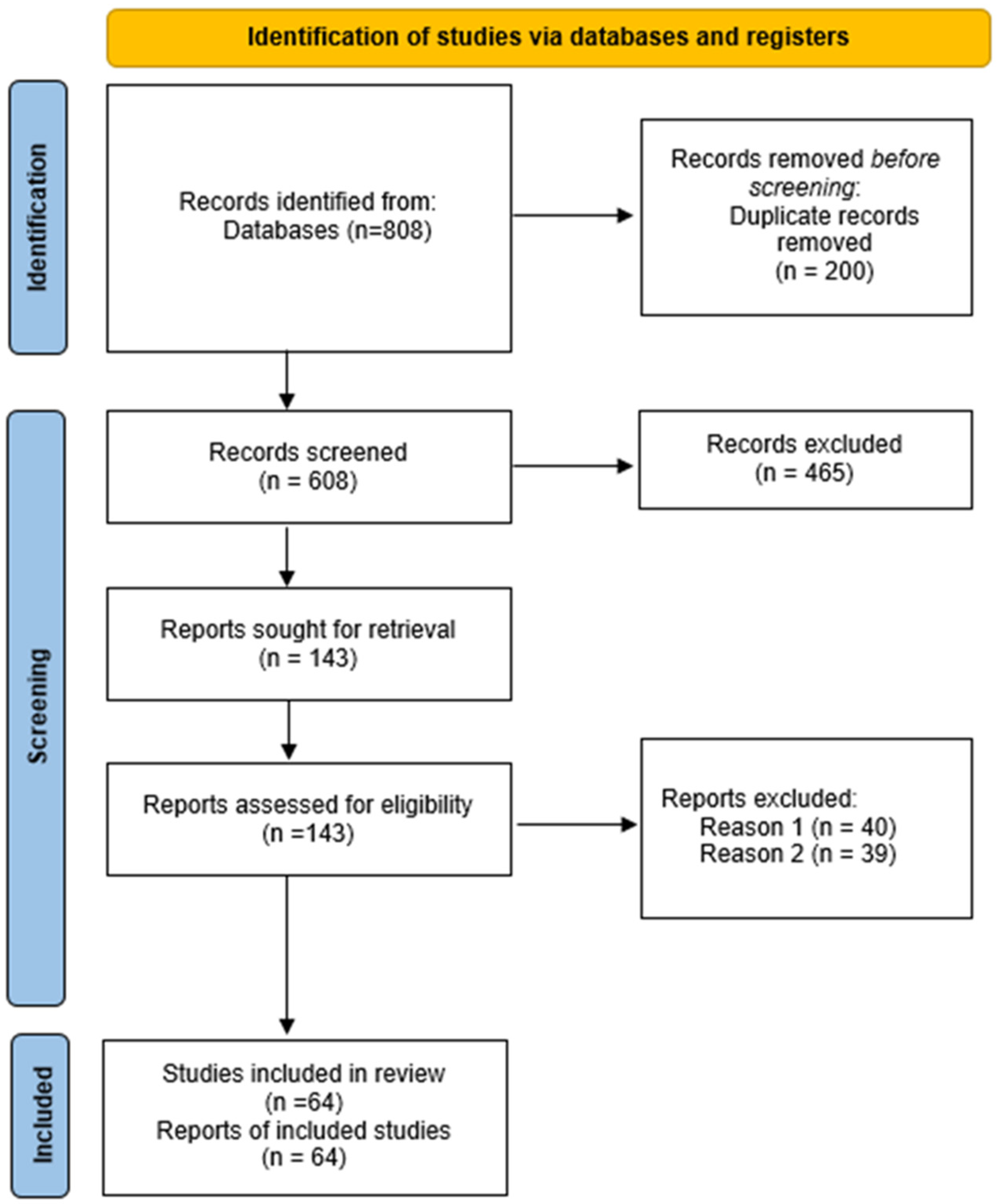
2.7. PRISMA Diagram
3. Determinants of the Welfare of Herding Dogs
4. Genes and Behaviour in Herding Dogs
4.1. Genetic Selection and Behavioural Predisposition
4.2. Genes and Predatory Instinct
4.3. The Genetic Basis of Behaviour and Predisposition in Herding Dogs
5. Behavioural Differences Between Sex and Breed
6. Impact of Training Methods on the Welfare of the Dog
7. The Welfare of Dogs When Working with Sheep
7.1. Atmospheric Conditions
7.2. Behavioural and Health Problems in Sheepdogs
8. Conclusions
Author Contributions
Funding
Institutional Review Board Statement
Informed Consent Statement
Data Availability Statement
Conflicts of Interest
References
- Lord, K.; Coppinger, L.; Coppinger, R. Differences in the behavior of landraces and breeds of dogs. In Genetics and the Behavior of Domestic Animals, 2nd ed.; Grandin, T., Deesing, M.J., Eds.; Academic Press: San Diego, CA, USA, 2014; pp. 195–235. [Google Scholar] [CrossRef]
- Sablik, P.; Pilarczyk, R.; Bąkowska, M.; Pilarczyk, B.; Matusevičius, P.; Mišeikienê, R. The impact of herding and guardian dogs on the behaviour and welfare of sheep. Acta Sci. Pol. Zootech. 2024, 23, 3–10. [Google Scholar] [CrossRef]
- European Parliament. Report on the Proposal for a Regulation of the European Parliament and of the Council on the Welfare of Dogs and Cats and Their Traceability, Report No. A10-0104/2025. 10 June 2025. Available online: https://www.europarl.europa.eu/doceo/document/A-10-2025-0104_EN.html (accessed on 30 October 2025).
- Udell, M.; Ewald, M.; Dorey, N.; Wynne, C.D.L. Exploring breed differences in dogs (Canis familiaris): Does exaggeration or inhibition of predatory response predict performance on human-guided tasks? Anim. Behav. 2014, 89, 99–105. [Google Scholar] [CrossRef]
- Arnott, E.R.; Early, J.B.; Wade, C.M.; McGreevy, P.D. Environmental factors associated with success rates of Australian stock herding dogs. PLoS ONE 2014, 9, e104457. [Google Scholar] [CrossRef]
- Hiby, E.F.; Rooney, N.J.; Bradshaw, J.W.S. Dog training methods: Their use, effectiveness and interaction with behaviour and welfare. Anim. Welf. 2004, 13, 63–69. [Google Scholar] [CrossRef]
- Rooney, N.J.; Cowan, S. Training methods and owner–dog interactions: Links with dog behaviour and learning ability. Appl. Anim. Behav. Sci. 2011, 132, 169–177. [Google Scholar] [CrossRef]
- Serpell, J. The Domestic Dog; Cambridge Univ. Press: Cambridge, UK, 2016. [Google Scholar] [CrossRef]
- Coppinger, L.; Coppinger, R. Dogs for herding and guarding livestock. In Livestock Handling and Transport; CABI: Wallingford, UK, 2019; pp. 254–270. [Google Scholar] [CrossRef]
- Beaver, B.V. The genetics of canine behaviour. Vet. Med. Small Anim. Clin. 1981, 10, 1423–1424. [Google Scholar]
- Shan, S.; Xu, F.; Brenig, B. Genome-wide association studies reveal neurological genes for dog herding, predation, temperament, and trainability traits. Front. Vet. Sci. 2021, 8, 693290. [Google Scholar] [CrossRef] [PubMed]
- Hart, B.L.; Hart, L.A. Selecting the best companion animal: Breed and gender specific behavioural profiles. In The Pet Connection; Anderson, R.K., Hart, B.L., Hart, L.A., Eds.; CENSHARE: Minneapolis, MN, USA, 1984; pp. 180–192. [Google Scholar] [CrossRef]
- Jeong, H.; Ostrander, E.A.; Kim, J. Genomic evidence for behavioral adaptation of herding dogs. Sci. Adv. 2025, 11, eadp4591. [Google Scholar] [CrossRef]
- Rooney, N.J.; Bradshaw, J.W.S.; Gaines, S.A. UK Detection Dog Rearing Project: An investigation into factors affecting search ability. In Proceedings of the 6th International Seminar on Detection Dogs, Kincardine, UK, 6–8 September 2005. [Google Scholar]
- Rooney, N.; Gaines, S.; Hiby, E. A practitioner’s guide to working dog welfare. J. Vet. Behav. 2009, 4, 127–134. [Google Scholar] [CrossRef]
- Wanser, S.H.; Udell, M.A.R. Does attachment security to a human handler influence the behavior of dogs who engage in animal assisted activities? Appl. Anim. Behav. Sci. 2019, 210, 88–94. [Google Scholar] [CrossRef]
- Bray, E.E.; Otto, C.M.; Udell, M.A.R.; Hall, N.J.; Johnston, A.M.; MacLean, E.L. Enhancing the Selection and Performance of Working Dogs. Front. Vet. Sci. 2021, 12, 644431. [Google Scholar] [CrossRef]
- Hiby, E.F. The Welfare of Kennelled Domestic Dogs. Ph.D. Thesis, University of Bristol, Bristol, UK, 2005. [Google Scholar]
- Page, M.J.; McKenzie, J.E.; Bossuyt, P.M.; Boutron, I.; Hoffmann, T.C.; Mulrow, C.D.; Shamseer, L.; Tetzlaff, J.M.; Akl, E.A.; Brennan, S.E.; et al. The PRISMA 2020 statement: An updated guideline for reporting systematic reviews. BMJ 2021, 372, n71. [Google Scholar] [CrossRef]
- Coppinger, R.; Coppinger, L. Dogs: A Startling New Understanding of Canine Origin, Behavior & Evolution, 1st ed.; Scribner: New York, NY, USA, 2001. [Google Scholar]
- Wobber, V.; Hare, B.; Koler-Matznick, J.; Wrangham, R.; Tomasello, M. Breed differences in domestic dogs’ (Canis familiaris) comprehension of human communicative signals. Interact. Stud. 2009, 10, 206–224. [Google Scholar] [CrossRef]
- Gácsi, M.; McGreevy, P.; Kara, E.; Miklósi, A. Effects of selection for cooperation and attention in dogs. Behav. Brain Funct. 2009, 5, 31. [Google Scholar] [CrossRef] [PubMed]
- Helton, W.S.; Helton, N.D. Physical size matters in the domestic dog’s (Canis lupus familiaris) ability to use human pointing cues. Behav. Process. 2010, 85, 77–79. [Google Scholar] [CrossRef] [PubMed]
- Egenvall, A.; Hedhammar, A.; Bonnett, B.N.; Olson, P. Survey of the Swedish dog population: Age, gender, breed, location and enrolment in animal insurance. Acta Vet. Scand. 1999, 40, 231–240. [Google Scholar] [CrossRef] [PubMed]
- Udell, M.A.R.; Dorey, N.R.; Wynne, C.D.L. What did domestication do to dogs? A new account of dogs’ sensitivity to human actions. Biol. Rev. 2010, 85, 327–345. [Google Scholar] [CrossRef]
- Press Cell. Your Dog’s Behavior Is a Product of Their Genes. Science Daily, 8 December 2022. Available online: https://www.sciencedaily.com/releases/2022/12/221208114727.htm (accessed on 22 December 2025).
- Eken Asp, H.; Fikse, W.F.; Nilsson, K.; Strandberg, E. Breed differences in everyday behaviour of dogs. Appl. Anim. Behav. Sci. 2015, 169, 69–77. [Google Scholar] [CrossRef]
- Scandurra, A.; Alterisio, A.; Di Cosmo, A.; D’Aniello, B. Behavioral and perceptual differences between sexes in dogs: An overview. Animals 2018, 8, 151. [Google Scholar] [CrossRef] [PubMed]
- Blackwell, E.J.; Bolster, C.; Richards, G.J.; Casey, R.A. The relationship between training methods and the occurrence of behaviour problems, as reported by owners, in a population of domestic dogs. J. Vet. Behav. 2008, 3, 207–217. [Google Scholar] [CrossRef]
- Schalke, E.; Stichnoth, J.; Ott, S.; Jones-Baade, R. Clinical signs caused by the use of electric training collars on dogs in everyday life situations. Appl. Anim. Behav. Sci. 2007, 105, 369–380. [Google Scholar] [CrossRef]
- Beerda, B.; Schilder, M.B.H.; van Hooff, J.A.R.A.M.; de Vries, H.W.; Mol, J.A. Behavioural and hormonal indicators of enduring environmental stress in dogs. Anim. Welf. 1997, 6, 247–258. [Google Scholar] [CrossRef]
- Casey, R.A.; Naj-Oleari, M.; Campbell, S.; Mendl, M.; Blackwell, E.J. Dogs are more pessimistic if their owners use two or more aversive training methods. Sci. Rep. 2021, 11, 19023. [Google Scholar] [CrossRef] [PubMed]
- Marschark, E.D.; Baenninger, R. Modification of instinctive herding dog behavior using reinforcement and punishment. Anthrozoös 2002, 15, 51–68. [Google Scholar] [CrossRef]
- McConnell, P.B.; Baylis, J.R. Interspecific communication in cooperative herding: Acoustic and visual signals from human shepherds and herding dogs. Z. Tierpsychol. 1985, 67, 302–328. [Google Scholar] [CrossRef]
- Roll, A.; Unsheim, J. Aggressive conflicts amongst dogs and factors affecting them. Appl. Anim. Behav. Sci. 1997, 52, 229–242. [Google Scholar] [CrossRef]
- Lieberman, D. Learning Behaviour and Cognition; Wadsworth: London, UK, 1999. [Google Scholar]
- Early, J.; Aalders, J.; Arnott, E.; Wade, C.; McGreevy, P. Sequential Analysis of Livestock Herding Dog and Sheep Interactions. Animals 2020, 10, 352. [Google Scholar] [CrossRef] [PubMed]
- van Bommel, L. Guardian Dogs: Best Practice Manual for the Use of Livestock Guardian Dogs; Invasive Animals CRC: Canberra, Australia, 2010. [Google Scholar]
- Mariti, C.; Ricci, E.; Zilocchi, M.; Gazzano, A. Owners as a secure base for their dogs. Behaviour 2013, 150, 1275–1294. [Google Scholar] [CrossRef]
- Konok, V.; Kosztolányi, A.; Rainer, W.; Mutschler, B.; Halsband, U.; Miklósi, Á. Influence of owners’ attachment style and personality on their dogs’ (Canis familiaris) separation-related disorder. PLoS ONE 2015, 10, e0118375. [Google Scholar] [CrossRef] [PubMed]
- Hawkins, R.D.; Hatin, B.D.M.; Revesz, E.O. Accuracy of canine vs. human emotion identification: Impact of dog ownership and belief in animal mind. Hum. Anim. Interact. Bull. 2021, 12, 1–18. [Google Scholar] [CrossRef]
- Fukuzawa, M.; Mills, D.; Cooper, J. More than just a word: Non-semantic command variables affect obedience in the domestic dog (Canis familiaris). Appl. Anim. Behav. Sci. 2004, 91, 129–141. [Google Scholar] [CrossRef]
- Alburquerque, N.; Guo, K.; Wilkinson, A.; Savalli, C.; Otta, E.; Mills, D. Dogs recognize dog and human emotions. Biol. Lett. 2015, 11, 20150883. [Google Scholar] [CrossRef]
- Handlin, L.; Nilsson, A.; Ejdebäck, M.; Hydbring-Sandberg, E.; Uvnäs-Moberg, K. Associations between the psychological characteristics of the human–dog relationship and oxytocin and cortisol levels. Anthrozoös 2012, 25, 215–228. [Google Scholar] [CrossRef]
- Rault, J.-L.; Waiblinger, S.; Boivin, X.; Hemsworth, P. The power of a positive human–animal relationship for animal welfare. Front. Vet. Sci. 2020, 7, 590867. [Google Scholar] [CrossRef] [PubMed]
- Tallet, C.; Brajon, S.; Devillers, N.; Lensink, J. Pig-human interactions: Creating a positive perception of humans to ensure pig welfare. In Advances in Pig Welfare; Woodhead Publishing: Cambridge, UK, 2018; pp. 381–398. [Google Scholar] [CrossRef]
- Lazzaroni, M.; Range, F.; Backes, J.; Portele, K.; Scheck, K.; Marshall-Pescini, S. The effect of domestication and experience on the social interaction of dogs and wolves with a human companion. Front. Psychol. 2020, 11, 785. [Google Scholar] [CrossRef] [PubMed]
- Kuhne, F.; Hößler, J.C.; Struwe, R. Emotions in dogs being petted by a familiar or unfamiliar person: Validating behavioural indicators of emotional states using heart rate variability. Appl. Anim. Behav. Sci. 2014, 161, 113–120. [Google Scholar] [CrossRef]
- Mariti, C.; Falaschi, C.; Zilocchi, M.; Fatjó, J.; Sighieri, C.; Ogi, A.; Gazzano, A. Analysis of the intraspecific visual communication in the domestic dog (Canis familiaris): A pilot study on the case of calming signals. J. Vet. Behav. 2017, 18, 49–55. [Google Scholar] [CrossRef]
- Gazzano, A.; Mariti, C.; Notari, L.; Sighieri, C.; McBride, E.A. Effects of early gentling and early environment on emotional development of puppies. Appl. Anim. Behav. Sci. 2008, 110, 294–304. [Google Scholar] [CrossRef]
- Van Poucke, E.; Höglin, A.; Jensen, P.; Roth, L.S.V. Breed group differences in the unsolvable problem task: Herding dogs prefer their owner, while solitary hunting dogs seek stranger proximity. Anim. Cogn. 2022, 25, 597–603. [Google Scholar] [CrossRef] [PubMed]
- Sundman, A.-S.; Van Poucke, E.; Svensson Holm, A.-C.; Olsen Faresjö, Å.; Theodorsson, E.; Jensen, P.; Roth, L.S.V. Long-term stress levels are synchronized in dogs and their owners. Sci. Rep. 2019, 9, 7391. [Google Scholar] [CrossRef] [PubMed]
- Bruchim, Y.; Aroch, I.; Nivy, R.; Baruch, S.; Abbas, A.; Frank, I.; Fishelson, Y.; Codner, C.; Horowitz, M. Impacts of previous heatstroke history on physiological parameters eHSP72 and biomarkers of oxidative stress in military working dogs. Cell Stress Chaperones 2019, 24, 937–946. [Google Scholar] [CrossRef]
- Andress, M.; Goodnight, M.E. Heatstroke in a working military dog. US Army Med. Dep. J. 2013, 34–37, Erratum in US Army Med. Dep. J. 2013, 97.. [Google Scholar] [PubMed]
- Stojsih, S.E.; Baker, J.L.; Les, C.M.; Bir, C.A. Review of canine deaths while in service in US civilian law enforcement (2002–2012). J. Spec. Oper. Med. 2014, 14, 86–91. [Google Scholar] [CrossRef] [PubMed]
- Bruchim, Y.; Klement, E.; Saragusty, J.; Finkeilstein, E.; Kass, P.; Aroch, I. Heat stroke in dogs: A retrospective study of 54 cases (1999–2004) and analysis of risk factors for death. J. Vet. Intern. Med. 2006, 20, 38–44. [Google Scholar] [CrossRef]
- Slotta-Bachmayr, L.; Oyugi, A.; Mutoro, N.; Burak, M.; Wykstra, M. Detection dogs working in hot climates: The influence on thermoregulation and fecal consistency. Animals 2024, 14, 2456. [Google Scholar] [CrossRef]
- Jessen, C. Wärmebilanz und Thermoregulation. In Physiologie der Haustiere; Engelhardt, W.V., Breves, G., Eds.; Enke Ferdinand: Stuttgart, Germany, 2005; pp. 446–469. [Google Scholar]
- Young, D.R.; Mosher, R.; Erve, P.; Spector, H. Body temperature and heat exchange during treadmill running in dogs. J. Appl. Physiol. 1959, 14, 839–843. [Google Scholar] [CrossRef] [PubMed]
- Phillips, C.J.C.; Coppinger, R.; Schimel, D.S. Hyperthermia in running sled dogs. J. Appl. Physiol. 1981, 51, 135–142. [Google Scholar] [CrossRef] [PubMed]
- Bruchim, Y.; Segev, G.; Kelmer, E.; Codner, C.; Marisat, A.; Horowitz, M. Hospitalized dogs recovery from naturally occurring heatstroke; does serum heat shock protein 72 provide prognostic biomarker? Cell Stress Chaperones 2016, 21, 123–130. [Google Scholar] [CrossRef]
- Parnes, S.C.; Mallikarjun, A.; Ramos, M.T.; Stone, T.A.; Otto, C.M. A randomized cross-over study comparing cooling methods for exercise-induced hyperthermia in working dogs in training. Animals 2023, 13, 3673. [Google Scholar] [CrossRef]
- Isaksen, K.E.; Linney, L.; Williamson, H.; Cave, N.J.; Norman, E.J.; Cogger, N. TeamMate: A longitudinal study of New Zealand working farm dogs. II. Occurrence of musculoskeletal abnormalities. Front. Vet. Sci. 2020, 7, 624. [Google Scholar] [CrossRef]
- Sheard, H. Demographics and Health of New Zealand Working Farm Dogs: A Survey of Dogs on Sheep and Beef Farms in New Zealand in 2009. Master’s Thesis, Massey University, Palmerston North, New Zealand, 2014. [Google Scholar]


| Database | Main Keywords | Synonyms/ Extensions | Exclusions | Thematic Aspects |
|---|---|---|---|---|
| PubMed | herding dogs, working dogs | sheepdog, herding breeds | companion dogs, lab dogs | welfare, stress, behaviour, training, human–dog interaction |
| Scopus | herding dogs, working dogs | sheepdog, herding breeds | pet dogs | welfare, stress, behaviour, training, human–dog interaction |
| Web of Science | herding dogs, working dogs | sheepdog, herding breeds | non-working dogs | welfare, stress, behaviour, training, genetics |
| Google Scholar | herding dogs, working dogs | sheepdog, herding breeds | companion dogs, pet dogs | welfare, stress, behaviour, training, human–dog interaction |
| Behaviour/Characteristic | Gene | Chromosome | Biological Function | Relationship with Behaviour | State of Evidence |
|---|---|---|---|---|---|
| Herding | THOC1 | CFA7 | Presynaptic development, survival of dopamine neurons | Associated with fearlessness traits (boldness) and cognitive function in herding dogs | Confirmed |
| ASIC2 | CFA9 | Encoding ion channels (ASICs), involved in the development of the nervous system | Candidate associated with pastoral work; no direct evidence of impact on fear response—possible indirect link | Hypothesis | |
| MSRB3 | CFA10 | Regulation of brain morphology, oxidative stress | Potential effects on neurological function, hearing and stress reactions | High probability | |
| LLPH | CFA10 | Neuronal development, synaptic transmission | May affect learning ability and adaptation | Hypothesis | |
| RFX8 | CFA10 | Schwann cell proliferation, nerve regeneration | May modulate neurological performance, important in the development of the nervous system | Hypothesis | |
| CHL1 | CFA20 | Nerve cell adhesion, neurite proliferation | Related to intelligence, cognitive functions and emotional responses | High probability | |
| Predation | JAK2 | CFA1 | Synaptic plasticity, regulation of neuronal transmission | Linked to intensity of pursuit and hunting behaviour | Confirmed |
| MEIS1 | CFA10 | Specification of neural progenitors | Linked to impulsivity and hyperactivity during pursuit | Confirmed | |
| LRRTM4 | CFA17 | Development of excitatory synapses | Can influence predatory aggression behaviour | Hypothesis | |
| Temperament | ACSS3 | CFA15 | Regulation of energy metabolism, stress response | Correlates with temperament and emotionality traits | Confirmed |
| Breed | Characteristic/ Behaviour | Genetic Basis/Influence | Influence on Behaviour/ Value (Usability) | Source |
|---|---|---|---|---|
| Border Collie | Herding instinct | Strong genetic basis for herding behaviour linked to brain neural networks | Inclination to automatically control the movement of the herd | [26] |
| High concentration and energy | Gene variants associated with nerve impulse conduction (axon guidance) | Extreme focus and motivation to work | [26] | |
| Australian Shepherd | High energy and diligence | Selection of genes facilitating motor skills and cognitive functions | Very strong need to be set activities and tasks | [13] |
| Reaction to visual/audio signals | Genes associated with the speed of stimulus processing | Quick response to commands and signals | [11] | |
| Shetland Sheepdog | Focus and obedience | Differences in cognitive genes (receptors and signal transmission) | Long concentration span and fast learning | [13] |
| Belgian Malinois | Autonomy and independent decision-making | Traces of selective changes in genes associated with social interactions and cognitive functions | Independent, often requiring training | [13] |
| Energy/endurance | Modification of neuronal and metabolic genes for supporting extended work periods | Very active, ideal for difficult tasks | [13] | |
| Collie (long-haired) | Mild temperament | Selection of behavioural traits conducive to cooperation with humans | Calmer, more of a “follower” than, for example, a Border Collie | [26] |
| Characteristic | Working Breed (Herding) | Non-Working Breed | Difference |
|---|---|---|---|
| Suitability for training | higher | lower | +10% |
| Interest in playing with people | more | less | +30% |
| Timidity | lower | higher | 10–60% lower |
| Aggression | lower (especially in companion dogs) | higher in timid dogs | _ |
| Ease of training in companion dogs | higher | lower | _ |
| Characteristic/Behaviour | Males | Females |
|---|---|---|
| Aggressiveness and boldness | Higher | Lower |
| Interactions with humans | Less willing to cooperate | More willing to cooperate |
| Social play with other dogs | More active in play | Less active |
| Cognitive flexibility/ navigation | Greater strategic flexibility | Less strategic flexibility |
| Visual focus | Less focus on individual stimuli | Better focus on individual stimuli |
| Method | Definition | Example Given in the Study | Effectiveness | Recommendations from the Study |
|---|---|---|---|---|
| Positive reinforcement | Adding a rewarding stimulus to increase the likelihood of the desired behaviour occurring | Allowing the dog access to sheep or verbal praise | Moderate—giving real permission to access sheep was most effective, while verbal praise had limited impact | Good for learning new commands, but not enough to fully control instinctive behaviour |
| Negative reinforcement | Removal of aversive stimulus to reinforce desired behaviour | Providing access to sheep after a valid command has been executed | Effective because dogs perceived access to sheep as a reward after being previously restricted | Supports the learning process if applied consistently |
| Punishment | Adding an aversive stimulus or taking away a reward to undermine undesirable behaviour | Blocking access to sheep or holding the dog | Most commonly used and effective in controlling dogs during instinctive behaviour | In the case of strong instincts, punishment has proven to be an essential part of training |
| Section/ Factor | Key Findings | Implications for Wellbeing | Recommendations/ Practical Application | Source |
|---|---|---|---|---|
| Genetic predisposition | Herding traits, cognitive abilities, and weakened predatory instincts are highly heritable; the EPHB1, THOC1, ASIC2, and MSRB3 genes influence herding behaviour and fear responses. | Genetic selection plays a key role in work efficiency and stress reduction; breed differences affect training needs. | Breeding selection based on behavioural traits; selection of dog breed, sex and genetic line for herding work. | [10,11] |
| Sex differences | Males are bolder and more aggressive; females are more cooperative and focused. | Sex influences task allocation and training strategies. | Adapt training and tasks according to sex. | [28] |
| Training methods | Positive reinforcement improves learning, reduces stress and behavioural problems; aversive methods increase anxiety, aggression and reduce trust. | Training directly affects wellbeing, relationships with humans and work efficiency. | Use reward methods; incorporate gentle negative reinforcement when necessary; avoid excessive punishment. | [29,33] |
| Relationship with owner | A strong, trust-based bond improves motivation, reduces stress and increases responsiveness. | Dog welfare and herding performance are dependent on one another. | Build trust, use consistent signals, positive interactions; signs of stress in the handler affect the dog. | [14,16,17] |
| Socialisation | Early socialisation reduces anxiety, and improves adaptation and cooperation with humans. | Socialisation affects long-term emotional stability and work performance. | Provide socialisation classes for puppies, allow controlled contact with animals and people; consistent communication. | [27,32] |
| Behavioural and health problems | Musculoskeletal injuries (wrist, hip, knee, fingers) and behavioural problems (lack of herding instinct, anxiety) limit the length and quality of work. | Injuries and behavioural problems reduce well-being and work efficiency. | Regular health checks; early detection of problems; appropriate exercise and weight selection. | [5,28,63,64] |
| Environmental conditions | High temperatures, humidity and physical exertion increase stress and the risk of overheating. | Physical wellbeing depends on acclimatisation, hydration and safe working conditions. | Monitor environmental conditions; gradual acclimatisation; ensure breaks and hydration. | [29,53,54,55,56,57,58,59,60,61,62] |
| Article summary | Well-being depends on a synergy between genetics, training, socialisation, relationship with handler and environmental conditions. | Positive reinforcement, selective breeding and good working conditions maximise welfare and efficiency. | Integrated approach: ethical training, breeding selection, early socialisation, environmental control. |
Disclaimer/Publisher’s Note: The statements, opinions and data contained in all publications are solely those of the individual author(s) and contributor(s) and not of MDPI and/or the editor(s). MDPI and/or the editor(s) disclaim responsibility for any injury to people or property resulting from any ideas, methods, instructions or products referred to in the content. |
© 2026 by the authors. Licensee MDPI, Basel, Switzerland. This article is an open access article distributed under the terms and conditions of the Creative Commons Attribution (CC BY) license.
Share and Cite
Pilarczyk, B.; Pilarczyk, R.; Bąkowska, M.; Tomza-Marciniak, A.; Kwita, E.; Udała, J. The Influence of Environmental and Genetic Factors and Training Background on the Welfare of Herding Dogs. Animals 2026, 16, 607. https://doi.org/10.3390/ani16040607
Pilarczyk B, Pilarczyk R, Bąkowska M, Tomza-Marciniak A, Kwita E, Udała J. The Influence of Environmental and Genetic Factors and Training Background on the Welfare of Herding Dogs. Animals. 2026; 16(4):607. https://doi.org/10.3390/ani16040607
Chicago/Turabian StylePilarczyk, Bogumiła, Renata Pilarczyk, Małgorzata Bąkowska, Agnieszka Tomza-Marciniak, Ewa Kwita, and Jan Udała. 2026. "The Influence of Environmental and Genetic Factors and Training Background on the Welfare of Herding Dogs" Animals 16, no. 4: 607. https://doi.org/10.3390/ani16040607
APA StylePilarczyk, B., Pilarczyk, R., Bąkowska, M., Tomza-Marciniak, A., Kwita, E., & Udała, J. (2026). The Influence of Environmental and Genetic Factors and Training Background on the Welfare of Herding Dogs. Animals, 16(4), 607. https://doi.org/10.3390/ani16040607