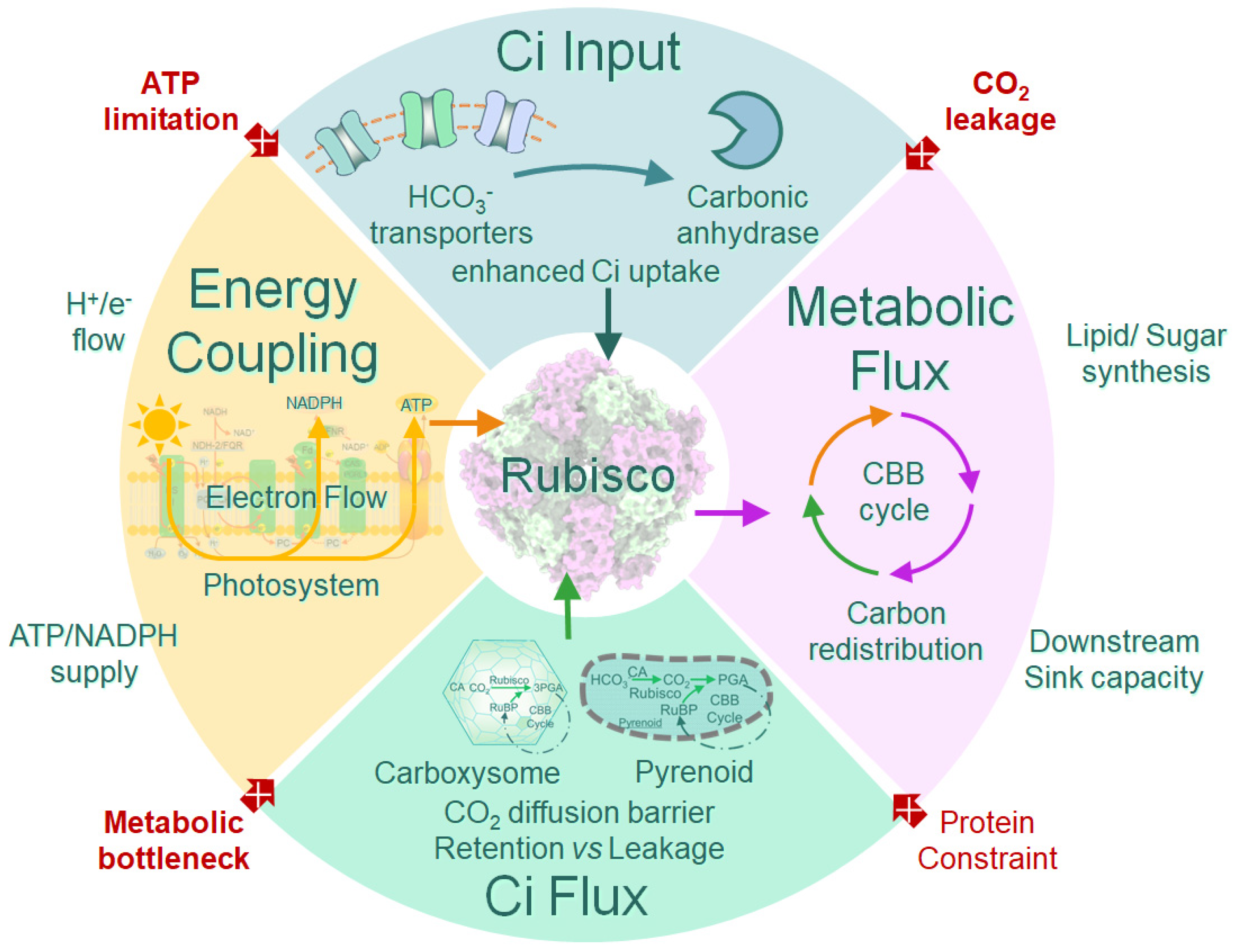
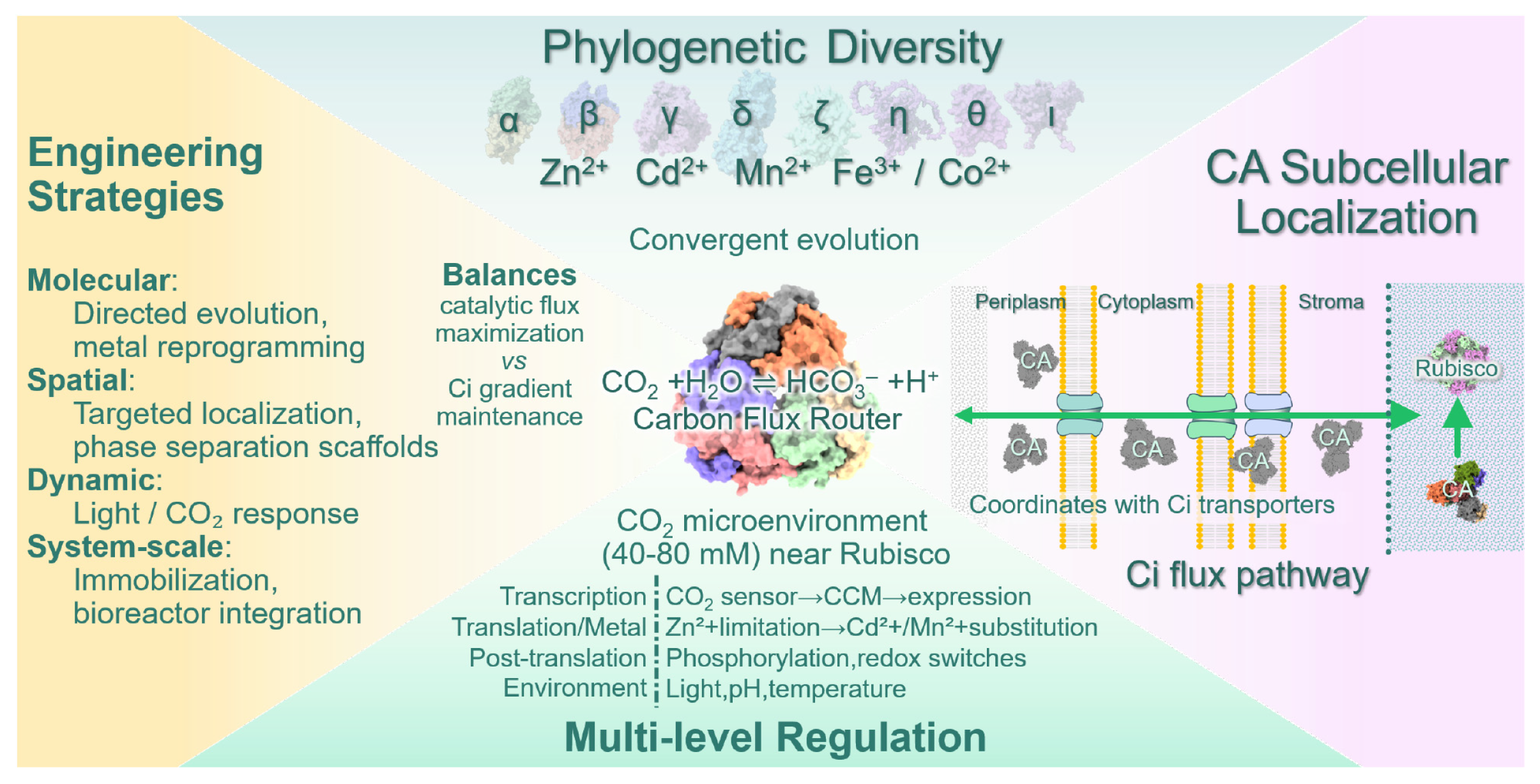
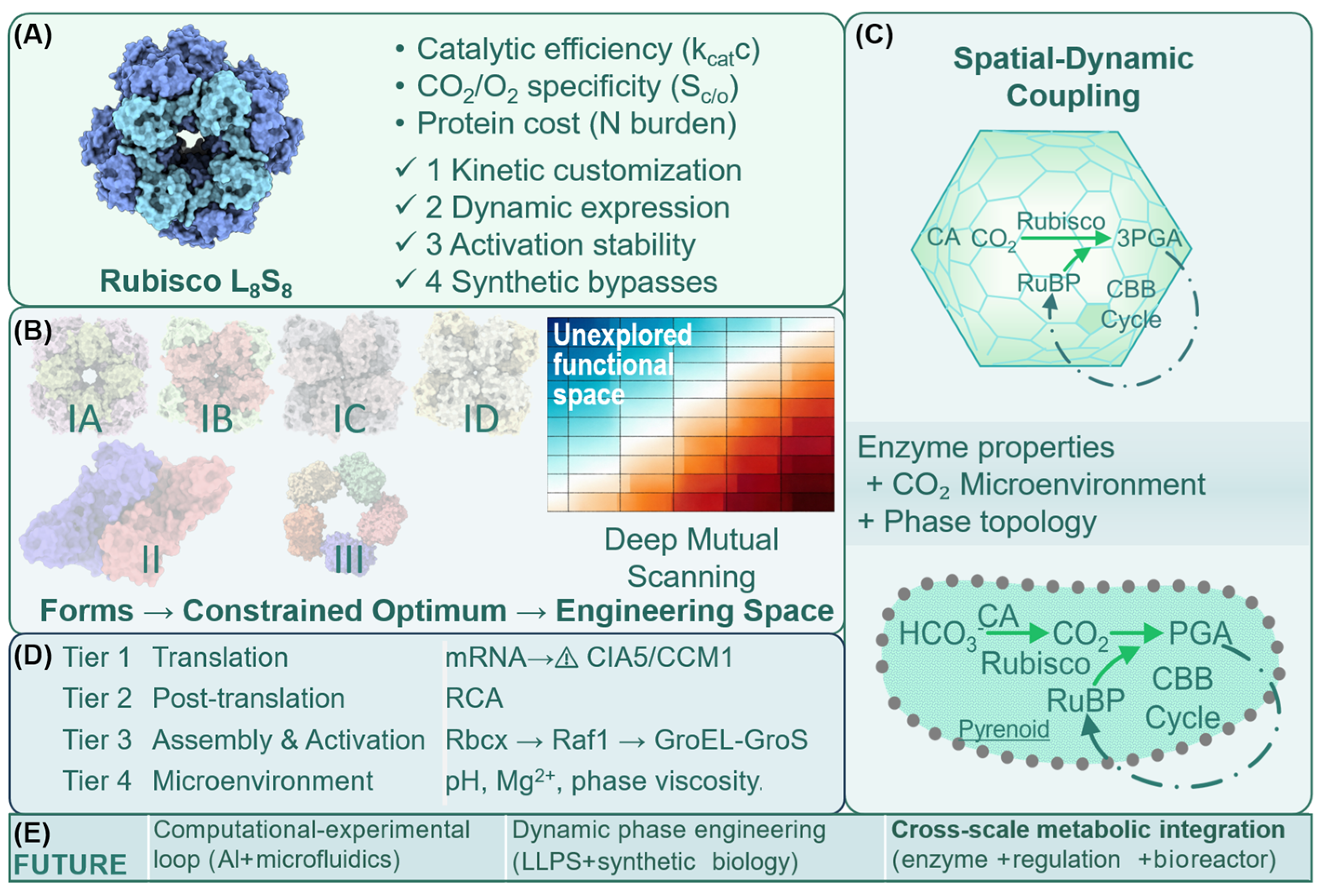
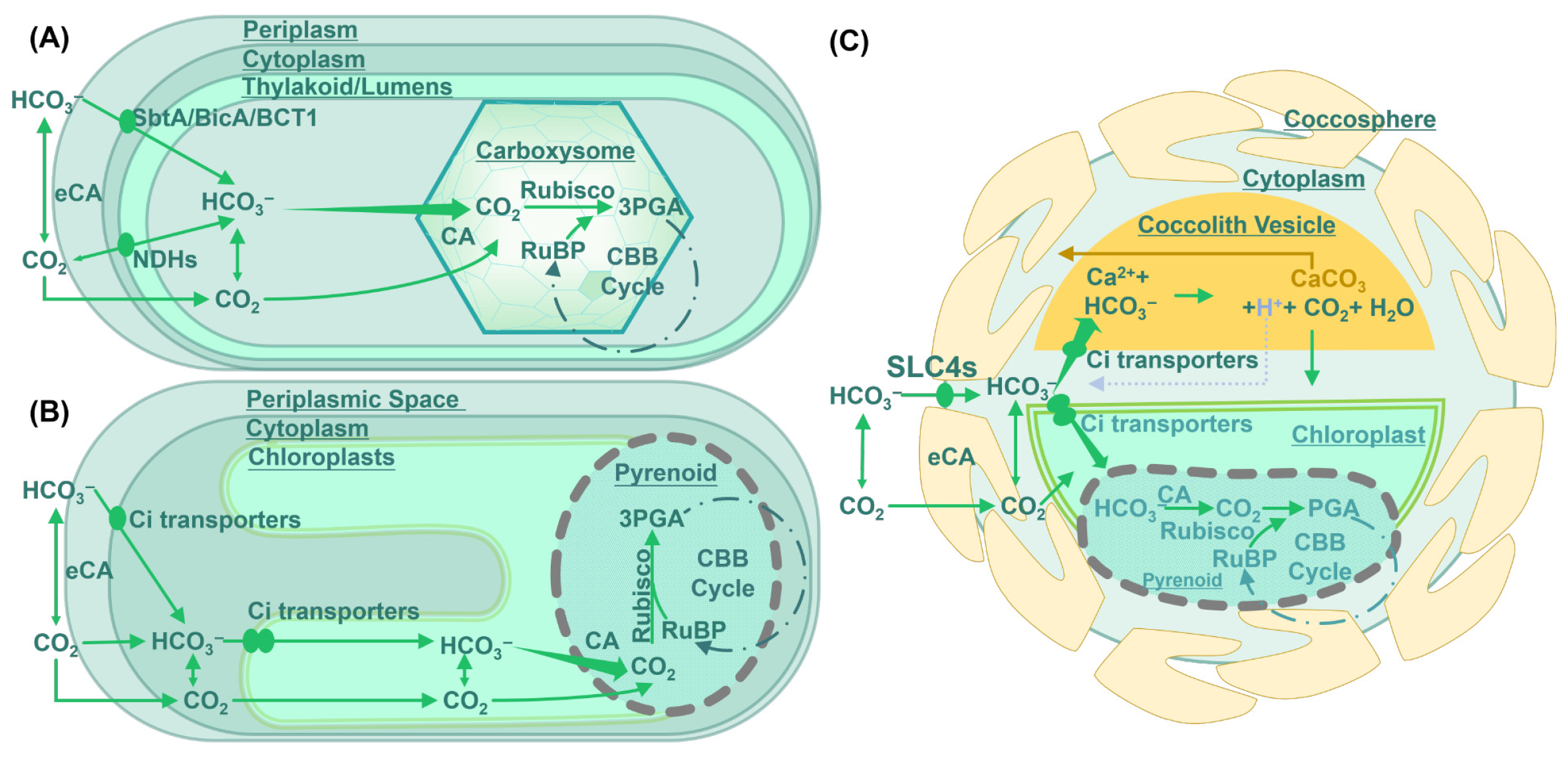
Engineering and Biological Mechanisms of Microalgal CO2 Fixation: A Review from Molecular Regulation to System Optimization


Abstract
1. Introduction
2. Gas–Liquid Mass Transfer and Intensification Strategies in Microalgal CO2 Fixation
2.1. Fundamental Constraints of CO2 Gas–Liquid Mass Transfer in Microalgal Systems
2.2. Engineering Strategies for Gas–Liquid Mass Transfer Enhancement in Photobioreactors
2.3. Coupled Light–Mass Transfer Optimization and Emerging Intelligent Transport Strategies
3. Carbon Concentrating Mechanisms in Microalgae
3.1. Functional Types and Conceptual Frameworks of CCMs
3.2. Biophysical CCMs
3.3. Biochemical (C4-like) CCMs
3.4. Hybrid or Composite Carbon Concentrating Mechanisms
3.4.1. Functional Modules of Hybrid CCMs
3.4.2. Diatoms as a Paradigm of Hybrid CCMs
3.4.3. Current Limitations and Conceptual Implications
3.5. Enhancement, Engineering, and Reprogramming of CCMs
3.5.1. Construction of Synthetic and Enhanced CCM Module
3.5.2. Regulatory Networks and Optimization of Energy Coupling
3.5.3. System- and Metabolism-Level Reinforcement of CCMs
3.5.4. Ecological Engineering and Hybrid System Integration
4. Functional Diversity and Regulatory Control of Carbonic Anhydrases in Microalgae
4.1. Carbonic Anhydrases as Core Catalytic Nodes in CCM Function
4.2. Diversity and Evolution of Carbonic Anhydrase Classes in Microalgae
4.3. Subcellular Localization and Functional Partitioning of CA Isoforms
4.4. Environmental and Cellular Regulation of CA Expression and Activity
4.5. Engineering and Application of CAs for Enhanced Carbon Capture and Microalgal Productivity
5. Functions and Regulatory Control of Rubisco
5.1. Rubisco as the Catalytic Gatekeeper of Biological CO2 Fixation
5.2. Microalgal Rubisco Diversity Shaped by Endosymbiosis and CCM Coupling
5.3. Regulation of Rubisco Expression and Catalytic Activity in Microalgae
5.4. Engineering Strategies for Rubisco-Mediated Carbon Fixation in Microalgae
6. Perspectives and Future Directions
7. Conclusions
Supplementary Materials
Author Contributions
Funding
Institutional Review Board Statement
Informed Consent Statement
Data Availability Statement
Acknowledgments
Conflicts of Interest
References
- Daneshvar, E.; Wicker, R.J.; Show, P.-L.; Bhatnagar, A. Biologically-mediated carbon capture and utilization by microalgae towards sustainable CO2 biofixation and biomass valorization—A review. Chem. Eng. J. 2022, 427, 130884. [Google Scholar] [CrossRef]
- Ummalyma, S.B.; Maharajan, T.; Sreelekshmy, B.R.; Eswaran, K. Carbon Sequestration by Microalgae and Engineering of Microalgal Cells by CRISPR Technology for Efficient CO2 Capture for Carbon Neutral Bioproducts. ACS EST Water 2025, 5, 4969–4984. [Google Scholar] [CrossRef]
- Sun, Z.; Chen, H.; Sun, L.; Wang, Q. Converting carbon dioxide to high value-added products: Microalgae-based green biomanufacturing. GCB Bioenergy 2023, 15, 386–398. [Google Scholar] [CrossRef]
- Ugya, A.Y.; Sheng, Y.; Chen, H.; Wang, Q. Microalgal bioengineering: A futuristic tool for carbon capture. Results Eng. 2024, 24, 102990. [Google Scholar] [CrossRef]
- Le Gouic, B.; Marec, H.; Pruvost, J.; Cornet, J.F. Investigation of growth limitation by CO2 mass transfer and inorganic carbon source for the microalga Chlorella vulgaris in a dedicated photobioreactor. Chem. Eng. Sci. 2021, 233, 116388. [Google Scholar] [CrossRef]
- Singh, S.K.; Sundaram, S.; Sinha, S.; Rahman, M.A.; Kapur, S. Recent advances in CO2 uptake and fixation mechanism of cyanobacteria and microalgae. Crit. Rev. Environ. Sci. Technol. 2016, 46, 1297–1323. [Google Scholar] [CrossRef]
- Sobczuk, T.M.; Camacho, F.G.; Rubio, F.C.; Fernández, F.G.A.; Grima, E.M. Carbon dioxide uptake efficiency by outdoor microalgal cultures in tubular airlift photobioreactors. Biotechnol. Bioeng. 2000, 67, 465–475. [Google Scholar] [CrossRef]
- Ndiaye, M.; Gadoin, E.; Gentric, C. CO2 gas–liquid mass transfer and kLa estimation: Numerical investigation in the context of airlift photobioreactor scale-up. Chem. Eng. Res. Des. 2018, 133, 90–102. [Google Scholar] [CrossRef]
- Sarat Chandra, T.; Maneesh Kumar, M.; Mukherji, S.; Chauhan, V.S.; Sarada, R.; Mudliar, S.N. Comparative life cycle assessment of microalgae-mediated CO2 capture in open raceway pond and airlift photobioreactor system. Clean Technol. Environ. Policy 2018, 20, 2357–2364. [Google Scholar] [CrossRef]
- Pawar, S.B. Process Engineering Aspects of Vertical Column Photobioreactors for Mass Production of Microalgae. ChemBioEng Rev. 2016, 3, 101–115. [Google Scholar] [CrossRef]
- Su, Z.; Kang, R.; Shi, S.; Cong, W.; Cai, Z. An economical device for carbon supplement in large-scale micro-algae production. Bioprocess Biosyst. Eng. 2008, 31, 641–645. [Google Scholar] [CrossRef]
- Uyar, B.; Ali, M.D.; Uyar, G.E.O. Design parameters comparison of bubble column, airlift and stirred tank photobioreactors for microalgae production. Bioprocess Biosyst. Eng. 2024, 47, 195–209. [Google Scholar] [CrossRef]
- Xia, A.; Hu, Z.; Liao, Q.; Huang, Y.; Zhu, X.; Ye, W.; Sun, Y. Enhancement of CO2 transfer and microalgae growth by perforated inverted arc trough internals in a flat-plate photobioreactor. Bioresour. Technol. 2018, 269, 292–299. [Google Scholar] [CrossRef] [PubMed]
- Kerner, M.; Wolff, T.; Brinkmann, T. Efficient supply with carbon dioxide from flue gas during large scale production of microalgae: A novel approach for bioenergy facades. Bioresour. Technol. 2024, 391, 129917. [Google Scholar] [CrossRef] [PubMed]
- Huang, X.; Zhu, N.; Xu, M.; Wei, X.; Li, F.; Jin, Y.; Liao, X.; Wu, P. Effects of gas bubble sizes on CO2 fixation, biomass synthesis, and metabolic responses in Chlorella pyrenoidosa. J. Environ. Chem. Eng. 2026, 14, 120692. [Google Scholar] [CrossRef]
- Cheng, J.; Xu, J.; Ye, Q.; Lai, X.; Zhang, X.; Zhou, J. Strengthening mass transfer of carbon dioxide microbubbles dissolver in a horizontal tubular photo-bioreactor for improving microalgae growth. Bioresour. Technol. 2019, 277, 11–17. [Google Scholar] [CrossRef]
- Zhang, M.; Wang, J.; Hu, C.; Liu, J.; Huang, Y.; Guo, X.; He, W.; Luo, W.; Li, C.; Li, L.; et al. Enhancing Energy Utilization and Production Efficiency of Spirulina sp. in a Thin-Layer Fountain Photobioreactor Using a Novel Variable-Frequency Mixing Technology. ACS Sustain. Chem. Eng. 2025, 13, 12158–12166. [Google Scholar] [CrossRef]
- Li, L.; Wei, J.; Lee, Y.-Y.; Zhang, Y.; Xue, S.; Atukuri, S.; Li, Y.; Marhaba, T.; Zhang, X.; Zhang, W. Comparative study of CO2 nanobubbles and macrobubbles: Effects on water chemistry, microalgal growth, and carbon utilization. Water Res. 2026, 288, 124714. [Google Scholar] [CrossRef]
- Xu, X.; Martin, G.J.O.; Kentish, S.E. Enhanced CO2 bio-utilization with a liquid–liquid membrane contactor in a bench-scale microalgae raceway pond. J. CO2 Util. 2019, 34, 207–214. [Google Scholar] [CrossRef]
- Zheng, Q.; Martin, G.J.O.; Kentish, S.E. Energy efficient transfer of carbon dioxide from flue gases to microalgal systems. Energy Environ. Sci. 2016, 9, 1074–1082. [Google Scholar] [CrossRef]
- da Rosa, G.M.; Moraes, L.; de Souza, M.d.R.A.Z.; Costa, J.A.V. Spirulina cultivation with a CO2 absorbent: Influence on growth parameters and macromolecule production. Bioresour. Technol. 2016, 200, 528–534. [Google Scholar] [CrossRef] [PubMed]
- Zhu, C.; Hu, C.; Liu, J.; Chi, Z.; Jiao, N. Integrating bicarbonate-based microalgal production with alkaline sewage for ocean negative carbon emissions. Trends Biotechnol. 2024, 42, 1592–1600. [Google Scholar] [CrossRef]
- Xu, X.; Kentish, S.E.; Martin, G.J.O. Direct Air Capture of CO2 by Microalgae with Buoyant Beads Encapsulating Carbonic Anhydrase. ACS Sustain. Chem. Eng. 2021, 9, 9698–9706. [Google Scholar] [CrossRef]
- Sun, Z.; Cao, S.; Xin, M.; Guo, S.; Zhang, Y.; Wang, Q.; Sun, L. Extracellular carbonic anhydrase from symbiotic bacteria enhances CO2 fixation and microalgal growth in co-culture systems. J. Environ. Chem. Eng. 2026, 14, 121896. [Google Scholar] [CrossRef]
- Mousavi, M.; Setoodeh, P.; Farsi, M. Theoretical study of flue gas CO2 conversion to microalgae Chlorella vulgaris biomass in a bubble column photobioreactor: Tanks-in-series approach, kinetic modeling, and dynamic optimization. J. Environ. Chem. Eng. 2022, 10, 107868. [Google Scholar] [CrossRef]
- Ojaniemi, U.; Tamminen, A.; Syrjänen, J.; Barth, D. CFD modeling of CO2 fixation by microalgae cultivated in a lab scale photobioreactor. Bioresour. Technol. 2025, 415, 131715. [Google Scholar] [CrossRef] [PubMed]
- Tummawai, T.; Rohitatisha Srinophakun, T.; Padungthon, S.; Sukpancharoen, S. Application of Artificial Intelligence and Image Processing for the Cultivation of Chlorella sp. Using Tubular Photobioreactors. ACS Omega 2024, 9, 46017–46029. [Google Scholar] [CrossRef]
- Kushwaha, O.S.; Uthayakumar, H.; Kumaresan, K. Modeling of carbon dioxide fixation by microalgae using hybrid artificial intelligence (AI) and fuzzy logic (FL) methods and optimization by genetic algorithm (GA). Environ. Sci. Pollut. Res. 2023, 30, 24927–24948. [Google Scholar] [CrossRef]
- Hosny, S.; Elshobary, M.E.; El-Sheekh, M.M. Unleashing the power of microalgae: A pioneering path to sustainability and achieving the sustainable development goals. Environ. Sci. Pollut. Res. 2025, 32, 17312–17342. [Google Scholar] [CrossRef]
- Giordano, M.; Beardall, J.; Raven, J.A. CO2 Concentrating Mechanisms In Algae: Mechanisms, Environmental Modulation, and Evolution. Annu. Rev. Plant Biol. 2005, 56, 99–131. [Google Scholar] [CrossRef]
- Raven, J.A.; Beardall, J.; Giordano, M. Energy costs of carbon dioxide concentrating mechanisms in aquatic organisms. Photosynth. Res. 2014, 121, 111–124. [Google Scholar] [CrossRef]
- Huffine, C.A.; Zhao, R.; Tang, Y.J.; Cameron, J.C. Role of carboxysomes in cyanobacterial CO2 assimilation: CO2 concentrating mechanisms and metabolon implications. Environ. Microbiol. 2023, 25, 219–228. [Google Scholar] [CrossRef]
- Hennacy, J.H.; Jonikas, M.C. Prospects for Engineering Biophysical CO2 Concentrating Mechanisms into Land Plants to Enhance Yields. Annu. Rev. Plant Biol. 2020, 71, 461–485. [Google Scholar] [CrossRef] [PubMed]
- Pierella Karlusich, J.J.; Bowler, C.; Biswas, H. Carbon Dioxide Concentration Mechanisms in Natural Populations of Marine Diatoms: Insights From Tara Oceans. Front. Plant Sci. 2021, 12, 657821. [Google Scholar] [CrossRef] [PubMed]
- Long, B.M.; Matsuda, Y.; Moroney, J.V. Algal chloroplast pyrenoids: Evidence for convergent evolution. Proc. Natl. Acad. Sci. USA 2024, 121, e2402546121. [Google Scholar] [CrossRef]
- Wang, Y.; Stessman, D.J.; Spalding, M.H. The CO2 concentrating mechanism and photosynthetic carbon assimilation in limiting CO2: How Chlamydomonas works against the gradient. Plant J. 2015, 82, 429–448. [Google Scholar] [CrossRef]
- Raven, J.A.; Gobler, C.J.; Hansen, P.J. Dynamic CO2 and pH levels in coastal, estuarine, and inland waters: Theoretical and observed effects on harmful algal blooms. Harmful Algae 2020, 91, 101594. [Google Scholar] [CrossRef]
- Raven, J.A.; Beardall, J.; Sánchez-Baracaldo, P. The possible evolution and future of CO2-concentrating mechanisms. J. Exp. Bot. 2017, 68, 3701–3716. [Google Scholar] [CrossRef] [PubMed]
- Sage, R.F. The evolution of C4 photosynthesis. New Phytol. 2004, 161, 341–370. [Google Scholar] [CrossRef]
- Matsuda, Y.; Hopkinson, B.M.; Nakajima, K.; Dupont, C.L.; Tsuji, Y. Mechanisms of carbon dioxide acquisition and CO2 sensing in marine diatoms: A gateway to carbon metabolism. Philos. Trans. R. Soc. B Biol. Sci. 2017, 372, 20160403. [Google Scholar] [CrossRef]
- Clement, R.; Jensen, E.; Prioretti, L.; Maberly, S.C.; Gontero, B. Diversity of CO2-concentrating mechanisms and responses to CO2 concentration in marine and freshwater diatoms. J. Exp. Bot. 2017, 68, 3925–3935. [Google Scholar] [CrossRef] [PubMed]
- Kustka, A.B.; Milligan, A.J.; Zheng, H.; New, A.M.; Gates, C.; Bidle, K.D.; Reinfelder, J.R. Low CO2 results in a rearrangement of carbon metabolism to support C4 photosynthetic carbon assimilation in Thalassiosira pseudonana. New Phytol. 2014, 204, 507–520. [Google Scholar] [CrossRef]
- Deng, X.; Cai, J.; Li, Y.; Fei, X. Expression and knockdown of the PEPC1 gene affect carbon flux in the biosynthesis of triacylglycerols by the green alga Chlamydomonas reinhardtii. Biotechnol. Lett. 2014, 36, 2199–2208. [Google Scholar] [CrossRef]
- Ewe, D.; Tachibana, M.; Kikutani, S.; Gruber, A.; Río Bártulos, C.; Konert, G.; Kaplan, A.; Matsuda, Y.; Kroth, P.G. The intracellular distribution of inorganic carbon fixing enzymes does not support the presence of a C4 pathway in the diatom Phaeodactylum tricornutum. Photosynth. Res. 2018, 137, 263–280. [Google Scholar] [CrossRef]
- Gerotto, C.; Norici, A.; Giordano, M. Toward Enhanced Fixation of CO2 in Aquatic Biomass: Focus on Microalgae. Front. Energy Res. 2020, 8, 213. [Google Scholar] [CrossRef]
- Haimovich-Dayan, M.; Garfinkel, N.; Ewe, D.; Marcus, Y.; Gruber, A.; Wagner, H.; Kroth, P.G.; Kaplan, A. The role of C4 metabolism in the marine diatom Phaeodactylum tricornutum. New Phytol. 2013, 197, 177–185. [Google Scholar] [CrossRef]
- Samukawa, M.; Shen, C.; Hopkinson, B.M.; Matsuda, Y. Localization of putative carbonic anhydrases in the marine diatom, Thalassiosira pseudonana. Photosynth. Res. 2014, 121, 235–249. [Google Scholar] [CrossRef]
- Mukherjee, A.; Lau, C.S.; Walker, C.E.; Rai, A.K.; Prejean, C.I.; Yates, G.; Emrich-Mills, T.; Lemoine, S.G.; Vinyard, D.J.; Mackinder, L.C.M.; et al. Thylakoid localized bestrophin-like proteins are essential for the CO2 concentrating mechanism of Chlamydomonas reinhardtii. Proc. Natl. Acad. Sci. USA 2019, 116, 16915–16920. [Google Scholar] [CrossRef]
- Dao, O.; Bertrand, M.; Alseekh, S.; Veillet, F.; Auroy, P.; Nguyen, P.-C.; Légeret, B.; Epting, V.; Morin, A.; Cuiné, S.; et al. The green algae CO2 concentrating mechanism and photorespiration jointly operate during acclimation to low CO2. Nat. Commun. 2025, 16, 5296. [Google Scholar] [CrossRef]
- Levering, J.; Dupont, C.L.; Allen, A.E.; Palsson, B.O.; Zengler, K. Integrated Regulatory and Metabolic Networks of the Marine Diatom Phaeodactylum tricornutum Predict the Response to Rising CO2 Levels. mSystems 2017, 2, e00142-16. [Google Scholar] [CrossRef] [PubMed]
- Wu, S.; Gu, W.; Jia, S.; Wang, L.; Wang, L.; Liu, X.; Zhou, L.; Huang, A.; Wang, G. Proteomic and biochemical responses to different concentrations of CO2 suggest the existence of multiple carbon metabolism strategies in Phaeodactylum tricornutum. Biotechnol. Biofuels 2021, 14, 235. [Google Scholar] [CrossRef]
- Sadvakasova, A.K.; Balouch, H.; Bauenova, M.O.; Kossalbayev, B.D.; Allakhverdiev, S.I.; Shabala, S. Strategies to intensify CO2 capture by microalgae for the circular bioeconomy. Trends Plant Sci. 2025, 31, 456–468. [Google Scholar] [CrossRef]
- Young, J.N.; Hopkinson, B.M. The potential for co-evolution of CO2-concentrating mechanisms and Rubisco in diatoms. J. Exp. Bot. 2017, 68, 3751–3762. [Google Scholar] [CrossRef]
- Yao, D.; Wu, L.; Tan, D.; Yu, Y.; Jiang, Q.; Wu, Y.; Wang, H.; Liu, Y. Enhancing CO2 fixation by microalgae in a Photobioreactor: Molecular mechanisms with exogenous carbonic anhydrase. Bioresour. Technol. 2024, 408, 131176. [Google Scholar] [CrossRef]
- Yao, D.; Li, Y.; Han, Z.; Tan, D.; Wang, M.; Deng, H.; Wang, H.; Liu, Y. Enhancement of microalgal carbon fixation via synergistic interactions with a facultative autotrophic bacterium Cytobacillus KQ-2. Bioresour. Technol. 2026, 439, 133310. [Google Scholar] [CrossRef] [PubMed]
- Kupriyanova, E.V.; Pronina, N.A.; Los, D.A. Adapting from Low to High: An Update to CO2-Concentrating Mechanisms of Cyanobacteria and Microalgae. Plants 2023, 12, 1569. [Google Scholar] [CrossRef] [PubMed]
- Nguyen, N.D.; Pulsford, S.B.; Long, B.M. Unraveling Rubisco packaging within β-carboxysomes. Structure 2024, 32, 1023–1025. [Google Scholar] [CrossRef]
- Nguyen, N.D.; Pulsford, S.B.; Förster, B.; Rottet, S.; Rourke, L.; Long, B.M.; Price, G.D. A carboxysome-based CO2 concentrating mechanism for C3 crop chloroplasts: Advances and the road ahead. Plant J. 2024, 118, 940–952. [Google Scholar] [CrossRef]
- Burlacot, A.; Peltier, G. Energy crosstalk between photosynthesis and the algal CO2-concentrating mechanisms. Trends Plant Sci. 2023, 28, 795–807. [Google Scholar] [CrossRef]
- Hou, Y.; Hu, Z.; Li, P.; Wang, D.; Chen, D.; Wang, Y.; Wei, Y.; Kitamura, Y.; Song, C. Coupling attached cultivation with CO2 absorption-microalgae conversion system for efficient bio-integrated carbon capture and utilization. Bioresour. Technol. 2025, 435, 132933. [Google Scholar] [CrossRef] [PubMed]
- Gill, J.M.; Hussain, S.M.; Ali, S.; Zahoor, A.F.; Alasmari, A.; Munir, M.; Naeem, E.; Amjad, M.; Yousaf, Z.; Faisal, M. Optimizing aquaculture sustainability: Microalgae-based co-culture systems for aquaculture wastewater treatment and pollution reduction. Algal Res. 2025, 92, 104430. [Google Scholar] [CrossRef]
- Wang, Y.; Duanmu, D.; Spalding, M.H. Carbon dioxide concentrating mechanism in Chlamydomonas reinhardtii: Inorganic carbon transport and CO2 recapture. Photosynth. Res. 2011, 109, 115–122. [Google Scholar] [CrossRef]
- Franco, M.E.E.; Singer, E.; Roux, S.; Meredith, L.K.; U’Ren, J.M. Genomic and metagenomic survey of microbial carbonic anhydrase genes reveals novel clades, high diversity, and biome-specificity. ISME Commun. 2026, 6, ycag054. [Google Scholar] [CrossRef]
- Jensen, E.L.; Maberly, S.C.; Gontero, B. Insights on the Functions and Ecophysiological Relevance of the Diverse Carbonic Anhydrases in Microalgae. Int. J. Mol. Sci. 2020, 21, 2922. [Google Scholar] [CrossRef] [PubMed]
- Jensen, E.L.; Clement, R.; Kosta, A.; Maberly, S.C.; Gontero, B. A new widespread subclass of carbonic anhydrase in marine phytoplankton. ISME J. 2019, 13, 2094–2106. [Google Scholar] [CrossRef]
- Hopkinson, B.M.; Meile, C.; Shen, C. Quantification of Extracellular Carbonic Anhydrase Activity in Two Marine Diatoms and Investigation of Its Role. Plant Physiol. 2013, 162, 1142–1152. [Google Scholar] [CrossRef] [PubMed]
- Eriksson, M.; Villand, P.; Gardeström, P.; Samuelsson, G. Induction and Regulation of Expression of a Low-CO2-Induced Mitochondrial Carbonic Anhydrase in Chlamydomonas reinhardtii. Plant Physiol. 1998, 116, 637–641. [Google Scholar] [CrossRef]
- Zhang, S.; Liu, Z. Advances in the biological fixation of carbon dioxide by microalgae. J. Chem. Technol. Biotechnol. 2021, 96, 1475–1495. [Google Scholar] [CrossRef]
- Bach, L.T.; Taucher, J. CO2 effects on diatoms: A synthesis of more than a decade of ocean acidification experiments with natural communities. Ocean Sci. 2019, 15, 1159–1175. [Google Scholar] [CrossRef]
- Morales, M.; Sánchez, L.; Revah, S. The impact of environmental factors on carbon dioxide fixation by microalgae. FEMS Microbiol. Lett. 2017, 3, fnx262. [Google Scholar] [CrossRef] [PubMed]
- Morel, F.M.M.; Lam, P.J.; Saito, M.A. Trace Metal Substitution in Marine Phytoplankton. Annu. Rev. Earth Planet. Sci. 2020, 48, 491–517. [Google Scholar] [CrossRef]
- Mukherjee, S.; Sen, R.; Ralph, P.J.; Poddar, N. The catalytic role of carbonic anhydrase in optimizing carbon fixation in microalgal cultures. J. Clean. Prod. 2025, 505, 145461. [Google Scholar] [CrossRef]
- Mustaffa, N.I.H.; Latif, M.T.; Wurl, O. The Role of Extracellular Carbonic Anhydrase in Biogeochemical Cycling: Recent Advances and Climate Change Responses. Int. J. Mol. Sci. 2021, 22, 7413. [Google Scholar] [CrossRef]
- Terentyev, V.V.; Shukshina, A.K. CAH3 from Chlamydomonas reinhardtii: Unique Carbonic Anhydrase of the Thylakoid Lumen. Cells 2024, 13, 109. [Google Scholar] [CrossRef]
- Davoodbasha, M.; Kathiravan, N.; Jayakannan, A.; Raghunathan, S.; Kim, J.-W.; Nooruddin, T. An Evidence of Carbonic Anhydrase Activity in Native Microalgae for CO2 Capture Application. Appl. Biochem. Biotechnol. 2024, 196, 7064–7073. [Google Scholar] [CrossRef]
- Vikramathithan, J.; Hwangbo, K.; Lim, J.-M.; Lim, K.-M.; Kang, D.Y.; Park, Y.-I.; Jeong, W.-J. Overexpression of Chlamydomonas reinhardtii LCIA (CrLCIA) gene increases growth of Nannochloropsis salina CCMP1776. Algal Res. 2020, 46, 101807. [Google Scholar] [CrossRef]
- Ng, P.C.; Adegbite, O.; Li, T.; Baslé, A.; Marles-Wright, J.; Liu, L.-N. Structure and encapsulation of carbonic anhydrase within the α-carboxysome. Proc. Natl. Acad. Sci. USA 2025, 122, e2523723122. [Google Scholar] [CrossRef] [PubMed]
- Scaife, M.A.; Nguyen, G.T.D.T.; Rico, J.; Lambert, D.; Helliwell, K.E.; Smith, A.G. Establishing Chlamydomonas reinhardtii as an industrial biotechnology host. Plant J. 2015, 82, 532–546. [Google Scholar] [CrossRef] [PubMed]
- Braun, H.-P.; Klusch, N. Promotion of oxidative phosphorylation by complex I-anchored carbonic anhydrases? Trends Plant Sci. 2024, 29, 64–71. [Google Scholar] [CrossRef] [PubMed]
- Lin, W.-R.; Lai, Y.-C.; Sung, P.-K.; Tan, S.-I.; Chang, C.-H.; Chen, C.-Y.; Chang, J.-S.; Ng, I.S. Enhancing carbon capture and lipid accumulation by genetic carbonic anhydrase in microalgae. J. Taiwan Inst. Chem. Eng. 2018, 93, 131–141. [Google Scholar] [CrossRef]
- Erb, T.J.; Zarzycki, J. A short history of RubisCO: The rise and fall (?) of Nature’s predominant CO2 fixing enzyme. Curr. Opin. Biotechnol. 2018, 49, 100–107. [Google Scholar] [CrossRef]
- Bar-On, Y.M.; Milo, R. The global mass and average rate of rubisco. Proc. Natl. Acad. Sci. USA 2019, 116, 4738–4743. [Google Scholar] [CrossRef]
- Falkowski, P. Ocean Science: The power of plankton. Nature 2012, 483, S17–S20. [Google Scholar] [CrossRef]
- Crockford, P.W.; Bar On, Y.M.; Ward, L.M.; Milo, R.; Halevy, I. The geologic history of primary productivity. Curr. Biol. 2023, 33, 4741–4750.E5. [Google Scholar] [CrossRef]
- Capó-Bauçà, S.; Iñiguez, C.; Galmés, J. The diversity and coevolution of Rubisco and CO2 concentrating mechanisms in marine macrophytes. New Phytol. 2024, 241, 2353–2365. [Google Scholar] [CrossRef]
- Silsbe, G.M.; Fox, J.; Westberry, T.K.; Halsey, K.H. Global declines in net primary production in the ocean color era. Nat. Commun. 2025, 16, 5821. [Google Scholar] [CrossRef]
- Taylor-Kearney, L.J.; Wang, R.Z.; Shih, P.M. Evolution and origins of rubisco. Curr. Biol. 2024, 34, R764–R767. [Google Scholar] [CrossRef]
- Prywes, N.; Phillips, N.R.; Tuck, O.T.; Valentin-Alvarado, L.E.; Savage, D.F. Rubisco Function, Evolution, and Engineering. Annu. Rev. Biochem. 2023, 92, 385–410. [Google Scholar] [CrossRef]
- Prywes, N.; Phillips, N.R.; Oltrogge, L.M.; Lindner, S.; Taylor-Kearney, L.J.; Tsai, Y.-C.C.; de Pins, B.; Cowan, A.E.; Chang, H.A.; Wang, R.Z.; et al. A map of the rubisco biochemical landscape. Nature 2025, 638, 823–828. [Google Scholar] [CrossRef]
- Oh, Z.G.; Askey, B.; Gunn, L.H. Red Rubiscos and opportunities for engineering green plants. J. Exp. Bot. 2022, 74, 520–542. [Google Scholar] [CrossRef]
- de Pins, B.; Greenspoon, L.; Bar-On, Y.M.; Shamshoum, M.; Ben-Nissan, R.; Milshtein, E.; Davidi, D.; Sharon, I.; Mueller-Cajar, O.; Noor, E.; et al. A systematic exploration of bacterial form I rubisco maximal carboxylation rates. EMBO J. 2024, 43, 3072–3083. [Google Scholar] [CrossRef] [PubMed]
- Flamholz, A.I.; Prywes, N.; Moran, U.; Davidi, D.; Bar-On, Y.M.; Oltrogge, L.M.; Alves, R.; Savage, D.; Milo, R. Revisiting Trade-offs between Rubisco Kinetic Parameters. Biochemistry 2019, 58, 3365–3376. [Google Scholar] [CrossRef]
- Elad, N.; Hou, Z.; Dumoux, M.; Ramezani, A.; Perilla, J.R.; Zhang, P. In-cell structure and variability of pyrenoid Rubisco. Nat. Commun. 2025, 16, 7763. [Google Scholar] [CrossRef] [PubMed]
- Young, J.N.; Heureux, A.M.C.; Sharwood, R.E.; Rickaby, R.E.M.; Morel, F.M.M.; Whitney, S.M. Large variation in the Rubisco kinetics of diatoms reveals diversity among their carbon-concentrating mechanisms. J. Exp. Bot. 2016, 67, 3445–3456. [Google Scholar] [CrossRef]
- Wunder, T.; Cheng, S.L.H.; Lai, S.-K.; Li, H.-Y.; Mueller-Cajar, O. The phase separation underlying the pyrenoid-based microalgal Rubisco supercharger. Nat. Commun. 2018, 9, 5076. [Google Scholar] [CrossRef] [PubMed]
- Rydzy, M.; Tracz, M.; Szczepaniak, A.; Grzyb, J. Insights into the Structure of Rubisco from Dinoflagellates-In Silico Studies. Int. J. Mol. Sci. 2021, 22, 8524. [Google Scholar] [CrossRef]
- Kurkela, J.; Tyystjärvi, T. Inorganic carbon sensing and signalling in cyanobacteria. Physiol. Plant. 2024, 176, e14140. [Google Scholar] [CrossRef]
- Chauhan, S.; Prabhu, N.P.; Hagemann, M.; Lin-Chao, S.; Prakash, J.S.S. The cAMP receptor protein, SyCRP1 acts as a transcriptional repressor of CO2-concentrating mechanism genes at high inorganic carbon levels in Synechocystis PCC 6803. Biochim. Biophys. Acta (BBA)—Gene Regul. Mech. 2025, 1868, 195117. [Google Scholar] [CrossRef]
- Li, X.; Wang, H.-B.; Jin, H.-L. Light Signaling-Dependent Regulation of PSII Biogenesis and Functional Maintenance. Plant Physiol. 2020, 183, 1855–1868. [Google Scholar] [CrossRef]
- Sun, Y.; Casella, S.; Fang, Y.; Huang, F.; Faulkner, M.; Barrett, S.; Liu, L.-N. Light Modulates the Biosynthesis and Organization of Cyanobacterial Carbon Fixation Machinery through Photosynthetic Electron Flow. Plant Physiol. 2016, 171, 530–541. [Google Scholar] [CrossRef]
- Dhawan, G.; Rao, B.J. Light-dark dependent changes in chloroplast and mitochondrial activity in Chlamydomonas reinhardtii. Front. Plant Sci. 2025, 16, 1622214. [Google Scholar] [CrossRef]
- Liang, L.; Wang, Z.; Ding, Y.; Li, Y.; Wen, X. Protein reserves elucidate the growth of microalgae under nitrogen deficiency. Algal Res. 2023, 75, 103269. [Google Scholar] [CrossRef]
- Losh, J.L.; Young, J.N.; Morel, F.M.M. Rubisco is a small fraction of total protein in marine phytoplankton. New Phytol. 2013, 198, 52–58. [Google Scholar] [CrossRef] [PubMed]
- Zienkiewicz, A.; Zienkiewicz, K.; Poliner, E.; Pulman, J.A.; Du, Z.-Y.; Stefano, G.; Tsai, C.-H.; Horn, P.; Feussner, I.; Farre, E.M.; et al. The Microalga Nannochloropsis during Transition from Quiescence to Autotrophy in Response to Nitrogen Availability. Plant Physiol. 2019, 182, 819–839. [Google Scholar] [CrossRef] [PubMed]
- Chen, J.; Ke, X.; Wu, J.; Wang, Y.; Liang, H.; Zheng, J.; Li, T.; Du, H. Physiological and transcriptomic responses of Sargassum hemiphyllum var. chinense to ocean acidification and nitrogen enrichment. BMC Genom. 2025, 26, 1039. [Google Scholar] [CrossRef]
- de los Reyes, P.; Romero-Campero, F.J.; Ruiz, M.T.; Romero, J.M.; Valverde, F. Evolution of Daily Gene Co-expression Patterns from Algae to Plants. Front. Plant Sci. 2017, 8, 1217. [Google Scholar] [CrossRef]
- Romero-Losada, A.B.; Arvanitidou, C.; García-Gómez, M.E.; Morales-Pineda, M.; Castro-Pérez, M.J.; Chew, Y.P.; van Ooijen, G.; García-González, M.; Romero-Campero, F.J. Multiomics integration unveils photoperiodic plasticity in the molecular rhythms of marine phytoplankton. Plant Cell 2025, 37, koaf033. [Google Scholar] [CrossRef] [PubMed]
- Cavanagh, A.P.; Slattery, R.; Kubien, D.S. Temperature-induced changes in Arabidopsis Rubisco activity and isoform expression. J. Exp. Bot. 2022, 74, 651–663. [Google Scholar] [CrossRef]
- Fal, S.; Aasfar, A.; Rabie, R.; Smouni, A.; Arroussi, H.E.L. Salt induced oxidative stress alters physiological, biochemical and metabolomic responses of green microalga Chlamydomonas reinhardtii. Heliyon 2022, 8, e08811. [Google Scholar] [CrossRef]
- Galmés, J.; Aranjuelo, I.; Medrano, H.; Flexas, J. Variation in Rubisco content and activity under variable climatic factors. Photosynth. Res. 2013, 117, 73–90. [Google Scholar] [CrossRef]
- Li, Q.; Jiang, Y.-L.; Xia, L.-Y.; Chen, Y.; Zhou, C.-Z. Structural insights into cyanobacterial RuBisCO assembly coordinated by two chaperones Raf1 and RbcX. Cell Discov. 2022, 8, 93. [Google Scholar] [CrossRef]
- Xia, L.-Y.; Jiang, Y.-L.; Kong, W.-W.; Sun, H.; Li, W.-F.; Chen, Y.; Zhou, C.-Z. Molecular basis for the assembly of RuBisCO assisted by the chaperone Raf1. Nat. Plants 2020, 6, 708–717. [Google Scholar] [CrossRef]
- Amaral, J.; Lobo, A.K.M.; Carmo-Silva, E. Regulation of Rubisco activity in crops. New Phytol. 2024, 241, 35–51. [Google Scholar] [CrossRef]
- Tsai, Y.-C.C.; Liew, L.; Guo, Z.; Liu, D.; Mueller-Cajar, O. The CbbQO-type rubisco activases encoded in carboxysome gene clusters can activate carboxysomal form IA rubiscos. J. Biol. Chem. 2022, 298, 101476. [Google Scholar] [CrossRef] [PubMed]
- Gjindali, A.; Page, R.; Ashton, C.J.; Robertson, I.; Page, M.T.; Bloemers, D.; Gould, P.D.; Worrall, D.; Orr, D.J.; Carmo-Silva, E. Two cowpea Rubisco activase isoforms for crop thermotolerance. bioRxiv 2025, 247, 1199–1217. [Google Scholar] [CrossRef]
- Catherall, E.; Musial, S.; Atkinson, N.; Walker, C.E.; Mackinder, L.C.M.; McCormick, A.J. From algae to plants: Understanding pyrenoid-based CO2-concentrating mechanisms. Trends Biochem. Sci. 2025, 50, 33–45. [Google Scholar] [CrossRef]
- Orr, D.J.; Robijns, A.K.J.; Baker, C.R.; Niyogi, K.K.; Carmo-Silva, E. Dynamics of Rubisco regulation by sugar phosphate derivatives and their phosphatases. J. Exp. Bot. 2022, 74, 581–590. [Google Scholar] [CrossRef] [PubMed]
- Li, R.; Pan, J.; Xing, J.; Yang, W. The Secret of High Carbon Fixation Efficiency in Chlamydomonas and Its Potential to Boost Yields in Land Plants. Green Carbon 2025, 4, 63–73. [Google Scholar] [CrossRef]
- Zhao, L.; Cai, Z.; Li, Y.; Zhang, Y. Engineering Rubisco to enhance CO2 utilization. Synth. Syst. Biotechnol. 2024, 9, 55–68. [Google Scholar] [CrossRef]
- Loh, D.H.; Gunn, L.H. A SynBio explosion: A whole new world for Rubisco engineering. J. Exp. Bot. 2025, 76, 2593–2597. [Google Scholar] [CrossRef] [PubMed]
- Salesse-Smith, C.E.; Wang, Y.; Long, S.P. Increasing Rubisco as a simple means to enhance photosynthesis and productivity now without lowering nitrogen use efficiency. New Phytol. 2025, 245, 951–965. [Google Scholar] [CrossRef]
- Namachivayam, R.; Manickam, G.P.; Eswaran, K.; Loganathan, A.; Kumar, K.K.; Shanmugam, V. Strategies to improve photosynthesis by modifying the RuBisCO system and its limitations. Mol. Biol. Rep. 2025, 52, 951. [Google Scholar] [CrossRef]
- Ogbaga, C.C.; Stepien, P.; Athar, H.-U.-R.; Ashraf, M. Engineering Rubisco activase from thermophilic cyanobacteria into high-temperature sensitive plants. Crit. Rev. Biotechnol. 2018, 38, 559–572. [Google Scholar] [CrossRef]
- Qin, K.; Ye, X.; Luo, S.; Fernie, A.R.; Zhang, Y. Engineering carbon assimilation in plants. J. Integr. Plant Biol. 2025, 67, 926–948. [Google Scholar] [CrossRef] [PubMed]
- Liu, L.-N. Advances in the bacterial organelles for CO2 fixation. Trends Microbiol. 2022, 30, 567–580. [Google Scholar] [CrossRef]
- Mackinder, L.C.M. The Chlamydomonas CO2-concentrating mechanism and its potential for engineering photosynthesis in plants. New Phytol. 2018, 217, 54–61. [Google Scholar] [CrossRef] [PubMed]
- Santos Correa, S.; Schultz, J.; Lauersen, K.J.; Soares Rosado, A. Natural carbon fixation and advances in synthetic engineering for redesigning and creating new fixation pathways. J. Adv. Res. 2023, 47, 75–92. [Google Scholar] [CrossRef]
- Dronsella, B.; Orsi, E.; Schulz-Mirbach, H.; Benito-Vaquerizo, S.; Yilmaz, S.; Glatter, T.; Bar-Even, A.; Erb, T.J.; Claassens, N.J. One-carbon fixation via the synthetic reductive glycine pathway exceeds yield of the Calvin cycle. Nat. Microbiol. 2025, 10, 646–653. [Google Scholar] [CrossRef]
- Tommasi, I.C. The Biochemistry of Artificial CO2-Fixation Pathways: The Exploitation of Carboxylase Enzymes Alternative to Rubisco. Catalysts 2024, 14, 679. [Google Scholar] [CrossRef]
- Puiggené, Ò.; Favoino, G.; Federici, F.; Partipilo, M.; Orsi, E.; Alván-Vargas, M.V.G.; Hernández-Sancho, J.M.; Dekker, N.K.; Ørsted, E.C.; Bozkurt, E.U.; et al. Seven critical challenges in synthetic one-carbon assimilation and their potential solutions. FEMS Microbiol. Rev. 2025, 49, fuaf011. [Google Scholar] [CrossRef]
- Alterio, V.; Langella, E.; Buonanno, M.; Esposito, D.; Nocentini, A.; Berrino, E.; Bua, S.; Polentarutti, M.; Supuran, C.T.; Monti, S.M.; et al. Zeta-carbonic anhydrases show CS2 hydrolase activity: A new metabolic carbon acquisition pathway in diatoms? Comput. Struct. Biotechnol. J. 2021, 19, 3427–3436. [Google Scholar] [CrossRef]
- Bach, L.T.; Mackinder, L.C.M.; Schulz, K.G.; Wheeler, G.; Schroeder, D.C.; Brownlee, C.; Riebesell, U. Dissecting the impact of CO2 and pH on the mechanisms of photosynthesis and calcification in the coccolithophore Emiliania huxleyi. New Phytol. 2013, 199, 121–134. [Google Scholar] [CrossRef]
- Blanco-Ameijeiras, S.; Stoll, H.M.; Zhang, H.; Hopkinson, B.M. Influence of temperature and CO2 on plasma-membrane permeability to CO2 and HCO3− in the marine haptophytes Emiliania huxleyi and Calcidiscus leptoporus (Prymnesiophyceae). J. Phycol. 2020, 56, 1283–1294. [Google Scholar] [CrossRef]
- Cainzos, M.; Marchetti, F.; Popovich, C.; Leonardi, P.; Pagnussat, G.; Zabaleta, E. Gamma carbonic anhydrases are subunits of the mitochondrial complex I of diatoms. Mol. Microbiol. 2021, 116, 109–125. [Google Scholar] [CrossRef]
- Davidi, D.; Shamshoum, M.; Guo, Z.; Bar-On, Y.M.; Prywes, N.; Oz, A.; Jablonska, J.; Flamholz, A.; Wernick, D.G.; Antonovsky, N.; et al. Highly active rubiscos discovered by systematic interrogation of natural sequence diversity. EMBO J. 2020, 39, e104081. [Google Scholar] [CrossRef]
- de Oliveira Maciel, A.; Christakopoulos, P.; Rova, U.; Antonopoulou, I. Carbonic anhydrase to boost CO2 sequestration: Improving carbon capture utilization and storage (CCUS). Chemosphere 2022, 299, 134419. [Google Scholar] [CrossRef]
- DiMario, R.J.; Clayton, H.; Mukherjee, A.; Ludwig, M.; Moroney, J.V. Plant carbonic anhydrases: Structures, locations, evolution, and physiological roles. Mol. Plant 2017, 10, 30–46. [Google Scholar] [CrossRef]
- Faucher, G.; Haunost, M.; Paul, A.J.; Tietz, A.U.C.; Riebesell, U. Growth response of Emiliania huxleyi to ocean alkalinity enhancement. Biogeosciences 2025, 22, 405–415. [Google Scholar] [CrossRef]
- Frolov, E.N.; Kublanov, I.V.; Toshchakov, S.V.; Lunev, E.A.; Pimenov, N.V.; Bonch-Osmolovskaya, E.A.; Lebedinsky, A.V.; Chernyh, N.A. Form III RubisCO-mediated transaldolase variant of the Calvin cycle in a chemolithoautotrophic bacterium. Proc. Natl. Acad. Sci. USA 2019, 116, 18638–18646. [Google Scholar] [CrossRef] [PubMed]
- Giovannuzzi, S.; De Luca, V.; Nocentini, A.; Capasso, C.; Supuran, C.T. Coumarins inhibit η-class carbonic anhydrase from Plasmodium falciparum. J. Enzym. Inhib. Med. Chem. 2022, 37, 680–685. [Google Scholar] [CrossRef] [PubMed]
- He, S.; Crans, V.L.; Jonikas, M.C. The pyrenoid: The eukaryotic CO2-concentrating organelle. Plant Cell 2023, 35, 3236–3259. [Google Scholar] [CrossRef]
- Kerfeld, C.A.; Melnicki, M.R. Assembly, function and evolution of cyanobacterial carboxysomes. Curr. Opin. Plant Biol. 2016, 31, 66–75. [Google Scholar] [CrossRef]
- Lee, S.-H.; McIntyre, D.; Honess, D.; Hulikova, A.; Pacheco-Torres, J.; Cerdán, S.; Swietach, P.; Harris, A.L.; Griffiths, J.R. Carbonic anhydrase IX is a pH-stat that sets an acidic tumour extracellular pH in vivo. Br. J. Cancer 2018, 119, 622–630. [Google Scholar] [CrossRef]
- Meyer, M.T.; Itakura, A.K.; Patena, W.; Wang, L.; He, S.; Emrich-Mills, T.; Lau, C.S.; Yates, G.; Mackinder, L.C.M.; Jonikas, M.C. Assembly of the algal CO2-fixing organelle, the pyrenoid, is guided by a Rubisco-binding motif. Sci. Adv. 2020, 6, eabd2408. [Google Scholar] [CrossRef] [PubMed]
- Nawaly, H.; Tanaka, A.; Toyoshima, Y.; Tsuji, Y.; Matsuda, Y. Localization and characterization θ carbonic anhydrases in Thalassiosira pseudonana. Photosynth. Res. 2023, 156, 217–229. [Google Scholar] [CrossRef] [PubMed]
- Tabita, F.R.; Satagopan, S.; Hanson, T.E.; Kreel, N.E.; Scott, S.S. Distinct form I, II, III, and IV Rubisco proteins from the three kingdoms of life provide clues about Rubisco evolution and structure/function relationships. J. Exp. Bot. 2008, 59, 1515–1524. [Google Scholar] [CrossRef] [PubMed]
- Trettel, D.S.; Pacheco, S.L.; Laskie, A.K.; Gonzalez-Esquer, C.R. Modeling bacterial microcompartment architectures for enhanced cyanobacterial carbon fixation. Front. Plant Sci. 2024, 15, 1346759. [Google Scholar] [CrossRef]
- Shen, C.; Dupont, C.L.; Hopkinson, B.M. The diversity of CO2-concentrating mechanisms in marine diatoms as inferred from their genetic content. J. Exp. Bot. 2017, 68, 3937–3948. [Google Scholar] [CrossRef]



| Reactor Type/Configuration | KL,a (s−1) | CO2 Utilization Efficiency (%) | Technology Maturity | Suitable Microalgae Species | Reference |
|---|---|---|---|---|---|
| Open raceway pond | 0.0014–0.0042 | 20–30 | Commercialisation | Spirulina, Chlorella, Dunaliella salina | [11] |
| Bubble column PBR | 0.0055–0.0111 | 40–60 | Laboratory-Pilot Scale | Chlamydomonas, Microcystis | [10] |
| Airlift PBR | 0.0111–0.0222 | 50–70 | Pilot Scale-Commercialisation | Chlorella, Dunaliella salina | [12] |
| Flat-panel PBR | 0.0083–0.0167 | 45–65 | Pilot Scale | Scenedesmus, Chlorella | [13,14] |
| Micro-Nano Bubble PBR | 0.0222–0.0417 | 60–80 | Laboratory Stage | Suitable for a variety of microalgae species | [15] |
| Type | Core Mechanism | Representative Species | Key Features | References |
|---|---|---|---|---|
| Biophysical CCM | Active uptake of HCO3− combined with strategic localization of carbonic anhydrases to create a high CO2 microenvironment around Rubisco | Cyanobacteria, green algae (e.g., Chlamydomonas reinhardtii), diatoms | Most common; relies on membrane transporters and CA localization to enhance substrate availability for Rubisco | [33] |
| Biochemical CCM/C4-like | Enzyme-mediated conversion of CO2 into C4 dicarboxylic acids via PEPC, MDH, and ME, followed by biochemical CO2 transport between intracellular compartments | Diatoms (Thalassiosira weissflogii, Phaeodactylum tricornutum), some green algae | Analogous to C4 plants, but completed within a single cell; hence referred to as “C4-like” | [34] |
| Hybrid CCM | Combines HCO3− active uptake with C4-like cycle, using multi-layered regulation to optimize CO2 supply | Certain diatoms, dinoflagellates, golden algae | Mechanism can switch depending on carbon source and light intensity, providing adaptive flexibility | [3] |
| Gene/Protein | Subcellular Localization | Functional Role | Engineering Potential | |
|---|---|---|---|---|
| CO2 transport system | RHP1, CCP1/2 | Plasma membrane | Facilitates direct CO2 uptake | Medium |
| HCO3− transport system | HLA3, SULTR2 | Plasma membrane | High-affinity HCO3− transport | High |
| Chloroplast HCO3− transporters | LCIA, BEST1 | Chloroplast membrane | Mediates HCO3− import into chloroplast | High |
| Carbonic anhydrases (CAs) | CAH1–9 | Extracellular/Cytosol/Chloroplast | Catalyze reversible CO2 ⇌ HCO3− conversion | Very high |
| Regulatory factors | Cia5, CcmR | Nucleus | Global transcriptional regulation of CCM genes | High |
| Protein scaffold components | EPYC1, CBC1/2 | Chloroplast | Promote Rubisco aggregation and local CO2 concentration | Medium |
Disclaimer/Publisher’s Note: The statements, opinions and data contained in all publications are solely those of the individual author(s) and contributor(s) and not of MDPI and/or the editor(s). MDPI and/or the editor(s) disclaim responsibility for any injury to people or property resulting from any ideas, methods, instructions or products referred to in the content. |
© 2026 by the authors. Licensee MDPI, Basel, Switzerland. This article is an open access article distributed under the terms and conditions of the Creative Commons Attribution (CC BY) license.
Share and Cite
Sun, Z.; Chen, W.; Xie, Y.; Guo, S.; Sun, L.; Wang, Q. Engineering and Biological Mechanisms of Microalgal CO2 Fixation: A Review from Molecular Regulation to System Optimization. Microorganisms 2026, 14, 999. https://doi.org/10.3390/microorganisms14050999
Sun Z, Chen W, Xie Y, Guo S, Sun L, Wang Q. Engineering and Biological Mechanisms of Microalgal CO2 Fixation: A Review from Molecular Regulation to System Optimization. Microorganisms. 2026; 14(5):999. https://doi.org/10.3390/microorganisms14050999
Chicago/Turabian StyleSun, Zhongliang, Weixian Chen, Yu Xie, Shoukai Guo, Liqin Sun, and Qiang Wang. 2026. "Engineering and Biological Mechanisms of Microalgal CO2 Fixation: A Review from Molecular Regulation to System Optimization" Microorganisms 14, no. 5: 999. https://doi.org/10.3390/microorganisms14050999
APA StyleSun, Z., Chen, W., Xie, Y., Guo, S., Sun, L., & Wang, Q. (2026). Engineering and Biological Mechanisms of Microalgal CO2 Fixation: A Review from Molecular Regulation to System Optimization. Microorganisms, 14(5), 999. https://doi.org/10.3390/microorganisms14050999