Next Article in Journal
Reply to Martínez-Murcia et al. Reassessment of Aeromonas oralensis. Comment on “Mashzhan et al. Whole-Genome Sequencing of a Potentially Novel Aeromonas Species Isolated from Diseased Siberian Sturgeon (Acipenser baerii) Using Oxford Nanopore Sequencing. Microorganisms 2025, 13, 1680”
Previous Article in Journal
Prebiotics Enhance Microbiome Recovery Following Antibiotic-Induced Dysbiosis
 
 
Reply published on 11 May 2026, see Microorganisms 2026, 14(5), 1081.
Comment

Reassessment of Aeromonas oralensis. Comment on Mashzhan et al. Whole-Genome Sequencing of a Potentially Novel Aeromonas Species Isolated from Diseased Siberian Sturgeon (Acipenser baerii) Using Oxford Nanopore Sequencing. Microorganisms 2025, 13, 1680


by
Antonio Martínez-Murcia
1,2,*,
Aaron Navarro
2 and
Caridad Miró-Pina
2
1
Area of Microbiology, University Miguel Hernández, 03312 Orihuela, Alicante, Spain
2
genetic PCR solutions®, 03300 Orihuela, Alicante, Spain
*
Author to whom correspondence should be addressed.
Microorganisms 2026, 14(5), 1080; https://doi.org/10.3390/microorganisms14051080
Submission received: 31 March 2026 / Revised: 22 April 2026 / Accepted: 29 April 2026 / Published: 11 May 2026
(This article belongs to the Section Microbial Biotechnology)
In this comment, we re-evaluate the proposal of Aeromonas oralensis as a novel species by Mashzhan et al. (2025) [1] using phylogenetic and genome-based analyses. The analysis indicated that strain AB005 falls within the diversity of Aeromonas hydrophila and does not support its recognition as a distinct species.
Aeromonas species are generally recognized pathogens of concern in aquaculture, also able to cause disease in humans [2,3]. Aeromonas oralensis sp. nov. was described on the basis of a single strain, AB005, isolated from the ulcerated muscle and gill lesions of diseased Siberian sturgeon (Acipenser baerii) at a farm in Oral, Western Kazakhstan [1]. Strain AB005 was first identified as A. hydrophila based on 100.0% 16S rRNA sequence identity (1403 bp) to that of the type strain A. hydrophila ATCC 7966T. However, the 16S rRNA gene has limited resolving power for species delineation within the genus Aeromonas, and closely related species often share nearly identical sequences [4]. Despite this high sequence similarity, this isolate did not produce indole and tested negative for ornithine decarboxylase and D-xylose fermentation, which were considered significant differences from typical A. hydrophila. The genome of strain AB005 was sequenced and showed an average nucleotide identity (ANI) value of 96.38% with A. hydrophila ATCC 7966T, 93.24% with its closest species A. dhakensis (formerly A. aquariorum), and 86.02% with A. jandaei. Phylogenomic analyses using Type (Strain) Genome Server (https://tygs.dsmz.de/, accessed on 30 March 2026), Genome-to-Genome Distance Calculator 3.0 (https://ggdc.dsmz.de/, accessed on 30 March 2026), and Ortho Average Nucleotide Identity (OrthoANI Tool v0.93.1) showed a digital DNA–DNA hybridization (dDDH) value of 68.9% with A. hydrophila ATCC 7966T and 68.0% with A. hydrophila subsp. ranae CIO 107985. Although very close to the 70% threshold, the authors considered these values to indicate that the strain AB005 represents a distinct species. Comparative genomic analysis using OrthoVenn v3 revealed several unique gene clusters which, together with the differences observed in the accessory genomes, support the genomic divergence of strain AB005. However, the BLASTp analysis of the unique gene clusters revealed that the highest sequence identities (>95%) corresponded to proteins from A. veronii and A. hydrophila. Despite sharing significant similarities with A. hydrophila, the unique combination of its genomic features, resistance gene profile, and physiological characteristics were significant enough to consider strain AB005 as a novel species.
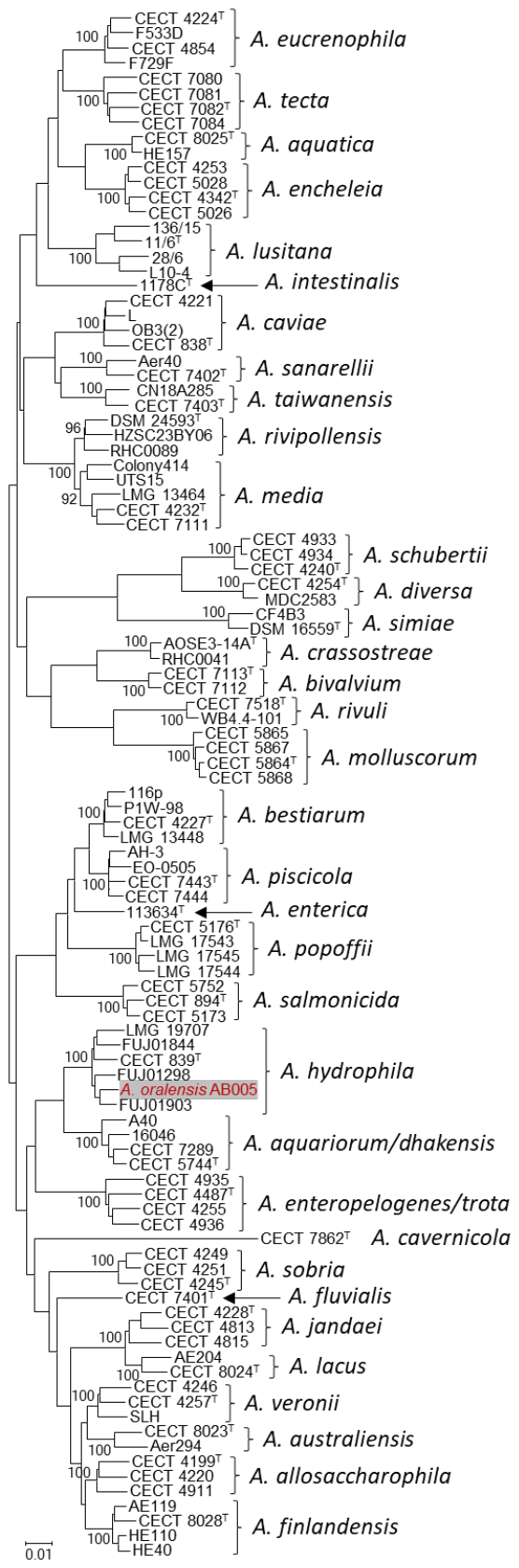
The identification of aeromonads using biochemical tests often fails due to the high phenotypic variability for strains of the same species, as is widely reported [5]. Currently, phylogenetic analysis and genome-based metrics are the standard framework for reliable species identification. Therefore, we investigated strain AB005 using multilocus phylogenetic analysis (MLPA) of six concatenated housekeeping gene sequences, including the type and other reference strains when available, an approach recommended for Aeromonas species delineation [6,7]. As housekeeping genes evolve in concert, the concatenated MLPA phylogeny reflects whole-genome relationships [7]. In addition to the type strain, we included publicly available genomes of A. hydrophila that have been previously identified as members of this species [8] for MLPA and genome-based comparisons, allowing for a more comprehensive representation of the genomic diversity of the species. The MLPA was consistent with phylogenomic relationships, and therefore provides a robust phylogenetic frame capable of discriminating Aeromonas species [7,9]. As illustrated in Figure 1, the strain AB005 was clearly included within the cluster corresponding to A. hydrophila, a robust phylogenetic group with a 100% bootstrap value. In addition, comparison of the 16S rRNA gene copies of strain AB005 with those of the type strain of A. hydrophila and other A. hydrophila strains included in the phylogenetic analysis revealed sequence similarities of 99.74–100%. These minor differences are attributable to microheterogeneities among the multiple copies of the 16S rRNA gene, a phenomenon previously reported in Aeromonas [10]. Moreover, ANI values were calculated using Skani (https://github.com/bluenote-1577/skani, accessed on 30 March 2026) [11]. Strain AB005 showed an ANI value of 96.19% with the type strain of A. hydrophila CECT 839T and ANI values ranging from 96.33 to 97.68% with other A. hydrophila strains included in the MLPA tree (Figure 1). According to MLPA, A. dhakensis and A. enteropelogenes were the closest species, with ANI values of 93.89% and 87.93%, respectively, between strain AB005 and the corresponding type strains. More distantly related species such as A. caviae and A. jandaei showed ANI values of 89.25% and 88.49%, respectively, between strain AB005 and the corresponding type strains (Table 1). These ANI values, which fully agreed with those previously described [1], clearly meet the threshold to consider strain AB005 as belonging to A. hydrophila. In addition, we used GGDC [12] to calculate the dDDH of strain AB005 with respect to reference genomes and results were as follows: 68.90% with A. hydrophila CECT 839T, 68.90–78.10% with the other A. hydrophila strains in the MLPA-tree, 49.60% with A. dhakensis CECT 5744T, 32.30% with A. caviae CECT 838T, 31.00% with A. jandaei CECT 4228T, and 29.90% with A. enteropelogenes CECT 4487T (Table 1). These values were consistent with those previously reported [1]. Although the dDDH value of 68.90% between strain AB005 and the A. hydrophila type strain is slightly below the conventional 70% threshold for species delineation, comparisons with additional A. hydrophila strains yield values above this limit, reaching up to 78.10%, supporting the inclusion of strain AB005 within the genomic diversity of the species. Similar cases have been reported in other bacterial taxa, where strains within the same species may exhibit dDDH values below the conventional 70% threshold, while ANI values and phylogenomic analyses consistently support their classification within a single species [13]. Taken together, the present analyses, including MLPA, ANI, and dDDH, unequivocally indicate that the isolate AB005 belongs to A. hydrophila, the type species of the genus Aeromonas. The atypical phenotypical characteristics reported are not of sufficient taxonomic value to consider a novel taxon; however, they argue for vast diversity within the species A. hydrophila. Furthermore, because A. oralensis was described from a single isolate and this strain exhibits very high phylogenetic and genomic relatedness to A. hydrophila, it was difficult to establish reliable species boundaries. Under such circumstances, the recognition of a separate species does not appear to be justified. According to Rule 24b of the International Code of Nomenclature of Prokaryotes [14,15], in case of heterotypic synonymy of same rank taxa, the senior name, because it was first validated, has priority over the junior. This rule only applies to names that have been validly published [16]. Since A. oralensis has not been validly published (https://lpsn.dsmz.de/genus/aeromonas, accessed on 30 March 2026), it has no standing in the nomenclature and cannot be formally proposed as a heterotypic synonym of A. hydrophila. Nevertheless, the phylogenetic and genomic evidence presented here clearly indicates that strain AB005, although it may test negative for indole production, ornithine decarboxylase, and D-xylose fermentation, belongs to A. hydrophila and does not support its recognition as a distinct species.

Author Contributions

Conceptualization, A.M.-M., A.N., and C.M.-P.; formal analysis, A.M.-M., A.N., and C.M.-P.; writing—original draft preparation, A.M.-M., A.N., and C.M.-P.; writing—review and editing, A.M.-M., A.N., and C.M.-P. All authors have read and agreed to the published version of the manuscript.

Data Availability Statement

The original contributions presented in this study are included in the article. Further inquiries can be directed to the corresponding author.

Acknowledgments

We are grateful to the GPS® R&D team.

Conflicts of Interest

Author Antonio Martínez-Murcia is a professor at the University Miguel Hernandez and a scientific advisor at genetic PCR solutions®. Authors Aaron Navarro and Caridad Miró-Pina were employed by genetic PCR solutions®. The authors declare no other potential or perceived conflicts of interest.

References

  1. Mashzhan, A.; Smekenov, I.; Bakiyev, S.; Utegenova, K.; Samatkyzy, D.; Daniyarov, A.; Kairov, U.; Sarbassov, D.; Bissenbaev, A. Whole-Genome Sequencing of a Potentially Novel Aeromonas Species Isolated from Diseased Siberian Sturgeon (Acipenser baerii) Using Oxford Nanopore Sequencing. Microorganisms 2025, 13, 1680. [Google Scholar] [CrossRef] [PubMed]
  2. Janda, J.M.; Abbott, S.L. The Genus Aeromonas: Taxonomy, Pathogenicity, and Infection. Clin. Microbiol. Rev. 2010, 23, 35–73. [Google Scholar] [CrossRef] [PubMed]
  3. Austin, B.; Austin, D. Bacterial Fish Pathogens: Diseases of Farmed and Wild Fish, 4th ed.; Springer: Dordrecht, The Netherlands, 2007; ISBN 978-1-4020-6068-7. [Google Scholar]
  4. Martinez-Murcia, A.J.; Benlloch, S.; Collins, M.D. Phylogenetic Interrelationships of Members of the Genera Aeromonas and Plesiomonas as Determined by 16S Ribosomal DNA Sequencing: Lack of Congruence with Results of DNA-DNA Hybridizations. Int. J. Syst. Bacteriol. 1992, 42, 412–421. [Google Scholar] [CrossRef] [PubMed]
  5. Martin-Carnahan, A.; Joseph, S.W. Aeromonadales ord. Nov. In Bergey’s Manual® of Systematic Bacteriology: Volume Two The Proteobacteria Part B The Gammaproteobacteria; Brenner, D.J., Krieg, N.R., Staley, J.T., Garrity, G.M., Boone, D.R., De Vos, P., Goodfellow, M., Rainey, F.A., Schleifer, K.-H., Eds.; Springer: Boston, MA, USA, 2005; pp. 556–587. ISBN 978-0-387-28022-6. [Google Scholar]
  6. Martinez-Murcia, A.J.; Monera, A.; Saavedra, M.J.; Oncina, R.; Lopez-Alvarez, M.; Lara, E.; Figueras, M.J. Multilocus Phylogenetic Analysis of the Genus Aeromonas. Syst. Appl. Microbiol. 2011, 34, 189–199. [Google Scholar] [CrossRef] [PubMed]
  7. Navarro, A.; Martínez-Murcia, A. Phylogenetic Analyses of the Genus Aeromonas Based on Housekeeping Gene Sequencing and Its Influence on Systematics. J. Appl. Microbiol. 2018, 125, 622–631. [Google Scholar] [CrossRef] [PubMed]
  8. Sakurai, A.; Suzuki, M.; Ohkushi, D.; Harada, S.; Hosokawa, N.; Ishikawa, K.; Sakurai, T.; Ishihara, T.; Sasazawa, H.; Yama-moto, T.; et al. Clinical Features, Genome Epidemiology, and Antimicrobial Resistance Profiles of Aeromonas Spp. Causing Human Infections: A Multicenter Prospective Cohort Study. Open Forum Infect. Dis. 2023, 10, ofad587. [Google Scholar] [CrossRef] [PubMed]
  9. Martínez-Murcia, A.; Lamy, B. Molecular Diagnostics by Genetic Methods. In Aeromonas; Caister Academic Press: Norfolk, UK, 2015; pp. 155–200. ISBN 978-1-908230-56-0. [Google Scholar]
  10. Alperi, A.; Figueras, M.J.; Inza, I.; Martínez-Murcia, A.J. Analysis of 16S rRNA Gene Mutations in a Subset of Aeromonas Strains and Their Impact in Species Delineation. Int. Microbiol. 2008, 11, 185–194. [Google Scholar] [CrossRef] [PubMed]
  11. Shaw, J.; Yu, Y.W. Fast and Robust Metagenomic Sequence Comparison through Sparse Chaining with Skani. Nat. Methods 2023, 20, 1661–1665. [Google Scholar] [CrossRef] [PubMed]
  12. Meier-Kolthoff, J.P.; Carbasse, J.S.; Peinado-Olarte, R.L.; Göker, M. TYGS and LPSN: A Database Tandem for Fast and Reliable Genome-Based Classification and Nomenclature of Prokaryotes. Nucleic Acids Res. 2022, 50, D801–D807. [Google Scholar] [CrossRef] [PubMed]
  13. Li, S.; Wang, X.-R.; Zhang, W.; Li, W.-J. Genome-Based Reassessment of Sphingobacterium Reveals the Limitation of the Fixed dDDH Threshold for Prokaryotic Species Delineation. Curr. Res. Microb. Sci. 2026, 10, 100524. [Google Scholar] [CrossRef] [PubMed]
  14. Tindall, B.J. Rule 24b of the International Code of Nomenclature of Prokaryotes and Regulating the Priority of Names and Epithets Considered to Be Associated with Heterotypic Synonyms. Int. J. Syst. Evol. Microbiol. 2019, 69, 3980–3983. [Google Scholar] [CrossRef] [PubMed]
  15. Oren, A.; Arahal, D.R.; Christensen, H.; Göker, M.; Manaia, C.M.; Moore, E.R.B. International Code of Nomenclature of Prokaryotes. Prokaryotic Code (2025 Revision). Int. J. Syst. Evol. Microbiol. 2026, 76, 006979. [Google Scholar] [CrossRef] [PubMed]
  16. Oren, A.; Garrity, G.M. New Combinations, Synonymy and Emendations Can Only Be Proposed Based on Names That Were Previously Validly Published. Int. J. Syst. Evol. Microbiol. 2020, 70, 4419–4420. [Google Scholar] [CrossRef] [PubMed]
Figure 1. Multilocus phylogenetic analysis (MLPA) obtained from the concatenated sequences of housekeeping genes gyrB, rpoD, recA, dnaJ, gyrA, and dnaX (N-J method; total of 3084 bp) showing the relationships of Aeromonas species and strain AB005 (highlighted in red). Numbers at nodes indicate bootstrap values (percentage of 1000 replicates). Bar, 0.01 estimated nucleotide substitutions per site. All sequence data were downloaded from the NCBI website.
Microorganisms 14 01080 g001
Table 1. Genome relatedness indices between different Aeromonas strains based on average nucleotide identity (ANI) and digital DNA–DNA hybridization (dDDH).
ReferenceQueryANIdDDH
A. hydrophila CECT 839TA. oralensis AB00596.19%68.90%
A. hydrophila FUJ01298A. oralensis AB00596.33%68.90%
A. hydrophila FUJ01844A. oralensis AB00596.46%70.00%
A. hydrophila FUJ01903A. oralensis AB00597.68%78.10%
A. hydrophila CECT 839TA. hydrophila FUJ0129897.15%74.70%
A. hydrophila CECT 839TA. hydrophila FUJ0184497.01%72.90%
A. hydrophila CECT 839TA. hydrophila FUJ0190396.46%69.20%
A. hydrophila CECT 839TA. dhakensis CECT 5744T94.04%50.30%
A. dhakensis CECT 5744TA. oralensis AB00593.89%49.60%
A. caviae CECT 838TA. oralensis AB00589.25%32.30%
A. jandaei CECT 4228TA. oralensis AB00588.49%31.00%
A. enteropelogenes CECT 4487TA. oralensis AB00587.93%29.90%
Disclaimer/Publisher’s Note: The statements, opinions and data contained in all publications are solely those of the individual author(s) and contributor(s) and not of MDPI and/or the editor(s). MDPI and/or the editor(s) disclaim responsibility for any injury to people or property resulting from any ideas, methods, instructions or products referred to in the content.