
Lightweight Fault Diagnosis of Port Crane Bearings Based on Multi-Source Feature Fusion Network and Structured Pruning

Abstract
1. Introduction
2. Materials and Methods
2.1. Relevant Fundamental Research
2.1.1. Multi-Scale Convolution
2.1.2. Residual Network
2.1.3. Structured Channel Pruning
- (1)
- Channel Importance Evaluation
- (2)
- Pruning Principle
2.2. The Proposed Method
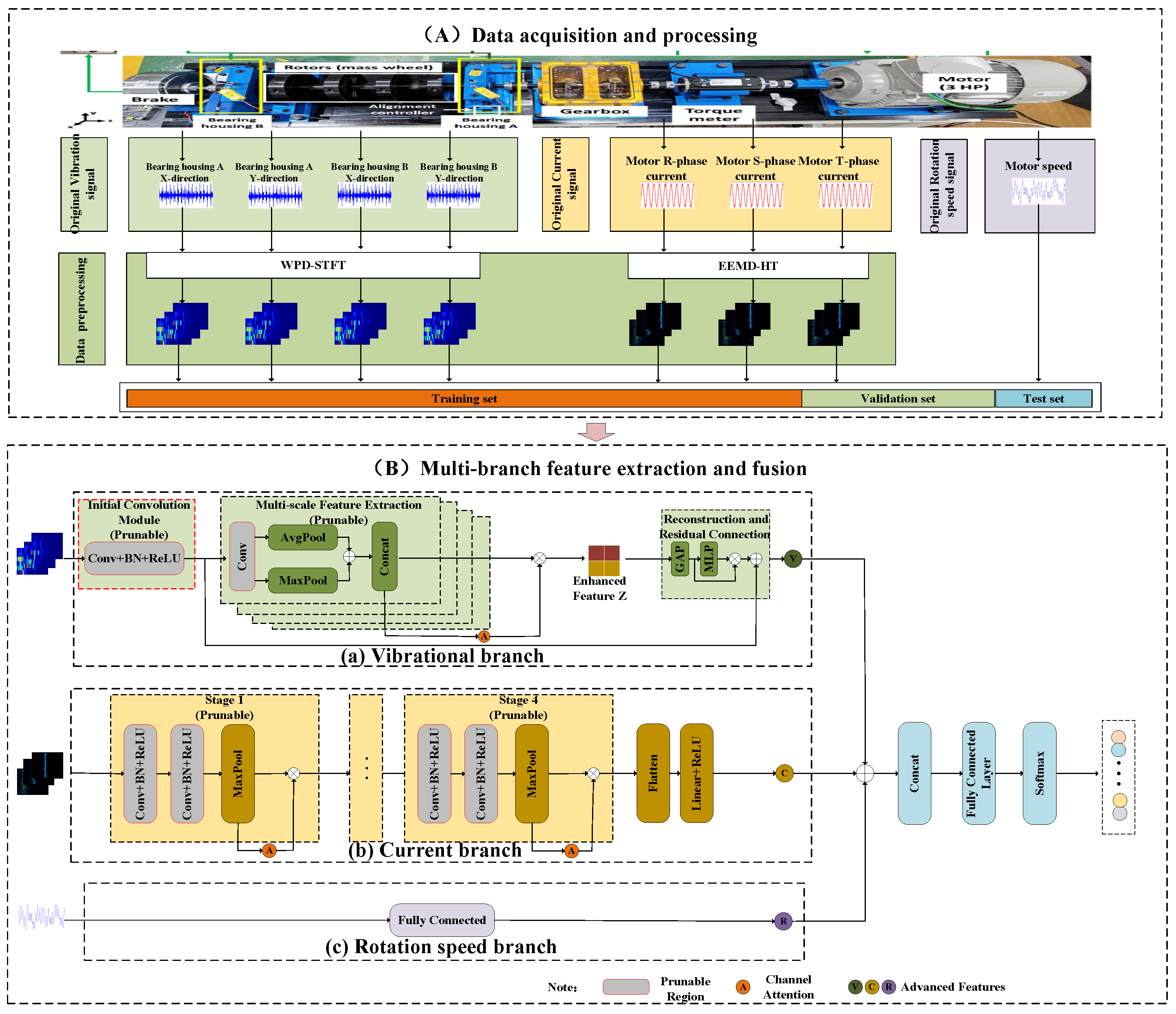
2.2.1. Differentiated Time-Frequency Preprocessing of Multi-Source Signals
2.2.2. Multi-Branch Temporal Feature Extraction Module
- (1)
- Vibration Signal Feature Branch
- (2)
- Current Signal Feature Branch
- (3)
- Speed Signal Feature Branch
2.2.3. Multi-Source Feature Fusion Mapping and Softmax Classification
- (1)
- Multi-Source Feature Channel Fusion
- (2)
- Fully Connected Mapping of Fused Features
- (3)
- Softmax Fault Classification and Loss Function Construction
2.2.4. Targeted Structured Pruning for Multi-Branch Networks
- (1)
- Channel Importance Evaluation Criterion
- (2)
- Execution Flow of Multi-Branch Targeted Pruning
- (3)
- Pruning Accuracy Recovery and Constraint Mechanism
3. Results
3.1. Experimental Environment and Parameter Settings
3.2. Experimental Group A
3.2.1. Introduction to the Dataset
3.2.2. Dataset Preprocessing
3.2.3. Analysis of Experimental Results
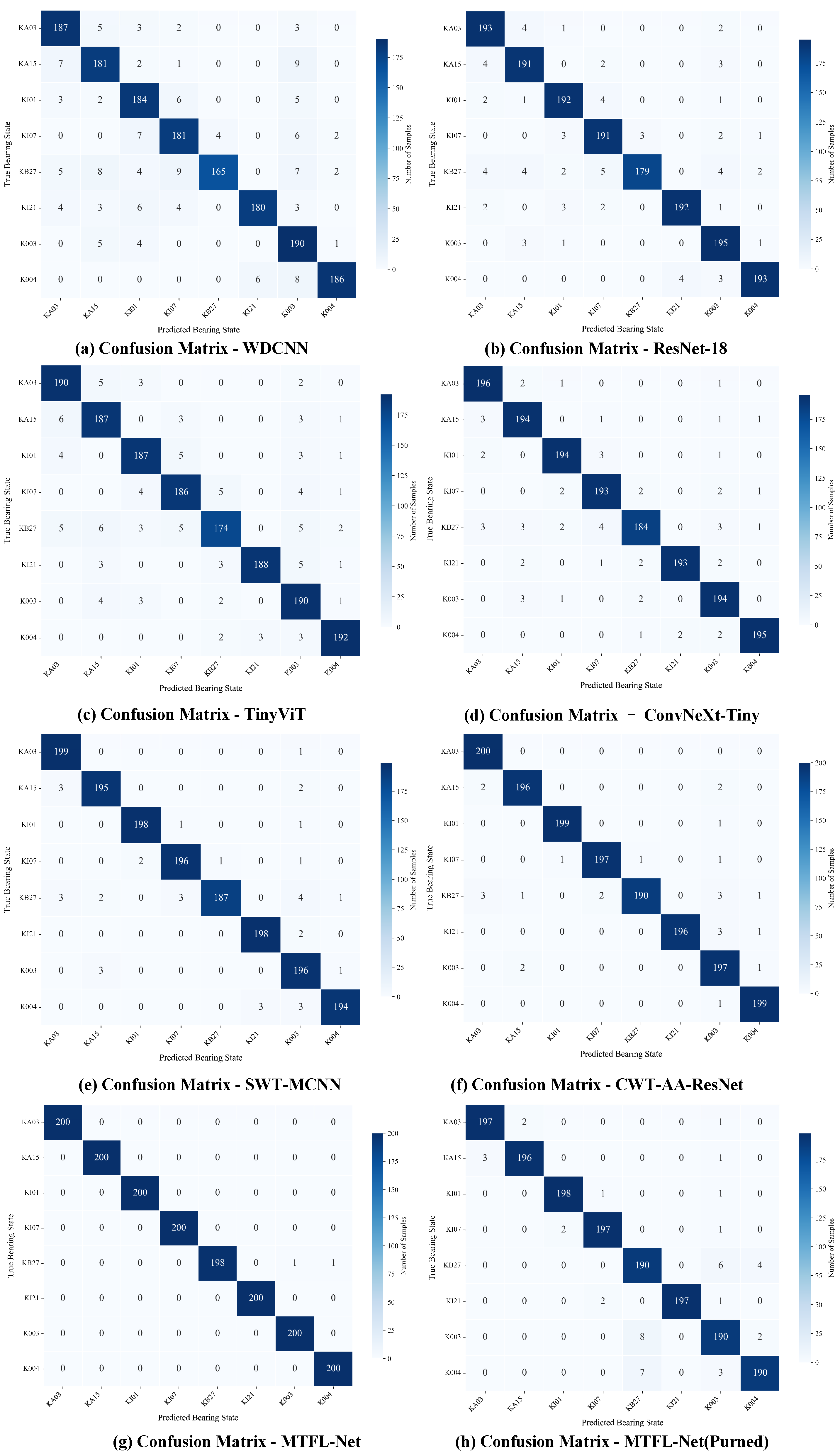
- The original MTFL-Net achieves a diagnostic accuracy of 99.87% on the PU dataset, outperforming all comparative models. This performance gain is attributed to the complementary characteristics of multi-source signals and the enhancement of fault-sensitive features by the attention mechanism, which enables the model to accurately distinguish subtle fault differences.
- The parameter and computation volume of the original MTFL-Net are higher than SWT-MCNN and TinyViT, but significantly lower than ConvNeXt-Tiny. Notably, MTFL-Net achieves 5.7 and 3.55 percentage points higher accuracy than TinyViT and ConvNeXt-Tiny respectively with only 8.17 M parameters, effectively balancing the strong feature representation capability of multi-source fusion and model compactness.
- After a 60% targeted structured channel pruning, the model is compressed to 3.28 M parameters with FLOPs reduced to 292.09 M. The per-sample inference time is only 2.88 ms, and the accuracy drop is limited to 3.13%. These results fully satisfy the deployment requirements for edge devices.
- To further assess how well the pruned model would work in real industrial settings, we analyzed its hardware needs and computational performance using the typical specs of industrial control computers commonly used in port automation. The pruned MTFL-Net is only 12.6 MB in size, uses roughly 18 MB of memory when running, and peaks at less than 35% CPU utilization. These figures show it easily meets the real-time requirement for industrial fault diagnosis, and can run alongside other monitoring systems on the same edge device without causing performance issues.
3.2.4. Confusion Matrix Analysis
3.3. Experimental Group B
3.3.1. Introduction to the Dataset
3.3.2. Experimental Results and Analysis
- (1)
- CWT-AA-ResNet and SWT-MCNN suffer from severe accuracy degradation under variable working conditions, especially in low SNR scenarios. At 0 dB, the accuracy of CWT-AA-ResNet and SWT-MCNN drops to 87.93% and 85.74% respectively, with a decline of more than 10% compared with the high SNR condition. This is because the single signal input lacks complementary information of working conditions and electromagnetic features, making it difficult to distinguish fault features from background noise and speed fluctuations.
- (2)
- The original MTFL-Net maintains the highest diagnostic accuracy under all SNR levels. Even at 0 dB strong noise and variable working conditions, the accuracy still reaches 93.36%, the pruned MTFL-Net also outperforms all comparative lightweight models, with an accuracy of 90.41% at 0 dB, verifying the robustness of the model structure and pruning strategy.
- (3)
- The performance gap between MTFL-Net and other models widens as the working condition fluctuates and noise intensity increases, which fully demonstrates that the multi-source fusion framework, differentiated time-frequency preprocessing, and attention mechanism can effectively capture stable fault features under non-stationary and strong interference scenarios.
3.3.3. Confusion Matrix Analysis
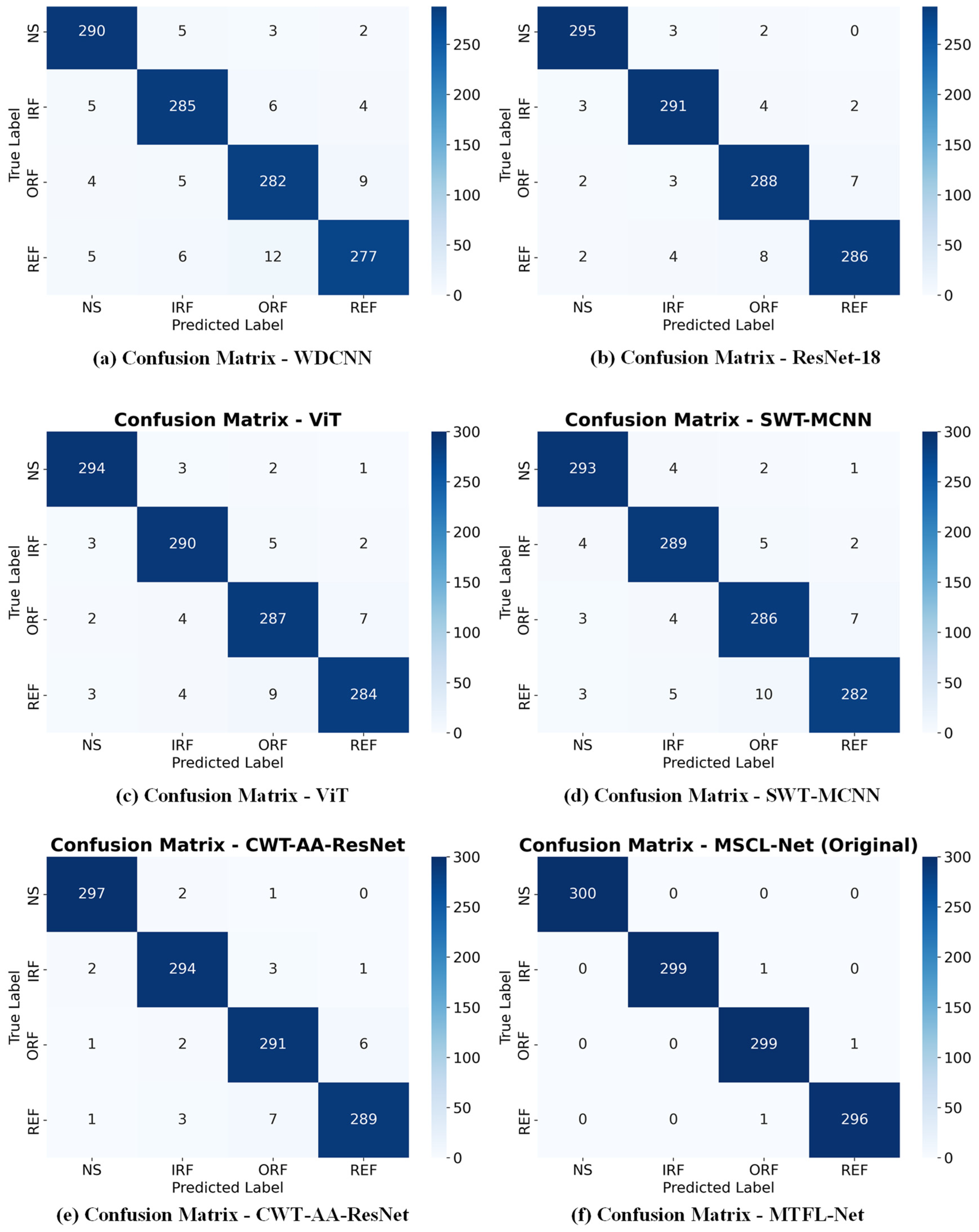
- From the confusion matrix results, MTFL-Net achieves a recognition accuracy of over 95% for all fault types, with 99.2% for normal state, 98.7% for inner race fault, 97.5% for outer race fault, and 95.3% for rolling element fault. Inner and outer race faults produce clear periodic impact signals with well-defined characteristic frequencies, which are relatively easy to capture even under speed fluctuations, so the model shows almost no misclassification for these two fault types. In contrast, rolling element faults generate much weaker and more dispersed impact features, and their characteristic frequencies are prone to overlap and aliasing with working condition interference components, making them the most challenging fault type to diagnose in practice. The misclassification in our model mainly occurs between rolling element fault and outer race fault, which is consistent with the actual feature variation law of bearing faults under variable speed conditions.
- CWT-AA-ResNet and SWT-MCNN have significant misclassification for rolling element fault, with recognition accuracies of only 91.2% and 88.5%, respectively. A large number of rolling element fault samples are misclassified as normal state or outer race fault, which is because the single input cannot fully capture the weak fault features under speed fluctuations, and the fixed convolution kernel cannot adapt to the change in fault characteristic frequency.
- Compared with the comparative models, MTFL-Net significantly improves the recognition accuracy of weak fault types under variable working conditions, which is attributed to the multi-source signal fusion that provides complementary fault information, and the channel attention mechanism that adaptively enhances the weight of weak fault features.
- Channel retention distribution: The convolutional channel retention rate was 42% for the vibration branch and 38% for the current branch, with uniform distribution and no over-pruning of any modality;
- Fault type accuracy comparison: After pruning, the accuracy of single-point faults (inner/outer race) decreased from 100% to 98.7%, and rolling element faults from 95.3% to 92.1%, with the accuracy drop of all fault types controlled within 3.2%.
3.3.4. Ablation Study for Variable-Condition Scenarios
4. Discussion
4.1. Summary of Core Innovations
4.2. Limitations and Future Research Directions
Author Contributions
Funding
Institutional Review Board Statement
Informed Consent Statement
Data Availability Statement
Conflicts of Interest
References
- Khan, M.A.; Asad, B.; Kudelina, K.; Vaimann, T.; Kallaste, A. The Bearing Faults Detection Methods for Electrical Machines—The State of the Art. Energies 2023, 16, 296. [Google Scholar] [CrossRef]
- Qiao, Z.; Ning, S.; Gai, Y.; Xie, C. A Digital Twin Guided Physical-Virtual Denoising Method for Early Fault Detection of Rolling Element Bearings. Mech. Syst. Signal Process. 2026, 249, 114108. [Google Scholar] [CrossRef]
- Er, M.B.; Koca, T. A Novel Approach for Motor Bearing Fault Detection Using EMD-Based Denoising and Detrended Fluctuation Analysis & LSTM Multimodal Hybrid Features with K-Means Clustering. J. Vib. Eng. Technol. 2026, 14, 103. [Google Scholar] [CrossRef]
- Cao, J.; Wen, Z.; Zhao, Q.; Zhang, Y.; Huang, L. A Rolling Bearing Fault Diagnosis Model Based on SAO-VMD and IARO-SVM. IEEE Trans. Consum. Electron. 2026, 72, 1112–1121. [Google Scholar] [CrossRef]
- Liu, X.; Zhang, Z.; Meng, F.; Zhang, Y. Fault Diagnosis of Wind Turbine Bearings Based on CNN and SSA–ELM. J. Vib. Eng. Technol. 2023, 11, 3929–3945. [Google Scholar] [CrossRef]
- Zhang, J.; Zhao, Z.; Jiao, Y.; Zhao, R.; Hu, X.; Che, R. DPCCNN: A New Lightweight Fault Diagnosis Model for Small Samples and High Noise Problem. Neurocomputing 2025, 626, 129526. [Google Scholar] [CrossRef]
- Wang, J.; Zhao, Y.; Wang, W.; Wu, Z. Improving Bearing Fault Diagnosis Method Based on the Fusion of Time–Frequency Diagram and a Novel Vision Transformer. J. Supercomput. 2025, 81, 262. [Google Scholar] [CrossRef]
- Fan, Y.; Fu, Z.; Li, H.; Yang, Y. Motor Bearing Fault Diagnosis Based on LMSWT with Improved Multiscale Convolutional Neural Network. IEEE Trans. Instrum. Meas. 2025, 74, 3537011. [Google Scholar] [CrossRef]
- Liu, G.; Zhang, C.; Xu, S.; Zhang, J.; Wu, L. A New Lightweight Fault Diagnosis Framework Towards Variable Speed Rolling Bearings. IEEE Access 2024, 12, 70170–70183. [Google Scholar] [CrossRef]
- Wu, X.; Du, J. Few-Shot Fault Diagnosis of Switch Machines Based on Multi-Sensor Fusion and Improved Class-Center Fine-Tuning Prototype Network. Control Eng. Pract. 2026, 172, 106849. [Google Scholar] [CrossRef]
- Chen, F.; Zhao, Z.; Hu, X.; Liu, D.; Yin, X.; Yang, J. A Nonlinear Dynamics Method Using Multi-Sensor Signal Fusion for Fault Diagnosis of Rotating Machinery. Adv. Eng. Inform. 2025, 65, 103190. [Google Scholar] [CrossRef]
- Wang, Y.; Wang, H.; Bai, R.; Shi, Y.; Chen, X.; Xu, Q. Enhanced Rolling Bearing Fault Diagnosis Using Multimodal Deep Learning and Singular Spectrum Analysis. Appl. Sci. 2025, 15, 4828. [Google Scholar] [CrossRef]
- Tong, C.; Chen, L.; Zhang, J.; Zhao, Z. Intelligent Fault Diagnosis Based on Multi-Source Information Fusion and Attention-Enhanced Networks. Sci. Rep. 2025, 15, 36222. [Google Scholar] [CrossRef]
- Zhang, Z.; Jiao, Z.; Li, Y.; Shao, M.; Dai, X. Intelligent Fault Diagnosis of Bearings Driven by Double-Level Data Fusion Based on Multichannel Sample Fusion and Feature Fusion under Time-Varying Speed Conditions. Reliab. Eng. Syst. Saf. 2024, 251, 110362. [Google Scholar] [CrossRef]
- He, Y.; Xiao, L. Structured Pruning for Deep Convolutional Neural Networks: A Survey. IEEE Trans. Pattern Anal. Mach. Intell. 2024, 46, 2900–2919. [Google Scholar] [CrossRef]
- Li, H.; Qiao, Z.; Zhang, C.; Lu, Y.; Zhang, X.; Wang, J. A Lightweight Model Compression Framework for Intelligent Fault Diagnosis of Machines on Resource-Constrained Devices. Nondestruct. Test. Eval. 2025, 1–22. [Google Scholar] [CrossRef]
- Lee, S.; Jeon, Y.; Lee, S.; Kim, J. Tailored Channel Pruning: Achieve Targeted Model Complexity Through Adaptive Sparsity Regularization. IEEE Access 2025, 13, 12113–12126. [Google Scholar] [CrossRef]
- Cheng, Y.; Lin, X.; Zhu, H.; Wu, J.; Shi, H.; Ding, H. A Novel Hierarchical Structural Pruning-Multiscale Feature Fusion Residual Network for Intelligent Fault Diagnosis. Mech. Mach. Theory 2023, 184, 105292. [Google Scholar] [CrossRef]
- Sun, J.; Liu, Z.; Wen, J. An Efficient Lightweight Network with Improved Heterogeneous Convolution for Bearing Fault Diagnosis. IEEE Access 2025, 13, 185759–185770. [Google Scholar] [CrossRef]
- Brock, A.; Lim, T.; Ritchie, J.M.; Weston, N. Neural Photo Editing with Introspective Adversarial Networks. arXiv 2017. [Google Scholar] [CrossRef]
- He, K.; Zhang, X.; Ren, S.; Sun, J. Deep Residual Learning for Image Recognition. In Proceedings of the 2016 IEEE Conference on Computer Vision and Pattern Recognition (CVPR), Las Vegas, NV, USA, 27–30 June 2016; pp. 770–778. [Google Scholar] [CrossRef]
- Li, H.; Kadav, A.; Durdanovic, I.; Samet, H.; Graf, H.P. Pruning Filters for Efficient ConvNets. arXiv 2017. [Google Scholar] [CrossRef]
- Nasiri, A.; Rahideh, A.; Agah, G.R.; Hedayati Kia, S. Ball-Bearing Fault Detection of Squirrel-Cage Induction Motors Based on Single-Phase Stator Current Using Wavelet Packet Decomposition and Statistical Features. IEEE Trans. Energy Convers. 2025, 40, 1529–1537. [Google Scholar] [CrossRef]
- Lessmeier, C.; Kimotho, J.K.; Zimmer, D.; Sextro, W. Condition Monitoring of Bearing Damage in Electromechanical Drive Systems by Using Motor Current Signals of Electric Motors: A Benchmark Data Set for Data-Driven Classification. PHM Soc. Eur. Conf. 2016, 3. [Google Scholar] [CrossRef]
- Zhang, W.; Peng, G.; Li, C.; Chen, Y.; Zhang, Z. A New Deep Learning Model for Fault Diagnosis with Good Anti-Noise and Domain Adaptation Ability on Raw Vibration Signals. Sensors 2017, 17, 425. [Google Scholar] [CrossRef] [PubMed]
- Cui, X.; An, X.; Hu, J. Fault Diagnosis Method for Rolling Bearings Based on Continuous Wavelet Transform and Optimized Residual Network. In Proceedings of the 2025 5th International Symposium on Artificial Intelligence and Intelligent Manufacturing (AIIM), Chengdu, China, 19–21 September 2025; pp. 335–338. [Google Scholar] [CrossRef]
- Ge, M.; Chen, Y.; Liu, H.; Chen, K. Research on Bearing Fault Diagnosis Based on Synchronous Compressed Wavelet Transform and Multi-Scale Convolutional Neural Networks. In Proceedings of the 2025 12th International Forum on Electrical Engineering and Automation (IFEEA), Xi’an, China, 7–9 November 2025; pp. 906–910. [Google Scholar] [CrossRef]
- Liu, Z.; Mao, H.; Wu, C.-Y.; Feichtenhofer, C.; Darrell, T.; Xie, S. A ConvNet for the 2020s. In Proceedings of the 2022 IEEE/CVF Conference on Computer Vision and Pattern Recognition (CVPR), New Orleans, LA, USA, 18–24 June 2022; pp. 11966–11976. [Google Scholar] [CrossRef]
- Wu, K.; Zhang, J.; Peng, H.; Liu, M.; Xiao, B.; Fu, J.; Yuan, L. TinyViT: Fast Pretraining Distillation for Small Vision Transformers. In Computer Vision—ECCV 2022; Avidan, S., Brostow, G., Cissé, M., Farinella, G.M., Hassner, T., Eds.; Springer Nature: Cham, Switzerland, 2022; pp. 68–85. [Google Scholar] [CrossRef]
- Jung, W.; Kim, S.-H.; Yun, S.-H.; Bae, J.; Park, Y.-H. Vibration, Acoustic, Temperature, and Motor Current Dataset of Rotating Machine under Varying Operating Conditions for Fault Diagnosis. Data Brief 2023, 48, 109049. [Google Scholar] [CrossRef] [PubMed]



| Network Branch | Layer Type | Input Dimensions | Output Dimensions |
|---|---|---|---|
| Vibration Branch | Input Layer | B × 4 × 5 × 3 × 64 × 64 | B × 4 × 5 × 3 × 64 × 64 |
| Dimensionality Reshaping | B × 4 × 5 × 3 × 64 × 64 | B × 20 × 3 × 64 × 64 | |
| Initial Convolution Module | B × 20 × 3 × 64 × 64 | B × 32 × 3 × 32 × 32 | |
| Multi-scale Feature Extraction Module | B × 32 × 3 × 32 × 32 | B × 128 × 3 × 32 × 32 | |
| Hierarchical Max Pooling | B × 128 × 3 × 32 × 32 | B × 512 × 3 × 2 × 2 | |
| Global Average Pooling | B × 512 × 3 × 2 × 2 | B × 512 × 3 × 1 × 1 | |
| Dimensionality Flattening | B × 512 × 3 × 1 × 1 | B × 1536 | |
| Fully Connected Layer | B × 1536 | B × 512 | |
| Current Branch | Input Layer | B × 3 × 5 × 3 × 64 × 64 | B × 3 × 5 × 3 × 64 × 64 |
| Dimensionality Reshaping | B × 3 × 5 × 3 × 64 × 64 | B × 15 × 3 × 64 × 64 | |
| Conv Block Stage 1–4 | B × 15 × 3 × 64 × 64 | B × 256 × 3 × 2 × 2 | |
| Global Average Pooling | B × 256 × 3 × 2 × 2 | B × 256 × 3 × 1 × 1 | |
| Dimensionality Flattening | B × 256 × 3 × 1 × 1 | B × 768 | |
| Fully Connected Layer | B × 768 | B × 512 |
| Model | Diagnostic Accuracy (%) | Parameters (M) | FLOPs (M) | Inference Time per Sample (ms) |
|---|---|---|---|---|
| WDCNN | 92.26 | 2.87 | 386.52 | 3.64 |
| ResNet-18 | 95.15 | 9.18 | 1728.64 | 10.32 |
| TinyViT | 94.17 | 5.23 | 621.37 | 6.18 |
| ConvNeXt-Tiny | 96.32 | 21.58 | 408.72 | 6.52 |
| SWT-MCNN | 97.83 | 2.12 | 214.56 | 2.15 |
| CWT-AA-ResNet | 98.11 | 9.78 | 682.34 | 6.82 |
| MTFL-Net (Original) | 99.87 | 8.17 | 957.33 | 8.43 |
| MTFL-Net (Pruned) | 96.74 | 3.28 | 292.09 | 2.88 |
| Model | Raw Data | 30 dB | 20 dB | 10 dB | 0 dB |
|---|---|---|---|---|---|
| WDCNN | 92.47 | 90.53 | 86.16 | 79.29 | 72.45 |
| ResNet-18 | 95.12 | 92.27 | 89.34 | 83.62 | 76.39 |
| ViT | 94.58 | 92.16 | 88.25 | 82.18 | 74.88 |
| SWT-MCNN | 94.17 | 93.62 | 90.04 | 88.35 | 85.74 |
| CWT-AA-ResNet | 96.52 | 94.85 | 92.73 | 90.61 | 87.93 |
| MTFL-Net (Original) | 99.64 | 99.28 | 97.15 | 95.37 | 93.36 |
| MTFL-Net (Pruned) | 96.82 | 96.15 | 94.08 | 92.26 | 90.41 |
| Model Variant | Diagnostic Accuracy (%) |
|---|---|
| Without multi-source fusion (single vibration signal) | 89.27 |
| Without speed signal input | 93.15 |
| Fixed speed condition (all samples normalized to 1500 RPM) | 92.42 |
| Without residual connection | 91.43 |
| Without channel attention | 94.36 |
| Full MTFL-Net | 97.15 |
Disclaimer/Publisher’s Note: The statements, opinions and data contained in all publications are solely those of the individual author(s) and contributor(s) and not of MDPI and/or the editor(s). MDPI and/or the editor(s) disclaim responsibility for any injury to people or property resulting from any ideas, methods, instructions or products referred to in the content. |
© 2026 by the authors. Licensee MDPI, Basel, Switzerland. This article is an open access article distributed under the terms and conditions of the Creative Commons Attribution (CC BY) license.
Share and Cite
Yang, Y.; Chen, Z.; Wang, H. Lightweight Fault Diagnosis of Port Crane Bearings Based on Multi-Source Feature Fusion Network and Structured Pruning. Actuators 2026, 15, 322. https://doi.org/10.3390/act15060322
Yang Y, Chen Z, Wang H. Lightweight Fault Diagnosis of Port Crane Bearings Based on Multi-Source Feature Fusion Network and Structured Pruning. Actuators. 2026; 15(6):322. https://doi.org/10.3390/act15060322
Chicago/Turabian StyleYang, Yongsheng, Zehui Chen, and Heng Wang. 2026. "Lightweight Fault Diagnosis of Port Crane Bearings Based on Multi-Source Feature Fusion Network and Structured Pruning" Actuators 15, no. 6: 322. https://doi.org/10.3390/act15060322
APA StyleYang, Y., Chen, Z., & Wang, H. (2026). Lightweight Fault Diagnosis of Port Crane Bearings Based on Multi-Source Feature Fusion Network and Structured Pruning. Actuators, 15(6), 322. https://doi.org/10.3390/act15060322