The Implication of Horizontal Gene Transfer Between Acanthamoeba and Its Intracellular Microbes on Pathogenicity: A Systematic Review

 , ,
, ,  ,
, 
Abstract
1. Introduction
1.1. General Characteristics of Free-Living Amoeba Affecting Human Health

| Reference | Species of FLA | Major Clinical Manifestations | Organ(s) Affected | Pathogenicity | Differential Diagnosis |
|---|---|---|---|---|---|
| Wang et al., 2023 [1] | Acanthamoeba spp. | Acanthamoeba keratitis (AK), granulomatous amoebic encephalitis (GAE), skin and lung infection | Cornea, conjunctiva, skin, lung, CNS (central nervous system) | The pathogenicity is mediated by adhesins, including mannose-binding protein (MBP) and laminin-binding protein (LBP), and the production of proteases, phospholipases, and cytolytic molecules that can trigger phagocytosis and cause pathological damage to mammalian cells. | Bacterial keratitis, fungal keratitis, herpes simplex keratitis, Balamuthia-associated GAE |
| Schuster et al., 2004 [36] | Naegleria fowleri | Primary amoebic meningoencephalitis (PAM) | CNS | Highly virulent, can cause death within 1–2 weeks of hospitalization; enters through the nasal cavity by penetrating the mucosal epithelial layer and migrates to the brain via olfactory nerves. Pathogenic determinants include the secretion of enzymes such as phospholipase and neuraminidase, and the formation of pores in target cell membranes, which can promote cell lysis and enhance phagocytic activity. | Acute bacterial meningitis, viral encephalitis |
| Visvesvara et al., 2007 [33] | Balamuthia mandrillaris | GAE, cutaneous lesions | CNS, skin | GAE can have high mortality. Stimulates brain microvascular endothelial cells to secrete the pleiotropic cytokine interleukin-6, a mediator of the early inflammatory response. Metalloprotease activity may facilitate extracellular matrix degradation. Interacts with extracellular matrix components, including collagen I, fibronectin, and laminin-1. | Acanthamoeba GAE, tuberculosis, fungal CNS infection, brain tumours |
| Siddiqui et al., 2024 [37] | Sappinia diploidea | A non-granulomatous amoebic encephalitis | CNS | A rare human pathogen. The pathogenesis of Sappinia species remains unclear because only a single human case of Sappinia-associated amoebic encephalitis has been documented. Experimental studies have shown that Sappinia is capable of infecting both immunodeficient and immunocompetent mice. | Brain abscesses, bacterial and fungal encephalitis |
| Siddiqui et al., 2021 [38] | Vermamoeba vermiformis | Keratitis, rare opportunistic parasitic infection in a patient with meningoencephalitis and bronchopneumonia | Cornea, respiratory tract | Limited information on the pathogenesis of V. vermiformis. Can cause host cell damage through trogocytosis (piecemeal phagocytosis) and the secretion of cytopathic factors. | Acanthamoeba keratitis, bacterial keratitis |
| Kinnear et al. [39] | Vahlkampfia spp. | Rare keratitis and opportunistic infections | Cornea | Pathogenesis is poorly understood. May involve adherence to corneal epithelial cells and direct cytopathic damage to host tissues. | Acanthamoeba keratitis, fungal keratitis |


1.2. Mechanisms of Gene Transfer
2. Materials and Methods
2.1. Protocol Registration and Design
2.2. Databases and Search Strategy
2.3. Inclusion and Exclusion Criteria
2.4. Search Methods, Data Extraction and Quality Assessment
3. Results
3.1. Results of the Articles Search
3.2. Characteristics of Included Studies
3.3. Evidence of HGT in the Acanthamoeba Host
3.4. Genes Horizontally Transferred Between the Acanthamoeba Host and Its Intracellular Microorganisms and Vice Versa
3.5. Effect of Intracellular Microbes on the Pathology of Acanthamoeba
3.6. Antimicrobial Resistance Gene Transfer Within and Between Endosymbionts and Acanthamoeba
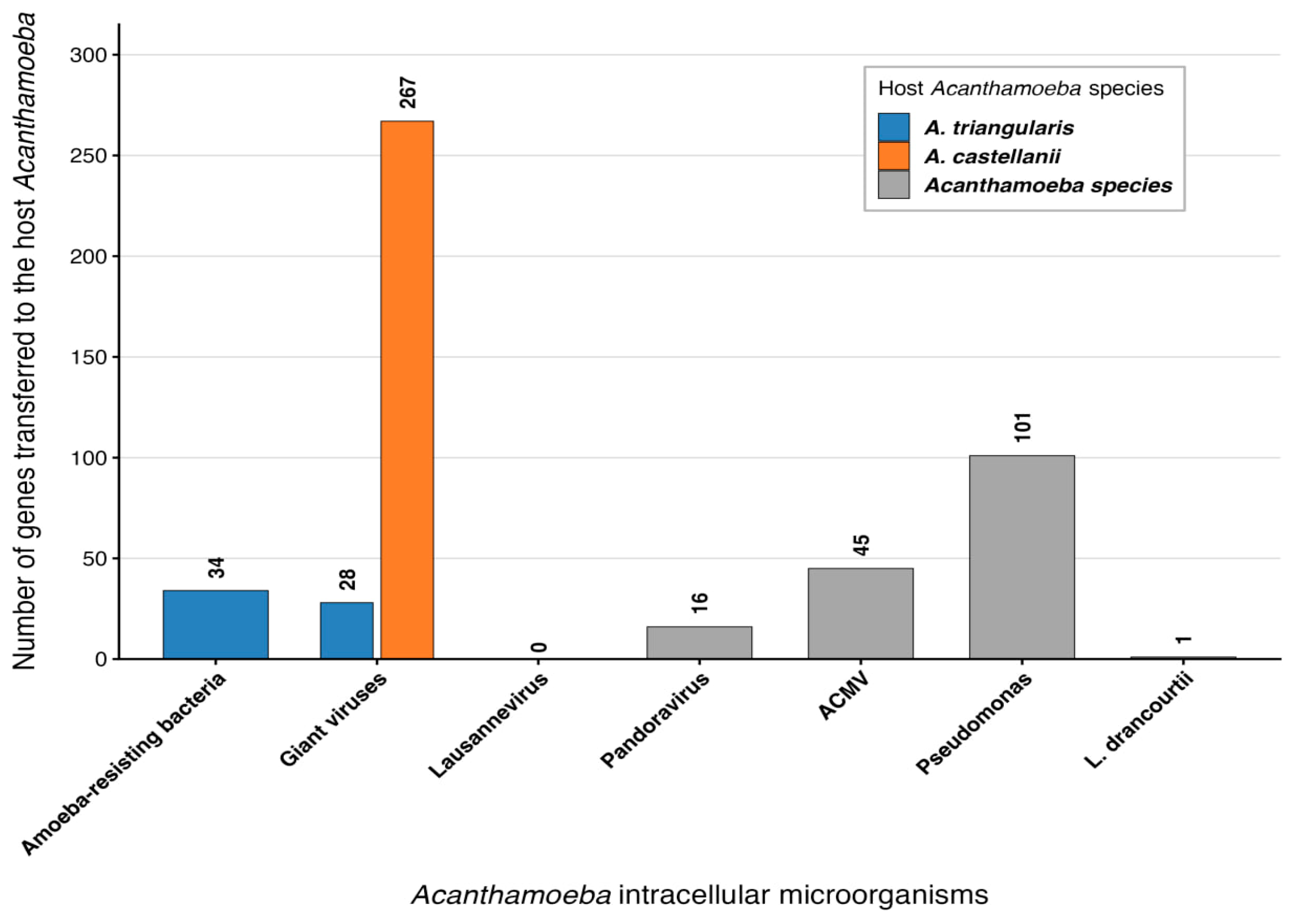
3.7. Number of Genes Horizontally Transferred to the Host Acanthamoeba
4. Discussion
5. Conclusions and Recommendations
6. Strengths and Limitations of the Systematic Review
Supplementary Materials
Author Contributions
Funding
Institutional Review Board Statement
Informed Consent Statement
Data Availability Statement
Acknowledgments
Conflicts of Interest
Abbreviations
| AK | Acanthamoeba keratitis |
| ARMs | Amoeba-resisting microorganisms |
| ARVs | Amoeba-resisting viruses |
| GAE | Granulomatous amoebic encephalitis |
| HGT | Horizontal gene transfer |
| HSP | Heat-shock proteins |
| KEGG | Kyoto Encyclopedia of Genes and Genomes |
| LBP | Laminin-binding proteins |
| MBP | Mannose-binding proteins |
| MCP | Major capsid protein |
| PRISMA | Preferred Reporting Items for Systematic Reviews and Meta-analyses |
| RAST | Rapid Annotation using Subsystem Technology |
| TGTase | tRNA-guanine transglycosylase |
| VAGs | Virulence-associated genes |
References
- Wang, Y.; Jiang, L.; Zhao, Y.; Ju, X.; Wang, L.; Jin, L.; Fine, R.D.; Li, M. Biological characteristics and pathogenicity of Acanthamoeba. Front. Microbiol. 2023, 14, 1147077. [Google Scholar] [CrossRef]
- Reyes-Batlle, M.; Sifaoui, I.; Rodríguez-Expósito, R.L.; Piñero, J.E.; Lorenzo-Morales, J. New insights in Acanthamoeba. Pathogens 2022, 11, 609. [Google Scholar] [CrossRef] [PubMed]
- Bao, M.; Bao, H.; Wang, S.; Zhou, H. The pathogenesis, risk factors, diagnosis and treatment of Acanthamoeba keratitis. Front. Med. 2025, 12, 1559224. [Google Scholar] [CrossRef]
- Magliano, A.C.; da Silva, F.M.; Teixeira, M.M.; Alfieri, S.C. Genotyping, physiological features and proteolytic activities of a potentially pathogenic Acanthamoeba sp. isolated from tap water in Brazil. Exp. Parasitol. 2009, 123, 231–235. [Google Scholar] [CrossRef]
- Lorenzo-Morales, J.; Martín-Navarro, C.M.; López-Arencibia, A.; Arnalich-Montiel, F.; Piñero, J.E.; Valladares, B. Acanthamoeba keratitis: An emerging disease gathering importance worldwide? Trends Parasitol. 2013, 29, 181–187. [Google Scholar] [CrossRef]
- Nagyová, V.; Nagy, A.; Janeček, Š.; Timko, J. Morphological, physiological, molecular and phylogenetic characterization of new environmental isolates of Acanthamoeba spp. from the region of Bratislava, Slovakia. Biologia 2010, 65, 81–91. [Google Scholar] [CrossRef]
- de Lacerda, A.G.; Lira, M. Acanthamoeba keratitis: A review of biology, pathophysiology and epidemiology. Ophthalmic Physiol. Opt. 2021, 41, 116–135. [Google Scholar] [CrossRef]
- Rayamajhee, B.; Subedi, D.; Peguda, H.K.; Willcox, M.D.; Henriquez, F.L.; Carnt, N. A systematic review of intracellular microorganisms within Acanthamoeba to understand potential impact for infection. Pathogens 2021, 10, 225. [Google Scholar] [CrossRef]
- Corsaro, D. Exploring LSU and ITS rDNA sequences for Acanthamoeba identification and phylogeny. Microorganisms 2022, 10, 1776. [Google Scholar] [CrossRef] [PubMed]
- Putaporntip, C.; Kuamsab, N.; Nuprasert, W.; Rojrung, R.; Pattanawong, U.; Tia, T.; Yanmanee, S.; Jongwutiwes, S. Analysis of Acanthamoeba genotypes from public freshwater sources in Thailand reveals a new genotype, T23 Acanthamoeba bangkokensis sp. nov. Sci. Rep. 2021, 11, 17290. [Google Scholar] [CrossRef]
- Burch, C.L.; Romanchuk, A.; Kelly, M.; Wu, Y.; Jones, C.D. Empirical evidence that complexity limits horizontal gene transfer. Genome Biol. Evol. 2023, 15, evad089. [Google Scholar] [CrossRef]
- Van Etten, J.; Bhattacharya, D. Horizontal gene transfer in eukaryotes: Not if, but how much? Trends Genet. 2020, 36, 915–925. [Google Scholar] [CrossRef] [PubMed]
- Fitzpatrick, D.A. Horizontal gene transfer in fungi. FEMS Microbiol. Lett. 2012, 329, 1–8. [Google Scholar] [CrossRef]
- Danchin, E.G.; Rosso, M.-N. Lateral gene transfers have polished animal genomes: Lessons from nematodes. Front. Cell. Infect. Microbiol. 2012, 2, 27. [Google Scholar] [CrossRef]
- Clarholm, M. Protozoan grazing of bacteria in soil—Impact and importance. Microb. Ecol. 1981, 7, 343–350. [Google Scholar] [CrossRef] [PubMed]
- Sriram, R.; Shoff, M.; Booton, G.; Fuerst, P.; Visvesvara, G.S. Survival of Acanthamoeba cysts after desiccation for more than 20 years. J. Clin. Microbiol. 2008, 46, 4045–4048. [Google Scholar] [CrossRef]
- Behera, H.S.; Satpathy, G.; Tripathi, M. Isolation and genotyping of Acanthamoeba spp. from Acanthamoeba meningitis/meningoencephalitis (AME) patients in India. Parasites Vectors 2016, 9, 442. [Google Scholar] [CrossRef]
- Nasher, F.; Wren, B.W. Unravelling mechanisms of bacterial recognition by Acanthamoeba: Insights into microbial ecology and immune responses. Front. Microbiol. 2024, 15, 1405133. [Google Scholar] [CrossRef]
- Mella, C.; Medina, G.; Flores-Martin, S.; Toledo, Z.; Simaluiza, R.; Pérez-Pérez, G.; Fernández, H. Interaction between zoonotic bacteria and free living amoebas. A new angle of an epidemiological polyhedron of public health importance? Austral J. Vet. Sci. 2016, 48, 1–10. [Google Scholar] [CrossRef]
- Gaze, W.; Burroughs, N.; Gallagher, M.; Wellington, E. Interactions between Salmonella typhimurium and Acanthamoeba polyphaga, and observation of a new mode of intracellular growth within contractile vacuoles. Microb. Ecol. 2003, 46, 358–369. [Google Scholar] [CrossRef] [PubMed]
- Rayamajhee, B.; Willcox, M.D.; Henriquez, F.L.; Petsoglou, C.; Subedi, D.; Carnt, N. Acanthamoeba, an environmental phagocyte enhancing survival and transmission of human pathogens. Trends Parasitol. 2022, 38, 975–990. [Google Scholar] [CrossRef]
- Gu, X.; Lu, X.; Lin, S.; Shi, X.; Shen, Y.; Lu, Q.; Yang, Y.; Yang, J.; Cai, J.; Fu, C.; et al. A comparative genomic approach to determine the virulence factors and horizontal gene transfer events of clinical Acanthamoeba isolates. Microbiol. Spectr. 2022, 10, e00025-22. [Google Scholar] [CrossRef] [PubMed]
- Scola, B.L.; Audic, S.; Robert, C.; Liang, J.; De Lamballerie, X.; Drancourt, M.; Birtles, R.; Claverie, J.-M.; Raoult, D. A giant virus in amoebae. Science 2003, 299, 2033. [Google Scholar] [CrossRef] [PubMed]
- Scheid, P.; Schwarzenberger, R. Acanthamoeba spp. as vehicle and reservoir of adenoviruses. Parasitol. Res. 2012, 111, 479–485. [Google Scholar] [CrossRef]
- Boratto, P.V.; Oliveira, G.P.; Machado, T.B.; Andrade, A.C.S.; Baudoin, J.-P.; Klose, T.; Schulz, F.; Azza, S.; Decloquement, P.; Chabrière, E.; et al. Yaravirus: A novel 80-nm virus infecting Acanthamoeba castellanii. Proc. Natl. Acad. Sci. USA 2020, 117, 16579–16586. [Google Scholar] [CrossRef]
- Mattana, A.; Serra, C.; Mariotti, E.; Delogu, G.; Fiori, P.L.; Cappuccinelli, P. Acanthamoeba castellanii promotion of in vitro survival and transmission of coxsackie b3 viruses. Eukaryot. Cell 2006, 5, 665–671. [Google Scholar] [CrossRef] [PubMed]
- Wilhelm, S.W.; Bird, J.T.; Bonifer, K.S.; Calfee, B.C.; Chen, T.; Coy, S.R.; Gainer, P.J.; Gann, E.R.; Heatherly, H.T.; Lee, J.; et al. A student’s guide to giant viruses infecting small eukaryotes: From Acanthamoeba to Zooxanthellae. Viruses 2017, 9, 46. [Google Scholar] [CrossRef]
- Mungroo, M.R.; Siddiqui, R.; Khan, N.A. War of the microbial world: Acanthamoeba spp. interactions with microorganisms. Folia Microbiol. 2021, 66, 689–699. [Google Scholar] [CrossRef]
- Gonçalves, D.d.S.; Ferreira, M.d.S.; Gomes, K.X.; Rodríguez-de La Noval, C.; Liedke, S.C.; da Costa, G.C.V.; Albuquerque, P.; Cortines, J.R.; Saramago Peralta, R.H.; Peralta, J.M.; et al. Unravelling the interactions of the environmental host Acanthamoeba castellanii with fungi through the recognition by mannose-binding proteins. Cell. Microbiol. 2019, 21, e13066. [Google Scholar] [CrossRef]
- Soleymani, E.; Fakhar, M.; Davoodi, L.; Motavallihaghi, S.; Sharifpour, A.; Maghsood, A.H. Isolation, characterization, and pathogenicity assay of Acanthamoeba and its endosymbionts in respiratory disorders and COVID-19 hospitalized patients, northern Iran. Exp. Parasitol. 2024, 262, 108774. [Google Scholar] [CrossRef]
- Tosetti, N.; Croxatto, A.; Greub, G. Amoebae as a tool to isolate new bacterial species, to discover new virulence factors and to study the host–pathogen interactions. Microb. Pathog. 2014, 77, 125–130. [Google Scholar] [CrossRef] [PubMed]
- Rayamajhee, B.; Sharma, S.; Willcox, M.; Henriquez, F.L.; Rajagopal, R.N.; Shrestha, G.S.; Subedi, D.; Bagga, B.; Carnt, N. Assessment of genotypes, endosymbionts and clinical characteristics of Acanthamoeba recovered from ocular infection. BMC Infect. Dis. 2022, 22, 757. [Google Scholar] [CrossRef]
- Visvesvara, G.S.; Moura, H.; Schuster, F.L. Pathogenic and opportunistic free-living amoebae: Acanthamoeba spp., Balamuthia mandrillaris, Naegleria fowleri, and Sappinia diploidea. FEMS Immunol. Med. Microbiol. 2007, 50, 1–26. [Google Scholar] [CrossRef] [PubMed]
- Marciano-Cabral, F.; Cabral, G. Acanthamoeba spp. as agents of disease in humans. Clin. Microbiol. Rev. 2003, 16, 273–307. [Google Scholar] [CrossRef]
- Siddiqui, R.; Khan, N.A. Biology and pathogenesis of Acanthamoeba. Parasites Vectors 2012, 5, 6. [Google Scholar] [CrossRef]
- Schuster, F.L.; Visvesvara, G.S. Free-living amoebae as opportunistic and non-opportunistic pathogens of humans and animals. Int. J. Parasitol. 2004, 34, 1001–1027. [Google Scholar] [CrossRef]
- Siddiqui, R.; Makhlouf, Z.; Maciver, S.K.; Alharbi, A.M.; Khan, N.A. Sappinia spp.: An update. Microbe 2024, 3, 100095. [Google Scholar] [CrossRef]
- Siddiqui, R.; Makhlouf, Z.; Khan, N.A. The increasing importance of Vermamoeba vermiformis. J. Eukaryot. Microbiol. 2021, 68, e12857. [Google Scholar] [CrossRef]
- Kinnear, F. Cytopathogenicity of Acanthamoeba, Vahlkampfia and Hartmannella: Quantative & qualitative in vitro studies on keratocytes. J. Infect. 2003, 46, 228–237. [Google Scholar] [CrossRef]
- Rayamajhee, B. Investigation of Genotypes and Intracellular Microbiome Composition of Acanthamoeba spp. Isolated from Clinical and Environmental Samples. Ph.D. Thesis, UNSW Sydney, Kensington, Australia, 2024. [Google Scholar]
- Syvanen, M.; Kado, C.I. Horizontal Gene Transfer; Academic Press: Cambridge, MA, USA, 2001. [Google Scholar]
- Chen, I.; Christie, P.J.; Dubnau, D. The ins and outs of DNA transfer in bacteria. Science 2005, 310, 1456–1460. [Google Scholar] [CrossRef] [PubMed]
- Bertelli, C.; Greub, G. Lateral gene exchanges shape the genomes of amoeba-resisting microorganisms. Front. Cell. Infect. Microbiol. 2012, 2, 110. [Google Scholar] [CrossRef]
- Sibbald, S.J.; Eme, L.; Archibald, J.M.; Roger, A.J. Lateral gene transfer mechanisms and pan-genomes in eukaryotes. Trends Parasitol. 2020, 36, 927–941. [Google Scholar] [CrossRef]
- Irwin, N.A.; Pittis, A.A.; Richards, T.A.; Keeling, P.J. Systematic evaluation of horizontal gene transfer between eukaryotes and viruses. Nat. Microbiol. 2022, 7, 327–336. [Google Scholar] [CrossRef]
- Keeling, P.J.; Palmer, J.D. Horizontal gene transfer in eukaryotic evolution. Nat. Rev. Genet. 2008, 9, 605–618. [Google Scholar] [CrossRef] [PubMed]
- Baharoglu, Z.; Krin, E.; Mazel, D. Connecting environment and genome plasticity in the characterization of transformation-induced SOS regulation and carbon catabolite control of the Vibrio cholerae integron integrase. J. Bacteriol. 2012, 194, 1659–1667. [Google Scholar] [CrossRef] [PubMed]
- Borgeaud, S.; Metzger, L.C.; Scrignari, T.; Blokesch, M. The type VI secretion system of Vibrio cholerae fosters horizontal gene transfer. Science 2015, 347, 63–67. [Google Scholar] [CrossRef]
- Guerin, É.; Cambray, G.; Sanchez-Alberola, N.; Campoy, S.; Erill, I.; Da Re, S.; Gonzalez-Zorn, B.; Barbé, J.; Ploy, M.-C.; Mazel, D. The SOS response controls integron recombination. Science 2009, 324, 1034. [Google Scholar] [CrossRef]
- Wang, Z.; Wu, M. Comparative genomic analysis of Acanthamoeba endosymbionts highlights the role of amoebae as a “melting pot” shaping the Rickettsiales evolution. Genome Biol. Evol. 2017, 9, 3214–3224. [Google Scholar] [CrossRef]
- Clarke, M.; Lohan, A.J.; Liu, B.; Lagkouvardos, I.; Roy, S.; Zafar, N.; Bertelli, C.; Schilde, C.; Kianianmomeni, A.; Bürglin, T.R.; et al. Genome of Acanthamoeba castellanii highlights extensive lateral gene transfer and early evolution of tyrosine kinase signaling. Genome Biol. 2013, 14, R11. [Google Scholar] [CrossRef] [PubMed]
- Hasni, I.; Andréani, J.; Colson, P.; La Scola, B. Description of Virulent Factors and Horizontal Gene Transfers of Keratitis-Associated Amoeba Acanthamoeba Triangularis by Genome Analysis. Pathogens 2020, 9, 217. [Google Scholar] [CrossRef]
- Maumus, F.; Blanc, G. Study of gene trafficking between Acanthamoeba and giant viruses suggests an undiscovered family of amoeba-infecting viruses. Genome Biol. Evol. 2016, 8, 3351–3363. [Google Scholar] [CrossRef]
- Rahman, M.H.; Mahbub, K.R.; Espinoza-Vergara, G.; Ritchie, A.; Hoque, M.M.; Noorian, P.; Cole, L.; McDougald, D.; Labbate, M. Protozoal food vacuoles enhance transformation in Vibrio cholerae through SOS-regulated DNA integration. ISME J. 2022, 16, 1993–2001. [Google Scholar] [CrossRef]
- Manna, S.; Harman, A. Horizontal gene transfer of a Chlamydial tRNA-guanine transglycosylase gene to eukaryotic microbes. Mol. Phylogenetics Evol. 2016, 94, 392–396. [Google Scholar] [CrossRef]
- Watanabe, T.; Yamazaki, S.; Maita, C.; Matushita, M.; Matsuo, J.; Okubo, T.; Yamaguchi, H. Lateral gene transfer between protozoa-related giant viruses of family Mimiviridae and Chlamydiae. Evol. Bioinform. 2018, 14, 1176934318788337. [Google Scholar] [CrossRef]
- Page, M.J.; McKenzie, J.E.; Bossuyt, P.M.; Boutron, I.; Hoffmann, T.C.; Mulrow, C.D.; Shamseer, L.; Tetzlaff, J.M.; Akl, E.A.; Brennan, S.E.; et al. The PRISMA 2020 statement: An updated guideline for reporting systematic reviews. BMJ 2021, 372, n71. [Google Scholar] [CrossRef] [PubMed]
- Munn, Z.; Moola, S.; Lisy, K.; Riitano, D.; Tufanaru, C. Methodological guidance for systematic reviews of observational epidemiological studies reporting prevalence and cumulative incidence data. JBI Evid. Implement. 2015, 13, 147–153. [Google Scholar] [CrossRef] [PubMed]
- Fritsche, T.R.; Sobek, D.; Gautom, R.K. Enhancement of in vitro cytopathogenicity by Acanthamoeba spp. following acquisition of bacterial endosymbionts. FEMS Microbiol. Lett. 1998, 166, 231–236. [Google Scholar] [CrossRef] [PubMed]
- Lin, C.; Li, L.-J.; Yang, K.; Xu, J.-Y.; Fan, X.-T.; Chen, Q.-L.; Zhu, Y.-G. Protozoa-enhanced conjugation frequency alters the dissemination of soil antibiotic resistance. ISME J. 2025, 19, wraf009. [Google Scholar] [CrossRef]
- Mueller, L.; Bertelli, C.; Pillonel, T.; Salamin, N.; Greub, G. One year genome evolution of Lausannevirus in allopatric versus sympatric conditions. Genome Biol. Evol. 2017, 9, 1432–1449. [Google Scholar] [CrossRef]
- Takemura, M. Medusavirus ancestor in a proto-eukaryotic cell: Updating the hypothesis for the viral origin of the nucleus. Front. Microbiol. 2020, 11, 571831. [Google Scholar] [CrossRef]
- Ling, X.; Gu, X.; Shen, Y.; Fu, C.; Zhou, Y.; Yin, Y.; Gao, Y.; Zhu, Y.; Lou, Y.; Zheng, M. Comparative genomic analysis of Acanthamoeba from different sources and horizontal transfer events of antimicrobial resistance genes. Msphere 2024, 9, e00548-24. [Google Scholar] [CrossRef] [PubMed]
- Erber, L.; Betat, H.; Mörl, M. CCA-Addition gone wild: Unusual occurrence and phylogeny of four different tRNA Nucleotidyltransferases in Acanthamoeba castellanii. Mol. Biol. Evol. 2021, 38, 1006–1017. [Google Scholar] [CrossRef]
- Rolland, S.; Mengue, L.; Noël, C.; Crapart, S.; Mercier, A.; Aucher, W.; Héchard, Y.; Samba-Louaka, A. Encystment induces Down-regulation of an acetyltransferase-like gene in Acanthamoeba castellanii. Pathogens 2020, 9, 321. [Google Scholar] [CrossRef] [PubMed]
- Sarink, M.J.; Grassi, L.; Tielens, A.G.; Verbon, A.; Vos, M.C.; Goessens, W.; Strepis, N.; Klaassen, C.H.; van Hellemond, J.J. Acanthamoeba castellanii can Facilitate Plasmid Transfer Between Environmental Pseudomonas spp. J. Basic Microbiol. 2025, 65, e70051. [Google Scholar] [CrossRef]
- Moliner, C.; Raoult, D.; Fournier, P.-E. Evidence of horizontal gene transfer between amoeba and bacteria. Clin. Microbiol. Infect. 2009, 15, 178–180. [Google Scholar] [CrossRef] [PubMed]
- Matthey-Doret, C.; Colp, M.J.; Escoll, P.; Thierry, A.; Moreau, P.; Curtis, B.; Sahr, T.; Sarrasin, M.; Gray, M.W.; Lang, B.F.; et al. Chromosome-scale assemblies of Acanthamoeba castellanii genomes provide insights into Legionella pneumophila infection–related chromatin reorganization. Genome Res. 2022, 32, 1698–1710. [Google Scholar] [CrossRef]
- Purssell, A.; Lau, R.; Boggild, A.K. Azithromycin and doxycycline attenuation of Acanthamoeba virulence in a human corneal tissue model. J. Infect. Dis. 2017, 215, 1303–1311. [Google Scholar]
- Hajialilo, E.; Rezaeian, M.; Niyyati, M.; Pourmand, M.R.; Mohebali, M.; Norouzi, M.; Pashabeyg, K.R.; Rezaie, S.; Khodavaisy, S. Molecular characterization of bacterial, viral and fungal endosymbionts of Acanthamoeba isolates in keratitis patients of Iran. Exp. Parasitol. 2019, 200, 48–54. [Google Scholar] [CrossRef]
- Fu, M.S.; Liporagi-Lopes, L.C.; dos Santos, S.R.; Tenor, J.L.; Perfect, J.R.; Cuomo, C.A.; Casadevall, A. Amoeba predation of Cryptococcus neoformans results in pleiotropic changes to traits associated with virulence. mBio 2021, 12, e00567-21. [Google Scholar] [CrossRef]
- Johnston, S.A.; May, R.C. C ryptococcus interactions with macrophages: Evasion and manipulation of the phagosome by a fungal pathogen. Cell. Microbiol. 2013, 15, 403–411. [Google Scholar] [CrossRef]
- Zaragoza, O. Basic principles of the virulence of Cryptococcus. Virulence 2019, 10, 490–501. [Google Scholar] [CrossRef]
- Von Wintersdorff, C.J.; Penders, J.; Van Niekerk, J.M.; Mills, N.D.; Majumder, S.; Van Alphen, L.B.; Savelkoul, P.H.; Wolffs, P.F. Dissemination of antimicrobial resistance in microbial ecosystems through horizontal gene transfer. Front. Microbiol. 2016, 7, 173. [Google Scholar] [CrossRef]
- Balczun, C.; Scheid, P.L. Free-living amoebae as hosts for and vectors of intracellular microorganisms with public health significance. Viruses 2017, 9, 65. [Google Scholar] [CrossRef] [PubMed]
- Molmeret, M.; Horn, M.; Wagner, M.; Santic, M.; Abu Kwaik, Y. Amoebae as training grounds for intracellular bacterial pathogens. Appl. Environ. Microbiol. 2005, 71, 20–28. [Google Scholar] [CrossRef]
- Harb, O.S.; Gao, L.Y.; Kwaik, Y.A. From protozoa to mammalian cells: A new paradigm in the life cycle of intracellular bacterial pathogens: Minireview. Environ. Microbiol. 2000, 2, 251–265. [Google Scholar] [CrossRef]
- Iovieno, A.; Ledee, D.R.; Miller, D.; Alfonso, E.C. Detection of bacterial endosymbionts in clinical Acanthamoeba isolates. Ophthalmology 2010, 117, 445–452.e3. [Google Scholar] [CrossRef]
- IuI, P.; Shmakov, L.; Gilichinskiĭ, D.; Gudkov, A. Heat shock protein of HSP70 family revealed in some contemporary freshwater Amoebae and in Acanthamoeba sp. from cysts isolated from permafrost samples. Tsitologiia 2006, 48, 691–694. [Google Scholar]
- Perez-Serrano, J.; Martínez, J.; Perez, B.; Bernadina, W.; Rodríguez-Caabeiro, F. In vitro shock response to different stressors in free living and pathogenic Acanthamoeba. Int. J. Parasitol. 2000, 30, 829–835. [Google Scholar] [CrossRef]
- Lorenzo-Morales, J.; Khan, N.A.; Walochnik, J. An update on Acanthamoeba keratitis: Diagnosis, pathogenesis and treatment. Parasite 2015, 22, 10. [Google Scholar] [CrossRef]
- Panjwani, N. Pathogenesis of Acanthamoeba keratitis. Ocul. Surf. 2010, 8, 70–79. [Google Scholar] [CrossRef]
- Siddiqui, R.; Maciver, S.K.; Khan, N.A. Beyond predation: Potential metabolic roles of intracellular bacteria in Acanthamoeba ecology. FEMS Microbiol. Lett. 2025, 372, fnaf124. [Google Scholar] [CrossRef]
- Schorey, J.S.; Cheng, Y.; Singh, P.P.; Smith, V.L. Exosomes and other extracellular vesicles in host–pathogen interactions. EMBO Rep. 2015, 16, 24–43. [Google Scholar] [CrossRef]
- Coakley, G.; Maizels, R.M.; Buck, A.H. Exosomes and other extracellular vesicles: The new communicators in parasite infections. Trends Parasitol. 2015, 31, 477–489. [Google Scholar] [CrossRef]
- Gomez-Valero, L.; Buchrieser, C. Genome dynamics in Legionella: The basis of versatility and adaptation to intracellular replication. Cold Spring Harb. Perspect. Med. 2013, 3, a009993. [Google Scholar] [CrossRef]
- Greub, G.; Raoult, D. Microorganisms resistant to free-living amoebae. Clin. Microbiol. Rev. 2004, 17, 413–433. [Google Scholar] [CrossRef]
- Coyne, S.; Rosenfeld, N.; Lambert, T.; Courvalin, P.; Périchon, B. Overexpression of resistance-nodulation-cell division pump AdeFGH confers multidrug resistance in Acinetobacter baumannii. Antimicrob. Agents Chemother. 2010, 54, 4389–4393. [Google Scholar] [CrossRef]
- Moliner, C.; Fournier, P.-E.; Raoult, D. Genome analysis of microorganisms living in amoebae reveals a melting pot of evolution. FEMS Microbiol. Rev. 2010, 34, 281–294. [Google Scholar] [CrossRef]


| Study Author/Year | Source of Sample | Host Acanthamoeba Species | Acanthamoeba Intracellular Microbes | Samples with Intracellular Microbes | Genes Transferred | Effect on Virulence | HGT Detection Method |
|---|---|---|---|---|---|---|---|
| Gu et al., 2022 [22] | Clinical and environmental | Acanthamoeba species genotype T3 and T4, including A. castellanii, A. polyphaga, A. triangularis | Pseudomonas spp., Mycobacterium genus, Rickettsia isolates, L. pneumophila, Chlamydia trachomatis, Cryptococcus depauperatus, C. neoformans, Pandoraviruses, A. castellanii medusavirus | 7 of 7 | VAGs (metalloproteases, cysteine proteases, LBP, HSP), metabolic and signaling genes, viral homologs | HGT with ARMs, especially Pseudomonas species, and enrichment of virulence genes (LBP, proteases, HSPs) | Whole-genome comparative genomics |
| Hasni et al., 2020 [52] | Clinical (corneal) | Acanthamoeba triangularis (genotype T4) | Chlamydiae, L. pneumophila, Acinetobacter, Pseudomonas species, and giant viruses (Pandoraviridae, Medusavirus, Mimiviridae, Marseillevirus, Pithovirus, Mollivirus) | 1 of 1 | 99 A. triangularis genes with best BLASTp hits to ARMs, phylogenetic analysis confirmed HGT for 62 genes (34 with amoeba-resisting bacteria, 28 with giant viruses) | Genomic analysis identified 48 VAGs associated with AK (including MBP, multiple serine and metalloproteases, phospholipases, HSP, antioxidant enzymes) | Whole-genome comparative genomics |
| Maumus & Blanc, 2016 [53] | Laboratory co-culture experment | A. castellanii strain Neff | Giant viruses (Pandoravirus, Mimivirus, Marseillevirus, Pithovirus, Mollivirus) | 1 of 1 | 267 LGT markers; viral genes including MCPs, ATPase, ligase | Not reported | BLASTP, phylogenetics, CDI, transcriptomics |
| Manna & Harman, 2016 [55] | Genome sequences from public databases | A. castellanii | Chlamydiae and Candidatus babela massiliensis | Not reported | A. castellanii acquired a TGTase gene from Chlamydiae. Candidatus Babela massiliensis acquired its TGTase from Chlamydiae inside Acanthamoeba. | Affect tRNA modification pathways, influence amoebal metabolism, and are considered a potential drug target because of similarity to virulence-associated TGTases | BLASTp, phylogenetic reconstruction, sequence similarity analysis |
| Mueller et al., 2017 [61] | A. castellanii ATCC 30010 culture collection | A. castellanii ATCC 30010 | Lausannevirus, Estrella lausannensis | 1 of 1 | No evidence for gene transfer having occurred | Not reported | LGT was investigated by BLASTN |
| Takemura 2020 [62] | Environmental (hot spring water) | A. castellanii | Medusavirus | Not reported | Histone genes (H1, H2A, H2B, H3, H4), DNA polymerase δ (B-family), Ran GTPase, and MCP | Not reported | Comparative genomics & molecular phylogenetics |
| Ling et al., 2024 [63] | Clinical (ocular AK isolates) and Environmental (water, soil) | Acanthamoeba species | Bacterial endosymbionts: Burkholderia, Klebsiella, Pseudomonas, Chlamydia, Mycobacterium, L. pneumophila, V. cholerae, Aspergillus species, Pandoravirus, and A. castellanii medusavirus | 48 strains total, 19 clinical ocular strains | adeF, amrA, amrB (ARGs transferred from Burkholderia to Acanthamoeba) | Indirectly suggested this may have enhanced drug resistance linked to treatment failure in AK | Comparative genomics, BLASTp (CARD), phylogenetic trees, bootstrap-validated HGT, rhizome or mosaic gene analysis |
| Erber et al., 2021 [64] | Environmental | A. castellanii | Desulfovibrio species and related Proteobacteria | Not applicable | ntr4 (A-adding tRNA nucleotidyltransferase) | Not reported | Sequence similarity analysis, phylogenetic network analysis, and recombinant protein functional validation |
| Rolland S., 2020 [65] | Acanthamoeba castellanii ATCC 30010 culture collection | A. castellanii ATCC 30010 | prokaryotes and belonging to the phyla of Chlorobacteria, cyanobacteria, and Firmicutes | 1 of 1 | lateral transfer of the ACA1_384820 gene (encodes a putative GNAT-family N-acetyltransferase) from prokaryotes | Not reported | BLASTp against NCBI nr showing best hits in bacteria |
| Sarink et al., 2025 [66] | Acanthamoeba castellanii ATCC strain culture collection | A. castellanii ATCC 30010 | P. oleovorans (plasmid donor) and P. aeruginosa strain 957 (recipient); an additional 18 P. aeruginosa strains tested | 7 co-culture experiment | blaVIM-2 (plasmid-encoded carbapenem-resistance gene) | Not reported | Confocal microscopy, MALDI-TOF |
| Watanabe et al., 2018 [56] | Environmental | Acanthamoeba species | Chlamydiae and Mimiviridae, Megavirus chiliensis | Not reported | 1338 genes of the Chlamydiae were found to be shared with the Megavirus chiliensis | Not reported | Genomic annotation with BLAST analysis using RAST, functional annotation was also performed using the KEGG and phylogenetic analysis |
| Lin et al., 2025 [60] | Environmental (agricultural soil) | A. castellanii | P. putida mixing experiment Predation | Not applicable | Plasmid-borne genes on RP4 plasmid (blaTEM (β-lactam), tetA (tetracycline), aph(3′)-Ib (kanamycin), gfp reporter | Virulence genes related to ARGs were detected: protozoa selected transconjugants carrying virulence factor genes (VFs) (tlyC, cya, acrB adjacent to intI1) | Fluorescence-activated cell sorting (FACS), qPCR, RT-qPCR, metagenomics |
| Moliner et al., 2009 [67] | Environmental water | A. castellanii | L. drancourtii | 1 of 1 | Malate synthase gene (From L. drancourtii to Acanthamoeba) | Not reported | Whole-genome sequencing, BLASTp/tBLASTn, reciprocal BLAST, phylogenetic analysis |
| Matthey-Doret et al., 2022 [68] | Experimental laboratory co-culture | A. castellanii strains Neff and C3 | Experimental infection of A.castellani with L. pneumophila | 1of 1 | A. castellani strain Neff carries the MCP gene with strong similarity to Mollivirus | Not assessed | Comparative genomics |
| Study Author/Year | Host Acanthamoeba Species | Acanthamoeba Endosymbionts | Effect on the Pathology of Acanthamoeba |
|---|---|---|---|
| Fritsche et al., 1998 [59] | Acanthamoeba species | Chlamydia-like Gram-negative coccus, Gram-negative rods | Endosymbiont-infected Acanthamoeba showed increased cytopathic effect on human embryonic tonsilar fibroblast |
| Fu et al., 2021 [71] | A.castellanii | Cryptococcus neoformans | C. neoformans expresses virulence, mutations in the gene encoding the oligopeptide transporter (CNAG_03013; OPT1) |
| Purssell et al., 2017 [69] | A. castellanii, A. polyphaga, A. culbertsoni (ATCC) | Holosporaceae (Rickettsiales) in A. polyphaga 30173, Mycobacterium species in A. polyphaga 50495, C. procabacter species OEW1 and Parachlamydia species OEW1 in Acanthamoeba PRA-220 | Infection of EpiCorneal tissue with A. castellanii 50493 and A. polyphaga 50372 increased TNF-α, IL-1, IL-6 and CuZn-SOD and caused cytopathic changes |
| Soleymani et al., 2024 [30] | Acanthamoeba species genotype T4 | S. maltophilia, Achromobacter species, uncultured fungus, Gloeotinia species | 5/8 isolates were highly pathogenic (thermo-/osmo-tolerant and CPE) |
| Hajialilo et al., 2019 [70] | Acanthamoeba T4 genotype | E. coli, Achromobacter species, P. aeruginosa, S. maltophilia, Microbacterium species, Brevibacillus species, Brevundimonas species, Aspergillus species, human adenovirus (HADV) | Isolates with endosymbionts (ICS2 E. coli; ICS7 with bacterial, fungal, and viral endosymbionts) showed higher pathogenicity and more severe CPE on Vero cells than the endosymbiont-free isolate ICS9 |
| Study Author/Year | Host Acanthamoeba Species | Acanthamoeba Endosymbionts | AMR Genes Detected |
|---|---|---|---|
| Ling et al., 2024 [63] | Acanthamoeba species (T4 genotype) | Bacterial endosymbionts: Burkholderia, Klebsiella, Pseudomonas, Chlamydia, Mycobacterium, L. pneumophila, V. cholerae, Aspergillus spp.; giant viruses: Pandoravirus, A. castellanii medusavirus | Unidirectional HGT from Burkholderia to Acanthamoeba involving RND efflux pump genes (adeF, amrA, amrB) |
| Lin et al., 2025 [60] | A. castellanii | P. putida mixing experiment predation | β-lactam(blaTEM), tetracycline(tetA), aminoglycoside [APH(3′)-Ib], ARG classes detected in transconjugants via metagenomics |
| Sarink et al., 2025 [66] | A. castellanii ATCC 30010 | P. oleovorans (plasmid donor) and P. aeruginosa strain 957 (recipient), additional 18 P. aeruginosa strains tested | blaVIM-2 |
Disclaimer/Publisher’s Note: The statements, opinions and data contained in all publications are solely those of the individual author(s) and contributor(s) and not of MDPI and/or the editor(s). MDPI and/or the editor(s) disclaim responsibility for any injury to people or property resulting from any ideas, methods, instructions or products referred to in the content. |
© 2026 by the authors. Licensee MDPI, Basel, Switzerland. This article is an open access article distributed under the terms and conditions of the Creative Commons Attribution (CC BY) license.
Share and Cite
Asrat, Y.; Bayleyegn, B.; Willcox, M.; Carnt, N.; Rayamajhee, B. The Implication of Horizontal Gene Transfer Between Acanthamoeba and Its Intracellular Microbes on Pathogenicity: A Systematic Review. Pathogens 2026, 15, 610. https://doi.org/10.3390/pathogens15060610
Asrat Y, Bayleyegn B, Willcox M, Carnt N, Rayamajhee B. The Implication of Horizontal Gene Transfer Between Acanthamoeba and Its Intracellular Microbes on Pathogenicity: A Systematic Review. Pathogens. 2026; 15(6):610. https://doi.org/10.3390/pathogens15060610
Chicago/Turabian StyleAsrat, Yalewayker, Biruk Bayleyegn, Mark Willcox, Nicole Carnt, and Binod Rayamajhee. 2026. "The Implication of Horizontal Gene Transfer Between Acanthamoeba and Its Intracellular Microbes on Pathogenicity: A Systematic Review" Pathogens 15, no. 6: 610. https://doi.org/10.3390/pathogens15060610
APA StyleAsrat, Y., Bayleyegn, B., Willcox, M., Carnt, N., & Rayamajhee, B. (2026). The Implication of Horizontal Gene Transfer Between Acanthamoeba and Its Intracellular Microbes on Pathogenicity: A Systematic Review. Pathogens, 15(6), 610. https://doi.org/10.3390/pathogens15060610