


Nutritional Stress and Prey Signals Trigger a Metabolic Shift in Arthrobotrys spp.: Aomae1 Expression Suggests a Role in the Switch Between Saprophytic and Parasitic Lifestyles

 ,
,  , , ,
, , ,  ,
,  , ,
, , 
Abstract
1. Introduction
2. Materials and Methods
2.1. Location
2.2. Biological Material and Fungal Liquid Cultures (FLCs)
2.2.1. Nematode-Trapping Fungi (NTF) Isolates
2.2.2. Haemonchus Contortus Infective Larvae
2.2.3. Fungal Nutritional Stress Assay
2.2.4. Fungal Liquid Culture Filtrates
2.3. Nematocidal Activity of LCFs and Fungal Isolates
2.3.1. Nematocidal Activity of Liquid Culture Filtrates (LCFs)
2.3.2. Assessment of the Trap Formation of Isolates Pre- and Post-Nutritional Stress
2.4. Mycochemical Screening of LFCs Using Thin Layer Chromatography (TLC)
2.5. Molecular Techniques
2.5.1. Fungal RNA Extraction
2.5.2. Fungal cDNA Synthesis and RT-qPCR Assays
2.6. Statistical Analysis
3. Results
3.1. Taxonomic Identification of Both Fungal Isolates
3.2. Nematocidal Activity of Fungal Liquid Culture Filtrates
3.3. Trap Formation
3.4. Analysis of Mycochemical Groups
3.5. Relative Expression Analysis
4. Discussion
5. Conclusions
Author Contributions
Funding
Institutional Review Board Statement
Informed Consent Statement
Data Availability Statement
Acknowledgments
Conflicts of Interest
Abbreviations
| NTF | Nematode-trapping fungi |
| Hc-L3 | Haemonchus contortus infective larvae |
| CzDxB | Czapek–Dox broth |
| TLC | Thin layer chromatography |
| RNA | Ribonucleic acid |
| cDNA | Complementary deoxyribonucleic acid |
| RT-qPCR | Reverse transcription quantitative polymerase chain reaction |
| GINs | Gastrointestinal nematodes |
| AH-like | Anthelmintic-like |
References
- Strydom, T.; Lavan, R.; Torres, S.; Heaney, K. The economic impact of parasit-ism from nematodes, trematodes and ticks on beef cattle production. Animals 2023, 13, 1599. [Google Scholar] [CrossRef]
- Borges, F.D.A.; Amarante, A.F.T.D.; Lopes, W.D.Z.; Canton, C.; Alvarez, L.; Lifschitz, A. Anthelmintic resistance of gastrointestinal nematodes in cattle in Brazil and Argentina-current status and global perspectives. Rev. Bras. Parasitol. Vet. 2024, 33, e010524. [Google Scholar] [CrossRef]
- Montalvo, R.R.; Alcívar, E.Z. Impacto de residuos de ivermectina en los alimentos de origen animal: Revisión. Rev. Cient. Arb. Multidisc. PENTACIENC 2024, 6, 132–141. [Google Scholar] [CrossRef]
- Verdú, J.R.; Cortez, V.; Rosa-García, R.; Ortiz, A.J.; García-Prieto, U.; Lumaret, J.P.; Sánchez-Piñero, F. Nontoxic effects of thymol, carvacrol, cinnamaldehyde, and garlic oil on dung beetles: A potential alternative to ecotoxic anthelmintics. PLoS ONE 2023, 18, e0295753. [Google Scholar] [CrossRef]
- Imani Baran, A. A mini-review of Bacillus thuringiensis application to control important economic and zoonotic parasites. J. Zoonot. Dis. 2023, 7, 207–216. [Google Scholar] [CrossRef]
- Dos Anjos, K.A.; Duarte, F.C.; Katiki, L.M.; Giglioti, R.; Santos, B.G.; Mendes, M.C. In vitro evaluation of the potential of mites of the family Macrochelidae (Acari: Mesostigmata) as macrobiological agents against the nematode Haemonchus contortus (Strongylida: Trichostrongylidae). Vet. Parasitol. 2024, 328, 110191. [Google Scholar] [CrossRef] [PubMed]
- da Silva, M.E.; Mercado, M.A.; Millán-Orozco, J.; Mendoza de Gives, P.; Liébano Hernández, E.; Ribeiro Braga, F.; de Araújo, J.V. Predatory activity of Butlerius nematodes and nematophagous fungi against Haemonchus contortus infective larvae. Rev. Bras. Parasitol. Vet. 2017, 26, 92–95. [Google Scholar] [CrossRef] [PubMed]
- Fernández, S.; Zegbi, S.; Sagües, F.; Iglesias, L.; Guerrero, I.; Saumell, C. Trapping behavior of Duddingtonia flagrans against gastrointestinal nematodes of cattle under year-round grazing conditions. Pathogens 2023, 12, 401. [Google Scholar] [CrossRef]
- Berhanu, M.; Gebeyaw, D.T.; Kefale, D.; Kang, Y. Overview of nematophagous fungi, isolation techniques, and their role in biological control of helminthic parasites: A literature review. Acta. Entomol. Zool. 2024, 5, 133–143. [Google Scholar] [CrossRef]
- Niu, X.-M.; Zhang, K.-Q. Arthrobotrys oligospora: A model organism for understanding the interaction between fungi and nematodes. Mycology 2011, 2, 59–78. [Google Scholar] [CrossRef]
- Rodríguez-Esquivel, D.L.; Ocampo-Gutiérrez, A.Y.; Olmedo-Juárez, A.; López-Arellano, M.E.; Hernández-Romano, J.; Aguilar-Marcelino, L.; Mendoza-de Gives, P. Using Arthrobotrys oligospora (Orbiliales) spores mixed with sterile sheep faeces for disinfesting soil micro-plots infested with Nacobbus aberrans (Nematoda: Pratylenchidae). Biocont. Sci. Technol. 2024, 34, 96–110. [Google Scholar] [CrossRef]
- Wang, D.; Ma, N.; Rao, W.; Zhang, Y. Recent advances in life history transition with nematode-trapping fungus Arthrobotrys oligospora and its application in sustainable agriculture. Pathogens 2023, 12, 367. [Google Scholar] [CrossRef] [PubMed]
- Szewc, M.; De Waal, T.; Zintl, A. Biological methods for the control of gastrointestinalnematodes. Vet. J. 2021, 268, 105602. [Google Scholar] [CrossRef]
- Degenkolb, T.; Vilcinskas, A. Metabolites from nematophagous fungi and nematicidal natural products from fungi as an alternative for biological control. Part I: Metabolites from nematophagous ascomycetes. Appl. Microbiol. Biotechnol. 2016, 100, 3799–3812. [Google Scholar] [CrossRef]
- Júnior, A.D.; Ferreira, V.M.; de Carvalho, L.M.; Álvares, F.B.V.; Vilela, V.L.R.; Ferraz, C.M.; Veloso, F.B.R.; Lima, T.F.; Braga, F.R.; de Araújo, J.V. Association of the nematophagous fungi Arthrobotrys musiformis and Monacrosporium sinense in vitro and in vivo for biological control of equine cyathostomins. Braz. J. Vet. Med. 2021, 43, e003021. [Google Scholar] [CrossRef]
- Purba, R.T.T.; Fauzi, F.; Sari, R.W.; Naibaho, D.C.; Putri, Q.A.; Maulana, A.; Punnapayak, H. Arthrobotrys thaumasia and Arthrobotrys musiformis as biocontrol agents against Meloidogyne hapla on tomato plant. Biodiversitas 2022, 23, 3659–3666. [Google Scholar] [CrossRef]
- Li, S.; Wang, D.; Gong, J.; Zhang, Y. Individual and combined application of nematophagous fungi as biological control agents against gastrointestinal nematodes in domestic animals. Pathogens 2022, 11, 172. [Google Scholar] [CrossRef] [PubMed]
- Jaramillo-Tlalapango, J.; Mendoza-de Gives, P.; Higuera-Piedrahita, R.I.; Ocampo-Gutiérrez, A.Y.; López-Arellano, M.E.; Pérez-Anzúrez, G.; Olmedo-Juárez, A.; Hernández-Romano, J.; Maza-López, J.; Delgado-Núñez, E.J. Study of a Mexican isolate of Arthrobotrys musiformis (Orbiliales): Predatory behavior and nematocidal activity of liquid culture filtrates against Haemonchus contortus (Trichostrongylidae), protein profile and myco-constituent groups. Fungal Biol. 2023, 127, 1345–1361. [Google Scholar] [CrossRef]
- Kuo, C.Y.; Tay, R.J.; Lin, H.C. The nematode-trapping fungus Arthrobotrys oligospora detects prey pheromones via G protein-coupled receptors. Nat. Microbiol. 2024, 9, 1738–1751. [Google Scholar] [CrossRef] [PubMed]
- Liu, Q.; Li, D.; Bai, N.; Zhu, Y.; Yang, J. Peroxin Pex14/17 is required for trap formation, and plays pleiotropic roles in mycelial development, stress response, and secondary metabolism in Arthrobotrys oligospora. Msphere 2023, 8, e00012-23. [Google Scholar] [CrossRef]
- Chen, Y.H.; Liu, X.; Dai, R.; Ou, X.; Xu, Z.F.; Zhang, K.Q.; Niu, X.M. Novel polyketide-terpenoid hybrid metabolites and increased fungal nematocidal ability by disruption of genes 277 and 279 in nematode-trapping fungus Arthrobotrys oligospora. J. Agri. Food. Chem. 2020, 68, 7870–7879. [Google Scholar] [CrossRef]
- Liu, Y.; Zhu, M.; Wang, W.; Li, X.; Bai, N.; Xie, M.; Yang, J. AoMae1 Regulates Hyphal Fusion, Lipid Droplet Accumulation, Conidiation, and Trap Formation in Arthrobotrys oligospora. J. Fungi 2023, 9, 496. [Google Scholar] [CrossRef]
- Bohórquez, S.M.A.; Rico, R.O.G. Efecto de diferentes condiciones de estrés sobre el crecimiento vegetativo del hongo filamentoso Acremonium chrysogenum. BISTUA Rev. Fac. Cienc. Bás. 2019, 17, 182–195. [Google Scholar]
- Colinas-Picazo, A.; Mendoza-de Gives, P.; Pérez-Anzúrez, G.; Gutiérrez-Medina, E.; Bautista-García, G.A.; Delgado-Núñez, E.J.; Olmedo-Juárez, A. Assessing the In Vitro Individual and Combined Effect of Arthrobotrys oligospora and A. musiformis (Orbiliales) Liquid Culture Filtrates against Infective Larvae of the Sheep Blood-Feeding Nematode Haemonchus contortus (Trichostrongylidae). Pathogens 2024, 13, 498. [Google Scholar] [CrossRef] [PubMed]
- Pérez-Anzúrez, G.; Olmedo-Juárez, A.; von-Son de Fernex, E.; Alonso-Díaz, M.Á.; Delgado-Núñez, E.J.; López-Arellano, M.E.; Mendoza-de Gives, P. Arthrobotrys musiformis (Orbiliales) kills Haemonchus contortus infective larvae (Trichostronylidae) through its predatory activity and its fungal culture filtrates. Pathogens 2022, 11, 1068. [Google Scholar] [CrossRef] [PubMed]
- Oorschot, C.V. Taxonomy of the Dactylaria complex, V. A review of Arthrobotrys and allied genera. Stud. Mycol. 1985, 26, 61–96. [Google Scholar]
- Pérez-Anzúrez, G.; Mendoza-de Gives, P.; Alonso-Díaz, M.Á.; von Son-de Fernex, E.; Paz-Silva, A.; López-Arellano, M.E.; Olmedo-Juárez, A. Lecanicillium psalliotae (Hypocreales: Cordycipitaceae) exerts ovicidal and larvicidal effects against the sheep Blood-Feeding nematode Haemonchus contortus through its liquid culture filtrates. Pathogens 2024, 13, 588. [Google Scholar] [CrossRef] [PubMed]
- Rivas-Morales, C.; Oranday-Cárdenas, M.A.; Verde-Star, M.J. Investigación en Plantas de Importancia Médica; OmniaScience: Barcelona, Spain, 2016; 430p. [Google Scholar]
- Harborne, J.B. Phytochemical Methods: A Guide to Modern Techniques of Plant Analysis, 3rd ed.; Chapman and Hall: London, UK, 1998; pp. 107–150. [Google Scholar]
- Cedillo-Borda, M.; López-Arellano, M.E.; Reyes-Guerrero, D.E. In vitro assessment of ivermectin resistance and gene expression profiles of P-glycoprotein genes from Haemonchus contortus (L3). Bio-Protocol 2020, 101, e3851. [Google Scholar] [CrossRef]
- Reyes-Guerrero, D.E.; Higuera-Piedrahita, R.I.; Maza-Lopez, J.; Mendoza-de-Gives, P.; Camas-Pereyra, R.; López-Arellano, M.E. Analysis of P-gp genes relative expression associated to ivermectin resistance in Haemonchus contortus larval stages from in vitro cultures (L3 and xL3) and from gerbils (Meriones unguiculatus) (L4) as models of study. J. Helmint. 2024, 98, e19. [Google Scholar] [CrossRef]
- Faria, L.E.M.; dos Santos Fonseca, J.; de Araújo, J.V.; de Carvalho, L.M.; Albuquerque, G.R.; de Souza Perinotto, W.M. Nematophagous fungi to controlling gastrointestinal nematodes in small ruminants: A systematic review. Vet. Parasitol. 2025, 334, 110410. [Google Scholar] [CrossRef]
- de la Crúz-Crúz, H.A.; Higuera-Piedrahita, R.I.; Zamilpa, A.; Alcalá-Canto, Y.; Ocampo-Gutiérrez, A.Y.; Arango-de la Pava, L.D.; Mendoza-de Gives, P. Using an Aqueous Suspension of Duddingtonia flagrans Chlamydospores and a Hexane Extract of Artemisia cina as Sustainable Methods to Reduce the Fecal Egg Count and Larvae of Haemonchus contortus in the Feces of Periparturient Ewes. Pathogens 2025, 14, 105. [Google Scholar] [CrossRef]
- Bahena-Nuñez, D.S.; Ocampo-Gutiérrez, A.Y.; Mendoza-de Gives, P.; González-Cortázar, M.; Zamilpa, A.; Higuera-Piedrahita, R.I.; Hernández-Romano, J. Arthrobotrys oligospora (Fungi: Orbiliales) and its liquid culture filtrate myco-constituents kill Haemonchus contortus infective larvae (Nematoda: Trichostrongylidae). Biocont. Sci. Technol. 2024, 34, 754–775. [Google Scholar] [CrossRef]
- Rahman, M.U.; Zhong, X.; Uzair, M. Application of fungi as biological control strategies for nematode management in horticultural crops. Phytopathol. Res. 2024, 6, 38. [Google Scholar] [CrossRef]
- de Freitas Soares, F.E.; Ferreira, J.M.; Genier, H.L.A.; Al-Ani, L.K.T.; Aguilar-Marcelino, L. Biological control 2.0: Use of nematophagous fungi enzymes for nematode control. J. Nat. Pestic. Res. 2023, 4, 100025. [Google Scholar] [CrossRef]
- Wong, H.J.; Mohamad-Fauzi, N.; Rizman-Idid, M.; Convey, P.; Aisyah Alias, S. Protective mechanisms and responses of micro-fungi towards ultraviolet-induced cellular damage. Polar Sci. 2019, 20, 19–34. [Google Scholar] [CrossRef]
- Künzler, M. How fungi defend themselves against microbial competitors and animal predators. PLoS Pathog. 2018, 14, e1007184. [Google Scholar] [CrossRef]
- Shende, V.V.; Bauman, K.D.; Moore, B.S. The shikimate pathway: Gateway to metabolic diversity. Nat. Prod. Rep. 2024, 41, 604–648. [Google Scholar] [CrossRef]
- Gives, P.M.D.; Rodriguez-Labastida, M.; Olmedo-Juarez, A.; Gamboa-Angulo, M.M.; Reyes-Estebanez, M. A Nematode Crude Extract Acts as an Elicitor of the Nematocidal Activity of Nematophagous Fungi Liquid Culture Filtrates Against Haemonchus contortus (Nematoda: Trichostrongylidae). Acta Parasit. 2022, 67, 678–686. [Google Scholar] [CrossRef]
- Wu, Y.; Yang, Z.; Jiang, Z.; Nizamani, M.M.; Zhang, H.; Liu, M.; Wei, S.; Wang, Y.; Li, K. Isolation. Identification, and Evaluation of the Predatory Activity of Chinese Arthrobotrys Species towards Economically Important Plant-Parasitic Nematodes. J. Fungi 2023, 9, 1125. [Google Scholar] [CrossRef]
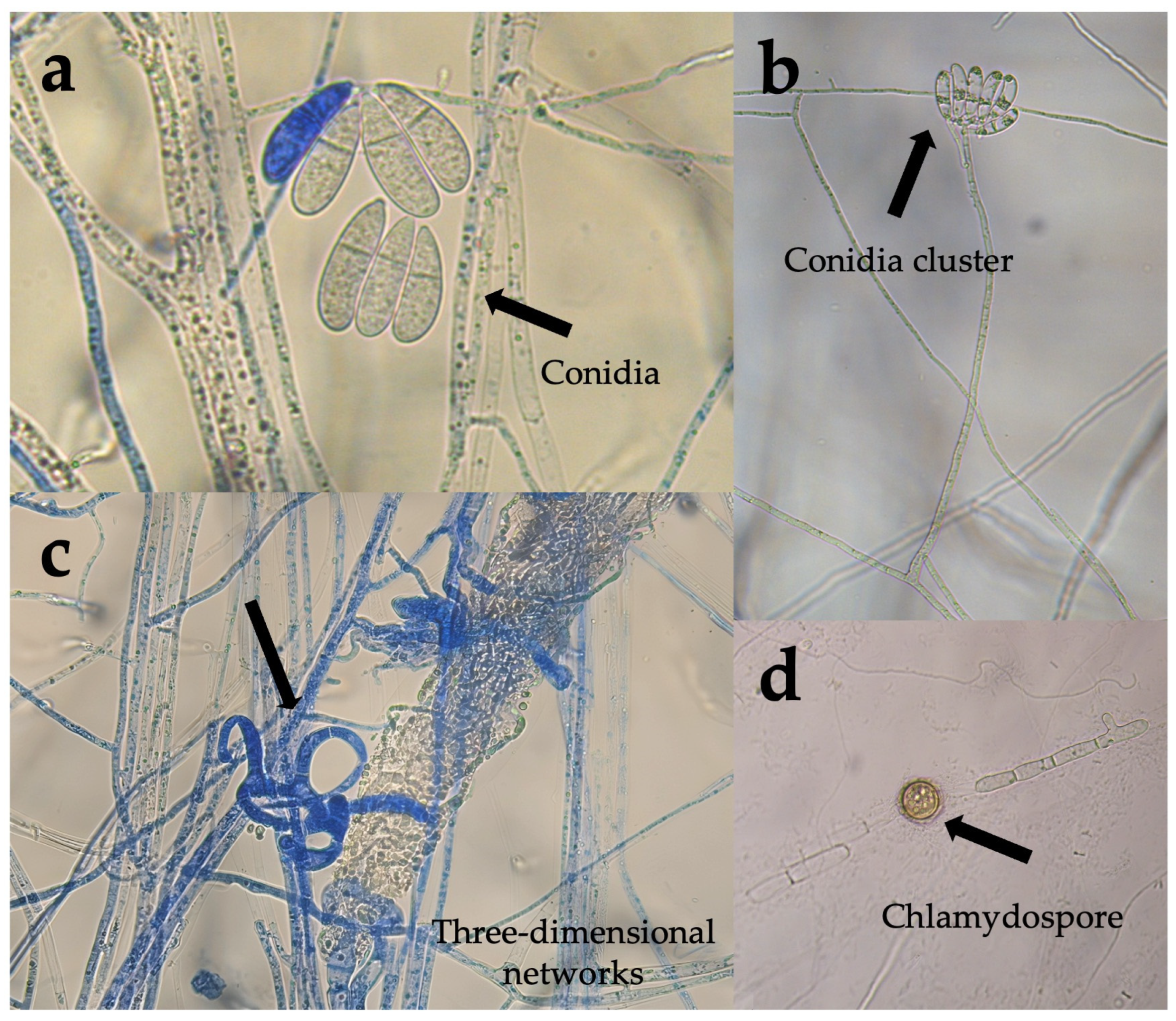
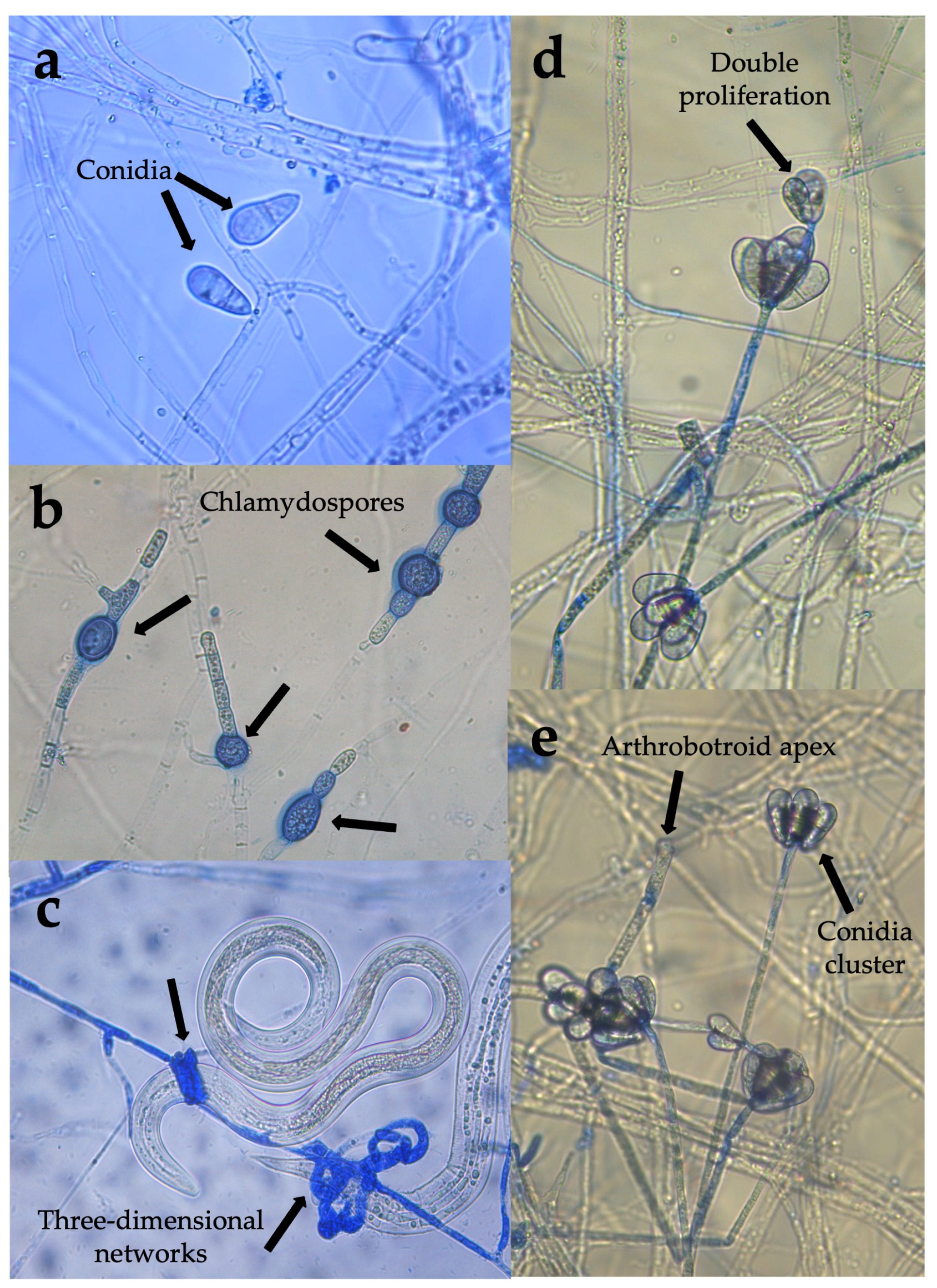
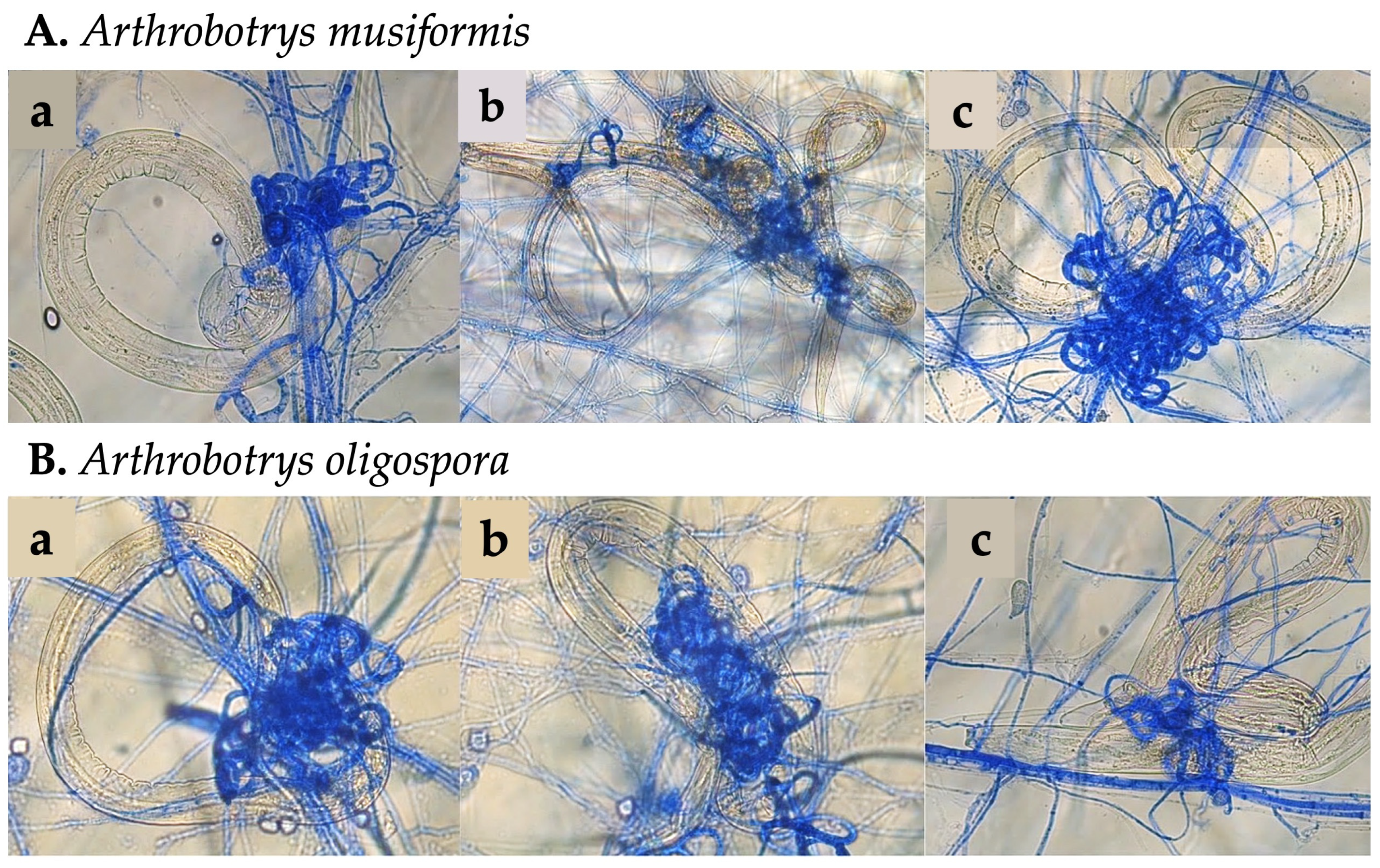

| Morphometric Characteristics | Arthrobotrys musiformis | Arthrobotrys oligospora |
|---|---|---|
| Conidial shape | Ovoid to ellipsoid, smooth-walled and transparent, i.e., hyaline. Slightly curved, with the distal end wider and rounded. | Obovoid to pyriform and slightly constricted at the septum. Its conidia are less elongated than those of A. musiformis. |
| Conidium length (m) | 29.05 (25.78–39.15) | 22.45 (18.95–23.56) |
| Conidium width (m) | 11.95 (11.05–15.65) | 10.22 (9.82–12.40) |
| Septa | 1 | 1 |
| Conidiophore | Conidiophores erect, simple and sometimes branched. They end in clusters of conidia that appear more elongated or linear. | Long and erect conidiophores with the gradual and progressive formation of denticles along its structure, from which clusters of conidia are generated, formed by two cells separated by a septum. |
| Conidiophore length (m) | 257.07 (135.48–405.02) | 378.50 (193.42–453.30) |
| Chlamydospores | Present | Present |
| Type of trap | Three-dimensional adhesive nets | Three-dimensional adhesive nets |
| Culture Condition | Traps/cm2 (Mean + SD) | CI (95%) | Ratio |
|---|---|---|---|
| Arthrobotrys musiformis | |||
| Nutrient-rich (CzDxB) | 2.17 ± 0.4 a | 1.59–2.74 | 1 |
| Nutritional stress (starvation) | 3.57 ± 0.8 a | 2.96–4.17 | 1.6 |
| Live prey (water + Hc-L3) | 8.33 ± 2.6 b | 6.45–10.21 | 3.8 |
| Arthrobotrys oligospora | |||
| Nutrient-rich (CzDxB) | 5.56 ± 1.2 a | 4.1–7.02 | 1 |
| Nutritional stress (starvation) | 6.10 ± 2 a | 4.65–7.55 | 1.1 |
| Live prey (water + Hc-L3) | 13.43 ± 5.3 b | 9.64–17.23 | 2.4 |
| Mycochemicals | Arthrobotrys musiformis | Arthrobotrys oligospora | ||||
|---|---|---|---|---|---|---|
| CzDxB | Starvation | Prey HcL3 | CzDxB | Starvation | Prey HcL3 | |
| Alkaloids | ++ | ++ | + | + | − | − |
| Coumarins | ++ | − | + | ++ | − | ++ |
| Flavonoids | − | − | − | − | − | − |
| Tannins | ++ | − | + | − | − | − |
| Triterpenes + sterols | − | − | − | − | − | − |
| Saponins | − | − | − | + | − | − |
| A. musiformis | A. oligospora | |||
|---|---|---|---|---|
| Aomae1 | β-Tubulin | Aomae1 | β-Tubulin | |
| 2−ΔCT-Fold Change | ||||
| CzDxB | 0.000179 | 1.00000 | 0.004804 | 1.00000 |
| Starvation | 0.004705–26.32 * | 1.00–1.00 *** | 0.008749–1.82 | 1.00–1.00 *** |
| (Prey Hc-L3) | 0.07668–429.05 *** | 1.00–1.00 *** | 0.213652–44.48 ** | 1.00–1.00 *** |
Disclaimer/Publisher’s Note: The statements, opinions and data contained in all publications are solely those of the individual author(s) and contributor(s) and not of MDPI and/or the editor(s). MDPI and/or the editor(s) disclaim responsibility for any injury to people or property resulting from any ideas, methods, instructions or products referred to in the content. |
© 2026 by the authors. Licensee MDPI, Basel, Switzerland. This article is an open access article distributed under the terms and conditions of the Creative Commons Attribution (CC BY) license.
Share and Cite
Hernández-Vega, M.J.; Mendoza-de Gives, P.; Reyes-Guerrero, D.E.; Pérez-Anzúrez, G.; Bautista-García, G.A.; Delgado-Núñez, E.J.; Olmedo-Juárez, A.; Ocampo-Gutiérrez, A.Y.; López-Arellano, M.E.; von Son-de Fernex, E. Nutritional Stress and Prey Signals Trigger a Metabolic Shift in Arthrobotrys spp.: Aomae1 Expression Suggests a Role in the Switch Between Saprophytic and Parasitic Lifestyles. Pathogens 2026, 15, 519. https://doi.org/10.3390/pathogens15050519
Hernández-Vega MJ, Mendoza-de Gives P, Reyes-Guerrero DE, Pérez-Anzúrez G, Bautista-García GA, Delgado-Núñez EJ, Olmedo-Juárez A, Ocampo-Gutiérrez AY, López-Arellano ME, von Son-de Fernex E. Nutritional Stress and Prey Signals Trigger a Metabolic Shift in Arthrobotrys spp.: Aomae1 Expression Suggests a Role in the Switch Between Saprophytic and Parasitic Lifestyles. Pathogens. 2026; 15(5):519. https://doi.org/10.3390/pathogens15050519
Chicago/Turabian StyleHernández-Vega, María José, Pedro Mendoza-de Gives, David Emanuel Reyes-Guerrero, Gustavo Pérez-Anzúrez, Génesis Andrea Bautista-García, Edgar Jesús Delgado-Núñez, Agustín Olmedo-Juárez, Ana Yuridia Ocampo-Gutiérrez, María Eugenia López-Arellano, and Elke von Son-de Fernex. 2026. "Nutritional Stress and Prey Signals Trigger a Metabolic Shift in Arthrobotrys spp.: Aomae1 Expression Suggests a Role in the Switch Between Saprophytic and Parasitic Lifestyles" Pathogens 15, no. 5: 519. https://doi.org/10.3390/pathogens15050519
APA StyleHernández-Vega, M. J., Mendoza-de Gives, P., Reyes-Guerrero, D. E., Pérez-Anzúrez, G., Bautista-García, G. A., Delgado-Núñez, E. J., Olmedo-Juárez, A., Ocampo-Gutiérrez, A. Y., López-Arellano, M. E., & von Son-de Fernex, E. (2026). Nutritional Stress and Prey Signals Trigger a Metabolic Shift in Arthrobotrys spp.: Aomae1 Expression Suggests a Role in the Switch Between Saprophytic and Parasitic Lifestyles. Pathogens, 15(5), 519. https://doi.org/10.3390/pathogens15050519

