1. Introduction
In the international interpretation of the right to education, the 4A framework (availability, accessibility, acceptability, adaptability) delineates the conditions under which this right can be effectively realized (
Committee on Economic, Social and Cultural Rights 1999). With the expansion of digital technologies, the substantive content of these criteria is undergoing a structural transformation: access to education and its quality are increasingly intertwined with access to digital devices and infrastructure (
Kovács-Szépvölgyi 2024). Consequently, restrictions on the use of mobile phones and other information and communication technologies in schools can no longer be framed solely as pedagogical considerations; they must also be understood as factors directly affecting the substantive realization of the right to education.
The integration of information and communication technologies (ICT) into the school environment has become a defining feature of contemporary education, aimed at fostering children’s digital literacy and competencies. At the same time, an increasing number of countries have introduced partial or comprehensive restrictions on students’ use of digital devices in schools, citing concerns related to distraction, mental health risks, cyberbullying, and overall well-being (
Selwyn and Aagaard 2021). Whether banning mobile phones in schools improves academic performance, enhances mental health, or reduces cyberbullying remains contested; accordingly, a shift toward the promotion of conscious and responsible use is often considered a more viable regulatory and pedagogical response (
Campbell et al. 2024).
The effects of device restrictions cannot be adequately assessed in isolation, but must be situated within the broader interplay of school-level, familial, and individual factors, as demonstrated by the SMART Schools Study (
Wood et al. 2023).
The UNESCO Global Education Monitoring Report (GEM Report) 2023 adopts a critical perspective on the integration of ICT in education. It highlights that the presence of digital devices—particularly smartphones—in school settings is frequently associated with significant cognitive distraction and declining academic performance, emphasizing that technology should assume a complementary rather than a replacement role in pedagogical processes. At the global level, the report advocates stricter regulation of mobile phone use in schools to safeguard students’ concentration and mental well-being (
UNESCO 2023).
These measures raise complex questions regarding their pedagogical justification and their compatibility with the rights of the child. Mobile phones are not merely communication tools; they function as key instruments for accessing information, maintaining social relationships, enabling (cultural) participation, and exercising the right to play. In this light, comprehensive bans call into question the extent to which they restrict students’ rights, particularly with regard to access to information and participation in the digital environment (
Reed and Dunn 2025). Digital technologies within educational systems thus function not only as tools, but as foundational enablers of social participation and the development of digital competencies. Correspondingly, digital education policies explicitly link their use to the promotion of equality and the expansion of participatory opportunities (
Ferrante et al. 2024).
From a legal perspective, the use of mobile phones in schools is best understood as a question of balance, situated between the fundamental rights of students and the school’s obligations relating to safety and discipline. The presence of mobile devices in educational institutions is therefore not merely a pedagogical or technological issue, but one with clear legal relevance, engaging a range of fundamental rights (
Smale et al. 2021). Children must be regarded as autonomous rights-holders within the digital environment as well. Consequently, comprehensive bans do not simply regulate the learning environment; they also raise the question of the extent to which such measures constrain children’s fundamental rights within a digitally mediated society (
Livingstone and Sylwander 2025).
In the digital environment, the 4A framework of the right to education becomes closely intertwined with children’s participatory rights, as digital technologies serve not only as gateways to learning, but also as instruments of expression and societal engagement. At the same time, digital inequalities—particularly those relating to the quality of access and levels of digital literacy—may limit the effective realization of these rights and contribute to the reproduction of existing social disparities (
Kovács-Szépvölgyi et al. 2025).
The study is grounded in a multi-layered analytical framework that builds on the tripartite approach of children’s rights, applied through a Hungarian case study. This model distinguishes three key actors: the state, the parent, and the child. Within a child rights perspective, the relationship between the child, the parents, and the state is not merely a constellation of actors but constitutes the fundamental structural and normative framework of rights exercise, in which the realization of the child’s rights emerges as the outcome of a dynamic balance among these three actors (
Sutherland 2020).
Our theoretical point of departure is that the analysis of digital regulation requires a framework capable of simultaneously capturing the legal-institutional logic of state regulation and the role of the individuals concerned. In this regard, the rule-of-law-based, cooperative approach of the cyberfare state concept is particularly instructive. Digital governance, even within democratic and rule-of-law settings, inherently combines welfare-oriented, service-based functions with mechanisms of control. At the same time, within this model, the legitimacy of state action depends precisely on the extent to which regulation does not operate solely in a top-down manner, but also accounts for the active role of the individual, in this case, both the child and the parent (
Kelemen 2026).
Within this theoretical framework, restrictions on the use of information and communication technology (ICT) devices in schools can be interpreted as a complex regulatory situation operating directly within the tripartite relationship of child–parent–state: state intervention simultaneously affects the scope of parental mediation and the exercise of the child’s digital autonomy. The contribution of the study lies in the examination of restrictions on school-based ICT use through a Hungarian case study within an integrated analytical framework that combines the tripartite model of children’s rights with the cyberfare state concept. This approach moves beyond traditional institutional or doctrinal analyses and enables an interpretation of digital regulation that captures the dynamic interplay between autonomy, protection, and state control.
To ensure conceptual coherence, these theoretical approaches are applied in a complementary and integrated manner throughout the analysis. The 4A framework provides the normative benchmark by specifying the substantive conditions under which the right to education can be realized in a digital context. The child–parent–state model captures the relational structure within which these rights are exercised, highlighting how regulatory interventions redistribute roles and responsibilities among key actors. Building on this, the concept of the cyberfare state offers an interpretative lens for understanding the broader transformation of governance, in which regulatory strategies combine elements of protection, control, and participation. Taken together, these frameworks enable a unified analytical approach that links normative standards, actor relationships, and regulatory rationalities, thereby allowing for a more comprehensive assessment of school-based ICT restrictions.
Building on the above theoretical framework, the study addresses the following research questions:
RQ1: What regulatory trends can be identified in the governance of ICT device use in schools across EU Member States, when examining nationwide hard law instruments, and how can these trends be interpreted in light of the 4A framework of the right to education and the governance logic of the cyberfare state?
RQ2: How does the Hungarian regulatory model fit within these broader European trends, and how is the balance between children’s rights and state intervention articulated in the Hungarian case?
RQ3: How do Hungarian parents perceive the regulation, and what do these perceptions reveal about its social legitimacy?
These research questions are addressed through a sequential, mixed-methods design. First, a comparative analysis of EU Member States identifies the main regulatory models and underlying policy trends (RQ1), thereby providing the broader interpretative context. Second, the Hungarian case study examines a concrete national implementation of these trends, including its legal structure and constitutional review (RQ2). Third, the empirical survey explores parental perceptions of the regulation, allowing for an assessment of its perceived legitimacy at the societal level (RQ3). Taken together, these components enable a multi-level analysis that links regulatory trends, legal-institutional design, and social reception, thereby providing a comprehensive understanding of ICT restrictions.
2. Materials and Methods
2.1. Comparative Legal and Policy Analysis (EU Member States)
The first pillar of the research is a qualitative comparative legal and policy analysis examining the regulatory architectures governing the use of ICT devices in schools across European Union Member States. The methodology is grounded in the principle of functional comparison, which moves beyond a purely textual juxtaposition of legal provisions and instead focuses on their social function and their impact on the educational environment (
Michaels 2006).
The scope of the analysis is deliberately confined to “hard law” instruments, that is, binding normative acts of nationwide applicability (laws, governmental decrees, and ministerial regulations). Non-binding recommendations, ethical codes, and other soft law instruments were intentionally excluded, as the objective of the study is to assess regulatory mechanisms backed by the coercive power of the state.
Primary data sources consisted of the relevant normative acts of the selected Member States. In developing the analytical framework, the study also draws on recent findings of the European Commission’s ENESET network (
European Commission et al. 2026), which indicate that the regulation of mobile phone use in schools across the EU does not follow a uniform model, but rather appears along a spectrum of varying regulatory intensity, ranging from comprehensive bans to conditional use frameworks.
The sample includes nine Member States—France, Hungary, Slovakia, Italy, Romania, Finland, Greece, Cyprus, Croatia, and Portugal—selected on the basis that, as of the end of March 2026, each had in place a binding, nationwide hard law regulation addressing the use of ICT devices in schools.
The analysis is structured along a three-dimensional coding framework:
Regulatory intensity: the type of restriction (comprehensive ban, partial limitation, or graduated model);
Enforcement and legal consequences: addressees and sanctioning mechanisms;
Exemption protocols: exceptions (e.g., special educational needs, health-related necessity, pedagogical autonomy).
The substantive analysis of the legal instruments was conducted qualitatively, with individual provisions categorized along these dimensions and organized into a comparable analytical structure.
2.2. Hungarian Case Study
The second pillar of the research consists of a Hungarian case study focusing on the 2024 amendment to the public education regulatory framework. The analysis centers on the legislative change that introduced restrictions on students’ access to digital devices during school hours (
Magyar Kormány 2024). The case study encompasses both legal and institutional dimensions of the regulation, including its normative content, underlying objectives, and enforcement mechanisms, as well as the related constitutional review proceedings.
The purpose of the analysis is to examine how the regulation articulates the relationship between state control, child protection, and the development of digital competencies, and how it can be situated within the tripartite framework of child–parent–state relations.
2.3. Empirical Data Collection and Analysis in Relation to the Hungarian Regulation
As an empirical complement to the case study, a questionnaire-based data collection was conducted among parents raising children aged 6–18 within the public education system. Data collection was carried out through an online survey, based on voluntary and anonymous participation, between February and March 2026. The questionnaire examined parental perceptions, attitudes, and experiences related to the regulation, with particular emphasis on its everyday effects and on the relationship between the family and the school.
The survey instrument was developed by the research team for the purposes of the present study, drawing on relevant literature on parental attitudes toward digital device use and school regulation. A five-point Likert scale was applied to measure attitudes, as it provides a balanced and widely used format that ensures sufficient differentiation of responses while maintaining interpretability for respondents.
The study was conducted using a non-interventional, anonymous, and fully voluntary online questionnaire. No personally identifiable data was collected. Prior to participation, respondents were informed about the purpose of the study, the voluntary nature of participation, data handling procedures, and their right to withdraw at any time without consequences. Participation was conditional upon providing explicit informed consent via an electronic consent procedure. The research protocol and survey instrument were reviewed and approved by the Scientific Advisory Board of Széchenyi István University (Decision Nr. SZE/ETT-12/2026 (II.9), approved on 9 February 2026).
The questionnaire consisted of several thematic blocks, as indicated in
Table 1, covering demographic characteristics, children’s use of digital devices, parental control practices, and attitudes and experiences related to school-based ICT restrictions. Attitudinal variables were measured using a five-point Likert scale.
Data processing and statistical analysis were performed using IBM SPSS Statistics (version 31.0.2.0). As a first step, descriptive statistics (frequencies, means, and standard deviations) were calculated. Relationships between variables were examined through cross-tabulation analysis and chi-square tests, while differences between groups were explored using independent samples t-tests.
3. Results
3.1. Comparative Analysis at the EU Level
Within the examined sample, several partially overlapping regulatory models can be identified, positioned along a spectrum ranging from comprehensive bans to conditional use, as illustrated in
Table 2. Across European practice, the most prevalent approach is conditional restriction, whereby the use of devices is prohibited by default but permitted under specified exceptions. Based on Member State regulations, three dominant regulatory logics can be distinguished: (1) comprehensive or quasi-comprehensive bans, (2) models restricting use to classroom settings, and (3) solutions based on physical separation (i.e., storage-based approaches). These are complemented by hybrid forms and institution-level implementation mechanisms, which further nuance the regulatory spectrum.
The most restrictive approach is represented by full territorial bans, as observed in France, where device use is prohibited across the entire school premises, including outside instructional time. A closely related, though device-specific, restrictive logic appears in Italy, where smartphones are comprehensively banned, while the pedagogical use of other digital devices remains permitted.
Parallel to this, physical separation-based solutions—typically involving storage mechanisms—emerge as an operational variant of comprehensive restriction, identifiable in Hungary and Greece. In these systems, regulation does not directly prohibit use, but instead limits physical access to devices, thereby de facto excluding their use during school hours.
A second group consists of classroom-restricted models, observed in Romania and Finland. In these cases, the primary regulatory objective is to ensure the uninterrupted functioning of the learning process, while explicitly allowing device use for pedagogical purposes.
A graduated, age-sensitive regulatory model appears in Slovakia, where the degree of restriction is aligned with students’ age and level of education, enabling a differentiated approach. In Croatia, a model based on institutional-level implementation can be identified: while national regulation establishes a general framework, the detailed rules of application are left to individual schools.
Cyprus and Portugal represent intermediate forms. In Cyprus, device use is generally restricted during the school day, whereas in Portugal, the prohibition extends to break periods as well, thereby further narrowing the scope for use.
With regard to enforcement, a significant degree of convergence can be observed. In most Member States, temporary confiscation and school-based disciplinary measures constitute the dominant sanctioning mechanisms, while in Greece, more stringent sanctions, including suspension, are also present.
3.2. Lessons from the Hungarian Case Study
The regulation of digital device use in Hungarian public education institutions was fundamentally reshaped by Government Decree 245/2024 (VIII. 8.), which entered into force on 1 September 2024 (
Magyar Kormány 2024). The regulation introduces a two-tier classification of items brought into educational institutions: (1) prohibited items and (2) items restricted in use. The former category includes objects that pose a threat to public safety, items prohibited by law, and products that may not be sold to minors. The latter category primarily encompasses digital devices—most notably mobile phones, internet-enabled smart devices, and devices capable of audio and video recording—whose possession is permitted, but whose use is restricted during specified periods.
The decree defines in detail both the personal and institutional scope of the restrictions. The rules governing restricted-use devices apply to primary education (grades 1–8), grammar schools (grades 5–12), and vocational secondary education (grades 9–13) throughout the entire school day. In addition, the restrictions apply in dormitories during organized sessions, in primary art schools during class time across all grades, and in vocational schools for the full duration of both academic and practical training, effectively covering the entire time spent within the institution. The regulation thus introduces a differentiated system based on institutional type and level of education, while maintaining a coherent and unified regulatory logic.
The decree also establishes detailed procedural rules: students are required to hand in restricted-use devices at the beginning of the school day, after which the institution ensures their secure storage, and the devices are returned at the end of the day. Exceptions apply where the use of such devices is justified on pedagogical or health-related grounds, subject to authorization by the head of the institution or a teacher. In this respect, the regulation introduces a centralized and standardized model, replacing the previous decentralized approach based on individual school policies.
3.3. Empirical Findings (Parental Perceptions)
3.3.1. Demographic Characteristics
Based on the demographic composition of the sample (n = 147), 27.5% of respondents have children of primary school age (6–10 years), while 60.5% have adolescent children (15–18 years), indicating an overrepresentation of the adolescent age group. This is also reflected in the distribution by school type: the proportion of respondents associated with primary education is somewhat lower than that of those with children in secondary education.
In terms of place of residence, 30.6% of respondents live in the capital or in county seats, while 69.4% reside in smaller towns or villages, suggesting a relatively rural sample composition. At the same time, a regional breakdown shows that 62.5% of respondents are linked to Budapest and Pest County, indicating a degree of geographical bias in the sample. The educational attainment of respondents is high: 69.4% hold a tertiary degree, and the proportion of those with at least secondary education approaches 90%.
3.3.2. Parental Mediation and Control: To What Extent Was Control Already Present?
Parental mediation and control were examined through three separate variables, each analyzed using cross-tabulation to explore how parental supervisory practices influence the evaluation of the regulation.
Parents who apply parental control on their child’s personal device tended to evaluate the restriction more positively than those who do not use such measures (76.7% vs. 64%). However, the chi-square test did not reveal a statistically significant difference between the two groups (p > 0.05).
A similar pattern can be observed in relation to software-based screen time monitoring: parents using such tools reported a higher proportion of positive evaluations (81.7% vs. 62.3%), although this difference was not statistically significant (p > 0.05).
Parents applying non-software-based control methods also evaluated the regulation more favourably (76.6% vs. 64.4%), yet this difference likewise did not reach statistical significance (p > 0.05).
Results of the independent samples t-test indicate that parents using software-based restrictions rated the regulation higher on average (M = 4.08) than those who do not use such solutions (M = 3.64); however, this difference was not statistically significant (p > 0.05).
Overall, parental attitudes tend to be positive regardless of prior control practices. The absence of statistically significant differences suggests that support for the regulation is not primarily determined by prior control practices, but rather reflects a more general normative orientation toward digital risk and school discipline. This finding indicates that parental attitudes may be shaped less by direct experience and more by broader perceptions of digital risks and the role of the school in managing them.
3.3.3. Awareness and Knowledge: To What Extent Are Parents Informed About the Regulation?
The vast majority of respondents had heard of the regulation; however, 12.9% reported that they were not familiar with its details. A comparison between awareness of the regulation and knowledge of the affected devices—illustrated in
Table 3—suggests that a general perception has developed among parents that is only partially dependent on detailed legal knowledge. Even respondents who were not familiar with the regulation often correctly identified the relevant devices. At the same time, certain inaccuracies can be observed, particularly in relation to smartwatches, which were identified as affected devices by a lower proportion of respondents.
The evaluation of usage conditions shows that, irrespective of familiarity with the regulation, the majority of respondents selected answers consistent with its main provision, suggesting that the practical application of the regulation has been at least partially internalized, as also illustrated in
Table 4. Nevertheless, a smaller proportion of inaccurate responses (17.7%) was observed, which may indicate limited knowledge of specific provisions or variations in institutional practices.
As illustrated in
Table 5, with regard to the method of device collection, the overwhelming majority of respondents identified morning collection and storage in line with the regulation, while the alternative of “keeping the device in the school bag” (7.5%) suggests that some institutions apply more flexible arrangements. The low proportion of “do not know” responses indicates that parents are generally aware of institutional practices.
Regarding school-based information provision (
Table 6), 12.2% of respondents reported not having received any information, while 15.6% were not aware of such communication, indicating deficiencies in information transmission. The analysis shows that information provision plays a significant role in shaping perceptions of the regulation: parents who received information were more likely to evaluate the restriction positively (74.6% vs. 50%), while the absence of information was associated with higher levels of uncertainty (27.8% “do not know” responses).
A similar pattern can be observed in the assessment of the necessity of the regulation, where informed parents expressed agreement to a greater extent. At the same time, perceptions of the regulation’s effects indicate that the majority of respondents did not perceive a clear change in children’s device use, and the proportion of uncertain responses remained relatively high in this regard.
Through the construction of a composite indicator, respondents who can be considered informed across multiple dimensions were identified (familiarity with the regulation, correct identification of usage rules and device collection practices, as well as the presence of institutional information provision). Based on these criteria, 39.45% of the sample (n = 58) can be classified as highly informed parents.
The analysis shows that information provision is closely associated with the evaluation of the regulation: parents who received information were more likely to evaluate the restriction positively (74.6% vs. 50%), while the absence of information was associated with higher levels of uncertainty (27.8% “do not know” responses).
A similar pattern can also be observed in the assessment of the necessity of the regulation, where informed parents expressed agreement to a greater extent. In contrast, the absence of information is associated with an increase in the proportion of uncertain responses.
At the same time, perceptions of the effects of the regulation indicate that the majority of respondents do not perceive a clear positive or negative change in children’s device use, and the proportion of uncertain responses remains relatively high in this regard.
The strong association between information provision and more positive evaluations highlights the importance of institutional communication in shaping perceived legitimacy and the everyday interpretation of the regulation.
3.3.4. Acceptance of the Regulation: To What Extent Do Parents Support the Measure?
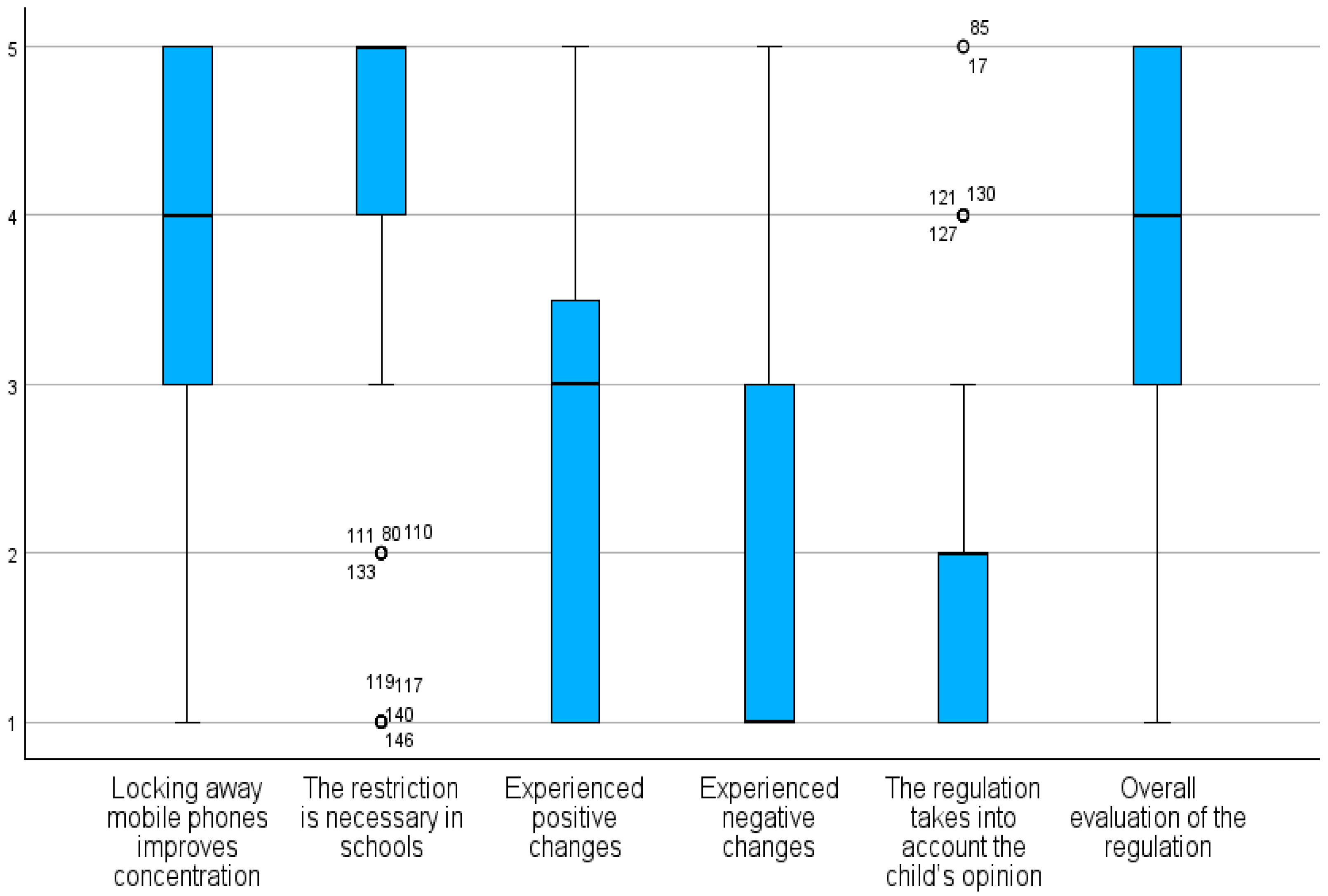
The analysis of the regulation’s acceptance reveals that while parents’ overall attitude is positive, their opinions are divided along certain dimensions (
Figure 1). The average response regarding the pedagogical usefulness of restricting mobile phones is around 4, suggesting confidence in improved concentration; however, the standard deviation is over 1, indicating a diversity of opinions.
A strong consensus emerges regarding the necessity of the restriction, with approximately 75% of responses falling into the higher range (4–5). In contrast, perceptions of the regulation’s actual effects are less clear-cut. The assessment of positive changes is divided (median = 3), while the perception of negative effects is low (median = 2). This suggests that while most parents do not experience significant negative consequences, the positive effects are not clearly evident either.
Regarding the consideration of children’s opinions, responses show low values, indicating that most parents do not perceive meaningful participation from children in the development of the regulation. The median for the overall assessment is 4, indicating a generally positive view. However, the higher standard deviation suggests that uncertainty and partial scepticism exist regarding the regulation’s specific implementation.
Based on the descriptive statistics, a distinction emerges between the normative support for the regulation and its practical assessment: while there is broad agreement on its necessity, the evaluation of its effects and implementation reveals greater uncertainty.
Cross-tabular analysis shows that the perceived necessity of the restriction is independent of directly observed changes in cyberbullying. A significant portion of respondents could not assess the effects, yet the majority of this group still supports the measure. This suggests that parental support is driven not primarily by empirical experience, but by general normative beliefs.
Furthermore, the analysis of correlations between variables shows that a key determinant of the regulation’s acceptance is the perception of its pedagogical usefulness: parents who associate the restriction of mobile phones with improved student concentration rate the regulation significantly more positively (Chi-square test, p < 0.05). This indicates that for parents, the restriction is perceived less as a prohibition and more as a tool to support a more effective learning environment.
This pattern suggests that the perceived legitimacy of the regulation is not primarily grounded in observable outcomes, but rather in a general normative conviction, indicating that support may be driven more by perceived risks than by empirically experienced effects.
3.3.5. Qualitative Analysis of Free-Text Responses and Attitude Structures
A total of 33 evaluable free-text responses were received to the open-ended question of the survey. Their qualitative content analysis revealed parental perceptions across multiple, partially overlapping thematic dimensions. Based on the coding of responses, 24.2% of statements were predominantly supportive, 60.6% were critical, and 15.2% were ambivalent (mixed) in nature. When ambivalent responses are included in the critical category, the proportion of critical attitudes increases to 75.8%. This suggests that most parents do not question the objective of the regulation itself, but rather its mode of implementation.
Supportive responses primarily emphasized the social and psychological benefits of the restriction. Several parents highlighted that limiting digital device use has a positive effect on peer interactions, noting that “children talk more and connect better with each other”, and that “during breaks they finally talk to each other again instead of looking at screens.” In addition, the need to reduce overstimulation and to promote conscious device use also emerged, as reflected in statements such as: “it is very difficult for them to use it consciously… I am glad they can grow up not always having it with them.” Some responses also stressed the habituation effect of the regulation, suggesting that it may contribute to normalizing reduced digital presence.
In contrast, the majority of responses reflected a critical perspective. These centered on the rejection of prohibition-based logic and the demand for an education-based approach. Several respondents explicitly articulated this dilemma: “device use should not be prohibited, but taught,” and “smart devices should be integrated into the teaching process and their advantages should be utilized.” Digital devices were framed not as problems, but as resources: “they facilitate access to digital learning materials.” Respondents also emphasized the importance of developing 21st-century competencies. Some expressed explicitly critical, generational evaluations, for example: “this kind of prohibition is very ‘boomer’.”
Criticism related to the practical implementation of the regulation was particularly prominent. Several responses pointed to its circumvention and limited effectiveness, noting that “if a child is clever enough, they bring a fake phone,” and that it is “easily bypassed by handing in another device.” In this context, concerns were also raised about the erosion of norm compliance: “rule-abiding children see this… and sooner or later they also resort to tricks.” Some responses identified restrictions on access to information as problematic, especially in relation to school communication systems: “they cannot check which classroom they have… they cannot access KRÉTA (the Hungarian nationwide electronic school administration and communication system) notifications.” In addition, safety and communication concerns were raised, such as: “I cannot call them if there is a change,” and the prohibition of smart devices (e.g., GPS-enabled smartwatches) was also linked to concerns about child safety. Another recurring issue concerned material responsibility, particularly in relation to potential damage to devices during storage.
A subset of responses also articulated system-level and political criticism directed at educational governance. These statements highlighted the perceived inconsistency and obsolescence of the regulation, for example: “the state distributes laptops… while banning phones,” and references to an “education system reminiscent of previous centuries.” Some responses expressed strong normative rejection. At the same time, an opposing, extremely restrictive position also appeared: “devices should not be allowed into schools at all,” indicating a degree of polarization in opinions.
Finally, several responses emphasized the need for a differentiated, age-specific regulatory approach, particularly with regard to differences between primary and secondary school students: “a distinction should be made… where independent judgement can already be expected.”
The qualitative findings reinforce the pattern identified in the quantitative analysis. While a substantial proportion of parents support the goal of reducing screen time at a normative level, many do not consider the current centralized, prohibition-based regulatory approach to be effective, legitimate, or sustainable. The responses indicate a clear demand for strengthening digital competence development, as well as for more flexible, institution-level adaptable, and participatory regulatory models.
This divergence between normative support and practical criticism supports the interpretation that the regulation’s legitimacy is complex and layered, combining general acceptance of its objectives with reservations regarding its implementation.
4. Discussion
4.1. EU Member State Approaches in Light of the Theoretical Framework
Based on the comparative analysis, the regulation of ICT device use in schools across European Union Member States can be interpreted not merely as an educational policy issue, but also as an extension of state control over the digital environment. The different regulatory models—from comprehensive bans to conditional use—are positioned along a spectrum that reflects the balance between children’s digital autonomy and the extent of state intervention (
Randhawa et al. 2025).
The practical implementation of bans may encounter significant difficulties, as the enforcement of rules is time-consuming, may generate conflicts, and often leads to exceptions (
Grigic Magnusson et al. 2023). Empirical studies also indicate that comprehensive restrictions on mobile phones do not necessarily result in the desired behavioural change; in some cases, they may even produce alternative, unintended patterns, such as concealed use or the reconfiguration of social activities (
Kopecký et al. 2021).
Within this interpretative framework, the concept of the “cyberfare state” does not denote exclusively repressive state intervention. It also highlights that, within rule-of-law-based, cooperative regulatory models, the state increasingly extends its normative and disciplinary role into segments of children’s everyday lives that previously belonged primarily to the sphere of family or informal socialization (
Kelemen 2026). Within the tripartite relationship of child–parent–state, this process represents a reconfiguration of regulatory competences: while control over digital device use has traditionally belonged to parental mediation and family norms, regulations concerning the use of ICT devices in schools increasingly elevate these control mechanisms to the level of the state.
The cooperative model of the “cyberfare state” requires not only a reconsideration of the nature of state control, but also an examination of its effects. The empirical analysis of regulatory impacts cannot be confined to institutional and normative levels; it must necessarily extend to the involvement of legal subjects, as both parents and children appear as active actors in the digital environment. Attitudes towards digital device use and patterns of compliance are not determined in a top-down manner but are dynamically and jointly constructed through the interaction of these actors, as also emphasized by
Rose et al. (
2022).
Although the findings indicate that Member State approaches within the EU are not uniform, a common direction can be identified in the strengthening of state regulation in the digital environment, particularly under the justification of child protection. At the same time, this strengthening of state regulation not only affects students’ digital autonomy. In many cases, it also narrows the institutional autonomy of schools: centralized, binding norms establish a standardized framework that may limit pedagogical autonomy and the capacity for institutional adaptation. Empirical studies also suggest that mobile phones have become an integral part of the educational environment, while comprehensive bans remain problematic from both pedagogical and enforcement perspectives: rules are often difficult to enforce, lead to exceptions, and do not enjoy unequivocal support among stakeholders (
Gath et al. 2024;
Pozsonyi et al. 2025).
From the perspective of the 4A framework of the right to education (availability, accessibility, acceptability, adaptability), the examined regulatory approaches raise important normative concerns in the digital context. As highlighted in the literature, digital technologies increasingly function as structural conditions for the realization of the right to education, rather than merely auxiliary tools (
Kovács-Szépvölgyi 2024). In this sense, restrictions on ICT device use may affect not only the pedagogical environment, but also the substantive accessibility and acceptability of education, particularly where they limit access to information, communication, and participation. The findings of the present study suggest that highly restrictive models—especially those lacking participatory legitimacy—risk undermining the adaptability dimension of the right to education, as they fail to accommodate students’ evolving capacities and the realities of digitally mediated learning environments. This reinforces the argument that effective regulation must move beyond prohibition and instead integrate child participation and digital competence development as essential components of rights-based educational governance.
4.2. The Hungarian Solution—In a Fundamental and Children’s Rights Approach
The Hungarian regulation—similarly to nationwide bans in several other countries—represents a strongly protection-oriented model that prioritizes safety and order, while treating the dimensions of autonomy, participation, and digital skills development as secondary (
Pozsonyi et al. 2025). International child rights discourse—particularly the General Comment of the UN Committee on the Rights of the Child on the digital environment—emphasizes that the best interests of the child encompass not only protection, but also rights related to access, information, and participation (
Reed and Dunn 2025). In line with this, previous empirical research indicates that children’s use of digital devices is not exclusively a matter of institutional or state regulation, but is fundamentally shaped within the family and social context, particularly through parental mediation and modelling (
Terras and Ramsay 2016;
UN Committee on the Rights of the Child 2021). This narrative is also consistent with the logic of the cooperative cyberfare state (
Kelemen 2026).
The constitutionality of the Hungarian regulation was examined by the Constitutional Court, which, in its Decision No. 3142/2025 (V. 15.) AB, held that the restriction on mobile phone use is constitutional. The constitutional complaint alleged the violation of several fundamental rights—particularly the rights to privacy, property, and education—primarily arguing that the general restriction on device use constitutes a disproportionate interference in students’ everyday lives (
Constitutional Court 2025).
During the proceedings, in an amicus curiae submission, the Minister of the Interior emphasized the protection of students and the safeguarding of an uninterrupted educational environment as the legitimate aims of the regulation, highlighting risks arising from uncontrolled device use (e.g., distraction, online harassment). This line of argument placed the regulation explicitly within a preventive and risk-management framework (
Ministry of the Interior 2024).
In line with this, the Constitutional Court concluded that the restriction does not affect the essential content of fundamental rights. According to its interpretation, possession of devices is not prohibited, their use is limited in time and space, and may be permitted for pedagogical purposes; therefore, the interference can be considered proportionate.
It can be observed that neither the constitutional complaint, nor the decision of the Constitutional Court, nor the amicus curiae submission of the Minister of the Interior adopts an explicitly child rights-based approach. The complaint relies on classical fundamental rights (e.g., privacy, property, education), while the decision and the amicus curiae argument emphasize the logic of public interest, safety, and the uninterrupted functioning of education. As a result, children appear not as autonomous rights-holders, but primarily as subjects requiring protection within the regulation and its practical application. The Hungarian solution thus represents a regulatory model grounded in a strong protective logic, which shifts the balance between fundamental rights primarily towards safety and pedagogical control.
From a child rights perspective, however, the regulation requires a more complex assessment. The principle of the best interests of the child encompasses not only protection, but also the dimensions of participation and evolving capacities. In this light, a broad restriction on access to digital devices that lacks differentiation according to age and students’ needs also de facto significantly narrows students’ room for manoeuvre.
In the child rights analysis of the Hungarian regulation, the most striking shortcoming is the complete absence of the child’s perspective. The findings of our research—particularly parental perceptions indicating that children’s views are not taken into account—together with the protective logic of the regulation, support the conclusion that the model treats the child primarily as a passive object to be protected from digital risks, rather than as an active subject with rights and opinions, and as an addressee of regulation. This protective approach, as highlighted in the literature, is common in the field of digital regulation and creates tension between the formal recognition of participatory rights and their practical realization, thereby hindering the transition from “voice to action” (
Kovács-Szépvölgyi et al. 2025). This practice stands in clear contrast with the spirit of the UN Convention on the Rights of the Child, in particular Article 12, which guarantees the child’s right to freely express their views in matters affecting them. The lack of student involvement is often rooted in the uncertainty and concerns of adult actors, who fear the consequences of “giving too much voice” to children and question their competence in serious decision-making (
Munongi 2023). The imposition of restrictions without consulting students, therefore, not only reflects a democratic deficit but also conveys the message that young people are not regarded as competent partners in shaping the rules governing their own learning environment.
The complete absence of the participation dimension is not only a legal or ethical deficit but also represents a significant “missed pedagogical opportunity.” The literature increasingly argues that top-down bans offer a simple administrative solution, while the evidence underlying them remains mixed and limited (
Campbell et al. 2024). This approach prioritizes prohibition over the complex pedagogical task of fostering responsible digital citizenship. Instead of providing a protected and moderated space (essentially a sandbox environment) in which students could collaboratively develop norms and learn the responsible, ethical, and conscious use of digital devices—including the development of self-regulation—the centralized regulation effectively constrains this learning process. As a result, the regulation risks falling short of serving what is arguably one of the most important objectives of 21st-century education: fostering digital citizenship grounded in critical consciousness, which prepares students for a world in which success depends not on prohibition, but on critical thinking and autonomous, responsible decision-making (
Dass and Kumar 2024).
The Hungarian regulatory model thus reflects a series of inherent trade-offs between child autonomy and state risk governance, as well as between legal certainty and pedagogical flexibility, and between protective objectives and the socialisation of students into rule-following behaviour.
4.3. Interpretation of Parental Perceptions
The interpretation of parental perceptions indicates that the social acceptance of restrictions on school mobile phone use is based primarily not on directly perceived effects, but on a general normative conviction. Based on the results of the present study, perceptions of digital risks play a significant role in underpinning support for the restriction, which is often regarded as justified, even where parents cannot report clear empirical effects. The empirical findings presented in this study can be interpreted as the social reception of this predominantly protection-oriented regulatory model, reflecting how the child–parent–state relationship is reconfigured in practice through perceptions of legitimacy and risk.
This interpretation is consistent with representative Hungarian research: according to the KINCS study (
n = 1000, including
n = 251 parents of children under 18), the majority of the Hungarian population agrees with school mobile phone restrictions, while the evaluation of concrete experiences is considerably more uncertain, and a substantial proportion of respondents indicate that they “cannot assess” the effects (
KINCS 2025). The present findings extend these earlier results by demonstrating that this pattern is not only observable at the level of general public opinion but is also reflected in more nuanced parental perceptions shaped by institutional context and communication. This suggests that the legitimacy of the regulation is not based solely on experiential evidence but is constructed through a broader protective narrative. The findings presented in
Section 3.3 reinforce this pattern at the institutional level, indicating that school-based restrictions are often not perceived as external interventions, but rather as extensions of family-level control mechanisms.
The preventive logic identified in the empirical findings is consistent with the literature. Research on mobile phone use consistently highlights the risks of distraction, psychological strain, and online harassment, which form a central justification for regulatory interventions. At the same time, these studies also indicate that, given the educational and communicative functions of digital devices, comprehensive bans cannot be considered an unequivocally optimal solution. Instead, approaches based on regulated and conscious use appear to be more substantiated. This duality is also clearly reflected in parental perceptions (
Bencze et al. 2025). Our empirical results further nuance this duality by showing that, while parents recognise both risks and benefits, their overall support tends to align more strongly with risk-based considerations than with observed pedagogical outcomes.
Hungarian research conducted among teachers likewise suggests that the practical effects of restricting mobile phone use are not unambiguous, and that the evaluation of such measures depends significantly on the mode of implementation and the institutional context. This is consistent with the findings of the present study, which indicate that parental support is based not exclusively on actual experience, but rather on perceived pedagogical benefits and risk perceptions (
Pozsonyi et al. 2025). The findings of the present study complement this perspective by indicating that similar patterns are observable from the parental viewpoint, reinforcing the importance of implementation context across different stakeholder groups.
Although one frequently stated aim of restricting digital devices is to promote direct, face-to-face interaction and thereby strengthen socialization processes, the practical implementation of the regulation contains an inherent paradox. The picture emerging from our research—in which parental support for the restriction is not unequivocal and institutional implementation shows a degree of flexibility (e.g., “keeping the device in the school bag”)—suggests that, in practice, the government decree functions as a form of lex imperfecta, that is, an imperfect legal norm. This imperfection does not stem solely from the absence of effective sanctions, but also from the everyday struggles of teachers in interpreting and applying the rule, thereby continuously redrawing the boundaries of “acceptable behaviour” (
McMain 2023). This inconsistency, stemming from both the regulation itself and the lack of broader social consensus, creates the “situational ambiguity” and “wiggle room” that, as empirical research demonstrates, can increase adolescents’ propensity to violate rules (
Hoyer et al. 2025). All of this occurs within a key institutional context in which young people’s legal socialisation takes place, that is, where their relationship to law and authority is formed (
Naftali 2022). A rule that is questionable in its legitimacy and inconsistently enforced is therefore not merely ineffective; its profound effects on students’ socialisation lie in how it may shift their focus from formal rule-following to developing informal strategies of circumvention.
In this context, students may perceive the rule not as a framework for communal coexistence, but as an obstacle to be overcome. Alongside the formal curriculum aimed at fostering obedience, a “hidden curriculum” emerges, within which students acquire strategies of rule-breaking and circumvention as coping mechanisms (
Kärner and Schneider 2024). The concealed use of devices and the circumvention of restrictions thus become part of everyday routine, transforming rules from norms to be followed into “mobilised cultural resources” used by students to pursue their own “local goals,” such as maintaining status or autonomy (
Nasi 2022).
This behaviour is not merely impulsive defiance, but rather can be interpreted as a rational response to a flawed regulatory environment. When students perceive rules or their enforcement as unfair and inconsistently applied, they tend to “delegitimise authority” and shift from moral compliance to an instrumental, cost–benefit-based evaluation (
Thomas and Mucherah 2018). This tendency is further reinforced by the lex imperfecta nature of the regulation; as there is no unified front among parents and teachers, the likelihood and severity of sanctions remain low. This conveys to young people that non-compliance is a logical and often low-risk behavioural strategy.
This phenomenon may extend beyond the issue of school discipline and have implications for children’s civic and legal socialisation. Schools constitute a key environment in which, through “learning by doing,” children develop their fundamental attitudes towards formal rules, authority, and political trust (
Kiess 2021). Where these school-based experiences are characterised by arbitrariness and inconsistency, a “spillover” effect can be observed; large-scale European research demonstrates that low levels of “procedural fairness” from teachers can predict lower levels of trust in law enforcement institutions later in life (
Stals and Ziemes 2024). Consequently, a poorly designed, top-down prohibition may produce unintended negative effects in the field of legal socialisation. By establishing what may be described as an “authoritarian school model” that undermines trust and the legitimacy of shared norms (
Clarke et al. 2021), such regulation may ultimately risk eroding the foundations of law-abiding behaviour to a greater extent than its anticipated benefits.
Digital devices form an integral part of students’ present and future lives; therefore, their complete exclusion is not only unrealistic, but— as demonstrated above—may also have detrimental effects on the culture of norm compliance. Instead, emphasis should be placed on enabling students to use these devices in a conscious, critical, and responsible manner. Restrictions on mobile phone use in schools can only be effective if complemented by a complex pedagogical approach. This implies, first, that restrictions cannot function merely as top-down technical measures (such as confiscation), but must be grounded in a collectively developed and consistently applied system of rules within the school, particularly among teachers. Such a system, legitimised and enforced by the community, effectively precludes the emergence of a “hidden curriculum” and its associated negative effects. Second, students must be provided, in parallel, with opportunities to develop media literacy, enabling them to understand the functioning, risks, and opportunities of digital technologies. This approach prioritises positive legal socialisation and education for responsible digital citizenship over prohibition. To be effective, such a pedagogical framework must be both differentiated, for instance between uncontrolled use during breaks and educational use, and adapted to students’ evolving needs and capacities. It is also crucial to recognize that school-level policies do not operate in a vacuum; the literature indicates that children’s use of digital devices is closely linked to parental patterns and regulatory practices, which can also function as protective factors (
Böttger and Zierer 2024).
Taken together, the empirical findings presented in
Section 3.3 reveal a consistent pattern in which parental support for the regulation remains relatively high despite the absence of clearly perceived or statistically significant effects. This suggests that the legitimacy of the measure is shaped less by direct experience and more by generalised perceptions of digital risk, as well as by institutional communication processes that frame the regulation as necessary and appropriate within the child–parent–state relationship. Within the theoretical framework of the study, this pattern reflects the governance logic of the cyberfare state, in which acceptance is constructed through normative expectations and perceived necessity rather than demonstrable outcomes, raising important questions regarding the acceptability and adaptability of such measures within the right to education.
4.4. Limitations
The study is subject to several limitations. First, the comparative analysis focuses exclusively on binding (hard law) regulations and therefore does not cover non-binding (soft law) instruments or institution-level regulatory practices, which play a significant role in several European Union Member States. Second, the empirical analysis is based on a non-representative sample of parents, which limits the generalisability of the findings. Third, the study captures perceptions from the early period following the introduction of the Hungarian regulation and therefore does not allow for an assessment of long-term effects.
5. Conclusions
The study demonstrates that the regulation of ICT device use in schools across European Union Member States does not follow uniform models, but is instead organised along a spectrum ranging from comprehensive bans to conditional use. Despite this diversity, a common direction can be identified in the strengthening of state regulation, primarily justified by the need for child protection and the management of digital risks. The Hungarian case exemplifies a distinctly protection-oriented model, in which prevention and risk minimisation dominate, while child rights considerations—particularly the dimensions of participation and autonomy—are less prominently reflected in regulatory and constitutional discourse. As the study has shown, this lack of stakeholder involvement and social consensus leads to low regulatory legitimacy and inconsistent implementation.
The empirical findings indicate that the social legitimacy of the regulation is based primarily not on directly perceived effects, but on a general normative conviction linked to perceptions of digital risks. The theoretical contribution of the study lies in demonstrating that a top-down, lex imperfecta-type regulation—resulting in a highly fragmented implementation—may produce unintended and detrimental consequences: as a response by students, a “hidden curriculum” emerges that teaches strategies for circumventing rules, which in the long term may undermine law-abiding behaviour. By linking the tripartite model of child–parent–state relations with the concept of the cyberfare state, the study not only outlines a cooperative model, but also highlights the serious consequences of its absence. On this basis, future policy approaches should move beyond the dichotomy of prohibition and permission and be grounded in differentiated models. The aim of such models is not only to strike a balance between protection and competence development, but also to establish the legitimacy of regulation. This requires the meaningful involvement of children, parents, and teachers, which is not merely a democratic principle, but a practical necessity for creating a school environment that supports, rather than undermines, norm compliance. This also delineates a key direction for future research.