
Child Online Sexual Exploitation and Abuse: Understanding Adversarial Tactics, Techniques, and Procedures


Abstract
1. Introduction
Increased Use of Smartphones Among Children
- Nine in 10 children own a mobile phone by the time they reach the age of 11.
- Three-quarters of social media users aged between 8 and 17 have their own account or profile on at least one of the large social media platforms.
- Most platforms have a minimum age of 13. However, six in 10 children aged 8 to 12 who use them have signed up using their personal profile.
- Almost three-quarters of teenagers between the ages of 13 and 17 have encountered one or more potential harms online.
- Three in five secondary school-aged children have been contacted online in a way that potentially made them feel uncomfortable.
- About 19% of children aged 10–15 years old exchanged messages with someone online whom they had never met before in the last year.
- Over 9000 child sexual abuse offenses involved an online element in 2023–24.
- Around a sixth of people who experienced online harassment offenses were under 18 years old.
- Under-18-year-olds were the subject of around a quarter of reported offenses of online blackmail in England, Wales, and Northern Ireland.
- There were around 107,000 offenses reported in 2022, a 7.6% increase compared to 2021, nearly quadruple what they were 10 years ago. Evidence continues to suggest many crimes remain unreported.
- About 75% of CSAE offenses relate to sexual crimes committed directly against children, and around 25% relate to online offenses of Indecent Images of Children.
- The crime types regarding CSAE are changing. For example, historically, Child-on-Child abuse accounted for around a third of offenses. The data in the report suggests that today, this is just over half.
- CSAE within the family environment remains a common form of reported abuse, accounting for an estimated 33% of reported CSAE crime. Parents and siblings were the two most common relationships featured.
- Group-based CSAE accounts for 5% of all identified and reported CSAE, ranging from unorganized peer group sharing of imagery to more organized, complex, high-harm cases with high community impact.
- Reported CSAE is heavily gendered, as expected, with males (82% of all CSAE perpetrators) predominantly abusing females (79% of victims). Sexual offending involving male victims is more common in offenses involving indecent images and younger children.
- The number of recorded incidents of Online Sexual Abuse continues to grow, and it accounts for at least 32% of CSAE.
- About 52% of all CSAE cases involved reports of children (aged 10 to 17) offending against other children, with 14 being the most common age.
2. State of the Art
2.1. Incidents of Child Online Sexual Exploitation and Abuse
2.2. Analytical Synthesis of Child Online Sexual Exploitation and Abuse
- Transforms fragmented observations into a structured, stage-based framework for CTI gatherings.
- Enables systematic analysis of threat actor capability, opportunity, and motive.
- Bridges the gap between a child’s behavioral insights and technical security applications.
- Supports all stakeholders in developing proactive detection, disruption, and prevention mechanisms.
3. Approach
3.1. MITRE ATT&CK and TTP-Based Analytical Approach
3.2. Justification of the Subjective Expert Judgment Approach
- Data Extraction: Identification of relevant behavioral indicators, grooming patterns, and exploitation methods from the literature.
- TTP Identification: Classification of these behaviors into discrete tactics and techniques based on adversarial intent and function.
- Stage Mapping: Alignment of identified TTPs with ATT&CK-style adversarial stages.
- Synthesis and Interpretation: Analysis of relationships between stages to infer attacker motives, capabilities, and operational patterns.
3.3. Mapping COSEA to MITRE ATT&CK-Style Adversarial Stages
- Reconnaissance: Offenders identify and profile potential victims through social media, online forums, gaming platforms, and chat environments, leveraging publicly available information and behavioral cues (e.g., vulnerability indicators such as loneliness or identity exploration).
- Resource Development: Perpetrators create fake identities, deploy anonymization tools, and establish communication channels (e.g., aliases, bot accounts, or encrypted messaging platforms) to support their operations.
- Initial Access (Engagement): Contact is initiated through social engineering techniques, including impersonation, flattery, and shared-interest narratives, often via instant messaging, social networks, or gaming platforms.
- Persistence (Relationship Building): Offenders cultivate ongoing relationships through trust-building strategies, emotional manipulation, and reinforcement mechanisms, ensuring continued engagement with the victim.
- Privilege Escalation (Control and Dependency): Psychological leverage is established through tactics such as “love bombing,” secrecy enforcement, and normalization of inappropriate interactions, increasing the offender’s influence over the victim.
- Execution (Exploitation): Victims are coerced or manipulated into engaging in sexual activities, including sharing explicit content, participating in live-streamed abuse, or facilitating offline encounters.
- Collection and Exfiltration: Exploitative material (e.g., images, videos, personal data) is obtained, stored, and potentially distributed or monetized across networks, including the dark web.
- Command and Control (Coercion and Sextortion): Offenders maintain control through threats, blackmail, or emotional coercion, ensuring continued compliance and preventing disclosure.
- Impact: The consequences include severe psychological harm, long-term trauma, and, in some cases, self-harm or suicide, alongside broader societal and legal implications.
3.4. Rationale and Contribution of the Approach
3.5. Applicability to Cyber Threat Intelligence
- Identification of threat actor patterns across social media platforms;
- Contextualization of incidents for investigative purposes post-incident;
- Development of detection and prevention mechanisms for victims;
- Enhanced information sharing among stakeholders.
4. Implementation
4.1. Tactics, Techniques, and Procedures (TTP) Used by Perpetrators on Victims
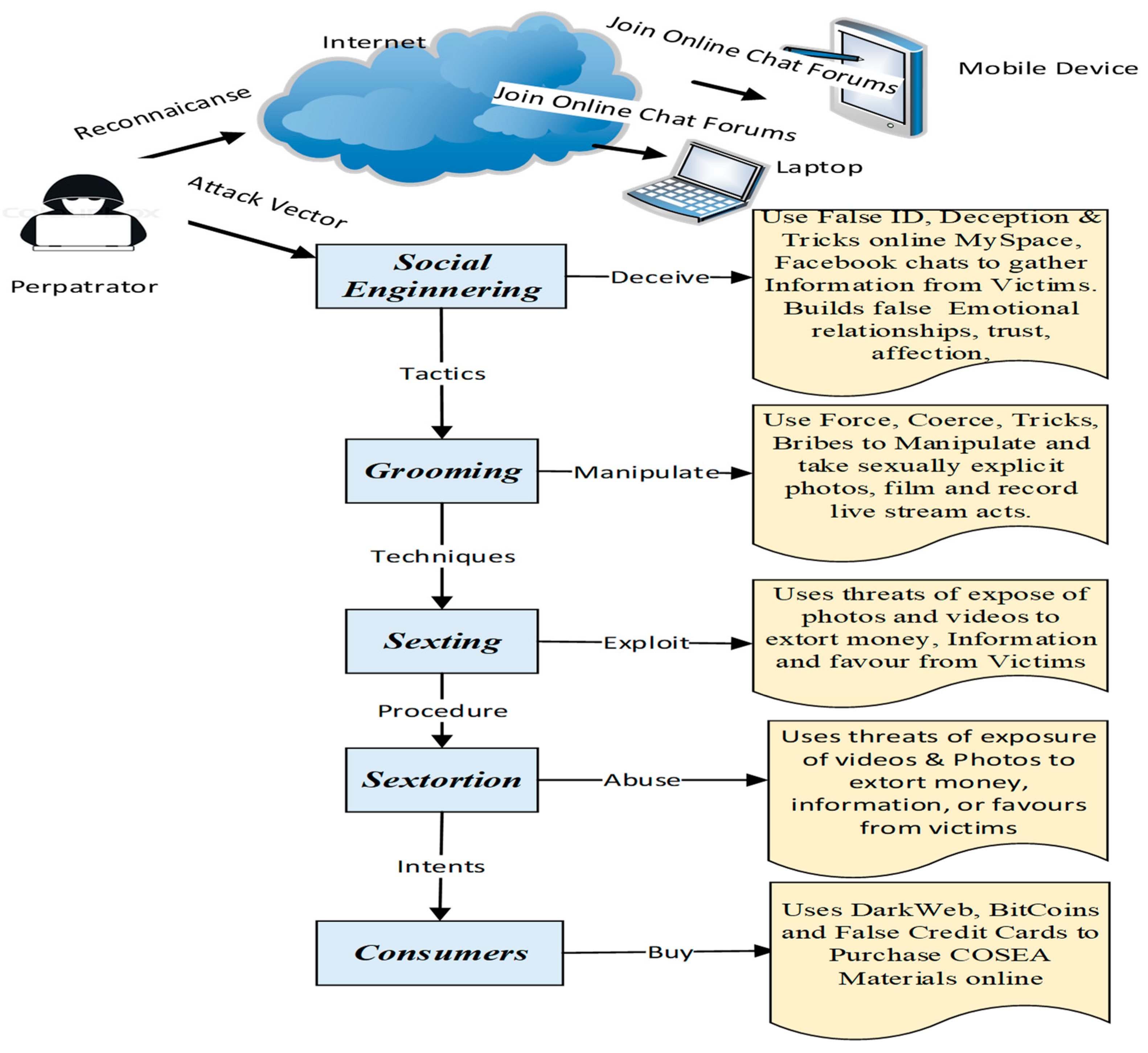
- Tactics: The perpetrator carries out reconnaissance on various social network sites, video game consoles, and online chat forums to identify the victims. Then the threat actor uses a social engineering method to gather information or passwords from victims. The online platforms and live streaming websites include MySpace, Facebook, instant messaging, pop-ups, chat rooms, and other internet forums to identify their victims for possible Child Sexual Exploitation and Abuse. Additionally, threat agents communicate with other agents within a campaign via online tools such as the dark web and Virtual Private Networks (VPNs) to execute attacks and conceal their identities (Azeria Labs 2017; Radford 2018; WePROTECT Global Alliance 2015; Benson and Benson 2005; Berelowitz et al. 2013; Kloess et al. 2017b; Barnum 2014).
- Techniques: Do the perpetrators adopt the strategies to facilitate the initial contact with the victim before the exploitation, such as social engineering, online grooming, sexting, sextortion, and other capabilities deployed? For instance, after the adversary establishes contact with the victim online, they may deceive the victim or use force, coercion, bribes, and other persuasive means to induce the victim to personally disclose information that could lead to further exploitation (Azeria Labs 2017; Radford 2018; WePROTECT Global Alliance 2015; Benson and Benson 2005; Berelowitz et al. 2013; Kloess et al. 2017b; Barnum 2014).
- Procedures: Include a set of tactics and techniques put together that the adversary uniquely uses to perform an attack. The procedures for each exploitation may vary depending on the nature of the abuse, purpose, and the money involved. A well-orchestrated procedure may not show signs of exploitation or abuse. For instance, the perpetrator may decide to use the internet, a webcam to capture images and film the explicit sexual abuse of the children, and may choose to live stream the abuse to an audience in a private online forum (Azeria Labs 2017; Radford 2018; WePROTECT Global Alliance 2015; Benson and Benson 2005; Berelowitz et al. 2013; Kloess et al. 2017b; Barnum 2014).
4.2. COSEA Attack Steps Deployed by Perpetrators to Exploit Victims Online
- Reconnaissance: The perpetrator carries out online searches and visits various online forums to identify which platforms they can join and conceal themselves to identify vulnerable children.
- Social Engineering or Catfishing: The perpetrator uses a false identity and tricks the child into revealing personal information about themselves and their families.
- Grooming: Perpetrators use deception to gather intelligence about the child to build emotional relationships, trust, and affection to manipulate, exploit, and abuse the victims later.
- Sexting: Perpetrators use force, bribes, tricks, and persuasion to get the victims online and into sexually explicit acts. They connect via smartphones with webcams to share sexually explicit photos, images, and live streaming of themselves and the child inappropriately online.
- Sextortion: Perpetrators use the threat to extort money, information, or sexual favors from their victims by threatening to reveal the sexually explicit activities they have secretly recorded unlawfully on social media.
- Consumers: They purchase COSEA materials online using false Credit Card details on the dark web and Bitcoins.
5. Discussions on a Child-Centered Approach to COSEA and the Influencing Factors
5.1. Child Online Sexual Exploitation and Abuse (COSEA) Challenges
5.2. Child-Centered Approaches to Factors Influencing COSEA Challenges
5.3. Limitations of the Study
6. Recommendations
7. Conclusions
Author Contributions
Funding
Institutional Review Board Statement
Informed Consent Statement
Data Availability Statement
Acknowledgments
Conflicts of Interest
References
- Ali, Sana, Hiba Abou Haykal, and Enaam Youssef. 2023. Child sexual abuse and the internet—A systematic review. Human Arenas 6: 404–21. [Google Scholar] [CrossRef]
- Azeria Labs. 2017. Tactics, Techniques, and Procedures (TTPs). Available online: https://azeria-labs.com/tactics-techniques-and-procedures-ttps/ (accessed on 18 April 2025).
- Bailey, Jane, Nicola Henry, and Asher Flynn. 2021. Technology-facilitated violence and abuse: International perspectives and experiences. In The Emerald International Handbook of Technology-Facilitated Violence and Abuse. Leeds: Emerald Publishing, pp. 1–17. [Google Scholar] [CrossRef]
- Baines, Victoria. 2019. Council of Europe Baseline Mapping: Building Europe for and with Children. Available online: https://rm.coe.int/191120-baseline-mapping-web-version-3-/168098e109 (accessed on 18 April 2025).
- Barnum, Sean. 2014. Standardizing Cyber Threat Intelligence Information with the Structured Threat Information Expression (STIX). Version 1.1. Available online: http://stixproject.github.io/about/STIX_Whitepaper_v1.1.pdf (accessed on 18 April 2025).
- Benson, Ilene R., and Michael J. Benson. 2005. Challenging online behaviors of youth: Findings from a comparative analysis of young people in the United States and New Zealand. Social Science Computer Review 23: 29–38. [Google Scholar] [CrossRef]
- Berelowitz, Sue, Jenny Clifton, Carlene Firmin, Sandra Gulyurtlu, and Gareth Edwards. 2013. If Only Someone Had Listened: Office of the Children’s Com-Missioner’s Inquiry into Child Sexual Exploitation in Gangs and Groups; London: Office of the Children’s Commissioner. Available online: https://www.childrenscommissioner.gov.uk (accessed on 18 April 2025).
- Brewster, Thomas. 2020. Child exploitation complaints rise 106% to hit 2 million in just one month: Is COVID-19 to blame? Forbes, April 24. Available online: https://www.forbes.com/sites/thomasbrewster/2020/04/24/child-exploitation-complaints-rise-106-to-hit-2-million-in-just-one-month-is-covid-19-to-blame (accessed on 18 April 2025).
- Chiang, Emily. 2020. Dark Web: Study Reveals How New Offenders Get Involved in Online Paedophile Communities. Birmingham: Institute for Forensic Linguistic, Aston University. Available online: https://theconversation.com/dark-web-study-reveals-how-new-offenders-get-involved-in-online-paedophile-communities-131933 (accessed on 18 April 2025).
- Childlight Global Child Safety Institute. 2024. Over 300 Million Children a Year Are Victims of Online Sexual Exploitation and Abuse. Available online: https://www.childlight.org/newsroom/over-300-million-children-a-year-are-victims-of-online-sexual-exploitation-and-abuse (accessed on 18 April 2025).
- Choi, Kyung-Shick, and Hannarae Lee. 2023. The trend of online child sexual abuse and exploitation: A profile of online sexual offenders and criminal justice response. Journal of Child Sexual Abuse 33: 804–23. [Google Scholar] [CrossRef]
- Choo, Kim-Kwang Raymond, Henry Hillman, and Christopher Hooper. 2014. Online child exploitation: Challenges and future research directions. Computer Law & Security Review 30: 687–98. [Google Scholar] [CrossRef]
- Cohen-Almagor, Raphael. 2013. Online child sex offenders: Challenges and countermeasures. The Howard Journal of Crime and Justice 52: 190–215. [Google Scholar] [CrossRef]
- Council of Europe. 2019. How Do We Prevent and Combat Online Child Sexual Exploitation and Abuse: Mapping and Comparative Review of Mechanisms for Collective Action. Available online: https://www.coe.int/en/web/children/-/how-do-we-prevent-and-combat-online-child-sexual-exploitation-and-abuse- (accessed on 18 April 2025).
- Daszczyszak, Roman, Dan Ellis, Steve Luke, and Sean Whitley. 2019. MITRE TTP-Based Hunting. McLean: MITRE. Available online: https://www.mitre.org/sites/default/files/2021-11/prs-19-3892-ttp-based-hunting.pdf (accessed on 18 April 2025).
- Demetis, Dionysios S., and Jan Kietzmann. 2021. Online child sexual exploitation: A new MIS challenge. Journal of the Association for Information Systems 22: 5–40. [Google Scholar] [CrossRef]
- ECPAT International. 2017. Online Child Sexual Exploitation: A Common Understanding. Bangkok: ECPAT International. [Google Scholar]
- Espelage, Dorothy L., and Jun Sung Hong. 2017. Cyberbullying prevention and intervention efforts: Current knowledge and future directions. The Canadian Journal of Psychiatry 62: 374–80. [Google Scholar] [CrossRef]
- Finkelhor, David, Heather Turner, and Deirdre Colburn. 2022. Prevalence of online sexual offenses against children in the US. JAMA Network Open 5: e2234471. [Google Scholar] [CrossRef]
- Fry, Deborah, Anna Krzeczkowska, Jingru Ren, Mengyao Lu, and Xiangming Fang. 2025. Prevalence estimates and nature of online child sexual exploitation and abuse: A systematic review and meta-analysis. Lancet Child Adolesc Health 9: 184–93. [Google Scholar] [CrossRef]
- Hallett, Sophie. 2016. An uncomfortable comfortableness: Care, child protection and child sexual exploitation. The British Journal of Social Work 46: 2137–52. [Google Scholar] [CrossRef]
- Hamilton-Giachritsis, Catherine, Elly Hanson, Helen Whittle, Filipa Alves-Costa, and Anthony Beech. 2020. Technology-assisted child sexual abuse in the UK: Young people’s views on the impact of online sexual abuse. Children and Youth Services Review 119: 105451. [Google Scholar] [CrossRef]
- Holt, Thomas J., Jesse Cale, Benoit Leclerc, and Jacqueline Drew. 2020. Assessing the challenges affecting investigative methods to combat online child exploitation material offences. Aggression and Violent Behavior 55: 101464. [Google Scholar] [CrossRef]
- Interagency Working Group. 2019. Trafficking Definitions for Working Group. Washington: Interagency Working Group. [Google Scholar]
- Internet Watch Foundation. 2018. Trends in Online Child Sexual Exploitation: Examining the Distribution of Captures of Live-Stream Child Sexual Abuse. Available online: https://www.iwf.org.uk (accessed on 18 April 2025).
- Ioannou, Maria, John Synnott, Amy Reynolds, and John Pearson. 2018. A comparison of online and offline grooming characteristics: An application of the victim roles model. Computers in Human Behavior 85: 291–97. [Google Scholar] [CrossRef]
- Joleby, Malin, Sara Landström, Carolina Lunde, and Linda S. Jonsson. 2021. Experiences and psychological health among children exposed to online child sexual abuse—A mixed methods study of court verdicts. Psychology, Crime & Law 27: 159–81. [Google Scholar] [CrossRef]
- Keller, M. H., and G. J. X. Dance. 2019. Preying on children: The emerging psychology of pedophiles. New York Times, September 29. Available online: https://www.nytimes.com/2019/09/29/us/pedophiles-online-sex-abuse.html (accessed on 18 April 2025).
- Kloess, Juliane A., Anthony R. Beech, and Leigh Harkins. 2014. Online child sexual exploitation: Prevalence, process, and offender characteristics. Trauma Violence Abuse 15: 126–39. [Google Scholar] [CrossRef]
- Kloess, Juliane A., Catherine E. Hamilton-Giachritsis, and Anthony R. Beech. 2017a. Offence processes of online sexual grooming and abuse of children via internet communication platforms. Sex Abuse 31: 73–96. [Google Scholar] [CrossRef]
- Kloess, Juliane A., Jessica Woodhams, Helen Whittle, Tim Grant, and Catherine E. Hamilton-Giachritsis. 2017b. The challenges of identifying and classifying child sexual abuse material. Sex Abuse 31: 173–96. [Google Scholar] [CrossRef]
- Kloess, Juliane A., Sarah Seymour-Smith, Catherine E. Hamilton-Giachritsis, Matthew L. Long, David Shipley, and Anthony R. Beech. 2017c. A qualitative analysis of offenders’ modus operandi in sexually exploitative interactions with children online. Sex Abuse 29: 563–91. [Google Scholar] [CrossRef]
- Laws, Sophie, and Gregory Hall. 2019. Addressing child sexual abuse and exploitation: Improvement in understanding and practice. Child Abuse Review 28: 399–404. [Google Scholar] [CrossRef]
- Lefevre, Michelle, Kristine Hickle, Barry Luckock, and Gillian Ruch. 2017. Building trust with children and young people at risk of child sexual exploitation. The British Journal of Social Work 47: 2456–73. [Google Scholar] [CrossRef]
- Longobardi, Claudio, Matteo Angelo Fabris, Laura Elvira Prino, and Michele Settanni. 2021. Online sexual victimization among middle school students: Prevalence and association with online risk behaviors. International Journal of Developmental Science 15: 39–46. [Google Scholar] [CrossRef]
- Merdian, Hannah L., Derek E. Perkins, Elspeth Dustagheer, and Emily Glorney. 2020. Development of a case formulation model for individuals involved in child sexual exploitation material. International Journal of Offender Therapy and Comparative Criminology 64: 1055–73. [Google Scholar] [CrossRef]
- MITRE ATT&CK: Ten Reconnaissance Techniques. 2025. Available online: https://attack.mitre.org/ (accessed on 18 April 2025).
- Montiel, Irene, Enrique Carbonell, and Noemí Pereda. 2016. Multiple online victimization of Spanish adolescents: Results from a community sample. Child Abuse & Neglect 52: 123–34. [Google Scholar] [CrossRef]
- Naebklang, Manida. 2014. The Commercial Sexual Exploitation of Children in Africa. Ghana: ECPAT International. Available online: https://www.ecpat.org (accessed on 18 April 2025).
- National Police Chiefs’ Council. 2024. Vulnerability Knowledge and Practice Programme (VKPP): National Analysis of Police-Recorded Child Sexual Abuse and Exploitation Crimes Report 2022. London: National Police Chiefs’ Council. [Google Scholar]
- NSPCC. 2020. What Is Child Sexual Exploitation? London: NSPCC. [Google Scholar]
- NSPCC. 2024. Statistics Briefing: Online Harm and Abuse. London: NSPCC. [Google Scholar]
- NSPCC. 2026. Protecting Children from Sexual Exploitation. Available online: https://learning.nspcc.org.uk/child-abuse-and-neglect/child-sexual-exploitation (accessed on 18 April 2025).
- Palmer, Catherine Emma, and Marian Foley. 2017. I have my life back: Recovering from child sexual exploitation. The British Journal of Social Work 47: 1094–110. [Google Scholar] [CrossRef][Green Version]
- Palmer, Tink. 2015. Digital Dangers: The Impact of Technology on the Sexual Abuse and Exploitation of Children and Young Persons. Available online: https://www.celcis.org (accessed on 18 April 2025).
- PureSight. 2018. Online Predators Statistics. Available online: https://www.puresight.com/Pedophiles/Online-Predators/online-predators-statistics.html (accessed on 18 April 2025).
- Quayle, Ethel. 2016. Researching online sexual exploitation and abuse: Are there links between online and offline vulnerabilities? In Global Kids Online. Edinburgh: University of Edinburgh. [Google Scholar]
- Quayle, Ethel. 2020. Prevention, disruption, and deterrence of online child sexual exploitation and abuse. ERA Forum 21: 429–47. [Google Scholar] [CrossRef]
- Radford, Lorraine. 2018. A Review of International Research on Interpersonal Violence; Centre of Expertise on Child Sexual Abuse. Preston: University of Central Lancashire. Available online: http://clok.uclan.ac.uk/21733/1/CSA%20international%20survey%20methodology.pdf (accessed on 18 April 2025).
- Radford, Lorraine, Susana Corral, Christine Bradley, Helen Fisher, Claire Bassett, Nick Howat, and Stephan Collishaw. n.d. Child Abuse and Neglect in the UK Today. London: NSPCC. Available online: https://learning.nspcc.org.uk/media/1042/child-abuse-neglect-uk-today-research-report.pdf (accessed on 18 April 2025).
- Ramiro, Laurie. S., Andrea B. Martinez, Janelle Rose D. Tan, Kachela Mariano, Gaea Marelle J. Miranda, and Greggy Bautista. 2019. Online child sexual exploitation and abuse: A community diagnosis using social norms theory. Child Abuse & Neglect 96: 104080. [Google Scholar] [CrossRef] [PubMed]
- Rook, Peter. 2019. Prosecuting Sexual Offences. Washington: JUSTICE. Available online: https://files.justice.org.uk/wp-content/uploads/2019/06/06170149/Prosecuting-Sexual-Offences-Report.pdf (accessed on 18 April 2025).
- Salter, Michael, and Elly Hanson. 2021. “I need you all to understand how pervasive this issue is”: User efforts to regulate child sexual offending on social media. In The Emerald International Handbook of Technology-Facilitated Violence and Abuse. Edited by Jane Bailey, Asher Flynn and Nicola Henry. Leeds: Emerald Publishing Limited, pp. 729–48. [Google Scholar] [CrossRef]
- Sivagurunathan, Marudan, Treena Orchard, Joy C. MacDermid, and Marilyn Evans. 2019. Barriers to Utilization of Mental Health Services amongst Male Child Sexual Abuse Survivors: Service Providers’ Perspective. Journal of Child Sexual Abuse 28: 819–39. [Google Scholar] [CrossRef] [PubMed]
- Tunagur, Mustafa Tolga, Hatice Oksal, Ömer Büber, Elif M. Kurt Tunagur, and Enes Sarıgedik. 2025. Risk factors and predictors of penetrative online child sexual abuse. Journal of Pediatric Health Care 39: 198–205. [Google Scholar] [CrossRef]
- United Kingdom. 2003. Sexual Offences Act 2003. Available online: https://www.legislation.gov.uk/ukpga/2003/42/pdfs/ukpga_20030042_en.pdf (accessed on 18 April 2025).
- United Nations Human Rights. 1989. Convention on the Rights of the Child. Available online: https://www.ohchr.org/EN/ProfessionalInterest/Pages/CRC.aspx (accessed on 18 April 2025).
- United Nations Office on Drugs and Crime. 2020. Online Child Sexual Exploitation and Abuse: Promoting a Culture of Lawfulness. Available online: https://www.unodc.org/e4j/en/cybercrime/module-12/key-issues/online-child-sexual-exploitation-and-abuse.html (accessed on 18 April 2025).
- Vold, George Brian, Thomas J. Bernard, and Jeffrey B. Snipes. 2002. Theoretical Criminology. Oxford: Oxford University Press. [Google Scholar]
- WePROTECT Global Alliance. 2015. Preventing and Tackling Child Sexual Exploitation and Abuse (CSEA): A Model National Re-sponse. Available online: https://www.weprotect.org/the-model-national-response/ (accessed on 18 April 2025).
- WePROTECT Global Alliance. 2020. Impact of COVID-19 on Child Sexual Exploitation. London: WePROTECT Global Alliance. [Google Scholar]
- WePROTECT Global Alliance. 2024. World’s First Estimate of the Scale of Online Child Sexual Exploitation and Abuse. Available online: https://www.weprotect.org/blog/worlds-first-estimate-of-the-scale-of-online-child-sexual-exploitation-and-abuse (accessed on 18 April 2025).
- Westendorf, Jasmine-Kim, and Louise Searle. 2017. Sexual exploitation and abuse in peace operations. International Affairs 93: 365–87. [Google Scholar] [CrossRef]
- Whittle, Helen, Catherine Hamilton-Giachritsis, Anthony R. Beech, and Guy Collings. 2013. A review of young people’s vulnerabilities to online grooming. Aggression and Violent Behavior 18: 135–46. [Google Scholar] [CrossRef]
- Williams, Rebecca, Ian A. Elliott, and Anthony R. Beech. 2013. Identifying sexual grooming themes used by internet sex offenders. Deviant Behavior 34: 135–52. [Google Scholar] [CrossRef]
- Wurtele, Sandy K. 2009. Preventing sexual abuse of children in the twenty-first century: Preparing for challenges and opportunities. Journal of Child Sexual Abuse 18: 1–18. [Google Scholar] [CrossRef] [PubMed]



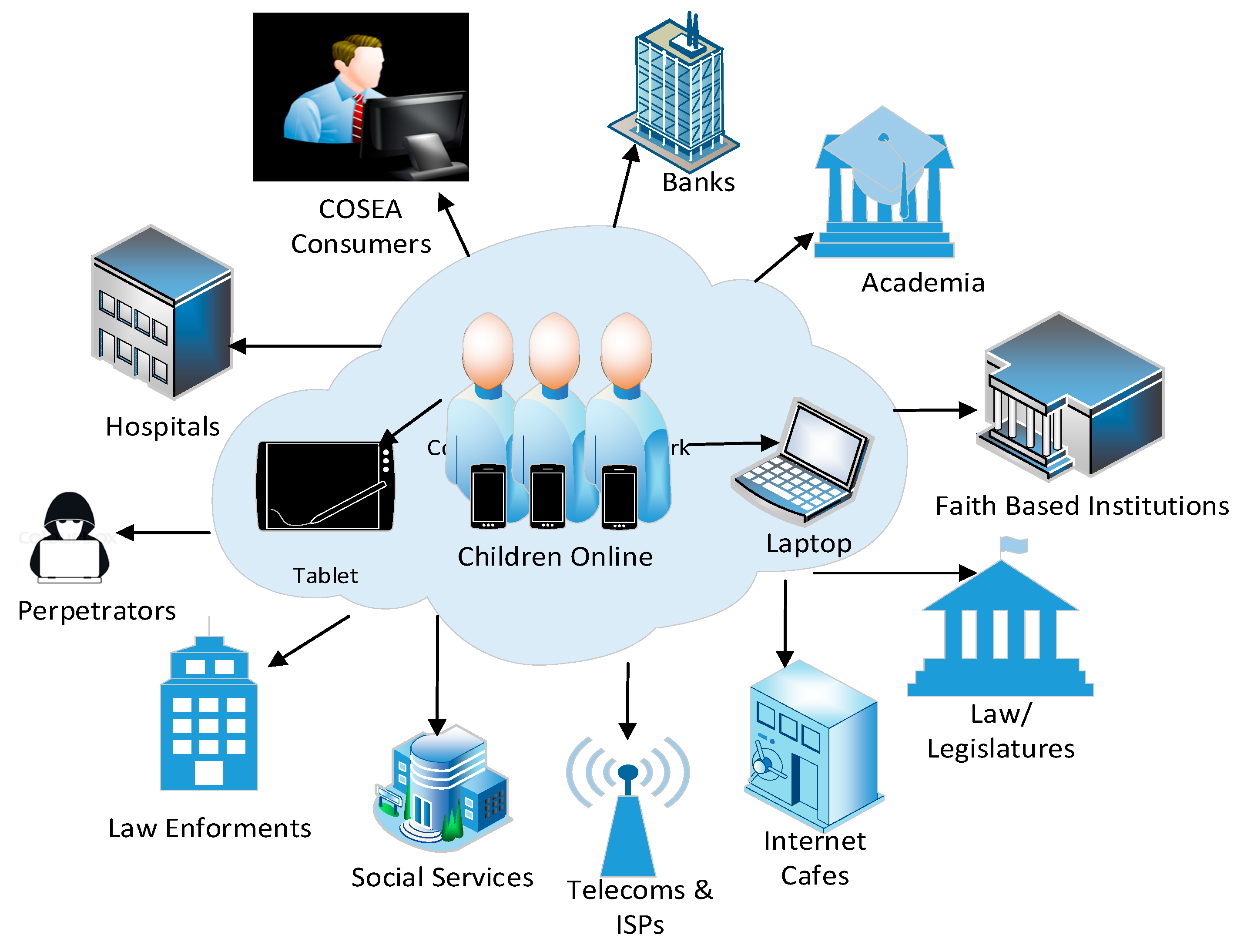
| Stakeholders | Roles and Responsibilities | Strategic Management Initiatives |
|---|---|---|
| Law and Legislature | National and international laws. | Implement laws that support all stakeholders’ initiatives. |
| Telecom Industries and ISPs | Set standards and directives. Understand the perpetrator’s motives and intents. | Implement standards, policies, configuration tools and triggers to detect, report, and prevent. |
| Law Enforcement Agencies | Employ expertise with an understanding of COSEA threats. | International collaborations and information sharing. Organize training and workshops. Set up forensic labs. |
| Banks and Financial Institutions | Report on any financial irregularities and transfers | Banks should form coalitions to detect and support international COSEA initiatives. |
| Internet and Cyber Cafes | Install IDS/IPS, firewalls, and anti-malware to detect sexually explicit materials. | Set up enforcement regulators to monitor cafes. Implement licenses and security policies. |
| Social Services | Provide social care, education, and support for parents and children. | Organize training and workshops to educate staff and create awareness of risk factors. |
| Faith-Based leaders | Provide moral and spiritual guidance to children and families in social settings. | Organize forums that foster sensitization, collaboration, corporate partnerships, trust, and reporting platforms. |
| NGOs and Interventions Groups | Promote awareness and interventions between victims and state institutions. | Liaise with global agencies to promote the well-being of victims. |
| Academia/Research Institutions | Provide research initiatives in the COSEA subject areas. Train teachers to be aware of risk factors and their impact on children. | Provide funding for research that provides threat intelligence and situational awareness for all stakeholders. |
| Hospitals | Gather health issues about victims and risk factors | Provide statistics to government institutions with health and risk factors for policy formulation. |
| Parents and Guardians | Provide parental guidance, protection, and support for children and young persons. | Provide governmental support for social services, hospitals, teachers, faith leaders, and law enforcement agencies to educate parents and guardians. |
Disclaimer/Publisher’s Note: The statements, opinions and data contained in all publications are solely those of the individual author(s) and contributor(s) and not of MDPI and/or the editor(s). MDPI and/or the editor(s) disclaim responsibility for any injury to people or property resulting from any ideas, methods, instructions or products referred to in the content. |
© 2026 by the authors. Licensee MDPI, Basel, Switzerland. This article is an open access article distributed under the terms and conditions of the Creative Commons Attribution (CC BY) license.
Share and Cite
Yeboah-Ofori, A.; Amenyah, A.A. Child Online Sexual Exploitation and Abuse: Understanding Adversarial Tactics, Techniques, and Procedures. Soc. Sci. 2026, 15, 305. https://doi.org/10.3390/socsci15050305
Yeboah-Ofori A, Amenyah AA. Child Online Sexual Exploitation and Abuse: Understanding Adversarial Tactics, Techniques, and Procedures. Social Sciences. 2026; 15(5):305. https://doi.org/10.3390/socsci15050305
Chicago/Turabian StyleYeboah-Ofori, Abel, and Awo Aidam Amenyah. 2026. "Child Online Sexual Exploitation and Abuse: Understanding Adversarial Tactics, Techniques, and Procedures" Social Sciences 15, no. 5: 305. https://doi.org/10.3390/socsci15050305
APA StyleYeboah-Ofori, A., & Amenyah, A. A. (2026). Child Online Sexual Exploitation and Abuse: Understanding Adversarial Tactics, Techniques, and Procedures. Social Sciences, 15(5), 305. https://doi.org/10.3390/socsci15050305