1. Introduction
Modernization represents a profound transformation across all dimensions of social life, reshaping values, norms, and institutions. Among the institutions most affected is the family. The shift from extended to nuclear family structures has brought both functional and structural changes, narrowing the family’s role and scope. As modernization progresses, the family continues to evolve, now encompassing diverse forms such as cohabiting partners, single-parent households, and adoptive arrangements. Declining marriage rates, increasing divorces, and rising individualism have further challenged the endurance of traditional family models. A key outcome of this transformation is the increase in divorce rates. In Türkiye, while marriage rates have steadily declined since the 2000s, divorce rates have increased. Despite becoming normalized, the fact that one in three marriages ends in divorce continues to be viewed as a societal concern. Although existing studies often focus on younger adults—understandably so, as divorces typically occur within the first five years—there has been a marked rise in divorces among older adults. This phenomenon, known as “gray divorce,” refers to separations among individuals over 50 and is becoming increasingly prevalent not only in developed countries but also in Türkiye. In this context, gray divorce can be considered one of the most visible outcomes of modernization’s impact on the institution of the family today. While the early breakdown of marriages among young individuals can be predicted and explained by individualization and transformations in social gender roles, the increase in divorce rates among individuals aged 50 and above demonstrates that modernization has also transformed traditional attitudes and social perceptions towards divorce. Importantly, it is important to note that gray divorce does not only signify the end of long-term marriages; it can also encompass the dissolution of marriages that occur after the age of 50, regardless of the duration of the marriage.
In Türkiye specifically, the fact that modernization progresses at different speeds in the eastern and western regions also reveals the spatial and cultural diversity of gray divorce. Therefore, the general dynamics of modernization discussed at the outset provide a critical foundation for understanding not only the institution of the family but also the rise of gray divorce itself. Multiple factors contribute to this trend, including increased life expectancy, evolving perceptions of marriage, higher marriage age, and women’s growing labor force participation and economic independence. Broader shifts—such as changing gender roles, digitalization, and the erosion of traditional norms—have also accelerated individualization, further influencing divorce decisions. Specific life transitions, such as empty-nest syndrome, retirement, and health issues, are also relevant risk factors.
This study examines the increasing frequency of gray divorces in Türkiye, particularly in the context of an aging population, declining marriages, and rising divorce rates. The main objective of the study is to evaluate gray divorce, a phenomenon that is becoming increasingly visible but has not been sufficiently studied in Türkiye, from a sociological perspective. By examining the causes, processes, and consequences of gray divorce in the Turkish context, the study aims to present a general picture, make the phenomenon visible by compiling current official statistical data and key literature on gray divorce, and establish a framework that will guide future research in this area, particularly in Türkiye.
2. Modernization and Family
Modernization, originating in the West and gradually spreading worldwide, refers to the profound transformation of traditional, religious, political, economic, scientific and cultural structures. The radical changes in 17th- and 18th-century Europe disrupted and dissolved established social institutions. Modernization thus represents a sweeping transformation involving the decline of traditional and religious institutions, the erosion of their significance and the breakdown of long-standing behavioral norms. Triggered by modernity, this process reshaped traditional social orders and their intellectual foundations. Unlike earlier historical changes, modernization is distinguished by its global scale and intensity, fundamentally altering the daily lives of individuals (
Giddens 2012).
Modernity is often defined in opposition to the ‘traditional’ era, which was based on intellectual and social structures rooted in theological foundations. In this period, theology guided thought systems, social organization, value judgments and understandings of the human being. Knowledge was derived from religion and disseminated through religious institutions. Political and cultural elements aligned within a religion-centered framework and discourses on humanity, society and the universe reflected a God-centered view. In contrast, modernity shifted focus from God to the individual. Human reason replaced theology as the primary source of knowledge, with human senses, experience and rationality becoming central to understanding the world (
Demir 1997).
Through modernization, societies have experienced dynamics such as industrialization, urbanization, the rise of nation-states, democracy, bureaucracy, historical progressivism, transformations in communication, shifting power relations, capitalist markets, evolving class structures, increased literacy, political participation, digitalization and the rationalization of all spheres of life. Collective sentiments have been replaced by values such as scientific thinking, individualism, rationalization and commercialization. As modern institutions expanded, traditional structures began to acquire modern characteristics while traditional values rapidly eroded (
Subasi 2003). Originating in the economy, modernization gradually transformed all social structures, aiming for universality by transcending time and space (
Saylan 2009). Habermas describes modernization as an ‘unfinished project’, continuously redefining itself in new forms (
Childs 2010). However, its impact varies globally, as modern structures elicit different responses across societies. Friedman interprets modernization as a crisis of faith within Western culture, marked by loss of meaning, fragmentation and the disintegration of cultural symbols (
Friedman 1981).
The family is among the institutions most deeply transformed by modernization. While commonly understood as a nuclear unit of parents and children, this model represents only one of many forms. A universal definition of family is problematic due to significant variation across cultural and geographical contexts, and the historically dynamic nature of family structures. Definitions that disregard such diversity risk ethnocentrism and reductionism (
Zencirkiran 2016). Nonetheless, the family may be broadly defined as a group connected by blood, marriage, agreement, or adoption, sharing responsibilities for reproduction and caregiving (
Schaefer 2013). As a central social institution, the family has undergone structural shifts that have altered both internal dynamics and societal functions. Historically, it is classified into two primary forms: the traditional (extended) family of pre-industrial societies and the modern (nuclear) family of industrial and post-industrial eras, each with distinct roles and structures.
The traditional extended family, prevalent in pre-industrial or partially industrialized societies, has historically spanned diverse regions. In such families, intergenerational co-residence is common, with blurred boundaries among members and strong relational continuity. Household members not only share living space but also social and economic responsibilities. As production is largely agricultural and home-based, most members contribute to labor. Authority typically resides with the eldest male, whose decisions are respected and followed; upon his death, leadership passes to the next eldest or strongest male, preserving a generational hierarchy (
Sezal 2003).
The nuclear family, associated with industrialization and modernization, consists of a mother, father and unmarried children. It is the dominant family structure in post-industrial urban societies. Unlike the extended family, the nuclear family is functionally narrower and includes fewer household members (
Arslanturk and Amman 2011). Many functions once carried out by the extended family have either disappeared or are now fulfilled in a more limited manner. However, this does not mean the nuclear family has lost all its functions. Decisions on matters such as spouse selection and post-marital residence are made jointly, authority is more balanced and gender-based discrimination is largely absent. While kinship ties persist, they are weaker than in extended families. Additionally, unlike the occasional polygamy in extended families, monogamy is the norm and spouse selection generally occur exogamous.
Modernization has radically changed not only family types but also how marriages are formed, functioned and ended. This transformation has reduced the number of children, narrowed family functions and weakened kinship ties. Factors such as rising female education levels, compulsory schooling and delayed marriage have reshaped decisions about marriage and parenthood. Changing gender roles, women’s participation in the labor force and growing demands for legal and social equality have significantly altered family dynamics. Meanwhile, mass media and the public exposure of private life have shifted perceptions of marriage and family. In particular, instant communication through the Internet and social media has introduced new models of relationships. The male-dominated structure of traditional families has weakened, giving way to more egalitarian marriages. This shift has led to new interpretations, both socially and legally. One of the most striking consequences of modernization for families is the rise in divorce. Divorce rates in both developed and developing countries have increased dramatically. This rise is linked to the rise of individualism, women’s economic independence, the culture of dissatisfaction promoted by consumer society and the tendency to treat relationships as disposable (
Zencirkiran 2016).
3. Family, Marriage and Divorce in Today’s Türkiye
The institution of the family in Türkiye has undergone rapid transformation, particularly in the last century. Structural and functional changes have affected the formation and continuity of families. This change reflects not only the transition from the extended family to the nuclear family, but also a broader transformation in social life. To understand divorces, and naturally, gray divorces in Türkiye, it is essential to go beyond these modern dynamics and consider the historical, religious, and legal contexts. Throughout the period from the Ottoman Empire to the Republic of Türkiye, marriage has held a central position as both a religious and social institution. The Turkish Civil Code, adopted on 17 February 1926, particularly its “Family Law” section, constituted a fundamental legal reform. With this law, monogamy replaced polygamy, the right to divorce by court decision based on reasons specified in the law was granted to both genders instead of divorce being solely at the discretion of the man, and equal inheritance rights for both sons and daughters replaced the practice of sons receiving full inheritance and daughters receiving half. Thus, women were placed on an equal footing with men in terms of rights relating to their private lives, such as marriage, divorce, property, and inheritance. This transformation constituted the most direct reflection of the Republican revolutions on family life. With the addition of the principle of “secularism” to the 1924 Constitution in 1937, the regulation of the family institution within a secular legal system, independent of religious rules, gained constitutional guarantee. Thus, the family has become not only a social institution but also an area shaped by the secular legal system. However, despite all these reforms, religious values and patriarchal cultural norms have long stigmatized divorce. Even today, especially in rural areas, religious discourse and traditional values continue to create a strong perception that marriage is “sacred” and “indissoluble.”
In contrast, in urbanized areas, divorce has become increasingly acceptable due to the effects of secularization and individualization. Therefore, divorce in Türkiye, as in many other societies, is not a process that can be explained solely by individual decisions; it is a multidimensional phenomenon shaped at the intersection of historical heritage, the impact of religious norms on social life, legal regulations, and cultural transformations. Making this context visible reveals that divorces are not merely an individual experience but also a critical indicator reflecting the transformation of the social structure.
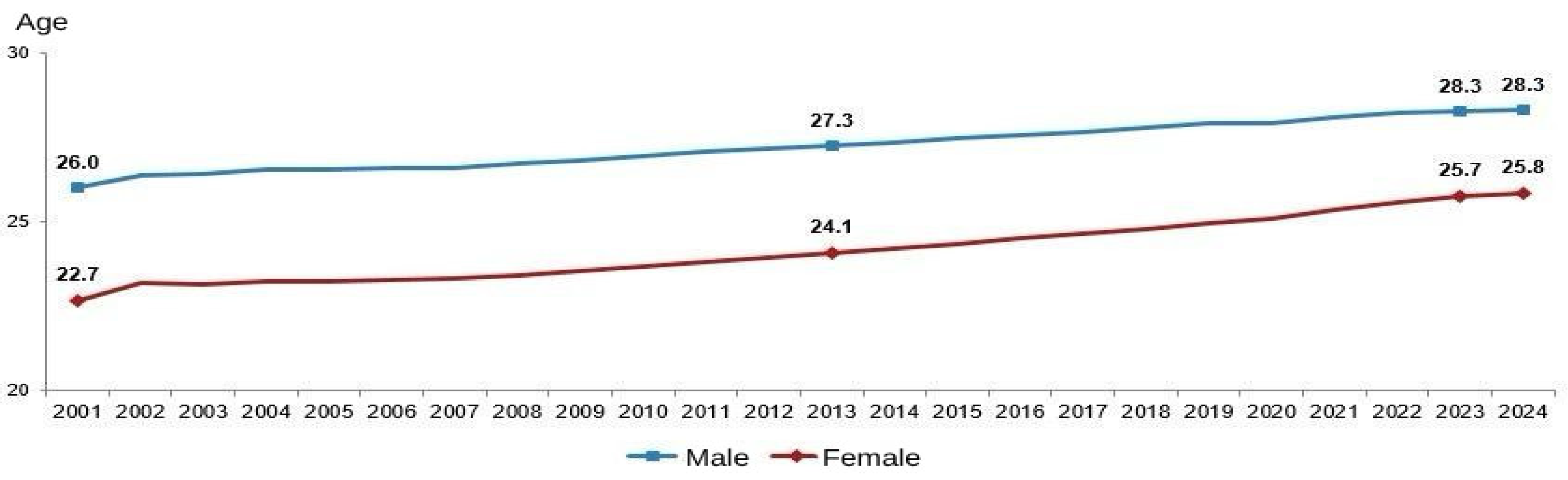
Today, the family struggles more than ever to sustain itself. Changing views on marriage and family, fluctuating marriage and divorce rates, and rising individualism are among the contributing factors. These dynamics have reduced the frequency of family formation. Another key factor is the declining interest in marriage among young people, as well as the increasing age at which people get married for the first time (see
Figure 1). Social and economic conditions also contribute to delayed marriages, leading to a decline in overall marriage rates.
The age at which people first get married is steadily increasing for both men and women. In 2001, the average was 22.7 for women and 26 for men; by 2024, it rose to 25.8 and 28.3, respectively. This trend is expected to continue and is not unique to Türkiye, as similar patterns are observed globally. Contributing factors include delayed marriage, growing preferences for individual freedom, economic challenges, alternative lifestyles and a general sense of unpreparedness for marriage (
Bas 2021).
Along with delayed marriages, divorces significantly affect family unions. Divorce, defined as the legal termination of marriage, is as old as marriage itself (
Marshall 2021). While historically viewed more harshly, societal attitudes toward divorce have softened over time, mainly due to its growing visibility. Today, divorce is more accepted, yet its rising frequency has transformed it from a personal decision into a sociological issue. The concern lies not in divorce itself but in its widespread prevalence, which threatens the continuity of the family institution and marital partnerships.
Compared to Western countries, divorce rates in Türkiye remain relatively low, mainly due to the high cultural value placed on marriage and family. In Turkish society, the family is seen as sacred and divorce is generally disapproved of, as reflected in expressions like ‘entering with a wedding dress and leaving with a shroud’. However, this traditional view has begun to shift. Rising divorce rates indicate that couples increasingly choose separation over resolving conflicts. According to TURKSTAT, the crude marriage rate decreased from 8.35 in 2001 to 6.65 in 2024, while the crude divorce rate increased from 1.41 to 2.19 during the same period (
TURKSTAT 2025c). These trends suggest that marriages are becoming less common while divorces are more frequent. As a result, marriage is losing its central role in social life and divorce is becoming more visible and accepted. Unlike in the past, individuals today feel less social pressure to maintain unhappy marriages and the commitment implied by ‘till death do us part’ no longer carries the same weight (
Canham et al. 2014).
Divorce is rarely a spontaneous decision; it typically results from problems accumulated over time. While the reasons vary by relationship, common causes include economic hardship, poor communication, declining social stigma, infidelity, violence, family interference, sexual incompatibility and insecurity. Like life, marriage has ups and downs. Although few marriages are consistently happy, every couple faces difficulties—some resolve them, others turn to divorce. Divorce can occur at any stage, but early years are perilous. TURKSTAT data confirms this: around 40,000 of the 173,342 divorces in 2023 occurred within the first three years of marriage. In 2024, 33.7% of 187,343 divorces happened within the first five years (
TURKSTAT 2025c). As marriage duration increases, the likelihood of divorce decreases. The first three years mark a critical threshold; surviving this period is indicative of greater marital stability. Divorce rates show an inverse relationship with marriage duration. In 2024, 36,005 divorced men were aged 35–39 and 36,075 divorced women were aged 30–34 (
TURKSTAT 2025c). Given the rising age of marriage, most divorces occur in the early years of marriage.
Striking divorce rates in early years of marriage have led studies to focus on young adults. However, most divorce research in Türkiye emphasizes causes rather than age groups (
Aksan and Sonmez 2019). While this is acceptable, given the higher prevalence among young adults, middle-aged and older adults also divorce at notable rates. For instance, in 2024, approximately one-fifth (35,478) of the 187,343 divorces involved men aged 50 and over, while 20,217 involved women in the same age group. In 2024, 971 men and 182 women aged 75 and older divorced; in 2023, the numbers were 857 and 179 (
TURKSTAT 2025c). While these figures are small relative to the total number of divorces, they highlight two key points: Divorce now spans all age groups, and each age group has distinct dynamics. What was once considered rare is now a growing sociological issue. Gray divorce signals a shift in the divorce landscape and is likely to become more common in Türkiye.
4. Gray Divorce as a New Phenomenon
In the literature, divorces among individuals aged 50 and above are termed “gray divorce,” symbolically referencing gray hair (
Maas 2022). The United States, with one of the highest global divorce rates—where 45% of marriages end in divorce—offers a critical case for examining gray divorce (
Brown and Lin 2012). Over the past five decades, divorces among older adults in the U.S. have notably increased. Although rare in the 1970s–1990s, gray divorce doubled by 2010, rising from under 10% to 25% of all divorces. By 2019, one in three divorced individuals was aged 50 or older, highlighting that divorce now substantially impacts older populations as well (
Brown and Lin 2022). Similar trends in gray divorce rates are also observed in European countries and Canada. In Sweden, gray divorces have more than doubled since the beginning of the millennium (
Bildtgard 2022). In Canada, the gray divorce rate increased by 26% between 1991 and 2006 and has remained stable since then (
Kozyrev Law 2025). In Italy, between 1974 and 2015, the proportion of divorces among those aged 50 and over increased approximately threefold, while the average age at which marriages ended rose from 38 to 48 for men and from 34 to 45 for women. During this period, the tendency to separate was observed at an earlier age, particularly among individuals with a high level of education, living in northern regions and belonging to modern family models; whereas among individuals with a low level of education, living in southern and island regions and belonging to traditional family structures, it occurred at a later age (
Arosio 2024). Similarly, in France, divorces among men over the age of 50 accounted for 38 per cent of all separations in 2016, compared to only 17 per cent in 1996; among women, the rate rose from 11 per cent to 29 per cent during the same period (
Belhacine 2025). In Germany, between 1991 and 2020, divorce rates among individuals aged 60 and above showed a striking increase, rising from 3.7 to 15.6 among men and from 2.1 to 9.3 among women (
Buyukkececi and Leopold 2024). Similar trends are observed in the divorce statistics of other European countries. These indicators demonstrate that gray divorces are commonplace today, despite differing social, cultural and demographic contexts.
Additionally, it is necessary to clarify a conceptual distinction at this point: The terms “gray divorce” and “the end of long-term marriages,” which are sometimes used interchangeably in the literature, do not refer to the same phenomena. Gray divorce refers to divorces among individuals aged 50 and above. At the same time, the end of long-term marriages is based on the duration of the marriage and does not necessarily occur in old age. Although there are some overlaps between them, distinguishing these two concepts contributes to a better understanding of the subject.
Early research on gray divorce identifies key factors behind rising divorce rates among individuals aged 50 and over. One primary factor is the higher prevalence of remarriages in this age group, which show significantly higher divorce rates than first marriages (
Hammond and Muller 1992). With increased exposure to divorce within their peer networks, older adults may perceive divorce as more socially acceptable. Women’s greater labor force participation and improved employment opportunities have also fostered economic autonomy, enabling them to initiate late-life divorces more freely. Additionally, global increases in life expectancy have reduced the likelihood of marriages ending through death, thereby raising the risk of divorce (
Brown and Lin 2012). Two main factors underlie this demographic shift: longer life expectancy and lower fertility rates. Medical advancements and expanded healthcare access have extended life spans, while declining birth rates stem from widespread birth control use, nuclear family structures, and changing gender roles (
Samanci Tekin and Kara 2018). These two dynamics lead to the aging of the population in Türkiye as in the rest of the world.
Modernization-driven individualization and the global erosion of traditional marriage norms have significantly contributed to the rise in gray divorces. As personal fulfillment becomes a central marital expectation, fewer marriages occur, yet the symbolic and emotional weight of marriage continues to grow. This paradox—declining marriage rates alongside heightened expectations—suggests a continued rise in late-life divorces. Additionally, marriage, as a dynamic institution, may gradually fail to meet the evolving needs of one or both partners, prompting more individuals aged 50 and over to end their unions.
Several life transitions contribute to the rise in gray divorces, including empty-nest syndrome, retirement and health problems (
Lin et al. 2018). When children leave home, parents often face a restructured marital dynamic, no longer centered around caregiving roles. This shift can diminish marital satisfaction, creating relational gaps that may lead to divorce (
Kalkandeler Ozdin 2024). Similarly, retirement marks a significant transition. As couples begin spending more time together after years of separate routines, mismatched expectations and evolving personal needs may surface, especially in long-term marriages. These adjustments can strain the relationship, making retirement a critical risk factor. Deteriorating health is another key contributor. In older age, chronic illness or caregiving demands may burden one spouse, potentially leading to marital dissolution if the other partner feels unable or unwilling to provide care. Health-related challenges thus significantly impact marital stability in later life. Ultimately, these risk factors—though distinct—interact with internal marital dynamics. When couples cannot navigate these fragile periods, gray divorce becomes more likely, underscoring that such decisions are shaped not only by personal choice but also by the structural vulnerabilities of long-term unions.
However, it would be reductive to attribute gray divorces solely to transitional risk factors. Most divorces in later life emerge from a combination of issues, including emotional or physical abuse, addiction, infidelity, gender inequality, role imbalances, or evolving marital dissatisfaction. These common drivers are present in many cases. However, research also shows that about one-fourth of gray divorces occur without overt conflict or harmful behavior, instead stemming from emotional disconnection, the dissolution of shared life goals, and evolving family dynamics (
Montenegro 2004). Qualitative findings highlight that late-life divorces are often shaped by existential changes unique to aging. Blitgard and Oberg identify four dominant narratives: the exhaustion of shared life projects, age-related personality shifts, a final pursuit of romantic fulfillment, and declining tolerance for inequality or mistreatment (
Bildtgard and Oberg 2022). Similarly, Crowley shows that individuals’ perceptions of marriage—as a path to self-realization or romantic devotion—influence their decisions to divorce (
Crowley 2017). These findings indicate that factors such as diminished excitement, routine or changing expectations are sufficient grounds for separation, particularly in cases of gray divorce arising from long-term marriages.
Ending long-term marriages is often more complex than dissolving recent ones, as they involve not only the couple but also shared histories with children and extended family. Consequently, gray divorces can have broader social impacts than those occurring earlier in life. Moreover, older adults generally face greater challenges in navigating post-divorce life compared to younger individuals. Notably, gender differences emerge in this context. Research indicates that women in mid-to-late adulthood have significantly lower remarriage rates than men (
Brown et al. 2006). Brown et al. found that within a decade of gray divorce, 37% of men had remarried, compared to only 22% of women (
Brown et al. 2019). Crowley notes that most women resist remarriage, whereas men are more receptive (
Crowley 2019). Brown et al. further highlight that frequent contact or cohabitation with adult children lowers the likelihood of remarriage, a pattern linked to “boundary ambiguity,” where familial roles and boundaries become difficult to redefine (
Brown et al. 2025).
A key gender-based disparity following gray divorce lies in economic well-being: women are disproportionately affected by financial hardship (
McDaniel and Coleman 2003). Deprived of spousal support, many women seek care and assistance from children or relatives, and in its absence, turn to public institutions (
Canham et al. 2014). Slavov and Wei report that while women increase their labor supply post-divorce, men’s employment tends to decline. Women’s non-wage income drops significantly, whereas men remain relatively unaffected (
Slavov and Wei 2021). Lin and Brown found that women’s living standards fall by up to 45% post-divorce, with recovery often contingent on forming a new union (
Lin and Brown 2021). Although wealth losses approach 50% for both sexes, women’s economic recovery is more precarious. Zhao et al. further note that women face greater post-divorce food insecurity (
Zhao et al. 2024).
Gray divorce at first increases feelings of depression, but most people feel better with time. This supports the crisis model, which sees divorce as a short-term problem, not a lasting trauma (
Tosi and van den Broek 2020). Lin et al. show that mental health declines are more pronounced among those with weak or absent ties to their children (
Lin et al. 2024). Gray divorce also reconfigures intergenerational relationships. Research by Buyukkececi and Leopold reveals stronger post-divorce ties between adult children and mothers, but weakened ties with fathers (
Buyukkececi and Leopold 2024). Brown et al. report that having grandchildren may reduce divorce risk, suggesting that intergenerational bonds promote marital stability (
Brown et al. 2021). This finding shows that intergenerational ties in the family structure contribute to marital stability.
Collectively, these findings demonstrate that gray divorce is not merely a demographic trend, but a complex social phenomenon shaped by gender inequalities, shifting family roles, and life course vulnerabilities. Its sociological analysis requires attention to life stage, gender, intergenerational dynamics, and policy frameworks. Given Türkiye’s aging population, declining marriage rates, and rising divorce trends, gray divorce poses a growing challenge to the family institution.
5. Gray Divorce in Türkiye
Divorce in Türkiye is a complex and multifaceted social phenomenon that extends beyond personal incompatibilities or relational breakdowns between spouses. Studies reveal that the underlying causes of divorce range from family conflicts and economic hardship to entrenched gender roles and traumatic experiences such as violence and infidelity (
Sahan and Kilicarslan 2024). Particularly in Türkiye’s patriarchal social structure, gender norms significantly shape women’s experiences within marriage and during divorce (
Targan Calis 2022). Violence against women emerges as a significant factor leading to divorce, rendering both women and children more vulnerable throughout the process (
Bulbul and Kaygusuz 2022). According to
TURKSTAT (
2022), the most commonly cited cause of divorce is the irresponsible or indifferent behavior of spouses, followed by infidelity, financial problems, and physical violence. While women more frequently report infidelity and abuse, men emphasize economic inadequacy as a key driver. Post-divorce issues, especially related to child custody, psychological well-being, and parenting roles, highlight the importance of institutional and judicial support systems.
Alongside these dynamics, Türkiye is undergoing a demographic transformation—from a predominantly young population toward an aging society. Declining fertility rates and increasing life expectancy, driven by socioeconomic and technological advancements, mark a significant shift (
Formosa and Kutsal 2017). These changes bring new challenges, including the rising visibility of gray divorce.
Life expectancy in Türkiye is gradually increasing. While life expectancy at birth was 55 years in the 1960s, it increased to 70 years in the 2000s and 77.3 years in 2021–2023 (
TURKSTAT 2024). These data indicate that the proportion of the population in the older age group will continue to increase in the years to come. Considering the aging population structure and increasing divorce rates, divorce rates of middle-aged and older adults in Türkiye stand out as a new sociological problem. Compared to the US and some European countries, Türkiye has a more traditional social structure. Turkish society’s cautious stance towards the phenomenon of divorce remains strong. Nevertheless, divorce rates in Türkiye have been increasing in parallel with the global trend in recent years. One of the most prominent indicators of this increase is the crude divorce rate data, which expresses the number of divorces per thousand population (
TURKSTAT 2025c).
As in the rest of the world, the main factor that makes gray divorce remarkable in Türkiye is the increase in the divorce rates of individuals aged 50 and over. Over the last two decades, divorces among middle and older age groups have not only increased in absolute numbers but also risen proportionally within overall divorce statistics. In 2001, women aged 50 and above accounted for about 6.8% of all divorces (6305 out of 91,994), and men in the same age group for about 11.7% (10,807 out of 91,994). By 2024, these shares had grown to nearly 10.8% for women (20,217 out of 187,343) and 18.9% for men (35,478 out of 187,343). Thus, while the total number of divorces in Türkiye roughly doubled between 2001 and 2024, divorces among individuals aged 50 and older nearly tripled, highlighting a disproportionately greater rise in gray divorce over this period.
The data in the
Table 1 clearly show that divorce rates in middle and older age groups in Türkiye are increasing. Although there are some periodic fluctuations in the 2001–2024 period, the general trend is upward. Accordingly, gray divorce cases are expected to continue to increase in the coming years.
When examining the ten cities in Türkiye with the highest and lowest numbers of gray divorces through various variables, the situation becomes even more diverse. The tables below present various current data for these cities.
The difference between the cities with the highest and lowest rates of gray divorce in Türkiye is closely related not only to demographic indicators but also to socioeconomic, cultural, and spatial conditions. The cities listed in
Table 2 stand out for their high population density, industrialization and tourism, accelerated urbanization, and the prevalence of modern lifestyles. In these cities, trends toward individualism, the transformation of gender roles, and a more flexible view of the institution of marriage have paved the way for an increase in gray divorce. The high concentration of older adults makes this trend more visible; with longer life expectancy, the dissolution of marriages has become a more common option. In contrast, the cities with the lowest rates of gray divorce in
Table 3 are located in the Eastern and Southeastern Anatolia regions of Türkiye and are notable for their traditional social structures. In these cities, the family functions not only as a nuclear unit but also as the fundamental institution of social solidarity and identity. Religious values and patriarchal cultural patterns reinforce the sanctity of marriage; divorce is perceived as a socially stigmatized and unwelcome phenomenon. In this context, the low rate of gray divorce stems not only from marriages being “stronger,” but also from the persistence of social pressure and cultural norms that discourage divorce. Some indicators in the tables do not reveal significant sociological differences between the averages. For example, there are no significant differences between the cities with the highest and lowest life expectancies. This situation shows that gray divorce cannot be explained directly by biological age, but rather that the main determining factor is the social and cultural context. Similarly, it can be said that slight differences in the age of marriage contribute only marginally to explaining gray divorce. More meaningful differences relate to the number of children and fertility.
In traditional regions, the relatively high number of children ensures that a stronger social bond and network of responsibilities reinforce marriages. In the West and in large cities, however, the lower number of children leads to marriages becoming relatively independent from social pressures. This makes divorce a more visible and viable option. The tables not only provide a numerical comparison but also reveal the spatial and cultural dimensions of gray divorce in Türkiye. Specifically, individualization, modernization, and the relaxation of social norms in large cities in Western Türkiye appear to be increasing gray divorce. In contrast, conservatism, religion, and traditional social norms in more traditional regions in eastern Türkiye seem to have a reducing effect on the frequency of gray divorces. Thus, gray divorce emerges as a phenomenon closely related not only to the increase in the elderly population but also to the level of social modernization.
6. Conclusions and Recommendations
The institution of the family faces increasing challenges in terms of its structure and continuity due to the effects of modernization. The rising age of marriage, declining marriage rates, increasing divorce rates, and the spread of alternative family forms are important components of this transformation. Divorce rates are increasing across all age groups in Türkiye; however, academic studies still focus predominantly on young adults. As can be seen from the tables presented in the study, the steady increase in divorces among individuals aged 50 and over in Türkiye from 2001 to 2024 indicates that divorces among the over-50s are not a temporary fluctuation but a permanent social trend. Given Türkiye’s ageing population, increasing life expectancy, and changing norms regarding marriage, gray divorces should be understood as a manifestation of more profound structural and cultural transformations. This situation highlights changes in gender roles, the restructuring of intergenerational relationships, and social changes occurring in old age. For women in particular, weak pension security, limited labour force participation, and inequalities in access to social support mechanisms create a more vulnerable economic and social position after divorce. For men, gray divorce primarily creates disadvantages through loneliness, weakened social ties, and the end of caregiving relationships. Regional differences in gray divorce are also noteworthy in the Turkish context. Gray divorce is becoming more prevalent in large cities in the West, where urbanization and individualization are intense. In contrast, the strong influence of traditional norms and religious values on family structures in Eastern and Southeastern Anatolia is thought to reduce the visibility of gray divorce. This situation shows that gray divorce is shaped not only by individual preferences but also by cultural and regional dynamics. This review study aims to draw attention to the social significance of the concept in Türkiye, where academic interest in gray divorce remains limited, and to provide a framework for theoretical and empirical research in the field. The increasing visibility of gray divorces in Türkiye highlights an urgent and priority research need in terms of sociological analysis and social policy development processes.
Future research must focus on various aspects to gain a deeper understanding of the consequences of gray divorce in Türkiye. In particular, it should examine in detail how gray divorce reproduces gender inequalities in Türkiye and its effects on care relationships, social support networks, and intergenerational solidarity in old age. Furthermore, research should examine how sociocultural and economic differences across Türkiye’s regions determine gray divorce rates, how women’s economic survival strategies are shaped after divorce, and the role of social policies in mitigating the adverse effects of gray divorce.